

Morris’ innovations have been absorbed so thoroughly into the
documentary mainstream that it’s easy to forget how controversial they
once were. Criterion has just released his first three films—1978’s Gates of Heaven, 1981’s Vernon, Florida, and 1988’s The Thin Blue Line—on Blu-Ray and DVD, with a spare set of bonus features, mostly
consisting of present-day interviews with Morris. Although Roger Ebert
championed Gates of Heaven, calling it one of his all-time
favorite films and claiming to have seen it more than 30 times, other
spectators accused Morris of condescending to his subjects, the
operators of pet cemeteries. The Thin Blue Line was damned for
incorporating fictional reenactments into its detailing of the framing
of Randall Dale Adams, an innocent man sentenced to death row in ‘70s
Dallas. Despite its critics, it turned out to be highly influential. The
true crime dramas on the ID channel couldn’t exist without it; on a
more elevated plane, neither could Andrew Jarecki’s HBO mini-series The Jinx, and it’s no surprise that The Act of Killing director
Joshua Oppenheimer pops up to give an interview on Criterion’s disc.
Together, these three films expanded our notion of what documentaries
could do.
At least half of the film consists of carefully posed interviews. Rather
than pretending to capture reality on the fly, Morris set his subjects
in deliberately arranged settings. They’re usually at the center of the
frame. The light source is sometimes visible. A telling prop or two—a
particularly ornate lamp, a framed photo of a dog, an abstract painting—can be seen in the background. Without calling attention to
themselves, Morris’ images are attractively lit and framed.
is divided into two halves. The first 40 minutes chronicle Floyd
McClure’s rough attempts to get a pet cemetery going, while the final
part depicts a working—and, seemingly, flourishing—cemetery called
Bubbling Water. The opening half portrays a world that doesn’t feel like
the ‘70s. The women, in particular, seem to be stuck in a ‘50s Douglas
Sirk wonderland, making no attempt to live up to the fashions of the
time. That changes later on. One cemetery owner speculates that the Pill
made pets more popular by allowing women to enter the workforce instead
of cranking out babies but leaving their need for nurturing and
companionship intact But the real difference in the film’s two sections
is that between storytelling and character study. At first, Morris seems
fascinated by the ins and outs of a failed pet cemetery. In the second
half of Gates of Heaven, he becomes more interested in the people
attracted to such a business, including an amateur rock guitarist who
plays him home-recorded tapes of his music and a former insurance
salesman who got fed up with that racket but still talks like he’s in
it.
the sentimentality of Morris’ subjects threatens to become
overwhelming. I don’t think the director sneers at them, but he keeps a
polite distance. Yet 37 years after the film was made, their lack of
media savvy seems refreshing. These days, many of the middle-aged and
elderly women who appear before Morris’ camera would probably consult
fashion magazines, before appearing in a documentary. The subjects of Gates of Heaven care more about their late pets than looking cool; Morris isn’t mocking them by revealing this .
takes Morris to Les Blank country (although without Blank’s
multiculturalism – all but one of its subjects is a white man.) It
originated as a documentary about a town nicknamed “Nub City,” famous in
the insurance industry for the number of self-mutilations leading to
fraudulent claims there. However, Morris’ attempts to make a film about
that practice got him beaten up, and he decided to abandon that idea and
concentrate on the more peaceful folks of Vernon, Florida.
Unfortunately, this film feels even more distant than Gates of Heaven.
The twin hobbies of Vernon residents seem to be hunting and
Christianity – not surprisingly for a small town in the South – but one
senses that Morris appreciates them at a remove. At one point, a man
asks him if he’s ever fired a gun and then instantly senses that he
hasn’t. Stylistically, Vernon, Florida relies more on montage than Gates of Heaven,
although it also uses long takes of its subjects talking. This time
around, they’re almost always filmed outdoors, in situations that seem
less controlled than those of Gates of Heaven. Still, Morris’ appreciation of small-town eccentricity paved the way for narrative films like Blue Velvet and Raising Arizona.
As Charles Musser’s liner notes point out, Randall Dale Adams, unjustly
convicted of murder, is color-coded white; the real killer, David
Harris, is bathed in orange light and interviewed in front of orange
bricks, matching the tone of his jail-issued clothes.
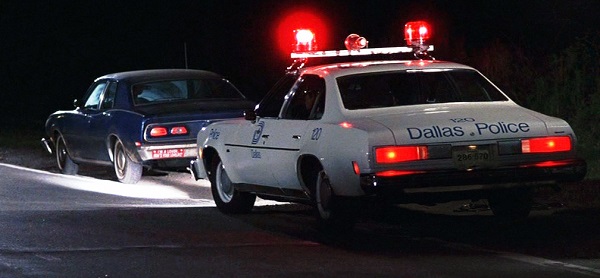
film is famous for introducing reenactments to the documentary. It’s
notable how sparingly Morris uses them. For the most part, the only
reenactment is the murder scene, constantly repeated as the story is
retold by another participant or witness. The scene itself is shot in a
fragmented style. Morris’ direction is hyper-real. Throughout, the film
never spoon-feeds the spectator. No interview subject is ever identified
on-screen by name; while it’s easy to figure out who Adams and Harris
are, the minor figures in the case are cited only in the closing
credits. The true crime dramas that it influenced do their best to
imitate narrative fiction, offering relatively seamless dramatizations.
The film still uses interviews to make most of its points. Morris also
returns to a handful of motifs: someone stubbing out a cigarette in a
full ashtray, a close-up of a clock on a wall.
According to John Pierson’s book Spike, Mike, Slackers and Dykes, no less a director than Spike Lee cited The Thin Blue Line
as the only concrete example of a film that caused social change. Here,
Morris proves himself to be a careful, patient storyteller. He was
never a lawyer, but he thinks like one. He lays out the facts of Adams’
case and allows Harris to figuratively hang himself. He also presents
Adams as a likable character—Adams comes off as a film noir hero, in
fact. If Morris flirts with elements of fiction here, he does so with
great care. The Thin Blue Line spoke truth to power loudly enough
to get a man released from jail. It’s too bad that Morris’ subsequent
encounters with Robert McNamara and Donald Rumsfeld are far meeker
engagements. Taking on the criminal justice system, Morris proved more
than up to the task; faced with the questionable judgments of
politicians, Morris let them drone on without challenging them too
often.
Steven Erickson is a writer and
filmmaker based in New York. He has published in newspapers and websites
across America, including The Village Voice, Gay City News, The Atlantic, Salon, indieWIRE, The Nashville Scene, Studio Daily and many others. His most recent film is the 2009 short Squawk.


 Press Play Video Blog