
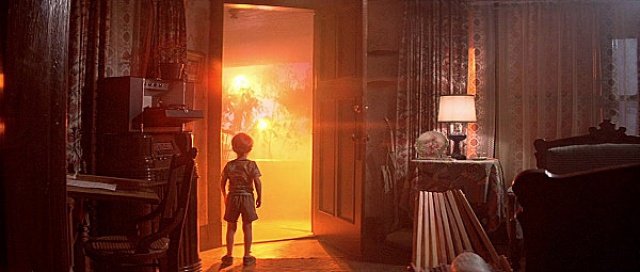
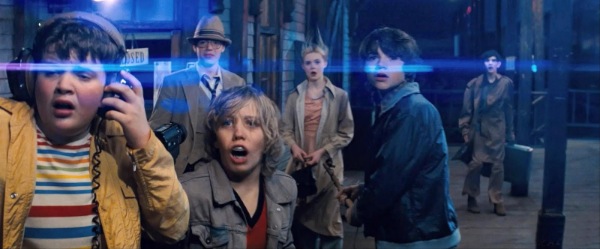
As I watched this briskly edited video essay by Waterclock about aliens in movies from Alien to Close Encounters of the Third Kind to E.T. to Super Eight, I found myself, oddly enough, drawn back to a memory from my childhood that had very little to do with outer space, but every bit to do with unfamiliar visitors. I grew up in an area of Dallas called the Park Cities, so named for the ample greenery, lush landscaping, and manicured lawns to be seen everywhere. It was an affluent neighborhood, and an implicitly guarded one; as I grew older and smarter, I grew increasingly frustrated and disgusted with the fact that anyone who wasn’t white or, for that matter, wasn’t driving a fairly expensive car was under suspicion in the area. In any event, when I was young, a group of gypsies moved into my neighborhood. No one knew where they came from. No one knew much about them, period, except that they were supposed to be "dangerous." The primary evidence of their dangerousness was their blunt behavior in grocery stores; an anecdote about "one of those gypsies" throwing a loaf of bread across the Safeway Market down the street from me because he "didn’t like the price" made the rounds repeatedly. I read a lot at that time, and my main curiosity about the gypsies was whether they had a covered wagon with them, and whether they played gyspy music on elaborately painted violins. This didn’t seem to be the case. The only palpable detail I gleaned about them, having never seen one of them, was that they wore jogging suits, the idea being that they’d stolen them, for how would traveling gypsies obtain jogging suits otherwise? According to popular wisdom, "they just took things." They were "greedy." I was told, in school, to watch out for them, to stay out of alleys, because they apparently loved alleys–and if I saw anyone in a jogging suit who looked, well, "different," to be on my guard. Apparently, the gypsies "traveled in groups": another criterion. The Park Cities had a local newspaper that conveyed to local residents the news of their biosphere, and the gypsies were definitely a hot item–the small organ probably expended more ink on the gypsies than it did on any other subject in its history. Though the gypsy furor died down, as well one might suspect, and without a ringing certainty as to whether the gypsies were, in fact, members of the Roma people, it taught me a valuable lesson about the American character. Americans are full of fear: fear of invasion, fear of theft, fear of difference, fear of instability, fear of death, of sickness, and, most sadly, of showing vulnerability. Americans flock to watch films about aliens, and, in particular alien invasions, because these films touch a crucial American nerve: what if our safety were threatened by forces we didn’t understand? Or, put another way, what if these forces simply showed up one day, and we had no idea what to do other than eliminate them? Or, put more accurately, what do we do about those who are different from us? Sadly, acceptance is not a part of the American sensibility, despite what certain parts of the Constitution might have us believe. Correspondingly, the alien narratives presented to Americans are always ones of destruction, of terror, of invasion, of a foreign menace moving in that must be stopped. This video piece brings home the excitement inherent in this narrative, the quickening of the blood that takes place when we believe we have something to defend, and it does so with great skill. In so doing, though, it points up the scary side of our country’s fascination with these creatures, and it makes viewers like me wonder what that fascination might mean–and, beyond that, if we might ever grow past the fears that make these films so successful.
Watch: A Video Essay about Aliens in Movies: Scary, Wondrous, Awful, Magnificent
Watch: A Video Essay about Aliens in Movies: Scary, Wondrous, Awful, Magnificent
 Press Play Video Blog