GREY MATTERS: Chaos Is Here To Stay

GREY MATTERS: Chaos Is Here To Stay

nullWhen a movie turns into the biggest film that isn’t a sequel or a remake in Earth’s history, you can bet that Hollywood is going to do everything short of ritual sacrifice to figure out what made that film such a billion dollar baby.  That movie, of course, is Gary Ross’ The Hunger Games, and the most easily utilized element of that film that can be transferred to other films hoping to cash in on the nonlinear zeitgeist is something not much loved around here—chaos cinema.

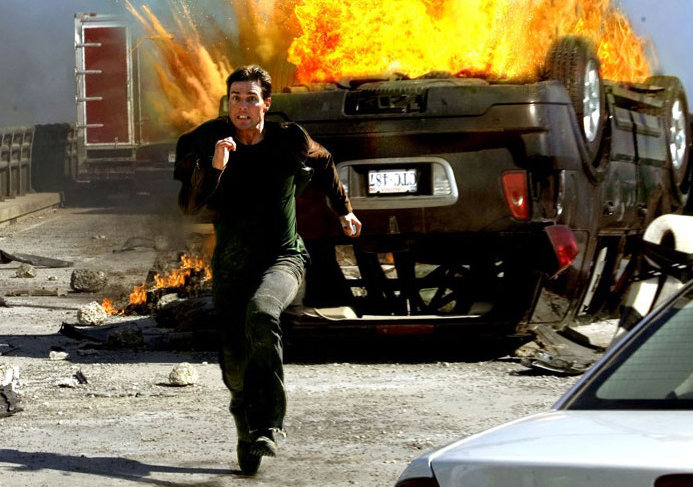
Chaos cinema: Yes, that pell-mell movie-making style of un-motivated shakycam and matching frenetic cutting style, both of which leave us confused as to where a character might be in a scene at any given time.

Chaos cinema: where the director starts a scene with a Dutch angle of a character running (a low, oblique shot like they’d use in a Batman cartoon), then cuts suddenly to her feet, and then a long shot in reverse from a helicopter, leaving the audience utterly baffled as to who’s where, or when, or how.

Ah, but making linear sense isn’t the goal. Visceral excitement is what’s on the menu, with a side dish of faux documentary-style verité.

And some folks here at Press Play really dislike it. Film writer Matthias Stork went so far as to craft a video essay titled “CHAOS CINEMA: The decline and fall of action filmmaking.”

Stork looks back fondly on how, until the early 21st century, classical style was the default.  Camera movement and editing were motivated, and things happened in the frame for a reason.

But over the last decade or so, all that started going to hell. Films were speeding up, being packed with event, and thanks to nonlinear editing systems like AVID, being cut into often crazed new shapes that made less and less sense. Sensory overload, stylistic excess, and exaggeration became the coin of a realm Stork named “chaos cinema”.

Looking back, it looks like Mr. Stork has a point. It really did seem that if a movie wasn’t one of those spiritually rotted films reflective of the Cheney years’ new bellicosity, it was one of those cutting edge techno-nihilism actioners, and both were total chaos.

Cases in point: stinkers like Black Hawk Down (2001), Domino (2005), The Kingdom (2007), Man on Fire (2004), Michael Bay's filmography, and Quantum of Solace (2008). One particularly offensive scene in The Dark Knight was brilliantly deconstructed by Jim Emerson here.

We see how Nolan seems to have either lost interest, or never had it, in where cars and trucks are coming from, what direction they seem to be going when he cuts, what happens after that happens, and so on. This may seem like nerdy minutiae unless you think of it this way—if this were real life, and a car hit you, and your body was thrown a few feet, and you closed your eyes, but when you opened them, you found you were on the other side of the road, well, that would freak you a bit. Same thing in movies.

So yes, these particular “chaos films” were dreadful grotesques. But what was I to make of–

Moulin Rouge! (2001), a rapturously gorgeous film that felt chopped together, at 120 BPM?  Or 2004’s hyper-jacked The Transporter? Or 2007’s [rec], which combined chopped-up, personal DV and horror? Or The Hurt Locker  (2008), the first chaos Oscar winner? Or Friday Night Lights (2006-2011) the first great show to import chaos values to serialized TV, and The River (2012) the first to do so to network horror?

To me, Rouge! Is a traditional musical, except with twice as many shots run at the speed of a trance remix. The Transporter is a Euro-trash version of a John Woo cartoon. And Friday Night Lights with graceful camera? Nope. Boring. We’d never be able to slink into those sizzling Texas mini-worlds on network time. And I’ve not yet mentioned Paul W.S. Anderson’s jaw-dropper of a surprise, Resident Evil: Afterlife, one of the greatest uses of multi-level geometry and spatiality in cinema I can recall seeing, where oneattack scene features twenty or so color-coded Milla Jovoviches attacking hundreds of color-coded bad guys, and it’s not even a high point.

Chaos, I think, has been evolving. And now there’s The Hunger Games, whose “high chaos” style will have an incalculably huge effect on action, drama, indie and hell, on all kinds of films, that just pulled in about $140 million its first weekend. In that film, Katniss' neo-Depression small town life of privation, hunting and solitude, her total love for her sister, and the ambient danger of a totalitarian government are all conveyed in quick, but soft-cut nonlinear hyper-montage that would take classical storytelling a quarter hour to express but here zips by in dreamy minutes. You've never seen a cinema future like this.

So: drop it. The argument is lost and over. Chaos is here to stay as a permanent part of televisual syntax. All that’s left is how we incorporate that reality into our critical discourses.

The exciting thing isn’t chaos cinema on its own—that can be as rote, knee-jerk and annoying to me as anything else.

It’s the incredibly exciting promise of what it will lead to that’s exciting, while classicism always just points back to more of itself. 

“Truths” are death and taxes. Everything else is changing and subjective. Everyone said ET was full of “universal” truths, when all I found was the truth that my heartstrings had been mauled and mangled by a sociopathic optimist. And recently I showed Psycho to a  friend—not a cineaste, a pro journalist, age 27—only to have her fall asleep. She felt terrible for just not getting it. Remembering my unseemly lack of ET resonance, I said not to worry. Universal, shmuniversal.

Meanwhile, this is a generation that’s been raised viewing entertainment on all manner of screens, some tiny, some tablet, in theaters, at home, everywhere. And a lot of the time, the image is literally shaky because it’s on your leg, in your hand, or wherever.

So televisual entertainment—movies, webcasts, networks, the whole shebang–wants to fit into our natural ecosystem by being a little wobbly itself—even Parks and Recreation and The Office are a bit shaky. So shakycam now signifies a base level of realism. The imperious side of chaos, then, is trapping artists in a small range of high velocities. This could be bad or…

I’m staying with my story—that Ross, who may not be a Great Filmmaker but is one helluva craftsman, trusted his instincts regarding how his market would best be served with the most valuable property on the planet. And he chose chaos. And, like that, chaos cinema became the mainstream.

VIDEO ESSAY: CHAOS CINEMA, PART 3; Matthias Stork addresses his critics

VIDEO ESSAY: Chaos Cinema, Part 3, Matthias Stork responds

Editor’s Note: Press Play is proud to debut part three in Matthias Stork’s Chaos Cinema, the latest installment in an ongoing consideration of a phenomenon that Stork defined in two video essays that ran on this site in August, 2011. His first two chapters touched off a firestorm of debate that’s still going on.  Just last weekend, New York Times contributor Alex Pappadeas cited the piece in a year-end “Riffs” column. Citing bizarre images in "the trailer for 2016, a possibly nonexistent sci-fi movie from Ghana," Pappadeas argued that the major problem with the style is that it does not go far enough. "The standard knock on Chaos Cinema filmmakers is that they’re constructing narratives entirely from rupture and collision," he writes. "But if movies are going to go there, they should really go there. Let’s stop asking directors who clearly have no affinity for story or character to pretend otherwise. Instead, let’s let the alien kick the baby, and see how far the baby will fly." That’s what Stork is doing here by addressing his critics directly using the form that has served him well in the past, the video essay. The full text of the piece’s narration is printed below. For context, we’ve also reproduced Parts 1 and 2 of Chaos Cinema as well. The comments section is open. You may fire when ready.

Chaos Cinema, Part 3

Parts 1 and 2 of my video essay Chaos Cinema argued that chaos cinema represents a major trend in mainstream action filmmaking. It could be seen as the third stage in mainstream movie storytelling.

The first stage was classical cinema. It reigned supreme from the silent era until well into the 1960s. It emphasized spatial clarity, for the most part. The goal was to keep the viewer oriented and involved. You were always supposed to know more or less where you were, where the action took place, and who was involved. And this visual clarity was only disrupted at moments of high tension.

Then came intensified continuity. It favors velocity and increases the speed of classical cinema. It still keeps the viewer oriented, but it does so in a more compact form – almost shorthand. The shots are more succinct, the cutting more aggressive, the camerawork more hectic. This is the old style, reconfigured in a new time.

The third and modern stage is chaos cinema. It makes the previous two stages look old-fashioned. The goal is total visceral impact. There is no clear axis of action that tells you where characters and objects are in relation to each other. The action does not have to be comprehensible. It has to be overwhelming. This is not the action that we have come to know in the cinema; it is the general idea of action. Chaos cinema is a vehicle for spectacle, a roller-coaster ride. It is designed to showcase attractions.

The three stages are by no means mutually exclusive. They are all interrelated and define what we see as the action film.

My video essay on chaos cinema led to an interesting discussion on the Internet. Many viewers agreed with my position. Others took issue with the argument and sought to refute or dismantle it.  They posited chaos cinema as a legitimate action style, with its own purposes and goals, and criticized the videos on several grounds.

The points raised were generally instructive. And some deserve a response.

1. Chaos Cinema as Pop Art – Ian Grey, Press Play

Several commenters dismissed my point of view as romantic, misguided. They argued that chaos cinema offers filmmakers a new style for a new age.

In his engaging essay "The Art of Chaos Cinema", Press Play columnist Ian Grey defines the chaos cinema style as “pop art”, with a film syntax that better suits the trashy taste of the PlayStation-trained, YouTube-raised digital generation. He writes: "[C]lassical cinema doesn’t match the experience of a generation of Facebookers, Tweeters and Call of Duty players. It just doesn’t." In his view, chaos cinema presents the world as it is: hyper-mediated, flamboyant and excessive. And classical action cinema is simply obsolete.

Chaos cinema is undoubtedly newer, perhaps even more modern. But I do not see it as an accurate reflection of the 21st century online / gaming experience. It is at best an interpretation. Using the Internet is not the same as watching chaos cinema fireworks onscreen.

Grey also stresses chaos cinema’s potential to engage audiences, keep them awake in the soporific dream machinery of the movie theater. We agree on this one, although I do not necessarily consider it to be a virtue.

null

2. Chaos Cinema as Abstract Art – Scott Nye, The Rail of Tomorrow

Scott Nye eloquently defended chaos cinema on the grounds of abstract art in his very emotional and convincing response. He compares the later work of director Tony Scott to abstract painting, claiming that they share certain aesthetic and ideological similarities. About Scott’s Domino, Nye writes, "I see a full-on sensory assault dedicated to visual abstraction and the destruction of our notions of what cinema should be."

I admit that Tony Scott’s chaos style is intriguing, especially the texture of his images. He paints with the camera in a playful, experimental manner. Or, more accurately, he splatters. Nye’s argument is thus sound in general terms.

But it ignores one thing: the genre context.

And that’s a problem with his comparison. Action filmmaking, even highly stylized action filmmaking, is really not abstract; it is literal. Its goal is to tell a mini-narrative, to record things that happen in a story for an audience that absorbs and processes the action. It is, at its basest level, a record of bodies, or objects, moving from point A to point B. Chasing. Leaping. Clashing. The action scene is <strong>a record of something concrete</strong>. Therefore,
legibility should matter. Precision should matter. Grace should matter.

Abstract artists such as Jackson Pollock or the filmmaker Stan Brakhage produced art with very different aims.  Their work only has an implied narrative, no characters, no motivations, and no tangible goals beyond what the individual viewer decides to bring to the work.

And here is another important point: artists such as these exclusively work in a hermetically sealed environment: the avant-garde. They have different audiences, reception spheres and ambitions.

This is not to say that the abstract has no place in the world of narrative. But when we discuss action, should we not agree on a specific framework? Is it abstract art? Not even the great Sergei Eisenstein could produce this association. And in any event, I suspect it will be a few years before <i>Domino</i> is displayed in the Louvre.

3. Chaos Cinema as Romanticism / Nostalgia – Matt Lynch, AKA Colonel Mortimer

nullThe video essay was also dismissed as anachronistic hipster nostalgia which favors the old over the new. Film critic Matt Lynch summed up the general dissent in a rather ingenious, if reductive tweet which labeled the video essay an example of "neoclassical get-off-my-lawnism". Frankly, it is hard to rebut this accusation. I admit a certain bias towards the old.But I am by no means opposed to the new … if it acknowledges the old, and demonstrates an understanding of it, a sense of its value. There have been a number of recent films fitting that description. And I enjoyed them very much.

4. Chaos Cinema as Myopic Discourse

My seemingly wholesale condemnation of chaos cinema in parts 1 and 2 of my video essay infuriated several commenters — and in retrospect, I have to admit, rightfully so.

I did point out that chaos can be effectively used as a narrative device. But my example of The Hurt Locker did not suffice. I should have included others. And I should have made clear that not all films cited as chaos cinema were bad movies that were somehow not worth seeing or discussing. In some cases, I chose particular clips because I think the films are below average. In other cases, I selected clips only because they illustrated a certain point that I wished to make about the look and feel of chaos cinema. In other words, if anyone felt insulted or offended by seeing a certain clip in there, my apologies.

null

5. Chaos Cinema as Video Game Aesthetic – Matthew Cheney, The Mumpsimus

Probably the most frequent issue raised in the chaos cinema discourse was the influence of video game aesthetics on action film style. Many weighed in claiming that chaos cinema is heavily informed by the hyperkineticism of first-person shooters. Matthew Cheney’s observations are a case in point. In an article on his blog The Mumpsimus, he writes: "I find the popular ones really disorienting and many of them bludgeoning. My perceptions haven't been trained to the action video game aesthetic, and it's all just chaos to me."

Action films and first-person shooters share certain narrative parallels. They are essentially navigations through space. As far as aesthetics are concerned, however, they could not be more different. Yes, shooters emphasize speed in all its glory, with pans, tilts and track-ins. But they transpire in a clearly defined diegetic space. There are no cuts, no disruptions, mise-en-scène rather than montage, complete stability. This is not chaos cinema. This is something else, something that cinema aspires to reproduce, by different means.

6. Chaos Cinema: Beyond the Surface – Ambrose Heron, FilmDetail

As many commenters pointed out, chaos cinema did not just magically appear in the new millennium. It was a steady process, a development. Critics such as David Bordwell, Barry Salt or Geoff King have been writing about the stylistic changes for a long time.  In his essay Chaos Cinema and the Rise of the Avid, blames non-linear editing systems for the emergence of chaos techniques. This is how we should discuss chaos cinema, as an aesthetic and industrial phenomenon.

In the end, however, we all approach action films with the same mindset. To quote Michael Bay: we demand our action to be …awesome!

Matthias Stork is a film scholar and filmmaker from Germany who is studying film and television at UCLA. He has an M.A. in Education with an emphasis on American and French literature and film from Goethe University, Frankfurt. He has attended the Cannes film festival twice (2010/2011) as a representative of Goethe University's film school. You can read his blog here.

Matthias Stork: Chaos Cinema/Classical Cinema part 1

Cinematographer John Bailey interviews Matthias Stork

null

Matthias Stork is more likely to be found hunched over a research desk at the Academy’s Margaret Herrick Library than in the darker recesses of a multiplex cinema playing the latest Hollywood visual effects laden action flick. He is, after all, a graduate student in the Department of Film and Television at UCLA. He has an M.A. in Education from Goethe University, Frankfurt, in his native Germany. His current focus is on German expressionist films of the 1920s.

In the last decade of the silent era the Hollywood studios siphoned off many of the finest German filmmakers; the stream became a flood with the rise of National Socialism in 1933. It included director Fritz Lang and the great cinematographer Karl Freund, who had emigrated to the US in 1929. Several years earlier, German émigré F.W. Murnau’s first American film, Sunrise, was one of the high water marks of this great stream. But it is the lesser-known director, Paul Leni, who is the object of Stork’s current research. Leni had made the macabre Waxworks in 1924 Weimar Germany. In Hollywood, he directed only four films before an early death at age 44 in September of 1929. He seems a worthy figure for exegesis for a young German film scholar.

But here is the surprise. Stork’s real scholarly passion is the American action film, a genre that at first glance seems ill tailored for an academic suit. But one of the endearing qualities of German scholarship in science as well as in the arts is its ability to imprint an academic perspective on pop culture as easily as on philosophical ontology.

Stephen Pizzello and Martha Winterhalter emailed me the link to a two-part video essay they had found called “Chaos Cinema.” They suggested it would make a good blog essay. Its creator, Matthias Stork, was not someone whom I knew, nor (despite having his own blog) whom I was able to track down easily. Finally, William McDonald, Professor of Film, Television and Digital Media at UCLA, provided me with Stork’s email. The young scholar met me a few days later on a bench outside the Herrick Library. The juxtaposition of his precise, even scholarly, English—as he spoke about the tropes of “action cinema” with its signature cataclysmic car chases and violent shootouts with exploding body parts—and the spatial and psychic dislocation of the films themselves, was intriguing. Even better, it turns out we both share an abiding love of the seminal films of the French New Wave.

You can read the rest of John Bailey's interview with Matthias Stork here at The American Society of Cinematographers website. 

Matthias Stork is a Press Play contributor and film scholar-critic from Germany who continues to pursue an academic career at UCLA where he studies film and television. He has an MA in Education with emphasis on American and French literature and film from Goethe University, Frankfurt. He has attended The Cannes film festival twice (2010/2011) as a representitive of Goethe University's film school and you can read his blog here.

VIDEO ESSAY: CHAOS CINEMA: The decline and fall of action filmmaking

VIDEO ESSAY: CHAOS CINEMA: The decline and fall of action filmmaking


Part 1


Part 2


EDITOR’S NOTE
: Press Play is proud to premiere a new video essay by Los Angeles scholar and filmmaker Matthias Stork. His video essay,
Chaos Cinema, should be a welcome sight to anyone who’s ever turned away from a movie because of a director’s shaky camera.

PART 1

During the first decade of the 21st century, film style changed profoundly. Throughout the initial century of moviemaking, the default style of commercial cinema was classical; it was meticulous and patient. At least in theory, every composition and camera move had a meaning, a purpose. Movies did not cut without good reason, as it was considered sloppy, even amateurish. Mainstream films once prided themselves on keeping you the viewer well-oriented because they wanted to make sure you always knew where you were and what was happening.

Action was always intelligible, no matter how frenetic the scenario. A prime example: John Woo’s classic Hong Kong action film Hard Boiled. Its action is wild and extravagant, but it is nevertheless coherent and comprehensible at all times. Viewers feel and experience the exaggerated shootout fantasy without ever losing their bearings. In terms of camerawork, editing and staging, precision is key. Woo’s film is in fact strongly influenced by the work of American directors such as Sam Peckinpah and Martin Scorsese. A similarly great American action film is John McTiernan’s Die Hard. Notice the economy of cuts and camera moves in the scene where hero John McClane fights the bad guy’s chief henchman, Karl. The fight itself is frantic yet clearly understandable, both riveting and stabilizing — the M.O. of classical cinema.

But in the past decade, that bit of received wisdom went right out the window. Commercial films became faster. Overstuffed. Hyperactive.

Rapid editing, close framings, bipolar lens lengths and promiscuous camera movement now define commercial filmmaking. Film scholar David Bordwell gave this type of filmmaking a name: intensified continuity. But Bordwell’s phrase may not go far enough. In many post-millennial releases, we’re not just seeing an intensification of classical technique, but a perversion. Contemporary blockbusters, particularly action movies, trade visual intelligibility for sensory overload, and the result is a film style marked by excess, exaggeration and overindulgence: chaos cinema.

Chaos cinema apes the illiteracy of the modern movie trailer. It consists of a barrage of high-voltage scenes. Every single frame runs on adrenaline. Every shot feels like the hysterical climax of a scene which an earlier movie might have spent several minutes building toward. Chaos cinema is a never-ending crescendo of flair and spectacle. It’s a shotgun aesthetic, firing a wide swath of sensationalistic technique that tears the old classical filmmaking style to bits. Directors who work in this mode aren’t interested in spatial clarity. It doesn’t matter where you are, and it barely matters if you know what’s happening onscreen. The new action films are fast, florid, volatile audiovisual war zones.

Even attentive spectators may have trouble finding their bearings in a film like this. Trying to orient yourself in the work of chaos cinema is like trying to find your way out of a maze, only to discover that your map has been replaced by a reproduction of a Jackson Pollock painting, except the only art here is the art of confusion.

Consider Michael Bay’s Bad Boys 2, an explosive mixture of out-of-control editing, intrusive snatch-and-grab shots and a hyperactive camera. Bay’s cacophony stifles the viewer’s ability to really process the film’s CGI-assisted skirmishes. The action is cool to look at, but it’s hard to discern in detail, and there’s no elegance to it. The shots are often wobbly. Sometimes this is due to the use of deliberately shaky handheld cameras. Other times, the filmmakers have made relatively stable shots seem much wilder and blurrier in post-production through the use of AfterEffects software. (This is not film grammar, it is film dyslexia.)

Considering all the deliberate insanity occurring onscreen, these movies should be totally unintelligible. Yet we still have a faint sense of what’s going on.

Why?

Because of the soundtrack.

Chaos films may not offer concrete visual information, but they insist that we hear what is happening onscreen. Ironically, as the visuals in action films have become sloppier, shallower and blurrier, the sound design has become more creative, dense and exact. This is what happens when you lose your eyesight: your other senses try to compensate. Consider how relentless machine-gun fire, roaring engines and bursting metal dominate the opening of Marc Forster’s James Bond entry, Quantum of Solace. The scene’s dense sound effects track fills in the gaps left by its vague and hyperactive visuals.

But the image-sound relationship is still off-kilter. What we hear is definitely a car chase — period.

But what we see is a “car chase.”

French auteur Robert Bresson rightfully stressed the importance of sound in the formation of atmospheric depth in movies. He even argued for its primacy, saying that in some ways sound might be even more important than picture. But in lavishly funded action films that wish to create an immersive experience, sound and image should be complementary, and they should be communicative. In Quantum of Solace and in other works of chaos cinema – image and sound ultimately do not enter into a dialogue, they just try to out-shout each other.

In contrast to Bay’s and Forster’s haphazard execution of action, consider the meticulously staged and photographed car chase in Ronin. In contemporary action cinema, such a sequence is, unfortunately, hard to find.

PART 2

Chaos cinema technique is not limited to action sequences. We see it used in dialogue sequences as well. We hear important plot information being communicated, but the camerawork and cutting deny us other pleasures, such as seeing a subtle change in facial expression or a revealing bit of body language.

This deficiency is especially discernible in the musical film, a genre that ordinarily relies heavily on clear-cut choreography and expressive gestures. But the woozy camera and A.D.D. editing pattern of contemporary releases clearly destroy any sense of spatial integrity. No matter how closely we look, the onscreen space remains a chaotic mess. For comparison, consider a scene from the classic Singin’ in the Rain. Long, uninterrupted takes allow us to see the extraordinary performances of the actors. No false manipulation necessary.

To be fair, the techniques of chaos cinema can be used intelligently and with a sense of purpose. Case in point: Kathryn Bigelow‘s The Hurt Locker. The film uses chaotic style pointedly and sparingly, to suggest the hyper-intensity of the characters’ combat experience and the professional warrior’s live-wire awareness of the lethal world that surrounds him. Bigelow immerses viewers in the protagonists’ perspectives, yet equally grants them a detached point of view. The film achieves a perfect harmony of story, action and viewer involvement.

But such exceptions do not disprove the rule. Most chaos cinema is indeed lazy, inexact and largely devoid of beauty or judgment. It’s an aesthetic configuration that refuses to engage viewers mentally and emotionally, instead aspiring to overwhelm, to overpower, to hypnotize viewers and plunge them into a passive state. The film does not seduce you into suspending disbelief. It bludgeons you until you give up.

Some film buffs have already grown tired of chaos cinema – especially the so-called “shaky cam,” which has been ridiculed even by South Park. Despite stirrings of viewer discontent, however, chaos is still the default filmmaking mode for certain kinds of entertainment, and it’s an easy way for Hollywood movies to denote hysteria, panic and disorder.

Chaos cinema seems to mark a return to the medium’s primitive origins, highlighting film’s potential for novelty and sheer spectacle – the allure of such formative early works as The Great Train Robbery. You can trace the roots of chaos cinema to several possible factors: the influence of music video aesthetics, the commercial success of TV, increasingly short viewer attention spans, the limitless possibilities of CGI, and a growing belief in more rather than less. Those who look closer, though, may wonder when cinema will recapture the early visceral appeal of the train pulling into the station at La Ciotat — truly a symbolic relic, powerful in its simplicity. Chaos cinema hijacks the Lumière brothers‘ iconic train, fills it with dynamite, sets the entire vehicle on fire and blows it up while crashing it through the screen and into the rumbling movie theater – then replays it over and over. And audiences are front and center, nailed to their seats, sensing the action but not truly experiencing it. All is chaos.

Matthias Stork is a film scholar and filmmaker from Germany who is studying film and television at UCLA. He has an M.A. in Education with an emphasis on American and French literature and film from Goethe University, Frankfurt. He has attended the Cannes film festival twice (2010/2011) as a representative of Goethe University’s film school. You can read his blog here.