
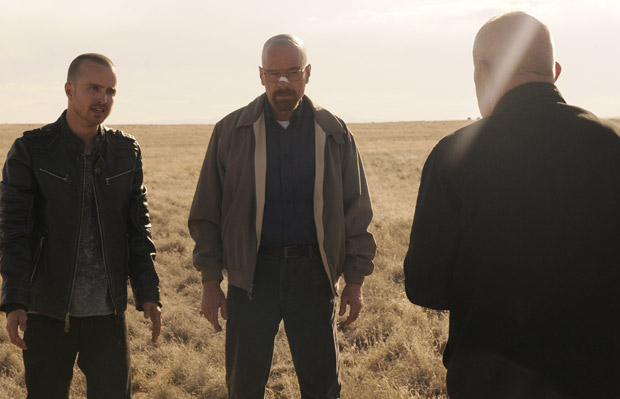
In the months since Breaking Bad's explosive season 4 finale, and Walt's certainly premature declaration of victory, we've had a long time to ponder what exactly he meant by saying, "I won." Sure, he had won the most obvious victory in outsmarting Gus Fring, who, at least with Mike as his right hand, had mostly been able to stay a few steps ahead of the erratic and unpredictable Heisenberg (well, except for the whole Gale thing). But really, what Walt thinks he has won is his own freedom: freedom from the inconveniences that having a boss like Gus Fring brought; freedom to do things his own way; freedom to be the Southwest's real meth kingpin. We've been passing through the looking glass of Walt's need to cook meth to support his family after his presupposed demise from cancer for a few seasons now; it's obvious this guy has found something he's not only good at, but truly enjoys, except for (or more likely because of) all of the inevitable drama, chaos, and destruction he leaves in his wake as a result. And all of this havoc is completely worth it to him as long as he finally gets to be "the man" at something.
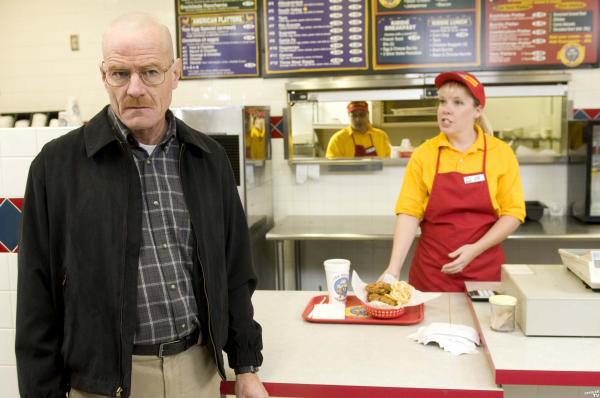
 But in the drug game, being "the man" is like having a target on your back, and Walt will realize soon enough that his problems have most likely been more augmented by Fring's murder than solved by it. In fact, below, in a callback to Season Two's predictive pre-credit scenes, we see a Walt with a full head of hair distractedly chit-chatting with a Denny's waitress, while nervously checking over his shoulder every few seconds. Breaking Bad’s signature sense of dread is almost overbearing (just watching the scene made me feel like I was about to have a panic attack), and as soon as we see that Walt is actually there to meet Lawson (his black market dealer for all things sidearm-related, played perfectly with cautious resignation ["Good luck, I guess."] by Deadwood's Jim Beaver), we know things can't be going as swimmingly as Walt thought they would when he said, "I won." When Walt uncovers the M60 machine gun Lawson has dropped off for him, it's obvious that something has gone severely pear-shaped.
There could be a few causes of such nastiness, knowing what we know now. Perhaps Hank has finally uncovered his brother-in-law's secret life as Heisenberg, and Walt is preparing for an all-out battle with the DEA. Perhaps the German conglomerate that was funding Fring's operation through the back door is more than a little annoyed that Gus has died, and has come to collect on their lost revenues. There is really no way to predict what Walt will have to defend himself against in the future, given writer Vince Gilligan's propensity for throwing viewers for a loop with left field plot twists. But, whatever has Walt packing such heavy heat is definitely formidable, and watching Walt dig himself deeper into whatever hole he's in will no doubt be equal parts terrifying, hilarious, and beautiful.
For now, Walt is on top of the world. The drug trade in town has been decentralized, and is just waiting for someone to step into power ("There is gold in the streets, just waiting for someone to come and scoop it up.") His cancer's been in remission for some time, Gus can't kill him, and as much as Mike might want to put a bullet squarely between Mr. White's eyes, he can't until one last issue remaining from Fring's empire (the laptop containing all of the super lab video surveillance) is taken care of. In dealing with the issue, Walt buys himself enough time for Mike to consider joining Walt and Jesse in their proposed partnership. Mike clearly wants nothing to do with Walt; he hasn't ever, really. But the way he sees it, if he doesn't help clear up the hard drive issue, he's equally as "boned" as Jesse and Walt; naturally, in taking part, he inadvertently will be screwing himself somehow. Mike even tries to tell Jesse to take the money he's made and "skip town, today," knowing full well this White guy is rotten. But Mike's already in too deep, and it is not going to end well for him, especially if Gus's broken picture frame has anything to do with it, and I'm sure it will.
Walt's proclivity for self-destruction is exemplified perfectly in the electromagnet scene (posted below), when he (of course) decides to crank the amperage to maximize the likelihood that the hard drive will get wiped, making the box truck topple into the evidence building and putting Jesse and himself directly in danger. Of course, with Mike around, they're able to get away unscathed (for now), and Walt's new level of hubris makes itself painfully apparent when Mike asks how they can be sure the plan worked: "Because I say so." This isn't Walt saying something like this to pump himself up and convince himself it's true (a la "I am the one who knocks."); Cranston's delivery is almost flippant, making it clear that when Walter White is truly comfortable with the level of power he now has, he doesn't need gravelly-voiced machismo to sell it. He seems amused, which is far more terrifying than he ever was before Gus's death. Walt doesn't have to fake it 'til he makes it: he has arrived.
And of course, there's Ted Beneke to consider. I suppose I should have known that without seeing a body in a coffin that then closes and goes into the ground in one shot, there's no guarantee of a character's death on any television show, but I was quite sure that Ted had gone the way of Lindus from Terriers. It seems as though I was incorrect, and Gilligan and Co. aren't quite done with Ted. I'm certainly curious about this decision; perhaps Beneke, despite claiming that he's going to keep his mouth shut, could be the guy to unravel Walt's meth business, intentionally or not, directly or not. It's more likely that Walt, now knowing what he does about the situation, is going to give Ted the dirt nap I suspected he was taking all along, and in doing so yet again leaving more problems to be solved.
Finally, Anna Gunn's portrayal of Skyler has made a subtle but significant shift. We have grown accustomed to seeing Skyler act by turns distant, skeptical, spiteful and angry with Walt, at times unrelentingly (and perhaps cruelly) so. But Walt's new freedom seems to have come at the cost of Skyler's. In Gunn’s spot-on portrayal, Skyler now acts like an abused animal, trapped in a cage partially of her own making, with no escape possible. She slinks around, defeated, and speaks to Walt only when spoken to. Her knowledge of Walt's hand in Gus's death has shaken her to her core, but not as much as the knowledge that she essentially drove Walt to it by giving all of their potential escape money to Ted. Skyler hasn't always been the most sympathetic character, and her involvement with Beneke's cooked books has essentially brought the White family back to square one, financially. But now it seems she has broken under the combination of her psychic guilt at her own complicity and her fear of the husband she thought she knew until recently. Gunn’s performance stands out painfully against Cranston's portrayal of Walt’s overconfidence and obliviousness to Skyler's fragile mental state. In the scene below, Walt tells Skyler he forgives her for the Ted situation, replaying a familiar trope: Walt needs to use Skyler as an emotional punching bag, because if he has nobody to demonize, he's forced to look inward and come to grips with the monster he's created in himself. The hug at the end is so unnatural, I could barely watch. Barely.
Dave Bunting is the co-owner (with his sister and fellow Press Play contributor, Sarah D. Bunting) of King Killer Studios, a popular music rehearsal and performance space in Gowanus, Brooklyn. He plays guitar and sings in his band, The Stink, and dabbles in photography, video editing, french press coffee, and real estate. Dave lives in Brooklyn with his wife, son, and sister.
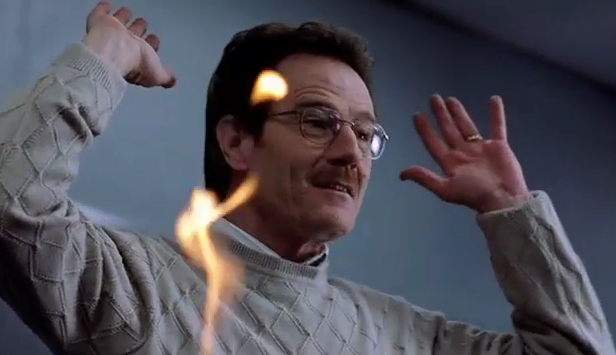
 Something happened when they were young that was crucial to the development of their characters as men. They were about 10 years old, and playing in the yard, as their uncle looked on, talking on a giant phone the size of a computer modem. Their uncle was a bigwig in the family drug cartel, a behemoth with many tentacles, reaching into the United States. He was running his business from a lawn chair, as the boys played and taunted one another. To the boys, their lives were normal, of course. They didn't know that their lives were any different than anyone else's. One boy takes the other's G.I. Joe doll and holds it just out of reach, taunting his brother until his brother breaks into tears, shouting, "I wish you were dead!" This innocent comment gets the uncle's attention. He calls both boys over, taking in the situation wordlessly and then asks the boy who had taunted his brother to get him a beer out of the bucket of melting ice beside his chair. The little boy reaches in, grabs a beer and holds it out but the uncle rejects it, telling him to get him one that is really cold. Leaning over the bucket, reaching in deeper, the little boy is caught unaware when the uncle swiftly pushes his head beneath the water. A struggle ensues. The uncle remains imperturbable, and asks the boy standing in front of him, "This is what you wanted, right?" The panic of the boy being held under the water intensifies, and his brother, desperate, starts hitting his uncle ferociously. Just before the submerged boy would have drowned, the uncle lets him go, and the boys huddle together by the bucket. The uncle stares down at the boys and says, "Family is all."
 As teenagers, they began working for the family business. While their uncle was a negotiator, the twins were the muscle. They killed enemies of the family with a breathtaking swiftness. They were perfectly suited, emotionally, for the job. They didn't experience an adrenaline rush like normal people in the face of danger. On the contrary, when faced with a dangerous situation, their blood pressure lowered. They were able to be very still. They had patience, they could wait. They had a deep coiled core of rage inside them, but their faces remained placid and flat. They liked to kill people with axes. Sure, you could shoot someone, but it wasn't as satisfying. They felt nothing as they chopped off the head of a man in the back room of a bar. He screamed, of course, but that didn't matter. They all scream.
 After their cousin Tuco is betrayed by some meth guy in Albuquerque named "Walter White", the twins know what they have to do. They move forward inexorably, getting closer and closer to their target. In a makeshift shrine devoted to death and their enemies, they place a sketch of "Walter White" beside a skull. Gleaming in their silver suits, they stare at the sketch, glance at one another, and then stare back. They have him in their sights, like a hungry lion spotting a lame antelope, and waiting, patiently, until the time is right to pounce.
 The meth supplier, realizing that he is in a world of trouble by saying "No" to the twins, sets up a private meeting with them in a vacant field outside of town. He acknowledges their family feeling and he acknowledges their need for revenge, but Walter White needs to stay alive. However, he must remind the twins that Walter White did not actually pull the trigger on the gun that killed their cousin. That job was done by White's brother-in-law, who was a DEA agent. One of the twins says, "We were told the DEA was off-limits." It is rare to hear either of them speak. The meth supplier assures them that this is his territory, and he calls the shots here. Go kill the DEA agent if that is what you need to do.
 Season 3 opens with a surreal scene of a group of people crawling in the dirt through a rustic Mexican village. It seems that some well-known ritual is taking place. Nobody seems too surprised at the sight. A gleaming car pulls up and two men get out. They are bald, handsome, and dressed in immaculate suits. They are also identical twins. Without hesitation, they join the ritual, lying down in the dirt, despite their silk suits, and crawling along with the others. The destination is a run-down shack which has been built into some kind of shrine. Inside there are lit candles with dripping wax and bouquets and skulls draped in beads. The men in suits pin a picture up on the wall. It is a sketch of the chemistry teacher. Wherever we are in this opening scene is far from the sun-blasted streets of Albuquerque (the stomping grounds of the chemistry teacher), but it is clear that his fearsome influence is spreading.
 This young man lives in isolation in a ratty room, spending most of his time playing violent video games, imagining his real-life enemies before him. He dates a pretty young woman, who takes him to a Georgia O'Keefe exhibit. He is singularly unimpressed, staring at one of O'Keefe's famous flower paintings and declaring, "That doesn't look like any vagina I ever saw." In the car afterwards, they talk about art, and repetition, and she tries to tell him what he is missing in his interpretaion of O'Keefe's work. In this scene he is almost fresh-faced. He kisses her gently. You really see how far this kid has fallen when you consider that in most other scenes he is either jacked up on meth, buying gas he can't pay for and then trading drugs with the cashier to pay for it, or beaten almost beyond recognition. There is a slow steady progression into hell with this character, and leaping around in time nails that point home.
 Seasons 3 and 4 also deal heavily with the chemistry aspect of meth production (which is a propos seeing as how the opening credits sequence features a periodic table), as well as the ins and outs of running a successful drug dealing business. A local Mexican restaurant in Albuquerque called Los Pollos Hermanos is a front, and freezer trucks filled with crystals hurtle across the desert, with armed men crouched in the back, their breath showing in the cold darkness. Often these trucks are stopped by rival drug-dealers. Multiple shoot-outs occur. We also see the creation of the meth itself, characters in white suits and gloves moving the gleaming blue crystals along, bagging them up. Later, we learn that this particular brand of meth is 99% pure, and industry-standard appears to be around 96%. Others wonder what the secret is, how this meth can be so pure, and how it is done. That 3% gap in quality serves to "up" other people's games.
 But the chemistry teacher has been living in two worlds for too long. As Season 4 progresses, that separation becomes harder and harder to maintain
 First we have gas mask man, who is a chemistry teacher, on medical leave due to his fight with cancer. It is clear that he is living a double life. His wife, Skyler, appears to have no idea that he is also a Drug Lord running a meth lab out of a battered RV. They visit the oncologist. The prognosis does not look good. He is very ill, balding and thin (although he has a full head of hair in the first scene with the getaway RV). The FBI calls a meeting of the school board to discuss the recent theft of chemistry equipment. The teacher gets a round of applause because he is so ill and yet has the commitment to show up at the meeting. Little do they all know that he was the one behind the ransacking of the chem lab in the first place. He spends the meeting distracted, silent, and putting his hand between his wife's legs under the table.
 We also see them back in the crashed RV in the desert, staring at the dead bodies in the back, one of which, horrifyingly, starts to move and moan. Flashing back, we see the two of them in a house, wearing gas masks, cleaning up after a brutal murder, body parts blown apart, flushing the meaty pieces down the toilet. They choke and gag at what they are doing. These two bodies are the missing Mexicans we've seen earlier, swimming across a muddy river.
 A meth lab has blown up in a nice suburban home with a swimming pool. A charred pink teddy bear, with one missing eyeball, floats in the pool, before being lifted out by a looming figure in a Hazmat suit. Evidence is bagged and lined up on the concrete. There are two body bags in the driveway. These are recurring dreamlike images, filmed entirely in black and white, except for the teddy bear, which blazes in pink against the monochromatic background. The bear is shown floating through the water, one side completely burnt from the explosion. This scene is shown repeatedly throughout the series and takes on an increasingly haunting aspect with each insistent repetition. The floating lone eyeball peers up through the water into the blazing light of day before being sucked into the bowels of the pool.
 Press Play Video Blog