Watch: Michael Stuhlbarg? Michael Stuhlbarg Is Calling!
MATT ZOLLER SEITZ: BOARDWALK EMPIRE season two finale
“To the Lost,” the second season finale of Boardwalk Empire, may be remembered as the moment when Boardwalk finally, finally hit its stride. This isn’t the first time the HBO drama has impressed me — even the worst episodes have had great scenes or moments — but there was something special about this one. It was dead solid perfect in almost every department. I think a lot of it comes back to the episode’s consistency of tone, and the show’s comfort with having settled on it.
I thought about tone during that haunting close-up of the soon-to-be-late James Darmody smoking a cigarette by an open window. There was really no reason why such a simple moment should have summoned such force. Michael Pitt wasn’t selling the moment at all. He was just sitting there smoking. Yet the accumulated weight of Jimmy’s trauma — his wife’s death and his tragic inability to feel his way through it thanks to his war experience, his Oedipally perverse childhood, and a life spent among super-macho gangsters — came through loud and clear. Pitt’s posture, gestures and slightly mask-like expressions were exactly right, just as his gentleness during the beachside pony-ride scene with Jimmy’s son was exactly right, and as his ego-free coolness during that rain-soaked final sequence was exactly right. I love how Pitt delivered Jimmy’s statement to Nucky about what to expect after your first killing: 48 hours of nausea. It reclaimed a bit of dignity for Jimmy in his final moments — the implication being that this was first time that Nucky, the butcher of Atlantic City, ever personally killed anyone — but it was not particularly boastful or petty. Jimmy was just a guy who had nothing to lose, delivering information.
Pitt’s acting was always good, if a bit vague and guarded early on — an understandable response to being ask to play a character who was whatever the show needed him to be at any given instant — but he was especially strong during the last five episodes, probably because the writing sharpened up, and he hit his peak last night. The performance was free of 21st-century neuroses, which is by no means the same thing as being untroubled. When Jimmy said he died in the trenches during the war, there was nothing self-dramatizing about it. The character was just reporting the facts as he saw them. Pitt’s acting, here and earlier on the show, was retro, but not ostentatiously so. It seemed to be pitched somewhere between 1940s-era Joel McCrea or Dana Andrews and the kinds of performances that Montgomery Clift gave in the 1950s, which were soulful and tormented, but never never over-indicated or begged for sympathy.
You can read the rest of Matt's piece here at Salon.
Matt Zoller Seitz is publisher of Press Play and TV critic for Salon.
RECAP: The man’s world of BOARDWALK EMPIRE

EDITOR'S NOTE: The following article contains spoilers for "Boardwalk Empire" season two, episode 10 ("Georgia Peaches"). Read at your own risk.
On one hand, yes, oh my God, oh the humanity, poor Angela Darmody (Aleksa Palladino), rest her soul; what a ghastly exit. Philadelphia gangster/butcher Manny Horvitz (William Forsythe) avenged a botched assassination attempt by Angela’s husband, Jimmy (Michael Pitt), by invading the Darmodys’ seaside house and putting Angela and her girlfriend down like livestock. It was obscenely dark, and I mean that as a compliment. Violence that’s supposed to mean something — to feel “real” and hurt the spectator — can’t be clean, abstract or comic bookish. It needs to have that ’70s movie nastiness, and this killing definitely had it. It reminded me of the murder spree that ended Boys Don’t Cry, with the bodies on the floor and the bloodstains on the wall. Horrifying.
But on the other hand: sooner or later “Boardwalk Empire” had to kill off somebody who was listed in the show’s opening credits, otherwise it would have seemed like Guest Star Murder Theater, and Angela was definitely the most disposable major character. She never drove important plotlines; mostly she reacted to her husband’s macho shenanigans, sometimes suffering in silence, sometimes acting out. Her appearances tended to tease the same question over and over: “Is Angela being true to herself and flirting with women this week, or trying to pass for straight again?” That’s a fascinating predicament for a female character in male-dominated 1920s Atlantic City, with its boho influence bubbling just under the surface, but “Boardwalk” has yet to address it in a meaningful way. We got a parting taste of Angela’s internal conflict during her final episode, but it ultimately felt like a glorified setup for the surprise of seeing a woman coming out of that bathroom instead of Jimmy. (On TV, when unhappy characters try to set things right with the people who mean the most to them, it often means that death is right around the corner.)
If you would like to read the rest of Matt's recap, click here at Salon.
Matt Zoller Seitz is the publisher of Press Play and TV critic for Salon.
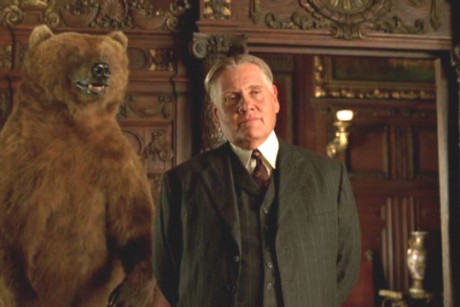
RECAP: A bear, a baseball glove and “Boardwalk Empire”
Editor's Note: The following article contains spoilers for "Boardwalk Episode" season two, episode eight, "Two Boats and a Lifeguard." Read at your own risk.
“Powerful” episodes of cable dramas make a huge impression on viewers, and are often acclaimed as the best of their season. Sometimes the praise is deserved; other times it’s a reaction to the sight of characters we like being diagnosed with fatal illnesses, beaten, raped, killed, etc. Meanwhile, low-key but complex episodes often get short shrift from critics and viewers. I hope that doesn’t happen with tonight’s “Boardwalk Empire” episode, “Two Boats and a Lifeguard,” because in degree of difficulty, it’s impressive, in some ways extraordinary.
As written by Terence Winter and directed by Tim Van Patten — a dynamic duo on a lot of great “Sopranos” episodes — “Two Boats and a Lifeguard” seems like just a “housekeeping” episode that’s mainly concerned with wrangling subplots and exploring characters. But as I’ll explain in a moment, the episode went way beyond that.
Nucky and Eli buried their father and had an uncomfortable moment of almost-reconciliation at the memorial. (This episode marked the final appearance of the late stage and screen actor Tom Aldredge, who played both Nucky and Eli’s dad and Carmela’s father on “The Sopranos.”) Nucky responded to his dad’s death — the psychological aftershock of the second assassination attempt against him, this one set up by his surrogate son Jimmy Darmody — by declaring that he was quitting his job as Atlantic City treasurer and was going to try to mend his ways and become a respectable citizen. (Fat chance of that happening on a show like this, but it was still a fascinating development that let star Steve Buscemi show us intriguing new shadings.) Nucky even asked Margaret’s son to address him as “Dad” rather than “Uncle Nucky” — a huge step toward commitment and emotional availability, even though it was conveyed in a rigid 19th century manner. Van Alden hired a nanny to take care of his baby with Lucy, in the process confirming his near-total inability to respond to the child as a father should, but revealing very faint glimmerings of potential near the end. (Or was that just wishful thinking on my part? Probably so — Van Alden is such a rancid sour persimmon — and so encrusted with lame graphic novel pathology, from religious fanaticism to sexual hypocrisy to cold sadism and murderous rage — that the writers might be unable to salvage him as a workable character.)
You read the rest of Matt's piece here at Salon.
Matt Zoller Seitz is TV critic for Salon and publisher of Press Play.