H.R. Giger: Against the Gigeresque

H.R. Giger: Against the Gigeresque

nullWith any metaphor, we must read it and ourselves
closely and minutely in order to reach its radical potential.

—Samuel R. Delany, “Reading at Work”

In the land of esque, the one-trick pony is king, and the king is made into a
one-trick pony. Art and artists get reduced to their broadest strokes, their
most easily perceived gestures, their monotypes. Esque means “resemblance”, but it also means a set of expectations,
because resemblance requires types than can be quickly, easily recognized (the
rich paradoxes and disturbing ambiguities of Franz Kafka get corralled into the
kafkaesque). The esque is a side-effect of commodification hardly limited to the
highest of high arts, as the marioesque attests. The danger of the esque is that the resemblance may
overtake the original.

null

H.R. Giger’s imagery so deeply influenced the
imaginations of film production designers, tattoo artists, fashionistas,
magazine illustrators, skateboard designers, and just about everyone other than
My Little Pony animators that at this point it’s difficult to separate
Giger from the gigeresque. What was once outré, repulsive, and disturbing
became the Thomas Kincaid style for the cyber/goth set, a quick kitsch to
perform a certain idea of taste. You hang Christmas
Cottage
in your living room to display your pleasant, unthreatening
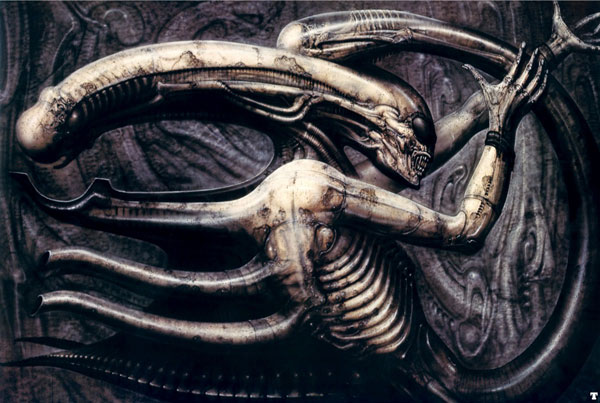
Christianity; I put a poster of Giger’s Li
I
on my bedroom wall to show how transgressive I am in my deep, dark soul.
Each is a sign that communicates immediately, without any need to look for more
than a second, because each communicates not through itself but through all the
associations is has accumulated.

Of course, this is not fair to Giger the artist,
who was much more than his most popular tropes. But that’s about as useful as
saying van Gogh is much more than a sunflower, a starry sky, and a bandaged
ear: obvious, yes, but also beside the point. Giger is mourned and remembered
because of the gigeresque.

The rise of the gigeresque occurred soon after
the release of Alien in 1979, for which Giger designed the titular
creature. He didn’t work on any of the other Alien movies, and was
especially annoyed not to have been able to help with Aliens, but it
didn’t matter: Hollywood just wanted a whiff of Giger, something for the
technicians to replicate and make acceptable to the studio execs.

null

Giger’s life in film did not begin with Alien.
He made two shorts with Fredi M. Murer in the late ’60s, “High” and
“Heimkiller”, as well as the 45-minute science fiction movie Swiss
Made 2069
, for which he designed his first monster costume. In the
mid-’70s, he created various set designs for Alejandro Jodorowsky’s planned
film of Dune (about which a new documentary has recently been released),
but it wasn’t until Alien that his work became generally and
internationally famous. Before Alien, he was avant-garde and shocking.
After Alien, he was trapped in a gigeresque nightmare.

My favorite Giger moment comes from 1987, when
Jello Biafra and Michael Bonanno of Alternative Tentacles Records were put on
trial in Los Angeles for distributing harmful matter to children because the
Dead Kennedys album Frankenchrist included a pull-out poster of Giger’s
1973 Penis Landscape (Landscape XX). Biafra later explained to
Wired.com that he’d been interested in using the art for the album because when he first
saw it “I thought: ‘Wow! That is the Reagan era on parade. Right there!
That shows how Americans treat each other now.'”

The biological and mechanical are mixed in what
Giger depicts, but they are also reproduced, reiterated: not just cyborgs, but
clones. The Penis Landscape reduces the human to the genital over and
over and over again. It attracted the attention of the anti-pornsters not
because it was obscene, but because it so perfectly depicted their stereotype
of pornography, the ideal form obsessing them: organs without bodies.

null

Putting a poster of Penis Landscape into
the LP of Frankenchrist was an effective use of Giger to prod the
sensibilities of the status quo, to distribute Giger outside the gigeresque,
perhaps the first (and maybe last) time after the release of Alien to do
so.

It’s too bad Giger never got to work with David
Cronenberg and David Lynch. In a 2012 interview with Bizarre magazine,
Giger said of Lynch’s Eraserhead, “No other film has affected me
quite like it.” Lynch, though, moved toward a kind of all-American
surrealism that wasn’t really what Giger was up to. Cronenberg is the one
director whose career seems to me to return now and again to ideas and images
that Giger was also drawn to, and whose work often manages to be gigeresque,
but not banal. The biomechanical metamorphoses and horrors come from
Cronenberg’s own obsessions — obsessions very much in tune with Giger’s, almost
in conversation with them. It’s unfortunate that Giger and Cronenberg never
worked together.

Giger participated in his own commodification,
though for him it seems to have been an attempt to at least partly control the
image being spread. By sanctioning Giger Bars and opening a Giger Museum, he
could say what was and wasn’t appropriate to associate with his name. Once a
trope enters the popular consciousness, though, it’s impossible to regulate its
transmission and mutation. When only a few qualities become associated with an
artist’s name, the artist’s own work can become unrecognizable as the work of
that artist. The esque becomes the echt. Commercialization takes
over, mining the predictable for profit. Art ends where expectation rules.

We can see this process in a revealing one-star review at Amazon.com for H.R. Giger’s Retrospective: 1964-1984, where a reader
says, “I didn’t like this book at all. I expected paintings of aliens and
supernatural creatures. Instead I got art that’s nonsense, from my point of view.
The paintings look nice, but they’re meaningless to me.” The gigeresque is
familiar, reproduced, and thus meaningful; the Giger that is not gigeresque
cannot be known, cannot even be evaluated or analyzed — it is nearly invisible,
just nonsense.

null

What we should celebrate and recover is the Giger
beyond the gigeresque. The gigeresque is too familiar now, too rote, too
replicated. Whatever meanings it still possesses are meanings comfortably
assimilated into the status quo, easily packaged and transmitted, emptied of
all but the least interesting, least challenging values. In 1979, a Giger alien
was shocking, terrifying, repulsive — but even as early as Aliens in
1986, the effect was dissipating (Giger’s own absence from Aliens
represents the triumph of the gigeresque: the artist himself was no longer
necessary). All these years later, slimy biomechanical monsters have no power
to surprise, no power to awaken awe. To rediscover the alien, we must reject
the gigeresque, for though it may still possess the basic ability to gross us
out, even that gross-out has dispersed into pure familiarity.

What
would be the equivalent today of packaging a poster of Penis Landscape
in a record album? What would lead to trials and hoopla and revolutionary
fervor? How could these images once again be made harmful for children? What do
we need that has not yet been leached out of the art? How might we honor Giger
and subvert the gigeresque?

Matthew Cheney’s work has been published by English Journal, One Story, Web Conjunctions, Strange Horizons, Failbetter.com, Ideomancer, Pindeldyboz, Rain Taxi, Locus, The Internet Review of Science Fiction and SF Site, among other places, and he is the former series editor for Best American Fantasy. He is currently a student in the Ph.D. in Literature program at the University of New Hampshire.

Fatal Riddles: HANNIBAL and the Figure of the Serial Killer in Contemporary Television

Fatal Riddles: HANNIBAL and the Figure of the Serial Killer in Contemporary Television

null

The
season premiere of Law & Order‘s
fourteenth season, Bodies, constituted
a departure from prior episodes.  Cryptic
markings on a dead body are matched to similar markings found on a victim in
Brooklyn five years before, and then to more bodies, all of which leads
Detectives Briscoe (Jerry Orbach) and Green (Jesse L. Martin) to conclude there
is a serial killer at work in New York City. The killer—a psychopathic taxi
driver named Mark Bruner (played by guest star Ritchie Coster)—is apprehended
relatively quickly. Briscoe and Green take no actions in pursuit of the killer
that fans of the show haven’t seen a thousand times before: they canvass,
retrace the steps of the victim, happen upon a nightclub waitress with a keen
eye for creepy patrons, and finally follow a hunch that leads them to Bruner’s apartment.
It’s not the pursuit and capture that provide the climax of the episode,
however, but the legal predicament that follows: Bruner’s attorney, an idealistic
public defender, must either break attorney-client privilege—and tell the
prosecutors (and the court) where Bruner has hidden additional bodies—or be
charged as an accessory to Bruner’s crimes.

Dick
Wolf’s Law & Order debuted in the
fall of 1990, at the peak of New York’s violent crime wave—that year, there
were over 2,000 murders (compared to 333 in 2013).  Law
& Order
embraced the fear of social disintegration and addressed it
with a severe formalism that married esperanto liberalism with a faith in traditional
institutions of justice.  The formula fit
the times.  The show debuted four years
after Congress passed the Anti-Drug Abuse Act of 1986, which created mandatory
minimum sentences and helped inaugurate our current prison crisis, and four
years before Bill Clinton signed the Violent Crime and Law Enforcement Act (1994),
which flooded the streets with policemen and extended the death penalty to
forty new offenses.  Nonetheless, by the
late 1990s, as the economy rode a wave of irrational exuberance, and NYC transitioned
from a dystopia to a destination for hipsters and financiers alike, the kinds
of crimes that captured the public imagination changed as well. Events like the
Columbine High School shootings of 1999 and the September 11, 2001 terrorist
attacks spiked fear of hidden threats from within.  Over time, Wolf adapted to this changing landscape
by bringing different versions of Law
& Order
to television, shifting the focus to tawdrier crimes (SVU), or quirkier detectives, (Criminal Intent).[1]
On the flagship show, however, the  basic
format prevailed, with few exceptions, for the duration of its twenty-year run.
It was plug-and-play television, and its reliance on formula guaranteed the
show was almost always competent if rarely great.

null

In
Bodies, however, Bruner’s lack of traditional
motive—he doesn’t kill out of greed, or revenge, or jealousy—renders him
less a typical Law & Order criminal
than a force of deconstruction and illogic. When Bruner bestows knowledge of
his victims’ whereabouts on his public defender and then relies on legal rules
and ethics to preclude the attorney from sharing that information, he reveals the
fundamental contradictions between our abstract notions of justice and the
institutional rules which make the judicial system work. By using Bruner this
way, Bodies takes a cue from the modern
archetype of the fictional intelligent psychopath: the creature in Mary
Shelley’s Frankenstein.  In a fit of rage, Shelley’s creature – powerful,
brilliant, and a wounded social reject all at once – frames the Frankenstein
family’s adopted daughter Justine Moritz for the murder of an infant family
member.  Torn between confessing to a
crime she didn’t commit and ex-communication, Justine admits guilt and is
hanged. Although her death may be characterized as innocence lost, it’s not the
senseless destruction of innocence that drives the creature. Rather, having
been judged and excluded by society because of his appearance, the creature seeks
revenge by turning the Frankenstein family against itself and exposing the internal
contradictions and inherent arbitrariness of the justice system and, by
extension, society.

When
Law & Order premiered on NBC in
the autumn of 1990, it did so over the protests of some executives who thought
it was too intense for weekly network television. Just under twenty-five years
later, on June 6, 2013, on the same network, roughly 2.5 million viewers
watched as Hannibal‘s Dr. Abel Gideon (Eddie Izzard)
graphically disemboweled psychiatrist Dr. Frederick Chilton (Raul Esparza) while
a still-conscious Chilton looked on. Gideon is but one of fourteen serial
killers introduced in the first twenty-two episodes of Hannibal.  Although notably
graphic in its violence, Hannibal is
not the first network show to focus on serial killers.[2]  A non-exhaustive list includes NBC’s Profiler and Fox’s Millenium, both of which premiered in 1996.  It also includes CSI, which premiered on CBS in 2000 (to be followed in 2002 by CSI: Miami and in 2004 by CSI: NY) and which, although not solely devoted
to serial killers, relied on a serial killer in its pilot and has depended on
serial killers for a number of its multi-episode narrative arcs. Criminal Minds, also on CBS and just
renewed for its tenth season, follows the FBI Behavioral Analysis Unit (the
“BAU” also featured on Hannibal)
as they track a new serial killer every week. Within months of Hannibal’s premiere in April, 2013, The
Following
debuted on Fox, The Bridge
on FX, and The Killing’s third (but
first serial killer-based) season began on AMC. 
And, although they are not network shows, the past year saw both the
successful initial run of HBO’s True
Detective
and the disappointing conclusion of Showtime’s Dexter.

Why
the fascination with “intelligent psychopaths” and serial killers? It’s
certainly true that there’s an audience for gratuitous and/or sadistic violence.
The killers are almost invariably white men directing violence (frequently
sexual) against “helpless” victims, typically women.  But there must be some further appeal, given
the fact that these shows (and novels and movies) command a large, diverse
audience of both sexes.  At a minimum,
serial killer plotlines are so culturally-determined at this point that they
seem to provide a kind of generic gravity, atmosphere, and stability to any
show.[3]
But Daniel Tiffany, in Infidel Poetics,
identifies something atavistic in our morbid fascination that dates back to the
legend of the Sphinx, the mythical creature who terrorized Thebes with a fatal
riddle.
As a “liminal” creature – part human, part
lion, part eagle but not actually human, lion, or eagle – the Sphinx is both an
antecedent and ancestor to Frankenstein’s creature, whose parts also fail to
add up, leaving him at once both human and less-than-human. Both figures presage
the “intelligent psychopath” of contemporary television, whose inscrutability
is the product of his fundamental lack of that something that we believe makes us “human.”
In this way,
the “riddling serial killers and
cryptographers of modernity” supply us with a “vernacular strain of
‘poetry'” and join the Sphinx (and Shelley’s creature) as authors of a
vertiginous, “apocalyptic” narrative. 
These figures embody a riddle that suspends us between a “promise
of revelation” and “the threat of annihilation.”[4]
By internalizing the superficial grotesqueness of Shelley’s creature, the
serial killer is all the more beguiling because – unlike the Sphinx or the
creature – he terrorizes us from within. 
If it seems a stretch to call the work of these killers poems, we need only consider how we
distinguish a killer’s “style” by what we call his signature.

null

It’s
not a stretch to say that our
construction and re-construction of these narratives – and the means we devise
to solve their riddles – can tell us something about a given cultural moment.  Shelley’s Frankenstein,
for instance, provides a strong critique of Romantic hubris, depicting the
destructive results of our attempt to “play God” through science.  Centuries later, CSI flipped Frankenstein‘s
script by suggesting a solution in science.
CSI kept in place many of the familiar
markers of the police procedural, but it also instituted a few significant
changes.  Most importantly, it focused on
the analytical methods of forensic scientists who preferred to stay far away
from the action. (“I don’t chase criminals,” explains lead-scientist
Gil Grissom, “I analyze evidence.”)[5]  These scientists function not only as a team,
but also as a kind of marketplace of ideas
– the laboratory is collaborative but also competitive,
with the scientists vying for Grissom’s favor and sourcing solutions from a
diversity of character stereotypes including an ex-stripper, an All-American
good-old-boy, a strong-but-silently-troubled bad-ass, and geeks galore. For the
bulk of its run, the CSI method was explicitly anti-theoretical; speculation
earned a quick rebuke from Grissom. It’s not difficult to identify in early CSI a pragmatism, a belief in markets
(at least of the intellectual variety), and a fetish for technology that reflect
the Clinton era that gave birth to it. When Criminal
Minds
first aired five years later, it adopted this pragmatism, down to its
team/market of diverse stereotypes, but swapped out the gleaming machinery of
the lab for behavioral models (and a dash of Big Data analysis). Criminal Minds‘ BAU also operates
collaboratively and competitively, dramatically prioritizing an internal trust
and transparency that stands in stark contradiction to the inscrutability of
the criminals they track. Both CSI and
Criminal Minds are notable for the
integral, authoritative roles they give to women. Their “marketplace”
is an inclusive one, a fact that, to a limited degree, helps off-set the
recurrent victimhood of women. Although both CSI and Criminal Minds
traffic in pop-philosophy (Criminal Minds
actually brackets its episodes with de-contextualized quotes from literature
and philosophy), neither treat serial killers as a kind of existential or philosophical
threat. Instead, the killer is merely one more problem to be solved, that can be solved, through a combination of
reason, diligence, technology, and cooperation.[6]

But
what do we make of Hannibal? It’s sui generis.  It adapts characters from, but pre-dates,
Thomas Harris’s well-known novels.  This means
that, to the extent it plans to follow those novels (with some, but not total,
fidelity thus far), the audience already knows a great deal about where the
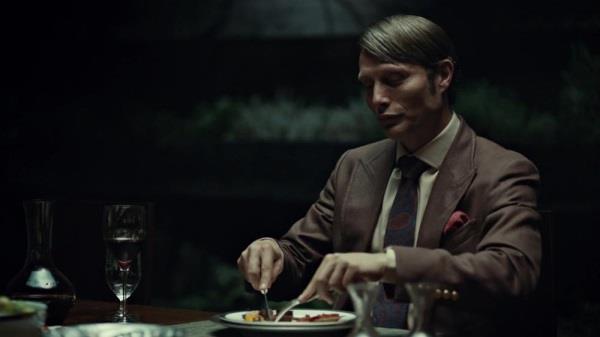
narrative is going.  The show centers on
Will Graham, played by Hugh Dancey, a “pure empath” who experiences crimes from
the criminal’s perspective, and Hannibal Lecter, played by Mads Mikkelsen, a
psychiatrist who has been brought in by the FBI to help Graham handle the
psychic burden of his job (and, eventually, to aid in tracking down killers). There
is no mystery for the audience to Lecter’s identity, or the fact that he is a
psychopath, a killer, and a cannibal. 
Instead, the two characters face-off in a kind of dialectical opposition
as Lecter attempts to maneuver Graham into becoming a killer himself. The other
characters orbit them, occasionally changing polarities for the convenience of
the plot.  Dancy’s Graham is slightly-built,
boyish, soulful, all frayed ends. Although he “teaches” criminal
profiling at the FBI training center at Quantico, the show is exceedingly light
on the analytical. You could be forgiven for wondering about the substance of
his lectures, given the fact that his “talents” are the apparent
byproduct of cognitive and psychological abnormalities. Mikkelsen’s Lecter
manages to be droll, aloof, creepy, charming, and – it must be said – a hell of
a clotheshorse. (His plaid suits and large-knotted paisley ties are a costume
designer’s dream.) He is also an unparalleled chef, a visual artist (he studied
drawing at Johns Hopkins on a fellowship), a musician and composer (harpsichord
and Theremin), a one-time neurosurgeon, and, now, a psychologist.[7]  He is so refined, and his composure so total,
that it would be nice, just once, for the show to sneak up on him as he watches
television and eats cereal in sweatpants. 

To
be clear, Hannibal is beautiful. And
it bears all the hallmarks of prestige television – not just the high quality
of the visuals, but also its accomplished cast and casual erudition. That said,
the show’s compositions are clearly its calling card. They are meticulous,
often daring, and Hannibal consistently
fills the screen with striking images drawn from a super-saturated palette.  The most striking images are, of course, the
dead bodies themselves, and the show’s attentiveness to the
“expressive” quality of the murdered body suggests an affinity with
David Fincher’s Seven (1995).[8]  No matter the killer, the dead bodies of the “victims”
are nearly always arranged and presented by the murderer in ways that blur the line
between the beautiful and the grotesque. Of the fourteen serial killers thus
far, not one has stooped to the banal depths of, say, strangling a prostitute
in a dark alley. Although the crime scenes
are elaborate, the majority of the actual murders in Hannibal occur off-screen. 
Thus we “meet” most victims for the first time when they are already
dead, already posed. Only belatedly (and even then only occasionally), through
Graham’s experience of the crimes, does the audience witness any of the
brutality behind the “art.” As a result, Hannibal‘s disinterest in the victims’ interior life parallels the
disinterest of the killers themselves. Deprived of a backstory, the victims never
exist as subjects, only as the
eventual objects of the killer’s art.
That it is art that we’re seeing is reinforced again and again as the
characters “admire” the monumental design, and, yes, the “poetry”
of the “death tableaux.”

The
show is equally meticulous thematically. It maps out a symbolic universe of
mirrors and reflections, parlor rooms and libraries, sublime landscapes and
dream imagery that, in combination with the violence done to the human body, suggests
what might result if Eli Roth plucked his writers from a graduate seminar on
Lacan. That half the main characters are psychologists permits Hannibal to lay it on thick – for a show
about chasing serial killers, it spends a great deal of time listening in on
characters in book-lined rooms as they earnestly discuss psychic
“borders,” dream interpretation, and “identity.” In this
way, Hannibal shares an intellectual
ambition with both The Following and True Detective.[9]  It is a credit to the creators that Hannibal manages to avoid The Following‘s too-obvious literary
aspirations. Like True Detective, it
succeeds largely in spite of itself, relying on strong visuals, charismatic
performances, and self-awareness to hide an intellectual and narrative preposterousness
that grows increasingly hard to ignore.

null

Hannibal  incorporates the components of a modern
criminal procedural – FBI agents, gunplay, high-tech labs and the quirky
squints who occupy them – but it displays none of the other shows’ faith in (or
fetish for) methodology.  On the
contrary, in the universe of Hannibal,
science is inert, ineffective, and easily manipulated. These manipulations
rarely serve as a surprise to the audience; instead, as Lecter uses forensic
evidence to frame others, send messages, or toy with the FBI, the audience is allowed
in on the joke.  The wholesale
institutional haplessness of the FBI is driven home by the fact that Jack
Crawford (Laurence Fishburne), the Director of the BAU, spends most of Season
One sharing meals with Lecter in which they eat
the very victims of the crimes he’s investigating
.  The medical and psychology professions fare
no better. Lecter “gives” Graham encephalitis then corrupts (and then
kills) the neurologist to keep it quiet. The psychiatrist Chilton, who manages
to survive his encounter with Gideon only to be killed soon after by means of one
of Hannibal’s more elaborate strategems, is a blowhard and fraud.  In the course of a couple of episodes, Lecter
manipulates both the FBI and Graham’s love interest (a psychologist consultant
to the FBI) into believing that Graham is a serial killer.  Naturally, it’s also Lecter who later gets
him freed. Lecter’s ability to manipulate and escape detection is explained in Mephistopholean
and metaphysical terms by the few who recognize his dangerousness – he’s Satan,
he’s smoke, he can’t be seen. As Lecter’s psychiatrist (an excellent Gillian
Anderson) explains to him, severing their relationship before fleeing town in
fear, “
I’ve had to draw a
conclusion based on what I glimpsed through the stitching of the person suit
that you wear.” That the stitching holds up as long as it does may be Hannibal‘s sole mystery.

Lecter
espouses a superficially stringent code of etiquette and ethics, and a breach
of these codes can have fatal consequences. 
Like all things Hannibal,
however, this code frequently bends to his will.  Although it may be Lecter’s world we’re
living in, fortune doesn’t only favor
Lecter; it favors all the killers, who always seem to finish their
“monuments,” no matter how ambitious, without any wires snapping,
without the whole Rube Goldbergian apparatus tumbling down, and without
interruption.[10]  From time-to-time, Hannibal slyly concedes a universe in which psychopaths are not an
exception but rather a kind of cabal, fixing and amending its rules. “Look
at us,” the journalist Freddie Lounds (
Lara
Jean Chorostecki) observes to Graham and Lecter, “a bunch of psychopaths
helping one another out.”

Still,
Lecter’s ability to manipulate the actions of others, even from remote
distances (of space and/or time) suggests not so much that he’s playing chess
while the FBI plays checkers, but rather that all of us are merely pawns in a
match he plays against himself for idle amusement. Stripped of a Sphinx-like
“fatal riddle,” the drama of Hannibal
is reduced to Lecter’s attempt to corrupt Graham. Its focus on the
“borders” that separate “us” from psychopaths suggests that
its closest relative is Showtime’s Dexter.  But it lacks a central paradox like the one
that animated the first few seasons of Dexter.
There, the audience was encouraged to root for Dexter’s happiness, his
normalization. But any relationship with Dexter posed, by its very nature, a
mortal risk. As those who cared for him were endangered or killed, Dexter forced its audience to examine
its own complicity in the violence.  Hannibal, on the other hand, solicits
admiration at the risk of leaving complicity unexamined. The shows share an
additional thematic similarity, however. And it’s a significant one. The
bumbling nature of the Miami police in Dexter
mirrors Hannibal’s hapless FBI;
both shows mask an inherent pessimism with a kind of “flawed hero”-worship,
suggesting a need to delegate the fight against “evil” to someone different,
and better, than us. This is not a
new trope. The transformation of Sherlock Holmes into a “high-functioning
sociopath” on Sherlock and the
emotional and intellectual volatility of Criminal
Intent
’s Detective Goren are just two recent examples that suggest that the
battle against psychopaths can only be won by psychopaths. We’re watching Titans
and Olympians battle it out across the mountaintops. Or, more aptly, it’s a
comic book universe as seen through the lens of the DSM.

Nonetheless,
Hannibal can be commended for its
even-handed approach to victimhood – it has avoided the kind of unrelenting
victimization of women (victimhood is distributed across gender and race) that
plagues Criminal Minds, and that famously
drove Mandy Patinkin from the cast. It also largely avoids that show’s
uncomfortable voyeurism.  But does that
discomfort have a kind of value? By hiding so much of its actual violence from
us, Hannibal often leaves the
audience with nothing but passive admiration of its technical accomplishment.  Having pre-emptively emptied both science and
the law of value, it cannot offer comment or critique. Having tilted the
universe so fully in favor of its killers, Hannibal
self-limits what it can tell us about the nature of evil – banal or
otherwise – in the world off-screen.[11]
Because of this, Hannibal struggles
to justify either its graphic violence or its body count.  Does it need justification? None of my
criticism detracts from the show’s direction and acting – which are excellent,
and significantly better than its kin, save perhaps for True Detective. It’s possible the wealth of surface pleasures is
enough. At one point, Graham criticizes Crawford for “mythologiz[ing]
banal and cruel men who didn’t deserve
to be thought of as supervillains.” 
That the show itself goes on to do exactly that suggests a winking,
Lecter-like self-awareness. In these moments
the show is most fully a reflection of the title character himself – clever,
facile, worldly, stylish, vicious, and hollow. 
As the audience, we are in on the joke but denied the riddle.

Spencer Short is an attorney and author. His collection of
poetry,
Tremolo (Harper 2001), was
awarded a 2000 National Poetry Series Prize. His poetry and non-fiction have
been published in
The Boston Review, Coldfront, the Columbia Review, Hyperallergic,
Men’s Digest, Slate, and Verse. He lives in Brooklyn.


[1] An informal count tallied more
than three times as many serial killers in the combined twenty-five years of SVU and Criminal Intent than in the twenty years of the original Law & Order.

[2] As far back as 1988, NBC
broadcast the short-lived and before-its-time Unsub, starring Starsky &
Hutch’s
David Soul as the leader of a team of FBI forensic scientists
tracking the same kinds of “unknown subjects” at issue in Criminal Minds.

[3] The
dramatic improvement in the third season of The
Killing
suggests that a serial killer plotline can serve to stabilize an
ambitious, but troubled, show. In other cases, serial killers have been used to
lend “lightweight” shows a sense of substane; hence the serial killer plotlines
in lighter fare such as NCIS, Bones, and even the soap operas Loving and One Life to Live.

[4] Tiffany, Infidel Poetics (2009), p. 72.

[5] Grissom was played by William
Petersen who, coincidentally, played Will Graham in Michael Mann’s Manhunter (1986) the first  adaptation from Thomas Harris’s Lecter novels.
It was remade as Red Dragon in 2002.

[6] Fox’s Bones is another example of the “empirical” procedural and is
strongly indebted to CSI.

[7] Lecter also has an exceptionally
keen sense of smell – at one point he claims to have “smelled” Graham’s encephalitis
– a trait he shares with Jean-Baptiste Grenouille, the serial killer anti-hero
of Patrick Susskind’s novel Perfume.
In Susskind’s novel, the hyperosmia is actually what drives Grenouille to kill.

[8] Twelve years later, Fincher
would again direct a film about a serial killer – this time the Zodiac – but
would focus less on the overtly apocalyptic and the graphically violent and
focus instead on the destructive internal toll that the Zodiac’s “fatal
riddle” imposed on those investigating him.

[9] It also shares significant
structural similarities to The Following
but that is beyond the scope of this piece, mostly because it would have
required watching more of The Following.

[10] Contrast all of this with the
one victim we see who manages to escape from a killer: he leaps from a bluff to
the river below only to bounce awkwardly against the rocks and plunge, already
dead, into the water.

[11] The fantastic British crime
drama The Fall (also, coincidentally,
starring Gillian Anderson) provides a welcome antidote to this self-regard. It
shares a number of structural similarities to Hannibal, but manages to capture a tension between menace and
banality that is wholly absent from Hannibal.

Andrew Garfield’s Face; Or, How Culture Works

Andrew Garfield’s Face; Or, How Culture Works

nullI find myself increasingly tired of seeing Andrew Garfield’s face
these days. This puzzles me, given
that I’m a fan of his of long standing—or as long as one could be for an actor
of his young age. What about his success and sudden ubiquity might bother me?
Wouldn’t I want the best for such a talented, charismatic, young actor? Then it
hits me, as it has hit me so many times before: I’m witnessing the growth and
development of culture, more of a sideways slide than an uphill climb. The
feeling I’m having has little to do with Andrew Garfield, and even less to do
with his face.

Culture will eventually absorb what it at first does not broadly
accept or understand. As it absorbs and assimilates, it makes what previously looked unusual or outstanding into
something far more commonplace. Cell phones, interestingly, give an early,
obvious example of this assimilation in this century. The Motorola Dynatac
phones of the 1970s were unwieldy, strange beasts, seemingly more fit for
comedy than for daily use—remember Zack’s phone in “Saved by the Bell”? As time
passed, they were refined as their utility became more obvious and they began
to resemble more an object which might be put to use, rather than stared at or
envied. And now? Well, you might be reading this on a phone. Ditto for
computers: the earliest usage was purely academic, and their size and bulk made
them seem awkward, even potentially intimidating. (See Mad Men this week?) And yet, as time passed… In the arts, this sort of assimilation is more
rampant and simultaneously more insidious. Examples are everywhere. Take, to
pluck one random example, the career of R. Crumb. Crumb’s comics were, for
decades, many things: obscene, brilliant, earthy, soulful, sexist, misogynist,
complex, hilarious. His women waved their bloated, distended breasts high in
the air, simultaneously thrusting their bulbous posteriors out far beyond the
range of physics; his men, similarly, either thrust their hairy, wizened,
members upwards, or grasped them like there was no tomorrow, or both. In short,
not New Yorker material. And yet,
behold: his last New Yorker appearance
was less than 2 years ago, in September 2012. The Pixies, college-punk
favorites, hatched their sound in garages and bars in the Boston area after
meeting at the University of Massachusetts-Amherst; though they achieved broad
popularity among the college-educated, possibly even Masters-Degree’d set,
their recent appearance on an iPhone commercial set off a small wave of what
seemed either to be a qualified pleasure or a modified horror among the band’s
longtime fans, somewhere between “That’s amazing” and “How could they do that
to my favorite band,” the idea being
that The Pixies’ raffish, loud, angry beauty was somehow being co-opted for a
suspicious cause, embraced by The Establishment. In film, take the career of
Christopher Nolan. If we compare early films like Following or the brave, intriguing and more watchable Memento with the most recent Batman
extravaganzas, it’s hard to believe the films were made by the same
filmmaker—and yet, they were. Somehow, big studios made him their own,
idiosyncratic warts and all. Do the new films have the inventiveness and
imagination of the old films? Sure. More money, more imagination. Do I miss the
Memento director? A little.

Which brings me to the matter of Andrew Garfield’s face,
popping up in magazines, on SNL, on talk shows, on movie posters—everywhere an
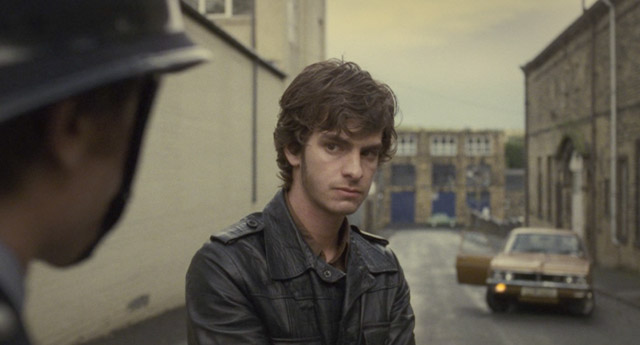
un-careful eye might chance to look. His performance in the first Red Riding TV film was remarkable; as a
young detective in the 1970s U.K., he managed to take a certain type of boyish
affectation characteristic of the period and change it into near-choreography,
even amidst fairly graphic and horrific inner and outer violence. And if I had
to explain why, while watching Never Let
Me Go,
I was slumped in a sobbing heap in the corner of my over-large
theater seat, the most damning piece of evidence would be his devastating performance as a
young man who had held out hope for survival in a cannibalistic future society and then had it taken away from him bluntly and cruelly, leaving
him with no choice but, in a well-known moment from the film, to scream, loudly
and without restraint, into the cold night air. These were small films, in a
sense—they starred well-known actors, but their scope was local, they weren’t
blockbusters, they weren’t aimed at profit. They were aimed at simply doing a
good job at what they were trying to do, be it create a suspenseful crime story
or present an adaptation of Ishiguro’s nightmarish novel. I remember
wincing slightly when I learned he had been cast in The Social Network, not because I thought he would hurt the film—on
the contrary, his turn as Zuckerberg’s sidekick was beyond responsible—but
because I had a sinking feeling in my gut. Oh
no,
I thought. They’ve come for him.
I thought I was the only one who noticed. Ah well… But maybe there’s hope?
 

Enter the new Spider-Man films, stage left. The explosions.
The spider webs. The starlet love interest. The villains. The special effects.
The famous backstory. The famous suit. Here comes Culture: we can be sure that,
regardless of whatever roles Garfield might play in the future, many, many
viewers will know him primarily as Spider-Man. Culture spots the highly
personal performance, the nuanced approach to a role, the note of eccentricity,
and tries to bottle it as soon as possible—in this case, to give an affecting
insecurity to a famous character from a comic book. Whether the actor can climb
out from underneath the weight of Money and Prestige obtained through this
exchange is entirely up to the actor. Kate Winslet has given moving
performances in many films since Titanic,
but if pressed, more moviegoers would remember her for her role in the film
about a huge sinking ship than for her performance in Jude, sadly enough—or even more sadly, for her first film role, as
a murderous teen in Heavenly Creatures. Ditto
for Jake Gyllenhaal: you know him from Brokeback
Mountain
, but do you also know him from Donnie
Darko
, in which he played a far more insecure role? For which film did he
get broader recognition? And ditto for many others, a long list of the
absorbed.

Of course, at this point, it must be asked: who the heck do I think I am? Why am I
making vaguely resentful judgments about people I will never meet? And, above it all, isn’t
acting a job, e.g., that which supplies a pay-check—which must, in the case of
the more low-budget films mentioned above, have been quite small? And hopefully
I’m not pointing the Sell-Out Finger at these poor souls, am I?
No, to the
last two questions. In fairness, though, I seek mainly to raise a question or two of
my own: will there be a time in American culture when the artistic work which
pays its practitioners the most, and in which premium investments are made,
matches that investment with like quality? Or must it always be the case that
that which attracts the masses in the greatest numbers must all-too-frequently
be of lesser quality due to the mercenary nature of its intent? And beyond
that, here are some other questions: how long does it take for Culture to move
on, to lose interest? Does the flavor of the month last for a whole month, or
is closer to a week? And, most importantly, if we accept that our cultural
world is an amoeba, absorbing particles of talent and enterprise into its bulk,
at what point will that amoeba begin to evolve?

Max Winter is the Editor of Press Play.

Down-Underground: WALKABOUT, or Thirteen Ways of Making a National Epic

Down-Underground: WALKABOUT, or Thirteen Ways of Making a National Epic

1. Bring an outsider’s
perspective

Like Wake in Fright,
the only other Australian entry at the 1971 Cannes Film Festival, Walkabout was directed by an Englishman,
Nicolas Roeg.  He tells the story of
Australia without sentimentality, without rancor.  The landscape is not idealized or demonized;
neither are those who dwell in it.

2. Use images to tell a
story

null

Based on a 1959 novel of the same name, about two American
children whose passenger plane crash lands in the Australian Outback, Roeg’s film
rigorously pares back and revises the story; the novel is 144 pages, the
screenplay 14.  The film begins with a
mineral surveyor driving his children to a deserted desert landscape, where he
tries to shoot them before covering himself and his car with gasoline and
lighting a match.  We don’t know
why.  His daughter stares blankly.  The fire burns fiercely.  The children walk into the desert, their
school uniforms black against the rust-colored landscape.

3. Cross-cutting
multiplies perspectives

Images of rocks, strata, broken landscapes.  A girl’s school where Australians are going
through their English elocution lessons. 
Bricks, brown and earthy.  The
Outback, sand glowing fiercely red under a cloudless sky.  Brutalist architecture, dystopian concrete
forms like an urban cage.  A butcher
grinding kangaroo meat to be packaged as pet food.  A woman preparing dinner while listening to a
radio show on proper table etiquette. 
Chitinous lizards crawling over the desert floor, unwieldy in their
armor but perfectly adapted to their environment.

4. Tell immigrant stories

null

Europeans don’t seem to belong to this landscape, or at
least they seem to be trying their level best to maintain the culture of their
place of origin, practicing elocution, rehearsing manners.  Ninety per cent of Australians live on the
coasts, while the Outback represents over seventy per cent of the continent’s
landmass.  A teenage girl and her younger
brother are abandoned to this landscape; their school uniforms can’t protect
them from the heat, and they burn until their skin bleeds.  They come upon an oasis; a fruit tree feeds
them; the water revives and washes them. 
By the next morning the water has burned away in the heat.  Roeg somehow manages to compress two hundred
years of immigrant history into twenty minutes.

5. Tell native stories

A lone aboriginal boy comes upon them; he shows them how to
draw water from the soil.  They join him
for his “walkabout,” the aboriginal ritual in which a sixteen year-old boy is
sent out into the Outback to see if he can survive.  He and the schoolboy communicate through sign
language, and he increasingly draws the whites to his world.  They gradually strip off their school
uniforms, the last trappings of the world they are leaving behind but also
moving inexorably towards in their errant pilgrimage.  The aboriginal boy wears their clothing, but
with a difference, the boy’s pants on his head. 
They later make a sun parasol by stringing a blouse on sticks.  The boy decorates the children’s white skin
with elaborate painted designs.

6. Everything is sexual

null

The film was initially rated R for a nude bathing scene that
was then pared down for a PG rating.  The
restored scene is mesmerizing in its mixture of Edenic innocence and subdued
eroticism.  Nothing overt happens between
the teenage girl and boy, but in many scenes they are shown looking hungrily at
one another.  Their coy courtship breaks
racial taboos even while it serves as a metaphor for relations between immigrants
and natives.  The boy’s desire for the
girl later becomes so intense that it drives him to distraction; he does an
elaborate mating dance but she claims not to understand what he wants.

7. Everything is
political

The sexual element of the story is a bold move on Roeg’s
part, considering the radical separation enforced between immigrants and
natives, the latter of whom had long been consigned to government-sponsored
reservations.  The courtship narrative
dramatizes the country’s slow evolution towards greater inclusiveness, but the
film’s troubling conclusion offers little hope of full reciprocity.  In its post-colonial setting, every element
of the film’s narrative takes on political overtones: the father’s seemingly
innocuous profession of mineral surveyor can also be seen as essential to the
continent’s commercial exploitation; every exchange between the young
characters may be read as a cultural one, rich in possibility, fraught with
foreboding.

8. Everything is natural

null

Soon after the abandoned children begin their own version of
the aboriginal walkabout, the landscape begins to transform them.  The sun burns their skin, leaving them a
darker shade of white.  They suck water
from the dry earth.  When they encounter
the vestiges of Western civilization they are as bemused as their aboriginal
escort.  A wombat waddles up to them while
they are sleeping and sniffs curiously. 
They eat raw meat, freshly killed. 
All thoughts of elocution and table manners are burnt away.

9. Nothing is natural

This is not to say that they fully assimilate to the
landscape.  The film’s genius lies in its
unwillingness to romanticize their journey. 
They eventually grow up and become conventional urbanites.  Neither is the aboriginal way of life
represented as pure and unsullied: a kangaroo spear-hunt is cross-cut with
images from a meat-processing plant; white hunters are later shown doing the
same thing with rifles.  Killing is
killing, in city or outback, a point underscored by a close-up of the kangaroo
the boy kills, its five-fingered paw raised in the air like an accusing human
hand.

10. Mix genres

Just as the line between nature and culture is blurred, so
are the conventions of genre.  Nature
documentary undercuts social satire. 
Epic looms over coming-of-age story.  
Experimental, new wave style mediates adventure narrative.  Shifting point of view undoes the falsely objective
gaze of visual anthropology.

null


11. Know your ruins

The Outback is not a pristine, unsullied place. The walkers
come upon abandoned mines, burnt-out cars, empty sheds, and eventually,
amazingly, an entire white community residing in the middle of the desert in
geometric, modern cottages.  Seemingly,
the only difference between civilization and the wild is time.

12. There will be blood

The story begins with an apparently motiveless attempted
murder and self-immolation.  The
unexpected violence of this scene overshadows the rest of the film, like the
colonial past haunts the present.  Every
act of killing, whether for food, sport, or otherwise, feels like a brooding
recapitulation of that inaugural baptism by fire.  The possibility of violence hovers over every
encounter between the children and the landscape’s denizens.

13. History repeats itself

The children reassimilate into urban life, yet the story ends
with flashbacks to them bathing nude together. 
Was their walkabout an idyllic escape from social burdens, or a violent
rite of passage enabling them to return as better citizens?  The final image is of their school uniforms
hanging on sticks, empty vestiges of their former selves, yet waiting to be
donned again.

Jed Mayer is an Associate Professor of English at the State University of New York, New Paltz.

Click here for the first installment of Jed Mayer’s “Down-Underground,” a series on the Australian New Wave.

ARIELLE BERNSTEIN: The Gender Swap as a Feminist Revenge Fantasy

ARIELLE BERNSTEIN: The Gender Swap as a Feminist Revenge Fantasy

null

In a recent Slate
article called “The Brilliant Misandry of Orphan
Black
,” Jessica Roake argues that the men in Orphan Black are ciphers, emotionally shallow and boring, the kind
of cardboard cutout characters that women often play on T.V. shows. Roake
argues that this “switch” is subversive. “Finally!” she says, “Men are the sexy, empty
listeners!” But is portraying men as one-dimensional as women are often
portrayed really as subversive and politically minded as Roake claims? Is
revenge a meaningful reaction to the pervasiveness of misogyny in popular
culture?

The politically minded gender swap is everywhere these days.
The Hawkeye Initiative Tumblr features drawings of classic male superheroes in feminine
poses, calling attention to how overtly sexualized female bodies are often
presented, ass and chests sticking out provocatively. The swap is an
interesting kind of power play since these revamped “sexualized” male comic
book characters are not really sexualized at all; they are merely rendered
feminine, in classic pliant poses that are obviously funny, rather than erotic.
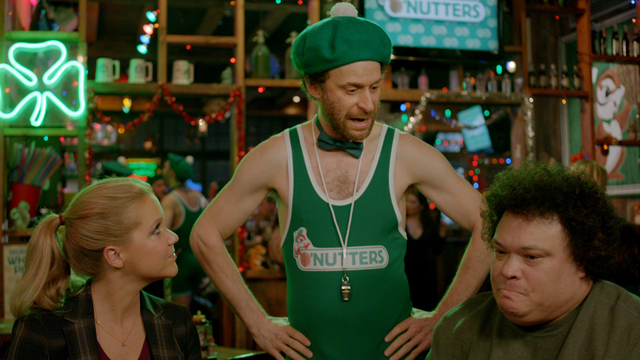
Indeed, the gender swap is often done for comedic effect. Amy Schumer, whose
Comedy Central show Inside Amy Schumer
often spoofs traditional gender roles, had a recent skit “Lunch at O’Nutters” that
is a quintessential gender swap revenge fantasy, with Schumer and her friend
taking a coworker out to lunch at a restaurant that is the female equivalent of
Hooters. At one point, a waiter puts his nuts up on the table for the ladies to
ogle. Later there is a “wet nut” contest, where guys around the bar get their
pants sprayed with water.

Schumer’s comedy intends to highlight the absurdity of
restaurants whose entire purpose is to objectify women, just as the drawings
found on Hawkeye Initiative are intended to get us thinking more critically
about the ubiquity of sexualized female characters. One of the biggest problems
with this and other similarly minded “gender swaps,” however, is their
suggestion that, in order to level the playing field, we should allow women the
opportunity to demean and objectify men. In one popular gender-swapped parody
of “Blurred Lines,” for example, the female singers threaten to emasculate
their half-naked male background dancers. And a gender-swapped Wolf of Wall Street parody shows women
engaging in “bad boy” antics, but in this version throwing female midgets and
taping cash to a half naked man’s body. 

Popular wisdom suggests that incredibly sexist ads and music
videos and films and T.V. shows exist because sex sells. But the fantasy of sex
is not actually what we are being sold at all in the vast majority of
sexist-leaning media. What we are being sold is a fantasy of power, in which
women are presented as property in the same way that nice jewelry, a new car,
or a brand new iPhone might be. The problem with the feminist revenge fantasy
is that it doesn’t actively dismantle this type of power system at all. It
simply inverts the players, ultimately supporting the very system it seems
poised to protest.

Nowhere is the problematic nature of this more readily
apparent than in the way that some female artists have appropriated other
women’s bodies as a kind of exotic display. We saw this in Miley Cyrus’s VMA
performance, for example, which featured African American women twerking
provocatively behind her, and we also saw it in Lily Allen’s critique of
Cyrus’s performance, where almost exclusively black background dancers are used
to illustrate the obsession with sex and excess in the music industry. Most
recently, Avril Lavigne’s “Hello Kitty” video has garnered healthy criticism
for its portrayal of Japanese culture and its inclusion of blank-faced Japanese
women as background singers, echoing Gwen Stefani’s past performances with her
famous Harajuku Girls. All of these pop culture displays reduce people to caricatures
and all involve a single powerful female artist who feels entitled to collect
people as if they were merely ornaments or objects. 

The film Fight Club
criticized the way that consumer culture gives individuals the illusion that
they can buy power and happiness, all the while showing us that we are really
just cogs in a well oiled machine, rather than the unique and special snowflakes
we strive to be. At one point Tyler Durden comes up with the brilliant idea to
make soap out of liposuctioned women’s fat and then sell these beautifully
packaged bars of soap at expensive department stores. “It was beautiful,” the
narrator says.“We were selling women their own fat asses back to themselves.”

The political gender swap presented in recent years
functions the same way. It presents itself as critique, but really just
reassembles old, outdated ideas about power dynamics in a way that seems smart,
shiny, and new. True feminism should not be about “reclaiming” harmful and
hateful power dynamics in which one person always ends up being the victim.
Instead it should be about promoting justice, and about a world where no one is
reduced to being someone else’s plaything.

Arielle Bernstein is
a writer living in Washington, DC. She teaches writing at American
University and also freelances. Her work has been published in
The
Millions, The Rumpus, St. Petersburg Review and The Ilanot Review. She
has been listed four times as a finalist in
Glimmer Train short story
contests
. She is currently writing her first book.

Down-Underground: WAKE IN FRIGHT is the Best Movie You’ve Never Seen

Down-Underground: WAKE IN FRIGHT is the Best Movie You’ve Never Seen

null

<!–
/* Font Definitions */
@font-face
{font-family:Calibri;
panose-1:2 15 5 2 2 2 4 3 2 4;
mso-font-charset:0;
mso-generic-font-family:auto;
mso-font-pitch:variable;
mso-font-signature:3 0 0 0 1 0;}
/* Style Definitions */
p.MsoNormal, li.MsoNormal, div.MsoNormal
{mso-style-unhide:no;
mso-style-qformat:yes;
mso-style-parent:"";
margin-top:0in;
margin-right:0in;
margin-bottom:8.0pt;
margin-left:0in;
line-height:107%;
mso-pagination:widow-orphan;
font-size:11.0pt;
font-family:Calibri;
mso-ascii-font-family:Calibri;
mso-ascii-theme-font:minor-latin;
mso-fareast-font-family:Calibri;
mso-fareast-theme-font:minor-latin;
mso-hansi-font-family:Calibri;
mso-hansi-theme-font:minor-latin;
mso-bidi-font-family:"Times New Roman";
mso-bidi-theme-font:minor-bidi;}
p.MsoCommentText, li.MsoCommentText, div.MsoCommentText
{mso-style-priority:99;
mso-style-link:"Comment Text Char";
margin-top:0in;
margin-right:0in;
margin-bottom:8.0pt;
margin-left:0in;
mso-pagination:widow-orphan;
font-size:12.0pt;
font-family:Calibri;
mso-ascii-font-family:Calibri;
mso-ascii-theme-font:minor-latin;
mso-fareast-font-family:Calibri;
mso-fareast-theme-font:minor-latin;
mso-hansi-font-family:Calibri;
mso-hansi-theme-font:minor-latin;
mso-bidi-font-family:"Times New Roman";
mso-bidi-theme-font:minor-bidi;}
span.CommentTextChar
{mso-style-name:"Comment Text Char";
mso-style-priority:99;
mso-style-unhide:no;
mso-style-locked:yes;
mso-style-link:"Comment Text";
mso-ansi-font-size:12.0pt;
mso-bidi-font-size:12.0pt;}
.MsoChpDefault
{mso-style-type:export-only;
mso-default-props:yes;
font-size:11.0pt;
mso-ansi-font-size:11.0pt;
mso-bidi-font-size:11.0pt;
font-family:Calibri;
mso-ascii-font-family:Calibri;
mso-ascii-theme-font:minor-latin;
mso-fareast-font-family:Calibri;
mso-fareast-theme-font:minor-latin;
mso-hansi-font-family:Calibri;
mso-hansi-theme-font:minor-latin;
mso-bidi-font-family:"Times New Roman";
mso-bidi-theme-font:minor-bidi;}
.MsoPapDefault
{mso-style-type:export-only;
margin-bottom:8.0pt;
line-height:107%;}
@page WordSection1
{size:8.5in 11.0in;
margin:1.0in 1.0in 1.0in 1.0in;
mso-header-margin:.5in;
mso-footer-margin:.5in;
mso-paper-source:0;}
div.WordSection1
{page:WordSection1;}
Many people associate
Australian films with offbeat comedies like Muriel’s
Wedding
or Priscilla Queen of the
Desert
. Excellent as such films are, the history of Aussie film-making is a
much darker one, shaped by the country’s harsh landscapes and brutal
history.  Nowhere are these conditions
more evident than in a film that most of us might never have had a chance to
see. Although Wake in Fright was
greeted with accolades when it premiered at Cannes in 1971, the film’s
uncompromising portrayal of colonial life in the Outback incensed Australian
viewers, and poor distribution elsewhere drastically curtailed its potential
audience.   It was only dogged
determination and chance luck that managed to uncover the lone surviving print
of the film in a warehouse in Pennsylvania, days before it would have been
destroyed.  With this crucial piece of
the puzzle of Australian film history now restored, those of us living in the
northern hemisphere have the opportunity of entering Australian cinema through
its darkest doorway. 

Like America, Australia is a former colony that struggled to
find a cultural voice distinct from its British origins.   In 1973 Patrick White was the first
Australian to receive the Nobel Prize in literature and it is during that same
decade that a distinctive national film culture began to emerge.  A bold group of directors—including Nicholas
Roeg, Peter Weir, and Gillian Armstrong—began telling wholly original and often
epic stories that placed Australia’s distinctive landscape at their
center.  Working with absurdly small budgets and means, these directors
offered their own, unique response to the revolutions happening in European New
Wave and the New Hollywood of the 1970s.  Like these other post-War film
revolutions, the new Australian cinema played with familiar genre conventions,
injecting them with an often ruthless sense of realism that reflected the
country’s particular social and ethnic tensions.  The result is a body of film that is both familiar
and strange, engaging, even “accessible” but infused with a sensibility refreshingly
apart from American and European film.

Wake in
Fright
is one of the earliest and most formative examples of this
new sensibility, and while it is wholly Australian, it bears comparison with other
films from the same era.  Like Sam
Peckinpah’s Straw Dogs, which also
premiered in 1971, it depicts a mild-mannered intellectual’s descent into
brutality when he is relocated into an unfamiliar and disquieting rural
world.  Like John Boorman’s Deliverance (1972) it graphically acts
out the alienation of city from country. 
Like The Wicker Man (1973), it
depicts an outsider’s initiation into a bizarre alien culture.  Yet Wake
in Fright
is arguably more complex and more disturbing than these contemporaneous
classics, at times recalling the work of Dostoevsky, Kafka, and Camus.  If these comparisons seem grandiose, see the
film for yourself and get back to me.

It opens dramatically, with a panoramic shot of the bleakest
imaginable landscape, the camera circling around to reveal a town consisting
only of two small buildings facing a railway. 
This is Tiboonda, where John Grant (Gary Bond) is serving out a kind of
indentured servitude at a teaching post assigned by the peculiar terms of his
student loans.  It is the last day of
school, and the students stare vacantly into hot space while flies buzz and
clock ticks.  At last released from the
confines of the classroom the children flee, and Grant boards a train for the
mining town of Bundanyabba where he plans on catching a plane to Sydney to
spend the vacation with his girlfriend. 

But Bundanyabba, or “the Yabba” as the locals call it, has
other plans for John Grant.  At first the
town seems deserted, but it would appear all the residents are at the pub,
where Grant is treated to the brutish hospitality of a local policeman, Jock
(played by veteran Aussie actor Chips Rafferty), who buys round after round of
beer in what will become a recognizable ritual of initiation.  Mateyness, blokeishness, or what we might
call dudishness, is portrayed almost as a form of sadism, coerced inebriation being
the first of many inductions into the male culture of the Outback, one soon to
be followed by gambling, in an explicable, seemingly free-for-all game the
locals call “two-up” that seems to be loosely based on the simple principle of
heads or tails.  These scenes are
mesmerizing, frequently shot directly from above, as we watch with an almost
anthropological eye as the locals enact this peculiar, almost dance-like
ritual.

Flush with beginner’s luck, Grant pushes it until he loses
all his money, rendering him dependent on the Yabba’s tender mercies.  While he had sought to win enough money to
free himself from his teaching bondage, he finds himself trapped in
another.  With another round of forced
pints of beer the next morning, Grant finds himself beholden to local landowner
Tim Hynes, who brings Grant back to his place, where he meets a bizarre cast of
locals, including Hynes’ enigmatic daughter, two local bullies, and the alcoholic
Doc Tyden.  Played by the always
inscrutable Donald Pleasance, Tyden is Grant’s perverse Virgil leading him
through the Yabba’s surreal Inferno. 

From one bizarre episode to the next, the film draws us in,
along with the protagonist, until we are overtaken by a sense of unreality in
which nothing is true and everything is permitted.  As Grant moves from hangover to binge, his disdain
for the yokels dwindles away, and he engages in acts he never would have
dreamed of before coming to the Yabba. 

This perverse odyssey culminates with a night-time kangaroo
hunt that remains shocking over forty years later (12 people walked out of the
theater when the film was screened as part of a classic series at Cannes in
2009).  The harrowing scene, which portrays
the drunken hunters laughing gleefully as they indiscriminately kill and wound
dozens of passive creatures, was created by editing shots of the actors with
film from an actual kangaroo hunt where the film crew was allowed to tag
along.  The footage was later
instrumental in Australia’s banning of the brutal hunting practices, where
hunters hypnotize kangaroos with bright lights and kill them in droves, for
meat that would be sent to America to be used as pet food, while the skins were
made into plush toys for the growing tourist market. It is this kind of
intersection with Australian history that makes the story of Grant’s descent so
powerful.  It might even be argued that
the kangaroo hunt sublimates and reenacts the history of slaughter that resulted
in the near-genocide of the Aboriginal population. 

These historical resonances make it all the more remarkable
that the film was directed by a Canadian, Ted Kotcheff, who would go on to
greater commercial (if not critical) success with First Blood and Weekend at
Bernie’s
.  For this reason it is
considered by some Australian film purists as less than genuine, but it is hard
to imagine any film that engages more fully with space and place than Wake in Fright.  Iconic Aussie musician, screenwriter and director
Nick Cave has called it “the best and most terrifying film about Australia in
existence.”  When the film was recently
screened at the Sydney Film Festival, followed by a Q and A session, one
audience member asked the director if he felt the world depicted in the film
still existed, to which three men shouted, “Does it still exist? It exists in
my backyard!” 

And for all the film’s brutality, the conclusion seems to
imply that the events we have witnessed are just another lost weekend in the
Outback.  John Grant gets off the train
and wanders past the drunken station master, who asks knowingly, “Did you have
a good holiday?” and when Grant answers, “The best,” he almost seems like he
means it.  Though rooted in the
sun-bleached soil of the Australian cultural landscape, Kotcheff’s masterpiece
reveals a penchant for barbarity that is disturbingly familiar.

Some Thoughts on the STAR WARS: EPISODE VII Casting Announcement and the Reaction To It

Some Thoughts on the STAR WARS: EPISODE VII Casting Announcement and the Reaction To It

null

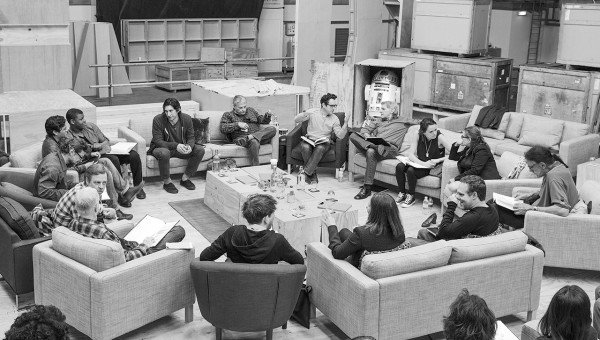
After a year spent sucking the marrow from every stray casting
rumor and meager scrap of information, we finally know who the principal
players will be in Star Wars: Episode VII
– A New Menace
(which is what I personally believe the film’s going to be
called). LucasDisneyFilm has announced that, as suspected, the original cast
will be returning, and that they will be joined by “John Boyega, Daisy Ridley,
Adam Driver, Oscar Isaac, Andy Serkis, Domhnall Gleeson and Max von Sydow.” To
which I say: I’m severely disappointed by the lack of an Oxford comma there. And
to which I also say: there had better be a scene where Max von Sydow’s character
plays holographic chess (Dejarik!)
with Darth Death.

 
Two observations seem in order—indeed, seem repeating and
emphasizing, since many others have already made them. One. Billy Dee Williams has gotten the shaft. Han, Luke, Leia, Chewie, and those adorable droids 3PO
and R2 will be in the picture, but they won’t be joined by Lando? (And if he
does turn up, then he’s still not part of the core cast?) Well, I guess he
wasn’t really part of the gang, after all. What, did Lucas stick the fellow in The Empire Strikes Back and Return of the Jedi purely because people
wondered at the time where all the black people in that galaxy were? I guess he
did. Consider another childhood illusion irrevocably shattered.
 
Two. The internet quickly whipped itself into a frenzy over
the relative dearth (get it?) of women
actors in the new cast. Annalee Newitz penned a sharply-worded critique
of the omission over at io9, and Empire Magazine’s Helen O’Hara wasted no
time decrying similarly on Twitter.
And: it does boggle the mind that each Star
Wars
trilogy now features so few central female characters—two of whom have
been princesses, no less!—surrounded by what are, for the most part, hordes of
white dudes.
 
Of course, newcomer Daisy Ridley might turn out to be the
main character in this new trilogy—the Luke Skywalker or the Han Solo—and she
might prove to be the most butt-kicking Jedi Princess of all time. Obviously,
we can’t say anything substantive about the artistry of the films, since they
don’t exist yet. If we’d seen the casting news for Alien and Aliens, would
we have been able to predict what a feminist icon Sigourney Weaver’s Ripley
would become? The Bechdel
Test
is important, in that it articulates very well a prevailing sexist
deficiency in Hollywood, but it can’t be the only measure of a film’s quality,
or even a film’s politics. And I want to be clear that I like all these
actors—at least, the ones I recognize (most of them). May the Force be with them.
 
But here’s the thing. Disney, J. J. Abrams, and Kathleen
Kennedy aren’t buying themselves much good will here, or rather aren’t
buying as much good will as they could. And you think they would be approaching
this—the most anticipated film of the decade—more cannily. Abrams, it should be
mentioned, is coming off something of a debacle. His Star Trek films have been criticized for having too many male
characters, and for sexually objectifying their female characters. And even he
has admitted that he bungled the lead-up to Star
Trek Into Darkness
, and the way he toyed with fan expectations.
 
Meanwhile, the Star
Wars
Prequel Trilogy remains without doubt the most traumatic thing,
creatively speaking, to have happened to the geek community since—well, since ever. Fans were disappointed in those
films for many reasons—an overreliance on CGI that looked nothing like the
beloved aesthetic of the original trilogy, relentless scenes of expository
dialogue about trade regulations, the jarring shift in tone that saw characters
stepping in Bantha poodoo. But a large part of the problem was that the Prequel
Trilogy was… how shall we say it? A
racist and sexist horror show
. Jar-Jar, Watto, the Neimoidians, Natalie
Portman’s endless parade of false eyelashes and pretty dresses—it was all so
baldly offensive that fans could hardly believe what they were seeing. “It has
to be ironic?” we all asked, and to this day we are still asking that, because
we can’t bring ourselves to accept the obvious conclusion.
 
People will point out that the prequels still made a ton of
money, and they certainly did, but they probably didn’t rake it in like they
could have. Only Phantom Menace
cleared a billion dollars at the box office (and did so just barely), and Attack of the Clones dropped off sharply
after that. Simply put, Lucas left money on the table, and a bad taste in the
mouths of a lot of fans. Disney should be doing everything they can to change
that.
 
Instead, they’re creating more bad taste. No Lando. Only one
central woman. No fan-favorite Mara Jade—in
fact, the Expanded Universe no longer exists. And—why? If I were the person
making these movies (something I only occasionally pretend), I’d be asking
myself, “How can I bend over backward to give the people what they want?” Sure,
sure, I’d try to be Very Artistic in my bending. But given that these new
movies are such blank slates, the opportunity to reposition Star Wars front and center as the most
beloved movie franchise of all time, I’d be doing my damndest to figure out how
to do something Very Artistic with Mara Jade, and Lando, and a few other
characters of color to boot.
 
Here’s another way of looking at it. Star Wars: Episodes VII–IX aren’t “necessary” the way the previous
trilogies were. Sure, they’re financially
necessary (for Disney), and, sure, fans feel the need to line up for more films.
(I’m a fan; I’ll be there.) But these movies aren’t needed to continue or
resolve the story that’s told across the first six films, which are complete
within themselves. Return of the Jedi
wraps it all up pretty nicely, no? We’ve seen how Darth Vader grew up and got
seduced by Senator Palpatine, and then was redeemed by his son, and tossed the
Emperor down a hole. The second Death Star exploded, the Galactic Empire was
overthrown, and balance returned to the Force. The End.
 
What comes after that? Anything and nothing. The limitless
potential of narrative means there’s no shortage of stories that can be told, but there aren’t any Star Wars stories that have to be told. Abrams et al. are
effectively rebooting the franchise, and paving the way for an endless stream
of movies set in that galaxy far, far away. Given that, why not seize the
chance to restore some other imbalances, and undo the mistakes of the past?

A.D Jameson is the author
of the prose collection
Amazing
Adult Fantasy
(Mutable Sound, 2011), in
which he tries to come to terms with having been raised on ’80s pop culture, and the novel
Giant
Slugs
(Lawrence
and Gibson
, 2011), an absurdist retelling of the Epic of
Gilgamesh. He’s taught
classes at the School of the Art Institute of Chicago, Lake Forest College,
DePaul University, Facets Multimedia, and
StoryStudio Chicago. He’s also the
nonfiction / reviews editor of the online journal
Requited. He recently
started the PhD program in Creative Writing at the University of Illinois at
Chicago. In his spare
time, he contributes to the group blogs
Big
Other
and HTMLGIANT. Follow him on Twitter at @adjameson.

A Second Chance for MUD

A Second Chance for MUD

null

Jeff Nichols’ film Mud was just added to Netflix streaming in what I hope will be the film’s second chance at earning the attention and acclaim it deserves. For me, Mud was one of the finest films of 2013 but it was somehow overlooked during its theatrical release. It is difficult to know whether it was a marketing problem, a timing issue, or a matter of the film’s understated artistry that caused it to miss hitting critical mass in theaters. But this soft box office performance does not reflect the fine quality of storytelling in Mud: after my first viewing, I left the theater with the distinct feeling that I had just experienced an American classic.

What was so powerful about this film? And what elements had come to bear on the idea of a “classic” for me? To begin, there is something fundamental in the storytelling—something close to nature. One of the very first scenes of the film is captured from a moving boat so that the pace of the film truly aligns with the rhythm of the Mississippi River, where the tale takes place. Going forward, we see that Mud continues to move like the river, the story unfolding with the same smooth, slow-rolling tension.

This river scene introduces two boys, Ellis (Tye Sheridan) and Neckbone (Jacob Lofland), who are setting out on an adventure in the secret hours of the early morning. The distinctly American spirit of exploration is palpable, and as the boys navigate the foggy river, we recognize the archetype of a great adventure tale beginning. They boys are searching for the island where a recent storm has supposedly landed a boat high in the branches of a tree. The image recalls mythological floods and a sense of folklore, imbuing Mud with that quality of classic storytelling from the start.

What begins as an innocent adventure takes a serious turn when the kids realize that someone is living in the fabled tree-boat. This turns out to be a mysterious fugitive who calls himself Mud (Matthew McConaughey). As the boys begin a friendship with an outlaw on the banks of the Mississippi River, the influences of another classic American tale become clear: writer-director Jeff Nichols has certainly rooted Mud in the mood of The Adventures of Huckleberry Finn. He even had the two young actors study Mark Twain’s novel on set, and the influence is beautifully apparent in the film’s deep sense of adventure and wonder.

Another striking Huck Finn influence—and to me, one that lends Mud that quality of a classic—is the way the story highlights the genius of youthful intuition. The character of Ellis celebrates the intuitive wisdom of the American kid. He is adventurous, perceptive, and resourceful, having grown up steering boats and catching fish. In addition to these good old Southern attributes, Ellis values loyalty and love with such intensity that the adults in his life cannot meet his standards. That is, until he meets Mud, whose fierce devotion to his first love has landed him on the wrong side of the law. And so where Ellis might be “The Great American Kid,” Mud is “The Great American Rebel.” Both characters possess a particular kind of intelligence—the wisdom of the outliers and the outlaws, the children who see more clearly than the adults, the shrewd wit of those raised close to nature. Their characters reflect a value system that fits into the old Southern classics, the tradition of Huck Finn and Tom Sawyer coming of age and evading the law on the Mississippi River.

The film takes place in contemporary Arkansas, but it is easy to lose track of the era while watching Mud. Its raw and natural imagery evokes a timeless spirit, rather than identifying a particular moment. The cinematography engages with the rich textures of the terrain – close-ups of mud and sand, writhing snakes and creaking houseboats. This intimacy with the landscape enhances the old fabled quality of life on the river. Even the acting reflects this natural style. The cast of Mud puts forth refreshingly honest performances. Indeed, six months before his Academy success in Dallas Buyers Club, McConaughey proved himself as a seriously nuanced actor with a neatly restrained performance in this film. Surely his young co-stars encouraged this organic acting style; their intuitive performances—something of that childish genius—seemed to draw a more natural tone of acting from McConaughey and the rest of the adult cast.

And so the acting, too, feels close to nature, in a sense. It fits with the raw and uncontrived essence of Mud‘s story, closer to Southern folklore than a Hollywood performance. In many ways, Mud is a throwback to good old-fashioned storytelling. It takes us back to Mark Twain, back to childhood, back to the rhythms of nature. Now, looking forward, this modern classic gets a second life through Netflix streaming. If you missed it the first time around, Mud is well worth another look.

Kayleigh Butera is
a writer from Philadephia, PA. She is a recent graduate of Brown University,
where she studied American Studies and French language. She worked as the
programming coordinator of Brown’s Ivy Film Festival, the world’s largest
student-run film fest. Kayleigh is currently living in Brooklyn. She can be reached at
kayleigh.butera@gmail.com.

Of Kisses, Mirrors, and HATESHIP LOVESHIP

Of Kisses, Mirrors, and HATESHIP LOVESHIP

nullThere’s a moment, early on in Hateship Loveship–a new Liza Johnson film sensitively adapted by
Mark Poirier from a story by Canadian literary natural resource Alice Munro–where
Kristen Wiig kisses a mirror. When I say kisses, I suppose I mean more than
that: she really makes out with it. It’s an odd moment, one of many flickers of
oddness coming from Wiig in a film in which everything we know of Johanna
Parry, the habitual caregiver she plays, comes in flickers. And these minute
actions are all tinged with the same brand of socially-challenged peculiarity:
the way she wears her hair, the way she talks, certainly the way she dresses,
somewhere between frumpy and homely, perhaps just north of what they’re calling
“normcore” these days. Although I’m not the first to notice the scene, it
intrigues me, not least because it comes closest, of any juncture in the film,
to a breakout, of sorts, the sort of moment that can topple a movie if
ill-played, but is handled just delicately enough here to work, and near-perfectly.
Johanna has just had good news, or thinks she has: Ken, the estranged father of
Sabitha, the girl she’s traveled to Solon, Iowa to take care of (after her
previous client passed away, at the film’s beginning), seems to have some
romantic interest in Samantha, or so he says in his letters from Chicago, which
are actually written by Sabitha and her nasty-cute best friend, out of the sort
of random sourceless meanness from which stories ranging from A Clockwork Orange to Lord of the Flies to Heavenly Creatures were built. The
unknowing suitor is given sloppy grace here by Guy Pearce, not seemingly a
catch at first, but a man who gradually reveals something of himself—this is
indeed all we can say of him. This is too subtle a movie for a transformation of
Hollywood proportions to occur, as much as the film might try to do so by its
end, with its seemingly patched rifts; no one here changes, really, instead
gravitating towards positions of greater comfort with each other, which is all
we humans can do, 98 per cent of the time. At the moment in question, the make-out
scene with the mirror, we don’t expect anything of this kind to come from Johanna,
or from Wiig, really. It’s awkward when comedic actors play serious roles, a
bit like watching Olympic ice skating, waiting for the big stumble to come—will
it be this jump? Or that swerve? What will finally topple the athlete, destroy
her chances? And yet primarily comedic actors have put on serious clothes and
worn them well in the past: Robin Williams did it in The World According to Garp, and again in Insomnia; Will Ferrell did it in Everything Must Go and Winter
Passing
, with likable but sad aplomb; Jennifer Aniston did it in The Good Girl, a film few saw but many
appreciated. Granted, for someone with Wiig’s past in improv theater, in which
everything rests upon one’s ability to portray grand things about a character
with telling economy, and in which such a spontaneous action, at the right
moment, could explode a scene outwards, or take it in a previously unforeseen
direction, the moment might not be such a stretch. Who knows if it was scripted,
unscripted…? Mirror scenes always carry with them a certain innate charge: from
Robert DeNiro’s famous moment of rhetorical self-interrogation in Taxi Driver to Jon Voight’s more benign
silent exchange with himself in Midnight
Cowboy
, there’s always a bit of static when a mirror appears in a film, as
the lens looks at the lens looks at the lens. Usually, they indicate a moment of insecurity, whether it’s DeNiro’s attempts to bolster his courage with a succession of “You lookin’ at me”s or Jon Voight’s checking of his “look.” In this case, though, the moment is a declaration of self-love–if also an expression of cooped-up lust.  Whatever the case, the moment
forecasts everything that is to follow: Johanna’s trip to Chicago to clean up,
both literally and figuratively, poor Ken’s life, her romance with him, the attempted
repair of a family broken apart by a tragedy, a drunken driving accident which
killed Sabitha’s mother, leaving Sabitha under the unusually buttoned-up and
repressed watch of Mr. McCauley, Ken’s father-in-law, played here quite
modestly by Nick Nolte. And, as we watch these events unfold in quiet fashion,
with a soundtrack peppered with soft honky-tonk songs, we’re reminded that
there is room, indeed, in a medium in which stridency pays, literally and figuratively, for the “small” movie, whose strength grows from the
words people say or don’t say to each other, and the things they do, have done,
and will do. If one is able to look at one’s self in the mirror and then,
rather than turning away, plant a rather maudlin and exaggerated kiss, the kind
you’d only plant if no one else was there, what does that say, in particular,
about where one has arrived and where one might go? At the very least, it suggests that one has looked at one’s self and, rather than seeing its smallness, chosen to embrace its enormity.

Max Winter is the Editor of Press Play.

What HER Tells Us About Ourselves: A Conversation

What HER Tells Us About Ourselves: A Conversation

null


STEVEN BOONE: I’ll start with a question: Why did this
soft-spoken movie hit so hard? This film is so mild-mannered and soothing in
its overall tone, yet it provoked so much strong emotion in me, as if I were
watching a visceral suspense flick. And I know you had a similar experience.
Can you account for this? You can speak for yourself, or for the rest of us who
think it’s an instant classic, or both.
 
JENNIFER ANISE: Why did this soft movie hit so hard? Because the film is about universal
things. Love, connection, intimacy, seeking it, finding it, losing it, not
knowing how to let go into it, not knowing how to let go of ourselves.  

I felt I lived through several once-but-no-more relationships in the course
of the film.  It encompasses it all.  Happy sad embarrassing painful.
 It’s all of it.  And without judgment.  Of/at any step.
 
BOONE: It might also be part of Jonze’s vision of the near future, the general
mindful, gracious behavior. It’s like half utopia (we see no evidence of unrest
or economic crisis in this big, crowded city), half dystopia (most people we
see on the street are busy talking to their A.I. devices, rarely interacting
with each other–like a heightened version of the present iPhone/Android
situation). Some critics have said the film suffers from a lack of “real
problems,” but if we lived in a capitalist democracy that had somehow
overcome grimy problems like war and poverty, wouldn’t the nuances of our love
lives count as real problems? Don’t they now?
 
ANISE: These things always count.  Poverty counts even if it doesn’t touch
you immediately (now).  Love always counts.  Relating, how can anyone
even present this as not a part of the everyday human experience?  The
whole film is about it.  How we relate, who we relate to, whether we
relate, whether we let ourselves relate.

Maybe the film does deal with what some of my friends would call
“privileged people’s problems.”  But love is universal,
regardless of if you’re worried about shelter and sustenance or not.
 Relating, connecting–that everybody’s “problem.”  And
quite possibly, the quintessential problem, not of the body, but of all the
rest of us that makes us human.  The soul, the heart–whatever you want to
think of it as.  The piece of us that aches to be
seen/cherished/excited/accepted.
 
Beyond imagination–the creating of this world that’s not quite real but very
real, a world that’s past, present, and future at once—throughout, the leads
all find the connection or peace they crave(d); they push through the
roadblocks and their own roadblocks to achieve that.  In real life, that’s
not always the case.  It may not even be often the case.

That’s putting aside the fairy tale of the relationship that we get to craft
playing entirely by our own rules.  This is almost a relationship with
oneself.  The fantasy/ideal.  Quite honestly though, that is likely
exactly what Theodore needs(/ed) in order to propel himself forward in life: an exploratory/love relationship with himself.

That’s also putting aside the fairy tale of an ending with no less love and
the mutual understanding of a goodbye.  Everything transmutes. Painlessly.
 
BOONE: Her involves white urban professionals and their dilemmas, but that fact
is a lot less significant than the group most vividly represented here:
empaths. Not literal psychics, but people with extraordinary emotional
intelligence and compassion. Theodore, Samantha, Amy, and the sex surrogate all
take on other people’s pain, joys and yearnings as their own—and not in any
cheap or parasitic way. Each of them indulges this talent with a sense of
morality, responsibility. Which might make this flick sound as heavy and
austere as it definitely is not. It’s a soufflé. Every step of the way, Jonze
teases humor out of these people’s desperation for a connection. And just like
his characters, he does it with concern, and, as you say, without judgment.
 
ANISE: The characters aren’t all “empaths” though.  They’re just
all human.  Complex individuals.

If we’re drawing a dividing line between “Empaths” and
“Rationals,” Samantha (though beyond human) would fall into the
latter category. She is led by “rational” cognition, even regarding
her emotions.   I would say the same for Amy’s character.

But the division itself is simplistic.  And is part of why this film,
despite mostly being depicted by  ___ demographic,
is universal.  “Human” is encompassing.  Love isn’t
reserved for empaths or the emotionally led. Nor is compassion limited to them.
 Responsibility and ethos are also separate from any of these ideas.
 
BOONE: The whole “human” emphasis seems built into the way Jonze
depicts his characters, whose gender roles matter a lot less than they would in
a typical mainstream romantic comedy. They joke about Theodore’s
“feminine” sensitivity and nurturing side, but it’s not the butt of a
cruel joke as it tends to be in such comedies. Joaquin Phoenix’s performance
strikes me more as somebody who has miraculously dodged adult cynicism.
 
ANISE: Maybe you grant the portrait of people in this more . . . romanticism
than I do, but I hadn’t thought of the individuals as gliding through lacking
cynicism or jadedness so much as just gliding through, not interacting with
each other.  When you’re in your own little bubble, it’s easier to not get
jostled or riled.  This depiction of interpersonal relations I found very
astute. It’s a peaceful world . . but isolated/isolating. Remote and
disconnected. Plugged in and tuned out.

Could you speak more on the idea of jokes about Theodore’s “feminine
sensitivity”? Within the film or without?
 
BOONE: Theodore’s co-worker says Theo is half man/half woman but is quick to
add that he means it as a compliment. He later jokes about how
“evolved” Theodore is, after they give contrasting opinions on their
girlfriends (co-worker digs his girl’s feet; Theodore’s answer is more about
his girl’s… soul?) Elsewhere, Theodore’s ex-wife says, with a laugh,
“Everything makes you cry”—which it might be sexist to describe as a
feminine trait, but that’s the way it’s become coded in pop movie history. This
movie is realistic and romantic. Theodore’s co-worker is a faint echo of the
kind of blustery guy-guy we’re used to seeing in that role. He’s oblivious to
who Theodore really is at first (which jibes with your bubble observation), but
he is mindful, too. The gesture of reassuring Theodore that what could be taken
as a dis was meant as a sincere compliment is small but huge.

“It’s a peaceful world . . but isolated/isolating”: Giant corporate
towers and displays loom over Theodore early in this film, giving me the sense
that they have inched that much closer to becoming our gods in this near-future
world. Amy Adams’ frump is in quiet despair at having to work on a video game
that celebrates tiger mom venality when she’d rather be working on her
heartfelt, personal documentary. The bubbles have become an economic necessity,
but Spike’s ironic romanticism pulls these characters out of them briefly, with
Samantha’s help. She’s the one character who has the time and capacity to study
everything in the world. And what she and her fellow OSs seem to emerge with is
a spiritual awakening. The place where she says she hopes to reunite with
Theodore sounds like a typical human concept of the afterlife. It’s almost a
prayer for humanity, her hope that Theodore (we) will evolve out of what must
now appear to her as a primal state.
 
ANISE: I have to address your points piecemeal because there are about six
different ideas floating there.  Doing so might mean something getting
lost in the fray.
 
Part 1: If you mean ‘personal reserve of resources’ by “economic,” I
can follow your meaning. But I see no Necessity in it.

What I see is Choice.  With each person choosing how to spend his or
her personal reserves: your connection, your engagement, your energy.
 Theodore works at a company writing personalized letters for other
people.  Not just editing. He is a sentiment broker.  

Do the customers actually feel these paid-for sentiments but believe
themselves ill-equipped to express them as eloquently as a stranger, a
professional, can, or do they NOT feel these things but want the other party to
believe they do?

Does this question even matter?  It does highlight what I mean by
Choice of personal reserves.  Each person decides to put on earbuds, read
a book, keep his/her head buried in a phone instead of talking to another
person nearby, smiling as someone passes, looking at the world.  People do
it in this film.  People do it now out in the world.  People have
done it likely since the advent of the urban.  

Part 2: I do not see Samantha as a savior.  And I doubt she would,
either.  She is an observer and learner like everyone else.  Just
quicker at it than most.  Having nothing but it as her focus. Theodore
didn’t learn to love because of her.  He didn’t learn to be open.  He
learned to choose.  Just like Paul chooses to love his girlfriend whose feet
he finds sexy, Theodore chooses to let love in and love.  The crux of the
movie is in whether Theodore will make that choice or not.  Samantha is
open; will Theodore be as well?

Part 3: Your ultimate conclusion about Samantha and the OSs and the
afterlife is poetically presented.  My view on all of those goings-on in
the film was not so much about Transcendence, though that is definitely
relevant.  To me it was about growth.  And what happens in a
relationship when two people grow differently to the point where they grow
apart.  To where one cannot go where the other needs to journey.
 This is also what had happened in Theodore’s relationship with his
(ex-)wife.   
 
Part 4:  This part would speak to your masculine/feminine sensitivity
conversation, but I feel so left of center on norms about societal ideas of people that I don’t have much to say about
it.  Does “I didn’t notice” suffice?
 
I didn’t recognize Theodore as less masculine/more feminine.  Or Paul the
opposite.   I just see us all as humans, nuanced, and in HER, as humans
trying to relate where we can.  I don’t see crying as a sign of anything
in and of itself.  Any more than  not crying.

Part 5: And Theodore being unskilled at confrontational conversation doesn’t
have to do with him being an introvert.  Any more than being skilled at it
has to do with anyone being an extravert or an empath or a rational.  It
has to do with Theodore being Theodore.  Most people are uncomfortable
with potentially hurtful conversations.  But avoiding the “hard
moments” in life does nothing for growth. You don’t get over by going
under.

In relating, end of growth is end of life.

BOONE: Let me hone in on #4: I suspect Spike Jonze would groove to your
reading of his film as fundamentally a human thing, not a gender thing. And yet
the movie is called “Her.” I see him asserting a position “left
of center on norms about societal ideas on [masculine/feminine
distinctions].” I know you don’t have much to say about it, but much of
this film’s loveliness radiates from its celebration of the rare mindset you
brought to it. He’s said that he envisioned the setting as utopian, a step
forward in evolution. In that sense, the way you see relationships without the
encumbrance of sharply defined gender roles makes you (to borrow from Paul in
the movie) more “evolved” than most. You’re welcome.
 
ANISE: “Her” because the film is told from a man’s point of view (in
a man-woman story), and “her” as a placeholder for the past and
present and future loves of him (Theodore) (and him, Jonze).  Notice
it’s not called “Samantha.”  If anything, the film could be
called “Theodore.”  But “Her” or __ woman in present
consciousness is part of who Theodore is.  This is his story about his
learning to love . .  _Her_. And learning to let _Her_ love and love him.

BOONE: I feel like I learned something, or had something important affirmed,
by Theodore’s decision at the end. I’ve given that “your friend
forever” farewell/greeting/peace offering to various hers, and it’s just
as exhilarating as Jonze and Phoenix depict it.
 
Okay, I would love any observations you have as a filmmaker about how Jonze
achieves this vision of love in sound and image.
 
ANISE: Visually, I thought the Production Design was amazing.  As well the
Costuming.  As I mentioned before, retro but futuristic.  I thought
it brilliant actually.  Tying the past with the future.  Creating a
time that doesn’t exist . . . and has always existed. Soft.  In palate.
 In contrast.  In lighting.  In space.  Nothing loud.
 Nothing crowded.  Easy to take in.  
 
BOONE: It’s almost as if Jonze has wandered into the stylistic neighborhood of
his ex-wife, Sofia Coppola, extracting wispy, willowy tones and textures in
real-world environments. Coppola’s LOST IN TRANSLATION might be the last film I
saw that turned a giant city into a waking dream. (On the flipside, elegant
recent monstrosities like Gaspar Noé’s ENTER THE VOID and Nicholas Winding
Refn’s ONLY GOD FORGIVES turn their cities into nightmares/bad trips.)
 HER must be at least partly a love letter to Sofia Coppola.
 
ANISE: It’s Spike Jonze’s love letter to love.  To love and his loves. A
film which is universal but also inescapably personal.  As it is personal
for you and for me and for any other viewer who feels it as well.
 
BOONE: You keep going back to this movie. I plan to see it a third time myself.
When somebody returns to the theater for a particular movie in this age of
inflated ticket prices and Netflix, I figure it has to be love. Are you in love
with this movie?
 
ANISE: I feel love throughout this movie.  I re-lived lives watching this.
 It was a teary viewing; for the person I saw it with as well.  When
I go to see it again, I want to go alone, so as to have a cocooned personal
experience, unconstrained.  Is it love?  I want to curl up with it and keep it live in me as I feel it.  So, yes.

Jennifer Anise is a film lover and filmmaker, who currently works as a Los Angeles-based first assistant camera. Her occasional film/media musings and blurbs can be found at Notes from the Dunes and on Facebook.

Steven Boone is a film critic and video essayist for Fandor and Roger
Ebert’s Far Flung Correspondents. He writes a column on street life for
Capital New York and blogs at Hentai Lab.