The Age of Counter-Intuition: What Thomas Vinterberg’s THE HUNT Might Tell Us About the George Zimmerman Verdict, Iraq, McCarthyism, and Other American Mistakes

The Age of Counter-Intuition: What Thomas Vinterberg’s THE HUNT Might Tell Us About Ourselves

null

NOTE: This piece contains spoilers.

The American imagination thrives on misinformation. Why was
America’s invasion of Iraq sanctioned by so many in 2003?  Because it was proposed that the country
possessed weapons of mass destruction. Were supporters of the invasion sure? Chances
are they weren’t, at bottom. But those in charge had a hunch. And that was, for
some, good enough. Why was George Zimmerman declared innocent in the shooting death of Trayvon Martin? Because his
jurors couldn’t prove he was guilty. Were his jurors sure he was innocent?
Probably not. But in the absence of opposing evidence—or the reluctance to bring intuition to bear—they handed over their verdict. In the 1950s, why did
McCarthyism stick in the public imagination, and not leave? For precisely the
same reason—vast numbers of intellectually incurious Americans just weren’t sure. And the vision
presented, in each case—of a nation of bad guys, of one bad guy who apparently provoked
an officer, of a league of secretive bad guys who were overthrowing the
government—was too delicious to resist. You wouldn’t necessarily think of The Hunt as a film that might speak to American life, whatever that is, but there is quite a bit in it that
might appeal to the growing American longing for justice, denied perpetually
by the seductiveness of counter-intuition, which grows like wildfire if allowed.
This film is almost a fable about that very tendency. The film has an eerie
quietness which, I’d like to think, grows out of the great simplicity of its
story, one of alleged child abuse in a small town—but this silence also might
suggest, to some American viewers, a highly focused portrait of daily life, the
unreality of its struggles and tortures merely suggestive of the daily news,
the silence of, well, truth.

Lucas is an assistant at a small school; though he was meant for a better position, taken from him when his previous school closed, he seems content with his lot. Played with a telling blankness
by Mads Mikkelsen, the kind of blankness you know will develop into rage with
time, Lucas is utterly at ease with children, the only sort of adult male
who would fit comfortably at a school with an all-female staff, bouncing up and
down like a cartoon character in early scenes. When he refuses the affections
of little Klara, beautifully played by Annika Wedderkopp, she tells a naughty tale
about him that, as all such tales do, grows in dimension. Because those in
charge, namely the most repressed-seeming schoolmarm you could possibly
imagine, brought to toe-curling life by Susse Wold, believe the child, because
she is, after all, incredibly cute, and the subject of her stories is, after
all, a man, Lucas is fired. But that’s really the least of it.

Lucas has many friends at the beginning of the film, but as
it continues he finds he has only family on his side. The bluntness and
immediacy with which he is punished is near-comic in its simplicity. The owner
of the local grocery tells Lucas’ son, explicitly, that he isn’t wanted there,
and neither is his father. Lucas is told, when he goes shopping, to leave the
premises in simple, painful terms, and when he doesn’t comply, he’s beaten up
and, quite literally, thrown out of the store. When he seeks refuge with his
trusting and distinctively intelligent brother, all goes well until a huge
stone flies through the kitchen window and his dog is murdered. The moral
certainty of his accusers is timeless: from the crowds in M to the angry mobs in old Westerns to the villagers in Frankenstein, the cliché that strength
in numbers masks a larger weakness receives signboard-sized illustration here.

Lucas becomes a
rather degraded version of himself as his punishment settles in. He begins
drinking far more than he used to. A romance he had started with a co-worker
collapses when he tosses her out of his house (literally) after she expresses
doubts about his innocence. His son comes to stay with him, the one bright spot
in the decline, but then finds himself locked out of his house after Lucas is
arrested. Towards the end of the film, Lucas staggers into a Christmas Mass,
bruised and drunk, the opposite of the bland-seeming fellow he had been. And at
this point, the allegory rises to a crescendo: humanity is capable of limitless
castigation, if its mind sets to it. This sort of castigation knows no borders:
it could be Trayvon Martin, killed under the suspicion of aggression, or it
could be countless innocent Iraqi children, killed by mere association. Or,
reaching back a little bit, American lives might be ruined on the basis of mere
suspicion of “un-American” sentiments.

As the film continues, it calms itself down a bit—and at the
end, Lucas even receives a pardon, of sorts, along with a reunion with Klara’s once-furious father, who was his best friend before the controversy began. The film ends with a poignant
moment, again all-too-relevant to what has become an increasingly American pattern of behavior in recent years. While he is
out on a hunting expedition with the men who had cast him out less than a year
previously, Lucas finds himself first dodging a bullet, and then staring into
the crosshairs of a gun, aimed by an obscured assailant. The film leaves us here, as if to remind us that suspicion, irrationality and, ultimately punishment walk beside us all the time, waiting for the right moment to surface.

Max Winter is the Editor-in-Chief of Press Play.

We Are the Disease: Apocalypse Porn, the American Zombie, and WORLD WAR Z

We Are the Disease: Apocalypse Porn, the American Zombie, and WORLD WAR Z

nullIf there’s one
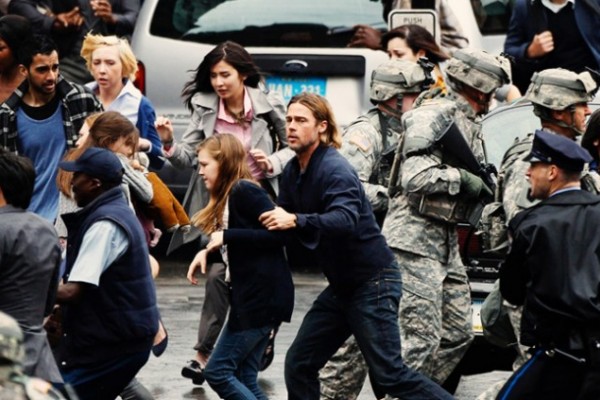
thing World War Z proves, it’s that
the apocalypse can be more than just exhilarating; it can be downright
gorgeous. There’s a certain splendor in chaos, and the film’s creators make
full use of their oft-discussed budget
by sparing not a single moment of grisly stimulation. But if viewers were interested
in aesthetics alone, they’d find no shortage
of outlets elsewhere. Mirroring
and building upon a similar fixation in the 1980s, what World War Z so effectively embodies is the American obsession with
the very idea of apocalypse: the myriad ways we will ruin ourselves, how we
will cope with that ruin, and how we will start over.

In his article,
Pessimism Porn,” Hugo
Lindgren describes our amplified interest in financial collapse following the
economic downturn of the past half-decade, and how this interest manifests in
our daily habits:

“Like real
porn, the economic variety gives you the illusion of control, and similarly it
only leaves you hungry for more. But econo-porn also feeds a powerful sense of
intellectual vanity. You walk the streets feeling superior to all these
heedless knaves who have no clue what’s coming down the pike. By making
yourself miserable about the frightful hell that awaits us, you feel better.
Pessimism can be bliss too.”

Our interest in
the all-out catastrophe witnessed in World
War Z
, though, extends beyond basic entertainment and narcissism; it speaks
to a deep-rooted unrest felt most keenly by Generations X and Y. Where pessimism
porn traffics in the pleasure derived from economic collapse, apocalypse porn
stems from a desire for a cultural refashioning; it’s a reaction to our
implicit involvement in structures we feel powerless
to alter
. We’re aware of the problems we face and that we’re a part of
them, but we don’t necessarily understand where our fault lies, and,
transitively, how we’d begin to right our wrongs. Meanwhile, we feel like we’re
doing better than ever: we’re more socially conscious, less bigoted, less
wasteful. Yet income
equality
and class resentment are on the rise, careless environmental practices lead to
greater damage and catastrophe by the day, and our political system often seems
more invested in protecting
partisan interests
than solution-oriented legislation. These systems are so
deeply entrenched in the framework of modern America that to “undo” them would
take years of dedicated work built around assumptions that could prove to have
been incorrect all along.

Zombies, on the
other hand? You can just kill them.

And it feels
good to see the supposed undead put to bloody rest. They’re the hyperbolic
analog for everything Americans hate about themselves and each other: they
consume blindly and beyond what they need to survive, they’re incapable of
empathy, and they lack the agency to make any decision beyond bloodlust. Their
punishment—if killing them is even to be considered punishment—is purely
functional, inviting the easy, naïve morality of criminal justice into action
pulp, shifting the focus from the more complicated matrix of culpability and hardship
to the catharsis of strategy.

It is an
accepted fact that dehumanization
occurs as a coping mechanism during wartime; in order to sterilize the emotional
toll of killing, we distance ourselves from the humanity of our enemies. Zombies
don’t even require that effort—they’re pre-packaged humanoid monsters. Part of
what makes World War Z such a
quintessential exemplar of apocalypse porn, in fact, is in its portrayal of these
iconic creatures. In keeping with 28 Days
Later
, the zombies in this film are not the slow-moving mutes of bygone
days. They’re powerful, capable of swift damage, best observed in scenes like
the closer to the film’s trailer. But World
War Z
owes as much to pandemic films like Contagion as it does to 28
Days
; the zombies’ real power lies in infestation, not singular scares. Often
depicted from the bird’s eye, in plain sight, they appear more an insect swarm
than individual teeth gnashers. From such a remove, they leave the impression
of scrambling ants
in the moment the anthill is kicked (particularly set against the sandy
backdrop of Jerusalem). This persistence in focusing on the macro—exhibited visually
through the sustained use of aerial cinematography—reveals the film’s interest
in keeping the isolated humanity (or loss thereof) from the viewer’s mind.

Distraction plays
a vital role; World War Z is no
character study. We’re supposed to be too busy rooting for the success of Brad
Pitt’s Gerry Lane amid ballooning crisis-mode, tactical narratives to notice
the millions turned into killing automatons. Most of the plot is spurred by
ticking time bomb scenarios that, if solved, serve to instigate new ones. The
ostensibly research-oriented mission to Camp Humphreys in South Korea, for
instance, devolves almost immediately into a laundry list of action tropes, all
of which disregard the human lives lost in escorting Lane back to a freshly fueled
helicopter. It is not uncommon for action films to care little for its supporting
and peripheral characters, but the gravitas of apocalypse bears greater weight than
the typical action flick—speculating about human behavior in the fallout opens
up, in theory, greater possibilities for psychological exploration in even the
most banal moments. The film’s insistence in defaulting to detached expressions
of violence, if nothing else, marks a yearning for simplistic morality in the
face of complex problems.

The zombie also
functions as a powerful allegory for maturation to adulthood in modern America,
symptomatic
of the recession. Prospective workers have witnessed a drop
in available jobs, worsening
conditions
in existing ones, and a rise in office and temp culture, where
purpose and fulfillment often seem like an afterthought. In their place,
notions of money and competition are incentivized above all, leading to general
disconnectedness that induces a zombie-like state of routine drudgery, where the agency to seek
out meaningful work feels stripped away rather than abdicated.

In a larger
sense, we feel monstrous. We feel tampered with. Unchecked government developments
like surveillance
and “killer
robots
” cause us to doubt that our fundamental rights will be honored.
Finding food without genetic modification or carcinogens
has become an increasingly herculean task, not to mention expensive. As social
media and the rat race of Internet journalism merge, reports of crime and
brutality pervade in what were once private spaces. The symbiosis between media
and mass opinion (as depicted in Bowling
for Columbine
over a decade ago) leaves the impression of a sinister
world—a self-fulfilling prophecy when it has become easier than ever for the
individual to wreak mass havoc in the form of shootings and bombings. Widespread
availability of advanced nuclear technologies allows any group to threaten
already precarious international relations on rapid timeframes, compounding
paranoia. Whether justifiably or not, we feel the itchy anxiety of impending
doom, as if we’re slowly clicking up the tracks of a steep roller coaster. In
response, we turn to entertainment to incite the ride’s drop—to rip off the
proverbial scab and “get it over with.” The line between thrill and addiction,
though, is a fine one, and whether this escapism is cathartic or exacerbating
is still up to debate.

Much like the
disparity between America and Europe’s relationship
with green practices, Europe has leapt ahead in its use of apocalyptic material
in media, transcending the pornographic quality exhibited in World War Z. Within the same fatalist
impulse, shows such as In the Flesh
and Les Revenants approach from an
altogether different angle: rehabilitation. They incorporate the disaster, but
the emotional register deals little with the disaster itself. Instead, these
films focus on the intimate, personal struggles faced by characters attempting
to rebuild their lives after unspeakable (or unknown)
trauma. It should be acknowledged here that World
War Z
is and has been
intended to be the first installment of a franchise. The film has moments that seem
to encourage concepts of teamwork and restoration—particularly in the tonally
inconsistent third act—which leaves hope that sequels might incorporate the
humanism of its source
text
, but only time will tell.

After being
extricated from the zombie infestation of Philadelphia to an aircraft carrier in
the Atlantic Ocean, Gerry Lane is asked by his former U.N. boss to join a
special operations unit charged with locating the source of the outbreak. Lane
is more than a little reluctant to leave his family, but after his initial
refusal, the naval commander standing by says to him, “Take a look around you, Mr. Lane. Each and every one of these
people [is] here because they serve a purpose. There’s no room here for
non-essential personnel. You want to help your family, let’s figure out how we
stop this. It’s your choice, Mr. Lane.” Purpose. Choice. Doesn’t sound
half bad, zombies and all.

Jesse Damiani is Series Co-Editor for Best American
Experimental Writing (Omnidawn, 2014). He lives in Madison,
WI.

Is Reggie Watts the Most Important Artist of the Century So Far?

Is Reggie Watts the Most Important Artist of the Century So Far?

null

The
only thing you need to know about “postmodernism” is that it’s over.
Several decades of academics goading us to dig deeper into the roots of all
language, the better to see that we don’t define words or understand others’
speech consistently, have come to a close. That’s largely because the
generation of literary and performance artists coming up now has—without
realizing it—eaten this “postmodernism” for breakfast every day and
grown tired of it long before formal exposure to it in college and grad
school. 

The
harsh reality that language is imperfect is simply old hat. Instead of
dissecting the realities of language, what today’s youngest and most innovative
artists are doing is speaking in the language of reality. They’ve leaped over
both the hundred thousand tomes of boring European literary theory that defined
academic art for decades, as well as the much-discussed sincerity-irony
spectrum that was so important to Gen-X art in the eighties and nineties—think
Bret Easton Ellis and “Reality Bites”—to come to a place in which
what really matters is achieving in art what we all already experience in life:
A sense that we move through so many online and real-time identities in our
lives, and are exposed to so many different types of discussions, and are so
unsure anymore about what is real and what is fiction and what the difference
between the two is, that the only recourse is to live life and make art as if
those identities, discussions, and realities were actually interchangeable.
This, then, is really all you need to know about “metamodernism,” the
place America’s most experimental young artists have taken us in music,
literature, film, and television.

Reggie
Watts, a New York City-based musician, comedian, and slam poet whose routine is
heavy on improvisation and stream-of-consciousness association, is just the
sort of multidimensional artist you need to be watching if you want to know
what experimentation in the literary and performance arts looks like right now.
Instead of academics like Kenneth Goldsmith or Rachel Blau DuPlessis performing
high-concept ideas in art based on European theories about the mind and
language, or young emo boys and girls painting over the gaps in their sincerity
with irony, we’ve now got artists like Watts. His way of making art is much
closer to the way we actually function day-to-day in America—something which,
not that you’d know it, has been a goal of experimental art for at least a
century. 

Back
in the early twentieth century, a number of European literary movements,
including Dadaism, Futurism, and Surrealism, bred young radicals who used
wild-eyed manifestos and ultra-challenging experimental literature to force
workaday men and women to more carefully consider the pitfalls of modern
living. While sometimes this form of social protest included an element of
performance, more commonly it was found in texts that—ironically—only the
Continental intelligentsia were likely to ever come across. The aim of all these
movements was nevertheless an admirable one: To make the conditions under which
art is created and performed every bit as dramatic and complex as the conditions
under which those who don’t make art
are forced to live. Unfortunately, somewhere along the way this ambitious aim
got sidetracked and stifled in the offices and classrooms of
university-dwelling English scholars. Metamodernistic artists like Watts offer
our best hope, now, of once again seeing America’s artist class making art directly
relevant to how we live today.

Perhaps
it’s not surprising, then, that metamodernists like Watts don’t go in for
reductive titles like “filmmaker” or “poet” or “novelist”
or “musician”; today’s most innovative work not only crosses all
boundaries of genre but in fact ignores such boundaries altogether. We see it
as much in poetry as in songwriting, as much in fiction as in comedy. This
metamodernist approach weaves together different planes of reality and modes of
communication to build the sort of uneasy coherence that allows us to survive
them intact. In other words, while it may often seem, in the Internet Age, that
a stable self-identity is a luxury few of us can access or afford, what
metamodernism offers us—all of us—is a way to locate an authentic self even
in the midst of contemporary America’s chaotic, social media-driven culture.

Watts’s
tenth multimedia production, the short film “Why Shit So Crazy?”, is now
available for streaming download from Netflix. It’s cobbled together from
various clips of the performer’s bizarre stage routine, a fact which itself
suggests more than one level of reality: the reality experienced by the people
who attended the shows we see excerpted in the video, and the new reality Watts
creates by foregrounding his short film as a highly-manipulated sequencing of
things that actually happened. Some of the effects in the video are
“merely” stylistic—for instance, psychedelic visual echoes, or
inexplicable slow-motion shots, all of which remind us we’re not in Kansas
anymore. But most, including countless conspicuous jump-cuts, are deliberate
and force us to consider the things we do and don’t count as “real”
in both art and life.

More
commonly, Watts is engaging in several manipulations of language that reveal
the metamodernistic life we now live. Sometimes, what Watts is doing is making
activities we’d normally consider secondary to a live performance the primary
focus of his act, much like tooling around on the Internet has become a way of
life for America’s youth rather than merely something to pass the time. Watts
at one point spends two minutes adjusting his microphone; later, he takes that
same microphone off-stage to have a brief yet convincing argument with his
girlfriend. On other occasions, common verbal tics become the entire substance
of Watts’s routine. And in one particularly memorable bit, Watts performs a
masterful and detailed mimicry of the whispered conversations of audience
members disrupting his performance. 

Often,
Watts leaves his audience wondering what the baseline of his act is—in other
words, who Watts himself really “is”—by switching without warning
between different accents, foreign languages, timbres, and volumes. He
sometimes even speaks in gibberish, though it’s gibberish so convincing in its
rhythm and timbre that it seems merely a reasonable continuation of the
monologue that preceded it. Many of Watts’s thoughts go unfinished, but in a
way that mimics ADD or ADHD rather than seeming coy or ironic. Other remarks
seem wise but also empty of content, like this one: “I’ve learned
throughout the years, living here in New York, that unless you keep realistic,
there’s no way you can survive. You have to make sure that things make sense every
day
.” Okay, that seems clear enough; wait a minute, what?

These
purposeful eccentricities emphasize just how much of the language we come
into contact with daily is noise that nevertheless feels essential and true.
For instance, sometimes Watts will sing his lyrics
“incorrectly”—offering a word that’s other than the one we might
have expected—though as the entire routine is improvised, it’s up for grabs in
this type of performance what’s “correct” or in error. Elsewhere
Watts seems to bare his heart with a searing sincerity, though as it’s in the
context of an improvised Jamaican pop-song scat, who knows: “I’ve been in
love so many times before, it’s hard to count. And when I fall in love again, I
won’t know if it’s really love because I can’t remember what it was the first
time I fell in love. Because it’s a construct of your memory. But it’s a
feeling nonetheless, and I’ve got to respect that in the process. And everyone
knows, everyone feels inside: that’s Life.” Some, all, or none of
this may be autobiographical, but it’s undeniably catchy as a sung lyric. It’s
also wise, yet it’s presented in just the sort of frivolous package we’d expect
to find nonsense in. That’s how the Internet Age feels sometimes, and Watts
knows it. The same can be said of his use of “call-and-response”
techniques. Usually, the sound that echoes back to him on stage is quite
different from the sound he requested from the audience, demonstrating for us
that even when we want to be in concert with one another, it’s impossible.

Watts
also goes into sudden diversions of thought and manipulations of fact that
frustrate even our most modest expectations. For instance, he tells a story
about his Montana childhood, and then he casually mentions an incident that
happened to him as a youth in the 1950s (which is impossible; Watts just turned
forty last year). Later, he details the history of the venue he’s performing in
with great authority, then subtly changes major facts the second time he
repeats them. More broadly, “Why Shit So Crazy?” slides seamlessly
from one topic or genre of performance to another, as when Watts moves from
miming to narrative to scat to hip-hop without pausing, or fills his improvised
songs with “plain speech” no one would ever set to music.

Yet
even Watts’s “plain speech” is quite a bit more—that is to say,
quite a bit less—than it at first
appears. At one point Watts speaks of how men and women “are” without
ever completing a thought or making a coherent observation. Women think and do
things, Watts explains, speaking as if he’s exposing a fundamental truth of
great import, and men also sometimes do and say things. And this, Watts
concludes, “explains” the situation in Palestine as well as the on-again,
off-again military conflict in Kashmir. It doesn’t, of course, explain either
of these things, but Watts nevertheless ends each sentence of his mini-lecture
with the words, “know what I mean?” Another of Watts’s songs is
comprised entirely of gorgeously sung profanities coupled with a recitation of
the parts of speech in English (e.g., noun, adjective, adverb). Still
another reproduces the compelling non-narratives of everyday gossip using a
string of sung pronouns: “I’ve got you, and you’ve got him, and he’s got
her, and she’s got she; he’s got he and we got them. We is them too when we go
there–well, no, I don’t know.”

It
helps that Watts is an excellent singer, lays down some of the best beats
you’ll ever hear, has impeccable comic timing, and can improvise narrative better
than even the most talented slam poet. Which is exactly what this new mode of
art calls for: Excellence in multiple types of language—and in the realities
those languages create for us—rather than specializing in obscure theories
about how individual parcels of language sometimes operate. It’s like today’s
young innovators are looking upward, toward the many different realities
layered atop our everyday one, whereas yesterday’s aging innovators are forever
looking down, trying to see how many angels (or European scholars) they can fit
on the head of a pin (or in scholarly treatises no one reads). 

We’re
seeing this same sort of emphasis on “super-consciousness”—that is,
on how realities collide and accumulate in the lives of real Americans—not only
in stage performances like Watts’s, but on the page, too, in the poetry and
fiction of young literary artists who live and write in multi-genre
communities. Increasingly, these literary artists are found in graduate fine
arts programs across the nation, even as they experience social networking
phenomena on a daily basis like the rest of us. If the previous generation of
artistic experimenters was fascinated by basic Internet-Age technology like
search engines and “uncreative writing” (the idea that you can take a
text that already exists and pretend it’s “poetry”), the younger
generation Watts is a member of is more interested in having fifty tabs open in
a web browser all at once and moving seamlessly between them as through a
single “reality.” Sure, it was interesting and instructive when John
Cage recorded his “4’33″” in 1952—a “song” that’s
simply four minutes and thirty-three seconds of silence—and Kenneth Goldsmith
intrigued many younger artists when he typed up an edition of The New York Times in 2003 and called it
a book of poetry (Day), but neither
teaching us to appreciate background noise nor challenging what sorts of
material can be used to make a poem resonate in 2013 the way they once did. If
anything, today’s young people are so suffused in noise and so bored at the way
language is constantly being thrown at them in tiny, marketing-savvy packets
that what they’re looking for is something entirely different: A way out of the
nation’s gummed-up language matrix that makes them feel more human rather than less.

We’ve
become accustomed to thinking that America’s poets and novelists don’t write
much if anything of relevance to today’s youth. But with more and more young
artists sticking with their artistic ambitions through college and graduate
school, we’re more commonly seeing young American creators who are eccentric
but not, importantly, separated out from their peers like the solitary geniuses
of America’s literary past. The result is a generation comprised of young poets
and novelists—and musicians, comedians, and genre-bending performers of all
types—who seem like the sort of people you’d want to get a beer with, and who,
however strange and distinct their performances or modes of writing, are
somehow capturing what it means to be in your twenties or thirties or even
forties in the Internet Age. The list of such artists includes poets like
Donald Dunbar, Chelsey Minnis, and Sampson Starkweather; musicians like Lady
Gaga and Bo Burnham; filmmakers like Joss Whedon, Shane Carruth, and Terrence
Malick; and multi-genre performers like Sarah Silverman and, of course, Reggie Watts.
Ultimately, these men and women are among the most successful experimental
artists in the United States not because they’re boring and obscure, but
because they’re exhilarating and only obscure in the way modern living
sometimes feels obscure. It’s all right to be confused and frustrated by the
simultaneous identities and realities our technologies force on us, but Watts
and other young artists in the metamodernistic mold teach us that it’s okay to
laugh at and embrace and combine these conflicting realities, too.

Seth Abramson is the author of three collections of poetry, most recently Thievery (University of Akron Press, 2013). He has published work in numerous magazines and anthologies, including Best New Poets, American Poetry Review, Boston Review, New American Writing, Colorado Review, Denver Quarterly, and The Southern Review.
A graduate of Dartmouth College, Harvard Law School, and the Iowa
Writers’ Workshop, he was a public defender from 2001 to 2007 and is
presently a doctoral candidate in English Literature at University of
Wisconsin-Madison. He runs a contemporary poetry review series for
The Huffington Post and has covered graduate creative writing programs for Poets & Writers magazine since 2008.

Cracking the Mold? Melissa McCarthy’s Position in 21st Century Female Comedy

Cracking the Mold? Melissa McCarthy’s Position in 21st Century Female Comedy

null

The idea that a comedy centering on the lives and
experiences of women cannot be a moneymaker has all but faded away after Bridesmaids’ release back in 2011, but
the debate over whether or not women, as a gender, are as funny as their male
counterparts is still being actively debated today. In many ways, this is
rather strange. After all, we have no shortage of funny women performing standup
and starring in various roles on TV and in the movies. Of course, humor is
highly subjective and culturally loaded. The things we find funny are a
combination of personal preference and social constructs. Melissa
McCarthy’s success as a comedian and status as the “new face” of female comedy
is likewise a combination of fierce talent and the
media’s willingness to give her support.

The support that McCarthy, and other female comedians,
receive tends to be tremendously ambivalent, a buttressing that continuously
comes back to the idea that funny women are rare and unusual. Female comedians are still perceived as
subversive, even though women like McCarthy have been performing comedy for
years.

All of this points to the fact that
our heightened awareness of sexism doesn’t necessarily stop it from occurring.
Two years ago I ran into a male acquaintance who I hadn’t seen for some time.
We caught up about career and relationship things, and then he mentioned that
the woman he was seeing was a few years younger than himself, a ripe old 27.

“I really prefer dating younger
women,” he told me earnestly. “After all, once a woman is my age—the late
twenties—she starts having certain expectations. It must be sad that, as a
woman, you have so much less time to explore and be young, what with your
biological clock and all.”

This was said one part in earnest, one
part as a playful jab, one part in an almost endearing attempt to talk to me about what it
was like to be a woman, but it hit me like a brick and left me feeling
exhausted and angry. I felt the same way when a male friend told me that he
could gain as much weight as he liked without bearing any social consequences
because that was just a women’s issue. Both women and men have stated
unflinchingly that women just don’t age well, period. Comments like these are
not intended to engage me in a dialogue about pressing gender concerns, nor are
they attempts to think critically about an inherently sexist system. Instead,
comments like these, which position gender stereotypes as stark, unchanging
facts, are intended to keep women in a position of vulnerability and
learned helplessness.

I keep being reminded of these
types of comments as I consider the recent hubbub about McCarthy, whose
tremendous success in TV shows (SNL,
Gilmore Girls, Mike and Molly
) and films (Bridesmaids and, most recently, The
Heat
) has inspired women and fueled further debate about whether women are
funny or not.  The debate, which is a
recurrent one, seems to boil down to the issue of whether or not female
comedians are as funny as male comedians. You can find such esteemed
thinkers as Jerry Lewis, Christopher Hitchens and Adam Carolla considering it
from various vantage points of subjectivity. Their comparisons always imply
that women, rather than being seen as individuals who either possess or lack a capacity for
humor, are instead seen as being somehow representative of all womankind.nullWhile McCarthy is talented and incredibly likeable, she is also not
the first female comedian to do physical comedy (Lucille Ball did that way back
in the 50s, when stuffing chocolate into her bra, or contorting her face when
crying, or falling over or into things when dancing). Nor is she the first to
wear her weight proudly (Roseanne Barr did that throughout Roseanne in the 80s and 90s). She is also not the first to be
raunchy and in-your-face (fortunately or not Joan Rivers still does that now). I don’t say this to downgrade McCarthy’s
accomplishments or to criticize her work. However, I do find it strange that women
are still perceived as being unusual when they are talented at any and all of
these things. If McCarthy has broken out of a mold, she has broken out of a
mold that many, many female comedians have already cracked.

The female comic, like the female
writer, the female artist, the female filmmaker or the female public
intellectual, is always seen as representative of a female experience, not a
human one. True, female comedians today are allowed to play with a greater
number of facades than they used to. There are “sexy” comedians like Chelsea
Handler, Whitney Cummings and Sarah Silverman, who are each perceived as pretty
first and funny second; “quirky” comedians (my favorite brand) like Tig Notaro,
Aubrey Plaza and Kristen Schaal, whose dedication to awkwardness is thoroughly
genderless; and “self deprecating” comedians like Tina Fey, Janeane Garofalo
and Roseanne Barr, who willingly put themselves down for the sake of a few
laughs. While each of these women individually brings great, unique talent to
the industry, female comedians, more so than their male counterparts, are pigeonholed
into certain set personas.

nullOf course, this is seen outside of
Hollywood as well. It may be a function of our Internet age as much as
run-of-the-mill sexism. I’ve been alternately thrilled and dismayed at the way online
magazines like Slate and The Atlantic feature women’s issues sections—which serve the
dual function of bringing women’s issues to attention and ghetto-izing them. It
certainly is helpful to have all of my feminist commentary in one handy section
of a magazine, but these publications, condescengingly enough, clearly don’t consider
issues that affect women to be “news.” Issues pertaining to gender in general
are presented as loftier lifestyle-oriented pieces. Bridesmaids was marketed as a game changer and seen as subversive
because it featured an all-female cast, but it was also only one of a long line
of female-centered films about getting married. While Bridesmaids was innovative in that it placed women in situations
more rough and raunchy than was previously deemed appropriate or acceptable, Bridesmaids’ success did not reinvent
Hollywood. as many feminists hoped it would. It simply paved the way for a new
female brand, one which Melissa McCarthy has become the poster child for: the
rough and raunchy female comic.

The
Heat
, McCarthy’s latest film, is effective and funny, but it is also hardly
revolutionary in its approach to comedy. Its appeal to both genders is really
based on the fact that the buddy cop comedy genre has been a historically male-oriented
one. In determining a film’s importance, we still mainly worry about whether or
not that film is going to appeal to men. Perhaps my cynicism sounds a bit
world-weary. After all, The Heat does
pass the Bechdel test, which posits that a movie’s gender equity can be gauged
by whether or not we encounter two or more women in a film who talk about
something other than a man. It highlights a positive and affirming
female-friendship that seems genuinely affectionate and is not based around
relationships with men.  That said, I am coming to a point as a feminist critic where watching two women who
don’t seem pathetic, or boring, or insular, or don’t make me feel like I want
to shoot myself in the head is not enough for me anymore. The summer months are
still a sea of bromances, as well as male-centered action and superhero movies,
and I don’t feel grateful when I see women “allowed” to engage in the same
vulgar and offensive humor that men have been playing at for years.

When writing this piece, I talked
it over with a friend, who tried playing devil’s advocate with me. My friend
said that all the female comics of the past 60 years were courageous game changers.
They have worked hard to help women break into the comedy world. But while I
agree that the socially-minded commentary of women like Margaret Cho, Wanda
Sykes and Roseanne Barr have been tremendously inspiring and empowering, it is
clear that the comedy circuit is still incredibly hostile to women. Our culture
itself is hostile to women, skeptical of their successes, unwilling
to see women’s accomplishments as anything more than a special interest work.
The recent and prolonged debate about whether or not it is okay to joke about
rape is often derailed by critics and comedians alike. Big headliners like
Daniel Tosh often claim impunity when confronted by angry critics, highlighting
how comedy can only be successful when there is complete freedom of speech. Unfortunately,
the sheer ubiquity of these types of jokes reinforces the idea that women’s
needs—for safety, consideration and respect—are simply not important, and that
women’s needs are actually counter to the goals of comedy as a whole.

nullThe trend of creating a kind of
false gender discourse as a means of actually reinstating the status quo is not
unique to the comedy circuit. In the past month blogger,
researcher and artist Nickolay Lamm tried his hand at transforming Barbie so that her
measurements would reflect the height, size and shape of an “average” American
woman, rather than the obviously out-of-proportion measurements of the much worshipped
and maligned traditional Barbie doll. In the pictures of this version of Barbie,
you can see a shorter, slightly thicker Barbie, with a rounder chin and ass.

I’m not sure what I am supposed to
feel about these kinds of projects. Most likely the same kind of gratitude I am
expected to feel when women are given the main billing in a comedy. Are these
new Barbies intended to help us recognize that the unattainable images we
constantly see are, in fact, unattainable? That a short lived dialogue
surrounding a trendy new meme will promote some kind of tangible change? The
reality is very different. Every few years someone else comes along with a new
reason for why the original Barbie is bad and how a more realistically shaped
Barbie would help girls learn to feel good about themselves. And we all know that
Barbie isn’t going anywhere. Little girls are not going to be fighting over
these new Barbie models. If Barbie sells
a bill of lies to girls and young women, “average” Barbie sells an even bigger such bill:
that continuing a dialogue around a problematic image will help heal us. In
reality, Barbie’s ubiquity is strengthened by clichés. These clichés surround
her very existence, which is a part of America’s cultural fabric.

Our current view of female
comedians reduces them to dolls. By this I don’t mean to suggest that we don’t
laugh at the jokes female comedians make or listen to them when they talk about
their experiences. What I mean is that we still reduce female comedians to
their gender. Perhaps this is a problem of consumerism, as well as sexism.
After all, we have just as many ridiculous and offensive stereotypes about
masculinity being marketed to us today ( the idea that men are buffoons who can’t
take care of children, for example, is a staple in sitcoms and commercials
alike,) and the culture of masculinity is not one that most of us are trained
to think critically about. At the end of the day, we buy the bill of goods we
are sold, which is why PSAs about how unrealistic photoshopping is are doing
nothing to help women (and men) feel better about themselves.

I enjoy laughing more than I enjoy
criticizing things. In researching this piece, I loved having the opportunity
to watch a lot of really wonderful and talented female comedians at their best.
But the longer I kept researching, the angrier I got. Our world pretends to
offer women a tremendous array of options, only to continuously remind women
that we should be thankful for getting anything at all.

Anger, of course, often comes from
a feeling of being out-of-control or helpless, and that is truly how I often
feel when I talk about these issues. I know I have seen them constantly, every day,
since I was a little girl. I know that there are a lot of compassionate and
concerned thinkers, male and female, who really want to improve these issues. I
also know, however, that real, permanent, far-reaching change won’t come from
simply allowing women a greater number of stereotypes to play into. What we don’t need is another a parade of
Barbies. It doesn’t matter if we accept all shapes, sizes, colors and any
number of interesting and evocative outfits. At the end of the day, funny,
talented women notwithstanding, the cultural machine is still just interested
in churning out plastic.


Arielle Bernstein is a writer living in Washington, DC. She teaches
writing at George Washington University and American University and also
freelances. Her work has been published in
The Millions, The Rumpus, St. Petersburg Review, and South Loop Review, and she has twice been listed as a finalist in Glimmertrain‘s Family Matters Short Story Contests. She is Associate Book Reviews Editor at The Nervous Breakdown.

Just Fight the Wolf Already! THE GREY and the Action Film’s Self-Awareness Problem

Just Fight the Wolf Already! THE GREY and the Action Film’s Self-Awareness Problem

null

“Many men go fishing all their lives without knowing that it is not fish they are after.”

-A bumper sticker

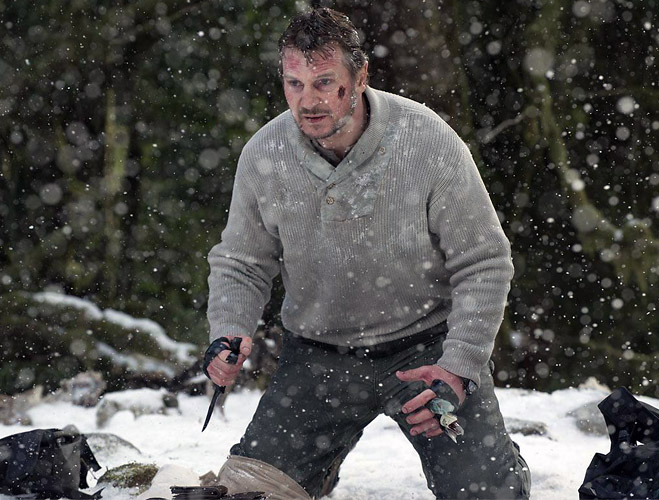
I really thought 2012 would be the year I’d finally get to see Liam Neeson fight a wolf. The Grey marks the latest in a particular set of movies, movies with retro craftsmanship and giddy knowingness tailored to Neeson’s stone face and unstoppable forward momentum, this time with a cartoonishly elemental set-up—professional hardass in a shawl-collar sweater Liam Neeson leads a dwindling pack of oil workers to safety after a plane crash strands them in a harsh sub-Arctic wilderness, where they are beset by a pack of killer wolves—which strips away everything but creative conflict with a magnificently contrived opponent. All the better for me to wallow around in my moviegoing Id.

Imagine, then, my lizard-brain anticipation when Liam Neeson, alone with the wolves at last, steeled himself to turn and fight, took deep cleansing breaths to prepare his spirit for death, and did that genius bit from the trailer where he fashions brass knuckles with black electrical tape and shattered airplane mini-bottles. And then: face down the alpha wolf, and cut to black. The end.

Now. Plenty of movies end at, rather than after, a moment of crisis: this is sometimes a cop-out or merely clever, but it can also be a leading question which filmmakers put to their audience. When our desire is thwarted, or manipulated, it’s an invitation to consciously articulate our expectations to ourselves, and to see how they sound. Oh, so you want to watch Liam Neeson fight a wolf, do you? How very interesting

This, frankly, rankles, because mostly I just want to watch Liam Neeson fight a wolf. Since the point has been pressed, yes, I do recognize that this is a fundamentally superficial desire. But then, a lot of man-hours at union scale went into implanting—implanting, not satiating—this desire in my brain. Dude, you’re the one who brought it up. It seems somewhat in bad faith for The Grey’s writer-director Joe Carnahan to interrogate an appetite of his own devising. It’s as if Pavlov kicked his dog outside without supper to make him really think about his saliva.

And when we do think about it, are we actually discovering things we didn’t know? I don’t really want to start in with whipping out our brains to see who’s got the biggest, but hi, I’m Mark Asch, I carry around a stub for A Brighter Summer Day in my wallet, and my desire to watch Liam Neeson fight a wolf is but a single star within one of the many aesthetic constellations I can readily point out to you against the clear night sky of my soul.

What I’m curious now is, where does it come from, this presumption that a productive point is being made by the ending of The Grey?

The Grey is, for much of its running time, as exemplary as you’d hope a movie about Liam Neeson leading a dwindling pack of oil workers to safety in a wilderness beset by killer wolves might be. There’s an eclectic cast, who die with great variety. They die as early warnings, as in a torchlit surprise attack on the first night; as humbling emblems of a fundamental existential arbitrariness, as in the wheezing, weak-hearted man who simply stops breathing under the gradual toll of altitude sickness; at the conclusion of nicely scaled setpieces, as in the man whose glasses precede him to the bottom of a ravine traversed by a makeshift rope; and with a tragic poignancy, as in a drowning lifted directly from Paul Newman’s Sometimes a Great Notion.

So far, so machopoetic. The action film, as we know from reading lots of film criticism, is about man’s will to inscribe meaning into an indifferent world through his deeds. Carnahan begins to make this point explicitly, as his band of bros engage not just in predictably meatheaded bonding over the smell of pussy, but in musings on the masculine spirit and the possibility that a higher power authored their fate. Thus, The Grey, with its blatant premise, is explicitly “about” the stuff left to the subtext of the classical action film. In a year in which more films than just Cabin in the Woods made sport of the way genre movies and genre junkies constantly try to outsmart each other, this sort of self-consciousness is at least natural, even if it’s more reflexive than revelatory.

At the end of the film, though, the spectacle and outcome of the ultimate confrontation is revealed to be ultimately extraneous to the test of mettle which precedes it. The readiness is all. The Grey’s true subject, then, is the critical discourse surrounding the action movie. It has already been about its genre, but in delivering this little why-we-watch lesson it ceases to be of its genre altogether.

And this is the part that makes me want to quote WWII propaganda posters at Joe Carnahan: Is your trip necessary? At the climax of the Raoul Walsh version of The Grey, Errol Flynn would fight a wolf. At the climax of the Howard Hawks version of The Grey, John Wayne would fight a wolf. At the climax of the Don Siegel version of The Grey, Clint Eastwood would fight a wolf.

These movies are not necessarily sillier than The Grey. These movies, or the ones like them, are the subject of the conversation we’ve long been having, about how the true subject of the action film is actually is the man and the will and the indifferent world and whatever. They’re the source of the action-movie discourse Carnahan chooses over action-movie pleasures—as if it was ever a matter of choosing.

And anyway, the pleasures, maybe even the silliness, help keep things in perspective. Maybe after John Wayne fights the wolf, Dean Martin sings a happy-drunk song about it, and maybe Clint Eastwood takes the wolf on a cross-country barnstorming arm-wrestling tour. This is all to the good. In The Grey, Liam Neeson has a poem which he recites to himself as a sort of manly mantra:

Once more into the fray.
Into the last good fight I'll ever know.
Live and die on this day.

Now. Inasmuch these verses are easily pictured tattooed across a bulky trapezius, they seem to accurately render the mindset of a man about to fight a killer wolf with a set of brass knuckles fashioned from black electrical tape and shattered airplane mini-bottles. Though I guess we’ll never know, will we?

But if it’s not that, then what is it? Because it’s not exactly “The Charge of the Light Brigade,” let alone Henry V. “Live and Die on This Day” (which I’m guessing is the name of the poem) is about as lyrical an invocation of the timeless martial virtues as Skyfall is a dramatically resonant portrait of a man numbing the aftershocks of childhood trauma with alcohol, promiscuity, and sadism.

But then again: what are the other points on the grading curve, actually? Skyfall is a useful case in point here, as a movie that appears to have duped itself into believing it’s obligated to fill the cultural space it’s purchased for itself, as if only some really deep depth to go along with the thrills, chills, and spills is necessary to justify its being a syngeristic product-tied-in saturation-marketed internationally rolled-out oxygen-hogging cultural steamroller, quick, hire a guy who’s done a Shakespeare adaptation to write some backstory. Adam Nayman describes another example of this sort of lettuce-on-the-Big-Mac logic in his Reverse Shot’s 11 Offenses entry on Prometheus: “By trying to retroactively justify the immense cultural fallout and industry impact of his superbly executed, pre-CGI B-movie by recasting it and its sequels as nothing less than events in the history of faith, [Ridley] Scott reveals himself as at best a dupe dragged along by a screenwriter in fanboy thrall to a franchise . . .”

It’s this same fallacy of self-containment that worries me about The Grey—this insistence that all the important intellectual pressure-points have been massaged, whether it’s a symptom of capitalism or postmodernism or cultural tunnel vision or sheer self-importance. There has to be something outside the movie! Otherwise we’re just letting the movie about Liam Neeson fighting wolves do all of our thinking for us.

Mark Asch, formerly the film editor of The L Magazine, is currently a Master's student in Reykjavik.