On THE BLACKLIST: Why James Spader Is the Perfect Star for the Increasingly Unreal Medium of Television

On THE BLACKLIST: James Spader Is the Perfect Star for the Increasingly Unreal Medium of Television

null

The television medium, and the act of watching television,
have always been remarkably surreal, and they only grow more so by the day. The
very action of sitting and watching flickering pixels on a screen which, in
most cases, is smaller than you are stands in direct contradiction to
everything we might call living,
enjoyable and stimulating as this non-life might be. For many viewers, it requires absorption;
for other viewers, it requires absorption and darkness; for still others, it
requires absorption, darkness, and complete silence.   As time has passed, TV has only become more
strange, and private; at one time, the screen formed the hub of a gathering
place, but it is less so now, as increasing numbers of people watch television
on their own terms: on their phones, on their computer screens, at off –hours,
while commuting. The idea of scheduling one’s day around a TV show is
increasingly uncommon. Given these developments, it stands to reason that James
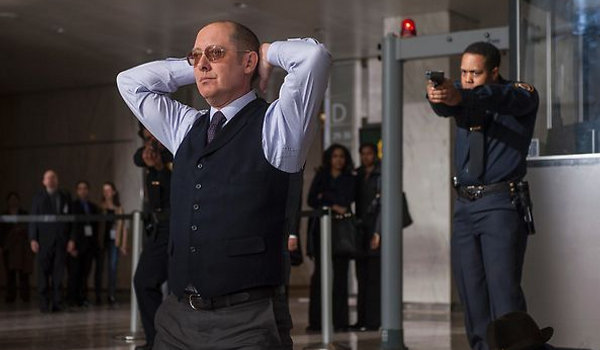
Spader, a shocking presence on The
Practice
and Boston Legal in the
past, and a rousing presence in NBC’s The
Blacklist
, would be its ideal actor.

The reasons why Spader is so appropriate for television have
to do both with his qualities as an actor and, actually, with the history of
television itself, in the last 25 to 30 years. Spader’s arrival in his first
major TV role, that of Alan Shore on The
Practice
, was not universally well-received at its outset. Why was this?
Well, because his film roles in the past had often contained a healthy layer of
sexuality—and often warped sexuality. The three most glaring examples of this
would be his remarkable breakthrough performance in
Steven Soderbergh’s sex, lies, and
videotape
, in which he filmed women talking about sex (and doing other
stuff) and then pleasured himself to videotapes of the sessions, giving an empathetic face to the perversity of voyeurism; his role as James
Ballard in David Cronenberg’s Crash,
including a sex scene with a scar in a woman’s leg; and Steven Shainberg’s Secretary, in which his officious lawyer Mr. Grey “got to know” his employee by masturbating
on her panties as she bent over his desk, skirt up. What was this man doing in
a fairly nondescript show about a law firm? Everything and nothing. At the
time, it seemed fairly clear that he had been added to boost ratings and make
the show more exciting; he did both, in spades. His character’s open-faced form
of brazen dishonesty gave considerable texture to a show which was gradually
building a wall around itself consisting entirely of predictable plots (the
same rut which some of Law and Order’s
variants have fallen into). His great comfort with sleaziness and with
destructive transgressions provided a meaningful satire of the nature of the
law profession and of the hidden altruism within many shows about that
profession, in which show’s characters become heroes by making the “right”
choice. He has roughly the same role in The
Blacklist
’s Raymond “Red” Reddington, a “most wanted” criminal whose wealth
of information makes him ultimately indispensable to his pursuers, and he plays
it with the same aggressively insouciant quality, as if every line he speaks is
not only the best line ever written for a television actor but is also the most
explosive; and the more dramatically he speaks the line, the more of a detonation it sets off.
In a sense, Spader’s delivery is like that of an old-fashioned stage actor,
speaking to an audience who may or may not absorb what he is saying. The
simplest exchanges become broad-voiced utterances; whether you understand the
motivation for the line becomes secondary importance—the main thing is the
momentously frank delivery. And so, in pushing himself outwards in this
theatrical way, isn’t Spader fulfilling the earliest dream of television,
which was to provide a home-based version of the theatrical experience?

But, back to the present. Spader is occupying, with unusual
elan, a historical moment in TV watching and reception: he is with us as TV
becomes an almost entirely private personal phenomenon, in which viewers
develop relationships with characters and plotlines that they cannot quite
shake, sometimes to an almost humorous degree, and in which viewers choose
which shows they wish to watch at length—and at how much length. It is indeed
significant, then, that Spader’s breakout role, his turn as bully Steff in Pretty in Pink notwithstanding, was in sex, lies and videotape, a film about a
man who derives his sole sexual pleasure from watching images on a TV screen,
after the fact, in total solitude and at his command. Fast forward 25 years: many
viewers these days watch television long after its air date, and with utter
control over the conditions of viewership. In 1989, when the film was released,
the VCR, as we know it in its home-friendly form, was less than 10 years old,
and rapidly gaining in popularity. By starring in such a film, Spader
associated himself indelibly with what has become a dominant mode of
viewership: what I want, when I want it. The binge watch. The repeat view. TV
shows ranging from Moonlighting to St. Elsewhere to (even) Mystery Science Theater 3000 nudged us,
at this time, towards a smarter view of what we were seeing on the screen:
couldn’t we view a multi-episode TV show as a kind of novel? Couldn’t we expect more from
television? It’s hard to think that that the development of VCR capability, giving viewers the chance to re-watch and scrutinize certain shows,
didn’t contribute to this change. Granted, the tapes Spader’s character was
watching in Soderbergh’s film were not the VHS tapes we might be familiar with,
but the impulse was the same.

Of course, The
Blacklist
is not necessarily the best vehicle for Spader. The episodic
nature of the show guarantees that viewers will not devour it in the same way
they devour more intellectually complex shows like Breaking Bad or The Wire.
Also, each episode is built around a different number on the FBI’s Most Wanted
list; these figures become much like the villains in comic strips, or their TV
counterparts. Each villain is neatly tracked down by the end of each episode each mystery resolved. Nevertheless, Spader’s presence, and his history, and his delivery—which constantly seems to look back at us as if to ask, If you think you’re above this, why are you watching it?—raise a
question about television, which, though it may have been raised before, can’t
be asked enough. As television continues to become more nuanced and
intellectually demanding, its approach, and its casts, will need to change.
Spader is unique in that he doesn’t give in to the demands of acting for a
smaller screen—the pandering, the mincing, the mugging; the charge we receive
from him is based on his staunch defiance of those requirements. Perhaps his
performance will draw some new colleagues in the future, from a place in which
the screen is brighter and larger, and the audience is darker and more
mysterious.

Max Winter is the Editor of Press Play.

Choose Your Own Adventure: The Allens, the Farrows, and You

Choose Your Own Adventure: The Allens, the Farrows, and You

null

When I was a teenager, I worshipped Woody Allen to an
unhealthy degree. I think, at some particularly unfortunate point, I might have
even dressed like him. To me, and I’m thinking to others, he represented three
things: urbanity and sophistication; a wit born of erudition; and the
possibility that one might, without an excess of good looks or distended
musculature, attract the opposite sex—through the sheer force of words. When it
was revealed that Allen had left Mia Farrow for his daughter/non-daughter,
Soon-Yi Previn, I tried hard to be objective about him, as a figure, but my
grasp of the reality of what one should and shouldn’t do in any human
relationship, combined with the decline in quality of his films after that
revelation, made it difficult to take him seriously, although I continue to
rank Annie Hall, Hannah and Her Sisters,
Husbands and Wives
, and Crimes and
Misdemeanors
among the greatest films of all time (it’s a long list). The
recent unearthing and re-unearthing of allegations that he molested 7-year-old Dylan
Farrow have provoked reams of commentary, consideration, and investigation into
his life, and specifically his life with Mia Farrow and her numerous children. This
fermenting, for lack of a better word, has been disappointing, not so much
because no conclusion has been reached (there isn’t one), but because of a lack
of overview, the inability of those commenting on the scenario to distance
themselves from it, or what it might mean to them, personally. What has resulted from the feverish reaction to these
decades-old events is a gradual tying of our hands, across the board, so that
to even consider the controversy is akin to opening a Choose Your Own Adventure
book, in which the judgment you might make, in whatever public forum, suggests that you possess a particular set
of characteristics—and, as in the books, you can’t make two judgments at once,
just as you can’t read two stories at once.

The problem is mainly one of tone. The words commonly used
to describe Allen at this point—monster, creep, wouldn’t want him alone with my
children, perverted—are not the words one uses when thinking clearly. Granted,
the circumstances don’t allow for too much clear thought—the actions described,
toy train, attic, and all, are horrific. It would be difficult for anyone to
react with equipoise to testimony on such events, real or imagined.
Nevertheless, what happens when public sentiment is stirred, across blogs,
comment boxes, newspapers, and telephone waves, is that a sort of brushfire
starts. If the fire grows too bright, it either subsumes other opinions or
whittles them down, makes them look black and vaguely evil. To suggest, as many
have, sentiments along the lines of “we’ll never know what happened” is to, in
many cases, add a parenthetical “(but we kind of do know).” To shrug about it
becomes, in a sense, a concession to the truth of What Is Written. Suggestions
that Dylan Farrow made up her allegations, her memories having been molded by
her mother’s coaching, end up sounding rather creepy beside the bold and righteous,
“He’s a criminal. He should pay.” A Daily Beast essay by Robert Wiede on the
matter, asserting that the allegations were false, was denounced by Jessica
Winter at Slate as “smarmy,” while Wiede’s tone wasn’t necessarily more or less
hostile than Farrow’s.

But indeed, what of the tone of the father and daughter
involved here? Their poorly written testimonies haven’t helped, speaking more
to deep-rooted rage than anything else. Oddly, the epistles (that’s what they are, really) share a tone,
one of aggression, of pots boiled over, much like the tone of some of Allen’s
most poignant filmic moments. Allen has his “Soon-Yi and I made
countless attempts to see Dylan but Mia blocked them all, spitefully knowing
how much we both loved her but totally indifferent to the pain and damage she
was causing the little girl merely to appease her own vindictiveness” or
“Again, I want to call attention to the integrity and honesty of a person who
conducts her life like that,” while Farrow has her “So imagine your
seven-year-old daughter being led into an attic by Woody Allen” or her “I have
a mother who found within herself a well of fortitude that saved us from the
chaos a predator brought into our home.” Allen finds himself the victim of
serious accusations, while Farrow finds herself the victim of both abuse and
patriarchal oppression following that abuse, making it hard for her to speak up.
Their public records, as it were, are powder kegs, bombs thrown into a movie
house, ultimately dangerous and corrosive, for all of their seeming liberation.
Farrow makes a strange gesture in offering a statement which can neither be
proved nor disproved; Allen makes a strange response in deferring to logic
rather than facts, as in his statement that it makes no sense that he would
molest someone at such a tempestuous time in his relations with Farrow’s
mother. The two statements cancel each other out, neither one more convincing
than the other, really. It’s a loaded spat, close to after-dinner theater—but
any popcorn you might throw has already been thrown. Just check the blogs, the
comment boxes and the social media.

What if the story here is entirely
different from a tale of abuse of power, or a fable about the importance of
speaking up about abuse? What if the story unfolding now points backwards, to the
reasons we enter relationships, and how we need to think those reasons over
carefully? Allen, at the time of the beginning of his relationship with Farrow,
gravitated towards women who did not outshine him, most notably Diane Keaton,
who, comic chops aside, relies on self-effacement for her comedy and will never
have the cultural stature Allen has. Farrow fits this mold as well: a tremendous
talent whose screen presence, at least at the time she met Allen, was never
overwhelming, and who, for all intents and purposes, is no longer an actress.
Farrow, on the other hand, was attracted to powerful men, like, say, Frank
Sinatra, or Andre Previn, men who dwarfed her, in a professional sense. In
becoming involved with Allen, it would seem, she wanted more of the same. And
yet: Allen publicly acknowledged his sexual deviance, both in print and in
other ways too obvious to even refer to directly; Farrow liked to care for
children, often children weakened by disability or poverty. They gravitated
towards each other because they each had something the other wanted, and yet
neither need could sustain a loving relationship. Each chose an adventure, and
unfortunately, their adventures collided somewhere near the end of the book.
The result? Pain that has pursued the family for 20 years. In creating a household together, they ultimately harmed themselves, and those around them, in small and vast ways. And in choosing to
side with one person rather than the other, to say “he done it,” or “she done
it,” we limit ourselves. The harder choice for us, as thinking people who live
in a society that loves celebrities, would be to recognize how different these
celebrities are from us, and to try to glean what wisdom we can from their
repeated, grave errors.

Max Winter is the Editor of Press Play.

The Shame of Pageantry: The 2014 Sochi Winter Olympics Opening Ceremony

The Shame of Pageantry: The 2014 Sochi Winter Olympics Opening Ceremony

null

I’m deeply offended by opulence.
I think people who eat three meals a day are showing off. I don’t understand
expensive watches. If I was ever talked into getting married, diamonds would
not be involved. Nor would ceremony. There would be no cake. I drive a ‘99 Ford
Taurus that doesn’t have any heat, which to me is a little showy. I have two
pairs of shoes and two pairs of jeans, but I’m shy about admitting to my
spending on such extravagances. You can only imagine what it was like for me to
watch the opening ceremonies of the Sochi Winter Olympic Games.

Sport revels in pageantry: The
uniforms, the mascots, the musical interludes, the coronation of heroes, the
parades of celebration, retiring numbers to the rafters. When competition is on
an international level, that pageantry marries jingoism, and we’re left with a
cartoonish representation of who we are as people, where we come from, and what
role sport plays in our lives. When a country like Russia, once proud, still
proud, with some post-Cold War self-esteem issues, is awarded an Olympic games,
we would be left to expect unmatched, unfettered, unapologetic pageantry.

“Welcome to the centre of
the universe!”

And so began the Games. Russian
TV star Yana Churikova shouted the phrase among swirling crescendos of
Tchaikovsky and t.A.T.u., and what followed was so opulent it would make a
royal wedding blush. Next came a strange mix of historic documentary and dance,
children dressed like Disney extras, a fair amount of hammering, a dash of sickling,
lots of Cyrillic, and more children in bright colors. I’m not a opening
ceremonies aficionado, but I expect they’re all like this to some extent. By “like this,” I mean horribly self-indulgent, and kind of offensive.

Once the entire history of Russia
was summarized (and somehow without the use of matryoshka dolls) over the
course of 20 minutes that felt like six or seven days, the countries paraded
into the stadium. Each country was dressed either as the most offensive
caricature of their nation, or a second year design student whose work is
informed by Selena Gomez and the explosive nature of Pop Rocks. The Canadians
were dressed as Mounties, of course, after the original plan to dress them as
polite hockey players with universal healthcare didn’t come to realization. The
Swedes were straight from Ikea, the Japanese from anime. The Chinese were
stoic. The Jamaicans danced to Bob Marley’s “Three Little Birds,” though the
music may have only been playing in my head. Some country where it hasn’t
snowed since ground brontosaurus was its biggest export paraded its only
participant, all smiles and no expectation. The US team’s outfits looked like
the July Fourth section at Target exploded. It was all quite awful.

For a moment I may have blacked
out, endured a seizure brought on by excessive flashing and excessive, well,
excess. When I tuned back in Hall of Fame goaltender Vladislav Tretiak and a
petite woman who Paul Henderson never scored on were taking the Olympic torch
on its last jog, lighting the flame that will burn for the duration of the
games. That’s right: this isn’t just a $52 billion dollar outdoor Wiggles
concert. There’s some sporting to be done.

Unfortunately, in these games,
the sport takes back seat to both the opulence of the endeavor, and the intolerant
oligarchy of its host. Already LGBTQ rights protestors have been arrested
before a puck has dropped, a skate laced, a luge luged. Dutch snowboarder
Cheryl Maas raised a rainbow glove palm to the camera after competition. Maas,
one of only six openly gay Olympians, is now the answer to the question: Who
was the first Sochi Olympian to protest Russia’s archaic anti-gay legislation
during the 2014 Games? And I suppose in that answer lies my larger frustration
with the opening ceremonies. I kept waiting to spot a small rainbow flag or a
You Can Play logo, anything from the athletes showing solidarity and support
for a community that is being oppressed by the country that is providing those
athletes with the grand stage for what they hope will be their finest hours.

But there were no flags. And
there was no support. Except for rainbow Greek mittens and pseudo-rainbow
German jackets, neither acknowledged by their nations as potest, but rather
happenstance. And if we’re looking to the Greeks and Germans as the voices of
reason, we’re all in trouble. And two countries. Just two. And not the one I
call home.

Within the maelstrom of opulent
noise, indulgent sheen, and radiant jingoism, there was the alarming dichotomy
of quiet.

I understand it is not the
responsibility of Olympians to make political stands. I understand it, but I
don’t agree with it. Olympians are there carrying my passport, wearing my flag,
representing my home. With that comes the great responsibility of carrying our
moral authority, our righteous indignation, our commitment to a tolerant world,
an inclusive world. This, to me, is the very purpose of the Olympics. Its
essence. Nations, people coming together in a search not just for personal
glory, but vicarious glory, and a glory that is filtered through the prism of
nationality.

These Games will come and go.
Heroes will be found. Stories written to be forever told. My hope is that they
are a safe Games, but also a Games where the opulence of its host, the shame of
pageantry over substance, is punished by fearless voices. The opening
ceremonies tried to tell the story of Russia, a story that currently finds a
strained narrative, with the whole world there to watch, wait, and wonder if
this is not the moment where morality and bravery trump opulence. Where a voice
will take the opportunity not to just revel in pageantry, but to use it to
celebrate a larger purpose.

Mike Spry is a writer, editor, and columnist who has written for The
Toronto Star, Maisonneuve, and The Smoking Jacket, among
others, and contributes to MTV’s
 PLAY
with AJ
. He is the author of the poetry collection JACK (Snare
Books, 2008), the short story collection
Distillery Songs (Insomniac Press,
2011), and the co-author of
Cheap Throat: The Diary of a Locked-Out
Hockey Player
(Found Press,
2013). His next poetry collection,
Bourbon & Eventide, is forthcoming in 2014
from Invisible Publishing. Follow him on Twitter
@mdspry.

The Art of Unease: Philip Seymour Hoffman

The Art of Unease: Philip Seymour Hoffman

nullIt takes a special talent to make us uncomfortable. Inundated with obnoxious reality television,
sensationalistic twenty-four hour news coverage, and a film culture that grows
louder and brasher by the day, it is all the more remarkable when an actor is
able to unsettle us.  Philip Seymour
Hoffman had this talent in an abundance that verged on the indecent. That he was also one of the most subtle
actors of the twenty-first century seems paradoxical, until we realize that
only by stealth and imagination could someone manage to catch a jaded viewer
off-guard.

I was first caught off-guard by Hoffman in his small but
crucial role as Scotty J. in Boogie
Nights
. The first appearance of this
awkward, chubby, blindingly pale presence, nervously chewing on a pen as his
belly hung out from under his childishly bright t-shirt, instantly defined this
odd but sympathetic character. When he
comes on to Dirk Diggler, I cringed in anticipation of a violent rebuff.  But Diggler turns him away with a firmness
tempered by kindness, and somehow this makes the scene all the more painful and
awkward. What follows is to me one of
the most memorable moments in contemporary film, when Hoffman’s character
crumbles into self-loathing, repeating “I’m a fucking idiot!” while sobbing
pitiably. Director Paul Thomas Anderson
lets this go on for a disturbingly long time, until Hoffman’s performance
begins to verge on self-parody. I
remember the audience starting to laugh, then going silent, then laughing
again, uncomfortable, not knowing how we were supposed to react. In subsequent years Hoffman would take us to
this unsettling place, over and over again.

Hoffman never gave a bad performance: I can’t imagine any
other actor of whom one can say this without hyperbole. More importantly, though, he never gave a
performance that was anything less than fascinating. Every time he took on a new role, it felt
like he was reinventing the art of acting itself. The characters he created were never people
you could relate to: they were wildly imaginative creations that made you think
about human beings differently. Who else
could have created the heavy-breathing compulsive masturbator of Happiness, and who else could have made
him a (sort of) sympathetic character? It’s that “sort of” that was Hoffman’s
unique gift: all his characters, however minor, filled the screen, but there
was always something elusive, furtive about them. Even the kindly hospice caregiver in Magnolia is imbued with a certain
strangeness, his saintly self-effacement before Jason Robards’ meanness verging
on the masochistic. 

Finding a character’s motivation is central to the practice
of acting, but Hoffman’s unique talent was for hiding that motivation from the
viewer. What drives The Master? Why is Dean
Trumbell so obsessed with taking revenge in Punch
Drunk Love
? How does Capote feel
about Perry Smith? This furtiveness is what makes his performance in Doubt such compelling viewing; doubt, uncertainty, unease was what Hoffman did best. Even at his most brash, as in his brilliant
creation of Freddy in The Talented Mr.
Ripley
, he turns what could have been a caricature of an obnoxious society
boy into a study in psychological complexity. Yet while Hoffman was always unerringly precise, he never seemed
studied. Each new creation seemed
effortless, and that was part of what made his characters so marvelously
strange. 

It will be hard not to think of the tragic circumstances of
his death as we go back and watch the wealth of astonishing performances he
left us, but I hope we can let his characters lead their own, peculiar lives,
without Hoffman’s biography intruding on them. What made Hoffman utterly unique was his imagination, and like the
creations of a great novelist, his characters will continue to lead their unfathomable
lives, a little beyond our reach. Though
it is crushing to realize we will have no new performances from this actor who,
by all signs, was just getting started, it is some consolation to know that he
will continue to surprise us and catch us off-guard, no matter how many times we
see one of his films. 

Jed Mayer is an Associate Professor of English at the State University of New York, New Paltz.

RIP Philip Seymour Hoffman, 1967–2014

RIP Philip Seymour Hoffman, 1967–2014

null

Philip Seymour Hoffman lived very close to us, in Manhattan. He was very visible in the neighborhood, riding his (old) bike, walking with his children, or sitting at a café, either murmuring to a companion while simultaneously filling a room or looking out from a table, alone, as if he belonged in that spot. I would always do an inner double take when I saw him in person. The first take would be to marvel at how relaxed he seemed, how comfortable in his skin, what a man-of-the-people mood he seemed to have about him. And the second take would be to think, my god, I just walked past one of the most intense, malleable, transformable American actors alive today, and I didn’t have to seek him out, didn’t have to stalk him: he was right in front of me. And as I watched more and more of his films, and simultaneously had the experience of passing him on the street, it occurred to me that the quality I was identifying as relaxedness might in fact be readiness: readiness to launch himself into a role, a situation, a life choice that would be dynamic, shocking, not pleasant to watch unfolding, but memorable, all the same, if memorable is an adequate word to use for his performances.

When great actors die as Hoffman did, revealing staggering addictions, or psyches run ragged because some unspecified demon is chasing them, the question always becomes: did the role become the person, or did the person become the role, or both? When Heath Ledger died similarly, Jack Nicholson was quoted as saying, “I warned him,” about the Ambien use that resulted from playing the Joker in Christopher Nolan’s The Dark Knight—one must assume that playing the same character in Tim Burton’s version of the story did a number on Nicholson as well. We could speculate a long time about to what extent actors can be said to “choose” their roles, but we can say, with some certainty, that if you’re validated by your work, then the roles you play begin to form a house you inhabit, shaped to your specifications. Hoffman’s turn as Freddie Miles in The Talented Mr. Ripley, his soft tones evidence of a poisonous mix of wealth and reckless immorality, would form one beam of the house; his
plaintive turn as Scotty J. in Boogie Nights, kissing up with futility to the cuter and better-equipped Dirk Diggler, would form another beam; the personification of sensitivity, intelligence, insidiousness, and self-absorption that was his performance of the title role in Capote would form another beam; his grand but pitiful presence in The Master would form another; and on it goes. The roles he played had in common a sense of uncomfortable intensity, as if there were an oblong, burning form lodged somewhere inside him that he bore patiently, but not without unhappiness that drove everything he did—even at his most relaxed moments on screen, he seemed badly in need of psychic fresh air.

And that’s why we watched Hoffman. And that’s why, with each film, our expectations of him grew. America’s love of its stars and its celebrities is very closely linked to its culture of expectation. From the smallest arenas to the largest, we have expectations. We want our children to over-perform, to impress us; we want each other to constantly succeed, to constantly out-do, over-achieve; and we want our celebrities to be, in a sense, like gods. We don’t want them to grow old. We don’t want them to stumble from grace. And, most of all, we don’t want them to be human. And so, when an actor like Hoffman, possessed of such a great talent along with the inner complexity necessary
to display that talent to its fullest, reveals himself, at the latest count, to have had at least eight empty bags of heroin in his apartment at time of death, we’re
stunned, and shocked, and we remark on the great tragedy of the moment, and
we’re correct to do so. It is tragic. But the significance of such an event should also be to remind us that we’re all human beings, and that part of our expectation, of our celebrities and ourselves, is that we will be just this: beautiful and imperfect, imperfect and beautiful, two qualities which will strive against each other so valiantly that you might mistakenly think one quality might be victorious.

Max Winter is the Editor of Press Play.

A NEW PRESS PLAY COLUMN: Seth Abramson’s “Metamericana”: Is Martin Scorsese’s Latest Offering Unbelievable On Purpose?

A NEW PRESS PLAY COLUMN: Seth Abramson’s “Metamericana”

null

This biweekly column
looks at instances of American film, television, drama, and comedy that
are in some way self-referential—”art about art.” Also discussed is
American metamodernism, a cultural paradigm that uses both fragmentary
and contradictory data to produce new forms of coherence.

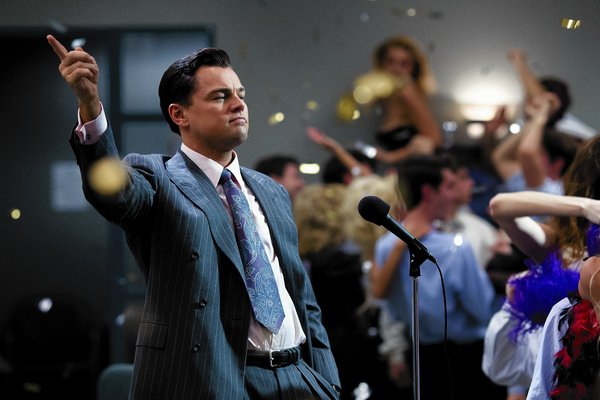
Greed, Martin
Scorsese suggests in his new film The
Wolf of Wall Street
, is now executed in U.S. financial markets on such a
colossal and audacious scale that it no longer has the capacity to scandalize
us. That’s why The Wolf of
Wall Street
may well be the most unbelievable film Hollywood has
produced in more than a decade, a claim that seems extraordinary given the
film’s grounding in the memoirs of the real-life “Wolf of Wall
Street,” Jordan Belfort. There’s a difference, however, between a biopic—something The
Wolf of Wall Street
exhibits little interest in being—and a movie that
intends, instead, to enter the historical record as High Art. The foremost ambitions
of High Art are to illuminate the unknown and frustrate the conventional;
entertainment value is a secondary consideration, indeed sometimes not even a
consideration at all. Which is why it’s little surprise that not only does
nearly everything that happens on-screen in Martin Scorsese’s new film strain
credulity, there’s little evidence that either Scorsese or his actors (among
them Leonardo DiCaprio, Jonah Hill, Matthew McConaughey, Rob Reiner, Jon
Favreau, and Bo Dietl) intended it to be otherwise. Even the movie’s run-time—an
arguably bloated three hours—seems calculated to emphasize the excess this
movie not only revels in but elevates to the level of conceptual spectacle. And
sometimes America needs a spectacle that outrages rather than delights; in
fact, often it is the outrage of unmet expectations that inspires America to
take dramatic action in its own self-interest. Given that, where malfeasance in
the American marketplace is concerned, America has yet to act decisively to
punish individual and institutional wrongdoers, dramatic remedial action is
long overdue.

To read major-media reviews of The Wolf of Wall Street, you would suspect
that many of the nation’s most esteemed film critics have missed the point of
the film entirely. Focused on the exploits of a gaggle of crooked stockbrokers
who sell near-worthless penny stocks to wealthy investors, Scorsese’s epic is
indeed, as Joe Morgenstern grumped disapprovingly in The Wall Street Journal,
a “hollow spectacle” (let’s ignore for a moment the jaw-dropping
irony of that publication in particular issuing such a declamation). But those
who opine that Leonardo DiCaprio, who plays stockbroker kingpin Jordan Belfort,
doesn’t seem “terribly comfortable” in the role (Christian Science
Monitor
), or that the film is, in sum, “about getting your own” (The
Detroit News
), or that DiCaprio’s and Hill’s on-screen antics are intended
as “slapstick” (National Public Radio) saw in Scorsese’s grand
vision only reflections of their own unwarranted disappointment. These critics
wanted a relatable human drama with an unambiguous moral; what they got was a
piece of High Art deliberately inaccessible by Hollywood standards.

To quote Belfort’s father Max upon seeing a credit card statement detailing
outrageous payments to prostitutes, “Crazy? This is obscene.”
Indeed it is. The Wolf of Wall Street is an aestheticized
obscenity—that is to say, one whose scope is intended to provoke awe, not
understanding—and unlike obvious predecessors such as Oliver Stone’s Wall
Street
, it comes to American movie-goers with no canned message whatsoever.
That’s right: Scorsese doesn’t deliver a Wall Street morality play so much as
offer his audience a spectacle of meaninglessness that’s intended to be exactly
that. The Wolf of Wall Street isn’t
seedy realism; it’s garish fantasy. Scorsese knows, and The Wolf Of Wall Street confirms, that misbehavior in the American
market has risen to the level of the sublime. The nation’s class of
moneymakers—whose sole exports are bullshit and nonsense—are the abstract
expressionist painters of contemporary America, the only difference being that
their canvas is the nation itself rather than a legion of
gallery wall-spaces.

It’s impossible to overstate the three-ring circus of absurdity on display in The
Wolf of Wall Street
. Donnie Azoff (Hill), upon seeing a gorgeous woman at a
crowded party, removes his penis from his pants and begins to masturbate;
Belfort (DiCaprio) snorts coke out of a prostitute’s asshole, sexually assaults
airline stewardesses, demands someone fetch him a bag of cocaine just moments
before drowning at sea, tapes thousands of dollars to a naked woman to smuggle
ill-gotten funds into Switzerland, and invites into his large-scale boiler-room
“office” a veritable parade of outrageous guests: everything from a
half-naked high school marching band to dancing prostitutes and begoggled,
velcro suit-wearing little people. In the film’s most audacious scene, Azoff
and Belfort take so many Quaaludes that the latter ends up crawling across a
country club parking lot, while the former falls through a glass table and
nearly chokes on a piece of ham. None of it, taken in its totality, is the
least bit plausible—no more than is Azoff urinating on a federal subpoena to
the applause of his officemates, or Belfort having sex with his wife atop a
giant pool of neatly-stacked hundred-dollar bills. But why do we expect that it
should be? And even if it’s all ripped straight from the pages of an
autobiography—mind you, the autobiography of a self-admitted drug-addict,
felon, and confidence man whose profit motive in selling his life story is
self-evident—ought we not credit Scorsese with sufficient artistic vision to
know when the truth is not just stranger than fiction but veritably
indecipherable?

If the characters and scenarios of The Wolf of Wall Street seem plastic
and deliriously unchanging, it’s because, Scorsese submits, the scope of American
greed is likewise far past the point of plausible melodrama. The 2001 Enron
scandal cost that company’s shareholders, many of whom were mid-level employees
with retirement accounts comprising exclusively Enron stock, more than $74
billion dollars; the collapse of Lehman Brothers and other global financial
services firms in 2008 cost American taxpayers $700 billion in bailouts. What
these and other recent financial scandals of similar scope have in common is
that they were preventable before the fact and only lightly redressed (in terms
of criminal penalties) after the fact. In short, even after years of DC-led tough-on-crime
initiatives emphasizing reductions in street crime, America had insufficient
stomach to punish the patrons of a different sort of “street” when their criminal
conduct cost the nation untold anguish and financial distress. That’s why
DiCaprio’s Belfort routinely breaks the fourth wall—not, as you might expect,
to educate the audience on why his character is doing what he’s doing, but
rather to remind the audience that whether they understand what’s happening or
not is beside the point, because the movie’s obscene spectacle continues
regardless. Never before has a film so baldly lectured its paying customers on
the irrelevance of their credulousness and comprehension. If Michael Douglas’
Gordon Gecko (Wall Street) monologued with sufficient gusto to encourage
(in some moviegoers) an understanding and even admiration of the reasoning
behind his avarice, DiCaprio’s Belfort is a villain more suited to the often
amoral twenty-first century. When he tells his lackeys, “I want you to
deal with your problems by being rich,” it’s immaterial whether he
believes his own bullshit, or whether you do, or whether you believe he
loves his wife or feels kinship with his friends, because the scope of what
he’s doing is beyond your small understanding in any case. Which is exactly how
America’s worst villains want things to be, and exactly why they’ve become
nearly impossible for the rest of us to stop.

Seth Abramson is the author of three collections of poetry, most recently Thievery (University of Akron Press, 2013). He has published work in numerous magazines and anthologies, including Best New Poets, American Poetry Review, Boston Review, New American Writing, Colorado Review, Denver Quarterly, and The Southern Review.
A graduate of Dartmouth College, Harvard Law School, and the Iowa
Writers’ Workshop, he was a public defender from 2001 to 2007 and is
presently a doctoral candidate in English Literature at University of
Wisconsin-Madison. He runs a contemporary poetry review series for
The Huffington Post and has covered graduate creative writing programs for Poets & Writers magazine since 2008.

ARIELLE BERNSTEIN: The Spaces Between: Spike Jonze’s HER and Love in the Time of Machines

ARIELLE BERNSTEIN: The Spaces Between: Spike Jonze’s HER and Love in the Time of Machines

nullWoody Allen’s brilliant Annie Hall ends on a joke. Alvy Singer, the film’s narrator, describes a guy who goes to his
psychiatrist complaining that his brother thinks he is a chicken. When the
doctor asks why he doesn’t have him committed, the guy responds, “I would, but
I need the eggs”.

“Well, I
guess that’s pretty much how I feel about relationships. You know, they’re
totally irrational and crazy and absurd and, but, uh, I guess we keep going
through it because, uh, most of us need the eggs.” Alvy says, slightly
bewildered.

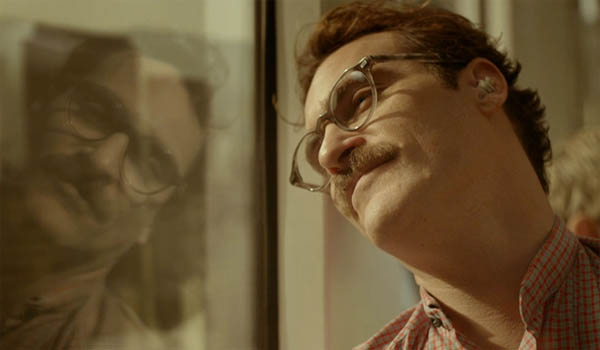
Her makes an
even more wistful claim—that those imaginary eggs are what actually make us feel
alive.

The central premise of Her is that a man ends up falling in
love with his OS. The idea that mankind might one day develop intimate
relationships with intelligent AI is certainly not new. In Battlestar Galactica, for example, cylons date, mate and develop
relationships with humans all the time, albeit for ulterior motives. But what
sets Her apart is that Samantha, the
OS that Theodore Twombly falls in love with, has no actual, physical body,
whether flesh and blood or metal and machine. Her very ephemeral nature mimics our
current era, where our first experiences of love are often shaped through the
use of email, social media sharing, and chatting online. If anything, these
technologies seem to be showcasing our need for intimacy, rather than diminishing
it. If I look at any of my friendships and relationships with other people on social media, I see a slew of images and inside jokes capturing something that
seems very real, but also seems paper-thin. Is this the nature of the machine,
or is this the nature of how we love?

Early on in Her, Amy, one of Theo’s close friends,
shyly shows the documentary she has been working on to Theo and her husband. We
see only the first few moments, a close up of her mother sleeping in bed. Her
husband is unimpressed and asks whether anything else will happen. Amy looks
embarrassed and explains that she feels the film is about dreams, how we spend
a third of our lives asleep, but can’t truly access those moments. Her husband
looks incredulous and asks why she doesn’t just interview her mother about her
dreams, since this would make her ideas more explicit.

The space between what Amy
sees and what her husband can’t is the center of Her, which is about the desire for connection in a world where
connection seems more and more fleeting. 
The surface of Her shows a
slightly dystopian landscape where people seem alienated, lonely and
disconnected from one another, even as individuals are more and more plugged in
to new technologies. But beneath this pastel veneer lies a warm animal pulse.
One of the major arguments of the film is
that love in a modern age is like love at any other time. We are motivated by
the same strange impulses as our ancestors, a pre-programmed idea of closeness
that has motivated humanity since the beginning of time. Samantha may herself
evolve during the film, but the weird, small, tender ways that human beings
strive to connect to each other, are never going to change.

Scarlet Johannson’s portrayal
of Samantha in this film would suggest that we aren’t moving away from each
other in the slightest. Many reviewers of Her
have pointed to Samantha’s voice as the warm and effervescent glue that holds
the film together. It’s hard not to be drawn to Samantha, even though we don’t
see her. Her OS breathes, sighs and trembles, laughs and even tenderly screams
while making love. Is this an affectation? In an essay called What’s Missing From Her, Anna Shechtman
argues that the female characters we are presented with in Her are not authentic, and that Samantha in particular is troubling
because her desire for a body is entirely based on wanting to connect with
Theodore. Our doubts about Samantha’s “personhood” are actually similar to our
doubts about what constitutes female desire. We always question whether women
who come on to men have ulterior motives or are faking it, in bed or otherwise.
It’s a little too easy to cast Samantha as the ultimate “manic pixie dream
girl” when she is actually constantly evolving, in both a technological and a
dramatic sense. By the end of the film she even outgrows Theo and the small,
gentle world that they created together.

Her might present
one of the most egalitarian and loving relationships on screen this past year. In
many films that focus on the way technology is changing how we view intimacy,
sex is reduced to a mere transaction, and female robots are often vulnerable
and designed to please or serve men, as we have seen in films from The Stepford Wives to Blade Runner. This view of sex is
consistently complicated in Her, even
in one of the first scenes when Theo has phone sex with a woman online and she
commands him to strangle her with a dead cat. This bizarre scene, where we only
see a close-up of Theo’s face shocked and confused, illustrates a world where people are desperately trying and
failing to connect with one another. Though the cat fetish scene is hilarious
in its portrayal of extreme disconnection, sex throughout Her is depicted less as salacious than tender, and when Theo makes
love to Samantha for the first time, the screen fades demurely to black.

We grow up with the people we
love, but the process of growing and changing means we sometimes grow away from
them too. In Her, intimacy is
fleeting, not because technology has diminished our relationships to one
another, but because people change over time. By the end of the film Samantha
has outgrown her relationship with Theo. She still loves him, but she has
fallen in love with a billion other things as well. She tries to convey to Theo
that this isn’t personal, but, of course, for human beings love is always about
focus; it means turning away from the rest of the world as much as it means
letting someone in.

Arielle Bernstein is
a writer living in Washington, DC. She teaches writing at American
University and also freelances. Her work has been published in
The
Millions, The Rumpus, St. Petersburg Review and The Ilanot Review. She
has been listed four times as a finalist in
Glimmer Train short story
contests
. She is currently writing her first book.

Stop the “Streamaggeddon” Articles: Netflix and the Idea of Total Media Access

Stop the “Streamaggeddon” Articles: Netflix and the Idea of Total Media Access

nullEvery
so often, a bunch of titles are taken off of Netflix’s streaming
video-on-demand “Watch Instantly” service. This happens because the company has
time-sensitive licensing contracts with other media companies that allow access
to various movies and TV shows, just as any TV or cable network would (or any
other video-on-demand service for that matter.

However,
a meme of sorts has developed in response to this business practice: someone
figures out that a mass-expiration of Netflix titles is on the horizon and posts
such information online
. And, if that person isn’t a journalist to begin
with, a journalist will turn the information into a widely disseminated
“tempest in a teapot” news item.

The
first time this
happened
, it was because Netflix posted
expiration dates on their public website and, when a licensing deal with Starz Plan expired, removed popular
titles like Toy Story 3
. Since
then, Netflix has made attempts to suppress
such info in order to prevent bad press
, even going so far as to
rechristening their “queue” feature as the “My List” feature, which intends to
make their streaming service more personalized and accessible. Nevertheless, sequels to “Streamaggeddon”
have
happened
as online sleuths have found other ways to ascertain title
expiration information.

On
the one hand, this type of news piece is a service to a Netflix subscriber who might
want to know whether something will become unavailable on their Watch Instantly
service. Fair enough. Yet its reoccurrence suggests that people are outraged or
expected to be upset over the idea that Netflix doesn’t fully provide open,
long-lasting, and convenient access to moving image media. And even if such
outrage may have diminishing returns as the news item makes the rounds again,
the implication remains the same.

But
why? At the risk of basing a stance on a general assumption and seeming Andy
Rooney-ish, we should realize that Netflix follows a contradictory model by
this point. While they publicize themselves as emblematic of a more open, more
user-driven, more idealistic age of electronic media, they still conduct
business according to the proprietary “walled garden” model, just as
cable or telecommunication companies have done for decades.

This
isn’t entirely Netflix’s fault. The company innovates and operates within an
industry that has obstinately and slowly adjusted to the company’s increasing
popularity in the marketplace. Even if Netflix and its kind do end up changing
the rules of the media industry, Netflix still has to play by preexisting rules
in order to prosper.

Nevertheless,
the widespread notion that cloud-based streaming services should allow us
constant, all-encompassing access to content is illusory, something that is
encouraged by technological wish fulfillment, and promoted by profit-motivated,
planned-obsolescence-pushing corporations like Netflix. This isn’t to say that “On
Demand” media doesn’t have its advantages. But it isn’t full proof in practice and
should not be overemphasized or used as a basis to make physical media or its
purveyors seem outmoded.

Many
moving image works belong concretely in the world, not abstractly in the cloud.
Consider the archival standpoint: as there is still no real form of digital
archival media, preserving the moving image on film is still the best option. And,
besides repertory screenings, many things are not available on video streaming
services and only accessible via official/bootleg VHS, Laserdisc or DVD copies.
Likewise, if you own a copy of a film or TV show on a physical piece of media,
you can freely access it as long as it is playable. No corporate entity will
have the power to take it away, as opposed to their ability to block access to
any proprietary, cloud-based media that you
seem
to own.

The
“Streamageddon” news meme is reflective of a myopic mentality and should cease.
Yes, Netflix is convenient and a technological marvel, but we should know by
now that it is and will continue to be more imperfect than we would prefer. Also,
puffing-up its role and function as a content provider—which is very much the
cause of the “Streamageddon” meme—could come at the expense of limiting our
moving image media culture and its possible perpetuity even if it seems like
Netflix is doing the opposite.  And
perhaps Netflix would be more willing to post title-expiration information if we
expressed a reasonable disillusionment with their services and there was no
risk of incurring bad press as a result. (Fat chance, I know. But still.)

So
in addition to being a possible subscriber to Netflix or any other streaming
service, hold on to your DVDs/laserdiscs/VHS tapes, patronize boutique video
rental or retail stores, go to screenings, and remember that Netflix, along
with “the Cloud,” is not the be all, end all of our media access capabilities
as consumers and viewers.

Holding
degrees in Film and Digital Media studies and Moving Image Archive
Studies, Lincoln Flynn lives in Los Angeles and writes about film on a sporadic
basis at
http://invisibleworkfilmwritings.tumblr.com. His Twitter handle is @Lincoln_Flynn.

The Esper Machine: The Collaborative Filmmaking Team of Pussy Riot, Patriarch Kirill, and Vladimir Putin

The Esper Machine: The Filmmaking Team of Pussy Riot, Patriarch Kirill, and Vladimir Putin

nullInformation has a way of escaping. It bounces and refracts
like light. It pools and flows as water does. It moves in different directions,
leaking out of images, out of language, out of the expressions on human faces.
No matter how carefully it’s diverted or how willfully it’s contained, it
proliferates in a way that can never be fully controlled.

There’s a scene in Ridley Scott’s Blade Runner where Harrison Ford’s Dekard is looking for replicants
who have escaped from an off-world mining colony to earth. He inspects a
photograph with an Esper machine, a Photoshop-like device that harnesses a
latent psychic power in the viewer to zoom into a photograph and shift
perspective within it to view areas not included in the original image. He
finds a convex mirror reminiscent of the one in Jan Van Eyck’s Giovanni Arnolfini and his Wife and
enters its reflected image to find the evidence he needs. The scene is an allegory
for the proliferation of information in human documentation, and the way our
powers of attention can unearth its hidden conduits and make it into meaning.

Another photograph, this one not featured in a science
fiction film but released several years ago by the press service of the Russian
Orthodox Church, also turned out to contain more information than what first
met the eye. It shows the head of the Russian church, Patriarch Kirill, seated
at a wooden table, talking with Russian justice minister Alexander Konovalov.
There is no watch on Kirill’s wrist, but a closer scrutiny of the scene reveals
a luxury Breguet timepiece in the reflection of the table’s glossy wood
surface. The watch had been photoshopped out by the church’s press service, but
they had neglected to erase its reflection. The press service may have had the
sense that this status symbol, worth several times the average annual salary of
a Russian worker, might seem extravagant for a man who has taken a vow of
poverty.

The story of the erased watch was picked up by news services
internationally after its discovery. In manipulating the image for their own
ends, but also inadvertently leaving in this sliver of reflected truth, the
Russian Orthodox Church drew attention to the very thing they were attempting
to conceal. The patriarch at first denied that he owned such a watch and rather
ironically called the photo evidence “a collage.” Later he was forced
to admit the watch belonged to him, blaming his press service for the slip-up.
The entire event was a collaborative political multimedia art piece. The
elements included the release of a digitally altered photograph with a clue
carelessly left in, the subsequent text and photographic comparisons produced
by the journalists covering the story, the performance of an ironically
counterfactual refutation and then admission by the church authorities, and the
final prose and images summarizing the story in the Western press. All these
bits of language and image writhed together chaotically in the murky digital
networks that connect, intersect and provide collision points for collaborating
and competing groups of people across the world. Looked at from a certain
angle, everyone involved in the event looked like a member of the same
political arts collective working together to manifest it. Like movements of
information, collaboration may extend itself beyond the particular wills and
goals of individual actors involved in it. The internet has sped up this
process exponentially.

Patriarch Kirill is best known in the West not for his
luxury watch collection or his unintentionally ironic political photo collage,
but for being the central figure in the prosecution of Pussy Riot, the feminist
performance art collective that has produced online videos of guerrilla punk
rock performances in public spaces in Russia. Pussy Riot is the most famous
group of performance artists that has ever existed, thanks in no small part to active
collaboration with Kirill and, ultimately, Vladimir Putin.

null

Putin’s gradual de-democratizing of Russia, increasingly autocratic
rule, election fraud, and creation of a new political alliance with the
Orthodox Church form the context in which Pussy Riot emerged as pro-democracy
activists. They had their roots in an earlier political performance art
collective, Voina. Both Voina and Pussy Riot are closer to Occupy Wall
Street-style direct action protestors than they are to typical American
political punk rock bands or performance artists. Both art groups have focused
on video documentation of outrageous, unsanctioned, impromptu public
performances. Their method is to use shock value to draw attention to power
imbalances in their society. Both groups are activists, but in their methods of
manifestation they are  primarily
filmmakers, reaching the world though the internet and relying on their
opponents’ overreaction to reach their audiences. Putin and Kirill were
eventually to become the executive producers of Pussy Riot’s film production
efforts.

Pussy Riot was formed in 2011, during the anti-Kremlin
protests against parliamentary election fraud by Putin’s United Russia party
and the crackdown on dissent that followed it. Tens of thousands of Russians
gathered in central Moscow, a temporary coalition of liberals, nationalists and
communists. The fact that Putin claimed that Hillary Clinton was responsible
for inspiring the protests demonstrates the degree to which he portrayed
criticism of the government as the result of malicious outside influences bent
on destroying the country, a classic rhetorical maneuver not unheard of in the
United States. The fact that he could pronounce such a patently absurd claim
with such confidence indicates the level of control he wields over Russian
state television. His absurd pronouncements in news releases are proof of his
skill as a film producer, a director and an actor.

It is in this context of protest and the subsequent return
of Putin to the presidency that Pussy Riot emerged as an art collective making
creative interventions with a Russia moving incrementally towards autocracy.
Despite being educated, middle class Muscovites, they have been violently
uninterested in institutional ensconcement, money, or critical acceptance. They
have never released any music commercially. Their approach as filmmakers has
been to focus single-mindedly on changing their society while sticking
rigorously to their own style. Their earnestness, commitment to ideas, naiveté,
and self-possession made them the central writers and actors working in an
ensemble cast, with a plot in which antagonists collaborated in a multimedia
performance event with a massive scale of production and a global audience.
They reinvented the rock video for the information age.

The unofficial Pussy Riot production team of Putin and
Kirill had been developing for several years, as the Orthodox church grew in
power while developing stronger ties to the Kremlin. Just before President Putin’s
controversial election to a third term, Kirill pronounced Putin’s twelve-year
rule a “miracle of God,” stated that it was “unchristian”
to join protest rallies, and asserted that it was part of one’s religious duty
to vote for Putin. He recommended that the faithful instead pray silently in
the privacy of their homes. As the church has increasingly became a propaganda
wing for the Kremlin, Moscow has put restrictions on other churches and
“foreign” faiths. Putin has used public tax monies toward restoring
Orthodox churches, and church officials have reciprocated by openly campaigning
for Putin and his party.

The documentary film producer Mike Lerner had already begun
his film about Pussy Riot before their performance of “Punk Prayer —
Mother of God, Chase Putin Away!” at Moscow’s Cathedral of Christ the
Savior. His co-director Maxim Pozdorovkin was his connection in Moscow. Pussy Riot: A Punk Prayer is built
around footage, procured by Pozdorovkin, that was filmed with the consent of
the government through the Russian version of Reuters. It was originally meant
to be streamed, but the government shut down the stream after the first few
days of the trial, sensing it might not be flattering. The
footage leaked though. Most of it had never been seen before. The three
defendants in the trial, Nadezhda Tolokonnikova, Mariya Alyokhina, and
Ekaterina Samutsevich, known as Nadia, Masha, and Katia, had requested that the
proceedings be filmed, and this was agreed upon with the court. The heart of
the film, then, is an elaborated work of appropriated footage originally
produced by the Kremlin. It is a court procedural of a blasphemy trial, with
contextualizing background material on the three defendants, their parents, as
well as information about the Church and the prosecutors. Though slow-moving
and somewhat incomplete as a documentary, it an extremely important piece of
political appropriation art, and is at the center of the massive interconnected
networks of footage and texts that comprise the overall collaboration of
Putin’s church/state complex and Pussy Riot’s feminist performance art
collective. The film shows the three women transforming the trial from a
pro-forma pseudo-legalistic suppression of dissent to an exposure of the
draconian conditions of Russia’s court system and a forum for them to explain
their art, their values, and their ideas.

Pussy Riot is a group of activist-artists, but these
activists are also purveyors of a formula. The idea: put on spontaneous hit and
run punk rock music performances with a political message, done in symbolic
public areas. The performers are anonymous women wearing balaclavas and dresses
arranged with wildly clashing Fauvist color schemes. The tone is angry,the
message focused, but all is done with humor and an intentional note of
silliness. “Anybody can take on this image, masks, dresses, instrument and
lyrics. It’s not hard. Write a song. Think of a place to perform,” says
Nadia. Pussy Riot is a guerrilla performance art formula meant for others to
take up.

Nadia, Masha, and Katia took this formula to the stage at
Moscow’s Cathedral of Christ the Savior as a protest against the partnership of
Putin and the Orthodox Church in stealing the elections. The performance took
place in an area preserved for priests on the soleas, where woman are
forbidden. The song “Punk Prayer – Mother of God, Chase Putin Away!”
features an angry punk riff reminiscent of the early British punk band Cockney
Rejects, alternating with a prayer to the Virgin Mary, beseeching her to drive
Putin out of office. The lyrics include the lines:

Virgin Mary, Mother of
God, put Putin away,

Put Putin away, put
Putin away.

Shit, shit, the Lord’s
shit!

The Church’s praise of
rotten dictators.

The cross-bearer
procession of black limousines.
A teacher-preacher
will meet you at school.

Go to class – bring
him money!

Virgin Mary, Mother of
God, become a feminist.

null

The song lasted less than a minute before security at the
church had the performers removed. The police arrived at the scene, but they
never bothered to opened a case. Shortly afterward, a video was uploaded to
Pussy Riot’s Live Journal page and quickly appeared on YouTube. It was only
then that the three members of Pussy Riot were subsequently arrested by the
Russian authorities and charged with “hooliganism motivated by religious
hatred.” Someone high up had seen the video and made a call.

Pussy Riot, a Punk
Prayer
begins with an image of Masha entering a room in medias res. The
door swings open suddenly and she rushes in, looks around suspiciously at the
green institutional space, hastily takes off her jacket and sits down with an
odd half-smile on her face. There is something strange about the rushed pacing
of the scene, as though it were shot backwards or sped up, and the tone of it
leads into the sporadic feeling of alternate reality the court footage will
take on. It is like a scene out of a Buñuel film. Masha’s burst through this
door is analogous to the speed with which Pussy Riot turned from obscure
activists into a global cause célèbre.

The film shows the trial taking place in an impossibly
small, overcrowded courtroom; only the defendant’s families and the press could
attend. The room seems to shrink as the film progresses. It was intentionally
chosen by the government to reduce the amount of people who could witness the
trial in person, perhaps anticipating the level of absurdity that would be
required to make the women appear to have been motivated by religious hatred. After
all, anyone beseeching the Virgin Mary to join their cause has accepted her
authority to some extent. Their lyrics include, “Mother of God, rid us of
Putin.” Objections to the anti-Putin message of the song fueled the engine
that set these events in motion. In order to prove their case of
“Hooliganism motivated by religious hatred,” the prosecutors were
forced to frame the proceedings as a blasphemy trial, assuming that offended
conservatives would accept this framework, forgetting that they ostensibly lived
in a secular constitutional democracy. This approach worked marvelously. Russia
is a highly conservative country, and Pussy Riot is mostly unpopular,
especially in the heartland, where news comes primarily from Putin-controlled
state television, where the women are portrayed as agents of foreign
governments who themselves are controlled “by Satan.” The
majority of Russians identify as Russian Orthodox, even though most don’t
believe in god, and the trial gave the government the chance to portray its
political opponents as threatening, disrespectful troublemakers and to solidify
Putin’s state/church partnership.

The case against Pussy Riot was so flimsy and the trial so
obviously rigged that no one really believed they were guilty of a hate crime.
They were on trial for opposing Putin and Kirill and the trial was justified by
highlighting the offence taken by the faithful. The language of the prosecution
leaned heavily on the crimes of offending “God” and “the entire
Christian world.”  The need to
demonstrate that “moral harm” was done to the handful of churchgoers
who were present in the almost empty cathedral at the time of the performance
led to testimonies like that of one candle seller who stated, “They spit
into my soul and into the soul of my God.” Other injured parties spoke
about being profoundly offended by the colors of the women’s dresses and their
exposed shoulders. The spectacle of criminal proceedings focusing on the
offended emotions of believers is closer to Muslim fundamentalist culture, an
Orthodox Christian jihad.

The three women stood accused of doing the “Devil’s
work,” and they were convicted for it, serving two years in Russian labor
camps. The judge, Marina Syrova, who had declined to hear nearly all defense
witnesses, pronounced that the women posed a danger to society and stated that
they had committed “grave crimes” of “insult and humiliation of
the Christian faith.” She indicated that defendants had psychological
disorders, and she excoriated them for embracing feminism, a “mortal sin.”
Their mental problems included “a proactive approach to life, a drive for
self-fulfillment, stubbornly defending their opinion, and propensity for
protest reactions.” Amnesty International declared them Prisoners of
Conscience.

The claustrophobic interiors shots of the courtroom in
Lerner’s film create a feeling of contained otherworldliness, where the rules
of normal modern judicial logic disappear and a Kafkaesque tone prevails. There
is an alteration of the nature of reality within the confined space of the
courtroom, reminiscent of Buñuel’s Exterminating Angel, with its dinner guests at a party inexplicably
unable to leave. Pussy Riot, a Punk
Prayer
captures a setting in which multiple stages of history exist
simultaneously. The prosecution draws on medieval Orthodox Christian liturgical
texts as evidence and the defendants give articulate speeches that quote from
western critical theory and modern Russian conceptual poetry. This situation of
simultaneous stages of historical development existing on the same stage
reflects the state of current Russia, with it’s mixtures of undrinkable tap
water and modern shopping centers.

The light that dies off at the rectangular edges of the
movie screen does not mark the essential framing of this film. There is a frame
within a frame that draws our attention to the movie’s arbitrary edges, even as
it replaces them as the central device defining the subjects: The women are
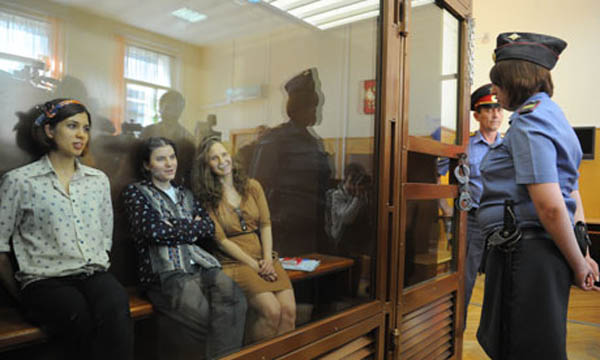
shot almost entirely through a glass box they were confined to in the
courtroom. At the time it was nicknamed “the aquarium.” It is as
though another reality containment field appeared within Buñuel’s mad dinner
party, this one encapsulating modernity and sanity in its airless chamber
within the larger madness enclosed around it. The glass box evokes an aquarium,
a wardrobe, and a partition in a cell in a zoo by turns. It separates the
accused from the space of the courtroom and suggests that those inside the box
exist in a alternate judicial reality that is being witnessed though a kind of
window. It implies that the defendants are dangerous, and that they are so
hated that they need to be protected from attack even within the confines of
the court. Its wood and glass work their magic gradually and almost invisibly; the
box suggests that the rules for those on the inside of the box are not the same
for those on the outside. This is how ideology works, by framing, by allowing the
visibility of the frame to inexplicably erode in importance from one’s cognitive
field of vision.

But information has a way of escaping. As we look at the
women, we also see the reflections of the court officials, family members and
security guards. We can see how small the room is on its opposite side, just as
we saw Kirill’s watch reflected in the high gloss of his desk’s wooden surface.
There are bright strobe flashes, the dark distorted silhouettes of
photographers and murky shapes that shift and loom with a blurred menace. These
ambiguous images in the glass suggest alternate possible fates for these
women,  alternate possible futures of
Russia. They form and change into different possibilities of manifestation,
different histories. The reflections of the reality outside the box and the
images of the women inside, laughing at the absurd comedy of the draconian
proceedings, fuse together mutually enclosed spaces of the trial in an uncanny
collage, a kind of film within a film. The glass box is the state’s framing
device, but it is also an Esper Machine.  
After Macha’s final statement, the judge makes a spectacularly
counterfactual statement that epitomizes the dark comedy of the trial:
“Let me remind you this is not a theater.” The preordained trial was
primarily designed to be a theater, to set an example for any manifestation of
opposition.

The massive film art collaboration of Pussy Riot, Kirill and
Putin has two different audiences and two different meanings that go along with
them. The Russian audience saw an insult to their faith and to state power
rightfully punished by a strong authority. This opportunity to pander to
chauvinism and to make the population feel threatened increased Putin’s
popularity and solidified this partnership with the Orthodox church, who in
turn demonstrated they can easily whip up a vengeful moral outrage when it’s
politically useful. Learner’s film has been banned, and Putin has signed a bill
imposing jail terms and fines for insulting people’s religious feelings: the
“Pussy Riot” law. The Russian protest movement has been defeated for
the time being.

In the West, the sprawling Pussy Riot phenomenon read as a
primarily as freedom of expression issue. It generated worldwide criticism of
constraints on political speech in Russia and garnered widespread support
from American pop musicians. Pussy Riot,
a Punk Prayer
has been short listed for an Oscar nomination. The western
framing of Pussy Riot as being essentially about individual freedom of
expression is somewhat ironic, considering the group was explicitly formed to
proliferate in a way that included collective direct action and total
anonymity. Western supporters may be surprised to find that the group is
staunchly anti-capitalist. “We refuse to perform as part of the capitalist
system, at concerts where they sell tickets.” The western response to Pussy
Riot has also included a fair share of sexist dismissals, both through claims that
the women are seeking fame and only get attention because they are attractive,
and in supporting them as glamorous celebrities while largely ignoring their
ideas. The chances that Pussy Riot-style actions could flourish in the West are
questionable. In New York, there is a 150-year-old law that makes it illegal to
congregate in public with two or more people while wearing a mask or any face
covering that disguises your identity. The law has been used several times
against Occupy Wall Street protestors and was implemented during a Pussy Riot
support rally, in which several people were arrested for wearing balaclavas.
Russia is not the only country using archaic laws for the purpose of harassing
civil society.

Masha and Nadia were released two months short of their
sentences in an amnesty measure designed to make Russia appear to be a modern
country with a rule of law,leading up to the Winter Olympics in Sochi, another
large-scale theatrical event. In the tradition of Russian dissidents, these
women have committed the crime of refusing to publicly accept their own
powerlessness, and they paid for it. They now have plans to form a new human
rights group focusing on prisoners’ rights, something they are now well-qualified
to work on. 

It remains to be seen what the production team of Putin and
Kirill will come up with next.  Putin is
himself a skilled appropriation artist. He produced a highly conceptual
master’s thesis, plagiarizing large sections of text verbatim from the work of two
University of Pittsburgh academics. His creative skills and knowledge of his
audience are considerable. It’s likely that Masha and Nadia may be working on
some kind of sequel with him in the future.

Drew Gardner’s books include Chomp Away (Combo, 2010), and Petroleum
Hat (Roof Books, 2005). He tweets at @chompaway and lives in New York
City.

Shia LaBeouf: Plagiarist or Genius?

Shia LaBeouf: Plagiarist or Genius?

null

By now, most movie
buffs have stumbled across the imbroglio involving Hollywood megastar Shia
LaBeouf, whose short film “HowardCantour.com” was allegedly rife with
plagiarism of cartoonist and screenwriter Daniel Clowes. The brouhaha has
recently expanded to include allegations that LaBeouf’s mini-comic Stale
N Mate
 was in substantial part a plagiarism of Benoit Duteurtre’s
novel The Little Girl and the Cigarette. Both Clowes and Melville
House, Duteurtre’s publisher, are considering legal action against the
twenty-seven year-old star of the “Transformers” film series and the
forthcoming Lars von Trier film Nymphomaniac.
Meanwhile, LaBeouf has flooded his Twitter account with statements of
contrition—all of which are apparently plagiarized from infamous apologies by
the likes of Alec Baldwin, Russell Crowe, former New York governor Eliot
Spitzer, Tiger Woods, and the con-man who gate-crashed Nelson Mandela’s funeral
as a sign-language “interpreter.” You’d think someone in the arts
community—
perhaps even someone
at Melville House, whose list is full of literary performances with which
LaBeouf’s present schtick is sympatico (e.g., Melville House’s Tao Lin
populated his novel Richard Yates
with “characters” including real-life celebrities Dakota Fanning and Haley Joel
Osment)—would have noticed that LaBeouf’s playing a game that has less to do
with appropriating others’ work than with a new and controversial form of
artistic expression called “metamodernism.”

“Metamodernism”
was a term coined by two European cultural theorists in 2010, and since its
birth the idea, a fairly simple one, has taken the Continent by storm. In
America, it’s still an emerging artistic philosophy—one that has infiltrated
venues far more public than its European originators likely imagined was
possible. The only text to be found on the primary website devoted to the idea is a somewhat
obtuse manifesto that nevertheless threatens to permanently change the way we
look at the performing, visual, material, and literary arts. The basic premise is
one LaBeouf and many others in Hollywood appear to have taken to heart: oscillating
rapidly between contrary poles of thought and emotion—for instance, truth and
falsehood, sincerity and irony, reality and fantasy, optimism and
cynicism—allows those who do it the best chance yet of transcending these
conventional spectrums entirely. Moreover, proponents of the term claim that
it’s the Internet, with its myriad forms of social media and dubious level of
accountability, that has forced upon us this new-fangled way of interpreting
contradictory data.

All this would be no
more than fodder for scholars if it weren’t so en vogue in American cinema. If
you’ve seen Leos Carax’s Holy Motors,
in which an actor painstakingly plays several “roles” in the absence of any
cameras—thereby challenging his (and our) capacity to distinguish between reality
and artifice—you’ll know what I mean. Even outside Hollywood, examples of
metamodernism in the American art world abound, such as Kyle Lambert’s
photorealistic iPad “portraits”
of celebrities like Morgan Freeman. In other words, metamodernism is no longer
limited to those genres, like poetry, to which only the effetely academic still
pay attention. Sampson Starkweather may publish a book of poems entitled The
First Four Books of Sampson Starkweather
; thirty-three year-old poet Noah
Cicero may cheekily publish The Collected Works of Noah Cicero, Vol. 1;
and poet Adam Robinson may publish a collection entitled Adam Robison
and Other Poems
 (mispelling intended), but Americans have not yet returned
en masse to poetry as a cultural bellwether. More’s the pity; by framing their
collections with titles that earnestly point to the vanity of publishing one’s
Art but also the ironies inherent in that vanity (Starkweather’s boast of “four
books” comprises only one book, for instance; likewise, Cicero can’t actually publish
a compendium of his life’s work in his early thirties, or Adam Robinson access
the gravitas of self-titling a collection when his readers suspect the cover
sports a typo), these poems are challenging us to reconsider what’s real and
what’s not, what’s sincere and what’s ironic. That these books have only a few
hundred readers apiece limits the effectiveness of the statement, however. But few
Americans could miss the insinuation into Hollywood of modes of
expression that call the very nature of reality into question. In the recent
film This Is the End, James Franco and several equally famous buds
delivered a wildly fantastical tale in which they played only slightly tweaked
versions of themselves. In Anchorman 2, Will Ferrell’s Ron Burgundy
reveals his recent suicide attempt to a stranger in a tone that suggests he’s
lying about each and every detail–when in fact he’s doing no more than
delivering the honest truth. And now we find aspiring auteur Shia LaBeouf
seemingly plagiarizing entire scenes from other artists, and then, when caught,
plagiarizing each apology in a way he surely knew would be registered
immediately by self-appointed cultural critics like Perez Hilton.

Hilton’s
mystification at
LaBeouf’s serialized (and possibly plagiarized) apologies is telling.
“This is just really weird,” Hilton wrote on his
self-titled website. “Plagiarism should not be treated
like a joke.” Maybe not, but what we’re learning is that plagiarism, much
like comedy, can most certainly be elevated to the status of Art. Most
recently, we’ve seen Netflix air (via its online streaming service) specials by
Bo Burnham (“What.”) and Reggie Watts (“Why S*** So
Crazy?”) that consistently discomfort audiences by willfully warping
reality. Watts’s largely improvised routine 
sees him shifting between
languages in the middle of sentences, telling obvious lies seemingly without
self-awareness, and using video editing techniques to comment on the
artificiality of his medium. Burnham’s “What.” takes this mind-bending
zaniness to previously unimagined heights, as the young comic repeatedly
engages in conversation prerecorded robotic voices whose scripts Burnham wrote
himself. For audience members to be offended when, for instance, one of these
voices calls the Caucasian Burnham a “nigger,” they must do a sort of
mental gymnastics, reminding themselves that the animatronic voice they’re
hearing is not, in fact, an unaccountable robot, but Burnham’s own script
filtered through an off-stage editing booth. And Burnham’s repeated, subtly
complex maxim—“Art is a lie; nothing
is real” (emphasis added)—is the same sort of point young poets like
Starkweather, Cicero, and Robinson are making, but it finds a far larger
audience on Netflix than it ever could in your local bookstore.

Burnham, like Watts,
routinely points to the divergent realities of the Internet Age—the way our
many on- and off-line personas are mere approximations of the truth—by
undercutting his comedy with a running commentary on his own performance. But
what elevates the work to the level of Art is its additional and simultaneous
dimensions: a secondary commentary that comments on the primary commentary, and
even, sometimes, a commentary on the commentary on the commentary. These
techniques call to mind LaBeouf’s implicit skewering of America’s massive and
growing celebrity-shaming apparatus, of which Hilton is a primary proprietor.
What better way to expose the complexities of influence and inspiration, or the
silliness of celebrity worship, or the culture of gutter journalism America has
lately developed, than to turn each stage of a needless media circus—rather
than just the first few—into a cacophony of absurdity and manufactured
outrage?

However abstract all
these performances of the way contemporary technology warps our sense of time
and space, they’re not just intellectually provocative but also—audiences are
more and more commonly reporting—wildly entertaining. The idea that the
world’s most important emerging art philosophy should not only be devoutly theory-driven
but also consistently engaging is a cultural shift of significant proportions,
even if we saw the roots of this phenomenon in cultural touchstones like Steve
Martin’s 1970s stand-up routines and the 1980s satire-pop of “Weird
Al” Yankovic. What this new and much larger generation of metamodern
artists promise, in the near-term, are many more confused responses on the
order of Perez Hilton’s; in the long term, this new mode of music, cinema,
comedy, and literary art could open up a vital conversation about how we all
think–and live–amidst the vagaries of our digitized realities.

Seth Abramson is the author of three collections of poetry, most recently Thievery (University of Akron Press, 2013). He has published work in numerous magazines and anthologies, including Best New Poets, American Poetry Review, Boston Review, New American Writing, Colorado Review, Denver Quarterly, and The Southern Review.
A graduate of Dartmouth College, Harvard Law School, and the Iowa
Writers’ Workshop, he was a public defender from 2001 to 2007 and is
presently a doctoral candidate in English Literature at University of
Wisconsin-Madison. He runs a contemporary poetry review series for
The Huffington Post and has covered graduate creative writing programs for Poets & Writers magazine since 2008.