

[This essay contains mild spoilers for Season 2 of Orange Is the New
Black]
When US Weekly began its
photo-driven series “Stars—They’re Just
Like Us!” it was a revelation in the art of Hollywood propaganda. The
magazine rolled up the red carpet and instead offered readers a rare view of
celebrities, not just in their own natural habitats, but in ours. “They recycle! They shop at
Wal-Mart! They sell 100% organic lemonade at a homespun
card-table stand outside their Brentwood mansions!” The series fashioned a different illusion of us vs. them: a shared world in which we’re all essentially the same people,
but some of Us just happen to have a
few million more dollars in our bank accounts than others.
This is a kind of
reverse-empathy, a strange effort to level the playing field, to “humanize”
celebrities—arguably the most privileged people on the planet (at least the
true A-Listers), those for whom the odds are ever in their favor. It’s a compelling pitch—but it’s tough to ignore that many are
still on the outside, peering in through the pages of a magazine that they probably
didn’t even buy, shopping at the Dollar Store out of necessity in lieu of choice, grazing on photos that are glossy but not so
shiny that they can actually see their own reflections staring back.
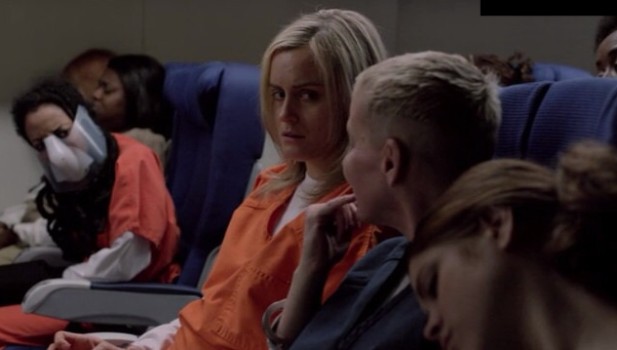
Now that Season One of
the Netflix Original series Orange Is the
New Black is safely stitched into our pop culture quilt, the show has shed
its initial hesitation and has its crazy eyes on its viewers just as much as they
have theirs on it. Season Two feels emboldened by its newfound
responsibility—to its characters, to its audience, and to actual women in
actual prison.
The show had its origin, of
course, with an actual woman in actual prison—Piper Kerman, who served a year
or so in federal prison for money laundering and drug trafficking, and then
wrote the memoir on which the show is based. Kerman, like her fictional
counterpart Piper Chapman, is white, blonde, a self-described WASP, educated at Smith, and born into wealth: the
celebrity who’s just like us, except behind bars. But through Orange Is the New Black, she’s also the
glossy magazine, our window into a world of women largely unseen, unexperienced
by most people—most people, that is, who can afford the time and money needed
to subscribe to and binge-watch Netflix.
Women not like us, except
for when they are.
Showrunner Jenji Kohan first
described the character of Piper Chapman as her
“Trojan Horse,” her spoonful-of-sugar
access point to be able to sell a show—and have it received successfully—that
is primarily about the lives of marginalized women: the elderly, women of
color, women of varying sexualities and gender identities, and—it’s actually
not an obvious point to make—women with criminal histories. Season One took a
deserved hit for falling short in shifting our gaze away from Piper’s story,
and while Season Two definitely improves upon the silence, it misses many
opportunities to change the conversation, most importantly from “Can you
believe this happens in prison?” to “You really need to know that this happens
in prison.” Put another way, it’s the difference between a tweet and the linked article a tweet lures
its reader into clicking.
Prison-themed shows and
movies often trade
in tropes the way their characters barter with cigarettes: shower violence,
the uber-butch
lesbian who spends the majority of her time looking for a submissive sex
partner, prison
breaks. Kohan does take on the greater cultural mantle of her subject
matter—her indictment of the federal system and the prison industrial complex
is not insignificant, especially in the confines of a comedy. But she often
doesn’t let the punishment fit the crime: she exposes the issue of
guard-on-inmate sexual assault, but then throws a blanket of romance and
“consent” over it, derailing her focus on a
real problem.
Tasha “Taystee”
Jefferson, for example, is a black woman essentially raised in the foster care
system before going into juvenile detention at the age of 16. In Season One,
she actually wins her release from a parole panel, but because of a wholly
inadequate re-entry plan, she quickly returns to prison—her only remaining
family—to finish out her sentence. We learn in Season Two that she spent much
of her time in foster care living in group homes. With just this handful of
facts, Kohan has the opportunity to tell a very real, very common, very
troublesome story: girls of color in foster care, especially those who live in
group homes rather than families, and especially those who move from home to
home, are
much more likely than their peers outside the child welfare system to
experience school dropout, early pregnancy, poor health and—as
Taystee demonstrates—juvenile
delinquency. Young people who go through both the foster care and juvenile justice systems (often called “crossover youth”) are most likely
to be African-American girls, and they accumulate even more
risk factors: they are more
likely to be detained as a result of their court cases (rather than released
with community-based consequences or dismissed), and they’re more likely to be
given harsher sentences than youth who aren’t involved in both systems.
Taystee tells us these
facts about her life, but we don’t grasp what makes her experience different or
important in the context of our non-fictional lives. Instead, we’re given a troubling
stereotype in Vee, the “evil foster mother” who intentionally takes on wards to
exploit them into her drug ring. Through flashback, we see Vee scouting 11-year-old
Taystee at a foster care/adoption ice cream social, knowing immediately that the
facts are stacked against the young girl: Taystee is not a baby, lives in a
group home, projects a self-assurance that reads as defiance, and tries too
hard to be loved—traits, we learn, as Taystee is told directly by Vee, that will
keep her from being any family’s choice. The nuance of Taystee’s struggles to
define who is and isn’t her family is a truly admirable aspect of her character,
but Kohan could have dug much deeper, given plot lines based on the actual, rich
stories all around us, and still introduced the villain she needed in Vee.
The problem is not so
much that OINTB’s back-stories are not to be believed; it’s more so that these
less-common stories reinforce the general public’s confirmation bias about
important social issues, and as such they betray the true widespread crises
within the criminal justice system and society at large. Suzanne “Crazy Eyes”
Warren is an entertaining, powerful, endearing character. But portraying her as
so physically violent belies the experience of the majority of people with
mental health issues: they are much more likely to be the victims of violence than to
perpetrate it. To send the false
message isn’t just artistic license; it’s actually damaging
misinformation—especially in an era when nearly 45% of inmates in federal prison have symptoms of
serious mental illness, such as
major depressive symptoms like attempted suicide, extreme loss of appetite and
extreme insomnia, and psychotic disorders that produce delusions or hallucinations,
among others. Crazy Eyes’s
suggestibility to violence, at the hands of Vee, becomes a much more
heavy-handed theme of Season Two than the notion that Suzanne is being victimized and likely not receiving proper mental
health treatment.
And don’t food stamps (the
colloquial name for the SNAP program) get a bad enough (false) rap already? Do
we need a character whose backstory rap sheet perpetuates the most overused, under-informed urban legend, that food stamp fraud is rampant, a story that
politicians so often use to fear-monger against the poor? Audiences need to
know that most people who depend on SNAP are children, the elderly, disabled
people and working adults who still fall below the poverty line. Smart people
who study these programs estimate that SNAP
lifted nearly 4 million people out of poverty in 2011, all through a
federal safety net program with a fraud rate of only about
2%. Storeowners like Gloria certainly exist, but Kohan should weigh the
consequences of using that as her defense. Truth does not always equal
responsibility, I s’pose.
This is not a call for Orange Is the New Black to function as
a documentary, or to make its audience eat broccoli when there’s cake to be shared. There are fine moments when Kohan allows an
important story to be told from the inside-out—as with Laverne Cox’s
outstanding portrayal of transgender inmate Sophia Burset (which
has led to more IRL advocacy opportunities for Cox), and there are further
fine moments when Kohan does not equivocate. She makes no bones about her bold
indictment of inadequate prison health care throughout both seasons: from
Burset’s inability to receive proper hormone treatment and Tricia’s overdose in
Season One to Season Two’s hunger strike demands and—perhaps the most moving
subplot of all—Jimmy’s “compassionate release,” though she is
addled with dementia.
And there are times Kohan
weaves policy and humor so effortlessly it’s dazzling. When the Latinas in the
kitchen serve “special trays” to the Black women filled with food wretched with
salt, Poussey, amongst the grumblings, snaps: “Man, they f*ckin’ us this way
’cause they know our people’s
predisposition for hypertension.”
And there are times Kohan’s
nuance is a deft jam: towards the end of Season Two, Piper—whether out of
boredom or cunning or a way for Kohan to further highlight Piper’s book-smarts
vs. her fellow inmates’ street-smarts—starts a prisoner-run newspaper. (+1 to
Kohan, as these enterprises have an important history and role in U.S. prisons.) The show pulls such a fun sleight-of-hand
in Caputo asking Piper to include a column featuring the guards.
“Guards—They’re Just Like Us!” she brightly suggests, though Caputo misses her
wink and edits it to “Guards—They’re People, Too.” The complexity is all the
richer for delivering so much insight so quickly—having the prison focus support
on a program designed to help inmates have empathy for their guards; the uneasy
lack of distinction between those who wear orange jumpsuits and those who wear
blue shirts; and even a sly gut-punch to our own ribs using the very same US
Weekly shtick.
 Prisoners—They’re Just Like Us
It’s what Kohan wants us
to experience, even if it seems as unreal as Piper’s first day behind bars. She
succeeds in many ways: we have empathy for her characters, for these fictional
individuals we feel we’ve come to know, come to care for, despite their
faults—and in some cases, their incredibly violent crimes. We smile warmly when
Frieda, the gray-haired inmate with the octopus neck tattoo, helps Red regain
her confidence, but this is a woman (at least she claims) who severed her
husband’s penis. We know that calm Zen-master Yoga Jones was somehow
responsible for the death of a child. Morello has been called “the most heart-breaking character of Season Two,” and yet we know she stalked a man and his
girlfriend to the point of planting a bomb on their car. And if you looked at
Miss Claudette’s jacket, it would’ve said premeditated murder. In the kitchen.
With the butcher knife.
Are these women just like
us? If we read about them in the morning paper, would we call them heart-breaking,
or throw-away-the-key vicious and irredeemable? Advocates—those who fight
against poverty, over-incarceration, and solitary confinement—use
storytelling to create empathy.
They use personal, lived stories that shake the status quo, challenge
assumptions and dispute stereotypes in order to effect change and create
connections between all members of a community. Recently, the
New York Times’ five-part series on
11-year-old Dasani, a young girl experiencing homelessness in Brooklyn,
rattled the internet with its personal, unflinching detail of her family’s
struggle. The expose may not have radically changed the conversation around
homelessness, but it’s not insignificant that an internet search for “Dasani”
returns the article as its 5th result in a country where Coca-Cola
is a brand of patriotism.
And yet, those with the
time and knowledge and resources to respond and help bring about that change seem
to display more empathy, more compassion for fictional characters than for their very real, real-life
counterparts. We adore Black Cindy for her humor and her charm, enough to laugh
at her penchant for felony theft. Google “Omar from The Wire” and
you get nearly five million results in 0.27 seconds. A shotgun-toting,
murderous, thieving, homeless black man. In the fictional world of The Wire, he’s a charismatic, quotable, beloved Robin
Hood—even President Obama calls him the best Wire character
of all time.
Viewers watch portrayals
of characters like Taystee and Black Cindy and Omar Little and feel smart when they
call it “real.” They come up with answers the way you might have aced the
reading comprehension sections of the GRE or the LSAT. The theme of the story is how politics makes strange bedfellows, even
in prison. The theme of the story is
enduring friendship, even in the harshest of conditions. The theme of the story
is that people are more alike than they are different. We identify all the
right injustices, like circling in a seek-and-find puzzle: solitary confinement
is torture; black women receive longer sentences than white women; sexual
assault in prison is real. We know poverty because we know The Wire’s Baltimore.
It’s no small wonder,
then, that the death announcement of Donnie Andrews, the man who inspired Omar
Little, is paired with a photo of the actor Michael K.
Williams. Andrews served 18 years
on a murder charge, then founded a youth outreach organization after his
release. He was only 58 years old when he died.
Watching television shows
like OITNB and The Wire has become a kind of compassionate release for our
collective conscience. But then what? What thoughts and words and deeds would we have for these characters
if we were sitting on their jury? What expression would be on our collective
faces if we passed them on a Baltimore corner?
Kohan’s two seasons so
far are hilarious, poignant, irreverent, weird, and ground-breaking for
television in their breadth of gender, race and identity. And worth watching. Season
Three has already begun filming. And it’s fair for us to ask for more from it.
But it’s entirely fair for the show to ask for even more from us, too.
Amy Woolard is a writer and child welfare/juvenile justice
policy attorney who lives in Charlottesville, Virginia. She is a graduate of
the Iowa Writers’ Workshop and the University of Virginia School of Law. Her
work has appeared or is forthcoming in the Virginia Quarterly Review,
the Massachusetts Review, the Indiana Review, The Journal, Fence, and the Best
New Poets 2013 anthology, among others. You can find her at shift7.me, and on Twitter as @awoo_.

 Press Play Video Blog