


After last week’s announcement of this year’s Oscar nominees, a handful of Press Play contributors gathered together via email to discuss the highs and lows in some of the major award categories. Below are some of the highlights of the conversation, and as always, we encourage you to keep the discussion going. The site's consensus picks for the films and individuals that should win be announced next week, starting Monday.
Matt Zoller Seitz: Has anybody seen A Better Life, for which Demián Bichir was nominated as Best Actor? That seemed out of left field. I feel like Gary Oldman might be a lock for that one, what do you think?
Glenn Close and Rooney Mara nominated for Best Actress is interesting, too. Some thought Close's work was too stunt-y. Mara seems a total surprise for me, as her character is so not Academy-friendly (in terms of looks and demeanor), and Mara is not anywhere close to a known quantity.
 Ali Arikan: Rooney Mara has been lauded by the critics and the industry, and the studio had been hyping her since the summer, so I'm not at all surprised that she got a nomination. Despite the fact that the Millennium books are terrible, people seem to love them, and Lisbeth Salander has become an iconic character. Plus, she also did sterling work in a solid film. What is interesting, however, is that either she or Glenn Close edged out Tilda Swinton for We Need to Talk About Rosemary's Omen. I thought she would be a lock.
I am happy about Moneyball, a film I thought I would hate, but ended up loving. I am one of the few in "our circles" who felt The Tree of Life was lacking, and I don't think it deserved a Best Picture nomination over Tinker Tailor Soldier Spy.
Extremely Loud and The Help are just risible. The latter was always going to be in there, but I thought Bridesmaids might have snuck in instead of Extremely Loud. Either way, having nine nominees obviously shows that the field is still pretty wide open.
 Matt: I like The Tree of Life best of the Best Picture nominees, though I know opinion in this thread is mixed. It's the most unconventional of any nominated film, so much so that I am pleasantly surprised that it became a sort of event when it hit theaters. I think more films that experimental should be made at the Hollywood level. There are not too many directors holding down the fort for that kind of experience, not even Malick's fellow '70s movie brats Spielberg and Scorsese.
Aaron Aradillas: I would argue that in their own ways, both Hugo and Tintin are experimental films. I mean, if it wasn't for their directors, I seriously doubt a studio would've rolled the dice on 'em.
Sarah D. Bunting: Margin Call got a Best Original Screenplay nod. Shut up, Oscars. Barf.
Ali: I also second Sarah's barf. Ewww.
My feelings about Melissa McCarthy mirror Scott Tobias' thoughts on Extremely Loud and Incredibly Close. I disliked Bridesmaids, but I despised her performance.
Aaron: I've yet to fully grasp the dislike for her performance. I know it exists, but I don't get it. I don't remember anyone being offended when Kevin Kline won for making a mockery of being a dumb, sexist man.
Nick Nolte is terrific in Warrior, but it is clearly a great performance of something he does well. He makes look effortless what Tom Hardy and Joel Edgerton huff and puff and make look so tiring. Besides, Nolte did a better version of this in Affliction.
 Christopher Plummer gives his career performance. There's no fat on it. Unlike The Insider, where he's a hoot, Plummer doesn't push it in Beginners, and that's why he leaves such an impression on those of us who love the movie. The way he embraces life at such a late date is funny, touching and ultimately quite sad. Ewan McGregor's character never acknowledges it, but he learns his father's final lessons and that's what leads to the movie's astonishingly hopeful and romantic ending. He is finally his father's son. Plummer's presence is felt in every scene. It be McGregor's story, but it's Plummer's film.
I'm a fan of Midnight in Paris, but Woody Allen's screenplay is not entirely original. It's kind of a variation on The Purple Rose of Cairo. Margin Call is a script written about how we're living right now. It trumps Mamet by not getting all tangled up in being clever with its verbal scenes.
Mara's my second choice in the Best Actress category, but Viola Davis is the only lead actress who literally has to create a character from scratch. The other performances all have something already existing that they're working off of.
Ali: I am not basing my dislike of McCarthy's performance on a curve. It was too easy, without any nuance and did not add anything to a film that definitely needed some sort of a breakout-star factor to make it less boring (and, you know, funny). So, I'd love to hear the case for her.
 Aaron: The beauty of McCarthy's performance is there isn't a trace of self-loathing or self-doubt that would probably get in a dozen other comedies with a character like hers. She is the most confident and aware person in the circle of Bridesmaids.
I'm willing to make a gentleman's bet that Meryl Streep will not win Best Actress. I think Viola Davis is going to "surprise" everyone and take it home.
Kevin B. Lee: If anything, Davis is the odd sober person surrounded by a carnival of sass, crass and crazy in The Help. Octavia Spencer and Jessica Chastain are like intrepid migrants from John Waters-land, while Davis anchors it in gravity and respectability ‒ she's the whipped cream atop the shit pie. I'm not sure whether she saves the movie or adds a layer of Oscar-mongering disingenuousness to what really should be an all-out camp farce. But her final scene standing up to Bryce Dallas Howard is a feat of acting gymnastics, going through a series of emotional states in lightning succession.
In contrast, The Iron Lady is pretty much all Meryl Streep (and everything that implies, good and bad). But it's an MVP performance; she actually made me like Margaret Thatcher for two hours.
Lisa Rosman: The Help is a tepid movie at best, offensive at worst, but as is so often the case, the performances far outstrip the film. Viola Davis never gives up an inch ‒ she may cater less as an actress than anyone else in Hollywood ‒ but so much goes on behind the eyes that she ignobles what could be a wretched role. And on that note, I love Rooney, but this is not the film for which she should win an Oscar. It's a one-trick-pony role and though she does it well, it doesn't have enough shades to win a golden naked man.
 I hate hate hate hate the idea of McCarthy winning this. The role is not just unfunny; it's mean-spirited and she executes it more poorly than she's done anything else in her career. (Wherefore art thou, Sookie?) Nay, for me it's Janet McTeer, who does everything that Close herself fails to do in the otherwise craptacular and super outdated Albert Nobbs. It's a finely tuned performance that brings real pathos and humor and at least three dimensions to the kind of person that Hollywood always, always gets wrong.
The rest I am less adamant on. I love Malick but The Tree of Life is not legible in ways that actually matter to me. Scorsese should take Best Director for Hugo, but I can understand why others do not agree. Gary Oldman should, of course, take it; it's a terrific performance, and Tinker Tailor the Thief Cook should get Best Adapted Screenplay. I don't love any of the Best Picture nominees but think Moneyball comes closest to being what I want a big movie to be. And sorry for the barfers, but I love Margin Call for Best Original Screenplay.
Aaron: I'm for Brad Pitt. I think he gives a star turn and acting powerhouse at once. George Clooney is great (and I have no problem if he wins), but he was going deeper into a character he does best: the good-looking asshole who is brought up short by life.
 There is real mystery to Pitt's take on Billy Beane. He loves the game, but knows the game is changing. He knows he has to get wins in order to keep his job and is more than willing to modernize for that reason. But he also knows there is something you can't calculate about the game of baseball. The scenes of Pitt driving to work or sitting in the locker room show a man who is constantly trying to figure out the odds and knowing deep down that there are some things you can't figure out. Also, Pitt is a great subtle comic performer in the scenes where he's making deals or bossing around others in the room. Like Jesse Eisenberg, he is a natural when it comes to Aaron Sorkin's writing.
Kevin: I think Pitt's performance falls under the same school of acting I endorse. (Clooney, on the other hand, is on autopilot).
Aaron: Clooney's not on auto, but I'll leave it at that. I do know Pitt is happy as can be to be nominated in the same category as Gary Oldman. His death scene in Fight Club is inspired by Oldman. Pitt says on that film’s commentary, "No one dies like Gary!" It should also be noted that Pitt gets a slight advantage in that his work in both Moneyball and The Tree of Life show how wide a range he truly has.
Lisa: I actually agree Clooney's not on auto, but I disliked the conceit of the casting of that film immensely. (Alexander Payne loves to get notoriously charismatic actors to play schlubs; it underscores his misanthropic view of "average people.")
 Ali: I, too, am for Pitt, even though I liked Tinker Tailor Soldier Spy Doo-Dah Doo-Dah more than any other American film this year. Goldman is magnificent as George Smiley, closer to John le Carré's vision than Alec Guinness' portrayal, and he explodes with understated pathos (paradoxically) the one time he shows his emotions (the incredible Soviet national anthem scene where he sees his wife having it on with Colin Firth).
That said, I have a problem with his voice and accent. He sounds like a constipated baboon trying to do an impression of Ian McKellen. It was but a minor quibble when I first saw the film, but after three times, it's just grating. (For what it's worth, Tom Hardy gives the best performance in that movie.)
As for Brad Pitt, first of all, his is an almost old-fashioned movie star performance. He's charming and cheeky and funny, and hella good looking. (Yes, I've just used "hella" ‒ I am a 14-year-old kid from 1998.) I have no idea who Beane is, so this is my estimation of the character as he is seen on the screen: as Aaron said, here is a person who decides to ride the waves of change. Pitt plays him as a nexus of frustration; he never made the big time, so he is trying to make up for that lost opportunity. He is clever, though. He knows that he is unable to see the forest for the trees (the final scene with Jonah Hill, the earlier conversation with his daughter, etc.), but that's what obsessive-compulsive people are like. They know what they're doing is irrational, but they have to keep doing it.
Also, the final shot shows him in full command of his face ‒ an incredibly important skill for a screen actor.
Matt: What about this Demián Bichir fellow? Nobody's really mentioned him as a contender….
Aaron: A Better Life is good, and he's really good, but not award-worthy, especially when you consider someone like, say, the criminally underrated Steve Carell or Kevin Spacey's triumphant return to good acting in Margin Call. If one is going to label his nomination the Indie Nod, I much prefer Michael Shannon. Take Shelter is far from perfect, but Shannon is amazing.
The biggest problem with A Better Life is the character of the 14-year-old son. The actor is pretty bad and the character, as written, is pretty thin. An old-school Mexican dad would not put up with half the shit this kid gives him. Compared to the father-son dynamic in A Bronx Tale, A Better Life comes up short.
 Can I make my case for The Help one more time? If the best 9/11 movies are not explicitly about 9/11 (Zodiac, Munich), then why can't one of the best films about race today be a movie about recent history? The outcry from so-called open-minded liberals was telling in that just because the movie was supposedly playing it safe by telling a story we all can agree on that it wasn't also making people think about the here and now.
Race is the one truly unspoken-about issue in this country. When it is spoken about, it is in an obvious safe way. The Help is about the moment when an open discussion was needed in order for change to occur. What the movie also makes clear is that discussion needs to be ongoing. And that is simply not the case right now.
Just because the movie delivers its "message" in bawdy, emotional, mass-appeal entertainment doesn't make it unworthy of praise (or awards). The Help not only attempts to keep recent history fresh in our minds, but also old-fashioned awards-worthy entertainment alive as well.
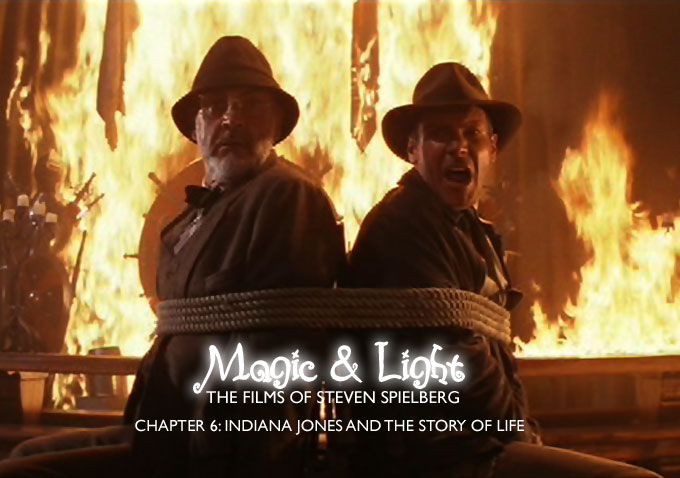
 In later films we will learn that Indy has taken on the vocation of his father as a way to impress, and then one-up, the old man, a stern and distant academic. In Raiders, Indy is presented as almost a runaway kid, a grown-up Bowery Boy who doesn’t give much thought to others. He possesses the shallowness of youth, complete with the clichéd woman in every port. He’s a heartbreaker, this one.
 When Indy, Willie, and Short Round come across a village, they discover all of the children have been kidnapped and forced into slave labor in the mines of the Thugee cult. In effect, the bad guys in this film have made the entire village childless, and turned all the kids into orphans by kidnapping them.
 While the elder Jones didn’t literally abandon his family to pursue his obsession, we have no doubt that a lot of the time when Indy was growing up, the old man was mentally or emotionally checked-out. You can see it in the way they communicate – or more accurately, don’t communicate.
 Released almost twenty years after the last Indiana Jones film, Indiana Jones and the Kingdom of the Crystal Skull feels like a coda. Indy seems to be re-thinking his decisions, and having pangs of regret. Although the sixty-something Indy is still a snarling, leathery ass-kicker, and in what might be his surliest mood since the middle section of Temple of Doom, the movie’s overall tone is rueful and melancholy.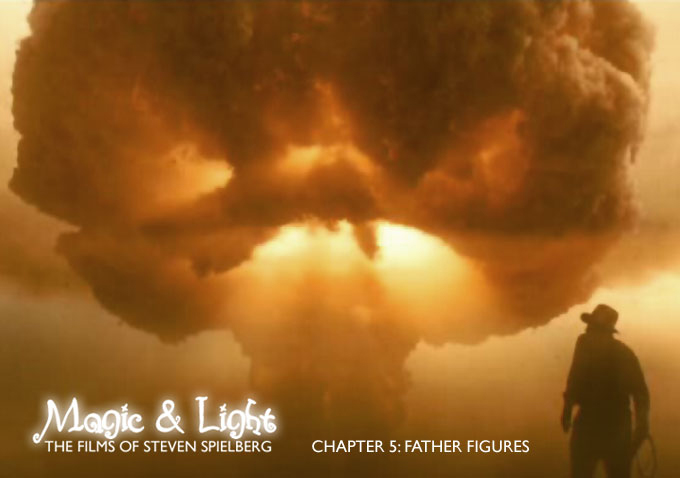
 In Jaws Roy Scheider’s Chief Brody is the father figure to a tightly-knit summer community being terrorized by a Great White Shark. The scene where his son mimics his gestures tells us he’s a loving, good father who will do anything to keep his family – and his community – safe.
  But when the men sit around drinking and talking we learn the source of Quint’s insanity. He tells them of how he survived the sinking of the USS Indianapolis, the naval vessel that an atomic bomb that helped the United States defeat Japan in World War II. They were ultimately successful — but the mission is famous mainly for having its crew picked off by ravenous sharks.
  The Spielberg who made Saving Private Ryan in the late 1990s was a family man in his 50s. Detractors questioned Miller’s final admonition — asking, in effect, “Well, what if Private Ryan went home and DIDN’T accomplish anything special?” But that’s really not the point of that moment. It is a purely personal, human moment between Miller and Ryan that transcends war or even politics. In Spielberg’s films, every life is worth saving, provided that the saved person goes on to continue to be – or to BECOME — a decent person, and do the best he can with the gift he’s been given.
  In Close Encounters of the Third Kind, Steven Spielberg shows a father driven to near madness in the pursuit of his dream. Roy Neary exhibits the behavior of a young artist who’ll stop at nothing to make the vision in his head a reality.
  Spielberg’s 1982 blockbuster E.T. feels like a continuation of Close Encounters – and not just because the story originated in Spielberg’s daydreaming about what might have happened if one of the aliens from Close Encounters got left behind. The film’s hero, Elliott, is the middle child in a bustling suburban home guided by a single mother. The absence of the father is conspicuous, and important. At time it feels as if we’re seeing what happened to the Neary family in Close Encounters after Roy lost his mind and ran off to Devil’s Tower.
  Throughout his films you can track Spielberg’s evolving feelings about the terrors, pleasures and responsibilities of fatherhood. In Empire of the Sun, based on J.G. Ballard’s novel, the preteen hero Jim is wrenched from his family as violently as any Spielberg hero, and must learn to survive on his own. He finds an unexpected ally – a sort of Humphrey Bogart-like, scoundrel-mentor – in Basie, an American steward stranded in Japanese-occupied Shanghai.
 The centerpiece of the movie is when the men sit around the table, drinking and talking. There’s an unspoken rivalry between the crusty old seaman Quint and the young smart-ass Hooper. They start to compare scars they’ve gotten while observing sharks. (Brody, a former big-city cop who has rarely fired his gun, has no scars.) Hooper is amused by Quint, humoring his macho posturings. Quint knows this. But Quint puts Hooper in his place when he begins to tell him how he survived the Indianapolis, the World War II vessel that delivered the Hiroshima bomb. The Indianapolis is most famous for being attacked and its crew being picked off by sharks. There are a couple of things going on in this sequence. Quint’s monologue stops the film cold and gives it a sense of drama that had been mostly absent up until that point. His story is real and is scarier than anything in the movie. That’s probably why some critics (particularly Pauline Kael) raised concerns about its inclusion in otherwise escapist entertainment. Some felt the movie was crossing a line by using a real-life tragedy in the service of an adventure story. It would seem to be exploiting the real pain of the families of those who perished or survived the Indianapolis. But for Spielberg and his contemporaries (Scorsese, Coppola, De Palma), nothing was off limits. Nothing was sacred if it made for a better story. Quint’s monologue transforms the movie from an old-fashioned monster movie into something haunting. It’s why the movie has endured all these years.


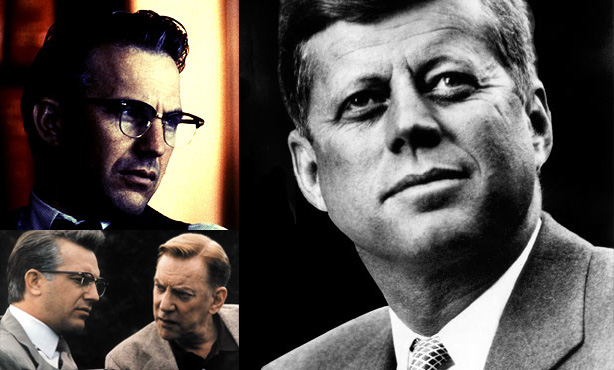

 impressionistic, near hallucinatory directorial style. By casting Tom Cruise as Ron Kovic, the Vietnam veteran who came home paralyzed and became a raging force in the anti-war movement, Stone committed a perverse act of image vandalism. He turned the audience’s relationship with Cruise, the ‘80s poster boy for All-American wholesomeness, on its head. The result was an emotionally sweeping film, a
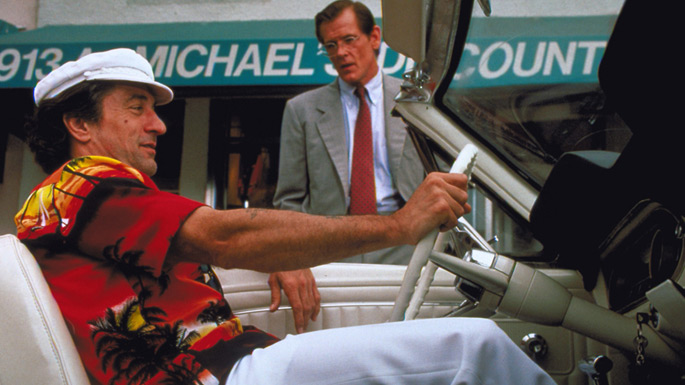
 For some critics, Cape Fear was seen as a placeholder, an attempt by Scorsese to earn some financial security so he could make his more “personal” stories. (The film was produced by Steven Spielberg’s Amblin Entertainment, with Spielberg wanting to produce his friend’s most financially successful film. Cape Fear remained Scorsese’s top grosser until Gangs of New York.) Like The King of Comedy in 1983, Cape Fear was the follow-up to an artistic triumph for Scorsese. King came after Raging Bull; Cape Fear came after
  And that’s where Max Cady (Robert De Niro) enters the scene. His rage at Sam is not only palpable, it is justified. It’s revealed that Sam defended Cady for rape and battery 14 years ago, and in the process of preparing a defense, he buried a report that said the girl Cady raped was promiscuous. For Scorsese, Sam’s “moral” choice to protect the community by violating his oath has rendered him a fallen man who has forsaken his rights to protection from the law – and God. Cady, who was illiterate at the time of his conviction, has become a self-taught man and intends for Sam to “learn about loss.”


 EDITOR'S NOTE: Kiefer Sutherland's ticking clock classic debuted 10 years ago this week. To mark this milestone, Press Play is re-publishing the video essay series "5 on 24" which was created by Matt Zoller Seitz and Aaron Aradillas for the Museum of Moving Image in 2010. According to their introduction, "5 on 24" examines various aspects of the show, including its real-time structure, its depiction of torture, and the psychology of its hero, counterterrorist agent Jack Bauer. The show tapped into the ticking-clock on-the-go mentality of post-millennial society. And its machine-gun pacing, real time structure, and long-form plotting took aesthetic risks that no other action show had dared.
 Press Play Video Blog