
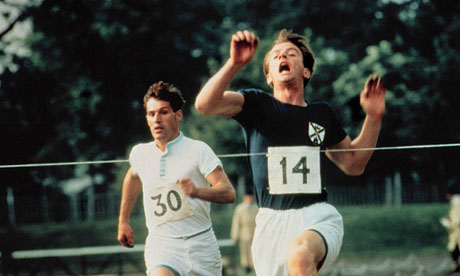

[EDITOR'S NOTE: In a yearly feature titled "Oscars Revisited," Press Play takes a look back at the Academy Awards race from earlier eras. Our inaugural series focuses on the five Best Picture nominees from calendar year 1981: Reds, Atlantic City, On Golden Pond, Raiders of the Lost Ark and Chariots of Fire.]
When Bud Greenspan loosed his 22-part documentary TV series The Olympiad on the world in 1976, he created a template by which all future Olympic-related works would be judged. Scoring the title sequence with Charpentier’s Te Deum, he signaled the godlike grandeur of the Olympian with Baroque pomp. Chariots of Fire, influenced by Greenspan in its lofty view of pure athletics and idealized, Oscar-winning score by Vangelis, is typical of the kind of Anglophile, prestige film the Academy favors. It is also a rare, accurate biopic with an above-average script (it won the best screenplay Oscar as well). This inspirational 1981 film tells the true story of the track team Britain sent to the Paris Olympics in 1924. Tellingly, it concentrates on two runners who stand apart from the upper-crust Cambridge men who comprise a major chunk of the team. The first is Harold Abrahams (Ben Cross), a hard-driving Jewish law student at Cambridge who uses winning races as a cudgel against anti-Semitism. The second is Eric Liddell (Ian Charleson), the son of a Scottish missionary who intends to follow in his fatherʼs footsteps, but has earned the nickname “The Flying Scotsman” for his prowess as a rugby player and sprinter.
 A turning point for Abrahams comes when he watches Liddell run. Not only does he see that his unbroken winning streak can be threatened by the awkward but fast Liddell, but he also meets Sam Massabini (Ian Holm), a professional track coach who has tried unsuccessfully to recruit Liddell. Abrahams persuades Massabini to come see him run, and Massabini agrees to coach him, an arrangement that displeases two Cambridge dons (Sir John Gielgud and Lindsay Anderson) with a strong commitment to the notion of amateurism. Abrahams ignores their protest, gives them a tongue lashing for trying to impede progress, and starts to train for the Olympics with Massabini, who becomes something of a surrogate father to him.
Liddell faces resistance as well when his sister Jennie (Cheryl Campbell) worries that his Olympic dream will tear him away from what is truly important—God and his ministry. While admitting that he has let running crowd out other aspects of his life, he tells Jennie, “I believe God made me for a purpose, but he also made me fast. And when I run I feel His pleasure.” He also has to endure pressure from the Prince of Wales himself for refusing to run a qualifying heat in Paris on the sabbath.
 Chariots of Fire takes few liberties with the facts, but screenwriter Colin Welland and director Hugh Hudson arrange them in such a way as to make the underlying story a conflict between mortal men and God. Indeed, the very title of the film quotes from a very pertinent book of the Torah, Kings, and is requoted in the hymn that closes the film “Jerusalem.” The film toggles between holy churches and earthly temples—in one scene, Hudson’s camera lingers amusingly on the figures of stained-glass cricket players adorning a Cambridge restaurant where Abrahams dines.
Abrahams, a fully assimilated, nonpracticing Jew, is always on the outside looking in. Surrounded by the Christianity of his country, he can only stand silently by as choirs praise the name of Jesus at his welcome to Cambridge and dramatically prefers to slip back to England unnoticed rather than face the ecstatic crowds that welcome Liddell and the others home at the boat train. His fiancée Sybil (Alice Krige) and a small sign calling him the toast of England comprise his hero’s welcome, the latter likely a true-to-life sentiment that has the unfortunate effect of seeming to be a bone thrown to the character. The film rather heavy-handedly has Gielgud and Anderson give voice to the anti-Semitism Abrahams faced, a convenient device to keep audiences from turning on his very WASP teammates who likely held similar views. In real life, Abrahams converted to Roman Catholicism, rather perversely still an outsider to English Protestantism; the film doesn’t wish to open that kettle of fish, but does allude to it by opening and closing the film at a present-day church memorial service to the recently deceased Abrahams.
The clear hero of the story is Liddell, a man who might have been handed a white feather of cowardice had he been a conscientious objector during World War I. Instead, he is judged to run for the right reason—to honor God— and sends down a chilling indictment of kings and men who put their own vanity and self-interest above God’s in a sermon delivered at a church somewhere in Paris on the very day he refused to run. This sermon is intercut with his teammates falling short in their races, more affirmation of who’s really the boss.
When Liddell finally prepares to run, he is handed a note containing the Bible quote “Those who honor me I will honor.” The film takes liberties with this true incident by affixing the unsigned note with American runner Jackson Scholz’s signature, a move certain to please an ascendant religious population in the United States. During the race, the reason for his flailing running style is revealed. When a voiceover of his remark to Jennie culminates on the words “His pleasure,” the perfectly cast Charleson throws his head back as if in orgasm, the embodiment of religious ecstasy, and easily wins the race.
Although the final words spoken in the film honor Abrahams (“He did it. He ran them off their feet.”), “Jerusalem” gives the final glory to God:
And did those feet in ancient time walk upon England's mountain green? And was the holy Lamb of God On England's pleasant pastures seen? And did the countenance divine shine forth upon our clouded hills? And was Jerusalem builded here among those dark satanic mills?
Marilyn Ferdinand is founder and a principal of Ferdy on Films and cofounder and a principal of For the Love of Film: The Film Preservation Blogathon, a unique fundraising blogathon now entering its third year. Marilyn has contributed film criticism to Fandor, Time Out Chicago, Wonders in the Dark, and Bright Lights Film Journal. She is a member of the Online Film Critics Society. A Chicago native and lifer, she carries on in the grand journalistic tradition of columnists in her city by using a headshot that reflects a reality long past.

 Nineteen eighty-one was the last gasp of the independent spirit of the '70s American cinema movement. The previous year's Raging Bull and Heaven's Gate may have represented both the climax and glorious ruin of the previous epoch; the all-consuming onslaught of Spielbergism and Reaganism commenced the following summer with the paradigm-changing success of E.T. But in 1981 there still was a kind of film being made which was soon to disappear: a film designed for intelligent, upscale adult audiences willing to be entertained on a more sophisticated level. Warren Beatty could only have made Reds at this point in his career, and of all the films nominated for the 1981 Best Picture Oscar, it works best as '70s swan song, especially in its interpolated documentary portions of aging witnesses to the life of John Reed. Otherwise, Reds was an ambitious and impressively literate mounting of a Lean-like spectacle that, since it celebrated the aspirations and ultimately lost dreams of fervid young 1917 communists (and by allusion, the contemporary counterculture), was unrevivable and largely forgotten during the rest of a conservative decade. The other four contenders were a varied lot: Steven Spielberg's Raiders of the Lost Ark, the year's pre-eminent popcorn smash; Chariots of Fire, a solidly produced British tradition-of-quality prestige yawner that was given some emotional texture by a stirring Vangelis score (as played on the opening credits over a pan of euphoric runners); On Golden Pond, a turgid sentimental spectacle of aging veterans Katherine Hepburn and Henry Fonda working together for the first time and co-starring with Fonda's daughter Jane; and Louis Malle's Atlantic City. Malle's film was the least pretentious and assuming of the bunch, yet also the most movie-movie-ish (even moreso than the mechanical Raiders). It is also the nominee whose reputation has grown the most over time.
 The film's iconic image is the European-scented scene of Sally (Susan Sarandon) cleaning herself with Lemon wedges by an open window, serenaded by classical music and gazed at across the way by a furtive Lou (Burt Lancaster). Sarandon was never more beautiful and sensual than in 1980, with her distinctively large eyes and ample bosom (well-exploited by Malle, both here and in his previous film Pretty Baby). She plays a worker at an oyster bar (hence, the ritualized lemon cleansings) who is also training to be a dealer in the casinos. Michel Piccoli is likely Malle's stand-in as a wizened Frenchman tutoring her in the rules of the game as well as the Gallic language itself. She's visited by her ex-husband, a ratty drug dealer who's happened upon an illicit wad of cocaine, and his pregnant hippie girlfriend, Chrissie (also Sally's sister). Lou lives next door. He's an aging numbers runner who "worked for the people who worked for the people". He spends his time nursing Grace (Kate Reid), his lover from way back who came to town, took third place in a Betty Grable lookalike contest, married a mobster and stayed. Grace's bedroom is as gratuitously overdecorated as one of the boudoirs in Pretty Baby's New Orleans brothel.
 Atlantic City's narrative texture and freewheeling romanticism have earned it a place as one of the most beloved American films of its period, but what struck me on my most recent viewing was how much it resembled a colorful, Jonathan Demme-esque survey of tacky Americana. A late '70s sign extolling the era's ecominic boosterism ("Atlantic City-Back on the Map Again") fronts the dillapidated exterior of Sally and Lou's crumbling apartment complex; Lou takes Grace's yapping toy dog to the "Pet-tique"; Robert Goulet and a tiny couplet of showgirls incongrously entertain at the hospital where Sally identifies her ex's body; the funeral parlor has 'We Understand' affixed under its name; the local news reports have a tacky authenticity. Sally leaves A.C. listening to "Sunrise Semester" on her car radio. The end credits music mimics a car radio shuttling down the dial, with different recordings from different eras evoking what Atlantic City once was and the city in transition that it had become.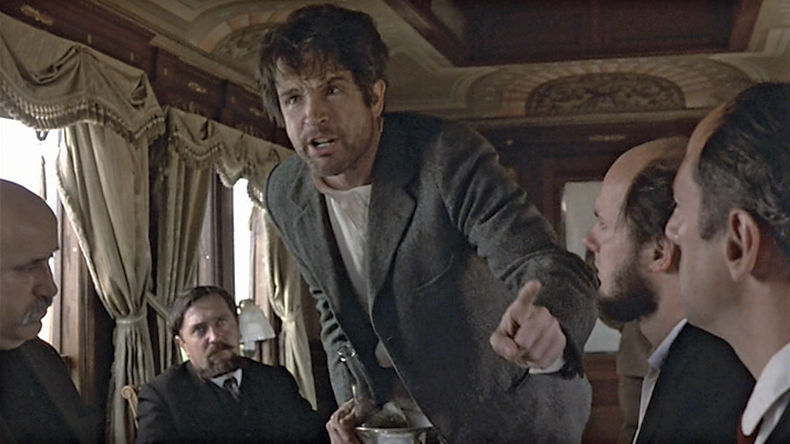
 Chalk it up to the power of Warren Beatty. Coasting on the success of such mega-hits as Shampoo – which he’d produced and starred in – and Heaven Can Wait – which he’d starred in, produced and co-directed – he was ready to make the ultimate “one for me.” And what a one it was. He’d been fascinated with the journalist since the mid-60s, and, with his typical slow burn, had started filming interviews with old-time lefty heavy hitters like feminist author Rebecca West, playwright Arthur Miller and ACLU founder Roger Nash Baldwin as far back as 1970 on the off chance that he'd gain funding to make a film about Reed and his comrades. Somehow he convinced Paramount of the feasibility of the project – though soon after signing on the dotted line they reportedly offered him $1 million to not make it – and it not only scored the brother four Oscar nods and one actual statue, but made $41 million, which was a highly respectable box office return for the time.
 At the film’s center lives the fraught romance between Reed (Beatty) and socialite writer Louise Bryant (Diane Keaton); Beatty had to maintain that aspect of the sweeping historical epic tradition, after all. I’d never really grokked Keaton’s much-touted beauty before. Above the high lace collars of that era, though, her grey eyes widen and narrow with a sensuality that’s hard to deny, and she speaks with none of the stammering affectations that muck up so many of her performances. But because the star-crossed lovers proclaimed a “free love” relationship – an eternally naïve concept if there ever were one, and one destined to appeal to well-known lothario Beatty – scene after scene sounds the soap operatic notes of their off-and-on relationship, including some gratingly if convincingly moony love scenes (Keaton and Beatty were reportedly involved off screen) and some awfully wooden dialogue (“I'm just living in your margins! No one takes me seriously!” “Well, what are you serious about?”). In general, dialogue has never been Beatty’s strong suit; everyone tends to rat-a-tat-tat in bumperstickese here (except for him; the man is a hopeless mumbler). There’s something charming about all that ideological jargon, though. So earnest. So unfashionable, at least until recently.
 Press Play Video Blog