CANNES 2012: Brandon Cronenberg’s ANTIVIRAL

CANNES 2012: Brandon Cronenberg’s ANTIVIRAL

null

Antiviral, Brandon Cronenberg’s directorial debut, proves the apple really doesn’t fall far from the tree. Like his father David Cronenberg’s early features, Antiviral is more of a collection of inspired, perverse ideas than a cogent piece de provocation. To be fair, Antiviral’s vision of the soon-to-be corrupt future is derivative, which would be a moot point if it didn’t evoke David Cronenberg films like Crash and Videodrome. But at the same time, Antiviral is more than sufficiently novel to be entertaining, even if Brandon Cronenberg’s script and direction are not as sufficiently assured.

Brandon Cronenberg imagines a world where people’s celebumania has mutated into an obsession with contracting famous people’s exotic diseases, which will literally consume their flesh. His debut has promise, though it lacks the conviction that we’ve come to associate with his father’s movies, over time.

Syd (Caleb Landry Jones) is a salesman at a clinic dedicated to infecting plebs who want to contract various diseases, including herpes, from their favorite celebrities. Syd is also a viral mule, inoculating himself and smuggling bugs out of the clinic to sell on the black market. Unfortunately for Syd, the latest bug he’s contracted, this time directly from “perfect” celeb Hannah Geist (Sarah Gadon), is of unknown origin and probably lethal.

While Syd looks for a cure, both for himself and for Hannah, he navigates between two predictably similar different worlds. The clean world of radical new cosmetic technology and antiseptic clinics is necessarily similar to the black market world of stem cell muscle steaks grown from human tissue samples. The representatives of both sides are equally morally bankrupt and practically cutthroat, from Arvid (Joe Pingue), the butcher who buys viruses and sells human meat, to Syd’s boss, Edward Porris (Douglas Smith), the CEO who publicly denies the ethical dubiousness of his practice to a reporter. 

Syd’s character arc is thus defined by his struggle to neither identify with nor distance himself from either side. The result of this class-based tug-of-war is not hard to guess. (Spoilers ahead, though not really!) Since he’s caught between two stations and has an unidentified sickness gnawing at his guts, Syd inevitably grows to accept that he wants to buy what Arvid and Edward are both selling. In one scene, Syd looks on with awe at an interactive TV console in a seedy club that allows customers to dominate a helpless celebrity, virtually. After the celebrity mewls and begs him, still an anonymous, un-committed voyeur, to tell her how she should hurt herself, Syd starts to become convinced.

In the end, Syd doesn’t wind up anywhere unexpected. He’s not a obsessed cipher like Videodrome’s Max Renn, or a free-wheeling pervert like Crash’s James Ballard, but rather an embroiled collaborator. His fate is too neat to be really transgressive, an effect which is, ironically enough, one of the most salient ways Brandon Cronenberg’s first work differs from most of his father’s work. On some level, David always knew how to push buttons, even if he did get better at it as he went along. Brandon’s a better scenarist and idea man than he is as a button-pusher though. One can only hope his follow-up is a little more distinct, or, barring that, a lot more confident.

Simon Abrams is a New York-based freelance arts critic. His film reviews and features have been featured in The Village Voice, Time Out New York, Slant Magazine, The L Magazine, The New York Press and Time Out Chicago. He currently writes TV criticism for The Onion AV Club and is a contributing writer at the Comics Journal. His writings on film are collected at the blog, Extended Cut.

GAME OF THRONES RECAP 8: THE PRINCE OF WINTERFELL

GAME OF THRONES RECAP 8: THE PRINCE OF WINTERFELL

One of the recurring discussions about this second season of Game Of Thrones concerns how much the television show is changed from the novels. While the merits of the specific changes are debatable, a running theme of both my reviews and those of other critics is that the show is more confident in its adaptation, becoming its own entity.

nullAs obvious as it might sound, we should remember that entity is a television show, and a particular form of a television show, at that: highly serialized with multiple interweaving plots, much like many of the great dramas of the last decade-plus. But the TV show-ness of Game Of Thrones works against it slightly in “The Prince Of Winterfell.” This episode leads towards the climax of the season, so it’s almost all build-up. Episodes like this are traditional in television, but they don't work so well for Game Of Thrones.

The two series associated most with the “build-up” episode are two of the most important for the current form of serialization, Buffy The Vampire Slayer and The Wire. Buffy helped develop a model of the standalone episode, with clues in each week's show leading towards a larger finale each season. After a few seasons, the overarching plot became such an important part of the show that the last batch of episodes became a string of heavily serialized “mythology” episodes, barely working by themselves. The Buffy episode “The Prince Of Winterfell” reminded me most of is “The Weight Of The World,” the fifth season's penultimate episode, in which Buffy, having lost all hope and motivation, has to be emotionally wrestled back into heroic shape for the season’s climax—the emotions before the storm. While both of these episodes may be competent, they’re fairly unmemorable out of context.

Game Of Thrones is significantly more complicated than Buffy, though, taking place across multiple geographic regions, with exponentially more major characters; in this sense, it’s more similar to The Wire. The Wire’s serialization was even more focused than Buffy’s, or any other show, really. Each of its seasons was 10-13 episodes, focused generally on a component of the society of Baltimore, and specifically on a drug case worked by the main characters. Most of the season would be build-up, the second-to-last episode would contain the climax of the investigation, and then would come the finale, the denouement. Game Of Thrones mostly followed that model in the first season, and is certainly following it here: several different plotlines are leading to what should be an explosive conclusion.

Here’s the problem: Games Of Thrones is even more scattered and geographically disjointed than The Wire. While The Wire had almost as many characters and motivations to keep track of as this show, all the events were working towards the same climax: the conclusion of the drug investigation, and then the rippling effects of that climax (although, to be fair, the fourth season deviated from this specific form). In Game Of Thrones, each smaller story seems to be moving towards a different climax.

The chief upcoming event we hear discussed is Stannis’ attack on King’s Landing, the capital. This would be the biggest battle of the war so far, and a total Stannis victory might even end that war altogether. Preparing for it makes sense. Jon Snow, now captured by wildlings and being led to their king, is also clearly moving toward a climax of some kind, as is Dany, desperate to get her dragons back. And the tension is clearly escalating in Winterfell, as Theon refuses to leave with his sister, even as a northerner army approaches.

But that’s only half of the show’s stories, maybe fewer. Robb Stark’s romance may be climaxing, but its effects are unclear, as are the actions of his mother, who has released Jaime Lannister in exchange for her children, escorted by Brienne of Tarth. This is a new story thread and an interesting choice for the show to make (these events happened relatively later in the novels than they do here). Samwell Tarly and the rest of the Night’s Watch haven’t been mentioned in several episodes, but their discovery of a cache of obsidian weapons is deemed important enough to show up here. Yes, the show is moving towards something, but the important ones can’t help but be  diluted among all the other events taking place.

Three different things make the lack of action in this episode disappointing. First, last week’s episode was also relationship-heavy and event-light. It was so good that this episode pales in comparison, though of course two high points in a row isn’t always wise structurally. Second, the eighth episode of the first season, “The Pointy End,” managed to contain several different momentous events: the death of Arya’s dancing instructor; the undead attack at the Night’s Watch, Robb Stark summoning his bannermen and gaining their respect. Meanwhile, “The Prince Of Winterfell” seems intentionally non-momentous.

Why “intentionally”? The most dramatic moment of the episode occurs when Arya and her friends leave Harrenhal by walking past a bevy of dead men, all killed off-screen by Arya’s murder genie, Jaqen H’ghar. There is craft here: the build-up to this moment involves the Stark girl's desperation and cleverness, telling Jaqen to kill himself, or aid her. When he says, “A girl lacks honor,” Arya gives a quick shrug. Honor is meaningless to her. She’s trying to survive, and win. This is all good.

There’s just one tiny problem with the resolution, though: it’s not what happened in the novels. The changes the show made from the novel end up removing Arya’s agency, the importance of her actions, the intensity of the actions themselves, and not one but two of her most badass moments. There’s still some time for the show to make it up to her, I suppose, but I simply cannot fathom why it would remove arguably the best scenes of the second book . . . unless it was to deliberately rearrange events to fit a Wire-like structural framework. It doesn’t have to work that way. Game Of Thrones has so many different characters, working on a complex enough narrative, that it could have action and preparation in each episode.

Despite a disappointing lack of events and warping of Arya’s story, there was still a lot to like about “The Prince Of Winterfell.” Its theme of finding romance and comfort in the midst of war and intrigue successfully built the emotional tension in advance of the impending climax. Robb Stark’s scene with his new crush Talisa was a major step forward for this storyline. And Peter Dinklage acted the hell out of his romantic scene with Shae, showing a vulnerability only hinted at before. Additionally, Tyrion’s scenes with Varys are among the best the show has done, filled with wit, danger, foreshadowing, and charm. (“We could throw books at his men.” “We don’t have that many books.”) This demonstrates that Game Of Thrones is telling its multiple stories well. The issue is how it’s editing those stories together into a story, and into a series.

Adaptation:

In addition to the tremendously disappointing changes in the Arya Stark story, another Stark is ill-served by the adaptation. Arya's mother Cat Stark has had her agency largely removed as well, due to a couple of changes. When Littlefinger made the offer to exchange Jaime for her daughters, her decision to free Jaime was changed from one she made on her own to one she merely accepted. In the novels, Cat also made that decision after receiving the “news” of Bran and Rickon’s death; here, she’s pushed into it by the Karstarks demanding Jaime’s death after his failed escape last week. Cat Stark’s strength made her arguably my favorite character in the novels, but the show regularly weakens her.

Rowan Kaiser is a freelance pop culture critic currently living in the Bay Area. He is a staff writer at The A.V. Club, covering television and literature. He also writes about video games for several different publications, including Joystiq and Paste Magazine. Follow him on Twitter @rowankaiser for unimportant musings on media and extremely important kitten photographs.

VIDEO ESSAY: Law and Disorder in Ying Liang’s THE OTHER HALF

VIDEO ESSAY: Law and Disorder in Ying Liang’s THE OTHER HALF

Chinese director Ying Liang cannot return to his country. On April 28, Ying debuted his film When Night Falls at the Jeonju International Film Festival in South Korea. The film is based on the true story of Yang Jia, who killed six policemen after allegedly suffering police brutality, and whose trial stirred controversy and protest over the fairness and due process of the legal system in China. After the film was shown in Jeonju, Ying’s family, in Shanghai, and his wife’s family, in Sichuan, were visited by Chinese authorities, who also tried “to buy the rights to the film.” Ying also learned that he would be arrested if he were to return to mainland China. He currently lives and works in Hong Kong, trying to manage the well-being of his relatives back home (asking them to document every interaction with local authorities), as well the fate of his new film.

When Night Falls has brought unprecedented scrutiny and pressure upon Ying Liang, but it’s not the first time his films have offered a sharply critical view of China’s societal dysfunction. Ying’s debut Taking Father Home examined the breakdown of families in the era of migrant labor. Good Cats views labor exploitation from the opposite end, following a young man’s entry into the inner circle of business and corruption in his hometown. Ying’s best feature, The Other Half, is perhaps the most thematically aligned with When Night Falls, as it also deals explicitly with the failure of China’s legal system to address the problems of its people. New Yorker film critic Richard Brody selected The Other Half as one of his ten best films of the 2000s, heralding Ying’s ability to bring a “laser-like analytical eye to the crossroads of private life and oppressive authority.” This video essay further explores the film and Ying’s ability to bring the “other half” of China into a stark spotlight.

Originally published on Fandor. Read a transcript of the video.

Kevin B. Lee is Editor in Chief of IndieWire’s PressPlay Video Blog, Video Essayist for Fandor Keyframe, and contributor to Roger Ebert.com. Follow him on Twitter.

CRUEL SUMMER: STRIPES (1981)

CRUEL SUMMER: STRIPES (1981)

In this series, frequent Press Play contributor Aaron Aradillas will analyze a significant movie from each year of the 1980s. The previous installment: The Blues Brothers (1980).

When Bill Murray came on the scene at the start of the 1980s, he represented a fundamental shift in comedy. He specialized in an utter emotional detachment from any and all situations. His fans claimed he was deconstructing the absurdity of whatever predicament he found himself in. The famous Saturday Night Live sketch of Murray as a lounge act performer singing about Star Wars was funny because he knew how pathetic the guy was. Murray did nothing but asides and put-ons. Some critics praised him as a Groucho Marx type, but if you looked closely, some of his lines had a nasty streak; while Groucho took the air out of a tense situation, Murray made you tense.

Performers like Jack Nicholson, Richard Pryor, even Eddie Murphy in 48 HRS., specialized in upsetting the status quo, speaking up for those who couldn’t speak, and expressing suspicion of those in power, Murray spoke for himself, suspicious of everyone. The most courteous thing he would do is not remind you that he’s the smartest person in the room. It’s almost impossible for Murray to do sincerity. His worst scene as an actor? His plea for goodwill toward your fellow man at the end of Scrooged. He’s like a bully telling you to be kind to others or else.

Murray became a comic hero pretty quickly. He gave the genial summer-camp comedy Meatballs a groovy anarchic charge. Along with Rodney Dangerfield, he was the highlight of the surprise hit Caddyshack. But it wasn’t until the release of Stripes in the summer of 1981 that Murray became a star. A service comedy that was surprisingly reverential toward the military, Stripes was the kind of anti-Establishment comedy that appealed to audiences. It was safely subversive but not offensive.

Directed by Ivan Reitman and written by Len Blum and Dan Goldberg, along with Harold Ramis, Stripes had the kind of anti-authority attitude that even conservatives could get behind. Rather than trashing institutions like the military, the movie just made the individuals in power look comically foolish. This was a big change from the thinking of just a decade earlier. At that time, young people questioned the nature of long-standing institutions far more aggressively. (It’s interesting to note that Stripes was originally conceived as a vehicle for Cheech and Chong. They truly didn’t trust institutions.) Now, it seemed, a compromise was being reached as Stripes predicted the coming onslaught of pop militarism in American movies. Just six months before the release of Stripes, Goldie Hawn had scored a hit (and an Oscar nomination) with the post-feminist service comedy Private Benjamin. Now we had Stripes. Throughout the 1980s, a whole series of movies did a brilliant job of allowing us to forget the trauma of Vietnam. Uncommon Valor, An Officer and a Gentleman, Missing in Action, Firefox, Rambo: First Blood Part II, Heartbreak Ridge, Aliens, Iron Eagle, Top Gun, RedDawn, Platoon Leader, and Commando all suggested, in one way or another, that Vietnam was a winnable battle. A lot of these movies were outrageously entertaining. They were also cinematic recruitment posters. (Oliver Stone’s Platoon would single-handedly provide the antidote to Hollywood’s love affair with war.)

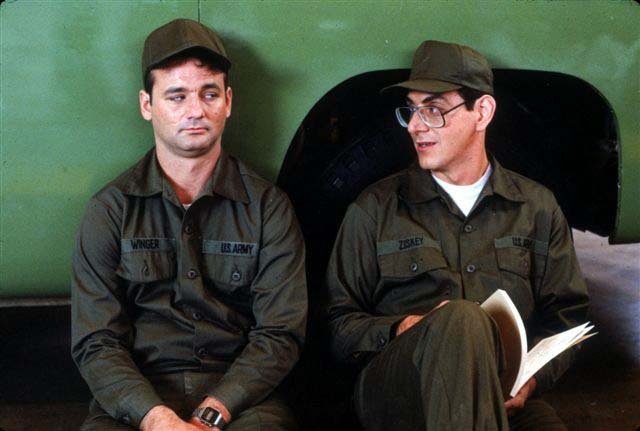
The opening of Stripes indicates it’s going to both play with and poke gentle fun at images of authority. The first image we see is a commercial for the Army playing on a television. Murray’s John Winger views the commercial with a mix of skepticism and (possible) curiosity. Murray’s trademark ironic detachment surfaces with his first line of dialogue. (“I don’t think I’ve ever been this happy.”) Winger is so blasé about life that when his girlfriend leaves him, he looks as if he is just going through the motions of being hurt. When Winger says, “Then, depression,” we laugh: If a Murray character is depressed, that would suggest he was once happy.

(Murray aficionados will no doubt know that Joel McHale’s character on Community is an homage to the stock Murray character. The difference being is that McHale’s Jeff Winger genuinely does care about his studymates.)

Luckily for the movie Murray’s coolness is tempered by Harold Ramis as his loyal best friend Russell. When Winger decides to join the Army because, frankly, he has nothing else to do, Russell accompanies him almost for the intellectual exercise of seeing where this will lead them. Or, in the parlance of Animal House, one stupid gesture deserves another. What gives the movie its zip is the comic spin given to standard basic-training scenes. There’s a less abrasive National Lampoon/MAD Magazine quality to some of the gags. There’s also a surprising sense of reverence toward the military, particularly in a shot at dusk where the platoon is going through an obstacle as they sing a recruitment song. Bill Butler’s crisp cinematography makes it clear this shot is not meant to be ironic. On the other end of the shot is the famous scene of the men marching and singing Manford Mann’s “Do Wah Diddy Diddy” as a cadence. (It is said that after the release of Stripes this became a popular cadence.) What you get with that bit is the acknowledgement of rock & roll’s place in the military.

Sgt. Hulka gives the movie’s situational comedy some weight. It was a masterstroke to cast Warren Oates as Hulka. He represents authority, but not totalitarian authority. He has Winger’s number the moment he sees him. He understands the impulse to question people in power. (He does it himself.) But he also knows that some semblance of order is needed to sustain life. Murray’s best scene is when Sgt. Hulka calls him out on his bad attitude and the audience ultimately comes to side with Sgt. Hulka.

From that point on, Murray’s performance picks up. The scene where he takes the guys to a mud wrestling contest has a playful three-ring circus quality. (The sequence is helped tremendously by John Candy’s wonderfully light comic presence.) When Murray is called upon to deliver an inspirational speech (a staple of 80s movies), he makes it off-kilter enough that he almost sounds convincing. It’s a jingoistic speech with a little sting. (“We’ve been kicking ass for 200 years! We’re 10 and 1!”)

The movie climaxes, of course, with an action sequence, as Winger, Russell, and their MP girlfriends must enter enemy territory (Germany and Czechoslovakia!) to rescue their fellow soldiers. Like the parade finale of Animal House, this sequence is about destruction, but it ALSO works as an action set-piece. Stripes toys with AN anti-authority stance but ultimately adheres to tradition. And at the center is Murray, thumbing his nose at everyone and everything. In recent years. a generation of filmmakers have found interesting ways to utilize Murray's limited range of emotions. John McNaughton located Murray's capacity for menace in the brilliant Mad Dog and Glory, while Wes Anderson maximized Murray's deadpan detachment by turning him into a terrific supporting actor in Rushmore and The Royal Tenenbaums. (When Anderson forced Murray to play a front-and-center character who had to care about others in The Life Aquatic With Steve Zissou, the result was both compelling and uneven.) But in the beginning, with Stripes, Murray's what-me-worry cocky arrogance turned out to mirror both the audience's and American movies during the 1980s.

San Antonio-based film critic Aaron Aradillas is a contributor to The House Next Door, a contributor to Moving Image Source, and the host of “Back at Midnight,” an Internet radio program about film and television.

MAD MEN RECAP 9: CHRISTMAS WALTZ

MAD MEN RECAP 9: CHRISTMAS WALTZ

In watching Mad Men episode 5.10, Christmas Waltz, my first thought was not about the episode's theme. In fact, at first, a theme didn't emerge. Instead, my first thought was how much fun this episode is. I haven’t been complaining about the season; last week got some bad reviews but I was fine with it, and the season overall has had some amazing episodes (Mystery Date and Far Away Places in particular), but this feels different. This feels like perfect Mad Men, everything we love about it. Scary, unpredictable, heart-stopping in its tense moments, laugh-out-loud funny, sexy, insightful . . . all the great Mad Men things. In fact, I’m pleased that a theme didn't present itself in an obvious way tonight. By being fun, funny, and surprising, Christmas Waltz engaged our interest without having to announce itself. The episode is also brilliant and unassuming, in that it doesn't have to stand on a chair and tell you how meaningful it is. But don't worry, there's meaning, and we'll get to that.

nullAs soon as I saw the "previously on" clips, I thought, 'We're getting everything the fans have been clamoring for.' More Lane, more Joan, less of a laser-focus on the Draper marriage to the exclusion of wonderful secondary characters. But I had no idea, no idea, that the longed-for return of Paul Kinsey was in store, and what a return it was! (I want you all to know that my son has to be at work at 5 a.m. on Monday, and my loud laughter was very inappropriate while he was trying to sleep. But I just couldn't help it. This scene is hysterical. Oh, Paul, we missed you so.) Watch his first scene here:

Paul, by the way, is the perfect access point to what the episode is about thematically: people turning themselves into things they aren't; people layering false identity onto false identity until they don't know, truly, who they are. Paul is a Krishna devotee, except he isn't. He knows himself, to a certain extent: He's still the jerk who wants people to like him but nobody does, and even in the act of serving his guru, Srila Prabhupada (yes, they depicted the real founder of the Krishna Consciousness Movement), he is sure that the guru likes everyone else better. This is the same old Paul who was jealous of Peggy's talent, and realizing he's the same person, whether in ad-man guise or spiritual guise, is actually a profound insight that might someday help him achieve true happiness, but for the moment, it makes him miserable.

Paul has a false image of his own creativity, made embarrassing by his ridiculous Star Trek script (when fans talked about Paul coming back to the show, Star Trek was often mentioned, so this was quite satisfying). He pretends to be a devotee to stay with Lakshmi; he is a twisted mass of false fronts and self-deception. Lakshmi, hilariously, is equally false, trading sex to undermine Paul's dreams, wanting a drink, slapping Harry, and calling Paul a great closer: neither the spiritual teacher she pretends to be nor the vulnerable, frightened girl Paul sees is anywhere in the person she presents (ass-first) to Harry.

Virtually by definition, a Joan episode is a great episode. Christina Hendricks  knocked it out of the park again. I am frustrated that we've seen almost nothing of Joan since episode 5.04, but this is a welcome return. Have we seen her melt down before? I don't think so. Oh, Joan, melt down for us:

This scene has everything; Joan Harris losing it, the magnificently silly receptionist, Mohawk's airplane getting crushed (a little foreshadowing for their late-episode strike announcement–historically accurate, natch), and Don coming to the rescue.

Joan, too, has layers of false identity, pretending to be a happy wife at SCDP for over five months when she knows her marriage is over, pretending that Greg is Kevin's father, and managing Roger's efforts to act as Kevin's father, which could pull the curtain away from her story. Joan had an identity she understood: "My mother raised me to be admired." But she also had an identity she thought she understood: Mrs. Harris. Now she just doesn't know. She's as lost as Paul, but without the ponytail. The sweetness of her connection to Don has always been a delight: Everyone loves the scene at the end of Guy Walks Into an Advertising Agency where they just get each other, because they know that being admired and feeling admirable are two very different things, and because they know each other as two people who have the appearance part down but not the rest of it. Will they or won't they? I kind of hope they won't, because I love the mutual respect, but I may be the only person on the entire Internet who feels that way, and I have to admit the potential visuals of a Don-Joan hookup make my head spin.

Roger, too, is juggling identities. He thinks his LSD experience exempts him from falsity, but he's still playing Roger games. Like Paul, whose shaven head doesn't drive out his old self, Roger is still trying to manipulate Joan with money and a puppy-dog sort of longing for her that shows no real commitment. He's never had a clue what she really wants and needs.

I haven't talked about Lane yet, and his falsity is most obvious, most pivotal, and most dangerous. All we know by the end of the episode is that he's set himself up to be caught, and probably by Joan, since she's the one who goes over the books. Forging Don's signature was an ugly move by a desperate man; he was so sure he'd figured it all out! At the beginning of the season, Lane was riddled with unarticulated longings; it's almost wrong to say he has a false front because, like Paul and like Joan, he hasn't a clue who the real Lane is. There's no true self hiding behind a false front, just a series of facades that fail to give him any satisfaction.

If there is a flaw in Christmas Waltz, it's that we can feel the machinery of this episode moving towards the conclusion of a later episode. Obviously, early episodes have to set up later ones, and also stand alone. When you experience the set-up more than the stand-alone, that's a structural flaw, and in the Lane storyline, that flaw is present. But: great episode? Yes! I am on pins and needles about Lane's fate.

Don is the mystery at the heart of it here: Who is he and who is he becoming?  While we have a pretty clear idea of the positive and negative trajectories of every other character (Paul, Joan, Roger, Harry, even Lakshmi), I honestly don't know who Don is defining himself as in Christmas Waltz.

Unaffected by work earlier, Don is suddenly, at the end, throwing himself into it. Missing Megan, he's angry at her, happy with her, and unhappy with her all at once. He doesn't understand her temper tantrum, at first taking it for sex play, and I'm not sure she understands it either. You know what's hard? Suddenly being home all day. Suddenly being "the wife," and preparing a simple, low-effort dinner and then having nothing else to do. The "problem that has no name" is worse in the suburbs but not only found there. Megan doesn't know who she is now either, and so the circle is complete.

Some additional thoughts:

  • We could tease out a second theme of people helping, or withholding help: Harry genuinely helped Paul, Don genuinely helped Joan. Lane got what he thought was the help he needed from the bank, but it proved not to be so. Joan also refused Roger's help, seeing strings attached.
  • Quote of the week goes to Don: "You’re going to need to define some of these pronouns if you want me to keep listening." Ha!
  • Megan throws food! Joan throws airplanes! Lakshmi slaps Harry! Even though nobody punched out Pete, that was still a lot of violence, and I loved it. Call me shallow.
  • We finally see Scarlett! She's been mentioned in many episodes but this is the first time she's appeared on-screen.
  • Don quotes Bobbi Barrett from episode 2.03: The Benefactor, "I like being bad and then going home and being good."

Deborah Lipp is the co-owner of Basket of Kisses, whose motto is "smart discussion about smart television." She is the author of six books, including "The Ultimate James Bond Fan Book."

Watch Mad Men Moments, a series of videos on Mad Men, produced by Indiewire Press Play.

GIRLS RECAP 6: THE RETURN

GIRLS RECAP 6: THE RETURN

null

One of the things I liked most about The Return—and I liked a bunch of things—was its title. Nearly every series has an episode like The Return, in which the hero returns to his/her place of origin to find things much changed for the smaller; after years of recapping serial television, on seeing that title, I'd originally expected the customary uncreative variation on one of the plots sure to follow—"Going Home," for instance, or "Homecoming," or a pun on the idea that you can't go home again or it's where the heart is.

null"The Return" was written by Lena Dunham and Judd Apatow, who pick up the clichés that surround "home" and see what icky bugs run out from underneath by sending Hannah to her parents' house in Michigan for the weekend, for their thirtieth anniversary. The episode defines and redefines "home" as it applies to Hannah: as an oblivious twentysomething, as a New Yorker, and as an adult only child. And it starts with the "oblivious" part when Hannah's heading to the airport. Marnie—Hannah's mother hen by proxy—leans out the window to remind Hannah that rent is due next week, and admonishes her to "be nice to your parents. Okay?" "I'm the nicest!" Hannah chirps.


She tries to be, but not very hard. Hannah slogs off the plane, lugging the garbage bag full of laundry that's serving as her suitcase. (In what post-2001 fantasy-land would the Hefty luggage get past TSA? Marnie would have made her borrow a duffel bag, I think.) Mom and Dad are waiting over-eagerly at the curb (next to their Volvo, natch); Dad is holding a sign with a picture of bananas on it, and mentions on the ride back to the house that they couldn't think of a better way to spend their anniversary than with "our best friend, who we just happened to create." That idea, simultaneously sweet and inappropriate, comes up repeatedly in the ep; her parents seem to have always treated Hannah as a sort of peer, but now that she's a real voting adult, nobody quite knows how to deal with that reality.

Mom responds to Dad by mentioning local job listings; she's doing it because she misses Hannah, but Hannah is immediately defensive. Mom also mentions the "fun Netflix" they've got at the house, a spot-on parental detail that Hannah is too busy texting, then stomping out of the room when Mom suggests she's hungry, to appreciate. (The movie they're watching: Million Dollar Baby. Rimshot!) Hannah flops on her bed, stares at her Party Girl poster, ignores a text from Marnie asking if she got the rent money from her parents, and calls Adam's phone but hangs up after one ring—she's put herself in his mind, but can plausibly claim that she just butt-dialed him.

And Dad assumes that Hannah is going on their anniversary "date," but Hannah declines—not because it's kind of weird, although she does mention that, but because she has a date of her own. Eric , whom Hannah meets when her frantic mother sends her on a mission to pick up hot-flash meds, is a sideburned cutie who co-owns a local pharmacy with his father, and a stark contrast to Adam in every possible way: traditionally good-looking; makes good money in a non-creative field; reacts with disbelief when Hannah tries to put a finger in his poop chute during sex, then murmurs to him, "I'm tight like a baby, right?" The look on Hannah's face when he initiates no-kink missionary intercourse is almost pitying.

He's a pleasant, solicitous young man with a business-like, adult relationship with his father, and he's definitively Not Adam. He's also definitively Not New York, and the automatic, unearned superiority Hannah feels to her high-school classmates—one perpetrated by New Yorkers of all ages—is another theme of the episode. It's made explicit in the pep talk Hannah gives herself in the mirror as she's getting ready to go out: "You are from New York, therefore you are just naturally interesting, okay? It is not up to you to fill up all of the pauses. You are not in danger of mortifying yourself." The latest in a line of unbecoming vintage frocks would beg to differ on that last point, as would the moment where she mentions offhandedly to Eric that she gave up on vegetarianism because Adam had nothing to eat at his place except meat—and because she thought that, if she went out for food, Adam wouldn't let her back in.

Hannah's New York bias in favor of, well, herself is even stronger in her interactions with Heather, an old high-school friend. We've seen framed pictures of Hannah and Heather in Hannah's old room, but they haven't kept in touch; Hannah hasn't heard anything about "the benefit"—the fundraiser Heather has put together for her friend Carrie, who got Natalee Hollowayed on a spring-break trip. Hannah also hasn't heard that Heather's about to move to Los Angeles to pursue a dance career, and when she asks whether Heather has any contacts out there to help her get started, Heather shrugs airily, "I know enough to know that you don't really have to know anybody."

In a way, she's right, because based on the moves we see, no contact short of Alvin Ailey could get Heather a job that wouldn't involve a pole—but it's Hannah's attitude we're meant to look at, and she believes that she knows better than Heather simply by virtue of living in "the big city" herself. Heather's belief that she merely has to move to L.A. and go on auditions to "make it" sounds innocent, even silly, but we've seen that Hannah cherished the publishing-world version of that belief. (And may yet cherish it.) Yes, the "benefit" is low-rent (to underscore the point, Edwin McCain's obnoxiously ubiquitous "I'll Be" is playing when Hannah and Eric walk in), and when Hannah buries her face in her pint to keep from laughing, it's sad for Heather and her inappropriate booty-dance of tribute to Carrie. It's also sad for Hannah, who thinks she knows something Heather doesn't about how to make it in a creative field.

Hannah's rant to Eric afterwards is revealing; Eric concedes that Heather's show "was a little cheesy," and Hannah wails, "It was very cheesy, and nobody's telling her! She's gonna go to L.A. and live in some shitty apartment and feel, like, sad and scared and lonely and weird, all the time, but she's got a good life here. I would like her life." Noooo kidding—that speech isn't a prediction for Heather's life, it's a description of Hannah's. When Eric jokes that he knows the florist has a job opening, Hannah retreats to the safety of Gotham-centric condescension, saying she'd get "a real job, like a teacher or something." Eric, bless his heart, doesn’t point out that she'd need a master's or certification to do that, just asks what her real job in New York is. She snaps that she's a writer, like she told him. Eric is surprised: "That's how you make money?" Hannah non-answers, "I don't have any money." I had that "no no no, it's not what I do, it's what I am" conversation about my career several times. In those conversations, it’s impossible not to sound like a stubborn jackass who should suck it up and sit for the LSATs before she winds up in bankruptcy court, and that's exactly what Hannah sounds like. But I can relate.

So can her father, as it turns out, but his "relating" to Hannah is more like "projecting." He's filling the space she's left at the dinner table by worrying aloud about her. "What does a person like that turn into?" he wonders, adding that she's funny and likable, "but that and ten cents . . ." Such a dad-ly expression, that. Mom thinks his assessment is harsh, but it’s really about Dad's own disappointments: "At what point will she realize, she's not gonna get to be what she wants to be when she grows up?" Like Hannah's comments about Heather moving to L.A., this isn't so much about the subject of the remarks as it is about the utterer; apparently Dad's life didn't turn out like he'd dreamed. Mom is taken aback by his lack of faith, and asks how he knows. "You know that, you're the one who forced us to cut her off to help her realize that!" Interesting take on what we saw; Mom did force the issue, but according to her, she wanted to have a lake house. Now she's singing a different tune: "I cut her off so she'd have something to write about!" Dad grumbles that "we don't even know if her writing is any good." It's hard to tell if this is a comment on how Hannah doesn't produce much in the first place, or if her parents just don't read it (remember how they left the pages she'd brought them behind in their hotel room?), but Mom thinks that Hannah knows how to have fun, "and she thinks about that fun, and she learns from that fun." The pronouncement is completely irrelevant to what makes a good, or successful, writer—but it also shows exactly how parents misunderstand what a writer does.

Certainly her parents try to supply Hannah with material later that night. Dad, vigorously pumping Mom from behind in the shower, slips and hits his head on the bathroom floor. Hannah comes home to find them dishabille, Mom trying to revive Dad, Dad naked and worried about a back strain, and has to help Mom haul Dad off the floor and into bed, suggesting repeatedly that he put a towel or a robe on.

After Dad's safely tucked in, Mom makes a gentle "not Mr. Right, but Mr. Right Now" observation about Eric that Hannah's surprised to hear the truth in, then asks if Hannah's doing okay financially, admitting that they cut her off rather abruptly. But they're proud that she's "making it work"—and Hannah, after taking a moment to consider asking for rent money anyway, chooses to pretend that she is making it work. Or vows to actually make it work.

Later, Adam calls. When Hannah says she's at home, he duhs that he is too, but she clarifies "home home," at her parents' house. She tells Adam about Dad's "sex injury," and about her own Eric-scapade, asking if it's "weird" that she told Adam that she slept with someone else. She's hoping it is, and the fruitlessness of this attempt to arouse his jealousy is as familiar to her now as her old high-school life no longer is. But Adam—wearing black undies and a lacy green satin sleep mask—doesn't react, so she changes the subject to Eric's gigantic, cheap apartment, wondering why they kill themselves to stay in a city that doesn't want them. Adam misses her. She's pleased, because she misses him—but what she really misses is home, the city, her life. She asks Adam to tell her what's going on out his window, and as he narrates a neighborhood crackhead's perambulations, Hannah stands on her parents' silent, dark front lawn, listening.

The Return is well crafted, subtle and smart about that day in every adult child's life when she refers to "home" as college, or her current city, and her mom goes quiet. It portrays Hannah's New York tunnel vision accurately without expecting us to sign off on it, and it asks what the definition of "home" is without answering its own question. Nice work by the supporting cast, especially Becky Ann Baker and Peter Scolari as her parents (and Little Scolari, heh), as the show itself "returns" to the exact observations that make it work best.

Sarah D. Bunting co-founded TelevisionWithoutPity.com, and has written for Seventeen, New York Magazine, MSNBC.com, Salon, Yahoo!, and others. She's the chief cook and bottle-washer at TomatoNation.com.

CANNES 2012: Michael Haneke’s AMOUR (Glenn Heath Jr.’s Take)

CANNES 2012: Michael Haneke’s AMOUR (Glenn Heath Jr.’s Take)

"Amour"

Sometimes the aged body revolts, leaving a once vibrant human life facing the inevitably slow process of physical decay. Old age can become a metaphorical tomb, welded shut by fading memories and unspoken emotions, a place where the outside world fades from consciousness and leaves only the opportunity for personal reflection behind. One lingering question persists: can lasting devotion and intimate love exist within such a suffocating process? Michael Haneke’s Amour dares to answer yes, addressing the possibility that nightmares and hopeful dreams can co-exist in the same closed-off cinematic space. By encasing the viewer in the expansive apartment of an elderly couple experiencing the grim reality of impending death, Haneke examines a nearly impossible scenario with brilliant restraint and complexity.

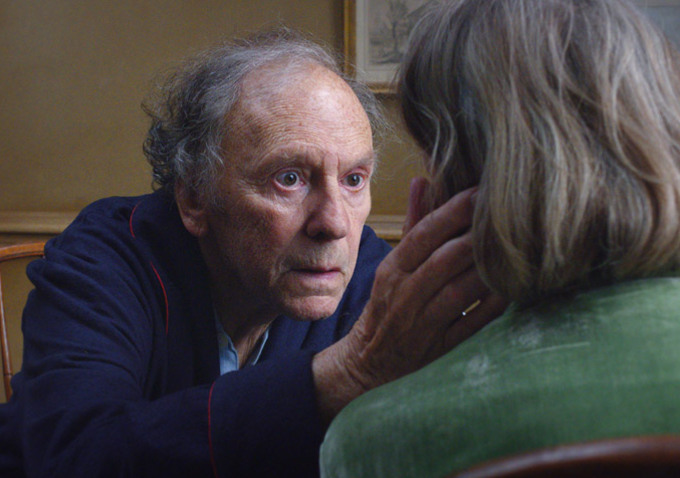
The opening moments of Amour find Georges (Jean-Louis Trintignant) and Anne (Emmanuelle Riva) attending a piano concert held by one of Anne’s former students. In a great straight-on shot of the crowd that holds for over a minute, we can barely glimpse the elderly couple in the middle of the frame, staring at the stage, waiting calmly and quietly together for the music to start. They’ve probably attended hundreds of such events over the course of their relationship, but this will be their last. A few cuts later, the couple returns to their upper-class domicile, bantering about family matters over a quaint breakfast. When Anne suddenly stops speaking and looks stricken, failing to respond to one of Georges' questions, it’s clear some kind of terrible shift has occurred. Haneke spends the rest of the film documenting Anne’s brutally frank deterioration and Georges' fracturing mental state.

Despite the grave subject matter, Haneke avoids turning the couple’s suffering into a grotesque sideshow. We feel their pain in every striking composition, especially when Darius Khondji’s stunning medium shots hover above Anne lying in bed, her darkly tinted eyes in haunting contrast with her increasingly jaundiced skin. But the recurring presence of found memory provides a constant reminder that there’s still emotion to mine beneath this cold façade. When Georges loads Anne into her wheelchair, he tries to remember a story from his youth about a film-going experience that changed his life. He states, “I can’t remember the film’s title, but I remember the emotions.” In this instance and many more, we get the sense his sheer attempt at remembrance offers warm comfort despite the fact that he is mired in an ongoing personal hell.

Like most of Haneke’s oeuvre, Amour strips down set design and audio cues to suit the film's stark material. Darius Khondji’s precise camera is at its best when slowly moving through the apartment foyer, or momentarily out into the hallway for a brilliantly realized dream sequence involving wet feet and an errant hand. But Haneke only delves into the surreal a few times, instead letting the ambient noises of Anne’s cries echo like a requiem in the cramped space. In many ways, the sounds of Amour are most essential, markers of disappearing time and waves of emotion slowly fading to black.

Finally, Haneke’s layered mise-en-scene would be somewhat hollow without the two devastating performances at the film’s center.  Trintignant and Riva entrench themselves completely in the experience, their main form of communication often coming in the form of striking facial contortions and long distance eye contact. This instinctual sense of togetherness between two long-time companions gives Amour its heart and soul, permanently instilling in us the thought that love is never truly fulfilled until that final fade to black.

Glenn Heath Jr. is a film critic for Slant Magazine, Not Coming to a Theater Near You, The L Magazine, and The House Next Door. Glenn is also a full-time Lecturer of Film Studies at Platt College and National University in San Diego, CA.

Welcome to the Cannes Film Festival 2012!

Welcome to the Cannes Film Festival!

null

Editor's Note: Press Play has two critics covering the Cannes Film Festival this year. Simon Abrams and Glenn Heath Jr. are tag-teaming their way through the most anticipated collection of screenings in the film industry. This is your ticket to Cannes. Enjoy!

nullGlenn Heath Jr.

`

nullSimon Abrams

Glenn Heath Jr. and Simon Abrams pick the winners at Cannes 2012. 

CANNES 2012: Michael Haneke’s AMOUR (Simon Abrams’ Take)

CANNES 2012: Michael Haneke’s AMOUR

null

Indifference kills quietly in Amour, the new psychodrama from Austrian provocateur Michael Haneke (The White Ribbon, Cache). In this devastating character study about the hell that is caring for an ailing loved one, writer and director Haneke explores grief as a slow, gnawing process. Coping with loss does not, however, begin with a catalyst as mundane as physical illness. Instead, it starts and ends with a debilitating kind of depression that’s facilitated by solitude. For Haneke, grief is just as frightening as death because it’s also a draining progression that we necessarily go through alone.

Georges (Jean-Louis Trintignant), an elderly pensioner, cares for his dementia-afflicted wife Anne (Emmanuelle Riva) to the best of his abilities, but he is gradually consumed with depression, making the confines of his apartment eventually resemble a baroque prison to him. But Georges isn’t ostensibly alone. His daughter Eva (Isabelle Huppert) offers assistance, as do a couple of home healthcare aides. Still, Georges turns all of them away eventually, for unspecified reasons. Their concern, as Georges tells Eva at one point, is irrelevant, as it can only serve to separate him from his wife.

Georges' belief that Anne needs his care clouds his judgment. He feels that no one else can deal with this burden, as no one else sees her or can care for her in the same way. However, this is only partially true: something as simple as a touch on the hand is enough to quiet Anne down during some of her more hysterical moments, but only for a while. Haneke treats Anne's deterioration very matter-of-factly. Knowing that there is no hope for Anne's recovery, Georges' only recourse is to retreat further into his own tortured headspace and brood alone.

Amour is striking for its subdued and relatively un-provocative quality. Haneke has become known for poking a stick in viewers’ eyes and then asking them why they keep coming back for more. And yet Amour’s icy calm representation is of a piece with earlier films like The Seventh Continent and Lemmings, in that all three are characterized by existential despair. Nobody can intervene and save Georges from the nightmarish routine that Anne’s illness and his obsessive but un-sensationalized affection for her have forced upon him.

Moreover, Haneke even teasingly suggests that Anne’s illness is probably just an arbitrary event that pushed Georges over the edge. Georges has a nightmare about home invasion, but the concern about burglars is introduced early in the film, before he even knows Anne is sick. Anne’s illness only speeds up a process that began before Anne fell ill. Harrowing but also disturbing on a more subtle level, Amour addresses individual concerns even as it demonstrates Haneke’s cynical and highly seductive brand of agnosticism.

Simon Abrams is a New York-based freelance arts critic. His film reviews and features have been featured in The Village Voice, Time Out New York, Slant Magazine, The L Magazine, The New York Press and Time Out Chicago. He currently writes TV criticism for The Onion AV Club and is a contributing writer at the Comics Journal. His writings on film are collected at the blog, Extended Cut.

CANNES 2012: John Hillcoat’s LAWLESS

CANNES 2012: John Hillcoat’s LAWLESS

null

“It is not the violence that sets men apart. It is the distance he is prepared to go.” Old west pragmatism oozes through the gruff words of Forrest Bondurant (Tom Hardy), the 1930s bootlegger and all around bear of a man at the center of John Hillcoat’s Depression-era gangster film, Lawless. One of three brothers profferring booze to Chicago gangsters from their country Virginia stills, Forrest is seemingly indestructible, a local legend for his endurance and survival. The same cannot be said of his younger sibling Jack (Shia LaBeouf), the embodiment of American ambition, who becomes a human punching bag when faced with the slightest conflict. Surname aside, Forrest and Jack couldn’t be more different in size and nature, and they come to represent contrasting visions of Manifest Destiny crashing against each other through family.

Parallel to the battle between tradition and progress runs a sturdy Western theme, and Lawless imbeds the fear of economic expansion in the nuances of brotherly resolve. Ultimately, the two men must confront their ideological conflicts when urban corruption and violence invade the Bondurant’s small town of Franklin, in the form of a corrupt D.A. and his hired gun, a reptilian neat freak named Charlie Rakes (Guy Pearce). This subtext makes Hillcoat’s brutal violence all the more potent. Forrest’s consistent use of brass knuckles on adversaries says a lot about his desire (and ability) to end fights quickly, protecting his family and profit margin with little fuss. In this sense, Lawless uses the gangster film genre to defend the virtues and returns of protecting a small business from corporate takeover.

Loyalty and revenge dominate the film’s mostly messy narrative arc. But convention is only a means to an end for Hillcoat, whose contained vision of Prohibition-era America lingers on intimate details of human suffering; dirt hitting a coffin face, the fluttering of scorched leaves propelled into the air by a dynamite blast, and the gurgling blood from a slit throat are all reminders that Hillcoat’s cinema is equally brutal and poetic. Also, the Great Depression may not be the film’s central focus, but the disparate souls littering the roadsides further remind us that life outside the gangster universe is equally gritty, if not more dispiriting. These images are often juxtaposed with Nick Cave’s brooding score.

Both Hardy and Pearce’s superb method performances deserve the attention they will inevitably receive, and LaBeouf nicely realizes a balance of tenderness and sleaze. But ultimately, Hillcoat sees performance as a way to induce mood, a way to explore landscapes and interiors through an actor’s physical stature. One of the more wonderfully blunt examples of this approach comes early in the film when infamous gangster Floyd Banner (Gary Oldman) stops his speeding car on Franklin’s main drag, walks calmly up the boulevard, and shreds his pursuer’s vehicle with Tommy gun fire. Jack witnesses the shootout from close range, and the slight grin Banner gives him while calmly walking away speaks volumes about the near-mystical divide between gangsterdom and reality.

While Lawless goes astray during an odd prologue mired in voice-over, it’s a genre film with many bold ideas and characterizations. Hillcoat’s ongoing deconstruction of backwoods legends, something he and Cave began to address in the grimy, sweat-soaked The Proposition (2005), takes a more sobering and human turn in Lawless. This is the American outback in all its bloody glory.

Glenn Heath Jr. is a film critic for Slant Magazine, Not Coming to a Theater Near You, The L Magazine, and The House Next Door. Glenn is also a full-time Lecturer of Film Studies at Platt College and National University in San Diego, CA.