FALLING SKIES RECAP 3: YOUNG BLOODS

FALLING SKIES RECAP 3: YOUNG BLOODS

null

This week's Falling Skies gave us some very earned emotional release. Like almost every episode, the action sequences were kick-ass, but the heart of the episode this week was in its emotional moments. While some of the set-up leading into the key dramatic sequences was schmaltzy, and some dialogue was schmaltzy, I do feel that, if you've been following the series, then the emotion will feel earned and you will have come away feeling the dignity and pathos of these characters.

nullYoung Bloods again proves that Season 2 is a vast improvement over Season 1 of this show. Season 1 faltered mostly in the stupidity area: Characters not taking the war seriously. There was too much sloppiness, as if we were watching an ordinary drama and not a life-and-death invasion scenario. Season 2 is far more serious. There have been some of the same problems this year (leaving the jar with the alien parasite inside it unguarded last week), but the overall effect now has much more gravity. In addition, this week's episode relied too much on sentiment in spots, yet it's definitely improved in that area as well.

What I wish most of all is that the show would trust itself. Guys, you don't have to underline every touching moment with piano music! You don't have set up scenes about the tragedy of disconnection. There's so much terrific drama developing organically that overplayed scenes like Lourdes' discovery that her family's small village has been destroyed, and then playing that emotion a second time for her Love Interest's benefit (and the audience's, just in case we hadn't figured it out), is almost cruel to the audience. (Love Interest's name is Jamil, by the way.) It's so unnecessary; we got it. I like this show a lot; it's got a strong cast and premise, creepy aliens, and is frequently fresh and surprising; for these reasons I recommend it to anyone who asks. But that's like; what I love on TV is a show that trusts its audience to come along for the ride, to understand the nuance, to hear things the first time they're said. Falling Skies hasn't risen to that level yet.

The episode opened with a thrilling action sequence (watch it below). I was fairly sure early on that curly-head Matt was purposely acting as bait, but that didn't take the excitement away. At its best, this show has a killer combination of creepy (the skitter's long fingers coming around the corner), high-octane (the shoot-out), and appealing characters (Matt saying it was "awesome" to get splattered with alien blood). See for yourself:

Last week I called for some hardcore passion between Tom and Anne, consistent with the intensity of the situation they're in. In emergencies and tragedies, people jump into sex and passion to reaffirm their own aliveness. The kissing was a nice start, but they were both a little too coy about the whole thing for my tastes. The scene did remind me, though, that Noah Wyle is a fine actor. His years on ER as John Carter were peppered with dozens of seductions—he was quite the ladies' man, was Dr. Carter. Here we can see why—in the way he tilts his head in towards her, creating intimacy just by angling his body, there's a sweet sexiness that establishes real chemistry.

Anyway, on with our show. Ben has super-hearing, another ability derived from having been harnessed. Man, oh man, are we going to learn that the aliens are from Krypton? Ben's new abilities risk becoming too much of a deux ex machina, but they also inform us who and what the skitters are. It's a fine line the writers must walk. We don't want Ben solving every problem for everyone, but his skitter-acquired abilities are a way of letting us know how well the alien creatures hear, swim, climb, and so on. Fortunately, Ben's angst is becoming more interesting, his isolation more justifiable, and his desire to fit in entirely forgivable. Even if that does mean glowing spikes get a pass for another week.

The theme of this episode was childhood and growing up. Some of it was done with great subtlety. For example, in the love scene, Anne's joy was eloquent when she was given a chocolate treat by Tom—her childhood favorite. Simply by receiving this gift we experienced nostalgia for a lost world, and vivid memory, and visceral pleasure, all rolled into one. Having the scene end with a passionate kiss reminds us that childhood really must end.

At the other extreme was Weaver's relationship with his daughter Jeannie. While their interplay was touching at times and also well-acted, most of it was so heavy-handed, I could almost feel it hitting me over the head. Their reunion was lovely, but their arguments rang false, and her accusations about the divorce were utterly out of place. Hey, Jeannie, you’re in the middle of an alien invasion. Forget about your divorce trauma. The reunion and her eventual departure rang absolutely true by themselves—of course a teenage girl goes with her boyfriend, not her daddy—and didn't need that overblown educational message about anger and communication. In fact, these moments were ones I was thinking of at the beginning when I said the emotional release was earned, so why clutter them up?

Most of the rest of the thematic elements fell between the extremes of delicately subtle and overblown: Tom's struggle to allow his youngest, Matt, some freedom and some danger was very real, and in parts very nicely played, and yet, again, the piano music! That whole subplot could have been done with much more restraint, because, again, with good actors, exciting action sequences, and high stakes, Why add sentiment, when it's already so intense?

Why do groups of kids always band together in warehouses and decorate with old couches? I feel like I've seen that visual a hundred times. I'm reminded of the Miri episode of the original Star Trek, of any number of vampire dens on Buffy the Vampire Slayer, of the episode Vatos of The Walking Dead: Isn't there a way of showing a group banded together like that without resorting to visual cliché?

Later in the episode, everything that happened in the skitter harnessing center was insanely good. The kids face down on the table, the discovery that the harnesses are actually giant, terrifying slugs, the aquarium, the raw fear, and then that battle. Damn that was good television. one thing this show does very well is balancing surprise, effective pacing, and an ongoing education of viewers about its world. This week’s we’ve learned how the harnesses operate: They're giant slugs, kept in aquariums, attached to children like some kind of symbiot. Yuk. .

Jamil ends by saying "Hope's all we got." Too on the nose, but it brings the theme back around; youth and family matter because they're the future, and our heroes are going to have to fight to even perceive there's a future. That's why they're going to Charleston, and that's why giving these characters a quest and a goal—even if Charleston turns out to be a tragic mistake—is the right decision for the show, and for its characters.

Deborah Lipp is the co-owner of Basket of Kisses, whose motto is "smart discussion about smart television." She is the author of six books, including "The Ultimate James Bond Fan Book."
TRUE BLOOD RECAP 4: WE’LL MEET AGAIN

TRUE BLOOD RECAP 4: WE’LL MEET AGAIN

Alan Ball’s a believer. Now on his last season as True Blood’s major domo, he continues to see no reason at all why Big Themes and literary stuff can’t coexist with camp, bodice ripper romance, Hammer gore camp and a Ken Russell-esque free-for-all approach to fantastic filmmaking. This week’s episode added family as a major element and ended up a sweetly, amusingly, and painfully memorable piece of work. 

nullIn genre dress, it playfully explored the pleasures of successful parenting while going very dark on the adjoined subjects of letting go badly, ultimate loss, and the persistent survivor’s guilt.
Pretty heady stuff. Not to worry—there are also state of the art splatter gore and broiling flesh effects. Still, the name of the season’s first episode—“Turn! Turn! Turn!”—continues to define everyone.

Even the non-familial characters were in extreme motion. We finally see the mix of LSD and mass murder in Iraq that caused Terry (Todd Lowe) to lose it. And somehow grief is making Lafayette (Nelsan Ellis) a target for Jesus’ demon. And Jason (Ryan Kwanten) is still trying to sever himself from the childhood sexual abuse that’s sentenced him to a life of empty zipless fucks.

Lately the entire show seemed to be bent on deconstructing its hero, Sookie Stackhouse (Anna Paquin), to the point where the show seemed to have nothing to do with her.

I was missing the point.  With the memory of her grandmother fading, and so many people dying for her or at her hands, what she’s really about is survivor’s guilt. 

Yeah, yeah, yeah, she hooks up with Alcide (Joe Manganiello, currently bouncing his wolfie goodness on-screen in Magic Mike). But that bit of oo-la-la is poisoned by Sook’s self-hatred. However, a single sentence at episode’s end changes everything. We’ll talk about that IN a bit.

What rules this episode is family, starting with Pam (Kristin Bauer) mothering Tara, three words I’ll enjoy typing for quite a while, it’s so beyond slash fiction fun.

As you recall, Tara (Rutina Wesley) tried to tanning-bed herself to death. Pam stopped it before Tara totally fried.

"Mothering" pace Pam is still bitchy and, well, Pam-ish, but still, she’s taking care of Tara. The question is, Why?

Easy answer: Eric said it was the right thing to do. And Pam worships Eric. And Eric made it clear last week that when you make someone a vamp, it’s akin to having a child, with all the same responsibilities. 

Interestingly, Pam’s bitchiness fades fast. She may quip of Tara’s reluctance to sink her teeth into a human, “three days and she already has an eating disorder”, but Pam really wants to help. When she finds a willing vamp fetishist at Fangtasia and orders Tara to feed, Pam wraps her arm around her young vampire and whispers encouragement. “This is who you are now . . . the top of the chain.”

Bill Compton (Stephen Moyer) is also feeling good about his progeny, Jessica, who’s gone from whiny adolescent to very determined young woman over the span of just four episodes. And unlike your usual overpraised cable TV show where a female character’s “complexity” is defined by her ability to become as cynical and nihilistic as the males she’s secondary to, Jessica, who’s very aware of all the horribleness life (and un-life) has to offer, makes a conscious choice to become more morally centered, supportive, and empathic than the males around her. She’s a born leader as well.

Bill, who always failed at all these things, enjoys a rare happy moment as he regards her and says, “I think I did well.”

And sometimes it doesn’t matter what you do, or how hard you work. Because Pam is going to lose Eric and vice versa.

When Eric and Bill first return from their meeting with the vampire Authority—how about we call it the “VA”?—Pam tries a squirt of playful snark regarding Tara: “Congratulations, you’re a grandfather.”

But Eric is not amused. Instead, he grills her about Russell Edgington (Denis O'Hare), the 3,000 year-old psycho-vamp who, having somehow broken out of the cement prison Eric and Bill created for him, will not only try to kill Eric, but destroy the VA and its goal of mainstreaming vampires into normal human life, for the sheer hell of it.

Eric tells her that whether it’s because of Russell Edgington or the VA, he’s going to die. And so he sets her free, officially, of all and any bonds to him. “I need you to live when I’m gone…you are my child as I was the child of Godric . . . and you’re a maker now . . . our blood will thrive.”

And then it’s done. He sets her free, ending a century-old relationship, but leaving her with child—Tara.

Trust me, True Blood is not my go-to destination for deep emotional experiences but, yeah, I got choked up. But this wasn’t TV-melodrama choked up. This was stranger, more like I felt when seeing, say, Cocteau’s Beauty and the Beast when I was 15. Is Ball mining similar subconscious monster archetype energies? Without going full-out Jungian on you, I do think that we don’t care about beauties, and beasts, and bitchy vampires named Pam, and their sudden ‘familial’ feelings towards African American girls who’ve suddenly turned vampire just because. I think there’s always something they represent in a grand passion play happening beneath every surface—and if you’re a grand fantasy master, as Ball has proved himself to be (with the help of with his writer’s room), you know how to work the under-surface stuff.

But onward.

You’d think the cold, 007-ish underground world of the VA would be the last place for anything domestic, but the show’s on a family roll, so here we go.

When VA head Roman and his . . . whatever she is, Salome (Valentina Cervi), are unable to torture ex-chancellor Nora into spilling info on who else is up to anti-mainstreaming, fundamentalist no good, she only cracks because it will save the life of her brother Eric, with whom she’s sleeping. (Ah, incest, what would cable TV dramas do without it?) And after Salome reminds her that for centuries she’s been like a sister to her.  

Meanwhile, out in a grassy field somewhere, Andy (Chris Bauer) and Jason are in a limousine with the obsequious Judge Clemmons (Conor O'Farrell).  The Judge is taking them somewhere really deluxe for serving Bon Temps so damned well. And with a flash of light they’re magically teleported to a Moulin Rouge-y fairy nightclub because in True Blood,a fairy nightclub is always a light-flash away. And frankly, that sort of gleeful disinterest in how the show “logically” gets characters from point A to B is one of its many charms.

Captain Andy runs into Maurella (Kristina Anapau), the spacy girl he had fairy sex with at the end of last season. Jason runs into a girl he knows from some time ago who says he and Sookie are in great danger from the vampires—worse, she tells him that vampires killed Sookie and Jason’s family and will soon kill them all!

Before he can find out anything more, some guards throw Andy and Jason out the cosmic portal—big burst of light!—and they’re on their asses in that grassy field. Run credits to a cover version of Vera Lynn’s “We’ll Meet Again.”

So there it is. A smoking gun, why Sook’s been almost predestined to be involved with vamps from the git-go. Or—Ball’s just screwing around with us until something else entirely happens. This is one of the joys of tuning in. But what I’m mostly taking from this is Pam and Eric, the look on both their faces when they realize there’s nothing they can do no matter what they want. Such beautiful flowers are sprouting up in True Blood to soil this fine fifth season.

Ian Grey has written, co-written or been a contributor to books on cinema, fine art, fashion, identity politics, music and tragedy. Magazines and newspapers that have his articles include Detroit Metro Times, gothic.net, Icon Magazine, International Musician and Recording World, Lacanian Ink, MusicFilmWeb, New York Post, The Perfect Sound, Salon, Smart Money Magazine, Teeth of the Divine, Venuszine, and Time Out New York.

GREY MATTERS: The Horrors of THE INVISIBLE WAR

GREY MATTERS: The Horrors of THE INVISIBLE WAR

null

The American military has largely dealt with the sexual assault of more than 95,000 service members since 2006 by stonewalling, denial, blaming the victims, and worse, according to Kirby Dick’s horrific and essential new film.

I’d had my concerns about Kirby Dick covering this material: his This Film is Not Yet Rated was a snarky swipe at the MPAA that was entirely too in love with itself and its clever graphics.  In this film, save a very occasional lapse into inappropriately cool-looking statistics, Dick’s baser instincts and any unfortunate slide into Michael Moore-like ‘liberal’ self righteousness are utterly consumed by the urgency of the task at hand. 

To the point where we experience a sort of horror-driven vertigo, The Invisible War provides hundreds of ex-service members a place to tell of their defilement by people they’d trusted with their lives. Even as it explores every conceivable reason behind the grotesque failure to address this ultimate crime, the film refuses to go anti-military, mirroring the across-the-board POV of female ex-soldiers who, despite their rape, still respect the uniform.

This is mainly a film of faces, with Dick cutting away only when needed—to courtrooms, clinics, Congress people, and others who won’t help, along with news clips of recent and mostly forgotten military sexual travesties for context. The relative asceticism gives War the apt hush of genocide.

Dick’s assembled a core group of women. There’s Kori, Coast Guard. Jessica, US Air Force. Robin, USAF.  Ariana, Marines. Trina, Navy. Elle, Marines. Hannah, Marines.

Each tells of their love and pride of country and service. Each then describes having that love obliterated and stolen from them by their perpetrator, who most likely goes unpunished.

Dick takes a blowtorch to any notion that rape is anything else but a crime of violence and power by repeatedly focusing on the unspeakably painful physical brutalization of these young peoples’ bodies.

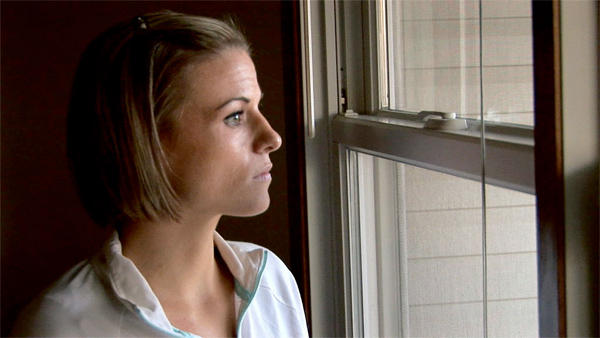
One woman’s spine is broken. Other women have broken bones elsewhere. Kirby focuses on Kori, a short ash blond spitfire whose jaw was crushed in her rape to the point that she can only eat Jell-O, pudding and other soft foods, as a sort of guide through the slow burn hell her perpetrator has turned her life into.

As her jaw problems worsen, the VA offers help with a back condition she doesn’t have. (Catch-22 lives.) Her husband—like all the spouses seen here—does everything humanly possible to help, and as his life is consumed by that endless job, the rapist claims another victim by proxy.

We meet woman after woman after woman, each with a story of love, service, rape, and betrayal by the military family she thought had her back. Watching these women’s’ faces and voices fuse as they all tell one extended story of incomprehensible soul-rending transgression is like hearing Jung’s collective consciousness screaming J’accuse.

Dick attacks every angle of this rotten story. His talking heads are all high-ranking, no-nonsense ex-military or thought leaders who exude zero-bias competence.  As with other victims who hide behind screens and electronic distortion, unearthed official documents, and military rape advocacy workers, the same story comes out, with the same details, the same narratives, the same outcomes, the same strings of words, even. That such identical details come from such radically different people either suggests that 1) Dick brilliantly coached about 50 non-pros to lie like trained actors or 2) This is the real, 100% true, truth. All it ever does is get worse as things are cleared up.

Who rapes? Often people of higher rank. Who know their victim. Who’ve raped before and will again.

We’re introduced to Brig. General Loree Sulton (Ret.) Psychiatrist, US Army, who’s brisk, friendly and assertive in her complete command of victims' psychology.

She tersely, chillingly asserts that tightly knit military units are nothing less than a “prime, target-rich environment for a predator” and points out the terrible irony that the military’s success at creating alternate families causes rape victims to suffer a far worse constellation of psychological damage after being raped, similar to that of incest. These were her surrogate brothers and fathers, after all, who attacked the victim, who may be lying about her, who are turning their backs on her.

Male predators also rape other males, with 20,000 “buddy-fuck” victims in the last ten years. Experts in multiple fields detach this from gay issues: again, rape is about power, violence and dominance. Rapists don’t care about gender. Just targets.

Kirby deftly alternates between small and large-scale abominations so as to keep the human suffering always at the fore, even when he goes historical. When you see a Marine talk about her agonizing violation, and then a second later we’re watching news footage of a famous rape military spree or court decision that says rape is an acceptable part of being in the military (this is a real thing), suddenly those facts are not distant, or abstractions. They’re real things, and you shudder to imagine how they affected the people you’ve come to care about during this film.

Dick follows one woman’s downward spiral from fighting in Operation Iraqi Freedom, to being raped and devastated by PTSD and ending up homeless and drug addicted, to asking, How did this happen? Why does the service so grievously mistreat some of its warriors?

And the answer Dick offers? Military justice is not American justice. There’s a chain of command deciding things. The chain of command has all manner of reasons for keeping rape cases closed or invisible and does not work according to democratic rules. Commanders with no personal involvement in a case might see a rape accusation as a potential black mark on their own career, sweeping the issue and possible investigation under the rug. Maybe they think the girl was asking for it. Maybe they’ve committed rape themselves.

We meet Captain Greg Rinckey (Ret.) US Army JAG Corps, a fortyish man who seems to still not believe the awfulness of what he has to communicate to the filmmakers. “The problem in the military is, the convening authority, who is not legally trained, makes the final decision.” That "decision" being what happens in a rape case, which defines a woman’s entire life.

As a corrective to the luxury of selective historic amnesia Americans enjoy, Kirby brings up recent scandals, old nightmares.

There’s the Tailhook Scandal in 1991: at least 87 women sexually assaulted by more than 100 U.S. Navy and United States Marine Corps aviation officers. The Aberdeen Scandal in ’96: 30 women raped.  

In the Colorado Springs Air Force Academy sexual assault scandal in 2003, 12% of all graduates claimed they were victims of rape or attempted rape. (The film reminds us that over 80% of victims never report their rape.)

At a certain point, the film crosses the line between objective documentary form and out and out advocacy in the same way Joe Berlinger and Bruce Sinofsky’s coverage of the West Memphis Three in Paradise Lost gave up even a fig leaf of detachment in the film’s two sequels, as the filmmakers realized the depth of the crime they were covering. I suppose some grand, detached style might be more artful, but I really don’t worry about superior grammar and usage when drowning people scream “help.”

Simply seeing The Invisible War won’t end any of the horrors it catalogues. But a movie like this wasn’t made to stop anything, it was made to anger you, to get you to do that first thing that keeps these monsters at bay. Ultimately, it really is up to you whether this film is a success or not.

Ian Grey has written, co-written or been a contributor to books on cinema, fine art, fashion, identity politics, music and tragedy. Magazines and newspapers that have his articles include Detroit Metro Times, gothic.net, Icon Magazine, International Musician and Recording World, Lacanian Ink, MusicFilmWeb, New York Post, The Perfect Sound, Salon, Smart Money Magazine, Teeth of the Divine, Venuszine, and Time Out New York.

VIDEO ESSAY: HAJI!

VIDEO ESSAY: HAJI!


I personally prefer the aggressive female . . . the superwoman. — Russ Meyer

In the 1960s there was a huge revival in striptease by way of topless go-go dancing. In Los Angeles there were a bevy of strip clubs that catered to all tastes. One particular swanky strip joint on La Cienega Boulevard, called The Losers, highlighted unpopular figures from current events. Richard Nixon, Fidel Castro, and other celebrity screw-ups would be lit up on the billboard as the loser of each week. Aside from that tasteless gimmick, The Losers was a little more classy than your usual strip club. Its dancers promoted classic burlesque and Las Vegas-style showmanship that attracted more sophisticated customers. One infamous patron of the establishment was Russ Meyer, who would often go there to select the sumptous starlets for his features. Nearly all of Meyer's stars began their career at The Losers: Tura Satana, Erica Gavin, Kitten Navidad, Bebe Louie, Shawn "Baby Doll" Devereaux, and my personal favorite, Haji. If there were any kind of pecking order at The Losers (which there was), Tura Satana would certainly be at the head of the table, but Haji would be second in command. When Mr. Meyer finally persuaded Haji to audition for a minor role in his next picture, Haji admitted that she didn't know the first thing about acting.  "Stick with me, kid," said Meyer, "I'll teach you everything you need to know." It would only be the beginning of her legendary, ass-kicking career.
 
Robert Nishimura is a Japan-based filmmaker, artist, and freelance designer. His designs can be found at Primolandia Productions. You can follow him on Twitter here.

Nora Ephron: Star Wars for Girls

Nora Ephron: Star Wars for Girls

null

I don't say this lightly: what Star Wars was for men and boys of a certain era (and believe me, I loved it, too), Ephron was for women and girls of that era.

When I got the premature call saying she had passed, I looked at my husband and said, "There's a disturbance in the Force." The world was less funny.

She was generous, gracious, hilarious and a huge help to those below her on the success and social ladder. She took criticism fairly, grudgingly admitting I might be right that the "Julia" part of her film Julia & Julia was infinitely deeper than the "Julie" part.

And in interviews, she reliably returned questions with a speed and spin that would make Venus Williams jealous. I never understood the reaction from hipster gals and most guys that her movies were slick Hollywood confections. To which I'd answer, "And what was Ernst Lubitsch?"

When the longtime New York Times film critic Vincent Canby cracked that Sleepless in Seattle was the movie you loved the night before and were embarrassed about the morning after, I called him—we didn't have email in 1993—and clucked, "You're just afraid that if you admit you like it, your manhood papers might get revoked." He laughed, saw it again, and admitted, "You know, it works."

The most important thing she taught me is that there's no use investing energy in fighting sexism. She believed the best revenge was putting that energy into your work.

Carrie Rickey is the film critic for the Philadelphia Inquirer.

VIDEO – Sight & Sound Film Poll: Ignatiy Vishnevetsky on How to Make a Random Top Ten List (and Why)

VIDEO – Sight & Sound Film Poll: Ignatiy Vishnevetsky on How to Make a Random Top Ten List (and Why)

Press Play presents Sight & Sound Film Poll: Critics' Picks, a series of video essays featuring prominent film critics on films they selected for Sight and Sound magazine's poll of the greatest films of all time. New videos will premiere regularly until the poll results are announced later this summer.

In speaking with critics voting in this year's Sight & Sound Film Poll, one detects an emerging theme of canonical distension, as participants attempt to distill their experience with 117-odd years of great cinema down to ten titles. More than a few have expressed the need to increase the ballot to twenty slots or more. Others complain that the proceedings seem certain to cement the placement of standard titles like Citizen Kane, The Rules of the Game and Vertigo, with little chance for other titles, especially from more recent years, to enter the top ten. Are we at a point in film history where a top ten poll does more harm than good in reflecting the best that cinema has to offer? Whatever the case, as argued here earlier, the poll's significance – both in how it forms tastes in cinema, and how it is formed itself – can't be taken for granted. 

Here on Press Play we've been conducting an ongoing conversation on how to shake up the Sight and Sound Poll and its resulting canon. Along these lines, it was fascinating to learn how film critic Ignatiy Vishnevetsky produced his top ten list for the poll when faced with more titles than he could possibly narrow down – over 90 in fact. The video explains his method, which, as he says, "is as good as anyone's," and then explores one of its intriguing results, the inclusion of three films from 1981. This year is not commonly known as being one of the best in movie history, but it is reflected as such in Vishnevetsky's list with Brian De Palma's Blow Out, Albert Brooks' Modern Romance, and Andre Techine's Hotel des Ameriques. This sets up an excellent opportunity to make an argument for why cinema from this particular year should be considered among the best ever made. Vishnevetsky does so with an astute exploration of filmmaking following the creative surge of '60s and '70s European New Wave and post-New Hollywood filmmaking, and before the advent of '80s commercialism.

What I like about what I will henceforth dub the Vishnevetsky Method to listmaking (again, watch the video for his explanation) is how its initial sense of randomness actually opens bracing new perspectives on canons and cinemas with a charge of rediscovery. For example, I decided to try the Vishnevetsky Method (though using a paperless, salad bowl-less version which I'll describe below) with my own list of 122 films that I considered for my own top ten. My results were as follows:

1. Outer Space (1999, Peter Tscherkassky)*
2. Histoire(s) du Cinema (1998, Jean-Luc Godard)
3. Yesterday Girl (1966, Alexander Kluge)
4. Sansho the Baliff (1954, Kenji Mizoguchi)
5. Intimate Confessions of a Chinese Courtesan (1972, Chor Yuen)
6. Days of Being Wild (1991, Wong Kar-Wai)
7. Love and Duty (1931, Bu Wancang)*
8. Pandora's Box (1929, G.W. Pabst)
9. Aparajito (1957, Satyajit Ray)
10. Bienvenido Mister Marshall! (1952, Luis Garcia Berlanga)

* indicates a title that I actually listed in my official Sight & Sound poll ballot.

Although I am passionate about Asian cinema and Chinese cinema in particular, I didn't expect this exercise to yield three Chinese titles; out of 122 possible titles that I listed for this exercise, 16 are Chinese language, a 1.5 of ten average (my actual top ten has two). But the presence of the three titles – Intimate Confessions of a Chinese Courtesan, Days of Being Wild and Love and Duty stimulate intriguing connections and arguments on behalf of their greatness, not just as exceptional Chinese language films, but films that in their own way pushed the edges of what was possible, not just in Chinese cinema but all cinema. It's a topic certainly worth devoting a video essay in the future. 

For those who don't have access to a salad bowl or paper, here's the paperless, salad bowl-less version of the Vishnevetsky method that I devised through digital resources. Follow these steps to get your own randomized top ten list:

1) Make a numbered list of every film you would consider putting on your top ten list. Make sure each film has a number associated with it. 
2) Visit this link: http://www.random.org/integers/
3) In the first field "Generate 100 random integers" replace 100 with 10.
4) In the next field "Each integer should have a value between 1 and 100," replace the number 100 with the number of films you've listed. 
5) In the next field, select one column for format.
6) Move to Part 2 and select "Get Numbers" 
7) Ten numbers will automatically generate at random. Match those numbers with their corresponding title. List those films in the order of those numbers.
8) Congratulations, you have a randomized top ten list! See what canon-changing insights you can derive from it, and feel free to share in the comments.

Ignatiy Vishnevetsky is a film critic for Mubi Notebook and co-host of Roger Ebert Presents At the Movies.

Kevin B. Lee is Editor in Chief of IndieWire’s PressPlay Video Blog, Video Essayist for Fandor Keyframe, and contributor to Roger Ebert.com. Follow him on Twitter.

SIMON SAYS: MAGIC MIKE and the Camera

SIMON SAYS: MAGIC MIKE and the Camera

null

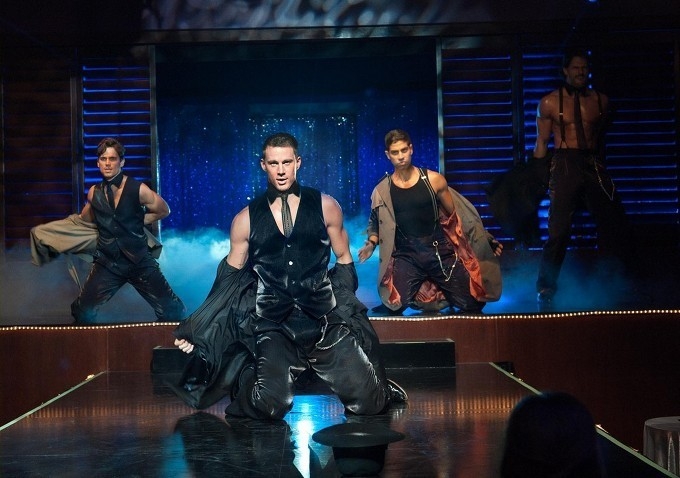
Steven Soderbergh's recent use of digital photography in Contagion (2011) and The Girlfriend Experience (2009) has a painterly quality. With Haywire, he proved that he could effortlessly achieve a nuanced look using the still burgeoning method of video photography. But with Magic Mike, he continues to hone the kind of glassy, flat but simultaneously elaborate aesthetic he's used for his more recent films. The broad beats of Magic Mike's narrative may be contrived, but Soderbergh enriches his usual main theme—of getting what you want by consenting to be exploited—through the film's highly stylized look. Soderbergh’s latest is at its best when its camerawork is most eccentric.

Based loosely on star Channing Tatum's own time as a stripper, Magic Mike is full of sequences designed to subtly disorient or dazzle viewers. Soderbergh constantly calls attention to the artificial nature of his imagery, using lens flares and, in a scene where Tatum raises his voice, unpolished audio to draw attention to his aesthetic and alienate viewers.

Magic Mike's story may not initially seem like it's all about Mike, but that's because it reflects his disillusionment with his job rather than narrating events in his life. At first, Mike thinks he’s an active agent in his life story—but he’s not. He realizes this after recruiting Adam (Alex Pettyfer), a naive, unemployed 19 year-old, to work with him at Xquisite, his strip club. Mike gives up his agency long enough to bond with Adam and develop a crush on Brooke (Cody Horn), Adam's sister.  But predictably, Mike eventually realizes that stripping is only a stopgap solution, and it has actually made it difficult for him to become financially independent. He grows to realize that he's only valuable to Dallas (Matthew McConaughey), the owner of the club Mike dances at, as long as he's doing what Dallas wants him to. 

Mike has contrived, generic reasons for wanting to divorce himself from his scantily clad livelihood. But they're inconsequential; Soderbergh establishes his character's true motivation in a thoughtful, albeit blunt, way. Bear in mind: sophistication is rarely combined with audiovisual elegance in Soderbergh's films. This is apparent in the way Soderbergh uses so much soft focus; his visual compositions all have uniform, flat look backgrounds. Shapes move behind the main figures, but the shapes are relatively indistinct. Additionally, Soderbergh's characters are constantly being projected on. In a crucial scene, Dallas teaches Adam how to dance at the club, posing in front of a wall-sized mirror. We see Adam learn to dance as it happens in the mirror, not directly; this neatly establishes the film's main concern with symmetry and obstacles. When characters want to really see each other, they appear to be positioned symmetrically. But the more out of sync with each other the characters get, the more visually different Soderbergh’s camerawork makes them appear, and hence the harder it is for audiences to actually see Mike and his friends (Brooke pointedly admonishes Adam by telling him, "I can fucking see you"). 

For example, Mike and Adam immediately form a shaky bond. The camera cuts back and forth between the two men as Mike drives Adam in his car for the first time. The men occupy separate spaces, but there is total symmetry to the shot-reverse shot visual structure of their conversations in the scene. The second time, Mike drives Adam home and, if you look hard enough, you can see that Adam is slightly better lit than Mike, that his head's not as close to the right side of the frame as Mike's is to the left side. The two have imperceptibly begun to drift apart. But in the third drive, Soderbergh shows the full-blown divide between the two men by creating a visibly rippling effect, suggesting that Mike and Adam are an outburst away from literally exploding at each other.

Soderbergh's visual flourishes establish Magic Mike’s concerns better than anything his characters say. In one blunt but effective juxtaposition, Soderbergh first shows a rain-streaked window pane and then transitions to a shot of a bust Dallas has made of himself. Another thoughtful visual cue is when Soderbergh literally shows us the barriers between Brooke and Mike disappearing through a tracking shot. As the shot continues, fewer objects clutter the image's foreground, leaving just Brooke and Mike, alone. Ironically, Magic Mike is probably dullest when most focused on its subject: when Mike and his colleagues strip on-stage, Soderbergh's approach is at its most basic.

Simon Abrams is a New York-based freelance arts critic. His film reviews and features have been featured in The Village Voice, Time Out New York, Slant Magazine, The L Magazine, The New York Press and Time Out Chicago. He currently writes TV criticism for The Onion AV Club and is a contributing writer at the Comics Journal. His writings on film are collected at the blog, Extended Cut.

VIDEO ESSAY: Sorkinisms, by Kevin T. Porter: A Writer Under a Microscope

VIDEO ESSAY: Sorkinisms, by Kevin T. Porter: A Writer Under a Microscope

EDITOR'S NOTE:

I don't know what to think of this video.

I know what its creator, Kevin T. Porter, wants me to think of it. He makes it clear that he considers this exhaustively researched and edited work to be "a tribute to the work of Aaron Sorkin"—a "playful excursion through Sorkin's wonderful world of words."

But that's not exactly how the piece comes across.

"This piece is not intended as a critique," he writes.

Mr. Porter's careful admonishment to his viewers does little to change the simple fact that this video—edited in a way that exposes the repetition in Sorkin's syntax—puts the whole enterprise on trial, arming Sorkin-haters with all the evidence they need to scream "hack!"

And they have a strong point.

On the one hand, the sameness laid bare in this piece can be easily be derided for its lack of imagination, and yet it can be celebrated on the other because—let's face it—Sorkin-speak has that unique tendency to transcend everything else in the frame, including story, plot, lighting, and direction. It's that much fun to hear.

But, the same point can be made about writer/director Joss Whedon, a writer with a voice so unique that he has built his own cult following of half-crazed fanatics—now that The Avengers has raked in a billion or so, the Whedonites will rule the world. Yet every character Mr. Whedon has ever created talks like some version of himself.

If anything, this remarkable video reminds us that writing is not golf.

Anyone who has ever rented a pair of clubs for the first time, stepped on to a fairway, and taken a swing at a ball off the ground knows that golf is damn hard. The very act of playing it bathes you in such abject humiliation that I personally think the New York Department of Corrections should force convicted felons to do it as punishment.

Writing, on the other hand, seems deceptively easy—especially for a first-timer. In fact, I'd say it takes a good while to discover how bad you are at it; one's identity as a writer, similarly, comes together only after one suffers a slower but just as humiliating journey through the complicated world of syntax, dialogue, and grammar.

Perhaps it's fair to say that the Sorkins and Whedons of the world have earned the right to their unique voices, and therefore they deserve a respectful place in popular entertainment.

While it is true none of these guys are ever going to win the Paddy Chayefsky award for realism, somehow, we still fall for them all the same. — Ken Cancelosi
 

VIDEO ESSAY – Matt Porterfield and the Art of the Question

VIDEO ESSAY – Matt Porterfield and the Art of the Question

What is it that makes Putty Hill one of the more striking American independent films of recent years? Is it the genuine working class Baltimore setting, where director Matt Porterfield grew up and still lives today? Is it the cinematography by Jeremy Saulnier? Is it the ensemble of nonprofessional actors who give the film a genuine, unaffected sense of character? Or is it the questions?

Putty Hill does so much with the first three elements to immerse you in the documentary-like authenticity of its world. But the film tears its own fabric of verisimilitude in scenes where Porterfield spontaneously interviews the characters, asking them questions from offscreen. Matt Porterfield is as much a member of this community, and a character in the film, as those on screen in 'Putty Hill.' These interviews are a paradox: They break the film’s documentary realism by making its format a subject in itself.

One might worry that such a strategy would reek of arty self-consciousness, but there’s something genuine about it, because it puts Porterfield’s relationship with his characters front and center. Porterfield spent a long time working with each of these nonprofessionals, asking them questions to help them develop their characters, mixing their real life experiences and fictional inventions. These scenes are both the outcome and an acknowledgment of that process. What it reveals about Porterfield is that he is not just a director of these subjects, but a confidante. In other words, he is as much a member of this community, and a character in his film, as those on screen.

You can already see this questioning approach in Porterfield’s first film Hamilton. The majority of the dialogue consists of questions and responses. By my count there are 65 questions asked in this 65-minute film. Even the rap song featured in a key scene is full of questions. Hamilton seemingly has the objective surface of an observational documentary, but when you listen to these dialogue scenes, you can practically hear Porterfield’s voice from Putty Hill in each conversation in Hamilton. Porterfield’s world shows everyday life as an investigative documentary, with people constantly interrogating each other, seeking answers.

Is there an underlying significance to all these questions? Both films deal with the ripple effect on a community caused by a private trauma. In Hamilton, it’s a teen pregnancy; in Putty Hill it’s a suicide. In most films, asking questions would serve to explore these incidents and lead towards a dramatic resolution. Here, the questions themselves are the drama: a constant effort to reach out and stay connected. The more questions are asked, the more they suggest how vulnerable these relationship are, and how strong the desire is to hold them together. In Porterfield’s films, the story is less important than exploring the community in which it takes place, and what’s at stake in preserving it.

Originally published on Fandor

Kevin B. Lee is Editor in Chief of IndieWire’s PressPlay Video Blog, Video Essayist for Fandor Keyframe, and contributor to Roger Ebert.com. Follow him on Twitter..

CRUEL SUMMER: TOP GUN (1986)

CRUEL SUMMER: TOP GUN (1986)

The "Cruel Summer" series of articles examines influential movies from the summers of the 1980s. The previous entries in the series have covered THE BLUES BROTHERS (1980), STRIPES (1981), ROCKY III (1982), WARGAMES (1983), PURPLE RAIN (1984), and PEE-WEE'S BIG ADVENTURE (1985).

The 1980s saw Hollywood going to war. America’s defeat in Vietnam instilled a sense of hopelessness that ran throughout the 1970s. The Vietnam movies of the late ‘70s (The Boys in Company C, Coming Home, The Deer Hunter, Apocalypse Now) were all about mourning and the tentative first steps necessary for the country to move on. Then, with the election of a former Hollywood star as President, Hollywood decided to re-up with the military and make movies that were the equivalent of Reagan’s military intervention policies. The distrust of the government and the military during the ‘70s was now giving way to a cinematic flexing of American might. All that was needed to build up morale was a few easy wins, and after that, the Vietnam disaster would hopefully seem like a bad dream.

From the softening of basic training in movies like Private Benjamin, Stripes, and An Officer and a Gentleman to re-staging Vietnam in men-on-a-mission action dramas like Missing in Action and Uncommon Valor,Hollywood saw it was better for business if America came out on the winning side. (The first Rambo movie, First Blood, would be the rare movie during this time that tapped into the rage and marginalization of returning Vietnam veterans. Its sequel, Rambo: First Blood Part II, would turn that rage into comic-book fury, complete with the crowd-baiting question, “Do we get to win this time?”) Vietnam cast a shadow over movies that weren’t even explicitly about the war. Vietnam became a shortcut to character development. Sylvester Stallone’s character in Nighthawks was a pacifist because of his experiences in Nam, while Roy Scheider’s pilot in Blue Thunder suffered from “stress” due to his tours of duty. Movies as varied as The Exterminator to Commando to the first Lethal Weapon all used Vietnam to heighten the audience’s identification with the lead character. All of this cinematic stockpiling of goodwill came to a head in 1986 with the release of a movie that turned Hollywood’s restaging of Vietnam as a winnable war into an advertisement for America’s outsized belief in its own exceptionalism.

Tony Scott’s Top Gun is a visual and aural assault, a full-throttle “ride” that doesn’t stop for pesky things like story. The story goes that the pitch for Miami Vice was “MTV cops.” The pitch for Top Gun could have easily been “MTV pilots.” Scott, along with his older brother Ridley, Adrian Lyne, and Alan Parker, was at the forefront of a group of British TV commercial directors. These directors made advertisements cinematic. When they got their shot at making movies, they infused their movies with a powerful visual sense. Ridley Scott made rust and dirt and grime look authentic and cool in movies like The Duelists and Alien. Parker gave everything an artificial beauty, even a Turkish prison in Midnight Express. Lyne’s use of backlighting throughout Flashdance would become a mainstay on MTV. But Tony Scott was the bad boy of the bunch. He could do everything they could do but he didn’t have any pretensions about subject matter or critical response. Pauline Kael described Top Gun as a “…recruiting poster that isn’t concerned with recruiting but with being a poster.” As it turned out that’s exactly what audiences liked about it. Advertising was now a legitimate form of storytelling.

The story of Top Gun is so simplistic that it’s almost child-like. Producers Don Simpson and Jerry Bruckheimer helped shape mainstream American movies by specializing in movies that anyone could follow. Movies like Flashdance, Top Gun, Beverly Hills Cop, and Days of Thunder gave viewers such a cocaine-adrenaline rush that you came out of the theater ready to take on the world. They made movies about winning, and in the 1980s that’s what audiences wanted to see. The screenplay (more like a scenario) by Jack Epps, Jr. and Jim Cash may have centered on hotshot Navy pilot Maverick (Tom Cruise) and his training at the Top Gun school but, really, the movie was about you and your dream to be the best at whatever you did. Simpson and Bruckheimer’s movies played like a cross between a rock concert and a motivational seminar.

The movies' pop psychology trappings didn't lessen their entertainment value (who doesn’t like a rush of adrenaline?) The opening credit sequence remains one of the best of the decade. From Harold Faltemeyer’s iconic synth-guitar theme to Jeffrey Kimble’s vivid filtered cinematography to the eroticized, slo-mo pans of fighter jets getting ready for a dawn run, the sequence seduces you into wanting to go to war. Even Kenny Loggins’ anthemic “Danger Zone” is part of the quickening of your senses and making you not question the sheer manipulativeness of what you are seeing. (“Revvin’ up your engine/Listen to her howl and roar”…) There aren’t really any scenes in Top Gun, just set-pieces. There aren’t really characters, either. Any nuance or shading in the characters is due to the characters' personalities, not the writing. The characters’ names do most of the work of characterization. When a character named Viper is described as the finest fighter pilot in the world (and he’s played by the sturdy Tom Skerritt), more than half the job is done.

The movie gives us a comic-book version of masculinity. Vulnerability is kept to a minimum. This leads to a good dose of (unintended?) homoeroticism. The verbal showdowns between Maverick and his chief rival Iceman (Val Kilmer) are kind of wonderful in the way the actors play the scenes totally straight. (They’re like the scenes between Charlton Heston and Stephen Boyd in Ben-Hur, except the actors in Top Gun don’t know their secret.) The locker room scenes have a PG level of jocular aggression, while the famous volleyball sequence is meant to appeal to the girls in the audience, but it’s clear Scott knew it would also appeal to men. (The use of Loggins’ awkwardly titled “Playing with the Boys” pretty much seals the deal.)

The aerial photography is still some of the best of its decade, if not in film history. The five major flight sequences help distinguish Top Gun as a superior action movie. Most flyboy fighter pilot movies relied heavily on “realistic” footage but rarely bothered to inform the viewer to what exactly was happening. Scott’s insistence on pre-planning the maneuvers and choreographing the flight sequences allowed him to display a sense of scale that recalls the Death Star run in Star Wars. (Lucas uses CGI the way Scott uses practical and model effects.) We genuinely feel like we’re in the cockpit of one these fighter jets. There’s a palpable feeling of exhilaration during takeoff or when one of the jets has to spin in order to avoid being shot down. There’s also genuine terror, especially when Maverick’s jet goes into a flat spin and he and his co-pilot Goose (Anthony Edwards) are forced to eject.

When Top Gun is in the air, it’s terrific popcorn entertainment. It’s the scenes on the ground that are more problematic. Unlike the non-musical sequences in Purple Rain, where the characters’ interactions were kept direct and intense, the scenes in-between flight sequences have a workman-like pacing that exposes just how thin the story really is. The best performance is by Edwards, who uses humor and sincerity to get us to love him. His death in the movie genuinely hurts. Kelly McGillis is the movie’s biggest weakness. SHE displays none of the confidence that made her so memorable in Witness, her previous movie. She has zero chemistry with Cruise, or more accurately she has just enough to get by. Compared with Cruise’s erotic connection with Rebecca DeMornay in Risky Business or McGillis’ passionate embrace of Harrison Ford in Witness, their scenes together are pretty tame. The one scene between them that works is when they’re sitting on her porch and listening to Otis Redding’s “Sittin’ on the Dock of the Bay.” The movie constantly tells us that they’re in love. (The gorgeous Berlin theme “Take My Breath Away” goes a long way in convincing us they’re a couple.)

Cruise’s chemistry with McGillis doesn’t really matter anyway. What matters is his chemistry with the audience. Cruise’s all-American image is so integral to the success of Top Gun that audiences and critics didn’t fully grasp that it takes a rare kind of acting skill to make what he does look effortless. In Risky Business, he used his baby-faced wholesomeness to get us on his side, even if he was playing a junior pimp. From his somewhat slight frame to his little-boy voice, Cruise, at first glance, wouldn’t seem to have the makings of one of the biggest movies stars in the world. But Cruise’s fabled work ethic is transmuted into his characters’ winning cockiness and we can’t help but be on his side, be it in The Color of Money or A Few Good Men or Magnolia or Mission Impossible: Ghost Protocol. In Top Gun, Tom Cruise became a star by embodying America’s belief in overcoming adversity in order to come out on top.

(NOTE: Oliver Stone would commit a courageous act of star vandalism by casting Cruise in Born on the Fourth of July. Cruise’s Ron Kovic is Maverick, humbled by the ugly reality of war, only to come out a winner on his own terms.)

Is Top Gun a good movie? That’s a tricky question. It’s certainly a watchable one that has managed to stick around long after other, more respectable movies have faded from memory. However, of all the movies surveyed in this series of articles it’s the one that has very little resonance today. The release of Stone’s Platoon at the end of ’86 effectively killed Hollywood’s un-ironic love affair with war. (The release of Robocop the following summer would usher in Hollywood’s long-standing romance with technology and machinery.) Top Gun’s influence can been seen in movies like The Rock, a mostly humorless “ride” that forgot to add the rock ‘n’ roll. (The Rock director Michael Bay is like Tony Scott’s ugly stepson. He’s the father of Chaos Cinema.) Top Gun is an artifact, like bellbottoms or the bob hairdo, from a seemingly more innocent time. It represents a coarsening of summer entertainment, a moment when advertising became a part of the storytelling. Who knew what was once considered crass marketing would now look restrained and old-fashioned?

San Antonio-based film critic Aaron Aradillas is a contributor to The House Next Door, a contributor to Moving Image Source, and the host ofBack at Midnight,” an Internet radio program about film and television.