VENICE INTERNATIONAL FILM FESTIVAL: Terrence Malick’s TO THE WONDER

VENICE INTERNATIONAL FILM FESTIVAL: Terrence Malick’s TO THE WONDER

null

A movement from the universal to the particular: that’s what Terrence Malick’s To the Wonder feels like, a year after The Tree of Life. The short period of time that elapsed between the two films—unprecedented in the director’s career—suggests they have much more in common than any of his earlier efforts. Ironically, The Tree of Life's all-encompassing perspective on human relationships, faith and the universe itself could have indicated that the film was a final statement in his career or in his life. Instead, what looked like the end was just another beginning—as so often happens in Malick’s stories—and the guy who once let twenty years pass between his second and third movie is now back on our screens mere months after his fifth movie.

This time the focus is quite different. Set in the present, this story follows the relationship between Neil (Ben Affleck) and Marina (Olga Kurylenko). Neil falls in love with Marina when he is visiting Paris; he subsequently brings her and her daughter to the United States, to live with him in Oklahoma. With little dialogue and the familiar depiction of fleeting moments, voice-overs and natural exploration, the growth and decay of the romance live in the space between each image on screen. We learn that Neil’s feelings are sincere, but somehow his hesitancy prevents him from fully committing to anything in his life. We find out that Marina has her own doubts, that she wants “to be a wife” but is also scarred by a dark past and confused by Neil’s reluctance. Less actually happens here than in other Malick movies, but at the same time this is the purest investigation of love in the director’s career. Two things happen as a result of that investigation.

The first is that we see an amplified emphasis on life in the present moment. Not in the chronological sense, although that has been a factor in Malick’s previous settings, but rather as an enhanced perception of time passing by rapidly, closing doors and making unalterable truths from ambiguity. The Tree of Life grounded its burning questions in the probing of the past, placing a family’s struggle in the context of a millennial journey. To the Wonder has no such frame to wrestle with. “You thought we had forever, that time didn’t exist,” Marina says to Neil at one point. Immediacy is a joy, and a killer. This is the stuff every love relationship is made of, but the Malick treatment—undisturbed by other narrative elements—makes it all the more painful.

The second thing that happens is that a menacing dread looms over the characters. Lead and cadmium poison the earth in Oklahoma. The tide is rising in Mont Saint-Michel. Emmanuel Lubezki’s versatile cinematography can show us numerous scenes, from Tree of Life’s sunny yards to the lunar-surface grayness of this movie. Rarely in Malick’s films has there been an objective correlative like this one. He usually prefers to throw everything together, with no separation to solidify a theme, letting emotion rise from spontaneous contrast. This method is still present here, but it’s joined by a more direct connotation. Not all things are shining, now.

The nature of Affleck and Kurylenko’s romance is reflected in the character of Javier Bardem’s wandering priest – a doubtful soul who’s supposed to comfort others and yet must also acknowledge his unsteady faith. He serves as a link between the lovers' struggle and the more literal spirituality of Malick’s world view—once again, signalling a clear separation of the film's components. Rachel McAdams appears as Neil’s ex-girlfriend, recalling at first Christian Bale’s turn in The New World: filling a void with grace and dignity. Marina is not John Smith, though. She comes and goes, unable to reconcile the two impulses she contains within herself, almost like two different women. One is “full of love” for him; the other “pulls her down towards the earth”.     

Here in Venice, where the film screened in Competition, many are already saying that To the Wonder is just a patchwork of leftovers from The Tree of Life, and that’s harsh, even despite the end-credits confirmation that footage from Malick’s previous film has in fact been used. In a broader, less derogatory sense, these criticisms might also be true. This film feels like a smaller island in the Malick archipelago, more fragmented and full of things we’ve seen before, but also highly permeable and interconnected with the others, almost in dialogue with them. Several actors were cut completely from the finished version of the film, as usual (Rachel Weisz and Jessica Chastain among them), and just as we can imagine their characters alive somewhere in this universe, asking questions to the sky, we can view To The Wonder’s closeness to The Tree of Life as a seamless, frictionless proximity.  

Tommaso Tocci is an Italian film critic, copywriter and translator. Follow him on Twitter.

VENICE INTERNATIONAL FILM FESTIVAL: Paul Thomas Anderson’s THE MASTER

VENICE INTERNATIONAL FILM FESTIVAL: Paul Thomas Anderson’s THE MASTER, At Last


null

Long awaited at the Lido, after a prolonged game of cat-and-mouse between the Festival and Harvey Weinstein’s marketing machine, Paul Thomas Anderson's The Master has finally been shown.

This is an elusive film, destined to stand out due to its surrounding circumstances. First, the anticipation, five years after 2007's There Will Be Blood; then the will-they-or-won’t-they dance with the Festival before it was announced (separate from other announcements) in the Competition line-up. In the meantime, The Master started popping up at surprise screenings in the United States before turning up in its full 70mm glory—an atypical approach, as was that of Samsara—at the actual Festival.

Expectations were sky-high, like nothing else around here in the past few years. And yet the film itself doesn’t, on its surface, justify that kind of momentum, because it tells the story of a man who is unable to find a sense of purpose. A WWII veteran clumsily forced back into society, Freddie Quell struggles to keep a job, drinks heavy cocktails (which include solvents, pills, and any kind of alcohol he can find), and is prone to angry outbursts. The Navy is not entirely to blame, though, since flashbacks show him in a similar predicament while on duty on the Pacific front. In fact, Joaquin Phoenix’s body and Anderson’s composition make it clear that Freddie and the space he inhabits will always be painfully at odds.

His meeting with Philip Seymour Hoffman’s Lancaster Dodd, a self-professed uber-thinker with a group of followers and a desire to find solutions to the world’s problems, quickly ignites another one of the director's trademark relationships involving fatherhood issues, conflicting trajectories, and opposing Weltanschauung. Only this time the dynamic appears to be more subtle. It’s quite obvious why Freddie would jump at the opportunity to follow such a master; Dodd’s grand delusions and clarity of intentions provide Freddie with the purpose he has been desperately seeking. More intriguing is Dodd’s fascination with the man who has entered his life: at first it’s mutual intoxication, as the two swap promises in exchange for the ‘good stuff’ that Freddie’s talent can provide. But Freddie is also an ever-regenerating blank slate onto which Dodd can project his quest, a renewable source of infatuation. A scene showing the two men hugging, shot from the side, demonstrates their dynamic perfectly: as Hoffman’s rotund form lunges into the space of the Other, Phoenix’s torso creates an emptiness to accommodate him.

The subtle dynamic between the two central characters informs the style and the pace of the whole film, making it hard to grasp. The core tension is generated by verbal repeition, as in the "applications" and exercises Dodd subjects his “guinea pig and protegé” to. Anderson replicates this with his use of depth in his shots, locating Phoenix behind elements in the foreground, placing him at odds with gorgeous backgrounds—courtesy of the film’s 70mm crispness and Mihai Malaimare Jr.’s cinematography—and generally stripping The Master of structural drive, an element which was crucial to There Will Be Blood. A fitting change, considering that Freddie Quell is the polar opposite of Daniel Plainview. The former is desperate to find a place, even though he doesn’t know how. The latter will stop at nothing to make his place, knowing all too well where to drill and what to hit. Plainview exuded directness, from the center of Anderson’s symmetry. Quell pathologically refuses progress (yet, sooner or later, everybody has to “pick a spot”…) and seems always well-positioned to disrupt those symmetries, starting with the twisted mess that Phoenix turned his face into for the role. Despite the enormous performance of Philip Seymour Hoffman, and despite the fact that the story is essentially about two men, Anderson cannot help focusing the film on its central character. There Will Be Blood was a radical departure in Anderson’s career; The Master displays similar scope and weight but has a more ambiguous texture.

Tommaso Tocci is an Italian film critic, copywriter and translator. Follow him on Twitter.

EYE OPENERS: The Trailer for the La Di Da Film Festival

EYE OPENERS: The Trailer for the La Di Da Film Festival

The trailer above, created by Tom Shek of National Television, is zippy and jammed with images, mainly the faces and presences of independent film figures. How many can you identify? The event it advertises is the La Di Da Film Festival, which will have its debut in New York on September 14-16: the festival has an eye on small, independent, handmade, spontaneous, and, most of all, original films. A production of the 92YTribeca and Bomb Magazine, among other sponsors, the festival is curated by critic Miriam Bale, who has published pieces in Film Comment, GQ.com, The L Magazine, and elsewhere.

The event will feature work and performances by Joshua and Ben Safdie, Maiko Endo, Sam Fleischner, Alex Karpovsky (of HBO's recent Girls), and others. The films the festival includes will be varied in their approach, from animation (Josephine Decker's Me the Terrible, about a child pirate's attack on New York) to found footage (Dustin Guy Defa's Family Nightmare, about life in dysfunctional families).

Click here for more information, or click here to buy tickets!

Grains of Sand: The Meditative Beauty of SAMSARA

Grains of Sand: The Meditative Beauty of SAMSARA

Ronald Fricke's Samsara is a trance movie. Its title is a Buddhist term that roughly translates as, "The cycle of death and rebirth to which life in the material world is bound." And in a roundabout way, the movie does tell that story. Fricke's 1992 feature Baraka tells that story, too—the biggest, simplest story; the only story, really. But for my money, Samsara is better than Baraka—and better than Godfrey Reggio's Koyaanisquatsi, which Fricke shot—because its images are more purely contemplative and much more free. They aren't being bent and juxtaposed to advance certain arguments, however loosely.

nullThere are points where the film steers you in a certain direction—for instance, rhyming shots of factory-farm butchery and shots of newly-minted rifle bullets pouring into a bin at an ammo factory (industrialized violence), or the placement of uncannily realistic robots, rubber sex dolls and meat-market strippers in the same montage (dehumanization). But for the most part it's a very loose, confident movie, one that seems to have been made by a much wiser, more relaxed director than the one who created Baraka. Fricke used a birth-to-death structure in Baraka, too, but it was more mathematically precise there. The earlier film was linear, for the most part. It confined its tangents to subchapters that might as well have been captioned: "The same industrial power that brought us modern cities also brought us genocide." "Different cultures observe different rituals, but deep down all rituals are the same." "The rich don't give a damn about the poor." In Samsara, Fricke and his editors work with similar images (though more vivid and crisp because they're shot on 70mm film). But this movie deploys them differently—in a looser, more confident, more open-ended way. You have to get into the spirit of the movie, engage with it, relax, and float downstream.

I wish there were more movies like it. I wish Tree of Life were a bit more like it, actually; I adored Tree of Life, but it wasn't until I saw Samsara that I realized why I was never quite able to embrace it as a Malick masterpiece. The problem wasn't that Tree of Life went too far into abstraction for my taste, but that it didn't go quite far enough. By anchoring ephemerally lovely images to a simple story and innocent/questing/banal voice-overs, Malick got as far away from mainstream narrative cinema cliches as he could without cutting the cord. Fricke cuts the cord. The result covers some of the same thematic ground as Tree of Life, and offers some similar images, but it's a much more direct, simple, free-spirited movie. It's experimental cinema pitched at mainstream audiences. As such, it has few equals.

nullThe director/cinematographer and his editors juxtapose images of wealth and poverty, nature and civilization, war zones and dead bodies, guns and ammunition, old people and young people, people of different cultures and faiths, and shots of babies, village elder-types, packed commuter trains and oppressive offices and charnel-house factory farms, scudding clouds, plumes of volcanic steam, rivers of lava, image after image in section after section. But rather than string the images along a linear-philosophical clothesline stretched from cradle to grave, Samsara shuffles and reshuffles images like cards in a deck. The movie visits and then returns to images of individuals, crowds of people, animals and vehicles whirling in circles, and dancers posed so that the lead dancer in the foreground seems to have multiple arms, like a Hindu goddess. Every person, every country, every climate, every body of water, every type of terrain is connected: we sense this connectedness from the rhythms of the film, not because individual cuts are telling you, "See? This thing here is kinda like this thing over here."

nullThere's no missing the disgust Fricke brings to shots of poultry being skinned and gutted, or the shots of shantytown residents digging through dumps while gleaming condominiums and office buildings loom behind them. And yet Samsara is not a didactic movie. It has a showman's sensibility. The probing closeups and geometrically lovely wide shots are presented as little movies in themselves, self-contained spectacles with their own internal logic and personality. Each shot is an object of contemplation, a springboard for emotion and reflection, but at the same time, the sheer handsomeness of the production says, "If you want to just sit back and enjoy this as a travelogue or a borderline-psychedelic sound-and-light show, that's fine, too."  Samsara is the work of a guru, not an acolyte. Fricke is a master leading the audience through meditation, giving us suggestions for dreaming. Our mind takes us where it takes us.

Matt Zoller Seitz is the co-founder of Press Play.

VIDEO ESSAY: The Weeknd at the House of Bava

VIDEO ESSAY: The Weeknd at the House of Bava

August typically finds the air of the cineplex ripe with horror fare—the supernatural thriller Apparition is being released this Friday and The Possession is due out next weekend—so I thought it a fitting time to pay homage to horror master Mario Bava. A true original in a genre rife with uninspired copycatting of well-worn formulas, Bava expanded the horror palette into vivid new dimensions of color, movement and sensuality. If cinema is a kind of architecture, Bava was a master designer of interiors, not just in building indoor set pieces with paltry B-movie resources, but in channeling our deepest fears and desires of the uncanny, in all its luscious depravity. His sinuous camera movements through sinister shadows alternating with lurid, beckoning neon are as seductive as they are threatening, bringing us ever closer to the consuming sensations of both sex and death.

As I edited clips from Blood and Black Lace and The Whip and the Flesh, two Bava films available on Fandor, the danger and sexiness of Bava’s cinema kept bringing to mind the music of The Weeknd, one of my favorite acts of the moment. So I decided to cut the video to the horrorific “High for This,” a track from The Weeknd’s 2011 releaseHouse of Balloons. Welcome to the House of Bava.

While there’s pure pleasure to be hand in the mix of Weeknd+Bava, I hope the video also yield’s some critical insights to the texture and craft of Bava’s filmmaking. Mostly I mixed up speeds for the clips, ranging from 1/20th to 10x normal speed. The fast clips are typically to compress Bava’s elaborate long takes, heightening the sensation of Bava’s camera tracking and moving across cavernous spaces. I use slow motion to stretch out moments of terror to get past their initial shock value and dote on their aesthetic properties, the elements of light, color and motion that feed their impact.

Through this we can see the full arsenal of techniques at his command: varying use of both deep staging and extreme closeups; off-screen sounds and negative space; a persistently pulsing sense of rhythm in both the visual and sound design, something like a cinematic corollary to human breathing; and, above all, an incredibly rich color palette that encompasses “all the colors of the dark” (the title of Tim Lucas’s supreme tome on Bava). Bava may possess one of the most borrowed toolkits in cinema history (you can see his tricks in everything from Ridley Scott’s Alien to Japanese exploitation), but his artistry still has plenty of room to be explored in its own right.

Originally published on Fandor.

Kevin B. Lee is Editor in Chief of IndieWire’s PressPlay Video Blog, Video Essayist for Fandor’s Keyframe, and a contributor to Roger Ebert.com. Follow him on Twitter.

VIDEO ESSAY: There Will Be Blood and Symmetry

VIDEO ESSAY: There Will Be Blood and Symmetry

Paul Thomas Anderson’s youthful panache and exploratory bent has yielded a small but forceful filmography. Even his two shortest efforts, Hard Eight and Punch-Drunk Love, are imbued with a relentless, epic spirit. Anderson has always embraced the electric potential in themes such as faith, incest, scamming, family dynamics, and the American West.

If Magnolia was a work that could only be made by a cocky, precocious rogue, then There Will Be Blood was evidence of mature polish. Magnolia’s creative ecstasy was replaced by tight formal elegance in Punch-Drunk Love and There Will Be Blood, and they’re all variations on the common themes of fatherhood, power, and spirituality. However, There Will Be Blood’s scope was so enormous that it required a type of maturity that Anderson had yet to demonstrate. He succeeded by employing large-scale symmetry capable of sustaining his dangerous ambition. The film didn’t collapse under its own gravitas because of a careful system of visual and thematic rhymes. Of course, Daniel Day-Lewis delivered a performance of Streetcar-Brando level virtuosity, but accolades are due equally to Anderson, who constructed a final vision of the character from subtle visual cues that lead Plainview from rise to ruin.

Matt Zurcher is a senior at Carnegie Mellon University studying film and musicology. He is an arts critic for CMU’s newspaper and blogs at www.thefamilyberzurcher.com.

VIDEO ESSAY: Andrew Sarris and Buster Keaton

VIDEO ESSAY: Andrew Sarris and Buster Keaton

The latest edition of the Sight & Sound Critics’ Poll of the greatest films of all time, held only once every decade, is full of delights and disappointments, with an epochal change at the top: Citizen Kane at long last unseated from the throne by Vertigo. The rise of other films through the rankings, led by 1929 groundbreaker Man with a Movie Camera’s first entry into the top ten, are well worth celebrating. (I’m also heartened to see the ascendance of Ozu’s Late Spring, Akerman’s Jeanne Dielman, Rossellini’s Voyage to Italy, Dreyer’s Ordetand Gertrud, Jacques Tati’s Playtime, and Godard’s Histoire(s) du Cinema, the last being possibly the ultimate “video essay”). Misfortune met other titles as they spilled down the list: Singin’ in the Rain, Pather Panchali, M, Barry Lyndon, The Magnificent Ambersons, The Third Man, Intolerance.

One of the saddest declines befell The General.  Buster Keaton’s 1926 masterpiece once ranked among the top ten in the 1972 and 1982 editions of the poll; in 2002 it still held firm at #15. This year it suffered its lowest ranking in decades, at #34. Keaton rival Charlie Chaplin fared no better, his sublime City Lights barely making the top 50. One might ascribe their fates to a lessening interest in silent cinema, but to the contrary, on the whole pre-talkie movies did as well as they ever had (with three occupying the top 10). Silent films certainly did much better than the other genre befitting Keaton and Chaplin, the comedy. Of the top 50 films in the poll, only seven are comedies (and only 9 in the top 100!), so it would seem the 846 participating critics and programmers lack a sense of humor. (For what it’s worth, my list included one comedy, the sublime and underseen 1946 gem Under the Bridges).

One also has to wonder if Keaton’s decline in the poll reflects a generational shift among the voting pool. Back in the 1950s and 1960s, Keaton, long neglected by Hollywood as a washed-up silent clown, became something of a cause célèbre among the first auteurist critics in the US and abroad. (A critics’ poll at the 1955 Brussels World Fair hoisted Sherlock Jr. as the greatest film of all time).  Keaton’s kinetic vision and death-defying craft was steadily championed through retrospective screenings and film classes, and by 1972, The General finally cracked the Sight & Sound top ten.

SEVEN CHANCES

Buster Keaton outruns wannabe brides in 'Seven Chances.'

Ranking among Keaton’s most devoted champions during (and well beyond) that period was Andrew Sarris, the legendary critic who passed away just two months ago. Sarris pioneered the notion that Hollywood directors could be seen as artists, and Keaton held a central place in his personal pantheon. I can’t help but think that Sarris’s passing and Keaton’s fall in the S&S poll have a symbolic connection, in the sense that a generation of critics like Sarris is gradually leaving our midst, giving way to other critics, values and favorite films. – Kevin B. Lee

TRANSCRIPT: EXCERPT ON KEATON FROM ANDREW SARRIS’S YOU AIN’T HEARD NOTHING YET:

Buster Keaton could be hilarious on occasion, but most of his work is not geared to a laugh meter. The Frozen North strikes me as his funniest film, with CopsThe High Sign, and The Goat not too far behind. Significantly, these are all short films. Even in these works, the virtuosity unveiled often transforms the wild laugh into an appreciative chuckle. All in all, Keaton is far from being the funniest comedian ever, yet he could generate the belly laugh when he so desired.

Keaton’s comedy, for the most part, does not deflate pomposity or overthrow the powers that be, at least not by conscious design. Copsbecame an underground classic in the late sixties because of the sheer number of “pigs” who were zapped and lampooned in the course of Buster’s madcap adventures. But Keaton is no anarchic angel. Much of the havoc he wreaks is caused by his lofty indifference to convention. At his best, he is consumed by an obsessive logic that impels him into a physically and visually harmonious relationship with the world around him. His forte is construction rather than demolition. Keaton walking into the movie screen in Sherlock Jr., Keaton dangling confidently from the mast in The Navigator, swinging from the falls in Our Hospitality, fleeing from the hordes of would-be brides in a continuous shot in Seven Chances, and above all, riding the whirlwind itself, to Oedipal reversal in Steamboat Bill Jr.by saving his father from drowning. If one assembles all these haunting images, and many more, the composite effect in one’s mind is a spectacle at which one must gasp rather than guffaw.If one thinks of a comedy/ha-ha as the most important part of screen comedy, one must conclude that the funniest films are almost invariably destructive and subversive and, more often than we like to admit, ratty and mean-spirited. The eternal appeal of the ethnic joke attests to the criterion of cruelty in these matters. So much “humor” is based on feelings of contempt, superiority, and comparative sophistication and normality.

When Buster Keaton was three years old, a Kansas cyclone lifted him out of a second story window and deposited him unharmed in the middle of an unpaved main street some four blocks away. In Steamboat Bill Jr.Keaton seems to draw on intuitive insights into the cyclonic forces of nature, and the state of grace and adaptability necessary to survive them. In the end, he triumphs over adversity by a majestic submission to the forces of motion, the very forces that constitute the logic and magic of all movies.

The True Horror of THE WALKING DEAD Comics

The True Horror of THE WALKING DEAD Comics

null

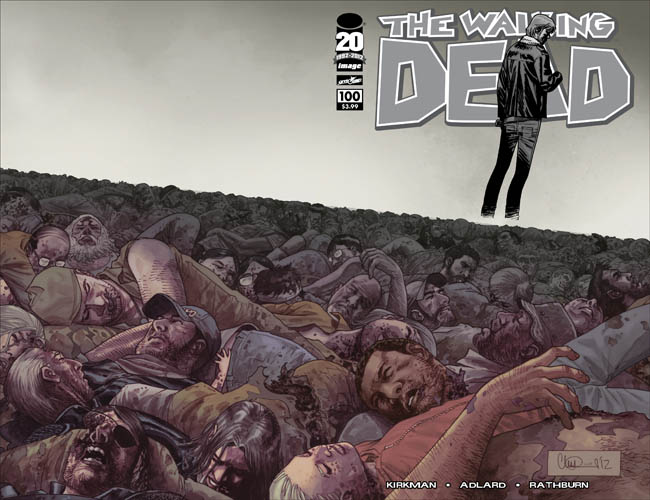
The Walking Dead Issue # 100 SPOILERS ahead. That is your only warning, but that really isn't what this is about, at all.

Which is worse: delusion or acknowledgment?

I have frequently had a very contentious relationship with The Walking Dead comic (written by Robert Kirkman). Four years ago, when Kirkman elected to kill off a large portion of the regular cast, including an infant girl, I went on a tirade that lasted for weeks. I was angry at Kirkman for his "betrayal" of the fans, and their affection or attachment to long-standing characters. Later though, I realized that my extreme emotional reaction to the comic was a rare thing, and that it was preferable to ambivalence. At least TWD is provocative. My take on the book went from "I’m never reading this again" to "top of the pile, read it immediately." But the most recent issue, # 100, is very distressing.

The events of this book make me seriously, seriously re-evaluate the relationship of the writer with his fan base. My honest opinion is that Robert Kirkman is a sadist. But hand in hand with that notion is something more dreadful: the fans are masochists. To keep returning to a series that has consistently "provoked you" with the exact same punishments is masochism. Because it is clear that Kirkman's entire philosophy with this book is to be as mean and awful to essentially good characters as he can. His entire shtick is to bait the audience with a simple little worm that I felt certain would not be on the hook in the anticipated issue # 100: "Someone is going to die." I felt certain that, because the entire series has been about suffering, punishment and death, he would actually find a clever way of making # 100 memorable without resorting to killing off a major character. Unfortunately, that is exactly what he did. In graphic, undignified, intimate detail, over the course of several pages, he displays the bludgeoning death of Glenn, a young man about to become a father. He has his skull bashed in and his eye popped out, in front of his friends and wife, who stand impotently by. That eye. That fucking eye! That eye in so many frames, like a punchline: ha ha, you fans, you were stupid enough to care about this character, now look.

This feeling of betrayal was at the root of the moral grappling I did years ago with the death of Rick’s wife Lori and their infant daughter. I had to take a good long look at what I wanted from the comic. At the time, TWD was not terribly original. It still isn’t. What it was was satisfying to fans of the “zombie/survival” horror genre, featuring regular people tasked with simply surviving a world overrun with gruesome reanimated ghouls.  Mountains of graphic carnage provided the eye candy, as in all the Romero films.  TWD was comfort food for horror fans. But the dynamic began to shift. By simple nature of its longevity and ongoing nature (as opposed to the finite storytelling of a feature film), the characters could not help but become more developed, more familiar to the audience. The attachment grew stronger, the stories more personally involving, so that the fans created an attachment to, and reliance upon, the characters to tell “their stories” in the same way that soap operas create passionate devotion in their audience. Concurrentnullwith this, though, was the tension created by Kirkman’s controlling hand, a struggle for dominance over ownership; a palpable desire to assert his authority over the book was more and more evident.  Again, this was stimulating for me as a fan; I was not used to being provoked in this way, in a world traditionally marked by the impermanence of death.  In comics, nobody ever dies forever.  Well, except in TWD.  Just 2 issues before Lori met her end, a supporting character name Tyreese was unexpectedly executed by decapitation in front of his friends. It was shocking, nauseating, and unambiguously FINAL. This man was dead. Ingloriously. Used as a pawn by another to demonstrate power. So: Tyreese, Lori, an infant, and a host of other supporting characters, wiped away from the page. As noted, I was, in retrospect, in shock. null

I denied the shock. I asserted I was in control of my feelings. I stressed that Robert Kirkman did not have this power over me. (But I was also ashamed to know that he did.) I swore off TWD over issues of betrayal of fans (not me, other fans—this was altruism). But over time, I came back.  The curiosity was irresistible. But also, I wanted that extremity of emotion. The demonstrated ability to shock, to extract feeling from the passive reader, was something I had not previously truly experienced in comics. To be clear, the single most common motivating factor of dropping a book (to stop reading a comic) is boredom. A disengagement with the proceedings or characters. TWD was many things but it was not boring. I elected (surrendered) to keep reading. But now there was another, more palpable emotion at play: dread.

Frequently I have read of fans' strategy of "not getting attached to anyone" in TWD, because Kirkman has routinely illustrated, through attrition, that "no one is safe." This would seem to run counter to the strategies used by other comics to retain readers, comics that actively encourage strong vicarious identification with their heroes and their super deeds. Always in peril, your average super hero is virtually guaranteed to overcome any adversity. But even a major hero like Superman or Batman faces death; but the economy of fandom and the profit margin of the publisher always collude to resurrect the dead hero. Death is temporary in the world of comics. It’s really nothing to worry about. Any longtime comics fan can tell you this. It is an accepted truth.

nullExcept in the world of TWD. In the world of this comic, anyone can die at any moment, but especially if that moment happens to be a hyped landmark anniversary issue. This is so cynical it makes me nauseous. This sadistic display, which the author can disingenuously claim is “natural” to the book, was calculated to occur in front of a large audience. Basically guaranteed to make a mountain of money. I find this unsettling, mercenary, and again, a sadistic display of power. An assertion of ownership and control over the characters and their fates. 

Of perhaps even greater moral terror (thank you Colonel Kurtz) is the way it makes me ponder my reaction to this spectacle. I seriously have to contemplate why an audience (including myself) would return to this world again and again, when Kirkman, the cynical bastard, has very clearly and repeatedly stated that this book is about hopelessness and imminent death, and that any joy will be revealed to the audience solely to make the ensuing horror that much less tolerable. Only pages before Glenn has his eyeball knocked out of his skull, he says with gratitude how he can see a bright future for himself. That he feels hope. But it is clear that this is solely a cheap device to manipulate the weak-minded reader into feeling a high, so that the ensuing low will be that much deeper. It’s the cheapest manipulation out there. It’s the same as when, in a WWII movie, a guy shows his buddy a picture of his girlfriend back home. That guy will be killed in the next scene. He might as well put on a red shirt and be in Star Trek.

The worst thing about Glenn's death is that it is punishment for anyone who has been weak enough to allow themselves to care about the narrative of TWD. Kirkman has strung another 50-odd issues since the last massacre in what feels like a hypnotist's trick in order to pick your pocket. But who is to blame, really? Is it Kirkman, preying upon the weak wills of comics fans, who he gambles will compulsively, addictively continue buying TWD no matter how miserable a world it is, or how much he degrades the characters? Or is the fan to blame, for voting with his dollar that he wants to be shat upon, to have his nose rubbed in filth and decay, and he is willing to pay for it? Because Kirkman has made it clear: that's what this book is about. The fans KNOW. *I* know. This book is about how the world sucks. It is about how no matter how hard you work, you will be punished a hundred times more. It is about how everything will fall to ruin. About how love is useless. How life is pointless, effort futile. How your mind will falter, you will benulllonely, your body will slowly be taken from you piece by piece, and even your humanity will be stripped away simply by continuing to live. You will eventually do awful things and be numb. And then you will die in an undignified manner, inspiring others to shut down, or just feel pain. Even if you survive longer than others, you will be scarred, disfigured, and mutilated. Just look at twice-shot Andrea, and one-handed Rick. The monocular Carl, who lost his conscience as well as half his vision. Even poor old Dale was reduced to limping around on a toilet plunger after he had his infected leg lopped off. And then he died, too. Pain and humiliation weren’t enough for old Dale.

For a fan to continue with this book, from this series of events and themes, that fan must actively take pleasure in hopelessness. Yet I think I am less concerned with how the author has again assaulted us with this recent event, than what it has inspired me to examine in myself. Why do I want to see this story, when it is clear and obvious it is just about some sick pervert exercising power over weak, compulsive masochists? There isn't going to be any happiness in this book. There isn't even any cleverness to be had with it. It’s a one-trick show: "someone will die." If a landmark issue is approaching that promises "a big event,"nullit’s obvious what that event will be. Someone dying. There's just no other trick left in the bag.  Other comics have pursued a similar strategy, telegraphing the imminent demise of the hero often months in advance, to generate sales. “Superman is going to die in # 75!” “What issue are we on now?”  “# 70.” “What happens in between now and then?” “We see the fight that happens first.  For five issues. (And their crossovers).”  But of course it is just a gimmick.  An accepted ruse the fans participate in.  It’s a don’t-ask-don’t-tell maneuver just waiting for the inevitable reversal, the return to status quo.

TWD's sole original note is that it has embraced the long-form narrative of the Supermen and the Spidermen and turned it into an endurance test for not only the characters but the audience. It’s such a relentlessly negative, vile parade that it causes me, again, moral terror. Is life so shitty that miserable comics fans will prefer being emotionally assaulted over feeling nothing at all?  Is it better to feel violated than jaded?  How dreadful is that? But seriously, is that what is happening with TWD? Are we, as readers, participating in some sick sex game with Robert Kirkman? Because I really think I will probably keep reading TWD. That's the awful and revelatory part. I definitely feel manipulated by Kirkman. I feel cheap, and I feel desperate in a way. I feel like I did when I watched 9/11 videos and cried but was happy that my life didn't suck as bad as that. I don't know if he is happy in his life. I don't know if I'd be happy if my fans said, "I only come back because I am weak and addicted. I know this won't make me happy and in fact will make me sick. Here is my money, that you can use to justify your continued storytelling as approval and desire for more." But what I think is revealed through this relationship is a sickness. I'm not proud of it. And it is very complex. Because I must find a balance between not caring about characters or their fates, and continuing to read about them. That just seems like subservient compulsion. It also feels like self-punishment. Are we taking pleasure in the violence routinely inflicted on the zombies, and in need of criticism for that pleasure? When the only payoff is anger, despair, disgust, and shame, why does a reader want more? What sort of pleasure is that? Doesn't that make the reader a disgusting, complicit participant?null

The jury’s still out as far as the TV show is concerned.  We may be headed there, we may not.  While the two narratives share characteristics, they are already markedly divergent.  True, we lost Dale, but every zombie story suffers casualties.  There is an opportunity with the show to retain some small element of hope, which the comic, with Glenn’s death, has forever abandoned. Already I sense a deepened, passionate attachment to the characters of the show.  A friend recently commented, “if they did that to Daryl, I’d stop watching.”  I wonder.  I wonder how long it will take the TV audience to accumulate the same degree of commitment to Their Stories as the comic fans have.  I wonder about the economy of TV versus the printed page, if real world forces (advertisers) will in any way constrict the show’s ability to mimic the scorched earth approach to characters that the comic has.  How alike are these two audiences?  How willing is a popular show’s audience to regularly tune into an hour of humiliation, despair and hopeless suffering?  Because that is the road the comic has gone down.  Maybe I am late to this party, but there isn’t any return after # 100. 

I think The Walking Dead comic degrades the human condition.  It twists our desires for entertainment and conflates them with guilt. The saddest thing is that it is obvious that I and others like it. It reveals me as a sicko. It reveals a weakness, and an insecurity, an inability to divorce myself from something that is bad for me. The Walking Dead is brutalizing rape porn. It's an abusive husband. It's a pusher of powder-cut junk. The best thing to do would be to just stop. But then there would be nothing. That is the terror. Again, Kurtz: "The horror." In the world of The Walking Dead, both on the page and off, you must make friends with horror, and moral terror. There just isn't anything else.

null

Lee Sparks is a critic based in Austin, Texas.

VIDEO ESSAY: Doris Wishman, the Mother of Sexploitation

VIDEO ESSAY: Doris Wishman, the Mother of Sexploitation

The career of Doris Wishman defies belief. She was one of the most prolific woman filmmakers of all time, making 30 features over four decades in a genre dominated by men, the sexploitation flick.

She only got into filmmaking in her 40s, after the untimely death of her husband left her looking for a way to keep herself occupied. The emerging subgenre of nudist films of the early ’60s were a cheap and easy way to start.

As censorship eased up and audiences demanded more extreme content, Wishman moved into darker stories of sex mixed with violence. It’s in these films that her sensibility starts to emerge, with an almost subversive approach to her subject matter. Her shooting and editing style keeps things off balance, carving out an unnerving sense of displacement amidst the eroticism.

BAD GIRLS GO TO HELL

'Bad Girls Go to Hell' (1965): Does the title say it all?

Her most successful films starred the appropriately named Chesty Morgan and her fulsome bosom. But instead of being sensual erotic organs, her breasts are used as weapons. In Wishman’s movies, sex isn’t depicted as something that is fulfilling, but a cold, even cruel act that’s often used like a transaction, a means to an end. It’s as if Wishman were commenting on her own career, her sexploitation films are just a way to get by.

Her ambivalence towards sex and sexploitation reaches a bizarre apogee with Let Me Die a Woman, a pseudo-documentary about the lives of transsexuals. Mixing real life testimonials, softcore reenactments, and explicit clinical footage, the film is a jarring embodiment of the different, at times conflicting ways we relate to sex: as a biological fact, as a perverse sensation, as profound self-discovery.

After her first and only attempt at a horror movie flopped, Wishman went inactive for a decade, but renewed interest in her work led to her comeback feature, Satan Was a Lady, made when she was in her 80s. The film follows Wishman’s classic setup of a woman using sex as a vehicle to find her own way through life, even as it lacks fulfillment in itself. It’s that tension over what sex means to us that stirs our interest in Doris Wishman, the unlikeliest of sexploitation directors.

Kevin B. Lee is Editor in Chief of IndieWire’s PressPlay Video Blog, Video Essayist for Fandor Keyframe, and contributor to Roger Ebert.com. Follow him on Twitter.

What the Sikhs Taught Me

What the Sikhs Taught Me

Several years ago, Press Play Editor in Chief Kevin B. Lee produced a video documenting hate crimes against the Sikh American community in the aftermath of 9/11. That video, "Dastaar: Defending Sikh Identity" has been circulating in the wake of the mass shootings in Oak Creek, Wisconsin last Sunday. The video is embedded below. Lee has also written a personal reflection about how the video led to his involvement in Sikhism. This essay is also published in Slate.

nullThis is a photo of me taken in 2008. I was in the middle of a five-year personal journey with the Sikh community, during which I seriously contemplated adopting the Sikh faith as my own. It was the most intensive and productive period of spiritual growth in my life, even if it ultimately ended in a personal failure of sorts. The tragedy that befell the Sikh congregation in Oak Creek last Sunday brought back to mind all my experiences with the Sikh-American community, and certain invaluable lessons they taught me that I am still trying to put into practice.

Seven years ago, I was just another aspiring independent filmmaker in New York City, biding my time in a nondescript office job to make ends meet. Frankly, I was ashamed to be a white-collar drone, so I kept a low profile. But word got around about my moonlighting, and one day a Sikh co-worker visited my cubicle. He told me his son and other Sikh children were being called terrorists by their classmates because of the turbans they wore. He asked if I could help him make a short educational video about his community that he could use at his son’s school. How could I say no?

That weekend I filmed my co-worker and other Sikh parents at a school fair, as they shared with other parents some facts about their culture and faith, varnished with more than a small sense of pride. Sikhism has the fifth-most followers of any world religion. (“More than the Jews!”) Founded in the 15th century, Sikhism is a newcomer among the major faiths. (“Our founder Guru Nanak studied all those other guys and learned from their mistakes!”) Sikhism emphasizes equality among all people regardless of faith, race, gender, or class. (“We fought the caste system in India!”) Sikhism doesn’t believe that one religion is better than any other, but rather that each has its own way to peace and enlightenment. (“We accept the other religions, that’s why Sikhism is the best!” wink)

The religious cynic in me found this all too good to be true. My youth had left me weary of organized religion: The church I grew up with was more of a social club where its congregation of professionals could network; the other kids seemed more interested in discussing designer clothes and cars than debating what appeared to me the obvious contradictions in the Bible. I had even spent two years as a missionary in China trying to come to terms with my Christian upbringing, ultimately to make a separate peace with God and keep my faith to myself. I haven’t attended church regularly in over a decade.

Now here I was listening to these lovely spiritual ideals being spouted by men in turbans, and they stirred the long-dormant idealist in me. Part of it was due to the presentation: They seemed so relaxed and accepting of other people’s questions and misgivings, betraying no anxiety to persuade their audience to do anything more than simply understand who they are. They boasted, somewhat ironically, “We are non-evangelical! We are not allowed to push our faith on others! Once you understand our beliefs, you’ll know why we don’t have to force them on others!” But their lack of interest in evangelizing, I realized, could partly explain why so many—myself included—were ignorant about their faith, an ignorance which has, at times, had tragic consequences.

This became apparent only a week after we started filming, when several white men brutally attacked a middle-aged Sikh man named Rajinder Singh Khalsa on a sidewalk in Queens in broad daylight, denouncing him as a terrorist. Once Khalsa left the hospital, my Sikh friends ushered me to his home to interview him for our video. I also met members of the Sikh Coalition, a group of young professionals who organized to protect Sikhs from violence and harassment. These men and women were the same age as me, and like me were the children of immigrant parents, and here they were were attending City Hall hearings and lobbying Congress and the White House, all in the time they could spare away from their jobs as lawyers, doctors, and programmers. My habitual self-pity over my unfulfilling day-job and my filmmaking routine looked laughable next to their work ethic and sense of purpose. Above all, I admired their cheerful optimism, a quality known in Sikhi as chardi kala: an attitude towards life that dusts off the cliché of “making the world a better place” and makes it radiate anew with the energy of Sikh convictions.

The Coalition introduced me to other Sikhs who were dealing with workplace harassment: an NYPD officer and a New York subway driver who were disciplined for not removing their turbans while on duty. The subway driver, Kevin Harrington, was an Irish-American man who adopted Sikhism 30 years ago and had been wearing a turban without incident while driving the subway for 20 years. September 11th had suddenly made his attire a problem. I would later learn that he, too, was moonlighting, as a Sikh Kundalini yoga instructor; I began taking his classes to help manage my stress. As I worked on the documentary, these people became fixtures of my days—and also good friends. Life seemed to be pointing me further in the direction of the Khalsa, the community of the Sikh faith.

http://video.google.com/googleplayer.swf?docid=5243469727255150190&hl=en&fs=true

The resulting short documentary, “Dastaar: Defending Sikh Identity,” eventually made its way to my co-worker’s son’s classroom, and it was also broadcast on PBS in New York City. The Sikh Coalition adopted it as their video of choice to show at schools and government agencies across the country. Rajinder Singh Khalsa, the beating victim, suggested I make a feature documentary on Sikhism, with him as the on-camera guide. His insights into Sikhism were always colorful, even when they were somewhat questionable. (“You know why there are no Buddhists left in India?” he asked. “Because they were too peaceful and got chased away. You can’t just be peaceful all the time, you have to stand up for yourself.”) On and off we worked on this documentary for the next three years. We didn’t quite finish it, but the journey became its own destination. We went to India together, staying in temples for three weeks and observing Sikhism in its homeland. We visited the Sikh holy city of Amritsar and its most sacred site, the Golden Temple, a building that is so beautifully conceived that the sunrise seems to ignite it with the light of heaven. And yet throughout the journey I found myself searching for signs of corruption and hypocrisy in the organized aspect of the faith, or anything to cast a more critical view. Old habits die hard.

Following the trip, I continued to internalize Sikhi. I routinely attended services at gurdwara, the Sikh temple, enjoying the extended raags performed during kirtan. (It’s sort of like being at a Grateful Dead or Phish concert, but on a much higher level.) I attended a university class on Sikhism for a scholarly perspective, and a workshop for people learning how to practice the faith. I talked with Sikh immigrants from India and their children, gauging how their values were passed across generations in a new environment. I hung out with Kevin Harrington and asked other American followers about how they practiced Sikhism without the benefit of a cultural upbringing within it.

As much as I learned from all of them, I knew that, underneath all this exploration and research, there was just one person who could take me where I needed to go: myself. My hipper-than-thou cynicism had run its course. Whatever my misgivings about organized faith, I knew that this, at its core, was as beautiful a belief system as anything I’d ever encountered, at least as beautiful as my own heart and mind would allow it to be. And so I found myself at the brink of becoming a practicing Sikh.

But ultimately I faltered. Why?

The answer lies in the same item, the same image, that brought me to work on behalf of the Sikh community in the first place. As a practicing Sikh, a man is required to wear a turban at all times in public. The turban was given to the Sikhs by their tenth Guru, Gobind Singh, at the time of their greatest peril. The turban, previously an article of clothing worn only by royalty, was placed on the heads of all Sikh men to make them see themselves as kings and conduct themselves accordingly: with honor, self-respect, courage, and piety. At the same time, the turban makes Sikhs symbolically “give their head” in the service of a higher order. No longer can they hide in anonymity. They are united in their values, and must stand together to uphold them.

I’ve worn the turban on several occasions, when visiting gurdwara or attending Sikh events, like the Surat Youth Conference where the photo above was taken. But when it came to making the commitment to wear it in daily life as a practicing Sikh, I couldn’t find the courage. It was such a bizarre disconnect. Everything about Sikhism on paper pointed to its being a belief system as perfect as anything I’d encountered: its de-emphasis on the retributive cycle of sin and forgiveness in favor of harmony between oneself and the world; its core doctrine of equality among all people across class, religion, race, and gender, a true oneness with all.

And yet, to truly be a Sikh, you have to stand out like a sore thumb as a living, visual manifestation of your beliefs. I just couldn’t do it, simply because I felt too self-conscious about how people would look at and perceive me. I couldn’t resist the comfort of not being looked at, of knowing that I could blend into a crowd, withdrawing into the secluded, private existence that I’d grown accustomed to. (Ralph Ellison’s Invisible Man is my favorite novel for a reason.) Maybe this is why I’ve found a more successful career as a film critic than as a filmmaker: I find it easier to watch others than to be looked at.

Let me make it clear, in no uncertain terms, that my failure to don the turban does not reflect poorly on Sikhism itself. On the contrary, the turban has a perfect logic to it. When you adopt a set of values that represent humanity at its finest, why wouldn’t you want to become a living symbol of it? By wearing your values in public, you “out” yourself as someone who must conduct themselves according to those values. It is a virtuous cycle, and it gives the Sikh faith its own special sense of drama, with its followers performing a sacred role in public every day.

In contrast, my failure to adopt the turban, after all my experiences and all that I learned about Sikhism, symbolizes the distance between my present self and the ideals I wish to embody. What the turban tells me is that our ideals are not a matter of convenience, but of true conviction. It also fills me with respect for all the Sikhs in America who do choose to look as they do, especially the Sikh children born in this country who every day are faced with the temptation to assimilate, particularly when post-9/11 America sees the turban as a threat. But the real threat has been the other way around all along. Oak Creek is only the most recent and most devastating instance of this perverse irony, and the distorted reality we live in, rooted in misperception.

My experience has stuck with me, and it taps me on the shoulder now that this tragedy has happened. Even though I still lack the courage to wear a turban, I learned that you can’t hide from the world forever. As long as you care about the world and the people in it, something will bring you out. This is why I felt compelled to write this testimony. I have to take my experiences and manifest them into something visible and useful that I can offer to others. We haven’t truly lived until we stand up for what that we believe is good in life. This is what the Sikhs have taught me.