VIDEO: 100 Masters of Animated Short Films

VIDEO: 100 Masters of Animated Short Films

One of Keyframe’s most popular articles from last year was its illustrated guide to 100 masters of the animated short film. Film animation has thrived for over a century, but has never seen quite the level of recognition afforded to live-action feature filmmakers. And while there are plenty of outstanding animated features to celebrate, a list of those films wouldn’t boast nearly as much eye-popping diversity as those represented by this list. 

Working within the compressed parameters of the short form, some of the most unique talents in the field of animation delivered their inimitable visions with maximum potency in a matter of mere minutes or even seconds. This video attempts to demonstrate that spectrum of brilliance with as much brevity: 100 masters in nine minutes.  Of course such a video can’t possibly do full justice to each of these artists,  but watching this visual roll call of animation heroes proceed, what’s remarkable is how strong a visual impression just a few seconds of each artist can make. 

This video would not be possible without the work of some of my old friends at the IMDb Classic Film Board, who first created this list back in 2008. They have since followed up to produce a list of 250 Great Animated Short Films, which can serve as an excellent guide if you’re looking for specific titles to explore any of the artists featured in this video.

Special thanks to Lee Price, who organized the compilation of both lists, and is currently writing in-depth entries about the 250 Great Animated Short Films on his blog, as well as on Press Play.

Kevin B. Lee is Editor in Chief of IndieWire’s PressPlay Video Blog, Founding Editor and Video Essayist for Fandor’s Keyframe, and a contributor to Roger Ebert.com. Follow him on Twitter.

SCREAMING HIDES THE SOUND, PART 2: THE WICKER MAN, The Pagan-Horror-Folk-Rock Musical

SCREAMING HIDES THE SOUND, PART 2: THE WICKER MAN, The Pagan-Horror-Folk-Rock Musical

null

Many seemingly healthy people are terrified of folk music, which makes it not surprising that one of the most innovative and hauntingly effective soundtracks in the history of horror films is essentially a collection of folk songs. Most of us can relate when John Belushi smashes the folk singer’s guitar during the toga party scene in Animal House, and who among us with hair above shoulder length would be caught dead at a folk festival? Folk music, by its very nature, runs against the grain of anything we might call “modern,” and contemporary sensibilities are instinctively repulsed when exposed to sounds that by any rights should be long dead. 

When Paul Giovanni composed his songs for Robin Hardy’s The Wicker Man in 1973, however, this music of the dead was experiencing a strange resurrection, and, with the cooperation of arranger Gary Carpenter, he crafted a soundtrack wholly in tune with the peculiar musical spirit of the moment. This moment involved a complex and often unsettling relationship between present and past. This relationship is something the moment had in common with the film itself, which is certainly one reason for the film’s enduring popularity.

The film’s opening scene captures the tensions that play throughout the narrative, as well as its soundtrack: as the film’s main character, Sergeant Howie (Edward Woodward), ascends in his sea plane over the Scottish coastline, the first sound we hear is of his buzzing engine, which gradually merges with the rising tones of Northumbrian pipes (essentially a small bagpipe). The police sergeant is headed to the mysterious Summerisle to investigate the disappearance of a young girl. Initially the reclusive islanders turn him and his plane away. Yet their rejection of an intruder from the modern world is at odds with the strange harmony achieved in the film’s first musical set-piece, as the combined engine and pipe sounds merge to create an unsettling drone that serves as the musical base to a haunting ballad based on a Robert Burns poem about a sixteenth century massacre.

The mournful beauty of this piece, enriched by ghostly choral harmonies, gradually segues into a jaunty folk ballad, “Corn Rigs,” sung by the film’s composer, Paul Giovanni. Giovanni was an American songwriter hired to concoct a convincing amalgam of ancient and modern folk sounds. “Corn Rigs” is a good example of the latter, though within the phase of the 70s English folk revival, the modern was often defined by the presence of ancient musical forces. Giovanni’s plummy voice sings a ribald tune of getting busy in the cornfields with a lass named Annie to the accompaniment of vigorous guitar strumming and pop backing vocals. This is folk music in its more listener-friendly form, with echoes of the Byrds, White-Album-era Beatles, and English group Steeleye Span, whose electric folk album Parcel of Rogues had recently broken into the upper echelons of the pop charts.  

Yet running alongside the song’s modern currents are weirder strains: spiraling recorders offering an appropriately Pan-like accompaniment to the lyrics’ subtly pagan elements. The singer’s tryst with Annie is described as taking place on “Lammas Night,” a late-summer harvest festival in the ancient Celtic calendar; so, what initially seems like a song reflective of the seventies spirit of zesty sexuality becomes a paean to ancient fertility rites. This tension between folk culture’s friendlier, modern face and its darker pagan heart runs throughout the film, as the viewer, along with Sergeant Howie, gradually discovers the true nature of musical sacrifice.

Original as Giovanni’s soundtrack is, it has several contemporary antecedents in folk music, many of them trends instigated by another American working with British musicians, producer Joe Boyd. Boyd was running sound at the infamous Newport Folk Festival of 1965 where Dylan went electric, driving a peaceful folk artist like Pete Seeger to take an axe to the power cords, so Boyd knew what kinds of sparks could fly when merging the ancient and the modern. As a producer in England, Boyd was drawn to groups like Fairport Convention and The Incredible String Band, who pursued the path opened by Dylan in reinventing native musical traditions.

When record collector and visual artist Harry Smith released his landmark collection The Anthology of American Folk Music in 1952, it offered a revisionist account of American music history that Greil Marcus would famously call “The Old Weird America,” but the bands working in the musical circles around Boyd would discover that their indigenous music was even older and weirder. Mixing traditional and original compositions, old and new instruments, ancient song structures and innovative modern recording techniques, the British electric folk movement produced some of the richest and strangest music of the 1960s and 70s, including among its ranks such influential figures as Nick Drake, Sandy Denny, and John Martyn.

The Wicker Man draws from this musical wellspring to create a soundscape behind the pagan practices of Summerisle, yet it also brings to these trends a sense of humor and irony not often found in folk music. As Sergeant Howie checks into his rooms at the local inn, The Green Man, he is confronted by the bawdy drinking song “The Landlord’s Daughter” and is later serenaded by the daughter herself: the character Willow, played by Britt Ekland. When “Willow’s Song” starts, the viewer begins to realize The Wicker Man may actually be a very strange kind of musical, as a naked Britt Ekland sings to Sergeant Howie in the next room and attempts to lure him to her bed. As the song builds, Ekland’s dancing becomes more provocative, as she pounds out the song’s escalating rhythms, switching between slapping the walls and slapping her bare bum. The song’s frankly erotic lyrics range from the beautiful (“Would you have a wond'rous sight? / The midday sun at midnight”), to the gross (as when she offers to show “How a maid can milk a bull / And every stroke a bucketful”).

“Willow’s Song” is one of Giovanni’s more famous pieces, having been subsequently covered by bands such as The Mock Turtles, Doves, and Sneaker Pimps, but what is perhaps most striking here is its synchronization into the scene. Director Robin Hardy plays with the distinction between sounds that are directly connected to the film’s narrative and those added for effect. The film makes it seem as if the pub band downstairs is playing the music, but as the song progresses musical elements are introduced that are clearly outside of their musical range. “Willow’s Song” is the first of many pieces that initially seem to be generated by residents of Summerisle but subtly introduce sound effects and orchestral elements crafted in the sound studio by arranger Gary Carpenter. The effect is unsettling, and effectively parallels Sergeant Howie’s and the viewer’s increasing sense that the islanders are up to more than a little harmless ribaldry.

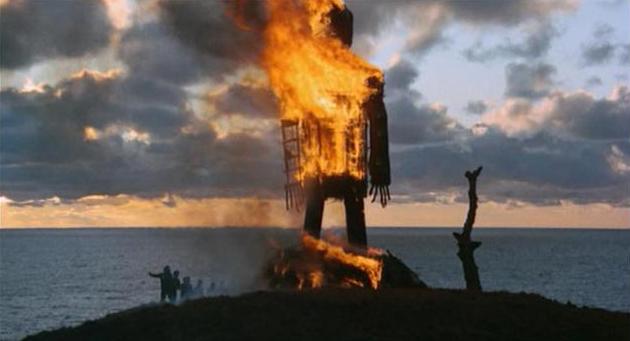
The tension between narrative and non-narrative music culminates in the final sequence of the film, a May Day festival in which everyone dons ritual costumes, Howie taking the place of The Fool, unbeknownst to the other revelers. As Howie pursues the sinister mystery at the heart of Summerisle, the traditional music of the islanders mingles with suspenseful chase music modeled on 70s electric folk, the electric guitar growing increasingly distorted by acid fuzz-tones. The popular modern styles appearing early in the soundtrack now give way to the harsher edge of musical modernity, challenging folk tradition even as the film seems to glorify it by showing paganism’s crueler strains. 

Those acquainted with the film may have noticed my careful avoidance of spoilers, keeping the shock ending a surprise for those who have yet to see this strange masterpiece. But when you do, just keep telling yourself: “It’s only a folk festival, it’s only a folk festival, it’s only a folk festival…”

Jed Mayer is an Associate Professor of English at the State University of New York, New Paltz.

In Remembrance of Harris Savides: 1957-2012

In Remembrance of Harris Savides: 1957-2012

Cinematographer Harris Savides, who died on Tuesday at 55, was a poet of light. He shot some of the most stylistically striking movies of the last two decades: James Gray’s The Yards; Sofia Coppola’s Somewhere; Jonathan Glazer’s Birth; Noah Baumbach’s Greenberg; Gus Van Sant’s Elephant, Gerry and Last Days; David Fincher’s The Game and Zodiac.

Look over that list and you get a sense of his versatility. But there was more to Savides than craft. His mix of artistic restlessness and quiet confidence bridged schools of filmmaking that might seem incompatible: virtuosity and naturalism. He came out of the world of fashion and TV ads and music videos, but when you look at his feature work, you rarely get the sense that you’re being sold anything. There’s a reticence and mystery to his images, as audacious as they often are.

Birth is filled with “How the hell did they do that?” camera moves and astoundingly long takes, but his New York streetscapes and lush interiors aren’t TV-commercial glossy, or even fussed over; they seem like places where real people, not movie characters, might live and work. Coppola’s comfortably numb Somewhere has an early 70s stoner art-film vibe, but its locked-down wide shots, which let us simply watch characters behaving for minutes at a stretch, bespeak powers of concentration that Coppola’s earlier movies only hinted at. Van Sant’s hothouse triptych seems influenced by the work of hypnotically stripped-down European filmmakers who had become critical darlings in the U.S. around that time, Bela Tarr especially; but the casual-seeming quality of the light—radiant, even woozy, yet somehow not sentimentalized—is thoroughly American. Van Sant’s school-shooting psychodrama Elephant, in particular, merges documentary patience and movie-brat showiness in a way that felt strange and new; no wonder it divided critics.

In time, Fincher’s Zodiac might prove the most significant picture of the bunch. Shot digitally with the Viper camera at a time when many directors and viewers were still suspicious of high-definition video, it was at once revolutionary and reassuring. No American movie had revealed the texture of night with such crystalline clarity. At the same time, though, the mid-’70s conspiracy thriller look that Fincher and Savides devised for Zodiac’s daytime and office scenes tied the movie to analog values, and sent an important subliminal message: tools change as technology evolves, but they’re still just a means to an end.

When I heard about Savides’ passing, I reached out to Jamie Stuart, a filmmaker and writer. He’s been doing highly conceptual documentary shorts for the New York Film Festival for years now; Roger Ebert championed his 2010 short film “Idiot with a Tripod.” Stuart was an admirer of Savides’ who interviewed him twice and corresponded with him via email; an edited transcript of our conversation follows.

null

MZS: Harris Savides' death hit me harder than that of most cinematographers, and in trying to figure out why that was, I decided it was because he was a transitional figure in a really volatile period of film history. I can't think of many cinematographers who demonstrated such mastery of both traditional celluloid and new digital technologies.

‪Jamie Stuart: It's interesting. I didn't really see that as his journey so much, because I know he was very dubious of digital and greatly preferred film. I really looked at him as somebody who came from high-end fashion and music videos and commercials—but then transitioned into simplicity and naturalism.   

‪MZS: Can you elaborate on that? Because when I think of Harris Savides, "simplicity" and "naturalism" aren't necessarily words that spring immediately to mind.

nullWhen I look over his filmography I see him acting as cinematographer on movies that seemed stylistically pivotal for their directors. He was behind the camera when Gus van Sant got into his American Bela Tarr phase, and did movie after movie comprised of very, very long Steadicam shots: Elephant, Gerry, Last Days. He was the director of photography on David Fincher's Zodiac, a groundbreaking, digitally-shot feature that revealed all the details of night that celluloid and low-end video couldn't show us before, and the somewhat stately rhythms of that movie signaled a new phase for Fincher. I wonder if the more contemplative The Curious Case of Benjamin Button and the almost live-TV-like claustrophobia of The Social Network would have happened without Fincher’s collaboration with Savides on Zodiac? We’re not talking meat-and-potatoes here. And Birth! My God. That's so daring visually that I can imagine Brian De Palma watching it and thinking, "I wouldn't have gone quite that far, but well-played, sir."

‪Stuart: Yes, but look at the way he shot and the way he lit a lot of those movies. When I first met him and interviewed him in 2003, he had just made Gerry and Elephant, and he found those experiences working mostly with long takes and practical light to be completely liberating. He was afraid he couldn't go back to shooting more controlled commercial work. He suggested he would feel like a caged animal.

I think that's one of the reasons Fincher brought him in on Zodiac — because he knew Harris would be able to give a natural look that also had style. Harris lit the basement scene, for instance, with 40-watt bulbs, I think. He was upset that the Viper couldn't handle low light well, so he was forced to light up a lot of scenes and stop down, when he really wanted to shoot things as they were.  

nullMZS: Interesting. So what you're describing here is a very simple way of shooting, one that tries to make the conditions seem "available" even if they were meticulously contrived. And then on top of that you've got formal daring with regard to camera movement. That closeup of Nicole Kidman in Birth, for example, is spectacular. No pretense of being "invisible" there. You are supposed to notice the artistry. The form is the show; the hugeness of these gestures help move the film into the realm of fable, make it operatic. And yet the exteriors and interiors don't have a fussed-over look. They're inviting, real-seeming. Glazer's previous movie Sexy Beast was daring, too, in its way, but it contains nothing as stunningly, brazenly big as the stuff in Birth. Savides must have had something to do with that change, don’t you think?

‪Stuart: Perhaps. But I wonder how much of that is Glazer and how much of that is Harris? I think Harris would've been perfectly content to shoot everything with natural light and a perfect camera angle. Harris has a quote somewhere about lighting rooms instead of actors. And that's a very specific approach.

He hated rim light or backlight. I once spotted a close-up of Jake in Zodiac that had rim light, took a still, sent it to him convinced that had been done in a reshoot that he didn't supervise. He confirmed. I remember him going on about Ballast, and how realistic it was. He loved The Dardenne brothers.  

MZS: Do you remember the first time you noticed Harris Savides' work? Do you remember when you decided he was somebody significant?

Stuart: I knew Harris' work initially from his music videos with Mark Romanek. The first one they did together was for Teenage Fanclub 20 years ago. It's black and white. Very simple. The band performing with a giant light above them.

Then, I remember when he did The Game and Fincher said he wanted Harris as his director of photography because the movie was really complex, and he needed a cameraman he could completely trust. So when I was covering the NYFF in '03, and he was there with Elephant, I introduced myself. We remained in touch ever since.

We had a similar taste in lighting and composition. We were trading e-mails when my blizzard video blew up, he was joking that I'd become a celebrity. After he first watched the video, he told me he was upset when it transitioned from black-and-white to color, but then he liked the color a lot, too, so he didn't mind.

The last time I think I saw him was at a Q&A Mark Romanek did a couple of years ago. As we were leaving, I remember looking back and seeing Mark and Harris walking together like old best friends.

I can say that, strangely, he was on my mind [Wednesday] night. The New York Film Festival screened my work at Richard Pena's tribute. One of the people featured in it was Noah Baumbach, whom I subsequently bumped into while leaving. I had sent Harris a still photo I took of Noah from a shoot a couple of months ago. I thought about e-mailing him to let him know that my work looked good on the big screen and that I'd just seen Noah.

So, to be honest, I'm a little mixed today. Going from the high of having my work play last night at the NYFF, then finding out about [his death Thursday] morning.  

MZS: Did you get to spend much time with him in person?

Stuart: Our relationship was primarily via e-mail. I interviewed him twice. Once in 2003, then again in 2006 before the release of Zodiac. We randomly discussed getting together to shoot some stills or maybe my tagging along when he was first testing the Alexa [motion picture camera]—but neither materialized.  

‪MZS: What, specifically or generally, do you think you learned from Harris Savides as an artist? Are there any things he inspired you to do, or to do better, or differently?

‪Stuart: He inspired me in the sense that I always sent him my work—and considering how highly I thought of him, I damn well hoped my work would be good enough to show him. He was somebody, a professional, who was there for me as I was embarking on my filmmaking career. And that's something I'm grateful for.

I remember sending him a copy of my first full mini-DV short in early 2004, made for like $50, and he told me his hat was off to me for doing so well with such little money. We thought similarly about lighting and composition. He had a very no-bullshit attitude about work. Whenever he made a movie and I offered my opinion, he always wanted it straight, even if I didn't like it.

He was somebody I always sent links of my work to. I liked his opinion. You know? I liked him. I liked his work.

Nelson Carvajal is an independent digital filmmaker, writer and content creator based out of Chicago, Illinois. His digital short films usually contain appropriated content and have screened at such venues as the London Underground Film Festival. Carvajal runs a blog called FREE CINEMA NOW which boasts the tagline: "Liberating Independent Film And Video From A Prehistoric Value System." You can follow Nelson on Twitter here.

Matt Zoller Seitz is the co-founder of Press Play.

Animating the Folktale: The Puppet Animation of Ivo Caprino

Animating the Folktale: The Puppet Animation of Ivo Caprino

null

The classical fairy tales and fables have served as fodder for many film animators, from the pioneer days of Lotte Reiniger and Walt Disney onward. One filmmaker almost exclusively associated with this type of material is Ivo Caprino (1920-2001), Norway’s most famous practitioner of the art of animation.

The closest parallel to Caprino is perhaps George Pal of Puppetoons fame. Like Pal, Caprino patented his own method of animation early in his career, basically replacing the marionette operator’s strings with a remote control device. However, Caprino’s work is very different from Pal’s, both in form and content. His world is more whimsical, like a storybook, with little of the gag-happiness of the classic Hollywood cartoons. This in no way should imply that Caprino was a dull fellow. In fact, he frequently displays a wicked sense of humor, a major factor in his films’ appeal to adults as well as children,

Caprino was also naturally gifted as a pure filmmaker, in this regard bearing comparison with the best of Disney: The choices in shots, blocking and editing (you know, mise en scène) are pretty much faultless. Even more significantly—and again like uncle Walt—Caprino was a master of personality animation, becoming ever more expert at giving his characters clearly individual traits in movement and behavior as well as visual appearance.

The appealing look of Caprino’s characters was originally given to them by his mother Ingeborg, an artist and writer of children’s books. These characters have an instantly recognizable ”Caprino look”: round blue eyes frequently in motion, perhaps together with a lifted eyebrow, conveying either wonder or slyness. To invoke yet another one of the American animators, Caprino’s use of the eyebrow in many ways recalls Chuck Jones’ famous mastery of this subtle ingredient of animation ”acting.”

Of the handful of films Caprino made between 1949 and 1975, only 5 short films were based on folktales, yet these made such an impression that they are instantly associated with his name. In the early 1950’s, Caprino had planned to make a feature film about Asbjørnsen and Moe, the writers and story collectors of the 19th century who were the parallel of the Brothers Grimm for the Germans. This projected feature was to combine live action of the two story collectors at work with puppet animation segments of the tales themselves. When he failed to get funding for the project, the idea had to be scrapped and Caprino made the short films instead. This was probably a blessing in disguise, as the later films certainly benefit from his increasingly sophisticated mastery of the medium.

If the tales of Asbjørnsen and Moe are less well known internationally than those of the Brothers Grimm, they have several characteristics in common. A noticeably Grimmian element recurring in those films is the punishment of bad guys and the rewarding of good guys, according to their behavior towards a mysterious stranger with magical powers. The hero of Veslefrikk med fela (Veslefrikk and His Fiddle, 1952), the first of the folktale shorts, gets three wishes.  The hero of Askeladden og de gode hjelperne (The Ash-Lad and the Good Helpers, 1961) gets a magic ship for use on land, in the sea, and in the air. And so it goes!

Also in common with the Grimms, these tales have their share of unabated cruelty and sadism. In this regard, Caprino is certainly different from Disney; he doesn’t shy away from bizarre dark humor. In Reve-enka (The Fox’s Widow, 1962), a fox encounters a very cute little rabbit who is singing and dancing merrily; the ”that’s good, that’s bad” routine that follows is almost vaudevillian:

”Why are you so happy?” asks the fox.

”I got married today,” replies the rabbit.

”That’s good.”

”Oh, not all that good, for my wife turned out to be a shrew.”

”That’s bad.”

”Oh, not all that bad, for she had a luxurious home.”

”That’s good.”

”Oh, not all that good, for the home burned down, and everything we owned with it.”

”That’s bad.”

”Oh, not all that bad, for the wife was burned as well!”

The rabbit laughs maniacally as he continues singing and dancing happily on his way. This, in a puppet film for children?

For the 150th Anniversary of Hans Christian Andersen’s birth, Caprino was commissioned to make a film of the master’s fairy tales. Caprino chose Den standhaftige tinnsoldat (The Steadfast Tin Soldier,1955), surely one of his finest achievements. Unlike what happens in the Disney versions of Andersen (The Little Mermaid and the rendition of the Tin Soldier in Fantasia 2000), there is no happy ending here.

Caprino’s biggest ”cult” favorite, at least in his native country, was Karius og Baktus (1954), from a children’s book intended to impress upon the youngsters the importance of dental hygiene. The two eponymous rascals are tiny trolls living in a boy’s mouth. They protest in vain when the lad, due to the pain they cause, finally sees a dentist who flushes them out in the horrific finale! This truly bizarre classic caused a lot of Norwegian youngsters to actually sympathize with the antagonists, two anarchistic embodiments of dental decay.

Caprino directed two full-length features. The first, Ugler i mosen (1959) was mainly a live-action family feature with puppet animation segments. A mostly innocuous affair, again certain elements have a somewhat more adult appeal, especially a nightmare sequence straight out of 1920s German expressionism. The second, which turned out to be his last film, was Flåklypa Grand Prix (Pinchcliffe Grand Prix, 1975). Caprino’s most ambitious work, this was over four years in the making. The long toil was rewarded; this was the most financially successful of any Norwegian feature film and one of the most critically acclaimed as well.

By that time, Caprino had gradually shifted from filming his puppets in ”live action” with the remote control technique to mostly using good old ”stop action”—one frame at a time. It might at first seem surprising that it wasn’t the other way around, since stop action obviously made the filming process take much longer. Caprino, however, had come to realize that stop action gave him much more control of the characters’ movements, enabling him to make them ”act” all the more subtly.

My favorite, and Caprino’s own fave as well, is his penultimate short, Sjuende far i huset (The Seventh Father of the House, 1966). Also based on on the old folktales, this one is quite different from the others in the series. Until the finale, there is little of the magic of the earlier films, and no boyish, resourceful hero. What we have here is rather a tall tale that makes satuire out of the subject of ”passing the buck.” Our protagonist is a weary traveler who comes to a house and humbly asks for lodging and food. The first man he meets refers him to his father, who refers him to his father, and so on, each one sadly commenting that ”the decision is not for me to make.” By the third or certainly the fourth father, the viewer begins thinking that now, at least, there simply cannot be an even older generation living in the house—but of course there is, and another, and another.

The challenge of this film was to make each succeeding father both believable, memorable and, not least, truly hilarious. Caprino commented later that the film worked for him personally as a sort of catharsis: The endless succession of buck-passers personified for him the bureaucrats he had struggled with through the years in getting funding for his films.

Though not exactly unknown internationally—in fact his cult seems to be growing—the films of Caprino can be difficult to get hold of. For the adventurous collector there is a great 8-disc set (PAL format, region 0), Caprinos eventyrlige verden (See http://www.caprino.no/start/en/default.asp for info, or check out amazon). All his major films are included, with lots of extras such as commercials and TV interviews. The films themselves have optional English soundtracks as well as subtitles.

Waldemar Hepstein is an artist for No Comprendo Press, a publisher of alternative comics. Hepstein's work has appeared in the magazine Fidus and is collected in albums like 'Snork'.

VIDEO ESSAY: The Portuguese Process – Pedro Costa and Miguel Gomes

VIDEO ESSAY: The Portuguese Process – Pedro Costa and Miguel Gomes

<em>Correction: While the video refers to <em>Our Beloved Month of August</em> as Miguel Gomes' debut feature, the film is actually his second.

Correction: While the video refers to Our Beloved Month of August as Miguel Gomes' debut feature, the film is actually his second.

One of the most striking films in recent memory is Our Beloved Month of August by Portugal’s Miguel Gomes. Part of what makes it so remarkable is the near-disastrous predicament in which it was made. Gomes and his crew traveled to the Portuguese countryside to shoot his first feature, only to discover that his funding fell through. Nonetheless, they decided to stick around and film their surroundings, improvising a documentary panorama that captures the vibrant lives and people they encountered, punctuated by summer concerts and festivals. They also turn the camera on themselves, recording their own working process as they figure out how to salvage their project. Then, unexpectedly, the film shifts into a fiction, and the documentary world we’ve been watching is transformed into a storybook version of itself. We are watching a film showing us how it becomes itself, like a caterpillar transforming into a butterfly.

Gomes may have been influenced in part by his fellow countryman Pedro Costa, who is a major practitioner of film as a process. In Ne Change Rien, he films the French actress and singer Jeanne Balibar recording her debut album and performing on stage. Balibar’s search for the right sound is a laborious process of false starts and retakes, but Costa films it with an incredible sense of precision and focus. Never once moving the camera, he’s utterly locked into each moment. Using a deceptively simple palette of shadows and light, he sculpts an arresting portrait of Balibar as she shapes her music.

Both of these films are remarkable in how they use what might normally be considered outtakes or behind-the-scenes scraps, sifting them to reveal beguiling mysteries to the creative process. I don’t think it’s an accident that music figures so prominently in both films. Music is that state of sublime expression that transcends and transforms the language of the mundane. Both of these films do so much to show just what it takes to get ther

Kevin B. Lee is Editor in Chief of IndieWire’s PressPlay Video Blog, Video Essayist for Fandor’s Keyframe, and a contributor to Roger Ebert.com. Follow him on Twitter.

VIDEO ESSAY: BEAVER’S LODGE: CAIN’S CUTTHROATS (1971)

VIDEO ESSAY: BEAVER’S LODGE: CAIN’S CUTTHROATS (1971)

This is the fifth installment of BEAVER'S LODGE, a series of video essays narrated by actor Jim Beaver which will offer critical takes on some of Beaver's favorite films. Jim Beaver is an actor, playwright, and film historian. Best known as Ellsworth on HBO’s Emmy-award winning series DEADWOOD and as Bobby Singer on SUPERNATURAL, he has also starred in such series as HARPER'S ISLAND, JOHN FROM CINCINNATI, and THUNDER ALLEY and appeared in nearly forty motion pictures. You can follow Jim on Twitter.

A great deal of effort was apparently put into making this the worst movie ever made. They didn't pull it off, but the effort certainly shows.

It's a Western with rockabilly songs. It's a Civil War-era movie that was originally released with footage of motorcycle gangs edited into it. It's a movie where single bullet holes look like exploding steak tartare. It's a movie with a black character played by the whitest-looking white woman you can imagine. It's a movie with 20 people in the cast, 18 of whom are the worst collective gathering of actors in the history of motion pictures.

Fortunately, one of the other two actors is John Carradine, who could be one of the best actors alive or one of the worst hams ever to set foot on a stage, depending on the material. Carradine, who should have had an Oscar for THE GRAPES OF WRATH and was reportedly a great Hamlet in his day, is in semi-hammy mode here, but it's more or less right for the character, a preacher/bounty hunter. It's one of the larger roles of his late career, when he clearly took anything that came along. If there's anything worth watching in this collection of uncut banjo picks, it's he.

Scott Brady, who is the only other bearable (or recognizable) actor in the cast, is Justice Cain, a former Confederate officer who is worshiped by his troops, but that doesn't keep them from raping his wife and killing her and his son when he refuses to join them in restarting the war, long after the rebel surrender. So Cain sets out to avenge himself on the men he once led, joining forces with Preacher Simms (Carradine), who spouts Bible verses and keeps a collection of human heads in a barrel of brine.

The movie is nowhere near as good as that description sounds. In fact, it's nowhere near as good as choking to death on a drill bit.

But at least there's a chance at one point to see John Carradine in drag. And Carradine, brilliant or hammy, always brightens up a movie.


SCREAMING HIDES THE SOUND, Part 1: The Resurrection of Fabio Frizzi

SCREAMING HIDES THE SOUND, Part 1: The Resurrection of Fabio Frizzi

If you had your windows open on the sultry evening of August 7, you may have heard a series of distant screams: don’t worry, those were actually cries of joy and surprise from horror film nerds around the world when the Russian Women’s Synchronized Swimming duet Natalia Ischenko and Svetlana Romashina gave their Olympic Gold Medal performance to the accompaniment of Goblin’s theme music to Dario Argento’s Italian horror classic Suspiria (1977).  I shrieked along with the other nerds, because here was a rare moment: what I thought was an obscure obsession had suddenly entered public recognition on the world stage, and justifiably: well-crafted horror soundtracks should be a public obsession. Their orchestration of dread is a fitting backdrop to our current period of anxiety and uncertainty, and it offers a listening experience even those who generally avoid horror movies as well as soundtracks might find surprisingly satisfying.

In other parts of the world, Goblin would not have seemed an obscure choice for the Russian swim team: the bombastic and innovative progressive rock band became something of a household name in their native Italy when their soundtrack to Argento’s Profondo Rosso (or Deep Red) debuted at number one in the popular music charts and stayed in the top 40 for the rest of 1975.  Goblin’s well-deserved fame has had the unfortunate effect of overshadowing other musical innovators like their contemporary Fabio Frizzi, but two of his classic soundtracks are ready for reconsideration, having been recently resurrected and lovingly repackaged by boutique labels Death Waltz and Mondo Records. Frizzi’s work has aged remarkably well, and listeners new to these scores will discover an artist whose aesthetic influenced not only other soundtrack composers but innovators in underground rock and electronic music circles as well.

Frizzi began his musical career in the rock trio Bixio-Frizzi-Tempera, providing tightly woven soundtracks with instruments and arrangements not often heard in American soundtracks for spaghetti westerns and Italian thrillers. Like Goblin, his work is a sterling example of the fruitful synthesis that emerged between experimental rock musicians and film-makers in the 1970s. Pink Floyd, Popol Vuh, Tangerine Dream and other innovative groups offered soundscapes that extended their freeform explorations of studio and stage into the visual realm. As this dynamic entered the realm of the horror genre, the result was a new musical vocabulary that would leave its bloody mark on later developments in both film and music as well. 

If the primary criterion of an ideal soundtrack is to enhance and intensify the action on the screen, then many of the most innovative horror soundtracks might be deemed failures. While Bernard Herrmann’s jagged strings ostensibly serve as an accompaniment to Norman Bates’ knife strokes in the famous shower scene from Psycho, try playing the scene without sound, then Herrmann’s soundtrack without Hitchcock’s film, and you will likely find that the strings overshadow the knife. Although horror films have long served as a medium where composers are able to experiment, troubling atonalities and tense polyrhythms so ably serving the subject matter, Herrmann’s unforgettable cue has cast a disproportionately long shadow over the genre.  While Herrman’s innovations are justly revered, it would take an offbeat choice of a song outside the real of orchestral arrangements to provide a well-needed shift in the horror film’s aesthetic.

With William Friedkin’s inspired choice of using the haunting theme from Mike Oldfield’s epic progressive rock album Tubular Bells in The Exorcist (1972), the horror soundtrack had a new musical model that combined sinuous delicacy with brooding menace.  Like other progressive rock artists, Oldfield added a wide range of instrumentation to the traditional rock pallet, and the ringing percussion of Oldfield’s theme would later be echoed by Goblin’s use of chiming celeste on the unforgettable opening to Suspiria.  Both pieces share a child-like delicacy in their jingling instrumentation, but in its transposition to the horror film, prog’s penchant for fairy tale whimsy and Tolkienesque fantasy mutated into twisted nursery melodies and dark folk tales.  At their best, Goblin were able to shift effortlessly from subtle melodies and exotic instrumentation to bludgeoning crescendos and sonic mayhem, but they often succumbed to prog rock’s besetting sin: self-indulgence.

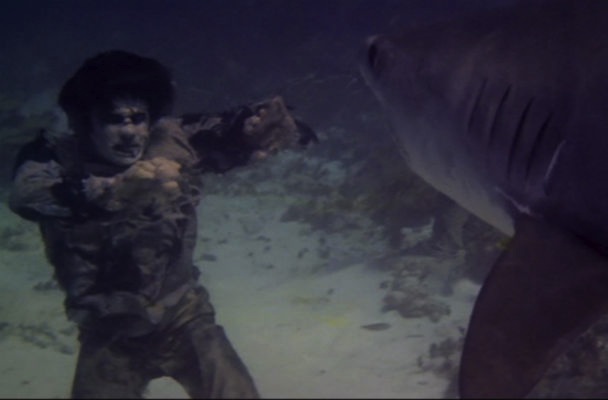
In 1979 Fabio Frizzi offered a more subtle approach to the Italo-horror soundtrack, one which deftly combined the minimalist structures of new music composers like Philip Glass and Steve Reich with experimental rock, funk and early electronica.  While Goblin’s Bacchanalian soundtracks are a fitting accompaniment to the garish colors and extreme art direction of Argento, Frizzi’s scores bear a more oblique relationship to the violence and gore they accompany. Zombie 2 was director Lucio Fulci’s attempt to cash in on the success of George Romero’s Dawn of the Dead, released as Zombie in Italy, and though far from being a worthy successor, its Grand Guignol horrors set a new standard for movie gore.  Boasting an unforgettable underwater battle between a zombie and a shark, the film succeeds by sheer audacity and brazen energy. 

Frizzi’s score is no less brazen or energetic, but transcends its filmic context—and in some respects the Italian horror film score tradition itself—by offering a richly arranged and measured composition without sacrificing the film’s violent urgency.  By 1979 the synthesizer was beginning to emerge in popular music, most notably in the early synth-pop of British artists like Gary Numan, The Human League, and OMD, where it became synonymous with urban unease and future shock.  Frizzi’s score is clearly influenced by the synthesizer’s new austerity measures, as well as drawing from earlier analogue techniques developed by German synthesized space rock, or kosmische music and English prog alike.  The most distinctive of the various sounds-of-futures-past dredged up by Frizzi is that of the mellotron, an early electronic keyboard that actually plays pre-recorded tape reels of choral and orchestral sounds.  While it was most famously used to grandiose effect in King Crimson’s In the Court of the Crimson King, in Frizzi’s hands the mellotron’s oddly compressed choral effects sound more like a choir of the undead muffled by graveyard soil.

Frizzi’s melding of the futuristic with the moribund in his use of electronics is matched by his peculiar melodic lines, which often move uncannily between the lively and the funereal.  While the Zombie 2 soundtrack often bears only an oblique reference to the violent and frenetic story line, this merging of the sounds of life and death provides a disturbingly effective aural equivalent to the undead creatures on-screen.  Frizzi’s soundtrack sounds both shockingly new in its use of stark synthesizer tones, and uncomfortably old in its use of tonal distortion and decay. Freud famously defined “the uncanny” as the sense of unease we feel when encountering something that seems alive when we know it should be dead.  It is an elusive quality that Frizzi manages to evoke melodically and sonically with seeming effortlessness.

The sense of decay and things long dead brought to life is even more palpable in Frizzi’s best-known score, created for another Fulci film, L’Aldila (The Beyond, 1981).  Though created two years after Zombie 2, this soundtrack sounds older, at times ancient, thanks to the dramatic use of (live) choral singers.  This later production wears its rock influences more loudly than its predecessor, the nimble drum and dead-cool fretless bass-lines infuses the often-Wagnerian heaviness of the compositions with a welcome dose of funk.  The mellotron remains a haunting presence, as are early analog synthesizers, but now the sounds are more crypto than techno.  Where Steve Reich was an obvious influence on the repetitive, slowly building song structures of Zombie 2, here the deft counterpoint almost suggests an undead Bach. 

These recordings deserve a broader listenership, connected as they are to musical innovations well outside the world of film soundtracks.  They are also invaluable documents of the dynamic relationship between film-makes and rock musicians during the classic era of the modern horror film.  Like other great scores from the 70s, Frizzi’s work provides an alternative picture of a musical past that deserves resurrection.

Jed Mayer is an Associate Professor of English at the State University of New York, New Paltz.

VIDEO ESSAY: Anatomy of the Sex Scene

VIDEO ESSAY: Anatomy of the Sex Scene

Origina

Originally published in Fandor.

Dogtooth is the story of a person who tries to escape a fictitious world. Alps is about a person who tries to enter a fabricated world.”—directorYorgos Lanthimos

Note: Both films feature actress Aggeliki Papoulia, one of the most remarkably performers to emerge in the international festival scene in the last few years. Her poker-faced commitment to these surreal, sexually demanding scenarios is critical to their execution.

Warning: this video contains spoilers as well as graphic sexual content.

Sex Scene from Dogtooth: Son’s bedroom. Older Daughter is enlisted by her family to satisfy the sexual cravings of Son.

Shot #1: This is the first and only time in the movie that the Daughter wears makeup, presumably to make her look less like a sibling and more like a sex partner to her brother. It’s one of several dehumanizing elements in this scene. There’s a perfunctory quality in the body language of both characters.  As she stands to undress the tight framing of the camera effectively separates her face from her body. The white rooms are awash in daylight, making this erotic moment feel sterile, as well as transparent—all the family members know this is happening.

Shot #2: This wider angle establishes more of the room. Stickers on the headboard of the boy’s bed signify his childish mentality, even though he has the body (and bodily needs) of a grown man.

Shot #3: Return to tight framing that separates heads from bodies, reinforcing the impersonal quality of this sexual encounter. The scene progresses in real time, as if to underscore that this unthinkable act of incest is actually happening. The real-time duration is also not unlike a porn film, suggesting that for the son it serves the same function as watching pornography.

Shot #4: An overhead shot of the boy’s back muscles exerting as he thrusts. The shot conveys his youthful virility, as well as a belabored quality of his sexual exertion, like a task his parents have assigned him to complete.

Shot #5: A side view of Older Daughter’s head and chest as she winces and stiffens. The mirror in the background reflects Son thrusting above her. The two images combined reinforce the disembodied quality of their act.

Shot #6: Overhead shot, post-coitus, two heads again disembodied. She has never been taught by her parents to express negative emotions. To voice her anger, she quotes from a movie she secretly watched. This moment catalyzes her awakening and rebellion against her family.

Sex Scene from Alps: Basement of store. Monte Rosa is hired to play the ex-girlfriend of a client who runs a lighting store.

Shot #1: The darkness underscores secrecy. There is confusion over whether sex is part of the agreement between the two parties. Handheld camera gives scene a spontaneous, uncertain quality, much looser than the rigid framing ofDogtooth.

The client instructs Monte Rosa, who follows his instructions.

Shot #2: Reverse angle reveals similar formal elements from the sex scene in Dogtooth. The woman’s body is cropped, emphasizing her presence as a body. But her body language, the briskness with which she disrobes, suggests a willingness to follow his instructions. The man’s orders are based on his past experience with his ex-lover.

Shot #3: Two figures framed on the couch; the man disrobes. The scene feels less formally composed than the one inDogtooth, more like a natural moment of intimacy.

Shot #4: The shot of Monte Rosa’s head and chest resembles a similar shot of the same actress in Dogtooth. This time the man’s head is not spatially disembodied by a reflection, but physically in the same space connected to her body. There’s more of a dialogue than in the Dogtooth scene, and it gives their interaction a greater sense of intimacy and warmth.

She laughs. Is it at the disconnect between the sentiment of the line she is speaking with the awkwardness of the situation? At the absurdity of being instructed to express a genuine feeling?

Shot #5: Or is it from a real sensation of pleasure?

In both scenes, the woman has internalized words from outside and is using them to express herself.

Kevin B. Lee is Editor in Chief of IndieWire’s PressPlay Video Blog, Video Essayist for Fandor’s Keyframe, and a contributor to Roger Ebert.com. Follow him on Twitter.

VIDEO ESSAY: Reel Islam

VIDEO ESSAY: Reel Islam

Originally posted on Fandor.

There are many things that disgust me about Innocence of Muslimsand all the tragic violence it has caused. As a movie lover, what disgusts me is this: Something that looks like it was made by rank amateurs in a basement studio, something that has nothing valuable to say about the lives and beliefs of one and a half billion people, has somehow captured the world’s attention in the worst way possible.  Lost in the media firestorm are many other films that actually deserve our attention in exploring the world of Islam.

The documentary Veiled Voicesis a revealing look at the evolving role of Muslim women in the Arab world, profiling several women who serve as leaders in their communities and in the media. The film shows how these women are fostering a new generation of progressive thinking and openness in Islamic society.

Children of the Prophet is a vivid look at Ashura, an important religious day for Shiite Muslims, the largest denomination of Islam in Iran. The film uses the occasion to elicit frank reflections from Iranians about their faith. We also learn that for young, modern Iranians, this religious day of mourning has a completely different significance.

The Tunisian comedy Khorma shows that, contrary to what the mass media portrays, Muslims don’t mind poking fun at their own faith and pointing out its shortcomings. Khorma is the simpleminded servant of a cleric whose job is to announce weddings and funerals, that is until one day when he gets them mixed up. Khorma takes over the job, and unwittingly exposes the petty corruption and economic exploitation lurking within the shadow industry of religious services.

But for a movie that captures the beauty of Islam at its purest, it’s hard to beat the films of Tunisian director Nacer Khemir.  Bab’Aziz the final chapter of Kehmir’s Desert Trilogy, and unlike the deplorable green screen effects ofInnocence of Muslims, it was actually shot in the desert, drinking in its panoramic beauty. Inspired by the mystical teachings of the Sufis, the film charts a winding intuitive journey, as one story falls into another. Each character has their own spiritual quest to fulfill, their own path to follow. Khemir’s film shows that Islam is not a single monolithic entity or pernicious threat, but a world of innumerable wonders waiting to be discovered, especially in its films.

Kevin B. Lee is Editor in Chief of IndieWire’s PressPlay Video Blog, Video Essayist for Fandor’s Keyframe, and a contributor to Roger Ebert.com. Follow him on Twitter.

What are some of your favorite films that depict Islam and the lives of Muslim people? Leave a comment.

The Mystery of Werner Herzog: Two Video Essays and One Text Essay

The Mystery of Werner Herzog: Two Video Essays and One Text Essay

DOES MR. JONATHAN SMITH CRY IN HIS PILLOW AT NIGHT?: THE UNIRONIC WORLDS OF WERNER HERZOG

One of the most revealing statements in the book Herzog on Herzog appears early on, when Werner Herzog tells interviewer Paul Cronin that from the time he was a young child he has suffered a particular "communication defect": he has no sense of irony.

Whether Herzog the actual human being does or doesn't have a sense of irony is itself a minor point, a bit of autobiographical gossip. But there is a useful truth in extrapolating the insight to his work: Understanding and appreciating Herzog's films means giving up on the pleasures of irony. (It is difficult to imagine a satire written and directed by Werner Herzog.) What is entertaining and meaningful in Herzog's movies and his public persona is a peculiar earnestness — the earnestness of the straight man in comedy routines, but less oblivious, more mystical. Various labels can and have been applied to his work: Romantic, Expressionist, Existentialist. But they are inevitably incomplete and unsatisfying because their orientation is toward analysis, systematization, precepts, and principles—where Herzog's philosophy is more like a garden of intuitions, or a collection of koans written on scraps of paper and scattered across the floor of an abandoned monastery atop some far-off mountain where the wind never settles down.

The title of Nelson Carvajal's new video essay, "Werner Herzog Looks at Man's Futility," is full of tricks and traps. What is Werner Herzog: the filmmaker, his films, the actual human being for whom that is a byline, the public figure we know from interviews and guest appearances and YouTube videos? Looks: How? With eyes or camera? Are we looking with him, through him? Man's Futility: "Man" as a macho revanchist term for "humanity"? Or literally of men: the futility of men, the futility of masculinity, men adjusting their lives to the fact of futility . . . (The video's first image, from Stroszek, is of a woman being beaten by men.)

Carvajal's work can speak for itself; its juxtapositions are rich with possibility and ambiguity. The choice of the word futility is what most strikes me. A quick glance at Herzog's oeuvre might cause an inattentive viewer to see it as nihilistic, as celebrating or at least embracing the futility of living: human life is inconsequential, nature is great and unknowable, death and failure are ever-present, hopes and dreams are naïve. But that is not it at all. Instead, Herzog encourages us toward the sublime, toward awe and humility when faced with great mystery—toward, indeed, the seeking and celebration of such mystery. Toward an epistemology that is not irrational but sur-rational, that thrives between the lines of all we could ever know. It is not that we live in a meaningless universe, but rather that our intellectual tools for measuring the meaning of the universe are about as well developed as those of a mosquito contemplating how Manhattan came to be so tall.

Existence is its own meaning. Thus, the need for pushing existence toward its limits and extremes, for exploration and adventure. Every worthwhile encounter happens at the end of some world. Facts are not truth, and truth is not a product of careful measurement and objective observation, but of ecstasy, and ecstasy requires the knowledge of the senses, the trust of intuition, the cultivation of mystery. Teleology leads to ruin, but knowledge and enlightment come from the fact of life's force: Aguirre, on a monkey-covered raft at the end of his adventures, doomed and clearly mad because still he dreams of conquest; Fitzcarraldo failing at what he set out for and achieving much he did not; Dieter Dengler clinging to existence with the same strength as the premature baby grips the doctor's hand in Stroszek. Life's force and the power of chance determine the aesthetic, with shots and scenes included not for reasons of cause and effect, not for obvious or metaphorical association, but because they feel right. Animals and objects take on mercurial meaning: the albino crocodiles in Cave of Forgotten Dreams, the fiery oil fields of Lessons of Darkness, the basketball in My Son, My Son, What Have Ye Done, the chickens in everything. Chance and chaos rule over all: the volcano in La Soufrière might explode at any moment, the actors in Heart of Glass are hypnotized and thus strange and unpredictable, the squirrels in the story told in Into the Abyss could have been killed if not for good brakes on a golf cart.

Herzog's truths emanate from estrangement. The worlds and peoples he portrays are always exotic, and so there is a consistent unity to his work from its earliest days—each film displays a contempt for nothing except dominant normality. No person or place is exotic to itself, but we do not have access to these selves. Few, if any, of Herzog's characters are "knowable" in the sense familiar from the genre of psychological realism. Psychologizing is futile. Worse than futile: boring. The camera's fascination adheres to anyone and anything that confounds simple analysis, that lives outside predictable boundaries, that does not look like commercial, homogenized culture. We discover (through cracks, crevices, abandoned pathways, extremes of distance, altitude, weather) the panoply of ways of living.

"I want the audience with me in wild fantasies in something that illuminates them," Herzog said in an appearance on The Colbert Report in June of 2011. Wild fantasies illuminate. Wild fantasies bring us beyond the banal, commodified dreams that haunt our days of sleepwalking. "You see if I were only fact based—you see, the book of books in literature then would be the Manhattan phone directory: four million entries, everything correct. But it dusts out of my ears and I do not know: do they dream at night? Does Mr. Jonathan Smith cry in his pillow at night?" Knowledge requires imagination, empathy, curiosity. Anything else is at best facts, and, as David Byrne once sang, "Facts are living turned inside out."

Herzog makes a point of differentiating his lack of a sense of irony from a lack of a sense of humor. Irony and humor, he says, are very different things. This is a truth borne out by Herzog's films, which are often filled with sly and absurd humor. By desaturating his work and words of irony, Herzog adds another layer of ambiguity to his films, provoking laughter at moments where we might not know why we are laughing, or what we are laughing at, and complicating those moments with other emotions.

I recognized this effect most forcefully when, on a lark, I re-edited the trailer for Baz Luhrman's upcoming adaptation of The Great Gatsby to be, instead, a preview for a Herzog movie. My intentions were entirely silly. But once I started editing the video, I realized that by inserting Herzog into the glitzy stylistics of the movie, and positing him as a director of the hollow shell of a character that is Gatsby (the opposite of the obsessed dreamers he often films, for Gatsby, though obsessed, lacks their gravitas, their mysticism, their madness), that the silliness of the premise was undercut.

Even when Herzog is at his most humorous and least meaningful, his affect is one of absolute sincerity, which heightens his humor but also adds other layers. When he reads Go the Fuck to Sleep, for instance, there is no fear that he will ever break into giggles, no chance that he will laugh along with us, no suspicion that he is even inviting us to laugh (imagine the contrast if an irony-besotted comedian like Stephen Colbert read it). Irony insists that we know there is a joke, that we see the opposite meanings, that we smirk inside because we get it. It can be a lot of fun, and even quite meaningful. But it's never what Herzog is up to.

A mien of sincerity can be as shallow and tiresome as an endless array of ironies—who wants to live in a world of anchorites, pamphleteers, and true believers? Gnomic pronouncements get old fast when all you want to know is whether you should eat at the restaurant on the corner. But ours is a culture of winks and spins, of campaign slogans, billboards for Jesus, self-help politics, and an endlessly Googled Earth. Every imaginable court bursts with jesters. We need a few people with no sense of irony to see through it all. We need enigmatic images to steal our dreams back from their corporate mergers.

Men are futile, yes, in every sense, and Herzog, whose movie worlds are mostly made of men, knows this as well as anybody. "Get over it," he seems to say. What does our futility matter if we can share our wild fantasies? Give up on the wonders of your gender, stop venerating your species. Are we so different from radioactive albino crocodiles? In the movie, they're just as real as we are. — Matthew Cheney

Nelson Carvajal is an independent digital filmmaker, writer and content creator based out of Chicago, Illinois. His digital short films usually contain appropriated content and have screened at such venues as the London Underground Film Festival. Carvajal runs a blog called FREE CINEMA NOW which boasts the tagline: "Liberating Independent Film And Video From A Prehistoric Value System."
You can follow Nelson on Twitter here.

Matthew Cheney's work has been published by English Journal, One Story, Web Conjunctions, Strange Horizons, Failbetter.com, Ideomancer, Pindeldyboz, Rain Taxi, Locus, The Internet Review of Science Fiction and SF Site, among other places, and he is the former series editor for Best American Fantasy. He teaches English, Women's Studies, and Communications & Media Studies at Plymouth State University.