Your ears didn’t deceive you. In the clip above, Dr. Wayne Fiscus (Howie Mandel) takes a verbal walk down Memory Lane as his residency at St. Eligius comes to a close in the final episode of St. Elsewhere’s six-year run and says it lasted “three years.” In the series’ original airing, I didn’t catch on immediately that each season only represented about six months and it took two seasons to complete a year. Don’t follow that timeline too closely—contradictions abound. Some units of measure adhere to that three year span—Norman Lloyd’s Dr. Daniel Auschlander began the series in 1982 at the age of 72 and, in the final episode that aired May 25, 1988, Auschlander tells Luther (Eric Laneuville) that he’s 75. Despite the fact that St. Elsewhere brought a new level of realism to the medical drama on TV, the show’s other elements weren’t bound by those same rules of logic and continuity. Tom Fontana and John Masius, the show’s longest-running writer-producers, penned an ending during that sixth season much different than the one viewers ended up seeing (and that the world still debates to this day). That unfilmed ending leaped 25 years into the future—to 2013—with Auschlander, dying of liver cancer since the show’s debut Oct. 26, 1982, still alive at 101. I’ll let readers work out the logical flaws in that math. (More on that ending in Part 3. I know we said a two-part series, but we changed our minds.) On the other hand, I don’t recall the first season explicitly stating 1982 was its starting point—perhaps St. Elsewhere took place in the future from the get-go. Certainly in many respects, the series often was ahead of its time.
 Television shows routinely kill off major characters now, often at unusual points in a season, but St. Elsewhere knocked off or wrote off regulars right and left. Kim Miyori’s Dr. Wendy Armstrong became the first regular to take the fall near the end of season two. After escaping an assault by the rapist terrorizing St. Eligius, secretly suffering from bulimia and misdiagnosing a patient with dire results, Wendy took her own life and became the first cast member in the opening credits to leave as a corpse before the year was over. She wouldn’t be the last. Other series killed off characters, but usually that coincided with an actor’s decision to leave the show at the end of a year or a performer’s unexpected death in real life. “I was lucky I made the first and the last episode,” said Christina Pickles, who played four-times wed Nurse Helen Rosenthal, who would go through a mastectomy and breast reconstruction after a bout with breast cancer, as well as drug addiction, through the course of the series. “It gave me five Emmy nominations and a career in this town, and it’s still having an effect,” she said. While not thought of as a particularly issue-oriented program, many topics passed through St. Eligius’ corridors that had little to do with medicine—apartheid, the Troubles in Northern Ireland, domestic terrorism, racism and bigotry, accompanied by the language of hate that comes as a shock to hear 30 years later on a prime time network show, even in context. The show touched on controversial medical issues such as medicinal marijuana, euthanasia, abortion—both the decision on whether or not to have one and the politics that can grow out of control surrounding it—as well as the then-new scourge of AIDS, which eventually infected one of its major characters (through heterosexual sex no less, stomping on the myth that only gay men and drug addicts need fear the disease). It even beat NYPD Blue in the prime time race to the moon when Ed Flanders’ Dr. Donald Westphall left the show in the third episode of the final season, dropping his drawers and telling Ronny Cox’s Dr. John Gideon, the new boss installed by the HMO that buys St. Eligius, that he can “kiss my ass, pal.” Cox shared a story relating to that scene I’d never heard before. “The NBC censor resigned over that,” Cox said. “(T)hat was back in the days when they still had Standards and Practices. I had a conversation with him once and he was so incensed by that, his sensibilities, that he actually quit over that.” That scene lived up to St. Elsewhere’s willingness to indulge in the downright wacky, always making us aware we were watching a TV show without explicitly breaking that fourth wall. Executive Producer Bruce Paltrow and his talented staff of writers and producers always walked a tightrope high above the floor below (often without a net). Still, as with The Flying Wallendas, sometimes the show didn’t make it to the other end of the wire. More often than not, the results proved thrilling rather than tragic.
Even with the decision to continue this tribute in two more parts instead of one, much ground remains to be covered. Channing Gibson began as a freelance writer on St. Elsewhere with his writing partner Charles H. “Chic” Eglee in the second season before they joined the staff as story editors with John Tinker, younger brother of producer Mark Tinker, the show’s co-developer, in the fourth season. When Masius and Fontana stepped down from their producing posts in the sixth season (though Fontana remained a “creative consultant”), the producing reins were handed to Gibson and the younger Tinker. (Eglee departed the show in 1986 to work on Moonlighting.) During my conversation with Gibson, he mentioned a formula that guided most installments. “St. Elsewhere always broke down, in almost every episode except for the stand-alone episodes . . . (into) four storytelling elements,” Gibson told me. “There was always a universal theme . . . which dealt with who we are as people, what life is about, that sort of thing. There was always a personal story that picked up on the thread of one of the characters and their personal lives and delved into it more deeply than we might get in an average episode. There was always a medical story, which was absolutely about medicine in the classic style, whether it’s Dr. Kildare or any other story, any other good medical show. Then there was always the humorous story. We built every show to have those four elements in them. At the same time, you’re passing people through and keeping the plates spinning on whatever they’re about.”
 Cindy Pickett joined St. Elsewhere at the end of the fourth season in 1986 as Dr. Carol Novino, a former nurse who entered medical school at the urging of Dr. Westphall and returns to St. Eligius as a resident. “I've never and haven't since been in an audition where you had to make them laugh and make them cry in one room in one audition,” Pickett said. “Because St. Elsewhere was a show that would make you cry and then make you laugh. So much of it was absurd. So much of it was very human and real and heartwrenching. Then this scene would be highly realistic and tragic and the next scene would be something completely surreal and funny.” Pickett had a pretty good 1986. Though she began as recurring, her role was upgraded to regular status by the fifth season in the fall. In between, she played Matthew Broderick’s mom in the summer smash Ferris Bueller’s Day Off.
St. Elsewhere also rewarded the attentive viewer with inside jokes and callbacks to previous storylines, even if the callback took place in the past before the incident occurred, such as the great one in the classic season four two-part episode “Time Heals” (arguably the series’ masterpiece) where Auschlander advises a maintenance man in 1965 to put plenty of insulation in the ceiling, when in Season Three, in the present, the hospital treated that same character for fatal asbestos exposure 20 years later. I will attempt to do the same for the careful reader. Those with limited attention spans should pop a Ritalin (or two) or proceed to the nearest exit in an orderly fashion. Admittedly, part of my love for this series stems from my own enjoyment of cracking wise for a mere handful of patrons in the back row. In the first season, G.W. Bailey’s character, psychiatrist Dr. Hugh Beale, attempted to lift the spirits of Dr. Westphall, overwhelmed by trying to manage the Legionnaires’ disease outbreak while coping with administrative headaches from the hospital’s city overseers. “As Coach Bum Phillips once said of Earl Campbell, ‘You may not be the only one in your class, but it sure wouldn't take long to call roll,’" Beale tells Westphall. That certainly applies to St. Elsewhere as well.
THINGS YOU SHOULD KNOW BEFORE AND AFTER
Before moving on, in the rush to complete Part 1, I failed to include some crucial points relating to St. Elsewhere’s first season. Most egregiously, I omitted Bonnie Bartlett’s introduction as Ellen Craig. Bartlett originally auditioned for the role of Helen Rosenthal and expressed reluctance at taking the recurring role of Mark Craig’s wife, but her real-life husband William Daniels encouraged her to take the part of his fictional wife. “They put me in, and I was just a little tiny part, and I didn’t even really want to do it, but Bill wanted me to do it because he thought it was funny,” Bartlett said. “She was a cigarette smoker, and he thought that was very funny, and he taught me to smoke because I don’t know how.” Ellen Craig’s introduction proves to be quite memorable as she confronts David Birney’s Dr. Ben Samuels, who has been driving Craig crazy by leaving him messages from a phantom doctor supposedly interested in purchasing his car. “It was really good company of people to work with. They were all really talented people,” Birney said. “We stuck together sometimes, an ensemble cast.” Terence Knox, the hospital’s troubled resident Peter White, reminded Birney of a particular example. When driving to the set one day, a policeman pulled Knox over, and Knox didn’t have his driver’s license. Birney happened to drive by. He stopped and asked Knox if he should tell the show that he’d be late to the set. The officer, recognizing Birney, was impressed enough to let Knox off with just a warning.
 I also neglected to include this anecdote from Jennifer Savidge about the scene she felt made her character of Lucy Papandrao begin to stand out in the first season. “It was a very nice scene. It was just one scene, but I was on the phone the whole time, helping Ed Begley run some medical stuff for a test, and . . . Bill Daniels comes in to look at the schedule and starts yelling at Ed while Ed’s trying to recite this stuff and I’m yelling at someone on the phone,” Savidge said. However, behind the scenes, a bit more had transpired off camera. Savidge had been hospitalized with a severe concussion after a horse riding accident. Although blood was still pouring from her ears and nose and she was disoriented, her agent told her she better get to the set or they’d hire someone else. “So the next group of interns came in, or residents, or whoever, and I said, ‘Oh, I’m just feeling great. I feel fine, no headache, nothing.’ So they said, ‘OK, you’re good to go,’ and they released me. I spent that whole day leaning up against the wall with my head back, praying that the blood didn’t start pouring out of my nose again. This is the stuff actors will do. It was a stupid thing to do, an insane thing to do. I could have had a clot or something in my brain,” Savidge recalled. She managed to avoid any gushers and after her scene was done, Knox came over and told her, “’You know Bruce Paltrow just came down to the set, and he was watching you do the scene, and he was asking about who you were, and he was saying that’s what we need, that attitude, that kind of abrasive, clipped kind of attitude,’ and Terry said, ‘Think about that. You’ve got to find your niche here, because if you do, then you could go along with the show. And you have, by doing this, already established some kind of a niche. Develop it,’” Savidge said. “That was the hardcore, kind of bitchy attitude of this nurse, who knew everything and felt the doctors basically knew nothing. That’s, I think, why I started to develop in that character, and if I had scenes with Begley, there was that sort of combative relationship that we have, and my sort of sarcastic way of dealing with him. It was something that wasn’t anywhere else on the show, and that just developed.”
Birney and Dr. Samuels departed St. Eligius after the first season, as did Bailey’s Dr. Hugh Beale. No explanation for the fictional characters’ departures was given, but interestingly enough, Samuels’ final scene took place at the nurses’ station just as Cynthia Sikes’ Dr. Annie Cavanero’s final scene would, upon her departure at the end of the third season. Perhaps the nurses’ station served as St. Eligius’ Bermuda Triangle. Birney admits disappointment in leaving the show, but his departure afforded him the opportunity to take over the role of Salieri in the original production of Amadeus on Broadway. Of course, Bailey and Birney weren’t the only St. Elsewhere staff members that left after that first season—co-creators and producers Joshua Brand and John Falsey exited as well. “It was a great opportunity. We had a great time doing it,” Brand said. “I was a much younger guy. It’s nice to try to do something special, to do something different. I’m always astounded when people still react to it and a lot have very strong-held opinions about the show and remember things about the show. I’m a lucky guy that I got to do it. I’m very appreciative.” As for Sikes’ later exit, she said, “I didn’t feel that it was going to continue on, the character, the way I thought it would, so we parted ways.”
That first season might have been all St. Elsewhere viewers ever saw (and they’d never have met Tommy Westphall or learned he was autistic). In fact, in the ratings-challenged first season’s last episode, “Addiction,” Fiscus asks the sexually voracious pathologist Cathy Martin (Barbara Whinnery) to perform an autopsy on a man named Nielsen who “died on his couch watching television.” After NBC officially cancelled the show and cast and crew began looking for work, they received a last-minute reprieve. ”The show was dropped after the first season and Brandon Tartikoff liked the show, liked the demographics of the show, and that’s how it went on,” Daniels said. That’s also the way the show progressed from season to season—always teetering on the edge of extinction. Tartikoff entered the executive ranks at NBC in 1977 and in 1981, at the age of 32, became the youngest president of network programming in history under Fred Silverman at the floundering network. The year after Tartikoff’s ascension, Silverman exited his role as chairman and CEO of NBC, replaced by the head of MTM Enterprises, Grant Tinker, father of Mark and John. To accept the job, Grant Tinker had to divest himself of his interest in MTM. What St. Elsewhere didn’t earn in Nielsen numbers that first year, it made up for in Emmy nods, grabbing 10 nominations, including nominations for best drama series and individual nominations for Daniels, Flanders, Begley, Pickles and guest stars James Coco and Doris Roberts (in the supporting categories, since the Emmys lacked separate awards for guest performers then); Flanders, Coco and Roberts won. Another NBC show that marks the 30th anniversary of its debut this year performed weakly in the ratings that season but won renewal and Emmy love, and even happened to be set in Boston as well—Cheers. For all the perceived darkness of the show's initial year, the period ended on a celebratory note as the St. Eligius staff celebrated the birth of Jack and Nina Morrison’s son, Pete. That would be one of the few moments of joy that the writers allowed Jack to experience for the rest of the show’s run.
THESE SHOOTS ARE MADE FOR WALKIN’
The short clip that began this piece also demonstrates some of the new techniques from feature filmmaking that St. Elsewhere brought to TV—namely long unbroken takes using cameras like the one from Panaflex, light enough to carry and allowing of more movement. “On St. Elsewhere, we would do a lot of . . . one-shots covering a long amount of dialogue in a single scene,” Mark Tinker said. Part of Paltrow’s redesign of the set when he stopped production on the pilot allowed for floors and lighting to conceal dolly tracks. The show’s budget couldn’t cover a Steadicam. “We had a guy named Rick Gunther, who was an amazing hand-held cameraman, and occasionally we’d put him in a wheelchair—either a standup wheelchair or a regular wheelchair—but mainly he walked,” said Tinker, who wrote many episodes and directed even more in addition to his other roles. Tinker helmed about twice as many installments as the next most frequent director, who turned out to be Laneuville, performing double duty as Luther Hawkins. He made his directing debut in the second season episode, “After Dark.”
That scene from “The Last One” between Fiscus and the opera singer (Ealyn Voss), which Tinker directed, displays another filmmaking illusion that St. Elsewhere often employed. “We would also do things like walk into the elevator and then have a scene take place in the elevator that never stopped, that never had a cut,” Tinker said. "The characters were in the foreground and the doors in the background were facing out. While they were playing the scene, we’d switch out what was outside the elevator, so when they stepped out, it would look like a different place and make it seem like the elevator really worked.”
The typical episode of St. Elsewhere took seven days to shoot, though the length of shooting days on series varies widely today. Tinker, who now serves as executive producer on ABC’s Private Practice, the spinoff from Shonda Rimes’ Grey’s Anatomy, continues to direct not only on that show but others as well as he has in the years since the doors closed on St. Eligius. “Most shows (today) are eight, some of them are nine. For all but the last year of NYPD Blue, we did eight days. For the last year, in order to take about a million dollars out of every episode, we did seven-day shows,” Tinker said. On (Private Practice), for the first five years we did nine-day shows and we sort of did the same trick for this year, and then we took a day off and made a bunch of budget cuts, so we’re doing eight-day shows now. Some of the cable shows, like The Closer, did seven all the time.” Just for comparison to other cable shows currently on the air: HBO’s True Blood averages between 11 and 14 days to film an episode, while AMC’s Breaking Bad typically shoots an installment in eight days.
Shooting schedules aren’t the only things that have changed in the decades since St. Elsewhere aired. It’s also rarer to find sequences on series that linger on a moment and allow the viewer to drink it all in, whether on network or cable. “I remember the scene where Helen Rosenthal comes back to work after her mastectomy,” Pickles said. ”There’s a scene [when Helen walks back to] the nurses’ station where [Dr. Beale] asks her if she’s ready to go back to work, and she says, ‘Yes.’ They would normally now cut there and go to another place but in those days the director cut back to Helen’s face, looking unsure and conflicted, in a very moving shot. Nowadays, that would not be in a television series.” Exceptions do exist, of course. Even though Breaking Bad airs with commercials on AMC, it still gets away with exquisite eight-minute long dialogue scenes, at times.
DAVE’S BIG WAVE
I still feel fortunate that David Morse spoke with me for this tribute. He seems like a quiet family man who doesn’t like to talk about himself but loves the craft of acting and feels fortunate to have made a career out of it, one that keeps him quite busy. He just finished playing the title role in an independent film called McCanick that filmed in his hometown of Philadelphia. The next day, he was heading to Vancouver for a small part in the film Horns, starring Daniel Radcliffe, before returning to New Orleans to conclude his role as police Lt.. Terry Colson in the criminally shortened final season of HBO’s Treme, which gets a whopping five episodes to wrap up all its stories. Morse stood out among the members of the St. Elsewhere ensemble as the conscientious Jack Morrison, and NBC executives loved him for it. “He is such a lovely, talented actor. The minute he came in to audition, it was so obvious that he was a special guy,” Brand said. “We loved writing for him.”
Other St. Elsewhere writers, particularly after the first season, however, loved to flip off people who pissed them off, and Morse and his character became part of the collateral damage from that impulse. “After those first two seasons, there’s not a lot that stands out for me. I loved directing on that last year and there are some things . . . the dream episode was really fun to do. Just sort of as an experience, [I loved] those first two seasons because of a lot of what my character was going through but also what he represented. That really was what I thought of as the character,” Morse said. “I thought he was fighting his fight in a strong way and coming out a single parent, losing his wife, all the things he was dealing with in the hospital.”
The second season death of his wife, Nina (Deborah White), provided one of the most memorable and touching moments not only of St. Elsewhere, but of television in general. That was particularly dramatic material but, after that, Jack’s traumas began piling up. His medical license proved to be invalid because he went to a shady school overseas. His brief romance with a woman named Clancy (Helen Hunt) ended after she cheated and aborted a pregnancy. Jack got temporarily paralyzed. His young son Pete was abducted. The clincher came when, while performing required volunteer duty at a prison, Jack was raped by an inmate. As if rape of any sort calls for puns and mocking, that episode bears the name “Cheek to Cheek.” Later, when that inmate, Nick Moats (John Dennis Johnston), gets out of prison and tries to find Jack again, little Pete, unbeknownst to his father, swaps his cap pistol for the real gun Morrison purchased for protection. When Jack aims to kill Moats, he’s unarmed. Thankfully, the oblivious toddler wanders in and plugs the bad guy himself, leaving Jack to complain that he was “impotent again.” No wonder Morse felt compelled to play so many bad guys later in his career.
 I asked Morse if at any point he talked to the producers or the writers about the nonstop barrage of suffering placed on Morrison’s shoulders. “I never really talked to them. No. I have my own theories about it and my own thoughts about it, but it’s kind of like talking about your own family,” Morse said. “I don’t really want to express it because we never really have talked about it. I think it’s more complicated than just what was on the screen.” I believe clues to the reasons behind the onslaught have been in plain view for a long time, though I can’t prove my hypothesis definitively. First though, a shaggy dog story.
How many remember the NBC series Here’s Boomer, that began in March 1980 and whose final episode aired a few months before St. Elsewhere’s premiere? That small number would be a lot smaller if Mark Tinker didn’t remind everyone repeatedly that the show about a mixed-breed terrier, a sort of canine Lone Ranger who traveled from town to town helping those in need before moving on, led to Jack Morrison’s nickname “Boomer” on St. Elsewhere. As Tinker has said since at least a Dec. 1, 1986 article in Us magazine by Mark Morrison, on the 2006 DVD commentary track of the “Cora and Arnie” episode, and to me personally, “The network was quite enamored of that program. On that show, they would tell the producers, they wanted more Boomer. On our show, they wanted more Morrison. Somehow we turned that into wanting more Boomer, and so we gave [Jack] the nickname Boomer.” Tinker says the same network executives sent those notes, and the Us article specifically refers to Here’s Boomer and St. Elsewhere having a common director who shared that story—the only common helmer being Victor Lobl. The Us article also quotes St. Elsewhere writer-producer and Tinker’s co-developer, John Masius, as admitting that by the end of the first season, Jack’s self-righteousness began to bore some of the writers and “we chipped away at his façade.” Funny. Watching the first season again, while I realize that Morse was playing a character, I had no inkling that Jack Morrison himself was some kind of phony putting on a show. He appeared genuinely sincere to me. The Us story and another one in People magazine the same year promoted Morrison’s wedding in the fifth season to Bonnie (Patricia Wettig), pushing the notion that Jack’s suffering might be over. One sentence in the Sept. 29, 1986 People story by Suzanne Adelson read, “’It's definitely going to get better for Jack,’ promises co-producer John Masius, ‘but it isn't going to be Miracle on 34th Street.’” Morse was quoted then as skeptically saying, “I think they're having too much fun with Jack for things to get better.” His instincts proved correct, since marital bliss ended up hampered by a former husband, Bonnie's departure for Seattle, and the eventual return of Nick Moats and his encounter with pistol-packing little Pete. If I’m correct at what lay behind the tormenting of Morse and Morrison, its impetus truly was nothing short of juvenile. Of course, it’s all speculation on my part, combined with bits and pieces of circumstantial evidence, though it might be telling to look at which members of the behind-the-scenes St. Elsewhere team Morse worked with again and which ones he didn’t.
Whatever prompted that nonsense, it doesn’t change the fact that Morse persevered and made Jack Morrison one of many great performances in his career. Pickett, whose character briefly hooked up with Jack in the final season, remembers “how shy David Morse was and I was shy, so we were shy together.” The ensemble welcomed Nancy Stafford in the second season as Joan Halloran, the person assigned by the city to oversee St. Eligius’ budget, as well as the love interest for the hospital’s new plastic surgeon, Dr. Bobby Caldwell (Mark Harmon). She remains proud of the success her co-stars have achieved. ”It sure did launch some great on-camera people. Howie Mandel is still doing stuff. He proved in that series to be a very underrated actor. David Morse is such a great actor, and I've always wanted to work with him again. I'm sorry I haven't had that chance over the years, but he proved to be just this amazing guy. Of course, then you get Mark Harmon and Denzel (Washington). So proud of those guys.” Still, Jack’s first tragedy in that second season provided Morse and Morrison with that indelible television moment.
The excerpt above can’t quite do justice to the convergence of storylines that led to that remarkable ending. It was the fourth episode of the second season. Stafford’s Joan Halloran had just been introduced as the “bad guy” because her job description made her ever-watchful for St. Eligius’ expenditures, which received a large added expense in the first episode when Alan Arkin’s Jerry Singleton decided to redecorate the E.R. with his car. At the same time, Dr. Craig was determined to perform a heart transplant on a longtime and otherwise healthy patient, the near saint Eve Leighton (the late Marian Mercer). Morrison’s main patient was Piper Laurie’s recovering stroke victim Fran Singleton. Then tragedy strikes in the form of a freak accident that takes Nina Morrison’s life. She becomes the heart donor for Eve Leighton, leading to an unforgettable scene, as Jack quietly listens for a connection to the wife taken from him so suddenly. “I’ve had so many people talk to me about that over the years,” Morse said. “Of course, everybody thinks they’re the only one who remembers it and they’re the only one it meant so much to—I can’t even give a number to the number of people who have talked to me about that episode. It’s an iconic moment in television, I think.” So iconic that more than a decade later, the soap opera General Hospital essentially ripped it off when the young daughter of one of its doctors died and her heart saved another child’s life, sending the daytime doctor to listen to his late daughter’s heart as well. “Steal from the best,” Morse said. Despite all of Jack Morrison’s trial and tribulations, he (and Morse) did receive a quite appropriate on-air gift in the show’s final episode.
STOP ME BEFORE I SUBREFERENCE AGAIN
The above line came at the end of an old Dennis Miller routine (back when he was funny, before he transformed into Howard Beale after Ned Beatty gives him the corporate cosmology speech in Network). However, it’s perfectly appropriate for any discussion of St. Elsewhere, which, throughout its six seasons, piled allusion upon reference upon inside joke, some inserted so subtly that they were easy to miss. Others were so blatant that they couldn’t be ignored. Either way, they served as a treat for the attentive viewer—and an outlet for the show’s writers who have admitted that sometimes, boredom can set in. “At a certain point in a TV show, the writers are writing for themselves to a large degree,” Gibson said. “If you’re just writing for the audience, you can get a little lost, a little bored.” The puns and references extended to the titles and weren’t limited to television—movies, books, poetry and theater also came into play. Television though remained at the top of heap. “We played around with the history of television and were very aware of ourselves as a TV show and all of us growing up as TV children,” Gibson said.
Stephen Furst, who first appeared three times in the second season as med student Elliot Axelrod before becoming a regular and a resident in the third season, loved that all the male residents’ fathers came from The Steve Allen Show. Granted, they missed or were unable to take advantage of the ultimate opportunity of having Don Knotts, Mr. Morrison in the old “Man on the Street” sketches, be Jack’s dad, but Tom Poston’s character in those bits never remembered his name anyway and his height made him appear more likely to have spawned David Morse’s character than Knotts anyway. Louis “Hi ho Steverino” Nye took on the role of Axelrod’s father, a veterinarian who brought a dog to St. Eligius, seeking chemotherapy. Bill “My name José Jiménez” Dana showed up as Fiscus’ dad (and Lainie Kazan turned up as his mother). Finally, Ehrlich, who always believed he was an orphan and raised by his daffy, usually drunk Aunt Charisse (Louise Lasser, Mary Hartman, Mary Hartman herself), turns out to be the son of spies Lech and Olga Oseranski, played by none other than Steve Allen and his wife Jayne Meadows.
A cursory search of first season references, television and otherwise, in addition to the late Mr. Nielsen previously mentioned, uncovered obvious or subtle callouts to works as diverse as Star Trek, An Affair to Remember, The Twilight Zone, Ernest Hemingway’s The Old Man and the Sea, Ben Casey, Dr. Kildare, T.S. Eliot’s Old Possum’s Book of Practical Cats, The Odd Couple, Leonard Nimoy’s In Search Of, Dylan Thomas’ Do Not Go Gentle Into That Good Night and a Geritol ad airing during the 1982-83 season. Of all the first season references, my personal favorite remains part of a phone conversation we overhear Dr. Beale having with someone we assume must be one of his patients as Dr. Westphall enters his office. “Mrs. Stephens, I don't think your daughter-in-law is a witch,” Beale tells the caller. “Masius and Fontana had a super reverence for these old TV shows,” Gibson said. Sometimes, the referential nature went so deep as to become allegorical, requiring research to discover all its layers, as in the sixth season episode directed by Morse, “A Coupla White Dummies Sitting Around Talking.” Written by D. Keith Mano from a story by Gibson and John Tinker, one of the storylines concerns Ehrlich being abducted by a maker of puppets and marionettes named Knox, played by Alan Young, best known as Mister Ed’s best buddy Wilbur. St. Eligius's Dr. Craig developed and installed an artificial heart called the Craig 9000, but Knox claims to be the true inventor of the device. The Knox character was based on a famous ventriloquist of the 1950s and ‘60s named Paul Winchell, known best for his dummy Jerry Mahoney. Winchell later became a recognizable voiceover artist, providing the voice for Tigger in Winnie the Pooh. One not so well known fact is that Winchell himself also liked to invent tthings: among the devices he developed and patented was an artificial heart, in 1963. The episode itself has one of St. Elsewhere’s most unusual endings: doll versions of Ehrlich and Craig discuss the events of the episode and end the show by singing You’ve Gotta Have Heart. “I still have that doll in storage,” Begley said.

For what may be the crowning achievement of the show’s penchant for references, look no further than “The Last One.” In fact, since that’s one of the only three episodes not from Season One that I've been able to revisit—thanks to having saved the video of the original airing for more than 24 years and transferring it to DVD myself (suck on that Fox Home Entertainment, and Rupert, I have the final Newhart as well, you stingy bastard)—I’m still discovering references in 2012 that I didn’t catch in 1988. For space reasons, we had to leave out a few references in the following montage: Craig’s “yeah yeah yeah” response to Ellen touting The Rock ‘n’ Roll Hall of Fame as one of the pluses for moving to Cleveland, as well as the cranky surgeon telling Rosenthal to “slide back to the Valley of the Dolls” in reference to her recent drug addiction. It’s always hard to catch the jokes over the P.A. system, so the Code Blue that gets called in Room 222, the series James L. Brooks created prior to The Mary Tyler Moore Show that featured early appearances by both Begley and Laneuville, didn’t make the cut either. It’s still stuffed full.
We’re probably lucky that I don’t have access to all 137 episodes, because going over all the references within them might very well crash the Internet. The show's creators squeezed in one last M*A*S*H reference in their final episode—and they alluded many times to that long-running comedy which ended the season they premiered, but I’m saving that discussion for Part 3. They also had done some Mary Tyler Moore winks before, but none on the epic scale of the finale. When Oliver Clark played the hysterical recurring role of John Doe No. 6, he watched The Mary Tyler Moore Show one day and became convinced that he was Mary Richards. Guest starring on the fourth season episode “Close Encounters” (which was followed by the episode “Watch the Skies,” the working title of Steven Spielberg’s 1977 film—even offscreen the writer were firing off references) happened to be Betty White, playing a military official and old friend of Westphall’s checking on an astronaut patient's condition. When John Doe No. 6 sees her in the hall, he immediately exclaims, “Sue Ann? Sue Ann Nivens?” to which she replies, “Sorry. You must have me confused with someone else.”
I wouldn’t want to try to catch all the hat tips to the musical 1776, in which Daniels starred on Broadway and in the film version as John Adams who, much like Mark Craig, was obnoxious and disliked, you know that sir. (The movie marks its 40th anniversary on the 17th of this month.) One I’d forgotten but that I found online occurs in the fifth season, when John Astin plays the husband of Dr. Paulette Kiem (France Nuyen), who becomes chief of surgery after Craig injures his hand. Kiem says something to her spouse in another language, and it can’t help but bring the Gomez out of Astin as he declares lustily, “Paulette—you spoke French.” That same year, they even paid homage to their MTM quality TV cousin Hill Street Blues when Lucy, promoted to head nurse while Helen was in drug rehab, ends a staff meeting with, “And hey, remember, let's be caring out there.” Not all of the pages—such as the ones frequently heard for Paltrow’s young children Gwyneth and Jake—were sweet and kind. New York Times TV critic John J. O’Connor wrote a harsh assessment of what he found to be the series’ strange evolution “into a pattern of grim-faced titillations and questionable cuteness, salvaged from mediocrity by one of the best repertory acting companies in a weekly series. Far from being innovative, St. Elsewhere has become a middling example of nighttime soap opera, complete with rapists, drug addicts and ‘hunk’ actors spending as much time as possible with their shirts off.” What good is an intercom system if you can’t use it? O’Connor, who apparently kept watching despite his disgust, found that someone bearing his name kept taking a turn for the worse in the emergency room, something he wrote about in a preview of the finale: “This reviewer found some of the changes silly, which no doubt accounted for the periodic bulletins at St. Eligius that a Mr. O'Connor was fading fast in the emergency ward. This, of course, left me loving St. Elsewhere all over again, bed sores and all.”
FACT THAT HE’S DYIN’ DON’T GIVE HIM PITY FOR OTHERS
While I disagree mostly with O’Connor’s 1986 assessment, it’s not because I found him completely offbase—I was a senior in high school by then, and lucky if I found a Sunday New York Times, so I didn’t read it when written. My main criticism would be that he’d addressed problems two years too late, after the ship had pretty well righted itself. On Feb. 15, 1984, the St. Eligius rapist first struck in the parking lot. Even at 14, I thought it was an odd move in an up-to-that-point stellar season, especially since the first victim wasn’t a character viewers knew. It didn’t look as if they were embarking on a rape victim’s storyline. The next sexual assault victim turned out to be Cathy Martin, in the morgue, the site of some of her consensual sexual encounters, and she managed to pull off the rapist’s ski mask—as viewers know—but the script the actors originally received just ended with Cathy being attacked. Terence Knox, the actor playing Dr. Peter White, who just had barely escaped punishment over stealing drugs, was appearing in Tennessee Williams’ Cat on a Hot Tin Roof at José Ferrer’s Coconut Grove theater in Miami during the show’s holiday break. He had given the script a cursory read, but he had other lines on his mind at the time. While in his hotel room awaiting rehearsal, he received a phone call from John Masius. “He said, ‘Listen, you’re going to be the rapist.’ I said, ‘What?’ He said, ‘You’re going to be the rapist.’ I just shrieked with despair and said, ‘No. No. I won’t do it,’ and I hung up the phone,” Knox told me. “The next day, I called them back and they were pissed off because I’d hung up the phone. They were pissed at me and I was pissed at them, but I was very grateful to them because everything I had as a career was owed to their giving me a shot. I guess it was my vanity more than anything else that was offended by the thought of myself being the rapist. I said I would do it and, as you know, I did.”
Later, Knox said he received assurances that White “was going to get away with it” and he learned that he’d be back for the third season. Between seasons, Executive Producer Bruce Paltrow “told me that they were probably gonna have to kill me off because they can’t have a rapist as one of the main characters on a show. They were probably gonna kill me off after eight or so episodes,” Knox said. “They were very kind to me. They gave me a career that I didn’t have and would not have had otherwise.” Still, the rapist storyline, as skillfully as Knox played the psychotic White, just distracted from the show’s other elements. It almost seemed like a precursor for the week-after-week, year-after-year chamber-of-horror shows such as Criminal Minds or Law & Order: SVU. “You know, [Terence Knox] was scary good in that role,” Nancy Stafford said. “Once he wrapped his head around being the rapist, boy—he totally got into it. He truly was frighteningly good in that part. I think it was a breakout for him, performance wise.”
For season two, St. Elsewhere received four out of the six Emmy nominations in the Outstanding Writing in a Drama Series Category. Three of those came from the first five episodes and only one—a classic disconnected from the rapist storyline—arrived late in the season. That episode, “The Women,” won the prize for the story by Tom Fontana and Masius and the teleplay by John Ford Noonan. It featured Paltrow’s wife, Blythe Danner, Brenda Vaccaro, and theater legend Eva Le Gallienne as the title characters sharing a hospital room. It's unfortunate that the episode provided no interaction between Le Gallienne’s character and Norman Lloyd’s Auschlander since Lloyd began his acting career with Le Gallienne’s Civic Repertory Theatre in New York, making his stage debut in the company’s production of Liliom in 1932 when Lloyd was 17 and she was 33. “When she was on the set, I brought her flowers and sort of had a welcome reunion with her,” Lloyd said. “I hadn’t seen her in many, many, many years. It was lovely to see her and she remembered me, but I didn’t do any scenes with her.” Danner relishes the memory of working with the acting giant on that episode. “That was a great experience on ‘The Women,’ working with one of the greatest American actresses, Eva Le Gallienne,” Danner said. “That was an incredible honor because a lot of people think she really is the first lady of the American stage and Brenda Vaccaro was a friend.” Not only did “The Women” allow Danner the chance to act opposite Le Gallienne and Vaccaro, her late husband directed her and she got to speak those award-winning words. “I remember having the great opportunity to work on that great monologue about my nose—that I wanted to make it more interesting, to give it a bump but Tom was so sweet and let me work on that with him,” she said. “It was a great experience.” Le Gallienne passed away in 1991 at 92.
That Emmy win for writing was the sole win for St. Elsewhere for the second season. Daniels and Begley received repeat nominations and Piper Laurie earned a supporting actress nomination. Stafford, who joined the cast as a regular that season, found both her favorite episodes that year. ”I think one of the funniest episodes was ‘Rough Cut.’ It's the one which has a lot of comedy where Dr. Caldwell—you know, Mark (Harmon) and I were about to go off to Paris—and he is telling them he has to rush rush rush hurry hurry and zips up his pants and he catches his (penis),” Stafford recalls. “I have to take him into the ER and he literally has to get uncut from his pants. You know he's in a lot of pain and, of course, the doctor who is assigned to tend to him was Cynthia Sikes. He asks, ‘Is there anybody else who could help?’” That particular episode also included Dr. Wendy Armstrong’s suicide, indicative of how no St. Elsewhere episode devoted all its time to comedy. I do wonder if The Farrelly Brothers were watching. “The other episode that I just love so much that I'm really proud of, because it was such a delight to do while it was hard at the same time, was an episode called ‘In Sickness and In Health’ when my dad died. William Windom was my dad. So awesome working with him,” Stafford said of the actor, who died in August at 88. “Priscilla Pointer played my mom. She was great. I liked (that one) because that was an opportunity for Joan to get out of her strait-laced, hard-nosed ice queen role and just play being vulnerable.”
 That season also marked Stephen Furst’s first appearances as Elliot Axelrod, when Axelrod still was a med student. “I wasn’t working at the time and (my agent) said, ‘There’s a part on St. Elsewhere.’ . . . So I said, ‘Yeah, I’ll do the part.’ She said, ‘It’s a small part.’ I said, ‘I’ll do it.’ She said, ‘No no—they want you to audition.’ I said, ‘What?’ and I got on my actor high horse and I said, ‘I’m not going to audition for this—one scene.’ She said, ‘You know, it’s a prestigious show,’” Furst recalled. “So I went and I auditioned and I did the one scene. By the time I drove home, I had already gotten a call that they had added another scene. I don’t think it was because of my performance from the first scene, I think they just had decided to write another scene. So it turned into a nice part with two scenes in it. Then about three weeks later, they had me come back and do the same part, the same character, small part. Then the third time, about four weeks later, they asked me to come back and do another one where the part was the lead. During the filming of that one, Bruce Paltrow came down and asked me if I’d sign a five-year contract and before he finished saying ‘tract’ on 'contract,' I had already signed.”
SHIRLEY’S GOT A GUN
Since Peter White needed to be killed off, someone had to do the killing. They could have had him killed in a police shoot-out or perhaps let the traumatized Cathy Martin take out her revenge. Barbara Whinnery never moved up to regular status. They always could have simply sent White to jail. Someone had a different idea in mind, though I can’t say with certainty where it originated, but I believe I know with whom and why. Ellen Bry portrayed Shirley Daniels, a feisty ER nurse and recurring character in the first season who briefly dated Fiscus until the siren call of Cathy Martin lured him back. Shirley disliked Cathy so much that when she first heard about her rape, she actually told her that she deserved it. In real life, Bry was dating writer-producer John Masius, and they eventually wed—after she’d been written off the show. Daniels lures Peter White to the morgue and, in one of the show’s most infamous scenes, pretends to seduce him before pulling out a gun and executing him—making sure to shoot him first in a place that guarantees his raping days are over.
Writer-producer Tom Fontana and actress Sagan Lewis, who played Dr. Jackie Wade, were married throughout the run of the show but it took quite a while for Wade to grow in prominence. (She didn’t make it to regular status in the opening credits until the final season, when Fontana had left for New York but still worked on the show as a “creative consultant”). Shirley did return twice to St. Eligius for various reasons but, coincidentally, that’s the same number of return appearances that Terence Knox made as Peter White in an episode devoted to dreams and in “After Life,” when a comatose Fiscus takes a tour of Heaven, Hell, and Purgatory and encounters several departed characters. Bry cites her last appearance as Shirley in the Season Five episode “Women Unchained” as her favorite. “The last scene of that show is a very dramatic scene between me and David Morse, where I’m being led off in chains again to jail. We have a heart-to-heart conversation in the emergency room,” Bry said. “I had really grown into my character and, I feel, really grown into my acting ability as well. I just felt that I improved as an actor during the course of the show.” Bry and Masius later divorced.
Pittsburgh viewers eagerly awaiting White’s comeuppance didn’t get to see Shirley fill Peter full of holes, as most NBC affiliates across the country did. It seems Pittsburgh station WPXI pre-empted the episode where White gets shot for “a Halloween treat” in the form of the horror movie Burnt Offering, so St. Elsewhere fans became somewhat confused the following week, when the episode started with Peter falling to the ground, shot, according to a Nov. 9, 1984, story in The Pittsburgh Press by Barbara Holsopple. The story quoted WPXI program director Mark Barash as saying, “I took about 10 calls from St. Elsewhere fans. You can’t please everybody.”
WHERE FISCUS DOESN’T KNOW YOUR NAME
On Jan. 9, 1985, the first nonfictional person entered St. Eligius’ emergency room complaining of a possible injury while jogging. Dr. Fiscus dutifully took the name, but "Michael Dukakis" didn’t seem to ring a bell. When Fiscus asked for the jogger’s occupation and the man answered, “Governor of the Commonwealth of Massachusetts,” Fiscus dropped his pen in disgust and abandoned his station, leaving Elliot to take care of the patient. Fortunately for Gov. Dukakis, Axelrod recognized him. Even more fortunately, Dukakis agreed to talk about his St. Elsewhere cameo 27 years later from his office at Northeastern University in Boston, where he serves as a Distinguished Professor of political science. The former presidential candidate just turned 79 on Saturday.
“I was very committed to developing a very strong film office here in Massachusetts. I thought we had great potential—and we do. I’m not a fan of tax breaks for moviemakers, and we didn’t have any, but I thought this place was a great venue to do TV and movies,” Dukakis said. “I decided early on that I would go to Hollywood and talk to studio heads and spend two or three days there, which I did, because the one thing that was slowing us down was some difficulties the studios were having with some of the local unions, particularly the Teamsters, and I wanted to see if I could straighten that out and get that back on track and convince them we were film friendly.”
During the trip, the head of the Massachusetts Film Bureau at the time, Marylou Crane, informed the governor of the opportunity to film the St. Elsewhere cameo. “I said, ‘Fine.’ So, early one of those mornings, I showed up and did my little cameo,” Dukakis said. The appearance as himself became the first in a long line of cameos that eventually included Cheers, Spenser for Hire, Lateline and Robert Altman’s Tanner on Tanner. Overall, the visit proved to be a success both for the governor’s state and Dukakis personally. The state’s ranking in film and TV production rose from near the bottom of the list to No. 5 in the U.S. during his tenure. On the trip, he also encountered a distant relative for the first time. “I met John Cassavetes for the first time, who, it turns out, was about my fourth cousin. His father was a first or second cousin of my mother’s,” he said.
Prior to his St. Elsewhere experience, Dukakis already had logged many hours of television production experience beyond campaign commercials since he served as the moderator for the national current affairs show The Advocates that aired on 200 stations between 1971 and 1973. “I was probably a good deal more familiar with studio production and delivery on camera than most candidates so this wasn’t a particularly novel thing for me,” Dukakis said. “I also knew about doing take after take after take, which we did in this case.”
Boston proved to be a particularly popular setting for TV shows. “At one point, we had four major national series going, all set in Boston. We had St. Elsewhere, Cheers, Spenser for Hire and Paper Chase,” Dukakis said. “At the same time, I was trying to beef up our tourism promotion campaign . . . and people started pouring in here, and they haven’t stopped coming. The Cheers bar continues to be the single most-visited attraction, if you can believe this, in Boston.”
 As for the Franklin Square building that stands in for St. Eligius, Dukakis says that it remains and still provides good housing for seniors, though the elevated train seen in the opening credits disappeared long ago when Boston built a subway. While the South Boston neighborhood depicted on St. Elsewhere tended to be depressed and crime ridden, Dukakis reports that isn’t so much the case any longer. Once the overhead transit line was removed and the subway went in, the neighborhood surrounding Franklin Square grew to be quite prosperous and very expensive.
Since Dukakis, at the time St. Elsewhere aired, kept himself busy being governor and laying the groundwork for his 1988 presidential run, he missed the episode a few weeks after his where the writers had some fun by having an actor portray a homeless man who came into the ER and repeated the exact same dialogue to Fiscus that Dukakis did.
HOW POOR ARE THEY THAT HAVE NOT PATIENTS!
That exclamation of fear that you hear coming from the residents when they see that perpetual patient Florence Hufnagel has returned lets you know instantly how much the doctors thought of the old woman as one giant pain in the ass. “It was the quintessential story of the patient who drives the medical team crazy and is dropped through the cracks due to annoyance, dying from negligence. It was filled with the beautiful black humor so prevalent in the show,” Jennifer Savidge said. With longtime comic actress Florence Halop in the role, Mrs. Hufnagel turned into comic dynamite. “She was hired to do one episode and she lasted for 18,” said Stephen Furst, whose Elliot Axelrod ended up having the most complex relationship with the woman. “What a pleasure to work with her. She used to always say, ‘I’m so sorry I’m mean to you’ and I’d tell her, ‘That’s OK.’” When I told Savidge about Furst’s story of Halop always apologizing after a scene, she said, “I should have probably apologized to her!” the actress who played caustic Nurse Lucy Papandrao said. “She did relish the line she had asking me if I was a Cretin, since my name was Greek.” Hufnagel delivered another classic rejoinder to Sikes’ Dr. Cavanero in her final season, warning her, "Don't you dare put the hands on me, Butch." Savidge admits, “I often thought of that character whenever I have been hospitalized. I often thought of MY character whenever hospitalized.” That’s understandable. I might not be able to revisit those classic Mrs. Hufnagle moments, but decades and many tours through the U.S. health care system later, I understand her a lot better. Recalling her, I almost feel like gathering victimized and wronged patients across the country and having us one by one shout, “No, I’m Mrs. Hufnagel!" in an homage to both her character and Spartacus.
Halop, whose brother Billy was one of the original Dead End Kids, began her show business career at the age of 4 and worked on Orson Welles Mercury Theater Radio program (I should have asked Norman Lloyd about that.) In a Sept. 25, 1985, Los Angeles Times article about Mrs. Hufnagle’s demise by Morgan Gendel, Halop spoke about the fan mail she received from real patients. "Listen, I got more fan mail that said, 'Thank God you talked about the hospital bill!'" Halop said in the article, referencing a scene where Mrs. Hufnagel challenges a $6.50 charge for rubbing alcohol and complains that she could “buy a bottle of Chivas for that.” True then, true now. If you know what blue pads are, check out what you can buy them for and then ask why a not-for-profit hospital charges $27 for three, The medical adviser on St. Elsewhere advised the writers that, for realism, either she had to get well or she had to die and so she did – suffocated when her hospital bed snapped into a V, though ultimately it turns out a rare surgical mistake by Dr. Craig caused her death. People remember her though. In a 2010 article by Cheryl Clark for HealthLeaders Media, she wrote about Mrs. Hufnagel and about the dangers of readmissions, and how changes under the Affordable Care Act won’t allow Medicare to pay for them, taking those poor suffering hospitals off the gravy train. My heart bleeds. I guess their administrators will have to make less, but I know it will just mean that they’ll understaff nurses on purpose even more than they do now. “I felt very proud to represent the nurses,” Pickles said. She should. Most of a hospital’s burdens fall onto them and they get overworked and underpaid for it. Meanwhile, for the paper pushers at the top, patient care will slip further down on their list of priorities.
Channing Gibson reminded me of one of his favorite Mrs. Hufnagel bits. In her video will, we learn that her maiden name was Gluck and the same law firm had represented the Gluck family since Goody Gluck stood accused at the Salem witch trials. What always tickled Gibson was what Hufnagel told Axelrod in the video was the family motto: “It is better to be despised than forgotten.” After Halop left the show, she won the role of the new bailiff on Night Court when the great Selma Diamond died. Sadly, Florence Halop only had one season there before she died herself at 63. Mrs. Hufnagel wasn’t solely piss and vinegar though as she had a tentative romance with retired vaudevilian Murray Robbin (Murray Rubin). Furst cites the scene where he tries to comfort Mrs. Hufnagel as one of his favorites—it definitely showed a different side of the patient.
ANCIENT FOOTPRINTS ARE EVERYWHERE
When I asked Tom Fontana if he had a particular favorite episode among the many in which he contributed during his six years writing and producing on the show, he replied, “I don’t think we ever made a perfect St. Elsewhere episode, but maybe that’s the nature of episodic television.” I found myself instinctively defending the show that transformed Fontana from a struggling playwright to a television success when I responded reflexively, “Time Heals” comes pretty damn close.” Fontana agreed somewhat about what to me clearly stands out as St. Elsewhere’s crowning achievement. Thankfully, the ambitious, amazing two-part episode from the fourth season happens to be the other St. Elsewhere episode that I managed to store on video all these decades. “Time Heals” manages to astound you just as much now as when it first aired on back-to-back February nights in 1986. In 1997, TV Guide ranked it No. 44 in their 100 best episodes of all time. I don’t have that full list handy, but I imagine that some of those 43 ranked above it were overrated. “Time Heals” uses the premise of the 50th anniversary of St. Eligius in 1985 (yes, despite this episode’s greatness, it does flout the show’s own time laws) to tell the back stories of Auschlander, Craig, Rosenthal and Westphall (and even a young Luther) in 10-year increments going back to the hospital’s opening in 1935 as a Catholic hospital by a priest named Father Joseph McCabe (played in an Emmy-nominated guest turn—the Emmys finally added that category—by Edward Herrmann).
Herrmann creates a remarkable character in McCabe from those opening moments of “Time Heals, Part 1,” where we just see him dancing his way through the empty hospital, preparing it for its opening, while an instrumental version of Ain’t Misbehavin’ plays through the loudspeakers. Viewers never have met McCabe before, yet without a word, Herrmann manages to evoke someone that you’d swear you’d known your whole life—or at least the entire run of the series. With just a bit of dialogue at the end of the gorgeous black-and-white sequence, Herrmann leaves an indelible impression—and it only grows in strength from there. Herrmann had been a friend of Bruce Paltrow and Blythe Danner for many years through work at the Williamstown Theatre Festival. Herrmann credits Paltrow for making McCabe such a vivid creation from that opening scene. “Bruce had a very good idea about the kind of man (McCabe) was and I just sort of built on that. I’ve known a number of priests and it’s grand to break stereotypes,” Herrmann said. “The church was very strict in the ‘20s, the ‘30s, the ‘40s—basically until Vatican II in the early ‘60s—but that did not mean that priests could not be lively and full of humor. The idea that religion is in the trenches, that it’s not just in the church.” McCabe can be appropriately peeved when an adolescent Donald Westphall (Michael Sherrell) expresses prejudice, and suitably annoyed when a parishioner interrupts his trip to the bathroom stall to transform it into a makeshift confessional.
 We get to see McCabe in 1935, 1945 and 1955. Ed Flanders not only plays younger incarnations of Donald Westphall in 1955, 1965 and 1975 sequences, he also takes on the role of Westphall’s father in the earlier decades as we learn the tragedies that always struck the Westphall family. Norman Lloyd gets to play Auschlander from 1955 on but when the Jewish doctor arrives on the scene in 1945—and almost immediately faces blatant and ugly anti-Semitism—James Stephens takes on the role. Viewers get to see Daniel’s courtship of young Katherine (played by Devon Ericson before she ages into Jane Wyatt). William Daniels gets a lot of the laughs as we see that in his younger days, Mark Craig basically behaved like Ehrlich to his mentor Dr. David Domedion (played in the 1955 scene by Jackie Cooper, 64 at the time, though at the end of the previous season, i.e. 30 years later, I guess, an 83-year-old Dean Jagger turned up as the ailing Domedion). It even turns out that the medical instrument which was given by Craig to Ehrlich, after saying that Domedion presented it to him, was actually purloined by Craig. When Christina Pickles arrives from England in 1965, Nurse Helen just has logged her first marriage and her last name is Eisenberg. We also get to follow the story of one family through those decades and how learning a medical secret from the past solves a medical mystery in the present.
Written by John Tinker, Masius and Fontana and directed by Mark Tinker, “Time Heals” also is a technical knockout. For a series always in danger of cancellation and a limited budget, spectacular production values pervade the entire two hours with each time period using color and variations on the familiar musical themes to evoke the decade being portrayed. Of the 14 Emmy nominations that St. Elsewhere received for its fourth season, six came from one or both parts of “Time Heals” and it won for costuming, art direction, sound mixing and writing, Separately that year, Daniels won his second consecutive Emmy as lead actor and Bonnie Bartlett won her first as supporting actress, the first time spouses won Emmys on the same night. “They just got very involved in our personal life and I came up with the idea of us having the grandchild and the son dying, whom Bill took to Bruce Paltrow, and those are very powerful episodes and that’s what got me the first Emmy,” Bartlett said. “It was the writing. It was great.” Another nomination that year went to Alfre Woodard who garnered a lead nomination when she joined the ensemble as ob-gyn Dr. Roxanne Turner, though she didn’t appear in the opening credits. In one of the very best scenes of “Time Heals, Part 2,” the church sells St. Eligius to the city and makes plans to transfer McCabe elsewhere. The priest explains to Auschlander why he named the hospital after that particular saint. I’m surprised more people didn’t make that connection when the show’s ending came around.
CUTTING EDGES
In many respects, medical shows on TV can be divided into two eras: B.S.E. and A.S.E. Despite its ventures into outlandish areas, St. Elsewhere injected a level of realism to the medical series that had been missing from the dramas that preceded it on the tube. “It was the best of all the medical shows and the medical shows that sort of spun off from it. They learned a lot from St. Elsewhere,” said Lloyd, who turns 98 on Thursday. In fact, several of the cast members and guest stars bridged those time periods, having appeared on earlier series, and later showing up on the next generation of medical shows of every stripe. In the first three episodes of the second season, Laurie played stroke victim Fran Singleton. The actress first appeared on a medical drama in a 1963 episode of Ben Casey as a favor to her friend Mark Rydell, who was beginning his directing career. To play Fran, Laurie said, “I think I went to Santa Monica Hospital and I met someone who got me to meet some people who suffered strokes and I also talked to some doctors.” Some of the cast had to prepare as well for Fran’s memorable entrance via the car driven by husband Jerry (Arkin) plowing through the ER wall. “I remember I gave Piper Laurie mouth-to-mouth resuscitation on the first show she was on,” Sikes said. “I actually did mouth-to-mouth—I had to learn how to do it, which is great. I had to really learn medical procedures.”
The performers also had to learn complicated medical terms as well. When Stephen Furst first began playing Dr. Axelrod, he couldn’t wrap his vocal cords around some tricky words but, thanks to a very cooperative extra in an ER scene, Furst employed the old Brando trick and taped the lines to the side of the woman’s face where he could read them. “The writers used to love to give us these long medical terms,” Cindy Pickett said. “I had a devil of a time trying to memorize it. Whenever they would give you one, they would all come down and watch you flub up for a while. They got a kick out of watching us struggle with these long medical terms. Me, especially.“ One of Pickett’s favorite moments on the show involved Dr. Novino at work, but it involved examination, not long words. “Ray Charles was my patient one time. He wanted to come on St. Elsewhere and play a homeless man and so I was his doctor. People kind of stayed away from him because he was such an icon, a legend. I would sit beside him, take after take. I had this one scene where I had to . . . take (a retinoscope and look into his eyes) and I always felt like I was violating something,” Pickett said. “I'm probably the only other person in his life other than his doctor who was looking into this beautiful man's blind eyes. It was strange and I thought, ‘Gosh, I hope he doesn't dislike me for doing this, somehow. Somehow I felt very vulnerable because it seemed like a very vulnerable thing to do, especially with a legend, but he was so gracious about it and he would make me laugh.”
Whether playing doctors or patients, performers of all ages had to learn about medical techniques or specifics about their ailments or disorders to make it look real. While Laurie was an adult researching the behavior of stroke victims, Chad Allen was only 8 years old when he auditioned for the role of Tommy Westphall, Donald Westphall’s autistic son. “I didn’t really know what autism was when I was 8 years old and approaching the idea of playing Tommy Westphall, and I had to learn a lot,” Allen said. St. Elsewhere became the first series to feature a recurring autistic character. The only other regular series prior to that to feature an episode centered on an autistic child was a 1978 installment of Quincy M.E. titled “A Test for Living.” “When you are that young, it’s hard to understand the depth of character. I remember my mother explaining to me when we were going on the audition that autistic children are stuck in their own world and it’s hard for them to relate to people on the outside of that,” Allen said. “I had a very active imagination as a kid and I loved to play pretend and I had my own world that I invented so I related to the character in that way. That’s how I approached it—I played pretend like I always did but I insisted on staying in that world and not coming back to reality.” Five years after the end of St. Elsewhere, Allen returned to a series about medicine, though it went back in time instead of forward—Dr. Quinn, Medicine Woman. Laurie returned to a fictional emergency room again when she played George Clooney’s mother on ER. What changes struck the actress the most in the portrayal of TV medicine in those decades? “They became so sophisticated it seems to me that all they’ve got on television are sick people, doctors and detectives—and people being murdered—but the actual medical stuff is so sophisticated,” Laurie said. Edward Herrmann returned as an elderly Father McCabe in the fifth season as the priest suffered the ravages of Lou Gehrig’s disease or ALS. Previously, Herrmann had starred as Gehrig himself in a 1978 television movie A Love Affair: The Eleanor and Lou Gehrig Story with Blythe Danner playing Mrs. Gehrig. “I learned a great deal from Mrs. Gehrig when I did the film,” Herrmann said. As for the different approaches to playing two very different men in different times afflicted with the same disease, the actor said, “McCabe had a very vital and vivid faith and he looked as an Orthodox Catholic would look at suffering . . . as a gift that you could participate in the suffering of Jesus.”
“At St. Elsewhere, we broke some rules and took the old Ben Casey/Dr. Kildare kind of ideas and turned them on their heads much the same way Hill Street turned the old cop shows on their heads,” Mark Tinker said. Begley has played a lot of doctors since Ehrlich, but he also appeared on quite a few serious, not-so-serious and seriously creepy hospital-set shows dating back to his days as a young actor with an appearance on Medical Center. Since St. Eligius closed its doors, Begley acted on the short-lived Gideon’s Crossing, Scrubs (alongside other St. Elsewhere alums Daniels, Furst and Laneuville), the U.S. adaptation of the horror miniseries Kingdom Hospital and Rob Corddry’s twisted comedy Childrens Hospital on The Cartoon Network, on which Pickles also has appeared as a nurse. “Medical shows starting with St. Elsewhere got quite real. ER and Chicago Hope—those are very good shows,” Begley said. “They got good with St. Elsewhere and I think they got even better with ER and Chicago Hope and Grey’s Anatomy—these are all wonderful shows. We definitely raised the bar as far as medical shows but ER took it to another level.” Of his mini-reunion with his former co-stars on the first season episode of Scrubs titled “My Sacrificial Clam,” Begley said, “We had a ball. At that point, we hadn’t been together for awhile.” Daniels recently filmed a stint on Grey’s Anatomy, playing a doctor whose first name happens to be Craig.
Tinker holds a unique perspective on medical dramas. Not only was he the most frequent director on St. Elsewhere and currently executive produces and frequently directs Private Practice, he directed at least one episode of Chicago Hope (which his brother John executive produced for several seasons), ER and Grey’s Anatomy as well. His behind-the-camera point-of-view offers its own take on the changes in medical shows. “By the time I got to those other shows, the technology of shooting the shows and the presentation of those shows in terms of the editing and the pace and the density of the writing had changed quite a bit,” Tinker said. “Today, the editing pace is faster—I think you can blame MTV or congratulate them, whichever way you look at it, for shortening people’s attention spans or making them need to have more visual stimulation. The stories were sort of all the same, just the style in which they were executed were different.” Lloyd, not only an acting veteran of stage, screen and television but an experienced director and producer as well, has witnessed many filmmaking changes in his long career. Though referring to movies when he said this, it applies to the changes in TV editing styles of which Tinker spoke as well. “I may seem that I’m an old fogey as I’m approaching my 98th year, but it seems to me there was a period of great storytelling. I don’t see that now,” Lloyd said. “The mechanical changes have affected the way people tell stories. There is a very modern way now of cutting and jump cutting. For my own tastes, the great storytellers were in the business long ago but not today. We didn’t have to go into special effects or people from outer space all the time . . . As good as those pictures are, we were about the human condition.” More than 54 years may separate me from Lloyd in age, but I tend to agree so that must make me an old fogey as well.
As for the medical shows since St. Elsewhere, I admit personal bias. St. Elsewhere spoiled me for other medical shows for a long time. I never got into ER or Chicago Hope (in fact, my favorite Chicago Hope scene happens to be a tossed-in gag in an episode of Tom Fontana’s later series, Homicide: Life on the Street). I love Hill Street Blues, but the police genre allows for more elasticity so I could enjoy later series such as Homicide, The Shield or The Wire (though The Wire painted on a much broader canvas than simply police work). It wasn’t until Scrubs and House that I found medical shows I could watch again. Somewhere around the second season of St. Elsewhere, while being wheeled into outpatient surgery to have tubes placed in my ears, I asked how real those staffers thought St. Elsewhere was. One of the nurses replied, “There isn’t as much sex around here.” I also inquired as to whether there would be music in the O.R. and there was, only in real life doctors, nurses and the rest don’t have to deal with the ever-present greed of the music industry or work up sound-alike cover versions as St. Elsewhere had to do to avoid paying fees that never end. (Even an imitation Led Zeppelin song was too much for that notoriously stingy band, which made them pull the fake from the rarely seen syndicated version.) The only real version the show ever bought the rights to use was ZZ Top’s Legs for Luther’s dream sequence.
I only digressed because it so happened that a lengthy hospital stay led to me watching House in the first place, which I loved when it was great (though that came mainly in its first four seasons) and because of Hugh Laurie’s magnificent performance. Morse even appeared early on as police Detective Michael Tritter, a cop that Dr. House treats so poorly during his hated clinic hours that Tritter pursues a vendetta against House and any of his colleagues who don’t cooperate, one of the heavies that he felt compelled to play after the excessive amount of abuse piled upon Morrison. When I asked if that’s really what made him be so mean to poor Dr. House, Morse answered, “It is why I’ve been so mean to everyone since then.” Like House, I take glee in tormenting administrators and doctors not doing their jobs (though unlike the limping TV doctor, nurses tend to love me, and I lack a Vicodin addiction), but I’d be that way if I’d never seen any of those endless House marathons on USA. “(House) is an original character, but he is the kind of character that reminds me of the kind of characters that we had on St. Elsewhere,” Gibson said. “He was a really terrific, very specific kind of character. Consciously or not, there’s certainly a bit of Mark Craig in him.” Gibson also happens to be the only person I interviewed who agreed with me somewhat that if you look for a natural successor to St. Elsewhere, you won’t find it in the hour-long dramas that came after it, but instead you’ll spot that sensibility more often on Scrubs. Gibson thinks I’m keying in on the comedic element. “St. Elsewhere was written very specifically always to have an element of humor,” he said, but Scrubs, at its best, aimed for more than just laughs. Patients died—sometimes going out with a musical number, sometimes just quietly. Even recurring characters could meet their end, only to return in one of the show’s many fantasy sequences. They addressed the financial issues of medicine just as seriously as St. Elsewhere did, whipsawing the viewer between the sad and the silly within moments of a single episode. Perhaps what struck me as so familiar was its awareness of itself as a television show with Jimmie Walker, Colin Hay or Ed McMahon making inexplicable cameos and guest stars from a different generation of TV shows such as St Elsewhere or The Love Boat. Finally, Scrubs also took place in a teaching hospital and, though they weren’t surgeons, the relationship between Dr. Perry Cox (John C. McGinley) and Dr. John “J.D.” Dorian (Zach Braff) definitely contained echoes of Craig and Ehrlich. Scrubs might have been a half-hour shorter and classified as a comedy, but Sacred Heart always seemed to be a first cousin to St. Eligius to me. I loved House at its best, but there I thought the medicine served as its MacGuffin. You watched for the main character, not for the cases.
TAKE A BIG DRINK OF MOONLIGHT INSTEAD
“Ed was such a good actor that there was no difference in his behavior before the camera or just in life talking to you. He was so natural, so real,” Christina Pickles said about Ed Flanders. In that brief scene above from the famous crossover between St. Elsewhere and Cheers in the last episode of the third season, Flanders actually spoke both as Donald Westphall and himself. It wasn’t clear that Flanders wanted to return for another season of St. Elsewhere. In fact, when Flanders decided to return, everyone scrambled to fit Westphall into the fourth season premiere at the last minute. As Norman Lloyd said in Bill Zehme’s 1988 article on the end of St. Elsewhere in Rolling Stone, “He personified the spirit of St. Elsewhere. There is no finer actor in America.” Sadly, as often happens with the most talented of artists, Flanders’ ample gifts came wrapped with darkness that eventually led him to commit suicide in 1995.
Stories abound of the difficulty of working with Flanders at those times, but when everything flowed smoothly, the results proved remarkable and the praise pervasive. “Ed, oh, Ed was troubled, but he was this wonderful actor. He was sort of the patriarch of the show. It was difficult at times working with Ed, but he was such a seasoned, wonderful actor that it was, well, that part was a gift,” Cindy Pickett said. “The part where he was having a hard time with everything in his life—it actually gave his character more depth, but I was very grateful to have had the time to work with him that I did.” When Pickett joined the show, writers originally intended to make her character of Dr. Carol Novino a potential romantic interest for Dr. Westphall. “He had his demons and to be romantically inclined with him on the show, I got a lot of those demons in my face and it was hard. Whenever you work with somebody, sometimes when things don't go smoothly it creates a dynamic that's good on screen. So, it worked. I had great respect for him.” The most widely reported incident related to Flanders’ return for the last episode where he was to give a highly emotional speech after Dr. Auschlander’s death to the staff, but Flanders went off script, first in rehearsal where, according to the 1988 Rolling Stone article, he said, “The only reason I’m here is $118,000 a week! The truth is I’m not going to miss any of you!” When the time arrived to film the scene itself, he again strayed from the words on the page, only this time into what Zehme described as a “meandering dirge” with Flanders “faltering repeatedly as he said, ‘I don’t think there are any words for love.’” Bruce Paltrow and the rest of the behind-the-scenes team had grown used to reshooting his scenes or fixing them in editing, though they considered refilming the speech as intended with William Daniels delivering it as Mark Craig. Instead, they did film it again with Flanders saying part of it to an empty room. If you watch the scene, it’s pretty obvious that Westphall’s words and the staff’s reactions aren’t happening simultaneously. “We were used to that with Eddie. Eddie had his demons but such an outstanding, brilliant actor that even the crap was pretty great,” Tom Fontana said.
“The scenes that we loved were anything with Ed Flanders and Bill and I together. Whenever we had a scene, it was absolute heaven on the set, I was playing with my two favorite actors,” Bonnie Bartlett said. “They were the most giving actors, never egotistical, always what’s best for the scene never thinking about the close-ups. “ No one disagrees on that point—or that Flanders had little use for performers who felt the need to immerse themselves into character. Edward Herrmann worked with Flanders previously on the famous Eleanor and Franklin series and admired him immensely. “He had little patience for actory actors. I remember one time talking to him about Shakespeare and I brought up A Midsummer Night’s Dream because I’d done a production of it in Lincoln Center. I played Flute the bellows-mender and they have this play within the play, Pyramus and Thisby, which is one of the looniest, daffiest, funniest, stupidest plays ever written because it’s played by amateurs and Shakespeare had a wonderful time sending it all up,” Herrmann said. “Eddie started laughing and said, ‘You know, every actor should do Pyramus and Thisby once a year just to blow out all the crap. It’s so funny and so silly that you can’t be pretentious playing Pyramus and Thisby.’ He’s absolutely right. I hadn’t thought of it that way. Get rid of all the New York method pretention. Get rid of all the English pretention and the French pretention and the Russian pretention and have a ball and be goofy.”
Despite any hassles, those behind-the-scenes sat in awe of Flanders’ talent as well. “One of the tremendous pleasures of the show was getting to work with these terrific actors. Each of them had a different style, different background in acting. They excelled in different ways. Ed Flanders was a truly amazing actor,” Channing Gibson said. “He wasn’t putting anything on in a visible way the way some actors do. He was very naturalistic in that way. He could bring it out in take after take after take. He was really phenomenal.” Paltrow cast Flanders again in another series. “(Flanders) was a wonderful actor. We did a series called The Road Home for Bruce Paltrow. Ed Flanders, when you looked at him in character—he just was that guy,” said Terence Knox, who had the lead role in the short-lived series.
Nancy Stafford particularly remembers a scene with Flanders when her character, Joan Halloran, has to take the fall with the city for the costs of repairing the ER. “I do remember there was really a wonderful scene between me and Ed Flanders in the dining room where basically, it's one of the first times where Halloran is vulnerable and sort of allowing her heart to get exposed,” Stafford said. Sagan Lewis, who played Dr. Jackie Wade, recalls how most of the younger actors stuck together out of respect, not just for Flanders but all of the acting veterans on the series. “The younger actors did seem to cling together, but I always attributed that to a respect for the veterans (like Billy Daniels, Bonnie Bartlett, Norman Lloyd, Ed Flanders and Christina Pickles—all theater legends),” Lewis said. “There was a clear delineation between who was accomplished in the acting world and who were beginning their careers. The veterans were supportive and excellent role models for us. For the most part, they were true pros. We younger actors wanted to get it right.” The true youngest member of the cast has the most distinctive recollections about Flanders since Flanders was the main actor he played opposite. “Ed and I were close. I remember to this day—it sounds funny—what it smelled like to be held by him because he spent a lot of time with his arms around me controlling me or holding me,” Chad Allen said. “I remember that very clearly. He was an amazing actor. He was dedicated to his work. I learned to respect the craft a lot from that early work with Ed.”
Despite the bumps and conflicts and the constant threat of cancellation, Lewis continues to remember her time on the show fondly. “The St. Elsewhere world was filled with people being people. Perfect environment? Probably not. Great work? Yes. I do recall Ed Flanders addressing some of us younger actors in the makeup room one morning. We were talking about our fairly low ratings. He got up from his makeup chair and grinned. ‘You kids better enjoy this gig while it lasts because I'm tellin' ya, it don't get better than this!"
[This piece will be concluded Thursday, November 4.]
Special thanks to Daniel Butterfield of The St. Elsewhere Experience and Peter Labuza for finding that 1988 Rolling Stone article for me.
From an early age, Edward Copeland became obsessed with movies, good television, books and theater. On the side, he nursed an addiction to news and information as well that led him into journalism where he toiled for 17 years until health problems forced him to give up the daily grind of work. In addition to writing for Press Play, he ran the blog Edward Copeland on Film (later renamed Edward Copeland's Tangents and currently in hibernation) and has written for The Demanders on rogerebert.com, at Slant Magazine's The House Next Door, Movies Without Pity, Awards Daily as well as the political commentary site The Reaction.


 The most innovative of the Carpenter-Howarth collaborations, however, is certainly Halloween III: Season of the Witch (1982), a soundtrack whose brilliance is in inverse proportion to that of the film it was created to accompany. The Halloween sequels ran out of steam earlier than most slasher franchises, beginning with Halloweeen II (1981), a film that, under the direction of newcomer Rick Rosenthal, indulges in the kind of exploitative violence of Carpenter’s imitators while largely eschewing its precursor’s blend of subtle suspense, humor and horror.
  The soundtrack of Halloween II is a true sequel to its predecessor, consisting largely of elaborate variations on Carpenter’s original, facilitated by Howarth’s vast analog synthesizer battery. Halloween III, on the other hand, offers fresh, new compositions that capture the bleakness and pessimism that lay just underneath the brightly painted surfaces of the early Reagan era. While the film itself presents a weak satire on commercialism through its story of an evil plot to control and kill children with a sinister line of mass-produced Halloween masks, the soundtrack presents a grim version of the shiny dance-pop and adult contemporary-friendly synthesizer music increasingly dominating American airwaves. “Chariots of Pumpkins,” as its title suggests, is a nightmarish take on Vangelis’ hugely successful theme to Chariots of Fire (1981), while more driving tracks, like “First Chase,” capture the darkness hovering at the edges of MTV hits like the Eurhythmics “Sweet Dreams” and Yazoo’s “Don’t Go.”
 The reason I write about cinema at all is because, at the age of 15, my high school French teacher sent our class to an art theater to see Jean Cocteau’s Beauty and the Beast.
 In particular, about that horrifically bloody week in 1863 that threatened to destroy the Union and the American experiment entirely, the week of The Draft Riots. As seen in the box office bust, Gangs of New York, the Riots started as white protests against conscription in the Union and led to a race war that killed 2,000 people.
 The first modern auteur—years before French directors and cinephiles writing in, you guessed it, Cahiers du Cinema, invent the “auteur theory”—is Georges Méliès, fleetingly resurrected in the American mind as a central character in Scorsese's Hugo.
 For cinephiles, mecca is La Cinémathèque Française. Situated in a gravity defying building by the great American architect Frank Gehry, the Cinémathèque, the museum boasts one of the largest collections of film-related materials in the world, including the robot woman of Metropolis (1927), beyond-rare drawings by Méliès, the bird masks of Georges Franju’s Judex (1963), and a new Dennis Hopper retrospective. Chuck Eddy famously said, “Rock ‘n roll always forgets”: the Cinémathèque is there to make certain the same thing doesn’t happen to cinema.
 Elements from 800 American films—clips, director's notes, posters, costumes, gloves, scenery and always more—are on worshipful display. A Givenchy dress worn by Audrey Hepburn in Sabrina floats in mid-chambers like a holy ghost; the words of Vincente Minelli and John Huston provide sacred texts.
 Welles. Dassin. Hitchcock. Milestone. Renoir. Chaplin. Weir. Scorsese. Those just include directors he's worked with (though several acted as well). He’s also been a director and producer himself. That list doesn’t include his co-stars on stage, screen and television. Lloyd appeared with Jane Wyatt in Milestone’s 1948 comedy No Minor Vices and later directed and became good friends with the actress before she eventually turned up as Katherine Auschlander on six episodes of St. Elsewhere, beginning in the second season. On both Alfred Hitchcock Presents and The Alfred Hitchcock Hour, he produced installments featuring Geraldine Fitzgerald, who would turn up twice at St. Eligius as Dr. Daniel Auschlander’s former lover, who bore him a son he never knew he had. From here on out, I’ll be able to say that for about 25 minutes, I spoke with a man who worked with them all. The purpose of my call was to discuss the 30th anniversary of St. Elsewhere and his role as Auschlander, but I desperately wanted to say to him, “Let’s start with the Mercury Theater and work our way up.” Unfortunately, we couldn’t – he’s too busy. He just finished a role in the movie A Place for Heroes that filmed in Iowa, and he says there’s another film he’d like to make but it needs financing. Two years ago, it was a great surprise to see him pop up on an episode of Modern Family. “That was great fun,” he said. This year marks many significant career anniversaries: the 80th anniversary of his Broadway debut with Eva Le Gallienne’s Civic Repertory Theatre, the 70th anniversary of his film debut in Hitchcock’s Saboteur and the 60th anniversary of Chaplin’s Limelight. I hope none of the other talented people I interviewed take this as a slight, but of everyone I spoke with, Lloyd retains the best memory. “He can tell you what he paid for taxes in 1937,” Tom Fontana told me, and part of me doubts he was joking. “That’s what’s so astonishing about Norman. The stories he will tell. He doesn’t forget anything,” Blythe Danner said. “People half his age or not quite, but who have known him that long, never, ever could hold a candle to that mind.” To think that when the character of Auschlander appeared in the first episode, the plan had him dying of liver cancer by the fourth show instead of being felled by a massive stroke 136 episodes later. Jennifer Savidge shared the story of what Danner told her late husband, Executive Producer Bruce Paltrow, about Lloyd and his role. “(Danner said) ‘Don’t let him die, he’s too good a character on the show’ and so they kept him alive,” Savidge said. Savidge is married to the actor Robert Fuller, best known to me for playing Dr. Kelly Brackett of Rampart Hospital on Emergency! and for teaching me the first medical term I memorized, “Start an IV
  Only one member of the original St. Elsewhere ensemble truly turned into a superstar—he's in a hit movie, Flight, in theaters now. Denzel Washington, despite his burgeoning career, honored his commitment to the series, only exiting his role as Dr. Philip Chandler one episode early in the sixth season. Washington scored his first Oscar nomination for supporting actor (for Cry Freedom) before St. Elsewhere left the air. A little more than a year later, Glory opened, winning Washington an Oscar for supporting actor. He received three more Oscar nominations, all for lead actor, winning for the most recent, Training Day, in 2001. In 2010, he won the Tony for best actor in a play for his first Broadway stint in the revival of August Wilson’s Fences. He only has two Emmy nominations and both come for producing, directing and/or writing documentaries. “When (Paltrow) died, Denzel Washington gave him such a great tribute. Bruce did something that no producer would do—and I know from experience,” Danner said. “St. Elsewhere was a big enough cast, luckily, that he could arrange for some actors to disappear for awhile. He allowed Denzel to leave for every single movie he was offered during those six years. He just didn’t want to hold anyone back.” While Washington always gave a good performance, a lot of the time it seemed as if the show didn’t know quite how to use his character. The most story he got was in the last few years, when Alfre Woodard joined the cast as a semi-regular in the role of ob-gyn Dr. Roxanne Turner, and she and Chandler shared a stormy romance because she hailed from the Deep South and Chandler carried a bit of elitism within him. “I have so many great memories of Denzel and how much fun he was to work with,” Pickett said, referring to the off-screen camaraderie she shared with Washington. Edward Herrmann, who met most of the modern-era cast members when he returned as the aged Father Joseph McCabe, suffering from ALS, in the fifth season episode “Where There’s Hope, There’s Crosby,” recalls a moment with Washington. “I remember him coming up, very respectful. He walked up and gave me a compliment, and I said, ‘Oh, thank you very much. Your work is terrific,’ and he walked away,” Herrmann said. “That was the only interaction I’ve ever had with Denzel. In retrospect, I wish I had gone over to try to establish a relationship, obviously for selfish reasons since he’s so successful. I love his work. Bruce really put together a cast of terrific players and it shows. I’m very, very proud of that show.” When it came time for Chandler’s exit from the series, it involved the surprise return of Dr. Turner who talked him into leaving with her. Chandler not only decided to do that—he decides to give up medicine as well. Washington himself has practically given up playing physicians, only playing a doctor once since the end of St. Elsewhere—and he played a psychiatrist in Antwone Fisher, which he also directed.
 Chad Allen had the best reaction, being the central character in the ending and 13 at the time, when he first read that script. “They didn’t tell me what they were going to do. They just sent me the script. I was 13 years old. I read it—I wasn’t sure I even understood it. It was confusing because nobody told me this was coming,” Allen said “I thought I understood what it meant so I ran down the hall and showed it to my mom and said, ‘You have to read this and tell me if you think it means what I think it means.’ She read it and said, ‘I think it means it’s all happening inside your head. The whole show was happening inside your head.’ I said, ‘Yeah, that’s what I think too. How cool is that?’” Once the episode aired, Allen’s initial excitement waned a bit. “I didn’t know that when I was 9 years old, and started out playing that part, that that is what it would turn into,” he said. “I got to be . . . that character that was sometimes demonized by people who didn’t like the ending of St. Elsewhere but praised by a lot of people who thought it was a perfect show. It’s something I’m very proud of.”



 In a way, this problem with dramatic situations in his work is a necessary consequence of the formal predilections that launched Tarantino’s career. When the most salient feature of your debut is that its characters spend a significant portion of the running time sitting around talking about pop culture, there’s a good chance that emotional depth is off the table altogether. The irony is that while Reservoir Dogs and Pulp Fiction were being hailed for their “slice of life” sensibility, they were really just trading one kind of artifice for another, less recognizably “cinematic” one. So while characters in a Tarantino film might just sit around talking about cheeseburgers or instant coffee, as real people are indeed wont to do, they were affirming themselves as fundamentally frivolous, which ultimately made it hard to care about their fates. Characters who resembled real people wound up feeling less fully realized than more conventional ones might have, which is the opposite of the intended effect. There’s no doubt that Pulp Fiction is a hugely enjoyable and inexhaustibly quotable film. But it’s not exactly emotionally rich or psychologically complex, either.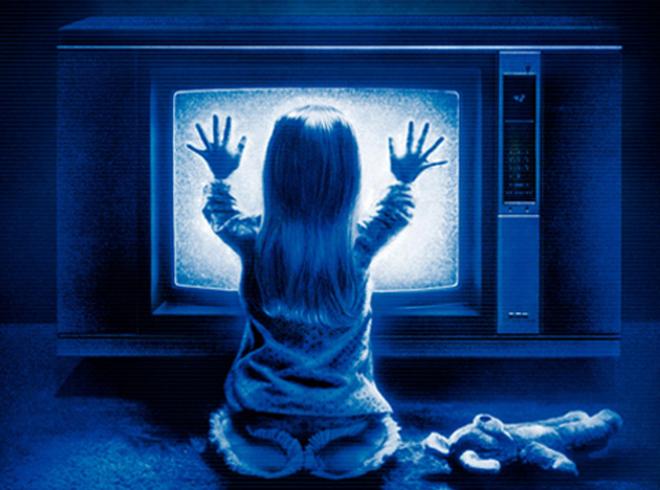
 Most responsible parents will tell you that using the television as a surrogate nanny is bad for kids, but my own experience as a child would argue against this. My parents were wise enough to know that they couldn't raise me alone, that there were some places in the child mind that parents shouldn't go, and the only reliable guides were creatures of the night.
.jpg) Watching the Universal films now, I am as aware of their flaws as of their flickering moments of brilliance. Carl Laemmle’s productions suffered from the curse of the early “talkies,” lamely interspersing arresting visual drama with perfunctory drawing room chat, light romance, and insipid comedy. But to paraphrase Norma Desmond: the monsters are big, it’s the pictures that got small. What struck me as a child watching these for the first time, and what still amazes me, is the concentrated power of character evoked by Karloff, Lugosi, and Chaney. The dead stare, wild arm movements, and disconcerting forward lurch of Karloff’s Creature have become iconic, and while they are easy to imitate, as I would come to learn by donning a “Frankenstein’s Monster” costume the following year, there is nothing quite as compelling as the real thing.
Watching the Universal films now, I am as aware of their flaws as of their flickering moments of brilliance. Carl Laemmle’s productions suffered from the curse of the early “talkies,” lamely interspersing arresting visual drama with perfunctory drawing room chat, light romance, and insipid comedy. But to paraphrase Norma Desmond: the monsters are big, it’s the pictures that got small. What struck me as a child watching these for the first time, and what still amazes me, is the concentrated power of character evoked by Karloff, Lugosi, and Chaney. The dead stare, wild arm movements, and disconcerting forward lurch of Karloff’s Creature have become iconic, and while they are easy to imitate, as I would come to learn by donning a “Frankenstein’s Monster” costume the following year, there is nothing quite as compelling as the real thing.  In the days before VCR, it was easy to forget the less compelling qualities of uneven horror classics. But one could experience their most arresting images repeatedly through grainy photographic reproductions in magazines like Famous Monsters of Filmland, Creepy, and Fangoria. These were the pulps of my youth, their garish covers splattered across drugstore and supermarket magazine racks across suburbia. The amount of time I spent gazing at still images of movie monsters dwarfs the time spent watching moving images on the television screen. Thanks to a series of Revell model sets, children of the sixties and seventies were even able to experience these creatures in three dimensions, and in painstakingly painted color. Monster magazines and model sets formed the youth culture of many of the great horror film innovators of the seventies, a point emphasized in Tobe Hooper’s Salem’s Lot (1979), whose youthful protagonist, Mark Petrie, adorns his room with posters and hand-painted models of the classic movie monsters.
  These figures have an undeniable charisma, a glamour that attracts while it repulses. It is an effect I had become familiar with from book illustrations to the Grimm’s Fairy Tales and other nursery chillers. I cherish having grown up with books as physical objects: an octavo or quarto tome can be haunted in ways a Kindle cannot. One particular image comes to mind, from Brunhoff’s Babar the King, which depicts, in a two-page spread, a horrific nightmare suffered by the elephant hero. I believe I gazed at this image more often than any other illustration from my childhood library, but each viewing involved a prolonged ceremony, as I worked up the courage to open the page, gripping the covers to shut the book quickly if the excitement became too much. This tense and awestruck mode of viewing is the essential posture of visual horror, one I would repeatedly resume in watching films as disparate as Dracula, Polanski’s Repulsion, Hooper’s The Texas Chainsaw Massacre, and Cronenberg’s Dead Ringers.


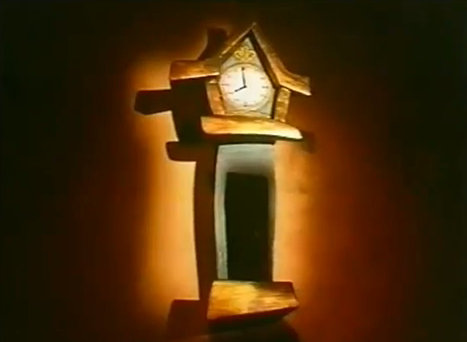


 Press Play Video Blog