
[Publisher’s Note: I’ve been arguing with film and TV critic Tom Carson for over a decade, over all sorts of issues. One is the relative merit, or lack thereof, of the films of Steven Spielberg, about whom I’m quite enthusiastic; Tom, not so much. Tom’s recent, highly skeptical take on Schindler’s List in The American Prospect sparked a chain of emails between us. We talked about Spielberg, history, Hollywood, the relationship between showmanship and truth, and other thorny issues. Read on, and feel free to argue with either (or both) of us in the comments.—Matt Zoller Seitz]
Matt Zoller Seitz: It’s fascinating to me that, after all these decades, and after so many Oscars and Oscar nominations and such a gigantic box-office take, Steven Spielberg is still considered an “issue.”
Tom Carson: Then we must read very different stuff online, because one reason I get so contrary about him is the amount of uncritical reverence he attracts.
MZS: I don’t get the “uncritical reverence” thing at all. The industry has canonized him for financial as well as “respectability” reasons—to Hollywood, he’s like Walt Disney, Alfred Hitchcock, Stanley Kramer, and maybe Cecil B. DeMille rolled into one, and they’ve certainly given him every award in existence at some point or another. But I wouldn’t describe the critical or even popular reception as purely adulatory. The numerous takedowns of Lincoln this past year seem to me like proof of that.
TC: But even when people find fault with a particular movie of his, he’s on a sort of hallowed plane I mistrust. Interestingly, in my experience, that’s especially true among younger movie buffs — who might be expected to think of Spielberg as an oldie and, you know, chafe a bit. Instead, he seems to be a hallowed figure to them, the guy who defines what movies can be.
MZS: Not a week goes by that I don’t see somebody on social media linking to a think piece or an interview with some other filmmaker decrying Spielberg as a rank sentimentalist, a hack, a fascist with a smiley face, or some combination. You’ve had serious problems with him for quite some time, Tom, and since I’ve been arguing with you about him for years now, I thought it might be fun to argue about him here.
The spark for this is your recent piece for The American Prospect, keyed into the 20th anniversary of Schindler’s List. It took the film to task for some of the same reasons that Stanley Kubrick disliked it—for, in essence, finding a triumphant story within a narrative of genocide.
This isn’t the first time you’ve been very skeptical about one of his historical films. I still remember your Esquire piece from 1999, after Saving Private Ryan came out and became a cultural phenomenon. It included a line so provocative that it made me write a whole rebuttal in New York Press: “Honestly, I can’t see much that Hitler would have wanted changed in Saving Private Ryan, except the color of the uniforms.” And this: “It’s a weird reversal of the usual proportions of the selfless-gallantry genre, in which one man dies to save many. As a parable of this nation’s World War II sacrifices, the story would be truer to what the GIs deserve being honored for if Ryan were a European. Then again, Saving Monsieur Renault might not have gripped the modern Stateside audience: Who cares about some damn snail eater? Instead, in a way that’s both solipsistic and tautological, saving the world gets redefined as saving ourselves–which must mean we are the world.”
Is it possible to sum up what it is about Spielberg that irks you so? Is it his filmmaking, his choice of subjects, his world view, or some combination?
TC: Every problem I have with Spielberg starts with conceding his brilliance as a filmmaker. That’s particularly true when he’s giving us one of his 20th-century history lessons. With both SPR and Schindler’s List, there’s a way that his depiction of the event gets conflated with, or even outright supercedes, the event itself. If you find fault with those movies, you’re indifferent to the GIs’ sacrifices or the Holocaust’s evil. And since I care a lot about history, I care a lot about those movies’ inadequacies in substituting for the real thing in people’s minds.
If the comparison isn’t too incongruous, it’s a bit like the way the Disney versions of classic children’s stories have become the quasi-official ones. I don’t want Spielberg’s idea of the Normandy invasion to be the authoritative one any more than I want the Disney version of The Jungle Book to replace Kipling. But my animus may have something to do with the fact that The Jungle Book and Cornelius Ryan’s The Longest Day are two books I knew practically by heart at age 10.
MZS: Well, I think what Spielberg is doing in these historical films is a more sophisticated than he’s being given credit for. He’s working in that Stanley Kramer vein—which is to say, on the most basic level, at the level of glossy Hollywood entertainment—but I don’t necessarily think the takeaway of his historical films is as simplistic as detractors say.
For instance, Schindler’s List, to me, doesn’t feel like a triumph-of-the-human-spirit movie at all, because it constantly makes us aware that this is an anomalous story; a lot of innocent people die onscreen in the film, and it’s portrayed with an almost Kubrickian level of cold absurdity, such as that scene where the young Jewish woman architect tells the Nazi officers that their architecture plans are subpar, and they take her advice to heart, then shoot her anyway.
I can’t think of another mainstream American film that explores the sick intricacies and self-justifying anti-logic of fascism and antisemitism as thoroughly as Schindler’s List does. I think the question, “How could a thing like this happen?” is asked and answered in the movie in a no-fuss, very pragmatic way: It happened, and the explanation is less important than the fact of all that moral inaction/complicity/corruption happening in every corner of the film.
The moment where Schindler observes the liquidation of the Krakow ghetto from afar, and suddenly sees this one little girl with a red coat, is a brilliant moment, one that challenges the audience in a clever, almost subliminal way. Schindler doesn’t personally know any of the people he’s watching suffer, but that splash of red indicates that he individualized this one abstraction, this one child, for whatever inscrutable personal reason. Suddenly the abstraction isn’t abstract anymore, and that launches him into this secret, very risky mission to save as many people as he can, at great risk to himself. That’s all it takes. And the implication is, that’s all it should take for anyone. I don’t think Schindler’s List devalues the magnitude of the Holocaust at all. I think it refuses to stop at the horror, refuses to put it in the past and declare it a mysterious, unanswerable horror, something sacred that you can never even depict for fear of trivializing it. I think it’s taking a much more common sense approach, a present tense, “What does this mean now?” approach, and saying something like, “It is possible to just make up your mind to give a damn about people you think have no connection to you—to just decide to care, and then to take action.”
We’re all Schindler, standing on that hillside watching horrors happen far away; we all could decide to add a splash of color to one person’s distant grey coat, and suddenly we’re invested, and it’s not as inscrutably difficult as we might make the process out to be. Maybe we intellectualize the basic issues too much.
That’s what I get out of Schindler’s List, and I think it’s hugely valuable. Is it naïve or corny to respond to a message like that? Or is refusing to respond to a message like than an indication of the sort of moral paralysis that enables atrocities to happen in the first place? There’s an anger, a furious present-tense anger, in Spielberg’s depiction of Nazi violence against Jews that caught me by surprise back in 1993, that still feels fresh, and that I believe is of great value and purpose.
Most Holocaust movies, whether dramas or documentaries, are a lament for something that happened a long time ago, and that has been sort of entombed by history, or by history books. When we say that a movie makes history “come alive,” it’s always a veiled admission that for most of us, anything that happened before we were born is a dead thing, dead to us, in the past, irrelevant except in terms of academic study or maybe political comparison. The history in Spielberg’s movies is not that way. Once you get past the bracketing devices, which I mostly don’t care for, and you’re in the thick of it, it’s happening now. You’re right in the middle of things. Suddenly what’s past has become present tense.
Schindler’s List might be Spielberg’s best example of this sort of approach to history. It’s got a dramatic-personal arc for the main character, and humor, and pathos/sentiment. But mostly it’s angry. It’s angry that these events happened in the first place. I mean, truly angry. Incredulously angry. Some of the more blackly humorous, Strangelove-ian depictions of German illogic are scathing. You can feel the filmmaker going, “You’ve got to be kidding me . . . How insane is this? How ridiculous is this? And what kind of spineless, ass-covering cowards would stand around letting something like this happen, for fear of losing their property or their social station?” It’s a primal response that is at times closer to what you’d expect from somebody like Oliver Stone than from Steven Spielberg, who is not know for his anger.
I love that sense of revulsion, the sense that the whole movie is shuddering in recoil. This movie holds the audience to a higher moral standard than most movies about the Holocaust, by not keeping the horror safely in the past, by making the violence present tense and battering you with it. And it’s really important to point out, again, that this movie is aimed at a general audience, at the widest possible viewership, and that most of the people seeing this have perhaps not imagined themselves into the situation as extensively as a history buff might have already done, or as a documentary buff might have already done. Job number one for a film of this type is to immerse the viewer and make the situations feel immediate, to spark an emotional understanding. And on that score, large parts of this film—and parts of Spielberg’s other historical dramas—are very successful. I don’t see how one could look at the movie and not think, “What would I do in this situation? If I were part of the ruling class, or one of the so-called ‘good Germans,’ would I risk everything the way Schindler did?”
For all the awards the film has won, I don’t think it has ever really been given proper credit for that.

The Girl’s Red Coat and Dorothy’s Ruby Slippers
TC: If you compare my two pieces, it should be obvious that I think more highly of Schindler’s List than I do of SPR. My problems with the former have to do with how the third act does, in my view, shunt aside the horror of mass death in favor of sentimentality about the handful of people Schindler saved. To my mind, there’s an equation between that red coat and Dorothy’s red ruby slippers—she’s The One—and what about the thousands of children sent to the gas chambers who got stuck wearing gray that day? I’m as grateful as anyone that Anne Frank is famous because we have her testimony. But at some level, to single out an individual victim of the Holocaust is to deny the horror of its anonymity. Like, if the kid hadn’t been so noticeable—and sorry, but she’s as cute and tough as Shirley Temple, guiding our responses somewhat—Schindler’s conscience wouldn’t have been stirred?
By and large—because I do admire how Goeth is characterized, and we’ll get to that—I also don’t agree with you that the movie is really all that informative about the nature of anti-Semitism or how the Holocaust came to be, since a viewer without prior awareness wouldn’t find much that explains either. Its power comes from re-creating the Holocaust’s atrocities so intensely that you feel you’re watching—or, if you’re susceptible, almost experiencing—the real thing. That bothers me. We have a lot of newsreel documentation of the actual camps, and the paradox is that Spielberg’s very scrupulous and horrific facsimile ends up having more authority for the audience because it’s superior as filmmaking. There’s something disturbing about the fake version replacing the documentary one at that level.
MZS: I don’t agree. Where Spielberg excels is where narrative cinema itself excels: at helping you understand the physical, visceral experience of going through something, whether it’s a mundane contemporary moment or some grand historical turning point. Where Spielberg flounders, I think, is when his films are trying to hard to put things in perspective, to put a frame around it. The strongest section of Amistad for me is that flashback to the Middle Passage, which conveys the full physical as well as moral (immoral) reality of the slave trade better than any mainstream American film or TV production ever had. The lived experience of being under fire and seeing people blown up around you is the most valuable and memorable part of Saving Private Ryan, although that film’s “men on a mission” template tends to turn a story with Apocalypse Now/Dr. Strangelove absurdist aspects into something that feels, or plays, much more conventionally. The guys argue about the logic or necessity of saving this one guy, but the movie makes it clear from the very beginning that they’re risking soldiers’ lives for a symbolic or PR gesture. And even at the end, the film has a deceptively complex/simple way of asking if it was all worth it: it’s concluding, I think, “Yes, it was worth it, in that they saved this one guy’s life, and that’s what you can take out of it—and maybe it’s the only unambiguously positive thing to come out of it all.”
But you’re still aware that almost everyone else in the platoon died, and they all had lives, too, lives that were just as valuable as Ryan’s.
The film is bracketed with those cemetery scenes, which are admittedly very sentimental and perhaps unnecessary from a plot standpoint, but even those aren’t as straightforward as they initially read. We start and end with an image of the American flag, but it’s not a robust, pristine, poster-ready image of a flag. The flag is tattered, and the sun is behind it. You see the flag, but you also see through the flag, a multi-valent image that might be—as odd as this sounds!—too subtle for the intended audience. Visually Spielberg is incredibly subtle, even when he’s being loud and spectacular, but those kinds of subtleties tend to get lost in the din.
The lived experience of those Schindler’s List atrocities are the most valuable aspect of the film—that and the practical response on the part of Schindler, which is to say “I need to do something about this.” That we never know why he did it is one of the reasons I respect the film as popular art, that “One more life” scene notwithstanding, which I really wish the film had done without.
But that’s the biggest problem for Spielberg, as far as this fan is concerned; that tendency—as a New York Times Magazine piece put it, back in 1999—to put ketchup on a perfectly good steak. Which might or might not be a whole other issue?
TC: Well, let’s start with your line “The lived experience of being under fire and seeing people blown up around you is the most valuable and memorable part of Saving Private Ryan. . .”, which is the heart of the problem for me. It isn’t a lived experience; it’s an illusion, brought off with great directorial flair and technological skill. To me, there’s a danger in people watching SPR and thinking they now know what It Was Really Like—much less How It Really Felt. They don’t and I don’t either. It used to be that movies simply couldn’t approximate — and, indeed, heighten and hyperbolize—reality in this way, and I question whether that’s a desirable goal.
Since I do know my D-Day history, I could also bore you with all the things SPR gets wrong or deliberately falsifies for excitement’s sake, which would obviously be less troublesome if people weren’t convinced that they were seeing D-Day exactly as it was. Beyond that, what I most dislike about SPR is its distasteful, bizarrely Wagnerian mysticism about sacrifice without reasoning why, which goes against the grain of everything I admire the GIs for and is the reason I never tire of saying that this is the kind of WWII movie the Germans would have made if they’d won it.
It doesn’t seem to me that Spielberg treats the mission as absurdist or reminds us—satirically or otherwise—that in some ways it’s PR. It treats saving Ryan as noble, with Hanks’s valedictory “Earn it” compensating for any illogic in all these guys dying to save just one.
And yes, the ketchup-on-steak problem is an abiding one. I really dislike both Schindler’s “And here are the real Schindler Jews!” epilogue and SPR‘s present-day frame story, though for somewhat different reasons. In one case, Spielberg is using the actual survivors to validate his movie, and in the other, the implication that Ryan—and by extension, America—has indeed “earned it” is both nonsensical and offensive to me.
 MZS: Again, I don’t think SPR ever comes out and says, “Yes, we ‘earned it'”, whatever that phrase means. Not in a political or historical sense. It’s just one guy talking to another guy as he’s dying, saying, “Don’t let this personal sacrifice become meaningless.” Whatever that means to Ryan is whatever that means to Ryan, and there’s no indication that he became a senator or CEO or the head of a movie studio. He’s just some old guy visiting the cemetery with his wife and family. I don’t really see a “by extension, America” in that bracketing device, though John Williams’ score confuses the issue, as it so often does.
TC: I’ve complained many times that Spielberg’s reliance on Williams is an artistic flaw. Even when a scene is emotionally complex and ambiguous, he often (not always) lets Williams undermine that by spelling out the obvious, non-ironic reaction, which is a form of either artistic cowardice or pop-culture casuistry. I can’t stand how little Spielberg trusts the audience most of the time.
As for the “We earned it” thing, I was unaware that the United States participated in WWII as a self-improvement project. What moves me most about the real GIs—incidentally, a very disgruntled, reluctant draftee army, not nearly as thrilled by or expert at warfare as the Germans were under Hitler—is that they ended up dying to liberate all these strangers in foreign lands that they had no connection to and whose languages they didn’t even speak. SPR makes it all about us, and I think the coda scene when the elderly Ryan asks, “Have I been a good man? Have I led a good life?” and wifey reassures him he’s done great is a pretty unmistakable benediction on that whole generation.
Spielberg the Showman vs. Spielberg the Artist
MZS: Spielberg the showman and Spielberg the artist are inextricably intertwined, and sometimes they get tangled up, if you know what I mean. But I think he’s doing consistently subtle work in an unsubtle mode. Compare Saving Private Ryan to, say, Michael Bay’s Pearl Harbor—that’s a film that I think is truly guilty of the sins you ascribe to Ryan, and has none of the residual ambivalence that makes Ryan fascinating even when it’s irritating or problematic. President Franklin Delano Roosevelt gets up out of a wheelchair in that one to chew out the joint chiefs of staff for being pussies!
TC: Well, bringing Pearl Harbor in as a point of comparison could turn me into a shrieking Spielberg fan in one second flat. I may have my problems with Saving Private Ryan, but it’s a serious movie that’s worth arguing about and not a travesty. I almost stood up and started shouting obscenities in the theater when Bay did that cutesy bit with the two American fighter planes flipping vertical to avoid crashing. It’s the “day of infamy” and he wants to make audiences laugh with a cool stunt.
MZS: The point is, I think there’s value in a kind of national reckoning blockbuster of this sort, and that it’s easy to lose sight of its utility when you’re a critic. Hotel Terminus is a far more sophisticated film about moral inaction in the fact of Nazi corruption and cruelty than Schindler’s List. But it’s a documentary, and done in a mode that is for a variety of reasons is simply incapable of reaching as large a number of people as a Spielberg blockbuster.
That’s the rub, ultimately. When you work on the scale that Spielberg works on, you’re basically making a story that consists of woodcuts. Every block has to be simple, pared down, graspable. You’re sort of working simultaneously with the reality and the myth that’s sprung up in its wake and that threatens to displace it. I think you can make popular art in that way and still be able to call it art – I think John Ford proved this quite a few times, though some may disagree – but the downside is, when you work this way, the movie’s complexities are more elusive, and more apt to be drowned out by the elements that are there to make it accessible. You may make something that, in terms of picture and sound, in terms of expression, is powerful, perhaps revelatory, but if it’s not scrupulously faithful to what happened, a lot of people are going to dismiss it anyway as being just a bunch of Hollywood bull. A bunch of pretty pictures. They’ll say, “Who cares about the form, when there are so many problematic aspects with the content?”
There’s always going to be that nagging question, “Can this even be done? Is it worth making this movie, in this mode, or are we kidding ourselves by even trying?”
TC: I wouldn’t say either Schindler’s List or SPR shouldn’t have been made, no.
But in both cases, I’m bothered by the perception that they’re the definitive, ultimate depiction of the events in question—an idea, as I’ve said elsewhere, Spielberg doesn’t exactly discourage—and that to watch either is the closest thing we’ll ever have to an approximation of the reality (clearly one of Spielberg’s artistic goals).
Even if it is, shouldn’t we accept that some realities aren’t available to us via cinematic mediation and we’re better off not confusing the two? You’re arguing that it’s a good thing for people to have this sort of vicarious experience, and I think it’s a slippery slope in terms of our historical understanding.
You should also feel free to call the next observation a double standard on my part. But I do think this kind of historical re-creation is a different story when the events are well outside anybody’s living memory and we don’t have newsreel records of them to complicate the aesthetic and ethical issues involved in our reaction to seeing them get the Spielberg treatment. I actually think more highly of Amistad than many people do, since we don’t have documentary films of the Middle Passage—or, as a result, any real way of visualizing its horrors *except* via a filmmaker’s version. I also like the underrated way in which the movie’s interest in thorny talkiness—not just compelling action—prefigures Lincoln.
Even so, here’s a counter-example: Spielberg has never tackled 9/11 head-on, and I hope he never will. But he has made two movies that were clearly responses to it—War of the Worlds, which is mostly terrific until the dumb plot starts taking over, and Munich, which is the single movie of his I admire most. Coming at the subject obliquely let him say so much without the quandary of challenging himself to make the World Trade Center’s fall even more vivid to audiences—and, therefore, more exciting, the inevitable downside of Spielbergization—than the TV footage we all watched over and over. So I prefer him in that indirect but eloquent mode to the “This is what it was really like” task he sets himself in SPR and Schindler’s List, which has a built-in fallacy, to my eyes.
For instance, as I hinted earlier, I do admire the treatment of Amon Goeth in Schindler’s List. The way he’s at once turned on by the chance to unleash his own sadism and a fairly pathetic (even creepily wistful, disgustingly self-pitying) mediocrity does tell us something about Nazism. There are interesting ways that the cutting keeps equating him with Schindler, not for a simple-minded censorious effect, but as if to imply that each man could have gone down the other man’s path if only Goeth hadn’t yielded to the worst in himself while Schindler was discovering the best.
But then the potential psychological complexity of that gives way to the large-scale depictions of the Final Solution’s atrocities, which are ever so slightly marred by showmanship—showmanship in a grim and noble cause, but showmanship nonetheless—and ultimately teach us less than a close-in movie just about Schindler and Goeth (maybe one not even set during the literal Holocaust, who knows?) might have. Does that make sense?
MZS: Yes, it does. It seems sort of a strange corollary of Francois Truffaut’s belief that there is no such thing as a truly anti-war film, since war is such an amazingly cinematic enterprise, always beautiful as spectacle, that to depict it is in some sense to glorify it. I don’t agree with that formulation one hundred percent. I think there are great anti-war films. But he was onto something. And perhaps you are as well, in a different context.
Are there some places movies shouldn’t go?
MZS: The year 1998 was an important one for big-budget films about World War II. Besides SPR, which was an outwardly very straightforward re-imagining of combat in Europe—one that I’d argue complicated and subverted some of the same cliches that it restaged with such incredible vigor—you had The Thin Red Line, which treated combat in the Pacific theater as a sort of midnight movie theological psychodrama about the effect of war and human civilization on nature. And there were two other films that dealt with the Holocaust in genre terms: Life Is Beautiful, which I think is almost universally reviled now, and Apt Pupil, based on Stephen King’s novella about an American suburban boy falling under the spell of an old ex-Nazi who’s moved into his neighborhood. Both of those movies were accused of being insensitive to history, and with perhaps distorting or falsifying history in a cheap way.
At various points during that year I read pieces about some or all of those films worrying that films shouldn’t even go there, that there’s something morally dicey about it. Jonathan Rosenbaum and J. Hoberman both made similar arguments about Schindler’s List, specifically the shower scene—that even depicting such a thing trivialized it. The argument seemed to be (in part at least) that maybe the best way to honor the horrors of history is not to depict certain aspects of it.
I think this is a counterproductive attitude—that one of the best ways to keep history alive is to let it breathe through popular culture, and take each representation of history as it comes, and judge it in terms of the piece itself, and not just in terms of how faithful it is to the actual record. Historical films aren’t just about what happened, or about preserving some facsimile of what happened, or communicating the factual essence of what happened. They are also snapshots of how we the audience—the culture—feeling and think about what happened. I think what we’re really seeing when we attend a film like SPR or Schindler’s List or Lincoln, or for that matter, Django Unchained or Apt Pupil, is a different kind of history, a record of how we felt about an earlier era at this particular point in time, somewhat removed.
TC: The “there are some places movies just shouldn’t go” argument is one I’m not happy to find myself making, even if it means I’m allied for the nonce with Rosenbaum and Hoberman—two critics I consider Mozart compared to my feeble versions of “Chopsticks.” But Spielberg is the ultimate test case, I guess—and who knows if I’d be taking the opposite side if we were talking about Gillo Pontecorvo. So I hope it’s not weaseling to say that the issue isn’t where movies should go so much as how they get there.
For instance, let’s take that famous Schindler shower scene. It excruciatingly recreates every stage of death in the gas chambers except the outcome (including the fact that the women are—accurately—nude, a *very* paradoxical declaration of high moral seriousness). In a way, the historical cheat here is the reverse of Spielberg putting paratroopers behind Omaha Beach (there were none) so he can give us Bloody Omaha up top. Not to be a D-Day pedant, but any troop of Rangers sent to rescue Ryan would have started from the much less bloody and spectacular Utah Beach landing instead. So I kind of knew SPR was fibbing for effect from the start.
But Schindler’s shower scene, to me, is far more morally questionable. The reason it’s there is that, fuck it, Unka Steven was determined to show us Auschwitz—even if the fates of the women we care about turn out to be different than what happened to 99 per cent of the people who got shipped there. For me, Schindler becomes grotesque at the moment the women greet real water coming out of the showerheads with ululations of relief.
That’s only partly because they likely wouldn’t have known “the showers” were usually a lie. The celebratory note here disgusts me, making Schindler’s Jews “exceptional” in a way I think is vile. I’d find that whole sequence infinitely more admirable if its ending had been the routine one at Auschwitz—a pile of obscenely dead bodies who had to be shoveled up, checked for gold teeth and carted off to the crematorium, as usual.
Overall, whenever a filmmaker tackles an obvious Harrowing Subject, my magniloquence detector goes on red alert. It’s interesting to compare Spielberg’s WW2 movies to Ken Burns and Lynn Novick’s The War, because in the latter, the filmmakers aggrandize themselves via the opposite route, the Ken Burns route—by being mournful and stately, not exciting. They’re still putting their version of icing on the cake, but The War does benefit from using the real footage and images, even if it’s got Yo-Yo Ma sawing away on the soundtrack.
Which is more valuable in instructing us about What It Was Really Like, which is more morally dubious?
Tom Carson is the movie critic for GQ and the author of the novels Gilligan’s Wake (2003) and Daisy Buchanan’s Daughter (2011).
Matt Zoller Seitz is the co-founder of Press Play.



 The rise of the antihero in American dramatic television has been nearly fifteen years in the making. Since Tony Soprano revealed a gangster as touching as he was menacing in 1999 (those ducks!), television has introduced programming with a level of thematic and ethical complexity at a consistency never before achieved in the medium. A glimpse at the major award circuit in the past half-decade reveals not only a critical interest in this turn, but a popular one, as well. Mad Men, Breaking Bad, and most recently, Homeland are just three shows that have achieved widespread recognition for their presentation of morally compromised protagonists.
  FX, known for its “There is no Box” brand, is no stranger to this breed of conflicted character. Its breakthrough program, The Shield, was a benchmark in the era of the antihero, considered by many to be an answer to HBO’s oft-discussed flagship. But where Tony Soprano was already a ringleader in an entrenched system of corruption, Vic Mackey was a crime-fighter, one of the good guys. Yet, in his Machiavellian lust to thwart baddies, we witness him torture, blackmail, plant evidence, and murder. In that sense, The Shield can be seen to usher in what has become the current antihero paradigm: where moral ambiguity abounds in spaces beyond the expected arenas of gangsters and thugs—among doctors and high school teachers, ordinary people.
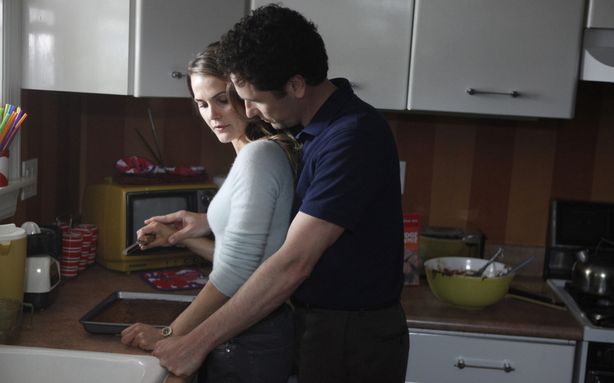
 Discussion of The Americans, thus far, has been largely centered around its relation to Showtime’s Homeland. However, the shows bear little resemblance to each other beyond their basic conversation about what it means to be a double agent, or, in a broader sense, to lead a double life. Homeland is sparked and sustained by a central terrorist plot. The romance that springs up between Claire Danes’s Carrie Mathison and Damian Lewis’s Nicholas Brody is, if a bit predictable, a delectable garnish. Specific motives correlate to known and desired effects (how will sniffing out a new piece of information help Carrie & Co. develop more effective counterterrorist responses?), and these propel the show. But neither Elizabeth nor Philip has a specific agenda—in typical Cold War style, there is no clear, overarching object—so the long-form conflict that emerges is largely character-driven, supplemented by action.
 A romance is only as good as its obstacles, and, as aforementioned, we find no shortage of obstacles in The Americans. If anything, the degree of coincidence incorporated in creating these barriers has been, for some viewers, the show’s primary shortcoming. But when coincidence deepens conflict instead of helping to resolve it—imbuing a certain degree of inevitability rather than deus ex machina—most are quick to forgive. So, when CIA agent Stan Beeman (Noah Emmerich’s savvier analog to Breaking Bad’s Hank) moves down the street from the Jenningses, we’re more interested in the “loaded gun” stress this generates than decrying its improbability. In the end, we don’t want Philip and Elizabeth to have an easy go until they’ve really earned it, and we’re rewarded amply for our masochism.
 Which maybe helps explain why the romantic moments we see unfold here are more touching than just about anything else on television. The premium channels seem to have adopted a per-episode sex quota, and meanwhile, The Americans encapsulates passion in handholding, meaningful looks, and veiled apologies. And the moments of spillover, whether pronounced or Victorian, are downright gut-wrenching. We know what’s at risk, what makes it so difficult for them. Once we understand the kind of traumas (emotional, physical, self-inflicted) Elizabeth has suffered, for instance, no amount of nudity, one night stands, or marital harmony elsewhere can better capture our affections than when, in spite of a seeming incapacity for tenderness, she reaches out and puts her hands on Philip’s shoulders. Sometimes, these romantic moments converge with violence, as in the pilot’s climax, and the effect is so powerful that it manages to transform Phil Collins’s “In the Air Tonight” into something anthemic, hard-hitting, and steamy.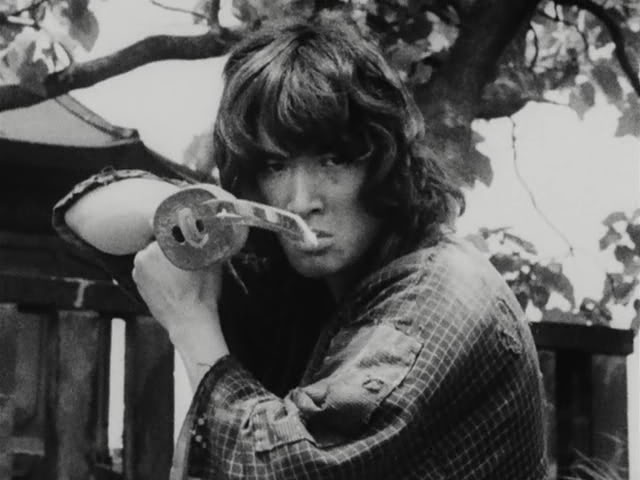

 Thus, it wasn’t until Gran Torino that I could say I really watched an Eastwood movie. The ones I’d seen before were films I looked at as the films I’d expected them to be. But Gran Torino shocked me into seeing it. I’d seen reviews belittling the movie, and I expected it to be a not-quite-vaguely racist heap of claptrap. I don’t remember even when I decided to watch it, or why. But I did.
  We need to pay close attention to the conclusions of Eastwood’s movies, particularly the ones he directs and stars in, because these films allow him to configure and reconfigure his iconicity. From Play Misty for Me to Gran Torino, he has played jazz riffs on the idea of “Clint Eastwood,” repeating and revising the figure he embodies. Nowhere are the riffs more poignantly played than in The Outlaw Josey Wales (the subject of


 On closer examination, chinks in the armor are evident: Wilfred is a program without a genre, as it’s nominally a sitcom but offers no laugh-tracks, studio audience, or stable points of reference (think of the reassuring, character-based through-lines of a sitcom like Friends or Seinfeld). Its titular character, the show’s costar, never appears outside a man-sized dog-suit, just the sort of visual quirk likely to squelch speculation of serious artist intent. It’s neither properly episodic nor properly serialized, as individual episodes both do and don’t depend upon episodes preceding and following. Wood, the show’s most conspicuous setpiece, plays the straight man to Jason Gann’s Wilfred so convincingly, it’s maddening. Certain scenes (such as one in which Ryan is forced to prostitute himself to eliminate a debt, or one in which Wilfred attempts to kill Ryan’s sister while under the influence of demonic possession) are among the most psychologically upsetting accessible on cable; there are entire sequences of episodes in both the first and second season of Wilfred that are gripping but almost entirely devoid of humor. And the series as a whole lacks a plot—unless you count as plot a man’s psyche slowly circling the drain.
 The third level of reality: Wilfred appears on Ryan’s doorstep with his “owner,” Jenna. As the series progresses, all options remain equally possible and equally unpalatable as to who or what Wilfred is. A dog, a man, a ghost, God, Satan, Ryan’s id, Ryan’s ego?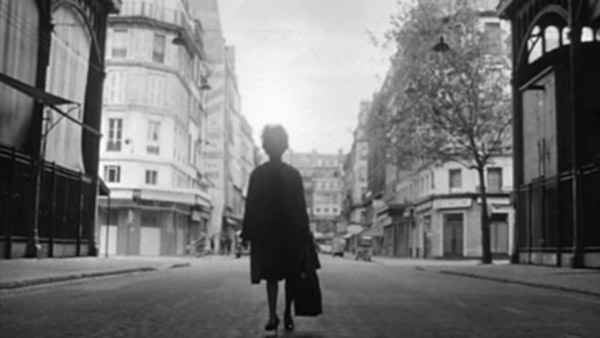
 Second, Rouch was a white Frenchman who made films mostly about Africans. Worse still, he started out during France’s colonial period. For this, he was criticized by no less a venerable personage than Senegalese writer/director Ousmane Sembene (the first prominent filmmaker to emerge from sub-Saharan Africa), who praised his 1958 film Moi, Un Noir but went on to accuse him of filming Africans like insects. However, as Rouch’s work progressed, he did his best to engage in true collaborations with his African subjects. His narrative films were shot without scripts, with the actors improvising a voice-over in the editing room. He made several films with African filmmakers as co-directors. Rouch couldn’t transcend his perspective as a Frenchman, but he tried to engage with Africa and Africans on their own terms: he never used the continent as a backdrop for the stories of white people, as so many filmmakers have. In fact, his film Petit a Petit reverses this trend, making Paris the setting for an African man’s quest for knowledge and his eventual disenchantment with European values.
  The Mad Masters is one of Rouch’s best-known films; unfortunately, it’s also one of his most widely misunderstood works. On the surface, one can easily see why. It depicts a ritual of the Hauka faith, in which penitents participate in a trance ritual culminating in the sacrifice of a dog (who's then eaten) and are then forgiven for their sins. It’s full of images of “possessed” Africans foaming at the mouth and burning themselves with torches. But there’s something more subversive going on here than a simple documentary about African religion. The Hauka faith does not seem to exist apart from the context of colonial Africa, at least as it’s portrayed by Rouch. The possessed are not claimed by their ancestors or gods; they’re taken over by the spirits of colonial figures like generals and engineers. Participating in the ceremony requires some to don a parody of European dress. One can see someone misreading it as a document of African “primitiveness,” but it really shows how cleverly the Hauka have created a new faith out of their oppressive surroundings. The film’s final few minutes suggest that it’s paid off for them in improved mental health.
  Moi, Un Noir may be remembered for influencing Jean-Luc Godard, who declared that he wanted to name Breathless Moi, Un Blanc as an homage to Rouch. More seriously, its use of jump cuts predates Godard’s use of the device. It makes the best case for Rouch’s “ethno-fictions.” Shot among a group of immigrants in the Ivory Coast, it was made without sound. This led to a brilliant idea: Rouch’s subjects could take on new personae, adopting the voices of Hollywood stars like Eddie Constantine and Edward G. Robinson. This isn’t, though, just another way of saying “the Yanks have colonized our subconscious,” as a character in Wim Wenders’ Kings of the Road would later put it; it actually grants Rouch’s subjects the right to larger-than-life fantasies. Without the voice-over, the film’s depiction of lower-class life in the Ivory Coast would probably be grim and hopeless; the narration lends it just the right touch of playfulness and wit. “Constantine” and “Robinson” may be poor, even sometimes justifiably bitter, but they still have a sense of humor.
  Chronicle of a Summer uses the phrase “cinéma vérité” in its opening sentence, although here it describes the directors' stated goal of “film truth,” not a label for a genre of documentaries. After the concept of “cinéma vérité” was popularized in the ‘60s, its naiveté was critiqued at length. Chronicle of a Summer is far from innocent. It incorporates scenes that feel fictional, even if they’re not, such as a long walk by Loridan down a nearly deserted street as she delivers a monologue about her past. Rouch and Morin begin and end the film by focusing on themselves – in no other Rouch film I’ve seen is the director such a prominent presence—but they end Chronicle of a Summer by showing the film to its subjects, getting their mixed reactions and then talking about those responses. One can imagine the film turning into an endless hall of mirrors, with a coda depicting the first public screenings.
  Press Play Video Blog