The Big Lebowski a Masterpiece? That’s Just, Like, Your Opinion, Man

THE BIG LEBOWSKI a Masterpiece? That’s Just, Like, Your Opinion, Man

null

Without question, The Big Lebowski is the most popular movie the Coen brothers ever made. I’m not talking about box office receipts—Fargo and O Brother, Where Art Thou had higher domestic grosses—but in terms of ubiquity and fandom, the 1998 stoner comedy has no equal. Louisville, Kentucky hosted its tenth annual Lebowski Fest last year, wherein diehard fans celebrated all things Dude. They quoted lines from the movie, dressed as their favorite characters, and drank more White Russians than they probably should have. What’s missing from the conversation, however, is not how the movie has become an underground pop culture phenomenon, but how The Big Lebowski stacks up as a movie. Quite simply, The Big Lebowski does not belong among the canon of the Coens’ best films, no matter how much the fans and urban achievers protest.

Maybe it’s confirmation bias, but whenever I bring the topic up with friends, I’m invariably met with, “That’s just, like, your opinion, man.” Indeed, repeating your favorite lines is part of the fun, especially when presented with the appropriate context. But there are other Coen comedies, too, and their meticulous consistency is what makes them better films. In terms of full-on kookiness, the introduction of Intolerable Cruelty’s Heinz, the Baron Krauss von Espy lands better and harder than the introduction of Jesus, the bowling pederast. With a mix of broad and focused diction, the central trio of O Brother, Where Art Thou has more consistent comic chemistry than uneven Lebowski heroes; Donny (Steve Buscemi) amounts to a one-note joke, drilled into the ground by the Coens. Come to think of it, Raising Arizona’s stolen baby is more a useful conceit than Donny is: when Ed (Holly Hunter) sobs with joy, it’s a captivatingly funny character moment. “Shut the fuck up, Donny” is merely a dismissive statement, repeated too much.

I don’t mean to imply that I think The Big Lebowski is a bad movie, or a bad comedy. As Sam Elliott’s character would say, “Far from it.” The Big Lebowski is a good comedy because it features smart lines for stupid characters. The Stranger (Elliott) introduces The Dude (Jeff Bridges) as the laziest man in all of Los Angeles County, but he’s also a quick wit. Other characters don’t reward his jokes—Maude’s (Julianne Moore) “Don’t be fatuous, Jeffrey” is the warmest response he gets—so the audience has an instinctive sympathy for The Dude. Nobody else but the viewers notice the sharp mind at work underneath the fog of weed, vodka, and sunglasses. Walter (John Goodman) is The Dude’s opposite and equal: while Walter’s broad gestures initially define him, it’s the smaller lines (e.g. “You mean beyond pacifism?”) that push him beyond caricature into something unique. And with a tapestry of odd secondary characters, The Big Lebowski ambles along without much fuss.

“Ambles” is the key word here. The weakness of The Big Lebowski—and the reason it does not deserve mention among the Coens’ best—is that it amounts to little more than a well-written shaggy dog story. First and foremost, meticulously tight plotting define the best films by the Coen Brothers. Blood Simple and Fargo, for example, are examples of pure cinematic storytelling, and they deal with the repercussions of murder in an inexorable, brutally logical way. Ardent Lebowski fans like to say the meandering plot and zany asides are deliberate, reflecting The Dude’s abiding nature. I’ve heard other defenses which claim that the movie has an airtight plot, and it’s The Dude’s stoner fog that makes it all appear so hazy. The problem with both theories is that they ignore how the Coens consistently put their characters in a narrative fog, even without the White Russians or pot. Fargo’s Jerry Lundegaard and even No Country’s Llewelyn Moss could not make their way through a dense narrative from the Coens, yet the directors’ command of plot is held to a higher standard than the flawed, imperfect information their characters are given. Put another way, the Coens fall into the trap of the Dude’s laziness in The Big Lebowski, and the Coens are at their best when they’re being very un-Dude.

Look, celebrating The Big Lebowski is not beneath me. Back in 2009 I went to a mini-Lebowski party at my friend’s apartment. In the email chain leading up to the party, I dropped multiple references to lines in the movie, including a couple that are in this article. I know what it is to be a fan, but it is important to separate fandom from analysis. The former can obfuscate the latter, which is a shame since some scrutiny might illuminate the secret of The Big Lebowksi’s unlikely endurance. Our answer is more than a throwaway line, or an annual festival. Say what you like about the tenets of actual criticism, Lebowski fans, at least it’s an ethos.

Alan Zilberman is the film editor of Brightest Young Things, as well as a contributor to Tiny Mix Tapes, Washington City Paper, and The Atlantic. Follow him on Twitter here.

O Coen Brothers, Where Art God? A Conversation Between Matt Zoller Seitz and Jeffrey Overstreet

O Coen Brothers, Where Art God? A Conversation Between Matt Zoller Seitz and Jeffrey Overstreet

null


Editor’s note: So, I was watching Raising Arizona for the 400th time the other night, and laughing at the sheer Freudian-Jungian comic bookish-ness of having the lone biker of the apocalypse appear in conjunction with the hero, H.I. McDonough, having a dream. It’s almost as if he was summoned by the hero’s dream—as if he’s a metaphor made flesh. You can see the biker as a physicalization of the hero’s internal struggle to put down the outlaw within, and become domesticated. The biker is an id creature erupting from inside of H.I.—the return of the repressed, I guess Freud might say—only he’s riding a giant Harley and he’s got shotguns and grenades.
 
And then I started to fixate on something else: the sense that there’s an equally strong religious or spiritual dimension to that scene. It’s as if the biker is a demon being summoned like a supernatural creature from a horror movie or an ancient folktale. Ed doesn’t call him a “warthog from Hell” for nothing.

And this in turn got me thinking about all the other instances in Joel and Ethan Coen’s filmography where it seems as though supernatural forces, or at least nonrational or uncanny forces, are at play—where what you’re seeing doesn’t quite seem to be metaphorical, if you know what I mean. There’s an angel and a guardian angel in The Hudsucker Proxy, and the actual stoppage of time. The villain in No Country for Old Men seems like Satan himself, or a demon from hell, not unlike that biker from Raising Arizona. The bad guy in The Ladykillers is basically Satan, doing battle with an old widow, and their dynamic recalls Robert Mitchum and Lillian Gish in The Night of the Hunter, which was a Manichean story that quoted the Bible and from folktales and fairytales rather liberally. A Serious Man draws on Jewish theology and folktales quite pointedly, and it ends with what looks rather like a miracle, or maybe a curse, or the apocalypse; and in any event, the film seems to connect with No Country for Old Men, which also has a fire-and-brimstone, or Revelation, kind of vibe.

And at a certain point I just thought, “I need to get Jeffrey Overstreet to talk to me about this, and see what he thinks.” Jeffrey is a novelist and one of my favorite film critics. He writes with great lucidity and compassion about all sorts of movies, from all sorts of angles, but what I value most about his work is the theological-moral perspective he takes on things. He’s not a dogmatic scold, sifting through popular art looking for work that fits a rigid world view; he’s more interested in Looking Closer, as his blog title suggests, to discover what, if anything, the work is saying. That’s what I think he does in this conversation.—Matt Zoller Seitz 

nullMatt Zoller Seitz: Do the Coens believe in God? Can we even say that for sure? Do they believe in the non-rational, the supernatural? Or are they just pranksters pulling our chains and hoping to spark conversation pieces like this one, while they sit there snickering? What do you think?

Jeffrey Overstreet: As Emily Dickinson says, “Success in Circuit
lies….” So, forgive me, but I’ll get to that question about God in a circuitous
fashion. 

I think it’s great that the scene
that started your engine for this conversation is “The Emergence of the Lone
Biker.” I think it’s one of the most intriguing in the Coen brothers’ whole repertoire.
(I can’t say “repertoire” in this conversation without giving it an exaggerated
Southern pronunciation, just as a Coen brothers character would say it.) Anyway,
that scene is not only resonant with apocalyptic, supernatural implications —
it’s intriguing in that it serves as one of several portals into their other
films. It’s one of those recurring motifs, those strands of thread that stitch
the Coens’ whole body of work together.

Raising Arizona’s H.I. has the
Lone Biker, who greatly resembles Sheriff Bell’s nemesis in No Country for Old Men —Anton Chigurh.
Both are lone figures of chaos, wrath, death, and judgment, prone to blasting
“the little things” (bunnies, birds) and the innocents. In fact, there are
shots of H.I.’s troubled sleep, in which he dreams of apocalyptic things, that
mirror Llewelyn’s troubled sleep after he brings the money home in No Country. There are strong connections
between H.I. and Llewlyn, fools-in-arms right down to the way that their stolen
goods drag them down into much darker and more frightful trouble. The allure of
“what other people have” — money, a family, power, fame — is the pathway to
hell for so many Coen characters.

But there are a variety of crooks in
the Coens’ world. There are boneheads like H.I. and Llewelyn, who take what
doesn’t belong to them and regret it. There are power-mad figureheads and CEOs
and “Men Behind Desks” like Waring Hudsucker in The Hudsucker Proxy and the Big Lebowski in the film that bears his
name, and the Hollywood studio execs in Barton
Fink
, and Leo in Miller’s Crossing
crooks who are insulated and egomaniacal, corrupt and rotten to the core. There
are flimsy fools of apathy and inaction, like Larry Gopnik in A Serious Man and Ed Crane in The Man Who Wasn’t There. Those who
insist on forcing the world into order through the power of law  —Sheriff Bell in No Country, Tom Reagan in Miller’s
Crossing
, Rooster Cogburn in True
Grit
— end up despairing, unless they act in allegiance to some kind of
higher law, embracing mercy and mystery.

In fact, the only characters I can
think of who aren’t seriously messed up are Marge Gunderson in Fargo and Mattie Ross in True Grit.

So, back to your question
about God: I think the Coens suggest him via
negativa
. They show the incompleteness and insufficiency of a vision that
leaves God out. There are clearly human evils at work —evils of foolishness,
carelessness, folly, and evils of greed and deliberate violence. But there are
also evils of apocalyptic, seemingly supernatural proportions. As No Country demonstrates, good deeds and
the power of law are not enough to save the world. Ultimately, the best we can
do is seek justice, love mercy, and walk humbly in the presence of something
greater than ourselves. 
null

The whole “white hats versus black hats” view of the world
 
MZS: It’s very elusive, very tricky, very coy, I guess you could say — the way they deal with these issues, or don’t deal with them.

From Blood Simple onward, the Coens have offered up plot after plot after plot wherein good and evil square off, but both good and evil are as comical as they are formidable. Good is noble but rather dull, or conventional and predictable. Evil—or corruption—is more exciting, I suppose, or at least superficially sexier than good, but kind of pathetic in the long run. Anton Chigurh is distinguished by his isolation and his grotesqueness. The crooks in Fargo bang prostitutes in hotel rooms after a Jose Feliciano concert, and seem to last all of ten minutes before Johnny Carson comes on; meanwhile, Marge Gunderson and her husband seem truly satisfied in their “boring” suburban home, in their shared bed.

In the Coens’ work, the settled, slightly boring but essentially satisfied “good” collides with the evil, the chaotic. And the fate of the world, or at least these characters’ own little world, is at stake.

nullBut here’s the really interesting part for me: in a Coen brothers film, you can never be entirely sure if good really defeated evil or if evil destroyed itself, through overconfidence or inattention or just plain bad luck.

Luck is such a huge factor in the Coens’ work. Blood Simple, Raising Arizona, Miller’s Crossing, Fargo, Barton Fink, Burn After Reading and so many other Coen brothers films have plots that seem driven by mysterious clockwork forces that could either be weighted in favor of “good” or not . . . . But then again, you kind of can’t tell. And while I think I know what the Coens think of their bad guys, I can’t be entirely sure if what I’m seeing onscreen is a condemnation, however comic, or merely a presentation.

Are they moralists, or are they anthropologists?

JO: I think they’re out to subvert the
whole “white hats versus black hats” view of the world. I think they
do believe in good and evil, but they seem to see all of humanity as having one
foot planted in both camps. Their character cannot be “the Good,” but the more
they “lean in” toward love, the more peace and hope and goodness they
find.

Think of H.I.’s final dream, the one
about growing old with a family and feasting. Think of Marge and Norm
celebrating the 3-cent stamp and the upcoming baby. Think of how the most moving
and inspiring moment in True Grit
comes not when Cogburn blasts the bad guys, but when he carries Mattie across
miles and miles trying to save her. The more these characters try and crush
evil, or to diagnose it with the intellect, or try to make themselves better
through the sheer force of will, the more hopeless and sick at heart they
become.

null

Think of poor Barton Fink, who rants
and rants about intellectuals who want “to insulate themselves from the
common man, from where they live…” And what is Barton doing? He’s
recoiling from his neighbor, trying to insulate himself from a “common man.”
But the wallpaper keeps peeling away, and he will eventually have to deal with
the ugliness, the corruption, that is common to everyone. His only hope for
relief, it seems, comes when he learns to carry his “box of
corruption” with him, rest, and look around at what beauty he can find in
the midst of the world’s seeming-absurdity. (And what is that diving pelican in
the final moment but an affirmation that there is something absurd in the
sublime, and something sublime in absurdity?)

In the same way, Sheriff Bell in No Country, for all of his efforts, must
sit at the table with his wife, confess to a sense of hopelessness and
futility, and “lean in” to a dream, to a sense that maybe there is a
glimmer of hope, but it exists beyond our control.

nullThat is why I think there is
profundity in Delmar’s baptism in O
Brother, Where Art Thou
? It’s grace. A fool like Delmar, and maybe even a
fool like Ulysses, can “be saved” when he accepts grace. When these
characters have a sort of Damascus-road encounter with something greater than
themselves, and allow the gravity of that to draw them away from their wicked
ways. “Well,” he tells his friends, “as soon as we get ourselves
cleaned up and we get a little smellum in our hair, why, we’re gonna feel 100%
better about ourselves and about life in general.” That doesn’t work. But
he will begin to feel better about
himself when grace inspires him back toward the straight and narrow, when love
“cleans him up.”

Even Mattie Ross, for all of her
righteous anger, pays a heavy price for trying to fix the world by force. After
she is “disarmed,” she seems to realize that the greatest reward of
her adventure was not justice achieved by violence, but the mysterious bond that
formed between her and Cogburn, who strove so mightily to help her.

The Coens’ paint a picture of a world
botched beyond belief, and beyond humanity’s capacity to repair. But there is
something transcendent about what those characters who know love enjoy. They
touch something that operates in, through, and beyond the human sphere.

Hey, even Private Detective Visser in
Blood Simple has a sense of it. He’s
preoccupied with Russia, where “everyone pulls for everyone else.”
But in Texas… “you’re on your own.”  

null

Just drifting through, like the tumbling tumbleweeds

MZS: I want to dig into this a bit more, this sense that bedrock Judeo-Christian concepts inform the Coen brothers’ filmography. I think it’s self-evidently true to say this, like saying that David Cronenberg is fascinated by the fragility of flesh and its overlap with technology, or that Steven Spielberg has daddy issues. But at the same time, it’s an observation that conflicts with the popular perception of the Coens as being cold or disinterested moral relativists—or at the very least, film school pranksters, guys who are all about homage, and who don’t believe in anything, really.

They certainly do hold their cards pretty close to their vests in that regard. But maybe not as close as detractors might say?

They’re essentially comic storytellers, even when they’re making supposed dramas, but after watching their work for nearly thirty years, I’ve concluded that deep down, they’re among the most moral, even moralistic, filmmakers working in the Hollywood mainstream. Good and evil aren’t metaphorical to them, even though they take on overtly symbolic guises at times. There is a right way and a wrong way to live. They do judge the corrupt, the weak, the impulsive and the greedy in very unflattering terms. When the bad guys in The Ladykillers get foiled, they seem to be struck down—smitten as if by God himself, then dumped onto a garbage barge like, well, human garbage, I guess. And then there’s that line in the police car near the end of Fargo: “There’s more to life than a little money, you know. Don’t you know that? And here ya are, and it’s a beautiful day. Well, I just don’t understand it.” 

What you say about surrendering to a higher power, or to the possibility of enlightenment or even “rapture,” as a Christian might put it, runs throughout Joel and Ethan Coen’s filmography—that sense that you have to let go, to surrender to cosmic forces rather than fight them, and let the universe sort itself out. That’s not to say that the outcome will necessarily favor Good, or even favor you personally—just that, as the films tell their stories, the universe has a way, and we don’t necessarily know what That Way is, and ultimately we’re all just drifting through, like the tumbling tumbleweeds in The Big Lebowski.

Do the Coens want to try to make sense of any of this? I don’t know . . . There are times when they seem as baffled as the rest of us. They certainly have a fondness for narrator characters who try to put everything in perspective and fail miserably and very amusingly. The narrator Moses—what a name!—in The Hudsucker Proxy, or Sam Elliott’s cowboy in Lebowski, kind of lose their places as they’re trying to put a frame around things. The Coens seem to get a kick out of tantalizing us with answers while laughing at the very idea that there could be answers. 

JO: Well . . . they sure don’t seem to think we’ll know answers on this side of Sheriff Bell’s dream. But there is something out there. There is somebody running the clock.

I’m uncomfortable with the term “moralists” when it comes to the Coens. Mere moralism isn’t enough. Moralism is just arithmetic: A fool plus his money are bound for hell. That’s not an accurate summation of their sensibility, because look at how the loving and the righteous and the innocent die miserably in their films. Exhibit A: Lana, from No Country. “Karma” is far too narrow a concept for the Coens.

Furthermore, there is too much
respect for mystery in these films
for the storytellers to be mere moralists.

null

Now, I don’t think the answer is to
start trying to pin a religion on them. A
Serious Man
makes it painfully clear that religion can become like Arthur Gopnick’s
book “The Mentaculus” … a labyrinth of laws and reasoning that ends
up making as much sense as the absurd, self-contradicting legal defense of Ed
Crane in The Man Who Wasn’t There.
Religion, while it binds communities and brings meaning through ritual, is
ultimately not enough. I’m not willing to brand the Coens as “covert
Christians.” And even if I did, the word “Christian” is about as
meaningful anymore as the word “conservative” or “Democrat”,
or the term “the American way.” It means a million things to a
million people. 
But they are definitely drawn to a
vision of the cosmos that resonates with my understanding of Christ’s
teachings. That is to say that “righteousness,” the ways of religion, and the
law-focused method of an “Old Testament” worldview, are ultimately insufficient.
We cannot earn our way to heaven by being good. We cannot save ourselves.

The Coens know that “all have
sinned,” and they know that “the wages of sin is death.” Everybody is likely to
die miserably in their movies, whether as a result of their own evil or someone
else’s.

But there is something out there,
some kind of offer of grace, and when we glimpse that, goodness happens
in us. We begin to love not for selfish reasons, but as a response, as a
reflection, as if we are instruments being tuned up by something greater than
ourselves.

No, I think that the clearest
summation of their worldview comes from Mattie in their True Grit remake: “You must pay for everything in this world,
one way and another. There is nothing free except the grace of God.”

null

The small and humble people of the world

JO: On a side note, while I don’t see
anything as simplistic as a “Christ figure” in the Coens’ films, I do
love the way some have speculated that “The Dude” himself is a
“holy fool” who acts as a sort of signpost toward Jesus. We see him
doing carpentry (badly). We see him “taking it easy for all us
sinners.” He walks around in a robe, and hangs out with all manner of
fools and crooks without an inclination toward judgment. He even bowls
alongside a “false Christ” (“The Jesus”). And what does he
drink at the grocery? Okay, I know, it’s a crazy stretch, probably a
coincidence, but I love the suggestion of “dual nature of Christ” in
the carton of half-and-half. (Cathleen Falsani has a whole book on this, by the
way: The Dude Abides: The Gospel According
to the Coen Brothers
.)

The Coens love the fact that God uses
the small and humble people of the world to shame the greater. 

MZS: Well, I didn’t want to come at this head-on, because it seems very un-Coen-like, but you went there first: I take it you believe that the Coens believe in God?

JO: Accept the mystery.

Okay, more directly: I think they believe
in grace. I think that they’re likely to give the great mystery enough respect
that they won’t name him. They’d rather show than tell. Or, if you will — they
don’t believe in God, they believe in G-d. That’s my inclination.

But then again, many great artists
who profess to profound doubts, cynicism, agnosticism, have given us inspiring theological art. Listen to Woody Allen say he doesn’t believe in
right and wrong, or good and evil, or God. But then he tells stories about men
who, when they commit all manner of sins, are haunted, conflicted,
dissatisfied.

Perhaps the Coens’ films are another
case of the art knowing more than the artists. And that is what should matter
anyway. I don’t much care what the artist believes. I care to discern what the
art reveals.

Annie Dillard once wrote, “There
is no such thing as an artist: there is only the world, lit or unlit as the
light allows. When the candle is burning, who looks at the wick? When the
candle is out, who needs it? But the world without light is wasteland and
chaos, and a life without sacrifice is abomination.” I love that. Give me
the work and its mystery. Don’t ask me what the artist believes.

nullMZS: Then what do you think the work reveals, about God, about faith, about the possibility of a moral code that can help us make sense of things? I feel like the Coens are very culturally conservative beneath it all, and not anything close to the snickering secular humanists you might think they are, considering their reputation as pranksters. I felt like the Nihilists in The Big Lebowski were the Coens’ playful mockery of critics who’ve called them Nihilists—”Ja, we are nihilists, we believe in nothing!” they repeat, chasing the hero through his dreams with huge castrating scissors. The Coens aren’t nihilists. They believe in something. And yet they don’t spell that something out. It emerges organically while you’re watching their films, maybe because they’re not entirely sure what “it” is, either. They can see the contours but not the details, maybe? It’s tricky and very subjective, what they’re doing, and what we’re doing as we watch they’re doing. It’s like looking for shapes in clouds. You see what you want to see, and maybe you’re right to see it, or maybe if you were a couple of miles in the other direction you’d see something else entirely. 

There’s an aspect to their work that reminds me of going to Sunday school as a kid, and I don’t mean that as a knock, not at all. It also reminds me of hearing my grandfather tell stories about his childhood by way of moral instruction. They’re illuminating the universe, or at least exploring it. But they’re not going about it in a didactic way. There’s something fundamentally humble about them, as visually and structurally and generically flamboyant as they sometimes are. I feel like they’re figuring things out, too—figuring themselves out, figuring the world out, and laughing at themselves, and the rest of us, for thinking there’s An Answer to anything.

JO: I get why it reminds you of Sunday School,
but I never get the sense that they’re lecturing. I get the sense that they’re
holding up a mirror to all of humanity, themselves included, and showing us
what a hilarious and pathetic mess we all — Coens included — make of things. I
think Barton Fink has self-critique
built into it — they’re making intellectual movies, but they know that even
ambitious art like that can only go so far. Their constant nods to Sullivan’s Travels, especially in Hudsucker and O Brother, tell us that they know that there is redemption in a
certain kind of self-effacing laughter. I suspect they see themselves as Larry Gopniks…
exasperated by the insanity in the people around them, but then capable of
perpetuating that same destruction with their own judgmentalism and compromise.

What many people perceive as
condescension, as “sneering at their characters” … I disagree with
that characterization. I tend to see that as a sign of their humility, maybe
even compassion, and above all… affection. We are deeply moved when Tom Reagan
shows mercy to Bernie in Miller’s
Crossing
. We feel that something has died when he becomes the figure of
wrath later. Visceral responses like that are what we need in order to remember
what is really at stake in this world. And I love their films for triggering
those responses, and making me look for signs of beauty and grace in this
world. As Dylan sings – and I can’t wait to see them visit Dylan’s scene in
their next film! — “It’s not dark yet, but it’s gettin’ there.”

nullChuck Jones clearly loved his Looney Toons characters. He loved their language, their exaggerated features, their cleverness, their vanity, their folly. But he loved those characters. And his depictions of human folly in the circus of those cartoons was a form of insightful humility, about all of us ridiculous human beings. So I think the Coens’ work disturbs audiences because it reminds us that, contrary to so many Hollywood messages, “being good” isn’t the answer. Being good is good, but—as Bill Murray says in Wes Anderson’s Moonrise Kingdom—it isn’t enough to fix things. Their movies “ring true” when they remind us that there is a “wrath that’s about to set down,” as Rooster Cogburn says. If that wasn’t true, it wouldn’t strike such a resonant chord in audiences. The Lone Biker of the Apocalypse in Raising Arizona is coming, and there’s something elemental and true about him. We ourselves have unleashed him, as H.I. declares. In No Country, we’re warned that we “can’t stop what’s comin’.” There is a moral code, yes, and we violate it in countless ways. We’re screwed.

But their work doesn’t stop there. It engages and encourages us by leaving us with moments that transcend all of that doom, all of that destruction. Their suggestion of the possibility of grace is not so much a sermon proclamation as a desperate hope.

And it wouldn’t move us so deeply if the anticipation of grace weren’t built into us somehow. It moves us because, on some level, we know it’s true.

Jeffrey Overstreet is the author of a “memoir of dangerous moviegoing” called Through a Screen Darkly, and a four-volume series of fantasy novels called The Auralia Thread, which includes Auralia’s Colors, Cyndere’s Midnight, Raven’s Ladder, and The Ale Boy’s Feast. Jeffrey is a contributing editor for Seattle Pacific University’s Response magazine, and he writes about art, faith, and culture for Image, Filmwell, and his own website, LookingCloser.org.


Matt Zoller Seitz is the co-founder of Press Play. His book-length interview with Wes Anderson, The Wes Anderson Collection, will be published in October, 2013, by Abrams Books. 

The Circle of Life: THE HUDSUCKER PROXY

The Circle of Life: The Hudsucker Proxy

null

More than anything, Joel and Ethan Coen fear being taken seriously. Barton Fink’s pompous playwright is superficially styled as a parody of Clifford Odets, but in retrospect—and particularly in light of the game-changing A Serious ManBarton emerges as a kind of negative self-portrait, embodying the Coens’ morbid terror of their own pretensions. But I’m spouting off again.

The Hudsucker Proxy is one of the Coens’ most outwardly frivolous movies, part of a group of ill-received farces that includes Intolerable Cruelty, The Ladykillers and Burn After Reading. But it’s often in their farces—where audiences least expect it and critics are most likely to overlook it—that the brothers grapple with some of their darkest themes. In Burn After Reading as in No Country for Old Men, innocent people are murdered without reason, but in Burn After Reading, the universe laughs.

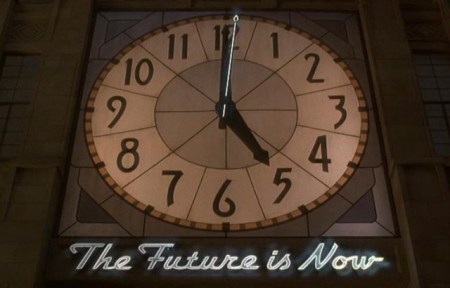
Hudsucker isn’t shy about announcing its preoccupations. As the camera floats through a transparently erszatz cityscape, narrator Bill Cobbs, his voice a sly parody of Morgan Freeman’s folksy drawl, fixes the time at seconds before midnight on New Year’s Eve, with “ol’ daddy earth fixin’ to start one more trip ’round the sun.” We close in on the luminous orb of a massive clock face atop an art deco skyscraper, sandwiched between the stone-carved legend “Hudsucker Industries” and the neon-scripted motto below: “The Future Is Now.” As the calendar is poised to turn over and wipe the slate clean, the people below, Cobb says, are “trying to catch hold of one moment in time—to be able to say, ‘Right now, this is it. I got it.’ ’Course by then it’ll be passed.”

nullThe Hudsucker Proxy is a screwball comedy about entropy, physical and, more crucially, moral. Tim Robbins’ Norville Barnes arrives in the big city as a fresh-faced rube, right off the bus from small-town U.S.A. Proudly clutching his diploma from the Muncie College of Business Administration (Go Eagles!), he’s come to claim his position in the rat race, but at every turn, the way is barred. Only when fate intervenes, as it frequently will, does he luck into a mailroom job in Hudsucker’s basement, slipping through the company’s revolving door just as the body of its soon-to-be-late founder, Waring Hudsucker (Charles Durning) is plummeting from the 44th floor (not counting the mezzanine).

Hudsucker’s suicide leaves a void at the top, which scheming VP Sidney J. Mussburger (a gloriously gruff Paul Newman) conspires to fill with Robbins’ dewy sap, driving down the company’s stock price so the board—a long, gleaming conference-room table filled with elderly white men whose eyebrows stretch to the sky—can buy up Hudsucker’s shares on the cheap. But idiot that he is, Norville Barnes has one great idea, sketched on a yellowed piece of paper he keeps folder up in his shoe. Norville’s concept sketch is an unadorned circle, one of many populating Hudsucker’s symbolically overladen cosmos, but to him its ingenuity is self-evident. Once installed as a clueless patsy, he proudly whips it out to show to the board, his pitch consisting of a simple wide-eyed phrase: “You know, for kids!”

Norville’s circle turns out to be the hula hoop, whose transformation from company-sinking boondoggle to unstoppable fad is chronicled in a giddy, wordless sequence at Hudsucker’s center. Once again, fate takes a heavy hand. A frustrated storekeeper chucks an armful of unsold hoops out his front door; one separates itself from the pack and rolls several city blocks, finally coming to rest at the feet of an inquisitive boy. He picks it up, slips it experimentally around his hips, and starts it spinning. (That the hula hoop’s journey is accomplished without recourse to CGI increases the feeling of fortuitousness; you know the take used is one among dozens where the hero hoop spun out of frame or crashed ingloriously to earth.) A mob of schoolchildren running home after the last bell come upon the boy, and the hula hoop becomes an overnight sensation. Norville’s idiot has become a savant.

nullNorville’s fall is as meteoric as his rise—as Hudsucker’s circles imply, what goes around comes around. His corn-fed ingenuousness turns to arrogance, he’s schemed out of a job, and we find ourselves where we began, with Norville stepping out onto the ledge adjoining Hudsucker Industries’ looming clock. But the cycle is finally broken, if only by some serious bending of the rules, a happy ending that suggests such endings only happen in the movies. Optimism and pessimism walk hand in hand.

The Hudsucker Proxy is the last film of the Coen’s high symbolic period, capping a stylistic trilogy that includes Miller’s Crossing and Barton Fink. The movie’s interest in the doomed repetition of history and the eternal dark side of human nature could hardly be more. Circles are everywhere: Hudsucker’s clock face, the coffee-mug ring that brings the company’s classified ad to Norville’s attention, the hula hoop and its descendants, the halo above Waring Hudsucker’s angelic head (“They’re all wearin’ ’em upstairs. It’s a fad.”) Joel Coen once said the brothers deliberately littered their films with untethered signifiers as a way of messing with critics, but here the recurring symbolism is like another layer of farce. It’s like the Coens are daring viewers to take their goofy screwball fable seriously, larding it with mythological and cinematic references like Jennifer Jason Leigh’s fast-talking reporter, a straightforward pastiche of Rosalind Russell in His Girl Friday.

There are parts of Hudsucker that don’t mesh. The lifeless expanse of Sidney Mussburger’s office is a trifle too melancholy, too cold; it feels like a shot meant for the Coens’ former cinematographer, Barry Sonnenfeld, rather than relatively new hire Roger Deakins. On its initial release, Hudsucker was touted as the Coens’ move up to large-scale filmmaking, teaming them with Lethal Weapon producer Joel Silver after their Cannes triple crown, and there are times when the movie doesn’t seem to fill the space allotted; its emphatic gestures echo like
Charles Foster Kane’s voice in an empty Xanadu. But that emptiness comes
to feel like part of the point, a solitary undertone that runs all the
way through. Hudsucker is warmer in every sense than Fargo,
the movie that followed it, but at heart they’re equally bleak about
people’s ability to do anything for a little bit of money.

Sam Adams writes for the Los Angeles Times, the Philadelphia Inquirer, Time Out New York, the Onion A.V. Club, and the Philadelphia City Paper. Follow him on Twitter.

The Five Best Uses of Music in Coen Brothers Films

The Five Best Uses of Pop Music in Coen Brothers Films

null

The Coen brothers’ relationship to source music is as integral to their vision as recurring themes and subject matter. Like a signature shot or the way certain characters speak, a director’s song selection can reverberate throughout an oeuvre. We anticipate with excitement what 45s are going to be “rediscovered” after being used in a movie. Martin Scorsese and David Chase are masters at using pop music to enhance ecstasy and dread. Danny Boyle uses Brit pop and world beat grooves to bring us into the jangled headspace of his anti-heroes. Quentin Tarantino brilliantly uses a mix-tape approach to music to complement his genre deconstructions. Matthew Weiner knows how to take an old standard and make it sound new again. Cameron Crowe celebrates the good vibrations of ‘70s gold. Allison Anders’ passion for American pop deserves more recognition. Same goes for Craig Brewer, who is practically alone in acknowledging that hip-hop and country no longer occupy separate playlists.

Then there are filmmakers whose understanding of music is constantly evolving. They don’t so much recontextualize their record collection as expand it. These filmmakers work in the vein of Stanley Kubrick, a master at selecting period-specific source music for his movies. Modern-day Kubrick musicologists include David Fincher, who uses both original scores and source cues in startlingly new ways. (Fight Club is his A Clockwork Orange, while the score to The Social Network feels like a companion piece to that of The Shining.) Wes Anderson is another director who constantly mixes things up on the soundtrack. The use of multiple Hank Williams songs in Moonrise Kingdom was an out-of-the-box gambit that proved surprisingly moving. (On the other hand, Paul Thomas Anderson so desperately wants to be a Kubrickphile that his soundtracks have felt increasingly strained since the gloriously melancholic Magnolia.) But the filmmakers who most resemble Kubrick when it comes to music are the Coen brothers. Ever since their audacious directorial debut Blood Simple (1985), Joel and Ethan Coen have used both source music and composed scores to set the tone of their fishbowl-lens visions of cruelty, trickery, detachment, and longing. Specializing in deadpan genre deconstructions, the Coens use music to provide the emotionality for their generally cool stories. Their movies have always given off the feeling of being hermetically-sealed environs where acts of cruelty and kindness are given equal weight. This would be quite off-putting if it weren’t for the music. What follows are the best uses of music in the Coens’ movies. I stand by my ranking, or my name isn’t Aaron Aradillas.

“Somebody to Love” by Jefferson Airplane 

A Serious Man, the Coens’ most humane movie, is all about the disorienting feeling of trying to assimilate in a world where faith in a higher power is constantly being tested. While not strictly autobiographical, the film is informed by the Coens’ Jewish upbringing during the 1960s in suburban Minnesota. Part of the first generation of Jewish-Americans who felt removed from the Holocaust, they re-create the swirling atmosphere of suburban blandness and mind-expanding psychedelia rock. As Physics professor Larry Gopnik (Michael Stuhlbarg) starts to seek answers to life’s mysteries, the Coens gently mock and pay respect to the temporary comforts of religious rituals. Unlike a physics problem, which can be mapped out to its one and only conclusion, real life is messier and can sometimes seem quite arbitrary.

Larry’s journey to the realization that not every question has an answer is foretold by the use of Jefferson Airplane’s “Somebody to Love.” a track from their Surrealistic Pillow album, the song is a rocked-out version of a mellower folk number that singer Grace Slick brought from The Great Society. The song is highlighted at three key points during the movie. First, it follows a seemingly unrelated prologue scene set in the early 20th century that centers on suspicion and misunderstandings in a rustic shtetl. The bemused tone of the prologue, followed by the swirling guitar sound of “Somebody to Love” over the opening credits, keys us to the movie’s constantly shifting mood of unrest. With Spencer Dryden’s forward-motion drumming and Slick’s authoritative yet pleadingly romantic howl, “Somebody to Love” is rightfully held up as a superior example of psychedelic rock. It’s revealed that the song is being heard on a tiny transistor radio by Larry’s son Danny (Aaron Wolff), who can barely concentrate on his Hebrew school studies. (He’s preparing for his Bar Mitzvah.) The lyrics of the song seem fatalistic but are actually cautiously optimistic.

    When the truth is found to be lies
    An’ all the joy within you dies
    Don’t you want somebody to love
    Don’t you need somebody to love
    Wouldn’t you love somebody to love
    You better find someone to love, love

It’s the thin line between “want” and “need” that drives Larry to question the purpose of his life—and why it seems to be inexplicably coming apart. He seeks counsel from three rabbis, but the answers they give him aren’t very helpful. It isn’t until the end when Danny, who has completed his Bar Mitzvah ceremony and is sitting with the most senior rabbi, that the song is reprised. The rabbi alters the opening lyrics of the song slightly and offers them as advice to Danny. This is followed by a gathering storm that forces the school kids to seek shelter. The final shot is of Danny looking at an ominous storm cloud. Here the song is reprised for a third and final time, except this time it all comes together as Danny, having just come of age, seems to grasp what his father does not. That is, sometimes not knowing can be scary, but it can also feel like freedom.

“It’s the Same Old Song” by The Four Tops 

Blood Simple was not your typical directorial debut. A blood-soaked neo-noir, it was a calling-card movie that rocked audiences. Released only a couple of months after Jim Jarmusch’s Stranger Than Paradise, Blood Simple was also an independent deadpan comedy, but it was also a scarily tense throwback to all those nasty ‘40s thrillers that revolved around sex, murder, guilt, and the fear of being caught. Before House of Games, before Reservoir Dogs, before One False Move, before The Usual Suspects, before Bound, the Coens reached back into Hollywood’s past and came up with a low-budget contraption built to thrill. It remains one of the most important debut features in modern movie history.

The highlight is an extended wordless sequence where, after a series of double-crosses and assumptions, dumb lug bartender Ray (John Getz) finds himself cleaning up the blood-splattered office of his girlfriend’s husband, who has been shot by the sleazy private investigator hired to kill the cheating couple. (You get all that?) As Ray locks the office door and begins to use his jacket to clean the blood, his co-worker Meurice (Samm-Art Williams) arrives and turns on the jukebox and “It’s the Same Old Song” blasts onto the soundtrack. The song’s jaunty melody is a variation on “I Can’t Help Myself (Sugar Pie, Honey Bunch),” while the lyrics about a former girlfriend who seems to enjoy leaving men in pain tap into the misogyny, the mistrust of women, that courses through film noir. The relentless beat is like the telltale heart of the audience. Like Donovan’s “Atlantis” during the “Billy Bats” sequence in GoodFellas, or Stealer’s Wheel’s “Stuck in the Middle with You” in Reservoir Dogs, “It’s the Same Old Song” in Blood Simple heightens our excitement in not wanting to look away. The sequence illustrates that a perfectly chosen pop song can allow you to get away with murder.

“Danny Boy” by Frank Patterson 

You Can’t Hit Albert Finney! by cliporama2

1990 turned out to be the year of the gangster film, with an emphasis on pop. You had GoodFellas, of course, with its gimme-shelter-from the-storm of violence and cocaine craziness. Abel Ferrara’s great King of New York possessed a Scarface-level of comic scariness that was set to the thumping beat of Schoolly D’s “Am I Black Enough for You?” The most hyped movie of the year, Warren Beatty’s candy-colored Dick Tracy, had songs written by Stephen Sondheim and performed by Madonna. (Her I’m Breathless is actually an underrated gem.) Even the unjustly maligned The Godfather Part III concludes with a nearly 30-minute action payoff, set to the opera Cavalleria rusticana, that remains one of the greatest pieces of sustained action filmmaking ever made. And in Miller’s Crossing, the Coens stage a musically-enhanced action sequence that plays like the ultimate version of a gangland shoot-out.

The movie is what I like to call one of their “tutorials.” Like Blood Simple, The Hudsucker Proxy, even Burn After Reading, the Coens like to make movies that are like “how to’s” on certain genres. Miller’s Crossing is an obsessively detailed re-creation of a ‘30s gangster movie. Everything from the clothes to the ugly mugs to the complicated machinations of the plot to the overly articulated dialogue instructs us on how we should be experiencing the movie. Naturally, there’s an attempted hit on a boss that’s a shoot-the-works knockout. As Leo (Albert Finney), the head of the Irish gang that runs the city, lies in bed while smoking a cigar, we hear Frank Patterson’s version of  ”Danny Boy” being played on a record player. This song, the quintessential Irish standard about a mother bidding her son farewell as he goes off to war, builds on the soundtrack as we see the feet of henchmen heading towards Leo’s bedroom. (They’ve been sent by Italian gangster Johnny Caper [Joe Polito] who, among his many grievances, is sick of Leo giving him the high hat.) Leo, sensing something is up, grabs his gun and lunges under his bed right at the moment the gunmen burst in shooting. “Danny Boy” seems to fade for a moment only to come roaring back on the soundtrack as a series of precisely edited shots and movements show Leo defending himself. After shooting one guy in the foot to have him fall to the ground so he can shoot him in the head while still hiding under the bed, Leo grabs a Tommy Gun and systematically goes after the remaining gunmen. There’s a bit of slapstick gruesomeness when Leo pumps what seems like a thousand rounds into one of the men. The climax of the scene has Leo doing a James Cagney pose as he slowly walks down the street, firing the machine gun at a car until it swerves, crashes and explodes. As Leo stands in the middle of the street, triumphant and satisfied, the song ends. The point is clear: war has been declared.

“The Man In Me” by Bob Dylan 

Ah, The Big Lebowski. It’s probably the Coens most well-known, most quoted, most revered movie. The follow-up to their great kidnapping comedy Fargo, Lebowski saw the brothers in prankster mode as they used a Raymond Chandler-like structure to riff on male aggression, ignorance, nihilism, and L.A.-based fringe characters. Taking off from a Brazil-like misunderstanding that causes pacifist The Dude (Jeff Bridges), his psycho Vietnam veteran best friend Walter (John Goodman), and their innocent buddy Donnie (Steve Buscemi) to attempt to rip off people they think are dumber than they are, The Big Lebowski is a stoner comedy that reveals just how circularly aimless a lot of plot-driven pulp fiction really is. It really doesn’t add up to much. By the end, most of the characters are back where they started. That’s probably why it has only grown in stature over the last 15 years. The movie’s give-and-take between laid-back detachment and in-your-face cruelty (embodied by Goodman’s towering performance) was a precursor to everything from Jackass to Napoleon Dynamite to Superbad.

The Big Lebowski would seem, at first glance, a heartless comedy of the grotesque, but the soundtrack tells a different story. A celebration of the ‘70s SoCal vibe, the Lebowski soundtrack is both ironic and sincere. You get absurd selections like Kenny Rogers & The First Edition’s “Just Dropped In (To See What Condition My Condition Was In)” and Henry Mancini’s “Lujon” alongside a searing live version of “Dead Flowers” by Townes Van Zandt. Also, as a running gag, you have the movie’s disdain for “the fucking Eagles.” (The Dude’s dislike of the ridiculously popular California band is leftover snobbery from his counterculture youth. There’s no way a group that successful can be good.) And, of course, we mustn’t forget Creedence. For me the best use of music is Bob Dylan’s “The Man in Me.” It’s used a couple of times (including in one of The Dude’s flying-like-Superman hallucinations), but its use in the strikes-and-spares opening-credit sequence sets the movie’s tone beautifully. We watch as serious-looking bowlers line up and execute perfectly controlled rolls. There’s a Busby Berkley-meets-Bob Fosse playfulness to the choreography of the movements. Musically, the song (taken from Dylan’s New Morning) is a laid-back groove with Dylan in fine voice. (This period of his career saw him transitioning from his trademark nasal pleading to his current smoker’s growl.) Lyrically, it’s blessedly devoid of Dylan’s typical skepticism and mistrust. The opening child-like refrain of la-la-la-la-la-la-la is quite affecting. The opening lines are a winking foreshadowing of The Dude’s role in the world.

    The man in me will do nearly any task
    And as for compensation, there’s a little he would ask

The Dude’s pacifism has morphed into a neverending journey to stay mellow in a world where aggression won’t stand. All he really wants is a new rug, and he is willing to do nearly anything for it. By the end, he’s lost a friend but is possibly a little wiser. The Dude. He abides.

“I Am a Man of Constant Sorrow” by The Soggy Bottom Boys 

The current popularity of bluegrass and folk music can be traced back to the runaway success of O Brother, Where Art Thou? A companion piece to the Coens’ hillbilly family comedy Raising Arizona, O Brother was a mix of Homer’s The Odyssey, Preston Sturges’ Sullivan’s Travels, and Hee-Haw. Depending on how you looked at it, the movie was either an inspired Depression-era Southern comedy of manners or a condescending, cracker-barrel comedy that made you feel superior to everyone and everything on screen. This trace of superiority the Coens seem to display over their characters (and sometimes the audience) has been something I and many others have grappled with over the years. It all began with Raising Arizona, a rollicking comedy that nevertheless isn’t above ridiculing “regional folk.” (At the time of the film’s release, critics praised the Coens’ sense of quirk and style while bashing David Byrne’s equally quirky but more humane Southern character study True Stories.) Fargo, Burn After Reading, and A Serious Man show the brothers playing it straight, and their filmmaking is better for it. Even True Grit had a more controlled sense of its down-home characters than O Brother. (With No Country for Old Men, they traded in their quirk for Cormac McCarthy’s nihilistic pulp. Talk about an upgrade.)

What saves O Brother, Where Art Thou? is its landmark soundtrack. Produced by T. Bone Burnett, the album consisted of period-specific traditionals and folk standards, used throughout the movie as a kind of running musical commentary as escaped convicts Ulysses Everett McGill (George Clooney), Delmar O’Donnell (Tim Blake Nelson), and Peter Hogwallop (John Turturro) go on a journey to retrieve some supposed buried treasure. I had thought of highlighting the haunting “Hard Time Killing Floor Blues,” performed in the movie by Chris Thomas King portraying delta bluesman Tommy Johnson, but I opted for “I Am a Man of Constant Sorrow.” As performed by The Soggy Bottom Boys (Tommy on guitar, Everett on lead vocals, Delmar and Pete on harmony), the song is heard throughout the movie. (The boys cut the record in one take in a recording booth as a way to make some quick cash. To their surprise, it became a smash hit.) The song is a lament by a man who’s at the end of his rope and has decided to leave everything behind and jump a train. He’s almost welcoming of the relief of death.

    It’s fare thee well my old lover
    I never expect to see you again
    For I’m bound to ride that northern railroad
    Perhaps I’ll die upon this train

The song becomes the theme for “Pappy” O’Daniel, (Charles Durning), the cheerfully corrupt (and honest) incumbent governor of Mississippi. Dan Tyminski’s vocal and guitar playing is so joyful that, like a lot of folk and gospel and rural American music, it turns despair into hope. The entire soundtrack is almost contrapuntal to the Coens’ occasional smugness toward the South. The music gives their diorama view of rural life a glimmer of soul.

San Antonio-based film critic Aaron Aradillas is a contributor to The House Next Door, a contributor to Moving Image Source, and the host of “Back at Midnight,” an Internet radio program about film and television.

The Bleak Spaces and Blank Faces of FARGO

The Bleak Spaces and Blank Faces of FARGO

null

When Fargo was released, I felt that my home state of Minnesota had finally been given its Oresteia, its Njal’s Saga, its Double Indemnity. Over the ensuing years, however, the popular image created by the Coen Brothers‘ regional epic has been a questionable inheritance. Thanks to Fargo, most people seem to think Minnesotans speak in cute, folksy phrases like “you betcha,” “ya, sure,” and “heckyamean?”  I’d like to say that this is totally untrue, but some Minnesotans actually do talk like that.  Sometimes I talk like that.  For instance, there’s this one phrase I picked up from one of my Mom’s friends.  She used to pause, look directly at you, wink, and say “True story!” with the trademark Minnesotan long “o.” This could be roughly translated into Laconic Midwestern as “yup.”  Now I say it.  Sure, initially we used the phrase around the house as a kind of joke, a gentle mockery of my Mom’s friend, but at some indefinable point it became an actual, living part of my vocabulary. 

The Coen Brothers do not so much write dialogue as dialects for their characters, rich vocabularies and idioms that wend through their films, giving solidity to even the most outlandish narratives. They create linguistic communities connected by language despite their often-violent conflicts. At times the very phraseology that marks them as belonging to the same tribe serves to maintain a chilly distance. The Minnesotan phrase “yah, real good,” for example, might convey warm approval, angry impatience, or curt dismissal, depending on the speaker. The characters in Fargo may speak the same language, but it shapes them in dramatically different ways.

nullAt the center of the film are two portraits of domesticity, one warm and loving, the other bitter and resentful.  When we first encounter these families there is little to distinguish them: they all seem to communicate in cheerful idioms suggesting all is hunky dory, you betcha.  As the horrible crime instigated by the secretly resentful Jerry Lundegaard begins to unfold, however, we see the void at the heart of the chirpy Midwestern family. In the terms of Icelandic saga, we might say that the Lundegaards marry
into the Gustafsons, and the tension between the tribal patriarchs
smolders into conflict.  Translated into 1980s Minnesotan: Jerry feels
threatened by his father-in-law, Wade, and hopes to score big on a
parking lot development.  Once we have first experienced the repressed anguish of the Lundegaards, their story subtly taints the film’s later portrayal of domestic life.  Marge and Norm Gunderson are expecting a child, and their shared life seems to consist mostly of trite conversations exchanged over large portions of food.  Their Minnesotan phrases and accents make them appear silly, comical, like characters in a Garrison Keillor routine.  But as they live their seemingly small, inconsequential lives, they breathe love and vitality into the very same language the Lundegaards use with so little meaning, such hidden meanness. 

nullThese very different families are brought together by a series of murders that unfold as a result of a peculiar crime instigated by Jerry Lundegaard that reads like a bad Midwestern joke: “D’ja hear the one about the guy that had his own wife kidnapped?” What drives him to this act remains something of a mystery.  When Carl Showalter (Steve Buscemi) asks him why anyone would want to do such a thing, he smiles nervously and stutters, “Well, that’s, that’s, I’m not go inta, inta—see, I just need money.” As the hired kidnappers press him, he nervously responds, “See, these are . . . personal matters.”  Like his two hapless goons, the audience learns little more of Jerry’s motives, as he turns away all unwanted scrutiny with a wooden smile and conversational clichés.  In what remains William H. Macy’s greatest performance, he transforms the annoying patter of the used car salesman into an accomplice to murder.

The television serves as the visual and conceptual link between the criminal elements set into motion by Lundegaard and the redemptive powers of the Gundersons.  After the kidnapping, Carl and his taciturn partner Gaear Grimsrud (Peter Stormare) take Jerry’s wife Jean to a cabin in the woods, where they eat TV dinners while trying to get a signal on a broken down set.  The growing tension of the film, the recent acts of violence, are renewed by Carl as he slams his fists on the television in between anxious readjustment of the jerry-rigged antenna.  The snowy screen fleetingly resolves itself into a ghostly picture with each bang, and the camera closes in on what Carl angrily refers to as “the fuckin’ shit-box.” 

nullSuddenly the picture resolves into an episode of the PBS show Nature.  The soporific voice of the narrator, in stark contrast to Showalter’s rage, intones: “The bark beetle carries the worm to its nest where it will feed its young for up to six months.”  We then see Marge and Norm Gunderson in bed, bathed in the stark light of the television, Marge watching with a glazed look while Norm sleeps against her side, both lying amidst a spilled bag of Old Dutch Potato Chips.  The narration continues: “In the spring, the larvae hatch and the cycle begins again.”  Since Marge is visibly pregnant, the program seems to comment on her own young, soon to hatch.  The Gunderson nest seems a placid place, a place of mindless gestation and hibernation.  But when the phone call comes summoning Police Chief Marge Gunderson to investigate a double homicide, their home becomes a retreat, a sanctuary from the world of meaningless violence in which we have been immersed.  It is a sanctuary from which Marge must emerge, restoring the world with love and order so that she can rear her child in peace.

The television figures prominently in another, very different, domestic scene shown earlier in the film.  Jean Lundegaard sits in her bathrobe, knitting while she watches what is perhaps the most annoying piece of local television ever recorded, KSTP-TV’s Good Company. Begun in the 1980s, the daytime variety and chat show was hosted by smarmy husband and wife team Steve and Sharon Edelman, a pair whose barely suppressed egos and strained cheeriness embody everything that is most repulsive in the Minnesotan character.  As Steve and his substitute co-host Katie Carlson describe how to make “Holidazzle Eggs” (don’t ask), Jean smiles, mesmerized by her imaginary friends.  Through the sliding glass door behind the television we see their surrounding community by way of the backs of several identical four-bedrooms. The Lundegaards aren’t typical so much as interchangeable with their neighbors; that is, until the violence unleashed by Jerry appears, in the form of a shambling, balaclava-clad figure who wanders up to the glass door and peers in. His appearance is so incongruous with the bland coziness of the domestic scene that the film seems to pause and gape along with Jean before he swings back a crow bar and smashes through the window, chasing Jean through the house as she screams in terror.

Fargo has been justly celebrated for its use of bleak, snowy landscapes to mirror the cold inner worlds of its most malevolent characters, but it should be noted that snow has many shades. The outside world prior to Jean’s abduction is decidedly beige, the neutral tones of the housing development barely standing out from the dirty late-winter snow. It is a blandness from which violence emerges, aptly reflecting the Lundegaards’ domesticity.  The film is filled with bleak spaces and blank faces, snow-covered rural roads and airport parking lots creating an appropriate backdrop to the glazed looks of blankly-smiling waitresses, dull-eyed truck-stop girls, and chatty used car salesman.  It is a blankness that threatens to devour even the film’s heroic Marge Gunderson and her cozy domestic life.

In one of the strangest scenes in the Coens’ oeuvre, Marge arranges an apparently illicit meeting with an old high school friend, Mike Yanagita, who calls her in the middle of the night hoping to catch up.  His eagerness over the phone clearly marks him as a stalker, yet Marge’s otherwise sound police instincts seem to fail her, or perhaps she simply chooses to ignore them.  In arranging a meeting with this rather sad stand-in for the role of “old flame,” her motives are suddenly as vague and shadowy as Jerry Lundegaard’s.  Their brief lunch date at The Radisson devolves quickly, as Mike’s chummy bluster grows increasingly flirtatious. When Marge checks his advances, he begins to tell the story of his wife’s death from leukemia, which at first arouses Marge’s pity, before his tearful desperation frightens her into calling a halt to the lunch. In a later phone conversation Marge discovers from a high school friend that Mike was never married, and she stares into space, having touched briefly one of the many blank spaces of the frozen world.

The film concludes with Marge and Norm Gunderson back in bed.  In between this and the earlier scene watching television in bed, Marge has conquered the forces of evil and restored order to their cozy world: their bedroom now appears touchingly intimate, nurturing. But if the contrasting greed and violence displayed earlier now lends a quiet dignity to their humble existence, it also lingers as a barely repressed threat. We have seen the violence that can emerge from blankness, and as their faces settle into a slightly glazed placidity, we can almost hear the wind howling outside. True story.

null

Jed Mayer is an Associate Professor of English at the State University of New York, New Paltz.

The Three Burials of NO COUNTRY FOR OLD MEN; Three Takes on Its Overrated Status

The Three Burials of NO COUNTRY FOR OLD MEN; Three Takes on Its Overrated Status

null[Editor’s note: The following is a collection of essays on the critical overestimation of No Country for Old Men, by Lincoln Flynn, Stacia Kissick Jones, and Alan Pyke.]

No Country for Old Men? Overrated!!!

When the Coen brothers’ eponymous film adaptation of Cormac McCarthy’s novel No Country for Old Men was released in 2007, it received near-universal critical acclaim; after the subpar efforts Intolerable Cruelty and The Ladykillers, it indicated an artistic comeback for its directors.

In general, the honed and virtuosic filmmaking skills of the Coens, combined with their postmodern storytelling sensibilities, give their detractors reason to call them talented but glib. Yet with No Country, the Coens-as-adaptors had ostensibly harnessed their usual instincts in the service of McCarthy’s source material, while using their talents as directors to make it a dynamic and multifaceted movie that had proved their salt as genuine auteurs.

Though many consider No Country to be an untouchable classic in the Coens’ oeuvre, it remains tonally flawed. Consequently—and at the risk of putting “my soul at hazard” by receiving invective from die-hard fans of the Coens and No Country—I consider it to be overrated and feel that A Serious Man and the Coens’ True Grit adaptation are more artistically successful later career films.

Effectively, No Country’s plot can be divided into two parts. The first part tells of the flight and pursuit of Llewellyn Moss (Josh Brolin) by Texas Sheriff Ed Tom Bell (Tommy Lee Jones) and psychotic hit-man Anton Chigurh (Javier Bardem) after Moss takes money from the scene of a drug-deal-related massacre. The second part resolves the three-tiered chase and further develops Bell’s melancholic nature.

Well within the Coens’ wheelhouse, the first part is basically a thriller that incorporates aspects of film noir and the western and is filmed or stylized in an artful and “resplendently austere” manner. The violence is gruesome, the editing is efficient, and the action and humor are darkly entertaining. The second part, on the other hand, is more restrained and less gruesome and humorous, in order to amplify the tragic and bleak resolution of the story.

This dichotomization of No Country is my main issue with the film: if Sheriff Bell’s resigned fear of entropy is where the basic theme of No Country lies, and if that fear is exemplified by the mayhem that is instigated by Llewellyn and Anton in the first half of the movie, then why did the Coens decide to represent that violence as slick and thrilling Grand Guignol? This is an inconsistency that makes the two parts of No Country incongruous and its resolution less devastating and resonant than it should be.

As I understand the character of Sheriff Bell, he doesn’t see anything fun or exciting in any of the chaos that he observes as a person and lawman. To him it is soul crushing and proof of the absence of God or any greater, noble meaning. Therefore, the film’s violence shouldn’t be kinetic or vivid. Likewise, if Bell’s saturnine worldview is thematically important in the end, then why is his apathy used as a source of much of the film’s gallows humor? This aspect feels appropriate to the Coens’ style but inappropriate to the story’s point.

When talking to a friend about the most recent James Bond film, she joked that “another name for Skyfall could’ve been No Country for Old Women.” Both No Country for Old Men and Skyfall feature Javier Bardem playing relentless villains who wear odd coiffures; also, both films were shot by cinematographer Roger Deakins. Moreover, both films have older authoritarian characters, played by Tommy Lee Jones and Judi Dench,, who respectively underscore the similar theses of each movie. Yet, as Skyfall is a franchise movie that had the added bonus of being dramatic and exquisitely made, for me No Country for Old Men is a well crafted yet thematically compromised art house version of a Terminator movie.–Lincoln Flynn

Holding
degrees in Film and Digital Media studies and Moving Image Archive
Studies, Lincoln Flynn lives in Los Angeles and writes about film on a sporadic
basis at
http://invisibleworkfilmwritings.tumblr.com. His Twitter handle is @Lincoln_Flynn.

null

Why Blood Simple Towers Over No Country for Old Men

Characters in the films of Joel and Ethan Coen tend toward the archetypical, but rather than existing in their expected cinematic habitat, they’re placed in ridiculous and macabre situations they simply are not prepared for. Though it is usually a delightful conceit, in No Country for Old Men (2005), it starts to become a belabored what-if scenario rather than a meaningful set of juxtapositions. No Country is a meditation on mortality and the eternal fight between humanity and inexplicable evil, set in rural Texas in the early 1980s, the same locale and era as the Coens’ early neo-noir Blood Simple. Both feature postmodern aesthetics, pitch-perfect and witty dialogue, the celebration of regional variances in language and culture, and characters suffering from a surfeit of poor decisions. They are both without question exceptional films. Comparisons between them are unavoidable, though in terms of style and substance, Blood Simple is the more successful of the two.

In Blood Simple, a series of misunderstandings and double-crosses combine with darkly comic undertones in a situation that could be resolved, or at least improved, if the two main characters had just talked to each other. The characters are at times very silly, an endearing trait in a film that examines the tragedy of poor choices. The Coens have since ceased caring whether the audience sympathizes with characters or not, though that tack is quite effective in No Country for Old Men. While Blood Simple is about lack of communication, No Country shows us that, sometimes, communication makes no difference at all. A flattened affect throughout the film heightens the realization that emotional connections simply do not matter in the face of true evil.

Where this flatness of emotion goes wrong is in No Country‘s tendency to leave moments unfinished. The Coens at one time were more than willing to let audiences figure things out for themselves. Ambiguity in No Country, such as not showing a key death  or ending a scene abruptly, is not meant to lead the audience to fill in points of the narrative themselves, but rather to allow the filmmakers to limit the emotions available to the audience. It’s artifice designed specifically to deny catharsis, grief or resolution, all part of the Coens’ rigorous cinematic control, but at great expense to realism.

Blood Simple, like most Coen brothers films, is clearly referential. One of the best such moments is the brazen borrowing of the famous ground-level swooping shot from Evil Dead (1981), a film which Joel Coen had worked on as assistant editor. The reference simultaneously invokes humor, the horror genre and a nod to burgeoning indie film movement of the film’s time. But where references like these in Blood Simple are natural and lighthearted, in No Country they are cold, calculated moments of manipulation. No Country, for example, copies the restaurant scene from Fargo; in these scenes, police officers in both films achieve necessary moments of clarity. It’s heavy-handed and out of place in No Country, a lazy quotation of their own cultural milestone without thought for its relevance.

Early in the Coens’ filmmaking careers, contempt was not a successful trait in a character. M. Emmet Walsh’s P.I. in Blood Simple possesses an undisguised derision for everyone around him, but it is undermined by the resourcefulness and luck of those he’s trying to con. For the Coens, the purpose of contempt has changed, and is now often the single biggest factor in resolving conflict: A character who shows contempt almost always wins out.

This is especially true in the case of the psychotic Anton Chigurh (Javier Bardem) in No Country, a killer whose contemptuous attitude is proven right time and again. It is his most important and identifiable characteristic, one that allows his particular brand of evil to succeed. Meanwhile, small-town sheriff Ed Tom Bell (Tommy Lee Jones) is just as exasperated with the folks around him, though he keeps his contempt in check, leaving him powerless against the sociopath’s self-imposed moral superiority.

The disdain for humanity in No Country, as in many of their other films, spills over into the filmmakers’ contempt for the audience. The Coens seem loathe nowadays to even acknowledge there is such a thing a worthwhile everyday person. In Blood Simple, Ray (John Getz) is an everyman archetype, on the surface as bland as John Gavin in Psycho (1960), yet we’re fascinated by his actions and sympathetic with him when things go wrong. In No Country, a series of everypersons, both men and women, are grotesques, stubborn and dull and frustrating. In an attempt to lead the audience into the mind of a killer, the Coens want us to be as unimpressed with these everyday people as Chigurh is; once you resist, Chigurh becomes caricature, just another dead-eyed psycho with a gimmick.

In the process of subverting themes in No Country for Old Men, the Coens often dispense with narrative altogether, preferring to use the film as a vehicle for delivering their own signature style. The film never quite gets around to challenging the validity of conventional cinematic narrative techniques, though it clearly means to do so. Blood Simple, in contrast, challenges common genre constructs precisely because it uses standard narrative techniques, and also allows for a humanity that encourages viewers to more closely engage with the moral and ethical dilemmas presented. Though both films are fine works in their own right, Blood Simple is a more exceptional one—even if it is more traditional.–Stacia Kissick Jones

Stacia Kissick Jones is a recovering literature major, freelance editor
and film critic. She is a regular contributor at
Spectrum Culture Online
and
ClassicFlix, and blogs at She Blogged By Night
(
http://www.shebloggedbynight.com).

nullNo Breathing Room: The Crucial Flaw of No Country for Old Men
A movie can be great and overrated, and so it is with the Coen brothers’ No Country For Old Men. The Coens’ trademark deftness with light and framing and showing a story rather than telling it gave us the best cinematic treatment of Cormac McCarthy to date. But much praise for the film conflates its technical brilliance with an imagined depth and detail of thought. In reality this film manages only to sketch ideas that have been more fully explored in other, similar films.

Considering the challenges of recreating the ideas from Cormac McCarthy’s notoriously thorny and meditative prose with visual language, No Country For Old Men achieves some wondrous things. The choice to eschew music almost entirely is particularly inspired as a reflection of McCarthy’s harsh, amoral world, and excellent performances help animate his ambivalent, despairing take on nostalgia for a simpler time that never quite was. A few things get lost in translation, but it’s a mistake to get too caught up in comparing book and film here.

The problem instead is that in effecting their translation, the Coens produced a film that only engages the story’s themes at arm’s length. The pulpy churn of the main plot crowds out any deeper meaning the three main characters’ pursuits of their respective fables might have.

Llewelyn Moss (Josh Brolin) pursues the simple self-deception that he’s cunning enough to steal $2 million from a cartel and live to enjoy it. That sets the captivating plot into motion, but the Coens excise some significant chunks of his flight, and freeze-dry the thematic nutrition out of his arc in the process. He’s fun to root for, but exists solely to necessitate the chase.

Anton Chigurh’s (Javier Bardem) fable is that the underworld’s predatory jungle law responds to fate and luck, and can be influenced by how men tend to their sense of honor. That’s a promising concept, but it’s only hinted at, never fleshed out. No Country‘s most memorable moments involve Bardem leaning his full weight into dazzling lines that don’t add up to anything coherent. “If the rule you followed brought you to this, of what use was the rule?” is a great bit of language, but Carson Wells (Woody Harrelson) is right: Chigurh just sounds insane. Beyond the grace of his syntax, his pseudo-existentialist riffs carry no more weight than a Bond villain’s cackling soliloquy about the motives for his evil plot.

Sheriff Ed Tom Bell’s (Tommy Lee Jones) fable is that men committed to rightness and legality are seeing a decay in their ability to preserve moral rectitude. Ed Tom’s weary grappling gets a fuller treatment, getting critiqued by fellow lawmen—“What you got ain’t new,” his uncle tells him—and reflected in the inter-generational tensions that crop up repeatedly at the edges of the story. Ed Tom’s statements are the closest No Country comes to actually biting down on some ideas rather than showing us the chain restaurant picture menu versions of them. But he, too, is just along for the ride of the main plot, popping in and out whenever it’s convenient.

There’s a better Tommy Lee Jones film on all these themes: The Three Burials of Melquiades Estrada tackles fatally bad luck, nostalgic male honor fulfillment, and modernity’s infringement on cowboy nobility without the sexy crime potboiler stuff that makes No Country so great an entertainment and so lightweight a film. The Coens have also done more with these ideas, in Blood Simple. The nominal stakes in these two movies are far lower than No Country‘s $2 million satchel of cash, but Blood Simple wrings more reflection on violence, mistrust, and self-deception out of a $10,000 wad. There’s no bouncing ball of cash to follow through Melquiades Estrada, but rather the corpse and memory of a man far unluckier than anyone on the wrong end of Chigurh’s cattle gun. The grand allure of the underworld pursuit makes No Country more fun, but it also reduces the big ideas its characters are chasing to window dressing for a nervy, unpredictable slaughter. The comparative simplicity and mundanity of the core stories in Blood Simple and Melquiades Estrada mean that those same ideas have room to breathe.–Alan Pyke

Alan
Pyke is a writer and commentator on film, television, fiction, music,
and politics, with a particular fascination for hiphop. He writes film
reviews for
TinyMixTapes and BrightestYoungThings, cultural criticism at The Daily Banter, and occasionally posts at his own site.

Chaos and Repair: Reclaiming THE LADYKILLERS

Chaos and Repair: Reclaiming THE LADYKILLERS

null

[Editor’s Note: This review originally appeared in the April 13, 2004 edition of New York Press.]

After 20 years of making movies, the Coens still don’t get the acclaim they deserve. Even in rave reviews, one senses a mistrust that originates in their perceived esthetic violations: their supposed hipness and detachment, their unwillingness to create “realistic” characters, their fondness for homage and pastiche and most of all, their relentless pursuit of visual and rhythmic perfection. They have been cited as smarty-pants pranksters who believe in nothing and are content to make movies about movies.

The latter sentiments were summarized in Anthony Lane’s April 5 New Yorker review, which called their remake of the Ealing comedy The Ladykillers “dead in the water” and posed the rhetorical question, “Are these super-controlled filmmakers content with a career as pasticheurs?” Lane’s dismissal was prefigured in a more thorough and respectful 2000 Film Comment piece on O Brother, Where Art Thou?, in which writer-editor Kent Jones said many positive and even rapturous things about the Coens, yet still seemed unwilling to embrace their work in its totality. “In the end,” Jones writes, “no matter how much you’ve been entertained, you’re left with the nagging questions: who are the Coen Brothers and where are they coming from? Even Kubrick, the one cinematic idol whose shadow falls over Joel and Ethan’s playground, never hid himself so completely within his work.”

But even if we assume every charge leveled against the Coens is true, a fan is still entitled to reply, “So what?” If the above qualities are indeed cinematic crimes, then Alfred Hitchcock, Fritz Lang, Carol Reed, Akira Kurosawa, Orson Welles and Kubrick should be deemed arch-criminals, and the Coens should trumpet their own guilt from the highest rooftop and urge fellow filmmakers to embark on like-minded lawbreaking sprees. If there’s an obvious downside to their approach, it’s that it’s so outwardly “perfect” that it encourages critics to deface each movie’s smooth surface rather than probe its roiling depths. That’s a shame, because the unity and complexity of the Coens’ work has few equals in modern cinema.

Furthermore, contrary to charges that they believe in nothing, I think the Coens are among the most moral (even moralistic) directors alive. Most (but not all) of their pictures are morality plays that deflate the selfishness and pomposity of individuals while finding good even in the most flawed social orders. Their films also insist, unfashionably, that there really is good and evil, and that while good is usually more naive than evil, it is (lucky for us) more stubborn and orderly.

nullConsider, for example, the fact that most Coen films revolve around showdowns between ego figures and id figures. (Think of the super-domestic mom in Raising Arizona, fighting to keep her reformed outlaw husband from being “seduced” by a pair of prison escapees and a demonic biker figure who first appears in a dream. Think also of Fargo, which contrasted pregnant cop Marge’s super-orderly, even dull home life against the random, whoremongering viciousness of the film’s nomadic criminals.) Think also of the Coens’ subtextual suggestion, in film after film, that even when evil is often stronger, cleverer, more charismatic and more ruthless than good, evil often destroys itself anyway because it’s more chaotic, more id-driven, than good, and thus more unstable. Blood Simple, Raising Arizona, Miller’s Crossing, The Hudsucker Proxy and Fargo all revolve around criminal schemes that ultimately collapse beneath the weight of their participants’ accumulated selfishness, dishonesty and bravado (with help from a clever hero, or a deus ex machina). The buried narrative of most (though not all) Coen movies finds an orderly universe being plunged into chaos, then meticulously repaired. The repair work is often performed by disreputable outsider heroes (Jeff Lebowski, Marge in Fargo, Tom in Miller’s Crossing) who do good under the radar, so deftly (or instinctively) that society has no clue how much it owes them.

The Ladykillers is a Coen film par excellence. Yes, it’s a goofy, even frothy black comedy, a five-finger exercise from filmmakers who specialize in baroque contraptionist concertos. But it’s still a masterfully assembled picture on serious themes. More significantly, it contrasts good guys who believe in social order, a higher power and an eternal reward against fringe-dwelling bad guys who care for little besides money.

nullTom Hanks’ criminal “mastermind,” Professor Goldthwait Higginson Dorr, a pretentious dandy who dresses like Colonel Sanders and talks like a cross between James Lipton and Wile E. Coyote, supergenius, is obviously a devil figure, like the biker in Raising Arizona, or Robert Mitchum’s preacher in The Night of the Hunter. He first appears while decent church-going old lady Marva Munson (Irma P. Hall) is talking to a portrait of her late husband, whose supernatural presence is certified by a point-of-view shot that looks down on Marva’s orderly living room from above. Dorr’s arrival is heralded by a sudden gust of wind that makes a candle flame flicker, and a shot of Dorr’s spooky silhouette against the window glass of Marva’s front door. Under the guise of renting a room and securing rehearsal space for his Renaissance and Rococo ensemble, the bad guy assembles a team of lowlife experts to tunnel through the wall of Marva’s basement and steal money from the nearby vault of a casino. The casino’s employees include Dorr’s inside man, the idiot casino janitor Gawain MacSam (Marlon Wayans), a foulmouthed cretin who wears a dollar-sign necklace.
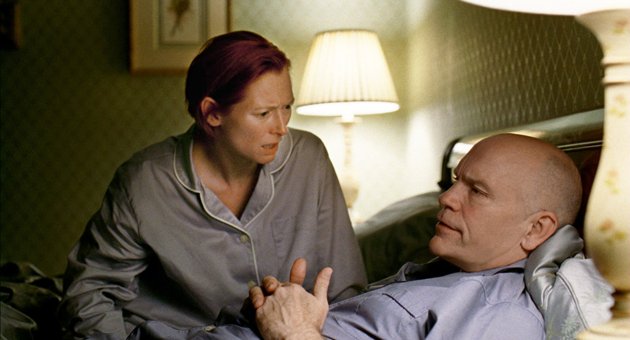
Without spoiling any plot twists or visual surprises, suffice it to say that while the Coens deflate the pretensions of each major character, no matter what part of the moral spectrum they inhabit, the film ultimately expresses approval of Marva and disdain for Dorr and his band of scurvy dolts. The Coens’ opposition of good and evil, chaos and order is so basic it’s nearly Manichean. Marva’s pastor warns his parishioners that society is decaying from a lack of morality and its citizens are worshiping false idols and indulging “declining, backsliding, never-minding sinners!” The movie’s soundtrack, supervised by regular collaborator T. Bone Burnett, contrasts the materialistic, mostly secular culture of hip-hop (represented on the soundtrack by “Another Day, Another Dollar”) against the steadfast spirituality of gospel (represented by such on-the-nose titles as “Trouble of this World”).

Like Lillian Gish’s holy maternal figure in The Night of the Hunter, Marva is sweetly incorruptible, the rock of decency Dorr’s gang of sleazy nitwits must dash itself against. Building on the original Ealing comedy by raising the spiritual stakes, the Coens depict criminals as literal lowlifes who do their dirty work in basements and tunnels, turn on each other like rats, and in the end, deserve to be disposed of like garbage. The systematic extermination of Dorr and company seems to be carried out not by any one character, but by unseen supernatural forces– Marva’s dearly departed but still watchful husband, perhaps, or even God himself. The Ladykillers may be silly, but it takes morality seriously. One wishes more critics would accord the same privilege to the Coens’ films.

Matt Zoller Seitz is the co-founder of Press Play.

They Know Not What They Do: BURN AFTER READING

They Know Not What They Do: BURN AFTER READING

null

When Katie Cox (Tilda Swinton) descends into her husband’s basement office and copies financial records off of his computer, we get a glimpse of a book on the desk, a book that looks to be George F. Kennan and the Origins of Containment: 1944-1946: The Kennan-Lukacs Correspondence. This should not surprise us. We have previously heard Osborne Cox (John Malkovich), while struggling to dictate his memoirs, declare: “The principles of George Kennan—a personal hero of mine—were what animated us. In fact they were what had originally inspired me to enter government service.”

Burn After Reading is a film about containment and knowledge, or, to put it another way, a tale of wars against chaos. Necessarily, it is a farce.

The Coen brothers’ films are sometimes criticized as nihilistic. They are only nihilistic, though, in the sense that Buddhism is nihilistic. The films are full of characters who quest for meaning and purpose, but they quest badly. They seek eternal verities in a universe that only provides constant change, shifting perspectives, cultural relativisms, random sets, infinite fractals, and distant enlightenment. These are not nothing. Knowledge, meaning, and even, perhaps, purpose can be found in them. In A Serious Man, the movie the Coens made directly after Burn After Reading, and which serves as a kind of cousin to it in many ways, Rabbi Marshak is the wisest of all the characters because he knows enough to pay attention to a pop song: “When the truth is found. To be lies. And all the hope. Within you dies. Then what?” One command: “Be a good boy.” And, left unspoken but vividly present: “Find somebody to love.”

nullSpy thrillers appeal to the pleasures of secret knowledge, the idea of knowledge as power. God is Truth, and Truth is always hidden, available only to the worthy, jealously protected and obfuscated by the clerics. Conspiracy theories are theologies, but they are also power fantasies. One legacy of J. Edgar Hoover, who successfully petitioned (or bullied) Hollywood into taking the side of his knowledge-seeking G-men, is that the most common representation of government agents in American films is of technically skilled poobahs of the panopticon. This is especially true of conspiracy thrillers, whose verneer of subversive or cynical intent is usually itself subverted, because there is nothing more flattering to government agencies than to portray them as dangerously powerful. (It is better to be feared than loved.) Popular chronicles of conspiracy, whether tales of heroes or martyrs, give us lone wolves hunted by all-seeing feds or monolithic, hyper-competent corporations. Such stories leave no room for the everyday mess of bureaucracy, for institutionalized incompetence, for the slips and serendipities of inevitable human error, for technical glitches, for stupidity, for ignorance, for chaos. Power-flattering representations serve the acronymed agencies well, providing them with an aura of omniscience, authority, infallibility.

Burn After Reading counters this with a portrayal of bureaucracies that possess extraordinary powers of surveillance, but not knowledge. Outside the bureaucracy, in the random chaos of the world (and the precisely-structured chaos of the film’s narrative), we see individuals whose confidence in their own knowledge is misplaced. The smartest people in any room turn out to be the CIA bureaucrats who know what they don’t know, and are perfectly capable of working with that. Their goal is simply containment. But Harry (George Clooney), Linda (Frances McDormand), and Chad (Brad Pitt)—and to a certain extent Osborne and Katie—suffer epistemological hubris. Again and again, they call each other stupid, or morons, or idiots, as they vie for position in the hierarchy of, in every sense of the word, intelligence. But intelligence is overrated. Bureaucracy teaches the pragmatic lesson that containment doesn’t require omniscience. In Burn After Reading, it’s a lesson most of the individuals outside the bureaucracy don’t learn in time to save themselves.

nullTheir yearning for complex explanations and Hollywood thrills blinds the characters to the unexciting, unflattering truths in front of them. We see this right from the beginning: Osborne protests his demotion and scorns the idea that he has a drinking problem, insisting, “This is political! Don’t tell me it’s not!” He storms out of the office and we cut to him at home, making a drink. Again and again, the film will show us that Osborne is a man with a violent temper who drinks a lot. The reason the CIA decided to demote him may be, in fact, exactly what they said. Osborne Cox believes that a man of his stature could not be relieved of
his duties for mundane reasons, but must have been felled by the hand of
nefarious conspirators. Osborne wants for his life to have been important in some way, as do we all—to have been more than just the life of a run-of-the-mill man, an ordinary guy. Like so many people who think their lives will achieve immortality by being printed and bound into narrative, he decides to write his memoirs (and even to gild the word with a fine French twist, memwaaa).

But the only people who care about his memoirs are Linda and Chad, who assume Osborne is important—and so, though he can’t see it, he has found the ideal audience for his life’s story. (Their only competition being Osborne’s catatonic father, who may, for all we know, think his son is as unimportant and annoying as everybody else does.) Osborne, Linda, and Chad are ideologically matched: they believe in the legends of the CIA, the Hollywood stories of derring-do and secrets that must be preserved at all costs. The CIA itself does not believe this—Osborne Cox had a security clearance level of 3, which elicits barely a shrug when the agency superiors learn there has been a leak. The Russians, once they look at the memoir material, deem it to be drivel. The only people in the world who think Oswald’s work was so important as to be worth lots of money, major conspiracies, and maybe a Hollywood deal are Linda and Chad.

nullA superficial interpretation of the film would propose that the Coens think all these characters are stupid and that we should laugh at their follies—that we should, in fact, revel in our superiority to these schmucks. Hence the occasional (or more than occasional, depending on where you look) criticism of the Coens for mocking their characters, for holding them in contempt. I cannot speak for the Coens, who may, in fact, be sneering smartypants bathed in fumes of schadenfreude, but the feelings ultimately produced in my experience of their movies are not ones of superiority for the characters so much as sympathetic solidarity. Not for all the characters, of course. Inevitably, there are bullies and tyrants whose sufferings are sweetly just deserts, but look, for instance, at a character like Linda. We (or I, at least) start out laughing at her, at her oblivious self-absorption, her bumptiousness. Ohhh, look at this silly woman getting all marked up by the plastic surgeon, this woman who thinks her health insurance company will pay for her expensive nips and tucks. Ha ha ha, isn’t she hilarious, isn’t she ridiculous, isn’t she just—

But for me this contempt doesn’t last. And this is one of the great powers of the Coens’ films, and part of those films’ great artistry and value. In the Coens’ world, people who begin as caricatures become, somehow, more human than characters in even the grittiest of verité social realism.

In Burn After Reading, I can mark the precise moment where this happens for me: a POV shot twenty-one minutes into the film, a shot through the windows in the office of Linda’s boss, Ted (Richard Jenkins), as Ted watches Linda hold her head and weep after the conversation with the  agent at the health insurance company. The effect stems from Frances McDormand’s performance, the terror in her eyes while she talks on the phone, the terror that lurks behind her mask of determination, and the moment where she can’t keep the mask from slipping. Having seen that, we don’t need to see her from the front right away. We know what she feels, we know why she weeps, and if we have any tinge of decency in our hearts, we feel chagrin. Because earlier, we saw her just as her plastic surgeon saw her: as silly meat. We judged her just as she judged the men whose profiles she so quickly flipped through on the dating website: “Loser, loser, loser.” We know now that this is her own fear, the fear she hopes, however realistically or unrealistically, to conquer by reinventing her physical self.

Loser, loser, loser. Haven’t you ever shared that fear? Haven’t you ever—foolishly, humanly—invested all your hopes in one path, and had that path shattered in an instant? (By a bureaucrat, perhaps, an agent . . .) Ted certainly has. His puppydog kindness toward Linda is a kindness I think we’re encouraged to share at that moment. Ted is the most decent guy in the film, a man who has come to accept life as it is, even to find pleasure in it. Once, he was a man of God, but it didn’t really work out. Now, he helps people get stronger, to get in better shape. Linda can’t see what Ted has to offer, his loving ordinariness, because her mask and her expectations blind her to Ted’s obvious infatuation. It’s too bad for Ted, but we’ve been him, too: a bit too puppydog, a bit too ordinary. For all his differences from Linda and from Osborne Cox, his fears are the same. All the main characters’ fears are the same. They don’t want to be a loser like the other losers. There’s contempt there, sure, but it’s not raw contempt so much as it’s a contempt masking fear. It’s a contempt we’re complicit in, but the Coens show us that we can escape our complicity by escaping our fears and embracing, accepting, and even delighting in our loserdom. Linda is one of the few characters to survive in the end, and the only character to truly get what she wanted from the beginning. Her triumph is one I celebrate, and I cherish the experience of starting from contempt for her when she first appears and evolving to cheer on her success at the end. The surgeries serve as the film’s primary MacGuffin, but as MacGuffins go it’s a complex one, because the gift of the movie is the gift of reinvention: for Linda and for us.

None of the other main characters find the same success. Most of them end up killed off by the chaos. Perhaps their failures are random, but that means some success will be random too, and that’s okay. We can live with that. Linda’s greed and vanity get her into the mess she gets into, but at least her greed is not the sort of dishonest, dissembling, gluttonous greed of George Clooney’s Harry. Linda just wants to find somebody to love. Like her, Harry is full of vanity, particularly as it relates to his gun (which he and everybody else always knows is a penis substitute), and he, too, is seeking love. But he’s a bad boy and his fate is to end up in a paranoid vortex of his own construction. His final scene with Linda in the park is a masterpiece of comic set-up, because various separate bits of information, precisely placed throughout the film, all converge to convince him that everybody is out to get him. The truth is exactly the opposite, but the effect of his delusion is congenial to everyone: he escapes to Venezuela. Just because you’re paranoid doesn’t mean everybody doesn’t really want you to go away.

More, of course, could be said about all the connections and coincidences, the incorrect assumptions, misheard remarks, mistaken identities: the beautiful structures and balances of the film. But saying much more is too much like explaining a great joke. Jokes and movies shouldn’t mean, but be.

Nonetheless, I feel obliged at least to note one other level on which the film is working: that of metafiction. This is a movie that knows it’s a movie, and is all the better for it. First, it relishes our genre knowledge, the knowledge that produces expectations, those things that lead us astray. The title credit sequence could be that of a spy thriller: we zoom in from space as if from a surveillance satellite (topic for another time: compare the CIA in Burn After Reading to God in A Serious Man), the music is determinedly dramatic, the credits splay across the screen accompanied by the techno-tinkle sound associated (why?) with computer text, and we cut to serious feet walking seriously through the serious, antiseptic corridors of CIA headquarters. The music will be the key to the seriousness throughout—it cues big revelations, moments of drama, rising tensions. The comedy comes from the music’s misjudgment: the relevations are, more often than not, mundane, the drama banal, the tension easily diffused. (It’s music more appropriate to, for instance, the previous movie George Clooney and Tilda Swinton made, Michael Clayton.) The film has been scored to meet the characters’ expectations for the kind of story they want to be in. Little do they know that they’re in an entirely different film from the one they desire.

nullAnd then there’s Coming Up Daisy, the Claire Danes and Dermot Mulroney movie-within-the-movie that Linda always takes her dates to. It is, apparently, a fluffy romance, a sappy fantasy of eternal love and perfect happiness and beautiful people. (The sort of fantasy that makes a woman like Linda hate herself and her life, the sort of fantasy that keeps many cosmetic surgeons in business.) Linda goes to the movie twice, once on a bad date (with Alan) and once on a date that seems to come out of just such a movie (with Harry). This is not the end of this reference, though. When Harry’s wife, Sandy, goes on a TV show in Seattle, one of the later guests is Dermot Mulroney. Harry is oblivious to his wife’s faithlessness, her ability to deceive him even more effectively than he thinks he is deceiving her—oblivious, in other words, to her agency. After Harry shoots Chad, he tries to make a salad for Katie, but only ends up chopping an enormous pile of carrots. In Seattle, though, Sandy kisses her boyfriend in the dressing room of the TV show while a segment about the “Sultan of Salad” plays above them. Sandy, it turns out, is the one character who lives in a world where fantasies of perfection are not quite so fantastical.

The casting of Burn After Reading also contributes to some of its metamovie touches: not just with the reuniting of Clooney and Swinton, but also, more slyly, with the appearance of David Rasche as a serious CIA man. Rasche is probably best known, at least to connoisseurs, for his starring role in the mid-’80s TV comedy Sledge Hammer!, a spoof of the Dirty Harry films in which Sledge’s solution to every problem is to shoot it with his giant gun. Sledge Hammer! makes even the broadest comedy in Burn After Reading look like a marvel of subtlety, but I know I can’t be the only viewer who, upon first seeing Rasche, immediately thought of his earlier character’s motto: “Trust me, I know what I’m doing.” Many of the characters in Burn After Reading think the same thing, with similar results.

(Tangentially, I expect I’m also not the only viewer who, on seeing the name of the gym where Linda, Chad, and Ted work, thought of Susan Jeffords’ brilliant book Hard Bodies: Hollywood Masculinity in the Reagan Era. Of Harry Callahan, Jeffords writes: “Harry’s heroism has a nihilistic edge to it that cannot reassure audiences that any of his actions have mattered or have changed the social order in any way.”)

Burn After Reading ends with The Fugs’ song “CIA Man,” and so the ending is, like everything else in the movie, perfect in its multiplicities of meaning:

Who’s the agency well-known to God?
The one that copped his staff and copped his rod?
Fucking-a man! CIA Man!

Matthew Cheney’s work has been published by English Journal, One Story, Web Conjunctions, Strange Horizons, Failbetter.com, Ideomancer, Pindeldyboz, Rain Taxi, Locus, The Internet Review of Science Fiction and SF Site, among other places, and he is the former series editor for Best American Fantasy. He teaches English, Women’s Studies, and Communications & Media Studies at Plymouth State University.

VIDEO ESSAY: Pacino: Full Roar

VIDEO ESSAY: Pacino: Full Roar

I could not stop laughing as I watched Nelson Carvajal’s “Al
Pacino: Full Roar”—not just because it’s the most entertaining
collection of over-the-top moments since Harry Hanrahan’s “Nicolas Cage
Losing His Shit,” but because Pacino is and always has been a theatrical
actor, delightfully so—a performer who manages to be big even when
he’s trying to be small. There’s an overabundance of every emotion in
every moment Pacino inhabits and in every move he makes. He sings the
body electric; sometimes he screams it. He’s a stripped electrical wire
zapping lightning bolts into the air like those transformers in the old
Universal horror films. Even when his characters are hiding or
repressing things, they seem on the verge of imploding or exploding,
transforming or mutating. When, in The Devil’s Advocate, Pacino’s Satan
launches into his “absentee landlord” monologue and his face is
momentarily lit up by pulses of volcanic red, it takes a moment to
register it as a lighting effect, so naturally does it seem to express
the lethal petulance streaming from the character’s eyes, mouth, and
jabbing fingers. 

We live for these sorts of moments. Pacino can be
wonderful when working small—see the first two Godfather films, the
quiet parts of Serpico and Dog Day Afternoon, his under-seen and perhaps
forgotten Bobby Deerfield, and the more Willy Loman-like interludes in
Donnie Brasco, in which Pacino is more likely to flinch from pain than
dish it out. But introversion and reflection didn’t make him a star;
explosiveness did, and whether he arrives at it via “slow burn” buildup,
as in the Godfather films, or launches into it full-throttle from frame
one and never takes his foot off the gas (Heat, baby), it’s invariably
as thrilling as the sight of Jack Nicholson tearing somebody a new one,
or Sean Penn contorting his face into a wet-eyed ball of anguish, or Nic
Cage being Nic Cage. You listen to the whisper while waiting for THE
SCREAM, OH YEAH! THAT’S RIGHT! ATTICA! ATTICA! I’D TAKE A FLAMETHROWER
TO THIS PLACE! THEY PULL ME BACK IN! CUZ SHE’S GOT A GREEEAAAAAT ASS! —
Matt Zoller Seitz

KILLER KARAOKE: Reality Television and the Death of the American Middle Class

KILLER KARAOKE: Reality Television and the Death of the American Middle Class

null

“There’s been class warfare going on for the last twenty years and my class has won.” —Warren Buffett

“I’m about to get my ass kicked by crawfish.”—Steve-O

It doesn’t seem unreasonable to imagine that, at the brainstorming session where the phrase “Not Reality. Actuality.” was coined, one of the copywriters might have pointed out that these two words are synonyms. Apparently this observation was never made, or not with sufficient conviction, because this is now the official motto of Turner Broadcasting’s TruTV network, which specializes in reality programming. Viewers might anticipate a new threshold of lowered expectations for the shows featured on this network, based solely on its grammatically challenged motto, but one show on it, Killer Karaoke, was recently described by the New York Times as “the highest possible use of the medium and the most profound statement ever made about the human condition.” This statement may be a bit of ironic hyperbole, but it contains a kernel of truth. Killer Karaoke is a window on the shrinking opportunities and declining fortunes of the American middle class.

The show combines two popular reality TV game show formats, the singing competition and the stunt challenge. It is essentially a mash-up of American Idol and Fear Factor. Like most other new reality television shows, the producers go out of their way to avoid cluttering up the show with original ideas. It is based on Sing If You Can, the 2011 British singing competition that celebrates performing while being subjected to extremely distracting circumstances, including having snakes draped on your body and being blasted with a high-powered mechanical storm simulation. Most of the concepts for the stunts on Killer Karaoke are drawn directly from Sing If You Can.

The contestants on Sing If You Can are well-known singers playing for charities, showing viewers the spectacle of celebrities experiencing various states of stress and alarm. Like American Idol or The Voice, the set design is cavernous and ostentatiously expensive-looking, and like those shows, the overarching feel of the show is one of inaccessible wealth, a wealth the audience is meant to voyeuristically ogle. The celebrity contestants on Sing If You Can may be amusingly stressed in the face of their challenges, but the audience is still very much meant to register them as betters existing in an untouchable universe of privilege.

Killer Karaoke takes this class structure and turns it on its head. The set is modest and the contestants read as average middle class karaoke enthusiasts, enthusiasts who hunger to be seen on television. The deal they accept by appearing on the show is startlingly bad. They are promised a chance to win “up to” $10,000. But it’s clear that the final challenge of the show is designed to pay out an average closer to half that amount. The largest amount won so far is $7,800. Survivor offered the winning contestant one million dollars. Fear Factor offered $50,000. The deal has been getting worse and worse as reality shows have progressed.

nullThe shows that exploded in the early aughts, starting with Survivor and Big Brother, represented a new historical relationship between reality TV actors and employers. Most reality shows today enjoy a spectacularly profitable exploitation of their actors. These shows are attractive to produce because creating the content and, ultimately, much of the show’s value requires them to utilize a class of unorganized low-paid laborer: the American reality contestant.

Capitalist economic systems require one central point of internal logic for them to function; in order to constantly expand profits, workers must be paid less than the value their work creates, ideally as little as possible, as little as the labor market will bear. In classical economic theory, new value only comes from one place, labor. In order to concentrate wealth for owners, shareholders and managers, this surplus value is then concentrated into financial instruments and forms of rent that charge the workers who created the value in the first place. It is a parasitic relationship.

Reality TV contestants are an excellent object for this kind of relationship, because they are a disposable, easily replaced group of workers. Because their working conditions are not regulated by the Screen Actor’s Guild, contestants can work unusually long hours, Some shows require a working day as long as 12-18 hours. Appearing on a show requires temporarily leaving, even risking, one’s job. Union pay for an actor on a scripted situation comedy is $25,000 per episode. Reality TV contestants are often paid nothing at all for their work, though some receive a modest stipend. Most agree to work for food and shelter during the time they are being filmed, in hopes that the exposure might lead to some future opportunity, if not just for the sheer narcissistic reward of appearing on television.

The worsening conditions for television workers with the advent of reality TV mirror the gradually worsening conditions of the American middle class over the past few decades. Since the early 1970s, business leaders and the pro-business lobby have orchestrated a massive wealth transfer from the middle class to the ruling elite through deregulation and changes in trade and tax policies that favor the upper classes at the expense of the working and middle classes. The Pew Research Center reports that the number of households earning two-thirds to twice the median income has shrunk from sixty-one percent of the US population in 1971 to fifty-one percent today, and that reduced middle class earns a lower percent of total national income. The 1972 adjusted gross wages for the average worker was $738 per week. In 2008 it was $598. In 1970 the average CEO made twice what the average worker made. Today that same CEO makes five hundred times what the average worker makes. The income of the richest one-percent has tripled since 1980, while at the same time the income of the bottom ninety percent has dropped by twenty percent. Bill Clinton and politicians from both sides of the aisles promised to create jobs with NAFTA in the early 1990s, but according to the Economic Policy Institute, NAFTA actually cost the United States nearly 700,000 jobs, mostly in manufacturing.

nullThere has only been one brief moment where the American middle class grew at all in the last thirty years: during the tech bubble of the late 1990s. Reality television as we know it began just after this anomalous growth spurt began reversing itself. Shows like Survivor, Big Brother and Fear Factor dramatized the new economic realities: vicious competition, humiliation, hard work for little reward, and winner-take-all ethics. These shows reflect the American economic policymakers’ ideology, where policy is decoupled from ethics, as well as from common sense. As wealth is more and more shifted from the middle class to a small concentration of the upper classes, demand begins to shrink, and with it, the ability to recover from the cyclical crises that are part of our economic system. The middle class is the main consumer class of the United States, and consumption is two thirds of the US economy. As the middle class shrinks, consumption shrinks. As consumption shrinks, the time it takes to recover after recessions grows. Increasing income inequality also translates into increasing economic instability and slower growth. Since the 1980s the job market has taken longer and longer to recover after every bust. More than five years after the great recession of 2007, the job market still hasn’t recovered, but the stock market is booming. Because of this, the wealthy are enjoying full recovery, while the middle and working classes are falling behind, largely because of high unemployment. Corporate profits are booming, but only during the Great Depression has the share of GDP going to salary and wages ever been lower. American workers are less and less part of American prosperity.

The new economy of reality television has helped American Idol become the most profitable show in the U.S. Its contestants represent legions of unpaid laborers. American Idol presents itself as an aspirational drama, but the perspectives of the show are very much those of the ruling elite. Success in this competition is about pleasing famous millionaires on their terms. Idol‘s Horatio Alger stories remain the mythic ideal, but the statistics point to a very different reality. In America, the chances of someone’s making it to the top or to the middle from the bottom are lower than in any other advanced industrial country. The essence of American Idol is not so much the performances of the singers as it is the dramatization of the unbridgeable class divide between the ruling elite panel sitting behind the desks and the average citizen contestants standing on stage.

nullThe early rounds of American Idol feature inappropriate contestants with little or no talent who are intentionally let through the cattle call weeding process. This represents an ugly and compelling entertainment spectacle that allows viewers to enjoy the drama of a few elite upper class celebrities verbally torturing some unfortunate neurotic caught in their web. These early scenes are job interviews designed to go horribly wrong. The hopeless contestants seem to deserve this fate because their grotesquely delusional overestimation of their talents and complete lack of understanding of what is expected of them by their prospective employers violates some primal sentiment of self-preservation in us. What they are really being punished for is not a lack of talent. They are being punished for being socially maladapted. Sadistic spectators at a ritual enforcement of conformity, we enjoy watching these sickly deer being culled from the herd.

In the later rounds, when we root for the talented underdogs who have made it through the culling process, our sentiment shifts: now we’re thrilled at someone else’s success. But we’re also connecting with our own desire to sell out. Can this person hold on to a vestige of their humanity and individuality while achieving the extreme-sports version of selling out? American Idol openly and engagingly celebrates the triumph of commercialism over art. As viewers, we are rooting for the corporate machine that manufactures these celebrities as much as for the contestants themselves.

Killer Karaoke breaks with this tradition. There is no panel. The contestants are judged only by the audience, according to whatever criteria they please, probably a mix of singing talent, courage, and how entertainingly they flip out. But winning is not exactly the point of the show. Something of an afterhtought, the anti-climactic final challenge involves singing while remaining balanced on a giant rotating turntable with two other remaining contestants. The point of the show is to see how winningly contestants can suffer humiliation and pain under objectionable working conditions. In contrast with American Idol, Killer Karaoke encourages the audience to sympathize with all the contestants from the beginning: though we’re amused by their suffering, we’re also rooting for them. We want everyone to succeed, in a situation where success comes down to freaking out in the most hilarious way.

nullThe host Steve-O (Stephen Gilchrist Glover), a graduate of Ringling Bros. and Barnum & Bailey Clown College, went from working in a Florida flea market circus to being one of the most visible performers on Jackass, the MTV reality show featuring self-harming stunts. His role on that show was marked by the  extremity of his stunts, his oddly calm and polite demeanor, and his notorious struggles with drugs and alcohol. The inane and sublime poetics of Jackass inform Killer Karaoke to a significant degree. The qualities the now drug-free Steve-O brings with him from his former show—a particular combination of affability, masochism, encouragement, and sunniness in the face of pain and humiliation—help form much of the tone of Killer Karaoke and differentiate it from a host of other reality shows. He is a man dumb enough to consent to be choked unconscious six times in a row, and sensitive enough to tenderly French-kiss a giraffe. He helps steer the contestants to do their best to accept the challenges in the Jackass spirit, and some of them do seem to have fully embraced the idea that their suffering and fear are meant to bring joy to others.

Steve-O is consistently lucid and endearing on the show, even when the occasional shadow of substance-induced derangement briefly passes over his face. It’s clear he is not really involved in the design of the stunts, which are extreme by game-show standards but lightweight compared to some of the activities featured on Jackass, which often veered closer to self-harm-oriented performance art than reality TV. Steve-O is very much a traditional game show host in this role on Killer Karaoke, an updated Bud Collyer. He stays out of the action and keeps to the role of explaining the stunts and drawing comments out of the contestants. In a recent interview about the show, he said, “Breaking bones and sticking things up my ass was not getting any easier.” It’s clear that he has a strong grasp of the economy of the show, and perhaps about reality TV in general: “It’s about the misfortune of others and exploiting people’s willingness to sacrifice their dignity and well being just to be on TV for a brief moment.” Steve-O’s host character is an expert on ill-advised activities who has happily gotten himself promoted to a upper management position.

One particularly telling challenge has the contestants singing while taking on the job of a waiter, serving Steve-O a five-course meal while being shocked by multiple electric collars attached to various parts of their bodies. This tableau of this challenge perfectly mirrors the increasingly debased working conditions in the United States. Before the performance, Steve-O briefly zaps himself on the neck with the shock collar set on full-strength, partly to associate himself with the contestant, and partly to imply that the singer is participating in the equivalent of a Jackass stunt. It is clear, though, that Steve-O is no longer engineering pain for himself but organizing it for others. Following the inevitable logic of career self-advancement, he has gone from being the exploited to being the manager of other people’s exploitation.

The genuine class anxiety-fueled schadenfreude of American Idol isn’t really a part of Killer Karaoke. Just before the stunts, Steve-O always says something to the effect of “You can do this, we’re all rooting for you,” even when it’s obvious that the contestant is about to get considerably more of a challenge than they are prepared for. This is a show where everyone is supposed to enjoy the pain together. Even when one contestant completely loses all traces of composure and stops singing entirely, Steve-O smiles and said afterward, “Nobody comes here to see everything go well.” Instead of notes from a panel of wealthy authority figures, the contestants, rather, get one line of instruction: “No matter what happens, do not stop singing.” All that is expected of them is to remain committed to the performance of the song in absurdly unacceptable circumstances. This mirrors being middle class in a country where a middle-class lifestyle has increasingly been an unsustainable performance that is only possible to continue though reckless borrowing. Is it that much of stretch to imagine a similar electric shock system being utilized on Amazon.com warehouse workers when the GPS units they’re forced to carry indicate they’re not moving fast enough? Currently these warnings come in text messages.

All the contestants can sing, but at its root Killer Karaoke is not really a singing show. It’s the interruption of the singing that counts. Most performers do not even get to the chorus of their chosen songs before their voices begin to lurch and jump into moans, screams, disconcerted verbal objections, fragments of melodies, and awkward gaps of silence. One particular challenge always seems to set off the most dynamically cacophonous additions to the songs. The challenge involves lowering the singer into a tank of cold water and then gradually filling the tank with larger and larger snakes. The physical discomfort combined with primal fear has produced some amazingly original variations in song interpretation. These musical ideas are accidental, but they are also compelling. The result is that Killer Karaoke is the only place where it is possible to hear avant garde music on television. If played outside the context of the show, some of these songs could easily rival early 1970s Yoko Ono recordings like “Unfinished Music,” for use of extended vocal technique, edginess and genuine expressiveness unsullied by commercial compromise. These are the primal screams of the disappearing American middle class.

Killer Karaoke‘s DNA can be traced back to one of the earliest reality shows, Beat the Clock. Beat the Clock, hosted by Bud Collyer, began airing in 1950, and featured contestants competing for money as they attempted timed stunts. Killer Karaoke, like Beat the Clock, is structured as a series of tasks: in other words, work. And it does something that TV is particularly good at: showing a person’s immediate, visceral response. Killer Karaoke doesn’t go farther into the contestant’s backstory than their name and what song they’ve chosen. Their reactions are their story.

What is relevant to viewers’ lives in Killer Karaoke is the purging, through laughter, of the stress of increasingly difficult and unrewarding work conditions. Its contestants have little to gain. The show exists in a world where the pretense of social mobility is almost totally gone. It’s taken for granted that the terms of work are bad. The show is about how well and how entertainingly the singers go through their ordeals, reflecting the increasingly shrinking opportunities and humiliating work conditions now facing the majority of the American workers, where one can expect little from working hard and playing by the rules. Maybe one day someone will make a show about how to actually change these conditions that is this much fun to watch.

Drew Gardner’s books include Chomp Away (Combo, 2010), and Petroleum Hat (Roof Books, 2005). He tweets at @chompaway and lives in New York City.