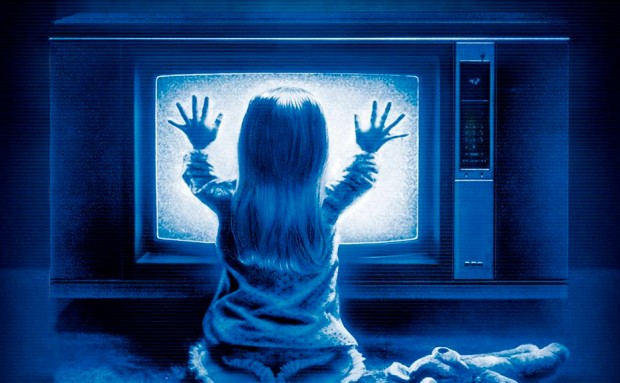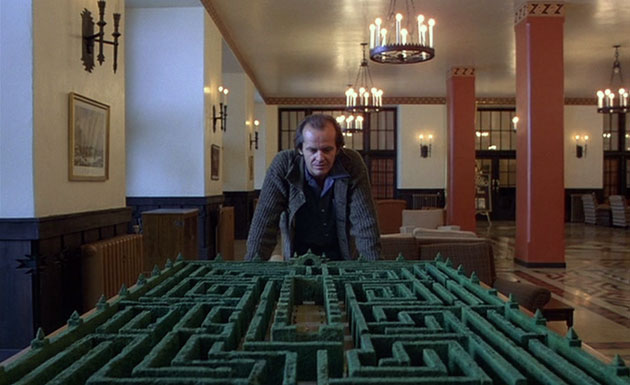
Sell Out the Hallway—Room 237 and the Stakes of Found Footage

Sell Out the Hallway—Room 237 and the Stakes of Found Footage

null

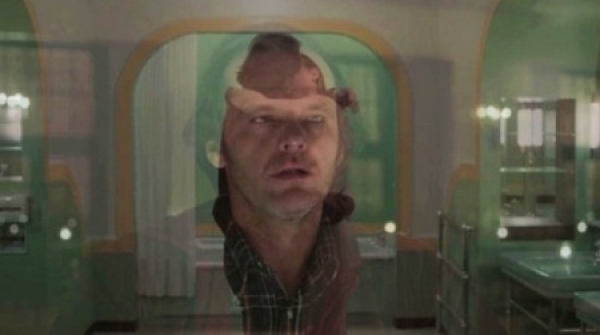
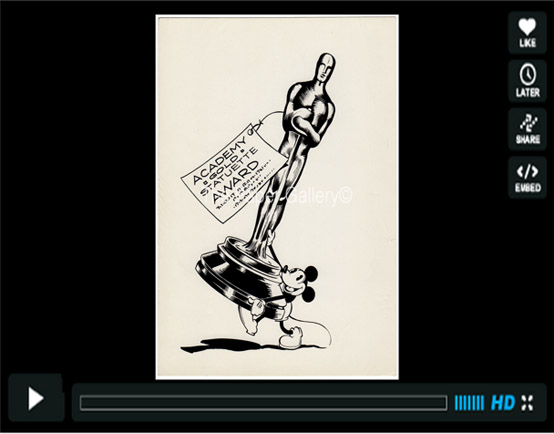
On a routine visit to the indispensible film blog Observations on Film Art, I was surprised and flattered to see that film scholar David Bordwell linked to the video essay work of myself and fellow Press Player Matt Zoller Seitz in a characteristically insightful probe of Room 237, the new feature-length film about Kubrick’s The Shining. Bordwell’s analysis uses Room 237 as a springboard to consider the practice and principles of film criticism—a topic made all the more poignant by the recent passing of Roger Ebert. We also recently published a piece by Robert Greene that regards Room 237 as a reflection of the unruly nature of the critical practice, and yesterday we published an article by Press Play regular Nelson Carvajal about his recent copyright problems with Vimeo and Disney concerning his viral Oscar video. These last two articles would seemingly have little to do with each other, but they touch on much of what I’ve been thinking about lately, with the release of Room 237 and its bearing on both online video essay works and the legacy of found footage art, as well as the contemporary practice of film criticism. I was recently interviewed by S.T. Van Airsdale on these matters for the Tribeca Film Festival website. Much of that interview went unused, so I am adapting that content here to address these issues.

It’s been intriguing to see critical and popular acclaim gather around Room 237, as smart critics praise it more that I’d expect them to. One even called it “the greatest film ever made about another film,” which is simply a gross overstatement. Even if we disqualify masterful essay films about multiple works, like Godard’s Histoire(s) du Cinema or Thom Andersen’s Los Angeles Plays Itself, even conventional behind-the-scenes docs like Lost in La Mancha or Hearts of Darkness: A Filmmakers Apocalypse are more illuminating about their single-film subject than Room 237. I’d even put Redlettermedia’s multi-part, feature-length viral YouTube takedown of Star Wars Episode I: The Phantom Menace above Room 237 in doing a better job of skewering the obsessive nature of cinephilia, while still making smart, concrete observations on how films are actually made in reality, not just how crazily they are interpreted in people’s minds.

But if we want to talk about truly stunning reworkings of existing films, there’s Joseph Cornell’s Rose Hobart and Peter Tscherkassky’s Outer Space, to name just a few of the many examples to be drawn from avant garde cinema. Experimental film programmers could have a field day counter-programming Room 237 with more interesting found footage films, one of the richest veins of avant garde filmmaking: we’re talking about Bruce Conner, Matthias Muller, Martin Arnold, Les Leveque, Gustav Deutsch, Dara Birnbaum, Marlon Riggs, Black Audio Film Collective, and Leslie Thornton. Compared to these works, Room 237 amounts to a longer, slicker version of Mystery Science Theater 3000, a pseudo-intellectual minstrel show in which critical inquiry is reduced to freakish obsession. The film bears a strong anti-intellectual impulse, more geared towards ramping up the spectacular weirdness of its interviewees than towards taking their ideas seriously.

But I may have less of an issue with the film than with the culture
that informs it. The fact that there’s more critical and popular
interest in discussing and promoting a film like this rather than any of
the more deserving works listed above says a considerable amount about how our
collective addiction to pop culture sets the terms for what we consider
worthwhile. The fact that it’s about The Shining and Kubrick reflects an
inbred strain of cinephilia built around brand-name auteurs. As
expressed through the terminal obsessions of Room 237’s subjects, this
kind of cinephilia amounts to an oxygen-deprived hermetic practice that
takes people further into the folds of their navels, so that they don’t
have to actually engage with the world. All of the film’s seemingly
socially relevant talk of Holocaust and Native American genocide is inconsequential in terms of what one can actually do with this
insight, reducing the world-changing power of movies to a cinematic
Sunday Times crossword puzzle.

One disturbing aspect of Greene’s piece is that it conflates the
onanistic interpretations of Room 237‘s interviewees with the work of
film critics. I’d like to think that my colleagues are not trapped in
their own existential version of the Overlook Hotel. But when I try to
take the long view on contemporary film criticism and culture, I
sometimes wonder if all we’re doing each week is describing new pictures
painted on prison walls. It’s a prison not of our own making, but born out of a system that encourages us to lose ourselves inside movies as
perpetual consumers, rather than enabling us to look through, around, and
beyond them. This is especially important in grappling with the way found footage is utilized in a film like Room 237, and
to what end, given the special legacy of found footage filmmaking.
 
For decades, found footage and remix moving image artists have largely
toiled on the margins due to copyright issues, a marginalized status
that persists even today with YouTube and Vimeo takedown notices, as
illustrated by Nelson Carvajal’s incident. This situation leads to a
politically charged dynamic around the act of creation. It raises the
question of who really owns our culture, and who has the right to use it
to create something new and valuable, regardless of how valuable those
derivative works are deemed by the copyright owner. So much of it comes
down to challenging the hierarchy of big media culture, with its
presumed power over the average human being (what they refer to as “the
consumer”), and establishing a new paradigm of cultural fairness. The
irony with Carvajal’s work, a four-minute highlight reel of every Oscar
Best Picture winner, was that it couldn’t have been a more positive
endorsement of Hollywood product, and yet it was still taken down. This
unilateral relationship between self-appointed corporate overseers and
the rest of us brings to mind Charles Foster Kane’s espousal of “love on
my terms. Those are the only terms anybody ever knows.”

nullFor me, Room 237 is more interesting as a commercial case study, along the same lines as Christian Marclay’s phenomenally successful art installation The Clock, a found footage work incorporating thousands of film clips into a functional, 24 hour video timepiece. The Clock has created a sensation nearly everywhere it has exhibited, including its current installation at the San Francisco Museum of Modern Art, where the museum’s twitter feed posts hourly wait times for viewing. Such commercially successful applications of found footage in both The Clock and Room 237 mark a distinct shift in fortunes from how found footage art has been received in the past.

In that light, we can see the release of Room 237—a film deemed unreleaseable when it debuted in the festival circuit, due to copyright concerns—a more positive instance of cooperation between the rights owner and the artist. When the film amounts to a feature length commercial promoting The Shining, they would be idiots not to welcome it. Meanwhile, Christian Marclay makes half a million dollars per installation for what amounts to a 24-hour long YouTube mashup, repackaged as a blockbuster museum gallery carnival amusement. Taking this all in, I think these works have more to say about what commercial interests drive the production, programming and packaging of found footage works to fit the needs of today’s art pop market than they have to say about the art of cinema.

Still, I take heart that there are as many people out there making this work and who are simply excited to be exploring the potential of this format. I’m especially proud that it is the mission of Press Play to feature this work. At the same time, I think everyone should be aware that the cultural ramifications of this kind of creative effort inevitably become political.  Unlike the lost souls in Room 237, we do not live, work or think in a vacuum. There is a system in place that influences the fates of different works, and much of it has to do with how each work serves the needs of that system. Once artists become aware of this, they see that they have a choice as far as which path they want to take and what they want their work to stand for.

Kevin B. Lee is the Editor-in-Chief of Press Play. Follow him on Twitter.
Between Fair Use and Infringement: The Perils of the Video Essay Form

Between Fair Use and Infringement: The Perils of the Video Essay Form

null

“In
its intent the video essay is no different from its print counterpart, which
for thousands of years has been a means for writers to confront hard questions
on the page. The essayist pushes toward some insight or some truth. That
insight, that truth, tends to be hard won, if at all, for the essay tends to
ask more than it answers. That asking—whether inscribed in ancient mud, printed
on paper, or streamed thirty frames per second—is central to the essay, is the
essay. […] Images and sound, those engines of emotion, have their own story to
tell. Promiscuity of the image isn’t a weakness of the essay-film. It’s a
feature. A volatile one, sure. And it’s changing the way we write, changing our
conception of what writing means.”
-John Bresland, On the Origin of the Video Essay

During
the last couple of years, as I developed my voice as an independent digital
filmmaker, a majority of the content in my filmography grew under the direction
of appropriation art, and in particular, the video essay form. I suppose that’s
why the above quote by Bresland speaks to me deeply these days. By “changing
our conception of what writing means,” this visual form of critical
storytelling also falls victim to accusations of piracy, infringement and
perhaps worse, unoriginality.

In 2011,
I began making cultural commentary video essays, on themes of mass media
consumption
,
and then in 2012 I was lucky enough to begin making video essays on the cinema
for Press Play. Creating and sharing video essay works with the
likes of Matt Zoller Seitz and Kevin B. Lee (the masters of the video essay
form) opened up my eyes to the far-reaching potential that the video essay
could achieve; in an age of hyper social media and over saturated online
content creation, the video essay form was the perfect medley for retooling
existing media in an effort to discover new meanings or alternative
interpretations, while also drawing back on nostalgia and what certain images
meant to different viewers. It’s been an exciting time, as the definition of
the video essay becomes more expansive and includes other forms of
appropriation art like the supercut or mashup.

But an
alarming cloud has been building: accusations of copyright infringement.

A
well-known case of this is Kevin B. Lee’s unfortunate clash with YouTube,
which resulted in his online videography being deleted completely. How could
such a travesty happen? Surely both YouTube and the third party copyright
owners (in Kevin’s specific case it was Warner Bros. Music) could see the
brilliance and vitality behind such a compilation of moving image criticism and
commentary. Why go through all the trouble of making Kevin start over with a
blank slate on his YouTube channel? What about his avid fans? These questions are
all the more troubling because there is probably no one who can legitimately
answer them. The reason for this is that a copyright takedown is usually automated.
In other words, if a video clip has a digital watermark, it’ll spur an online
takedown notice. There is no discussion by a team at a film studio; there’s
just an Internet spambot, making it clear that you cannot use this material.

And then
that same dark “accusation of copyright infringement” cloud got around to me
too. In February of this year I created a 4-minute video montage of every Best
Picture winner, in chronological order. Using Final Cut Pro as my editing
platform, in the modest work desk of my bedroom in my apartment, I created the
video in one sitting, on a Tuesday afternoon. And, as with every video essay I
create, I uploaded it to my Vimeo profile, with the citation: “Fair use is
codified at Section 107 of the Copyright Act: Under the fair use doctrine, it
is not an infringement to use the copyrighted works of another in some
circumstances, such as for commentary, criticism, news reporting, or
educational use.” For each video, I always acknowledged that I was abiding by
U.S. Copyright Law.
After all, they were for critical, cultural and educational use. So, with the
Oscar video, I wanted to share my enthusiasm for the coming Academy Awards
broadcast.

The
enthusiasm proved to be contagious.

I could
never have predicted that my Oscar video would go viral and receive some
national media coverage (Esquire
Magazine
,
Entertainment Weekly, etc.).
The best part about it was that it introduced a new set of viewers to my
existing body of work—and when you’re an independent digital filmmaker, that’s
the best kind of currency. The movie business is such a hard arena to stay
alive in and having an audience getting excited
about
your videography is a vital encouragement to keep going.

Fast forward to Monday April 8th, 2013: I receive an email from Vimeo,
saying that the Walt Disney Company found the material to be “infringing” and they had to
remove the video from my Vimeo account. That hurt. The video had accumulated nearly half a
million views on Vimeo and even made some television appearances on various
local news broadcasts.
People liked it and were sharing it. But now that has stopped. The Walt Disney
Company, in one swift move, not only flexed their corporate litigation muscle,
but they did it well after the fact. I understand that digital watermarking on
certain clips can spur an online takedown notice but why didn’t it happen
sooner? The video’s viral success wasn’t exactly a secret. If the Walt Disney
Company found my work to be “infringing,” why wait until AFTER the Oscar
telecast to take it down? Again, there’s no one to answer these questions,
because copyright takedown notices are impersonal, automated and cold.

I didn’t
make a single penny off of my Oscar video and the Walt Disney Company didn’t
make any money by removing it from Vimeo. It was a labor of love for me, birthed during a prolific stage of my career. By removing my Oscar video, the
Walt Disney Company only shoots itself in the foot: Much of the feedback for my
video centered on how people were excited about the Oscars again and wanted to
actually seek out some of those forgotten titles. You wouldn’t know that now,
since the Vimeo page is deleted, along with its stats, “Likes” and comment
thread.

This
experience has put me into a disheartened funk. Part of me suspects the Walt
Disney Company saw no artistry in my video and solely looked for a
bottom line win in their books. I know that’s probably not the case. It’s just
the digital copyright police out on the prowl, taking down one video after the
next. What I do know is that yesterday I was excited about what video essay I
would start working on next.

Today
I’m not so sure.

Regardless,
it’s a troubling issue that needs more attention, because the video essay form
is a vital filmmaking genre and should be respected, guarded and supported
rigorously
.
Otherwise, we, as a movie-loving audience, will lose the bigger battle of
innovation and progress in the ever-changing landscape of film criticism,
digital filmmaking and online accessibility.

Nelson Carvajal is an independent digital filmmaker, writer and content
creator based out of Chicago, Illinois. His digital short films usually
contain appropriated content and have screened at such venues as the
London Underground Film Festival. Carvajal runs a blog called FREE CINEMA NOW
which boasts the tagline: “Liberating Independent Film And Video From A
Prehistoric Value System.” You can follow Nelson on Twitter
here.

Roger Ebert: End of Message

Roger Ebert: End of Message

null

Last weekend, the BBC published an article titled “How to write the perfect obituary” following the brouhaha around the New York Times’ recent obituary of Yvonne Brill. The Times piece had been deemed inappropriate and sexist for kicking off a rocket scientist’s post mortem with her apparently exemplary domesticity, including her “mean beef stroganoff,” and the BBC talked to a number of writers about the potential pitfalls of writing obituaries. It was a fluffy weekend piece, and I would have moved on were it not for one particular detail.

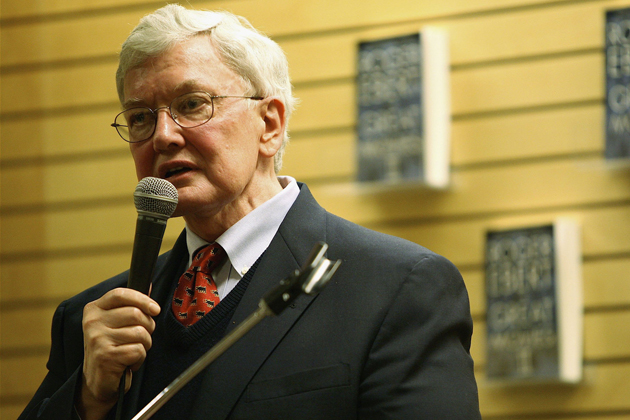
Among the writers interviewed was Harry de Quetteville, the Daily Telegraph’s obituaries editor. Apart from the Chicago Sun-Times, the Daily Telegraph, arguably London’s greatest daily, was Roger Ebert’s favorite newspaper, and he particularly relished their obituaries.  When I saw de Quetteville’s name, a momentary lapse in consciousness almost inspired me to compose a new e-mail to Roger. The subject would read “The BBC on how to write the perfect obituary; they’ve also talked to the Telegraph’s obit editor,” include a link, and end with “/eom.”

You see, “/eom,” i.e. “end of message,” was an abbreviation that Roger had particularly taken a shining to. He used to make a point of reading all of his emails, as well as the countless comments that his blog posts would elicit, so he had once emailed a large group of his correspondents urging them to submit links to him in a message’s subject line, and to finish it off with an “/eom” so that he would know the body text was empty. To the point. That’s the way he liked it. “Don’t beat around the bush.” Say what you’re going to say. Then “/eom” that baby”! His customary reply to link submissions was a concise “Tweeting! /eom”.

And tweet he did. He was against the very idea of Twitter at first, famously declaring “I will never be a twit” in a blog post dated March 28, 2009. Yet less than seven months later, he joined Twitter, the final one in a long list of media that he mastered over the course of a 42-year journalism career, by announcing proudly to the world: “This just in: I am a Twit.”

In hindsight, Twitter was the last hurrah of Roger Ebert’s illustrious life. His position as the chief film critic of the Chicago Sun-Times, but, more importantly, his film review show with the late Gene Siskel, had already turned him into a household name. But on Twitter he gained a further following his sincere, whimsical, and witty musings on life, the universe, and everything. Many have commented on how his passions outside of the cinema, which he extensively chronicled on his personal blog starting in 2007, introduced a more personal insight, but his film reviews had always reflected so much of his interests, passions, and idiosyncrasies. He only publicly admitted to being an alcoholic in 2009, yet hints of his ailment had been scattered throughout his writing for decades. He didn’t have to acknowledge his agnosticism or his admiration for Darwin: it was evident in his reviews. He loved Shakespeare and was a life-long Anglophile, two further fascinations he frequently detailed in his criticism. But blogging helped clear up the bigger picture. He enjoyed waxing lyrical, without having to worry about pitches, deadlines, or word limits, and relished the interactivity.

In fact, interactivity had always played a huge part in his modus operandi, even before he took to Twitter or Facebook—even before the rest of the world really took to the Internet, in fact. He was an early adopter of e-mail, and had his own forum on CompuServe, which he embraced fully.  Right around the same time, his Video Companion was included in the Cinemania CD-ROM, which surely played a further part in introducing his writing to a younger audience. But even before the ascendancy of new media, Ebert always communicated with his fans. His weekly Movie Answerman and Film Glossary columns accepted submissions. He taught courses on film, and started his own film festival, the annual Ebertfest at the University of Illinois at Champaign-Urbana. He simply loved to engage in conversation with the thousands who venerated him in whatever shape or form that tit-a-tat would take. He was a genuine renaissance man, and he adopted new challenges wholeheartedly.

As I wrote that final sentence in the previous paragraph, I got curious and checked RogerEbert.com to see how Roger rated 1994 Penny Marshall comedy, Renaissance Man. Not highly, it turns out, and after finishing off his pan, I followed the links provided within the review itself to Roger’s notices for Dead Poets Society, Private Benjamin, and, finally, Franco Zeffirelli’s Hamlet. This led to my getting lost down the rabbit hole of Roger’s reviews of other Shakespeare adaptations, and by the time I realised I had a piece to finish, an hour had gone by, I had read or re-read over fifty pieces, and was yearning for more. That was the great power Roger had over his readers: he made the reader curious and interested. He had a deliberate writing style, and, as Glenn Kenny observed, despised bullshit: he WAS a schoolboy AND he knew what he liked. He was a man of ideas, some of them very complicated, but he always managed to get them across simply, and without condescension. His prose was simple yet true, and in a profession that more and more frequently values the convoluted and fake, it had its fair amount of detractors. They were wrong, of course, and Roger’s continuous popularity was a testament to his endurance.

Roger was also a friend. But as time passes, and as people ask me, friends as well as the press, about the sort of friendship and relationship I had with him, I find myself hesitant to answer the question. Roger was a very private person about subjects he wanted to keep that way, but, generally speaking, he was very open. He was a friend to all who came knocking. I exchanged daily emails with him, wrote for his website, attended his film festival, visited his house. He made me feel welcome, but this had nothing to do with the length or depth of our acquaintance or the fact that I was one of his Far-Flung Correspondents. He was just a welcoming sort of guy, which is what I always tried to communicate to people who asked me for his email address. “You don’t need my introduction,” I’d tell fellow writers. “If anything, he probably knows your work already.” 

It’s been five days since the world found out about Roger Ebert’s death. Writers have been competing in the eloquence of their tributes, and even though I am not one to judge the particular way a person mourns, I have found certain aspects of this deluge rather off-putting.  I simply think it an incongruent way to mourn the death and celebrate the life of a man who despised cant and abhorred schmaltz (though he enjoyed having fawning admirers). Just look at his obituary of Studs Terkel, his hero: “He was the most widely and deeply loved man I ever hope to know.” Roger knew the meaning of the phrase “too much of a good thing.” He was a measured man, who kept things simple. He loved the movies, he loved his wife, he loved his family, and he loved his friends. He was a kind and generous soul, who lived a full and happy life. He will be missed. Every day. /eom

Ali Arikan is the chief film critic of Dipnot TV,
a Turkish news portal and iPad magazine, and one of Roger Ebert’s
Far-Flung Correspondents. Ali is also a regular contributor to
The House Next Door, Slant Magazine’s official blog. Occasionally, he updates his personal blog Cerebral Mastication.
In addition, his writing appears on various film and pop-culture sites
on the blogosphere. He also believes in the transformative potential of Twitter.

ROOM 237 and the Attack of the Id Critic

ROOM 237 and the Attack of the Id Critic

null

Room 237 is the first great comedy about film criticism. Or maybe it’s the first great horror-comedy. Or maybe I’m reading too much into it.

Rodney Ascher’s obsessive exploration of a collection of obsessive interpretations of Stanley Kubrick’s The Shining is full of wit and knowledge, sharply executed and deliriously insightful into the ways we process images and construct meaning in movies. Ascher never makes fun of his entertaining collection of crackpots, but his commitment to them and their analyses is complete. Frame-by-frame, backwards and forwards, the film is deconstructed; a German typewriter equals a Holocaust subtext, a missing chair from one shot to the next is not the result of a standard continuity screw up but a sign of Kubrick’s brilliant parody of low-budget horror filmmaking. Ascher lets these analyses proceed to their gloriously ridiculous ends.

These (mostly) silly conspiracies are not being articulated by professional film critics, clearly. But to a filmmaker (like me), a person attuned to the means of producing a film, where chaos reigns and meaning is often stumbled upon, even by the most control-freakish of directors, this type of over-interpretation is painfully hilarious. Because Ascher knows exactly what he’s doing, Room 237 is a cringe-worthy comedy of the highest order.

Never has a filmmaker attempted a movie so completely about the mental process of film critique. These characters are not “proper” film critics. But their obsessive readings can be seen as a metaphor for all film analysis. That burning need to scrutinize—to interpret and explain—is the soul of even the most sophisticated criticism. What Room 237 does is take that internal desire to understand and transforms it into a raging, slobbering, terribly funny movie monster.

I watched it with hands over mouth, openly terrified of this new screen villain, the id critic. Sometime around the Apollo 11 sweater reveal, I let down my guard and enjoyed the sidesplitting humor for what it was. But that initial feeling of terror was real, coming straight from my filmmaker-brain, where subtlety is life force and dumb symbolism is the destroyer of truth, or something like that. This type of deep-in-the-mud meaning excavation was something like a nightmare, tapping into my worst fears about the movie creation/interpretation process.

The film seems to have touched a nerve with critics, too. In a ranting blog entry after seeing the film at the 2012 Toronto Film Festival, Jonathan Rosenbaum blasted Room 237 as “reprehensible” because Ascher “refuses to make any distinctions between interpretations that are semi-plausible or psychotic, conceivable or ridiculous, implying that they’re all just ‘film criticism’ and because everyone is a film critic nowadays, they all deserve to be treated with equal amounts of respect and/or mockery.” I understand the sensitivity, JRo. Meanwhile, from apparently the same screening, critic Girish Shambu called the film “a disturbing representation of the practice of film criticism.

Clearly, a least a few critics were as disturbed by the id critic movie monster as me. Are they being forced to recognize the monster inside?

“I think any critic who doesn’t see themselves reflected in Room 237‘s obsessives is either lying or in denial (although I just wrote a piece on circular motifs in The Hudsucker Proxy, so I may be projecting),” said critic Sam Adams. “Of course I recognize the monster within,” added former AV Club editor, Scott Tobias, “I don’t think we’re conspiracy theorists by nature, but you don’t do this for a living (or a habit) without sharing some of [the] mad obsession of Room 237‘s subjects. There are always going to be times when a sensible critic might not seem far removed from the film’s subjects, when the “monster within” is revealed.”

All interpretation has the potential to become over-interpretation and Room 237, at its core, is a portrait of the mind of the interpreter. Ascher isn’t interested in film criticism, per se, but by brilliantly refusing to question the outlandish theories on display (such as The Shining being Kubrick’s coded confession to his wife for staging the moon landing), he’s implicitly created what can be seen as a high parody of film critique.

A filmmaker creates a film, often by any means necessary and often at the expense of his/her sanity. Said film has “meaning” inasmuch as it presents a set of ideas as a work of art. This film then makes its way into the world, where it is confronted first by a hoard of well-versed gatekeepers, who (often as a means of employment, but not always) dissect it, sometimes in blurbs, sometimes in long essays, creating personal “takes” on the work. This process (even when amazingly rewarding to the writer) can be excruciating to a person who makes movies.

“I’m sympathetic to your frustrations as a filmmaker, Robert, but your perspective is irrelevant to this kind of inquiry,” said friend and critic Eric Hynes when I asked him to comment. “There’s a reason that this obsessive mentality gravitates towards reclusive, mysterious, or dead artists—there’s room, there’s an invitation even, for audience participation and conjecture. But even for less opaque films and filmmakers, once you’re done with it, it belongs to the world. Intent matters, of course, but you can’t control whether anyone gets it or gets you.”

This did not make me feel better.

Room 237 is like an act of revenge from a filmmaker upon the critics. If Ascher had made other features and gone through the normal ups and downs with critics, I could almost stage my own Room 237 about his Room 237 to prove correct this revenge hypothesis. As it stands, the film is blisteringly funny and provocative in the way it opens up the hidden wounds and secret tensions between filmmaking and film reviewing. Do critics understand that Room 237, as horror-comedy, might be destroying the delicate balance of filmmaker-film critic relations?

“One definition of ‘film criticism’ would be the translation of an extremely personal reaction into terms that seem objectively reasonable,” says critic Vadim Rizov.

“So sure, I ‘see myself,’ (in the characters in Room 237) but good/great criticism doesn’t have to be reasonable; it just has to have an argument that illuminates something about the film, even if I disagree totally.”

Sensible enough. Maybe Ascher hasn’t destroyed the universe. “I took the Sontag phrase “Against Interpretation” very much to heart,” says critic Glenn Kenny, reassuringly. “I don’t think that a work of art is defined via decoding its supposed symbolism. What the filmmaker cannot correctly gauge, in the final analysis, is what the movie looks like to someone who DIDN’T make it. This can be valuable to the filmmaker, or not. I don’t want to get too dogmatic about it.”

“As a critic,” adds Tobias, “I’m cautious about proposing grand unifying themes like the ones expressed in Room 237, because it encourages a kind of myopia that limits your understanding of a work. Kubrick certainly programmed meaning into his work, but once a film is released, I believe firmly that it belongs to the viewer and that not all meanings are intentional.”

This is the important point. To the filmmaker brain, Room 237 illustrates violently and hilariously the degree to which the filmmaker really doesn’t matter once the film is done. So maybe the id critic isn’t the movie monster here. Maybe it’s my own fears manifested at which I’m nervously cackling.

But when it comes down to it, Room 237 is, in fact, a celebration of movie creating and watching. “Room 237 offers examples of (I guess) ‘bad’ film criticism, but the cranky fanaticism on display can illuminate potentially unexplored corners,” says Rizov.

“Though there’s clearly something monstrous about the perversions of interpretation on display, I also feel a kind of exhilaration as the theories unfold,” says Hynes, “the ‘let’s see what I can see when I see things obsessively’ impulse is less monstrous than essential to all endeavoring to reach greater understanding.”

“The implicit argument the movie makes,” adds Kenny, “is that the interpretations have value as fantastic stories of their own, that they construct a Borgesian library of imaginative “knowledge” which is of value.”

Okay fine. Room 237 is not a comedy about film criticism. But it is damn funny that we all keep doing this.

Robert Greene’s documentaries include Fake It So Real, Kati With An I and Owning The Weather. He also produces and edits films with 4th Row Films. He blogs here. Follow him on Twitter here.

Excerpts from a Critic’s Screening Notes for UPSTREAM COLOR, Arranged as Free Verse

Excerpts from a Critic’s Screening Notes for UPSTREAM COLOR, Arranged as Free Verse

null

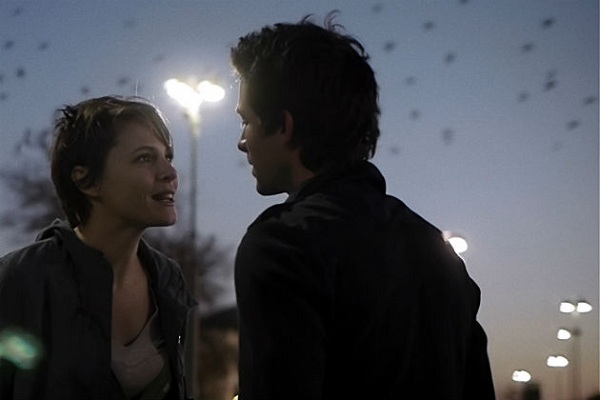
Warning: plot spoilers ahead.

“It won’t come out.”

Pig.

Tent.

Surgery. Pulling worm out, putting into pig.

Worms in dirt.

Pig tagged in ear.

Pig w/ other pigs.

***

Kissing in bed. He has scar on ankle.

Then they’re lying naked in sheets in pig field

“Why do you live in hotels?”

***

Pregnancy is impossible

He finds her on street, she’s incoherent

“I’m marrying you”

She insists on getting a car

***

Happy together

Telling stories about past—but whose memories are they?

New house

“I tell you a story, and you take it and make it your own”

His childhood trips to Vermont—

Memories jumbled

Piglets

***

She’s lost, he’s driving, giving her directions to get out

“Why were you at my work?” “I didn’t know I was”

They run home, looking for… what?

Crouched in the bathtub, afraid

***

She recites as he reads from WALDEN

“A sojourner in civilized life again”

“A universal and memorable ending”

Why WALDEN??

Rebirth: good or bad?

***

Looking for more flowers, but finds only white ones

In greenhouse, the thief shakes his head “no,” as if disappointed by plants

Kris w/ piglet, cradling it like a baby

Nelson Kim is a regular contributor to Hammer To Nail and an adjunct
professor at Fordham and Columbia. He is currently in post-production on
his first feature film,
Someone Else, starring Aaron Yoo and Leonardo
Nam.

A Far-Flung Memory of Roger

A Far-Flung Memory of Roger

null

Back when I was a kid, every now and then my Dad would go on a business trip abroad. This was a huge deal back in the late 1980s and early 1990s, since every item coming from the world stretching to the West of my native Poland was seen by our eyes to possess near-magical qualities. The richness of color was matched by a gaudiness of design simply unseen in Eastern Europe. The few candy bars and Teenage Mutant Ninja Turtles T-shirts I got from my Dad could have just as well been imported from Oz itself.

One of the last gifts I got from him as a teenager was a CD-ROM called “Cinemania ‘97”, a vast data base of reviews that combined the outputs of Leonard Maltin, Pauline Kael and Roger Ebert in order to create a new kind of interactive movie guide—one that would later be supplanted by internet browsers and IMdB. My Dad knew of my passion for movies (I dragged him out to see them often enough to make him abhor Disney flicks for life). I started devouring the contents of the disc right away: cross-referencing like mad, looking up films that ran on Polish TV the given week, soaking up facts and, last but not least, learning English in the process. Some of the words were so beautiful as mere sounds that I almost regret ever learning their meanings. Peerless, taut, and stellar were only some of them; the old and greasy-looking English-Polish dictionary my folks owned was never far away when I used “Cinemania”.

Of the entries included on the disc, the ones by Roger were the longest and most detailed. Maltin wrote capsules and Kael’s pieces were the edited-down versions of her New Yorker reviews, originally contained in 5001 Nights at the Movies. Roger’s prose was instantly accessible and inviting. He seemed uninterested in infallibility (something Kael would thrive on, clearly having enjoyed publishing what she saw as the final word on her subjects). He came off as a super-knowledgeable guy who happened to want to simply talk movies with you. He would never judge you for botching a phrase in English, I thought to myself—only for being untrue to your gut feeling. I took immediate comfort in that, which later allowed me to make my own tentative attempts at writing criticism in English.

All this was happening as I was undergoing puberty and reaching the predictable geek peak of my life. As we turn into adults and our bodies stop making sense to us (and start offering scary pains and pleasures), it’s common to burrow into the world of one’s passion, with its safety from judgment and limitless stretches of impractical knowledge waiting to be explored. For the awkward, sports-adverse teenage me, that shelter was the movies. Without even knowing it, Roger convinced me it was possible to talk about movies in a way both learned and relaxed—and that was years before I could even see clips of his famous TV show, which never ran in Poland.
I remember having caught The Exorcist on late-night TV soon after I got “Cinemania.” I was still a devout Catholic then—as well as a closeted gay kid living in a country where even sex education classes didn’t go much further than discussing the first (strictly straight) base. I was traumatized by the Friedkin movie, and the scene of Linda Blair masturbating with a crucifix sent me into a state of deep shock (there was no Richard Pryor around to dispel the horror with his famed Black Exorcist skit: “Wash your ass, girl! And get that cross outta yo’ pussy!”). Reading Roger’s review that same night, and finding out that he considered it a great movie, was even a greater shock to me. At the same time, that very review provided one of the first, much-needed cracks in my insular religious upbringing: learning that a movie with that much blasphemy could actually be good was a revelation, a hint at a different way of thinking about the world than was prevalent in the environment I grew up in.

Years later, thanks to a recommendation from my mentor and friend, Kevin B. Lee, I became one of Roger’s Far-Flung Correspondents. The depth of the honor is almost too obvious to be discussed here, and it was only enhanced by the fact that I could also work with Jim Emerson, Roger’s closest collaborator and, yes, the editor of “Cinemania ‘97.” I still remember the day I filed my first piece, on Jerzy Skolimowski’s Deep End, shaking and expecting rejection. Instead, I got the warmest and most encouraging email of my life – and in a matter of minutes, since Roger always responded instantaneously.

As an editor, Roger was endlessly encouraging and just about limitless in his hospitality. As FFCs, me and my great colleagues enjoyed tremendous freedom in choosing subjects and deciding on the best ways to approach them. Be it an ultra-rare Pola Negri silent or the guilty pleasure of “Honey, I Shrunk the Kids,” Roger was game—he trusted us that much.

It was that comfort and safety that made me not even think twice, when—upon writing a piece on my childhood fascination with Dynasty for Roger—I suddenly realized that I just wrote a sentence in which I referred to myself as a gay man. I never did that before: lots of my friends knew about me already, but I never once mentioned the fact in print or on-line. I remember staring at the screen for a second, and thinking: “It’s OK, this one’s for Roger.”

Roger’s writing suggested a great wit inhabiting a generous soul—he could be rough, but he was never mean. When he vented frustration with a movie, it wasn’t in order to be hurtful. He could famously hate (and  hate, and hate, and hate) a movie, but he would never take a film down just for the pleasure of crafting a retweetable pan.

My one and only time when I spoke with Roger came at EbertFest 2012. He wrote in his pad: “I care deeply for your writing, Michael,” to which I replied: “I learned English from reading your stuff!” His answer was pure Roger: “No wonder you use it so well, then.” I will never forget that moment.

Michał Oleszczyk is a film critic and scholar based in
Kraków, Poland. He wrote the first Polish book on Terence Davies and translated
J. Hoberman and Jonathan Rosenbaum’s “Midnight Movies” into Polish. He contributes
to RogerEbert.com, “Fandor”, “Slant Magazine”, “Hammer to Nail” and many Polish
outlets. He has been named the Critic of the Year 2012 by the Polish Film
Institute.

Speaking for the assembly: the genius of Roger Ebert, 1942-2013

Speaking for the assembly: the genius of Roger Ebert, 1942-2013

null

No one was better at describing the emotional experience of
watching a film than Roger Ebert. Few were better at describing the emotional
experience of life.  Roger knew
the two experiences were one and the same. That was his genius.


In his
appreciation of Roger
, critic Jim Emerson warned himself and others against
writing one of “those
‘In Memoriam’ pieces in which the writers overstate their closeness to the
deceased.” I’ll try not to make do that here, but it will not be easy. Roger
was the Giving Tree of film critics, and he was extraordinarily generous to me.
Over the years he brough me out to EbertFest, published my video essays, and linked
to my blogs The House Next Door and Press Play. We emailed each other almost
every day, to alert each other to videos we liked or young critics we thought
that the other should know about. He was a mentor as well as a friend. Amazingly,
this experience was not unusual. To know Roger was to feel uniquely understood
and appreciated. He had a rare gift of intimacy that turned strangers into
friends – not just fellow critics, but readers and viewers.

How did he do it? Through a combination of eloquence, love
and commitment. Roger could punch his weight with any film historian or
theorist – when he still had a speaking voice, he could spend days analyzing beloved
films shot-by-shot – but that wasn’t where his passions lay. Roger was an
enthusiast, a standard-bearer and a talent scout. He lived for the new, the
great, the wonderful. He saw with his heart. 

null“What I believe,” he once wrote,
“is that all people should remain two things throughout their lifetimes:
curious and teachable.” He was describing himself, of course, as all critics
ultimately do. All of his writing was part of an ongoing journey of
self-discovery, whether it took the form of a blog entry about his cancer
treatment or his feelings of disfigurement after having his jaw removed or his battles with alcohol, or a 700-word pan
of some new comedy or action picture. One of his greatest late-period reviews, of Terrence Malick’s The Tree of Life, was as much about his struggle to accept and embrace mortality as it was about the film. 

“The film’s portrait of everyday life, inspired by Malick’s memories of his hometown of Waco, Texas, is bounded by two immensities, one of space and time, and the other of spirituality,” Roger wrote. “The Tree of Life has awe-inspiring visuals suggesting the birth and expansion of the universe, the appearance of life on a microscopic level and the evolution of species. This process leads to the present moment, and to all of us. We were created in the Big Bang and over untold millions of years, molecules formed themselves into, well, you and me … And what comes after? In whispered words near the beginning, ‘nature’ and ‘grace’ are heard. We have seen nature as it gives and takes away; one of the family’s boys dies. We also see how it works with time, as Jack O’Brien (Hunter McCracken) grows into a middle-aged man (Sean Penn). And what then? The film’s coda provides a vision of an afterlife, a desolate landscape on which quiet people solemnly recognize and greet one another, and all is understood in the fullness of time.”

There were so many moments like that in Roger’s writing — moments when the facade of detachment, which in most cases never existed anyway, falls away, and we’re looking into a man’s soul. 

There is a melancholy gulf over the holidays between those who have someplace to go, and those who do not,” he writes, in the opening paragraph of his review of Billy Wilder’s The Apartment. The film, he says, “is so affecting partly because of that buried reason: It takes place on the shortest days of the year, when dusk falls swiftly and the streets are cold, when after the office party some people go home to their families and others go home to apartments where they haven’t even bothered to put up a tree. On Christmas Eve, more than any other night of the year, the lonely person feels robbed of something that was there in childhood and isn’t there anymore.”

The consul drinks,” Roger writes in the opening paragraph of his Under the Volcano review. “He has been drinking for so many years that he has arrived at that peculiar stage in alcoholism where he no longer drinks to get high or to get drunk. He drinks simply to hold himself together and continue to function.”

“The camera watches Elliott moving around,” Roger writes in a piece about revisiting one of his favorite films, E.T., with his granddaughters. “And Raven, that’s when you asked me, ‘Is this E.T.’s vision?’ And I said, yes, we were seeing everything now from E.T.’s point of view. And I thought you’d asked a very good question, because most kids your age wouldn’t have noticed that the camera had a point of view–that we were seeing everything from low to the ground, as a short little creature would view it, and experiencing what he (or she) would see after wandering out of the woods on a strange planet. While we were watching, I realized how right you were to ask that question. The whole movie is based on what moviemakers call ‘point of view.’ Almost every single important shot is seen either as E.T. would see it, or as Elliott would see it. And things are understood as they would understand them.” 

The fusion of
inner- and outer-directedness seen in these pieces, and in hundreds more spread out over forty-plus years, is rare and striking.  It alone can mean the difference between forgetting and
remembering a writer’s words. 

We remember Roger. We remember Roger’s words.
They were one and the same.

Roger lived to introduce us to new films, new faces, new
ways of thinking and seeing. When he got excited – as he did about Spike Lee,
Steve James, Zhang Yimou, Jane Campion, Jim Jarmusch, Steven Soderbergh and all
the other filmmakers he helped put on the map – his words had an evangelical
fervor; when he turned melancholy or introspective, they had a Talmudic wisdom.
At its most impassioned, Roger’s writing (and his spirited declarations on the
old TV shows) reminded me of my favorite admonition from Corinthians, that “in the assembly”  — i.e. the church — “I would rather speak five words with
my understanding, that I might instruct others also, than ten thousand words in
another language.”  Roger
spoke for the assembly, in simple but eloquent language. He described films,
filmmakers and even whole film movements in punchy sentences and colloquial phrases
and controlled bursts of lyricism that stimulated discussion rather than shutting
it down. “Without ever once deviating from a conversational tone,
Ebert could make watching Welles, Bresson, Ozu and Mizoguchi sound like nothing
less than the purest joy,” wrote Variety’s Justin Chang. 

Roger was what I call a “silver lining” critic, one who goes
into every film hoping it’ll be great and was saddened if it wasn’t, yet still
looked for pleasing aspects. He sometimes caught flack for grading on a curve
— for judging a movie not against the towering masterworks of cinema art, but
against other films of its type. There were times when that philosophy made him
seem like a grade-inflating “nice guy” teacher, even someone who’d taken leave
of his senses. (Four stars for The Loss
of Sexual Innocence
? Seriously? And I’ll never understand his fondness for Paul Haggis’ Crash.) But other times it was hard
to argue with his methods and conclusions because hey, look at the films. Is Rainer
Werner Fassbinder’s Ali: Fear Eats the
Soul
a four-star movie? If you must rate by stars, absolutely. Ditto Oldboy, one of the great
visceral-psychological mind-twisters, and the first Lethal
Weapon
, a world-class example of what Roger called a “bruised forearm
movie.” (How many hilarious moviegoing shorthand phrases did Roger coin or
popularize? Hundreds, at least. My favorites are “fruit
cart scene
,” “semi-obligatory
lyrical interlude
” and “Leno
device
.”)

There was always joy in his writing, and it came from the
joy he took in living. He was truly, madly, deeply in love with his wife Chaz, his best friend and strongest advocate. He was relentlessly productive and very canny about
investigating new technology and figuring out how he could use it to communicate. His sensibility was so naturally warm and inviting that it was easy to overlook how tough
and unsentimental he could be about the media he used so superbly. He was a veteran
newspaperman who got his start at a time when stories were still created on
typewriters, but he and Gene Siskel instinctively understood the value of TV as an amplifier of print, and over the years their TV show intertwined with Ebert’s own written criticism to the point where each seemed an extension of the other. This strategy seemed prescient even then, when newspapers were still a powerful force in American life; I dimly recall a piece from the early 1980s that referred to him and Siskel as veterans of “one of the few big cities in America where newspapers still compete,” a reminder that the industry’s death started earlier than most of us were ready to accept. When Roger got to the end of the 1990s – the last great decade for
newspapers, and in retrospect the beginning of their final decline – he started to look
ahead to the next frontier, or frontiers. He did pioneering, successful
work in CD-ROMs, then moved into online journalism, building his own site and intertwining it with that of his home paper, the Chicago Sun-Times, in ways that make those two outlets seem as fused as the Sun-Times and the TV series had seemed in the 1970s and ’80s. He took to Twitter like a duck to
water. He championed the video essay and included examples of it in his recent, lamentably short-lived TV show Ebert Presents At the Movies. He was the youngest old man any of us knew. 

His health problems not only failed to slow him down, they seemed at times to energize him. He did more before lunchtime than most of us did in a week. There were times in the last few years when I’d look at his Twitter stream, his web site and the near-continual chain of emails on which we were both cc’d, along with many other colleagues — the National Society of Film Critics, EbertFest, rogerebert.com — and marvel that a man who’d endured so much could even function, much less thrive. But thrive Roger did. Adversity didn’t just make him more defiantly prolific, it seemed to amplify his goodness. He grew kinder and more thoughtful by the year. 

And whether he was writing or speaking, on paper or on television or onscreen, it was always about the words, the words, the words. 

The words were his. He was his words. 

We remember Roger. We will always remember Roger. He normalized cinephilia. He made finding the art in life and the life in art seem unremarkable yet deeply satisfying
activities, things that everyone could and should do. 

We didn’t so
much absorb his insights as walk through them, like a door in a dream that opens
to reveal a previously unnoticed room.

Remembering Roger Ebert (1942-2013)

Remembering Roger Ebert (1942-2013)

nullIt was the same ritual every year. It was usually late October, maybe early November. You’d go to the mall where there was a bookstore, usually a Walden Books. (This was before Borders and Barnes & Noble were in every shopping center.) The section devoted to “Film” was one shelf, not a wall. You’d scan the shelf to see where it was. Then, you’d come across its brightly colored thick spine and pull it from the shelf. You’d flip through it excitedly, not being able to wait to get home and devour every page.

I’m talking about the annual ritual of picking up Roger Ebert’s Movie Home Companion. The first one I ever got was in 1991. It had red and yellow lettering, with Ebert on the cover, doing a thumbs-up pose. I was 12 going on 13 and was already a devotee of Siskel & Ebert. I wasn’t aware Ebert collected his print reviews in book form. When I found out I couldn’t wait to get home and read it cover to cover. And I did. I remember there were lengthy pieces on Marlon Brando (in connection with the summer 1990 release of The Freshman) and escalating movie violence. There was Ebert’s essay on why Goodfellas was the best film of 1990. Considering that that was the movie that made me start to develop my critical voice and want to write about movies, I read that essay with particularly great awareness of its reasoning and phrasing. Mostly, though, I read the book for its reviews. I read ‘em all. I started to make note of certain positive reviews of movies I hadn’t seen and would seek them out at the video store or when I would read the Sunday paper’s weekly TV listings. That’s how I discovered movies like James B. Harris’ Cop and Blue Collar and My Dinner with Andre and Four Friends and Looking for Mr. Goodbar. I would watch the movie and then go back and read Ebert’s review to see if his reaction mirrored my own. Sometimes it did. Sometimes it didn’t. (He liked Cop but I loved it. He loved Fellini’s Satyricon, but you couldn’t pay me to see it again.)

nullAnd the ritual continued every year, around my birthday. Along with Leonard Maltin’s Home Video Guide, the Movie Home Companion kept me occupied when I should’ve been studying or doing my homework. Being severely visually impaired, I shouldn’t have been reading for long stretches at a time, but I did. (I remember when I discovered the Talking Book Program for the Blind had Ebert’s A Kiss is Still a Kiss on tape. I must’ve listened to it dozens of times, especially his interviews with Clint Eastwood, Lee Marvin, William Hurt, Nastassja Kinski, and Robert Mitchum, and his level-headed defense of Bob Woodward’s Wired.) Ebert’s introductions to each subsequent edition were like yearly dispatches from an old friend. He would end each intro with a list of recommended readings including Pauline Kael, Andrew Sarris, James Agee, Otis Ferguson, Stanley Kaufmann and other esteemed critics. He wasn’t insecure about having people leave him to discover other voices. He encouraged it. I devoured Kael and Sarris and Molly Haskell. I also read some John Simon. (I’m still debating if that was a good idea.) Eventually, I started seeking out different critical voices on my own. I got subscriptions to both Film Comment and Entertainment Weekly. Ebert taught me not to discriminate, so I appreciated the scholarly tone of Kent Jones and the punchy yet elegant phrasing of USA Today’s Mike Clark and EW’s Owen Gleiberman.

I started to write reviews myself. Like most things you attempt, you start by copying. I eventually developed my own voice that has a penchant for utilizing illuminating alliterations and parentheticals. (I love me some parentheticals.) I don’t write like Ebert. He was a newspaper man through and through and I, sadly, had to come of age during the Dead Trees era. Then again, Ebert didn’t really bother with those kinds of distinctions. He mourned the demise of newspapers, but he also embraced social media early on, as a way to continue writing about movies or, more accurately, he just loved finding ways to continue writing.

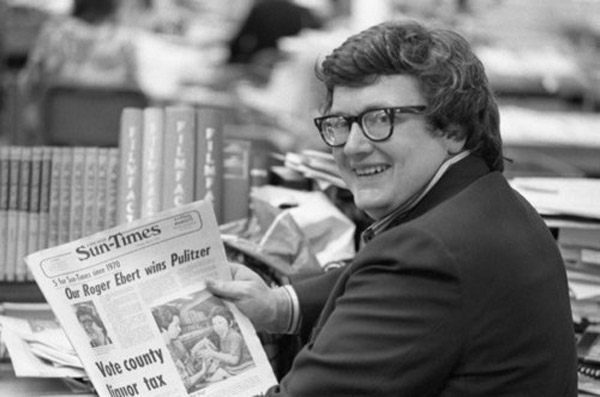
Ebert was a writer, a newspaper man, before he was a critic. His voice as a writer is what will be remembered. To dismiss Ebert’s contribution to film criticism because of his participation in the Siskel & Ebert program requires you to ignore the fact that the vast majority of Ebert’s criticism is in print. The show brought a generation (including myself) to the writing, and the writing inspired us to find our voice. (Blaming the TV show for the commercialization of film criticism is akin to hating Jaws and Star Wars because you dread all the copycats that were inevitably going to follow. Denying pleasure is the one thing a critic should never do.) It was hard to watch Ebert struggle with his deteriorating health over the years. It seemed especially cruel when he lost the ability to speak, but he rose to the challenge. His writing toughened over these last few years. He seemed to be less forgiving of movies that only did the bare minimum of what their genre required. (Ebert had been accused of being to forgiving of disposable entertainments. He wasn’t. He just started to demand more.) He used his blog to write about politics, Chicago history, his personal life, and movies. It always came back to writing about movies because they allowed him to write about everything else. Ebert lost his ability to speak, but he never lost his voice. Roger Ebert. One voice for all to hear. 

San Antonio-based film critic Aaron Aradillas is a contributor to The House Next Door, a contributor to Moving Image Source, and the host of Back at Midnight,” an Internet radio program about film and television.

VIDEO ESSAY: Siskel and Ebert: Screen Fighting Men

VIDEO ESSAY: Siskel and Ebert: Screen Fighting Men

Gene Siskel and Roger Ebert were journalists, film reviewers, TV personalities and friends. They disliked each other and loved each other. They needled each other on the air and put on a great show, but it was always in the service of film criticism and education, a means of exciting viewers and drawing them in. Their decades long partnership produced some of the finest televised film criticism of our era; their contentious relationship inspired all of America to think more deeply about lovely images that pass before us, the characters that populate our culture, and the cinematic artists that define our lives. 

This video essay doesn’t attempt to evaluate their important critical legacies. It zeros in on the magic itself, that remarkable chemistry that kept America watching for decades — a relationship copied but never equaled, serious but irreverent, respectable but never respectful. 

They worked together until Gene Siskel’s untimely death in 1999. The title sums up their unique place in American culture and their lasting legacy of inspiration: “Siskel and Ebert: Screen Fighting Men.” 

Raised in Fear: POLTERGEIST and the Culture of Forgetting

Raised in Fear: POLTERGEIST and the Culture of Forgetting

null

Poltergeist begins with the national anthem, once played by television networks late at night before they ended their daily broadcasts.  The montage of patriotic images that regularly accompanied these sign-offs is made strange in this film through extreme close-up shots depicting a grotesquely pixilated television screen, projecting fragmented images of Romanesque columns and military statues commemorating unidentifiable wars. The screen then fills with hissing static, from which emerges another ritual of the dead that threatens to devour the Freeling family and their community. Poltergeist is a film about the repressed traumas and anxieties underlying the American dream, a point further emphasized when we learn that Cuestra Verde, the planned community in southern California where the story takes place, was founded in the year of our nation’s bicentennial. The Freelings are the “first family” of this housing development, and as such are made to bear the burden of the community’s collective guilt.

1976 also happens to be the year my own family moved from the decaying farmhouse where my father grew up into a brand new faux-Tudor that my parents picked out of a magazine. We told ourselves stories about this move as if it were the realization of our family’s dreams, and the newness, size, and privacy of the house’s setting were the material manifestation of those dreams. Though we were one of the first families to move into this new housing development, we could dimly perceive other residents through the screen of trees surrounding our backyard. Later, when my sister and I tried to make friends with some of the local kids, we found them to be hostile to outsiders: in just a few months, cliques had formed and solidified into tribal antagonisms. By the time my parents divorced and sold the house some ten years later, our dog had shown up dead on our front steps and our healthy and surprisingly reliable cat disappeared, never to be seen again. My mother looks back on this as the happiest period of our lives. Like the Freelings, I have learned that happiness is often maintained through selective acts of forgetting.

nullThere has been much dispute about who actually did what in the making of Poltergeist, with suggestions that Tobe Hooper’s title of director was only nominal, and that producer and co-screenwriter Spielberg was the driving creative force behind the scenes. Certainly the film would seem to have little in common with Hooper’s harrowing classic The Texas Chainsaw Massacre (1974): the grainy texture and ruthless violence of that film are worlds away from the lavish visual spectacles that unfold amidst the comfortable middle class settings of Poltergeist. Nevertheless, Hooper’s direction and co-authorship may be felt in the sense of menace and threat manifested from the beyond, an otherworldly place revealed to be firmly rooted in the very earth beneath the concrete and sheetrock of Cuestra Verde. 

A comparison of Hooper’s two great films reveal them to share a common preoccupation with place, particularly in terms of the ways Americans seek to repress the past in the name of progress. The serial murdering family that haunts The Texas Chainsaw Massacre is made up of unemployed cattlemen, put out of work by the industrialized slaughterhouses and feedlots of modern agriculture. The bloodbath that unfolds in the film may be read as the grisly revenge taken by workers dismissed as casually as the animals they were once paid to slaughter. In Poltergeist, the planners of Cuestra Verde built its homes on the site of an old cemetery. As they move to expand the community into the surrounding hills, they plan to do the same with another burial site, a plan that shocks Steve Freeling (Craig T. Nelson), who says to his boss: “Oh you’re kidding. Oh come on. That’s sacreligious, isn’t it?” to which his boss glibly replies: “Oh, don’t worry about it. After all, it’s not ancient tribal burial ground. It’s just people.” 

To compare it with another film about an American haunting, Poltergeist offers a curious inversion of the genocidal logic underlying The Shining, whose horrors emerge from the Indian burial grounds that lie under the Overlook Hotel. Both stories concern the ways in which we overlook the past, but in Poltergeist the American ritual of forgetting has become more pervasive. While the builders of the Overlook Hotel had to fend off various Native American attacks during its construction, no one complained about the disinterment of the cemetery’s dead until Steve Freeling spoke up. Ancient tribal burial grounds are an alien concept to rationally planned communities: we no longer honor the household gods but simply build on top of them at our convenience.

nullThe film’s totem of forgetting is the television, and the Freelings are avid worshippers. There is one in every room of the Freelings’ home, and when Carol Anne talks with “the TV People” she raises her hands to the screen as if she were one of the apes bowing before the black monolith of 2001: A Space Odyssey. The Freelings are a good family who seem to have gone slightly astray, their lives detached from the larger world outside and from the history buried beneath their feet. At night Steve and Diane (JoBeth Williams) wind down by smoking pot and watching reruns of The Twilight Zone. Tellingly, Steve is absently reading Reagan: The Man, the President, the sanctimonious biography of a public figure uniquely successful in promoting a sanitized version of progress in which American capitalism redeems the nightmares of history. While the Freelings do not commit any crimes, they are complicit in an American culture of forgetting that allows people to be bulldozed for the making of a brighter future.
After Carol Anne is abducted to the plane of the TV People, she is urged, “don’t go into the light.” In the narrative, the light represents the afterlife, but it might also suggest that light of forgetfulness that shines fitfully from the television screens glowing throughout the house. It also seems to shine brightly on Cuestra Verde itself: in several scenes the characters remark on how beautiful and sunny the weather is while horrors run rampant in the Freelings’ home. It is a world in which distractions make it easy to lose one’s way. The film is abundant with product placements, and the children’s room is covered with tie-in products from Star Wars, Alien, and other movies: like its main characters, Poltergeist is complicit in the culture it seems to condemn. Yet while the psychic investigators suggest that the children’s product-filled closet is the “heart of the house,” dwarfish medium Tangina (Zelda Rubinstein) prophetically replies, “This house has many hearts.” 

Like the Freelings, I watched a lot of Twilight Zone episodes while growing up in my suburban home.  One episode has always haunted me, and it seems like a kind of DNA sample from which Poltergeist might have been cloned. In “Little Girl Lost,” a family suddenly loses their daughter to another dimension: they seek everywhere but can only hear her disembodied voice through various points in the house that seem to intersect with the alien plane. In the period my mother remembers as the happiest in our family’s life, we all spent a great deal of time watching reruns in separate rooms, cut off from one another and from the surrounding neighborhood. Any one of us could have disappeared, like the cat who never came back, and I am embarrassed to think how long it might have taken for one of us to notice.  The monstrous threats posed in horror films are often unconsciously desired visitations that serve to transform the individuals and unite the families who face them. But there is another kind of horror, one that is almost too subtle for the camera’s lens, in which families and friends disappear while we look into the light and slowly forget.

Jed Mayer is an Associate Professor of English at the State University of New York, New Paltz.