CANNES 2013: An Interview with James Gray

Cannes 2013: An Interview with James Gray

null 

The great emotional impact of James Gray’s formidable new
melodrama The Immigrant is gradual.
In the film’s epic opening moments, polish immigrant Ewa (Marion Cottilard)
arrives at Ellis Island in 1921. The weight of her character’s
decisions and compromises, which involve trusting a shady theater operator named
Bruno (Joaquin Phoenix) with her well being, is not immediately felt. But like
all of James Gray’s tormented lead characters, the more time you spend with
them, the more complex their experiences become. Through Ewa’s glazed eyes, the
film examines how survival and adaptation often trumps common sense and safety.
In this sense, Gray has crafted a masterpiece of pragmatic will that only gains
resonance with each shadowy frame. A day after The Immigrant premiered at Cannes 2013 to a rousing mix of praise
and criticism, Press Play sat down with Gray at the Carlton Hotel on the
Croisette to discuss 1930s melodramas, gender representation on screen, family
dynamics, and Fellini’s La Strada.

Press Play: Your
films often deal with the illusion of the American dream. How do you think The Immigrant is different from your
previous work in this regard?

James Gray: Ewa
is a survivor. I think she’s going to make it. I don’t think she’s going to
live a perfect life or be able to forget what has happened to her, but I think
she’s going to make it somehow. I don’t know if my other characters will make
it. In a perverse way Ewa is heroic, and I don’t mean heroic like a superhero.
What I mean is heroic in a mythic sense because she accomplishes something in
her pursuit to create a new life for herself and her sister. I think despite
everything she goes through, she is going to endure and pull through. So maybe
that’s how her experience, and the film as a whole, are different.

PP: The Immigrant is told from the
perspective of a woman, while your previous films have all been told from the
perspective of men. Why was this film so important to tell from a woman’s
perspective, especially considering the period piece setting?

JG: In Los
Angeles, of all places I had seen a production of Il trittico, which is three operettas by Puccini, two of which are
tragic—“Il tabarro” and “Suor Angelica,” and the third is a comedy, “Gianni
Schicchi.” Woody Allen directed the comedy, and William Friedkin directed the
tragedies. The second one Friedkin did, “Sour Angelica,” is one of the most
beautiful things I’ve seen in my life. There was a real breakthrough moment for
me during this segment because I saw something completely, nakedly emotional
which didn’t require any of the trappings of machismo. Nobody had to hold a gun,
and nobody had to run around acting tough. It was entirely about a woman’s
experience. This experience showed me that I was able to drop all of the
trappings of male behavior and make something that follows the emotion of the
moment. As for the period, that was me trying to tap in directly to parts of my
own family history, why my family exists the way it does emotionally. Both the
gender of the character and this desire to mine my own history were married
to create the story.

PP: The gender
issue is brought up quite often in the film. Ewa is a single woman who has her
family ripped apart in the opening moments, and it leaves her with this
decision to make. Does she move forward or backward? If the film were told from
a man’s perspective, it would have an entirely different focus.

JG: I was on the
jury in Marrakech in December, and we had to give a Best Actress award. I
couldn’t find an actress in the main character role to choose from. My own
position as a juror was that, as a group, we should make a comment and not give the
award at all because no film had a great female performance at its center. I
find that situation interesting, because women make up the majority on this
planet.  What, 52 or 53 percent of the
population? And yet, for some reason, men control the news and drama. But with my films I’ve always tried to make a comment on
the patriarchy, to say this is the way things are. I guess The Immigrant was my only way to break through that. It’s weird,
because American films in the 1930s and 40s, particularly melodramas, were made
for woman. From Bette Davis to Joan Crawford to Barbara Stanwyck to Katherine
Hepburn, and for some reason we’ve taken a step backward in this sense. Think
about this. Take Lawrence Kasdan’s Body
Heat
and Billy Wilder’s Double
Indemnity
. The latter’s presentation of the woman is in some ways
distinctly more progressive than the former. In Body Heat, the femme fatale turns out to be the center of all evil,
and in Double Indemnity Neff turns
out to be equally as guilty, if not more so, for everything that occurs. One was
made in the 40s, and one was made in the 80s. If you came down from Venus and
looked at both movies politically, you might think Double Indemnity was made more recently.

[At this point Mr. Gray spots director Jim Jarmusch
walking through the restaurant and stops the interview to say hello. The two
exchange friendly words of support, and before leaving, Gray kindly introduces
Jarmusch to this wonderfully bemused interviewer.]

JG: Sorry. It’s
been months since I’ve seen Jim and I love him to death. He’s a very important
person to me.

PP: That’s a
whole other interview we could do.

JG: Yeah.
[Laughs]

PP: You were
talking about female centered films from the 30s and 40s, and I think The Immigrant does attempt to get back
to that focus.

JG: Those films are mostly melodramas, which is a beautiful
genre, but sometimes they get melodramatic. Melodrama and melodramatic are not
the same thing, and often people make the mistake of confusing the two.
Melodrama is one of the most stunning art forms. These are stories where the
emotions are big and the situations are big, and the artists believe in the
situation dramatically. There’s no irony or distance. If there is a sense of
distance, the story becomes melodramatic. Being in the moment is a risky place
for a creative person to be. Because believing in the emotional moment is very
out of fashion. But there’s no art without risk.

PP: There’s a level of pragmatism
in Eva’s decisions that make her unique as a character, strong, realistic, and
vulnerable. What was it about her sense of pragmatism that interested you most?

JG: Not long
before I made the film I read Primo Levi’s book Survival in Auschwitz, which talks about the perverse idea that even
in this horrible place, there were moments of joy. To me this is so
inconceivable. I mean, what joy is going on there? I don’t understand. But the
idea is that even under the most horrendous of circumstances, survival is the
single most powerful idea. I wanted to compose a character who would be, in a
quiet way, very steely, very driven by survival, and by adaptability. She would
adapt to any circumstance, no matter how awful.

PP: It’s even
more interesting when you consider Jeremy Renner’s character Orlando, the
charming magician, and how he complicates Ewa’s pragmatism.

JG: It’s very
hard for Ewa to believe him. Orlando has a history as a gambler, a drunk, and
a womanizer. The whole idea isn’t to create characters that have no flaws. If I
had made Renner’s character a white knight in response to Bruno, there would be
no choice, conflict, or struggle. There would be nothing interesting about this
dynamic. When approaching this situation, I thought of the conception of the
Holy Fool, the idea that a person can show us the way, but it doesn’t mean that
person is perfect.

PP: Kind of like La Strada?

JG: Exactly like La Strada! The movie is a rip-off of La Strada. Well, not the last third. But if you think of La Strada, you have Zampano (Joaquin Phoenix’s character), you have
Gelsomina (Marion Cotillard’s character), and you have The Holy Fool (Jeremy
Renner’s character). The Immigrant is
directed in a very different way because La
Strada
is essentially a fable and a road movie, so there are differences.
But I was certainly affected by Fellini’s film. I just decided to approach it
in a more realistic way. Today, if you made a fable like that it might be seen
as quite quaint. Also, you don’t want to merely repeat Fellini anyway. You want
to do your own thing. Interestingly though, at the end of La Strada there’s no real redemption. It’s actually a lot darker
than my film. Zampano realizes too late that he loves her. There’s no real
redemption. Here, I had wanted to present a situation where the characters’
relationships and confessions are paramount. In some ways, there is hope for
both Ewa and Bruno.

PP: In terms of
performance, how did you approach the character of Bruno with Joaquin Phoenix?

JG: We had
engineered that whole thing really almost in reverse. We had started thinking
about the climax, which in a way sums up the entire character, the
self-destructive qualities of the character. I always felt that the self-hate
of Bruno would govern all of the behavior that came before in the film—the
lying, the manipulating, and the fact that he is essentially a predator. It’s all an act to intimidate Ewa into being on stage. But it was a strange
trajectory in terms of working on the character backwards, from the end to the
beginning.

PP: Why do family
dynamics interest you so much?

JG: It’s the
basis of who we are. So much of who we are as people comes from the dynamics of
the family. But absence of family also is who you are. If I want to understand
who a person is, I start there.

PP: This film is unique in that Ewa is by herself and Bruno
provides this false sense of extended family. But it’s all a façade.

JG: He does it on purpose and that’s how he survives. Bruno
even says it in the film, “The things you do to survive.” One of the great
traumas for me is what I call the “4am scaries”, the realization that we are
alone in the world. I remember as a little kid I would always feel comfortable
if the light in the crack of my parent’s door was on at night. When it went off
that meant they were asleep. Then that terror and the fear of being by myself
started to creep in. I think this feeling is more important than we care to
admit.  Being in a gang, being in a club,
a group, all of this is an attempt to try and shatter that fear, and Bruno
creates this kind of pseudo-family in order to survive emotionally and
financially. He might not admit that as a character, but it’s his way.

PP: I have to ask you this because it’s been on my mind
every since your first film. Happy occasions in your films are never really
happy. Dinner parties in We Own the Night,
the family gatherings in Two Lovers,
the welcome home party in The Yards,
they all hide the repressed emotional state of the characters and their
relation to family.

JG: [Laughs] I never thought of it that way but you’re completely
right. There are some things you aren’t conscious of in life, and that is one of
them. I think it says terrible things about my own past, meanwhile I have
family gatherings that are great. I have a fantastic wife and great kids, so I
don’t know what I’m working out there, but it’s not necessarily conscious. I
guess it’s dramatic tension, multiple levels of a scene. A scene should always
operate based on what the subject is that’s right beneath it. The subtext is
everything.

Glenn Heath Jr. is a film critic for Slant Magazine, Not Coming to a Theater Near You, The L Magazine, and
The House Next Door. Glenn is also a full-time Lecturer of Film Studies
at Platt College and National University in San Diego, CA.

RAISED IN FEAR: NIGHT OF THE HUNTER and the Horrors of Childhood

RAISED IN FEAR: NIGHT OF THE HUNTER and the Horrors of Childhood

null

The most harrowing film ever made about childhood opens with
a lullaby that is anything but soothing: “The hunter in the night / Fills your
childish heart with fright / Fear is only a dream / So dream, little one,
dream.”  As we stand on the threshold of
Charles Laughton’s haunted masterpiece Night
of the Hunter
, this lullaby sings us into the world of a scared child who,
strangely, is being encouraged to dream a dream of fear, which is a fair
description of the film that follows. While
Night of the Hunter wonderfully
defies classification, blending elements of expressionism, gothic, fairy tale,
and film noir, I would like to offer a reading of the film as a very particular
kind of horror film, one that enables us to see the world from a victim’s point
of view. Such films are anything but
empowering, in the sense used by the kind of self-help guides and memoirs of
personal struggle that litter our nation’s bookshelves. Rather, these films teach us sympathy and
compassion through a humbling sense of disempowerment,
which, in the case of Night of the Hunter,
involves taking us back to the horrors of childhood.

The tale is set in West Virginia during the Depression, and
the scarcity of those times drives the cruel deeds that unfold. We first see little Pearl and John Harper playing
happily in their yard when suddenly their father appears, on the run from the
police for a bank job in which two people were killed. He thrusts the stolen money on young John, which
will soon make him the object of murderous greed. Fear is John’s inheritance, yet the film
implies that even children who don’t experience his and his sister’s unique
form of persecution are born to suffer. Later in the film, as they flee from danger, they are forced to beg for
food along with other children. Their
grudging benefactor gives them each a potato before shooing them off, as she
muses: “Such times: when young’uns run the roads….” Near the end of the film,
when their guardian, Rachel Cooper (Lillian Gish), recites the story of Herod’s
slaughter of the innocents, she reflects: “It did seem like it was a plague
time for little ones, those olden days, those hard, hard times.” The film subtly parallels “those olden days”
with the “hard, hard times” of the Depression Era, and in its prolific use of
fairy tale motifs, connects this with the struggling peasant culture that
spawned the classic folk tales collected by the Brothers Grimm.

Although oral folk tales were traditionally recited to old
and young alike, they have a special resonance for children because of their
prominent place in the narratives, a place that is, as we all remember, often
terrifying. Whether being abandoned by
one’s parents in the woods because there isn’t enough food to go around, like
Hansel and Gretel, or being chopped up and fed to father in a stew, like the
child victim in “The Juniper Tree,” the children of fairy tales have much to
fear, especially from their parents. Once their father burdens them with the secret location of $10,000 in
stolen bank money, John and Pearl Harper’s story enters the dark dream world of
the fairy tale as they are pursued by Harry Powell (Robert Mitchum), a sinister
self-anointed preacher who is alluded to several times as “a wolf in sheep’s
clothing.” Yet the children are the only
ones able to see Harry Powell for the Big, Bad Wolf that he really is, and Night of the Hunter deftly captures that
sense of powerlessness all of us felt when, as children, we sensed something
wrong but weren’t able to do anything about it.

nullThe film is a virtual catalogue of iconic images of
childhood fears: closed basement doorways, crescent moons in night skies, empty
barns, shadowy attics, dark forests, and treacherous swamps make up Night of the Hunter’s haunted
landscapes. One of the film’s most
frightening scenes takes place in the Harpers’ basement, when Powell drags the
children down to help him find the stolen money. When the supposed cache turns out to be
empty, he turns viciously on John, who manages to extinguish the light and
overturn a shelf of canning jars on the villain’s head. Powell’s usually sly, seductive patter turns suddenly
into an animalistic wail. In the claustrophobic darkness of the basement, this
transformation is especially chilling, recalling many a downstairs journey and the accompanying fears.  The children
flee up the stairs, shot expressionistically as a thin
corridor of angular light hanging in a sea of blackness.  As in many scenes, the light and dark contrast here
is so strong as to make the image look like an old woodcut illustration. The children barely escape, slamming the
basement door, as vicious animal growls emerge from behind it.  As he continues relentlessly pursuing them as
they flee downriver, at one point John hears him singing his signature hymn,
“Leaning on the Everlasting Arms,” and wonders, “Don’t he never sleep?”  Fairy tale threats never do: they only take
on new forms as we grow older.

It’s striking to note that this film was produced amidst the
optimism and economic recovery of the nineteen-fifties, and perhaps this is why
the film initially flopped. Though
dream-like and fanciful, it nevertheless presents an unpleasant reminder of
hard times that remained all too real in the memories of older filmgoers.  Seen now, this classic takes on new life as a
dark fairy tale for an age of austerity. The world we are entering will indeed be, as the children’s guardian,
Rachel Cooper, says, “a hard world for little things.” Yet, given the grim outlook for our
collective future, it seems surprising that so many people remain so eager to
bring more little things into it. It is
this, as much as the perversely self-satisfied culture of child-rearing, that
inspired my previous piece on the film Who
Can Kill a Child? 

Climate scientists recently announced that we’ve reached a
dreaded milestone for CO2 levels, an announcement that received surprisingly
little attention.  But last year a
similar, and to my mind even more disturbing, milestone was passed, and some
actually considered it, perversely, as a cause for celebration. On March 12, 2012 the world population reached
seven billion, and while we might hope for a future in which this growing
population will be able to reduce its carbon footprint, there is no denying the
simple fact that more people means more mouths to feed, and if the wasteful way
we produce our food doesn’t change in a drastic way, those little mouths are
going to be very hungry. This is one of the things I think of when I hear
Rachel Cooper’s words during the Christmas scene that ends Night of the Hunter: “Lord save little children.  You’d think the world’d be ashamed to name
such a day as Christmas for one of them, then go on in the same old way. My
soul is humble when I see the way little ones accept their lot.”

The triumph of Laughton’s masterpiece is to make us
similarly humble by imaginatively putting us in the vulnerable position of
children.  It is a vulnerability they
share with other creatures, a point clearly established in the film’s most
memorable scene: John and Pearl’s nighttime flight down the Ohio River. As they pass a series of animals on the
Ohio’s banks—frogs, owls, turtles, foxes—they eventually come to a herd of
sheep corralled behind a fence. Time
hangs suspended as the children and the sheep stare at one another, sharing a
mutual recognition that the film has prepared us for by frequently referring to
John and Pearl as “little lambs.” This
mutual recognition anticipates the later scene of Powell’s capture by police,
when John cries out in pain at his former persecutor’s suffering. He later refuses to testify against him at
the trial, with compassion which stands in stark contrast to the vengefulness of the
townspeople, who form a lynch mob bent on Powell’s blood.  It is the virtue of great horror movies to
remind us what it was like to be a child, and to sympathetically identify with
victims, whatever their age might be.

Jed Mayer is an Associate Professor of English at the State University of New York, New Paltz.

CANNES 2013: Images, Part III

CANNES 2013: Images, Part III

null

Crazy weather, lost luggage, a Final Destination-like near death experience, rampant larceny;
Cannes 2013 was certainly a wild ride. Looking back over the last two weeks I
can’t help but think this year’s festival will go down as one of strangest
ever. And I mean that in the best possible sense. Here are a few more images to
consider now that the lights have dimmed on the Croisette.

Bastards (dir. Claire Denis): In the elliptical and haunting
opening sequence of this devil of an abstract noir, a sharply dressed man paces
back and forth in his dark office before jumping out the window. Blankets of
rain descend from the heavens, completely filling the frame and turning an
entire building face is turned into an urban waterfall. This monumentally moody
and disjointed beginning gives Bastards
its horrifying identity. Denis eliminates typical exposition in favor of
cryptic, hypnotizing imagery that works to create an all-encompassing tonal
dread. Even when the weather subsides, Denis continues her extreme representation
of a suffocating locale: blinding white skies are contrasted with deep black
background spaces.

Behind the Candelabra (dir. Steven Soderbergh): The gleam of
wealthy and posh surfaces hides an ocean of sadness underneath. Soderbergh has
always been a master of the shot-reverse-shot, but here he favors brilliant
two-shots of Damon and Douglas surrounded by the inner workings of Liberace’s
master estate. One of the most wonderful surprises comes when the film cuts
from the couple’s first real dinner date to a medium shot of their first
Jacuzzi dip. The frankness of the transition is beautiful and adept at bringing
out each character’s needs at this specific moment, be it a need to be heard or
a desire to listen.

Only Lovers Left Alive (dir. Jim Jarmusch): If pop culture
hollowness sucks the life out all that is good and noble, then it’s wonderfully
ironic that the vampires in Jarmusch’s breezy and strange love story despise
everything mainstream. Played by Tilda Swinton and Tom Hiddleston, this sulking
duo wraps about creative injustice and the failures of historiography to
remember the true artists, ultimately personifying the film’s themes of
artistic compromise and contradiction. One image of a starry sky blurring into
a spinning record explores the idea that art is as organic and expansive as
anything witnessed in the heavens. Inevitably, the film itself becomes a last
ditch effort by artists of all stripes and afflictions to section off a private
space to appreciate the work itself, devoid of the nonsensical context and
buzz.

Nebraska (dir. Alexander Payne): Basically any shot with
Bruce Dern’s character looking off into the black-and-white distance, lost in a thought or
perhaps a waking dream. These moments convey the disconnect between his
perspective and that of his family, who keep bringing him back to reality
despite his devout need to redeem a clearinghouse certificate promising a
million dollars. While the film itself walks a fine line between condescension
and sentimentality. Dern’s performance is often heartbreaking in its distance
from the actual narrative (he won the award for Best Actor at this year’s
festival).

Glenn Heath Jr. is a film critic for Slant Magazine, Not Coming to a Theater Near You, The L Magazine, and
The House Next Door. Glenn is also a full-time Lecturer of Film Studies
at Platt College and National University in San Diego, CA.

RAISED IN FEAR: Who Can Kill a Child?

RAISED IN FEAR: Who Can Kill a Child?

null

Having
children is one of those bourgeois activities that leave me baffled, like
playing golf, eating sushi, or watching Downton Abbey.  Although I remain on speaking terms with
friends who, regretfully, choose to have children, there’s no denying the gulf
that separates the baby-haves and the baby-have-nots. And there’s nothing like the chill that grips
me when couples my wife and I have known for years, and who always claimed they
would remain child-free, suddenly announce: “We’re going to have a baby!”  From that point on all previous conversations
about how annoying kids are will be forgotten, to be replaced with the silent
assumption: yes, but ours are different. 
At such moments I turn to horror films for solace, and while Village of the Damned, The Brood, and The Omen all help, there’s only one film that truly captures the
experience of being trapped in a world of children and those who adore them.

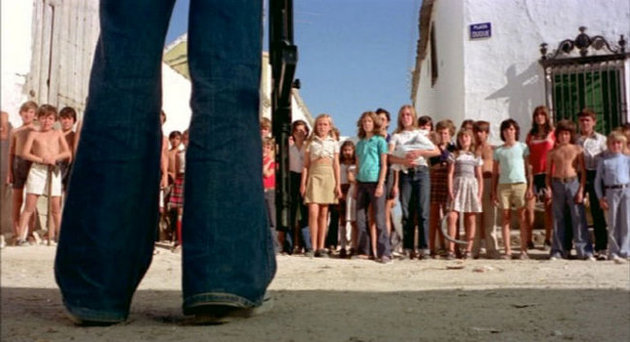
Who Can Kill a Child (1976) is a
relatively obscure Spanish horror film directed by Narcisco Ibanez Serrador,
but it should be much better known, and not only by people like me, who are sick
of having to pretend to be awed by how wonderful children are. It is a challenging, confrontational work
that raises difficult questions concerning overpopulation, inequality, and the
nature of evil. The film tells the story
of an English couple vacationing on the Spanish coast as they enjoy their last
weeks of freedom before a very pregnant Evelyn gives birth to their third
child.  Distracted by the noise and
crowds of Benavis, where a festival is being held, they rent a boat and go
alone to the island of Almanzora, which they find strangely deserted, except
for occasional bands of vacantly smiling children, who grow increasingly
threatening, and eventually homicidal. While the premise is admittedly unoriginal, if tantalizing, the power of
the narrative emerges through its sense of quiet unease, complex character
development, and provocative intrusions of topical and historical sound bytes
into the film’s otherwise eerily isolated world.

Taking its cue from the Mondo Cane films—those
pseudo-documentary films of the sixties and seventies that shocked audiences
with their depiction of violent rituals and grotesque behavior from around the
world—Who Can Kill a Child’s opening
credit sequence runs over a disturbing montage of twentieth-century atrocities,
beginning with the Holocaust and spiraling through numerous wars and civil
conflicts, in each case emphasizing the overwhelming toll on children.
  Disturbingly, the sound of children’s
laughter can be heard over the grim stock footage, as well as a child humming a
haunting melody reminiscent of Krzysztof Komeda’s indelible theme to Rosemary’s Baby. As the death roll finally reaches its height, we cut to black and white footage of barely clad children crouching
in the dirt, which seems to signal another abject image of orphaned destitution
until the camera pulls back, transforming to bright color footage of a beach
crowded by leisurely European tourists. This striking contrast
underscores the film’s later meditations on the thin borderlines between
comfort and chaos.

As Evelyn
and her husband Tom later enjoy the spectacle of a local parade, they discover
that their camera has run out of film and duck into a shop.  As they wait for the clerk to bring their
rolls of Kodak, they turn to a television on the counter, broadcasting
footage of a massacre in Bangkok. When
the clerk returns, he shrugs and observes: “The world is crazy. In the end the ones who suffer the most are
the children. From war: the
children. From famine: the children.” It
is an observation that will echo in the English couple’s minds as their
vacation continues. After making this
morose speech, however, the clerk smiles and says: “What a lovely day to take
pictures!” In the following scene, disturbingly enough,
Evelyn wades in the ocean while Tom tries to snap her picture. The thin membrane between the first world
privilege that safeguards their “lovely day” and the disorder that lurks beyond
their borders is suddenly broken by an ambiguous disturbance in the distance, a
disturbance that is later revealed to be a body washing ashore. These early scenes are loaded with many such
moments of horror lurking just beyond the vacationers’ perception.

The answer to the question of why a film that is about to present us with packs of homicidal
children is so preoccupied with reminding us how vulnerable children are in a
treacherously unstable global economy remains ambiguous, but some hints seem to
be given in the conversations between Tom and Evelyn on the night before their boat
trip.  As they walk down a crowded
street, Tom asks, “Would you like to sit down?” and she replies, “Where, it’s
so crowded.”  Looking down at her
pregnant belly, he observes: “Well, we’re not helping the situation, are
we?”  Later, as Tom broods over the
events of the day, he recounts a story from Fellini’s La Dolce Vita about a man who kills his two children, his wife, and
later himself. When Evelyn asks why, he
answers, “I imagine he was trying to save his children from the future.”  This prompts his wife to mention that they
were almost going to “kill this one,” pointing to her belly, and asks if he’s
glad they didn’t.  Tom doesn’t seem
entirely sure, and he equivocates that they had two children already, before
reassuring his wife as they go to sleep. 
Such scenes suggest a certain parallel, if not complicity, between their
household population and the rest of the world’s.  Overpopulation, the film indicates, is a problem we like to
project onto other countries when it often happens under our very noses, and it
is our privileged, first world children who are going to leave the largest
carbon footprint, and consume the most resources, indirectly fueling the
violent conflicts that hover around drought and famine like flies.

All this
might seem like a rather ponderous set-up for a horror film, but what is
astonishing is how deftly these elements are woven into the fast-paced establishing
shots. Soon we find ourselves on the
island of Almanzera, where we enter a very different reality. From the raucous crowds of the mainland we
shift to an almost silent, dreamlike space reminiscent of Val Lewton’s great
noir-thrillers of the 1940s, like I
Walked with a Zombie
, and Isle of the
Dead
, but with one significant difference: while classic horror films use
darkness as their medium of fear, Who Can
Kill a Child
uses light, an almost blinding, stark Mediterranean light, as
relentless and omnipresent as the increasing sense of menace to which it seems
tied. Like a mischievous child, the film
plays hide and go seek with the violence lurking just behind every corner. One particularly disturbing scene shows
Evelyn calling Tom’s attention to an old man huddled in a doorway in a distant
angle of a narrow but brightly lit street. A girl appears in the distance, smiling pleasantly as she walks towards
them. Once she reaches the old man she
looks happily to her right at him, though we still can’t see anything more than
his arm holding a cane. After smiling
guilelessly towards the couple, whose point of view the camera shares, she
turns to the man again, seizes his cane, and sets to beating him violently to
death, though we only see the evidence of this from the increasing amount of
red visible on the cane as it repeatedly rises and falls and the girl laughs
with glee.

Such
moments of barely concealed horror parallel the couple’s reluctance in
admitting the children’s monstrousness, a reluctance shared by another adult
whom they encounter, who tells them the story of how the children suddenly
changed. As he describes how they killed his wife, he notes with amazement that
nobody moved to stop them, because, of course, “who can kill a child?” It is an
understandable reluctance that the English couple have a hard time getting
over, putting them in even graver danger. As the film progresses towards its harrowing conclusion, it forces the
viewer into the uncomfortable position of the protagonists: though the children
are often shown blank-faced and coldly malevolent, there are also many scenes
where they are depicted as infinitely charming, seemingly innocent.  When they nevertheless show themselves
capable of horrendous violence, we are tempted to ask, along with Evelyn,
“Isn’t a normal child incapable of killing another human being?”  When we recall how violent the 1970s were,
this line has a disturbing historical resonance.  It’s sad to think there was once a time when
adults could be so innocent as to ask such a question.

Jed Mayer is an Associate Professor of English at the State University of New York, New Paltz.

CANNES 2013: James Gray’s THE IMMIGRANT

CANNES 2013: James Gray’s THE IMMIGRANT

null

Few films have captured the level of complex pragmatism it
must take for a desperate person to survive in a completely new place with no
support or ideological context. James Gray’s arresting period-piece melodrama The Immigrant achieves this feat.
Examining in fine detail the difficult experiences of a Polish woman named Eva
(Marion Cotillard) who arrives at Ellis Island in 1921, the film constructs a
sense of prolonged panic out of the most poetic images. Easy answers don’t
exist in this film, just life-changing decisions that must be made quietly on a
moment’s notice. Early scenes confirm that Eva has already been forced to make
a few tough choices on the voyage across the Atlantic.

From The Immigrant’s
magnificent opening shot, a hypnotic zoom-out starting on the Statue of Liberty
and eventually including a well-dressed man staring into the distance, Gray
establishes a sense of wooziness in the mise-en-scene. Inside the processing
center, lines of swaying bodies fill the dour space and long corridors stretch
in all directions. It’s a highway of varying perspectives and stories, the
American dream in transit. Despite the extreme foreignness of this situation for the
characters involved, their hope remains alive. “We’ll make our own families,”
Eva confidently says to her sickly sister as they walk in single file. Seconds
later, the coughing young woman is quarantined in the island infirmary, leaving
Eva alone in a gray new world.

And the obstacles keep coming. Labeled a woman of “loose
morals” due to a previous incident on the boat, Eva immediately faces
deportation. That is until a shady theater owner named Bruno (Joaquin Phoenix)
steps in to help, offering housing and employment, but at what price? Stuck
between moving forward and sliding backward, Eva takes a chance. What’s most
fascinating about their dynamic, though, is that Eva understands from the very
beginning that Bruno will be poisonous. But he represents her only option, so
she takes it.

That Eva falls deeper into a bad situation—becoming one of
Bruno’s “Little Doves” in a vaudeville-style peep show and the more salacious
activity that follows—isn’t surprising. Gray’s treatment of the material,
however, is never less than nuanced and engaging on an intimate scale. Family
infrastructure, something he has explored to some extent in all of his films,
becomes more complicated and warped in The
Immigrant
. Gray usually positions a male protagonist and a matriarch at the
center of his work, but here a single woman without a family is being
manipulated by a false patriarch. When asked by Bruno if the meager
compensation she receives is worth the sacrifice of her body and soul, Eva
responds: “I love money. I hate you. And I hate myself.”

Shame also plays a pivotal role in The Immigrant, both as an emotion felt by multiple characters and a
way of thematically expressing the cost of pragmatism in their lives. Bruno
suppresses his romantic feelings for Eva in order to exploit her business
prospects. Eva foresees another potential partnership with Orlando the Magician
(Jeremy Renner) only to have her hopes dashed in an instant. This trend of
self-despair climaxes with a pair of separate, messy confessionals,
intense scenes that solidify The
Immigrant
as a great study of emotional contradiction.

For all its thematic heft, The Immigrant also functions as a striking cinematic collage of
tinted shades and shadows. Whether it’s the luminous shot of colorful light
streaming through massive stained glass windows, or a police beat-down inside a
tunnel lit entirely by flashlights, the film’s images, shot by the great
cinematographer Darius Khondji, have a ghostly quality that directly connect
with the characters’ desperate will to survive. For all its internal despair, The Immigrant never loses a
sense of hope and resiliency. You should look no further than the film’s brilliant final shot of mirrors and windows working in harmony to see an image of a pair of lost souls
finally diverging for the better.

Glenn Heath Jr. is a film critic for Slant Magazine, Not Coming to a Theater Near You, The L Magazine, and
The House Next Door. Glenn is also a full-time Lecturer of Film Studies
at Platt College and National University in San Diego, CA.

CANNES 2013: Nicholas Winding Refn’s ONLY GOD FORGIVES

CANNES 2013: Nicholas Winding Refn’s ONLY GOD FORGIVES

null

In Nicolas Winding Refn’s Only God Forgives, to witness God is to experience the devil. The
grim reaper glides through the night in the form of Chang (Vithaya
Pansringarm), a corrupt police enforcer who lords over a seedy neon-dipped slumhole in Bangkok as judge, jury, and executioner. In the early moments of the film, after a
thuggish American ex-pat boxing promoter named Billy (Tom Burke) rapes and
kills a 16-year-old local girl, Chang steps in and allows the victim’s father a
chance at brutal revenge. The grieving man takes it. This sets in motion a series of escalating
retaliations involving Billy’s brother and partner Julian (Ryan Gosling) and
their visiting horror-show of a mother, Crystal (Kristin Scott Thomas), each
bit formed to brutally triangulate Refn’s masochistic view of familial
sacrifice. 

Unlike Drive,
Refn’s semi-hopeful ode to pure genre cinema, Only God Forgives wallows in the misery of its bleak and
quasi-surrealist urban setting. Brooding characters move through shadowy spaces
at a snail’s pace as if each were in the process of being defrosted from a
cryogenic sleep. These human zombies barely speak, and when they do their words
resemble grunts more than coherent sentences. Everyone appears to be perfectly
at home living in hell, but exactly whose nightmare this belongs to is nearly
always obscured. When action does occur, as with the restaurant shootout that
acts as the centerpiece for the film, it’s mostly revealed in slow motion,
turning even the violence of Only God
Forgives
into a protracted variation on Refn’s lobotomy aesthetic. 

A few bizarre sequences inside a brothel involving Julian
and his Thai prostitute/girlfriend hint at a more sexually psychotic
form of repression and guilt. Coated in vibrant colors and texture, these
disjointed “love” scenes are often complemented by a deafening score and
sporadic gong beats that seem to echo from the heavens above. It’s almost too
much kinetics to spare. Here, Refn isn’t interested in exploring anything
beyond the surface of his own vision; he’d rather just bang the drum loudly and
crush you into submission.

If anything, Only God
Forgives
proves that Refn is out to create something akin to a kind of red-light-district cinema. Compositions are excessively balanced and held for long
amounts of time. These images are meant to be watched and desired, lusted after
simply because they evoke a form of evocative skin-deep arousal. Refn
ultimately fails in his efforts. The front-on shot of Kristin Scott Thomas’s
serpent queen sitting ready to strike at a restaurant table engulfed with
crystal ware is a perfect example of why Only
God Forgives
is mostly poseur filmmaking. Whatever visual impact it may
inherently carry, it’s devoid of any actual character tension, relegating the
vulgar key scene that follows into the territory of camp. 

Style aside, Only God
Forgives
is of interest for an oddly compelling thematic structure that
involves a series of decisions (and non-decisions) by fathers and daughters,
mothers and sons. One small but harrowing example comes when Chang approaches
the man responsible for setting up the aforementioned hit on the restaurant.
During their muted conversation, the impending victim’s handicapped son watches
on from a nearby chair. The man takes responsibility for his action but asks
Chang to spare his boy. Such sacrifices and deals inevitably define Only God Forgives as a super-excessive
morality play where some characters act nobly in their final moments, while
others attempt to weasel out of their inevitable fate. Either way, gushers of
blood are inevitable.

Finally, the duality between public and private performances
(be it violence, song, or confession) is something to consider before labeling Only God Forgives a massive failure.
Chang’s karaoke sequences before his police brethren are both intimate and
collectively creepy, a religious ballad of sorts performed by an earthly deity.
Mai’s peep show for Julian behind a wall of dangling beads is initially framed
as something private, until Refn cuts to reveal other men in the room. When
Julian assaults one of the men for laughing at Mai it proves that Only God Forgives is deeply concerned
with the moment-to-moment shifts between closed and open spaces, and how each
character invades and retreats between the two. Interestingly, Chang’s long
blade often severs these spatial connections with one swipe, as in a sequence
involving ice picks and sharp hairpins. Only God can permanently sever Refn’s
fanatic and indulgent underworld.

Glenn Heath Jr. is a film critic for Slant Magazine, Not Coming to a Theater Near You, The L Magazine, and
The House Next Door. Glenn is also a full-time Lecturer of Film Studies
at Platt College and National University in San Diego, CA.

CANNES 2013: Images: Part 2

CANNES 2013: Images: Part 2

null

After nearly four straight days of rain, sunshine has
finally graced the Croissette. It’s glorious. Wardrobes have gotten
significantly skimpier and smiles have broadened greatly, and everyone at
Cannes seems to be settling in. The great irony about this festival is that just when one gets used to the insane schedule, it’s time to depart home. Anyway,
here are some more cinematic images I’ve been thinking about from films inside
and out of the competition.

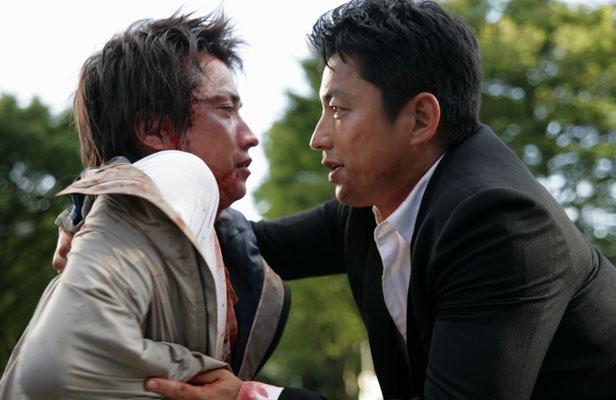
Shield of Straw (dir. Takashi Miike): A much needed reprieve
from the usually heavy-handed fare at Cannes, the newest Miike (at least until
he releases another one next week) is genre cinema on fire. Two security agents
are tasked with protecting a serial child murderer after the wealthy yakuza grandfather of one of the victims puts a public bounty on the killer’s head. Everyone
they come in contact with (nurses, civilians, mechanics) could be an assassin,
including the police officers themselves. The hunt is on almost immediately,
beginning with a brilliantly mad action scene involving a massive parade of cop
cars and a nitrogen truck bomb careening down the freeway. But it’s the
sequence right before that contains my favorite image in the film. As the opening
credits play, a sharply dressed shooter takes aim at an off-screen target and
fires, producing a thick plume of blue-tinged smoke that engulfs his body
before slowly evaporating. It’s a
perfect visual analog for the film’s fleeting veil of protection, so integral
to the film’s themes of honor and sacrifice.

Borgman (dir. Alex van Wamerdan): Five minutes of pure
cinema open this unsettlingly bleak dark comedy about a drifter/demon who causes
havoc within a wealthy Dutch family on the verge of collapse. Sans dialogue, a
gunslinger, a knife-wielder, and a shotgun-toting priest ramp up for a morning
hunt, sharpening weapons and loading clips. The trio then moves forward into
a dense forest, stalking a contingent of devils living underground in primitive
dwellings just below the surface. As the titular Borgman realizes his life is
in danger, the sharp blade of a lengthy staff strikes through the ground and
nearly impales his skull. Too bad the rest of this ambitious yet strangely
cyclical film succumbs to deadpan suffering and obscured religious
connotations.

Tip Top (dir. Serge Bozon): Utterly insane. This
indescribable anti-procedural from the great young French director of La France, about two I.A. detectives
attempting to solve a series of murders involving Algerian drug informants, is
the oddest film of Cannes 2013. The
great Isabelle Huppert plays Esther, a blunt force female hammer of a woman who
openly reveals her sadomasochistic tendencies, which involve very rough sex. Her
obsession produces a moment so strange that it’s sure to be the one I remember
most. After participating in a brutal beat-down session with her husband,
Esther goes back to work the next day sporting some serious morning after
scars. A particularly nasty one on the bridge of her nose opens up, producing a
trickle of blood that smoothly drips down to the tip of her outstretched
tongue. Not only does this shocking image express the film’s evocative and
challenging sense of humor, it becomes a symbol for unresolved rage that cannot
help but ooze from the body in the strangest of ways.

Glenn Heath Jr. is a film critic for Slant Magazine, Not Coming to a Theater Near You, The L Magazine, and
The House Next Door. Glenn is also a full-time Lecturer of Film Studies
at Platt College and National University in San Diego, CA.

CANNES 2013: Joel and Ethan Coen’s INSIDE LLEWYN DAVIS

CANNES 2013: Joel and Ethan Coen’s INSIDE LLEWYN DAVIS

nullPlenty of films exist about struggling young artists trying to be great and failing in the process. But Joel and Ethan Coen’s Inside Llewyn Davis is unique in focusing on a great struggling young artist resigned to the idea of his own impending failure. Not surprisingly, sadness is one of the film’s strongest and most resonant themes, expressed primarily through Llewyn’s (Oscar Isaac) searching eyes, which convey yearning and defeat simultaneously. Yet the Coens match the character’s extended melancholy with a sense of narrative openness, especially in the random events that allow the meandering stream-of-consciousness story to exude hopeful qualities along the way.

Set in early 1960s Greenwich Village at the dawn of the folk music revolution, the film opens with the bearded Llewyn performing in medium shot in a smoky beatnik bar. From the outset, his raspy musical voice is honest and vulnerable, two traits that seem to vanish the second he must deal with the real world in any discernible way. Even more interesting, the audience in the film doesn’t quite jive with Llewyn’s brooding and inclusive musical persona. The crowd’s lethargic faces look on in jest, proving the lack of connection between performer and patron. Much of Inside Llewyn Davis is about the often-futile attempts at translating original artistry into mass emotional consumption.

From the dimly lit stage to the only slightly brighter streets, jobless Llewyn aimlessly breezes from one NYC borough to the next, crashing on different friends’ couches and dealing with the wake of conflicts he’s helped to cause. Time passes by slowly, and deceptively minor scenes involving Llewyn’s agent and family quickly build on each other both thematically and emotionally, adding to the film’s fluid and whimsical pace. Music is always in the air, with the Coens’ sprinkling of full performances by Llewyn and other folk personalities throughout the film. But often it appears only the film’s audience can hear their genius (and absurdity). They are all truly ahead of their time in one way or another.

An unexpected pregnancy involving the girlfriend (Carey Mulligan) of a close friend and the non-impact of his unsuccessful debut solo record prove to be small ripples in Llewyn’s life. Hilariously, what most films would construe as “major” melodramatic conflicts become dwarfed by a small inconvenience involving a friend’s cat that turns into a sublime romp through the city streets. Holding the feline tightly after its near escape, Llewyn sits noticeably out of place on the subway. In an amazing moment, the Coens show the cat’s face inquisitively peering out the window, awake to the kinetic world rushing by. Whether the animal is transfixed by its own reflection or the passing terminal signs remains one of the film’s great wonders.

If Inside Llewyn Davis shares the deceptively shapeless and wandering trajectory of O Brother, Where Art Thou?, it feels profoundly breezy in a completely different way. This can be greatly attributed to Oscar Isaac’s heartbreaking performance, which gives even the smallest moment palpable weight. He even manages to convey an entire generation’s frustration and malaise in a single spoken farewell without the hint of indulgence. Llewyn understands that aside from bits of bad luck and potentially a few cultural circumstances, his life has been defined by missed opportunities involving love, family, success, and artistic creation. He may seem at peace with these failures on the surface, grooving with disappointment as if were his permanent dance partner. But those lovely eyes are all hurt. What’s inside Llewyn Davis is pure regret. 

Glenn Heath Jr. is a film critic for Slant Magazine, Not Coming to a Theater Near You, The L Magazine, and
The House Next Door. Glenn is also a full-time Lecturer of Film Studies
at Platt College and National University in San Diego, CA.

CANNES 2013: Images, Part 1

CANNES 2013: Images, Part 1

Thick grey clouds paint the coastal horizon, and rain keeps
falling. Massive yachts bob up and down in the choppy water while scattering
festival attendees take cover under umbrella canopies. Usually a sun-dipped
wide shot of blue skies and vibrant colors, Cannes in 2013 has instead been
dominated by a blurry and blustery Tarr-esque vision of enraged weather. Throw
in an endless supply of cinema, and naturally, it’s hard not to have images on
the mind. Here are a few of my favorite
snapshots from films screening early in the festival, with added analysis.

Heli (dir. Amat Escalante): A tale of Mexican manhood
broken, singed, and reborn through violence. In the middle of act two, the
titular character, now embroiled in a terrifying drug deal gone bad, stands
stoically poised for battle against a massive black military truck mounted with
a machine gun. The vehicle’s hood practically touches Heli’s chin, as if war
machine and man were debating between dance, embrace, or death.  

nullThe Past (dir. Asghar Farhadi): Nobody does emotional
collision better than Farhadi. Script, performance, and mise-en-scene work in
perfect harmony despite one too many narrative wrinkles. Glass boundaries
sprout up during moments where communication is essential. The opening sequence
finds Marie (Berenice Bejo) trying to get the attention of her estranged
husband, Ahmad (Ali Mosaffa) as he departs the airport security check.
Separated by a thick windowpane, the two speak even though they cannot hear each
other, momentarily pausing before joining together on the other side.

Like Father, Like Son (dir. Hirokazu Kore-eda): Tender,
patient, and sincere, traits best represented in a single shot of a two hands
(father and son) playing the piano together. This lovely melodrama about
parental wisdom and arrogance proves that time shared will always be thicker
than blood. 

The Bling Ring (dir. Sofia Coppola): Celebrities are no
longer physically necessary. All we need to get high on glam is to touch and
possess their stuff. The best thing about Coppola’s ultimately tiresome pop
culture social study is one amazing shot of the young burglars spryly romping
across the frame atop a dark hill flanked by the Los Angeles skyline in the
background. This is where the vapid wild things are and forever will be.

nullJimmy P (dir. Arnaud Desplechin): Middling and flaccid, with
very few aesthetic flourishes. But there is a drop-dead gorgeous dreamy
pastoral of Benicio del Toro’s Jimmy P standing in a bed of tall flowers looking
up at the blinding sun. For a moment, this mostly talky tale of friendships,
traumas, and goodbyes expresses itself in a beautifully visual way.

The Selfish Giant (dir. Clio Barnard): British miserablism,
the pre-teen years. If you’ve seen Loach’s Sweet Sixteen, Ramsay’s Ratcatcher,
or any Shane Meadows joint, this thing feels stale and reductive by comparison.
None of the aesthetic flair Barnard showed in her great debut, The Arbor, is on
display, replaced by a dour monochromatic haze. Still, the final act provides a
harrowing image of two hands holding, one white and fresh with life and the
other one charred to a crisp black.

More images to come…

Glenn Heath Jr. is a film critic for Slant Magazine, Not Coming to a Theater Near You, The L Magazine, and
The House Next Door. Glenn is also a full-time Lecturer of Film Studies
at Platt College and National University in San Diego, CA.

CANNES 2013: Jia Zhang-ke’s A TOUCH OF SIN

CANNES 2013: Jia Zhang-ke’s A TOUCH OF SIN

null

Jia Zhang-ke sees modern day China as an expansive minefield
of potential narratives, each one ready to trigger its own
perspective on the countless institutional and societal issues that ultimately
impact identity, gender roles, and economic expansion. Fittingly, his films
typically dance between documentary and fiction, subverting traditional narrative
structures to create a cinema of inferred and allegorical critique. A few
stylistic patterns persist: Verbose documentary subjects (some real, some
imagined) confess their unhappiness with flawed social systems yet immerse
themselves in the routine of suffering. Hollow industrial symbols house working-class conscripts attempting to rebuild spaces from the inside out. In Jia’s
world, personal contradiction implies national malaise. 

Yet Jia’s new film, A
Touch of Sin
, is all the more abnormal and harrowing because it completely
reverses this tendency. Not only is it a sprawling and beguiling fable that
drifts between the lives of four desperate characters living in different
districts, it makes no qualms about using genre to shred nuance. The proof is
in the visual consequences of every shotgun blast. Part revenge film, part cyclical
nightmare, A Touch of Sin forcefully
explores the experiences of these wandering souls weathered by contradiction,
broken by corruption, and possessed by weaponry. Each story overlaps slightly,
but is never dependent or linked to the other. All are thematically connected
by the possibility (and exaction) of violence, which erupts in public places,
at dinner tables, and in cars in striking and abrupt fashion. 

Interesting, then, that the opening image—a wall of lush
banana leaves frayed at the edges—gives a false sense of solace and nature
that returns only intermittently. It can also be seen in the moment where
raindrops batter the dusty hood of a car immediately after a brutal killing.
From the first story involving a factory worker driven mad by bureaucratic
stagnancy, it’s clear that Jia is interested in the aggressive tango between
action and reaction. Bubbling rage and social impotence are facts of life for
Dahai (Jiang Wu), a low-level worker who repeatedly calls out his village
leaders for cheating the town out of money earned in a business deal with the
state. As Dahai confronts each crooked limb of this intricate operation, he
grows more disillusioned with his place in the community. His anger peaks when
some paid thugs brutally beat him on the runway of the local airfield, leading
to a series of murders that destroy the corrupt line of communication with two
barrels.

A Touch of Sin
only becomes more intricate and layered as it moves forward. One thread involving a
nomad migrant worker, whose hand seems to be elementally linked to his pistol,
is especially fascinating for its brutal pragmatism toward family traditions
and patriarchy. Gender roles and male chauvinism are skewered (quite literally
in fact) during the bizarre third section about a woman attempting to overcome
the moment her longtime lover’s wife exacts vengeance. Starring Jia staple Zhao
Tao, this segment furthers a key theme regarding the near-mystical hold weapons
can have over people pushed to the limits of their control, not to mention the
motif of physical bodies being whipped into submission.

Possibly the most stunning segment involves a young man who
comes to represent China’s newest generation. After finding temporary work in a
high-end brothel, Xiao Hui (Luo Lanshan) attempts to court one of the girls,
seemingly with the most noble of intentions. Ironically, his advances are
stunted not by a lack of emotional connection or love, but by the girl’s desire
to remain ingratiated in the economically comfortable cycle of her work life.  In A Touch of Sin, there is no room for
romantic love, especially when this world swallows up those hoping to exact any
kind of change.

If Jia destroys subtlety in favor of immediacy, he does so
not to simply paint the frame red with carnage, but to explore the thoughtless
reasons why we reach for these killing machines in the first place. Is it
something instinctual inside of us, or is it an action that has been learned
over thousands of years of frustration and repression? Or are we just “worshipping
ghosts,” as one character muses during an impromptu prayer, making the weaponry
itself just another form of religious expression? A Touch of Sin asks many questions but refuses to answer them,
instead layering symbols, events, and repercussions from one story to the next.
The end result is ambitious, disturbing, and kinetic, something akin to a
modern day prophecy forewarning a plague of national rot and disillusionment
already on its way to settling in forever.

Glenn Heath Jr. is a film critic for Slant Magazine, Not Coming to a Theater Near You, The L Magazine, and
The House Next Door. Glenn is also a full-time Lecturer of Film Studies
at Platt College and National University in San Diego, CA.