In Which PRINCE AVALANCHE Looks Ahead to a Generation Cast Adrift

In Which PRINCE AVALANCHE Looks Ahead to a Generation Cast Adrift

null

Note: This piece could be said to contain spoilers. At the worst, though, it could be said to presume too much knowledge of the film.

Though David Gordon Green’s Prince Avalanche has been lauded, and justifiably, for its acting performances, its cinematography, and its mellow, sweet mood, it tells another story, apart from a seemingly minimal tale of two highway workers in late 1980s Texas. This story is about both the meaning of work and the generation that will follow that of the film’s two protagonists. Prince Avalanche, in its quiet, blink-and-you’ll-miss-it, vaguely Chekhovian way, points forward to a generation of the present, in its 30s and 40s, cast onto its own recognizance by an ailing economy, often self-employed, in a state of simultaneous freefall and perpetual opportunism–and yet, somehow, adapting to its circumstances.

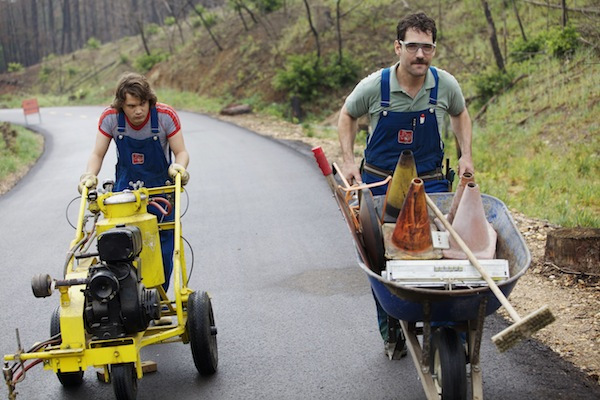
Alvin (Paul Rudd) and his partner Lance (Emile Hirsch) have a job painting stripes on a highway, in a part of Texas ravaged by forest fires, in the summer of 1988. In order for this scenario to have meaning, you would have to think a bit about its context. America, in 1988, depending on (but possibly regardless of) who you talked to, was not a happy place. The economy, though it had experienced a surge in prior years, was about to go into a downturn, and by the time Bill Clinton ran for President in 1992, he would be able to use that economic situation as a stepping stone to get himself elected. The first Gulf War was not far off. By comparison with today’s hypersophistication, this was a far simpler time; email, for instance, was only a luxury of select academic institutions, making the ultimate importance of written letters to the lives of this film’s characters particularly poignant. The generation of people coming of age at this time would be christened Generation X, so named for their mystification at what to do with themselves, what route to follow, and towards what success. How appropriate, then, that Alvin and his partner have such a tedious, simple, and seemingly endless job, whose boundaries are both certain and uncertain. The stripes are ambiguous, as was the future of the country at this point: which way do the stripes point? Well, in a sense, like all such tasks in literature and film, the stripe-painting points outwards, at a larger situation. (Think, for instance, of the job the prison camp workers have in Life Is Beautiful: moving rocks from one place to another. Or, to make a slightly more obscure reference, consider the job James Spader and Mandy Patinkin have in the wonderful but little-seen The Music of Chance: building a wall, piece by piece, whose purpose is uncertain, under the eye of the millionaire played by Charles Durning. Or the the labor of the hapless victim in Poe’s “The Cask of Amontillado.”) Work for work’s sake, in such a circumstance, becomes as blank as it sounds.

And what of our context, the context in which the film is being watched? America is on its way to recovering from the one-two punch of the economic collapse caused by 9/11 followed by the collapse of the banks in 2008. Employment is said to be on the rise, but its rise is slow. So slow, in fact, that many American workers are without a desk; they work for themselves. Happily, in many cases, but always hungrily. Our government refers to these workers as entrepreneurs, but that is not necessarily what they are. Are they self-sufficient? Possibly. Do the trades they practice, ranging from web design to cooking to writing to food delivery, bear certain futures? Possibly. In the event of another drastic economic slide, will these people still have work? Possibly. Will the workers in Prince Avalanche still have jobs after the film ends? Possibly.

Rootlessness is embedded in the story at the film’s heart. Alvin is a seemingly rooted, determined, efficient worker; he teaches himself German for self-improvement (and to prepare for a vacation), as well as claiming to be enjoying the solitude and the simplicity of his job for the chance it gives him to contemplate the value of his relationship with Madison, his girlfriend, back home in Garland, a suburb of Dallas, TX. Rudd plays Alvin with a memorably rigid affect; he has quite often been funny but square in his previous films, and this role seems, if anything, a comment on those roles. Lance is far from rooted, seeming to have no plans but to sleep with women at any opportunity. Hirsch brings experience to this role, having been most notably seen in recent years as Alexander Supertramp, the youth who famously took off for Alaska, abandoning his belongings, attempting to live off nature, and failing, in Into the Wild. His character here is far less intelligent than Supertramp, but he has a similar mood of wildness in him. When Alvin’s girlfriend leaves him, he realizes his illusions of self-discipline have no value, and he becomes, like his partner, rootless and weightless at heart, letting loose. In one drunken flurry, the two workers paint wildly spiraling lines on the asphalt, rather than strictly measured stripes, and then dump their equipment in a ravine.

The supporting elements here do little to contradict the film’s portentousness. The workers periodically meet an elderly man in a pick-up truck who seems to have worked at their job in the past, spouting off, at one point, the number of stripes per mile; invariably, he offers them some of his homemade hooch, which they drink, later in the film, as a way to toast their freedom. He seems one part Falstaff, one part Ancient Mariner, another part Angel of History. Another odd figure, a woman both real and unreal, wanders through the ruins of a house destroyed by the fires. In what may be a dream, Alvin joins her, ultimately pantomiming the acts of coming home and greeting his girlfriend in the house’s ruins, as if to suggest that a certain way of life is on its way out: that of the stable home, the solid existence, established during the 1950s and carried on through the 1980s. These figures and scenes are rolled out with great austerity and moment, although Green applies his trademark gentleness to them, as well.

Perhaps it is over-ambitious to read too much into a quiet, quaint, sweet film like this. Perhaps its tale of a relationship between two men is, as has been suggested elsewhere, nothing more than that, an accomplishment in and of itself, a worthy hook on which to hang rhapsodic scenes of the Texas landscape, and in which to deploy the sorts of poetic, offhand lines this director has been known for since All the Real Girls. On the other hand, though, its temporal setting urges a more socially and historically aware reading, as do its symbols, all fairly obvious ones: the monotonous stripes; the highways which, as do all highways, point both ways; the scorched land, from which we can be sure more foliage will grow. One of the film’s final images would seem to seal the deal, thematically: that of children dancing, carefree, in the sun, little knowing that as they grow older, they will, like the film’s protagonists, struggle to make a path through a scorched economic landscape.    

Max Winter is the Editor-in-Chief of Press Play.
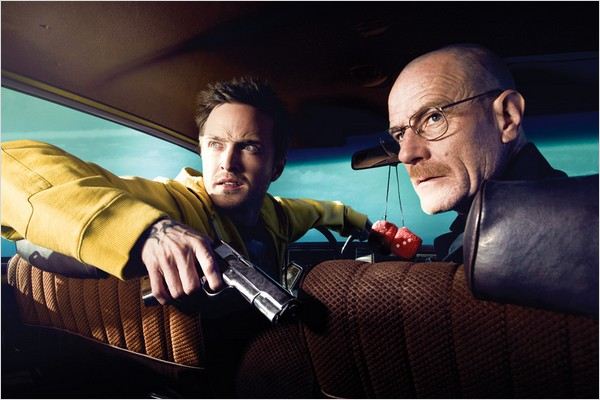
VIDEO ESSAY: Gliding Over All: The Cinematography of BREAKING BAD, Season 2

VIDEO ESSAY: Gliding Over All: The Cinematography of BREAKING BAD, Season 2

This video essay is a co-production of Press Play and RogerEbert.com.

Season 2 of Breaking Bad is about the speed and exhilaration
of being reborn, as well as the mounting pressures and heightening dangers that
come with transformation.  Dave Bunting’s
video essay is a free-fall montage, each scene seamlessly drifting into the
next: an aimless array of violence, fear and the desire for escape.

Breaking Bad asks if we are simply the product of
circumstances beyond our control, or if we are in fact agents propelling our
own destiny. In Season 2, Walt’s transformation into Heisenberg is triggered,
but is also incomplete. Is Walt a man driven by selfless devotion to providing
for his family, or is he actually motivated by his own hunger for power? Season
2 is built around a charred stuffed animal’s descent from the heavens. At
the start of each episode we see bigger parts of the same strange and startling
image. In Bunting’s essay, the heart of Season 2 is not the mystery of what this
object is or where it will land, but the center of a father’s grief and how one
mistake born of that grief ends up being a catalyst for even greater disaster.

Choices may often be perceived as the catalyst for change
throughout Breaking Bad, but the show often demonstrates that our agency is
not merely limited; it is profoundly influenced by circumstances well beyond our control. But while Walt’s transformation is not necessarily
the product of his decisions, Walt does bear responsibility for his choices. In
Season 2, Walt’s decision to let Jane die indicates a major shift in Walt’s
moral compass and challenges the viewer to continue to identify with him and
root for him as a hero in this story.

The cinematography of Breaking Bad shows tremendous
scope, as well as intimacy—we see both the gorgeous desert landscape and a close-ups of Walt’s deeply lined face as he struggles through chemo. Scenes
of Walt and Jesse cooking and spending time in the desert together highlight the tremendous differences between
these two men—in size, gait, age, sense of style, and use of language. But as the
season progresses, their hazmat silhouettes on the horizon become less and less
distinguishable. Here, intimacy, like moral decision-making, is two parts
circumstance, one part actual individual choice.  Still, in Bunting’s video essay we see the
ways in which Walt and Jesse differ when confronted with moral choices. When
separate, Jesse is often depicted as crouching over, wide eyed and overwhelmed—his preference is always to slip back into the candy-colored dream world of
comic books, puppy love, and drug experiences, where he doesn’t have to deal with
the weight of his own decisions. In contrast, in Season 2, we see the
beginning of Walt‘s transformation into “the one who knocks.” Alone, apart
from Jesse, he is hard-eyed, diligent, the master of his own destiny, whether he is
holding a gun, pushing a cart, or standing naked in a fluorescent-lit
supermarket.

In Season 2, deserts are torn apart by man-made explosives,
and lovers float away from each other in drug-induced dreams. Many characters
like Skyler and Hank often seem to be in the periphery, outside the kinetic,
often volatile relationship between Jesse and Walt. This sense of a rapidly
disintegrating sense of reality and moral sensibility is exacerbated in time-lapse scenes, often used when Walt and Jesse are cooking, but also capturing
the otherworldly backdrop of the Southwestern American sky.  These sped-up scenes feel flushed and
out-of-breath, like time is racing and the entire world is out of control.

In Bunting’s masterful distillation of Season 2’s central
themes, the audio is just as important as the visual. The repetition of Donald’s
air traffic directions—resolute, measured, unemotional—becomes the backbone for
the unfolding human drama, connecting these seemingly disparate stories and
showing how human choices create disaster in a way that no butterfly wing ever
could.–Arielle Bernstein

To read an interview with Breaking Bad‘s director of photography, click here:

http://www.rogerebert.com/balder-and-dash/gliding-over-all-the-cinematography-of-breaking-bad-season-2


Arielle Bernstein
is
a writer living in Washington, DC. She teaches writing at American
University and also freelances. Her work has been published in
The
Millions, The Rumpus, St. Petersburg Review and The Ilanot Review. She
has been listed three times as a finalist in
Glimmer Train short story
contests
. She is currently writing her first book. She is Associate
Book Reviews Editor at
The Nervous Breakdown.

Dave Bunting, Jr. is the co-owner (with his sister and fellow Press Play contributor, Sarah D. Bunting) of King Killer Studios, a popular music rehearsal and performance space in Gowanus, Brooklyn.  He plays guitar and sings in his band, The Stink,
and dabbles in photography, video editing, french press coffee, and
real estate.  Dave lives in Brooklyn with his wife, son, and sister.

The Western’s New Revisionism: The Sun Sets on the White Guys

The Western’s New Revisionism: The Sun Sets on the White Guys

nullIn a souped-up cinematic landscape of robots, superheroes and CGI, the
western and its dusty cowboy rides on—despite mixed results. Django Unchained and True Grit drew urbane audiences and accolades, but the turd that
was The Lone Ranger fell atop an ever
taller pile of manure. A ride through the celluloid cowboy’s evolution might
(almost) explain why Disney, in all its financial prowess, would gamble $225
million on a talking Tonto.

The cowboy figure found an immediate home in American
cinema. Buffalo Bill’s Wild West Show—a circus-like cavalcade featuring crack
shot Annie Oakley and a parade of the planet’s finest horsemen (Native
Americans, Mongols, Turks, Gauchos, Bedouins, et al)—was a favorite subject of
early motion pictures. America’s first blockbuster, The Great Train Robbery (1903),
was a vivid cowboy heist pic that—113 years after its creation—makes me wince at
its grizzliest bits. Stuffed like too much sausage into a snug baby blue get-up,
the Lone Ranger and his grunting sidekick, Tonto, were successors to a long
line of serial pic cowboys that included wildly popular Red Ryder and singing
cowboy Gene Autry. Geared towards kids more than adults, these squeaky clean
“smooth-like-a-Ken-doll” cowboys were sermons in spurs, embodying virtue among
the cacti. They never drank, smoked, swore or winked at women. As America
entered WWII, the moral certainty of Ken Doll cowboys stoked our collective
fire of righteousness and racism, and painted us a history myth of preordained victory.
 

The cowboy-iest cowboy films—such as Red
River
, My Darling Clementine and She Wore a Yellow Ribbon—were created
in the years immediately before and after WWII.  The films reflected the same nationalistic
righteousness as the serials, but they were made for adults—adults with the war
on their minds. So the heroes grew grander and more macho. Like Cowboy Kings, they
drank, gambled, fornicated, and shot up bad guys. They embodied bloodlust. The
West’s evolution into economic prosperity was the perfect allegory for America’s
expansion into the world economy. John Wayne in Red River wasn’t just driving his cattle to market; he was driving
the engine of American capitalism.

After WWII, male characters across every film genre began to change. It
was the birth of the anti-hero, and cowboys—despite their hyper-masculinity—were
not exempt. Like the returning servicemen themselves, they grew complex, jaded
and vulnerable. They’d seen things. Bad things. They were never looking for
trouble, but trouble always found them. Gary Cooper in High Noon, Glenn Ford in 3:10
to Yuma
and Jimmy Stewart in The Man Who Shot Liberty Valance were reluctant to kill, but dammit,
sometimes a man needed killing.
 

Though frozen in time and rigidly tethered to a landscape, westerns
changed. Goodbye, John Wayne—hello, James Dean, whose character in Giant (1956) morphs from a lowly cowboy roughneck
into a misanthropic oil tycoon (foreshadowing the Hearst-like figure of There Will Be Blood). In eight short years,
the myth of the self-made man transformed from John Wayne’s bold cattleman in Red River (1948) to Dean’s pathetic Jett
Rink, babbling drunk to a big empty room—effectively bucking the myth off its
high horse. These films are also referred to as revisionist westerns, but they
didn’t revise the formula or the history (the Earps won the Gunfight at the O.K. Corral [1957], like
they did in My Darling Clementine [1946], like they actually did in 1881)—cowboys simply evolved into more
three-dimensional characters.

In 1953, a new kind of cowboy rode into town—thanks to
the popularity of Shane: the Stranger. With
no personal history (sometimes, not even a name), the Stranger makes the world safe
for the little guy. He’s a cop without a badge, or, seemingly, a heart. After WWII,
many veterans were suffering from what we would eventually recognize as PTSD. They
felt estranged from their nuclear families and the entire American dream myth. The
Stranger has no bad memories because he has no history—he’s just a hobo with a
horse and a gun.

Throughout the 60s , the legitimacy of “legitimate” authority and a corrupt,
predatory system became an increasingly familiar theme in film: The Manchurian Candidate, Dr.
Strangelove, Z, M*A*S*H*, In the Heat of the Night, Serpico, Papillion,
and Cool Hand Luke. Beamed straight into living rooms, footage
of the Vietnam War would allow Americans access to carnage unseen on our home
turf since the Civil War. And as the nation’s confidence of the 50s withered, the
western shifted its focus from the good guys to the bad guys. In Vietnam-era
westerns, we rooted not for the hero who saves the day, but for the cowboys with
convictions as broken as our own. They were second generation to the Stranger,
but many straight-up criminals who didn’t give a hoot about saving the day. Clint
Eastwood’s Man with No Name in Leone’s A Fistful
of Dollars
takes money from the bad guys to kill other bad guys. A
veritable Möbius strip of killing. These cowboys prayed to no God, honored and obeyed
no woman, and toiled for no man. In films like Butch Cassidy and the Sundance Kid, Once Upon a Time in the West, The
Wild Bunch
, The Long Riders and Young Guns, the message was simple: fuck
the system.
 

null

Reflecting the brutality of the war, the violence and misogyny quotient shot
through the roof and depicted a raging river of murder and rape. Sam Peckinpah’s
Wild Bunch has been credited with
visually introducing Americans to the bullet hole, and in the first fifteen
minutes of Sergio Leone’s Once Upon a
Time in the West,
Henry Fonda (once a Cowboy King of Kings) shoots an
entire family, and one surviving little boy, dead. And oy vey—what’s with all the rape, High Plains Drifter, Josey Wales, et
al?! Poor Sandra Locke. If she was on a wagon train, rape was just over the hill.
 

One of the marked recent shifts in the western has been in its portrayal
of the cowboy’s connection to family, and of the family unit. One episode of Bonanza
will tell you: once upon a time, family was the institution for which the
cowboy fought and the bedrock to which he returned. Myriad depictions of the
Earp brothers reflect the western’s preoccupation with kin. Gary Cooper embarked
on his epic battle in High Noon not to keep the townsfolk safe (they
were all cowards), but for his wife. Unable to sustain a family like the one he
fights for, Shane drifts on to points unknown. Estranged from their real
families, bad guys followed surrogate families of criminal gangs. Everybody had
a posse.

Unlike the Stranger, cowboys of the Vietnam era had backstories that
included their families. You either got a little taste, like Jason Robards in Once Upon a Time in the West (“
You know, Jill, you remind me of my mother. She
was the biggest whore in Alameda and the finest woman that ever lived. Whoever
my father was for an hour or for a month . . . he must have been a happy man.”) or you got the whole horrific
enchilada, as in The Outlaw Josey Wales, when
the titular character’s wife and son are sadistically murdered on screen.

null

It’s remarkable that the untethered Stranger sustained so many popular
films, as backstory allows us to bond with a character, and he didn’t have one.
But once the cowboys collective’ backstories began to emerge, the picture that
developed was: family is a liability. It slows you down, makes you weak, and invites
heartbreak. In the FX series Justified, families are comprised of criminal
fuckups who will either shoot your ass or get you shot. Lead character U.S.
Marshall Rayland Givens is terrible
at sustaining familial relationships—he can’t even show up on time for his
pregnant wife’s sonogram appointment. They’re separated, by the way.

For example, Jesse James was the subject of
The Long Riders (1980) and
The
Assassination of Jesse James by the Coward Robert Ford
(2007), but the representation family in both films could
not be more different. The Long Riders stars four sets of siblings:
James and Stacy Keach as the James brothers; David, Robert and Keith Carradine
as the Youngers; Dennis and Randy Quaid as Ed and Clell Miller; and Christopher
and Nicholas Guest as the Fords. Director Walter Hill saw that the brothers’
bonds manifested on screen. The relationships were sources of solace and
invigorated the characters. The Keaches appeared in most scenes together.

In The Assassination… Frank
James, played by Sam Shepard, is rarely on screen, and when he is, he’s
isolated and anxious. Charlie Ford taunts his brother Robert, played by Casey
Affleck, sadistically—you can understand why the kid’s such a weirdo. Their
whole Ford family seems estranged, though cramped in their lonely farmhouse.
Sycophantic Robert looks to Jesse as a surrogate father figure. All the
characters look outside their families for  acceptance. In the poetic
opening sequence, the narrator says of James’ children, “They did not know
their father’s name.”

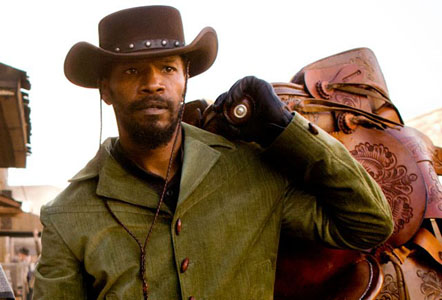
In Django Unchained, King
Schultz’s accent and dentist wagon provide a taste of his backstory. His
romantic fairy tales suggest that he has known love, maybe even family, but
he’s not looking back. So he’s a practical, successful killing machine. Like
Josie Wales, Django is burdened by his well-drawn past and visions of his
beloved wife Brunhilde beaten and raped. When King begins to feel obligations
as Django does—obligations to principal—he acts from his heart, and dies for
it.


Portrayals of women characters and their prominence in westerns are
(slowly) improving. But while their presence usually indicates a tighter familial
bond, they, too, struggle to lift the dead weight of their family units. In Meek’s Cutoff, Michelle Williams must act
against her husband and extended family to save them from death on the Oregon
trail—and they are not helping. Mags
Bennett on Season 2 of Justified is savvy enough to free her family from the poverty
of rural Kentucky, but also ruthless enough to shatter her son’s hand with a
hammer when he defies her. He deserved it.

Films like Meek’s Cutoff, The Lone Ranger and most notably Django Unchained signal a new age of
for-real revisionist westerns—ones that bestow acts of bravery, dignity and
heroism on characters who have never been western heroes (traditionally minor
ones)—especially women and people of color. By setting a gladiator movie (which
tracks a slave’s journey to emancipation via violence) in a western landscape, Tarantino makes of Django a new kind of cowboy—but with old roots. After he blows up the last of his enemies,
and is ready to ride off with his beloved Brunhilde, Django’s horse—for no
reason—does this little dance, like Trigger! As the corny background music
swells, Django becomes a full-fledged Ken Doll cowboy, albeit dressed way cooler.
Because Django’s origins were the lowliest, his rise is the stuff of classical mythology.
American cowboys—i.e. white guys—have known hundreds of years of supremacy, and
only a few dozen as failures, so their return to hero status would be a short,
probably boring flight. And since dastardly white guys continue to hunt us
little guys and gals for sport, it’s getting harder to root for them in any
capacity.
 

null

Except as Losers, which may be the new black for white cowboys: busted men
overwhelmed by failure and loss. Like AMC’s Longmire—an
old school, taciturn, bad-ass Wyoming sheriff, driven to despair and drunk
driving over the death of his wife. Or Tommy Lee Jones in No Country For Old Men, haunted by mankind’s inexplicable brutality.
Or Tommy Lee Jones, again, in
The Three Burials of Melquiades Estrada (Cuckoo!). On season 4
of Justified
, two troubled, PTSD-plagued
veterans squared off in an episode-long ambush; both wore cowboy hats, but only one made it to season 5. They’re
all a far cry from heroes, unless heroism entails living “long after the thrill
of living is gone.” White cowboys aren’t dead, per se, but they might be,
reluctantly, considering Zoloft. The fun ones, like Rayland Givens, are real shits.

Which leaves the western hugely understaffed in the hero department, so minor
characters—who we can root for without ambivalence—are stepping up. Rapper Common
plays Elam Ferguson in AMC’s Hell on Wheels—a freed slave in league
with a former Confederate solider. But Ferguson’s no mere sidekick; he’s got
the brawn and brains, his own story
lines, and he gets his own nookie. Nookie’s very important. Tonto never got any
nookie. And unlike the 1969 original, the Coen Brothers’ remake of True Grit followed the book and its
intended hero—14 year-old Mattie Ross.
 

null

In 1974, as the black sheriff of a white town, Black Bart in Blazing Saddles could’ve only been played
for laughs. Today, they might try to pull it off straight (or campy, a’la Wild Wild West), and it just might fly.
But the emerging formula for success seems to begin in realism—a historically
accurate premise, like Django, as opposed to an old stereotype smothered in CGI,
like Tonto.
Blazing Saddles showed us precisely how dumb Tonto was by superimposing
his vocabulary onto a white guy named Mongo (short for mongoloid). 

Disney saw color when they should have been looking for character. Or at
least a script [Cue sound of Slim Pickens yee-hah-ing
as he rodeo-rides a nuclear warhead to oblivion].

Alas, it’s an evolution, not a revolution. The genre’s bedrock is
hyper-violence, racism and sexism. Portrayals of Native Americans—and Johnny
Depp playing Native Americans—and Johnny Depp playing cowboys alongside Native
Americans—is a whole other essay.

Jennifer
L. Knox 
is
the author of three books of poems, The Mystery of the Hidden Driveway, Drunk by
Noon, and A Gringo Like Me—all available from Bloof
Books—and Holliday, a chapbook of
poems written in the voice of Doc Holliday. Her writing has appeared in The
New Yorker, New York Times, and four
times in the Best American Poetry series. She is at work on
her first novel.

Can’t See the Movie for the Screen: THE CANYONS and the American Worship of Celebrities

Can’t See the Movie for the Screen: THE CANYONS and the American Worship of Celebrities

null

I could write an entire essay about The Canyons–1000-2000 words, at least–without ever having seen it. The amount of sheer context that has surrounded this wildly underwhelming film, concerning its director, its screenwriter, and its star, provides substantial fodder for conversation. About what? The movies that are made, the movies we choose to see, why we choose to see them, and, frighteningly, what we think of them. The Canyons has attracted lengthy, considered commentary from many corners, including some corners, including the New York Times or Salon, in which you would have thought the critics there, after seeing the film, would have passed on the opportunity to write about it. How could they have passed, though, with all the backstory surrounding it, like an enormous fur overcoat? This backstory grows–and vibrantly–from the American obsession with celebrity culture, which amounts to a near-celebritocracy.

About that backstory, though: let’s start with the film’s director, Paul Schrader. His scripts for Taxi Driver and Raging Bull, from nearly 40 years ago, elevated him to near-godlike status among film buffs and regular moviegoers alike. However, that early promise did not lead to sustained, wide-ranging popularity; films ranging from American Gigolo to Mishima to Auto Focus were critically acclaimed, but not sufficiently critically acclaimed to be considered cinematic events (with the possible exception of American Gigolo). As his films have relentlessly explored the seamier sides of life, fewer and fewer viewers have been willing to take the journey with him, beyond a militia of devotees. After his lengthy New York Times article about the difficulties of working with his star, Lindsay Lohan, it was hard not to think that using the star was an attempt to raise his own status at the box office, to prove himself capable of creating a spectacle. And then there’s the screenwriter, Bret Easton Ellis, most famous for early, dynamic novels like Less Than Zero or American Psycho. In recent years he has become more famous for his overbearing presence and his nasty tweets than for his work, which has not struck quite the same loud chord with readers as did his earlier books. Again, it’s tough not to read his engagement with this film as an attempt to pull himself into the spotlight by a notorious star’s bootstraps (to mix metaphors).

But what about those bootstraps? And what about that star?

Oh, that poor star.

There’s a lot you would have to ignore if you wanted to take The Canyons, or Lohan’s performance in it, on their own terms. The prison time. The ankle bracelets. The driving while intoxicated. The missed court dates. The court dates made while wearing stunning apparel. The embarrassing interviews, each more falsely “honest” than the last. And there, almost completely crowded out by all that we’d have to set aside, would sit her two good performances, in Mean Girls and A Prairie Home Companion, the latter of which was probably missed by many. And then there are the aforementioned tales of her behavior on-set, her tantrums, her absences, her lack of preparation, her immaturity, and her apparently newsworthy near-toppling of the whole venture.

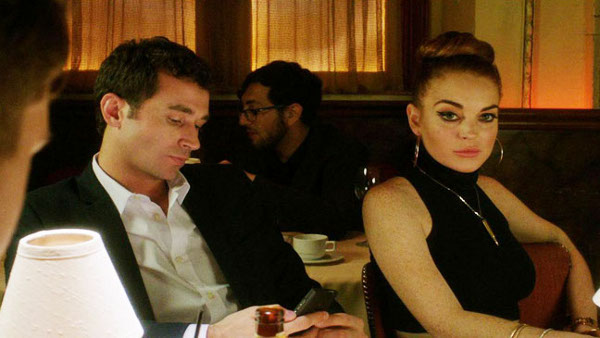
And the venture itself? Sadly, it would be impossible for anyone with both a conscience and a wholly functional critical apparatus to find this attention-grabbing film more than marginally interesting, artful, or, least of all, shocking. We can give points, if to nothing else, to the cinematography, which evokes the deadened, shallow, decaying Hollywood we’ve come to expect from countless other films about that same microcosm. The gray, deserted, drab theaters the film uses as interstitial shots provide an admirable backdrop for the film’s satire of moviemaking. The story to which that satire is hitched, unfortunately, is woefully thin: Christian, a young, trust-funded filmmaker (James Deen) “keeps” Tara (Lohan) in a beautiful house overlooking the ocean. He’s cast a studly young man (Nolan Funk) in his new film, who turns out to be an ex-boyfriend of Tara’s. As Christian digs, he finds out information that makes him unusually jealous of Tara, and he promptly loses all control of his drug-addled mind (to make a long story short). Before this happens, though, we gain an insight into this resoundingly unpleasant couple’s lifestyle, transitioning fairly smoothly between an opening dinner scene–in which the couple spends most of their time out with another couple (the star of the film Christian is directing, and his girlfriend) staring at their cell phones–into a scene in which they have a threesome with a man Christian found on the Internet. The sex in the film, though perhaps a shocking move for a former member of the Mickey Mouse Club, isn’t shocking by comparison with other films that have been released, say, within the last 25-50 years. There’s a deflated feeling hovering over the entire film: the dialogue, such as it is, is delivered with awkward pauses after each line, as if the actors were waiting for a laugh track. Lohan’s acting, by comparison with her co-stars, is compelling, but again only by comparison. More often than not, because her co-stars are so inexpressive in their delivery, her excesses of emotion (mainly crying) seem rather unusual, as if perhaps she had walked into the wrong movie.

One could ask, then, why see such a film? Why write about it? Why give it the time? Because it has a mood of controversy about it, and controversy can be fascinating. Because the publicity for it, as is often the case with over-hyped films, transcends the product—but is no less persuasive for doing so. Because it has talent attached to it, and hope springs eternal.  But the film itself? Daring? Shocking? The most shocking thing about it is the degree to which it reflects, as a phenomenon, the de-evolution of American sensibility, the allotment of power and, weirdly, aesthetic influence to whichever figure displays most flashingly before us. Ultimately, this film is most interesting as a phenomenon, as evidence of the power of, to put it simply, talk, talk so loud that it shapes our tastes, and ultimately, our lives.

Max Winter is the Editor-in-Chief of Press Play.
What Is Decadism? An Explanation and a Top 10 List

What Is Decadism? An Explanation and a Top 10 List

Decadism may be defined as a dependence on the decade—as a time-keeping unit and
also as a way of thinking about changing cultural mores and aesthetics. It’s an
American invention. Decadism is America’s great contribution to contemporary fashion
in the West, which is otherwise largely the product of Paris, capital of the 19th
century. Throwing the concept of even vaguely gradual change (the subtle
raising and lowering of hemlines, the expansion or diminution of bodices, bustles,
sleeves, and pantaloons) out the window, America saturated its version of the
decade with consumable material and industrial specifics, architectural
silhouettes, ludicrous trends, and “it” items like the poodle skirt or bell-bottoms.
As Walter Benjamin noted, “Fashions are a collective medicament for the ravages
of oblivion. The more short-lived a period, the more susceptible it is to
fashion.” The decade of America’s speed-obsessed 20th century—say
the 1920s, the 1970s, or the 1990s, take your pick—is just so damn precise, so
recognizable. In this sense, to talk about American decades and decadism isn’t just
nostalgic; it’s an exploration of the way in which changing tastes reflect other
societal variations and upheavals.

But things
have, as things will, changed. As networked technology propels us ever more
discernibly into an era simultaneously obsessed with sharable fashion imagery
and characterized by the international proliferation of microtrends that appear
and pass away with a blasé alacrity alarming to the traditional fashion
magazine, we’ve begun to witness the consolidation of a new nostalgia. This new
nostalgia is a longing for the old way of doing fashion, for—you guessed it—the
temporality of the decade. Our new nostalgia is decadism. We’re becoming decadist all over again! Decadism is now
not merely a sign of nostalgia for the decade in question. It’s a sign of
nostalgia for decade-based fashion and thinking in general, for a system for
organizing tastes based on the notion of the decade. In this sense, though the
word “decade” (from the Greek for “ten”) is etymologically unrelated to the
term “decadence” (associated with “decay”), decadism is rapidly replacing
decadence as a kind of gently reactionary aesthetic and experiential mode. We
live in a time of archive fever, of historical tourism (from Wikipedia to Drunk History Month), of “favoriting” and
all the other preferential tools the Internet holds. Decadism allows us a
return to a less particulate, niche, complex, and incessantly updated way of establishing
taste. Decadism is a respite—not just from the present but from the future.

One of the
best places to observe decadism, both old and new, is, of course, at the
movies. Decadism does very well on film (or video, as the case may be). The
decadist work is, however, not to be confused with the period piece, the
historical drama. While some historical dramas are also decadist films, not all
decadist films are historical dramas. Decadism requires a certain decorative saturation,
a certain studied inattention to elements
not intimately associated with aesthetics, such as plot. For example, the only
imaginable excuse for the canned, comatose travesty that is Baz Luhrmann’s
recent The Great Gatsby is the film’s
decadist pretensions. While Gatsby is
obviously not a historically accurate portrayal of the 1920s, the drive to
produce a total “era” of some jazzy, boozy, gilt-plated totalizing persuasion
explains what the professionals who participated in the making of this turd
could have been thinking. Decadism is a pursuit of its own, with its own terms
and grounds. Like Azealia
Banks’s video for “1991,”
which brought back delicious notes of Crystal Waters, C+C Music
Factory, Deee-Lite, et al.—and even a little hint, to my mind, of the greatly
underappreciated King of New York (1990)—decadist
films revel in establishing a thickly described and even escapist visual environment.
All movies by John Waters (pre-1994) are decadist. Much of the work of Rainer
Werner Fassbinder, even when set in the present, is decadist; The Bitter Tears of Petra Von Kant
(1972), for example, is a priori
decadist, with its rococo loathing for the decade yet to come. Wes Anderson is
very twee and a tiny bit decadist. Pedro Almodóvar could be the greatest
decadist colorist of all time. Much as I hate to admit it, James Cameron’s Titanic (1997) has a certain decadist
bent. Utopian and even futuristic films have connections to decadism; the
decorative pleasure they imagine is quite similar to the pleasures of decadism.
Decadism is, overall, a more or less weak form of camp, an environmental camp
offered to a viewing eye (apparently) deprived of aesthetic coherence. Decadism
is not about looking into the past, but rather about converting the past into a
slightly jokey, hokey, and even surreally vivid surface, so that the past
appears as something that is not only not
lost
in the present, but as something we cannot lose.

For those
longing, then, for some deeply decadist viewing, here is my own eccentric list
of ten movies with serious, for better or for worse, decadismo:

10. Dick Tracy (1990):
Let’s get this early ’90s atrocity out of the way. At first you can’t remember
whether this movie isn’t just a series of outtakes from Madonna’s “Express
Yourself” video (which would probably make for a much better film), but then
there’s Al Pacino as a hunchbacked gangster and Warren Beatty as the uptight
dude who loves yellow outerwear. Standard-setting use of cheeseball noir and
deco elements, one must admit—though the fact that this was originally a comic strip
might have something to do with that. I feel like every movie I’ve ever hated
made over the past twenty-three years was somehow spawned by this lurid 3D
adaptation of stuff that works much better on the page.

9. Seven Brides For
Seven Brothers
(1954): They live on the frontier, go a-barn raisin’, and
have alphabetized names from the Old Testament. Enough said.

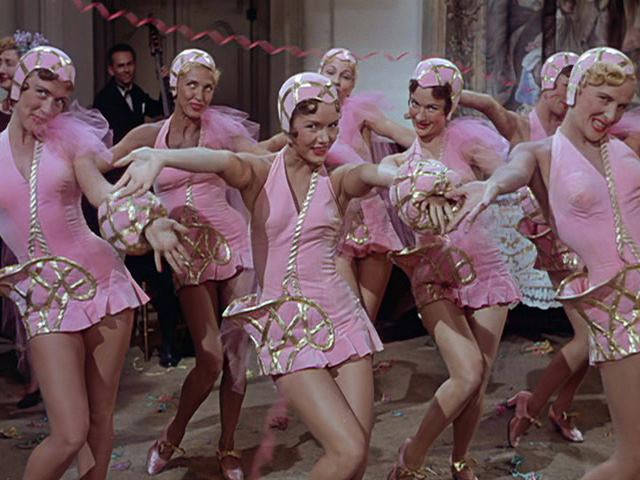
8. Singin’ in the Rain
(1952): It’s not lost on me that the first three items on this list are all
American musicals of some persuasion. It’s not like there aren’t a bunch out
there (Mary Poppins (1964) and My Fair Lady (also 1964), for example, are actually guides to late-Victorian upholstery),
so it’s low-hanging fruit, but one has to recognize the meta-theatrical genius
of this adorably daffy and nicely costumed Gene Kelly vehicle about the origins
of “talkies.”

7. Picnic at Hanging
Rock
(1975): Come for the white lace, stay for the sunbaked hysteria.
There’s a certain Stevie Nicks thing at work in this Australian film, a ’70s
exploration of the year 1900, with, among other things, questionably accurate
hair. Beyond the clothing, this ripped-from-the-headlines tale of disappearing
virgins plays on the period feminine ideal to disturbing effect.

6. A Single Man (2009):
We’re going back to the 1960s from 2009 now, because Tom Ford wants me to. This
one makes the list for the scenes where the immaculate Julianne Moore is
getting sloppy drunk in her residence—and for the lovingly shot architecture.
Thank you Tom for making us such a gorgeous, painstakingly realized fashion
eyewear advertisement! (Here we could also throw in Far From Heaven (2002), Revolutionary
Road
(2008), and other tame
postwar recreations.)

5. In the Mood for
Love
(2000): Soulful and slightly
sentimental where Jean-Luc Godard is precise and political, Wong Kar-wai is still
a genius when it comes to the portrayal of the world of things. I might like to
be reincarnated as Tony Leung’s pocket comb. I’m only halfway kidding about
that.

4. Interiors
(1978): This little-known Woody Allen gem is set in the present, which is to
say the 1970s, the time at which it was made, but truly it is one of the most
stylish films I have ever seen. I could care less about the angst-y narrative
of Mother and Father’s broken marriage, but oh, those rooms! Those vases!

3. House (1977):
Admittedly, I’m cheating again, but this has to be about the most aesthetically
specific movie of all time. Actually, I think it’s about cutting-edge fashions
of 1983? Nobuhiko Obayashi makes us
consider what happens when day-glo innocence is threatened by low-budget
funhouse sadism, with just a touch of real horror (blood, wet hair). This movie
also reminds me a lot of the way cats are currently portrayed online.

.

2. Behind the
Candelabra
(2013): Dear Powers That Be, I want you to know that I never
really “got” Matt Damon until I saw him with this many noses. Holy shit, this
is one of the greatest decadist films of all time and it only just appeared!

1. I recant. As I pause to think about it some more, the
truly, purely, absolutely decadist film actually portrays its own present. From
People on Sunday (1930) to E.T. (1982), only the most deeply cut
trace of the present can make for an intensely decadist experience. Thus, it’s
without shame that I say that my favorite
decadist film also mostly reflects its own present. This is Daisies (1966), about two girls who have
fun and do a “fashion show” that involves slowly prancing over a banquet table,
squishing the food, and removing some, though not all of, their modish,
mass-produced clothes.

Lucy Ives was born in New York City in 1980, received an AB from Harvard College, an MFA from the Iowa Writers’ Workshop,
and is currently completing a PhD in Comparative Literature at New
York University. She has lived outside the U.S. for extended periods in
Hirosaki, Japan, and Paris and has studied French, German, Greek,
Japanese, and Latin, among other languages. She is the author of the
books
Orange Roses (Ahsahta Press, 2013), Nineties (Tea Party
Republicans Press, 2013),
Anamnesis (Slope Editions, 2009), and the
chapbook
My Thousand Novel (Cosa Nostra Editions, 2009). She is a deputy editor at Triple Canopy.

THE CONJURING and the Specter of the Seventies

THE CONJURING and the Specter of the Seventies

nullEditor’s Note: This piece contains statements that could, loosely, be construed as spoilers, but honestly, they’re phrased in a way that won’t make the film any less scary, so let’s all just relax, okay? Read the piece, which is, after all, about slightly more elevated things than what’s BOO! scary in the film.

James Wan’s The
Conjuring
is that rare thing: a contemporary horror film that doesn’t
suck.  Critics and audiences seem to
agree on this point, and I hope that the film’s minimal use of digital effects
and focus on good acting, effective story-telling, and dramatic mood-setting
will be imitated by other makers of horror films.  Such qualities once stood, not as the
exception, but as the rule in horror film production, and Wan’s film pays
homage to the genre’s great era, the 1970s. 
Set in 1971, The Conjuring is
haunted, not only by the demon tormenting the Perron family in their rural Rhode
Island home, but by the specter of an era that disturbingly resembles our own.

Rising unemployment and inflation, soaring gas prices, oil
spills in the Gulf of Mexico, nuclear accidents, rising gun violence,
terrorism, and divisive party politics: these constituted daily life in the
1970s as they do today.  Yet unlike
today, the films of the era reflected these grim experiences, offering
audiences a chance to see their fears and anxieties brought to gritty life on
the screen.  Certainly the period had its
share of escapist films, but unlike today, these did not dominate the
Cineplex.  The period was also less
attached to that most clichéd of plot devices: the happy ending.  But while The
Conjuring
succumbs to this temptation somewhat, it remains haunted by the
dark forces of the past the film has unleashed.

Tellingly, these dark forces reside in an archive kept by
the paranormal investigators Ed and Lorraine Warren.  Based on the actual husband and wife team who
investigated over 10,000 hauntings, including the Amityville Horror, they are
marvelously portrayed by Patrick Wilson and Vera Farmiga, who accurately convey
the zealous, sober earnestness that attended unexplained phenomena in the
70s.  As a kid I devoured the seemingly
endless documentaries produced for theatrical release by studios like Sunn
Classic Pictures, responsible for such “classic pictures” as The Outer Space Connection, The Mysterious Monsters, and The Bermuda Triangle.  It was a great time to grow up, when there
seemed to be a whole lot of adults who believed in the same fairy tales you
did.  In The Conjuring, the Warrens look like 70s televangelists, but
instead of a desperate studio audience, they preach to audiences of college
students, who listen to their lectures with rapt attention, and all
simultaneously raise their hands for questions at the end. 

null

The real-life Warrens continue to maintain an occult museum
in the back of their Connecticut home. Its portrayal in The Conjuring remains
one of the film’s more potent images, part Ray Bradbury-esque curio emporium,
part small town museum.  All of the
objects stored there are cursed or possessed by spirits, and the Warrens keep
them there for the rest of the world’s protection.  The most terrifying of these is a grotesque
doll (is there any other kind in horror films?) named Annabelle, whose story
serves as a kind of prelude to the Perron family haunting.  Her sinister grin and lifeless features serve
as reference points to a host of haunted manikins, from the Zuni warrior doll hunting Karen Black in Trilogy of Terror (1975),
to Anthony Hopkins’ malign
ventriloquist’s dummy in Magic (1978), to the evil clown in Poltergeist (1982), not to mention Chucky and his seemingly endless
(and, frankly, not very scary) brood from the Child’s Play franchise.  Annabelle
serves as an emblem of the film, which itself is a kind of archive of past horrors
not entirely put to rest.

The Conjuring is
very much a period piece.  Polyester and
plaid play a significant role in the costuming, The Brady Bunch plays on the television, and the film texture is
slightly grainy, with the muted palette and natural lighting distinctive to seventies
cinema.  As such, it takes its place as
part of a growing list of recent films set in the period, including Zodiac, No Country for Old Men, Super
8
, Argo, and key sections of Cloud Atlas. These films project a
common picture of the 1970s, as a decade,rife with random violence, Byzantine
politics, and unexplained phenomena: in other words, the weird decade. 

This is a truer picture than the one conveyed by the
period’s better-known denomination, the “me decade.”  It has always seemed to me a gross injustice
that the period in which women’s and gay rights issues emerged into political
and social life, along with widespread recognition of gross disparities in the
American economy and the way those disparities served to broaden racial and
class differences, would be given such a selfish sobriquet.  That name would better be given to the decade
that followed, when right wing leaders like Reagan, Bush, and Thatcher pandered
to business interests, fostering a culture based on greed rather than
community.  In their various ways,
contemporary films that return to the seventies share a mutual preoccupation
with the darker underpinnings of the period, and how it might serve as a guide
to our own.  We are left with the legacy
of the eighties’ political and economic injustices—renewed and deepened in the
second Bush era—but we seem to have lost the shared sense of anger, frustration
and fear that characterized the seventies, and that was reflected in the era’s
films.

null

And yet The Conjuring falls
short of fully realizing such possibilities. 
The moral of the story ultimately rests on a conservative affirmation of
the power of religion and of family.  The
Warrens marshal the same Christian forces that defeated the demon haunting
Linda Blair in The Exorcist (1973),
enhanced by the powerful maternal feelings of the demon’s host, Carolyn
Perron.  This triumph of Christian family
values is buttressed by Lili Taylor’s portrayal of Carolyn as a bland, almost
childish mother of five (!), who blithely accepts her husband’s long periods of
absence on his trucking runs, smilingly managing the large household
alone.  This is a family portrait rather
out-of-sync with the age of Gloria Steinem, Maude,
and the E.R.A. While Taylor’s Stepford
Wives
-like behavior lends an effective character arc for her later
possession—and there is a certain subversive tension in her being possessed by
a witch who killed her own child—the blithe ending seems to foreclose on these
more intriguing possibilities, effectively replacing the values of the
seventies with those of the eighties and the Moral Majority.

But in the last scene of the film, we return to the Warrens’
occult museum, where Ed places a haunted music box from which all of the occult
mayhem emerged.  The sinister music
box—an abiding horror trope used to haunting effect in such films as The Innocents, Deep Red, and The Ring—as
if its melody weren’t scary enough, contains a pop-up clown, possible sibling
to Annabelle grinning evilly in the museum’s corner, effigy of the girl doll
who fought back.  This music box contains
a mirror that might serve as another emblem for The Conjuring. When we look in it we see a distorted reflection of
what’s behind us.  Wan’s film conjures
the sense of unease and violence that permeates our memories of the seventies
and seemingly puts them to rest.  But the
grinning doll doesn’t look like she wants to stay put.

Jed Mayer is an Associate Professor of English at the State University of New York, New Paltz.

The Age of Counter-Intuition: What Thomas Vinterberg’s THE HUNT Might Tell Us About the George Zimmerman Verdict, Iraq, McCarthyism, and Other American Mistakes

The Age of Counter-Intuition: What Thomas Vinterberg’s THE HUNT Might Tell Us About Ourselves

null

NOTE: This piece contains spoilers.

The American imagination thrives on misinformation. Why was
America’s invasion of Iraq sanctioned by so many in 2003?  Because it was proposed that the country
possessed weapons of mass destruction. Were supporters of the invasion sure? Chances
are they weren’t, at bottom. But those in charge had a hunch. And that was, for
some, good enough. Why was George Zimmerman declared innocent in the shooting death of Trayvon Martin? Because his
jurors couldn’t prove he was guilty. Were his jurors sure he was innocent?
Probably not. But in the absence of opposing evidence—or the reluctance to bring intuition to bear—they handed over their verdict. In the 1950s, why did
McCarthyism stick in the public imagination, and not leave? For precisely the
same reason—vast numbers of intellectually incurious Americans just weren’t sure. And the vision
presented, in each case—of a nation of bad guys, of one bad guy who apparently provoked
an officer, of a league of secretive bad guys who were overthrowing the
government—was too delicious to resist. You wouldn’t necessarily think of The Hunt as a film that might speak to American life, whatever that is, but there is quite a bit in it that
might appeal to the growing American longing for justice, denied perpetually
by the seductiveness of counter-intuition, which grows like wildfire if allowed.
This film is almost a fable about that very tendency. The film has an eerie
quietness which, I’d like to think, grows out of the great simplicity of its
story, one of alleged child abuse in a small town—but this silence also might
suggest, to some American viewers, a highly focused portrait of daily life, the
unreality of its struggles and tortures merely suggestive of the daily news,
the silence of, well, truth.

Lucas is an assistant at a small school; though he was meant for a better position, taken from him when his previous school closed, he seems content with his lot. Played with a telling blankness
by Mads Mikkelsen, the kind of blankness you know will develop into rage with
time, Lucas is utterly at ease with children, the only sort of adult male
who would fit comfortably at a school with an all-female staff, bouncing up and
down like a cartoon character in early scenes. When he refuses the affections
of little Klara, beautifully played by Annika Wedderkopp, she tells a naughty tale
about him that, as all such tales do, grows in dimension. Because those in
charge, namely the most repressed-seeming schoolmarm you could possibly
imagine, brought to toe-curling life by Susse Wold, believe the child, because
she is, after all, incredibly cute, and the subject of her stories is, after
all, a man, Lucas is fired. But that’s really the least of it.

Lucas has many friends at the beginning of the film, but as
it continues he finds he has only family on his side. The bluntness and
immediacy with which he is punished is near-comic in its simplicity. The owner
of the local grocery tells Lucas’ son, explicitly, that he isn’t wanted there,
and neither is his father. Lucas is told, when he goes shopping, to leave the
premises in simple, painful terms, and when he doesn’t comply, he’s beaten up
and, quite literally, thrown out of the store. When he seeks refuge with his
trusting and distinctively intelligent brother, all goes well until a huge
stone flies through the kitchen window and his dog is murdered. The moral
certainty of his accusers is timeless: from the crowds in M to the angry mobs in old Westerns to the villagers in Frankenstein, the cliché that strength
in numbers masks a larger weakness receives signboard-sized illustration here.

Lucas becomes a
rather degraded version of himself as his punishment settles in. He begins
drinking far more than he used to. A romance he had started with a co-worker
collapses when he tosses her out of his house (literally) after she expresses
doubts about his innocence. His son comes to stay with him, the one bright spot
in the decline, but then finds himself locked out of his house after Lucas is
arrested. Towards the end of the film, Lucas staggers into a Christmas Mass,
bruised and drunk, the opposite of the bland-seeming fellow he had been. And at
this point, the allegory rises to a crescendo: humanity is capable of limitless
castigation, if its mind sets to it. This sort of castigation knows no borders:
it could be Trayvon Martin, killed under the suspicion of aggression, or it
could be countless innocent Iraqi children, killed by mere association. Or,
reaching back a little bit, American lives might be ruined on the basis of mere
suspicion of “un-American” sentiments.

As the film continues, it calms itself down a bit—and at the
end, Lucas even receives a pardon, of sorts, along with a reunion with Klara’s once-furious father, who was his best friend before the controversy began. The film ends with a poignant
moment, again all-too-relevant to what has become an increasingly American pattern of behavior in recent years. While he is
out on a hunting expedition with the men who had cast him out less than a year
previously, Lucas finds himself first dodging a bullet, and then staring into
the crosshairs of a gun, aimed by an obscured assailant. The film leaves us here, as if to remind us that suspicion, irrationality and, ultimately punishment walk beside us all the time, waiting for the right moment to surface.

Max Winter is the Editor-in-Chief of Press Play.

We Are the Disease: Apocalypse Porn, the American Zombie, and WORLD WAR Z

We Are the Disease: Apocalypse Porn, the American Zombie, and WORLD WAR Z

nullIf there’s one
thing World War Z proves, it’s that
the apocalypse can be more than just exhilarating; it can be downright
gorgeous. There’s a certain splendor in chaos, and the film’s creators make
full use of their oft-discussed budget
by sparing not a single moment of grisly stimulation. But if viewers were interested
in aesthetics alone, they’d find no shortage
of outlets elsewhere. Mirroring
and building upon a similar fixation in the 1980s, what World War Z so effectively embodies is the American obsession with
the very idea of apocalypse: the myriad ways we will ruin ourselves, how we
will cope with that ruin, and how we will start over.

In his article,
Pessimism Porn,” Hugo
Lindgren describes our amplified interest in financial collapse following the
economic downturn of the past half-decade, and how this interest manifests in
our daily habits:

“Like real
porn, the economic variety gives you the illusion of control, and similarly it
only leaves you hungry for more. But econo-porn also feeds a powerful sense of
intellectual vanity. You walk the streets feeling superior to all these
heedless knaves who have no clue what’s coming down the pike. By making
yourself miserable about the frightful hell that awaits us, you feel better.
Pessimism can be bliss too.”

Our interest in
the all-out catastrophe witnessed in World
War Z
, though, extends beyond basic entertainment and narcissism; it speaks
to a deep-rooted unrest felt most keenly by Generations X and Y. Where pessimism
porn traffics in the pleasure derived from economic collapse, apocalypse porn
stems from a desire for a cultural refashioning; it’s a reaction to our
implicit involvement in structures we feel powerless
to alter
. We’re aware of the problems we face and that we’re a part of
them, but we don’t necessarily understand where our fault lies, and,
transitively, how we’d begin to right our wrongs. Meanwhile, we feel like we’re
doing better than ever: we’re more socially conscious, less bigoted, less
wasteful. Yet income
equality
and class resentment are on the rise, careless environmental practices lead to
greater damage and catastrophe by the day, and our political system often seems
more invested in protecting
partisan interests
than solution-oriented legislation. These systems are so
deeply entrenched in the framework of modern America that to “undo” them would
take years of dedicated work built around assumptions that could prove to have
been incorrect all along.

Zombies, on the
other hand? You can just kill them.

And it feels
good to see the supposed undead put to bloody rest. They’re the hyperbolic
analog for everything Americans hate about themselves and each other: they
consume blindly and beyond what they need to survive, they’re incapable of
empathy, and they lack the agency to make any decision beyond bloodlust. Their
punishment—if killing them is even to be considered punishment—is purely
functional, inviting the easy, naïve morality of criminal justice into action
pulp, shifting the focus from the more complicated matrix of culpability and hardship
to the catharsis of strategy.

It is an
accepted fact that dehumanization
occurs as a coping mechanism during wartime; in order to sterilize the emotional
toll of killing, we distance ourselves from the humanity of our enemies. Zombies
don’t even require that effort—they’re pre-packaged humanoid monsters. Part of
what makes World War Z such a
quintessential exemplar of apocalypse porn, in fact, is in its portrayal of these
iconic creatures. In keeping with 28 Days
Later
, the zombies in this film are not the slow-moving mutes of bygone
days. They’re powerful, capable of swift damage, best observed in scenes like
the closer to the film’s trailer. But World
War Z
owes as much to pandemic films like Contagion as it does to 28
Days
; the zombies’ real power lies in infestation, not singular scares. Often
depicted from the bird’s eye, in plain sight, they appear more an insect swarm
than individual teeth gnashers. From such a remove, they leave the impression
of scrambling ants
in the moment the anthill is kicked (particularly set against the sandy
backdrop of Jerusalem). This persistence in focusing on the macro—exhibited visually
through the sustained use of aerial cinematography—reveals the film’s interest
in keeping the isolated humanity (or loss thereof) from the viewer’s mind.

Distraction plays
a vital role; World War Z is no
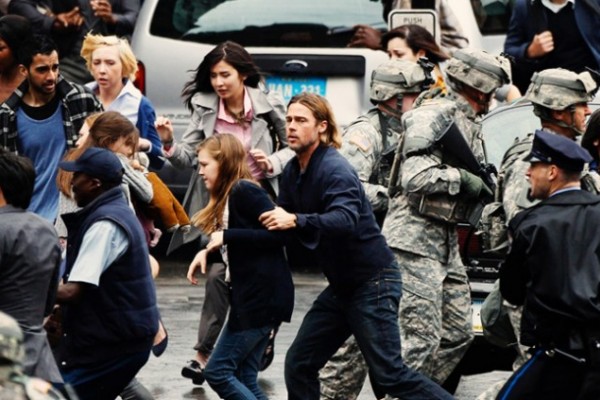
character study. We’re supposed to be too busy rooting for the success of Brad
Pitt’s Gerry Lane amid ballooning crisis-mode, tactical narratives to notice
the millions turned into killing automatons. Most of the plot is spurred by
ticking time bomb scenarios that, if solved, serve to instigate new ones. The
ostensibly research-oriented mission to Camp Humphreys in South Korea, for
instance, devolves almost immediately into a laundry list of action tropes, all
of which disregard the human lives lost in escorting Lane back to a freshly fueled
helicopter. It is not uncommon for action films to care little for its supporting
and peripheral characters, but the gravitas of apocalypse bears greater weight than
the typical action flick—speculating about human behavior in the fallout opens
up, in theory, greater possibilities for psychological exploration in even the
most banal moments. The film’s insistence in defaulting to detached expressions
of violence, if nothing else, marks a yearning for simplistic morality in the
face of complex problems.

The zombie also
functions as a powerful allegory for maturation to adulthood in modern America,
symptomatic
of the recession. Prospective workers have witnessed a drop
in available jobs, worsening
conditions
in existing ones, and a rise in office and temp culture, where
purpose and fulfillment often seem like an afterthought. In their place,
notions of money and competition are incentivized above all, leading to general
disconnectedness that induces a zombie-like state of routine drudgery, where the agency to seek
out meaningful work feels stripped away rather than abdicated.

In a larger
sense, we feel monstrous. We feel tampered with. Unchecked government developments
like surveillance
and “killer
robots
” cause us to doubt that our fundamental rights will be honored.
Finding food without genetic modification or carcinogens
has become an increasingly herculean task, not to mention expensive. As social
media and the rat race of Internet journalism merge, reports of crime and
brutality pervade in what were once private spaces. The symbiosis between media
and mass opinion (as depicted in Bowling
for Columbine
over a decade ago) leaves the impression of a sinister
world—a self-fulfilling prophecy when it has become easier than ever for the
individual to wreak mass havoc in the form of shootings and bombings. Widespread
availability of advanced nuclear technologies allows any group to threaten
already precarious international relations on rapid timeframes, compounding
paranoia. Whether justifiably or not, we feel the itchy anxiety of impending
doom, as if we’re slowly clicking up the tracks of a steep roller coaster. In
response, we turn to entertainment to incite the ride’s drop—to rip off the
proverbial scab and “get it over with.” The line between thrill and addiction,
though, is a fine one, and whether this escapism is cathartic or exacerbating
is still up to debate.

Much like the
disparity between America and Europe’s relationship
with green practices, Europe has leapt ahead in its use of apocalyptic material
in media, transcending the pornographic quality exhibited in World War Z. Within the same fatalist
impulse, shows such as In the Flesh
and Les Revenants approach from an
altogether different angle: rehabilitation. They incorporate the disaster, but
the emotional register deals little with the disaster itself. Instead, these
films focus on the intimate, personal struggles faced by characters attempting
to rebuild their lives after unspeakable (or unknown)
trauma. It should be acknowledged here that World
War Z
is and has been
intended to be the first installment of a franchise. The film has moments that seem
to encourage concepts of teamwork and restoration—particularly in the tonally
inconsistent third act—which leaves hope that sequels might incorporate the
humanism of its source
text
, but only time will tell.

After being
extricated from the zombie infestation of Philadelphia to an aircraft carrier in
the Atlantic Ocean, Gerry Lane is asked by his former U.N. boss to join a
special operations unit charged with locating the source of the outbreak. Lane
is more than a little reluctant to leave his family, but after his initial
refusal, the naval commander standing by says to him, “Take a look around you, Mr. Lane. Each and every one of these
people [is] here because they serve a purpose. There’s no room here for
non-essential personnel. You want to help your family, let’s figure out how we
stop this. It’s your choice, Mr. Lane.” Purpose. Choice. Doesn’t sound
half bad, zombies and all.

Jesse Damiani is Series Co-Editor for Best American
Experimental Writing (Omnidawn, 2014). He lives in Madison,
WI.

VIDEO ESSAY: Siding with the Victim, Part 3: We Are All Meat

VIDEO ESSAY: Siding with the Victim, Part 3: We Are All Meat

Warning: This video contains shocking imagery, and so the faint of heart might want to gird themselves before Pressing Play.

[Complete script follows:]

We like to think we are in control, of our lives, of our
bodies, of our futures. If we work hard
and manage our lives, everything will turn out fine. 

We hold these truths to be self-evident . . . until we lose
that fragile sense of control.

Illness, injury, the loss of a loved one: all of us have
experienced moments when we realize we have no control over things, when we are
powerless.

That’s an uncomfortable place to be. But these experiences teach us that just
because we’re human, that doesn’t mean we’re special.

Art critic John Berger has said: “Animals are born, are
sentient, and are mortal. In these
things they resemble man.” In other
words, our most basic selves are animal. The horror movie reveals this, by showing us our mortality, stripping
away our arrogance.

Trapped. Tortured. Hunted. Slaughtered. This is the way of life, and death, for most animals. We’d like to forget this, but the horror film
never forgets. It reminds us that, like the over 50 billion animals killed
every year for human consumption, in the end, we are all meat.

The images of violence so abundant in modern horror movies
may seem prurient, mindless, sadistic. But
they also show us what we would otherwise turn away from: namely, the raw
material fact of our physical bodies, which, at the end of the day, are only so
much meat.

Most of us believe that human beings are more than this, but
horror movies are not so sure.

Plot and dialogue are crucial to a great horror film, but
when it comes time to immerse the audience in fear, the only sound we hear is
screaming. 

And sometimes a string section. 

To be without a voice is to be put in the place of animals:
speechless.

No film better captures this feeling of brute powerlessness
than The Texas Chainsaw Massacre. When a band of twenty-somethings pick up a
hitcher in rural Texas, he tells them about an old slaughterhouse that has been
closed down. He tells them his family’s
always been in meat, a grotesque line that cuts several ways: First, for
generations this community was sustained by the local meat industry; Second,
like the rest of the community, the hitcher and his family are no more
important to big agriculture than the animals they slaughtered; and Third,
driven to madness, they now make meat out of anything that crosses their path,
animal or human, male or female.

This scene is arguably the most terrifying ever filmed. It exemplifies
the moral force of siding with the victim. Here we see a woman stripped of every last vestige of her humanity, her
very fear made an object of derision by her monstrous hosts.

Most striking is the camera’s concentration on her eyes. A
baby’s eyes tell a mother what it needs, what it feels; in a dog’s or cat’s
eyes we can tell if it is happy or sad, scared or confident. Eyes transcend the species barrier, but,
unfortunately, that isn’t going to help this victim.

And this is why horror movies bring us to these horrifying
places: so that we can’t ignore the appeal in a victim’s eyes. In horror we
bear witness to suffering. We recognize ourselves in the victims, and the
victims in ourselves.

This family has always been in meat. For the film’s most frightening antagonist,
known as Leatherface, this is literally true. He wears a mask made from the skin from a human victim.  He is one of the most terrifying creations in
the history of cinema. Yet in this scene, unexpectedly, we feel a grudging
sense of sympathy with a monster we have already witnessed ruthlessly murdering
several hapless twenty-somethings. He is
like a guilty child, uncomfortable in his own skin. Underneath that mask we can imagine a being
stalled at a rudimentary stage of development, and made evil. But we can also recognize,
perhaps even relate to, his anguish.

Our protagonist has clearly been wounded by her experiences,
inside and out, and she can only laugh maniacally as the truck moves away at
the growing distance between herself and her erstwhile attacker. This distance, though, is only an illusion. Her
attacker’s dance of demented victory suggests a kinship between their warped
psychological states, and a reminder that monsters and victims, predator and
prey, are often two sides of the same being.


Ken Cancelosi is the Publisher and Co-Founder of Press Play.

Jed Mayer is an Associate Professor of English at the State University of New York, New Paltz.

Is Reggie Watts the Most Important Artist of the Century So Far?

Is Reggie Watts the Most Important Artist of the Century So Far?

null

The
only thing you need to know about “postmodernism” is that it’s over.
Several decades of academics goading us to dig deeper into the roots of all
language, the better to see that we don’t define words or understand others’
speech consistently, have come to a close. That’s largely because the
generation of literary and performance artists coming up now has—without
realizing it—eaten this “postmodernism” for breakfast every day and
grown tired of it long before formal exposure to it in college and grad
school. 

The
harsh reality that language is imperfect is simply old hat. Instead of
dissecting the realities of language, what today’s youngest and most innovative
artists are doing is speaking in the language of reality. They’ve leaped over
both the hundred thousand tomes of boring European literary theory that defined
academic art for decades, as well as the much-discussed sincerity-irony
spectrum that was so important to Gen-X art in the eighties and nineties—think
Bret Easton Ellis and “Reality Bites”—to come to a place in which
what really matters is achieving in art what we all already experience in life:
A sense that we move through so many online and real-time identities in our
lives, and are exposed to so many different types of discussions, and are so
unsure anymore about what is real and what is fiction and what the difference
between the two is, that the only recourse is to live life and make art as if
those identities, discussions, and realities were actually interchangeable.
This, then, is really all you need to know about “metamodernism,” the
place America’s most experimental young artists have taken us in music,
literature, film, and television.

Reggie
Watts, a New York City-based musician, comedian, and slam poet whose routine is
heavy on improvisation and stream-of-consciousness association, is just the
sort of multidimensional artist you need to be watching if you want to know
what experimentation in the literary and performance arts looks like right now.
Instead of academics like Kenneth Goldsmith or Rachel Blau DuPlessis performing
high-concept ideas in art based on European theories about the mind and
language, or young emo boys and girls painting over the gaps in their sincerity
with irony, we’ve now got artists like Watts. His way of making art is much
closer to the way we actually function day-to-day in America—something which,
not that you’d know it, has been a goal of experimental art for at least a
century. 

Back
in the early twentieth century, a number of European literary movements,
including Dadaism, Futurism, and Surrealism, bred young radicals who used
wild-eyed manifestos and ultra-challenging experimental literature to force
workaday men and women to more carefully consider the pitfalls of modern
living. While sometimes this form of social protest included an element of
performance, more commonly it was found in texts that—ironically—only the
Continental intelligentsia were likely to ever come across. The aim of all these
movements was nevertheless an admirable one: To make the conditions under which
art is created and performed every bit as dramatic and complex as the conditions
under which those who don’t make art
are forced to live. Unfortunately, somewhere along the way this ambitious aim
got sidetracked and stifled in the offices and classrooms of
university-dwelling English scholars. Metamodernistic artists like Watts offer
our best hope, now, of once again seeing America’s artist class making art directly
relevant to how we live today.

Perhaps
it’s not surprising, then, that metamodernists like Watts don’t go in for
reductive titles like “filmmaker” or “poet” or “novelist”
or “musician”; today’s most innovative work not only crosses all
boundaries of genre but in fact ignores such boundaries altogether. We see it
as much in poetry as in songwriting, as much in fiction as in comedy. This
metamodernist approach weaves together different planes of reality and modes of
communication to build the sort of uneasy coherence that allows us to survive
them intact. In other words, while it may often seem, in the Internet Age, that
a stable self-identity is a luxury few of us can access or afford, what
metamodernism offers us—all of us—is a way to locate an authentic self even
in the midst of contemporary America’s chaotic, social media-driven culture.

Watts’s
tenth multimedia production, the short film “Why Shit So Crazy?”, is now
available for streaming download from Netflix. It’s cobbled together from
various clips of the performer’s bizarre stage routine, a fact which itself
suggests more than one level of reality: the reality experienced by the people
who attended the shows we see excerpted in the video, and the new reality Watts
creates by foregrounding his short film as a highly-manipulated sequencing of
things that actually happened. Some of the effects in the video are
“merely” stylistic—for instance, psychedelic visual echoes, or
inexplicable slow-motion shots, all of which remind us we’re not in Kansas
anymore. But most, including countless conspicuous jump-cuts, are deliberate
and force us to consider the things we do and don’t count as “real”
in both art and life.

More
commonly, Watts is engaging in several manipulations of language that reveal
the metamodernistic life we now live. Sometimes, what Watts is doing is making
activities we’d normally consider secondary to a live performance the primary
focus of his act, much like tooling around on the Internet has become a way of
life for America’s youth rather than merely something to pass the time. Watts
at one point spends two minutes adjusting his microphone; later, he takes that
same microphone off-stage to have a brief yet convincing argument with his
girlfriend. On other occasions, common verbal tics become the entire substance
of Watts’s routine. And in one particularly memorable bit, Watts performs a
masterful and detailed mimicry of the whispered conversations of audience
members disrupting his performance. 

Often,
Watts leaves his audience wondering what the baseline of his act is—in other
words, who Watts himself really “is”—by switching without warning
between different accents, foreign languages, timbres, and volumes. He
sometimes even speaks in gibberish, though it’s gibberish so convincing in its
rhythm and timbre that it seems merely a reasonable continuation of the
monologue that preceded it. Many of Watts’s thoughts go unfinished, but in a
way that mimics ADD or ADHD rather than seeming coy or ironic. Other remarks
seem wise but also empty of content, like this one: “I’ve learned
throughout the years, living here in New York, that unless you keep realistic,
there’s no way you can survive. You have to make sure that things make sense every
day
.” Okay, that seems clear enough; wait a minute, what?

These
purposeful eccentricities emphasize just how much of the language we come
into contact with daily is noise that nevertheless feels essential and true.
For instance, sometimes Watts will sing his lyrics
“incorrectly”—offering a word that’s other than the one we might
have expected—though as the entire routine is improvised, it’s up for grabs in
this type of performance what’s “correct” or in error. Elsewhere
Watts seems to bare his heart with a searing sincerity, though as it’s in the
context of an improvised Jamaican pop-song scat, who knows: “I’ve been in
love so many times before, it’s hard to count. And when I fall in love again, I
won’t know if it’s really love because I can’t remember what it was the first
time I fell in love. Because it’s a construct of your memory. But it’s a
feeling nonetheless, and I’ve got to respect that in the process. And everyone
knows, everyone feels inside: that’s Life.” Some, all, or none of
this may be autobiographical, but it’s undeniably catchy as a sung lyric. It’s
also wise, yet it’s presented in just the sort of frivolous package we’d expect
to find nonsense in. That’s how the Internet Age feels sometimes, and Watts
knows it. The same can be said of his use of “call-and-response”
techniques. Usually, the sound that echoes back to him on stage is quite
different from the sound he requested from the audience, demonstrating for us
that even when we want to be in concert with one another, it’s impossible.

Watts
also goes into sudden diversions of thought and manipulations of fact that
frustrate even our most modest expectations. For instance, he tells a story
about his Montana childhood, and then he casually mentions an incident that
happened to him as a youth in the 1950s (which is impossible; Watts just turned
forty last year). Later, he details the history of the venue he’s performing in
with great authority, then subtly changes major facts the second time he
repeats them. More broadly, “Why Shit So Crazy?” slides seamlessly
from one topic or genre of performance to another, as when Watts moves from
miming to narrative to scat to hip-hop without pausing, or fills his improvised
songs with “plain speech” no one would ever set to music.

Yet
even Watts’s “plain speech” is quite a bit more—that is to say,
quite a bit less—than it at first
appears. At one point Watts speaks of how men and women “are” without
ever completing a thought or making a coherent observation. Women think and do
things, Watts explains, speaking as if he’s exposing a fundamental truth of
great import, and men also sometimes do and say things. And this, Watts
concludes, “explains” the situation in Palestine as well as the on-again,
off-again military conflict in Kashmir. It doesn’t, of course, explain either
of these things, but Watts nevertheless ends each sentence of his mini-lecture
with the words, “know what I mean?” Another of Watts’s songs is
comprised entirely of gorgeously sung profanities coupled with a recitation of
the parts of speech in English (e.g., noun, adjective, adverb). Still
another reproduces the compelling non-narratives of everyday gossip using a
string of sung pronouns: “I’ve got you, and you’ve got him, and he’s got
her, and she’s got she; he’s got he and we got them. We is them too when we go
there–well, no, I don’t know.”

It
helps that Watts is an excellent singer, lays down some of the best beats
you’ll ever hear, has impeccable comic timing, and can improvise narrative better
than even the most talented slam poet. Which is exactly what this new mode of
art calls for: Excellence in multiple types of language—and in the realities
those languages create for us—rather than specializing in obscure theories
about how individual parcels of language sometimes operate. It’s like today’s
young innovators are looking upward, toward the many different realities
layered atop our everyday one, whereas yesterday’s aging innovators are forever
looking down, trying to see how many angels (or European scholars) they can fit
on the head of a pin (or in scholarly treatises no one reads). 

We’re
seeing this same sort of emphasis on “super-consciousness”—that is,
on how realities collide and accumulate in the lives of real Americans—not only
in stage performances like Watts’s, but on the page, too, in the poetry and
fiction of young literary artists who live and write in multi-genre
communities. Increasingly, these literary artists are found in graduate fine
arts programs across the nation, even as they experience social networking
phenomena on a daily basis like the rest of us. If the previous generation of
artistic experimenters was fascinated by basic Internet-Age technology like
search engines and “uncreative writing” (the idea that you can take a
text that already exists and pretend it’s “poetry”), the younger
generation Watts is a member of is more interested in having fifty tabs open in
a web browser all at once and moving seamlessly between them as through a
single “reality.” Sure, it was interesting and instructive when John
Cage recorded his “4’33″” in 1952—a “song” that’s
simply four minutes and thirty-three seconds of silence—and Kenneth Goldsmith
intrigued many younger artists when he typed up an edition of The New York Times in 2003 and called it
a book of poetry (Day), but neither
teaching us to appreciate background noise nor challenging what sorts of
material can be used to make a poem resonate in 2013 the way they once did. If
anything, today’s young people are so suffused in noise and so bored at the way
language is constantly being thrown at them in tiny, marketing-savvy packets
that what they’re looking for is something entirely different: A way out of the
nation’s gummed-up language matrix that makes them feel more human rather than less.

We’ve
become accustomed to thinking that America’s poets and novelists don’t write
much if anything of relevance to today’s youth. But with more and more young
artists sticking with their artistic ambitions through college and graduate
school, we’re more commonly seeing young American creators who are eccentric
but not, importantly, separated out from their peers like the solitary geniuses
of America’s literary past. The result is a generation comprised of young poets
and novelists—and musicians, comedians, and genre-bending performers of all
types—who seem like the sort of people you’d want to get a beer with, and who,
however strange and distinct their performances or modes of writing, are
somehow capturing what it means to be in your twenties or thirties or even
forties in the Internet Age. The list of such artists includes poets like
Donald Dunbar, Chelsey Minnis, and Sampson Starkweather; musicians like Lady
Gaga and Bo Burnham; filmmakers like Joss Whedon, Shane Carruth, and Terrence
Malick; and multi-genre performers like Sarah Silverman and, of course, Reggie Watts.
Ultimately, these men and women are among the most successful experimental
artists in the United States not because they’re boring and obscure, but
because they’re exhilarating and only obscure in the way modern living
sometimes feels obscure. It’s all right to be confused and frustrated by the
simultaneous identities and realities our technologies force on us, but Watts
and other young artists in the metamodernistic mold teach us that it’s okay to
laugh at and embrace and combine these conflicting realities, too.

Seth Abramson is the author of three collections of poetry, most recently Thievery (University of Akron Press, 2013). He has published work in numerous magazines and anthologies, including Best New Poets, American Poetry Review, Boston Review, New American Writing, Colorado Review, Denver Quarterly, and The Southern Review.
A graduate of Dartmouth College, Harvard Law School, and the Iowa
Writers’ Workshop, he was a public defender from 2001 to 2007 and is
presently a doctoral candidate in English Literature at University of
Wisconsin-Madison. He runs a contemporary poetry review series for
The Huffington Post and has covered graduate creative writing programs for Poets & Writers magazine since 2008.