Screenwriter Bob Nelson Talks About What’s Personal and What’s Payne in NEBRASKA

Screenwriter Bob Nelson Talks About What’s Personal and What’s Payne in NEBRASKA

null

Since Premiering at Cannes this year, Nebraska has become an indie darling. The hype around Alexander
Payne’s new feature was buzzing long before its release: Bruce Dern makes his comeback! First time
screenwriter Bob Nelson makes his debut! Nelson has now been nominated for an
Independent Spirit Award and Golden Globe.

Nelson, who worked in TV for years in Seattle on shows like Almost: Live! brings us an impressive,
intimate first feature script. After winning a sweepstakes prize for a million
dollars, Woody Grant (Dern) is set on claiming his prize. His son David (Will
Forte) decides to take him on a trip to obtain the cash, despite the fact that it’s
clearly a scam. The film is a raw, poignant look at a crumbling patriarch and
his compassionate son. Although the story may seem melancholy, the movie finds
levity in its humor. (After all, this is a Payne film.)

I spoke briefly with Nelson about this film at the red carpet
premiere of Nebraska at the AFI Film
Festival:

Meredith Alloway: This is your
first feature. How did you get it in the hands of
Payne? 
 

Bob Nelson: I was working at a Seattle show called The Eyes of Nye. Producer Julie Thompson
came up. I had written a screenplay to try and get a TV job. Julie got the
script to Ron Yerxa and Albert Berger, who have a company called Bona Fide
Productions.  They decided to send it to Alexander
[Payne], not with the intention to direct it but just to produce it and raise
money. I was very fortunate, very lucky, and it doesn’t happen a lot. The one
take-away is that even though I was in Seattle, I was still working in the business.

MA: Nebraska was
optioned back in 2003. What were some elements that Payne infused into your
original draft, over the years?

BN: He’s got a
little bit spread throughout the script. Right off the top, he did some work on
the first act. In my version, David worked in a cubicle and Ross [his brother
played by Bob Odenkirk] was an insurance salesman. He changed their professions,
giving a 40 year old a job where there didn’t seem to be many advancement
possibilities. He created this tension between the brothers, which is nice.
When they have the moment later on with the air compressor, it kind of completes
their story. Mount Rushmore was his idea. He said, ‘You know they’re going
pretty close to Mount Rushmore. Why don’t you have them stop there?’ Those lines that they’re saying in that scene are
pretty much Alexander.

MA: I can’t imagine
anyone else playing Woody. Are there particular moments where you witnessed
Dern make the Woody you wrote his own?
 

BN: It’s pretty much the whole thing—that’s even better. As
much as you can do in your mind when you’re writing, nothing compares to having
an actor fill it out and make it real. This is pretty special. I was on the set
for a week and I got to see a little bit of that. I got in the video truck and
watched. Boy, when I saw the whole thing put together I was amazed. One of the
first scenes I saw him doing was when he walks into the tavern and sees Ed Pegram
[played by Stacy Keach] with the letter. I knew he was Woody.

MA: Which character
are you the most like? I often feel the writer’s voice speaking through David.
Was he your vehicle?
 

BN: The script did start with my own father, my relationship
with my dad. I could have imagined my dad doing this, as he was more confused. He might want to make a trip like that. How
would you deal with it?
I honestly used some real life instances that are
in the movie. David brought up those old thoughts of, what do you do with this person you love that had this addiction? You’re
trying to do the right thing by them and give them dignity and show some
forgiveness. My dad was shot down in WWII and was quite a changed person. He
was a generous guy who loaned tools out and never got them back.  The scene at the railroad tracks was from
real life. I used those and at a certain point I started inventing things based
on that. It did help in the beginning to mine from real life.

MA: My favorite
scene in the movie is when all the men in the family sit in the living room,
drink beer and stare at the TV. The dialogue is so terse that it’s hilarious.
How did this scene evolve from your initial idea to what we saw on screen?

BN: Well that’s Alexander’s staging. In my mind, I was
remembering from my childhood that they wouldn’t necessarily watch TV all the time; they would sit in a circle but still not talk. Alexander came up with the idea
of them staring forward. If they have something to say, they say it. There’s
no awkwardness.

MA: You wrote for
years on Almost Live! What resources
did you use to make the transition and tackle a feature?

BN: In fact, I started out and got to page 20 and realized I
should educate myself. I read some screenplays. Some of them would be Casablanca or North by Northwest, but they helped me to get a feel for the film.
I read some books, but I prefer reading books about people talking about the
screenwriting process.

MA: What are your
feelings on the charges that the film is condescending?
 

BN: Yeah that’s a tough one to talk about. I
come from a comedy background, and I always wanted to do drama and mix the two,
and that’s what Alexander does. Basically if I’m going to write something,
since we’re both humorous at heart, I think every project we do is going to have
some gentle humor about the participants. It’s personal, in a way, because these
are people I love. I don’t think of them as any less smart than we are. I also
don’t want to paint them as “salt of the earth.” The guys staring at the TV,
they had dry senses of humor. I loved those guys. But I can’t change people’s
perceptions. We’re all a little silly. I
could do a scene about some hipsters in New York watching television and make
fun of them talking all the time. That would be the New York version.

MA: Any filmmakers
or artists from this year’s crop of films you find inspiring?

BN: I grew up with Billy Wilder. I love The Apartment. Any screenwriter starting out should watch The Apartment for structure. I grew up
on 70s films. Hal Ashby also combines drama and humor. I also had a
fondness for Horton Foote; you can see that in Nebraska. These days I love the Coen brothers. Albert Brooks was a big
influence. Christopher Guest—there’s a guy who’s accused of being condescending! We
love his films!

MA: What’s up next
for you?

BN: One of my friends is Joel McHale; I’ve written a
script for Joel that I’m directing. We’re out trying to raise
the money now. My last goal in life is to turn Joel McHale into a movie star!

MA: You’ll be
directing this one as well?

BN: That’s what I’m telling people! I have to find someone to
believe it that has money! I just wrote another script that’s even smaller than
Nebraska. It’s inspired by Bicycle Thieves. It’s another dramedy.

Bob Nelson was born on July 18, 1956 in Yankton, South Dakota, USA. He is a writer and actor, known for Nebraska (2013), The Eyes of Nye (2005), and The Magic Hour (1998).

Meredith Alloway is a LA local and Texas native. She is currently Senior
Editor at TheScriptLab.com where she focuses on screenwriting education
and entertainment resources. She also launched her own interview showm
“All the Way with Alloway,” where she scoops the latest up and coming
industry insiders. She received her Playwriting and Theatre degree from
Southern Methodist University and continues to pursue her own writing
for film and stage.

On the Shoulders of Giants: Why Movies Are Shifting from the Undead to Big Monsters

On the Shoulders of Giants: Why Movies Are Shifting from the Undead to Big Monsters

null

At this year’s New York
Comic Con, hordes
of cosplayers
donned khaki military jackets, white spandex, combat boots,
and hip-level silver boxes—costumes imitating the uniforms of the Survey Corps
in this spring’s breakout anime show, Attack
on Titan
. In the show, the Survey Corps is the group responsible for identifying
and dispatching gigantic humanoids that eat people for fun. Earlier this year, Jack the Giant Slayer blended the Jack
and the Beanstalk and Jack the Giant Killer fairy tales into a battle of mythic
proportions between humans and giants, and, in the fall, the Guillermo del
Toro-helmed Pacific Rim combined
global crisis and B-movie kitsch with state-of-the-art mecha-kaiju grudge
matches. That vampires and zombies have surged in popularity over the past
decade is news to none, but it’s becoming clear that, in the new moment, our
interests lie with bigger things.

To discuss the genres
intended to scare—horror, suspense, and thriller, et al.—is to examine the
cultural fears they exploit. They serve as litmus tests for our collective anxieties;
no matter how intelligent a scary movie may be, the underlying purpose is to
frighten—to activate in viewers some amalgam of masochism (the chance to be put
through psychological discomfort), catharsis (the chance to see what scares us
exterminated), and voyeurism (the chance to see others suffer our demons). The spike
in popularity of vampires and zombies in Western entertainment stems back to
the pre-recession decadence of the early aughts. Before the financial collapse,
enough of the American population felt comfortable that their basic needs would
be met, creating an environment that allowed many the space to speculate about
evils lurking in their midst. The embarrassment of riches was obvious enough to
generate the fear that it could be stripped away, making the undead, creatures
that begin their lives as humans, perfect vehicles to play on this anxiety. Hearkening
back to the Biblical fall from Paradise, their immutability only deepens their
evil. They exist as binaries along the spectrum of the idea that overwhelming
power can easily turn monstrous; vampires present the conundrum of willful
immortality, zombies showcase the total relinquishing of agency to beast instinct
without the pesky intrusion of awareness.

But, by 2013, the
illusion of economic security has long since crumbled, and with it, the energy
to interrogate the contours and consequences of the milieu that produced it.
“Big monster” movies and television shows mirror this phenomenon in their frequent
inclusion of global catastrophe. In place of the fear that we’ll lose our
resources is the fear that we’ll even survive long enough to use what resources
we have left. These creatures generally exhibit neither the vampire’s cunning nor
the zombie’s contagion, and, maybe most importantly, are not so obviously us, and when they are—as in the giant
armored robots of Pacific Rim—they showcase
our aptitude for collectively addressing and combatting impending evil of equal
proportion.

This is the most pivotal psychological
difference between big monsters and the undead: the turn away from the individual
to the group. One person—with enough strength, wit, or courage—can
singlehandedly dispatch zombies or vampires. Giants, though, are enemies so
massive that only a group can vanquish them. Where a zombie can be shot in the
head and a vampire can be exposed to sunlight, the kaiju in Pacific Rim, for instance, have no
obvious Achilles heel. Humanity’s only fighting chance lies in the convergence
of disparate sets of knowledge—some from scientists, some from black market
dealers, some from those who fight the beasts directly. It is only from this
collaboration that Newton Geiszler, the excitable researcher with
nontraditional methods, begins to discover patterns that can be exploited to
save humanity.

Attack on Titan is also an exemplar of this new trend in its degree of remove from
culpability. Big monsters are, at worst, an accidental outgrowth of humanity,
and likely unrelated to us whatsoever. We’re aware that the monsters couldn’t
exist without our involvement (this becomes an important plot point in Attack on Titan), but blaming ourselves
for them doesn’t fit, either. Even if we were implicitly involved in their creation,
our involvement was unknowing and passive. The average person may buy Kraft
macaroni, for instance, but that doesn’t mean the average person intended to
support the parent company, Monsanto, in effectively monopolizing
entire crops
.

Simultaneously, our social
ills are the outgrowth of groupthink, and, as is the case with mega-conglomerations,
are the fault of no definable enemy. This process is explained in a recent video titled “The Innovation of Loneliness.”

In its immediacy of
exchange, the Internet is unprecedented in its uniting of human knowledge and
experience, revealing on a mass scale our best and our worst. The new
technologies that have sprung up alongside it have created as many conveniences
as they have barriers of separation, ranging from internet-based customer
service lines to video conferencing. No technology is fundamentally bad—neither
are big monsters, in that sense—they’re just doing what they’re compelled to
do. How we respond to them has effects on us, though, some of which can harm us
and others that can help or better us. Much as social networking has altered our
sense of community, it also allows us to organize in record timeframes. With
the growing presence of fundraising apparatuses like Kickstarter and Indiegogo,
grassroots campaigns have never been easier or more effective. As witnessed in
the increasing relevance of viral media, the strength of the individual now
lies in one’s participation in the sharing process. We still need leaders and
innovators, but there are so many voices now that we can—and in fact,
must—exist in more stratified niches than ever before. There will always be the
Eren Jaegers and Raleigh Beckets—those who traditionally exist as heroes of the
stories—but they will have relied more heavily than ever before on the work of
the Armin Arlerts and Mikasa Ackermans, the Newton Geiszlers and Hannibal Chaus.
It’s the agency of an individual hero that’s being held in scrutiny, not the
necessity of their existence.

Where undead
entertainment traffics in pessimism, big monster movies often feature underlying
optimism, typically borne of dire circumstance. The fighting is necessary for
our very survival, imbuing it with undeniable purpose, and, maybe most
importantly: we’re fighting for something we want to save. It’s not about the
monsters; it’s about us, the underdogs. It’s about what we’ll do—who we’ll become—to
fight back. If it was the allowances of the group that allowed these monsters
to exist, it can only be the group that takes them down. Our giants are bigger
than they’ve ever been. We can’t beat them alone.

Jesse Damiani is Series Co-Editor for Best American
Experimental Writing (Omnidawn, 2014). He lives in Madison,
WI.

Complicit in THE ARMSTRONG LIE

Complicit in THE ARMSTRONG LIE

null

In no other place are we so
desperate to crown monarchs, to live vicariously through victory and wealth,
than in the realm of celebrity. We are smitten by the success of others. In Lance
Armstrong, we were given a character for the ages. A man born to a single
mother in East Nowhere, Texas. A cancer survivor who rose to prominence in a
sport dominated by Europeans and ignored by Americans. While Michael Jordan, Wayne
Gretzky, and Brett Favre were preceded by Julius Erving, Bobby Orr, and Roger Staubach,
Armstrong was a singular entity, the king of a land that had just been
discovered. He dated rock stars and supermodels. He was handsome and wealthy. His
celebrity was virginal, and unique in the glimmering magazine cover world
dominated by common and contrived stories.

And it was, in its entirety,
built on lies all too familiar. Built on vengeance. Cheating. A complex system
of blood doping and performance-enhancing drugs designed to take him to the
forefront of his sport, and the heights of celebrity.

Alex Gibney’s The Armstrong Lie began as a tale of
redemption. In 2009, the disgraced cyclist returned to the scene of his
greatest achievements, the Tour de France, where he had won a record seven
titles, and brought Gibney and crew to capture his comeback. But, once again,
Armstrong (as is now well-documented) was caught cheating and doping, and
Gibney’s film was put on hiatus. Four years later, Armstrong reached out to
Gibney to set the record straight on his marred career, and the documentary
became a story of a man so driven to greatness, so oblivious to his own self-destructive
nature, that he was deluded into believing he had yet another comeback in him, a
comeback not in competition, but in the public spectrum, one that would feature
Oprah in a supporting role as his hand-picked interviewer/enabler/PR shill, and
one that Gibney would capture for posterity.

Unfortunately, both the film and
its subject are deeply flawed. Armstrong is fearlessly naïve about his ability
to dope without being caught, to charm without being transparent– and Gibney
is so taken by Armstrong’s aura and the story he hopes to tell that he raises
the question as to why viewers have been asked to empathize with a ruthless,
destructive, vindictive cheat. In footage shot during the 2009 Tour comeback,
Armstrong and Gibney come off as teammates, certainly more than Armstrong and
his actual teammates, who more closely resemble reluctant participants in the
lies. Gibney, on more than one occasion in his narration and the film’s action,
reveals himself to be cheering for Armstrong, a revelation both awkward for the
audience and counter to the medium of documentary. A successful documentary
revels in its subject and defines the immersive; it puts the viewer at the
story’s core and the filmmaker in the quiet shadows. The Armstrong Lie takes on a promotional tone, and though
Armstrong’s warts are revealed, Gibney foolishly attempts to apply cover-up, by
shifting blame or asserting over-and-over that everyone in cycling was doping, to
conceal what the audience is already well aware of, that Armstrong cheated his
way to celebrity, and did so with no care for those around him. Armstrong uses
Gibney as he used his teammates, his celebrity, his fans, and his sport.

What is also startling about The Armstrong Lie’s failings is its
overt effort to isolate Armstrong, a man who defines isolation through his
manner and sport. Whether it be from former teammates, Italian doping doctor Michele
Ferrari, or Gibney himself, the film tries desperately to reveal Armstrong as a
loner, a man on a mission to dominate a sport, and attain celebrity no matter
the cost. However, Armstrong does this with little or no help. Gibney’s heavy
hand is present throughout, most notably through the near total absence of
Armstrong’s family. Some of his children appear for a moment, when they are awkward
witnesses to a surprise drug test, a test seemingly as common as the breakfast
it interrupts. Armstrong’s first wife is not mentioned. His current partner is
acknowledged briefly, as are his dalliances in celebrity dating. Perhaps Gibney
wanted viewers to simply assume known facts–but this comes across as an
attempt by a director to find the movie he wants, and not the film unfolding
before him.

What appears above may seem like
an indictment of the film, though it is anything but. Through his complicity in
the Armstrong lie, Gibney reveals the very manner in which we are all complicit
in the deception of celebrity. While Gibney shows Armstrong with children
struggling with cancer as an attempt to elicit empathy, instead we see a man
who will use anyone, including children suffering from the very disease that
nearly claimed his life, in order to disguise the truth of his being. Gibney is
as taken by Armstrong as the children are, as the cameras are, as we were. 

During the height of the
Armstrong affair I appeared on the sports and pop culture program, PLAY with A.J. As part of their humorous
“30 Seconds of Fame” segment, I were asked, “The Huffington Post is reporting that there are three
Lance Armstrong movies in the works…what should the movie be called?”
My reply was: “One Ball, but What a Dick:
The Lance Armstrong Story
.” I wouldn’t normally dare to find a punch line
in cancer, a horrific disease that is devoid of humor or prejudice. But
Armstrong’s betrayal of his fans, family, his charity, his sport, allowed for
my humour.

But the joke said more about the celebrity
relationship of sports fandom than the failings of Armstrong. With The Armstrong Lie, Gibney is no different from the fans that
cheered Barry Bonds to 73 home runs in 2001, golf’s apologists who continued to
feed the Tiger Woods machine despite sordid tales of flawed character, or the
NFL fans who continue to embrace Michael Vick despite his serving jail time for
abusing dogs. Sports fandom allows for this obliviousness in a manner that
Hollywood does not because of cultural familiarity. We’ve all ridden a bike,
swung a bat, tossed a football, and yet so few of us have sung on stage, or
acted, or written. We live vicariously through athletes because we don’t
require a giant leap of faith to imagine ourselves in their Nikes. And so we
excuse their faults because we so wish that their faults could be ours.

We know how the story ends, and The Armstrong Lie is well aware of that.
The documentary’s post-script is unnecessary. Armstrong was stripped of his
seven Tour de France titles, dropped by his sponsors, and dismissed by his own
cancer charity, Livestrong. If it was Gibney’s intention when editing his
footage to include himself as a character through which the audience
experiences the director’s flaws analogous to our own, then the film is a
rousing success. If it was unintentional, then it fails as a documentary film,
but not as a document. Either way, The
Armstrong Lie
is a riveting examination of both celebrity and those of us
who feed it, and while it may not completely give us permission to laugh, it
asks us to consider our relationship with those through whom we live
vicariously.

Mike Spry is a writer, editor, and columnist who has written for The
Toronto Star, Maisonneuve, and The Smoking Jacket, among
others, and contributes to MTV’s
 PLAY
with AJ
. He is the author of the poetry collection JACK (Snare
Books, 2008), the short story collection
Distillery Songs (Insomniac Press,
2011), and the co-author of
Cheap Throat: The Diary of a Locked-Out
Hockey Player
(Found Press,
2013). His next poetry collection,
Bourbon & Eventide, is forthcoming in 2014
from Invisible Publishing. Follow him on Twitter
@mdspry.

VIDEO ESSAY: Dragons in Movies

VIDEO ESSAY: Dragons in Movies

HERE, THERE BE DRAGONS
by Matthew Cheney

In Siegfried’s Death, the first part of Fritz Lang’s 1924 epic Die Nibelungen, Siegfried slays a dragon and bathes in its blood, making himself invincible (except for a spot of skin that was covered by a leaf). The dragon is a lizard-like creature, more dinosaur than mythic god. Siegfried’s triumph is the triumph of a human over the ancient, bestial powers of Nature; it is a short-lived triumph, though, for as the title of the episode states, Lang’s film is a story of death.

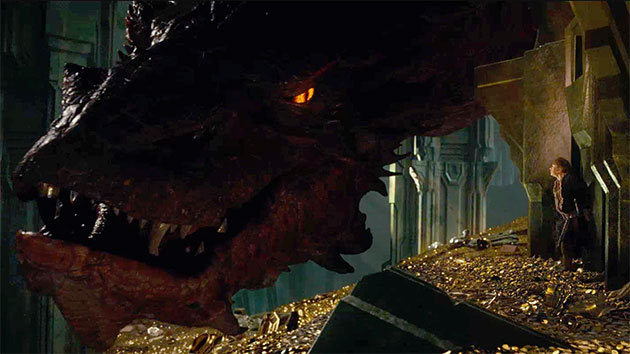
In confronting dragons, humans confront an ancient, alien Nature. Unlike the other popular fantasy figures these days—vampires and zombies—dragons are not transmuted humans, but rather something beyond us, other than us. Often, they are represented as deeply greedy, and this is their fatal flaw (e.g. Smaug in The Hobbit). They guard, hoard, and covet. Within most fantasy stories, they’re part of a medieval environment and their greed stands in contrast to the commons. The triumph of the little human against the dragon is a heroic reappropriation of resources and a signal of the human ability to triumph over the hoard of Nature—the dragon must die for civilization to advance. Sometimes, as with Die Nibelungen, that triumph and advancement is questioned, but most stories of good little warriors triumphing over inherently unknowable, evil dragons are stories of hard-won triumph, with nary a glance to the dark satanic mills ahead. The unspoken truth is that such dragons never die, but instead finds their revenge in human progress, their fire diffused through factory furnaces, their smoke blotting out the sky, as the smog of Smaug chokes and cancers the descendants of the triumphant hero.

And yet there is beauty and wonder in the figure of the dragon, particularly when the dragon flies. This is another dragon story, the story of the improbably lithe creature casting off gravity. Cinema loves to soar, and it is no surprise to see so many cinematic dragons shooting through the sky. In flight, the dragon gains a kind of freedom from the greed that holds it to a single place or particular hoard. Often, humans then can become not the enemies of dragons, but their riders—not equals, perhaps, but partners, a new force greater than either individual. As common as the story of the hero who defeats the dragon is the story of the rider who either tames it or is chosen. The elemental, alien forces of Nature can be turned into a tool and even, perhaps, a friend. The dragon’s power can be harnessed.

Power, indeed. There’s a certain industrial-warriorness to most dragons—flying, armor-scaled, fire-breathing dragons suggest the terror of early aerial warfare. (What is the Blitz but an attack of dragons?) In the sky, dragons move from being Nature to being Gods: the loving, helpful, or at least vaguely friendly God that is the dragon and its rider; the inscrutable, punishing God that is the fire-breather descending from the night. Unless tamed, this power must be destroyed. Controlled, it can be wielded.

As terrifying, elemental, and alien as they are, dragons are not always represented as nightmares. There are countless dragons for children, whether Puff or Pete’s. We seem to have a roughly equal number of scary/archetypal dragons as cute/cuddly dragons. There’s more than one way to tame, and train, your dragon. Taming nature, after all, sometimes just requires a kid to wield a lawn mower.

Because the dragon is so obviously Not Human, it can easily be misunderstood as evil, but sometimes dragons are, as Hagrid tells Harry Potter, just misunderstood. Sometimes, as Disney offered in 1941, they’re a Reluctant Dragon. And then there’s 1996’s Dragonheart, in which a dragonslayer and the last remaining dragon join forces. These are parables of tolerance, of overcoming animosities, of looking beyond the myths. We can learn to love and cherish dragons. We can come to see them as human. But the relationship is never equal. Taming them into our humanity, we dominate them, and, once again, win. (We must trick the scary dragons and tame the cute dragons. If we join forces, it is the dragon that must die, not the human hero.)

In cinema, the dragon must be an effect, its otherness unavoidable because it is a machine or an animation or a computer program rather than a person in a costume. Fritz Lang’s dragon was a giant puppet requiring a dozen operators to push and pull and twist and turn its mechanisms. The result only adds to the alien effect. The same is true of the stop-motion dragons of the mid-20th century films—no matter how careful and accomplished the motion, it is still clearly somehow off, and thus the dragon of ancient Nature is rendered unnatural, odd, scary, funny, wrong. The cute dragons get created in drawn animation so that their colors can be bright, their movement fluid. Their absolute otherness is made obvious, though, when, as in Pete’s Dragon, the dragon is drawn and the humans are live.

Regardless of the level of technical achievement—whether the primitive puppet-machine of Die Nibelungen or the advanced CGI of Harry Potter and the Goblet of Fire—the dragon is always clearly not a human actor. The alien must stay alien. Even today, when the dragons have achieved unprecedented realism on the screen, their only human quality is their voice. Whatever the result of our encounter with the dragon, what we know is that it will not, it cannot, ever be us. No matter how close, the dragon will always be at a distance. No matter the here, the dragon must always be there.

Leigh Singer is a freelance film journalist, filmmaker and screenwriter.
Leigh studied Film and Literature at Warwick University, where he
directed and adapted the world stage premiere of Steven Soderbergh’s
‘sex, lies and videotape’. He has written or made video essays on fllm for The Guardian, The Independent, BBCi,
Dazed & Confused, Total Film, RogerEbert.com
and others, has appeared on TV and radio as a film critic and is a
programmer with the London Film Festival. You can reach him on Twitter
@Leigh_Singer

Matthew Cheney’s work has been published by English Journal, One Story, Web Conjunctions, Strange Horizons, Failbetter.com, Ideomancer, Pindeldyboz, Rain Taxi, Locus, The Internet Review of Science Fiction and SF Site, among other places, and he is the former series editor for Best American Fantasy. He is currently a student in the Ph.D. in Literature program at the University of New Hampshire.

How WHITE REINDEER Defies Cliches of Grief

How WHITE REINDEER Defies Cliches of Grief

null

Spoiler Alert: This piece could be said to contain spoilers, but it would be difficult to discuss the film without spoilers.

Grief is a vast, ugly emotion. No one cries beautifully. No
one copes with death gracefully. Of the emotions one might depict on the big
screen, it would seem to be the most difficult. And yet, in the movies, we have
grown to accept a comfortable set of images, moods, even whole scenes that
communicate it: the hug, in which we usually see a comforting look on one
character’s face as he or she comforts someone else; the collapse in a hospital
hallway, seen from a distance, on the receipt of bad news; the lone tear,
rolling down a cheek, of a person on a telephone, when we can’t hear what’s
being said but we know what it is just the same; the downcast eyes; the slumped
shoulders. We respond to these images, generally, without realizing we’ve seen
them many times before, or perhaps because
we’ve seen them before (paging Susan Sontag, maybe). In any case, Zachary Clark’s White Reindeer is all about a woman’s grieving
process—is steeped in it, in fact—and its great strength lies in its
determination to work against filmic clichés of that process. Its outstanding
set of actors, fantastically chosen soundtrack, and moving, sensitive
cinematography make this film so genuine you can almost taste it.

We’ve all known someone like Suzanne, played beautifully
by Anna Margaret Hollyman. As if she were switching masks, she wears a perky
face at times, and a near-slack face at others, deploying them expertly. She
has a blond, pretty, all-American look, and she knows it—and yet… When we first
see her, she is watching her husband deliver the weather on a local news
station as she waits to show a house to two clients (she’s in real estate),
eyebrows raised, half-smiling, a devoted spouse; after the showing, which goes
very well, her seemingly wholesome clients overjoyed, we get a side view of her,
bent over for some energetic and talkative standing-up sex, in work clothes.
When tragedy hits, only a few scenes later, after she has arrived home from
Christmas shopping (the film is set in that cliché-laden time of the year), the
first thing she does is drop her vacuum cleaner, in near-comic fashion: her
husband is lying dead on the floor, shot in the head. The next thing she does
is file a police report and eat a candy cane the detective offers her (a candy
cane?); later she goes to a Marriott, where her parents arrive to stay with her,
and her mother, in fact, sleeps in her bed. The director presents these scenes
to us without preparation or fanfare—in fact, the lack of either is dramatic in
and of itself. When we do see Suzanne break down, she’s on the toilet, dress
around her knees, sobbing loudly and without inhibition. This would
seem, in hindsight, near-sentimental if it weren’t for the fact that the
director gives us another bathroom scene later, after her husband’s funeral; as he cries loudly—blubbers, in fact—he tells Suzanne her husband cheated on her with a stripper.

It doesn’t help Suzanne that the film is set in the
Christmas season, when happiness is obligatory for all and attainable by fewer
than we’d think—but it does help the film, by casting her approach to grief
into relief. (And it also gives Clark the chance to fill the soundtrack with ghoulishly
cheery Christmas music, some in English, some not, which gives the whole film a
strangely taut, wired feeling.) After finding out where her husband’s mistress
worked, she does what any responsible widow would do: she tracks the stripper
down, gets acquainted, and then goes out clubbing with her. This isn’t before,
of course, she buys over five thousand dollars’ worth of holiday oriented
clothing and Christmas decorations. She does cry again, but she shares this moment
of sadness with a stack of empty egg nog cartons. There are moments in the film
where some viewers’ sense of decency might make them think Clark has gone too
far—but the feeling shouldn’t last, because what he actually doing is trying to
convey the ersatz reality of human reactions, and human behavior. Not pretty. Not
graceful. Not believable, ironically enough. Indeed, Suzanne parties plenty,
for someone who’s just lost her husband. She attends a holiday party, thrown by
her earlier clients, which turns out to be an orgy—yes, an orgy, complete
with swinging breasts, hand jobs, masks, oral and anal sex, everything. And Suzanne
participates, if sadly.

Clark’s very smart move in this film is to temper the satire
(in its truest sense, given that Clark is asking us to acknowledge the reality
of the way we humans act when faced with unmanageable sadness, and to distrust
the way grief happens in the movies) with poignance and attentiveness.
Fantasia, the stripper, is played with unsettling poise by Laura
Lemar-Goldsborough; as the movie winds along, we find out about her home life
with her mother and her child, revealed in soft, funny touches (the child wakes
Suzanne up from her sleep on Fantasia’s sofa after a long night out by banging
a gift near her head and screaming “Wake up, Wake up, Wake up!”). The two women have
an immediate bond, as people, and not just as a cheating husband’s wife and her
husband’s lover—this friendship steels the movie, giving it a sense of uplift.

But that uplift comes from elsewhere, as well.
What Clark is actually suggesting is something larger—that the answer to the
problem of handling loss comes from letting the world in, in whatever form.
This is very much a movie about survival—and another one of its strengths is
that, even as it makes a myriad of dark jokes, it doesn’t make either grieving or subsequent survival seem
easy or simple. Suzanne’s pain in the film is mixed, in even portions, with
excitement, with love, and with intoxication of all kinds. Much like, it turns
out, life itself.

Max Winter is the Editor-in-Chief of Press Play.

Kathleen Hanna Up Front: On THE PUNK SINGER

Kathleen Hanna Up Front: On THE PUNK SINGER

null

This is what a feminist looks like: a young woman in a white
t-shirt at the center of someone’s crowded house party in Olympia, Washington,
1991, her dark hair tied back in a sloppy ponytail, all eyes on her; she
holds the room’s attention with the magnetism of a movie star as she chants a
poem in railroad-train rhythm, in the voice of a little girl realizing she’s
been sexually abused: “I am your worst nightmare come to life/I’m a girl
who can’t shut up/There is not a gag big enough to handle this mouth/Because
I’m not going to shut up/I’m going to tell EEEEVVVVVEEERRRYYYYOOOOONNNNE!”

This clip of Kathleen Hanna mid-performance opens Sini
Anderson’s documentary The Punk Singer, an unprecedented feature-length
portrait of the radical icon and “leader” of the leaderless ’90s riot
grrrl movement whose music, while spanning a range of styles from angry punk to
danceable electronica, has always been built on a core backbone of
no-compromise feminism; Hanna admits her impetus for pursuing an
audience is because “nobody has ever listened to me my whole life,” a personal manifesto balanced perplexingly with her 2005 declaration that she had nothing more to
say, ever.

That declaration was hard to believe. Hanna’s gift was
always her ability to distill feminist theory into accessible, chantable
soundbites: “I eat your hate like love.” “We are turning cursive
letters into knives.” “In her kiss I taste the revolution.” (She famously penned the phrase “Kurt Smells Like Teen Spirit,” a
drunken graffito that became an anthemic catchphrase of the grunge era.). Those
soundbites sprouted barbs when flung out in her distinctive singing voice:
unpolished, babyish, high-register without ever becoming true soprano, and yes,
objectively, “shrill”, if there’s any objectivity left in a word
that’s to women what “uppity” is to African-Americans—I do not
like the timbre of your voice
disguised as I do not like the content of
your words.

Add to that Bikini Kill’s insistence that women come up to
the front rows of their shows, pushing men to the back, and Hanna’s
push-and-pull sexual presence onstage, luring and rebuking hungry eyes by
undressing and scrawling words like “SLUT” in black
Sharpie on her baby fat, doing bump and grind moves (learned during a stint
as a stripper, back in college in Olympia) with uncalculated, ungraceful
sprawls and tantrums as she caterwauled and grinned. You want me, you hate
me, you will listen to me. And there is nothing stopping you from being me.

This wasn’t an easy concoction to swallow. I’ll admit I choked
on it when I was a teenager in suburban Baltimore, a mere 50 miles up the road
from the place where Bikini Kill was carving out its revolution, grrrl style,  but ideologically many more miles away, our discoherent
punk scene forever in the shadow of uber-principled Dischord Records. I
rejected the reverse discrimination of pushing men to the back so that the
women could enjoy the music without being battered by the mosh pit they
dominated. How stupid. Women didn’t need someone to tell them to come to the
front. Wasn’t that the point of punk? That if you were a woman and wanted to
come to the front, you did it, with hard shoulders and gritted teeth, and you
took the consequences like the outlaw girl you were? In D.C., I slipped in the
pit and someone landed on my head. I got hit in the eyes and saw stars. In
Boston I got punched in the face so hard by some guy’s flailing fist I couldn’t
open my mouth for the next 48 hours. This is how I embraced punk rock’s
anti-pretty. This was its promise to me: eat our fists and you too can get
everything we do.

But isn’t that the nature of privilege? That those who don’t
fight for it get it anyway? Sheryl Sandberg wears the ethos in boardroom suits
that I wore in combat boots in 1991. “Lean in”, the argument goes,
“and you can run with the boys too.” Hanna saw it another way, a
smarter way: girls up front and boys in the back, even the timid boys who never
crowded anyone out on purpose but still managed to win without knowing. Try it,
just for tonight, so you can remember what it’s like to have someone’s bigger
(or smaller) piece of cake, while you hear a woman sing about how no one
believes what her body’s been through, a real-life version of Corinne Burns in Ladies
And Gentlemen, The Fabulous Stains
(1982). She warned the women in
the crowd, “They’ve got such big plans for the world but they don’t include
us.” Then carry that feeling, plus or minus, into the night air after you
leave the show, while your ears are still ringing, and let it change you.

When Hanna’s own ears began to ring, however, things began
to fall apart. After successful post-Bikini Kill projects The Julie Ruin and Le
Tigre, Hanna started experiencing baffling symptoms: numbness, fatigue, ear ringing,
and most traumatizing, loss of control over her singing voice. In a lifetime
full of brave gestures, The Punk Singer‘s second act may be Hanna’s bravest, as she drops the veil of her
own cult glamour and confesses that she lied to her fans about the truth behind
her 2005 withdrawal from music. Late stage Lyme disease, contracted after an
inadequately treated tick bite, was making her chronically ill. (Worse, again
no one was listening—her real symptoms were being dismissed as psychosomatic, with one nurse
dismissing her near-collapse at a rally as just a panic attack.) In the most
moving sequence, she allows her husband, Adam Horovitz of the Beastie Boys, to
videotape her as she’s taking some of her brutal treatment regime. The scene is
full of pathos, but its meaning cuts both ways. Is exposing her weakness (in
body and spirit) a penance, addressed to her fans, for not telling them the whole truth? Or
is it once again a rebuke to the doctors who’ve wronged the woman who once
shouted: “I’m not going to shut up/I’m going to tell
EEEEVVVVVEEERRRYYYYOOOOONNNNE!”

Hanna’s recovery is messy and uncertain, and The Punk
Singer
doesn’t tie things up in a neat bundle. But director Anderson leaves
an optimistic gap that suggests there is room for a third act in Hanna’s life. At the end of the film, she’s steeling herself to perform again with
her new band The Julie Ruin. Offstage she’s nervous and frail, waiting in the
wings while Bikini Kill tribute bands perform her songs and friends like Kim
Gordon praise her spirit. There’s a stiffness in her stride that makes it look as if her
joints hurt. But onstage, something in her bones uncoils, and she is once again that fearless
girl with the mic in her hand, right where she belongs, where people
listen.

Violet LeVoit is a video producer and editor, film critic, and
media educator whose film writing has appeared in many publications in
the US and UK. She is the author of the short story collection
I Am Genghis Cum (Fungasm Press). She lives in Philadelphia.

Some Things Are Best Done the Old-Fashioned Way, Pixar Studios: The Beauty of IS THE MAN WHO IS TALL HAPPY?

Some Things Are Best Done the Old-Fashioned Way, Pixar: The Beauty of IS THE MAN WHO IS TALL HAPPY?

null

Imperfection will always be more interesting than perfection. We will always be drawn towards a work, be it a film, a novel, or a piece of music, for the ways in which it swerves, for the decisions the creator of the work has made which make it distinct from others of its type, or elevate it. And yet our culture does not necessarily move this way—in fact, accuracy, perfection, flawlessness, whatever you would like to call it, receive tremendous cultural validation. This sort of striving is desirable in the sciences, but disturbing when it edges over into the arts. The most recent trend in animated films, for instance, has been to make them smoother, to make their figures more polished in appearance and strangely realistic, even as their actual proportions are distorted; we don’t see the shaky hand of the animator in these works at all, because many times the animator’s physical hand has been replaced by a mouse or a computer key, or maybe a stylus, dragged across a specially constructed pad. And the result of this? Gradually, the public memory of, and appreciation for, older, more personal ways of creating films is being erased, to be replaced by images which give the illusion of being more “advanced” because they have been created with more advanced technology. Why watch Fantasia when you could watch Toy Story? Why watch the early Warner Bros. cartoons when you could watch Monsters University? Michel Gondry’s latest, Is The Man Who Is Tall Happy?, is an animated film on a linguist and political philosopher, seemingly an invitation to disaster. However, the film is anything but. Gondry tells two stories at once, here: one is a plain-spoken, relaxedly paced conversation with Noam Chomsky about his life and thought; the other is the story of a filmmaker’s attempt to understand Chomsky’s words, expressed through highly personalized and gloriously imperfect drawings. Technology was obviously quite important to the making of this film–nevertheless, in telling both of these stories, Is the Man Who Is Tall Happy? is a strong reminder of the power of the human touch, for lack of a better phrase, in artistic works.

The first story the film tells is one which many Chomsky fans may be familiar with already. Gondry asks Chomsky a number of questions, both personal and impersonal, and Chomsky gives dry but straightforward responses. Chomsky has a congenial, warm, and fairly comforting tone, even as he issues intellectual challenges. We learn about Chomsky’s father, and his love of classic Hebrew tales; we also learn about Chomsky’s school days, and how he hated sports, asking why anyone would want to be better than anyone else (there’s a foreign policy statement in a nutshell); we also learn that Chomsky is uncomfortable speaking about his late wife, the only moment in a continuous stream of monologic explanation in which the interviewee is simply silent. The explanation present here addresses Chomsky’s ideas about language: why and how words might have certain meanings for us, and where we get our ideas about what those words mean. Gondry does his best to parry productively, in a verbal way, with Chomsky, but often comes up short, even by his own admission. Chomsky’s solution to the problem–how does one have a meaningful conversation across a vast language and (possibly) intelligence gap?–is profound. He draws. And the drawings move, and they also speak, albeit silently.

But saying they move is an oversimplification. They cavort; they shimmer; they dominate, at times, with poor Chomsky reduced nearly to the size of a talking footnote. And what does Gondry draw? All sorts of things. At time the designs take the shape of rows of parallel lines extending outwards, up, down, over, back; at time Gondry draws huge machines that push their robotic arms across the screen; at times Gondry draws simple, childlike figures, meant to represent him or Chomsky. Of course, calling them childlike isn’t so accurate: drawing is, in this particular instance, an immediate form of communication, however long (several years) it took Gondry to make the film. Gondry is trying to translate the concepts he is facing in visual terms–and this makes the second, more interesting and complicated story in the film. In constructing the film in this way, Gondry makes himself vulnerable–very few of us, who aren’t professionally trained, can draw flawless representations of anything. This imperfection is, in fact, a sign of humanity. Despite their roughness, though, the illustrations in the film communicate, with their energy, and perhaps with some other indescribable element, akin to those notes that only dogs can hear, that Gondry does grasp Chomsky’s concepts (even if he denies it). And, knowing that, we feel that we can grasp them as well.

But, all this aside, why are the drawings important? So Gondry made an animated film about a subject most people would think to be unanimateable–so what? Well, the significance is this: the problem with films such as Toy Story 1, Toy Story 2, Toy Story 3, Up, Monsters University, Brave, or Ratatouille is that, entertaining and complex as these films might be, and as impressively droll and clever as their storylines might be, and as purely dynamic as they might be, and as impressively realistic as they might be, hovering somewhere between animation and photography, they’re not real in the right sense, in that they don’t tell you anything about the person who made them. They don’t tell you if their creators could actually make a real drawing, in pencil, on paper; they don’t tell you how the creators feel about their subject, as this film so often does; while they might have grand themes, as in Brave, or Up, you’re never entirely sure who it is who’s communicating it, as an absence of style becomes an absence of, well, presence behind the camera. Is there a camera, even? It’s okay to take for granted that our telephones will become smarter and smarter; it’s okay to take for granted that travel will become more and more comfortable, or that even that all cars will someday drive themselves. But is it okay for filmmakers to take for granted that all their viewers want is more accuracy on screen, more “polish,” leaving out the possibility that the reflection of “reality” viewers want might be one more clearly filtered through a human being’s perspective?

Max Winter is the Editor-in-Chief of Press Play.

The Life Lesson of LENNY COOKE

The Life Lesson of LENNY COOKE

null

“I don’t think they’re evaluated and
drafted because they’re ready. They’re evaluated and drafted because of their
potential […] also: They’re cheap. You can buy them,” explains Mike Jarvis. At the
time of the interview, Jarvis was the basketball coach of St. John’s
University. The “them” he’s referring to are the young basketball prodigies who
put their dreams on the line the moment they enter the NBA draft. Most of the
time, these talented young athletes have a couple of college years under their
belt, which lifts the veil on alternate career possibilities, in the event that
their future bid in the draft falls through–but in 2001, the NBA made an
unprecedented move by drafting Glynn Academy high school’s Kwame Brown as the
first overall pick; Brown would later be joined by Tyson Chandler (Dominguez
High School) and Eddy Curry (Thornwood High School) in the first round as well.
That 2001 NBA Draft not only made history, it changed the entire climate of
talent-seeking and cultivation in professional basketball. It stripped back
the rite of passage of continuing education (i.e. college) as an option for
these young men and tempted them with the opportunity of instant fame and “cash
money.” It also left a taste of cynicism among the higher-ups in the industry.
According to Jarvis, “In its own way, it’s not a whole lot different than
slavery. You buy the best-looking person. If they make it, fine. If they don’t,
you go out and buy somebody else.” At the time of the 2001 NBA Draft, Lenny
Cooke was ranked the number one high school basketball player in the country,
beating out fellow youthful players like LeBron James, Carmelo Anthony and
Amar’e Stoudamire.

Cooke’s decision to enter the 2002 NBA
Draft, as a 19-year-old talent fresh out of high school, is what is at the
center of Ben and Joshua Safdie’s new cinema verite-style documentary Lenny
Cooke
. Using handheld cameras that often zoom in and out on their subjects,
while chasing a moment or fleeting thought, the Safdie Brothers have unusual
access to Cooke’s day-to-day activities in the months leading up to the 2002
Draft; Cooke sometimes busies himself with basketball practice, but mostly
hangs out with his New York-based friends and Virginia-based family. Because of
the immediacy of this kind of filmmaking, we watch the red tape and gym
court-politics surrounding the young basketball star from a remove, like flies
on a wall. Particularly, there’s a bleak but insightful scene of a former NBA
coach breaking down how little money the players stand to earn, once they’re
actually drafted into the NBA, to a room of full of teenage basketball players;
as they listen to the coach crunch the numbers (e.g. paying federal taxes,
health insurance, taking care of the innumerable amount of family members that
will come out of the woodwork, etc.) into a real, bottom line scenario, and
their faces get more pensive and quiet, we get a glimpse at how fooled these
young men have been by the faux rock-star appeal of the professional athlete’s
life.

And through it all, Cooke seems like a
generally nice young kid. Sure he’s tall, more physically developed than your
average teenage male, but he has a wonder in his eyes—almost like a childlike
sense of discovery—when all of these new life opportunities are presented to
him. He is in a tailspin, due to all the attention from the media, from sports
agents, and from his status as the neighborhood hero. Still, Cooke is a
teenage father: he’d rather play an arcade video game than deal with his
tireless baby. He also falls victim to the attention of his early high school
stardom (a trip to Las Vegas, the temptation of other women, and access
to walking-around money). And when the documentary reaches the pivotal night of
the 2002 NBA Draft, neither the people in the film or members of the audience
can anticipate what will happen.

The fallout and denouement after that
fateful draft night makes up the final third of the film. The results are
equally surprising and sometimes satisfying. And the last third of Lenny
Cooke
is exceptionally moving: in this section, the film emerges as a life
lesson
, not just a basketball documentary: Cooke was constantly surrounded by
people who wanted to help him—and those who wanted to exploit him. At the end
of the day, neither Cooke nor his closest of friends could put the blame on any
one industry move-maker or organization. The Lenny Cooke of this film  was always in control of his own life
decisions. Early on in the documentary, a mentor who really did care for
Cooke’s future put it plainly: “It’s easy to be responsible–if you’re
responsible all the time. It’s difficult when you pick and choose the times you
want to be responsible. Ain’t nobody gonna teach you how to be a better
basketball player until you learn how to be a better person.”

Nelson Carvajal is an independent digital filmmaker, writer and content
creator based out of Chicago, Illinois. His digital short films usually
contain appropriated content and have screened at such venues as the
London Underground Film Festival. Carvajal runs a blog called FREE CINEMA NOW
which boasts the tagline: “Liberating Independent Film And Video From A
Prehistoric Value System.” You can follow Nelson on Twitter
here.

A New Column by Arielle Bernstein: Without a Caveat: Can Girls Look Past GoldieBlox?

A New Column by Arielle Bernstein: Without a Caveat: Can Girls Look Past GoldieBlox?

null

Consumer culture has always been about the illusion of
options. GoldieBlox, a toy that encourages girls to be engineers, both plays off
of stereotypes about female needs and yearnings (the need for a story, the
requirement of pink packaging) while also attempting to undercut current pink
princess culture, which, as I mentioned in my previous column, remains the
dominant image of “femininity” in America. In a previous ad for
GoldieBlox, we could see little girls seated in front of a television, bored out of
their skulls by ads which depicted little girls playing princess. Together they
would develop a miraculous contraption that would turn off the TV, while a parody version
of the Beastie Boys’ song “Girls” played in the background.

The ad garnered considerable attention, especially in
light of the discussion on whether or not GoldieBlox’s version of “Girls” should
be considered fair use (the makers of GoldieBlox have subsequently agreed to redo the ad). Less consideration has been given to the parody itself
and the fact that “girl power” is so often framed by pitting girls against girls, rather than creating an
environment where little girls and boys are encouraged to choose toys that
appeal to them. 

The problem with GoldieBlox’s ad was the same as in Pink’s song and
music video, “Stupid Girls,” where a little girl is encouraged to choose
between a doll and a football. After Pink showcases various dumb girl
stereotypes—the valley girl carrying her puppy in her purse, the bimbo who
wants to be loved, the skinny blonde who refuses to eat- our little tomboy
heroine makes the “right” choice and goes for the football. GoldiBlox
encourages a similarly reductive attitude towards gender, with little girls’ sing-song
voices hating on dolls: “…we
would like to use our brains. We
are all more than princess maids.” As if girls don’t use their brains when
playing dress up or with dolls. As if the very accoutrements of girlhood render
girls deaf, blind, and dumb.

Anti-princess culture is often more hostile towards girls
than princess culture itself is. It enforces negative stereotypes about
femininity by asserting that the only way girls can be smart is to reject traditionally
feminine things. It’s wonderful when girls are strongly encouraged to excel in
a range of different fields, but I’d love to see a world that also lauds men
who pursue a career as a nurse or teacher. For all the furious antipathy
towards the pink aisle it is much easier to be a tomboy in our culture than to
be a little boy that likes girlie things. One of the main reasons for this is the
fact that we still view traditionally feminine things as less important than
male ones. A girl who likes aggressive sports and toys that feature weapons is
likely to be praised for her tenacity, while a boy who likes to play dress up
and play with dolls is still seen as doing something that is fundamentally
taboo. This is clearly seen in the slew of cases where little boys have faced
repeated harassment at school for wanting to wear nail polish or wear dresses.
But we don’t have movements encouraging boys to explore their “feminine side”
precisely because we don’t view doing so as meaningful or important.

Ads like the one for GoldieBlox reinforce the idea that
girlhood is an obstacle to success, rather than simply encouraging girls to
pursue what they want and love who they are. Phrases like “more than just a
princess” do little to counter pink culture but do a lot to harm girls. By consistently
presenting girlie-girl culture as stupid, airheaded and catty, we are
effectively reducing the chance that girls who do like dolls and princesses might
see themselves as capable and competent just as they are.

In its second season, Mad Men
famously played off the idea that women had only two options for what they
could aspire to be in life: a Jackie or a Marilyn.  Today we see that false and limited dichotomy
as completely sexist, but we are still offering girls and young women shallow
and limited options: the pretty princess or the tomboy warrior, the playboy
bunny or the gaming geek. Let’s not confuse these new cookie cutter models of
female identity with genuine empowerment. True freedom will come when we don’t
feel the need to continuously remind girls that they are “more than just a
princess.” The only word that has ever stuck with this brand of messaging is
the word just. Girls need models of empowerment that don’t consistently
emphasize that their burden will be to forever fight against a world that sees
them as meek and incompetent. It’s a sad lesson, and one which perpetuates a
view in which girls will never be seen as brave or strong without a caveat.

Of course, at its root, all advertising wants to us to get
rid of our old toys and replace them with new ones, at least until we get bored
of old patterns or eventually grow up. Today, we need toys that challenge
children to explore the world around them, rather than remind them that the
gender they are born into will determine their entire path, whether they like
it or not.

Arielle Bernstein is
a writer living in Washington, DC. She teaches writing at American
University and also freelances. Her work has been published in
The
Millions, The Rumpus, St. Petersburg Review and The Ilanot Review. She
has been listed three times as a finalist in
Glimmer Train short story
contests
. She is currently writing her first book. She is Associate
Book Reviews Editor at
The Nervous Breakdown.

Why Sokurov’s FAUST Could Not Have Been Made in America

Why Sokurov’s FAUST Could Not Have Been Made in America

null

On seeing Alexander Sokurov’s FAUST, after I was finished marveling at its sensual and near-decadent cinematography, my first thought was an odd one, tautological in fact: this film could not have been made in America. When I tried to figure out why the non-American-ness had struck me, the answer I came to was a simple one: American filmmakers (and reviewers) often fear surrealism. 

But let’s back up, a bit: surrealism, after all, is an impossibly broad term. And if we define the word as simply “that which could not happen in real life,” the statement is patently untrue. American audiences, after all, love their horror films: films such as The Exorcist, Halloween, and others have made their way into the canon with great ease. And what about science fiction? Our Alien, our Star Wars, and our E.T. are all proud American possessions which aesthetes and non-aesthetes alike are able to agree upon as classics. And what about the goofy-surrealism in movies from It’s a Wonderful Life to Splash to Groundhog Day? And what about the grand history of American animation? Pinocchio? Snow White? Fantasia? 

Their rules are different. In the movies above, the improbability is set up, as if in a display case, made the centerpiece of the film: look, kids, it’s an alien! Visiting! From outer space! That would never happen! Or: is that girl really possessed by a demon? Really? That’s just… unbelievable. Or: hold on, now: a man experiences the same day? Over and over? Not possible. The wonderment of the filmmaker at the idea itself is foregrounded, so the viewers are somehow made safe: we know we’re not supposed to believe, which is why we go ahead and believe. But what if a surreal element—such as, for instance, the selling of one’s soul in exchange for one night of sex—is merely dropped into a story, as a plot element, and treated as such, among other elements, such as poverty, illness, human anatomy, urban filth? This is what Faust does, and what Sokurov’s colleagues on the continent (from Sweden to France to Italy) did for a large part of the twentieth century. The earliest examples to dent American consciousness with any force were bold, and unforgettable. Bergman had a knight play chess with Death; Fellini had a middle-aged cinematographer travel through his own nightmares; Bunuel had… well, what didn’t he have? And the tradition continued–in Europe. In America, the idea that one might simply insert a magical element into a film and then keep going, not allowing the suspension of disbelief to dwarf the rest of the story, has never taken hold.

This is not to say that it has not been attempted: after all, Maya Deren made many heavily European-influenced surrealist films, most famously Meshes in the Afternoon. And: America can boast one decidedly unreal American filmmaker in David Lynch, whose films, from Eraserhead through Lost Highway or Mulholland Dr. or Inland Empire, have become progressively more surreal. And, of course, there are other small flukes, such as Richard Kelly’s Donnie Darko. But more widely glorified American films always have a firm grounding in the real, in the everyday, the problems of our lives as we experience them, from the private agonies of a newspaper magnate to the attraction between a New Orleans bruiser and his damaged sister-in-law to the violence and intrigue at the heart of an American crime family.

There are experiments, of course, but always within reason. Favorites Joel and Ethan Coen mess around a little: their Barton Fink ended with a wholly unbelievable but thematically appropriate inferno–and elsewhere, the slant they take on places such as Hollywood, CA, or Fargo, MN are so off-kilter as to give us that small, dizzy feeling we get when an artist of any stripe has raised us, however slightly, off the planet. John Cassavetes could be said to have taken the real and made it into something other-worldly, free-associative and dreamlike as such films as A Woman Under the Influence or Faces are. Wes Anderson gives us movies with scenarios and plots that are highly improbable, as in Moonrise Kingdom–though it would be more accurate to say he makes jazzlike riffs on stories we have known all our lives (love stories, growing up stories, Freudian family dramas), rather than surreal gestures. We have, as well, Spike Jonze and Charlie Kaufman—but in films such as Where the Wild Things Are, or Adaptation, or Synecdoche, New York, the surreal concept engulfs the movie, as if it needed to be made painfully obvious in order to be presentable to American audiences.

Lest the above seem too simplistic, perhaps a better way of expressing the sentiment would be to say that Faust is a powerful reminder of the difference between European and American filmmaking, in that the film’s comfort with the unreal, such as a cloth falling from a mirror which is swinging from the sky, one of the film’s opening shots, doesn’t allow us to ruminate over such details for too long, or to ponder their meaning: we simply accept them, almost without realizing it. The film provides transport in plenty of other ways: the rather edgy, overly physical way the characters interact with each other, a mixture of dance, pantomime, and basketball; the distorted distances between the viewer and the subject, such as the up-close view of a dead man’s genitals or the convex lens applied sometimes to characters’ faces; or the unorthodox use of a grandiose soundtrack in conjunction with, say, the intense dirtiness of 19th century city streets. All of these elements combine to create an experience which is un-American, in the best possible sense.

My interest in this film is nostalgic: among the first films I saw that I was told to view as films were those of Bergman, Fellini, Kurosawa, Bunuel, and others. Because I saw them at a very young age, they became a sort of standard by which I judged other films and, eventually, music, literature, paintings… Not so many years ago, I was a graduate student in writing, and when the surreal crept into my work, the most common response was that it was “unearned” or “easy” or “tricky” or, oddly enough, “not believable.” So: Faust roused, in this viewer, memories of a distant past, of the moment when, in Wild Strawberries, I first saw a coach move down an empty street while tilted on two wheels, as well as being a reminder that, in many ways, our culture has quite a bit of conservatism–ingrained conservatism–to shake off.

Max Winter is the Editor of Press Play.