Electronic Meditation: The Musical Synthesis of Tangerine Dream and Michael Mann

Electronic Meditation: The Musical Synthesis of Tangerine Dream and Michael Mann

null

The recent Blu-ray edition of Michael Mann’s influential Thief (1981) has inspired a number of
perceptive reappraisals of this stylish and enigmatic film. Of particular interest has been the film’s
cool, impressionistic cinematography, creating visual moods that bear a complicated
relationship to the story’s tensions and violence.  Just as important in setting these complex
moods, however, and just as influential, is the film’s electronic score,
composed by German band Tangerine Dream. 
While the sound they pioneered, combining melodic minimalism and taut
synthetic rhythms, would become almost a cliché in films and on dancefloors
throughout the 1980s, in Mann’s film their music serves to create an aural
environment that is simultaneously meditative and driving, and is a crucial
element of the film’s achievement.

While Tangerine Dream would go on to score dozens of films,
this was only their second major soundtrack for a Hollywood picture.  Their first was William Friedkin’s cult
classic Sorcerer (1977), itself due
for its first blu-ray release (and hopefully a long-overdue reappraisal from
critics) in April.  Friedkin was already
well-known for his innovative use of music, particularly in The Exorcist, where he took the main
theme from Mike Oldfield’s progressive rock opus Tubular Bells and transformed it into a sound that has become as
synonymous with terror as Bernard Herrmann’s slicing string section for
Hitchcock’s Psycho.  In its original setting, Oldfield’s music sets
a dreamy, pastoral mood, its ringing bell tones and slowly building piano
arpeggios more conducive to meditation than fear.  Yet in Friedkin’s film, the music conjures up an
otherworldly presence, the minor chords and circular melodies casting a
seductive, sinister spell.  This
transformation is every bit as striking as Quentin Tarantino’s subversive use of
“Stuck in the Middle with You” by Stealer’s Wheel to serve as the disturbingly
cheery accompaniment to Michael Madsen’s gruesome torture of a police officer
in Reservoir Dogs.  With the innovative scores used by
filmmakers like Wes Anderson, the Coen Brothers and others, we have become well
used to hearing found music used against the grain in this way, but Friedkin’s
use of Oldfield retains an air of mystery about it.

As iconic as this score has become, Friedkin has said that,
had he heard the music of Tangerine Dream before making The Exorcist, he would have asked them to score the film.  By the time he first heard their music in the
mid-1970s, the electronic group had evolved from the abstract atonality of
their early years to the increasingly rhythmic space rock of their most popular
period.  At the core of the group were
early members Edgar Froese and Christopher Franke, accompanied by shifting
members for the remaining decade. 
Friedkin first heard them at a concert given in a darkened cathedral in
the primeval Black Forest, an experience that would play a fundamental role in
his development as a filmmaker. “I’d never seen anything like that,” Mr.
Friedkin said. “They played one long piece of music that sounded like a
combination of Jimi Hendrix and Stockhausen.  The whole notion of the film I
later made came that evening. I started to see the images of the movie that
ultimately became Sorcerer.”

Like Mann’s Thief,
Sorcerer balances contemplative,
sometimes abstract visual elements with the taut narrative of the
thriller.  This style owes much
to the European New Wave, particularly the films of Werner Herzog and
Jean-Pierre Melville, which recast traditional elements of the thriller into
abstract meditations on destiny and free will. 
The story brings together several desperate characters who have fled
from their criminal pasts into anonymity in a remote village in South America.  After terrorists blow up a local oil well,
the oil company seeks four drivers to move a shipment of volatile nitro-glycerin
through the rain forest so that the explosives can be used to stop the flow of
flaming oil.  Tangerine Dream’s music is
not heard until the film’s second half, depicting this harrowing journey
through excruciating challenges.  While
their score has a remarkable range, moving from ethereal drones to blinding
white noise, their signature sound emerges in the form of slowly evolving
modular melodies that grow more taut and rhythmic as the journey’s tensions
increase.  A key element of the
soundtrack’s success is the nature of synthesized sound itself, which can be
sculpted into a variety of forms, in which any given sound can change
from melodic to rhythmic by increasing a tone’s percussive attack.  The electronic sounds blend seamlessly with
the truck engine’s roar and the driving rain in the film’s complex sound
design, creating a total aural atmosphere of a kind that would be later
augmented by Mann in Thief.

The films also share a preoccupation with their detailed,
seemingly real-time depiction of men engaged in complicated tasks, and both
films depend upon Tangerine Dream’s score to lend focus and tension to these
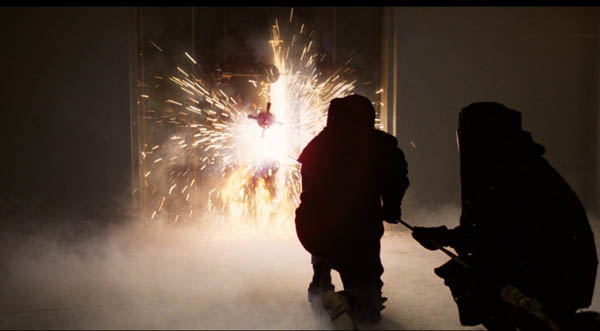
depictions.  Thief begins with a now-famous 9-minute scene in which the
protagonist Frank (James Caan) breaks into a high security vault.  The electronic rhythms and pulses of the
score become almost indistinguishable from the iconic image of the giant drill
that fills the screen, sending sparks flying to bounce off of Frank’s
surprisingly hip looking safety glasses. 
The repetitive rhythms anticipate those that would later emerge in the
Chicago club scene.  Dubbed house music,
this minimal electronic dancefloor sound has become synonymous with techno and
its variants, combining driving beats with stark, industrial sounds uniquely
suited to high-ceilinged dance clubs.  It
is a sound oddly suited to the enigmatic mood struck by Mann’s film, in which
grueling, repetitive tasks become existential rituals in which the protagonist
momentarily defies the forces that would trap him. 

Tangerine Dream’s music is used prominently in three main
sections of the film, first in the tense opening scene, then over the second
major break-in depicted a little over halfway into the picture, and, finally,
in the climactic scene of the film where Frank violently frees himself from
oppressive obligations.  Each of these
major scenes is distinctive for its lack of dialogue and almost total focus on
a particular, grim task.  Taken
individually, they assume a quality that’s hard to disassociate from the music
video, a form that was soon to come into its own with MTV, which began
broadcasting the same year Thief was
released.  Mann himself, as producer of Miami Vice, would play an important role
in extending the vocabulary of this new form by incorporating extended music
sequences into dramatic narratives, accompanied by Jan Hammer’s infinitely
adaptable electronic compositions. 

But the mood of Thief
and its relationship to Tangerine Dream’s music is a much more complicated
affair than the pink and neon night scenes evoked in Miami ViceThief conjures a kind of anti-glamour in
which grim-faced criminals pound heavy metal tools, their faces pouring sweat as
they force their way into seemingly impenetrable steel chambers.  Without a driving soundtrack and incomparably
rich cinematography, these scenes would be an extremely hard sell, but Thief transforms what might easily come
off as arty and boring into gripping cinema. 
Like Mann’s film, Tangerine Dream’s score combines the ethereal and the
meditative with the metallic and the visceral. 
The result is a film in which every element combines in a portrayal of
crime as both act and atmosphere, murder and mood.

Jed Mayer is an Associate Professor of English at the State University of New York, New Paltz.
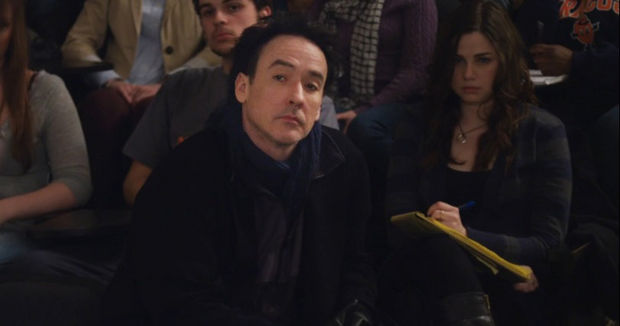
John Cusack in ADULT WORLD: No More Mr. Nice Guy

John Cusack in ADULT WORLD: No More Mr. Nice Guy

null

Several times during his turn as Rat Billings, the grizzled
poet at the heart of Adult World, I wanted to punch John Cusack in the face.
It’s a brilliant performance. In the quirky solar system of odd personalities
making up this tale of a young Syracuse grad who wants desperately to be a
published poet and takes Rat as her guide, Cusack makes an erstwhile and unfriendly
sun: the other characters float around Rat like so many misfit asteroids. While
some aspects of the film have an indie-fied clunk to them, Adult World works beautifully as a sad, sensitive character study,
in which two people who could not be more different find some common ground—even
if that common ground involves hostility. The main story of the film—a young
poet needs money, finds work at a porn store, meets lots of interesting, kind
people, and learns something about herself in the process—seems grossly outshadowed
by the Krazy-Kat-and-Ignatz-style love-hate relationship between Cusack and his
young would-be protégé.

This is a curious film, because the key characteristic that
Cusack has always offered his audience is a certain comfort born of geniality.
His emotional highs and emotional lows are always mitigated by a gentle squint
and a soft, vaguely raspy voice. Even when he is seething with romantic rage as
Rob in High Fidelity, or assassinating people with high efficiency in Grosse Pointe
Blank
, or swindling smoothly in The Grifters, you feel sympathy with him: sure,
he just killed a man, but he must be an okay guy, deep down, right? This feeling
we have might stem not so much from an effort on Cusack’s part to please
audiences as from a certain relaxation with the camera—his tendency to “play
himself” in films has been well-documented. His performance in this film gives
little of the prior sense of comfort. Cusack might well be relaxed in the role,
but it’s what he’s relaxing into that’s
significant. 

Rat is a certain kind of writing professor, whom anyone who
has gone through a writing program might recognize (director Scott Coffey must
have done his research): once proud, once tough and able to toss off bons mots with great ease, now settled
into teaching at a university, not as well-praised, pushing himself through
writing courses, possibly wondering if the whole thing is worth continuing, and
taking it out on his students. When Amy (Emma Roberts), an ambitious young
writer just out of college, forces herself on him in an effort to learn from
him, he literally runs away from her—as he does from his students at the end of
one of his writing classes. When the two of them have their first conversation,
everything about Rat suggests enclosure: the way he folds his arms and legs in
on himself, the pursed frown, and the cold look in his eyes, which he maintains
throughout the film. Rat’s nastiness comes out most interestingly in the
details, the small things he does. At one point, early in their acquaintance,
Rat asks Amy, “Did Leyner put you up to this? Did Mark…?” Although Cusack and
Mark Leyner, author of urbane humor classics Et Tu, Babe, My Cousin, My
Gastroenterologist
, and The Sugar-Frosted Nutsack, among others, are
offscreen friends (they wrote War, Inc. together), mentioning Leyner says a lot
about Rat, or what he once was: a young, cocksure, hip, attitudinal upstart who
drew an audience in the early 1990s through his sarcasm and seeming toughness.
At another moment, after Amy has thrown herself at Rat in a drunken stupor, she
ends up in his lap: he heaves her, without much sentiment, onto a sofa, as if
to show what he really thinks of her. His nastiness comes out in broad strokes
too, of course; as he is about to slam his front door on Amy, he tosses off,
“You’re the kind of muse I’d get,” and she’s thrilled, too naïve to hear the
sarcasm. When he meets Amy’s parents, he confides to her mother that she “lacks
all knowledge.”  When a student in his class
asks if a poem’s interpretation will be “on the test,” he tells her, “You’ll be
tested every day, for the rest of your life, and you know what? You’ll fail.” The
director tries to give Rat some moments of tenderness, at the very end of the
film, but it rings falsely; somehow, for him to call Amy a “stem against the
tide,” after having misled her in various ways which I won’t spoil, isn’t quite
enough.

The film is carried, for the most part, by Cusack’s toned-down
but tuned-in performance, though Coffey’s supporting cast is strong as can be.
Funnily enough, John Cullum and Cloris Leachman play the owners of the porn store that gives the movie its title and gives Amy a job:
Cullum’s most famous role in the last 25 years was as Holling in the TV cult favorite Northern
Exposure
, in which his character married a woman a quarter his age, and Leachman
made a breakthrough performance in The
Last Picture Show
, as a football coach’s wife who cheats on her husband with a
teen-aged Timothy Bottoms. Though there is no romance between Rat and Amy, Coffey seems to nod to its possibility with his casting choices. Evan Peters, as the perky, well-adjusted porn store
manager, may be wildly miscast, but it’s easy to forgive, given the exuberance
and energy he brings to the part. Roberts herself could best be described as
intrepid; she brings as much magnitude as she can to what is, essentially, a
“straight man” role,” that is, playing off of Rat’s jaded, tired, vaguely
poisonous energy. There are many times where the movie’s seams show, where
Coffey hits us over the head with a wanna-be tale of “uplift” and “finding
yourself.” But the most interesting aspect of the film is its significance in
Cusack’s career. This part, along with his performance as convict Hillary in
The Paperboy or Richard Nixon in Lee Daniels’ The Butler, are a long way from his performance as
Lloyd Dobler in Say Anything. It will be enjoyable, if unnerving, to see where Cusack turns
next.

Max Winter is the Editor of Press Play.

THE LEGO MOVIE: Turn Down the Nostalgia

THE LEGO MOVIE: Turn Down the Nostalgia

null

Note: This piece contains spoilers.

The vast majority of Phil Lord & Chris Miller’s new
film, The Lego Movie, is inventive, entertaining, sharply funny, and a
particular combination of total chaos and laser focus that makes for an
extraordinarily enjoyable time at the movies. I expect to revisit these
first 80 minutes or so many times in the future. I hope never again to
be put through the last twenty, which felt more than a little
disingenuous. Though it tries to insist that kids’ toys, games, and
movies should be primarily made for and enjoyed by their target
audience, it ends up being guilty of doing exactly the opposite,
crafting a message more geared for nostalgia-ridden adults. This is more
than just an awkward dramatic structure; this is an ideological
paradox.

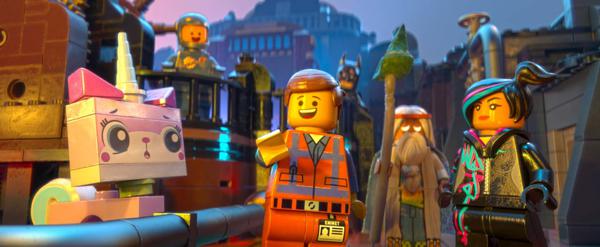
The majority of the film takes place in an animated world,
wherein Emmet (voiced by Chris Pratt), an ordinary construction worker,
is pulled into a sort of revolution. It turns out that Lord Business
(voiced by Will Ferrell) intends to seal up the walls between Lego
“dimensions” (your city, your Wild West town, etc.), but a few “master
builders” are attempting to put a stop to this, and let every Lego
citizen live as they please. Emmet, it turns out, may have stumbled onto
the exact piece they need to seal their victory.

In those final twenty minutes, however, it is revealed, as perhaps
we’d suspected, that the movie takes place quite literally in the
imagination of a child given control over a giant Lego set. All the
wacky imagination and mishmash of cultural icons, geared to a story so
quickly-paced and nonsensical it could only be the product of someone
tapped in closely to the mind of a child? It turns out there’s an
explanation for that – it actually comes from the mind of a child. What
seemed boundless becomes banal, more explicable than exciting, more
Inception than inventive.

As the camera pulls back on Emmet, having dove into what we
believed to be his death, we find him lying on the floor of a
live-action, not animated, set, gazing up at his true master, a young
boy, Finn (Jadon Sand), himself subservient to the actual owner of the
toys – his dad (Will Ferrell, live, in person). The film quickly asserts
that its exploration of the perils of conformity and the unbridled joy
of individual imagination were less a comment on “life in the modern
world,” and much more to do with the conflict that comes when adults try
to retain control on childish things, in the process robbing the very
children around them of their own childhood. Dad is quite agitated to
find Finn at his play set.

It turns out Dad and Finn have had this discussion before. “How
many times have I told you,” he says, indicating the “DO NOT TOUCH”
signs tacked onto every corner of the sprawling world he’s created.
“These are block building sets.” “But we got them at the toy store,”
Finn replies. “They say for ages 7-14.” “That’s just a suggestion,” Dad
insists, reaching for the glue to cement every piece in its proper place,
so that no cowboys ride through  city streets and no spacemen square
off against dragons.

This potent, sadly relevant theme is definitely worth exploring. By
exploring it within The Lego Movie, however, Lord and Miller are
committing the very sin they’re attempting to condemn. Up until the full
revelation of the “real life” world, the film fires on all cylinders,
delivering entertainment and humor that requires no special maturity nor
naivete to enjoy. It’s a true family film. The audience is everyone.
Who is the audience for the finale? Adults, certainly, but perhaps not
even all of them. Those with their own carefully-managed collections of
children’s toys? Those aware that such grown-ups exist? Whatever the
case, it’s not a theme for children: not inappropriate for them, but
rather wildly out of place. The adults have reclaimed the playspace.

What’s more, this coda was entirely unnecessary to relay this
theme. Within the animated world, Lord Business enacts figuratively what
his real-life counterpart is doing literally, concocting a massive plan
to ensure that all the toys stay in their proper place, and that
everything works according to arbitrarily-assigned rules. This meets a
two-tiered challenge, villainizing both corporations that churn out
tedious, expository discussions of films in the guise of
action-adventure and the adults who demand such entertainment and wreck
all the fun. That content is all there for audience members who need it.
Those that don’t—the kids‘—can still enjoy a magnificent motion
picture. Until, that is, they’re forced to endure another abrasively
dull discussion on grand themes built not for them, but for an older
generation attempting to keep the toys all to themselves. Their fun be
damned, this is about something. Just like every other achingly dull
superhero movie.

Scott
Nye is a member of the Online Film Critics Society. His work has
appeared on
RogerEbert.com, Movie Mezzanine, Battleship Pretension,
CriterionCast, and The House Next Door. He maintains a blog at railoftomorrow.com. Follow him on Twitter @railoftomorrow.

METAMERICANA: THE LEGO MOVIE: Metamodernism for Kids

METAMERICANA: THE LEGO MOVIE: Metamodernism for Kids

null


This biweekly column
looks at instances of American film, television, drama, and comedy that
are in some way self-referential—”art about art.” Also discussed is
American metamodernism, a cultural paradigm that uses both fragmentary
and contradictory data to produce new forms of coherence.

Note: This piece contains spoilers.

Unlike modernism and
postmodernism, the first principles of metamodernism are fairly easy to
understand. The basic premise is that we’re constantly caught between opposing
concepts like “knowledge” and “doubt,” “reality” and “unreality,” and “Art” and
“Life”; learning to move quickly between these concepts may be our best hope
yet of regaining a sense of self in the Internet Age. The core message here is
simple enough, in fact so simple that not only could a child pick it up
quickly, it’s arguably children who understand the metamodern “cultural
paradigm” better than anyone. Children, unlike their parents, move more or less
seamlessly from the realm of fantasy to the aggressive insistence of
reality. In fact, they daily face the prospect of having the things they think
they know undermined by their elders. And while we don’t often associate
childhood with High Art, certainly the most popular child’s toy in human
history—Lego building blocks—is designed to let children forget their often
restrictive lives for a while and bask, instead, in their own limitless
ingenuity. Legos may or may not constitute building blocks for art, but if you’ve
ever seen a child (or even an “AFOL,” an Adult Fan of Lego) mucking about with them,
it’s hard to tell the difference between transient play and committed artistry.
Which is exactly the point The Lego Movie wants to make to kids and
adults alike: It’s okay not to know where to put things, or to put things in a
place they don’t seem to belong, or to let your imagination outstrip your
common sense. It’s equal parts a simple message of empowerment for kids and one
sophisticated enough to deserve the adjective “metamodern,” making The Lego
Movie
the first unabashedly metamodern children’s film in Hollywood
history.

In The Lego Movie—a
film that combines actual Lego models, stop-motion animation, and (to a much
greater extent) high-quality CG animation—an ordinary Lego minifigure of no
great distinction, Emmet, learns that he alone has the means to stop the evil
Lord Business from gluing together all the building blocks that comprise his
universe. The metaphor is, at first blush, a pretty obvious one: Lord Business
(Will Ferrell) wants to end dynamism of all kinds, including creativity, in
order to better control all aspects of Lego (and, metaphorically, human)
existence. As instruments for his nefarious scheme, Lord Business uses
“micromanagers,” giant robotic Lego constructions whose literal purpose mirrors
the emotional work so many human adults engage in every day: meticulously
arranging existential elements whose native state is wild, unruly, and
wonderful. Certainly, it’s no secret that much of what makes living worthwhile—the
many forms of love; the many forms of courage; the boundlessness of creativity—makes
little sense when we subject it to the petty prescriptions of micromanagement.

What’s most striking
about The Lego Movie, however, putting aside the colorfulness and
frenetic whirl of the film’s terrific action sequences, is how often one spots
strange “glitches” in this superlative but otherwise predictable children’s
film. Certain lines of dialogue seem oddly childish; certain Lego constructions
in the film seem peculiarly inept (perhaps because Lego ran contests permitting
fans to submit designs for the movie); on occasion the sound effects seem to be
produced by a child, rather than a computer; and certain elements of Emmet’s
world are clearly non-Lego (e.g., a battery, a band-aid, an X-ACTO knife, and
the mega-weapon Lord Business plans to usher in the Apocalypse with, Krazy
Glue). In fact, much of the humor of The Lego Movie—and there’s quite a
lot of it—can be described as a persistent “badness” children are likely to
miss because it matches their sensibilities, and adults are incapable of
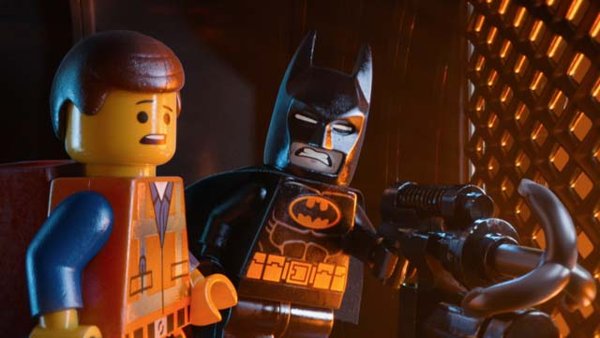
missing because it so offends theirs. At one point, Batman (Will Arnett) sings
for the assembled team of anti-Business “Master Builders” a theme song
that he’s written for himself. These
are those lyrics (verbatim):

Yes,
this is real music. Dark. Brooding. Important. Ground-breaking. Check out the
lyrics: ‘Darkness! No parents! Continued darkness!’ (More darkness, get it!) ‘The
opposite of light! Black hole! Curtains drawn! In the basement, middle of the
night, blacked-out windows! Other places that are dark! Black suit! Black
coffee!’ (You get it; that’s just the first verse.) ‘Darkness! No parents!
Super-rich! Kind of makes it better…’

Not only is this song
“meta” in the conventional sense—it’s a theme song that foregrounds its own
writing process—it’s also just the sort of stream-of-consciousness
semi-nonsense that a child might make up, so hearing it from the mouth of the
self-serious Batman is more or less instant comedy. But this self-referentiality
is hardly limited to Arnett’s Batman; in fact, it is a trait of many of the film’s
characters and scenarios. Emmet gives uncomfortably detailed descriptions of
his own personal qualities; lead female Lego “Wyldstyle” (Elizabeth Banks) has
a name so preposterously self-conscious that its irksome fakeness is constantly
being remarked upon by other characters; Morgan Freeman’s Gandalf-like
Vitruvius veers wildly from Morgan Freeman in Glory to a ten year-old
version of Morgan Freeman to a wise-cracking take on Morgan Freeman playing God
(literally) in Bruce Almighty

Freeman’s Vitruvius
is perhaps the best example of the film’s revealing peculiarities. Early
on, the character’s eyes begin glowing as he recites a prophecy that
purportedly heralds Emmet’s heroism. However, this physical manifestation of
authenticity is undercut by the fact that the Prophecy’s language contains a
unambiguous concession that it’s all made-up nonsense. According to the
language of the Prophecy itself, the Prophecy must be true “because it rhymes”—a
line Vitruvius recites as though he’s just made it up. So what should we
believe, our eyes or our ears? Later, Vitruvius is the subject of one of those
cinematic shots
in which a character leans into the frame from off-screen to address a comedic
quip to the camera; the oddity here is that as soon as Freeman’s bearded sage
begins leaning, the camera shifts to a different perspective, from which
perspective the character’s posture  looks artificial and unnecessary. Later still,
when Vitruvius “dies,” he appears—for the first time—with a string wrapped
around his waist to help him “fly,” even though he’d previously done more or
less the equivalent without such an aid. In other words, one never feels
entirely certain what Vitruvius is supposed to be, even in moments of dramatic
tension that normally would call for stability of character.

The divide between
sincerity and irony is also critical to metamodernism, and oscillation between
those two poles is everywhere in The Lego Movie. The film’s main theme,
“Everything Is Awesome” (performed by sister duo Tegan & Sara), concludes
with a lengthy rap by The Lonely Island (Andy Samberg, Jorma Taccone, and Akiva
Schaffer) that features the following lyrics (video here
):

Life
is good, ‘cause everything’s awesome!

Lost
my job, it’s a new opportunity—

more
free time for my awesome community!

Stepped
in mud, got new brown shoes:

It’s
awesome to win, it’s awesome to lose!

Blue
skies, bouncy springs, we just named

two
awesome things!

A
Nobel Prize, a piece of string,

you
know what’s awesome? Everything!

Everything
you see, think, or say is awesome!

In the pre-metamodern
world, these lyrics would be immediately (and rightly) received as ironic.
These days, not so much. In fact, it’s impossible to tell whether the
exuberance behind the song above is real or feigned, as it’s simultaneously the
anthem for a repressive totalitarian state run by Lord Business and an
unbearably catchy, optimistic tune the high-spirited Emmet continues to enjoy
even after its sinister intentions are revealed.

All in all, the film’s
inconsistencies feel like those a child would impose on his own play—which, we
soon discover, is exactly what they are. The Lego Movie is, it turns
out, a movie within a movie within a movie, inasmuch as the “frame” for the
film is a live-action sequence whose lead character (“Finn,” played by Jadon
Sand) is purportedly creating all the scenarios that comprise the film. This
tidy bit of metanarrative is complicated by the fact that the characters of the
film-within-a-film repeatedly act in ways Finn clearly does not control.
For instance, once Emmet has been tossed out of his carefully constructed Lego
world and into our “real” world, we still see him acting in an animated fashion
that’s undoubtedly not the product of Finn’s imagination. In one devilishly
creepy moment, Emmet—at this point supposedly an inert, “actual” Lego
minifigure—flops about on a table in order to escape the machinations of Will
Ferrell (now playing, as himself, The Man Upstairs, Finn’s father). It’s all
pretty heady stuff for a kids’ flick.

The
Lego Movie

treats knowledge, reality, and creativity as being so interchangeable with
ignorance, fantasy, and autobiography that the entire film exists in a
metamodern space that’s simultaneously all and none of these things. The fact
that, for perhaps the first time in movie history, children who see a film can
go out after the final credits roll and purchase the exact objects that
appeared in the movie (not recreations, but the same Lego sets that were used
on screen) makes this a movie within a movie within a movie within a movie.
That is, given that the movie implicitly urges children to purchase toys that
emphasize the movie’s own artificiality and reproducibility—the script, as
noted, is really just audio from a child’s play session—means that any child
who sees The Lego Movie can become the director of his or her own
similar (or even identical) film.

But The Lego Movie—arguably,
as we’re seeing, the most cerebral children’s film yet produced—doesn’t stop
there. Superimposed over many of the shots in the film are the identification
numbers for individual Lego pieces, data few children are likely to know or
understand but which are common currency in the world of AFOLs and real-life
“Master Builders” (the term for those Lego employees who design and build the
Danish company’s intricate sets). What this suggests is that, even as the film
instructs children and adults alike on how important it is to deviate from
life’s many implicit and explicit “instructions,” the people who make Legos are
also using the film as a paean to their own love of the ubiquitous building
blocks. This is a paradox of sorts, as Lego’s Master Builders are tasked with
putting together the very instruction manuals the movie hints are a source of
evil—including, in a vicious twist, the instruction manuals that tell children
how to make the sets from the movie that were (in movie terms) explicitly
made without instructions.
So we see in the thematic strokes of The Lego
Movie
a yearning for freedom that the film’s developers might well have
been directing not merely at themselves but also their employers. Does that
make this a movie within a movie within a movie within a movie within a movie?
I don’t know. But certainly, the fact that the very same Lego folks who are
spoken to directly by the film’s thematic through-lines had to later design the
allegedly hodge-podge Lego constructions that appeared in the movie means that
the ending of The Lego Movie is finally an unhappy one: it
seems there’s no escape from Art when you choose (as Lego Master Builders do)
to make Art your Life.

In the years to come,
devoted metamodernists will surely come to regard The Lego Movie as one
of the most intricate renderings of metamodernism ever brought to the silver
screen. I just came from seeing the film, and find myself very much enmeshed in
a metamodern state: I don’t know what in this movie is “real” (that is,
depending upon how you look at it, created with deliberation by Lego Master
Builders, or created on the spot by Finn’s play session, another child’s play
session, or the childlike improvisation of clever adults like Will Arnett) and
what is “unreal” (that is, depending upon how you look at it, the product of
some “magic” inherent in the Lego characters depicted by the film, or the
product of a screenwriting creativity that’s adult enough to include
information neither Finn nor any child could possibly be expected to know). In
other words, I find myself, post-Lego Movie, in exactly the same
position as the young moviegoers to whom this movie is presumptively targeted.
And isn’t feeling like a kid again exactly the sort of sentiment children’s
films are supposed to invoke?

{NB:
On February 3rd, it was announced that a sequel to The Lego Movie is already in
development.}

Seth Abramson is the author of three collections of poetry, most recently Thievery (University of Akron Press, 2013). He has published work in numerous magazines and anthologies, including Best New Poets, American Poetry Review, Boston Review, New American Writing, Colorado Review, Denver Quarterly, and The Southern Review.
A graduate of Dartmouth College, Harvard Law School, and the Iowa
Writers’ Workshop, he was a public defender from 2001 to 2007 and is
presently a doctoral candidate in English Literature at University of
Wisconsin-Madison. He runs a contemporary poetry review series for
The Huffington Post and has covered graduate creative writing programs for Poets & Writers magazine since 2008.

On THE BLACKLIST: Why James Spader Is the Perfect Star for the Increasingly Unreal Medium of Television

On THE BLACKLIST: James Spader Is the Perfect Star for the Increasingly Unreal Medium of Television

null

The television medium, and the act of watching television,
have always been remarkably surreal, and they only grow more so by the day. The
very action of sitting and watching flickering pixels on a screen which, in
most cases, is smaller than you are stands in direct contradiction to
everything we might call living,
enjoyable and stimulating as this non-life might be. For many viewers, it requires absorption;
for other viewers, it requires absorption and darkness; for still others, it
requires absorption, darkness, and complete silence.   As time has passed, TV has only become more
strange, and private; at one time, the screen formed the hub of a gathering
place, but it is less so now, as increasing numbers of people watch television
on their own terms: on their phones, on their computer screens, at off –hours,
while commuting. The idea of scheduling one’s day around a TV show is
increasingly uncommon. Given these developments, it stands to reason that James
Spader, a shocking presence on The
Practice
and Boston Legal in the
past, and a rousing presence in NBC’s The
Blacklist
, would be its ideal actor.

The reasons why Spader is so appropriate for television have
to do both with his qualities as an actor and, actually, with the history of
television itself, in the last 25 to 30 years. Spader’s arrival in his first
major TV role, that of Alan Shore on The
Practice
, was not universally well-received at its outset. Why was this?
Well, because his film roles in the past had often contained a healthy layer of
sexuality—and often warped sexuality. The three most glaring examples of this
would be his remarkable breakthrough performance in
Steven Soderbergh’s sex, lies, and
videotape
, in which he filmed women talking about sex (and doing other
stuff) and then pleasured himself to videotapes of the sessions, giving an empathetic face to the perversity of voyeurism; his role as James
Ballard in David Cronenberg’s Crash,
including a sex scene with a scar in a woman’s leg; and Steven Shainberg’s Secretary, in which his officious lawyer Mr. Grey “got to know” his employee by masturbating
on her panties as she bent over his desk, skirt up. What was this man doing in
a fairly nondescript show about a law firm? Everything and nothing. At the
time, it seemed fairly clear that he had been added to boost ratings and make
the show more exciting; he did both, in spades. His character’s open-faced form
of brazen dishonesty gave considerable texture to a show which was gradually
building a wall around itself consisting entirely of predictable plots (the
same rut which some of Law and Order’s
variants have fallen into). His great comfort with sleaziness and with
destructive transgressions provided a meaningful satire of the nature of the
law profession and of the hidden altruism within many shows about that
profession, in which show’s characters become heroes by making the “right”
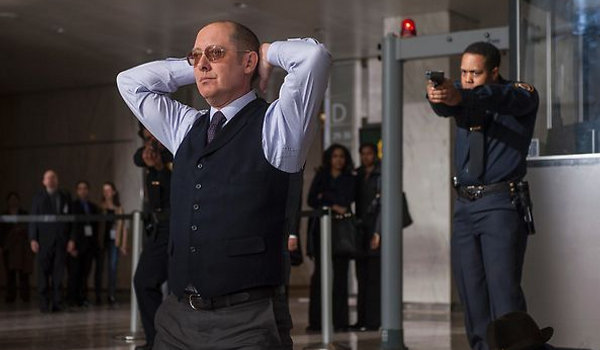
choice. He has roughly the same role in The
Blacklist
’s Raymond “Red” Reddington, a “most wanted” criminal whose wealth
of information makes him ultimately indispensable to his pursuers, and he plays
it with the same aggressively insouciant quality, as if every line he speaks is
not only the best line ever written for a television actor but is also the most
explosive; and the more dramatically he speaks the line, the more of a detonation it sets off.
In a sense, Spader’s delivery is like that of an old-fashioned stage actor,
speaking to an audience who may or may not absorb what he is saying. The
simplest exchanges become broad-voiced utterances; whether you understand the
motivation for the line becomes secondary importance—the main thing is the
momentously frank delivery. And so, in pushing himself outwards in this
theatrical way, isn’t Spader fulfilling the earliest dream of television,
which was to provide a home-based version of the theatrical experience?

But, back to the present. Spader is occupying, with unusual
elan, a historical moment in TV watching and reception: he is with us as TV
becomes an almost entirely private personal phenomenon, in which viewers
develop relationships with characters and plotlines that they cannot quite
shake, sometimes to an almost humorous degree, and in which viewers choose
which shows they wish to watch at length—and at how much length. It is indeed
significant, then, that Spader’s breakout role, his turn as bully Steff in Pretty in Pink notwithstanding, was in sex, lies and videotape, a film about a
man who derives his sole sexual pleasure from watching images on a TV screen,
after the fact, in total solitude and at his command. Fast forward 25 years: many
viewers these days watch television long after its air date, and with utter
control over the conditions of viewership. In 1989, when the film was released,
the VCR, as we know it in its home-friendly form, was less than 10 years old,
and rapidly gaining in popularity. By starring in such a film, Spader
associated himself indelibly with what has become a dominant mode of
viewership: what I want, when I want it. The binge watch. The repeat view. TV
shows ranging from Moonlighting to St. Elsewhere to (even) Mystery Science Theater 3000 nudged us,
at this time, towards a smarter view of what we were seeing on the screen:
couldn’t we view a multi-episode TV show as a kind of novel? Couldn’t we expect more from
television? It’s hard to think that that the development of VCR capability, giving viewers the chance to re-watch and scrutinize certain shows,
didn’t contribute to this change. Granted, the tapes Spader’s character was
watching in Soderbergh’s film were not the VHS tapes we might be familiar with,
but the impulse was the same.

Of course, The
Blacklist
is not necessarily the best vehicle for Spader. The episodic
nature of the show guarantees that viewers will not devour it in the same way
they devour more intellectually complex shows like Breaking Bad or The Wire.
Also, each episode is built around a different number on the FBI’s Most Wanted
list; these figures become much like the villains in comic strips, or their TV
counterparts. Each villain is neatly tracked down by the end of each episode each mystery resolved. Nevertheless, Spader’s presence, and his history, and his delivery—which constantly seems to look back at us as if to ask, If you think you’re above this, why are you watching it?—raise a
question about television, which, though it may have been raised before, can’t
be asked enough. As television continues to become more nuanced and
intellectually demanding, its approach, and its casts, will need to change.
Spader is unique in that he doesn’t give in to the demands of acting for a
smaller screen—the pandering, the mincing, the mugging; the charge we receive
from him is based on his staunch defiance of those requirements. Perhaps his
performance will draw some new colleagues in the future, from a place in which
the screen is brighter and larger, and the audience is darker and more
mysterious.

Max Winter is the Editor of Press Play.

Choose Your Own Adventure: The Allens, the Farrows, and You

Choose Your Own Adventure: The Allens, the Farrows, and You

null

When I was a teenager, I worshipped Woody Allen to an
unhealthy degree. I think, at some particularly unfortunate point, I might have
even dressed like him. To me, and I’m thinking to others, he represented three
things: urbanity and sophistication; a wit born of erudition; and the
possibility that one might, without an excess of good looks or distended
musculature, attract the opposite sex—through the sheer force of words. When it
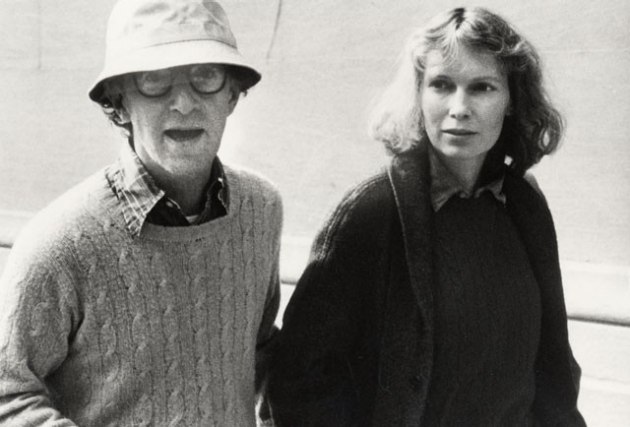
was revealed that Allen had left Mia Farrow for his daughter/non-daughter,
Soon-Yi Previn, I tried hard to be objective about him, as a figure, but my
grasp of the reality of what one should and shouldn’t do in any human
relationship, combined with the decline in quality of his films after that
revelation, made it difficult to take him seriously, although I continue to
rank Annie Hall, Hannah and Her Sisters,
Husbands and Wives
, and Crimes and
Misdemeanors
among the greatest films of all time (it’s a long list). The
recent unearthing and re-unearthing of allegations that he molested 7-year-old Dylan
Farrow have provoked reams of commentary, consideration, and investigation into
his life, and specifically his life with Mia Farrow and her numerous children. This
fermenting, for lack of a better word, has been disappointing, not so much
because no conclusion has been reached (there isn’t one), but because of a lack
of overview, the inability of those commenting on the scenario to distance
themselves from it, or what it might mean to them, personally. What has resulted from the feverish reaction to these
decades-old events is a gradual tying of our hands, across the board, so that
to even consider the controversy is akin to opening a Choose Your Own Adventure
book, in which the judgment you might make, in whatever public forum, suggests that you possess a particular set
of characteristics—and, as in the books, you can’t make two judgments at once,
just as you can’t read two stories at once.

The problem is mainly one of tone. The words commonly used
to describe Allen at this point—monster, creep, wouldn’t want him alone with my
children, perverted—are not the words one uses when thinking clearly. Granted,
the circumstances don’t allow for too much clear thought—the actions described,
toy train, attic, and all, are horrific. It would be difficult for anyone to
react with equipoise to testimony on such events, real or imagined.
Nevertheless, what happens when public sentiment is stirred, across blogs,
comment boxes, newspapers, and telephone waves, is that a sort of brushfire
starts. If the fire grows too bright, it either subsumes other opinions or
whittles them down, makes them look black and vaguely evil. To suggest, as many
have, sentiments along the lines of “we’ll never know what happened” is to, in
many cases, add a parenthetical “(but we kind of do know).” To shrug about it
becomes, in a sense, a concession to the truth of What Is Written. Suggestions
that Dylan Farrow made up her allegations, her memories having been molded by
her mother’s coaching, end up sounding rather creepy beside the bold and righteous,
“He’s a criminal. He should pay.” A Daily Beast essay by Robert Wiede on the
matter, asserting that the allegations were false, was denounced by Jessica
Winter at Slate as “smarmy,” while Wiede’s tone wasn’t necessarily more or less
hostile than Farrow’s.

But indeed, what of the tone of the father and daughter
involved here? Their poorly written testimonies haven’t helped, speaking more
to deep-rooted rage than anything else. Oddly, the epistles (that’s what they are, really) share a tone,
one of aggression, of pots boiled over, much like the tone of some of Allen’s
most poignant filmic moments. Allen has his “Soon-Yi and I made
countless attempts to see Dylan but Mia blocked them all, spitefully knowing
how much we both loved her but totally indifferent to the pain and damage she
was causing the little girl merely to appease her own vindictiveness” or
“Again, I want to call attention to the integrity and honesty of a person who
conducts her life like that,” while Farrow has her “So imagine your
seven-year-old daughter being led into an attic by Woody Allen” or her “I have
a mother who found within herself a well of fortitude that saved us from the
chaos a predator brought into our home.” Allen finds himself the victim of
serious accusations, while Farrow finds herself the victim of both abuse and
patriarchal oppression following that abuse, making it hard for her to speak up.
Their public records, as it were, are powder kegs, bombs thrown into a movie
house, ultimately dangerous and corrosive, for all of their seeming liberation.
Farrow makes a strange gesture in offering a statement which can neither be
proved nor disproved; Allen makes a strange response in deferring to logic
rather than facts, as in his statement that it makes no sense that he would
molest someone at such a tempestuous time in his relations with Farrow’s
mother. The two statements cancel each other out, neither one more convincing
than the other, really. It’s a loaded spat, close to after-dinner theater—but
any popcorn you might throw has already been thrown. Just check the blogs, the
comment boxes and the social media.

What if the story here is entirely
different from a tale of abuse of power, or a fable about the importance of
speaking up about abuse? What if the story unfolding now points backwards, to the
reasons we enter relationships, and how we need to think those reasons over
carefully? Allen, at the time of the beginning of his relationship with Farrow,
gravitated towards women who did not outshine him, most notably Diane Keaton,
who, comic chops aside, relies on self-effacement for her comedy and will never
have the cultural stature Allen has. Farrow fits this mold as well: a tremendous
talent whose screen presence, at least at the time she met Allen, was never
overwhelming, and who, for all intents and purposes, is no longer an actress.
Farrow, on the other hand, was attracted to powerful men, like, say, Frank
Sinatra, or Andre Previn, men who dwarfed her, in a professional sense. In
becoming involved with Allen, it would seem, she wanted more of the same. And
yet: Allen publicly acknowledged his sexual deviance, both in print and in
other ways too obvious to even refer to directly; Farrow liked to care for
children, often children weakened by disability or poverty. They gravitated
towards each other because they each had something the other wanted, and yet
neither need could sustain a loving relationship. Each chose an adventure, and
unfortunately, their adventures collided somewhere near the end of the book.
The result? Pain that has pursued the family for 20 years. In creating a household together, they ultimately harmed themselves, and those around them, in small and vast ways. And in choosing to
side with one person rather than the other, to say “he done it,” or “she done
it,” we limit ourselves. The harder choice for us, as thinking people who live
in a society that loves celebrities, would be to recognize how different these
celebrities are from us, and to try to glean what wisdom we can from their
repeated, grave errors.

Max Winter is the Editor of Press Play.

The Shame of Pageantry: The 2014 Sochi Winter Olympics Opening Ceremony

The Shame of Pageantry: The 2014 Sochi Winter Olympics Opening Ceremony

null

I’m deeply offended by opulence.
I think people who eat three meals a day are showing off. I don’t understand
expensive watches. If I was ever talked into getting married, diamonds would
not be involved. Nor would ceremony. There would be no cake. I drive a ‘99 Ford
Taurus that doesn’t have any heat, which to me is a little showy. I have two
pairs of shoes and two pairs of jeans, but I’m shy about admitting to my
spending on such extravagances. You can only imagine what it was like for me to
watch the opening ceremonies of the Sochi Winter Olympic Games.

Sport revels in pageantry: The
uniforms, the mascots, the musical interludes, the coronation of heroes, the
parades of celebration, retiring numbers to the rafters. When competition is on
an international level, that pageantry marries jingoism, and we’re left with a
cartoonish representation of who we are as people, where we come from, and what
role sport plays in our lives. When a country like Russia, once proud, still
proud, with some post-Cold War self-esteem issues, is awarded an Olympic games,
we would be left to expect unmatched, unfettered, unapologetic pageantry.

“Welcome to the centre of
the universe!”

And so began the Games. Russian
TV star Yana Churikova shouted the phrase among swirling crescendos of
Tchaikovsky and t.A.T.u., and what followed was so opulent it would make a
royal wedding blush. Next came a strange mix of historic documentary and dance,
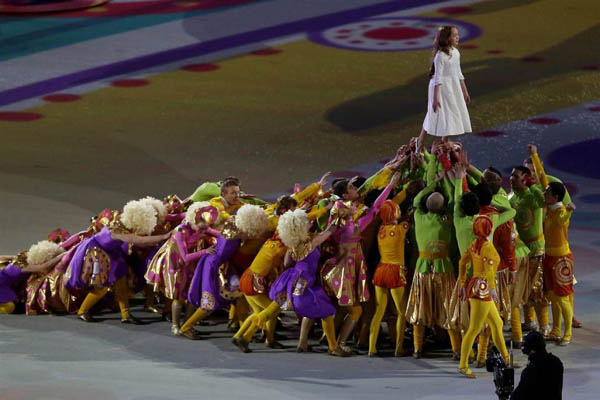
children dressed like Disney extras, a fair amount of hammering, a dash of sickling,
lots of Cyrillic, and more children in bright colors. I’m not a opening
ceremonies aficionado, but I expect they’re all like this to some extent. By “like this,” I mean horribly self-indulgent, and kind of offensive.

Once the entire history of Russia
was summarized (and somehow without the use of matryoshka dolls) over the
course of 20 minutes that felt like six or seven days, the countries paraded
into the stadium. Each country was dressed either as the most offensive
caricature of their nation, or a second year design student whose work is
informed by Selena Gomez and the explosive nature of Pop Rocks. The Canadians
were dressed as Mounties, of course, after the original plan to dress them as
polite hockey players with universal healthcare didn’t come to realization. The
Swedes were straight from Ikea, the Japanese from anime. The Chinese were
stoic. The Jamaicans danced to Bob Marley’s “Three Little Birds,” though the
music may have only been playing in my head. Some country where it hasn’t
snowed since ground brontosaurus was its biggest export paraded its only
participant, all smiles and no expectation. The US team’s outfits looked like
the July Fourth section at Target exploded. It was all quite awful.

For a moment I may have blacked
out, endured a seizure brought on by excessive flashing and excessive, well,
excess. When I tuned back in Hall of Fame goaltender Vladislav Tretiak and a
petite woman who Paul Henderson never scored on were taking the Olympic torch
on its last jog, lighting the flame that will burn for the duration of the
games. That’s right: this isn’t just a $52 billion dollar outdoor Wiggles
concert. There’s some sporting to be done.

Unfortunately, in these games,
the sport takes back seat to both the opulence of the endeavor, and the intolerant
oligarchy of its host. Already LGBTQ rights protestors have been arrested
before a puck has dropped, a skate laced, a luge luged. Dutch snowboarder
Cheryl Maas raised a rainbow glove palm to the camera after competition. Maas,
one of only six openly gay Olympians, is now the answer to the question: Who
was the first Sochi Olympian to protest Russia’s archaic anti-gay legislation
during the 2014 Games? And I suppose in that answer lies my larger frustration
with the opening ceremonies. I kept waiting to spot a small rainbow flag or a
You Can Play logo, anything from the athletes showing solidarity and support
for a community that is being oppressed by the country that is providing those
athletes with the grand stage for what they hope will be their finest hours.

But there were no flags. And
there was no support. Except for rainbow Greek mittens and pseudo-rainbow
German jackets, neither acknowledged by their nations as potest, but rather
happenstance. And if we’re looking to the Greeks and Germans as the voices of
reason, we’re all in trouble. And two countries. Just two. And not the one I
call home.

Within the maelstrom of opulent
noise, indulgent sheen, and radiant jingoism, there was the alarming dichotomy
of quiet.

I understand it is not the
responsibility of Olympians to make political stands. I understand it, but I
don’t agree with it. Olympians are there carrying my passport, wearing my flag,
representing my home. With that comes the great responsibility of carrying our
moral authority, our righteous indignation, our commitment to a tolerant world,
an inclusive world. This, to me, is the very purpose of the Olympics. Its
essence. Nations, people coming together in a search not just for personal
glory, but vicarious glory, and a glory that is filtered through the prism of
nationality.

These Games will come and go.
Heroes will be found. Stories written to be forever told. My hope is that they
are a safe Games, but also a Games where the opulence of its host, the shame of
pageantry over substance, is punished by fearless voices. The opening
ceremonies tried to tell the story of Russia, a story that currently finds a
strained narrative, with the whole world there to watch, wait, and wonder if
this is not the moment where morality and bravery trump opulence. Where a voice
will take the opportunity not to just revel in pageantry, but to use it to
celebrate a larger purpose.

Mike Spry is a writer, editor, and columnist who has written for The
Toronto Star, Maisonneuve, and The Smoking Jacket, among
others, and contributes to MTV’s
 PLAY
with AJ
. He is the author of the poetry collection JACK (Snare
Books, 2008), the short story collection
Distillery Songs (Insomniac Press,
2011), and the co-author of
Cheap Throat: The Diary of a Locked-Out
Hockey Player
(Found Press,
2013). His next poetry collection,
Bourbon & Eventide, is forthcoming in 2014
from Invisible Publishing. Follow him on Twitter
@mdspry.

VIDEO ESSAY: Women in the Works of Martin Scorsese

VIDEO ESSAY: Women in the Works of Martin Scorsese

The first time I saw After
Hours
(the first of 9 or 10), I was 15, and I had no idea who Martin
Scorsese was, or even that he had directed the movie. I saw it in a shopping
mall in north Dallas, an unlikely place, perhaps. I was surprised, as a 15-year-old boy, to discover a
man had directed it; I had assumed it was directed by a woman.
Why? Because women ruled the show. The female characters in the film—Catherine
O’Hara’s manipulative Samaritan, Rosanna Arquette’s vulnerable and elusive
temptress, Linda Fiorentino’s frequently topless sculptor, Teri Garr’s
threatening sociopath with a beehive—lorded it over the men. Who represents
“the stronger sex” in this film? Griffin Dunne’s hapless wanderer, John Heard’s
sad-sack bartender, and, two pieces de
resistance
, Cheech and Chong’s local burglars. The film chronicles a trip
into the New York demimonde, as such a place ruled by women. And how does the
journey end? Dunne is sealed in a plaster statue—by a woman. He manages to
break free, but still. Such it is with many of Scorsese’s films: while we
cannot call these works matriarchal, by any means, in the struggle between men
and women, everyone gets punished. No one comes out on top. Scorsese rolls out
dramas for us to behold, in which men act badly towards women, women are
aggrieved, men charge off in a cloud of exhaust, and there is no indication that
the director, in the background, has chosen a side.

And so it is with many of Scorsese’s films. When Lorraine
Bracco’s Karen chews out Ray Liotta’s Henry Hill for standing her up in Goodfellas, she doesn’t do it privately:
she does it publicly, in front of a rapt crowd, the most rapt audience member
being Hill himself, half-smiling as his future wife screams at him. Even the
ever-so-famous restaurant tracking shot, in which Hill leads his girlfriend
into a mobster-hangout restaurant through the back way, showing his knowledge
of the place off to her and then showing her off to his friends, presents as a
grand, performative display, too over-the-top to be believable as anything but
a subtle critique of the way men may place women on pedestals in an effort to
cripple them. In Scorsese’s films, this doesn’t work, or at least not smoothly;
most of the men in Goodfellas,
indeed, end up either dead or emasculated. Scorsese pulls an even grander stunt
in Taxi Driver; the two main female
characters in the film, Jodie Foster’s teen prostitute and Cybill Shepard’s politician,
serve little other purpose than to cast Travis Bickle’s tremendous personality
problems into relief. He views these women as icons of purity, figures of worship,
points of escape—but in reality his interactions with them only drive him
further downwards by reminding him of how far upwards he has to climb.

And yet throughout these films, Scorsese watches: he does
not opinionate. In one of the most seemingly humiliating scenes from Wolf of Wall Street, a woman is covered
in money, quite literally, but she notably remains standing and even banters
with her sleazy Wall Street assailants during the process. When DiCaprio’s
Belfort dares his wife to throw a glass of water on him, the moment is
near-comic: Belfort is scared, genuinely scared, of a glass of water. Could he,
despite his success, be powerless in this arena, in some sense? Yes, he could. And
when his wife states that the skirtage around the house is going to be “really
short” after a heated argument, it’s no joke, rather a statement of power, an
assertion of privilege.

Regardless of how raffish, aggressive, or un-controlled
Scorsese’s characters may be at times (and Wolf
of Wall Street
has come under heavy criticism for just this quality), his
dramas take place on a grand scale, in which largeness is the point. When
Sharon Stone’s Ginger struts through Casino, she knows all eyes are on her, and
Scorsese knows it, too, and yet his camera is not objectifying her: he’s
showing our objectification to us. Her collapse, similarly, is immense, and
theatrical, and threatens to swallow the movie at moments—and yet this fall
from grace is a stage in a story, not a stage in a director’s thought process.
It is appropriate that the film that put Scorsese on the map, or at least
pushed him towards it, was Alice Doesn’t
Live Here Anymore
, the tale of a woman’s slow journey towards self-respect. Viewed this way, historically, we come to a surprising conclusion: that a man whose films have largely been about a male-dominated world might have been showing us that world only to reflect women’s views of it.

Nelson Carvajal is an independent digital filmmaker, writer and content
creator based out of Chicago, Illinois. His digital short films usually
contain appropriated content and have screened at such venues as the
London Underground Film Festival. Carvajal runs a blog called FREE CINEMA NOW
which boasts the tagline: “Liberating Independent Film And Video From A
Prehistoric Value System.” You can follow Nelson on Twitter
here.

Max Winter is the Editor of Press Play.

The Art of Unease: Philip Seymour Hoffman

The Art of Unease: Philip Seymour Hoffman

nullIt takes a special talent to make us uncomfortable. Inundated with obnoxious reality television,
sensationalistic twenty-four hour news coverage, and a film culture that grows
louder and brasher by the day, it is all the more remarkable when an actor is
able to unsettle us.  Philip Seymour
Hoffman had this talent in an abundance that verged on the indecent. That he was also one of the most subtle
actors of the twenty-first century seems paradoxical, until we realize that
only by stealth and imagination could someone manage to catch a jaded viewer
off-guard.

I was first caught off-guard by Hoffman in his small but
crucial role as Scotty J. in Boogie
Nights
. The first appearance of this
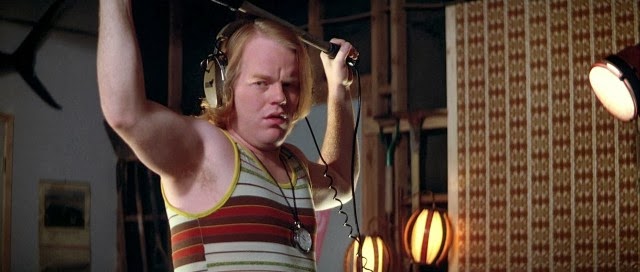
awkward, chubby, blindingly pale presence, nervously chewing on a pen as his
belly hung out from under his childishly bright t-shirt, instantly defined this
odd but sympathetic character. When he
comes on to Dirk Diggler, I cringed in anticipation of a violent rebuff.  But Diggler turns him away with a firmness
tempered by kindness, and somehow this makes the scene all the more painful and
awkward. What follows is to me one of
the most memorable moments in contemporary film, when Hoffman’s character
crumbles into self-loathing, repeating “I’m a fucking idiot!” while sobbing
pitiably. Director Paul Thomas Anderson
lets this go on for a disturbingly long time, until Hoffman’s performance
begins to verge on self-parody. I
remember the audience starting to laugh, then going silent, then laughing
again, uncomfortable, not knowing how we were supposed to react. In subsequent years Hoffman would take us to
this unsettling place, over and over again.

Hoffman never gave a bad performance: I can’t imagine any
other actor of whom one can say this without hyperbole. More importantly, though, he never gave a
performance that was anything less than fascinating. Every time he took on a new role, it felt
like he was reinventing the art of acting itself. The characters he created were never people
you could relate to: they were wildly imaginative creations that made you think
about human beings differently. Who else
could have created the heavy-breathing compulsive masturbator of Happiness, and who else could have made
him a (sort of) sympathetic character? It’s that “sort of” that was Hoffman’s
unique gift: all his characters, however minor, filled the screen, but there
was always something elusive, furtive about them. Even the kindly hospice caregiver in Magnolia is imbued with a certain
strangeness, his saintly self-effacement before Jason Robards’ meanness verging
on the masochistic. 

Finding a character’s motivation is central to the practice
of acting, but Hoffman’s unique talent was for hiding that motivation from the
viewer. What drives The Master? Why is Dean
Trumbell so obsessed with taking revenge in Punch
Drunk Love
? How does Capote feel
about Perry Smith? This furtiveness is what makes his performance in Doubt such compelling viewing; doubt, uncertainty, unease was what Hoffman did best. Even at his most brash, as in his brilliant
creation of Freddy in The Talented Mr.
Ripley
, he turns what could have been a caricature of an obnoxious society
boy into a study in psychological complexity. Yet while Hoffman was always unerringly precise, he never seemed
studied. Each new creation seemed
effortless, and that was part of what made his characters so marvelously
strange. 

It will be hard not to think of the tragic circumstances of
his death as we go back and watch the wealth of astonishing performances he
left us, but I hope we can let his characters lead their own, peculiar lives,
without Hoffman’s biography intruding on them. What made Hoffman utterly unique was his imagination, and like the
creations of a great novelist, his characters will continue to lead their unfathomable
lives, a little beyond our reach. Though
it is crushing to realize we will have no new performances from this actor who,
by all signs, was just getting started, it is some consolation to know that he
will continue to surprise us and catch us off-guard, no matter how many times we
see one of his films. 

Jed Mayer is an Associate Professor of English at the State University of New York, New Paltz.

RIP Philip Seymour Hoffman, 1967–2014

RIP Philip Seymour Hoffman, 1967–2014

null

Philip Seymour Hoffman lived very close to us, in Manhattan. He was very visible in the neighborhood, riding his (old) bike, walking with his children, or sitting at a café, either murmuring to a companion while simultaneously filling a room or looking out from a table, alone, as if he belonged in that spot. I would always do an inner double take when I saw him in person. The first take would be to marvel at how relaxed he seemed, how comfortable in his skin, what a man-of-the-people mood he seemed to have about him. And the second take would be to think, my god, I just walked past one of the most intense, malleable, transformable American actors alive today, and I didn’t have to seek him out, didn’t have to stalk him: he was right in front of me. And as I watched more and more of his films, and simultaneously had the experience of passing him on the street, it occurred to me that the quality I was identifying as relaxedness might in fact be readiness: readiness to launch himself into a role, a situation, a life choice that would be dynamic, shocking, not pleasant to watch unfolding, but memorable, all the same, if memorable is an adequate word to use for his performances.

When great actors die as Hoffman did, revealing staggering addictions, or psyches run ragged because some unspecified demon is chasing them, the question always becomes: did the role become the person, or did the person become the role, or both? When Heath Ledger died similarly, Jack Nicholson was quoted as saying, “I warned him,” about the Ambien use that resulted from playing the Joker in Christopher Nolan’s The Dark Knight—one must assume that playing the same character in Tim Burton’s version of the story did a number on Nicholson as well. We could speculate a long time about to what extent actors can be said to “choose” their roles, but we can say, with some certainty, that if you’re validated by your work, then the roles you play begin to form a house you inhabit, shaped to your specifications. Hoffman’s turn as Freddie Miles in The Talented Mr. Ripley, his soft tones evidence of a poisonous mix of wealth and reckless immorality, would form one beam of the house; his
plaintive turn as Scotty J. in Boogie Nights, kissing up with futility to the cuter and better-equipped Dirk Diggler, would form another beam; the personification of sensitivity, intelligence, insidiousness, and self-absorption that was his performance of the title role in Capote would form another beam; his grand but pitiful presence in The Master would form another; and on it goes. The roles he played had in common a sense of uncomfortable intensity, as if there were an oblong, burning form lodged somewhere inside him that he bore patiently, but not without unhappiness that drove everything he did—even at his most relaxed moments on screen, he seemed badly in need of psychic fresh air.

And that’s why we watched Hoffman. And that’s why, with each film, our expectations of him grew. America’s love of its stars and its celebrities is very closely linked to its culture of expectation. From the smallest arenas to the largest, we have expectations. We want our children to over-perform, to impress us; we want each other to constantly succeed, to constantly out-do, over-achieve; and we want our celebrities to be, in a sense, like gods. We don’t want them to grow old. We don’t want them to stumble from grace. And, most of all, we don’t want them to be human. And so, when an actor like Hoffman, possessed of such a great talent along with the inner complexity necessary
to display that talent to its fullest, reveals himself, at the latest count, to have had at least eight empty bags of heroin in his apartment at time of death, we’re
stunned, and shocked, and we remark on the great tragedy of the moment, and
we’re correct to do so. It is tragic. But the significance of such an event should also be to remind us that we’re all human beings, and that part of our expectation, of our celebrities and ourselves, is that we will be just this: beautiful and imperfect, imperfect and beautiful, two qualities which will strive against each other so valiantly that you might mistakenly think one quality might be victorious.

Max Winter is the Editor of Press Play.