The Curious Appeal of Griffin Dunne

The Curious Appeal of Griffin Dunne

null

I don’t like hubris in any form; when I see it on screen, my
dislike is amplified. Hence, I tend not to be a huge fan of Lead Actors. Joaquin
Phoenix is a Method-fueled blur, Cate Blanchett a scenery chewer, Leonardo
DiCaprio too young, even at his age. I tend to be drawn towards character
actors, or at least those who have built their careers on secondary roles: the Brad Dourifs, the Tom Noonans, the Marcia Gay Hardens, the
non-mega-stars. I tend, also, to be a fan of Griffin Dunne, wherever he appears.
Dunne is an interesting case: he gave early star turns in An American Werewolf in London and After Hours, but has since then been primarily a supporting player, albeit a consistent one.
He formed a standard Griffin Dunne expression in the early films, one which
combines three stages of rage: the initial outburst, the growing anger, and the
acknowledgment that there is nothing to be done, settling into a fixed glower
that never entirely leaves his face. This vulnerability, and his frustration
with it, is too ingrained in him for him to ever be a leading man—he seems to
feel his pains the way the rest of us feel them. He wants to hide them, but he
can’t. Insecurities, fears, and anxieties in the Lead Actor, by contrast, must occur like the
psychological equivalents of exploding cars; they must be huge, expansive, intimidating,
screen-filling. Dunne doesn’t fill the screen, and yet he does occupy it. In
his current film, The Discoverers, he
occupies the screen much like a human grounding plug—his presence never allows
other characters’ histrionics to go too far. Any rage of his own is, likewise, contained.

Granted, The
Discoverers
had stiff competition, given that it opened on the same day as
Godzilla; if faced with the choice of
seeing a film about the career struggles of a poorly shaven history professor
or a movie about a gigantic lizard from the bottom of the ocean, the decision might, for many viewers, be fairly simple. This is regrettable, because any flaws the
film contains (and there are a few) are small in contrast with the strength of
its different elements. The story has a shaggy-dog quality to it, one part road movie, one part self-realization saga: divorced
history professor Lewis Birch (Dunne) is traveling to Portland for a professional conference
with his two children, here beautifully deadpanned by Madeleine Martin and Devon Graye; he has
also just sent his 6,000-plus-page history text on a minor figure in the Lewis
and Clark Expedition to a diminutive, obscure academic publisher. Neither of
these attempts are destined to be successful; Birch broadcasts their impending
failure with his entire bearing: the stubble on his chin, his poor posture, his
messy apartment, even his dirty car, suggest things won’t work out so well for
him. The fact that he moonlights as a security guard indicates, in tandem with
all of the other clues, that the trip is a bit of a Hail Mary pass. What
distinguishes Dunne’s performance from those of other actors who have “gone
sloppy” for the sake of a role (see Michael Douglas in Wonder Boys, for a famous example) is that it hurts more. In a
swerve that shapes the story, Birch is forced to make a detour en route to the
conference to see his estranged parents, one receding into dementia, the other
fatally ill. The lack of love communicated between Birch and his father, played
beautifully by Stuart Margolin, is palpable; what radiates here is less alienation
than profound dislike. It comes out in small ways, such as their inability to
look fully at each other for long, or the vaguely deadened, aggravated sound in
Dunne’s voice when he speaks to his father. The two are left alone because Birch’s mother dies suddenly, before she speaks a line of dialogue; her absence
hangs over the rest of the film as if it might be the only thing that would
cement their relationship.

In After Hours and American Werewolf, as with subsequent roles, Dunne seemed more
rational than any of the players surrounding him. After Hours found his modest office worker wandering through the
streets of Soho at night, being toyed with and pursued by a host of brilliantly
portrayed characters, including a be-beehived Teri Garr, a sad, brooding,
obsessive John Heard, and a vengeful Catherine O’Hara. In American Werewolf, he still offered the voice of reason, even from
beyond death, as his soon-to-be-lupine friend couldn’t control the changes
occurring in his body and mind and Dunne’s gorily maimed corpse had to explain things
to him, in a sarcastic, do-I-really-have-to-explain-this tone. Here, similarly, Dunne’s grounding-plug instincts are put to the test
as he must follow his father into the woods, where he has gone with a group of
re-enactors of the Lewis and Clark expedition. Predictably, the re-enactors all
speak in period language, eschew modern convenience, act somewhat
freakishly—and predictably, hijinks ensue. But these hijinks don’t reach nearly
the pitch they could have—the film’s strength lies in the fact that neither
their absurdity nor Dunne’s sad state are entirely laughable. The director
chooses, instead, to come close to embracing them—we learn a lot about the
expedition through Birch and through his father’s band of cohorts, as the film
looks openly at the re-enactors, considering why they might have arrived at
this point. Perhaps the most touching of these performances comes from Cara
Buono, playing a potentially damaged soul-seeker, a million miles from her more strident recent role as Faye on Mad Men. Similarly, we come to
see Birch as less a middle-aged, down-at-heels academic than a confused son of
confused parents, striving to be more than marginally better at parenting
himself.

Dunne is the leading man of this film, and yet he is not the
leading man. The film offers too much competition, in every way, even beyond
the strengths of its other actors. The script, while it has its moments of pat
indie-com humor, is admirably restrained and intimate; even Birch’s daughter’s
indication of a stray pube on a bathroom floor, as she and Birch are both sitting there, turns into a
moment of closeness. The film’s visuals, as well, rise beyond the story: the
blue of a mountain range or the immensity of a fog-filled morning write their
own kind of script here, across the film’s plot, and they operate in a gorgeous
counterpoint with it. Dunne can’t compete with these elements, nor does he try
to. The strength of actors like this, those who operate on a fainter register than others,
is that they remind us of what we are like, rather than what we are told we might
be like, if we tried. The strength of Dunne’s performance here is that, despite the fact
that he’s arguably the center of the film, you’d never know it to look at him.

Max Winter is the Editor of Press Play.

Peter Sarsgaard: On NIGHT MOVES, Marine Biology, and Blowing Up Dams

Peter Sarsgaard: On NIGHT MOVES, Marine Biology, and Blowing Up Dams

null

When I think of Peter Sarsgaard, I think of An Education. I think of him breaking Carey Mulligan’s
heart, and then devastating others in Boys
Don’t Cry.
I think of him as the creepy villain in Green Lantern, the slippery student in Kinsey, and Linda’s awful boyfriend in Lovelace. Common denominator: bad guys.

In Night Moves, directed
by Kelly Reichardt (Wendy and Lucy, Old
Joy)
Sarsgaard stars opposite Dakota Fanning and Jesse Eisenberg as
environmentalists who plan to blow up a hydroelectric dam. Recently we discussed his own
personal activism, passions, past, and perhaps why he’s so drawn to play those
“evil” characters.

MA: Your father was
in the air force and your family traveled a lot when you were a child. Did this
ignite your inclination towards acting, to play different characters in
different environments?
 

PS: I mean I don’t think it got me interested in acting. I
think it might be what makes it so that I can have the idea of the variety of
people in the world, different incomes. That helps. When you’re going to play
someone it’s interesting and nice to see experiences that aren’t like yours.
But there’s always the remarkable similarity of all people.

MA: What made you decide to become an actor? 

PS: I was at Washington University in St. Louis. I thought
of myself as an athlete and a writer.  I’d gotten concussions and injuries playing
soccer so I quit and I needed something to fill my time. I never daydreamed
about being an actor, although my interest in literature was in Shakespeare.  

MA: Was there ever a
different path you considered choosing, or still consider today?

PS: Marine Biologist.

MA: Why Marine
Biology?

PS: Because the oceans are pretty unexplored places and the
final frontier on our planet; also because they’re the source of life. There
are dramatic things happening to them at the moment, and they’re worth exploring.  

MA: You were raised
Roman Catholic. You’ve said that something that always fascinated you was the
concept that you’re supposed to love your enemy. Did this influence your work
with evil characters, John Lotter in Boys
Don’t Cry
being one of them? How do you access that?

PS: “Evil characters” is not something I would ever have
thought of them as. It may have been my upbringing in Catholicism, may have
been me. It’s not helpful to think of anyone as evil. I’ve always looked at the
world as a place where people have done evil things. There are people in the world, for instance, that would describe Americans
as evil.

MA: Who’s the most
frightening person you’ve ever played?

PS: Who would I least want to hang out with? Probably John
Lotter. I guess I have a place of understanding for everyone I’ve
played.

MA: Who was the most
challenging?

PS: I always had a very hard time connecting to Chuck in
Lovelace. With John Lotter, it was understood thoroughly why he was doing what he’s
doing. Chuck was like a big baby, super destructive
and self-serving. 

MA: How did becoming a husband and then a father change your work as an actor?

PS: I don’t know the answer to that. I mean, my daughter is
desperate for me to do something she can watch. That’s not really up to me!

MA: You need to play
a Disney villain.

PS: I could segue into it by playing the voice of a bad guy,
maybe, and go from there! 

MA: Do you use your
family as emotional triggers in your work or try to steer clear of that type of
personalization in your method?

PS: It’s all personalization. There’s nothing else. It has
nothing to do with the people immediately around me. It’s more self-oriented
than that. I’ve done my best work when I’m away from my family. 

MA: What are your
methods, or does it depend on the film?

PS: It depends. If no one on the movie has met me before or knows
me, that’s the easiest. I don’t do a lot of things that don’t relate
to being the person. I will try to keep it going for my other actors. I want
them to do the least amount of pretending as possible.

MA: In Night Moves, the characters take an
environmental issue into their own hands, blowing up a hydroelectric dam. Is
there any issue you are this passionate about?

PS: The death penalty. My first movie was Dead Man Walking. I was around people
that really felt strongly about it, and they made me think about it. Usually the
way I think someone is radicalized is through a personal experience. The thing about environmental activism is that we are all having a personal experience
with our environment, whether we open our eyes or not. I think these people [in Night Moves] are not able to disassociate
as well as some people. A lot of us don’t hear the DefCon 5 alarm bell ringing
as loud as these people do.

MA: How has being a
working actor given you a platform for your political, environmental or social
activism?
 

PS: When I did The
Killing
, I did that part because I felt it explored the issue
in a way that was challenging. A lot of people, practically all the way through,
thought this person was supposed to die. I believe even the guilty should
not be killed. We can all agree that the 4% of people on death row that are innocent
is a big problem. That’s how I’ve used it.

MA: What was the most
interesting thing you learned working with Kelly Reichardt? What was it like on
set?

PA: It doesn’t feel like anything to be in Kelly’s movies.
There’s not that performance feeling, ever. You’re not opening on Broadway. Kelly
wants it to be easy, without a lot of fretting.
She values the way in which people don’t think about what they’re doing. In
life, people turn on the radio and end up singing to James Taylor on the way to
blow up a dam. It’s difficult to keep a thought like that in your mind.

MA: What’s an
aspiration you have in life apart from something in the arts?

PS: I would like to sail across the Atlantic. I would like
the experience of being that far away from land.

Meredith Alloway is a LA local and Texas native. She is currently Senior
Editor at TheScriptLab.com where she focuses on screenwriting education
and entertainment resources. She also launched her own interview show,
“All the Way with Alloway,” where she scoops the latest up and coming
industry insiders. She received her Playwriting and Theatre degree from
Southern Methodist University and continues to pursue her own writing
for film and stage.

VIDEO ESSAY: In Memory of Gordon Willis (1931-2014)

VIDEO ESSAY: In Memory of Gordon Willis (1931-2014)

A Master of Light, Shadow and the Human Condition: In Memory
of Gordon Willis (1931-2014)

As the tribute articles, obituaries and remembrances for the
late cinematographer Gordon Willis begin to flood in, almost all of them are
sure to lead with “Godfather Cinematographer” in the headline. Surely it’s
partly because Willis’ work in The
Godfather Trilogy
is one of the most influential collections of moving images in
film history—but those headlines probably stem more from the idea that the populace of
readers will only know Willis’ name from those films.  This is too bad because Willis’ equally
significant contribution to the art of cinematography goes back to his
spectacular filmography of sleeper films from the 1970s through mid 1980s. Even then, Willis
was pushing the envelope in regards to the stylistic direction of his then
peers (Vilmos Zsigmond, Conrad Hall, and Lazlo Kovacs, among others). Outside of
his collaborations with Woody Allen (Annie
Hall
, Interiors, Manhattan, Stardust Memories, A
Midsummer’s Night Sex Comedy
and Broadway
Danny Rose
), Willis’ dynamic End of
the Road
made spectacular use of the hot vs. cold lighting settings amidst
the film’s rambunctious interior settings. In The People Next Door, Willis was able to light the interiors of family
homes so that they looked real and less like a family setting you would see on
television (note how the neighbors’ house party sequence would later influence
the free-loving car key party scene from Ang Lee’s The Ice Storm). Willis wasn’t interested in recreating the real
world; he wanted to represent it as truly as possible.

In regards to The
Godfather
films, well, where does one begin? There is just so much to soak
in, from the sepia tone scenes to the films’ controlled, if elegant, framing of
such violent acts as an orchestrated mass murder juxtaposed against a baptism
in a church. Perhaps more powerful than any onscreen kill was Willis’ uncanny
ability to command our attention through his long takes of characters’ faces.
Although bullets fly throughout the first Godfather
film, nothing in that movie captures our undivided attention and excitement
like that slow burning shot of Michael Corleone’s (Al Pacino) angst-ridden face
that is desperately searching for answers as he prepares to whip out his gun to
kill Solazzo and McClusky in the Italian restaurant. Even in non-violent
settings like a school campus (The Paper
Chase
) or a newspaper office (All The
President’s Men
), Willis’ photography keeps the mood riveting because he
allows his camera to study the faces of the screen characters; we see how their
faces twist in frustration or frown in disillusionment against the light that
presses down upon their skin. It wasn’t just that Willis had a unique visual
style all his own; it was that he was a true artist, a visual storyteller.
Willis knew that a pretty shot only had surface merits. He knew he had to let
the camera invade each screen presence by letting the shot study it, through
every prolonged take. As he did so, we became immersed in those moments. We may have
even seen ourselves in Michael Corleone’s face in that restaurant. Gordon
Willis was a great cinematographer not just because he mastered the
fundamentals of lighting design. He was a great cinematographer because he knew
how to look at us, even when we couldn’t look at ourselves.

Nelson Carvajal is an independent digital filmmaker, writer and content
creator based out of Chicago, Illinois. His digital short films usually
contain appropriated content and have screened at such venues as the
London Underground Film Festival. Carvajal runs a blog called FREE CINEMA NOW
which boasts the tagline: “Liberating Independent Film And Video From A
Prehistoric Value System.” You can follow Nelson on Twitter
here.

On Louis C.K., “Fat,” “Not Fat,” and the Importance of Holding Hands

On Louis CK, “Fat,” “Not Fat,” and the Importance of Holding Hands

null          “You know what the meanest thing is you can say to a fat
girl? That ‘you’re not fat.’”

At 5’4” and about 167 pounds, according to my last Wii Fit
weigh-in, the digitally-rendered Mii version of myself and I are firmly within
the Orange Alert “overweight” category, according to both the federal
government and the fitness experts at Nintendo. Granted, those same Nintendo
engineers freaked out an entire generation of female high school athletes when
the Wii Fit made its U.S. debut in 2008, by telling them they too were
borderline obese. However, my Mii (which is automatically plumped up according
to my real-life gravitational pull) and I are not confusing muscle mass for
extra LB’s. The worn-through holes in the inner thighs of my Old Navy Rock
Stars are frustrating evidence enough for my pear-shaped, student-budget self.
And though I don’t aim to lose the two dozen or so pounds my now-antique video
game console recommends, primarily because I would simply look weird, it would
be nice to throw on a shirt and jeans without worrying if my navel is peeping
through the gap at the bottom of a button-down.

That being said, I’m not sure if I am seen by others as “fat.”
Several people (excepting grade-school bullies and a particular ex-boyfriend)
have specifically informed me that I am “not fat” Obviously the spectrum of
body shapes is highly variegated, but my place on it has long been difficult
for me to define. So, while watching the latest episode of Louie this past Monday, I found myself identifying more than I
initially expected with Vanessa, the above-quoted “fat girl,” especially during
the episode’s poignant closing, when Vanessa elegantly calls Louie out on his
well-meaning and perhaps unintentionally backhanded bullshit.  It was a rare televised blow struck on behalf
of the “fat,” the “not fat,” and everyone else who — like Louie and Vanessa
both, as they stroll into the sunset hand in hand, understanding each other
through touch as much as humor — runs around in potentially lovable and
routinely devalued skin. Rather than digressing into an oversimplified binary
of what is and is not considered attractive, the episode skillfully alludes to
vagaries of personhood that extend beyond weight. Being a fat girl in the
dating world sucks, Vanessa says, breaking a taboo of what she isn’t supposed
to say, but so does a range of characteristics that might mysteriously
reclassify someone as supposedly unworthy and unwanted.

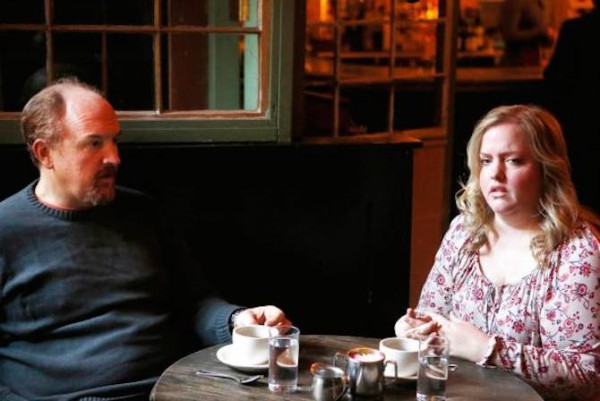
Vanessa is a sharp-witted server at the West Village comedy
club where Louie is a regular. After she catches Louie’s set one night, she
tells him she loves “seeing him up there,” though she “hates comedy.” (She
herself is clearly more talented than at least one of the male comedians shown
on stage; Louie observes her cracking up Ed Burns and hobnobbing with Dave
Attell.) Vanessa is honest, hilarious, attractive, and fat. She forthrightly
asks Louie out, but he begs off, saying that “he’s tired.” “Oh my God, are you
going to be okay?” she says, forehead wrinkling with over-concern. “You should
have said something before, I didn’t know you were tired.”

It’s also implied that Vanessa is better at her job than
employees like the pretty, slender young blonde named Sunshine, who shuts Louie
down when he clumsily asks, “Is that really your name?” Dealing with a crabby customer
waiting too long for his check, Vanessa says, “I’m not your waitress, but let’s
go find her and kick her ass.” If I didn’t want to be friends with this
fictional person from her first appearance, I definitely wanted to from that moment
onward.

Vanessa’s approach with Louie reverberated with my own so truly
that I cringed while watching her give him thousand-dollar hockey play-off
tickets because she’s busy on game night, and subsequently convince him to grab
a cup of coffee with her, with the implied caveat that it’s not exactly a date. (She still pumps her
fist in victory.) As far as spending time with another human being goes, Louie
and Vanessa’s not-date is enviably good. They obviously click on several
levels; later, Vanessa tells Louie that if someone were watching them from a
few yards away, they would see a great couple in action. Yet, throughout his
interactions with her, you can see the half-fictionalized Louie/Louis trying to
process conflicting input and impulses. Here’s a woman who is fun, clever,
generous to a fault, and who genuinely likes him, his gastronomical “bang bang”
adventures notwithstanding. Dave Attell seems to vouch for her. And Louie
himself is “nobody’s bargain,” to quote the Boss. So what’s the problem? We’re
all riders on this train, and there’s no mercy in this town, so why is what
Vanessa’s asking too much?

The answer might lie in Jim Norton’s one-word reaction when
he sees Vanessa at the club: “Yuck.” After all, what could be more disgusting
than a compelling woman who would accept Louie as he is, without forcing him to
conform to an artificially higher standard? Tellingly, Louie says nothing. That
moment foreshadows the conversation he and Vanessa have about calling dating
“trying” at the end of their vague hang-out session. “Try dating as a fat girl
in your early thirties,” she tells him, inviting his wan, conciliatory
contradiction, “You’re not…you’re…”

“Oh Louie,” she sighs, already disappointed before he says,
“You’re not fat.”

Thus begins Vanessa’s wrenchingly honest monologue about living
as a fat girl in New York City. “Why do you hate us so much?” she asks,
admitting that she’s choosing Louie to represent “all guys,” as she is
representing “all fat girls.” “What is it about the basics of human happiness
— you know, feeling attractive, feeling loved, having guys chase after us —
that is not in the cards for us?” This is something I have mulled over many
times, openly challenging my late mother’s installed voice that tells me, as
she did when I was an intense high school junior, I have “everything a man
could want,” a lingering and enigmatic phrase.

“If I was ‘very, really beautiful,’” which Louie calls
Vanessa post-“not fat,” “then you would have said ‘yes’ when I asked you out,” she
says, adding that the “high-caliber” guys flirt right back with her, because
they know their status and social power won’t be compromised. Meanwhile, the “regular”
guys, including the great Louis C.K., refuse to bat an eyelash at her, “because
they get scared that they should be with a girl like me. And why not?” What is
dangerous about being with a person like Vanessa, an overweight but confident grad
school nerd like myself, or any number of the amazing women I know, who have a
variety of bodies and somehow routinely become friends with men they like, instead of lovers? A lack of mutual
attraction is one thing, but repeatedly falling into the “she’s great, but…” category
causes a person to start asking questions more frequently. Meanwhile, the warm
embrace of gentle rejection that Louie describes as a special female talent at
the beginning of the show, and which he employs himself, becomes less and less
comforting.

And as the episode clarifies, it’s not a matter of sex. “I
didn’t ask if you ever fucked a fat girl,” Vanessa tells Louie. If she had
simply offered a quickie in the stock room, she says, he would have jumped at
it. Vanessa then lays it on the line, speaking for many: “I can get laid —
any woman who is willing can get laid. I don’t want that. I don’t even want a
husband or boyfriend. I just want to hold hands with a nice guy, and walk and
talk.” Louie finally takes her hand, and as they amble toward the horizon, he tells
a fat lady joke, the best possible ending to the show.

Part of the episode’s brilliance lies in exploring why that
simple, public display of intimacy can be so threatening, especially when the
person on the other end of the held hand is, according to the sliding scale
implemented by our societal hive brain, demonstratively imperfect. Sarah
Baker’s portrayal of Vanessa incisively tackles the interwoven, rat-king-like
nest of issues surrounding culturally-approved body images and actual desire,
but the genius in Louie’s writing is
that “fat” could, with minimal adjustment, be swapped out for a range of
alleged flaws. This is a specific story, but with threads that tie it to a
number of all-too-human experiences.

A few years ago, on what would become the most surprisingly
romantic evening of my three decades plus on Earth, a friend of mine suddenly
changed the game and opened my heart just by taking my hand as we walked down
the street to a party. Unfortunately, this took place in London, and more
unfortunately, said friend still lives and teaches in one of the world’s most
famous college towns outside of the UK’s bustling capital. An Atlantic-sized
ocean of time has now passed, stretching the endurance of perceived destiny and
slowly eroding whatever true feeling passed between us.

Since then I have had enough spontaneous and short-lived
adventures to keep a girl occupied, but maybe too often I’ve returned to the
thought of that night, and that feeling, especially because, as one of my male
friends said recently while discussing the vicissitudes of dating, “You do have people who like having sex with
you.” Sure. Most of them have been “good guys,” as Vanessa describes Louie. Sometimes
they’ve even bought me coffee or walked me to the subway the next morning.

But rarely have they held my hand.

Kathleen Brennan is a history PhD student at the CUNY Graduate Center. Occasionally she writes and edits non-academic things at her home in Brooklyn, NY.

RIP Gordon Willis, 1931–2014: The View from Dallas, Texas

RIP Gordon Willis, 1931–2014: The View from Dallas, Texas

"Manhattan"

Try to sympathize with me, for a second: Dallas, Texas was a
very difficult place to grow up during the 1980s. Put more specifically, it was
a difficult place to grow up if you were artistically minded or vulnerable or
smart, all of which I was. (I think.) Cars were important. Money was important.
Football was important. Status was important. Religion (as long as it was
Christian) was important. The intellectual life? Not highly valued.
Sensitivity? Not highly valued. Wit? Nix. Erudition? Nix. As I got older, all I
began to think of was escape: how
would I free myself from this environment? What could I do, as I grew up, to
ensure that I might live in a world that welcomed me, to a certain extent, or
at least tolerated me? As time passed, the answer became increasingly clear: get
to New York. And Gordon Willis had a great deal to do with that development.

I was nine when I first visited New York; I would be twelve
when I visited it again. I had heard plenty from my parents and their friends,
faculty at the local university, about the life of the city: the subways, the
homeless people, the smell of pretzels, the endless lines of numbered streets, the speed, the intense conversations, the immediacy.
But it was film that would truly draw me in, that would ultimately tell me New
York was my destination. Which films, exactly? Annie
Hall
and Manhattan. Again, I’ll
ask for your empathy. I was 12. Most kids at my age were hopelessly sarcastic;
I was hopelessly self-deprecating. The idea of a man making fun of himself and
gaining something like an artistic reputation for it was both beyond my
understanding and seemingly too good to be true. But even farther beyond my
understanding was the city itself. What world was it Allen and his characters
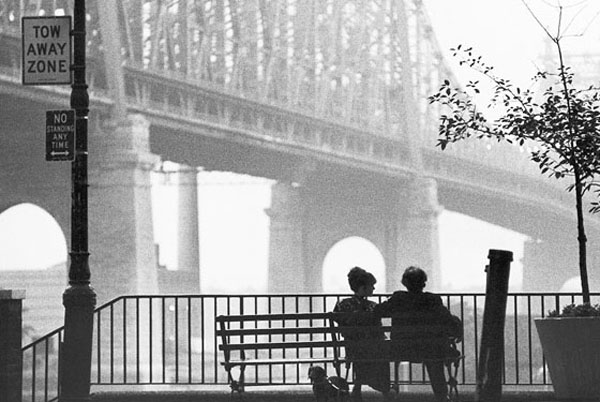
were living in? A world in which a man and a woman might sit, all night, at
the foot of a grand bridge, its contours shadow-lit as the sun came up. A
world in which a man and a woman might stand on a balcony and the beauty of the
skyline behind them might be just enough to eclipse the wit and awkwardness of
the dialogue rolling out of their mouths. A world in which a writer might
make several false starts to a novel as the camera soared over a Petri dish of
skyscrapers. A world in which the soft-focus intimacy of a bar scene, of a
group of well-heeled friends out for drinks, might be enough to make you forget
Allen’s character was dating a teenager. A world in which there was no trash
on the sidewalks, everyone seemed fairly clean and well-dressed, the sky was
always sunny, the stone of the New York apartment buildings was always a
brilliant white or a blood-dark red or a surprisingly vivid brown. A world
in which the unspoken message was, You
think you’re watching a story onscreen, and you think you’re only here for the
laughs, but in reality, I, the city, am the real story. You’re here for me.

Gordon Willis was responsible for this. I had
emotional reactions to other films Willis had a part in, as well, of course. The first time I saw The Godfather, despite all the
encouragement I had had to dislike it for its glorification of violence, I
would have to admit that its visual lushness was breathtaking—again making the
action on screen, the shootings, the conspiracies, the tests of manhood, the
pathological Mafia rituals, the inherent
sense of machismo, seem almost beside the point. When I saw Pennies from
Heaven
at age 11, I expected little from it besides a novel performance by Steve
Martin (was it going to be funny?); little did I know that, apart from being introduced to the surreal mind
of Dennis Potter, I would have a visual funhouse ride ahead of me: not only was
the intensity of the atmosphere he created—with its rainy nights, its dismal,
impoverished apartments, and its Hopper-like tableaux—thrilling to me, though I
didn’t have the vocabulary to explain why, My Eleven Year Old Self was both
scandalized and exhilarated by Christopher Walken’s dance number. The dimly lit
bar in which Walken tries to seduce Bernadette Peters with a wild tap-dance to
“Let’s Misbehave” was a magical place, not only because of its dim light but
because the light was not dim enough to conceal what seemed to My Eleven Year
Old Self like a waterfall of topless photos of women, a cascade of large,
fulsome female breasts. My Eleven Year Old Self’s jaw stayed open for a week. I
have only Willis to blame, or thank.

The fact is this: if you want real life, live it. If you
want psychodrama, create it. If you want to fall in love, go after it with an
open heart. If you want to be transported, though, if you want to feel that
you’re immersed thoroughly in an individual’s vision of a story, a world, and
the degree to which one might shape the other, go to the movies. Most
specifically, if you wish, Gordon Willis’s movies. He was a master of unearthly
transport who, without knowing it, changed my life. I moved to New York when I
was 18 and would live there, with few interruptions, for 25 years. And, regardless
of what I discovered—that New York is dirty, that not every conversation will
be backlit with golden light, that staying up all night is not as glorious as
it might seem—Willis’s vision stayed with me, and still stays with me.

Max Winter is the Editor of Press Play.

How I Came to Love Godzilla; or, A Chronicle of Heroes and Villains in the Gojira Series

How I Came to Love Godzilla; or, A Chronicle of Heroes and Villains in the Gojira Series

nullGodzilla was the megaton elephant in the room of my
marriage.

I married my husband because we liked all the same things. I
know some people talk up the idea that “opposites attract,” but since books and
film and food are about 90 percent of my life, it seemed like I had better
marry somebody with a brain as much like mine as I could get, without any
cloning involved. But there was this one small thing I thought we’d deal with
later, the way most couples deal with different opinions on having kids or how
to spend and save. That one small thing was Godzilla.

Chris was really into the Godzilla family of films, and I
would rather have eaten live worms than have watched these movies with
him.  Everyone has some idea about these
movies,, right? The big dopey-looking guy in the worn-out suit, stomping on
poorly-made miniatures and fighting some outlandish other monster suit, like
a giant lobster
or a weird
thing with a buzz saw in its chest
. I just didn’t see the point. And I
didn’t understand how someone as smart as my husband could enjoy these films so
much.

null

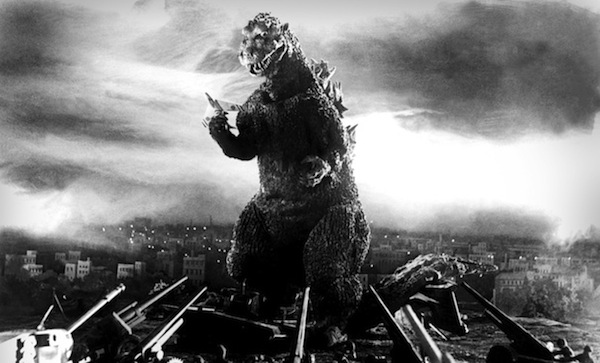
But then, worn down, I finally agreed to watch the original 1954
film, Godzilla, or Gojira. And I was impressed. Not only by the
film itself, which—thanks to the direction of Ishiro Honda, the now-classic score
by Akira Ifukube, and especially the masterful special effects direction of Eiji Tsuburaya—rose above
the traditional sci-fi/monster flick trappings to become a genuinely beautiful,
visually impressive, and deeply moving film. I was also impressed by the fact
that a film originally planned as a Japanese King
Kong
or The Beast from 20,000 Fathoms became so serious, moral, and
terrifying.

The monster in Toho’s film was more like the Beast than Kong—less humanized, more an unstoppable force. But unlike the Beast, Godzilla was
a sympathetic figure: his end is as tragic as his beginning. Of course, I
shouldn’t have been surprised that a movie about an atomic-age monster would be
imminently sadder and more impactful in the hands of the Japanese post-World
War II. And certainly the most striking images of the movie are as moving as
they are dreadful, reminders of what we did to Japan: a hospital full of burned
people; a group of children singing in the face of disaster; city block after
city block on fire; a group of sailors attacked with great ruthlessness at sea,
clearly influenced by the then-recent incident where a Japanese fishing boat
was caught in the fallout from the Bikini Atoll test.  It was a movie that resonated absolutely at
that time with audiences around the world—even with Americans, after a well-meaning
but clumsy American cut was mad
e that included American actor Raymond Burr
as a Tokyo reporter named Steve Martin.  

So after watching, and being blown away by the first film, I
was curious now to see the other films. Did they continue to preach the dangers
of nuclear warfare? It seemed they must, since that’s what Godzilla was—a nuclear horror—and yet, it
seemed unlikely that the films could sustain that same message, especially
through five decades.

And that is the
crux of what’s so interesting about the Gojira
series, despite its rather serious flaws. I have now watched all of the films,
some many times, and yes, I’ve come to love Godzilla, too. And not just because
I fell in love with the first film, which was the perfect film for its time,
and certainly the only one of the films that could be considered “great.” The
other Gojira movies, whether they are
great or terrible (and there is a wide range), are movies of their moment: that
is to say, rather than being about giant monsters and scrappy humans, these are
ultimately films about heroes and villains—and who they are says everything
about the time in which these movies were made. And by the way, that means that
sometimes the movies are deeply serious, and other times, deeply silly. As
Keith Phipps at the
Dissolve
pointed out recently, “Sometimes a monster is a metaphor for all
that’s troubling about a certain time and place; at other times, it’s just a
guy in a rubber suit smashing a bunch of miniatures.”

There can be no more fascinating series to watch, for a fan
of cultural and film history in the 20th century. Only the James
Bond series comes close, but even that is much more limited in its scope and
its necessarily static hero. The Gojira
films, on the othe handr, vary wildly in plot, character, tone, audience and
cinematography. Even the title character goes from hero to villain to symbol to
something in between.

The films can be roughly split into
three periods.
The classic or Showa series, spanning
1954-1975; the Heisei series, spanning 1984-1995; and the Millennium series,
spanning 1999-2004.  In the first part of
the classic series, the two films made in the fifties, doctors and scientists
are in ample supply as heroes, and the films wrestle with important subjects –
nature, and the monsters that supply it, are villains, though human-made.

null

In the sixties, the movies veer away
from the original message. As Jim Knipfel writes at Den
of Geek
: “Early in the franchise and often
under the guidance of director Ishiro Honda, when things just got really
fucking weird, when images straight out of Salvador Dali, Andre Breton, or Luis
Buñuel were inserted into the reality of the Toho universe, and none of the
human characters really batted much of an eye about it.” A distrust of
corporations went along with the weirdness: in King
Kong vs Godzilla
and Mothra vs. Godzilla,
it’s the corporate types who are trying to make money off of exploiting the
monsters – they become laughing stocks and goofy villains by trying to beat
nature at her own game, while the monsters become more sympathetic. In Ghidorah, the Three-Headed Monster,
a princess runs from assassins while possessed by the spirit of aliens – and
the series takes a turn for the wacked-out science-fiction quality which has become
a hallmark of the series ever since. The films seem less about nuclear war than
they do about the fear of invasion. In these later sixties films, Godzilla
becomes a world hero, saving the earth from alien invaders and monsters from
other planets.

null

By the 1970s, the films seem to be largely
for and about children – with the powerful exception of Godzilla vs. Hedorah (more on that in a minute.) Bullies and scary
criminals are villains, and absentee parents and latchkey kids abound. Godzilla
suddenly has ‘friends,’ and the monsters are become cute, hi-fiving,
kid-helping pro-wrestlers of sorts. In some of the films, the monsters live
together on an island (like
Monster Island)
and come to the rescue when needed. If the kids aren’t the heroes, they’re
still central to the story. These movies are pretty much the worst of the
series, often liberally making use of stock footage from past films and
featuring monsters so cartoonish they’re slapstick.

(Godzilla vs Hedorah,
of course, from 1971, is an exception that is also very much of its time – it’s
a strange, bleak look at the environmental havoc caused by pollution, which
comes to life in the form of a giant smog monster. It’s a serious film, despite
its odd psychedelic dance sequences, one that shows people and animals literally
being burned alive by Hedorah.)

null

The Heisei series of the eighties and
nineties is more uniform in tone, though the stories vary wildly. From a
rip-off of Indiana Jones that turns into an environmental message where the real bad guys are the corporation pushing
for deforestation; to a recurring character named Miki who has a psychic
connection with Godzilla, to a mutant Godzilla clone from space; these films
usually hold up humans as the bad guys, while another group of humans works
with Godzilla or other monsters to save the planet. During the eighties,
Godzilla would become a villain once again – only to morph into a hero by the
mid-nineties. I should also point out that at this point in the series,
Godzilla once more faces some of his classic foes, in an attempt to revive the
popularity of the series. Most of these films were not released in American
theaters, including
Godzilla vs. King Ghidorah,
a fascinating film that features a pre-atomic Godzilla-saurus ravaging American
troops and saving Japanese soldiers during WWII. (It also features
time-traveling humans from the future called Futurians, tiny adorable Ghidorah
babies, and a Terminator-like android named M-11.)

null

The Millennium series is the most
unwatchable group of Godzilla films (in my opinion), despite a higher production budget. The
stories are unmemorable, and the heroes are usually military characters,
admirable and steel-jawed, given little to do or say other than climb into a
giant robot or shoot “mazers.” Godzilla is, at least, fierce and very much the
harbinger of real, deeply felt terror. A dark and modern tone fills the films –
even the palette has shifted from the bright colors of the 80s and 90s films to
a dark mix of steely greens and grays. An odd quirk of this series: each one is
pitched as a separate sequel to the original 1954 Godzilla (with one exception
centering on Mechagodzilla.) The movies are all pretty grim, and some seem
close to the spirit of the original film: for instance, in Godzilla,
Mothra, and King Ghidorah, Giant Monsters All Out Attack
, Godzilla is an
ancient beast from hell who’s formed of the tormented souls of the dead of
World War II.

Having watched, many times, this
evolution of culture reflected in the evolution of the Gojira films, I (and of course, my husband) are fascinated to see
what the
American
film
(I’m not even bothering to count the
1998 garbage fest) will be. It certainly promises to be dark, serious,
well-acted, and – perhaps in the troubled, pessimistic spirit of our times, Godzilla
will be the metaphor, more than the guy in the suit.

Amber Sparks’ short stories have been widely published in journals and anthologies, including New York Tyrant, Unsaid, Gargoyle, Barrelhouse, and The Collagist. Her chapbook, A Long Dark Sleep: Stories for the Next World was included in the chapbook collection Shut Up/Look Pretty from Tiny Hardcore Press, and her first full-length story collection, May We Shed These Human Bodies, was published in 2012 by Curbside Splendor. You can find her at ambernoellesparks.com or follow her on Twitter @ambernoelle.

H.R. Giger: Against the Gigeresque

H.R. Giger: Against the Gigeresque

nullWith any metaphor, we must read it and ourselves
closely and minutely in order to reach its radical potential.

—Samuel R. Delany, “Reading at Work”

In the land of esque, the one-trick pony is king, and the king is made into a
one-trick pony. Art and artists get reduced to their broadest strokes, their
most easily perceived gestures, their monotypes. Esque means “resemblance”, but it also means a set of expectations,
because resemblance requires types than can be quickly, easily recognized (the
rich paradoxes and disturbing ambiguities of Franz Kafka get corralled into the
kafkaesque). The esque is a side-effect of commodification hardly limited to the
highest of high arts, as the marioesque attests. The danger of the esque is that the resemblance may
overtake the original.

null

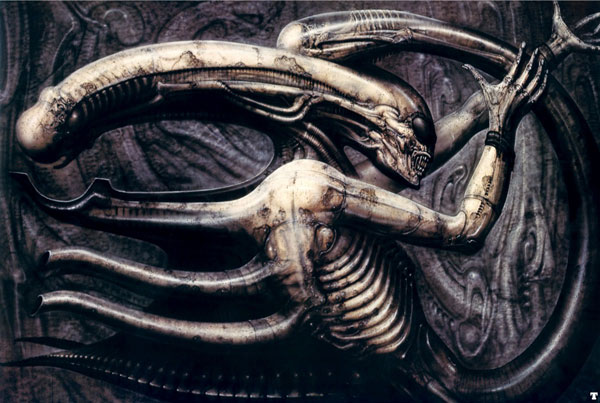
H.R. Giger’s imagery so deeply influenced the
imaginations of film production designers, tattoo artists, fashionistas,
magazine illustrators, skateboard designers, and just about everyone other than
My Little Pony animators that at this point it’s difficult to separate
Giger from the gigeresque. What was once outré, repulsive, and disturbing
became the Thomas Kincaid style for the cyber/goth set, a quick kitsch to
perform a certain idea of taste. You hang Christmas
Cottage
in your living room to display your pleasant, unthreatening
Christianity; I put a poster of Giger’s Li
I
on my bedroom wall to show how transgressive I am in my deep, dark soul.
Each is a sign that communicates immediately, without any need to look for more
than a second, because each communicates not through itself but through all the
associations is has accumulated.

Of course, this is not fair to Giger the artist,
who was much more than his most popular tropes. But that’s about as useful as
saying van Gogh is much more than a sunflower, a starry sky, and a bandaged
ear: obvious, yes, but also beside the point. Giger is mourned and remembered
because of the gigeresque.

The rise of the gigeresque occurred soon after
the release of Alien in 1979, for which Giger designed the titular
creature. He didn’t work on any of the other Alien movies, and was
especially annoyed not to have been able to help with Aliens, but it
didn’t matter: Hollywood just wanted a whiff of Giger, something for the
technicians to replicate and make acceptable to the studio execs.

null

Giger’s life in film did not begin with Alien.
He made two shorts with Fredi M. Murer in the late ’60s, “High” and
“Heimkiller”, as well as the 45-minute science fiction movie Swiss
Made 2069
, for which he designed his first monster costume. In the
mid-’70s, he created various set designs for Alejandro Jodorowsky’s planned
film of Dune (about which a new documentary has recently been released),
but it wasn’t until Alien that his work became generally and
internationally famous. Before Alien, he was avant-garde and shocking.
After Alien, he was trapped in a gigeresque nightmare.

My favorite Giger moment comes from 1987, when
Jello Biafra and Michael Bonanno of Alternative Tentacles Records were put on
trial in Los Angeles for distributing harmful matter to children because the
Dead Kennedys album Frankenchrist included a pull-out poster of Giger’s
1973 Penis Landscape (Landscape XX). Biafra later explained to
Wired.com that he’d been interested in using the art for the album because when he first
saw it “I thought: ‘Wow! That is the Reagan era on parade. Right there!
That shows how Americans treat each other now.'”

The biological and mechanical are mixed in what
Giger depicts, but they are also reproduced, reiterated: not just cyborgs, but
clones. The Penis Landscape reduces the human to the genital over and
over and over again. It attracted the attention of the anti-pornsters not
because it was obscene, but because it so perfectly depicted their stereotype
of pornography, the ideal form obsessing them: organs without bodies.

null

Putting a poster of Penis Landscape into
the LP of Frankenchrist was an effective use of Giger to prod the
sensibilities of the status quo, to distribute Giger outside the gigeresque,
perhaps the first (and maybe last) time after the release of Alien to do
so.

It’s too bad Giger never got to work with David
Cronenberg and David Lynch. In a 2012 interview with Bizarre magazine,
Giger said of Lynch’s Eraserhead, “No other film has affected me
quite like it.” Lynch, though, moved toward a kind of all-American
surrealism that wasn’t really what Giger was up to. Cronenberg is the one
director whose career seems to me to return now and again to ideas and images
that Giger was also drawn to, and whose work often manages to be gigeresque,
but not banal. The biomechanical metamorphoses and horrors come from
Cronenberg’s own obsessions — obsessions very much in tune with Giger’s, almost
in conversation with them. It’s unfortunate that Giger and Cronenberg never
worked together.

Giger participated in his own commodification,
though for him it seems to have been an attempt to at least partly control the
image being spread. By sanctioning Giger Bars and opening a Giger Museum, he
could say what was and wasn’t appropriate to associate with his name. Once a
trope enters the popular consciousness, though, it’s impossible to regulate its
transmission and mutation. When only a few qualities become associated with an
artist’s name, the artist’s own work can become unrecognizable as the work of
that artist. The esque becomes the echt. Commercialization takes
over, mining the predictable for profit. Art ends where expectation rules.

We can see this process in a revealing one-star review at Amazon.com for H.R. Giger’s Retrospective: 1964-1984, where a reader
says, “I didn’t like this book at all. I expected paintings of aliens and
supernatural creatures. Instead I got art that’s nonsense, from my point of view.
The paintings look nice, but they’re meaningless to me.” The gigeresque is
familiar, reproduced, and thus meaningful; the Giger that is not gigeresque
cannot be known, cannot even be evaluated or analyzed — it is nearly invisible,
just nonsense.

null

What we should celebrate and recover is the Giger
beyond the gigeresque. The gigeresque is too familiar now, too rote, too
replicated. Whatever meanings it still possesses are meanings comfortably
assimilated into the status quo, easily packaged and transmitted, emptied of
all but the least interesting, least challenging values. In 1979, a Giger alien
was shocking, terrifying, repulsive — but even as early as Aliens in
1986, the effect was dissipating (Giger’s own absence from Aliens
represents the triumph of the gigeresque: the artist himself was no longer
necessary). All these years later, slimy biomechanical monsters have no power
to surprise, no power to awaken awe. To rediscover the alien, we must reject
the gigeresque, for though it may still possess the basic ability to gross us
out, even that gross-out has dispersed into pure familiarity.

What
would be the equivalent today of packaging a poster of Penis Landscape
in a record album? What would lead to trials and hoopla and revolutionary
fervor? How could these images once again be made harmful for children? What do
we need that has not yet been leached out of the art? How might we honor Giger
and subvert the gigeresque?

Matthew Cheney’s work has been published by English Journal, One Story, Web Conjunctions, Strange Horizons, Failbetter.com, Ideomancer, Pindeldyboz, Rain Taxi, Locus, The Internet Review of Science Fiction and SF Site, among other places, and he is the former series editor for Best American Fantasy. He is currently a student in the Ph.D. in Literature program at the University of New Hampshire.

Fatal Riddles: HANNIBAL and the Figure of the Serial Killer in Contemporary Television

Fatal Riddles: HANNIBAL and the Figure of the Serial Killer in Contemporary Television

null

The
season premiere of Law & Order‘s
fourteenth season, Bodies, constituted
a departure from prior episodes.  Cryptic
markings on a dead body are matched to similar markings found on a victim in
Brooklyn five years before, and then to more bodies, all of which leads
Detectives Briscoe (Jerry Orbach) and Green (Jesse L. Martin) to conclude there
is a serial killer at work in New York City. The killer—a psychopathic taxi
driver named Mark Bruner (played by guest star Ritchie Coster)—is apprehended
relatively quickly. Briscoe and Green take no actions in pursuit of the killer
that fans of the show haven’t seen a thousand times before: they canvass,
retrace the steps of the victim, happen upon a nightclub waitress with a keen
eye for creepy patrons, and finally follow a hunch that leads them to Bruner’s apartment.
It’s not the pursuit and capture that provide the climax of the episode,
however, but the legal predicament that follows: Bruner’s attorney, an idealistic
public defender, must either break attorney-client privilege—and tell the
prosecutors (and the court) where Bruner has hidden additional bodies—or be
charged as an accessory to Bruner’s crimes.

Dick
Wolf’s Law & Order debuted in the
fall of 1990, at the peak of New York’s violent crime wave—that year, there
were over 2,000 murders (compared to 333 in 2013).  Law
& Order
embraced the fear of social disintegration and addressed it
with a severe formalism that married esperanto liberalism with a faith in traditional
institutions of justice.  The formula fit
the times.  The show debuted four years
after Congress passed the Anti-Drug Abuse Act of 1986, which created mandatory
minimum sentences and helped inaugurate our current prison crisis, and four
years before Bill Clinton signed the Violent Crime and Law Enforcement Act (1994),
which flooded the streets with policemen and extended the death penalty to
forty new offenses.  Nonetheless, by the
late 1990s, as the economy rode a wave of irrational exuberance, and NYC transitioned
from a dystopia to a destination for hipsters and financiers alike, the kinds
of crimes that captured the public imagination changed as well. Events like the
Columbine High School shootings of 1999 and the September 11, 2001 terrorist
attacks spiked fear of hidden threats from within.  Over time, Wolf adapted to this changing landscape
by bringing different versions of Law
& Order
to television, shifting the focus to tawdrier crimes (SVU), or quirkier detectives, (Criminal Intent).[1]
On the flagship show, however, the  basic
format prevailed, with few exceptions, for the duration of its twenty-year run.
It was plug-and-play television, and its reliance on formula guaranteed the
show was almost always competent if rarely great.

null

In
Bodies, however, Bruner’s lack of traditional
motive—he doesn’t kill out of greed, or revenge, or jealousy—renders him
less a typical Law & Order criminal
than a force of deconstruction and illogic. When Bruner bestows knowledge of
his victims’ whereabouts on his public defender and then relies on legal rules
and ethics to preclude the attorney from sharing that information, he reveals the
fundamental contradictions between our abstract notions of justice and the
institutional rules which make the judicial system work. By using Bruner this
way, Bodies takes a cue from the modern
archetype of the fictional intelligent psychopath: the creature in Mary
Shelley’s Frankenstein.  In a fit of rage, Shelley’s creature – powerful,
brilliant, and a wounded social reject all at once – frames the Frankenstein
family’s adopted daughter Justine Moritz for the murder of an infant family
member.  Torn between confessing to a
crime she didn’t commit and ex-communication, Justine admits guilt and is
hanged. Although her death may be characterized as innocence lost, it’s not the
senseless destruction of innocence that drives the creature. Rather, having
been judged and excluded by society because of his appearance, the creature seeks
revenge by turning the Frankenstein family against itself and exposing the internal
contradictions and inherent arbitrariness of the justice system and, by
extension, society.

When
Law & Order premiered on NBC in
the autumn of 1990, it did so over the protests of some executives who thought
it was too intense for weekly network television. Just under twenty-five years
later, on June 6, 2013, on the same network, roughly 2.5 million viewers
watched as Hannibal‘s Dr. Abel Gideon (Eddie Izzard)
graphically disemboweled psychiatrist Dr. Frederick Chilton (Raul Esparza) while
a still-conscious Chilton looked on. Gideon is but one of fourteen serial
killers introduced in the first twenty-two episodes of Hannibal.  Although notably
graphic in its violence, Hannibal is
not the first network show to focus on serial killers.[2]  A non-exhaustive list includes NBC’s Profiler and Fox’s Millenium, both of which premiered in 1996.  It also includes CSI, which premiered on CBS in 2000 (to be followed in 2002 by CSI: Miami and in 2004 by CSI: NY) and which, although not solely devoted
to serial killers, relied on a serial killer in its pilot and has depended on
serial killers for a number of its multi-episode narrative arcs. Criminal Minds, also on CBS and just
renewed for its tenth season, follows the FBI Behavioral Analysis Unit (the
“BAU” also featured on Hannibal)
as they track a new serial killer every week. Within months of Hannibal’s premiere in April, 2013, The
Following
debuted on Fox, The Bridge
on FX, and The Killing’s third (but
first serial killer-based) season began on AMC. 
And, although they are not network shows, the past year saw both the
successful initial run of HBO’s True
Detective
and the disappointing conclusion of Showtime’s Dexter.

Why
the fascination with “intelligent psychopaths” and serial killers? It’s
certainly true that there’s an audience for gratuitous and/or sadistic violence.
The killers are almost invariably white men directing violence (frequently
sexual) against “helpless” victims, typically women.  But there must be some further appeal, given
the fact that these shows (and novels and movies) command a large, diverse
audience of both sexes.  At a minimum,
serial killer plotlines are so culturally-determined at this point that they
seem to provide a kind of generic gravity, atmosphere, and stability to any
show.[3]
But Daniel Tiffany, in Infidel Poetics,
identifies something atavistic in our morbid fascination that dates back to the
legend of the Sphinx, the mythical creature who terrorized Thebes with a fatal
riddle.
As a “liminal” creature – part human, part
lion, part eagle but not actually human, lion, or eagle – the Sphinx is both an
antecedent and ancestor to Frankenstein’s creature, whose parts also fail to
add up, leaving him at once both human and less-than-human. Both figures presage
the “intelligent psychopath” of contemporary television, whose inscrutability
is the product of his fundamental lack of that something that we believe makes us “human.”
In this way,
the “riddling serial killers and
cryptographers of modernity” supply us with a “vernacular strain of
‘poetry'” and join the Sphinx (and Shelley’s creature) as authors of a
vertiginous, “apocalyptic” narrative. 
These figures embody a riddle that suspends us between a “promise
of revelation” and “the threat of annihilation.”[4]
By internalizing the superficial grotesqueness of Shelley’s creature, the
serial killer is all the more beguiling because – unlike the Sphinx or the
creature – he terrorizes us from within. 
If it seems a stretch to call the work of these killers poems, we need only consider how we
distinguish a killer’s “style” by what we call his signature.

null

It’s
not a stretch to say that our
construction and re-construction of these narratives – and the means we devise
to solve their riddles – can tell us something about a given cultural moment.  Shelley’s Frankenstein,
for instance, provides a strong critique of Romantic hubris, depicting the
destructive results of our attempt to “play God” through science.  Centuries later, CSI flipped Frankenstein‘s
script by suggesting a solution in science.
CSI kept in place many of the familiar
markers of the police procedural, but it also instituted a few significant
changes.  Most importantly, it focused on
the analytical methods of forensic scientists who preferred to stay far away
from the action. (“I don’t chase criminals,” explains lead-scientist
Gil Grissom, “I analyze evidence.”)[5]  These scientists function not only as a team,
but also as a kind of marketplace of ideas
– the laboratory is collaborative but also competitive,
with the scientists vying for Grissom’s favor and sourcing solutions from a
diversity of character stereotypes including an ex-stripper, an All-American
good-old-boy, a strong-but-silently-troubled bad-ass, and geeks galore. For the
bulk of its run, the CSI method was explicitly anti-theoretical; speculation
earned a quick rebuke from Grissom. It’s not difficult to identify in early CSI a pragmatism, a belief in markets
(at least of the intellectual variety), and a fetish for technology that reflect
the Clinton era that gave birth to it. When Criminal
Minds
first aired five years later, it adopted this pragmatism, down to its
team/market of diverse stereotypes, but swapped out the gleaming machinery of
the lab for behavioral models (and a dash of Big Data analysis). Criminal Minds‘ BAU also operates
collaboratively and competitively, dramatically prioritizing an internal trust
and transparency that stands in stark contradiction to the inscrutability of
the criminals they track. Both CSI and
Criminal Minds are notable for the
integral, authoritative roles they give to women. Their “marketplace”
is an inclusive one, a fact that, to a limited degree, helps off-set the
recurrent victimhood of women. Although both CSI and Criminal Minds
traffic in pop-philosophy (Criminal Minds
actually brackets its episodes with de-contextualized quotes from literature
and philosophy), neither treat serial killers as a kind of existential or philosophical
threat. Instead, the killer is merely one more problem to be solved, that can be solved, through a combination of
reason, diligence, technology, and cooperation.[6]

But
what do we make of Hannibal? It’s sui generis.  It adapts characters from, but pre-dates,
Thomas Harris’s well-known novels.  This means
that, to the extent it plans to follow those novels (with some, but not total,
fidelity thus far), the audience already knows a great deal about where the
narrative is going.  The show centers on
Will Graham, played by Hugh Dancey, a “pure empath” who experiences crimes from
the criminal’s perspective, and Hannibal Lecter, played by Mads Mikkelsen, a
psychiatrist who has been brought in by the FBI to help Graham handle the
psychic burden of his job (and, eventually, to aid in tracking down killers). There
is no mystery for the audience to Lecter’s identity, or the fact that he is a
psychopath, a killer, and a cannibal. 
Instead, the two characters face-off in a kind of dialectical opposition
as Lecter attempts to maneuver Graham into becoming a killer himself. The other
characters orbit them, occasionally changing polarities for the convenience of
the plot.  Dancy’s Graham is slightly-built,
boyish, soulful, all frayed ends. Although he “teaches” criminal
profiling at the FBI training center at Quantico, the show is exceedingly light
on the analytical. You could be forgiven for wondering about the substance of
his lectures, given the fact that his “talents” are the apparent
byproduct of cognitive and psychological abnormalities. Mikkelsen’s Lecter
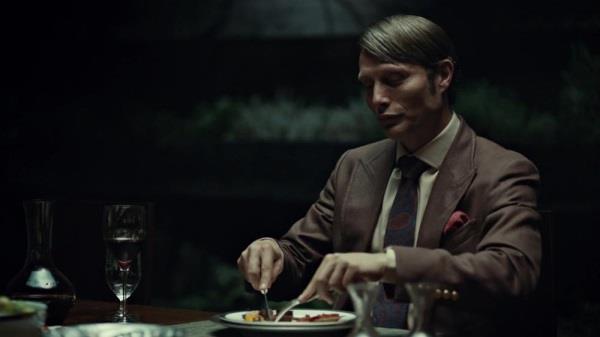
manages to be droll, aloof, creepy, charming, and – it must be said – a hell of
a clotheshorse. (His plaid suits and large-knotted paisley ties are a costume
designer’s dream.) He is also an unparalleled chef, a visual artist (he studied
drawing at Johns Hopkins on a fellowship), a musician and composer (harpsichord
and Theremin), a one-time neurosurgeon, and, now, a psychologist.[7]  He is so refined, and his composure so total,
that it would be nice, just once, for the show to sneak up on him as he watches
television and eats cereal in sweatpants. 

To
be clear, Hannibal is beautiful. And
it bears all the hallmarks of prestige television – not just the high quality
of the visuals, but also its accomplished cast and casual erudition. That said,
the show’s compositions are clearly its calling card. They are meticulous,
often daring, and Hannibal consistently
fills the screen with striking images drawn from a super-saturated palette.  The most striking images are, of course, the
dead bodies themselves, and the show’s attentiveness to the
“expressive” quality of the murdered body suggests an affinity with
David Fincher’s Seven (1995).[8]  No matter the killer, the dead bodies of the “victims”
are nearly always arranged and presented by the murderer in ways that blur the line
between the beautiful and the grotesque. Of the fourteen serial killers thus
far, not one has stooped to the banal depths of, say, strangling a prostitute
in a dark alley. Although the crime scenes
are elaborate, the majority of the actual murders in Hannibal occur off-screen. 
Thus we “meet” most victims for the first time when they are already
dead, already posed. Only belatedly (and even then only occasionally), through
Graham’s experience of the crimes, does the audience witness any of the
brutality behind the “art.” As a result, Hannibal‘s disinterest in the victims’ interior life parallels the
disinterest of the killers themselves. Deprived of a backstory, the victims never
exist as subjects, only as the
eventual objects of the killer’s art.
That it is art that we’re seeing is reinforced again and again as the
characters “admire” the monumental design, and, yes, the “poetry”
of the “death tableaux.”

The
show is equally meticulous thematically. It maps out a symbolic universe of
mirrors and reflections, parlor rooms and libraries, sublime landscapes and
dream imagery that, in combination with the violence done to the human body, suggests
what might result if Eli Roth plucked his writers from a graduate seminar on
Lacan. That half the main characters are psychologists permits Hannibal to lay it on thick – for a show
about chasing serial killers, it spends a great deal of time listening in on
characters in book-lined rooms as they earnestly discuss psychic
“borders,” dream interpretation, and “identity.” In this
way, Hannibal shares an intellectual
ambition with both The Following and True Detective.[9]  It is a credit to the creators that Hannibal manages to avoid The Following‘s too-obvious literary
aspirations. Like True Detective, it
succeeds largely in spite of itself, relying on strong visuals, charismatic
performances, and self-awareness to hide an intellectual and narrative preposterousness
that grows increasingly hard to ignore.

null

Hannibal  incorporates the components of a modern
criminal procedural – FBI agents, gunplay, high-tech labs and the quirky
squints who occupy them – but it displays none of the other shows’ faith in (or
fetish for) methodology.  On the
contrary, in the universe of Hannibal,
science is inert, ineffective, and easily manipulated. These manipulations
rarely serve as a surprise to the audience; instead, as Lecter uses forensic
evidence to frame others, send messages, or toy with the FBI, the audience is allowed
in on the joke.  The wholesale
institutional haplessness of the FBI is driven home by the fact that Jack
Crawford (Laurence Fishburne), the Director of the BAU, spends most of Season
One sharing meals with Lecter in which they eat
the very victims of the crimes he’s investigating
.  The medical and psychology professions fare
no better. Lecter “gives” Graham encephalitis then corrupts (and then
kills) the neurologist to keep it quiet. The psychiatrist Chilton, who manages
to survive his encounter with Gideon only to be killed soon after by means of one
of Hannibal’s more elaborate strategems, is a blowhard and fraud.  In the course of a couple of episodes, Lecter
manipulates both the FBI and Graham’s love interest (a psychologist consultant
to the FBI) into believing that Graham is a serial killer.  Naturally, it’s also Lecter who later gets
him freed. Lecter’s ability to manipulate and escape detection is explained in Mephistopholean
and metaphysical terms by the few who recognize his dangerousness – he’s Satan,
he’s smoke, he can’t be seen. As Lecter’s psychiatrist (an excellent Gillian
Anderson) explains to him, severing their relationship before fleeing town in
fear, “
I’ve had to draw a
conclusion based on what I glimpsed through the stitching of the person suit
that you wear.” That the stitching holds up as long as it does may be Hannibal‘s sole mystery.

Lecter
espouses a superficially stringent code of etiquette and ethics, and a breach
of these codes can have fatal consequences. 
Like all things Hannibal,
however, this code frequently bends to his will.  Although it may be Lecter’s world we’re
living in, fortune doesn’t only favor
Lecter; it favors all the killers, who always seem to finish their
“monuments,” no matter how ambitious, without any wires snapping,
without the whole Rube Goldbergian apparatus tumbling down, and without
interruption.[10]  From time-to-time, Hannibal slyly concedes a universe in which psychopaths are not an
exception but rather a kind of cabal, fixing and amending its rules. “Look
at us,” the journalist Freddie Lounds (
Lara
Jean Chorostecki) observes to Graham and Lecter, “a bunch of psychopaths
helping one another out.”

Still,
Lecter’s ability to manipulate the actions of others, even from remote
distances (of space and/or time) suggests not so much that he’s playing chess
while the FBI plays checkers, but rather that all of us are merely pawns in a
match he plays against himself for idle amusement. Stripped of a Sphinx-like
“fatal riddle,” the drama of Hannibal
is reduced to Lecter’s attempt to corrupt Graham. Its focus on the
“borders” that separate “us” from psychopaths suggests that
its closest relative is Showtime’s Dexter.  But it lacks a central paradox like the one
that animated the first few seasons of Dexter.
There, the audience was encouraged to root for Dexter’s happiness, his
normalization. But any relationship with Dexter posed, by its very nature, a
mortal risk. As those who cared for him were endangered or killed, Dexter forced its audience to examine
its own complicity in the violence.  Hannibal, on the other hand, solicits
admiration at the risk of leaving complicity unexamined. The shows share an
additional thematic similarity, however. And it’s a significant one. The
bumbling nature of the Miami police in Dexter
mirrors Hannibal’s hapless FBI;
both shows mask an inherent pessimism with a kind of “flawed hero”-worship,
suggesting a need to delegate the fight against “evil” to someone different,
and better, than us. This is not a
new trope. The transformation of Sherlock Holmes into a “high-functioning
sociopath” on Sherlock and the
emotional and intellectual volatility of Criminal
Intent
’s Detective Goren are just two recent examples that suggest that the
battle against psychopaths can only be won by psychopaths. We’re watching Titans
and Olympians battle it out across the mountaintops. Or, more aptly, it’s a
comic book universe as seen through the lens of the DSM.

Nonetheless,
Hannibal can be commended for its
even-handed approach to victimhood – it has avoided the kind of unrelenting
victimization of women (victimhood is distributed across gender and race) that
plagues Criminal Minds, and that famously
drove Mandy Patinkin from the cast. It also largely avoids that show’s
uncomfortable voyeurism.  But does that
discomfort have a kind of value? By hiding so much of its actual violence from
us, Hannibal often leaves the
audience with nothing but passive admiration of its technical accomplishment.  Having pre-emptively emptied both science and
the law of value, it cannot offer comment or critique. Having tilted the
universe so fully in favor of its killers, Hannibal
self-limits what it can tell us about the nature of evil – banal or
otherwise – in the world off-screen.[11]
Because of this, Hannibal struggles
to justify either its graphic violence or its body count.  Does it need justification? None of my
criticism detracts from the show’s direction and acting – which are excellent,
and significantly better than its kin, save perhaps for True Detective. It’s possible the wealth of surface pleasures is
enough. At one point, Graham criticizes Crawford for “mythologiz[ing]
banal and cruel men who didn’t deserve
to be thought of as supervillains.” 
That the show itself goes on to do exactly that suggests a winking,
Lecter-like self-awareness. In these moments
the show is most fully a reflection of the title character himself – clever,
facile, worldly, stylish, vicious, and hollow. 
As the audience, we are in on the joke but denied the riddle.

Spencer Short is an attorney and author. His collection of
poetry,
Tremolo (Harper 2001), was
awarded a 2000 National Poetry Series Prize. His poetry and non-fiction have
been published in
The Boston Review, Coldfront, the Columbia Review, Hyperallergic,
Men’s Digest, Slate, and Verse. He lives in Brooklyn.


[1] An informal count tallied more
than three times as many serial killers in the combined twenty-five years of SVU and Criminal Intent than in the twenty years of the original Law & Order.

[2] As far back as 1988, NBC
broadcast the short-lived and before-its-time Unsub, starring Starsky &
Hutch’s
David Soul as the leader of a team of FBI forensic scientists
tracking the same kinds of “unknown subjects” at issue in Criminal Minds.

[3] The
dramatic improvement in the third season of The
Killing
suggests that a serial killer plotline can serve to stabilize an
ambitious, but troubled, show. In other cases, serial killers have been used to
lend “lightweight” shows a sense of substane; hence the serial killer plotlines
in lighter fare such as NCIS, Bones, and even the soap operas Loving and One Life to Live.

[4] Tiffany, Infidel Poetics (2009), p. 72.

[5] Grissom was played by William
Petersen who, coincidentally, played Will Graham in Michael Mann’s Manhunter (1986) the first  adaptation from Thomas Harris’s Lecter novels.
It was remade as Red Dragon in 2002.

[6] Fox’s Bones is another example of the “empirical” procedural and is
strongly indebted to CSI.

[7] Lecter also has an exceptionally
keen sense of smell – at one point he claims to have “smelled” Graham’s encephalitis
– a trait he shares with Jean-Baptiste Grenouille, the serial killer anti-hero
of Patrick Susskind’s novel Perfume.
In Susskind’s novel, the hyperosmia is actually what drives Grenouille to kill.

[8] Twelve years later, Fincher
would again direct a film about a serial killer – this time the Zodiac – but
would focus less on the overtly apocalyptic and the graphically violent and
focus instead on the destructive internal toll that the Zodiac’s “fatal
riddle” imposed on those investigating him.

[9] It also shares significant
structural similarities to The Following
but that is beyond the scope of this piece, mostly because it would have
required watching more of The Following.

[10] Contrast all of this with the
one victim we see who manages to escape from a killer: he leaps from a bluff to
the river below only to bounce awkwardly against the rocks and plunge, already
dead, into the water.

[11] The fantastic British crime
drama The Fall (also, coincidentally,
starring Gillian Anderson) provides a welcome antidote to this self-regard. It
shares a number of structural similarities to Hannibal, but manages to capture a tension between menace and
banality that is wholly absent from Hannibal.

VIDEO ESSAY: Virtual Animals: Building the Digital Ark

VIDEO ESSAY: Virtual Animals: Building the Digital Ark

[The script of the video essay follows.]

For most of us, our first encounter with a wild animal
happens through a screen: the camera has the power to bring us closer to an
animal than we are ever likely to get in the wild.  It is by sight that we become fascinated with
them, by sight that we come to know them, by sight that we mourn their
disappearance. 

We are currently living through the world’s sixth mass
extinction event, the first to be caused entirely by humans.  By the century’s end, we are likely to have
lost half of the world’s species.  Film
will not only be the most intimate encounter we have with animals: for most
species, it will be the only encounter possible.

The fewer animals we find in the wild, the more we see on
screen.  The digital revolution has
enabled filmmakers to create an entirely new breed of animal, one that exists
only in the form of pixels.  Absence of
flesh and blood answered by an abundance of virtual animals.

Animals have always been a central part of filmmaking, and
animals on the screen have always had a complex relationship to their real life
counterparts.  One of the earliest films
made by Thomas Edison is of an animal execution.  In 1903 the rogue performing elephant Topsy
was sentenced to death by electrocution after killing her trainer.  Edison used the event as an opportunity to
show the power of alternating current, as
well as his state of the art film camera. 
Thousands watched the event, and many thousands more flocked to the
film.

The celluloid used in film stock comes from gelatin made
from the rendered bodies of animals. 
Eastman Kodak had its own rendering plant so that they could monitor the
quality of the animal product that went into the patented celluloid used by
most filmmakers.  Before digital, when
you watched a film, the image on the screen was literally being projected
through animal matter.

With digital we usher in a new era in which animals might
play a different role on the screen.  For
Darren Aronofsky’s animal epic Noah,
Industrial Light and Magic created 14,000 virtual animals, none of which
involved the use of live animals in their creation.  Aronofsky felt it would be against the theme
of the film to put live animals in dangerous or harmful filming conditions.  The result is the most breathtaking collection
of virtual animals ever assembled.  The
film itself is a kind of digital ark, bringing thousands of animals to life
even while their real-life counterparts are likely to become extinct in the
coming decades.

Before Noah, CGI
artists more often used live animals on the set to serve as models for digital
versions.  The process is called
capturing.  In the filming of Ang Lee’s Life of Pi, four tigers were used to
create the unforgettable feline presence of Richard Parker.  One of them was reported to have nearly
drowned on the set. 

We know animals by sight. 
By seeing we know they have souls. 
Somehow, these souls survive even in their visual avatars, even when
what we are watching is not an animal at all, but a collection of pixels on a
screen.

Nelson Carvajal is an independent digital filmmaker, writer and content
creator based out of Chicago, Illinois. His digital short films usually
contain appropriated content and have screened at such venues as the
London Underground Film Festival. Carvajal runs a blog called FREE CINEMA NOW
which boasts the tagline: “Liberating Independent Film And Video From A
Prehistoric Value System.” You can follow Nelson on Twitter
here.

Jed Mayer is an Associate Professor of English at the State University of New York, New Paltz.

Atom Egoyan Discusses Seeking Truth with DEVIL’S KNOT

Atom Egoyan Discusses Seeking Truth with DEVIL’S KNOT

nullThe case of the West Memphis Three has been dissected, inspected and interpreted for years. In 1994 three teenagers were tried and convicted of the murder of
three young boys in Memphis, Arkansas. They were accused of involving Satanic
ritual in the killing. During their life sentence in jail, their innocence was in
question. Musicians, activists and artists have raised the question for years: Who was really to blame in this modern day
witch-hunt?

The
Paradise Lost documentary trilogy explored the verdict, gaining
support when Metallica offered their music to the soundtrack. Amy Berg’s
documentary West of Memphis premiered with success at Sundance in 2012, produced by Peter Jackson. Novels have explored the case as well, such
as Blood of Innocents by Guy Reel and Devil’s Knot by
Mara Leveritt, the latter of which inspired Atom Egoyan
’s film.

Egoyan,
known for his incredible The Sweet
Hereafter
and breakout film Exotica, directs
this narrative adaptation. Reese Witherspoon came on board the project on early
to produce and star as Pam Hobbs, mother to one of the deceased children. Colin
Firth, Dane DeHaan, Mireille Enos, Stephen Moyer and Kevin Durand round out the cast.

I had a moment to speak with Egoyan, eager to
discover his own intention in revisiting the case. He reveals his personal
motivations for making the movie, how he handles actors, their boundaries and
his troubling search for justice.

MA: The West Memphis
Three were released from prison in 2011. Did you spend any time with them or immerse
yourself in study of the judicial system in preparation for the film

AE: I spent time with Jason [Baldwin] certainly. In
terms of preparing for the film, really it was a film that was concentrated on
what happened in that town 20 years ago. Looking at all the possible other
avenues that the court did not explore, to me, that was the intention.
I think whats most
troubling about this case is that there were so many routes that were not
followed. The trial was
handicapped by a judge who clearly had an agenda. This was the most horrifying crime
scene imaginable. It was also supernatural because there wasn’t any
hard evidence. Its as though
these evil perpetrators had to be created. The film is trying to show that you cannot use circumstantial evidence
unless all other avenues are completely exhausted. The film is presenting the
full spectrum.

MA: Both Devil’s Knot and The
Sweet Hereafter
center on a tragedy that affects a community. What
fascinates you about exploring this ripple effect of mourning, sanity, and
blame? 

AE: Im Armenian,
and April 24th was the 99th commemoration of the genocide. The perpetrator never
admitted the crime. I was raised with that, this question: how do you actually find
the truth
of such a traumatic event? Im obsessed
with that issue. I find it deeply upsetting when I see justice not being served.
How do we as human beings deal with the unknown? The West Memphis Three trial is a joke on so many different levels.
The documentary [West of Memphis] actually finds in its structure a person who should have
been followed. Even that is a dramatic solution thats convenient. But there so many other elements of
drama and mystery. Were still living with this ambiguity. That is so
troubling. I wanted to create this sense that it‘s unresolved.

MA: Many of your films have elements of the thriller
genre, withholding key information from the audience early on. You did so in this film and
also in Exotica. Tell
me about this withholding and how you use it to build
tension.

AE: Thats a really good question because it’s a little
perverse,
the way it‘s
done in this film. The audience expects Colin Firth to come in as the knight in shining armor, Atticus Finch. Hes the
gentleman in the southern court. To see hes excluded in the court
in one scene subverts our expectation. It has all the elements of a courtroom
thriller. It was also very unusual and Im actually obsessed with the idea, because I’ve seen justice not
served, that the only justice is acknowledgement between two individuals. This happens between Reese and Colin in the forest at one point: something is fucked up and is deeply upsetting.
Sometimes thats where
healing can maybe begin.

MA:
Reese Witherspoon really championed this film early on. What was
your relationship with her
on set, considering she also produced the project?

AE:
The thing thats amazing about Reese in this movie is that shes so generous. Shes part of
this fabric, and she was prepared to plunge into that and not look like a
Hollywood star. She was prepared to be this mom who lost her son. She was so concerned
that it be tonally right, that it not use any clichés.
Ultimately
, the forest is a place
steeped in religion and belief. What happened in the forest
was
so demonic. In absence of evidence, demons had to be
conjured in the courtroom.

MA:
Colin Firth is an incredible actor and Dane DeHaan has an incredibly
promising career ahead of him. What did you learn from working with both
actors, given theyre at opposite
ends of the spectrum when it comes to experience?

AE:
I have to admit that this whole
experience is overwhelming because I couldn’t believe the caliber of
actor drawn to this project. I was in awe of these actors. Dane was mind-blowingly great in
this role. Mireille is so great in this tiny role, I cast her in my next film. Kevin Durand, every one of these actors,
became really possessed. The film was unique this way, it existed in this pocket of consciousness. Chris Morgans interviews in that room are online. Dane got to reincarnate that character. Hes replicating whats on that tape.

MA:
Many directors have pushed their actors to dangerous places. We recently
read the backlash from the actors in Blue
is the Warmest Colour.
 Have you ever had a moment where you had to
pull an actor back
from that place
? That, or push them forward, but with a watching eye?

AE:
Every actor has a different
temperament. Part of my job is to know what those boundaries are. The actor has
to know youll be there
at the other end, that youre trying
to represent
them in the best light, who they are as theyre harnessing these roles. The methods vary
from actor to actor. With this film, all these great actors in the
courtroom
were in this place
together. They got to share that with their fellow actors in this theatrical way.

Meredith Alloway is a LA local and Texas native. She is currently Senior
Editor at TheScriptLab.com where she focuses on screenwriting education
and entertainment resources. She also launched her own interview showm
“All the Way with Alloway,” where she scoops the latest up and coming
industry insiders. She received her Playwriting and Theatre degree from
Southern Methodist University and continues to pursue her own writing
for film and stage.