Why Whit Stillman’s Work Endures After All These Similar Movies: On THE COSMOPOLITANS

Why Whit Stillman’s Work Endures After All These Similar Movies: On THE COSMOPOLITANS

null
There are plenty of reasons not to watch The Cosmopolitans. The director of this Amazon pilot, Whit Stillman, has been issuing films about the upper-upper-class
since the early 1990s, and at a time at which the country in which the films are
released continues to go through severe economic duress, and at which the
divisions between the wealthy and the non-wealthy continue to grow sharper,
viewers might well choose to watch other pilots; after all, several have been released very recently. Additionally,
one might say his characters tend to hew to the same characteristics, time
after time: disaffected, confused, fortunate, unreliable, unpredictable, and
yet also quite predictable. And the list of dissuading elements goes on.
However, when I watch his films, as I continue to do, I think of a couple of
comments I received, oddly enough, from writing teachers. One pertained to what
the teacher called “the courage to be quiet.” In context, the comment
referenced being able to resist the impulse to write loud, flashy,
attention-grabbing, surreal work, as I was doing, and challenging myself to
write in a softer register. In terms of Stillman’s films the phrase could refer
to filming stories in which no one really does
anything, if “doing something” means saving the world or fighting
10-storey-tall robots or jetting between dimensions or inhabiting John
Malkovich’s brain or seeing a double of one’s self on a weekend retreat—or
working with, and competing with, that double. In a climate in which concepts
are important in films and TV shows, and original concepts sell (and why shouldn’t they?), making a
film in which problems are local, dialogue is clever, and no one moves terribly
quickly does indeed take courage.

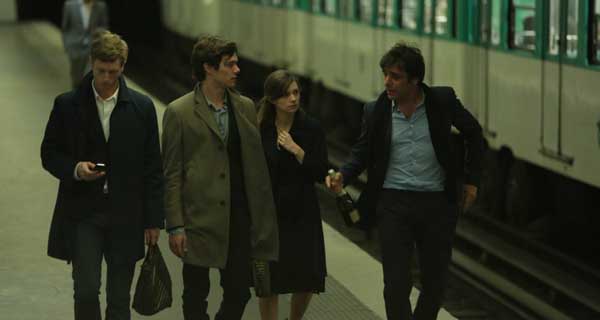
The pilot of The Cosmopolitans is plenty quiet. Its story,
such as it is, involves a threesome of wealthy young men who live in Paris.
It’s not clear that they have jobs; it’s not clear that they do much during the
day, besides taking language courses and pursuing women. The men are fairly
prototypical Stillman characters. Jimmy, played with considerable energy and
nail-biting nervousness by Adam Brody, is looking for love, finding it each
minute, and then losing it. His tall, thin, fair-complexioned friend Hal (Jordan Rountree), who resembles a
cross between a Russian wolfhound and a human, is similarly unlucky; his
girlfriend Clemence has left him, and he hangs on her every text message in the
hopes she might be contacting him. Their Italian acquaintance Sandro (Adriano Giannini) seems marginally
more worldly but similarly unfocused, similarly single, and comfortable in the
high-end world they live in. As you can see, there isn’t much drama here.
There’s no hook. There’s no rush to create a fraught story within the first ten
minutes. There are no twists. There’s intrigue, but all of the boring, human
sort. And yet at the same time, the pilot is very watchable, because it is, as
famous American expatriate Hemingway might have said (and indeed one of his
descendants stars here), true. Sharp as the witticisms these
characters exchange might be, and they are sharp, they are memorable primarily because
they emanate from a firm knowledge of the class Stillman is making films about.
Similarities and differences with Woody Allen have been noted, but the chief
difference is this, and it turns out to be the key to why Allen’s films have
declined in quality in recent years: Allen does not know the class he is
filming, the European artists, the young, independently wealthy protagonists,
and his is not the kind of imagination which can recreate experiences he has
not had, or had a portion of. Stillman is, to honor an ancient and shady chestnut, writing about what he knows.

Even-keeled as the dramatic topography may be in this pilot,
Stillman manages to insert some literary characters, figures with some breadth
and potential. Chloe Sevigny, in what might be her best performance since Kids,
plays a fashion journalist who radiates a mood of anger, bitterness and possible sexual
frustration from her first appearance; she says everything through clenched teeth
and what would seem to be too much caffeine, speaking truth but without caring
about its damage when spoken, criticizing the three single fellows for not
having “figured things out” yet. Freddy Asblom plays Fritz, a shifty,
bottomlessly wealthy young snot whose life revolves around cocktail parties,
philandering, romantic entanglements; he quite memorably loses his poise as he throws Sandro out of a party at his home for bringing drug dealers there, all of his previous oily delivery reduced to some barked
monosyllables. And Carrie MacLemore brings us Aubrey, a young woman on her own from Alabama, living
with a passive-aggressive boyfriend, or perhaps not living with him, or maybe
both; she’s played openly and with memorable plainness here by MacLemore, though she is a type who has appeared in
Stillman’s films before, moneyed, intelligent, not quite sure of herself, and
yet challenging enough to hold her own against Stillman’s young,
hyper-articulate bucks.

The second comment Stillman’s work makes me think of was one
I received much earlier, and which is perhaps more relevant to the work at
hand. During a discussion of class in fiction, the teacher suggested that one shouldn’t
be biased towards a writer’s work because the writer might be wealthy and might
depict people who are young, happy, and wealthy; neither the writer nor the
characters can help being that way. A sage observation: one can learn a lot by appreciating a work’s virtues before deriding it for characteristics which may set you off in some private, personal way. Stillman’s films are aggressively, steadily clever and perceptive, and this pilot is no different. They move forward less than they burrow in, one comment leading to another comment, until a final insight is reached that may be surprisingly dark but still somewhat profound. After all is through, the class of these characters, their sameness, their lack of what many people would consider to be real problems, bcomes beside the point. The wit of Stillman’s scripts, as well as the sense of introspection that wit creates, becomes sufficiently moving on its own, and the rest is just gravy, or in this case, jus.

Max Winter is the Editor of Press Play.

The Cool of Science, from Bill Nye to David Rees

The Cool of Science, from Bill Nye to David Rees

null
I was a horrible science
student. It was always my worst class. Right through high school. The only time
I ever cheated on a test was in grade 7 science class, and when I got caught
Mr. McGinn, the teacher, saw the shame in my eyes and we never spoke of it
again. I guess I never liked how absolute science was. It lacked humility. It
was all ego. As I’ve gotten older, this early flawed relationship with science
has manifested itself in strange ways. For example, I don’t believe that the Apollo 11 moon landing happened. I
doubted our science was capable of making it work. I’m religiously
superstitious, because superstition is the antithesis of science. I’m a
romantic. I believe in fate, a most unscientific proposition. I mean, I respect
science. I’m not a creationist. I like its work. Whatever chemist developed the
pomade that settles down my beard seems to have had some good notions. Gravity
and electricity are pretty great. But what I’ve realized recently, and what
television creators are realizing as well, is that that ego, that lack of
humility, gives science a distinctly cool quality. Confident. Retro. Universal.

The roots of cool science on
contemporary TV can likely be traced back to Bill Nye the Science Guy. Nye, a
student of Carl Sagan’s at Cornell, was an engineer in the aeronautics industry
before falling into television offering science segments during programs long
since forgotten. His eponymous show broadcast 100 episodes, and since then he
has been the cheese sauce to science’s broccoli across multiple media
platforms. He’s the pundit networks call to explain complicated matters to
fickle audiences, reducing climate change and the Big Bang theory to its basic
elements. He’s easy to stomach because of his folksy manner and trademark bow
tie. And what is cool if not some folksy dude sporting an anachronistic fashion
accessory? I’m suspicious of the fact he doesn’t have a PhD, but his work is
virtuous (consider his debate with science denier Ken Ham, in which Nye argued
the absolute theories of Darwinism and Ham argued that Jesus rode dinosaurs) and
someone has to spoon feed the fact that the earth isn’t 2000 years old to the
creationists. And, hell, Bill Nye was on Dancing
with the Stars
, so he’s even cool with middle-aged suburban housewives. He’s
multi-demographic cool.

If Nye has a contemporary equivalent,
or perhaps competitor, it’s Neil deGrasse Tyson, the prominent astrophysicist,
who is jovial, adorably geeky, and, like Nye, able to make complicated ideas very
simple. He’s a funny tweeter. He has a moustache. If you’ve been to Brooklyn or
an Arcade Fire show, you know moustaches are cool. He’s the millenials’
favorite PhD. In contrast to Nye, Dr. deGrasse Tyson does his punditry on shows
like The Daily Show, The Colbert Report, and Real Time with Bill Maher, where cool
hangs out, while squares watch Fallon, where the politically and socially
inclined go for their news. deGrasse Tyson recently hosted Cosmos: A Spacetime Odyssey, a revisitation of the seminal Carl Sagan’s Cosmos: A Personal Voyage,
in which his passion for science is clear, and his belief in its crucial role
in an engaged and advancing civilization is infectious. Even for someone like
me, who thinks Neil Armstrong filmed the moon landing on a sound stage in
Studio City.

Currently, the most prominent
and culturally ingrained scientists on television aren’t really scientists. The Big Bang Theory, CBS’s hit sitcom,
features no less than six characters who are scientists. Well, five scientists
and one aerospace engineer. The show outfits its cast in attire straight out of
Williamsburg, the very centre of all things cool, gives them the flaws and
ticks that humanize us all, and infuses the narrative with pop humour and
scientific jargon. The show has ridden an inexplicable wave of affection for
science, which has made scientists cool.

But the problem with cool,
especially marketable and monetized cool, is that the entertainment industry
inevitably tries to duplicate it with disappointing results. That’s why every
new sitcom in the late 90s featured six beautiful friends in a coffee shop and
lasted four episodes.

Recently, I came across the
National Geographic Channel’s Going Deep
with David Rees
, which may be the beginning of the end of cool science on
TV. Rees is not a scientist. Or an engineer. He’s a writer. And a cartoonist.
And apparently has a vested interest in pencils. The show is not without its
merits. In watching this season I learned how to make ice, and tie my shoes, swat
a fly, and open a door, banal activities I had been carelessly attending to
without thought for nearly four decades. Rees investigates the benign and treats
us to the science behind it. But what is most striking about Rees’ show is its
almost desperate desire to be cool.

Going Deep borrows heavily from filmmaker Wes Anderson, crown
prince of the zeitgeist of cool, in its cinematography, score, and title fonts.
The program often attempts to replicate Anderson’s signature aesthetic:
perfectly centered shots, harmonized colors, and the Futura typeface for
titling. I was surprised to learn the score was not done by Mark Mothersbaugh.

Rees clowns relentlessly for the
camera. He breaks the fourth wall, talking to his crew. He swears. The result,
unfortunately, is a show that is the very opposite of cool because it doesn’t
understand what cool is. Desperate is not cool. Oddly, Rees strikes me as
someone who is cool, off-camera. He is personable, has an interesting
background, and is comfortable on camera. One can’t help but think while
watching the show that if Rees was less animated against the backdrop of the
Anderson homage, the show would be quite wonderful. 

Nye didn’t aspire to cool; he
fell into it. Like Neil Diamond circa 1998. deGrasse Tyson isn’t cool because
he’s on TV, he’s on TV because he’s cool. The
Big Bang Theory
isn’t cool because its characters are scientists. It’s cool
because its creator Chuck Lorre controls the universe. Well, no, but it’s cool
because it took a science and put it in the sitcom world, something that had
never been done before, and took that opportunity to explore science and geek-dom
through that familiar lens. Cool is often born either of what is new or what is
rediscovered. It’s why retro is cool. It’s the casual employment of the
contemporary and the forgotten. Instagram’s retro filters. DJs sampling music
of yesteryear. Your nana’s red plastic frames.

What Nye, deGrasse Tyson, and
Chuck Lorre understood was the marvel of science itself. Science has the
capability to answer, in absolute terms, every question about the universe. That
in and of itself is astounding. Science sells itself. It’s genuine. It’s
literally truth. And that’s what those who try to manufacture cool have never
been able to grip about cool. It just happens. It’s organic. It enters the
universe unannounced and disappears into the ether in the same manner. Going Deep with David Rees tries too
hard. And cool don’t try, man.

Mike Spry is a writer, editor, and columnist who has written for The
Toronto Star, Maisonneuve, and The Smoking Jacket, among
others, and contributes to MTV’s
 PLAY
with AJ
. He is the author of the poetry collection JACK (Snare
Books, 2008) and
Bourbon & Eventide (Invisible Publishing, 2014), the short story collection Distillery Songs (Insomniac Press,
2011), and the co-author of
Cheap Throat: The Diary of a Locked-Out
Hockey Player
(Found Press,
2013).
Follow him on Twitter @mdspry.

How GROUNDHOG DAY and THE ONE I LOVE Describe the Indescribable

How GROUNDHOG DAY and THE ONE I LOVE Describe the Indescribable

null

Note: This piece contains spoilers, in a sense.

The One I Love is a film very much in the tradition of
Groundhog Day, another film that employed bizarre structural
techniques in the service of a love story—but it seems, by and large, that this film
picks up where that one left off, so that each work shows stages in the
development of the human animal in the midst of a relationship. Both films are
light enough on their feet that you wouldn’t immediately think they had
anything all that serious to impart, but, in fact, they do.

It’s easy, when watching films like these, to pick up on the
wrong things. In the case of the older film, we marvel at how strange it is
that Murray’s fop lives the same day over and over, assuming that the chief
metaphor here is that life itself is repetitive, and that it’s hard to learn
from one’s mistakes, and that even the grumpiest malcontent can find true love
if given enough chances. The reality is, of course, that the film tells the
story of the difficulty of love, and the inevitability of stumbles and false
starts on the way towards it. With The One I Love, we marvel at the fact that the couple at
the center of the film, having gone to a weekend retreat recommended by their
couples counselor, have found themselves sharing a huge mansion with a couple
who looks exactly like them, with only slight differences.

Charlie McDowell’s film addresses not the difficulty of love,
but the strangeness of the idea of it. Think, for a second: two animals meet
each other, become more familiar with each other, and then, if both partners continue to
appreciate the other partner, spend the rest of their lives together, or a large part of it. As the animals
spend time with each other, they get to know each other better and better. They
come to know characteristics they appreciate, and characteristics they do not
appreciate. They watch out for each other. They fight. They have moments of
great love and affection. They have sex. They have children. This is a
fascinating process if you’re studying baby ducks, and it’s also fascinating if
you’re watching humans. One thing this film does, as Groundhog Day did, is that it forces us to look at humans in a
relationship as animals, and watch how they behave as they grow to know, and un-know, themselves and their partners.

Another important similarity between this film and its
predecessor is the seeming blankness of its performances. The actors chosen
here do not bear, in their performances here or elsewhere, a distracting heat.
Elizabeth Moss has played, throughout her career, characters of great subtlety, but she
has rarely played characters with great eccentricity (except perhaps for her
early turn in Girl, Interrupted, but that was more of an acting stunt). She is
best at a sort of plain, calm openness, which, ironically enough, could allow
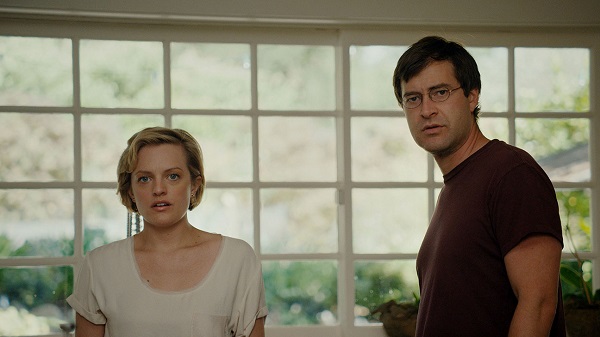
for a number of different possible results; here, her Sophie wavers between drawing our sympathies and driving us away, her lip quivering at tense moments just enough to make us understand her anger at her spouse.  Mark Duplass’s performance is
fairly blank, as well—his Ethan wobbles between likability and unlikability
throughout the movie, having teetered into adultery, but nevertheless
presenting the affect of a nerdy everyman. In the earlier film, the actors seem
all similarly cherry picked for their blankness: Bill Murray’s deadpan, Andie
MacDowell’s mild-mannered attractiveness, Chris Elliott’s likable goofiness. Even Stephen Tobolowsky, in that film, seems like a well-chosen part of a set piece.
What these performances do, by not calling attention to themselves, is draw
attention to a central storyline, which in each case is a fairly basic but elegant one.

But in one film we learn what is wrong with us before we fall in
love; in the other, we learn what remains wrong with us afterwards. In Groundhog Day, Phil’s faults before he falls in love
are many: his egotism, his sarcasm, his misanthropy, his narcissism, his
cynicism. We can see him begin to expand, or open up, from the first minute he
sees Rita in the newsroom—regardless of whether or not this expansion manifests
itself outwardly from the start. Once the mornings begin to repeat themselves, Phil’s lying and bumbling begins a comic metamorphosis, as Rita remains
relatively the same. Indeed, the largest change we see in Rita is that she grows to
accept Phil’s quirks, or at least becomes more vocal about the traits in him she
dislikes. And so, by the end of the film, Phil has repaired himself, in a
sense, becoming a person who might, conceivably, be lovable. The film does not
suggest he has undergone an Ebenezer-Scrooge-level transformation, but it comes
close. He has gotten to this point by making the sorts of mistakes that are all too common in relationships, and learning from them–the moments of forgetfulness, or insensitivity, or clumsiness, that are part of the process by which the complicated animals called humans learn to share a burrow, either real or theoretical. The One I Love could be said to begin 10 years later, after marriage,
after the tenderness and rage that come with it. While neither Ethan nor Sophie are comparable with the characters in the earlier film, they
don’t need to be. The message remains the same: the phenomenon we are
witnessing is one of the strangest things we could see on a screen, even if it is happening all around us, all the time. The
characters here talk to each other, and then they talk to duplicates of each
other; they have experiences with each other, and then they realize those
experiences were with other versions of each other, which they did not realize
at the time. Even summarizing it is confusing, as is the experience depicted.
As the film continues, we see the two couples finally meeting and having dinner
with each other—and agreeing to spend the rest of the weekend hanging out with
each other, a happy foursome. Which is almost conceivable, as a social arrangement: one version of Ethan is uptight, the
other slightly more relaxed; one version of Sophie seems accepting, the
other slightly less content and more brittle. Which is all a roundabout way of
saying that we, as we’ve been told before, contain multitudes; while Whitman
might have meant that he identified with all people when he said those words, isn’t it also the case
that, when we have decided to share our lives, this is the greatest sort of
expansion, that two people could be, in a sense, a multitude? Additionally, isn’t it also true that one’s sense of a partner is perpetually revised in small ways, for good or ill, during the course of a relationship, so that the version of the Other one sees is shifting almost constantly?

As the saying goes, form is content. Some subjects
deserve a certain treatment, and the process by which they come to receive that
treatment can be rather mysterious. In the case of both Ramis’ film and the
current film, the filmmaker is describing something which, at its bottom,
cannot be mimetically represented—only some version of our idea of it would
make it there. So, what do the filmmakers do? They go out on a structural limb,
experimenting in wild ways with time, or with character development, or with
structure as a whole. And, in so doing, both directors manage to describe the frustrating and
somewhat bottomless nature of human relationships with what could be considered deeply enjoyable realism.

Max Winter is the Editor of Press Play.

First AMERICAN HORROR STORY, Now TRUE DETECTIVE: Why Award Nominations Say More Than You Think

First AMERICAN HORROR STORY, Now TRUE DETECTIVE: Why Award Nominations Say More Than You Think

null

With any spate of Emmy nominations
come the invariable snubs and the inevitable outcry.
Last year, the hot topic was Tatiana Maslany,
this year it’s True Detective. Why is this show categorized as a traditional drama when the likes of Fargo and American Horror
Story
—which share the same anthology format—reside in the miniseries
category? Why would HBO pit True
Detective
, certainly a great program, against the juggernaut final (half-)season
of Breaking Bad (among other notables)?
The explanation involving the wording of the rules
has hardly softened
the speculation
that this is a power play on HBO’s part. FX faced similar criticisms in the
past with American Horror Story,
ultimately settling into the miniseries category, a move that many viewed as a
convenient way to avoid competing with the likes of Homeland and Game of Thrones. This all might seem
superfluous (it’s about the art, not the awards!), but the way True Detective’s
categorization issue has been handled adds new economic value to the genre,
increasing the likelihood that we’ll see an exponential surge of anthologies in
years to come.

Though American Horror Story is hardly the
first of its kind,
it is without question the catalyst for the renewed interest in the form we’re witnessing
now. Its approach—closed seasons that bear no relation to the others save for
recurring cast members—has brought FX a diversified audience
and heaps of award nominations and wins.
Capitalizing on that success, True
Detective
and Fargo established
2014 as a breakout year for the televised anthology. In February, Mark Maurer
illustrated some of the benefits
of the form, citing its binge-friendly structure, potential to create
fulfilling storylines, and ability to attract star talent with demanding
schedules. I’d submit that another asset of the form is its ability to
undermine audience expectations. Like the ever-popular novel-in-stories genre
in the literary world, the anthology series allows its viewers’ minds to run
wild on a moment-to-moment basis. Where we pretty much knew that Breaking Bad wouldn’t kill off Walt in
Season 2, for instance, we can’t carry the same certainty for any of the protagonists
in Fargo—a show that is very aware of
this advantage. No matter how TV-literate we may fancy ourselves, the anthology
retains the capacity to surprise us in ways (kind, quality, and frequency) that
a traditional drama can’t match.

And there are other
benefits: self-reference and tie-ins in the form of cameos, recurring cast
members (or repeat characters played by new talent), or whole plotlines (as in
the announcement of Fargo’s setting
in Season 2). Once upon a time, syndication was king: a show needed to reach
the fabled 100-episode mark to earn the right to be bought by other networks
for reruns. Video-on-Demand streaming and rental services have changed the game
entirely. Where syndication regularly depended on the whims of the lowest
common denominator, streaming services have proven that niche consumer
interests can be just as profitable, particularly when involving cult,
award-winning, or critically acclaimed series. The result is that a quality
program—even one that didn’t necessarily wrangle many viewers during its initial
run—can still be sold to VOD services for a handsome price, thus earning its
keep in the eyes of the network, as Mad
Men’s
whopping $75-$100 million price tag
in 2011 evinces.

As television becomes
increasingly oriented around streaming, the sheer watchability of anthology
shows—which tend to feature fewer episodes with tighter storylines—alongside
the aforementioned advantages, imbues them with major cash-cow potential. One
bad season need not sound a show’s death knell. With American Horror Story, for example, I was taken with the first
season’s jarring visual style and juxtaposition of horror, lightheartedness,
and suburban claustrophobia, but found the second season’s gore-focus tiresome
enough to quit after a few episodes. Because each season is self-contained, I knew
I could check back in for Season 3 without fearing I’d missed vital information—not
the kind of thing one can realistically do in the middle of a serialized,
long-form narrative. As a result, anthologies also, with some exception, renew
their access points on a rolling basis; they can grab new viewers at the start
of each season. If a potential viewer of Fargo
wanted to watch the series in terms of chronology rather than release date, for
example, they could start with next year’s 1979 Sioux Falls setting,
then “backtrack” to Bemidji 2006. I can even imagine future programs toying
with this idea, creating jigsaw puzzles intended to be watched in a variety of
sequences.

The demand for high-quality
drama, which significantly increases the costs associated with producing new
programs, has steered many channels to invest more heavily in pre-vetted source
texts: offerings that have demonstrated profitability elsewhere, such as
novels, films, comics, and international series. Alongside Fargo, Hannibal, Bates Motel, Constantine, Gotham, Agents of S.H.I.E.L.D., The Killing, Homeland, Arrow, The Bridge, and Gracepoint are just some of the adaptations to have been green-lit
for the small screen in recent memory. With any show, the hope is for a long,
lucrative run. Ideally, each season after the first textures and builds on all
that’s been established without retreading old territory, but “topping” previous
work can be tricky without defaulting to far-fetched scenarios in hopes of
recreating the dynamism that attracted viewers in the first place. For this
reason, the anthology provides a nice home for original content. What is lost
in plot continuity is gained in ease of longevity; all things being equal,
networks can trust that each season of an anthology will perform similarly to
the ones before it, and writers/producers can create new, organic work each
season.

And now, the True Detective award kerfuffle has
revealed yet another strength: the ability to hop genres come award season. As
long as the likes of the Emmy committee continues to wash its hands of
responsibility, the precedent will hold. Networks will game the system, placing
their anthologies in whichever category they believe will yield the best
results (imagine the mess when they start dipping their fingers in proper
comedy anthologies). This form is one of the most exciting things in television;
in many ways, it’s the most organic structure for the medium and the habits of its
viewership. Relegating it to the miniseries category doesn’t fit, but it
equally doesn’t belong in the traditional drama category. Until there are
enough additions to the genre, we won’t see a designated anthology category. In
the meantime, the field is wide open for those willing to experiment.

Jesse Damiani is Series Co-Editor for Best American
Experimental Writing (Omnidawn, 2014). He lives in Madison,
WI.

VIDEO ESSAY: R.I.P. Lauren Bacall

VIDEO ESSAY: R.I.P. Lauren Bacall

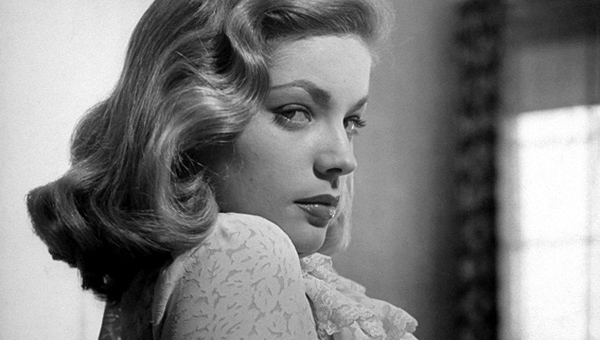
What defines sex appeal on the big screen? This is a question that has been pondered in countless essays, sometimes with extensive scholarship attached, sometimes not, but the answer remains elusive, as it should. When watching Lauren Bacall in her early films, it is impossible not to think of "sexy" as one of the adjectives to describe her, and yet where is that sexiness coming from? In part, it comes from a sort of conversational fear, a sense that she, or rather one of the characters she plays, might say something barbed, or worse, at any turn, and that if she doesn’t, she’s choosing not to. There’s a "nothing ventured, nothing gained" quality in the act of watching her; unless there’s some risk involved in any experience–in this case, the risk of shock–there’s no point in having the experience, or so the platitude goes. There’s her voice, of course, the deep-toned, husky, "bedroom" voice, which is, in its own way, permissive; it sends a mood of acceptance, as well as engagement. I first saw Bacall in The Big Sleep when I was quite young, almost too young to understand her, or the importance of the film, or Bogart’s presence in it–but I did understand that she represented a comfort with, and an embodiment of, specifically adult sexuality, for grown-ups, a quality I still consider somewhat removed or Parnassian, even at my current, seemingly mature age. She seemed then, and she seems in retrospect, like a pinnacle, evidence of a time when on-screen sex appeal might emanate from other sources than it does currently.

For now, what we consider sexy has a not-so-subtle price tag attached to it. Many viewers only consider the star or starlet a sex symbol if their image has appeared a certain number of times, on a certain number of billboards, in a certain number of high-profile films. The quality of that appearance is a factor, as well. Viewers know how much money is invested in the films in which the Symbol appears. They know how much money the Symbol is paid for each film. They know who the highest paid stars are. They know what the most expensive films are. Or they can easily find out. They know that technology can easily modify a star’s appearance to make it look however a filmmaker might want it to look. We know that this equipment is highly costly. They know that the said Symbol eats expensive food, gets exercise through an expensive trainer, and wears more expensive clothes than are imaginable to us–or if they’re imaginable, they aren’t within financial reach. All of this ultimately enters, oddly enough, into popular conceptions of sex appeal–and because of the integration of star culture into the larger body of cultural or even news reporting, one might begin to take a matter-of-fact attitude towards this appeal itself. Is the set of reactions, subtle and not-so-subtle, physical and otherwise, to sexiness, lessened with this development? Somewhat. It’s not so much that the stars of yesterday were better, or sexier, it’s that they may have been playing by a slightly different set of rules.

Which brings me to Bacall’s face. When she was introduced to me as a classic sex symbol as a child, my very first thought was Her? Really? She looks so . . . normal. And then I caught on. There is an approachability in her features that doesn’t bear much similarity with the Pitts, the Jolies, the Greens, the Stones, or even the Geres, the Fondas, or the Dickinsons. As theatrical as her movements, her carriage, and her phrasings might be, there’s a sense of the human being beneath it, there, as well; as she herself said, "the look" began because she was lowering her head to keep from shaking too much. In the right light, watching Lauren Bacall could be a powerful reminder of the difference between being an actor and being a human being, and how the best actors show viewers both experiences. Sex appeal at present is more likely to be measured in near-mathematical terms: are the proportions correct? How perfect are the features? If we compare the Symbol to other Symbols, how does this Symbol match up? The simplest way of saying it is that viewers have gotten colder, and the simplest question about a star—sexy? or not sexy?—is filtered through a set of criteria that have little to do with lust and more with what makes a good screensaver. It would be difficult to trace the series of cultural seismic shifts that have led to this attitude, but one thing remains certain. To say Bacall represents another era in moviemaking is unquestionable, and to say that era is bygone is an understatement.–Max Winter  

Serena Bramble is a film editor whose
montage skills are an end result of accumulated years of movie-watching
and loving. Serena is a graduate from the Teledramatic Arts and
Technology department at Cal State Monterey Bay. In addition to editing,
she also writes on her blog Brief Encounters of the Cinematic Kind.

Max Winter is the Editor of Press Play.

METAMERICANA: Outlaw Country Goes Psychedelic: An Interview with Sturgill Simpson on His Music Videos

Outlaw Country Goes Psychedelic: An Interview with Sturgill Simpson on His Music Videos

null

If any album of 2014 can be said to have received
“universal acclaim,” it’s Metamodern
Sounds in Country Music
, released in May by country artist Sturgill
Simpson. A mesmerizing and sometimes bewildering mix of traditional country
sounds, contemporary philosophy, and psychedelic recording-studio wizardry, the
album’s appeal appears to cross all boundaries of age and genre. Pitchfork called it “a
surprisingly tender….vehicle for big, unwieldy ideas about human
consciousness and the nature of life”, while no less an old-media stalwart than
The New York Times called it “a triumph of exhaustion, one of the most jolting
country albums in recent memory.” NPR wrote that Simpson had “perfected the trick of distilling
classic country from many eras and moving away from it at the same time . . . [a]
trick that takes skill and affection for the history of the genre, as well as a
willingness to stand alone”; meanwhile, a television channel built to capture
the hearts of the Heartland, Country Music Television, credits Simpson with “a voice that recalls Merle Haggard,
and guitar licks that bring Buck Owens to mind.”

Other glowing reviews of Metamodern Sounds by Rolling
Stone
(“equal parts haunted, tender, and trippy”), The Austin Chronicle (“the rising rural talent….uses the genre’s classic
narratives to obscure right and wrong in the search for higher truths
”), and Record Collector (“Simpson truly scores in the ease with which he
ponders life’s bigger questions while couching them in familiar country
language and sounds
”) have helped seal the album’s reputation as one of the
year’s most acclaimed releases. And now the album has earned its author an Emerging
Act of the Year nomination from The Americana Honors & Awards, and popular
Americana blog Twang Nation calls Metamodern Sounds a “dark horse
candidate
” to win a Grammy Award for Americana Album of the
Year—a claim that’s now been echoed on the personal websites of countless fans
of Americana.

The music charts love Simpson, too. Metamodern Sounds has thus far spent
nine weeks in the Billboard Top 200, peaking at #59, and just
as long on the Country Music chart, peaking just outside the top ten. And to
top it off, Simpson just appeared on The Late
Show with David Letterman
.

What hasn’t yet been much discussed are the three
oddball music videos Simpson has thus far released: the first two, “Turtles All
the Way Down” and “The Promise,” from  Metamodern Sounds, and the third, “Railroad
of Sin,” from his 2013 debut album High
Top Mountain.
Simpson has been interviewed countless times this year—by
everyone from Rolling Stone to The Wall
Street Journal
, National
Public Radio
to Billboard—but
never once asked to discuss in detail the multimedia rollout that accompanied
the release of Metamodern Sounds (let
alone the sole video release from Simpson’s first album, which is every bit as
strangely juxtapositive as his videos for Metamodern
Sounds
). This oversight may be attributable to the fact that the lyrics and
music of Metamodern Sounds require so
much careful attention and discussion; or, it may be that even the media
outlets now praising Simpson underestimate the scope and ambition of his
project. Certainly, on the evidence below—the videos themselves—it seems clear
that the visuals accompanying Metamodern
Sounds
are as critical to the project as are the album’s ten songs.

Last week I caught up with Simpson to ask him some
pointed questions about these three videos, as well as the artistic vision
behind them. Below are links to each of the three, followed by Simpson’s
discussion of them with Press Play.

“Turtles
All the Way Down,” Metamodern Sounds in Country Music (2014)

“The
Promise,” Metamodern Sounds in Country Music (2014)

“Railroad
of Sin,” High Top Mountain (2013)

Press Play (PP): In filming videos for a country album that’s in
many ways unconventional, what are your influences? Any favorite videos by
musicians in other genres?

Sturgill Simpson (SS): I’m a movie buff/indie film whore. Lots of
foreign [films]…lots of 60’s westerns. I someday hope to find the time and coin
to invest more of my creative energy towards the visual media side of releasing
music. I’d love to make short film videos pushing the conventional standards of
what a country music video can be.

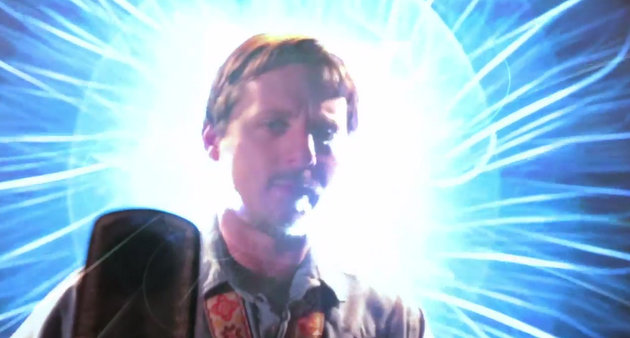
PP: The video for “Turtles All the Way Down” features
psychedelic CGI and gorgeously styled shots of the band, but it also gives
viewers a first-person look at a virtual wormhole during the lyrics’
denouement. Do you see this idea of a short-cut between two far-flung positions
as being important to the work you’re doing on Metamodern Sounds in
Country Music
? If so, what’s on either end of the wormhole?

SS: More than anything, I believe the themes, content, and sonic palette
of the album created the wormholes and sort of formed the juxtaposition on
their own. I’m not sure how much of it was intentional, looking back now. Even
with most finite planning you never know what the final result will reveal
itself to be until it’s staring back at you. I think the album just really
shows where my head was at that moment in time.

PP: The videos for
“Turtles All the Way Down” and “The Promise” juxtapose an almost DIY ethic
(e.g., close-up tracking shots of you and other members of the band)
and a real commitment to using technology (e.g., computer-generated visual
effects) to mesmerize. Can you talk about the process of filming these videos?
How much of the concepts were drawn from your own sense of Metamodern
Sounds in Country Music
, and how much was a multimedia collaboration with
other artists?

SS: Well that’s another story in itself. My buddy Graham Uhelski directed
and edited everything. I gave him a mental outline of what I was after and
wanted to see on both songs and he filtered that through his interpretation to
get what you see. For “The Promise” we decided a single simple tracking shot
filmed inside a bleeding heart was all it needed. I knew the video for “Turtles”
had to employ inter-dimensional/thematic elements. Really I just wanted to
make it look like a live performance at the Omega Point. Our budget was next to
nothing. We put together a small team of highly talented, dedicated players and
turned an empty warehouse into a soundstage. I was introduced to a generative
software artist in New York named Scott (Spot) Draves through Dr. Rick
Strassman and his colleague Andrew Stone. Scott created an interface
A.I./synthetic consciousness software called Electric Sheep. I sent him the
album and explained the message I was trying to get across with the project. He
was sympathetic to the cause and my budget and very graciously offered his
assistance.

PP: The video for “Turtles”
definitely achieved that “inter-dimensional” ambition—it’s a wild mix of
religious lighting, pharmaceutical-friendly animation, “infinite regress”
cosmological theory, and lyrics that run the gamut from Jesus to Buddha, fairy
tales to aliens. How concerned were you about trying to tie everything together
visually?

SS: That was the challenge and for me, simultaneously the source of the
excitement in tackling it.

PP: It’d be impossible
to watch these three videos without thinking about the use of color in each;
not many live-action videos are more spectacularly colored than these are, and
in each case the use of color feels not just aesthetic but rhetorical. Was
featuring transformative, blurred, and technicolor displays a particular
emphasis in putting together these videos, and if so, how do you see that
emphasis interacting with Metamodern Sounds in Country Music (and/or
earlier work from High Top Mountain) lyrically and thematically?

SS: Everybody is on drugs . . . just give ’em what they want.

PP: In addition to the
references to various drugs in “Turtles,” a lot of people have homed in on your
album’s use of the word “metamodern.” Do you think of these as metamodern music
videos?

SS: Now that’s a question I’d really much rather hear your thoughts on.

PP: The second release
from Metamodern Sounds, “The
Promise,” uses vignetting to leave us with the uncanny feeling we’re literally looking through someone’s
heart. It’s a song with a clear narrative bent, so I wondered if you could talk
about the role (if any) of narrative in that video. Did you and your team
imagine the moment you’ve captured on film as a contextualized one, or was the
concept primarily aesthetic?

SS: Nailed it. We wanted it to look like you were staring directly into a
bleeding heart or a very vulnerable love light.

PP: “Promise” also
superimposes black-and-white film-reel visual effects over a static,
“real-world” shot of you sitting on a stool; the reel effects are later
replaced by an over-saturated color palette and the same “ink” effect we
briefly saw in “Turtles All the Way Down.” Is foregrounding the different ways
reality can be framed—music, writing, cinema, photography, et cetera—important
to your “metamodern” approach to songwriting, and if so, how do you see it
playing out in the work?

SS: I believe framing reality is one of the only ways we can ever be
sure it actually exists. In that regard, I feel as though I’m still learning
who I am as an artist.

PP: Switching to the
2013 video for “Railroad of Sin”—it makes Tokyo subways and business districts
the setting for a classic rockabilly sound. It’s not a combination many would
come to organically, but it really works, so I wanted to ask you how you conceived
of it? And also the video’s epigraph—“a single dream is more powerful than a
thousand realities”—feels critical to what you’re up to. What can you tell us
about that video?

SS: I lived in Japan when I was younger for about two years. I spent my
time equally between religiously studying Aikido in Shinjuku by day and hard
partying in Shibuya and Roppongi by night. On more than a few nights, those
subways were my own personal stage coach to hell. I thought it would be fun to
return and work with some friends to capture the techno advanced world of Tokyo
against the backdrop of a high octane country song about a reckless life of
abandonment and personal disregard represented as a speeding train.

PP: A side note about
all three of these videos: the distribution channels for music videos today are
obviously a world apart from what they were in the 1980s, when you and I were
more or less coming online culturally; did the new potential for “virality”—a
strange word—play any role in the design and execution of these videos?

SS: Of course. As you pointed out, there was no such thing as “viral”
in the 80’s and 90’s video world. I knew before making these videos the only
place people would ever see them would be on YouTube. With that said, CMT
actually picked up the “Turtles” video for rotation, so go figure. That in and
of itself is a win in my book.

PP: Looking ahead, are
there plans for any additional videos for Metamodern Sounds in Country
Music
? If so, any details?

SS: Yes. Eventually, I want to have a video or visual representation for
every song on the album so you can watch the album in order of its track
listing. This may take a year or more.

Seth Abramson is the author of three collections of poetry, most recently Thievery (University of Akron Press, 2013). He has published work in numerous magazines and anthologies, including Best New Poets, American Poetry Review, Boston Review, New American Writing, Colorado Review, Denver Quarterly, and The Southern Review.
A graduate of Dartmouth College, Harvard Law School, and the Iowa
Writers’ Workshop, he was a public defender from 2001 to 2007 and is
presently a doctoral candidate in English Literature at University of
Wisconsin-Madison. He runs a contemporary poetry review series for
The Huffington Post and has covered graduate creative writing programs for Poets & Writers magazine since 2008.

Kevin Kline on MY OLD LADY, THE LAST OF ROBIN HOOD, and His 26-Year-Old Self

Kevin Kline on MY OLD LADY, THE LAST OF ROBIN HOOD, and His 26-Year-Old Self

null
Kevin Kline has
studied at Juilliard, played Shakespearean icons like King Lear and Hamlet, won
two Tony Awards, been nominated for 5 Golden Globes, and, justifiably, won an
Oscar. He has two new films out this month, My
Old Lady
and The Last of Robin Hood and
gives two vastly different but incredibly inspiring performances.

In My Old Lady, Kline
plays Mathias, an American who moves to Paris to claim an apartment he’s
inherited. He soon discovers Mathilde (Maggie Smith), a tenant who still lives
in the home and refuses to budge. Her daughter Chloé (Kristin Scott Thomas) is insistent
on their right to the Parisian home and although she creates initial conflict
for Mathias, she soon propels him into a journey of self-discovery and family
reflection. The film is an adaptation of
the play by Israel Horovitz, who also directed. 

Kline also plays Errol Flynn in The Last of Robin Hood. The film centers
on the scandalous romance between the aging movie star and young actress
Beverly Aadland.

Kline discussed what drew him to
these roles, the importance of his training, and his first time on Broadway.

MA:
“We think
we’ve been cursed by God; we’ve been cursed by our parents.” This line from My Old Lady really illuminates the core
of the story, moving past relying on your family. Was this an avenue for you
into the project? Did it strike a chord personally?

KK: It’s indicative
of the kind of lines [Israel] writes. [The play is] very
serious about parental curse and fate and the narrative we compose for ourselves: these merciful revelations that we find out, life isn’t what we thought, which is part of any good story. Israel
had done something unique in this particular mix of comedy and drama and
romance. You don’t get to see characters in
movies that say, ‘‘I’ve been cursed by God!” This guy is very self destructive, flagellating while blaming everyone else for all
his woes, and then eventually, strangely reconciling what he thought his past was with
his present. It was unusual, with recognizable, human characters.


MA: So much of Mathias’
turmoil lies in the Viager, this elusive French equity-release contract. How
does that illuminate the American-European divide?

KK:
It’s an old
thing.  It dates back to the Napoleonic
era. They are still very popular. There are similar situations where you can
buy an apartment cheaply but you can’t take possession till the person dies. It
is characteristically French and says something about their culture. Mathias
says cynically, “So you’re betting on somebody dying soon?” You can also look
at it as buying a place and giving money to someone who can live out their
years there. There’s something quite positive about it, too.

MA: Mathias is an
aging man, but at the same time so much a child because he hasn’t coped with
his past.  How do you begin developing
him? Do you pull a Stanislavsky and give yourself specific given circumstances
from his youth?

KK: I think
a lot of it’s instinctual but so much of it dredges up, it’s right there on the
tip of his tongue, the edge of his consciousness. That’s easy to give voice to.
He’s got all his opinions about what his life has been. A lot of that is
spelled out in the play. Of course you had to visualize and think through more detail
about what his childhood was like, but [Horovitz] spells it out.


MA:
What enticed you about both of these roles? Both Mathias and Errol Flynn have such
psychological complexity.

KK:
It’s hard to
make a comparison but you could say both of those characters had messy lives. In My Old Lady the
psychological complexity, to be 58 and really kind of lost and trying
desperately to make some sense of his life, that was the attraction. With Errol
Flynn, this was a man who was the highest paid, most successful movie star and
now he’s at the tail end of his career, and it’s caught up with him. That
character was determined to be Flynn no matter what and was defiantly himself to
the very end. With [Mathias] there’s still hope for change, which happens. Both
of them are complicated fellows. And especially with My Old Lady there was something about that second chance, still
learning. Young people think that old people have it all figured out.  (Joking) I’ve got it all figured out, most of
us don’t!

MA: With more
robust roles like Errol Flynn or Falstaff, which you’ve played, is there a physicality
that allows you do build a character from the outside in?

KK:
Very similar
characters! Very Falstaff-ian! Flynn is very funny, very witty and a jokester
and a prankster and a life force! With Falstaff, he is a corrupter
of youth! They played by their own rules. With Falstaff you put the
fat suit on, but this appetite that Falstaff and Flynn had, enormous, sensuous appetites,
there’s another physical transformation. Flynn was a great athlete. In his youth he was a
boxer and a diver and a swimmer! He would spar with professional boxers! He
broke his back a few times. There’s physicality to that. It’s working from the
outside in and inside out, and then you meet somewhere. Because you’re shooting out of
sequence, there’s not a lot of time for experimentation.

MA: Given there’s
not that time for investigating on set, training is obviously important in films. How crucial was
your time at Julliard? What set that apart from just being on set and learning
from actual experience?

KK: Training can
be important for some actors, for other actors they don’t need it. Film acting
is not stage acting. If you’re interested in classical theatre, the training is
helpful and you have to learn to forget some of the things you’re taught in
school. You have to find your own way. Julliard provided a place to practice, although
it was very competitive. Give me an opening night on Broadway with all the
critics there any day over an acting class! But if I had just gone from
college into a sitcom, and just played the same kind of role over and over, I
would never have had the confidence to try Shakespeare or comedy! I was usually
the leading man! It’s understanding what style is and tone and differentiating
and stretching yourself as an actor. In terms of the confidence, I know how to
work with this elevated language because I’ve done it and come to a certain
reconciliation.

MA: You made your
Broadway debut in Chekhov’s The Three Sisters.
Looking back now, what would you tell yourself on that
first opening night?

KK: It’s funny
because I remember that opening night! I was 26 years old in The Three Sisters, which may be my favorite
play in this world to this day! I was having a go at it. John Houseman was backstage, saying “Don’t do that melancholy Midwestern thing!” A half hour before I’m going
on in the first preview! I think he was saying that my Midwestern upbringing
made me bring some melancholy aspect to the character. That’s something you say
during the 6-week rehearsal process! That’s a producer for you! What advice? Don’t be dissuaded by bad reviews. I performed four plays in repertory in a period of four weeks, and was reviewed by all the first string critics during this time. Some actors
take 10 years for that horrific experience!  Don’t be too hard on yourself. One thing they
don’t teach you in drama school is how not to let a director screw you up in a
performance. That’s something you learn. Where you’ve compromised yourself. It’s pleasing the director but not me. It’s
not what I’m really here for
. That takes years to learn. You have to be
patient! It’s also what William Goldman said about Hollywood, “No one knows
anything!” No one knows. Doubt everything. And find your own way. And don’t
stop going to the theater!

Meredith Alloway is a LA local and Texas native. She is currently Senior
Editor at TheScriptLab.com where she focuses on screenwriting education
and entertainment resources. She also launched her own interview show,
"All the Way with Alloway," where she scoops the latest up and coming
industry insiders. She received her Playwriting and Theatre degree from
Southern Methodist University and continues to pursue her own writing
for film and stage.

Humor Is Life: RIP Robin Williams, 1951–2014

Humor Is Life: RIP Robin Williams, 1951–2014

null
Anyone who has more than a passing acquaintance with me
knows this: I consider humor very important. It can be a great social balm, a
means of communicating with others—but beyond that, it is one of the most
complex ways I can think of, besides poetry, to make sense out of the
peculiarity of waking up, functioning, and being in the world. For me, those who
through whatever gift are able to make humor their livelihood, and sustain that
livelihood over a lifetime, become like prophets, speaking the highest sort of
truth—but truth, ironically enough, that could either make your eyes water and
your nose run or make you wet your pants. So the mixture of feelings I had when
I read of Robin Williams’s suicide was dramatic. Grief, of course. Shock. Anger.
Confusion. These were all at the front of my mind, blaring, inescapable. But
above and beyond all of these, was, oddly enough, fear, whose source I could
not immediately identify. Then it came to me.

I remember being amazed, as a twelve-year-old, that
Williams could act seriously. When I learned that he had been cast in The World According to Garp, I was
baffled. But he’s Mork, I thought. Mork from Ork. What’s he doing in a film of
this stature? After all, the film was based on a novel by John Irving. A close
friend of the time, Steve Ingham, was nuts about Irving, and he had me nuts
about him, too. And so the idea that such a movie might be coming out assumed
gigantic importance for me. The fact that Robin Williams would star in it was
both wonderful and terrible: wonderful because I, like most people my age,
worshipped Williams, but terrible because I simply couldn’t imagine him being
serious. As it was, he gave a memorable performance as young human tabula rasa
T.S. Garp, up against formidable talents such as Glenn Close and John
Lithgow—though the film would not necessarily loom large amongst others, due to
its personal, small scope, I would always remember that as one of his best
performances. And, when thinking about the range of films he made over the
course of his career, it’s the serious roles that stand out most. He learned,
gradually, how to take control of the serious parts he was given, and to do so
in a way that seemed natural to him. Movies such as Dead Poets Society, or Awakenings, while certainly moving, offered lesser performances than Good Will
Hunting
, or The Fisher King, or Insomnia—where you were actually able to
forget, for a moment, that you were watching someone who, in another context,
could be continuously funny, for fifteen solid minutes, who might reduce you to
the point of pathetic laughter—and then would keep on, as if he didn’t care if
you were in pain, lying in your bed or on your sofa, in the dark, late at
night, clutching your stomach. It’s that feeling I’ll remember most about him,
in fact, the feeling you would get when watching him on stage, without props:
that of watching someone supremely in control of himself, of his voice, of his
posture, of his physical movements, but also, in a sense, anarchic within
himself, unable to sit still when appearing on a talk show, sometimes seeming
as if he were moving around a room when he was still seated, so animated, so
wise. And the irreverence: the fact that he could use a voice whose baseline
was a slightly worshipful tone to be wildly, brashly, politically incorrect, to
make fun of, frankly, anything he felt like making fun of. What inspiring,
beautiful freedom.

There’s really no explaining this death. Nothing works. He was depressed. His comic gifts masked a
deep darkness. We never knew the real man. Substance abuse took its toll.

These are all statements he probably would have made fun of. All we really know
is that yesterday, he felt bad enough, or desperate enough, or frustrated
enough, to put an end to his own life. All any one individual can speak of with
any accuracy is the effect of an event like this on that individual’s life.
This event will probably haunt me for a long time. I’ve been thinking a lot,
recently, about my own life, about its scope and span, and it occurred to me
that Williams’ public visibility began in the late 70s, just when I would have
first been able to laugh at his jokes, to recognize what it meant to witness
someone who was truly, indelibly funny. And he’s stayed present in my life
through almost four decades, as long as I’ve been on this planet. A presence like this
becomes a cultural cornerstone, a foundation, someone upon whom you rely for a
service, or a specific function. I knew that if I saw him appear in his natural
element, which was to say tossing his hilarious sagacity into space and seeing
where it landed, he could be relied upon to make me laugh, regardless of whatever had happened before I watched him, regardless of whatever feelings I had at the time. And so the fear I felt when I learned that
he died was fear of what his absence meant. And what is that? The best way
of saying it is this. It’s like cosmic slapstick: I lean against a wall, but someone’s
taken it away when I wasn’t looking, because it turned out to be a false wall, and so I’m stumbling, semi-comically, semi-tragically, slowly stumbling into darkness.

Max Winter is the Editor of Press Play.

What Does It Mean That Joe Swanberg Has Made a Feel-Good Movie?

What Does It Mean That Joe Swanberg Has Made a Feel-Good Movie?

null
The newest film from Joe Swanberg, whatever its faults and
virtues might be, makes one thing abundantly clear: that certain styles require
a form to pour themselves into if their best qualities are to be revealed. Swanberg’s
earlier films, works like Nights and Weekends, and Hannah Takes the Stairs,
were hybrids of fiction and documentary. With little of what you might call a
classic “story” to them, they depicted ordinary people going about
their lives: working, traveling, eating, sleeping, having sex, having
arguments. The script was generally improvised, the affect generally minimal—so
minimal, in fact, that the term mumblecore grew around his films, to describe
the only half-present delivery given to a lot of the dialogue. The idea was to
create as natural a film as possible, to include both uninteresting and
interesting activity on screen and hope that one type was equal to the other.
Any attempts to describe the reality of watching one of these films, though,
leads one in a Rumsfeldian direction: suffice it to say that that there are
uninteresting scenes that are interesting for being uninteresting, and there
are uninteresting scenes that are simply uninteresting. It was as if what we
might (broadly) call imagination had been bled out of the films, to get us to
look at the contours of ordinary, unaffected reaction.

In recent years, Swanberg has moved away from that: Drinking Buddies had more electricity
and sweetness to it than the films preceding it, possibly helped along by the
vivaciousness and skill of its actors; 24
Exposures
was a suspense film, which failed because it wasn’t that
suspenseful, given that relaxed improvisation doesn’t help a suspenseful mood;
the current film is a step forward from both of its predecessors: a real story,
with a real conflict, real characters, and real moments of poignancy, which are
allowed to breathe, as fictional, created moments. But, given that, the
question this movie raises is a complex one. I’ve written before about the way
in which cap-C culture eventually absorbs what it does not at first understand;
at the time, I used Andrew Garfield as an example of someone who had first
gained acclaim in smaller-exposure venues and was suddenly playing Spider-Man. In
Swanberg’s case, though, what seems to be happening is the reverse: a director
who was fairly staunch in his rawness (a rawness executed, it should be said,
with deliberation) has now made a nice, even heartwarming movie. So what does
that mean, for him, and for our notions of the way artists develop?

The form into which Swanberg’s sensibility has been poured
is as follows: Jeff lives with his wife Kelly and their child in a modest home in
Chicago. Jeff’s sister Jenny comes home for the holidays, having just broken up with
her boyfriend. Her very first night, she goes out with her rowdy friend Carson and
gets so drunk she has to be carried home; she’ll spend most of the film in a
grown-up-child daze. Kelly seems uptight at first, annoyed at Jenny’s antics, but then
reveals herself to be merely frustrated in her writerly ambitions. Jenny meets a
boy, loses him, gets upset, gets drunk, nearly burns the house down, doesn’t, and
is redeemed, sort of. End of story. It’s a heartwarming tale about the
importance of family, about finding your ambition, about following it, about
survival, and many other themes that might float around these. The performances
are understated and consistently strong: Anna Kendrick, as Jenny, proves herself to be a
supple, malleable intelligent actress with self-awareness to spare; Melanie Lynskey is complex as Kelly, offering us a mother who is annoying and
endearing by turns, all good things in such a close-up film; Dunham, too, has a
played-down presence here as Carson, a genuine wit, a genuine bad influence. As is the
case in all his films, Swanberg’s sense of place is solid, as he shows us the
pale tans and reds of Chicago neighborhoods in winter, sending an impression of
unmistakable coldness in the air.  The
film is tightly structured, as well—even at its most casual and Swanbergian,
there aren’t too many loose ends here. The elements work nicely together; the
film purrs smoothly, never going above a certain speed limit. It’s a pleasing
experience. And this is where the tricky questions begin. And they’re really
just questions.

What does it mean, for instance, that Swanberg has filmed a
story which could, one supposes, have been made by another filmmaker? With a bit more polish, a more poppy soundtrack, more big-name stars, more of a
big payoff, but basically the same story structure, the same tale could have been told by any director from Barry Levinson to Lisa Cholodenko. What does it mean that
Swanberg, who has prided himself on working within a carefully defined fiscal
and intellectual budget, has gravitated, starting with Drinking Buddies, towards using more well-known actors,
whom he will share with plenty of other directors and other films? And telling cozier, more comfortable stories? Is it as
simple as funding, simply having the ability to pay more for talent? Or is there a more subtle development taking place?
Could it be that Swanberg is reaching a point of compromise with the films
around him—or rather the films around him of this type, about local,
down-to-earth subjects, without too many special effects? And if so, what’s the nature of that compromise? What led to it? Were the raw, archly relaxed earlier films merely preparation for this point? A point which seems to be something of a middle ground?

Max Winter is the Editor of Press Play.

FARGO, TRUE DETECTIVE, JUSTIFIED, RECTIFY and the Construction of the American Small Town, Part II

FARGO, TRUE DETECTIVE, JUSTIFIED, RECTIFY and the Construction of the American Small Town, Part II

null
In Part One of this essay, I was
pretty tough on Fargo and True Detective, accusing them of an
absence of imagination, and generosity, in their approach to small-town and
rural life. Perhaps I should heed my
own call for generosity, however. Both Fargo
and True Detective are, in the grand
scheme of things (or, at least, relative to so much television that’s come
before), ambitious, stylish, well-made shows. In certain ways, they are
perfectly wedded to their truncated mini-series form; small towns and miniseries
provide and require just enough life to flesh out a narrative but not so much that
they necessarily overflow with life,
with randomness, imposing their messiness on an auteur’s message. Rejecting for
the most part Frederic Jameson’s "thickening continuum" of geographical
indistinguishability, both Fargo and True Detective rely on their locales to
convey an iconoclasm and remoteness that makes possible the tragic events that
transpire. This isolation is reinforced by the general absence of pop cultural
signifiers—the television, film, or musical touchstones that have become so
ubiquitous in contemporary television and film that they often go unnoticed. [1] Modern
technology plays a diminished role, as well (even taking account of the fact
that shows aren’t precisely contemporary). Fargo‘s
disgraced FBI agents Pepper and Budge work in an old-school, analog file room;
the relevant "files" that True
Detective’s
Hart and Cohle seek are said to be lost in post-hurricane
flooding. Instead of GPS tracking there
are French Connection-style
stakeouts. In an age of cell phones, Fargo’s
Gus Grimly nonetheless communicates with his daughter on a walkie-talkie. The
"murder board" at the Bemidji police station is a string figure of
red yarn and local vernacular (one suspect is identified as the "deaf
fella").

It’s hard to tell if the shows
ignore the march of culture and technology as an homage to the by-gone genres they
recall (noir, pulp fiction) or whether those genres provide Hawley and
Pizzolatto an opportunity to slip out of our networked and interconnected world
for a moment, providing a bit of space and quiet to map out their ideas. Either
way, it’s hard not to identify a flattening at work. Still, it’s not as if Fargo or True Detective
are the first shows to reduce small-town and rural life to one-dimensionality
or to a trope. Indeed, twenty-five years before Frederic Jameson wrote his
essay on the false, flat history of small towns and nostalgia films, the Andy
Griffith Show
was providing America with a weekly window into a "time gone
by" via Mayberry, North Carolina. Though it was filmed in, and ostensibly took
place in, the 1960s, Griffith himself has explained that the show consciously
catered to a nostalgia for times past, cultivating an 1930s-ish atmosphere. This is the endless reservoir of our
nostalgia. The Andy Griffith Show has
been on the air (in some form) since it debuted on CBS in 1961, and audiences continue
to watch it today out of nostalgia for a time that the show itself sought to
escape via an even deeper nostalgia. 

The Andy Griffith Show was among the first of its kind. By 1971, CBS
had seven rural-themed shows in its line-up, a glut of bumpkin-escapist fare so
pervasive, so identified with cultural complacency, that Gil Scott Heron
indicted it in his seminal spoken-word piece "The Revolution Will Not Be
Televised" ("Green Acres, The
Beverly Hillbillies, and Hooterville Junction
will no longer be so Goddamn relevant"
). That year, as part of
an attempt to appeal to a younger, more contemporary demographic, CBS initiated
what became known as "the rural purge"—cancelling its entire line-up of rural
shows, including Mayberry RFC, Green Acres, and (the year before) Petticoat Junction. As one actor joked, "It
was the year CBS killed everything with a tree in it." [2] And just like that, the "noble rubes" and
barnyard hijinks were gone. But only briefly. A popular (and political) uproar led to CBS’
attempt to placate critics a year later with The Waltons, which followed a decidedly noble family’s travails in
a hardscrabble 1930s Virginia.  Initially
expected to fail—for both demographic and scheduling reasons—The Waltons stayed on the air for nearly a decade (a run extended by several television movies), and it peaked
at Number 2 in the Nielsen ratings in 1973-74. Although it may have been intended to placate the fans of CBS’s canceled
shows, The Waltons also marked a departure
from its predecessors, in part by being more overtly historical (it took place
forty years before its air date) if still folksy, but also by foregoing broad
characterizations and humor. (NBC would try to tap into a similar audience via
the even more historical, more folksy themes of Little House on the Prairie in 1974.) That
said, pre-Waltons cartoonishness
would make a brief return with the Dukes
of Hazzard
in the late 1970s. And the comic conflict between rural unreason
and urban sophistication (and exasperation) seen in Green Acres would be revisited, and revised, by Newhart (1982-1990). In other words, The Waltons didn’t really supplant the
shows it replaced. It simply added another trope to the mix. 

Together,
these 1960s and 70s series have provided, and continue to provide, a template
for the numerous rural and small-town shows that followed. For main characters
and audiences alike, television’s version of small-town America have frequently
served as something more than a source of easy laughs. They suggest an escape
from, or a corrective to, the misguided ambitions and increasing complexity of American
life. There are variations within the tropes, of course, whether it involves shaking
off the corrupting influence of New York corporate law (Ed), or a Manhattan transplant at the liminal edge of Alaska’s vast
wilderness (Northern Exposure), or
the Lake Wobegon-esque hermeticism of a town where everyone is strong,
good-looking, and above-average (Gilmore
Girls
, Everwood, Dawson’s Creek). Northern Exposure debuted a short six months after Twin Peaks and though the two shows are
marked by thematic similarities—an outsider arrives from out of town and is introduced
to a cast of eccentric characters in a rustic Northwestern setting—Northern Exposure incorporated and
civilized Twin Peaks’ rough edges,
retrofitting its strangeness to familiar frameworks. [3] 
Structurally, Northern Exposure was closer
to Newhart, even if it seemed a
little artier around the edges. [4]
Despite their differences, the majority of these more modern rural and
small-town series attack the fundamental premise of a show like Peyton Place—Jameson’s "claustrophobia
and anxiety," or the assumption that small towns are prisons one must
escape—with aggressive eccentricity (Northern
Exposure
), geniality (Ed), and/or
wit (Gilmore Girls). As enjoyable as
these shows were, watching them again, all of the effort nonetheless suggests a
touch of over-compensation.

*          *          *          *

null
Though
there’s no question that the charm of the more contemporary shows discussed
above is revved up high, it’s also true that they are, in many ways, more
self-aware and sophisticated than their 1960s and 1970s predecessors. Take Ed, which ran on NBC from 2000-2004.  On one level, it’s a traditional nostalgia
show. Ed Stevens (Tom Cavanagh), a local son of Stuckeyville, Ohio who left to
become a New York attorney,  "loses
his job and his wife on the same day" (she sleeps with the mailman—which
is the first notice that we’re entering the region of television tropes as much
as we’re entering small-town America)—and takes off to regroup in his
hometown of Stuckeyville, Ohio. There, inspired by a brief but genuine romantic
moment with his high school crush, Carol Vessey (Modern Family’s Julie Bowen), Ed buys the local bowling alley and opens
up his law practice inside. He quickly slips back into a slightly revised
version of his teenage life. His social circle is made up of high school acquaintances;
two of them actually teach at Stuckeyville High. The main characters, thirty-ish, mostly
single, prone to juvenile pranks, remain caught between childhood and adulthood.
Ed, in particular, is boyish in all respects, baby-faced, impulsive, stubborn,
and, most tellingly, endlessly impressed with his own cleverness. The stakes in
Ed are so low, the threat of conflict
so attenuated, that Ed aggressively pursues Carol for seasons-on-end without any
indications from the show’s creators that his behavior might be inappropriate. [5]
If anything, the show posits Carol’s resistance to Ed’s advances as a violation
of the narrative contract, punishing her with a series of terrible boyfriends.
Her fiancé, Dennis Martino (John Slattery), was so despised by Ed‘s audience that fans devoted a
website to the myriad ways they might kill him off. Meanwhile, the show unfolds a high
school sub-narrative, the story of current high school student Warren Cheswick (Justin
Long) who (surprise!) has a crush not only on Carol (his teacher at
Stuckeyville High) but also on Stuckeyville High’s prom queen (and thus Carol’s
teenage analog). In other words, Warren acts as both a bridge and an avatar for
Ed, a perfect vehicle for Ed to relive his youth in its actual and its
alternative forms. [6] Ed’s
second chance also extends to his work. His Stuckeyville legal practice has little
to do with his prior life as a lawyer; instead, he becomes a champion of
community values—his low-stakes, high-principle, long-shot cases rarely end
in a positive judgment, but even so, they often trigger heartfelt confessions
or settlements. His clients (aging pastors and doddering party magicians, good Samaritans,
a variety of sad sacks), and his causes (turning his bowling alley into a
historical landmark, for instance) consistently thrust Ed into the role of
quixotic resistance fighter against bottom-line tendencies. In other words, Ed’s
legal battles are antithetical to, and a kind of redemption for, his prior work
on behalf of faceless multinational corporations—a job Ed was fired from for
"missing a single comma in a 3,000 page document." I mean, is there anything
worse than craven capitalism that’s also
prissy about punctuation?

But
Ed is flush with self-awareness, as
well. When Stuckeyville High decides to start a student-run television station,
Warren’s vision of the station’s programming sounds a lot like an original
pitch for Ed: "Americans
these days are looking to television for something comforting, something warm,
gentle and reassuring." The show
not only acknowledges its genealogy (name-dropping Northern Exposure early in Season One), and its peers (via a
guest-starring role for Picket Fences’ Adam
Wylie), it’s also steeped in television history. In addition to the shows
mentioned above, the first season alludes to, among others, Archie Bunker, Happy Days, M.A.S.H., One Day at a Time, and The Rockford Files. This might be viewed
as yet another embodiment of the loss of small-town autonomy (and identity) at
the hands of "identical products and standardized spaces" that
Jameson laments. And perhaps it is. But Ed
relies on pop cultural memories as a source of stability, using that shared
heritage to link the characters in the show to each other and, of course, to
the audience. With its foregrounding of familiar tropes and its web of cultural
allusions, you can almost feel the nostalgia of Ed the show, pulling against the nostalgia of Ed the character, in
its suggestion that what we long for isn’t the idyll of the small town itself
but rather the television shows that have taken its place. And so, although a
large crowd shows up to see the cast of Happy
Days
at a Stuckeybowl promotion, Ed’s attempt to preserve Stuckeybowl
itself as a cultural landmark is met with far less fanfare. In its way, this pop cultural nostalgia signals
a kind of irreversible cultural shift from a childhood of local exploration to
the latch-key childhood of television (or video game) as geographically-indistinct
babysitter. [7] Ed embraces
cultural signification but dispels with the chaotic surrealism of, say, Twin Peaks by stabilizing that
signification. It becomes a kind of
currency.

*          *          *          *

The
persistence of these tropes makes one appreciate all the more those shows that
manage to accrue complexity and ambiguity. Justified,
for instance, which tracks the life and work of a U.S. Marshal banished to his
backwater birthplace, completed its fifth season on FX this year. That
birthplace, Harlan County, Kentucky, is vibrant, and the show takes its time
establishing not just the region’s class hierarchies but also sub-strata, the
teeming and disparate socioeconomic microhabitats that exist even within social
classes. Justified plays out against
a very real backdrop of failed farms and a changing mining industry (Season Two
revolves around the attempts of a mining company to secure land rights) that no
longer supplies the jobs and money it once did. [8]
Not surprisingly, the citizens of Harlan County view both foreign (i.e.,
out-of-state) corporations and the federal government with wariness. And Justified makes clear that the rise of
crime (and drug abuse) in the region is tied to, but not dictated by, economic
conditions. Although the show is genre television—it doesn’t pretend to be
much more than serialized crime fiction—its creators and writers have learned
something fundamental from Elmore Leonard, the genre-master who wrote the novels
and short-story from which Justified
draws its main character, Raylan Givens (Timothy Olyphant). [9]
Justified’s stories
are full of family and regional history, nature and nurture, issues of class,
race, and even gender. These forces work their way through most episodes, and
the result is a cast of characters who make life-and-death decisions in ways
that are frequently unpredictable but rarely incomprehensible. There is a local logic to the Justified universe. As a result, its strongest seasons—two and
four—are those that are most grounded in Harlan County’s history, culture,
and economics. 

At
the end of Season Four, as the violence escalates and the stakes are continuously
raised, it’s a shared, local memory (of an Apollo astronaut’s helicopter
landing at their high school twenty years before) that proves life-saving for both
Raylan and his nemesis, Boyd Crowder (Walter Goggins), Raylan’s childhood
friend and, at times, his uneasy ally. Boyd is a brilliant character—most
fans of the show are aware that its creators intended to kill him off in Season
One but couldn’t because Goggins was so good—but he may not be the show’s best.
It will be a while before anyone comes up with an antagonist as fascinating,
terrifying, and ultimately tragic, as the criminal matriarch Mags Bennett from
Season Two. Powered by a smart, steely performance by Margo Martindale, Mags is
all the more compelling because the character’s power and dangerousness is
terrestrial and local—she is inseparable from the Harlan County that she
loves and that she sells out, torn between tradition and opportunity, loyalty
and fairness, family and community. It comes as no surprise, then, that Justified’s weakest season—this most
recent one—was the first to take events far away from Kentucky (even if it
eventually circled back to familiar soil). And it’s probably not a coincidence
that this was the first season in which neither of the two main characters had
a father figure; Boyd’s father Bo died in Season One, and Arlo, Raylan’s father
and Boyd’s surrogate father, died in Season Four. The show’s first steps
outside of the well-developed regional and familial history result in a loss of
gravity that renders the jokes tinny and more mocking and the violence more arbitrary
and gratuitous than in prior seasons. The show has never lacked for the
stereotypes audiences expect of shows in a rural setting (there are "dumb
rednecks" to spare), but when it’s on its game, it shares Leonard’s genuine
affection for characters, including the dimwitted outcasts. Even better, it
plays with those same stereotypes. Outsiders who underestimate the locals do so
at their own peril. In the end, Justified
pays respect to its characters by constructing a complex moral universe; one
worthy of the characters’ life-changing decisions.

*          *          *          *

null
Unlike Fargo, True Detective, and Justified, the violence in Ray McKinnon’s slow-building but (for
me, at least) transcendently powerful Rectify
(The Sundance Channel) remains, for the most part, in the distant past or the
uncertain future. Season One follows the first free week in the adult life of
Daniel Holden (Aden Young), once convicted of killing his high school
girlfriend and now released back into the wild (in this case, his hometown of
Paulie, Georgia) after twenty years on death row. [10]
The show doubles its narrative, frequently flashing back to Daniel’s last
year(s) on death row, chronicling his relationship with his fellow inmates,
including his closest friend, Kerwin (Johnny Ray Gill), with whom he has a
running dialogue through a vent connecting their cells.  Like True
Detective’s
Cohle, Daniel is an autodidact who leans heavily on
intellectual structure to measure and mediate a universe that has treated him
with cruel arbitrariness. Unlike Cohle, however, Holden acknowledges early on that
the approach has severe limits—that a "world view" that does not allow for "optimism"
is a "kind of fantasy itself."  The first
six episodes are primarily the story of Daniel’s attempt to escape the limits
of a compulsive pessimism that, while necessary in prison, proves altogether
more destructive outside its walls. The show does not shake this pessimism
easily. There’s a lingering acknowledgment in the show’s slow-boiling threat of
malice and violence of the possibility that, as Daniel’s dying former defense
attorney, Rutherford Gaines (Hal Holbrook) puts it to Daniel’s current defense
attorney, Jon Stern (Luke Kirby), we’re nothing more than "monkeys going to
nowhere." Lorne Malvo would no doubt agree. [11]

Rectify
is, like Fargo, concerned with the lessons
in scale and seclusion that attend small-town experience. Over the course of its
first season, Rectify complicates,
but does not fully reject, the Peyton
Place
cliché that small towns are prisons. For Daniel, fresh off of decades
of  Spartan solitude, Paulie’s banality is
almost too much, a source of wonder and confusion he can’t understand let alone
control. [12] But
the show also makes clear that Paulie is painfully restrictive for Daniel’s
family members and has been for years. Notions of freedom, confinement, and
privacy are interrogated from the very first scene, where we watch (in profile,
through a dark room and a window) the intake of a newly-arrived prisoner,
complete with cavity search. In the
background, watching through another window and a closed door, is Daniel, waiting
to be processed and released. For the first time in twenty years, Daniel is on
the other side of a window, the surveillor, not the surveilled. In keeping with
this, a guard turns his back to allow Daniel to change into civilian clothes
and even offers him a drink while he waits. 
These first minutes of the first season are typical of Rectify’s approach throughout: a carefully
arranged scene that lets the camera linger when other shows would move it along.
Here, the camera watches Daniel closely, using the muted bewilderment washing
over him to measure the significance of the changes at work.

The
changes do not last long, and the panopticon of prison life gives way to a
different surveillance state. Because Daniel has not been exonerated—he is
released on the basis of DNA evidence that has called his conviction into
question, pending retrial—there is nowhere he, or his family, can go that is
not noted, watched, catalogued, and commented upon by the citizens of Paulie.
("Remember," his attorney tells the family, before they’ve even been reunited
with him, "everything we do is being watched and judged.") Paulie’s citizens
may not agree about Daniel but they do not lack for opinions and, twenty years
after his conviction, the shockwaves still continue to cause damage. In one
flashback, Kerwin, his friend from the adjacent cell on death row, attempts to
cut through Daniel’s pessimism, asking Daniel to "just imagine . . . a world
full of windows." But we come to understand that windows constitute both a
freedom and a threat; as if on cue, we’re brought into Daniel’s present, with television
cameras crowding around his mother’s car as the two of them attempt to leave
the parking lot of a large box store.

And
yet Rectify never construes Paulie
narrowly. Save for one or two characters, it refuses to simplify even the town’s
most unlikeable citizens. A gossipy waitress (Kim Wall), for instance, who
spreads the rumor that Daniel’s sister, Amantha (Abigail Spencer) is sleeping
with Stern, also sends Daniel home with fried chicken from the diner, without
charge. [13]
Ted Jr. (Clayne Crawford), Daniel’s step-brother, is a familiar brand of
jackass, all bluster and baseless self-confidence, who struggles to be
understanding and supportive on Daniel’s return when, in truth, he feels both
threatened and slightly undone by the events. Nonetheless, Ted Jr.’s love for
his wife, Tawny (he passes up the opportunity to cheat without a thought when
he’s on the road for work) and his step-mother appear unconditional. Oft-maligned
institutions are treated with similar ambiguity.  Rectify’s
portrayal of big tent religious revivalism is in marked contrast to that of True Detective, where the church’s
collection of misfits (resembling a circus sideshow) mostly serves to give
Cohle the opportunity to lob insults (Cohle derides their "collective IQ,"
noting that it’s "safe to say no one [t]here is gonna be splitting the atom"). Daniel,
on the other hand, rushes into a baptism at the urging of Tawny, with whom he
has a not-completely-innocent connection. In keeping with Rectify’s
painstaking narrative process, Daniel’s baptism resolves nothing, registering
as a moment of catharsis that nonetheless leaves Daniel confused and raw.  Transcendence might not be in the offing, but
the show nonetheless refuses to judge those with faith, like Tawny, who dare to
suggest that "miracles" might be possible "in this town, right now." [14]

Rectify is slow-paced, and its long silences hang heavily. The
deliberate pace is also a destabilizing force; Rectify packs abundant weirdness into its vast, languid spaces. A
lot of this weirdness stems from Daniel, who remains as much of an enigma to us
as he does to his family and fellow citizens. We come to learn a little about
the child who was sent to prison twenty years before—smart, strange—and he
retains no small amount of teenage goofiness. Early in the first season there’s
a scene where Daniel dances in the family’s attic, wearing his father’s hunting
gear and spinning a duck call while listening to Cracker’s "Low" on his old Walkman,
that is absurd, touching and very funny all at once. Still, his anger and his urges are quite
real, and very powerful. Just how lost Daniel is becomes clear in the fifth
episode of Season One, when, wandering the streets sleepless, Daniel is picked
up by a grizzled (and, yes, mysterious)
stranger [15]
in a beater of a truck (W. Earl Brown) who asks Daniel to help him with some
errands. To go into too much detail would be to destroy a delightfully strange
hour of television. Nonetheless, at one point Daniel and his new friend wrestle
in a field in the early morning and, as the violence becomes increasingly
pronounced, the scenes suggest the real possibility that Daniel could, in that
moment, kill or be killed. More than this danger, and dangerousness, however,
the scenes reveal a loneliness so deep that Daniel is willing to throw himself
into the fight’s visceral, brutal tenderness as a (lousy) surrogate for
intimacy and touch. Watching the episode—in addition to being strange, one of
the finest hours of television I’ve watched in a long time—I was reminded of
the dark, funny surrealism of Denis Johnson’s classic Jesus’ Son, which navigates similar territory, blurring the lines
between reality and dream and between violence, failure, and transcendence.

Rutherford
Gaines tells Stern, a lawyer for a death penalty public interest group, that Stern
will never understand Paulie’s treatment of Daniel because he wasn’t there to experience
the terror and anger that gripped the town at the time of the murder and trial.
But if collective memory is the engine of the town’s anger, it also suggests inherent
limits. There are characters—not just Tawny, but a hair stylist, an
acquaintance or two, a few random individuals—who suggest the possibility that
Paulie will be able to move on from the events, that the specter of Daniel will
not always linger. Of course, it’s
not as simple as forgetting. A town’s collective memory can be persistent and
self-perpetuating, and legend and folklore frequently step in when actual
memories start to fade. This persistence is driven home in Rectify’s second season, when Stern and Amantha are confronted by a
Paulie resident outside of the town’s roller-skating rink for nothing more than
the mindless enjoyment each other’s company. Stern challenges her indignation:

Jon: How old were you then?
Five? Eight?

Woman: I was old enough.

Jon: Old enough…for what? To listen to what your parents told you and
believe it because they told you it was the truth? Afraid to think for
yourself? Scared to look at all the facts?

Perhaps word-of-mouth and local legend also have their
limits, however. More than any other characters, it’s those, like Daniel’s
half-brother, Jared (Jake Austin Walker), who weren’t born when the events
transpired (and thus, like Stern, weren’t there to experience that collective
pain) that provide the most substantial indication that Daniel could reclaim possession
of his life. This promise is evident even in the obnoxious teens who snap
photos of themselves with Daniel. They’re drawn to Daniel out of a morbid curiosity,
a horror-attraction that’s familiar to many of us who grew up in small towns. At
a certain age, darkness has an appeal simply because it’s different. And who needs Black Sabbath when you have a convicted
killer next door? But that attraction is abstract, the opposite of experiential—indeed, it is based on the foreignness of
the horror—and thus a passing phase. Even Daniel seems to understand this,
explaining to Jared, somewhat ominously, that Jared’s curiosity about him (or,
as Daniel phrases it, his curiosity about the "taboo") is natural,
but demands caution.

Although
Rust Cohle is True Detective’s philosopher-king,
it’s Harrelson’s Martin Hart who provides us with the show’s core philosophical
observation: "infidelity is one kind of sin but my
true failure was inattention."
This inattention abounds in the True
Detective
universe – whether it’s the intrinsic inattention of the state
police force, families, and schools that ignore the disappearances of their
daughters or the extrinsic inattention of the world at large, the failure of anyone
to notice what is going on in southern Louisiana allows evil to fester and
grow. [16]
This is what makes Rectify’s rejection
of traditional narrative demands so remarkable. The town’s vigilance is, in
many ways, pernicious; and yet it’s the show’s refusal to look away for the
convenience of narrative, its willingness to let moments hang in the air, and
its patience in following side characters through seemingly digressive
plotlines, that grants it a rare, and powerful, moral authority. 

*          *          *          *

null
I
suppose I shouldn’t find it surprising that each of shows on which I’ve focused
centers around the law, whether it be
lawmen, lawyers, or alleged law-breakers. After all, the law is our foremost nexus
and repository of social and cultural currents. And if criminality is an
expression of frustrated ambition, what better specimen than a small-town
crook? Even Cecil County, where I grew up, has its version, straight out of Justified’s playbook. In the late 1970s,
the area in-and-around the county, on both sides of the Mason-Dixon line, was
the stalking ground of the infamous "Johnston Family Gang," who made
a small fortune stealing farm equipment, cars, drugs, money, and antiques they
fenced through friends and neighbors they’d charmed or intimidated into silence.
Although the Johnstons "worked" out of Chester County, Pennsylvania, Bruce
Johnston, Sr., the ring-leader, was living in Elkton with a girlfriend at the
time of his eventual arrest, and the gang’s crimes routinely crossed state
lines into Maryland and Delaware. From a distance, the Johnston Gang seems in
keeping with television’s tradition of hillbilly rebels—the kind whose crimes
are more ornery than malicious.  But the
Johnstons were ruthless. In 1981, Bruce Sr. and his brothers Norman and David
were convicted of murdering six people (among them three teenagers, including Bruce
Jr.’s fifteen-year old girlfriend, Robin), and attempting to murder Bruce, Jr.,
in order to silence potential testimony against them. Papers around the country
covered the trials, and in the end each brother received multiple life
sentences. Just five years later, in 1986, the Johnston Gang served as the
lightly-fictionalized basis for James Foley’s At Close Range (starring Christopher Walken and Sean Penn), providing
fifteen fleeting minutes of fame for our pocket of the mid-Atlantic. 

The
Johnston legend did not end with those convictions, however. In 1999, Norman hatched
a daring, if old-school, plan of escape, managing to break out of Huntington
State Prison by "stuff[ing] a dummy trimmed with
human hair into his cell bed, then bust[ing] through window bars and
vanish[ing]
." He avoided custody
for 19 days. And for those 19 days he was a constant presence in the papers and
the constant source of sightings—on a porch, in a park, at a fruit stand,
along railroad tracks—and speculation in Cecil County, particularly that he
was returning "for revenge or to get money." Johnston’s escape provided ample opportunity for city papers to reinforce small-town
and rural clichés, proving that hackneyed depictions of small towns are not the
exclusive province of the television writers’ room and translating the county’s
“cornstalk lined neighborhood yards” into hoary tropes:

None of this is comforting
to residents of Cecil County, many of whom are used to leaving doors unlocked.
Now, many of them report staying home, with their windows locked and front door
bolted. Streets that last week were filled with the noise of children on
bicycles have fallen silent.

There’s no question that Johnston’s presence
was unsettling for locals. But the above is the stuff of folklore, not news. Instead
of terror, the evidence suggests that, like the curious teens of Rectify, the people who lived along the
Mason-Dixon line enjoyed their brief flirtation with the lawlessness (or taboo)
that Johnston symbolized. That, not
fear, goes a long way toward explaining why copies of At Close Range flew off the shelves of local video stores during Johnston’s
time on the run
. Buried under the bullshit in those 1999 newspaper
articles, as well, is a sense of pride, a belief among locals that Johnston’s knowledge
of the land and homegrown resilience would be enough to evade the massive
manhunt dedicated to his capture:

"He knows the area.
… The man was a hunter. The
man was a farmer," said Tim Bickling, who has been following reports about the
manhunt. "If he wants to hide, he can hide," said Bickling, standing
outside his white clapboard home in nearby Cherry Hill.

The combination of memory, fear, morbid
fascination, and regional pride is potent, and the area buzzed for the duration
of Johnston’s flight. In the end, however, his capture proved both
anticlimactic and a little comic:

But for days on end, he was on the run from state troopers,
crouching in the cornfields, his heart pounding with each pass of the state
police chopper. He was frustrated by his inability to steal new cars with
tricky alarms and to operate self-serve gas pumps. After 20 years in prison,
even his old Chester County stomping grounds didn’t seem the same. "He was
dazed by all the change," said his brother, Joe Rivera, who spoke to
Johnston once during his time on the run.

For all his ingenuity, Johnston
couldn’t anticipate or adapt to the changes in landscape and technology that
took place during his twenty years away. There were new housing developments
and factories where once there were open fields. His old networks had dried up and disappeared.  And so, after all of that work to get free,
he escaped into a world that was not just unwelcoming but foreign to him. Which makes me think of Daniel Holden’s attempts to
navigate a once-familiar world that similarly moved on, inexorably, during his
twenty years in prison. The irony, of course, is that these disorienting forces
of change are also those that might, eventually, set Daniel free.  Even then, however, it can’t help but be a long,
dark journey. 

Spencer Short is an attorney and author. His collection of
poetry,
Tremolo (Harper 2001), was
awarded a 2000 National Poetry Series Prize. His poetry and non-fiction have
been published in
The Boston Review, Coldfront, the Columbia Review, Hyperallergic,
Men’s Digest, Slate, and Verse. He lives in Brooklyn.


[1] It’s easy to point to shows like Buffy
the Vampire Slayer
, Versonica Mars,
and even light comedy-dramas like USA’s Psych,
all of which rely on popular culture in a variety of ways.  But even a show as by-the-book as CBS’s NCIS includes a character (Tony DiNozo)
who provides film-based metacommentary on the narrative.

[3] Some
shows, like David E. Kelley’s Picket
Fences,
tried to triangulate Twin
Peaks
and Northern Exposure,
keeping a touch of the menace but losing the strangeness.  Picket
Fences
also stands out for its embrace of hot button public/social issues.
It struggled with ratings for most of its relatively short life, however.

[4] The
shows share not only a conceptual framework but also a flair for the surreal
with their forebearer, Green Acres.

[5] Although I tend to disagree with her
examples, and even (to some extent) her thesis, it’s hard not to apply
Genevieve Valentine’s take on the nice
guy
stalker to Ed Stevens. See http://www.avclub.com/article/full-boyle-guys-who-dont-hear-no-just-arent-funny–202474

[6] Like Ed, Warren has an unpopular classmate
(Ginnifer Goodwin) who pines for him. Ed never truly considers Molly (Lesley
Boone), his funny, charismatic, loyal friend, an option. Unlike Ed, Warren eventually
reciprocates the attention. 

[7] Its purest form can be found on VH1’s contemporaneous (and successful) pop
culture/nostalgia-fetishizing shows like I
Remember the 90s
and Pop-Up Video.

[8] The
latter is the result of a variety of factors, including depletion from a
century of mining and  the advent of mechanized
surface mining that has cut down on the need for manpower (while devastating
the landscape). See http://www.maced.org/coal/mining-employ.htm

[9]
Givens is, himself, an anachronism, a throw-back to the shoot-first lawmen of
Westerns (the genre that gave Leonard his start).

[10]
Although Season Two recently began,
I’ve limited my analysis (for the most part) to Season One because I’ve had
time to watch and re-watch the shows. While I’ve enjoyed Season Two a great
deal, the show really demands more time and attention than I’ve been able to
devote to it.

[11] For
Malvo, animal is our true nature, and he believes (and
Lester Nygaard seems to prove) that embracing our inner-predator constitutes a
liberating return to form. For
Gaines, however, our primal origins constitute (literally) a form of original
sin. As a result, Rectify inverts Fargo’s frustrated race-to-the-bottom
into the story of our failed transcendence.

[12] If
I have one complaint about the show, it’s that it leans a little heavy on this
wonder, with its barrage of lens flares, its high blue skies, and its endless
meadows.

[13]
Bigger surprises lurk in Season Two.

[14] It shares this sensibility with Justified, whose.  Its traveling evangelists in Season 4 aren’t
saints, but they aren’t wholly insincere, either. And there’s no questioning at
least some positive influence on at
least some portions the community
(I’m looking at you, Ellen May).

[15] Erik Adams, at the AV Club, reads these
scenes as a straightforward Christian allegory (and Brown’s character as,
essentially, "the Devil"). I don’t read it quite so narrowly, if only
because the "temptation" offered by Brown’s character is so slight,
so temporary, and, in the end, oddly
therapeutic
.  It may have set Daniel
on the path to his baptism, but not because of any latent evil. Rather the
experience lets him know just how lost he is (and remains).  See http://www.avclub.com/tvclub/rectify-drip-drip-97543

[16] Cohle
is, perhaps, most guilty of inattention – neglecting the moment, community, his
own needs and hiding behind work and nihilistic cosmology.