FAST CLIP: Video for Goat’s “Hide From The Sun” by Sam Macon

FAST CLIP: Video for Goat’s “Hide From The Sun” by Sam Macon

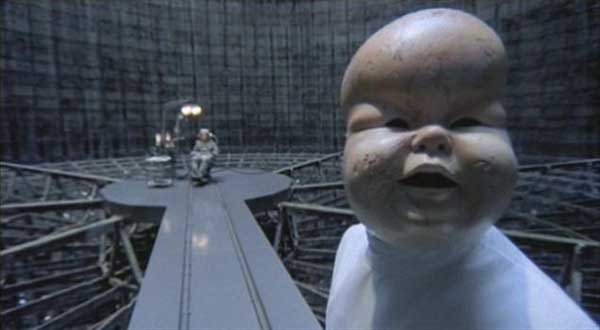
If there is something anarchic, primal, and unknowable about Sam Macon’s new video for Swedish band Goat’s song "Hide From The Sun," from their new Subpop album Commune, that may be in part because there is something primal, pagan, and mysterious about the band itself. Its members wear masks when they perform, and it is rumored that the band has been existence for 30-odd years, in different forms. Leaping to the African-inspired pounding beat of the song, in this video human figures wearing animal masks chase a pre-Raphaelite young woman, wearing a diaphanous white gown, through a misty forest, are subdued by her in a flash of light, and then become her subjects after a hallucinatory journey through a long tunnel into an ill-defined afterworld. The lyrics are not overly intelligible, which is fine; in a song like this words function more as mood-setters through tone than as bearers of meaning. Sam Macon has designed beautiful, semi-Mayan, semi-indigenous, semi-childlike costumes for this piece, and provides animation for its more surreal parts that looks both hand-crafted and carefully considered. Watching Macon’s colors cavort and spin through the universe he creates would leave blessed trails on the retinae of any viewer. The song has a panicky nerve to it; raher than letting his camera be guided by the jumps and jolts of the song, though, Macon lets this energy flow through the film and empower it, pushing it along. Wordless epiphanies occur, one after the other, about power, about the nature of vision, about the passage into maturity, as we move through the video; we drink these in because, old as the story Macon tells might be, we never tire of hearing it.

Max Winter is the Editor of Press Play.

FAST CLIP: Video for Beck’s “Heart Is a Drum” by Sophie Muller

FAST CLIP: Video for Beck’s “Heart Is a Drum” by Sophie Muller

Beck has always had the capacity for expansiveness inside
his songs, even during the goofy days of One
Foot in the Grave
and Loser; the
song “Jack-ass” from Odelay always
read to me as an audio version of a Super-8 tour of a flat, marsh-infested
landscape of unchecked emotions rained upon by pure cool from the artist
himself. He has found a likely chronicler in longtime video maker Sophie
Muller, whose video for “Heart Is a Drum,” from the recent Morning Phase, takes us through and around cycles of life, death,
and aging. It’s been said that the piece owes a lot to Maya Deren’s Meshes in the Afternoon, which may
indeed be true, on the surface, but there are other influences lurking here, as
well, in the dust-bowl era pastoral Muller carries us through: the starkness of
the earliest and most aesthetically pure Bergman films; the Terrence Malick of Days of Heaven in its broad, sparsely
punctuated landscapes; a little bit of early Peter Bogdanovich, of the The Last Picture Show period; possibly
Jim Jarmusch’s brooding but also ambulatory realism that lends itself so
beautifully to down-at-heels domestic scenes. The video tells us a circular story,
as Beck sings his song of universality, of a beating heart “keeping time with
everyone.” We see the mature Beck, suited, standing in a deserted farmhouse,
staring outwards, looking within. Then we see different figures standing at the
end of a dusty road; Muller has played with the actual focus in such a way that
we are never sure where we stand with this story, even at its end. A caped,
masked figure of Death, tall, dark, scythe in hand, stands in a field, far
away, now closer, now walking swiftly towards Beck and a small child. A woman
is stricken down, as is her husband, whose face has an intensity and severity that
recalls the great silent film actors. There is a tremendous sense of poignance here.
The song itself goes in praise of embracing life in its completeness, and the
difficulty of doing so is brought home clearly by Muller’s film. Beyond this,
though, Beck has weathered change within his own work, from punk to funk to
bossanova, and so he has earned the right to slow down, in a sense. There is a
confidence to the way that he sings, “Need to find someone to show me how to
play it slow,” that suggests, in fact, he already knows how, as is borne out by the sound
of his recent albums, which has been, if anything, larger, more declarative,
more resonant than those of the past. As the video drifts towards its
conclusion, we see a hipper, younger version of Beck, bedecked with pony-tailed
ski cap and flappy clothes, walking with Death, in a small party that also
includes a small boy and the doomed couple who appeared earlier—a nod to The Seventh Seal, but also a haunting
image, suggesting that all that has occurred was only for the purpose of moving
onwards, or maybe inwards. Sometimes, there’s nowhere else one might rather go.

Max Winter is the Editor of Press Play.

FAST CLIP: Video for Waxahatchee’s “Misery over Dispute” by Joshua Mikel

FAST CLIP: Video for Waxahatchee’s “Misery over Dispute” by Joshua Mikel

At their best, music videos can function as small films unto
themselves, underscoring the talents of their subjects by placing them
within scenarios that enhance lyrics, music and ambience all at once. In
so doing, these filmlets may recall, either
consciously or subliminally, other films. It is difficult, when watching
Joshua Mikel’s
recent video for southern rocker Waxahatchee’s (Katie Crutchfield)
“Misery Over
Dispute,” not to think of a few different films. The two that ring the
loudest
bells, though, are “Singin’ in the Rain” and “Raging Bull.” An
appropriate mix,
perhaps, for the story the song tells. In 12 lines, the song describes a
collapsed relationship, with the singer’s departure the only option, a
choice
of “misery over dispute.” The video is just under two minutes long,
pounded out
in the musician’s signature fashion, guitars heavy, voice somewhat
raspy, in
some senses more a chant than a song, melodic arc absent, almost
irrelevant in
a song this brief. The singer spends most of her time dancing, under a
spotlight, kicking dust up around her, and catching what look like
cinders as
they fall. Tom Waits fans may find some corollary here to some of the
stunts
Waits has pulled in his live shows, with scattered sparkles and a
semi-shuffle
that kicks up a glowing cloud around him. But what a contradiction of
impulses
this is. The freedom of the dance Crutchfield does here recalls the way
Gene
Kelly danced in a puddle in “Singin’ in the Rain,” with a seamless
optimism
that would be both foreign to contemporary viewers and something of a
standard
to reach toward—reflective, here, of the singer’s ability to leave,
leave and
not look back, choosing loneliness over argument. But, on the other
hand, when
Jake LaMotta dances alone, under dim lights, in a boxing ring, in “Raging
Bull,” we
see a figure who relishes battle, who relishes conflict, and whose
movements
around the ring have acquired, with time, an epic quality, however raw
and crude
his activities while actually boxing might be. As Waxahatchee sings of
feeling
“spineless and sick in your eyes,” we can’t help but feel the pull of
the
battle, of argument, of rage, a feeling conveyed in very few words. The
director has chosen a dark, shadowy room and soft, black-and-white hues
for the
video, usually code for realism, but in this case a code for the
dreamlike
state we find ourselves in when within that most beguiling of situations, the
human
relationship.

Max Winter is the Editor of Press Play.

The Tenuous State of Writing in the Information Age

The Tenuous State of Writing in the Information Age

nullI don’t really do manifestos, typically, or grandstand, or
pitch tents, where writing is concerned. I also don’t ultimately think that setting
rules is a good way to foster creative thought. I do, though, like the idea of
aspiration in writing—of aiming, with all the devotion one can muster, at a
spot just above eye level, at a certain sense of quality, at a sense that
you’ve listened to the voices of influence long enough that you’re putting into
practice what they may have taught you. This publication, the one you’re
looking at, is one of a type. There are others of its type: the other parts of
this network, Salon, Slate, Huffington Post, Think Progress, Dame, Jezebel, and
numerous comrades, too many to name. 
Often, the cultural articles that appear here, and in similarly aimed
publications, e.g. blogs, are distinguished by a crucial link: between what is happening on
a screen, or in an artistic work, and what is happening in the world.  That phrase, “what is happening in the world,”
could mean a number of things: news events, cultural trends, or, most
poignantly, remnants from one’s own past. These pieces, then, often shear very
close to subject matter which could be considered emotionally “hot” for their
writers—content which could either inspire elation or deep rage. Because of
this, the task of the writer is doubled: the root subject must be addressed,
and then what lies behind the root subject, the context, must be addressed. And
in both cases, the task is to address the subject eloquently, and with respect
for the activity in which the writer is engaged: that is, writing. We live in a
time when individuals have more ways to express themselves and to communicate
with others than they ever had before. And communicate they do: in blog posts,
in tweets, in editorials, on personal web sites, and elsewhere. There is no
shortage of passion and sincerity in these writings, particularly the blog
posts. But the problem is that sometimes, in the course of expressing things
which are closest and deepest for the writer, articulation is sacrificed, and
some very, very basic, indispensable rules of good writing and editing are left by the wayside.

When a film or television show touches on themes that are
controversial, and perhaps does it in a way that could be seen as flawed, it’s
inevitable, in the age of instant response, that there will be, almost
immediately, a lot of writing online about the topic. Some of the writing will
be cogent, and might, through its insight, present an outlook on a subject or
theme that you might not have thought of before. It seems to this reader,
though, that often the perspectives I read on these subjects, in the process of
linking the personal to the artistic to the political, have the same general
timbre. The experience goes something like this. As is expected of me, I click
on a headline that draws my attention, usually containing the words “Here’s
Why” or “Gets Right” or “Gets Wrong,” or possibly a strongly positioned “I”
statement which reveals something about the writer’s life or attitudes which is
undeniably alluring. The article opens, I begin to read, and then this is where
I may separate from many readers, or may not. I see lives and attitudes opened
up, presented in their fullness, but I also see problems. Sometimes the
problems are small ones: a missing comma here, a missing word there, a
subject-verb agreement problem there, a misspelled proper name there. These are
easy enough to move past, since they needn’t derail the impact of a piece.  Sometimes, though, the problems are a little deeper.
As you read along, you begin to notice clichés at different points in the
sentences; sometimes a whole sentence might be a cliché. And this is where the
mean-spirited, unsympathetic thoughts begin, that human compassion tells us we
must squelch: I feel like I’ve read this
before. Couldn’t another phrase have been used? I’d like to sympathize, but
this seems a little too after-school-ish for me.
It’s not nice to think
these things, particularly when more personal material is being discussed;
after all, a person’s “telling of their story” is the most exalted act they
could perform, in one sense—the baring of personal history, the laying out of
each person’s true tale. How could that be faulted? In any event, sometimes the
problems lie even more deep within a piece, and this is when readers like
myself, and possibly like others, have really, really mean-spirited thoughts.
Upon reading the writer’s opinions, the reaction is one of a set of rhetorical
questions: How trite could one piece be?
What does this mean? Who does this person think he or she is?
The reason
for this reaction is normally that the issue at hand has not been explored
deeply enough, the contradictory conditions not examined or countered, the
depths probed, and so what you receive, before you, is a one-dimensional
spewing, whose only argument is its thesis, and whose body is really just a
restatement of the thesis. You might well agree with that argument, and praise
it for its bravery, or its honesty, or the stridence of its tone. On the other
hand, though, you might not buy it: the sad life story, the experience of
alienation, the tale of abuse might not draw you in. Why? Because it wasn’t
written well enough, or edited well enough—or both, equally. And so rejection is
a wholly fair response.

Within the tenets of good writing there are many chestnuts.
Avoid clichés. Support your arguments with evidence. Show, don’t tell. Omit
needless words. These tenets have lasted because they distinguish, to put it
simplistically, good writing from bad, profundity from shallowness, writing
that stays fresh for a day from writing that stays fresh for decades. At the
current time, the culture we live in is a mouthy one: for every event there is
a prompt response, and then another, and then another. Blogging itself is an
industry: miraculously, individuals are paid to tell their stories. But, as
with all industries, there are pressures. Pressures for ad revenues. Pressures
for clicks. Pressures for timeliness. And the result of these pressures, it
seems to me, is that a slippage is starting to occur, in which what were once
basic rules of good writing have become somewhat less important by comparison
with these pressures, by comparison with the need to keep the wolf away from
one’s door. We read post after post, each one a window into a personal
experience, each one a microscopic look at one life among billions. And the
urgency of it all is enough that at times it seems as if the publication is
more important than what’s being published. And perhaps it is, in one sense;
maybe the act of unleashing a story one might have held close is healthy for
the writer, and healthy for the reader, cathartic. But there are a couple of
problems. One is that the act of writing, if not taken seriously, results in
bad prose, sometimes even unintelligible prose—which could, if you thought it
over long enough, negate the purpose for having written in the first place. The
other problem is that the basic tenets for what we call “good” writing don’t go
away if you ignore them. The responsibility here lies with the writer and the
editor equally. All too often, our temptation is to blame the author of an
inflammatory, or poorly considered, or baffling essay: How dare she say that! The reality, though, is that most pieces
published in forums in which there is an editor have to pass the eyes of that
editor, and so to a certain extent, the editor has to be considered to have
approved the piece wholesale: its approach, its virtues, and its flaws. Or at
the very least, the editor has to have felt good enough about the piece to
allow it to be attached to his or her name. And so, since the activity being
engaged in is writing, the writer and editor must work together: if the editor
sees problems with a piece, those problems need to be addressed, both large and
small.  If these large or small problems
persist, then a simple question arises: what happened? I have to be careful how
I say the following, because I don’t want to imply that the job of an editor or
the job of a writer is by any means an easy one, or one in which emotions are
not in constant conflict with better judgment. However, I wonder if a change is
taking place in the way we, as a culture, view verbal expression. There is a
part of every writer’s mind, and every editor’s mind, that acts as a sort of
Greek chorus as the work is taking place. Why
are you doing that
, it asks. Are you
sure you want to say it this way
, it asks. Maybe here is a good place to start over, it suggests.  That’s
not how you spell that word,
it groans. You’re
repeating yourself,
it nudges. And, most painfully, Sure, this meant a lot to you, but that doesn’t mean it will move
anyone else.
What I wonder is, then, if that part of the writer’s or editor’s
mind is shrinking, and if the voices crying out inside it are getting fainter, as the pressures of commerce grow greater.
And if, beyond that, as readers, we’re starting to think those voices don’t matter,
after all.

Max Winter is the Editor of Press Play.

HAPPY VALLEY, PRIME SUSPECT, and the Growth of the Everywoman in Crime Dramas

HAPPY VALLEY, PRIME SUSPECT, and the Growth of the Everywoman in Crime Dramas

nullWhen we first meet Catherine Cawood
(Sarah Lancashire), a uniformed police sergeant patrolling West Yorkshire in
Sally Wainwright’s Happy Valley,
she’s dashing into a convenience store to grab a fire extinguisher and a pair
of cheap sunglasses.  She’s on her way to
a local playground where one of the town’s many unemployed, heroin-addicted
youth has doused himself in petrol and is threatening to set himself on
fire.  "He can send himself to paradise,
that’s his choice,” she explains to a subordinate as they walk briskly toward the
scene, “but he’s not taking my eyebrows with him." In these first moments, Wainwright tells us a
lot about the middle-aged Cawood as Cawood tells us a lot about herself, using her
own story, sketched out in broadly downbeat strokes, to build a bridge to the
suicidal young man:

Catherine: I’m Catherine, by the way. I’m 47, I’m
divorced, I live with my sister who’s a recovering heroin addict. I have two
grown-up children. One dead, one who doesn’t speak to me, and a grandson.

Man: So why? Why doesn’t he speak to you?

Catherine: It’s complicated.

Catherine: Let’s talk about you.

It’s an introduction that’s both sharp and endearing, which simultaneously
hints at one of the show’s central, if somewhat buried, themes: Carwood’s
sublimation of her lingering grief at the suicide of her daughter and her
attempt to channel it into selfless service to her family and her community.  Over the course of Happy Valley‘s six episodes, the Cawood we meet in the series’
opening moments—coolly competent, pragmatic, holding on to a touch of vanity—will be pushed to, and past, her breaking point. 

Happy
Valley
is one of three series from Wainwright currently on-air in the U.K. (the
others are Last Tango in Halifax and Scott 
& Bailey
).  It’s
ostensibly the story of a failed kidnapping—there’s a touch of the Coens’ Fargo in the set-up, in which a
seemingly put-upon accountant arranges a kidnapping of his boss’s daughter—and
it’s not until about half-way through that it becomes clear that it’s as much a
case-study of grief and loss as it is a police procedural.  Like its protagonist, however, Happy Valley acknowledges that the world
doesn’t pause for our personal drama—there are teacher conferences, family
crises, and jobs that continue to demand our attention—and so it dutifully
trudges on with its narrative.  As a
result, although the first season (of six one-hour episodes) is available in
its entirety on Netflix, it’s not a show that necessarily invites binge-watching.  It digs too deeply into messy emotions,
placing as much emphasis on its characters’ reactions to events as it does on the
events themselves.  In keeping with this,
actual violence is rare—though when it occurs, it is almost vulgar in its
brutality.

Although it is not without its dark
humor, day-to-day suffering permeates this series—there’s terminal cancer and multiple
sclerosis, alcoholism and drug abuse, high unemployment and abundant squalor. The
focus nevertheless remains on Cawood herself. 
Her daughter killed herself after giving birth to her rapist’s son—a
difficult boy named Ryan who Cawood is
raising without any help from the rest of the family, save her sister.  It’s the release of that rapist, Tommy Lee Royce
(James Norton), from prison—she’s been warned about it by her ex-husband but
it’s not until she sees Royce on the street that it hits her—that triggers
the return of long-suppressed turmoil.  But the stressors that feed that turmoil are
everywhere, and often self-imposed.  Cawood
is raising her grandson, the product of that rape, and his volatility makes her
fear that he’s inherited Royce’s violent streak; she is sheltering her sister, who
is recovering from a long-term heroin addiction; and her position on the police
force thrusts her into competing, contradictory, and occasionally impossible
roles—uniformed police officer and investigator, maternal figure and authority
figure, all at once.  That she serves as
a de facto mother to everyone but her children functions as a cruel,
cosmic irony.

The mini-series form suits Happy Valley.  It’s easy to imagine it collapsing under the
weight of its bleakness and interiority at a longer length.  And it could just as easily get lost in its granular
focus on Cawood.  At roughly six hours, Happy Valley is the same length as Top of the Lake and a few hours shy of Fargo, True Detective, and American
Horror Story
, and yet its ambitions couldn’t be more different—it doesn’t
play to the crowd (or a critical culture built around recaps) with the attention-grabbing
virtuosity of Cary Fukanaga’s direction in True
Detective
(a six-minute-tracking-shot!). Nor does it approach Steven
Soderbergh’s nuanced direction of The
Knick
(which just this week Matt Zoller Seitz called “the greatest
sustained display of directorial virtuosity in the history of American TV”).  Happy
Valley
, on the other hand,is no-frills. 
Because of this, perhaps, the West Yorkshire of Happy Valley is almost indistinguishable from the British police
procedurals I fell in love with in the early-to-mid nineties—Prime Suspect, Cracker (and later, I confess, even lesser series like Blood on the Wire and Rebus) – when I studied and worked in
London. Grey skies. Drab public housing. That general sense of physical and
spiritual fatigue.  What surprised me,
however, is how pleasing I find its drabness. 
Part of this is likely nostalgia. 
But part of it is the knowledge that—having tossed aside pyrotechnics
– the show must succeed or fail on its writing and performances.  In succeeding on those narrow terms, Happy Valley feels like an antidote to the
high-art pretense, elaborate composition, and under-cooked philosophy of so
many of its brethren.

I spent a lot of time thinking
about Prime Suspect while watching Happy Valley. Revisiting Prime Suspect now (something I
recommend), the sexism that Helen Mirren’s DCI Jane Tennison faces at every step—both viciously personal and blithely institutional—can feel a little heavy handed.  It’s easy to forget just how radical Tennison
was when Prime Suspect debuted in
1991. [1] It wasn’t Tennison’s intelligence that made Prime Suspect so different (though it
was uncommon enough) but rather her appetites—for alcohol, for sex, and, especially,
for recognition and promotion.  They
dwarfed those of the men around her, including her superiors (no small
feat).  Unlike Prime Suspect’s wildly popular contemporary, Cracker, which coated its main character’s (Robbie Coltrane) bad
habits in a Romantic gloss, all part of his larger-than-life genius, Tennison’s
appetites are more thorny.  She pays the
price for them just as often as they drive her forward.  By staying neutral, Prime Suspect ushered in an era in which women were not only viable
protagonists in a police procedural, but were finally permitted (if not yet
entitled) to make bad decisions, and even to be occasionally unlikeable. (It
helped, of course, that Tennison’s abundant flaws were dramatized by Helen
Mirren.) The best shows that followed in its wake—like Happy Valley—have found a way not only to acknowledge their
protagonists’ flaws, but to capture the richness and complexity gained from
living with bad habits and decisions.  Wainright
smartly capitalizes on Lancashire’s ability to carry Cawood through endless
registers, from the coolly competent officer we meet in Episode 1 through
periods of grief, depression, anger, and—yes—“unlikeability.”  In doing so, she creates a believable, and
complicated, Everywoman.

To be clear, Cawood does not share
Tennison’s appetites, or her bad habits: 
she’s far more likely to have a cup of tea than a whiskey at the end of
a long day. And yet she engages in an ill-advised affair with her married
ex-husband.  And there’s a fleeting awkwardness
in some of her conversations with superiors and former colleagues that suggests
the kind of personal history neither party wants to revisit.  That these plot points are not central to the
drama—and are often no more than implied—could be interpreted as a sign of
progress, though Wainwright has taken some pains to distance Cawood from Tennison,
explaining that "Prime Suspect was 20 years ago," and that, in talking to current police
officers, "None of
them seemed to think it was a big deal they were women. The police have gone
through a lot of reforms. There might be some hidden sexism, but now it’s
really not that unusual for a woman to be the head of an investigation. To try
and make an issue out of that would have felt rather old fashioned."

Perhaps she’s right. 
Times change.  The recent attempt to
adapt Prime Suspect to US television never
quite figured out how to translate the original’s tension into the 21st
century. But how distant is it, really?  I
got the sense watching Happy Valley that
the changes Wainwright cites aren’t, in spite of her optimism, necessarily all for the better.  At least Tennison was generally left to do
her investigative work.  Cawood’s
responsibilities, on the other hand, are endless—part Sherlock, part social
worker, both manager and mother.  And it’s
not as if sexism has disappeared, either in or out of the station-house.  It’s embodied by her superiors, who at times display
a boys-club disregard for her concerns (though, as with Tennison, they’re quick
to trot her out for public relations value.) 
And it’s on display in one of the show’s best—and funniest—scenes,
when Cawood’s ex-husband, a reporter who Cawood has repeatedly pushed to write
about the Yorkshire drug trade, calls her to say that he’s followed her
advice.  As he goes on and on, explaining
the workings of a local supply and demand that she deals with on a daily basis,
Cawood feigns interest in what he’s telling her—to preserve his enthusiasm,
or his pride, or just out of learned deference – as her expression simultaneously
reveals a bemused frustration that he doesn’t realize she already knows all it with
a level of detail he’ll never even comprehend.  This isn’t the misogyny and sabotage that
Tennison faced—her ex-husband loves and respects her—but it’s also clear that
we’re a long way from out-growing our conditioned biases (including,
apparently, mansplaining).

It’s true,
however, that these issues aren’t the focus of Happy Valley—even if the series benefits from the heavy lifting
of those that came before, it’s content to swap the personal for the
political.  But it’s not all Cawood, all the time.  Underlying the kidnapping narrative is a
somewhat half-formed argument regarding evil and its origins.  As the focus narrows on Cawood, however, the
peripheral stories and characters grow a little threadbare, including the
kidnapping narrative (though both George Costigan, as the father of the
kidnapped young woman, and Siobhan Finneran, as Cawood’s sister, are excellent
in their roles).  Problematically, the
motives of the criminals are never entirely clear—not even their greed explains
why they take on the risk of a kidnap and ransom—though they share a few
traits:  hubris, myopia, and selfishness,
to start, but also an abject refusal to take responsibility for their actions
and the damage they’ve caused. 

The philosophical argument, on the other
hand, begins and ends with Tommy Lee Royce, whose violent sadism over the
course of the series confirms Cawood’s worst fears.   At her
low-point, exhausted, depressed, and likely suffering from PTSD after a beating
at Royce’s hand, Cawood confesses to her ex-husband her fear that Ryan is
destined to be like his father.  In answering
the age-old question of nature or nurture, however, Happy Valley comes down emphatically on the side of nurture and
against the idea of ineluctable evil.  As
her ex-husband explains, Royce isn’t a sociopath, he’s a "little twisted
thing[s] who grew up unloved . . . more than unloved, despised probably,
treated like dirt on a daily basis in squalor and chaos.”  And he’s right, at least to some extent—we’ve met the mother and she is, in technical terms, a nightmare.  These abstract themes would be empty
exposition if it weren’t for Wainwright’s and Lancashire’s work.  In numerous scenes, when Cawood’s carefully
cultivated patience and selflessness are peeled back to reveal a very real
rage, she is legitimately frightening in her isolation and her instinct to lash
out at those nearest to her.  In those
scenes, Happy Valley comes closest to
making a political pitch, though it is fittingly rooted in psychology.  The "little twisted thing" inside
Tommy that drives him to violence exists in each of us, it suggests, and what
holds it at bay is family, stability, and structure.  And martyrs like Catherine Cawood.  But given the unrelenting chaos and squalor that
threatens Happy Valley, and the
punishment Cawood endures (she half-jokes at one point that she should have “punching-bag”
written on her forehead), it’s unclear if this is any reason for optimism.

Spencer Short is an attorney and author. His collection of
poetry,
Tremolo (Harper 2001), was
awarded a 2000 National Poetry Series Prize. His poetry and non-fiction have
been published in
The Boston Review, Coldfront, the Columbia Review, Hyperallergic,
Men’s Digest, Slate, and Verse. He lives in Brooklyn.


[1] Prime Suspect
debuted in the U.K. just three years after the demise of Cagney & Lacey here in the U.S.– a show canceled early in its
run over concerns the characters were too tough (and thus likely to be mistaken
for lesbians) before being revamped, softened, and returned to the
line-up.  Wainwright’s Scott & Bailey bears more than a
passing resemblance to Cagney & Lacey.

METAMERICANA: How Eoin Duffy’s Animated Short THE MISSING SCARF Forecasts Our Adorable, Inescapable Apocalypse

METAMERICANA: How Eoin Duffy’s THE MISSING SCARF Forecasts Our Adorable, Inescapable Apocalypse

For
many decades, the secret to making a
highly successful and thoroughly educational children’s film has really
been no secret at all: simply give a live-action, hand-puppet, or
animated avatar (all stand-ins for the child herself) an embarrassingly
simple dilemma, and then detail the tyke’s increasingly hilarious
attempts to navigate it. The last of these efforts will, of course, be
successful. The Missing Scarf,
an Academy Award-nominated animated short written by Eoin Duffy and
narrated by cult icon George Takei, now widely viewable for the first time, at first seems to check all these
boxes. In fact, it ultimately turns each of them on its head. The result
is a superlative and resoundingly educational adult film that’s every bit as abstract and harrowing as the average Sesame Street short is tactile and comforting.
The
plot: Albert the Squirrel has lost his scarf, which seems like a
consequential mishap until we meet Albert’s friends, who are
considerably worse off. Cecil the Owl is terrified of the dark, despite being nocturnal; Conrad the Beaver worries that he is incompetent at the only thing his species is known for (building dams); Edwin the Fox, despite the natural charisma of his species, believes that
his friends are plotting to kill him; and Frederick the Bear, poor
gentle brute, daily stares into the abyss of not just his own but the
entire universe’s (relatively speaking) impending self-annihilation—a
fear of individual and collective death that is, we must
concede, entirely rational. 
Albert’s
friends, in other words, are facing the adult equivalent of not being
able to tie your own shoes: they’re finding it impossible to function as
members of a civil society. Cecil can’t meet his responsibilities
because he’s temperamentally incapable of facing them; Conrad accepts
his responsibilities but has no aptitude for them; Edwin has aptitude
for his responsibilities but takes no pleasure in their
fruits; and Frederick is capable, successful, and reasonably
well-adjusted—all of which gives him the time and space to realize that
absolutely nothing any of us does matters in the slightest.
Albert
offers gems of wisdom to each friend, for which service he receives no
direct compensation—as his friends haven’t seen his missing accessory.
Cecil is shown the illuminating wonders of the dark (though all he
ultimately finds is, quite literally, a steaming pile of manure); Conrad
is shown the utility of failure (though all he ultimately experiences
is the terror of drowning, as his
dam does indeed break, killing him); Edwin is shown that isolation is
often self-imposed (though when Edwin ends his self-imposed isolation
and opens his heart to his friends, they do in fact kill him); and
Frederick is shown that nature is more resilient than he suspects—a possibility he doubts, but is willing to ponder further. Throughout these
lectures, Albert is revealed to be such a wise old soul that it seems impossible that he was ever so careless as to misplace an article of
clothing in the first place. Albert, that is, is a fully formed and
fully evolved entity, one whose foibles and follies are adorable
primarily because they’re the only things that distinguish him from a
god.
But it’s at this point in the narrative of The Missing Scarf
that the genre into which Albert’s escapades have been encoded catches
up to him—and his friends—for in educational children’s films, there
is always some surprising event toward the end of the narrative that
either solves the hero’s dilemma or renders it irrelevant. In Albert’s
case, it’s the young squirrel’s sudden realization that the arrival of
spring means his scarf is no longer necessary.
This, in the world of The Missing Scarf,
is exactly when the world ends. Literally. Frederick and Albert are
both killed then and there, horribly and graphically, as is all life on
Earth. Their final moments alive are filled with confusion, terror, and
abject despair.
It’s
not entirely clear what the takeaway is here. It may have
something to do with the fact that all creative invention—for instance,
an animated short—relies on the illusion of control, indeed
the abiding artifice of what we politely call free will. To say that we
live in a world in which we may truly "create" is to assume we have
the time, space, energy, means, and culture into which a novel creation
may be put. But even if we have all these things, they just as surely
are temporary: they can be taken away from us at any time, by anyone or
anything. We could suddenly be maimed, imprisoned, or even murdered; we
could lose our ambitions, lose our will, or even lose our minds; the
world could shift all its relations beneath our feet by the time we wake
tomorrow, or instead be destroyed utterly (and just as unexpectedly) by
some outside force we can’t presently foresee. This last tragedy is
exactly what we find in the final seconds of The Missing Scarf, reminding us that our colossally sincere commitment to creation
can in half an instant be thwarted by the equally colossal irony of all
matter’s inevitable destruction.
The Missing Scarf
is equal parts funny and scary; heart-warming and heart-rending;
allegorical and desperately literal. Arguments could be made for it
to reside at any point on these (or other) polar spectra. But what’s
certain is that the film as a whole—however brief it is; indeed, it
clocks in at under seven minutes—is not just a riveting but an entirely
necessary bit of viewing for any adult who wants to understand our
cultural moment. We are suffused, today, with a sense that
while we can’t know exactly when the world as we know it will end, we do
know for reasonably certain that we are presently doing our level best
to hasten that end with (for instance) our over-use of
environment-killing fossil fuels. Similarly, we can’t know exactly what
daily obstacles and long-term tribulations we have it in us to overcome,
but we know beyond a shadow of a doubt that, right up until the moment
of our species’ annihilation, answering that question will always fall
solely to each of us as individuals. 
Postmodernists
like to say that we’re at the end of history, but in fact it is far
more correct to say that we are living in the shadow of history—with an
emphasis on the word living.
Whatever fate befalls us singly, collectively, or (as to Albert and
company) in our separate and/or communal manifestation(s) as multimedia-driven,
allegorical avatars, we are compelled to rush toward that fate with as much
grace, courage, and wisdom as we can muster. 
Albert starts out missing a scarf, and ends up missing his head. Too often we start out our adult lives
without our wits about us, and therefore spend many wasted years searching for things we don’t really need. The Missing Scarf
urges us to get ourselves back on track with the same alternately
optimistic and cynical urgency of a public-television clip in which
Cookie Monster learns how to avoid indigestion or Elmo learns how to
share a skateboard. The only question is, are we listening? The Missing Scarf
pulls out all the stops to get us to listen—everything from adorable cartoon
animals to a voiceover by our favorite YouTube celebrity—and for that
it deserves commendation as one of the best short films of the last
decade, animated or otherwise.

Seth Abramson is the author of three collections of poetry, most recently Thievery (University of Akron Press, 2013). He has published work in numerous magazines and anthologies, including Best New Poets, American Poetry Review, Boston Review, New American Writing, Colorado Review, Denver Quarterly, and The Southern Review.
A graduate of Dartmouth College, Harvard Law School, and the Iowa
Writers’ Workshop, he was a public defender from 2001 to 2007 and is
presently a doctoral candidate in English Literature at University of
Wisconsin-Madison. He runs a contemporary poetry review series for
The Huffington Post and has covered graduate creative writing programs for Poets & Writers magazine since 2008.

VIDEO ESSAY: Terry Gilliam: The Triumph of Fantasy

VIDEO ESSAY: Terry Gilliam: The Triumph of Fantasy

In a 1988 interview with David Morgan for Sight and Sound, Terry Gilliam proposed that the most common theme of his movies had been fantasy vs. reality, and that, after the not-entirely-happy endings of Time Bandits and Brazil, The Adventures of Baron Munchausen offered the happiness previously denied, a happiness made possible by “the triumph of fantasy”.

That
triumph is not, though, inherently happy. Gilliam’s occasional happy
endings are not so much triumphs of fantasy as they are triumphs of a
certain tone. They are the endings that fit the style and subject matter
of those particular films. More often than not, his endings are more
ambiguous, but fantasy still triumphs. Even poor Sam Lowry in Brazil
gets to fly away into permanent delusion. Fantasy is sometimes a
torment for Gilliam’s characters, but it is a torment only in that it is
haunted by reality, and reality in Gilliam is a land of pain,
injustice, and, perhaps worst of all, ordinariness.

For
if there is, generally, an overarching theme to Gilliam’s work, it is
one familiar from fairy tales, comic books, science fiction stories, and
so many other works of popular culture: the yearning of an ordinary
person to be, in truth, extraordinary — a hero, a savior, a king, a
master of the universe. (Time Bandits is Harry Potter
avant la wand, and it’s no surprise that, according to Gilliam, J.K.
Rowling and others hoped he would direct one of the movies.) Gilliam is
especially sensitive to the ins and outs of this power fantasy, and as
much as he wants to maintain the pure, innocent wonder of children’s
experience, he recognizes that in adults such wonder may be far from a
blessing. Notice, for instance, how in many of his films, including his
most recent, The Zero Theorem,
there’s a component of gendered, heterosexual fantasy: an awkward (even
schlubby) male builds up a fantasy of a beautiful (often blonde) woman
who ushers him into his heroism.

Thus, the theme song for The Zero Theorem,
Karen Souza’s sultry cover of Radiohead’s “Creep”, is deeply
appropriate not only for that film but for so much of Gilliam’s work
overall. The point of view is that of a person who sees someone as “just
like an angel” and feels not merely inadequate but repulsive: “I’m a
creep. I’m a weirdo.” Some of Gilliam’s protagonists become heroes in
the world of the film, and get to trade in their status as weirdo and
experience the life of the lauded; others have their ideas of heroism
challenged and subverted, their dreams transformed so that they can
better live in everyday life, but still: the desire to transcend
ordinary existence is common to most of them.

For
all his love of fantasy, Gilliam is enough of a realist to know that
most creeps and weirdos don’t get the girl of their dreams, or the girl
of their dreams turns out to be more human than they’d bargained for,
and so what they are left with is the pure, perfect bliss of the dream —
the triumph of fantasy. Whether, in the end, we see such a triumph as
pitiful and escapist or heartwarming and nourishing — or somewhere in
between — is up to us. The greatest triumph may be the sort we see at
the end of The Fisher King,
where after all the delusions and madness and quests and tears and
dreams we are encouraged to seek not girls to fantasize about or dragons
to slay, but ordinary moments to infuse with wonder.

Matthew Cheney’s work has been published by English Journal, One Story, Web Conjunctions, Strange Horizons, Failbetter.com, Ideomancer, Pindeldyboz, Rain Taxi, Locus, The Internet Review of Science Fiction and SF Site, among other places, and he is the former series editor for Best American Fantasy. He is currently a student in the Ph.D. in Literature program at the University of New Hampshire.

VIDEO ESSAY: Electric Sheep: How Female Power Is Limited By Consumer Culture

VIDEO ESSAY: Electric Sheep: How Female Power Is Limited By Consumer Culture

[The script for the video essay follows.]

In the opening montage to Do The Right Thing, Tina, played by Rosie Perez, dances to “Fight
The Power,” the only figure in an otherwise empty urban landscape. In this opening sequence, Tina symbolizes
everything we associate with female power: a delicate body in a kung fu pose,
her big beautiful eyes coupled with tight fists. In the world of the “strong
female character,” sex is a snarl, fingers are clenched and punches are thrown,
even though the camera zooms in and lingers on curves.

In the opening credits Tina seems active and empowered, In
the actual film, Tina is house-bound. We see moments of her talking to Mookie,
begging him to come home or lecturing him about being a man. However, we don’t
have any scenes of interiority, where Tina is established as a character, with
her own hopes and dreams. 

Her existence in Do
The Right Thing
is less about unpacking the world that women of color live
in than showing a sexy female figure in a poor urban landscape. After that
opening sequence, Tina is actively disempowered. Her role goes from
revolutionary to mere eye candy. Tina’s big moment in a film about individuals
making hard choices is when Mookie finally shows up and rolls an ice cube over
her segmented body.

The image of the female revolutionary has often been adapted
to fit different time periods. In the 1928 film, The Passion of Joan of Arc, we see close ups of Joan’s face
crying. In a ’48 version we see Joan in full armor leading the charge, as well
as images of her bound and crying. In
the 1999 film, The Messenger, Joan’s
hair is shorn, her eyes looking intently, her lip curled into a snarl. Is Joan
of Arc’s strength from her religious conviction, or her prowess on the
battlefield? 

We focus less on the substance of icons of female strength
than we do on their image. We worry about what Wonder Woman is going to wear
when she fights evil. We get concerned about whether Super Girl’s breasts look
fake. We cheer when Beyonce dresses up as Rosie The Riveter; her curled bicep
is lauded as a powerful statement about female empowerment. We care less about
what celebrities actually do to help women than whether or not they are
willing and proud to proclaim themselves feminists. We want the quick sound byte,
the 3:00 minute Upworthy video, the clever meme.

We don’t want women to be objects, but we sure as hell want
them to be symbols. 

The powerful woman is defined first by how she looks and how
she holds her body. The “strong female lead” is always beautiful and fierce,
sexy and tough. She has a tragic back-story and a yearning for justice as solid
and strong as any male action hero. In today’s world, Xena, Buffy, The Bride,
and Lara Croft, as well as superheroes like Wonder Woman and Super Girl, are read
as powerful because of their physical prowess. Often their power is meant to
surprise us precisely because, despite their physical strength, they appear
pretty, delicate, and sweet.

The ubiquity of these images of female strength and power is
exacerbated in a world of Instagram images and constantly generated GIFs.
Beyonce’s allusion to Rosie the Riveter is one part homage and one part
marketing initiative. It’s a beautiful, brazen and, above all, familiar image,
a picture of feminism that we generally don’t question, an idea about power we
all agree we can get behind.

Beyonce and Janelle Monae are two artists at the forefront
of today’s feminist movement. Beyonce is deeply invested in claiming space for
female experience in a man’s world and insists on a woman’s right to “have
it all.” In contrast, Monae demands change. Monae doesn’t want us to “ban
bossy” or “lean in”, she wants us to open our minds. To embrace creativity,
queerness, sensuality.

There’s a reason Beyonce can be heralded as both a feminist
icon, and also have her lyrics used to support a mainstream film like Fifty Shades of Grey, which is less
about S&M than a relationship that meets all the criteria for abuse. In
reality, Queen Bey isn’t worried about power dynamics as long as she gets to
call the shots, which is why her rallying call of “bow down bitches!” is less a
call for female revolution than an assertion that she wants a seat in the boys
club.

Beyonce’s feminist message, though visible and important,
does not actively disrupt the mainstream. In contrast, Janelle Monae is an
R&B artist who is actually deeply invested in dismantling the way we think
about power. In her debut studio album, The
ArchAndroid
, Monae plays the character Cindi Mayweather, an android who
time travels to save a civilization from forces trying to suppress freedom and
love. In her recently released Q.U.E.E.N.,
Monae also calls for revolution. She encourages solidarity amongst the
disenfranchised, the wacky and the just plain weird. Women in Monae’s videos
don’t bump and grind, objects for the camera, the way they do in almost every
single music video. They smile, they dance, they play records, they sing.  While Beyonce croons slow ballads about
yearning to be an object of allure for her husband, Monae tells a male lover on
“Prime Time,” “I don’t want to be mysterious with you.”

In a world where female sexuality and power is
still often obscured, rendered strange, unintelligible, or made to exist to
fulfill a male fantasy, Monae’s insistence on being seen as a full person is
far more radical than any power pose you can copy and share on Facebook or
Instagram. While Beyonce’s brand of feminism might be a more attractive model
for consumer culture, it’s artists like Monae, who insist on questioning the
ways we are labeled, that will ultimately help us do what Tina in Do The Right Thing strives for in her
opening dance, but never ultimately achieves: get a chance to actually fight the
power.

Arielle Bernstein is
a writer living in Washington, DC. She teaches writing at American
University and also freelances. Her work has been published in
The
Millions, The Rumpus, St. Petersburg Review and The Ilanot Review. She
has been listed four times as a finalist in
Glimmer Train short story
contests
. She is currently writing her first book.


Serena Bramble is a film editor whose
montage skills are an end result of accumulated years of movie-watching
and loving. Serena is a graduate from the Teledramatic Arts and
Technology department at Cal State Monterey Bay. In addition to editing,
she also writes on her blog Brief Encounters of the Cinematic Kind.

Thanks, Mrs. Doubtfire. Thanks, Mom and Dad.

Thanks, Mrs. Doubtfire. Thanks, Mom and Dad.

nullWhen I learned that Robin Williams
died, I watched Mrs. Doubtfire. Right before I watched it, my mother and I stood
beneath the ceiling fan in the kitchen of her Brooklyn home. She looked at me. Mrs.
Doubtfire
, which showcased the brilliant performance of Williams as a newly
divorced father named Daniel and Mrs. Doubtfire, a snarky and sweet nanny, was
one of the many films we watched together in the nineties, after she and my
father were divorced. After long days spent at her nursing job, she would come
home to the apartment we shared then.  At
night we would pop in VHS tapes that we’d rented or bought from a nearby
Captain Video: Beaches, Terms of Endearment, Mermaids, This Is My Life, and some
others. Each film had meaning for us because it touched upon relationships
between parents and children.  I was
thirteen years old when Mrs. Doubtfire was released.   I was thirty-three when I held the
dusty VHS tape that she brought me from her basement to watch in Williams’
honor. In her kitchen we both felt for this man who
entertained film watchers like us but who suffered tremendously.  My mother is a
mental health nurse; he easily could have been one of her patients.  Often she works with individuals who are at high risk for suicide. She sees the effects of
depression first hand.  And as a teacher,
I’d lost a military student, who was warm and funny, to suicide two years earlier. The tears
in my mother’s eyes came when she asked me to remember the powerful if common
message Williams offered in the film: Children are not responsible for
their parents’ divorce.  In response, I
hugged her.

These days I understand things
about her and my father’s divorce that I didn’t understand when I was
nine. Back then, all I could focus on was
my own pain.  I wanted us to be a family
again, rather than being shuffled back and forth between two homes for the joint
custody arrangement my brother Michael and I had chosen. On a summer day not long before our family of
four ceased to exist, he and I took a walk to our local drugstore in Midwood, Brooklyn. It was a place where we’d often bump into neighbors because it was also near a
popular pizzeria, Sal’s. It
was next to Five Star Video, another video store that housed VHS tapes and
always had updated posters in the windows: such as the poster for Ghost,
starring Patrick Swayze. On the stretch of residential blocks towards
the stores, our four year age difference, which sometimes caused Michael to tease
me about my “black tooth,” one of my two front ones that was permanently gray
from a dead nerve after I fell on it, was put aside. I asked him who he wanted to live with. He said, “Both of them.” I rapidly agreed. It
was impossible to choose. We wanted our mother and father equally. 

Recently, watching Mrs. Doubtfire
for the first time in years, I found myself paying closer attention to the
parents’ words and actions, and less attention to the children’s. While I am not a parent, Michael is. So are
many of my friends. I am a constant
witness to their responsibilities, in addition to the ones my own parents still
hold. I am trying to secure a full time
job in a difficult field and economy.
They continue to embrace their roles with nothing but love. I didn’t fully see how that kind of love
could exist in life or in the film while watching it in the apartment my mother
and I shared.  I could only find myself
in Daniel’s children, viewing the three of them, and Michael and I, as victims
of “a broken home.” I was sullen Lydia,
who wasn’t used to having her parents living in separate homes. I was Chris, who resented having had a
birthday; if I hadn’t had a stupid plaster paint and clown party at age seven
with the son of the man my mother was seeing after the divorce and later
married, maybe they wouldn’t have coupled up, and she and my father could get
back together. I was Natalie, who hated how my parents didn’t get along; they’d
gone from smiling on Christmas mornings together, when Michael and I opened our
gifts, to being unkind about one another in the same way that Robin Williams
angrily delivered the line, “You’re my goddamn kids too.”  But as an adult, I understood that I hadn’t
been the only one who felt badly. My
parents had their struggles as well.

In Mrs. Doubtfire, Daniel hugs his
children when he moves out. My mother hugged us when her friend Susan helped
her carry furniture down the stairs of our home.  Standing by the couch witnessing this was one
of the saddest moments I had experienced yet. 
My mother wasn’t crying, but it didn’t mean she wasn’t hurting. She was holding it together for Michael and me. My father did the same when suddenly
he had to make dinners and manage a household on his own much like Daniel and
his ex-wife Miranda. The difference is
that the film ended after 125 minutes, and my parents’ job was never really
done. From those early days of packing
lunches, making sure we had the things we needed, such as school uniforms,
books, food and a roof over our heads, to today when they are doing all they
can to be good grandparents to Michael’s daughter and eventually his son, they stand by us. In the past I saw Michael and myself as part of
their failed marriage. I now know that
the vacations they didn’t take, the expensive clothes they never bought, and
the very few dinners they had out were done for the same reasons stated at the
end of the movie. I can still hear Robin
Williams’ voice in my head: “If there’s love, dear, those are the ties that bind.”

Although Robin Williams is no longer with us, his
roles as Daniel and Mrs. Doubtfire will continue to shine because of what they
represent to families who experience divorce firsthand. There will always be families like mine, who
have learned to adjust to less than ideal circumstances.  There will be children who need to be
reassured that “grown up problems” have nothing to do with them, and they are
still loved. When I hugged my mother
last night, we both said we felt terrible about Robin Williams. And I’m certain
that we were appreciative, not just of each other but of Mrs. Doubtfire, too.

Kathryn
Buckley lives in New York and teaches in New Jersey so she spends lots
of time on trains.  When she isn’t grading papers, reading or writing
she goes to concerts, spends time with people she is fond of who
tolerate her and her strange ways and uses Fujifilm disposable cameras
to take pictures she actually has developed because she prefers the
Stone Age to this digital one.  She has an MFA in Fiction from The New
School and her work has appeared in
From the Heart of Brooklyn Volume 2,
Toad Journal, The American, Ebibliotekos, 34th Parallel, and Eclectica and
is forthcoming in
The Chaffey Review.

Tim Sutton Talks About MEMPHIS as the Doorway to Enlightenment

Tim Sutton Talks About MEMPHIS as the Doorway to Enlightenment

nullTim Sutton is a Brooklyn-based filmmaker whose first film Pavilion was part of the IFP Narrative Lab
and opened at SXSW in 2012. Memphis, his
second feature, played at the Venice Film Festival and Sundance last year. But unlike many other indie filmmakers,
Sutton isn’t splashed across social media, documenting his filmmaking via Instagram
or Twitter. So when I went to meet him at the Chateau Marmont lounge in West
Hollywood, I had no idea who to look for. To my luck, his familiar publicist introduced
us, two white wines on the table next to a shabby/chic couch. Sutton smiled,
hair half grey, round glasses and a button down. Sutton and I immediately got
to chatting about our love for New York City and how trendy Bed Sty has become.
Like Memphis, New York City can be a place for wanderers, for people searching
for internal, eternal answers. It turns out that Sutton, like his main
character in Memphis, is on a
spiritual journey to burn down structure in search of the sublime.

I should preface that Sutton isn’t as dreamy or bohemian as
his work might suggest. He’s a very humble, regular man who, like me, still
finds hanging at Chateau exciting. His everyman mood is exactly what makes his
introspective film that much more palpable. Although the themes may be lofty,
they’re grounded, like Sutton, in a very universal battle: the struggle for simple human
happiness.

Memphis was lyrical,
vacillating between narrative and documentary, an intriguing portrayal of
Willis, a gifted singer in search of wisdom. But the film is just as much a
jewel as it is a challenge; the elusive story and nearly non-existent plot are undeniably
polarizing. The film isn’t easy to watch and takes an immense amount of focus
with an elusive payoff. Some may walk away feeling that their time was wasted, while
others might feel enlightened. Sutton admits, “Thirty people walked out of the
press screening” at Sundance. The film was first developed through the Venice
Biennale College-Cinema. The program cultivates and enriches projects that go
on to premiere at the Venice Film Festival. Memphis grew out of the highly respected program but premiered at the festival
to little praise.

Despite its divided audiences, Memphis continues to gain an impressive amount of steam, finally
premiering in LA last week.  It’s not
targeting mainstream viewers, but instead critics and audiences that are
interested in uncovering indie gems. Sutton is approaching cinema in an
exciting, intimate way, vulnerably and without the pressure to meet audience
expectations. He’s not concerned with resolution or moral lessons encapsulated
in happy endings.

“I’m not trying to be a rebel, to break rules, I’m just trying to find myself
in this universe and be okay not knowing.”

At the center of the story is Willis (Willis Earl Beal), a
wanderer. Sutton glows, clearly passionate, when we start to discuss the
character in detail.  He “has all the
gifts from God… and people want success for him. What he wants is elusive. It’s
glory. In a way it’s searching for identity, life, satisfaction, some version
of success.” It’s not hard to draw comparisons between Memphis and Gus Van Sant’s Last
Days.
Van Sant focuses on Kurt Cobain (Michael Pitt) in the same way Sutton
frames Willis. They let their subjects roam, unrestrained, and follow them like
a documentarian might. The films are moving portraits.

The entire film hinges on Beal’s performance, a
collaborative partnership that Sutton refers to as a “cosmic occurrence.”
Sutton didn’t go through casting directors or reach out to Willis’ agents. His
producer John Baker sent him “ a clip that was on Pitchfork of [Willis] singing
a song into a cell phone on his grandmother’s back porch. It’s nothing; it’s
for no one.” Sutton was sure, though, that he could center his film on Beal,
saying “he is living something in that song.” He admits their first meeting felt
unusual, when they met in “New York City on the Upper East Side in a Chinese
restaurant and Willis ordered a scotch.” Willis’ wife also joined the meeting,
which Sutton didn’t expect. Everything about their relationship is admittedly like Oscar and Felix, but somehow their journeys are similar. “I was writing Willis Earl
Beal’s life without knowing who he was. He was living my movie without knowing
who I was. I hate to be all like flighty about it, but it’s prophecy!”

“It’s a totally autobiographical movie.” Sutton stresses that,
even though he’s not from the south or a singer, “It’s me.”

“I’m a very spiritual person in the same way that Willis is. I believe
in brain waves and signs and nature and the power of the sun and the moon. What
is it telling me? I have no idea, but it fills me.”

Another crucial part of the film is the city of Memphis.
Sutton has a long past with the location, first traveling there when he was 21
years old. “I found the place where people like me don’t go to. It was an
astounding event. I danced all night. Something was happening there that I felt
like nobody gets to experience. It stuck with me.” Sutton encapsulates the
broken landscape, filling the movie with abandoned buildings, lush forests and
the fascinating populace itself. “Memphis is a town where some of the greatest
singers of the world came out.  Some of
them were buried in unmarked graves. There’s a curse in Memphis, as a much as a
blessing. There are beautiful trees and churches on every block, but across the
street is a liquor store and a pawn shop. The rich and the poor, the black and
white. It’s like a volcano.”

That same juxtaposition also exists in Los Angeles,
melancholia and glamour, irrefutably at its peak at the Marmont.  It’s a guilty pleasure to talk about with a
filmmaker while sipping chardonnay. But the parallels, as lofty as they may be,
are clear between Memphis and the soul of an artist like Willis.
 

That conflict, finding glory and happiness but also
portraying ugliness and sorrow to be a decent artist, is the crux of Willis’s
story. How does a city like Memphis preserve its culture, but escape its
poverty? Tim doesn’t provide answers, just posing the questions. There’s no big
Hollywood bow at the end, which some may find maddening and others liberating.

Tim’s search for the sublime has been in his blood for
years. I ask him about his childhood, for a circumstance he can pinpoint as the
beginning. Immediately, he refers to the story of John Henry, a book his mom
read to him and which he even continues to give as a gift. “The last image in
that is him busting through a tunnel, into an orange infinity, and then he
dies. That image took on such mystical power in my mind over the past 30 years
that it became this psychedelic story that I could make, that Willis becomes
this image; and he does. My father died when I was 9 years old. I’ve been
searching for that elusive figure ever since.”

Locating Sutton and his background firmly is just as
difficult as doing so with Willis.  Where
did he come from? He laughs, “At the
age of 25 I thought I was going to win Sundance Film Festival and be a hero.
But I did not do that.” He then set a goal to make a feature by thirty, but
life got in the way.  He worked at Getty
Images for four years in the footage department with a $200,000 yearly budget
to make pretty much whatever he wanted. “I started working with this DP and
started doing silent short films. “ They developed a language together,
learning to build a curious, beautiful world around their subjects.
 

He didn’t make his first feature till he was 38. By that
time, he was also a father: “I was more assured in myself as far as a leader in
an honest way.” This confidence was key in the making of Memphis, a project that, given its spontaneous shooting format,
could have gone totally wrong. But Sutton didn’t try to control his team on set
or off.  He focused on “empowering” his
colleagues instead of controlling them.

Sutton describes his hobbies as a kid, some of which inform
his current ability to work in such a fluid, trusting fashion. “I was into
soccer because it was amorphous.” For a time, he also considered being a jazz
critic. “Everyone goes their separate ways, and then somehow they all know how
to come back into a certain form and then go out again.” He is fascinated with
the idea of making something “shapeless” and “liquid.”

“In my filmmaking I’m completely in the present. I’m completely where I
probably can’t be in my real life. That’s my dream life, to be constantly in
the present.”

Memphis can be
included, rightfully so, in the current discussion about breaking structure and
the rapidly growing viewing platforms. Netflix, Apple TV, Amazon and a number
of other outlets are at the forefront of a viewing revolution: the media are no longer constrained by time. Audiences
can consume them in a variety of ways. This is exactly what makes Memphis pertinent. Sutton is not just talking about re-evaluating structure,
like every TV executive. He actually did it. “You have to be
open to the void, utter disaster. What you’re making is a living document.” He
focused more on the feelings than sticking to a standard plot, especially when
presenting his 40-page script at the Venice Biennale.

He also chose a producer, John Baker, who has worked in
documentary film. He didn’t want a “set” or actors who had “agents’ schedules.”
Instead, he found people who were ready to “glow on film.” He steered clear of
directing on set, but would prompt his actors with simple questions, such as, “I want to
know what you think about love.” Walking up to people in Memphis and talking to
them about making the film in thier city wasn’t a hard sell. Sutton told them, “It’s got to be you.”
“No one says it’s got to be you to these guys.” His film is a platform for
these people whose stories would otherwise go untold. He gives them the power
and confidence to share.

This documentary-style, raw, shapeless feeling of the film
both pulls viewers in and pushes some of them away. Sutton, though, is moving on to a
new project that he hopes will shape his filmmaking further, and perhaps leave fewer
audience members behind. “Instead of being about a dream world, it’s very much
of this world and it’s based around a horrible tragedy. Pavilion was about discovery, youth. Memphis is about pure experimentation. It’s abstract. This third
film will be about executing the form in a way that’s more recognizable to
people.”

Sutton makes us wonder why we categorize new filmmakers that
come around, especially on the festival circuit. Are they dramatic directors,
dark comedy directors, or activists for a cause? Sutton proves that perhaps an exciting
new artist can’t be pigeonholed in this way. His work suggests a little bit of every genre
and every tone. But Sutton reveals, “The nicest thing someone has said about my
filmmaking is that it’s like lotion. It becomes part of your skin, something
that’s physical.”  As much as Sutton
wants his work to wash over you, he isn’t pretentious about it. His work may
resemble Terrence Malick’s, with sparse dialogue and lyrical visual sequences.
But Sutton isn’t demanding you sit and watch people run their fingers through
brush for three hours. That, or search for existential meaning in every moment. “I’m
purposely leaving the door open for people to let their minds wonder, to think
for themselves, to watch and consider, to meditate on it.”

Meredith Alloway is a Texas native and a freelance contributor for CraveOnline,  Paste,
Flaunt and Complex Magazine. She is also Senior Editor at The Script
Lab. She writes for both TV and film and will always be an unabashed
Shakespeare nerd. @atwwalloway