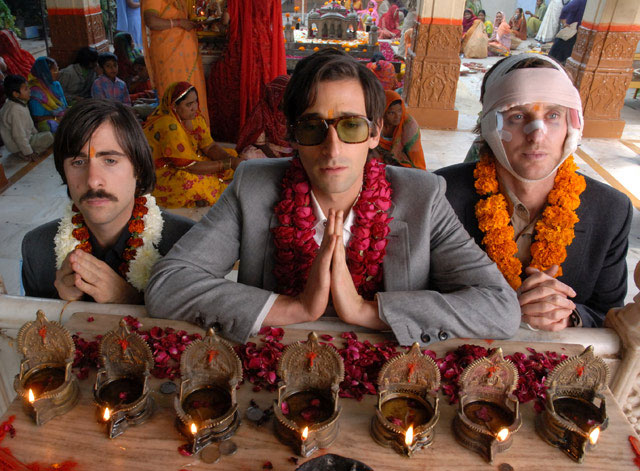
PICTURES OF LOSS: THE DARJEELING LIMITED, directed by Wes Anderson

PICTURES OF LOSS: The Darjeeling Limited

null


EDITOR'S NOTE: We are proud to present an unusual and personal series of articles by critic Peter Tonguette about grief and mourning on film, and how certain moviegoing experiences affected him in the aftermath of his father's death. Peter's series includes pieces on Hereafter, The Darjeeling Limited, Running on Empty, Men Don't Leave and A Soldier's Daughter Never Cries. If you would like to read the introduction to the series, Pictures of Loss: Introduction, click here. If you would like to read part 1 of the series, Pictures of Loss: Hereafter, click here. If you would like to read Pictures of Loss: Running On Empty, click here. If you would like to read Pictures of Loss: Men Don't Leave, click here. If you would like to read Pictures of Loss: A Soldier's Daughter Never Cries, click here. Matt Zoller Seitz

About a year-and-a-half after my father died, I was at the Ohio Theatre (a former Loew’s movie palace in Columbus, Ohio) waiting for a screening of To Kill a Mockingbird to begin when I mindlessly reached for my inside jacket pocket. I seldom wear the navy blue blazer I had on, and I suppose I was curious to see what old to-do list or movie program I might find stuffed in it. What I found instead was some unused Kleenex tissue, neatly folded in the shape of a square. “What was that doing there?” I thought at first.

Then I remembered one of the last times I had worn this jacket.
nullWhen my father was buried at Dayton National Cemetery (he was an officer in the Air Force before going into banking), I tried to go prepared. I wanted to absorb what was said at the service. I wanted to take in the physical surroundings where my father would be laid to rest, as unimaginable as it is for me to write those words, even now. More than anything, I wanted to anticipate what my own reaction to all of this might be. I did not think I would break down, but I knew enough to know that I could not be sure.

So, in lieu of a handkerchief, I must have placed the folded Kleenex tissue in my inside jacket pocket. I had forgotten all about it until eighteen months later, as To Kill a Mockingbird was about to begin.

When I went to see the movie that ordinary Sunday afternoon in June, it was just another thing to do. I loved Harper Lee’s story and Robert Mulligan’s direction. I wondered what Gregory Peck’s courtroom speeches would sound like in a big theatre. But I was not thinking that I would relive my grief. Then again, I wasn’t expecting to find that Kleenex either.

I realized that day that I would never be able to see an old favorite the same way again. When I revisit certain films now, the magic has dissipated. I’ll always remember how genuinely hilarious I thought Bringing Up Baby was when I saw it for the first time at age sixteen. My reaction was not unlike Peter Bogdanovich’s during his first viewing: “I screamed with laughter, but also with amazement: they had done this!” When I saw the movie again this summer—this second summer without my father—I admired it as much as ever, but something was missing. Missing in me. Bringing Up Baby should be laughed at, not “admired.”

When I decided to have a look at Wes Anderson’s films for the first time since my father’s death, I wasn’t sure what to expect. In my mind’s eye, I pictured nothing but the joyous derring-do of Anderson’s protagonists, like Max Fischer leaving a case of bees in Herman Blume’s hotel room or Raleigh St. Clair listening to a private investigator’s report on his wife Margot Tenenbaum’s extramarital activities. As far as I was concerned, these movies represented the same thing Bringing Up Baby did: a happier time, now lost.
null
The movies, however, told a different story. A decade ago, in his seminal Film Comment essay on Anderson, Kent Jones identified Max Fischer’s “profound anger and sadness over his mother’s death” as the source of the character’s iconoclastic behavior. In his films since Rushmore, Anderson has become even more preoccupied with mortality. It seems to have been his raison d’être in making The Royal Tenenbaums: “I was trying to make a movie in which there was the possibility that people could die,” he told Film Comment’s Gavin Smith. In that film, of course, the eponymous patriarch does die, and it is the death of, respectively, a beloved friend and a beloved father in The Life Aquatic with Steve Zissou and The Darjeeling Limited that inspire the quests that occupy the main characters of those wonderful movies.

Until The Darjeeling Limited, I think much of this was lost on me. When Max Fischer sat beside his mother’s grave in a smoky cemetery, I know I liked the shot (which, the director says, was influenced by the great final shot of Peter Bogdanovich’s Daisy Miller), but I don’t remember connecting with the emotion. As for the funeral that concludes The Royal Tenenbaums, I think I saw it mostly in dramatic terms—a satisfying grace note to end with. I certainly wasn’t thinking about my own father.

But by the time The Darjeeling Limited came out, I was older. So was my father. The three brothers in the film—Peter (Adrien Brody), Francis (Owen Wilson), and Jack (Jason Schwartzman)—seemed roughly my age. And their father (who has recently died as the film opens) seemed roughly my father’s age.

The movie struck a chord.

In a dozen superficial ways, The Darjeeling Limited got under my skin as no other Anderson film had before. I related most of all to the middle brother, Peter. Let’s start with his first name. For as long as I could remember, my parents had instilled in me a sense of pride in my given name. They liked it and so did I. Growing up, I never knew another Peter, but that didn’t bother me—to the contrary, it made me feel even more special. Oddly enough, I associate my name with the British movies my mother took me to as a child. She would invariably point out the many Peters among the cast and crewmembers listed in the end credits of films produced in England.

Now, all of these years later, there was a Peter in The Darjeeling Limited. It meant something that he was called that rather than Dignan or Max or Royal or Steve Zissou.
null
In the film’s opening scene, Peter sees the apparition of his father (Bill Murray), who is racing to catch a train somewhere in India. At the last moment, Peter, who is supposed to be on the same train, runs past him, but not before doing a double take. After Peter hops on board, he pauses to take a long look back at the ghost of the man he’s left behind. He seems disbelieving for a moment—could it be him? He lifts up the pair of sunglasses he’s wearing—which turn out to be his father’s—to seemingly get a better view. But then reality sets in—whoever it is back there, he isn’t going on any train trip—and Peter turns away, his eyes downcast, his lips pursed.

As I’ve said, I saw a great deal of Peter in myself. I felt I shared his thoughtful, serious manner—not for me, the whimsy of Max Fischer. I admired his sense of style, too, especially the trim Louis Vuitton suit he wears throughout the film. I liked the insouciance with which he lit a cigarette, even though I myself didn’t (and don’t) smoke. As one who suffers from migraines, I even related to his headaches, which seemed so much like my own (if his perpetual massaging of his temples was any indication). My point is that I think my identification with Peter allowed me to comprehend his stoic grief in the scene I just described. “That could be me,” I thought to myself. “That is how I might look or act if I experienced a death in the family.” I would have been quick to add, “And thank God I haven’t.”

But now I have.
null
Watching the film again, I seized on the scenes that dealt directly with the brothers’ grief. As Meghan O’Rourke writes in her memoir The Long Goodbye, “I was hungry for death scenes.” It reminds me of the way Peter, seated for dinner with his brothers on The Darjeeling Limited, keeps returning to the short story Jack has written about the day of their father’s funeral (“He had been killed suddenly, struck by a cab while crossing the street”), in spite of the distractions—Francis’s odd behavior and appearance, the two German ladies seated across from them—that surround him. Later, he excuses himself to re-read a portion of the story in the men’s room on the train. He does so by himself because he finds he is moved to tears and doesn’t want to cry in front of others.

Wes Anderson gets it: We let so few see how we really feel.

I have become convinced that Anderson was wrong when he told Gavin Smith that in his earlier films “one thing you knew is that none of these characters could die.” If that is the case, then why, in Rushmore, do I think of Max’s mother every time Max is on screen? And Edward Appleby every time Miss Cross is on screen?

Of course, this is a recent development for me. When I have watched Rushmore in the past, I always looked forward to one especially lovely moment. It comes during the montage sequence set to Cat Stevens’s “Here Comes My Baby,” after Max has asked Miss Cross for them to remain friends “in a strictly platonic way” and has agreed to her request to “make a go of it and settle down at Grover Cleveland.” It’s a very quick shot: at a game of tennis, Mr. Blume and Miss Cross are resting until Max enters the frame and shoos Mr. Blume back onto the court. So that Max can sit next to Miss Cross. Max flashes her a broad smile, which she sweetly returns.

This moment always reminded me of the terrifically romantic first line of Philip Roth’s Goodbye, Columbus: “The first time I saw Brenda, she asked me to hold her glasses.” Maybe it’s because both scenes are set at country clubs.

In that exchange of looks between Max and Miss Cross, I always thought I was watching a hopelessly smitten kid and a beautiful, carefree young woman. But now I see an orphan—and a widow. I am as surprised by this reaction as I was by what I found when I reached for my inside jacket pocket.

Peter Tonguette is the author of Orson Welles Remembered and The Films of James Bridges. He is currently writing a critical study of the films of Peter Bogdanovich for the University Press of Kentucky and editing a collection of interviews with Bogdanovich for the University Press of Mississippi. You can visit Peter's website here.
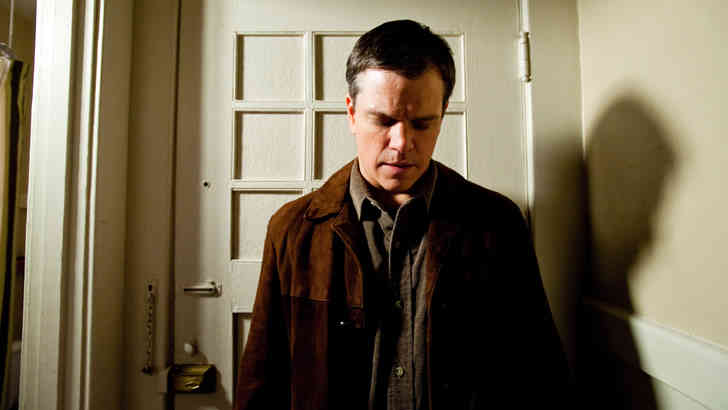
 

PICTURES OF LOSS: HEREAFTER, directed by Clint Eastwood

PICTURES OF LOSS: HEREAFTER, directed by Clint Eastwood

null

EDITOR'S NOTE: We are proud to present an unusual and personal series of articles by critic Peter Tonguette about grief and mourning on film, and how certain moviegoing experiences affected him in the aftermath of his father's death. Peter's series includes pieces on Hereafter, The Darjeeling Limited, Running on Empty, Men Don't Leave and A Soldier's Daughter Never Cries. If you would like to read the introduction to this series, click here. If you would like to read Pictures of Loss: The Darjeeling Limited, click here. If you would like to read Pictures of Loss: Running On Empty, click here. If you would like to read Pictures of Loss: Men Don't Leave, click here. If you would like to read Pictures of Loss: A Soldier's Daughter Never Cries, click here.Matt Zoller Seitz

Joan Didion says, “We tell ourselves stories in order to live.” In the months after my father died, the story I told myself was that I could write as I always had, about movies and movie directors, and that this would, in fact, serve as a useful distraction from my grief. I was certain that my professionalism would see me through this terrible time.

Most would call it denial.

Soon enough, I found that I couldn’t sit for most movies, and the last thing I wanted to do was write about them. The only words that mattered now—that my father haddied—were the words I could not bring myself to write. I suspect the same is true in the aftermath of any catastrophic event. To write of anything else feels trivial; what could possibly take precedence over the catastrophe? Yet to write about the catastrophe itself is just too difficult.

I managed to do a few interviews for the book I was finishing and a handful of magazine assignments, which I eagerly accepted before finding that my usual dedication and focus had forsaken me. I tried everything, including reminding myself that my father would want me to proceed apace with my career. In hindsight, my putting the matter that way—which I did on more than one occasion—seems telling. If I was so certain about continuing to write about movies, why would I even raise the possibility of stopping?

Eventually, I was nudged back to work by the prospect of collaborating with a friend on a small editing project. The friendship was more helpful to me than the work, which was not particularly creative, but it was a start. Since I hadn’t worked on a consistent basis in months, I regarded the project as a challenge and was eager to do well. Because I had a
partner in crime, and because she was a friend, I had no choice but to hold up my end of the bargain.

The exercise was a turning point. I began to write again in earnest, but ever so slowly, and only gradually did it dawn on me that I had a book to finish, that there were people in this world who actually wanted me to write for them. But what allowed me to see it through to completion, I realize now, was not the professionalism I imagined I possessed or the pressure of not wanting to disappoint a good friend.
null
My book was about the late filmmaker James Bridges, whose films were often about the heartache of losing a loved one. This is certainly the theme of his best film, September 30, 1955, which stars Richard Thomas as a college student in Arkansas who is bereft at the death of his idol James Dean. Long before my father’s death, I had made voluminous notes about the film, but as I marshaled them into a manuscript, I found that I was obsessed by it. “Death is never far in Bridges’s films,” I wrote, and it wasn’t far from my mind as I typed those words. At first, I did not know why I dwelt so intensely on September 30, 1955. I’m sure I was convinced I did so because it was “among the very greatest of American films of the 1970s.”

But something else was afoot.

I found myself relating to the grief of the Richard Thomas character in a very personal way. I understood his sorrow—and I bickered with it, too. He lost a movie star, not a parent or a family member or a friend. He should know better, though I myself hadn’t always known better. As a teenager, I was always very affected by the death of a public figure I admired, like Stanley Kubrick. Yet when J.D. Salinger died several weeks after I lost my father, I was very sorry, but not devastated.

I watched and re-watched September 30, 1955, and the words poured forth, but I was still unaware of the reason why. So I didn’t seek out other films that gave me the jolt it had.

Instead, they seemed to find me.

One night, I was working in my room when someone decided to put in a DVD of Clint Eastwood’s Hereafter. I used to love Eastwood’s films. I was the sort of person who considered Bronco Billy to be a masterpiece. I saw Mystic River three times when it was first released in theatres. In my present state, however, keeping up with Eastwood was low on my list of priorities. I’m sure I thought, “Why bother? What difference does it make if it’s any good or not?” But as the film started, I caught myself turning to watch every few minutes. A snippet of dialogue would intrigue me. An overheard moment would pull me in. I glimpsed a scene here, a scene there, and I found it harder and harder to turn away. I soon left my work and moved to a chair closer to the TV. The film did more than command my attention. I was—literally—being drawn in by it.
null
In Hereafter, Matt Damon plays George Lonegan, a psychic who does not wish do be a psychic. It is one of Damon’s best performances. Even though he declines to help many sad, desperate people who feel they can benefit from his gift, he always retains sympathy for the grief-stricken amongst us, a reflection of Eastwood’s own compassionate perspective.

Has the director ever filmed a moment as heartrending as when a British youngster named Marcus (whose twin brother Jason has died in an accident) looks to his sibling’s empty bed and says, “Goodnight, Jas”?

Obsessed with communicating with his brother, Marcus learns of George and tracks him
down when George serendipitously makes a trip to London. Marcus wants him to do a reading, but the answer is—predictably—no. “I don’t do that anymore,” he insists in a huff. But Marcus will not give up that easily and proceeds to stake himself outside of George’s hotel room all day. George’s basic decency finally gets the better of him, as he invites Marcus inside. He begins by asking Marcus a stream of questions, with Marcus either answering or nodding his head yes to each. “Someone close to you has passed away… A male… He was young when he died… Is this person your brother? Older brother? But not by much, he says. Only by a few minutes… I’m sorry, kid.”

Because we have seen Marcus and Jason’s story unfold, we know that everything George says is true. Because George has only just met Marcus, we also know that his psychic abilities are therefore real.
null
It turns out that Eastwood’s attitude toward the supernatural is as matter-of-fact as his screen persona. He seems to have followed the suggestion of the poet and novelist Robert Graves, who once wrote that “one should accept ghosts very much as one accepts fire—a more common but equally mysterious phenomenon.” In Hereafter, Eastwood accepts George’s abilities much as Graves accepted ghosts and fire: at face value. For example, when George is pestered into doing a reading by a young woman he has a romanticinterest in (played by Bryce Dallas Howard), he relays a message from her deceased father that is greatly upsetting to her, thus ending their nascent relationship. Why would George do this unless he really was psychic? After all, from his perspective, would it not have made more sense to tell the woman something she wanted to hear?

Rilke wrote the line “Who says that all must vanish?” in a different context, but it is easy to imagine Eastwood and screenwriter Peter Morgan asking it of us, as they confidently but casually assert that loved ones are still here, somehow, even after they seem gone. My favorite moment in Hereafter comes when George tours the London home of Charles Dickens (his favorite author). He pauses to admire the painting “Dickens’s Dream,” which, it is explained by a tour guide, shows a dozing Dickens surrounded by “characters from his novels floating in the air around him.” The description beautifully anticipates the way George says Jason describes the afterlife to him: “The weightlessness. He says that’s cool.”

Not since Evelyn Waugh’s A Handful of Dust has the work of Charles Dickens been referenced to such powerful effect.
null
Even though Hereafter is about death and near-death, I didn’t find it grim. Just the opposite. I remembered the strange truth of what Stanley Kubrick told Stephen King when he was about to make The Shining into a movie: “Well, the concept of the ghost presupposes life after death. That’s a cheerful concept, isn’t it?” There isn’t a single character in Hereafter who I would call cheerful, yet Marcus walks away from his session with George with the reassurance he has been seeking. “If you’re worried about being on your own, don’t be,” his brother communicates to him, through George. “You’re not. Because he is you and you are him. One cell. One person. Always.”

If we must suspend disbelief to fully share in Marcus’s solace at hearing those words, let us remind ourselves that we are in good company. At the end of his final film, Family Plot, Hitchcock allows a fake psychic (Barbara Harris) to demonstrate authentic telepathic abilities. “Blanche, you did it! You are psychic!” her husband (Bruce Dern) exclaims, as if imitating Hitchcock’s own incredulousness. But it’s true—she is!

Of course I loved Hereafter: here was a film that expressed not only my pain but also to my most basic, private wish, the same wish expressed by the son who loses his father in Paul Brickman’s Men Don’t Leave (discussed later this week): “I want to see him again. One more time.”

Peter Tonguette is the author of Orson Welles Remembered and The Films of James Bridges. He is currently writing a critical study of the films of Peter Bogdanovich for the University Press of Kentucky and editing a collection of interviews with Bogdanovich for the University Press of Mississippi. You can visit Peter's website here.

VIDEO ESSAY: Searching for the Muppets

VIDEO ESSAY: Searching for the Muppets

null

[iw-legacyvideo id=”6e400350-1317-11e1-8472-123138165f92″ url480p=” http://v.indiewire.com/iw_flash/PressPlayNew/PressPlay_Muppets_Part2.mp4″ url720p=”null” url1080p=”null” stillimage=”http://indiewire.s3.amazonaws.com/6e/4162e0131711e18472123138165f92/file/animal_muppet_13.jpg”%5D

EDITOR'S NOTE: The release of Jason Segel's The Muppets has re-ignited world-wide interest in revisiting the legacy of Jim Henson. To mark the occasion, Press Play contributor Jason Bellamy has created Searching for the Muppets, parts 1 & 2. Together, these video essays explain the enduring popularity of these beloved characters as well as evaluate their cultural impact since the death of their creator. The embeddable version of Muppets, part 1 is here. The embeddable version of Muppets, Part 2 is here.

When Jim Henson died in 1990, at the age of 53, there was reason to fear that the Muppets wouldn’t live on without him.

They did. Since Henson’s death, Muppets have appeared in three major movies, a short-lived TV series, a few TV specials and several direct-to-YouTube videos. They’ve inspired toys, calendars and postage stamps. And now they’re poised to hit the big screen yet again, in a movie written by and starring Jason Segel.

Indeed, the Muppets brand, which has roots to the 1950s, has persisted in Henson’s absence. But the Muppets’ true spirit? That’s been hard to find.

The word “muppet,” a combination of “marionette” and “puppet,” accurately describes the majority of Henson’s foam-and-fur characters wherever they may roam, from Sesame Street to Saturday Night Live. But when we talk about “The Muppets,” we’re referring to a very specific, if sprawling, cast of characters who gained their fame with The Muppet Show.

Starring Kermit the Frog, Miss Piggy, Fozzie Bear, Gonzo, Rowlf, the Swedish Chef, Statler and Waldorf and so many more, The Muppet Show played for five seasons. It inspired three Jim Henson movies and a cartoon spinoff, not to mention Fraggle Rock, while creating a brand as distinct as the one over at Sesame Street.

nullWhere Sesame Street is designed to educate, The Muppet Show is designed to entertain. Full of frenetic song-and-dance routines, intentionally bad jokes and chest-heaving off-stage drama, The Muppet Show is a loud, loony, heartfelt variety act that’s transparently disguised as a loud, loony, heartfelt variety act.

To find the essence of the Muppets, the search has to begin here, because The Muppet Show was Henson’s magic factory. It was a place where a frog tap-danced, crocodiles rocked and pigs flew … in space. Working closely with head writer Jerry Juhl and longtime collaborator Frank Oz, who literally was Bert to Henson’s Ernie, Henson created a world of whimsical absurdity that seemed limitless, and in fact often delighted at pointing to the presumptive line just before leaping over it.

Like the puppets themselves, the show was a marriage of tangible authenticity and cartoonish fantasy, brought to life by incredible unseen artists who were so skillful in their illusions that the predominantly waist-up action never seemed less than fully formed.

Thirty-five years after its inception, the genius of The Muppet Show remains its cross-demographic appeal. Kids are helplessly drawn to the characters’ colorful and cuddly exteriors, and all the high-energy skits that needn’t be fully comprehended to be wildly entertaining. Adults, meanwhile, find kinship in the characters’ black and blue interiors — all those maladjusted and overwhelmed but unfailingly optimistic souls.
null
It’s easy to forget, in light of the Muppets’ well-known capacity for sweetness, that irritability and lack of sympathy extended far beyond the old cranks lobbing insults from the theater balcony. Indeed, as often as The Muppet Show is tender, it’s a symposium of bickering, putdowns, sarcasm and exasperation. Henson’s Muppets possess the boundless optimism of a child, but their personality flaws, ranging from anger to arrogance to ignorance, are distinctively adult.

From afar, The Muppet Show fulfills Henson’s dream, articulated by Kermit in The Muppet Movie. It’s a place for singing and dancing and making people happy. More than that, though, The Muppet Show – like the three Henson-powered movies that followed it – is a tribute to perseverance, an ode to those who soldier on with indomitable hope in the face of mediocre or even disastrous results.

The cast of The Muppet Show is a band of misfits, oddballs and failures. The Swedish Chef’s cooking abilities are as questionable as his dialect. Bunsen Honeydew’s inventions only succeed in traumatizing his put upon assistant Beaker. Fozzie is a comedian forever in search of his first laugh. Gonzo is a desperate performance artist in search of his audience – a weirdo before there was a Jackass. Miss Piggy is a diva without talent and a seductress without an enthusiastic admirer. And Kermit? He’s a dreamer stuck in a nightmare, a well-meaning leader and loyal friend who wants to do the right thing, and usually does, but sometimes can’t quite manage to bite his fly-catching tongue.
null
Kermit’s importance to the Muppets’ signature spirit and brand identity can’t be minimized. Clever and self-aware, Kermit is the audience surrogate, our guide through the chaos, an island of sanity amidst an ocean of zany foolishness. After Henson’s death, when Kermit’s presence was significantly reduced in deference to the man who gave the banjo-playing frog his soul, it created a void that has never been adequately filled.

To some degree it never can be. But the Muppets phenomenon is bigger than Kermit and even Henson. The post-Henson Muppet projects haven’t missed the character of Kermit so much as the quality of Kermit’s character. Kermit isn’t just the most identifiable Muppet, he’s the most relatable one, too. In Kermit’s determination, we see who we want to be, and through his occasional inability to maintain his composure, we see who we are. Kermit grounds the Muppets. Without him, or another Muppet in that role, the balance is thrown off and the inmates take over the asylum.

That Kermit and the gang have seemed less like themselves since Henson’s death has less to do with the puppeteers performing them – Steve Whitmire, in Kermit’s case – than with the roles the Muppets themselves have been performing. In two of the three big-screen movies released in the post-Henson era, the Muppets have vacated their own characters to step into others. These projects are not without their charms, but it’s hardly an accident that the most consistently entertaining character in the post-Henson years is the one who has been allowed to remain mostly himself: Gonzo.

Alas, the other characters often appear to be in a daze. Fozzie has no clue whatsoever that he’s Fozziewig in A Christmas Carol, and to watch Kermit as Captain Smollett in Treasure Island is to be condemned to the tragedy foretold in Henson’s final Muppet movie, 1984’s The Muppets Take Manhattan, in which Kermit is struck by a cab and gets amnesia. Kermit looks like Kermit, and he roughly sounds like Kermit, but he just isn’t Kermit. Not exactly. Which only makes us long for the real thing.
null
Sure enough, the post-Henson projects have held true to the mission statement of singing, dancing and making people happy, but while doing so the Muppets have disappeared inside their characters all too well, and the wonderful exceptions only prove the rule.

These post-Jim Henson Muppet adaptations stand in stark contrast to the one near the end of The Muppet Show’s third season, when the Muppets perform Robin Hood. Here, as in A Christmas Carol and Treasure Island, the Muppets step into other roles, but the crucial difference is that they never lose their own identities. Kermit, as Robin Hood, is still more of a backstage ringleader than a hero. Gonzo plays the Sheriff of Nottingham, but he only does damage only to himself. And Miss Piggy, who refuses to accept her role as Sister Tuck, proves more conniving than the Sheriff of Nottingham in an effort to get top billing, whatever it takes.

Time and again, The Muppet Show shows us that the Muppets can’t escape who they are. They’re too odd, too mediocre, too, well, human for that. And we love them for it.

And that brings us back to the Muppets’ unforgettable sweetness.

If in memory, the cuteness and tenderness of the Muppets overshadows the bickering and putdowns, there’s a reason. Many episodes of The Muppet Show end with the cast rallying around the guest star and joining in song, effectively erasing all the preceding friction and failure with one dose of literal harmony.

What made the Muppets’ sweetness so affecting is that, just like the exasperation and suffering, it’s entirely honest. With imperfect voices and awkward figures, the Muppets sing from the heart. And by ending almost every episode of The Muppet Show in song, Henson suggests that underneath the cynicism and the sarcasm, and the woe and the wounds, love and hopefulness are our default settings.

Beyond the singing and the dancing, the arguing and the teasing, the gags and the stunts, the core value of The Muppet Show is sincerity. When you find earnestness, you find the spirit of the Muppets. 


Jason Bellamy ruminates on cinema at The Cooler and is a regular contributor to Slant Magazine's The House Next Door, coauthoring The Conversations series with Ed Howard. Follow him on Twitter.

PICTURES OF LOSS: Introduction

PICTURES OF LOSS: Introduction

null


EDITOR'S NOTE: We are proud to present an unusual and personal series of articles by critic Peter Tonguette about grief and mourning on film, and how certain moviegoing experiences affected him in the aftermath of his father's death. Peter's series includes pieces on Hereafter, The Darjeeling Limited, Running on Empty, Men Don't Leave and A Soldier's Daughter Never Cries. If you would like to read part 1 of the series, Pictures of Loss: Hereafter, click here. If you would like to read Pictures of Loss: The Darjeeling Limited, click here. If you would like to read Pictures of Loss: Running On Empty, click here.  If you would like to read Pictures of Loss: Men Don't Leave, click here. If you would like to read Pictures of Loss: A Soldier's Daughter Never Cries, click here. Matt Zoller Seitz

Ever since I began writing professionally about film, my father nearly always read what I wrote. Yet it was only recently that it hit me: Before he died in January of 2010, the last article he read by me concerned the death of a parent, and most of the films I have thought to write about since then concern losses like my own.
null
My article was about a new memoir by Orson Welles’s eldest daughter, Chris, whom I interviewed for the occasion. If I made a point to emphasize how much of her book had to do with a daughter missing her father—I referred to its “preoccupation with filial matters” and “sometimes sorrowful tone”—perhaps it was because Welles, who was a distracted, often incommunicado father, died at seventy.

Seventy: an age I considered not at all elderly.

Seventy: only two years younger than my father was when I wrote (and he read) my article.

Yet as I reread it now, so much about it rings so hollow. When I wrote it, I didn’t know the first thing about losing a parent, as Chris Welles did, as Orson Welles did. (By the time he was a teenager, both of his parents had died.) “Filial matters”? A fancy phrase, but little more.

I wish I could go back and rewrite my article. I wish I could go back and re-ask my questions of Chris. Of course, what I really wish is that I could return to my former state of ignorance. That would mean that my father was here again and, as before, I could only guess at what losing him would feel like.

As my father read my article about Chris Welles, I am certain that he did not for one moment place himself in the shoes of the lost parent, any more than I did the bereaved child. My father’s death was sudden and unexpected. Yet for this to have been the last thing of mine that he read is an inescapable irony. I’ve come to think of it as my unknowing goodbye to him. Yes, my words were written in innocence of my subject, and yes, they seem dreadfully stilted to me now.

But aren’t goodbyes always innocent, always stilted?

After my father died, my interest in movies—and in writing about them, too—went on vacation. For a long time, I thought it was a permanent vacation. Gradually, though, I found myself drawn back to movies, but they were always movies about grief and I always happened upon them by accident. Like the accident of my being in the middle of writing a book about a filmmaker (James Bridges) who made a lot of movies about the sorrow of losing a loved one. Or like the accident of being in a room when a movie about the living trying to communicate with the dead (Clint Eastwood’s Hereafter) was playing on television.

Were these things really accidents? There was the time I went to a screening of Bergman’s Persona and a trailer for Powell and Pressburger’s A Matter of Life and Death preceded the feature attraction. The trailer introduced the film by way of excerpting the astonishing opening scene: As RAF pilot David Niven is hurtling toward his death, he falls in love with Kim Hunter, the American radio operator communicating with him in his final minutes. I had not thought about A Matter of Life and Death in years and years, and I had not gone to Persona to think about matters of life and death. But for the next 90 minutes, as Liv Ullmann and Bibi Andersson were talking in Swedish, I could think of nothing but it, about the indomitability of love and the utter waste of death.

The poet Meghan O’Rourke, author of the extraordinary memoir The Long Goodbye (which I will return to throughout the pieces in this series), has talked about finding more solace in literature than in self-help books after her mother died. She said she experienced a “shock of recognition” when she re-read Hamlet and it dawned on her that the play was really about a young person in mourning, not unlike herself. Eventually, I, too, found it helpful to ponder my feelings through a work of fiction, to experience the anguish and loneliness of loss vicariously, through characters on a movie screen or television set.

I think of William Blake, who wrote:

“Can I see another’s woe,
And not be in sorrow too?”

And James Baldwin, who said:

“You think your pain and your heartbreak are unprecedented in the history of the world, but then you read.”

Or in my case: But then you see.

One afternoon in the summer I was seventeen, I was in a restaurant with my parents and younger brother. We were not celebrating any particular occasion and the meal itself was completely unmemorable. But I’ve never forgotten what I saw. Directly across from me, not visible to anyone else, was a middle-aged woman sitting in a booth by herself. As she tentatively nursed a Coca-Cola, a song was playing on the radio. I couldn’t possibly say what it was, but it was not unlike, say, the Beach Boys’ “God Only Knows.” It had that same poignant feeling to it. As the woman sat there, her eyes downcast, she began mouthing the sad words of the sad song. She didn’t appear to be mentally ill or disturbed in any way. Something had simply gone wrong for her. How was I to know? Who was I to guess?

It was like the scene in Magnolia (a movie I don’t care for) when the characters sing along to Aimee Mann’s “Wise Up,” except that it actually affected me.

I remember feeling such great pity for her that it spoiled the rest of my day. I feel less sorry for the woman than I used to it is because I am now in her shoes, looking to pop culture to give voice to my pain, and I wouldn’t want people to think I’m feeling sorry for myself.

Meghan O’Rourke begins her memoir with an epigraph from a novel by Iris Murdoch called An Accidental Man: “The bereaved cannot communicate with the unbereaved.” Perhaps, going forward, I am only able to communicate with bereaved movies. I no longer love films only for their graceful direction or witty dialogue, for their mise-en-scene or montage. For a film to reach me, it must speak to my loss, as the films examined in this series do. Hereafter. The Darjeeling Limited. Running on Empty. Men Don’t Leave. A Soldier’s Daughter Never Cries. There are so many others. I found that I needed them at a time when I thought I was beyond needing movies.

I was wrong.

For Alexandra Asher Sears, who read and encouraged.

Peter Tonguette is the author of Orson Welles Remembered and The Films of James Bridges. He is currently writing a critical study of the films of Peter Bogdanovich for the University Press of Kentucky and editing a collection of interviews with Bogdanovich for the University Press of Mississippi. You can visit Peter's website here.

SLIDE SHOW: Woody Allen’s greatest films

Slide Show: Woody Allen’s greatest films

null

Woody Allen, whose career will be celebrated next week by PBS’ documentary series American Masters, has been making films for so long that it’s a wonder the program didn’t profile him sooner. With 47 directing credits, 68 screenwriting credits, and let’s-not-even-start-totaling his Oscar wins and nominations, he’s a gray-haired machine who gets more done in a decade than most artists accomplish in a lifetime.

When I decided to pick my favorite Allen films for a slide show, I thought it would be easy. After all, he tells “American Masters” that he’s pursued a quantity-over-quality strategy, making as many pictures as he can and hoping his batting average stays solid over time. Filtering out the really horrible titles wasn’t tough — so long, “Curse of the Jade Scorpion,” Celebrity and Hollywood Ending.

But picking the best took longer than I expected, because while most filmmakers are lucky to have one career phase, Allen has had at least five. There was the “earlier, funny phase,” the late-’70s American urban artiste phase, the 1980s chameleon entertainer phase, the post-Soon-Yi-scandal 1990s phase in which his scripts got a lot angrier and more profane, and most recently a European phase — one that delivered his top-grossing feature, 2011′s Midnight in Paris. And in between phases he’s had slumps so dispiriting that some people figured he was done.

You can view Matt's slide show here at Salon.

Matt Zoller Seitz is the TV critic for Salon and publisher of Press Play.

Eastwood’s “J. Edgar” takes few risks with its controversial subject

Eastwood’s “J. Edgar” takes few risks with its controversial subject

null

You'd think Clint Eastwood would be the right guy to direct a movie about J. Edgar Hoover. After all, who better to tell the story of the 20th century's most influential law enforcement officer, the man who wrote the rule book on fighting crime only to disregard those rules when they prevented him from getting his man, than Dirty Harry himself? Or, to be less obvious, what would the man responsible for White Hunter Black Heart, A Perfect World and Million Dollar Baby — movies about men who defied authority, be it Hollywood, the law or God — bring to the life story of the man who held authority over the country for nearly 50 years? Alas, Clint Eastwood's stately biopic J. Edgar is a frustrating experience. For nearly 2 hours and 20 minutes we are held captive by the possibility of a major revelation or insight into a man whose obsession with cataloging every single detail of a person's personal and professional lives foretold the collapse of privacy. We get hints, intimations and suggestions of darker urges that shaped Hoover's behavior, but nothing concrete about the man's personality, and no attitude whatsoever toward his actions. Eastwood mistakes vagueness for ambiguity and puts us in the position of being armchair psychiatrists.

Working from a screenplay by Dustin Lance Black and starring Leonardo DiCaprio in the lead role, J. Edgar certainly has a high-end pedigree, but the film is so concerned with being "refined" that it sacrifices momentum. Opening with Hoover dictating his autobiography in an effort to set the record straight, the film shows promise, even if the investigative flashback structure it employs should've been retired a long time ago. It inevitably leads to a then-this-happened-then-this-followed-by-this rhythm that can be a grind. But Hoover's origin story is fascinating, especially as he tries to convince his boss Mitchell Palmer (Geoff Pierson) to invest in new sciences like fingerprint analysis. We see how Hoover's crusade against communist radicals led to his being put in charge of the F.B.I., which he would remake into his own image of clean-cut American righteousness. We are introduced to the three key people in his life: his mother Annie (Judi Dench), who molded her Edgar into a model of properness; Helen Gandy (Naomi Watts), his loyal secretary; and Clyde Tolson (Armie Hammer), his most loyal…friend?
null
Then…we wait, patiently, for a theme or pattern to emerge. One never quite comes through. By trying to condense a 50-year history into a 2 1/3-hour runtime, J. Edgar becomes a highlight reel with some of the best parts edited out. Hoover's war against '30s gangsters like Baby Face Nelson and John Dillinger is reduced to more or less a montage. Hoover during World War II? Nothing. Hoover during McCarthyism? We get one line of dialogue dismissing McCarthy as an opportunist. The movie's greatest flaw is how it does not deal with Hoover's clashes with the Kennedys, especially Bobby. Hoover's hatred of Bobby Kennedy was legendary, and for a movie about his life to omit that part is just wrong. Instead we get too many scenes of Hoover's mother laying on guilt trips about what he must do. This is Psych 101 screenwriting territory, way below the thinking of Eastwood and his collaborators.

The most obvious (and possibly most entertaining) approach to this material would be to treat it like one of those ripped-from-the-headlines '30s Warners pictures, complete with gossip and innuendo. (We get a charge in one scene when we see famous bits from The Public Enemy being shown to a cheering audience.) The other approach to the material would be to concentrate on just a few defining moments. It is extremely difficult to condense a man's life into an extended runtime. Malcolm X did it, but then again it was focusing on 20 years, not 50. (It still managed to bring it up to the present with that startling final scene of Nelson Mandela addressing a classroom.) <i>Nixon</i> also did it, but Oliver Stone, unlike Eastwood, has a singular gift for innovative visuals and editing that gives his movies drive. The model for a movie like J. Edgar is something like Danny DeVito's criminally underrated Hoffa. Like J. Edgar, it also uses a flashback structure, but screenwriter David Mamet doesn't bother with trying to cram a man's life into a conventional narrative. Hoffa is simply presented as-is, and we take in how those around him react to his actions. By doing that, we come away understanding Hoffa's achievements as a labor leader, but also understand that his ego and quest for power led to him eventually losing sight of his original intentions. (Interestingly, the highlight of Hoffa is the extended sequences where he squares off with Robert Kennedy.) A typical scene in J. Edgar is of two people sitting in a darkened room talking around what is on their minds. If you're going to make a movie consisting of these kinds of scenes, you'd better make sure they have something interesting to say. Or, at the very least make clear what it is they are <i>not</i> saying. (Tom Stern's drab cinematography doesn't help matters. While not as bad as his work in Eastwood's Changeling, it makes you not want to see the color brown for at least three months. His lighting is like Gordon Willis minus texture — or soul.)

At 81, Eastwood has spent the last 10 to 15 years making movies where he seems to be re-examining not only his own image, but the image of stoic, non-verbal men, He's been deconstructing the notion of masculinity before men were told it was okay to get in touch with their feelings. The idea that men needed to do whatever it took to get the job done was being undercut by the (necessary) assertion of feminine and racial equality. Eastwood's best films are about men reeling from change and how they either reject it or are humbled by it. In Million Dollar Baby (his best film in the last decade), boxing trainer Frankie Dunn is constantly questioning God's plan only to get a comeuppance when he demands unquestioning faith in his training methods from his fighters. A Perfect World saw Eastwood deconstructing the Western showdown by setting a generational clash of law and disorder on the eve of the Kennedy assassination. (A Perfect World is a far more complex breakdown of Western myths than the somewhat overrated Unforgiven.) White Hunter Black Heart told a thinly fictionalized version of John Huston's recklessness while making The African Queen, with Eastwood playing Huston as a filmmaker learning that trying to exert the same kind of control he has on a movie set in everyday life can lead to self-destruction. Even less successful efforts saw Eastwood attempting to re-think history, considering if his generation got things wrong. His two-part World War II saga Flags of Our Fathers and Letters from Iwo Jima had moments of great irony hinting that Eastwood might've learned something from Saving Private Ryan; too bad, in the end, he wound up buying into the myths of the Greatest Generation. Hereafter found Eastwood confronting mortality; too bad the movie got all New Age-y in its final sequence. And in the disastrous Gran Torino, Eastwood directed himself in what felt like his farewell performance as Korean War vet Walt Kowalski, a longstanding racist forced to realize he was wrong about everything; too bad the movie played Walt's racism for laughs and came off like a recruitment film for the Tea Party.
null
Every movie Eastwood makes seems to be in preparation for his next one. Taking on the life of J. Edgar Hoover suggested Eastwood was ready to tackle one of the most polarizing figures of his generation, and by doing so confronting the two topics he's often accused of shying away from: sexuality and race. There is evidence that Eastwood is more than capable of handling adult sexuality; his performance in the New Orleans cop procedural Tightrope saw him playing a man grappling with unhealthy sexual urges. Unfortunately Eastwood has given his critics more than enough opportunities to accuse him of insensitivity with ugly portrayals of women and gays in movies like The Rookie and Sudden Impact. His track record for handling race is even spottier, with black characters being subservient yet equal. (Don't even bother bringing up Bird.) But with J. Edgar it would seem Eastwood would have to tackle these issues head-on. He doesn't. He blinks. Hoover's sexuality is treated as a case of repression crossed with the smothering of a mother from hell. Screenwriter Black, who wrote the terrifically insightful Milk, seems to have written the script of J. Edgar from a 2011 perspective, as if he's saying, "Isn't it too bad Hoover wasn't allowed to live in a more open society where his sexuality wouldn't have been an issue?" That's a great notion but it's one that Eastwood and DiCaprio are not operating from. The movie winds up working at cross-purposes, and would've been better served by simply dumping all the scenes with Hoover's mother or just relegating her to one early sequence. (That's why biopics like Citizen Cohn and The Aviator work so well.) That extra time could've been used to strengthen one of the other more interesting relationships, like Hoover's connection with his longtime companion Clyde Tolson. As it stands, Hoover's relationship with Tolson comes awfully close in some scenes to resembling that of Mr. Burns and Smithers. They're like the first bromance. They're so chaste in their affection that when they have their big fight, the scene seems to come out of nowhere. When they kiss, we laugh, not out of nervousness, but because there's no passion or preparation. When Hoover takes out Ms. Gandy on a date and she rebuffs his advances, we don't know if her rejection sours him on women or if he's thrilled that she's as dedicated to her work as he is. On a basic psychological level the movie doesn't even bother with suggesting that Hoover wanted to sleep with his mother, Ms. Gandy or Tolson. We think that's what's going on, but we're never certain. (If we were to go by the movie, Hoover apparently died without ever having sex.)

And Hoover's racism is transformed into his crusade against communist radicals. His battles against civil rights leaders are reduced to his attempts to ruin the reputation of Dr. Martin Luther King, Jr. When he's listening to a recording of King having sex, we wonder if Hoover is jealous of such a blatant act of sexuality. The same goes with his taping of President Kennedy. Is Hoover envious because they're having all the fun? And why does he hate communists so much? We never hear him articulate an argument. When Bobby Kennedy tells him that our enemies are now foreign, not domestic, he makes perfect sense. But Hoover disregards his warnings, suggesting a deep-seeded paranoia of everyone. There's a whiff if Jack D. Ripper to his campaign against Dr. King. He believes King to be a communist threatening to contaminate the soul of the American people. (I was going to write "our precious bodily fluids.") A racial slur by Hoover's mother plants the notion early on that he is someone who parrots his mother's views, but we never hear him use a racial slur himself.

But there are moments when you feel the movie starting to come alive. All the scenes involving Charles Lindbergh and the kidnapping of the Lindbergh baby crackle with tension. (Unfortunately these scenes are broken up by that damn flashback structure. You spend a good part of the time doing your own mental re-editing of the movie.) This entire episode should be the centerpiece of the movie. It should both showcase Hoover's achievements and his weaknesses. His defiance of his superiors to employ new techniques of gathering evidence in order to apprehend those responsible for the Lindbergh kidnapping plays like the origin story of C.S.I. The case also shows Hoover's eagerness to present the appearance of justice without bothering with the thorny details of degrees of guilt or innocence. DiCaprio gives another strong performance, all the more impressive considering he has to fill in the blanks of the script. He's able to suggest what isn't on the page through a glance or a sigh or his old-man shuffle. (The aging makeup would seem to have a lock on the Oscar.) There are moments where DiCaprio gets you to feel Hoover's loneliness and repressed rage. A startling scene late in the movie when Hoover is dictating a letter that he hopes will intimidate Dr. King into declining the Nobel Peace Prize suggests the darker movie this could've been, while also pointing out the weakness in the character of Ms. Gandy. It's the only time she seems to question her "Edgar" if he's doing the right thing. Is this really the first instance of someone questioning Hoover? I doubt it. Very little is known about Hoover's secretary, but that shouldn't prevent Eastwood and his team from speculating on the nature of their relationship. The same goes for Armie Hammer's characterization of Tolson. There's a hint of Tolson assuming the role of submissive to Hoover, but it's never followed through. Hammer, coming off his triumph as the Winklevoss twins in The Social Network, gives one of those supporting performances you find on the IMDb page of big movie stars; it's a good credit to have at the start of your career, as proof you're willing to tackle "risky" material. He's captivating and, like DiCaprio, does his best to fill in the blanks. And Josh Lucas gives his best performance since Wonderland in the small but vivid role of Charles Lindbergh.

In the end, J. Edgar is neither defensive nor offensive. It's the definition of "respectful," and that's something you'd never expect from a movie about J. Edgar Hoover. There is one scene towards the end that does manage to create a sense of discomfort. A montage of late '60s turmoil (including the assassination of Dr. King) is juxtaposed with Hoover narrating that if we don't remember history we're destined to repeat it. For a few fleeting moments, the movie seems to be offering a justification of Hoover's tactics. The scene suggests that the upheavals of the Vietnam era were a result of Hoover not being allowed to keep an eye on everyone. That's a provocative stance that the movie doesn't attempt to defend or refute. (A better movie would pick a side. A great movie would suggest Hoover was both right and wrong.) That scene is topped by a brief scene of Nixon being informed of Hoover's death; the president's immediate response is like an outtake from an Oliver Stone movie. It's moments like these that J. Edgar flirts with playing dirty.

San Antonio-based film critic Aaron Aradillas is a contributor to The House Next Door, a contributor to Moving Image Source, and the host of “Back at Midnight,” an Internet radio program about film and television.

GREY MATTERS: With “Grimm” and “Once Upon A Time,” TV fantasy casts its spell with mixed results

GREY MATTERS: With “Grimm” and “Once Upon A Time,” TV fantasy casts its spell with mixed results

null

Fall's two biggest TV hits center on traumatized people waking up to a universally terrible reality, and all anyone can do is work endlessly to prevent things from perpetually worsening. But what I wonder about the ascendancy of Grimm and Once Upon a Time is if people are tuning in because they directly validate our sense of things falling apart, or if viewers feel so battered that they can’t even enjoy fantasy without a substratum of neo-Depression dread and jitters. Certainly, both shows’ hard-times elements are in your face so often that interpretation mostly becomes a critical redundancy.

For this way-dedicated Joss Whedon fan, Grimm feels like a karaoke version of a cover band's take on an Angel episode, with mise-en-scène ported from Jennifer’s Body. (Steal from the best.)  The show's co-creator is Angel main man David Greenwalt, which explains Grimm’s similarities but does nothing to shed light on why it's so, well, awful.

It takes place in Portland, where there's a lot of moss. Nick Burkhardt (David Giuntoli) is a pretty detective who starts seeing flashes of citizens with monster faces. His Aunt Marie (Kate Burton) drops by in a beat up '70s station wagon, mobile home in tow – a visit from the terrible economy. Unemployed thanks to a fight with cancer that has her bald and near death, Aunt Marie wants Nick to know something: his parents did not die in a car crash. They were murdered.

Also, he's a Grimm, as in “Grimm’s Fairy Tales,” which were actually reports by Nick’s ancestors on their ongoing battles against a seemingly endless profusion of creatures that walk among us. That’s why he can see monster people.
null
After the workman-like pilot, Grimm riffs a version of "Goldilocks and the Three Bears" that only makes sense to people living in the stuck-in-glue daymare of Depression 2.0. The hook: an attractive couple breaks into a swanky country home. Do they use super criminal skills to computer-transfer gold bonds to an anonymous account in the Cayman Islands? To steal a rare diamond? To hot-wire the family's classic 1963 Porsche 356B Cabriolet Convertible?

No. They’re just two members of Generation Debt who want to pretend to be rich for a couple hours. They drink rich people wine, eat rich people food and fuck on rich people sheets. That is, until the rich people return and only the girl can get away in time, leaving the boy as prey for the week’s beasties: bear people. Like, bears in a bear market. Well, I thought it was funny.

Anyway, Grimm is a rote procedural glued to a weekly creature feature. The only time it has a pulse is when it is most Angel-like, with Nick playing straight guy to the hilariously constantly annoyed "big bad wolf," played by the delightful Silas Weir Mitchell. But while David Boreanaz owned an enjoyably self-deprecating brand of comic timing and Angel (the character) always had a backstory of epic woe to texturize his prettiness, the Brandon Routh-ian Giuntoli just leaves the always-game Mitchell with a puppy’s eagerness for a foil. Could be limiting.

Perhaps Greenwalt’s master plan is to bring current social anxieties to the forefront to get our minds off the fact that the show proper hasn’t that much on its own mind. Or perhaps Grimm's real objective is to officially add “supernatural” to the doctor/cop/hospital list of approved genre presets.
null
Luckily, there’s Once Upon a Time to distract us from such mercenary things, doing that awesome TV thing: teaching us how to watch it while also creating the kind of giddy, free-associative buzz you get after a couple hits of mellow sensimilla.

Lots of shows have practically sold the souls of virgins wetted with the tears of newborns to get people to think, “This is the new Lost”. Well, this is the new Lost in the way it sucks viewers into its tale of spiritual entrapment, now updated for the new hopelessness and told in a way that’s just super sui generis. (It helps that the show is written by ex-Lost scribes Adam Horowitz and Edward Kitsis.)

Once Upon a Time’s hook is that fairy tales are real, and that at some point in the world of these tales, the Evil Queen (Lana Parrilla) let loose a curse that threw everyone to the worst of all places in all the universes: America in 2011. Now, fairy tale characters live as normal Americans in Storybrooke, Maine, which allows us to enjoy, for example, the magnificent and delightful Robert Carlyle in two roles: Rumpelstiltskin and Mr. Gold, Storybrooke’s local one-percenter.

Our P.O.V. character is Emma Swan (Jennifer Morrison), broadly played (like many of the people in Once Upon a Time) as a sort of bounty hunter with a large chip on her shoulder. Her life's efforts have gained her a Volkswagen Bug, a red faux-leather Forever 21-style jacket, and that’s about it.  (Unlike Grimm, where Nick casually sports a good $5,000 of McQueen-level leather couture. The fashion folks here understand how class represents in style.)
null
Anyway, Emma meets 10-year-old Henry (Jared S. Gilmore), who – long story short – she becomes so compelled to take care of that she brings him to his hometown of Storybrooke to see what the deal is with his mom, Regina (the Evil Queen in fairy world), who's a real piece of work and basically runs the town. Swan instantly feels a deep affinity with Mary, Henry's elementary school teacher (Ginnifer Goodwin, rockin’ an adorable and practical short Mia Farrow/Vidal Sassoon cut), who in fairy world is Emma’s mother, which is kind of kinky in my opinion.

Little Henry, clearly a nascent Obama Democrat, thinks that by remembering how things got so terrible, the residents of Storybrooke will get back to where they once belonged. But will they? Are the events unfolding in the past/fairy world fixed, or can they be changed to change this world? Will knowing what you once were influence who you are now?

The human incarnation of the Evil Queen, Regina, loves her child Henry, but she knows something is existentially wrong about everything in Storybrooke, and we’re already getting indications that, a la Lost's Others, she may not be the repository of pure, unmotivated evil that “Grimm’s Fairy Tales” would probably like us to believe. (Holy inter-textuality, Batman!)

A lot of people gave the show’s pilot shit for being too earnest – as if irony and self-snarkiness were automatic virtues – but by its second episode, Once Upon a Time was already showing a stealthy sense of humor about itself, with Snow White giving Prince Charming (Josh Dallas) shit about his name, and the Prince pulling out a warrant for White, showing her wanted for treason, murder and the like. The original multi-camera laziness has been perked up by zippy single camera moves. Morrison has grown comfortable enough with a very stylized character; she casually tosses extra-value curveballs into already funny lines like, "Kid, telling someone their soulmate is in a coma is probably not helpful."
null
And I’m loving a narrative strategy that doesn’t work by linear storytelling but by skillfully randomized accumulation of themes, images and recalled interactions. The writers not only have cocky confidence in their skills, they have confidence in their audience. Most of all, the show works in shades of entrapment, which is why, I believe, five or so million Americans keep tuning into it during a terrible Sunday night time slot.

Just like the surviving passengers of Lost’s Flight 815 can’t really leave the island even when they leave it, the rudely Americanized fairy tale folk of Once Upon a Time feel somehow displaced, with glimmers of basic, existential wrongness indicating something vast and malign is writing the script. At a time when so many critics seem willing to wait years for Boardwalk Empire to match in quality what it has in stylish depictions of cruelty, gore-violence and horrible men (the things that automatically signify "quality" and "seriousness" sight unseen these days), it’s no surprise that viewers are happy to vote with their remotes and tune in to a show like Once Upon a Time, a show that entertains and connects with wit, spirit and soul about things that matter to them.

Me, I’m more than happy to put my Best Show sticker on Once Upon a Time, a wee smidgen above Homeland – a great show, but still a super-honed iteration of things we’ve seen before, while the loopy, lysergic Once Upon a Time has the right stuff to transcend the nihilism craze, to become awesome in a way we’ve never seen.

Ian Grey has written, co-written or been a contributor to books on cinema, fine art, fashion, identity politics, music and tragedy. Magazines and newspapers that have his articles include Detroit Metro Times, gothic.net, Icon Magazine, International Musician and Recording World, Lacanian Ink, MusicFilmWeb, New York Post, The Perfect Sound, Salon, Smart Money Magazine, Teeth of the Divine, Venuszine, and Time Out/New York

LISA ROSMAN: Lars von Trier’s MELANCHOLIA is a masterpiece

Melancholia, directed by Lars von Trier and starring Kirsten Dunst

null

Lars von Trier is not a brother who provokes a neutral response: there are those who feel he can do no wrong, and then there are naysayers like me. Although I consider Dancer in the Dark one of the best movies of the last decade, I swore I’d never sit through another of his films after suffering through the school-play machinations of Dogville. A guy who so unilaterally criticizes America without ever having stepped foot on its soil deserves a similar boycott, I declared.  

But now that he’s taken psychological projection to unprecedented proportions, he’s become downright fascinating.  

More navel-brandishing than navel-gazing, his last two films have served as gorgeous canvases upon which his worst fears and miseries are writ so large that they articulate the human condition with a grandeur normally only achieved by Michel Gondry and Charlie Kaufman. In 2009’s Antichrist, for example, von Trier makes literal that most scorching of Freudian themes – castration – and his latest is by far the cleverest rendition of the strain of pre-2012 apocalyptic films circulating through cinemas. In it, he not only globalizes his own depressive and suicidal tendencies but renders them universal in the form of a deadly asteroid dubbed Melancholia hurtling directly toward planet Earth. Subtext as supertext; subconscious as supercosmos. Not to mention supercalifragilisticexpialidocious.

nullThat said, this isn’t just Lars’ world that we’re living in this time. It’s also Kirsten Dunst’s. Women cast in the Danish writer/director’s films rarely fare well, as they’re typically limited to only one of the three faces of Mommy von Trier: wan, hysterical or brutal. (Should this sound hyperbolic, consider the 2009 New York Film Festival videoconference in which von Trier claimed that not even the psychotic, castrating mother of Antichristcompared to [his] mother.”) Here, Dunst is cast as a stand-in for von Trier himself, and she sinks her famously crooked fangs into his despair but good.  

She’s always been a more nuanced actress than is widely recognized, radiating a weary patience that elevates even her most flatfooted projects (Marie Antoinette, Elizabethtown). But as Justine, the melancholic in question, she mines new colors in her work. This would be ironic since, like most depressives, von Trier’s film is usually monochromatic in tone if not in its often-lush cinematography. But Dunst, who’s been open about her own struggles with depression, seems liberated by the dark material – much like her character as she prepares for the end of a world she finds so painful.  

The film is divided into two sections; the first, “Justine,” consists of the character’s horrific bridal party at the palatial estate of her sister Claire (Charlotte Gainsbourg, as green at the gills as most of L.v.T.’s heroines). From the first scene, in which she and her new husband (Alexander Skarsgård, so housebroken that he’s virtually unrecognizable from his True Blood incarnation), get stuck on a country road in their garishly large stretch limo, the point is clear: this girl doesn’t fit in the materialistic (or arguably even the material) world. And yet, also like Lars himself, she’s not terrible at manipulating these slick surfaces, a reality which only seems to exacerbate her self-loathing. (I've alway found it amusing that this pronounced anti-materialist makes films that look like Obsession commercials.) In fact, she’s such an advertising whiz that her cad of a boss (Stellan Skarsgård) weasels for her help even in his wedding toast. Capitalists being von Trier’s second-favorite scapegoat after bad mommies, this is one of the clunkiest notes of this film. Her tight smile is not.  

nullAll the bridal toasts put Justine under the table. The more others urge happiness upon her, the more she visibly cringes. (I couldn’t help but recall my Israeli ex-shrink’s words to me: “Happiness is so America! Better to aim for truth!”) Worse, her divorced parents use their toasts as a platform for skewering each other in front of an audience. A lethal contrarian masquerading as a mere nonconformist, her mother (Charlotte Rampling sporting tie-dye!) is so solipsistically scathing (“I don’t believe in marriage!”) that Justine crumples into a state from which she, and ultimately everyone around her, cannot recover. She disappears from the wedding party in order to take a bath, reappears to take a piss on the lawn as well as on her boss (only slightly less literally) and, finally, fucks a corporate lackey out on the golf course for all to see. There’s no wedding cake in the world sweet enough to take the edge off that move.  

By the beginning of “Claire,” the film’s second section, Justine is so catatonic that she can’t keep her eyes open, let alone bathe or feed herself. Claire and her ever-irked husband (a brilliantly cast Kiefer Sutherland) do their best to prop her back up, but they’re unhinged by the threat of the potentially lethal asteroid rushing toward Earth.  

nullIronically, by helming a film that basks in the depressive’s view on life, von Trier finally has created a film that legitimately allows for other perspectives as well. Claire may also recognize the weakness and selfishness of the world around her, but she still embraces its blessings. She may have been as unnurtured as Justine (and may have chosen a sheep-in-wolf’s-clothing husband to provide cold comfort) but she can still love her son and sister as well as life itself. So it makes sense that, faced with its extinction, she now needs care-taking, while Justine, whose depression has previously rendered her as cruel as her black hole of a mother, can finally exhibit compassion and vitality. She can afford to. Since she views Earth as an extension of the squalid emptiness roaring within her, the prospect of its demise is enthralling.  

In what very well may be one of the loveliest moments in 2011 cinema, a panic-stricken Claire trails her sister as she steals into the woods. There, Justine offers her naked body to the moonlight like a sylph, like a siren, like a sister of no mercy. Only what is wild, what is wholly undoctored, is real to her. The rest, all of what humankind has created, is bullshit that deserves to be put out of its misery – including herself. No wonder she surrenders to the coming maelstrom with ecstasy.

In Melancholia, von Trier has created a mission statement of a masterpiece, one that reminds us that nihilism itself can serve as a legitimate form of creation, a means as well as The End. It’s the ultimate inversion of the old hippie phrase “think global, act local,” and, against all odds, it works.

Lisa Rosman writes the indieWire film blog New Deal Sally and has reviewed film for Marie Claire, Time Out New York, Salon.com, LA Weekly, Us Weekly, Premiere and Flavorpill.com, where she was film editor for five years. She has also commentated for the Oxygen Channel, TNT, the IFC and NY1. You can follow Lisa on twitter here.

Why did so many Nazis get away with murder?

Why did so many Nazis get away with murder?

nullSimon Weisenthal’s greatest contribution to the world was his dogged pursuit of Nazi criminals who escaped punishment at the end of World War II. His second greatest contribution was his reminder that despite being described as “the Good War” or “a just war,” not enough good was ultimately done, and comparatively little justice was meted out. Some of the most prominent and heinous architects of mass murder simply got on with their lives, and some were the recipients of largesse — jobs, travel assistance, even money and government protection — that was denied to the people who endured their cruelty. And we tend to forget that for every high-ranking sadist or mass murderer who was imprisoned or executed after the war, thousands more who assisted them directly (through action) or indirectly (through silence) were never even called to account.
This grim fact is the jumping-off point for “Elusive Justice” (Tuesday, PBS; check local listings), a documentary by Jonathan Silvers about Holocaust survivors (and victims) and the German war criminals that still weigh on their minds nearly 70 years after the end of the war. Narrated by Candice Bergen, the movie hits some of the expected topics and people, including the Nuremberg Trials and the efforts of Weisenthal (who disliked being called a “Nazi hunter” because so much of his work consisted of sifting through documents) and Asher Ben Natan, who funded and organized ex-Nazi-tracking operations in Europe.

You can read the rest of Matt's piece here at Salon.

Matt Zoller Seitz is publisher of Press Play.

The Chicago Way: Crime Story back on DVD for its 25th Anniversary

The Chicago Way: Crime Story back on DVD for its 25th Anniversary

null

http://www.movingimagesource.us/flash/mediaplayer.swf?id=54/801

EDITOR'S NOTE: Contributor Tony Dayoub marks the 25th anniversary of the premiere of Michael Mann's Crime Story. We have paired his new piece with Matt Zoller Seitz's video essay Zen Pulp, Pt. 5: Crime Story, which was created for the Museum of Moving Image.

On September 18, 1986, director Michael Mann (Heat) made good on his promising career in TV and film with the debut of his new period cops-and-robbers saga, Crime Story. Not only did Crime Story’s feature-quality production design live up to that of its TV antecedent, Mann’s stylish Miami Vice; Crime Story also fulfilled its aim to present a morally complex world in which it was often difficult to tell those who broke the law from those who upheld it. Set in 1963, the show explores the multiple facets of a young hood’s rise to power in the Chicago Mob through the viewpoints of its three protagonists. Ray Luca (Anthony Denison) is the pompadoured criminal quickly ascending the ranks of the “Outfit.” Lieutenant Mike Torello (Dennis Farina) is the cop in charge of Chicago’s Major Crime Unit (or MCU) who bends the law in the service of justice. And David Abrams (Stephen Lang) is the idealistic young lawyer caught between the two men and their obsessive cat-and-mouse game. Today, a little over 25 years since its premiere, Crime Story: The Complete Series (Image Entertainment) comes out on DVD. At press time, review copies were not made available, so it’s impossible to ascertain if any improvements have been made over the questionable video quality of previous iterations. But this short-lived series, an influential precursor to the well-written serials littered throughout cable this decade (i.e., The Sopranos, Mad Men, Justified, and others), is worth owning despite any potential issues with its digital transfer.


In 1984, the success of Miami Vice’s MTV cops premise had made Mann a household name, allowing him to develop virtually any project for NBC. Mann went back to a theme that informed his earlier films and would recur again and again in subsequent ones: the razor-thin borderline between order and chaos. In his first feature, Thief (1981), Mann focused on the rigid code of honor of a Chicago jewel thief named Frank (James Caan), zeroing in on his professionalism and expertise as counterpoint to the crooked methods used by the police and his criminal associates to bring him under control. Manhunter, a crime procedural, took a different tack, examining how FBI profiler Will Graham (William Petersen) experiences a progressive loss of his own identity as he tries to get inside the head of an active serial killer. With the same skill Vice displayed in applying memorable music to key moments of its violent tale, only now taking a period setting into account, Crime Story represented a sort of apotheosis of all of these elements.

null
In much the same way Heat would later, Crime Story looked at opposing sides of the law – both in sharp relief and, in some cases, muddled reflection of each other. (Heck, Heat even lifted one scene from Crime Story whole cloth – Al Pacino’s cop discovers he’s being cuckolded and takes his TV as he moves out, just as Torello does in an early episode.) Torello’s poisonous hatred of Luca spills onto his personal life, rupturing his marriage and often bringing death to his loved ones. At one point, Torello acknowledges his obsession privately to Luca, “You know, when you chase someone as long as I’ve chased you, in the end, it really comes down to two people: you and me.” With little regard for his officers – big-hearted Sgt. Danny Krychek (Bill Smitrovich), cigar-chomping Walter Clemmons (Paul Butler), jokester Nate Grossman (Steve Ryan), and rookie detective Joey Indelli (Billy Campbell) – Torello rushes headlong in pursuit of Luca, frequently endangering the lives of innocent bystanders.  The lethal Luca, meanwhile, cooly dispatches orders and manages his lackeys in much the same way a company CEO does. Public defender Abrams justifies his work on behalf of criminal scum by righteously pointing out that everyone is entitled to a top-notch legal defense. But as the series continues, Torello begins fumbling the rest of his police work in order to focus on Luca, coming under fire from a federal attorney. Abrams starts feeling the sting of his close association with mobsters, especially when his father (himself a famous mob lawyer) is killed by a car bomb meant for him. The ambitious Luca becomes more reckless in his hunger for power.


By the time Luca makes it to the top of his organization, he is paranoid. Luca turns on his closest henchmen, Pauli Taglia (John Santucci) and Max Goldman (Andrew Dice Clay), in an episode directed by Mann himself, “Top of the World.” The real-life events that inform the episode (perhaps the pinnacle of the entire series) also provide the backstory for Martin Scorsese’s Casino. Like Joe Pesci’s Nicky Santoro, the character of Luca stands in for real-life mobster Anthony “the Ant” Spilotro whose cowboy antics began interfering with the Chicago Outfit’s Vegas dealings. The character of Max Goldman, like Robert De Niro’s “Ace” Rothstein in Casino, is a stand-in for Frank “Lefty” Rosenthal. Casino’s opening scene, in which Rothstein survives an abortive car explosion, is also depicted in “Top of the World;” Goldman survives an explosion meant to eliminate him for discovering Luca cheating with his wife.

null
Crime Story came by its gritty realism honestly. It was created by Chuck Adamson, a former Chicago cop who consulted Mann on Thief, and Gustave Reininger, a former investment banker turned screenwriter with a tendency to put himself in dangerous undercover situations while researching his work. In fact, Mann filled out Crime Story’s cast, much the same way he did in Thief, with actors who had once been cops or felons in Chicago. Lead actor Farina had been a cop and Adamson’s partner. And Santucci, whose supporting character of Pauli was the show’s breakout favorite, had been a highline jewel thief busted by Adamson and Farina. Santucci’s exploits served as much of the foundation for Thief, and he doubled as a technical consultant on Crime Story.


While it wasn’t the first prime-time series to have serialized elements, Crime Story was one of the most cohesive, at least in the first of its two seasons. The first season follows Luca’s meteoric rise from simple home invader (in the pilot episode directed by Abel Ferrara) in Chicago to chief enforcer for syndicate boss Manny Weisbord (Joseph Weisman) in Las Vegas. Torello rides his coattails, in a sense, graduating to G-man with the Justice Department along with the disillusioned Abrams, both of them tasked specifically with bringing Luca and the Outfit to justice. The time-compressed first season comes to a natural and nihilistic conclusion, in which few of the characters seem to get out alive, Mann’s nod to the slim chances that the ratings-challenged series would return for a second season. But return it did, and now, the Crime Story writing staff, or what was left of it after many moved on to other projects, had to figure out how to get themselves out of the corner that they had painted themselves into. With two, possibly three, of the lead characters at death’s door in the first season finale, the ultimate resolution was far-fetched for a show that had always prided itself for its verisimilitude. The show wound down its second season with inconsistent episodes set in the Vegas milieu before concluding with a tight trilogy of episodes filmed in Mexico, where Torello’s squad goes vigilante in order to finally stop Luca once and for all. One wonders if today’s TV landscape might have been more supportive of Crime Story.

null

Though ratings played a part in its cancellation, another significant contribution was the expense of recreating the early ‘60s. Today’s cable series have learned to amortize their costs – not to mention increase the production time allotted in filming an episode – by producing seasons that are half the number of episodes as those of network series. With less need for filler episodes – Crime Story produced a number of episodes that mostly consisted of clip compilations to bring its audience up to speed – then season-long storylines take on more potency. Just look at the current season of Sons of Anarchy, another show in which the criminals are the protagonists. Kurt Sutter’s outlaw biker series had to ask for one more episode than its allotted 13 when it became clear this year’s plotline involving SAMCRO’s dealings with a Mexican drug cartel was bursting with too much story potential.
Still, as a forerunner to the morally relativistic worlds seen on TV crime sagas like Boardwalk Empire and its cable confreres, Crime Story stands out as a beautifully executed and engaging exemplar.

Atlanta-based freelance writer Tony Dayoub writes about film and television for his blog, Cinema Viewfinder, and reviews DVDs and Blu-rays for Nomad Editions: Wide Screen, a digital weekly. His criticism has also been featured in Slant’s The House Next Door blog, Opposing Views and Blogcritics.org. Follow him on Twitter.