“Everything can be transformed,” said Laura Dern’s character, Amy Jellicoe, on last night’s first-season finale of Enlightened, walking to work and then through the corridors of her office. “Every single thing. Goodness exists. It’s all around. It’s just sleeping. It can be wakened.”
HBO, which is reputedly on the fence about renewing this critically acclaimed but low-rated series, should recognize the goodness on its schedule Monday night and give Enlightened another season. It’s charming, intelligent, uncomfortable, often moving. Executive produced by Dern and writer-producer Mike White, and written by White, Enlightened is doing things that no series has ever done, in a tone that no show has ever attempted. And on top of that, it feels like a definitive statement on a troubled era.
If you saw the finale of Enlightened last night — only half-jokingly titled “Burn it Down” — you know that Amy made good on her promises to confront her employer, the giant drug company Abaddon, about the callousness and illegality that she uncovered through research. You also know that Amy, who survived a breakdown so severe that it sent her into rehab, is especially outraged about her own department, which is developing software that figures out how to work employees as hard as possible while paying them as a little as possible. Enlightened is not an explicitly political series — not in the way that South Park is, or that The West Wing was — and yet the corporate intrigue aspects strike to the heart of the moral crisis that’s convulsing this nation. The image of Amy fantasizing about pouring gasoline on the floors of Abaddon’s headquarters and setting it ablaze was chilling — and as metaphor, perfect. Do we continue to accept business as usual out of a weary belief that change is just too hard? Or do we say something, and do something, even if means enduring humiliation and abuse? Do we continue to live in this rotting house, or do we burn it down?
You can read the rest of Matt's article here at Salon.
Matt Zoller Seitz is publisher of Press Play and TV critic for Salon.
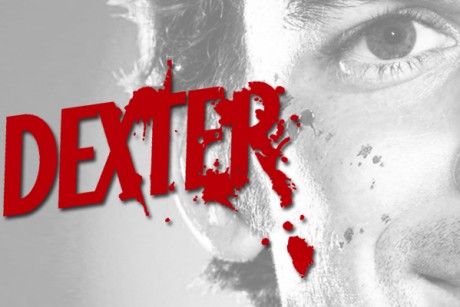
Seriously, Showtime: Dexter-Debra incest? That’s what you’re banking on as you approach the season-six finale? Isn’t that why God created slashfic? What’s next? Ghost-y tussles between Dexter and Harry? Deb and Laguerta? The mind reels.
This week’s Dexter is all bent out of shape, peaking at the 20-minute mark, then limping along as it betrays sundry atrocities, anti-revelations and proof that Captain Laguerta (Lauren Vélez) is the Latina Cruella de Vil of the Miami police department.
After a recap in which Debra (Jennifer Carpenter) says that Dex (Michael C. Hall) is her one safe place — oh, great — the Miami police find the body of Travis’ latest murdered girl, along with the corpse of Doomsday_Adam (Kyle Davis), the one-time Travis fanboy, who was actually stabbed by Dexter.
Travis, meanwhile, has hogtied Angel (David Zayas), stolen his ID and given it to Doomsday_Adam’s batty wife Beth (Jordana Spiro). He’s also gifted Beth with a backpack bomb of wormwood poison, with instructions to deliver the package to Deb. She’d once interviewed the object of Travis’ passions, his sister (who he then killed, as these brother-sister love affairs never pan out). And so Deb and the Miami P.D. must die in the name of God. It’s simple, really.
You can read the rest of Ian's piece here at Salon.
Ian Grey has written, co-written or been a contributor to books on cinema, fine art, fashion, identity politics, music and tragedy. His column "Grey Matters" runs every week at Press Play.
MATT ZOLLER SEITZ: BOARDWALK EMPIRE season two finale
“To the Lost,” the second season finale of Boardwalk Empire, may be remembered as the moment when Boardwalk finally, finally hit its stride. This isn’t the first time the HBO drama has impressed me — even the worst episodes have had great scenes or moments — but there was something special about this one. It was dead solid perfect in almost every department. I think a lot of it comes back to the episode’s consistency of tone, and the show’s comfort with having settled on it.
I thought about tone during that haunting close-up of the soon-to-be-late James Darmody smoking a cigarette by an open window. There was really no reason why such a simple moment should have summoned such force. Michael Pitt wasn’t selling the moment at all. He was just sitting there smoking. Yet the accumulated weight of Jimmy’s trauma — his wife’s death and his tragic inability to feel his way through it thanks to his war experience, his Oedipally perverse childhood, and a life spent among super-macho gangsters — came through loud and clear. Pitt’s posture, gestures and slightly mask-like expressions were exactly right, just as his gentleness during the beachside pony-ride scene with Jimmy’s son was exactly right, and as his ego-free coolness during that rain-soaked final sequence was exactly right. I love how Pitt delivered Jimmy’s statement to Nucky about what to expect after your first killing: 48 hours of nausea. It reclaimed a bit of dignity for Jimmy in his final moments — the implication being that this was first time that Nucky, the butcher of Atlantic City, ever personally killed anyone — but it was not particularly boastful or petty. Jimmy was just a guy who had nothing to lose, delivering information.
Pitt’s acting was always good, if a bit vague and guarded early on — an understandable response to being ask to play a character who was whatever the show needed him to be at any given instant — but he was especially strong during the last five episodes, probably because the writing sharpened up, and he hit his peak last night. The performance was free of 21st-century neuroses, which is by no means the same thing as being untroubled. When Jimmy said he died in the trenches during the war, there was nothing self-dramatizing about it. The character was just reporting the facts as he saw them. Pitt’s acting, here and earlier on the show, was retro, but not ostentatiously so. It seemed to be pitched somewhere between 1940s-era Joel McCrea or Dana Andrews and the kinds of performances that Montgomery Clift gave in the 1950s, which were soulful and tormented, but never never over-indicated or begged for sympathy.
You can read the rest of Matt's piece here at Salon.
Matt Zoller Seitz is publisher of Press Play and TV critic for Salon.
GREY MATTERS: Here are the top 10 beautiful ideas, people and events that defined 2011
This is my theory and I’m sticking to it: if more things were more beautiful, everything else would be way better. Even in this age of fiscal cholera, beauty for the sake of it is it’s own sacred reward.
But as Americans, we’re saddled with the Protestant curse and the attendant pathologies of fetishizing plainness, respecting the mediocre and being in thrall to outright ugliness, whether that manifests in strip malls, lip-warping Restylane or mind-rotting Rush. We could all use a bit of Stendhal syndrome, that most wonderfully strange of
psychosomatic ailments that causes the individual to experience rapid heartbeat, dizziness and even hallucinations when exposed to beautiful things.
And so: a list, where I don’t worry on a genre or platform and instead celebrate ten people, events or ideas whose beauty shook me of the uglies in 2011.
1. Alexander McQueen, "Savage Beauty," The New York Metropolitan Museum of Art, May 4 – August 7
Experiencing "Savage Beauty" was a ravishment and reminder that form is just a means, and that for Alexander McQueen, fashion, film, hologram, robotics and sculpture were all just avenues to transcendence. McQueen was expert in them all, even if he did make his mint in high end couture.
McQueen had the soul of a Romantic and a Gothic, and the sense of humor of a postmodernist who could contain and cross-reference Scorsese, Corman and Kubrick, Scottish nationalism, man versus and fucking machines, angels in water, angels in light, The Birds, and nature triumphant always. McQueen’s runway shows were performance art mixed with Oscar-worthy short films where nature, death and mourning fused.
As you walked the Met’s reverberant, church-like spaces, you encountered Poe in the thousand hand-placed raven feathers of a dress; HAL 9000 reborn in twisting machines that ejaculate clashing colors on a spinning model; the Alien as phallic chrome spine-jewelry; a hologram box of Kate Moss floating in an eternity-loop in what looked like snowy high fashion seaweed. Georges Méliès would have wept.
McQueen was on the verge of creating a new species in style, a hybrid of anime and aquatica glimpsed in Lady Gaga’s Bad Romance video. But after a protracted depression, the designer of the early 21st century took his own life at age 40.
On July 22, 2011, President Obama, Secretary of Defense Leon Panetta, and Admiral Mike Mullen, Chairman of the Joint Chiefs of Staff, officially started the process that would end Don’t Ask, Don’t Tell on September 20, 2011.
It is beautiful beyond words to know that, because of Obama’s kept promise, unknown thousands now live and serve without the virus of shame eating their guts away as a country begins the process of joining the civilized world.
3. Hugo, directed by Martin Scorsese
Good God, what a fourth act Hugo finds the 69-year-old Martin Scorsese in, taking the Stendhal-inducing gorgeousity of Kundun and triple-upping it.
There isn’t an inch that isn’t gorgeously fussed over to beautiful purpose. You could take any frame from the film and have the best artwork in your home. And yet it isn’t simple-minded pictorialism. Every image powers the one coming while advancing the narrative (exactly like a McQueen runway performance, although Scorsese’s an
Armani man.)
Sandy Powell’s wool-heavy designs are almost pornographically gorgeous in a mid-period Gaultier way. If gorgeous imagery mixed with deep-bone-felt humanism were food, you could feed a family of five for a month on a screening of Hugo.
4. Alex Kingston as River Song, Doctor Who
I remember Alex Kingston from ER: sassy, brassy, British – what wasn’t there to love? But, well, it was ER, you know? Limitations were the order of business.
But then came Russell T. Davies and Steven Moffat’s resurrection of Doctor Who, which gave life to Kingston as River Song, a gleefully amoral time traveller who, unfortunately, is travelling in the reverse time direction as the good Doctor she dearly loves.
The result: every time she sees him, he remembers her a little bit less until, ultimately, he will recall her not at all.
As an elegantly painful metaphor for Alzheimer’s in particular and entropy in general, it’s hard to beat. But this is Doctor Who, for fuck’s sake, so there’s also River Song as butt-kicking, quip-popping action hero in the finest of couture. Being in kissing distance of 50 just adds some could-give-a-fuck Helen Mirren to the mix.
5. Timothy Olyphant's shoulders, Justified
It's been a really long time since a star's physiology symbolized his meaning so elegantly, so beautifully. The gold standard of this sort of thing was John Wayne's gait, which in three steps told you all you needed to know about his essence.
On FX’s Justified, Timothy Olyphant's shoulders do a Wayne sort of thing. The beauty in those shoulders is not just their sculptural appeal. It's how Olyphant, playing a modern day sheriff in white trash Kentucky, elegantly cleaves space, shoulders-first. He's carrying on those wide shoulders the weight of an angry man who must corral that rage with a moral code he most certainly did not inherit from the terrible father who betrayed him. When he's with the women he loves, his head sort of bobs down between his shoulders like a boy in trouble – which he is, really.
Along with the sadness of this new, angry, decent lawman, Timothy Olyphant’s shoulders announce a new, softer iteration of the recent masculinity-in-crisis craze (Breaking Bad, Sons of Anarchy, Terriers). “I’m willing,” those shoulders say, “and I want to be very, very reasonable. But I will hurt you if you fuck with me. And it pains me how much I will enjoy hurting you.”
6. Janelle Monáe
McQueen lived long enough to base his last collection around Lady Gaga’s “Bad Romance”. It’s a terrible tease to imagine what he no doubt would have done with the wonder that is Janelle Monáe and any song off her album The ArchAndroid (Suites II and III). They are, after all, drinking of the same wells – Fritz Lang, Hitchcock, Goldfinger, Ziggy Stardust, Philip-K.-Dickian simulacrum erotica – to which Monáe adds her amazing Cubist Afro/deco space-waitress look and her musical splashes of space-age Afro-funk, spazzy semi-metal, big band
played by a few people. There’s nobody on Earth even faintly in her league; the rapture is in listening to her Technicolor dream-trip mind flipping out at warp speed.
7. Lady Gaga, “Judas” music video, 0:44
Look at her face. The secret is she’s just…nice looking, possible looking, and she’s on this great adventure – that’s why they love her. And in this second and a half we see her at the precipice of the true beginning of the unfolding of the legend she co-wrote, programmed, played, sang, engineered. Unprecedented control. And here’s the release of joy. She may never quite have that expression again. It is ecstatic and pure. 8. The ascendancy of e-reader culture
As the uber-cheap Kindles rolled out this November, the elegant beauty and ascension of e-reader culture became undeniable. At a low entry price during the worst economy, a book lover now gets anything instantly, and in so doing, everyone – the reader, the retailer and (God forbid!) the writer – profits.
I like – I need – to get books at slashed prices. I love supporting my friends’ books or small presses, and I love avoiding snide clerks, battered copies, sitting on dirty floors while I try to read sample chapters or discovering that only volume three of a six-volume series is available.
It’s a windfall being able to choose between biographies on Isabella Blow (the visionary who discovered Alexander McQueen) or books on black metal, or finding fantasies like the Hunger Games books, which
really are quite good, dammit. Having access to informed criticism saves more money and time.
The bookstore as community hub, zine and subculture publication distrib is still vital and needed – Baltimore’s Normals is a best-case scenario – but for first run books, e-books are simply, quantitatively better.
9. Black metal invades (finally!)
Black metal was originally defined in the early ‘90s by low-fi misanthropic bursts of fast-picked, super distorted guitars, blast-beat drums and throat-slashed screams about sundry Satanic miseries. It was seriously niche.
But as it cross-pollinated with ambient, new folk and soundtrack music (see Nicolas Winding Refn’s Valhalla Rising), it morphed into something blatantly beautiful. Hopped up on highly processed guitars, echoed drums and washed out keyboards, I imagine the Cocteau Twins if they'd been born on 9/11, which is probably subliminally part of the picture.
Brooklyn's Wolves in the Throne Room suggest deep space, narcosis and sudden metal attacks. Agalloch, a Portland outfit, are more pastoral: they sound like the prettiest trees ever falling into the most lovely of icy rivers. The documentary Until the Light Takes You made black metal’s ascendancy official, but bands like Agalloch, Wolves, Havnatt, Alcest, Nadja and tons more proved the new breed’s sell is based entirely on a savage glacial beauty. You get it where you can. 10. V for Vendetta masks
Released in 2006 at the peak of the new bellicosity, V for Vendetta’s anti-fascist/Christianist allegory was nobody’s idea of a hit or artistic success, but it did have the blunt-tool power of real political class rage you never, ever get in an American-bankrolled film.
That the film’s sardonically anonymous Guy Fawkes masks should become the 99 Percenter’s fashion accessory of choice was a beautiful bit of intuitive mass pop-political alchemy. The mask wouldn’t define the 99% movement, but a crowd without a few Fawkers just doesn’t feel quite right, you know? Talk about revolting into style.
Ian Grey has written, co-written or been a contributor to books on cinema, fine art, fashion, identity politics, music and tragedy. His column "Grey Matters" runs every week at Press Play. To read another piece about Drive, with analysis of common themes and images in all of Refn's films, click here.
This is it, folks: David Gordon Green isn’t the guy that made George Washington and All the Real Girls anymore. Now, he’s the guy that made Pineapple Express and Your Highness. Which is a transition that doesn’t really deserve an award or a hearty handshake or even much praise really. But for the sake of needlessly giving credit where credit is due, I have to say: this new David Gordon Green is ok.
No, seriously. I may have joked in the past that, after hearing that Green wanted to remake Dario Argento’s Suspiria, perhaps doing a shot-for-shot remake of Super Mario Bros.: The Movie would be more his speed. And I definitely don’t think his comedies are worth starting a #teamstonergreen movement for or anything. But Green’s slacker comedies have been incrementally getting better. And they’re mostly funny.
So…yeah, I am working myself up to recommending The Sitter. Because it’s often very funny, thanks in no small part to star Jonah Hill. And until Green and his screenwriters start to take seriously the clichés they had been theretofore only conforming to with their tongues lazily lolling in their collective cheek, it’s pretty amiably ditzy. The film’s charms don’t really wear off until it has to become a narrative about something. Still, The Sitter’s about 2/3rds on-target, which is unfortunately more than can be said about most studio-produced contemporary comedies.
In The Sitter, an exceptionally disheveled Hill plays Noah Griffith, a push-over and a slacker that has to baby-sit three troublesome tykes so that his single mother can go out on a date. One kid, Rodrigo (Kevin Hernandez), is Hispanic, has to go the bathroom constantly and enjoys blowing toilets up. Another kid, Blithe (Landry Bender), wants to grow up to be a “celebutante” and hence wears too much make-up and acts like she knows what’s hot and what’s not. The third kid, Slater (Max Records), is the least annoying kid as he’s just got anxiety issues…oh, and apparently he’s a repressed homosexual, which is news even to him. None of these kids are interesting. You did not come to see The Sitter to watch these kids. Because these kids are only worthwhile as straight men to Jonah Hill’s fat man in a little plaid coat.
Because, let’s face it, the plot of The Sitter is exhausting and not always comically so. Even screenwriter Brian Gatewood and Alessandro Tanaka eventually throw up their hands and accept that they have to get semi-serious about their lazy, potty-mouthed pastiche after a point, which puts a serious damper on Green’s genital-fixated style of humor (I’d say the point where the film stops being generously funny is probably the point where Noah tells Slater that he’s gay…).
So Noah takes these kids out on a wild journey to buy cocaine from Sam Rockwell, who plays a cocaine dealer named Karl that’s basically like Alfred Molina’s character in Boogie Nights but with a muscleman fetish and not as funny. But that goes to hell because Rodrigo winds up stealing one of Karl’s smack-filled dinosaur eggs (Karl also has a dinosaur and Faberge egg fetish). Then Noah meets Roxanne (Kylie Bunbury), an attractive but nerdy black girl that he can relate to and hence eventually winds up dating. Oh and Noah’s got daddy issues. Blah blah blah, balls on fire, blah blah blah, Method Man cameo, blah blah, double-fisted punch to the balls, blah.
But hey, how ‘bout that Jonah Hill? While his serious dramatic performance in Moneyball is impressive, I think he delivers an equally superlative turn in The Sitter. Hill exudes schlubbiness, which is almost enough to make his character seem fully-developed (note: his character is not even halfway well-developed). Noah is a sassy, slovenly loser, which is perfect for Hill, since he looked like Gene Wilder ate Zero Mostel when he shot The Sitter.
Noah is such a waste of space that we’re introduced to while he’s going down on his aloof girlfriend Marisa (Ari Graynor). Marisa doesn’t reciprocate, leaving Noah to peddle dejectedly back home to his mom’s place on his two-speed bike. This isn’t for want of trying: he guilelessly tries to steer her towards his crotch, winking and nudging her all the while. But she feigns stomach problems and that’s the end of that. This is material tailor-
made for Hill, though if Moneyball is any indication, he’s now trying to put that period in his career behind him. It’s similarly too bad that, true to generic form, Noah has to grow up a little by film’s end—he was just hitting his stride.
But let’s not talk about that. Like Hill, Green is in a period of creative stasis. He’s doing what he’s most comfortable right now and that’s only commendable because he’s doing it with a comic performer as talented as Hill, someone that can really turn it on if given half the chance. And The Sitter is roughly half of a chance, give or take a tenth of a chance. It’s sporadically very funny, then it’s mostly just a stupid kiddy pic. But hey, I laughed.
Simon Abrams is a New York-based freelance arts critic. His film reviews and features have been featured in the Village Voice, Time Out New York, Slant Magazine, The L Magazine, New York Press and Time Out Chicago. He currently writes TV criticism for The Onion AV Club and is a contributing writer at the Comics Journal. His writings on film are collected at the blog, The Extended Cut.
VIDEO ESSAY: Chaos Cinema, Part 3, Matthias Stork responds
Editor’s Note: Press Play is proud to debut part three in Matthias Stork’s Chaos Cinema, the latest installment in an ongoing consideration of a phenomenon that Stork defined in two video essays that ran on this site in August, 2011. His first two chapters touched off a firestorm of debate that’s still going on. Just last weekend, New York Times contributor Alex Pappadeascited the piece in a year-end “Riffs” column. Citing bizarre images in "the trailer for 2016, a possibly nonexistent sci-fi movie from Ghana," Pappadeas argued that the major problem with the style is that it does not go far enough. "The standard knock on Chaos Cinema filmmakers is that they’re constructing narratives entirely from rupture and collision," he writes. "But if movies are going to go there, they should really go there. Let’s stop asking directors who clearly have no affinity for story or character to pretend otherwise. Instead, let’s let the alien kick the baby, and see how far the baby will fly." That’s what Stork is doing here by addressing his critics directly using the form that has served him well in the past, the video essay. The full text of the piece’s narration is printed below. For context, we’ve also reproduced Parts 1 and 2 of Chaos Cinema as well. The comments section is open. You may fire when ready.
Chaos Cinema, Part 3
Parts 1 and 2 of my video essay Chaos Cinema argued that chaos cinema represents a major trend in mainstream action filmmaking. It could be seen as the third stage in mainstream movie storytelling.
The first stage was classical cinema. It reigned supreme from the silent era until well into the 1960s. It emphasized spatial clarity, for the most part. The goal was to keep the viewer oriented and involved. You were always supposed to know more or less where you were, where the action took place, and who was involved. And this visual clarity was only disrupted at moments of high tension.
Then came intensified continuity. It favors velocity and increases the speed of classical cinema. It still keeps the viewer oriented, but it does so in a more compact form – almost shorthand. The shots are more succinct, the cutting more aggressive, the camerawork more hectic. This is the old style, reconfigured in a new time.
The third and modern stage is chaos cinema. It makes the previous two stages look old-fashioned. The goal is total visceral impact. There is no clear axis of action that tells you where characters and objects are in relation to each other. The action does not have to be comprehensible. It has to be overwhelming. This is not the action that we have come to know in the cinema; it is the general idea of action. Chaos cinema is a vehicle for spectacle, a roller-coaster ride. It is designed to showcase attractions.
The three stages are by no means mutually exclusive. They are all interrelated and define what we see as the action film.
My video essay on chaos cinema led to an interesting discussion on the Internet. Many viewers agreed with my position. Others took issue with the argument and sought to refute or dismantle it. They posited chaos cinema as a legitimate action style, with its own purposes and goals, and criticized the videos on several grounds.
The points raised were generally instructive. And some deserve a response.
1. Chaos Cinema as Pop Art – Ian Grey, Press Play
Several commenters dismissed my point of view as romantic, misguided. They argued that chaos cinema offers filmmakers a new style for a new age.
In his engaging essay "The Art of Chaos Cinema", Press Play columnist Ian Grey defines the chaos cinema style as “pop art”, with a film syntax that better suits the trashy taste of the PlayStation-trained, YouTube-raised digital generation. He writes: "[C]lassical cinema doesn’t match the experience of a generation of Facebookers, Tweeters and Call of Duty players. It just doesn’t." In his view, chaos cinema presents the world as it is: hyper-mediated, flamboyant and excessive. And classical action cinema is simply obsolete.
Chaos cinema is undoubtedly newer, perhaps even more modern. But I do not see it as an accurate reflection of the 21st century online / gaming experience. It is at best an interpretation. Using the Internet is not the same as watching chaos cinema fireworks onscreen.
Grey also stresses chaos cinema’s potential to engage audiences, keep them awake in the soporific dream machinery of the movie theater. We agree on this one, although I do not necessarily consider it to be a virtue.
2. Chaos Cinema as Abstract Art – Scott Nye, The Rail of Tomorrow
I admit that Tony Scott’s chaos style is intriguing, especially the texture of his images. He paints with the camera in a playful, experimental manner. Or, more accurately, he splatters. Nye’s argument is thus sound in general terms.
But it ignores one thing: the genre context.
And that’s a problem with his comparison. Action filmmaking, even highly stylized action filmmaking, is really not abstract; it is literal. Its goal is to tell a mini-narrative, to record things that happen in a story for an audience that absorbs and processes the action. It is, at its basest level, a record of bodies, or objects, moving from point A to point B. Chasing. Leaping. Clashing. The action scene is <strong>a record of something concrete</strong>. Therefore,
legibility should matter. Precision should matter. Grace should matter.
Abstract artists such as Jackson Pollock or the filmmaker Stan Brakhage produced art with very different aims. Their work only has an implied narrative, no characters, no motivations, and no tangible goals beyond what the individual viewer decides to bring to the work.
And here is another important point: artists such as these exclusively work in a hermetically sealed environment: the avant-garde. They have different audiences, reception spheres and ambitions.
This is not to say that the abstract has no place in the world of narrative. But when we discuss action, should we not agree on a specific framework? Is it abstract art? Not even the great Sergei Eisenstein could produce this association. And in any event, I suspect it will be a few years before <i>Domino</i> is displayed in the Louvre.
The video essay was also dismissed as anachronistic hipster nostalgia which favors the old over the new. Film critic Matt Lynch summed up the general dissent in a rather ingenious, if reductive tweet which labeled the video essay an example of "neoclassical get-off-my-lawnism". Frankly, it is hard to rebut this accusation. I admit a certain bias towards the old.But I am by no means opposed to the new … if it acknowledges the old, and demonstrates an understanding of it, a sense of its value. There have been a number of recent films fitting that description. And I enjoyed them very much.
4. Chaos Cinema as Myopic Discourse
My seemingly wholesale condemnation of chaos cinema in parts 1 and 2 of my video essay infuriated several commenters — and in retrospect, I have to admit, rightfully so.
I did point out that chaos can be effectively used as a narrative device. But my example of The Hurt Locker did not suffice. I should have included others. And I should have made clear that not all films cited as chaos cinema were bad movies that were somehow not worth seeing or discussing. In some cases, I chose particular clips because I think the films are below average. In other cases, I selected clips only because they illustrated a certain point that I wished to make about the look and feel of chaos cinema. In other words, if anyone felt insulted or offended by seeing a certain clip in there, my apologies.
5. Chaos Cinema as Video Game Aesthetic – Matthew Cheney, The Mumpsimus
Action films and first-person shooters share certain narrative parallels. They are essentially navigations through space. As far as aesthetics are concerned, however, they could not be more different. Yes, shooters emphasize speed in all its glory, with pans, tilts and track-ins. But they transpire in a clearly defined diegetic space. There are no cuts, no disruptions, mise-en-scène rather than montage, complete stability. This is not chaos cinema. This is something else, something that cinema aspires to reproduce, by different means.
6. Chaos Cinema: Beyond the Surface – Ambrose Heron, FilmDetail
As many commenters pointed out, chaos cinema did not just magically appear in the new millennium. It was a steady process, a development. Critics such as David Bordwell, Barry Salt or Geoff King have been writing about the stylistic changes for a long time. In his essay Chaos Cinema and the Rise of the Avid, blames non-linear editing systems for the emergence of chaos techniques. This is how we should discuss chaos cinema, as an aesthetic and industrial phenomenon.
In the end, however, we all approach action films with the same mindset. To quote Michael Bay: we demand our action to be …awesome!
Matthias Stork is a film scholar and filmmaker from Germany who is studying film and television at UCLA. He has an M.A. in Education with an emphasis on American and French literature and film from Goethe University, Frankfurt. He has attended the Cannes film festival twice (2010/2011) as a representative of Goethe University's film school. You can read his blog here.
TONY DAYOUB: TINKER TAILOR SOLDIER SPY is a worthy remake filled with lonely characters
The tall, athletic man introduced earlier in Tinker Tailor Soldier Spyas British Intelligence officer Jim Prideaux (Mark Strong) walks into a classroom and begins to write his name on the chalkboard. Only he does not write the name we’ve come to know him by. The typically garrulous young males attending the tony prep school remain blissfully unaware of their new teacher’s identity as he starts handing out the class assignment. But the viewer is all too keenly aware of who Prideaux is if only for the fact that we saw him shot in the back at the start of Tomas Alfredson’s film adaptation of the John le Carré novel. Is this a flashback? Or did Prideaux somehow survive the shooting? Prideaux’s mild demeanor belies his efficiency, a fact his students become aware of when a bird trapped in the chimney suddenly flies into the classroom in confusion. Prideaux rapidly pulls out a club from his desk drawer and swats the bird down to the ground where it continues to squeal in pain. As Alfredson directs the camera to capture the students’ horrified reactions, the sound of Prideaux beating the bird to death comes from off-screen.
This memorable scene crystallizes much of the convoluted – yet ultimately satisfying – story of Tinker Tailor Soldier Spy. For one, the momentary confusion caused by the squawking bird is a metaphor representing the chaos a Soviet double agent is causing within the upper ranks of the Circus, the British Intelligence branch MI6 that Prideaux was working for at the time he was shot in Budapest. Secondly, the viewer must determine whether what is being shown is taking place in the film’s past or its present. Lastly, the sequence illustrates how a character who’s been left to languish in a sort of purgatory for a failed espionage mission may actually be underestimated in his level of competency. The treatment of Prideaux after the shooting – torture, reassignment and disavowal – has been a far more protracted death than the mercy killing he granted the poor animal.
One could say the same thing about George Smiley (Gary Oldman), ex-Deputy Director of the Circus, who was dismissed along with his boss, the mysteriously designated Control (John Hurt), when Prideaux was believed to have been killed in Hungary. Control had secretly sent Prideaux there in order to uncover a mole amongst his top lieutenants: “Tinker” (Toby Jones), “Tailor” (Colin Firth), “Soldier” (Ciarán Hinds) and “Beggarman,” Smiley himself. Smiley’s firing along with that of Control’s made the question of his treachery academic. But both operatives were now on the outside, unable to ferret out which of the other three officers was providing the Soviet double agent some of the Circus’s most valuable secrets. The aimless Smiley goes about his daily routine – swimming in the Thames, contemplating the ruin of his marriage and unable to shake the paranoia inherent in his lifelong career – all but forgotten by his country. However, the death of Control, and intelligence gathered by an underling, Ricki Tarr (Tom Hardy), initiates an invitation from the Prime Minister’s office for Smiley to return and continue his former boss’s investigation into the identity of the traitor.
The usually volatile Oldman is superb as the constricted Smiley. Oldman’s portrayal is even more amazing considering it follows in the footsteps of Alec Guinness, whose performance as Smiley in the original 1979 BBC miniseries and its sequel, Smiley’s People – both available on DVD from Acorn Media if you’d like to compare – is among his most iconic. Over the hill, his hair streaked with gray, and wearing oversized spectacles – red frames for the flashback sequences, horn-rimmed for the ones set in the film’s present day, 1974 – Oldman’s Smiley is a study not so much of repression but economy. Smiley never raises his voice in the film, not even at the close friend who is cuckolding him, except for when an associate tries to justify his betrayal of queen and country. Smiley’s reflective glasses even serve as an occasional blind, shielding his tempestuous, observant eyes from any examination. When a fly is buzzing around the interior of a car driven by protégé Peter Guillam (Benedict Cumberbatch), Smiley, rather than fruitlessly wave his hand in the air chasing it down, waits until the fly is close enough to the window to roll it down and let suction take care of the rest.
What one finds most striking about Tinker Tailor Soldier Spy is the anguish and loneliness that lies at the heart of its brittle, cold exterior. As the movie starts to wind down, the depth of alienation experienced by those in this nasty profession becomes ever more apparent. The desire for emotional connections – the utter loneliness of the job – drives many of the film’s players, including Prideaux, the closeted Guillam, the traitorous mole and yes, even the stoic Smiley. Tarr, the lethal operative whose intelligence relaunched the inquiry, is eager to finish his part of the mission to chuck it all for a quiet life raising a family. Prideaux and Guillam, each separately involved in his own secret homosexual relationship, are the epitome of the type of individuals bred for the espionage service, men of character who have developed an unerring ease in cultivating a double life. And then there’s Smiley, whose frustrating love for his philandering wife is the only chink in his carefully built armor. Smiley’s weakness might just be the proper fuel for his instinctive ability to unearth his fellows’ motivations and find out who the mole really is.
Atlanta-based freelance writer TonyDayoub writes about film and television for his blog, Cinema Viewfinder, and reviews DVDs and Blu-rays for Nomad Editions: Wide Screen, a digital weekly. His criticism has also been featured in Slant’s The House Next Door blog, Opposing Views and Blogcritics.org. Follow him on Twitter.
There’s one big problem with compiling a list of great spy movies: How exactly do you define a “spy movie”? Do the spies have to be employed by a government agency? Does the action have to be international, or can it be domestic, even local? Do the characters have to engage in deception and/or information-gathering, or can they mainly be assassins, like James Bond or Jason Bourne? Is the “assassin film” its own separate genre? If movie characters have nothing to do with international politics but engage in surveillance and deception and other classic spy activities, can their story be grouped within the “spy movie” category?
James Bond wouldn’t spend five seconds contemplating any of that. He’d be too busy quaffing martinis with a diplomat’s wife and telling a dealer to pass the shoe. He’s represented on this list of great spy movies, along with grittier, more mundane depictions of espionage, deceit and international mayhem. I included a couple of TV programs as well as movies, because the genre’s emphasis on character and atmosphere makes it especially well-suited to the small screen.
Since these lists always seem to be compiled according to some mysterious private criteria, I’ll disclose mine upfront: If a film depicts characters navigating the treacherous labyrinth of the military-industrial complex, in their own country or abroad, and engaging in deception or impersonation or codebreaking or defection or assassination or other tried-and-true espionage mainstays, I considered it. But if too many of those aspects were missing, I ruled it out. That’s why you’ll see The Ipcress File but not, say, The Conversation. I’ve also arranged the list in pairs, or double features, because some of the films just seemed to fit together nicely. Let’s argue about it in the Letters section, where I hope you’ll volunteer your own list of great spy films, and your own definition of the category. Be sure to use a pseudonym and file from a secure location. You can’t be too careful.
Press Play is proud to announce our first video essay series in direct partnership with IndieWire: Magic and Light: The Films of Steven Spielberg. Set to premiere Dec. 15, 2011 on this blog, this series will examine facets of Spielberg's movie career, including his stylistic evolution as a director, his depiction of violence, his interest in communication and language, his portrayal of authority and evil, and the importance of father figures — both present and absent — throughout his work.
Magic and Light is produced by Press Play founder and Salon TV critic Matt Zoller Seitz and coproduced and narrated by Ali Arikan, chief film critic of Dipknot TV, Press Play contributor, and one of Roger Ebert's Far Flung Correspondents. The Spielberg series brings many of Press Play's writers and editors together on a single long-form project. Individual episodes were written by Seitz, Arikan, Simon Abrams and Aaron Aradillas, and cut by Steven Santos, Serena Bramble, Matt Zoller Seitz, Richard Seitz and Jose Salvador Gallegos. For a taste of Magic and Light, check out the embeddable trailer above, which was edited by Serena Bramble. — Editors
MATT ZOLLER SEITZ: The controlled madness of AMERICAN HORROR STORY
EDITOR'S NOTE:The following article contains spoilers for American Horror Story season one, episode 10, "Smoldering Children." Read at your own risk.
“Ladies and gentlemen … the ham.”
This may be the line that Jessica Lange was born to say, in the role she was born to play, on a TV show perfectly suited to her fluttery intensity. That she delivered it over a tight shot of a ham festooned with moist pineapple slices being thrust into the camera’s lens — as if the show were being broadcast in 3-D! — made it a perfect kick-off to “Smoldering Children,” the 10th episode of the first season of American Horror Story.
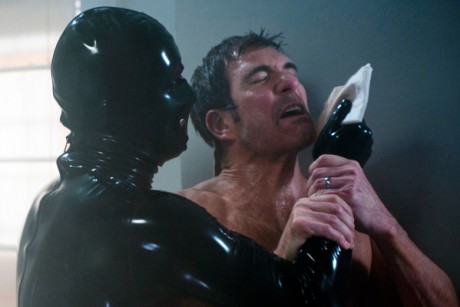
Written by X-Files veteran James Wong and directed by Michael Lehmann (Heathers), the hour greatly escalated the madness on this already demented show. Created by Glee executive producers Ryan Murphy and Brad Falchuk, the series seems to be inventing a new kind of horror — a 21st-century, short-attention-span-theater version, with no lulls. The traditional buildup to the big scare? Booooo-ring. Perhaps operating under the assumption — not unwarranted — that most viewers are watching the program on DVR or illegal download and will just fast-forward to the “good parts” anyhow, they’ve decided to save us all the bother. Every few seconds there’s a fabulously bitchy one-liner, a grim bit of exposition or a surprisingly deft transition between the two, or a beating or stabbing or disembowelment or horrendous searing of flesh, or a faintly S&M-dungeon-flavored sex scene, or a revelation that a character you thought was alive was actually dead all along, or that the heroine has been impregnated by both her husband and by a black-rubber-suited spectral hunk and is carrying both of their children.
What happened tonight? Let’s review — with the caveat that when you describe the actual events on this show, they sound like the plot of a hypothetical horror novel being plotted out by a couple of precocious 13-year-olds.
You can read the rest of Matt's article here at Salon.
Matt Zoller Seitz is publisher of Press Play and TV critic for Salon.


 Seriously, Showtime: Dexter-
 “To the Lost,” the second season finale of Boardwalk Empire, may be remembered as the moment when Boardwalk finally, finally hit its stride. This isn’t the first time the HBO drama has impressed me — even the worst episodes have had great scenes or moments — but there was something special about this one. It was dead solid perfect in almost every department. I think a lot of it comes back to the episode’s consistency of tone, and the show’s comfort with having settled on it.


 This is it, folks: David Gordon Green isn’t the guy that made George Washington and All the Real Girls anymore. Now, he’s the guy that made Pineapple Express and Your Highness. Which is a transition that doesn’t really deserve an award or a hearty handshake or even much praise really. But for the sake of needlessly giving credit where credit is due, I have to say: this new David Gordon Green is ok.
 Because, let’s face it, the plot of The Sitter is exhausting and not always comically so. Even screenwriter Brian Gatewood and Alessandro Tanaka eventually throw up their hands and accept that they have to get semi-serious about their lazy, potty-mouthed pastiche after a point, which puts a serious damper on Green’s genital-fixated style of humor (I’d say the point where the film stops being generously funny is probably the point where Noah tells Slater that he’s gay…).

 The video essay was also dismissed as anachronistic hipster nostalgia which favors the old over the new. Film critic


 This memorable scene crystallizes much of the convoluted – yet ultimately satisfying – story of
  The usually volatile Oldman is superb as the constricted Smiley. Oldman’s portrayal is even more amazing considering it follows in the footsteps of Alec Guinness, whose performance as Smiley in the original 1979 BBC miniseries and its sequel,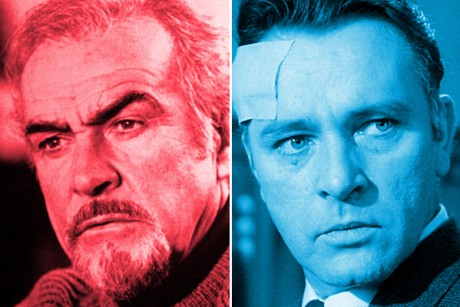



 Press Play Video Blog