SLIDE SHOW: The best TV shows of the year

SLIDE SHOW: The best TV shows of the year

nullWe’re living in some kind of new Golden Age of scripted TV, and this year’s best offerings were amazing. I decided to be rigorous and restrict myself to just 10 entries. It wasn’t easy.

These 10 picks represent what I think were the most creative and consistently satisfying scripted comedies and dramas that aired on American TV during 2011. If I’d expanded the list to account for shows that were somewhat more erratic but that produced terrific individual episodes, this list would have had 30 or maybe even 40 titles on it. If anybody’s curious, I may post the expanded list in the comments section.

You may see some of the runners-up cited next week, when I will present a slide show honoring the best individual episodes of scripted series. There might be an article listing the best nonfiction programs as well.

You can view Matt's slide show here at Salon.

Matt Zoller Seitz is the publisher of Press Play and TV critic for Salon.

AARON ARADILLAS: JAWS: the film and the director that changed everything

AARON ARADILLAS: JAWS: the film and the director that changed everything

null


[Editor's Note: It's Steven Spielberg weekend here at Press Play. We are publishing our first video essay series in direct partnership with IndieWire: Magic and Light: The Films of Steven Spielberg.  This series examines facets of Spielberg's movie career, including his stylistic evolution as a director, his depiction of violence, his interest in communication and language, his portrayal of authority and evil, and the importance of father figures — both present and absent — throughout his work. If you would like to watch Magic and Light: The Films of Steven Spielberg Chapter 1: Introduction, go here ]

It is often said that Steven Spielberg’s Jaws, his excitingly directed adaptation of Peter Benchley’s disposable beach read about a summer community being terrorized by a great white shark, ushered in what we now know as the modern blockbuster. It, along with George Lucas’ Star Wars, brought about what we now accept as the Summer Movie Season. Up until Jaws, studios had considered the summer a vast wasteland where they could offload their grade-z programmers. Just like the town of Amity in the film (really Martha’s Vineyard), where a successful summer tourist season could carry the town through the rest of the year, Hollywood studios would forever rely on summer blockbusters to carry them throughout the rest of the year. This is all true, but Jaws is something else. Look closely and you’ll see it is actually the last old-fashioned adventure, a kind of farewell to a rickety yet sturdy style of Hollywood filmmaking – and values.

The first half of Jaws plays like one of those ‘50s monster movies where a town is under attack by a man-eating creature, but instead of it being mutated ants or Godzilla, it is a shark. The opening shark attack put the audience on notice that this wasn’t your run-of-the-mill horror film. The shooting of the movie was plagued by a constantly malfunctioning mechanical shark. This setback forced Spielberg to be creative by creating suspense by withholding the sight of the shark. This also lined up beautifully with future audiences’ anticipation of the summer movie season. You didn’t know what was coming your way.


There are really only two points of view in the film; the shark’s or Spielberg’s, and at times they’re one and the same. The opening of the film is a P.O.V. shot of the shark in motion, but it could easily be Spielberg, the hot young director who had wowed TV audiences with the compact road thriller Duel and impressed critics with the mature romantic chase picture The Sugarland Express, looking to announce himself to the world. Not yet 30, Spielberg was a product of the first generation to grow up with television. He had an encyclopedic understanding of film and film history. He loved Hollywood spectacles like Around the World in 80 Days and B movies by William Whitney equally. He clearly respected the movies and stars that came before him, but he also knew things had to change. He wanted to tell stories faster and on the appropriate scale. He wanted to make a monster movie where you actually believed the characters were in danger.

Like Hitchcock and Welles, Spielberg refused to be restricted by the rules of realistic perspectives. For Spielberg, the camera could be where it was needed to be in order to tell the story. The only point of view that mattered was his; all others were secondary. You can see this in the sequence where Chief Brody (Roy Scheider) is with his family on the beach, keeping watch on everyone to make sure they’re safe. He’s been told by the mayor to consider a shark attack an isolated incident. Brody isn’t comfortable with this. As he watches people swimming and playing, Spielberg uses a series of wipes to get our senses heightened to the possibility of another shark attack. Then, John Williams’ two-note score begins and we’re plunged into the water as the shark zeros in on the splashing legs of a boy. When the boy is attacked Spielberg cuts to Brody and uses the famous zoom in/pullback shot from Vertigo to make us aware of Brody’s worst fears coming true. The entire sequence isn’t shot to make us feel like one of the tourists on the beach. It is told from the perspective of a filmmaker wanting to play us like a piano. (That scene appears below.)


The second half of the film has Brody and college rich kid oceanographer Hooper (Richard Dreyfuss) accompanying veteran shark hunter Quint (Robert Shaw) as they set out to kill the shark. When their boat leaves the dock it’s as if the movie is leaving behind traditional filmmaking and entering uncharted territory. The camera is rarely, if ever, locked down. It bobs up and down, circles the characters, swoops around Quint’s leaky boat looking for the best angle. (One of my favorite unexplained shots is when Quint stands out on the ship’s pulpit, readying to shoot a barrel into the shark, and the camera moves up and down as he takes aim.) It is the second half of the film that we finally see the shark, but Spielberg purposely catches us off guard. It’s a throwaway gag designed to make you scream, then laugh. (Spielberg also cheats by not using the shark’s theme music to warn us it’s nearby.) Later, Spielberg displays a playful sense of motion as the men seem to be chasing the shark. Williams’ score along with the camera gliding alongside the boat and the sight of barrels moving in the water give us a real sense of momentum.

nullThe centerpiece of the movie is when the men sit around the table, drinking and talking. There’s an unspoken rivalry between the crusty old seaman Quint and the young smart-ass Hooper. They start to compare scars they’ve gotten while observing sharks. (Brody, a former big-city cop who has rarely fired his gun, has no scars.) Hooper is amused by Quint, humoring his macho posturings. Quint knows this. But Quint puts Hooper in his place when he begins to tell him how he survived the Indianapolis, the World War II vessel that delivered the Hiroshima bomb. The Indianapolis is most famous for being attacked and its crew being picked off by sharks. There are a couple of things going on in this sequence. Quint’s monologue stops the film cold and gives it a sense of drama that had been mostly absent up until that point. His story is real and is scarier than anything in the movie. That’s probably why some critics (particularly Pauline Kael) raised concerns about its inclusion in otherwise escapist entertainment. Some felt the movie was crossing a line by using a real-life tragedy in the service of an adventure story. It would seem to be exploiting the real pain of the families of those who perished or survived the Indianapolis. But for Spielberg and his contemporaries (Scorsese, Coppola, De Palma), nothing was off limits. Nothing was sacred if it made for a better story. Quint’s monologue transforms the movie from an old-fashioned monster movie into something haunting. It’s why the movie has endured all these years.


The sequence also represents the changing of the guard as an older generation relinquishes power to a younger, cockier one; it’s the passing of Hollywood’s old guard to a generation of new filmmakers itching to make their mark. Shaw’s Quint stands in for a generation of men of few words who rarely allowed themselves to show their emotions, men full of stories – and to a certain degree, full of shit. Quint’s tale of survival trumps anything that Hooper will ever experience. Hooper knows this. Earlier, he had mocked Quint’s crumbling of a beer can by crumbling his Styrofoam cup. Now he has a newfound respect for him and quietly accepts his wisdom. But Hooper is also clearly Spielberg’s stand-in, a smart-ass who employs the latest in technology to do his job. Brody’s our stand-in as he takes in all he can from the old and the new in an attempt to keep up with what is going on around him. And when the shark finally leaps onto the boat (and at the audience) and bites down on poor Quint, we are seeing the devouring of an outdated Hollywood value system. The shark is the unknown variable that continues to surprise audiences. From the shark in Jaws to the Millennium Falcon going into hyperspace to Superman taking flight to the runaway boulder in Raiders of the Lost Ark to the Stay Puft Marshmallow Man to seeing the Batmobile to the T-1000 to the dinosaurs in Jurassic Park to the long shadow of the flying saucers in Independence Day to Jar Jar Binks to the birth of Darth Vader, we’ve been conditioned to expect the unexpected during the summer. Jaws was the first movie roller coaster. At the time, who would’ve predicted that we wouldn’t want the ride to end?

San Antonio-based film critic Aaron Aradillas is a contributor to The House Next Door, a contributor to Moving Image Source, and the host of “Back at Midnight,” an Internet radio program about film and television.

MAGIC AND LIGHT: THE FILMS OF STEVEN SPIELBERG: Chapter 1: Introduction

VIDEO ESSAY: MAGIC AND LIGHT: THE FILMS OF STEVEN SPIELBERG: Chapter 1: Introduction

[Editor's Note: Press Play is proud to present Chapter 1 of our first video essay series in direct partnership with IndieWire: Magic and Light: The Films of Steven Spielberg.  This series examines facets of Spielberg's movie career, including his stylistic evolution as a director, his depiction of violence, his interest in communication and language, his portrayal of authority and evil, and the importance of father figures — both present and absent — throughout his work.

Magic and Light is produced by Press Play founder and Salon TV critic Matt Zoller Seitz and coproduced and narrated by Ali Arikan, chief film critic of Dipknot TV, Press Play contributor, and one of Roger Ebert's Far Flung Correspondents. The Spielberg series brings many of Press Play's writers and editors together on a single long-form project. Individual episodes were written by Seitz, Arikan, Simon Abrams and Aaron Aradillas, and cut by Steven Santos, Serena Bramble, Matt Zoller Seitz, Richard Seitz and Kevin B. Lee To watch Chapter 2, "Blood and Pulp," about the presentation of violence in Spieberg's movies, click here. To watch Chapter 3, "Communication," click here. To watch Chapter 4, "Evil & Authority," click here. To watch Chapter 5, "Father Figures," click here. To watch Chapter 6, "Indiana Jones and the Story of Life," click here.]

Narration:

Steven Spielberg is one of the most popular storytellers of all time. Based solely on box-office receipts, that’s an inarguable fact.

It's been true since 1975, when the box office take of his breakthrough Jaws redefined the the word "blockbuster."

Look at the top grossing movies of all time, and you'll see that a startling number were produced or directed by Spielberg. And yet this almost forty-year streak hasn't been enough to insulate him against charges that he's a frivolous director – or that, at the very least, his success is an example of style, or more accurately technique, over substance. That he does not persuade or even seduce viewers, but that he overwhelms them. With sound. With light. With music. And special effects.

But a closer look at the Spielberg canon betrays a remarkable depth of feeling and consistency of vision; a recurring set of interests, expressed with increasing subtlety and dexterity over time; a distinctive moral sense; a philosophy of life.

The sheer inescapability of Spielberg makes it tempting to ignore all this; to deny it and refute it; to write him off as an essentially juvenile showman, unworthy of serious consideration, even when he's dealing in quote-unquote serious subject matter.

nullThese complaints have persisted well into Spielberg's fourth decade as a pop culture force, and it's not hard to see why. He is not a confrontational or particularly edgy filmmaker, nor for the most part does he try to be. Even his most stylistically or thematically daring films are conceived in populist terms, to reach the widest audience – the widest MARKET – possible.

The raps against Spielberg are legion, and many are hard, even impossible, to refute.

That his sensibility is fuelled primarily by movies and television and other 20th century media, rather than novels or opera or painting or other, older art forms. 

That his populism, his sentimentality, and his love of neat endings with clearly stated lessons mark him as a mainstream, perhaps even middlebrow, storyteller.

That he is the Peter Pan of cinema: The boy who refused to grow up.

And there is something so overwhelming about Spielberg, even at his subtlest, that some may be inclined to resist as a matter of course. His is a cinema of apocalyptic finales and miraculous visions. A cinema of eye-filling, eardrum-shattering immensity.

Think about Spielberg's signature images for a moment. What do you picture? The sun. The moon. Shooting stars. Menacing skies filled with biblically awesome storm clouds.

You know how students love to talk about the idea of the storyteller, or the director, as God? Well, Steven Spielberg turns that subtext into text. He makes it official. Here is a director who inscribes his signature on the elements… on the cosmos. A director, who literally or figuratively raises entire historical periods, civilizations, even SPECIES from the dead.

The fact that Spielberg is perfectly attuned to the commercial aspects of cinema does not preclude the idea that he is a master artist, who's worthy of appreciation and study. J.G. Ballard, whose memoir-novel Empire of the Sun was adapted by Spielberg back in 1987, once wrote:

"The qualities that the cineastes see as weaknesses, I see as Spielberg's strengths, and as the reason why he is one of today's most important film-makers – the producer-director who single-handedly saved the Hollywood film when it threatened to founder in the Seventies. Besides, sentimentality and spectacle have a valuable place in the arts, as in the operas of Puccini – though there are puritans who feel slightly queasy at the thought of Tosca and Madama Butterfly. In many ways Spielberg is the Puccini of cinema, one of the highest compliments I can pay. He may be a little too sweet for some tastes, but what melodies, what orchestrations, what cathedrals of emotion.""

nullIn recent decades, the notion that Spielberg is somehow trying to prove himself, or re-brand himself, or be quote-unquote serious when he moves away from action-adventure or fantasy, has come to seem increasingly quaint, shorthand for a truism that's not true anymore. It's a critical relic from a long-gone era, akin to marvelling at the notion that, say, Woody Allen or Pedro Almodovar has directed a bleak drama. Indeed, hardly anyone under the age of 40 expresses even mild surprise that Spielberg would make a film such as Schindler's List, Munich, or A.I.

The longer Spielberg directs movies, the more apparent it becomes that his is a chameleonic talent, more versatile in some ways than the talents of two of his most profound cinematic influences, Alfred Hitchcock and Walt Disney.

The phrase "A Steven Spielberg Film" no longer refers to a certain genre, or even a particular mood or mode. Over the decades it has become more elusive, mysterious and much harder to pin down. And that visible evolution – that muddying and deepening – has had a retroactive effect on his movies. Just as the so-called "serious" films reveal themselves as undeniably, obviously, overwhelmingly Spielbergian, in the late 1970s and early 1980s sense, so too do Spielberg's earlier, supposedly "lighter" films reveal their own kind of seriousness. Spielberg’s idea of personal growth is a crucial aspect of all his films. He puts his characters through almost Biblical tests that would have made Job say, "Well, that's a bit much, isn't it?" They come out of the other side as better, more mature, more sensitive people, but at terrible cost.

Simply put, Steven Spielberg was always a serious filmmaker, just as Disney and Hitchcock, and John Ford and Howard Hawks, and Sam Peckinpah and Martin Scorsese, were always serious. Spielberg is, and always was, an auteur by any measure. A reliable purveyor of richly imagined, thoughtfully constructed entertainment and art.

nullThis series will examine just a few of Spielberg's key obsessions and motifs, as expressed over a wide range of films, released over four decades. We'll look at the influence of pulp fiction, serials and comic books on Spielberg's skillful depiction of violence – and how he learned to modulate it over time, in ever more varied ways. We'll look at the importance of communication and translation in Spielberg's films: the director's evident conviction that curiosity and goodwill can overcome superstition, bigotry and fear. We'll examine Spielberg's multifaceted portrait of evil and authority, and how the two intertwine, and express themselves in some of his most important characters. And we'll look at the director's sometimes warm, sometimes harrowing portrait of family life, with its negotiations and compromises, disappointments and tragedies — and the pivotal role played by father figures. Cold and loving. Present and absent.

As we shall see, Spielberg is in some ways a more complex and multifaceted filmmaker than even his fans give him credit for.  Beneath the explosions and effects; the slapstick and thrills; the emotion and wonder; lies an acute sense of right and wrong.  An appreciation of human weakness. An awareness that we are capable of great cowardice and cruelty. And that, even under the worst of circumstances, we can do great things. He is an exuberant showman. A stealthy artist. And a master of magic and light.

A critic, journalist and filmmaker, Matt Zoller Seitz is the publisher of Press Play, the staff TV columnist for Salon.com and a finalist for the Pulitzer prize in criticism. Ali Arikan is the chief film critic of Dipnot TV, a Turkish news portal and iPad magazine, and one of Roger Ebert’s Far-Flung Correspondents. Ali is also a regular contributor to The House Next Door, Slant Magazine’s official blog. Occasionally, he updates his personal blog Cerebral Mastication. In addition, his writing appears on various film and pop-culture sites on the blogosphere. You can follow his updates on twitter at twitter.com/aliarikan. Serena Bramble is a rookie film editor whose montage skills are an end result of accumulated years of movie-watching and loving. Serena is currently pursuing a Bachelor's degree in Teledramatic Arts and Technology from Cal State Monterey Bay. In addition to editing, she also writes on her blog Brief Encounters of the Cinematic Kind.

Reeling and Spinning: Lindsay Lohan is taking her clothes off. . . .again

Reeling and Spinning: Lindsay Lohan is taking her clothes off. . . .again

null

So, Lindsay Lohan is butt-bald-nekkid in next month’s issue of Playboy. Well, whoopty fuckin’ shit!

Is there anyone shocked by this news? After years of the once-promising, red-headed starlet fucking up her life and her career in every way possible, she is now in the pages of the magazine everyone figured she would end up in eventually. To me, the most shocking thing is that this it might actually persuade men to jack off to an issue of Playboy for the first time since the mid-’90s. (That is, if they haven’t already seen the leaked pics on the Web.) 

And really, who hasn’t seen Lohan naked by now? Those who saw Robert Rodriguez’s latest enchilada western Machete were greeted to several Lohan topless scenes. And while the Playboy spread makes her resemble Marilyn Monroe's “Sweetheart of the Month” appearance in the first Playboy issue, Lohan already did a Marilyn-influenced spread in 2008 when she and famed Monroe photographer Bert Stern recreated one of Monroe’s final shoots for New York Magazine. (She really needs to quit with the Marilyn-emulating. We all know how that shit turned out and if you don’t know, My Week with Marilyn is out now. Hell, even Megan Fox is getting rid of her Marilyn tattoo.) And those who saw Robert Rodriguez’s latest enchilada western Machete were greeted to several scenes where Lohan was topless and perky.

nullI actually think posing nude for Playboy is the most respectable, professional thing Lohan has done in years. It’s been so long since I’ve seen her in anything good — whether it’s a movie, a guest-hosting stint on SNL or even a cameo in a music video —that I’ve lost my frame of reference for measuring the relative quality of her acting. I mean, how long has it been since Mean Girls? Seven years? I haven’t seen anything lately that has given me the slightest inkling that this gal has been working on her craft and I’ve seen her in many-a-shitty film. Remember when she was horribly miscast as a twentysomething career gal whose streak of good luck disappears after swapping spit with a pre-Star Trek Chris Pine in the not-even-remotely-funny vehicle Just My Luck? Of course not, because you have respect for yourself. I, on the other hand, am a film critic, therefore, I don’t, so I did. Or how about Lohan's turn as a trauma-stricken college student who may or may not moonlight as a slutty stripper in the just-plain-crazy I Know Who Killed Me? There is only one thing I can say about that movie: SHE HAS A ROBOT ARM!!!!??!!

In all fairness, she did give a couple of performances that weren’t god-awful. She kept a low-key, angsty steelo when she played Meryl Streep’s poetry-writing daughter in Robert Altman’s A Prairie Home Companion. (I guess when your mom is being played by MERYL FUCKIN’ STREEP, the only thing you can do is shut up and watch how a pro does it.) And, as much as it pains me to bring up Emilio Estevez’s embarrassing, ensemble period piece Bobby, her performance as an optimistic bride-to-be getting married to Elijah Wood’s Vietnam-bound groom is noteworthy simply because I actually see her trying.

But that was back in the good ol’ days when she gave a shit. Apparently, all those years hanging with Paris Hilton depleted Lohan of the brain cells needed to be a productive member of society. In the span of seven years, she has lived the sort of fast-paced, fodder-for-tabloids celebrity experience that would even make Frances Farmer say, “What the fuck is wrong with this chick?”

nullLet’s review: Drugs, alcohol, eating disorders, rehab, arrests, jail time, straight relationships, gay relationships, back to straight relationships. She’s like a walking season of Weeds. But, then again, I would go on a tear like that if I had the sort of parents she has. Her mother, Dina, is a bigger publicity hoe than her daughter, while her father, Michael, is such a model definition of a deadbeat dad that he makes my father (whoever he is) look like Fred MacMurray.

The funny thing is that, while she has been pissing her time away, other formerly underaged It Girls have been working their asses off making careers for themselves as working adult actresses. Some have reached A-list status (hey, Natalie and ScarJo). Some get sporadic but still-steady work (like former Aerosmith video co-stars Alicia Silverstone and Liv Tyler). Some have careers in television (Claire Danes in Homeland, Christina Ricci in Pan Am). And some dropped out for mental health reasons, only to bounce back and get the best acclaim of their career after hooking up with Lars von Trier (great to see you back, Kirsten).

If I appear to be a bit too harsh on Ms. Lohan, it’s because I expected so much more from her. When she appeared on the scene, she was like a curvy, grounded breath of fresh air, a girl who looked and acted like, well, a girl. Maybe, that’s what we all wanted her to be: a child actress who would grow up to be another Liz Taylor or Jodie Foster. Sadly, that has not turned out to be the case. She has become everyone’s wayward sister – you know, the one who shows up on your doorstep out of nowhere, mooches off you and fucks up your life. She is Martha Marcy May Marlene – for reals!

Unfortunately, showing her ass all airbrushed and freckle-free in a stroke-book doesn’t indicate that a Robert Downey, Jr.-style career resurrection will be happening for her anytime soon. Some of you may (especially dudes) may be more forgiving of Lohan after seeing her warts-and-all pictorial, but I don’t feel like being an enabler. Quite frankly, I gave up on ol’ girl a long time ago. You can only take a woman breaking your heart so many times before you get fed up and wash your hands of her.

If she wants to be the Lindsay Lohan she’s been, then good riddance. If she wants to be the Lindsay Lohan she could be, then good luck.

Craig D. Lindsey used to have a job, as the film critic and pop-culture columnist for The Raleigh News & Observer. Now, he's back out there hustling, writing about whatever for Nashville Scene, the Greensboro News & Record, Philadelphia Weekly, The Independent Weekly and other publications. He has a Tumblr blog. You can also hit him up on Twitter.

MATT ZOLLER SEITZ: Where can AMERICAN HORROR STORY go from here?

MATT ZOLLER SEITZ: Where can AMERICAN HORROR STORY go from here?

null

EDITOR'S NOTE: The following article contains spoilers for "American Horror Story" season one, episode 11, "Birth." Read at your own risk.

“Just because we’re dead doesn’t mean we don’t have wants … desires,” said Tate, the pouty, bratty, forever-teenage rubber-suit-wearing, mom-of-the-house raping, suicide pact-making … sorry, I feel like there should be about 12 more adjectives in there, because the ghostly Tate, like most of the characters on FX’s aggressively lurid “American Horror Story,” requires them. But let’s stay focused on Tate’s statement, because it’s key. Yes, of course! He and the other ghosts have wants … desires. And one of the many amazing things about the show is how, over the past few episodes, it has subtly moved the ghosts to the center of the narrative, to the point where the ever-dwindling number of living characters have started to seem like the supporting cast on a show that they were ostensibly the stars of. (Of course, now that they’re all dropping like flies — even money on Constance to bite the dust by the end of season two — they get to be at the center of the story again.)

I’ll spare you a detailed recap because if you didn’t see the episode, you shouldn’t be reading this article in the first place — and besides, appreciation and speculation is more fun. As written by Tim Minear and directed by Alfonso Gomez-Rejon, it was perhaps the show’s spookiest episode to date, campy and trippy (check out all those dissolves!) yet straightforwardly horrific, in the art house/grindhouse vein of a 1970s Ken Russell or Dario Argento picture.

You can read the rest of Matt's piece here at Salon.

Matt Zoller Seitz is the publisher of Press Play and TV critic for Salon.

MATT ZOLLER SEITZ: GLEE has a Judy Garland Christmas

MATT ZOLLER SEITZ: GLEE has a Judy Garland Christmas

nullAll together now, readers: If you hate Glee so much, Matt, why do you keep watching it? I don’t know, folks. At the risk of sounding like a masochistic romantic who’s stuck in a tortuous relationship — Dear diary, I can’t TAKE this anymore, it’s horrible and it’s KILLING me … but OH MY GOD IF YOU COULD HAVE SEEN THE GIFT SHE BOUGHT ME! — I have to go on the record about last night’s Glee Christmas special. It was brilliant.

OK, actually, I should qualify that — the middle section was brilliant. The wraparound stuff was the Glee usual: silly, pandering and dull. During the final number — “Do They Know It’s Christmas,” set in a soup kitchen that no doubt was populated by the children of “Glee” cast and crew — even the actors seemed bored, except for Jane Lynch, whose Coach Sylvester was acknowledging the first anniversary of her sister’s death. (Tear cup.) But OH MY GOD IF YOU COULD HAVE SEEN THAT MIDDLE SECTION, DIARY! Presented in black-and-white, it perfectly re-created the set, the tone and even the camera moves of The Judy Garland Show Christmas special from 1963, but with a cultural flash forward/flashback quality, presenting a patchwork quilt vision of America that wouldn’t have gotten past the network censors four decades ago.

You can read the rest of Matt's recap here at Salon.

Matt Zoller Seitz is the publisher of Press Play and TV critic at Salon.

CHAPTER ART: MAGIC AND LIGHT: THE FILMS OF STEVEN SPIELBERG debuted Dec. 15

CHAPTER ART: MAGIC AND LIGHT: THE FILMS OF STEVEN SPIELBERG debuts tommorow

nullnullnullnull

null

Press Play's first video essay series in direct partnership with IndieWire: Magic and Light: The Films of Steven Spielberg.  Beginning Dec. 15, 2011 at Press Play, this series examines facets of Spielberg's movie career, including his stylistic evolution as a director, his depiction of violence, his interest in communication and language, his portrayal of authority and evil, and the importance of father figures — both present and absent — throughout his work.

Magic and Light is produced by Press Play founder and Salon TV critic Matt Zoller Seitz and coproduced and narrated by Ali Arikan, chief film critic of Dipknot TV, Press Play contributor, and one of Roger Ebert's Far Flung Correspondents. The Spielberg series brings many of Press Play's writers and editors together on a single long-form project. Individual episodes were written by Seitz, Arikan, Simon Abrams and Aaron Aradillas, and cut by Steven Santos, Serena Bramble, Matt Zoller Seitz, Richard Seitz and Kevin B. Lee. For a taste of Magic and Light, check out the chapters above. The trailer for this series is here. Chapter 1 of the series is here. — Editors

AARON ARADILLAS: Taking Aim: the meaning of Oliver Stone’s JFK 20 years on

AARON ARADILLAS: Taking Aim: Oliver Stone’s JFK @ 20

null

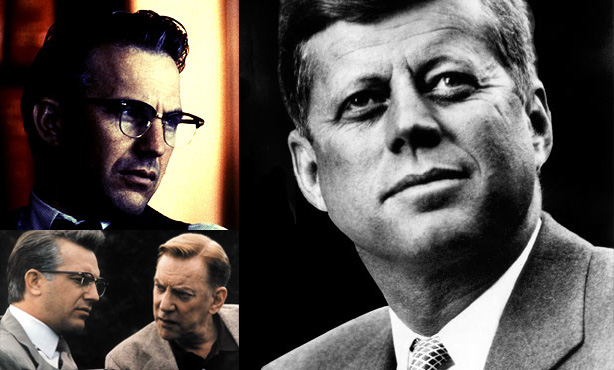
Released in 1991, JFK is the first official film of the ‘90s. Director Oliver Stone, a dramatist first and foremost, uses the defining moment of the second half of the 20th century – the assassination of President John F. Kennedy – to try to figure out what exactly went so wrong in the wake of America’s triumphant prosperity following World War II. Stone sees the Kennedy assassination as the moment when his generation – the Baby Boomers, the generation to reap the rewards of the Greatest Generation – splintered into those who would forever be suspicious of authority and those who figuratively went to sleep to the constantly changing world around them.

Stone, an only child of privilege, turned his back on his roots by dropping out of Yale to join the Marines and go to the front line of Vietnam. He wanted to find himself. (In his autobiographical film Platoon, Stone’s surrogate, Chris Taylor (Charlie Sheen) says he dropped out of college and volunteered because he didn’t see the point of the poor kids having to go to war. Fellow soldier King (Keith David) laughs and says, “Shit, you gotta be rich in the first place to think like that. Everybody know, the poor are always being fucked over by the rich. Always have, always will.”) He came back from the war a decorated hero but just as confused as when he went, maybe more so. His experiences with combat, drugs and clashes with authority gave Stone the ammo to become one of Hollywood’s top screenwriters, writing such pulp landmarks as Midnight Express and Scarface. He energized the second half of the 1980s with his electrifying directorial efforts Salvador, Platoon, Wall Street and Talk Radio, muckraking docudramas that flirted with danger with their confrontational attitude toward accepted history. Then, with Born on the Fourth of July, Stone began a transition into a morenullimpressionistic, near hallucinatory directorial style. By casting Tom Cruise as Ron Kovic, the Vietnam veteran who came home paralyzed and became a raging force in the anti-war movement, Stone committed a perverse act of image vandalism. He turned the audience’s relationship with Cruise, the ‘80s poster boy for All-American wholesomeness, on its head. The result was an emotionally sweeping film, a The Best Years of Our Lives for Vietnam that moved from anger to sorrow to cautious optimism. Stone’s follow-up was the rock & roll head trip The Doors, a movie that captured for the first time ever the enormous ego and narcissism that was a major part of the hippie dream.

JFK represents the culmination of Stone’s work up to that point, the curtain raiser for his extraordinary ‘90s run of movies that forced us to rethink our collective history and consider the history we were making. Part ‘70s-style political thriller, part Frank Capra dream, part mix-media collage of fact and speculation, JFK recreated the feeling of disorientation that swept across America beginning on November 22nd, 1963. The movie may have been set in the ‘60s, but its sensibility was present-day 1991. Stone uses the story of New Orleans District Attorney Jim Garrison – a flamboyant, controversial, some would say reckless man who remains the only man to date to bring someone to trial for the assassination of President Kennedy – as his way into his own investigation of the case. In ‘70s political thrillers like The Conversation and All the President’s Men, both the protagonist and the audience were shocked to discover how corrupt The System was. JFK has no such illusions. It is infused with a nervous energy and constant state of paranoia, the byproduct of the coke-fueled go-go ‘80s. Hip audiences weren’t shocked to discover a cover-up conspiracy was afoot. They wanted the movie to go even deeper into the heart of darkness.

Old guard critics and historians were outraged at the time at what they saw as Stone playing fast and loose with history. They felt Stone had a responsibility to be clear and not muddy history with speculation. But Stone is not a historian; he’s a storyteller. His responsibility is to emotional truth. JFK is a movie told with hindsight. A scene of the Garrison family sitting around the dinner table as Jim talks about his growing concerns about the Warren Commission is like a Norman Rockwell tableau about to crack, an All-American family unit unaware that its days are numbered. The scene is followed by Garrison awakening from a nightmare, an awakening that America as a whole would be forced to go through. (That scene appears below.)


JFK’s groundbreaking free-form editing style and use of several kinds of film stocks upset traditionalists who felt fact-based docudramas should have clean narratives, as so not to confuse the viewer. But Stone and editors Joe Hutshing and Pietro Scalia knew audiences were ready and capable of processing several pieces of information at once. We had been perfecting the ability to filter fact from fiction, speculation from theory. In a sequence where Garrison walks two of his assistants through his discovery of a secret intelligence community smack dab in the middle of New Orleans, where Lee Harvey Oswald spent his free time, we are shown Stone’s methodology. We see key characters like Oswald (Gary Oldman) or Guy Bannister (Ed Asner) emerge from building doorways as soon as Garrison says their names, as if entering from off-stage and being presented to the audience for consideration. When Garrison recounts documented events the film switches to handheld black and white photography. We take in the information on multiple levels at once and without any difficulty. As Garrison pieces things together, so do we. We begin to put the pieces together, deciding for ourselves what is important and what isn’t. (That scene also appears below.)
 

The film’s most incendiary instance of speculative imagery occurs when Garrison and his staff are discussing the discovery of Oswald’s palm print on the rifle. Garrison is suspicious of this and suggests that someone could’ve easily grabbed the print while Oswald was in the morgue. The movie cuts to a black and white image of someone lifting Oswald’s hand off the gurney and pressing it against the butt of the rifle. Critics criticized Stone for including such an image, fearing audiences would interpret it as found documentary footage. (Did they really think someone would allow himself to be photographed in such an incriminating manner?) Of course Stone’s critics knew the image was staged for dramatic purposes, but were concerned others wouldn’t be able to tell the difference.

The movie operates on two realities at once. On one level it tells the story of Jim Garrison’s growing obsession with solving a murder. On a basic high-concept level, JFK plays like Anatomy of a Murder crossed with Blow-Up. On another level, the movie is racing ahead of the characters as history marches past their discovery of new evidence. This is dramatized in the sequence where Garrison and his team sit around a restaurant table discussing the travel history of Oswald leading up to the assassination. The sequence is broken up with the doctoring of the famous photograph of Oswald holding the murder weapon in his hands. We see brief shots of the pasting of the image together in a darkroom. The scene climaxes with Garrison telling his team, “We’re through the looking-glass here, people. White is black and black is white. Maybe Oswald is what he said he is – a patsy.” At that instance we see the finished photograph. Stone is saying no matter how much “truth” we discover there are still forces at work. (That complete scene is below.)


The casting of Kevin Costner turned out to be a masterstroke as he uses his Jimmy Stewart/Gary Cooper-like rapport with the audience to bring them along on Stone’s shadow version of American history. Costner’s casting goes a long way to giving credibility to the frankly shaky reputation of the real-life Garrison. When Costner’s Garrison is walking to the courthouse and John Williams’ militaristic score accompanies him, it’s like an update of Mr. Smith Goes to Washington. This time the difference is that the fight might turn out to be a futile one. Costner is contrasted brilliantly with Tommy Lee Jones’ mysterious C.I.A. man Clay Shaw. Jones gives the character an effete style that turns out to be just a mask. When Shaw leaves Garrison’s office he extends his best wishes to everyone in the room. We’d almost believe his sincerity if it wasn’t for the fleeting moment when his eyes narrow and we realize he hasn’t revealed a thing about himself. The rest of the cast is comprised of actors who disappear into their roles as Stone employs an Irwin Allen-like genius for typecasting. He uses John Candy’s trademark jovial persona to shocking effect as a flamboyantly crooked lawyer. (His constant sweating tells us he’s in a constant state of crisis control.) Joe Pesci is all manic energy, chain-smoking and constantly explaining, as disgraced company man David Ferrie. Oldman is an enigma from beginning to end as modern history’s original Travis Bickle. And Kevin Bacon is terrific as a strutting gay hustler with a radical conservative streak. (He’s like Jon Voight’s Joe Buck minus the naiveté.) The ensemble casting of movies like JFK and Nixon is almost a lost art today. (It takes a Scorsese or Soderbergh to bring together a cast of high profile names willing to give themselves over to an envelope-pushing enterprise.) A scene involving Jones, Pesci, Bacon and Oldman is kind of amazing as we see different generations and acting styles meshing in order to further a story.
 

The highlight of the movie is Garrison’s meeting with Mr. X (Donald Sutherland), a high-ranking military official who tells him he is very close. The nearly 18-minute sequence is a spellbinding piece of filmmaking as fact, speculation, reenactments and documentary footage add up to a vision of the military-political machine operating on its own, as if human intervention is simply an inconvenience. It is the granddaddy of all walk-and-talk sequences with ‘70s Hollywood liberal icon Sutherland giving the film his seal of approval. (That scene scene appear above this graf.)
 

That sequence is mirrored by Garrison’s closing summation as he lays bare all the evidence he’s amassed as proof of a conspiracy. The centerpiece of his closing argument is the film’s bold use of the Zapruder 8 mm home movie of the assassination. Stone has Garrison replay the movie over and over again until we become convinced we can see exactly what happened. Or do we? In the end, the legacy of Oliver Stone’s JFK is not whether you believe Garrison or some other conspiracy theory or simply believe Oswald acted alone. What Stone dramatized is the moment when America stopped believing its own eyes, when the notion of “fact” would forever be up for debate.

San Antonio-based film critic Aaron Aradillas is a contributor to The House Next Door, a contributor to Moving Image Source, and the host of “Back at Midnight,” an Internet radio program about film and television.

VIDEO ESSAY: Moment of wonder: THE SPIELBERG FACE

VIDEO ESSAY: Moment of wonder: THE SPIELBERG FACE

null

[Editor's Note: Press Play is proud to present our first video essay series in direct partnership with IndieWire: Magic and Light: The Films of Steven Spielberg.  This series examines facets of Spielberg's movie career, including his stylistic evolution as a director, his depiction of violence, his interest in communication and language, his portrayal of authority and evil, and the importance of father figures — both present and absent — throughout his work.

Magic and Light is produced by Press Play founder and Salon TV critic Matt Zoller Seitz and coproduced and narrated by Ali Arikan, chief film critic of Dipknot TV, Press Play contributor, and one of Roger Ebert's Far Flung Correspondents. The Spielberg series brings many of Press Play's writers and editors together on a single long-form project. Individual episodes were written by Seitz, Arikan, Simon Abrams and Aaron Aradillas, and cut by Steven Santos, Serena Bramble, Matt Zoller Seitz, Richard Seitz and Kevin B. Lee. To watch Chapter 1: Introduction, go here. To watch Chapter 2: Blood & Pulp, go here. To watch Chapter 3: Communication, go here. To watch Chapter 4: Evil & Authority, click here. To watch Chapter 5: Father Figures, click here. To watch Chapter 6: Indiana Jones and the Story of Life, click here. ]

Narration:

If there is one recurring image that defines the cinema of Steven Spielberg, it is The Spielberg Face. Eyes open, staring in wordless wonder in a moment where time stands still. But above all, a child-like surrender in the act of watching, both theirs and ours.  It’s as if their total submission to what they are seeing mirrors our own.

The face tells us that a monumental event is happening; in doing so, it also tells us how we should feel. If Spielberg deserves to be called a master of audience manipulation, then this is his signature stroke. You can’t think of the most iconic moments in Spielberg’s cinema without The Spielberg Face.

Expressive close-ups of faces reacting to events offscreen. This is a common device in Hollywood filmmaking, perhaps due in part to Spielberg’s influence. Sometimes these shots even make explicit homage to his movies. This is not to say that Spielberg invented the technique.  The expressive close-up existed as early as the days of D.W. Griffith, and has long been a staple of both international and classical Hollywood filmmaking.

But it’s safe to say that none have come close applying this technique as prolifically throughout their filmmaking career as Spielberg has. He has used it in a variety of genres in any number of situations: sudden shock or creeping dread, the trauma of remembering the past or of confronting the future, discovering humanity in another person, or discovering humanity in oneself.

You can read the rest of the transcript here at Fandor.

Kevin Lee is Editor in Chief of Fandor, a new video on demand website featuring the best of independent and international films. He is also a film critic and award-winning filmmaker. In addition to editing Keyframe, Kevin contributes to film publications and produces online video essays.

The Art of MAGIC & LIGHT: THE FILMS OF STEVEN SPIELBERG

The Art of MAGIC & LIGHT: THE FILMS OF STEVEN SPIELBERG

nullnullnullnullnullnullnull

null

MAGIC & LIGHT: THE FILMS OF STEVEN SPIELBERG premieres Dec. 15 at Press Play. Check out these eye-popping title cards. As they used to say of CLOSE ENCOUNTERS trading cards back in the '70s, collect them all!

[Editor's note: These are graphics designed by Boke Yuzgen to promote the Press Play original video essay series Magic and Light: The Films of Steven Spielberg, which will premiere Dec. 15 on this site. The series is produced by Matt Zoller Seitz and Ali Arikan and narrated by Arikan. It brings the talents of many Press Play contributors together on a single project.  The individual chapters are written by Seitz, Arikan, Simon Abrams and Aaron Aradillas, and edited by Steven Santos, Matt Zoller Seitz, Richard Seitz, Kevin B. Lee and Serena Bramble.]