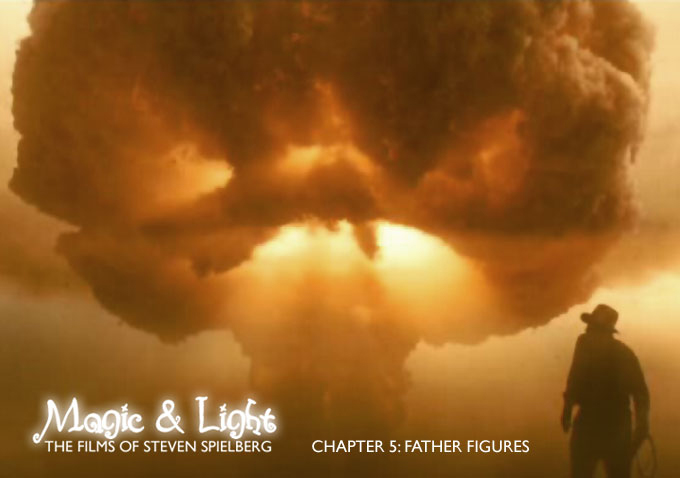
VIDEO ESSAY: MAGIC AND LIGHT: THE FILMS OF STEVEN SPIELBERG, Chapter 5: Father Figures

VIDEO ESSAY: MAGIC AND LIGHT: THE FILMS OF STEVEN SPIELBERG, Chapter 5: Father figures

[Editor's Note: Press Play is proud to present Chapter 5 of our first video essay series in direct partnership with IndieWire: Magic and Light: The Films of Steven Spielberg.  This series examines facets of Spielberg's movie career, including his stylistic evolution as a director, his depiction of violence, his interest in communication and language, his portrayal of authority and evil, and the importance of father figures — both present and absent — throughout his work.

Magic and Light is produced by Press Play founder and Salon TV critic Matt Zoller Seitz and coproduced and narrated by Ali Arikan, chief film critic of Dipknot TV, Press Play contributor, and one of Roger Ebert's Far Flung Correspondents. The Spielberg series brings many of Press Play's writers and editors together on a single long-form project. Individual episodes were written by Seitz, Arikan, Simon Abrams and Aaron Aradillas, and cut by Steven Santos, Serena Bramble, Matt Zoller Seitz, Richard Seitz and Kevin B. Lee. To watch Magic and Light: The Films of Steven Spielberg Chapter 1: Introduction, go here. To watch Magic and Light: The Films of Steven Spielberg Chapter 2: Blood & Pulp, go here.  To watch Magic and Light: The Films of Steven Spielberg, Chapter 3: Communication, click here. To watch Magic and Light: The Films of Steven Spielberg, Chapter 4: Evil & Authority, click here.]

Narration:

Steven Spielberg is the product of The Greatest Generation — a Baby Boomer raised on idealized images of the nuclear family, progress, and American might. He is also a child of divorce — a dreamer from a broken home. Spielberg’s attempt to reconcile these two biographical facts—the mythic ideal of the family, and the reality of its dismantling—has been at the heart of many of his films. Spielberg’s movies often focus on a real or makeshift family unit, banding together to fight an outside force that threatens to tear it apart. At the head of this makeshift family, there is often a father figure imparting wisdom to his charges, or being forced to confront his shortcomings as a protector. Often both.

nullIn Jaws Roy Scheider’s Chief Brody is the father figure to a tightly-knit summer community being terrorized by a Great White Shark. The scene where his son mimics his gestures tells us he’s a loving, good father who will do anything to keep his family – and his community – safe.

The film’s second half shows Brody becoming part of a makeshift family of shark hunters, with World War II veteran Quint taking over as protector of the landlubber police chief and the rich-kid, know-it-all oceanographer, Hooper.

The trio of Quint, Brody and Hooper  feels like a makeshift family unit: an impetuous, sarcastic younger brother, a tougher, wiser older brother, and their boozing, cantankerous, tinpot dictator dad.

At first, Brody and Hooper question Quint’s methods as well as his manner. The old sea captain is a gruff taskmaster. He’s slobblish, domineering and rude. He is also quite mad.

nullBut when the men sit around drinking and talking we learn the source of Quint’s insanity. He tells them of how he survived the sinking of the USS Indianapolis, the naval vessel that an atomic bomb that helped the United States defeat Japan in World War II. They were ultimately successful — but the mission is famous mainly for having its crew picked off by ravenous sharks.

Quint’s ordeal trumps anything Brody or Hooper will ever experience. And it seems to make a deep impression on them. Although they never stop resenting Quint’s sourness or fearing his craziness, they appreciate his toughness, and learn to work with him. They are members of the younger generation learning to respect a seasoned elder because they are, so to speak, all on the same boat.

And when the father dies horribly — leaving the boat adrift at sea, and the mission figuratively adrift – it is up to the sons to complete the mission.

In Saving Private Ryan, Captain Miller is an unofficial father figure to a mostly young group of Army Rangers. He’s given the public relations-burnishing task of finding and extracting the last surviving member of a group of brothers who were all killed fighting the Germans. Miller wonders if this mission is worth the price. For every man he’s lost in his command, Miller figures he’s saved maybe 10, 20. Now he’s been asked to put his entire platoon—his family—in harm’s way to save just one.

Miller hopes that Ryan is worth it – that he goes home and invents a longer-lasting light bulb or cures cancer. But he puts the thought aside for the same reason that parents try not to think about whether the incredible effort they’ve invested in their own, flesh-and-blood children will yield a saint, a felon, or something in between. One cannot know such things — and the end result of parenting isn’t the point of the exercise. You do it out of love. And duty. And you hope for the best.

When the men finally find Private Ryan he doesn’t want to go home. Why? Not out of some abstract sense of patriotism, but for immediate, personal reasons. Ryan doesn’t want to leave HIS surrogate family – his fellow soldiers.

Miller and the rest of the rescue team decide to stay and help Ryan secure a tower. It’s  practically a suicide mission. And it ends with Miller making the ultimate sacrifice.

nullThe Spielberg who made Saving Private Ryan in the late 1990s was a family man in his 50s. Detractors questioned Miller’s final admonition — asking, in effect, “Well, what if Private Ryan went home and DIDN’T accomplish anything special?” But that’s really not the point of that moment. It is a purely personal, human moment between Miller and Ryan that transcends war or even politics. In Spielberg’s films, every life is worth saving, provided that the saved person goes on to continue to be – or to BECOME — a decent person, and do the best he can with the gift he’s been given.

It’s probably worth pointing out that the Spielberg who directed “Saving Private Ryan” was a different person from the wunderkind of the 1970s. He was no longer the ambitious, single, childless twentysomething who directed Jaws, and who placed his sympathies with the brother figures that were caught between a bad father and a hungry shark.

The late’90s Spielberg is convinced that a son must earn his place in the world — and that it is the father’s responsibility to teach him that lesson. The weight of that conviction gives Saving Private Ryan a momentous quality, as well as a certain dour heaviness. It imparts a sense that a grave lesson was learned in World War II, and that this movie exists to teach it again — for the benefit of people who weren’t around to hear it the first time.

Whether in his serious movies or his pop fantasies, Spielberg often pivots the story on the father figure, be it real or surrogate. It’s not something as trite as Spielberg having Daddy Issues. More likely he is still uncovering something new about the nature of being a father.

For Spielberg, the presence and goodness of the mother is, with very few exceptions, a given. She will always protect and nurture. Fathers do that too. But they can also abandon the child, or be inexpressive when trying to impart knowledge. In Spielberg’s world, mothers are usually instinctive caregivers, healers, and teachers. They know what to do. Fathers are eternal students. They must learn, and keep learning.

null In Close Encounters of the Third Kind, Steven Spielberg shows a father driven to near madness in the pursuit of his dream. Roy Neary exhibits the behavior of a young artist who’ll stop at nothing to make the vision in his head a reality.  

The movie contrasts Roy Neary’s destructive obsession against the plight of Jillian Guiler, a single mom. Like Roy, she has been implanted with a vision of extraterrestrial contact. But her motive in going to Devil’s Tower is quite different. Where Roy wants to make his dreams come true – expressing the selfish drive of an artist — Jillian wants only to rescue her kidnapped son.

 The contrast between the two storylines is striking. We watch a mother desperately try to hold her family together. Meanwhile, a father abandons his own family to answer a higher calling.  Close Encounters is clearly the work of a young artist. Spielberg has said on several occasions that he made the movie today, he would not have had Roy Neary abandon his family to pursue his vision. Whether that’s indicative of deeper wisdom or a sort of creeping personal and artistic softness is impossible to say. But it’s definitely a change that came with age, and that is reflected in Spielberg’s attitude toward parents and their children – and grandchildren.

In any event, the film’s narrative momentum and sense of craft are so overwhelming that we do not judge Roy for what he does. Instead, we root for him – or at the very least, live vicariously through him, as he does something that most of us would not be brave enough – or obsessed enough – to do.

The image of Roy walking into the mothership to be a part of a new family could stand in for Spielberg in the mid-seventies: A young man leaving home to become a part of a filmmaking family, ascending from relative obscurity to become the most popular storyteller of his time.

But it’s a bittersweet moment, thanks to our awareness of what Roy has given up, and what his children have lost. He has chosen visionary fulfillment over personal responsibility.

nullSpielberg’s 1982 blockbuster E.T. feels like a continuation of Close Encounters – and not just because the story originated in Spielberg’s daydreaming about what might have happened if one of the aliens from Close Encounters got left behind. The film’s hero, Elliott, is the middle child in a bustling suburban home guided by a single mother. The absence of the father is conspicuous, and important. At time it feels as if we’re seeing what happened to the Neary family in Close Encounters after Roy lost his mind and ran off to Devil’s Tower.

In E.T. Spielberg uses the fanciful story of a boy and his friendship with an alien creature as his way of dealing directly with the trauma of divorce. The absence of Elliott’s father, the fact that his family will never be whole, permeates every scene of E.T. Elliott learns the hard lesson early that nothing can last forever.  

When Eliott befriends E.T., it’s as if he’s found an equal – a pet that reveals himself as a playmate. But really their friendship is compacted account of how all children will eventually be asked one day to look after those who nurtured and protected them. The relationship between the boy and his alien illustrates the phrase “the child is father to the man.” And as the tale unfolds, both E.T. and Elliott learn it.   E.T., like Elliott, feels abandoned by his family. But E.T. quickly assumes the role of friend of protector – and in some strange way, a mentor — of Elliott.

By the end of the story, the roles have switched. Elliott takes on the responsibility of reuniting E.T. with his family at the landing site. But at the same time, though, E.T. also reveals a depth of maturity and wisdom that we might not have suspected earlier. The crowd-pleasing shot of the rescued alien appearing in the back of the hijacked government van suggests an almost mythic power and wisdom. E.T.’s pose is vaguely Christlike. But the wrinkled visage and tattered robe suggest confident, loving grandfather who’s seen it all.

The final scene shows Elliott re-experiencing the heartbreak that comes when a family must separate. But he seems better able to handle it. It’s an intensely sad moment, but also resigned and mature.  Elliott seems tougher now. And wiser.

nullThroughout his films you can track Spielberg’s evolving feelings about the terrors, pleasures and responsibilities of fatherhood. In Empire of the Sun, based on J.G. Ballard’s novel, the preteen hero Jim is wrenched from his family as violently as any Spielberg hero, and must learn to survive on his own. He finds an unexpected ally – a sort of Humphrey Bogart-like, scoundrel-mentor – in Basie, an American steward stranded in Japanese-occupied Shanghai.

The film’s title is a bit of a pun: Son, S-U-N, is a reference to the sun on the flag of Imperial Japan. But it also describes the suddenly parentless hero’s empire – an immense, splendid, and very dangerous backyard for him to play in, and grow in. Empire of the son … S-O-N.

Even in Hook we are treated to the sight of the eternal child Peter Pan coming to grips with being a father, and learning to nurture the child within the man, but without neglecting his adult responsibilities.

Later films show Spielberg to be impatient, even resentful, at the sight of fathers neglecting their duties. You can sense his anger in wanting deadbeat dads to get a clue — a comeuppance.

In War of the Worlds divorced dad Ray Ferrier can hardly be bothered to look after his kids for a weekend.

When an alien invasion occurs, he is confronted for the first time in his life with the prospect of caring for others. Ray has never been reliable. Now, he must reunite his children with their mother. If he can do that then maybe he will earn the right to be a father.

In Minority Report Chief Anderton is a far cry from Chief Brody. This gifted cop watches over the people of D.C. not out of concern, but suspicion.

But there is a reason for his wanting to know the whereabouts of everyone under his authority. It stems from his failing as a protective father, which led to the kidnapping and murder of his only son.

Anderton was a good husband and dad, but a moment of distraction led to the loss of his family, and deep depression, and then to drug addiction.

In Jurassic Park, the childless hero’s discomfort with children is a running joke throughout the film’s first half. In an early scene of paleontologist Alan Grant lecturing about how dinosaurs evolved from birds, he even seems to take pleasure in terrifying the youngest members of his audience.

Alan is awkward and hesitant – fearful, even — when he suddenly finds himself the protector of two kids.

But by the end of the film, his parental instincts are in full bloom and he seems at peace with his responsibilities.

The film’s screenplay has an extremely conservative point-of-view on the matter. Parenting is depicted not just as an important job that perpetuates the species, but a symbol of evolution.

This is driven home in the film’s final shot, which shows the hero, his girlfriend and the two children being airlifted away from an island of primordial terror. The movie cuts from shots of this makeshift nuclear family, safe at last and relaxing, to shots of pelicans soaring through the sky. The meaning is clear: the willingness to take responsibility for a child, even one who’s not your own, is a marker of true maturity.  Alan Grant began the film as a dinosaur. By the end he has evolved into a bird.

Matt Zoller Seitz is the publisher of Press Play, the staff TV columnist for Salon.com and a finalist for the Pulitzer Prize in criticism. Ali Arikan is the chief film critic of Dipnot TV, a Turkish new portal and iPad magazine, and one of Roger Ebert's Far-Flung Correspondents. San Antonio-based film critic Aaron Aradillas is a contributor to The House Next Door, a contributor to Moving Image Source, and the host of “Back at Midnight,” an Internet radio program about film and television. Steven Santos is a freelance TV editor/filmmaker based in New York. He has cut docu-series for MTV, The Travel Channel, The Biography Channel, The Science Channel and Animal Planet. His work can be found at http://www.stevenedits.com. He also writes about films at his blog, The Fine Cut.


PETER TONGUETTE: EVERYONE SAYS I LOVE YOU is a stealthy Christmas classic

PETER TONGUETTE: EVERYONE SAYS I LOVE YOU is a stealthy Christmas classic

null


1.

In Stardust Memories, as we all know, Woody Allen plays a movie director. At one point, a studio executive (a brilliant little cameo role by Laraine Newman) says to him, “This is an Easter film. We don’t need a movie by an atheist.”

But what about a Christmas film by an atheist?

2.

By the time I saw Woody Allen’s Christmas movie Everyone Says I Love You, Christmas was over, and so was New Year’s Eve. It wasn’t until some dreary day in the middle of something like February that the film reached us, weeks after the tree had been taken out to the curb and the confetti swept away. That day, Christmas seemed very far away.

It wasn’t just that the season had passed. It was where I was calling from, as Raymond Carver might put it, that was the problem. Everyone Says I Love You was a musical comedy set in Manhattan, Venice, and Paris, and it was the last city that served as the backdrop for the film’s richly evoked Christmas scenes. Well, I had never been to any of those cities, and it was hard not to feel out of the loop when gawking at them from Slidell, Louisiana, the city north of New Orleans where for all intents and purposes I grew up.

In my thirteen-year-old mind, it wasn’t a difficult choice: La Tour Eiffel or the Superdome? Please.

I was besotted with the offhand glamour of the Christmas section of Everyone Says I Love. For example, the way the story’s narrator D.J. (Natasha Lyonne) says that her family (mother Goldie Hawn, father Woody Allen, stepfather AlannullAlda, and assorted siblings and step-siblings) doesn’t go for the usual Christmas things, like singing carols or hangings stockings. “What we do do is we head right for Paris,” she says, “and we spend our Christmas holiday at the Ritz.” Woody Allen must have directed Natasha Lyonne to deliver that line—among the wittiest he has ever written—in as deadpan a manner as possible. It’s charming how this lifestyle is, for D.J., routine.

Allen had her same nonchalant tone when he talked to interviewer Eric Lax about some of the challenges he faced in making Everyone Says I Love You. One problem was that he wanted to film the scene where Edward Norton picks out an engagement ring for D.J.’s older sister (played by Drew Barrymore) at Tiffany’s. “[B]ut they didn’t want us to dance on the glass countertops. We said we’d put in our own glass and protect everything but they just didn’t want dancing on them. They said we could dance in the aisles and take over the place but we went over to Harry Winston and they gave us complete cooperation and it was fresher.”

I would have gladly traded problems with Woody Allen.

3.

At the same time, if I really searched my memory, I could find things in my life that were comparable to the stylishness of the family who spends Christmas at the Ritz. My favorite scene in Everyone Says I Love You comes when Woody Allen and Goldie Hawn go to a Groucho Marx-themed Christmas Eve party. Everyone there has dressed up like the comedian. There was something about the party’s improbable combination of elegance and silliness that I could relate to.

nullYou see, around this time our family was friends with a family who lived in uptown New Orleans on a street called Audubon Place. The Christmas before I saw Everyone Says I Love You, we went to a party they threw at their grand house, which was probably not even the grandest on their street. I couldn’t tell you because the only time I ever saw it was in the cover of night at parties like this one. But really: I knew. Whenever I entered their house—three stories, with a spiral staircase and an elevator—I thought of April Wheeler’s line in the Richard Yates novel Revolutionary Road: “I still had this idea that there was a whole world of marvelous golden people somewhere…”

I always felt like telling April Wheeler that the people she is talking about live on Audubon Place.

The wife had an enormous collection of hats. I don’t mean that she had ten hats. There were at least fifty, but there could have easily been 100 or more. There was shelf after shelf of hats, protected by glass, illuminated by what was presumably special lighting. Their variety was almost cartoon-like. That’s what reminded me of the Groucho Marx party in Everyone Says I Love You; the hats looked as silly faux greasepaint moustaches do in the context of a luxe party.

And yet there was something terrific about them, too. Woody Allen would recognize this truth. He saw Everyone Says I Love You as a fond valentine to the Upper East Side—in all of its over-the-top splendor. “I look around and I see rich kids going to these private schools and their chauffeurs take them,” he told Time magazine, “and I see husbands and wives come down at night, and he’s got a tux on and she’s got a gown, and they go out—it’s a wonderful, romantic neighborhood. These people have money, and it’s nothing to be ashamed of.”

I came to share Woody Allen’s benevolent view of wretched excess. People collect butterflies. Why not hats?

4.


Maybe, then, I shouldn’t have felt so excluded from the world of Everyone Says I Love You. A few days after Christmas that year, my father and I went to the Brooks Brothers on Canal Street, hoping to find a good sale. I had been looking for an overcoat. I remember my father telling Stephanie, the clerk who usually helped us, that I was looking for the sort of overcoat “that Jules Feiffer might wear.”

You see, in my mind Christmas and the New York intelligentsia and having nice things were all rolled up into one tangly ball. These associations made perfect sense to me. My father got where I was coming from, but at the time I privately thought to myself, “I wonder if Stephanie has even heard of Jules Feiffer?” I might have also thought, “When in the hell will Everyone Says I Love You open down here?”

Then again, is shopping for a Jules Feiffer-style overcoat at Brooks Brothers a few days after Christmas so much more déclassé, or any less unconventional, than spending Christmas at the Ritz?

nullI say “Woody Allen’s Christmas movie,” but of course only a small portion of Everyone Says I Love You takes place during the holiday season. Yet when you watch the movie for the second or third time (I have seen it perhaps 10 times by now), it feels like the whole story is building to those scenes. There is a lot to enjoy in the scenes set in the spring, summer, and fall, but they don’t have the same magical pull. By the time we get to Halloween, we’re antsy, and so is our director. Woody Allen can’t wait for Christmas. He’s like a seven-year-old that way.

So many of the movies I think of as Christmas movies have very little to do with the holiday per se. I think of them as Christmas movies only because I saw them on or near Christmas. I’m talking about films like Marnie, Love Streams, Sleepy Hollow, Slacker, The Trial, The Talented Mr. Ripley. So it still really bothers me that I wasn’t able to see an actual Christmas movie like Everyone Says I Love You until February of the following year. I think I would have better grasped the connections between the fantasy on the screen and the reality of my own life if the hat collection on Audubon Place had been fresh in my mind as I watched the party where everyone looked like Groucho Marx.

The most famous scene in Everyone Says I Love You comes when Woody Allen and Goldie Hawn leave the Groucho Marx party and go for a stroll beside the River Seine. The stroll turns into a dance number and after it is over, Woody and Goldie talk about their former life together and their current life apart. It seems like they begin every sentence with “Do you remember when…?” Is there a better way to spend Christmas Eve than reconciling yourself to your past?

It was this scene that prompted Roger Ebert (the movie’s best and most persistent champion) to wonder if “perhaps Everyone Says I Love You is the best film Woody Allen has ever made.”

All I can say is this: there is nothing like leaving a fancy party early and facing the bite of the cold night air. Especially if you’re with a pretty companion. Especially if you’re going over old times with her. Especially if it’s Christmastime and you’re in Paris. I’ve had a few experiences not unlike these. I hope to have a few more.

Peter Tonguette is the author of Orson Welles Remembered and The Films of James Bridges. He is currently writing a critical study of the films of Peter Bogdanovich for the University Press of Kentucky and editing a collection of interviews with Bogdanovich for the University Press of Mississippi. You can visit Peter's website here.

VIDEO ESSAY: MAGIC AND LIGHT: THE FILMS OF STEVEN SPIELBERG, Chapter 4: Evil and Authority

VIDEO ESSAY: MAGIC AND LIGHT: THE FILMS OF STEVEN SPIELBERG, Chapter 4: Evil and Authority


[Editor's Note: Press Play is proud to present Chapter 4 of our first video essay series in direct partnership with IndieWire: Magic and Light: The Films of Steven Spielberg.  This series examines facets of Spielberg's movie career, including his stylistic evolution as a director, his depiction of violence, his interest in communication and language, his portrayal of authority and evil, and the importance of father figures — both present and absent — throughout his work.

Magic and Light is produced by Press Play founder and Salon TV critic Matt Zoller Seitz and coproduced and narrated by Ali Arikan, chief film critic of Dipknot TV, Press Play contributor, and one of Roger Ebert's Far Flung Correspondents. The Spielberg series brings many of Press Play's writers and editors together on a single long-form project. Individual episodes were written by Seitz, Arikan, Simon Abrams and Aaron Aradillas, and cut by Steven Santos, Serena Bramble, Matt Zoller Seitz, Richard Seitz and Kevin B. Lee. To watch Magic and Light: The Films of Steven Spielberg Chapter 1: Introduction, go here. To watch Magic and Light: The Films of Steven Spielberg Chapter 2: Blood & Pulp, go here.  To watch Magic and Light: The Films of Steven Spielberg, Chapter 3: Communication, click here. To watch Chapter 5, Father Figures, click here. To watch Magic and Light: The Films of Steven Spielberg Chapter 6: Indiana Jones and the Story of Life, go here]

Narration:

The antagonist, in Steven Spielberg’s films, has many faces.  It can be government scientists involved in seemingly shady plots.

It can be unstoppable behemoths such as the shark in Jaws or the tanker truck in Duel. Warped ideologies, as in Schindler’s List.  Or the tangled and self-defeating allure of vengeance, as in Munich.

What’s essential is that none of these could truly be considered “evil” in the classical — or theological — mould. You can’t blame the T-Rex for being a T-Rex in Jurassic Park. You can’t blame a Martian for being a Martian in War of the Worlds. They are what they are. And even in the most menacing moments, even the most outwardly inhuman antagonists display qualities that could even be described as, well, almost human.
 
Evil, in Spielberg’s movies, is almost purely elemental. As strange as it might sound, it seems almost value-neutral — a menacing force that is simply there, like the terrifying, almost Biblical storms that gather in the skies of many of his films.

nullThe human version of this element is authority. In Spielberg’s movies, evil, such as it is, always comes back to the use or abuse of power. The relative good or evil of people in a Spielberg film can be discerned by looking at how they use whatever authority they have in a given situation – how they tap into, and apply, power.  This is how morality is measured. It is how good or evil is measured. In the words of WH Auden, “Evil is unspectacular and always human; And shares our bed and eats at our own table.”

Individual villains in Spielberg’s films are, if not totally guiltless, then definitely warped.  Indiana Jones’ French nemesis Belloq, in Raiders of the Lost Ark, is an overly-ambitious careerist, his reason for shacking up with the Nazis.  

The American billionaire Walter Donovan does the same in Indiana Jones and the Last Crusade for greed and glory: he is a cartoon villain in the mould of Montgomery Burns.

Even in The Color Purple or Schindler’s List, central villains have a certain complexity.  

Amon Goeth, hideous as he might be, is a deranged, damaged person, and clearly not wired right – a pathetic alcoholic with a bloated beer belly.  

Albert Johnson, a drunk and violent letch who goes by the nickname Mister, transfers his resentment of the old south and Jim Crow on his household. The casual viciousness of the system is an unseen force that seems to amplify his worst qualities, and Celie bears the brunt of his self-loathing.

nullBoth Goeth and Mister are monsters and emotionally twisted; and, evil does manifest itself — but only through characters that are morally and psychologically defeated.  They’re in with the power structure set out by society; even though they’re just individuals, in another sense they ARE authority.  

It is often society’s authority that is the true enemy in the Spielberg canon.  Many of Spielberg’s antagonists are but human extensions of it. The true evil in Munich is that the state of Israel feels entitled to do anything it feels is necessary to avenge the murder of its athletes by Palestinian terrorists. As the story unfolds, it turns into a classic case of what soldiers call “mission creep.” A mission with a clearly defined, and perhaps morally defensible objective keeps getting new and more questionable duties tacked onto it.

Over time it becomes harder and harder for the heroes to tell who they’re killing — and what (if anything) the targets had to do with the original Olympic massacre. And yet they’re expected to do what they’re told without question or doubt, because the government’s representatives tell them it has to be done, and to question authority would be an offense against the motherland.  It’s yet another example in Spielberg’s films of authority slowly clenching its iron fist around the individual. Nobody in Munich is evil – not the assassins, not their handlers, not the PLO targets they’re hunting. But they all are collectively responsible for evil acts.

In Raiders of the Lost Ark, Belloq is not Satan: Like Vichy France itself, he’s cowardly, weak, and opportunistic. And he has willingly let himself be corrupted by the system.  

Goeth is a sadistic son of a bitch, but he’s been given total power by the system — and, as such, by Nazi Germany itself.

nullSpielberg’s slave-era drama Amistad pointedly avoids giving us a single, cartoonish, Mandingo slave master that we can direct our righteous ire against. The villain is a corrupt, debased and complacent system that everyone has grown used to, and that treats humans as property – a system that must be recognized as such, and resisted.  Here, as in Schindler’s List, the representatives of corrupt authority are rather bland, even borderline faceless people. They embody Hannah Arendt’s notion of the banality of evil.

Even the hero’s fellow Africans are implicated in this. Without their greedy viciousness, the noble Cinque would never have ended up in chains.

We see the government operatives clandestinely eavesdropping on the little suburb in E.T.: The Extraterrestrial — a vision of terrors to come.  

Saving Private Ryan offers a different riff. Every single GI in the group searching for the titular soldier — including the leader of the outfit, Captain Miller — gets killed because of a PR exercise. They are literally dying for a symbol.

In Jaws, it is the mayor’s decision not to shut down the beaches after the first shark attack that leads to more tragedy.  Spielberg’s adaptation of Peter Benchley’s novel is like a high seas adventure version of Henrik Ibsen’s An Enemy of the People – a play in which the citizens of a small resort town discover that the runoff from a tannery is polluting the waters of the local baths, and collectively decide not to hurt their bottom line by doing something about it. There is one authority figure in the Spielberg canon who is particularly fascinating in this respect: John Hammond, the industrialist who created Jurassic Park.

Hammond is outwardly pleasant, but ultimately very dangerous.  The character comes across as a benevolent Santa Claus or old Walt Disney figure, but is actually a genial Dr. Frankenstein. And he is ultimately responsible for every maiming and killing that happens on his tropical islands.  

This sympathy for Hammond – unique to the film since the character is a right bastard in the original novel – seems to betray something of Spielberg.  Despite the filmmaker’s inherent distaste for authority, it is undeniable that he is one of the most powerful men in the film industry.  

Frankly, Steven Spielberg IS Hollywood.  Could it be that he sees himself not only his everyman heroes, but also as the figures of authority, even the seemingly malevolent or destructive ones? The ambiguity would be very much in character for Spielberg.

nullJohn Hammond, the creator of Jurassic Park, at first seems a charming old man who just wants to dazzle people and make them happy. But if you total up the body count of all the films in the series, he seems infinitely less adorable. Hammond is a cross between Dr. Frankenstein and Walt Disney, purveying spectacular wildlife attractions that end up killing the customers.

Yet the man behind this film series, director-producer Steven Spielberg, never condemns him outright. We get the sense that he understands him and even sympathizes with him – that he sees him as a kindred spirit.

Steven Spielberg is, of course, an authority figure himself, so it should not surprise anyone that he’d have sympathy for this particular devil. He is the most financially successful filmmaker in the history of motion pictures. Many of the top-grossing movies are ones he directed or produced. He is co-owner of his own studio, and has licensed his characters and situations to theme parks and toy manufacturers. He is not just a filmmaker but a mogul … a brand .. and a cultural force. As such, his portrait of authority figures always contains a certain amount of empathy and understanding, whether the character is kindly but destructively clueless impresario like John Hammond, or a more overtly repulsive and menacing character, like some of the ones presented in the first part of this essay. Even the mayor of Amity in Jaws seems more pathetic than purely evil – a man whose moral sense was suffocated by the almighty dollar.

Spielberg’s knowing and often mordantly funny depictions of commercialization and branding flow into this as well. The filmmaker consistently manages to have it both ways — imaginatively presenting some of the comical or oppressive aspects of commercialism, while showcasing actual products and corporate logos within his films. The richest and most contradictory example of this is the slow pan across the merchandise in the original Jurassic Park.

The logos are identical to those of the Jurassic Park franchise itself. The movie is advertising itself and critiquing itself at the same time. It is a pat on the back that doubles as a warning: Let the buyer beware.

Over time, Spielberg has maintained the mentality of an independent filmmaker — an auteur director standing apart from the very system that he of course embodies as a producer, a studio boss, a multiple Oscar winner, and all-around purveyor of stuff.

This manifests itself onscreen in Spielberg’s complex and often conflicted portrait of the individual’s relationship to authority: be it the government of a small town in Jaws; the Jim Crow south in The Color Purple; the blandly menacing futureworld societies of Minority Report and A.I.: Artificial Intelligence; and military and law enforcement agents in Close Encounters of the Third Kind, E.T., Saving Private Ryan and Catch Me If You Can, which impede, manipulate, control or pursue the film’s heroes.

Spielberg’s heroes survive, and sometimes triumph, by being tough, smart, and lucky.  Most of all lucky.  

But for the sympathetic characters to survive – for their narratives to have a personal tipping point – they also require the help of a sympathetic person in authority.  

This type of character is the flip side of the more menacing or corrupt authority figures we talked about earlier. He is a regular fixture in Spielberg’s films – a reliable type. He’s inside the power structure, such as it is. He draws a paycheck from the establishment and does its bidding. And yet he maintains an outsider’s mentality and responds — perhaps nostalgically, perhaps even a touch guiltily — to true victims, rebels, and heroes.  

This type of character cannot help but admire the pluck of a resourceful hero, fugitive or troublemaker – and feel sympathy for the beleaguered, the exploited, and the dispossessed.  

We can feel his empathy and understanding even when he’s acting in concert with the forces that make life hell for the good guys. And when the chips are down, when it really and truly matters, he does the right thing.

nullThe UFOlogist Lacombe in Close Encounters might be the first major character in a Spielberg film that fits this description – the ally within the establishment. It is Lacombe who spies the escaped UFO obsessives heading for the Devil’s Tower but refrains from tipping off the army.  It is because of Lacombe that Roy is able to don a red jumpsuit and join the other extraterrestrial pilgrims. It is because of Lacombe, a government agent, that Roy ultimately gets his wish, and walks up that ramp into the mothership.

In both Close Encounters and in E.T., the military and the government scientists initially seem sinister – and inasmuch as they impede the progress of our heroes, they are definitely forces to root against. But their faceless, threatening appearance early on eventually gives way to a more nuanced portrait. Once we’ve gotten a closer look at them, we can see that they’re just people — and that they’re as curious as anybody.

The fifth column, the inside man, is often critically important to the Spielberg hero’s success. During the finale of E.T., all that Keys needs to do to bring down the alien ship is to get on his walkie-talkie. He doesn’t. Instead, he watches the ship land and the alien depart. He is happy – privileged – just to be there. He’s a cleaned up, respectable version of Roy Neary – what Roy would have turned into if he’d stayed on earth and joined the government.

Indiana Jones should have been caught and killed on that steamship in Raiders of the Lost Ark. He survived only because the owner of an African freighter intervened — supposedly a no-good scoundrel who’s only in it for the money.

The mutineers in Amistad only get a shot at freedom because one of the most influential men in America — former president John Quincy Adams no less — decides to take up their cause.  

In Catch Me if You Can, the FBI agent Carl Hanratty offers a lifeline to Frank Abagnale JR, who seizes on the opportunity, thus saving himself from life-long imprisonment.

And in Minority Report, Spielberg turns the tables on an essential wheel in the machine, the supercop John Anderton — who realizes that a conspiracy is afoot, kidnaps the precog Agatha, and becomes a hounded fugitive, and an enemy of the state.

nullOskar Schindler deserves a special mention as the ultimate Fifth Column. He is a subversive infiltrator deep in the heart of the Nazi apparatus, fueled by the moral impetus to do the right thing, even though he is almost completely inscrutable, and justifies his goodness on mercenary grounds. Initially, Schindler is a cad and a dandy; an incorrigible womaniser; an exploiter of slave labour; a boorish bully; and a member of the Nazi party.  

Earlier in the film, Schindler is an opportunist, in cahoots with the National Socialists not out of ideological sympathy, but merely because they happen to be the ones in power.  He is a cut-throat capitalist, and his first act of rescue is for blood-curdlingly self-serving, business reasons.

Later, in 1942, Schindler witnesses the initial stages of Operation Reinhard in Krakow, the annihilation of the city's Jewish ghetto.  These visceral scenes of liquidation, degradation, and execution are haunting; and leave an indelible mark in Schindler.  This moment of truth is not met with angst-ridden introspection: Schindler proves himself, and changes, through his deeds.  Through bribery, collusion, and deception, he sabotages the Nazi war effort while saving 1100 Jews from the savagery of the Holocaust.

Of course, this sort of miracle could only be achieved by someone who was in with the overall authority of the powers-that-be.  That Schindler is a member of the Nazi party, that he is an insider, is necessary to the success of his plans.   Schindler mitigates the machine from the inside by using his own connections.  He is a businessman of fine-standing with the National Socialists, who hardly bat an eyelid as Schindler pulls the run under them in order to save his Jewish workers.  In the grand scheme of things, only a wanton, libidinous, money-grubbing and wholly-inscrutable industrialist – and dyed-in-the-wool authority figure — could have flown under the radar of the Nazi machine and pulled off that sort of a miracle.

Matt Zoller Seitz is the publisher of Press Play, the staff TV columnist for Salon.com and a finalist for the Pulitzer Prize in criticism. Ali Arikan is the chief film critic of Dipnot TV, a Turkish new portal and iPad magazine, and one of Roger Ebert's Far-Flung Correspondents. Kevin B. Lee is Editor in Chief of Fandor.

PETER TONGUETTE: Director Steven Spielberg and editor Michael Kahn: a life long partnership

PETER TONGUETTE: Director Steven Spielberg and editor Michael Kahn: a life long partnership

[Editor's Note: It's Steven Spielberg weekend here at Press Play. We are publishing our first video essay series in direct partnership with IndieWire called Magic and Light: The Films of Steven Spielberg.  This series examines facets of Spielberg's movie career, including his stylistic evolution as a director, his depiction of violence, his interest in communication and language, his portrayal of authority and evil, and the importance of father figures — both present and absent — throughout his work. A different version of the following article originally appeared in CinemaEditor magazine, Volume 61, Issue 1, First Quarter 2011, under the title, "Michael Kahn, A.C.E.: A Beginner's Mind, A Professional's Craft." If you would like to watch Magic and Light: The Films of Steven Spielberg Chapter 1: Introduction, go here. If you would like to view Magic and Light Chapter 2: Blood & Pulp, go here. To watch Magic and Light: The Films of Steven Spielberg Chapter 3, go here. ]

nullI was the sort of kid who paid attention to movie credits, even if I didn’t comprehend them, so from an early age I was familiar with the name of Michael Kahn. There it was, appearing again and again at the start of some of my favorite movies as a child: Close Encounters of the Third Kind, Raiders of the Lost Ark, Empire of the Sun. It was always preceded by words like “Film Editor” or “Edited By.”

Years later, I had the opportunity to write for CinemaEditor magazine, the official periodical of the American Cinema Editors (ACE), an honorary society. I wrote for the magazine for five years, diligently filing story after story about editor after editor, but all the while I dreamed of speaking with one editor in particular. The editor whose name I remembered from my childhood.

The day came when it was announced that Michael Kahn would receive the ACE Career Achievement Award in February 2011, and I was asked to profile him for CinemaEditor. I don’t know that I’ve ever been as excited about an interview.

But even his closest collaborator, Steven Spielberg, manages to still get excited about working with the man. When Spielberg accepted the American Film Institute’s Life Achievement Award in 1995, he singled out two of his longtime collaborators. Audiences watching the special at home that night would probably have seen the first one—John Williams—coming a mile away. But the second name Spielberg mentioned would be unfamiliar to many. “And, wherever you are, my lifelong editor, Michael Kahn, I wouldn’t be standing up here without you,” Spielberg said. (That video appears below)


“Wherever you are”? Michael Kahn really was elusive, but—as I was to discover—not in a Greta Garbo sort of way. He was so modest that when I called him up last November to ask him about the award, it was difficult to get him to talk very much about it. “I’ve gone to a lot of these events and I’ve seen all of these fellas get these awards,” he told me. “I never thought that it fit me to get one. I was delighted that my peers think me good enough to get the award. It was very surprising to me. I’m happy and thrilled that I belong in that category.”

Maybe Kahn was surprised that his career had taken him to this point. After all, it was a career that unfolded as if by accident. Born and raised in New York City, he told me he never had any thought of going into film or television in any capacity. “My parents didn’t encourage me to do this,” he said. “To tell you the truth, I got out of high school and I didn’t know what I wanted to do.”


nullThat isn’t to say that Kahn didn’t go to the movies a lot. It was a weekend ritual for him as a teenager. “I’d go Saturday, I’d go Sunday. I’d see anything that was playing,” he recalled. For an editor who would later make films like Poltergeist and Jurassic Park, Kahn’s youthful response to horror films is surprising: “If there was a scary picture on, I’d throw the coat over my head! Even today, I can edit a horror movie, but I can’t watch one! When I was a kid, I was very impressionable and it was extremely scary to me.”

He remembered going to double features. “So you went to see one and then you got the other one. I wanted to see a Western, so there was a Western, and then I got the other one. And if the other was too scary, I’d chew on my Hershey’s chocolate bar! I’d buy a big chocolate bar that had the little blocks of H-E-R-S-H-E-Y-S. I’d chew off a block and by the time the movie was over I’d finished the whole bar! I was probably as high as a kite by that time!”

Another accident: Kahn got a job at a New York ad agency that made commercials in California. “They had clients like Pepsi-Cola and Phillip Morris,” he said. “So they sent my boss out there. I was just a flunky, you know? They said, ‘Do you want to come?’ I said, ‘Sure.’ I came out to the coast. I didn’t know a thing. I didn’t even know what editing was, honest to God. They did a series of commercials and I said, ‘Gee, can I stay?’ They said, ‘Sure, if you want to.’”

nullKahn stayed and got a job at Desilu. It was there that he came into contact with Dann Cahn, Desilu’s editorial supervisor. “Danny was very nice to me,” Kahn said. “I was his assistant in the office. He said, ‘Listen, if you want to get ahead in this business, you’d better get into a union.’ So he got me into the editors union.”


Do you get the theme here? “And it was an accident that Danny liked me,” Kahn laughed. “He didn’t have to like me, but he did and there I was. He said, ‘I’m going to have to put you in the editing room.’ He put me in the editing room as an assistant to John Woodcock. I assisted him and I started learning about what an editor did.”

It was through osmosis that Kahn learned the art of editing. Besides Cahn and Woodcock, he absorbed the knowledge and expertise of such editors as Harry Harris (later an acclaimed director) and Bud Molin. It was Jerry London, another Desilu alum, who took Kahn from assistant editor to editor. London was editing Hogan’s Heroes when he decided to give directing a try. “We were friends, our wives were friends, we went out together,” Kahn remembered. “He said, ‘I’m starting a new show called Hogan’s Heroes for Bing Crosby Productions. If you come on as my assistant, the fifth or sixth show, I’ll make you an editor, so that I can go ahead and direct.’ Lo and behold, that’s exactly what happened….

“I learned how to edit on Hogan’s Heroes. I did it for five or six years. You had a lot of different directors. They all had different styles. I learned how to make things work. By the time I was through with him Hogan’s Heroes, I was a regular cowboy, you know?”

He graduated to features with George C. Scott’s Rage in 1972. In the five years between it and Close Encounters of the Third Kind (his first film with Steven Spielberg), Kahn edited twelve films. He found something to take away from each experience. “It wouldn’t matter what film it was,” he said. “Whatever came up, I did. I did a lot of low-budget pictures and had nothing but fun.” He had just done a film for Irvin Kershner—The Return of a Man Called Horse—when he was up for Close Encounters. “Kershner knew Steven, and so did [cinematographer] Owen Roizman, and Steven respected them,” Kahn said. “They recommended me. They gave him my name and I went in for an interview with Steven. It was a fast interview, but he told me to meet him in Devils Tower, Wyoming, and I met him there and we did Close Encounters. We got along well. It all went beautifully.”

nullTwenty-three films later, it is still going beautifully. “It just worked out that way,” Kahn said. “What did the old guy say? ‘It was meant to be!’… I’ve worked with Steven for so many years and I’m amazed at how he’s advanced. He wasn’t what he used to be. He’s better. You become a sidekick. You become a partner. I’m very comfortable with him. We spend a lot of time together in the editing room.”

Since Kahn edits as Spielberg is filming, a rough cut is usually ready in a week or less after production ends. “I edit right behind him,” he said. “I mount the show and I put it together. And at least he’s not going to be shocked when he sees the scenes because he’s seen them all. That saves a lot of time.”

During the filming of Saving Private Ryan, Spielberg repeatedly visited the editing room to look at the opening D-Day landing sequence, which had already been cut. As Kahn recalled, “I said, ‘How come you’re looking at it so much?’ He said, ‘Well, I don’t want the ending to be similar to the beginning. I want to keep it all fresh. And the beginning inspires me.’ He kept looking at it.” The scene couldn’t have provided Spielberg with inspiration had the film not been assembled according to Kahn’s method of cutting as shooting progresses.

Spielberg’s versatility has meant that Kahn has worked in virtually every genre, from science-fiction (Close Encounters) to adventure (Raiders of the Lost Ark), from historical drama (Empire of the Sun) to comedy (The Terminal). “There are some directors that do one genre,” he observed. “They stay with what they know. Steven is more adventurous. He’ll go and try different things. We were in Poland doing Schindler’s List and from ILM, in a big saucer, we’d be getting shots in from Jurassic Park. We’d be looking at them in Poland. I had my work print with me, so I would cut those shots in as they came in. We’re doing two shows at the same time, but it was fun.”

Even if he has worked in a particular genre before (as he has in the three Indiana Jones sequels), Kahn does his best to approach each film with a fresh set of eyes. “I try to forget what I have done in the past and drop it, so I’m not taking any baggage with me,” he said. “I don’t differentiate between one thing or another. The next thing I’m going to is like the first time I’m doing it. I find it fresh and new. There’s a phrase that I always use. It’s called ‘beginner’s mind.’ I come in with beginner’s mind, like it’s the first time I’ve done something and it’s brand new…. Each time I do a show, I try to forget everything that happened on the previous project. I come in with an open, free mind, like I haven’t edited before. I’m open to the director’s ideas because that’s the one you’re working with. With directors, I don’t talk too much. I listen. By listening and watching, that’s how I learn how to put it together and [understand] what the director had in mind.”

nullKahn didn’t mince words in explaining why his collaboration with Spielberg has been so successful: “After all, let’s be frank, I’m working with the best. There’s no doubt about it. I don’t say that because I’m with him. If I wasn’t with him, I’d say it. His memory is unbelievable. I feel I have a great memory, but he doesn’t forget. He likes me to put in temp music from other scores. He remembers the temps I put in years ago! It blows my mind. He’ll remember something. ‘Oh, you used that before!’ ‘Yeah, but it was ten years ago!’”

I got a scoop as my interview with Michael Kahn was coming to a close. Going in, I knew that all of the films he made with Spielberg had been cut on film, but then Kahn told me something as we were talking a bit about War Horse: “I’m doing a film with him now and it’s the first time that we’re working on the Avid. He decided that he’d like to try it. I was already experienced on the Avid.”

Spielberg is famous for cutting on film—“Steven likes the smell of it, the feel of it, the history of it,” Kahn told me—so this was a startling revelation, but in a way it made sense. It’s a testament to what Kahn called Spielberg’s adventurousness. He doesn’t stay settled in one genre or in one manner of working, even if he’s been working that way for a very long time.

This doesn’t daunt Kahn, though, who was similarly unflappable when talking about the challenges of editing The Adventures of Tintin: The Secret of the Unicorn, Spielberg’s first animated film and also his first in 3-D. “It’s all the same, no matter what they do technologically,” Kahn said. “What I do is the same. Being on the right angle at the right time and trying to help the story editorially. It doesn’t change, no matter if it’s 3-D, 4-D or 10-D!”

I could hear the enthusiasm in Michael Kahn’s voice as he talked to me about his craft. “When I was coming up as an editor,” he said, “editing was a transitory stage. [Editors] wanted to be directors. I was one of the few who was happy as an editor. I just wanted to be the best that I could be at it.” His suggestion to young editors who are just beginning? “I would say to see as many motion pictures as you can. How are you going to grow unless you see styles and see what people are doing?” In a way, it’s not unlike his own unwitting preparation for the job, watching all of those double features as a teenager in New York.

“To tell you the truth,” he laughed, “I can’t even find a big Hershey’s bar anymore!”

Peter Tonguette is the author of Orson Welles Remembered and The Films of James Bridges. He is currently writing a critical study of the films of Peter Bogdanovich for the University Press of Kentucky and editing a collection of interviews with Bogdanovich for the University Press of Mississippi. You can visit Peter's website here.
 

VIDEO ESSAY: MAGIC AND LIGHT: THE FILMS OF STEVEN SPIELBERG – Chapter 3: Communication

VIDEO ESSAY: MAGIC AND LIGHT: THE FILMS OF STEVEN SPIELBERG – Chapter 3: Communication

[Editor's Note: Press Play is proud to present Chapter 3 of our first video essay series in direct partnership with IndieWire: Magic and Light: The Films of Steven Spielberg.  This series examines facets of Spielberg's movie career, including his stylistic evolution as a director, his depiction of violence, his interest in communication and language, his portrayal of authority and evil, and the importance of father figures — both present and absent — throughout his work.

Magic and Light is produced by Press Play founder and Salon TV critic Matt Zoller Seitz and coproduced and narrated by Ali Arikan, chief film critic of Dipknot TV, Press Play contributor, and one of Roger Ebert's Far Flung Correspondents. The Spielberg series brings many of Press Play's writers and editors together on a single long-form project. Individual episodes were written by Seitz, Arikan, Simon Abrams and Aaron Aradillas, and cut by Steven Santos, Serena Bramble, Matt Zoller Seitz, Richard Seitz and Kevin B. Lee. To watch Magic and Light: The Films of Steven Spielberg Chapter 1: Introduction, go here. To watch Magic and Light: The Films of Steven Spielberg Chapter 2: Blood & Pulp, go here. To watch Magic and Light: The Films for Steven Spielberg Chapter 4: Evil and Authority, click here. To watch Magic and Light: The Films of Steven Spielberg, Chapter 5: Father Figures, click here]

Narration:

Steven Spielberg's movies are often described as hopeful, optimistic, sweet — or, pejoratively, as sentimental, naive, and "feel-good."

In some sense, all those adjectives are right. Many of his movies are transcendently cheerful. Even the bleakest offer a shred of hope for humanity, or else lament when it falls short of its potential. And all share an underlying belief: that misunderstandings could be fixed, problems solved, and disasters averted if we could all just learn to get along.

And before we can get along, we must communicate.

Close Encounters of the Third Kind is the first major Spielberg film to put this theme in the foreground.  But nearly all his movies touch on it: 1941 and the Indiana Jones films treat it lightheartedly, Close Encounters, E.T. and The Terminal with poignant warmth. In many of the historical dramas, we see both successful and failed attempts at communication depicted in an array of moods and modes. Ironic, hopeful, despairing — even coolly journalistic.

In scene after scene of film after film, Spielberg shows us characters struggling to speak unfamiliar languages in unfamiliar environments — often spiraling into depression until they meet some caring person, some fellow being, who will listen to them, and honestly try to communicate with them, and take the trouble to learn what they need and want, and help them get it. The films present verbal and nonverbal communication — and sometimes miscommunication — in a staggering variety of ways.

nullLanguage — and translation — are everything. In Close Encounters, for instance, Roy Neary tries to translate a dream vision into something he can feel and touch … and ultimately visit. Meanwhile, scientists use mathematics and puzzle logic to understand the nature of mysterious signals transmitted from space. In The Terminal, an international terminal becomes a microcosm of the world as a stranded traveler from an invented Balkan country learns to communicate with a sort of mini-United Nations of airport staff and airline employees, many of whom speak languages other than English. Spielberg’s other films feature smaller but no less significant moments of communication between individuals reaching out across gulfs of geography, language and culture. In a pivotal scene in Saving Private Ryan, a German prisoner's clumsy attempt to appeal to his Army Ranger captors' humanity saves his life.  It's ultimately not the words that persuade, but the man's all-too-human desperation.  

In Munich, Spielberg's film about the corrosive moral effect of vengeance, Israeli commandos accidentally end up sharing a safe house with commandos from the PLO — their sworn enemies — yet manage to negotiate a fragile, temporary truce. Here we see representatives of warring tribes viewing each other as individuals, sensing each other's humanity and transcending the walls that normally separate them from each other. Words, gestures and facial expressions break the ice. But what seals the deal — what makes true communication possible — is the greatest common language of all, music.  

nullIronically, the truth of their human connection can only surface because of a verbal un-truth. The Israelis have convinced the PLO fighters that they're non-Jewish members of international left-wing militant groups. One PLO fighter speaks blunt political truth to the film's German-raised Mossad agent hero because he believes he's a German gentile. The Mossad agent, shielded by his false facade, speaks from the heart as well. Throughout, Al Green's "Let's Stay Together" echoes in the background, gently satirizing the endless Israeli-PLO struggle — but also suggesting a deeper connection that both men consciously deny.
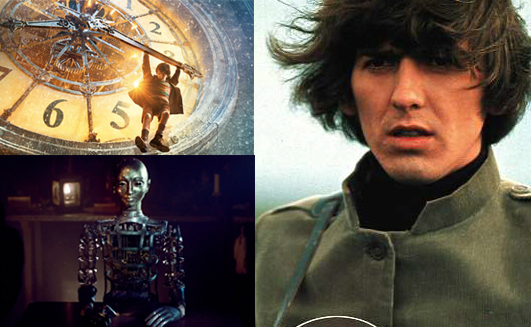
The more closely you study Spielberg's films, the more obvious it becomes that communication, translation and language are at the core of his personality as a director. What fans would call his optimism — and what detractors would call his naivete — are expressed most strongly in scenes where members of different races, cultures, even species transcend superficial differences, and do the hard work necessary to really listen to each other, and talk to each other.

This crystallizes in the climax of Close Encounters, which sees humankind speaking to extraterrestrials through a spontaneously composed musical-mathematical language. Not merely a triumph of direction and visual effects, the scene also lets Spielberg's regular composer, John Williams, step into the spotlight and take a solo. On an aesthetic level, this is just delightful. It means that Williams is, in effect, conducting — or directing — the film's most important sequence, on Spielberg's behalf. For a few minutes, Williams becomes Steven Spielberg's translator, and spokesman — a behind-the-scenes mirror of the UFO expert Lacombe's relationship with his own translator and spokesman, David Laughlin. Over time, the aliens, who initially seemed terrifying, seem merely inscrutable, then approachable. In the end, they're revealed as delicate, luminous beings, inviting us to join them among the stars.

A critic, journalist and filmmaker, Matt Zoller Seitz is the staff TV columnist for Salon.com and a finalist for the Pulitzer prize in criticism. He has worked as a movie critic for The New York Times, New York Press and New Times Newspapers and as a TV critic for The Star-Ledger of Newark. His video essays about Terrence Malick, Oliver Stone, Kathryn Bigelow, Budd Boetticher, Wes Anderson, Clint Eastwood, Michael Mann and other directors can be viewed at the The Museum of the Moving Image web site. Seitz is the founder of The House Next Door, a website devoted to critical writing about popular culture. His book-length conversation with Wes Anderson about his films, titled The Wes Anderson Collection, will be published in fall, 2012 by Abrams Books.

GREY MATTERS: Martin Scorsese’s interesting year

GREY MATTERS: Martin Scorsese’s interesting year

null

Aside from being a lousy whitewash out to prove God-knows-what, Martin Scorsese’s George Harrison: Living in the Material World doesn’t even live up to some simple realities, things like the fact that when you’re Martin Scorsese, you most certainly do have a huge responsibility when taking on such an undertaking. Nobody will ever again have your resources, access or your name, and the sobriety of purpose and sheer cred that goes with it.

And now, to super-complicate matters really interestingly, we have Hugo, easily one of Scorsese’s top five films, a masterpiece, coming mere months on the heels of the Harrison debacle. The two films, in eternal orbit and connected by “George” as a name and notion – of the guitar player and his revolution in sound, and of the disgraced special effects trailblazer, Georges Méliès, who, in our world, delighted a small, asthmatic Italian-American boy in Little Italy almost 60 years ago with his lowest-fi wonders.

My sense is that Scorsese – a Catholic boomer from the age of Aquarius, director of Kundun and The Last Temptation of Christ – simply could not have made Hugo without the mysteries of Harrison’s persona and life-long mysticism nagging him on. It’s just a damned pity that a huge chunk of facts, music history and Harrison’s vast, real legacy had to be the sacrificial lamb for Scorsese’s beautiful triumph.

So am I arguing that artists have responsibilities? Nope, no way. Do journalists? Yes. Absolutely.

nullBut in Material World Scorsese straddles art and reportage and screws the pooch on both. And yet Hugo, a film that makes no bones about being a total spin on some history using the toolbox of fiction, absolutely gets the heart of so many truths: truths about cinema, anger and healing, growing up and magic. And yeah, ironically, of the creation of history.

The irony is that the methods and mindset that serve Hugo so well are poison to Material World. Before we move on, though, a quick view of both films.

Material World offers a superfan’s mind-blow of previously unearthed Beatles and Harrison footage to drag us through a brilliantly edited but still relentlessly middlebrow, Ken Burns-like take on The Beatles and Harrison.

You know the drill. Grew up in grim, post-war Liverpool. Played crap clubs with John, Paul and Ringo until gaining world domination. Became entranced with Indian culture, the sitar and transcendental meditation under the guidance of Maharishi Mahesh Yogi. Made the magisterial All Things Must Pass solo record with the insane Phil Spector, now imprisoned for murder. Formed The Travelling Wilburys with Dylan, Tom Petty, Jeff Lynne and Roy Orbison. Did too much coke at some point. Got cancer, beat it. Suffered a knife attack by an insane person. Got cancer again, died peacefully. Every so often something new and interesting pops up – Harrison was a race car driver? – only to be summarily deleted.

nullAs you’ve probably heard, the film’s talking heads – among them Ringo and McCartney – are sometimes identified and sometimes not. About fifteen years of Harrison’s life are simply omitted, one assumes, because, like that racing bit, they just don’t fit Marty’s thesis: quiet guy becomes mystic. (You could say this lacks dimension.) The tales we’ve heard of George as a compulsive, somewhat cruel womanizer are whimsically hinted at by his wife Olivia, and then dropped. The epic coke binges occupy a fascinating single string of video that suggests the great film this could have been – I’ll return to that topic.

In general, Scorsese behaves as if his love of music will cover for the fact he truly doesn’t understand the thing, how it works or why the damned it so bewitches and obsesses him.

On the other hand, Hugo finds Scorsese not only at home in multiple cinematic languages and dialects, but talking about talking those languages. And so 3D not only works as immersion technique, but as an element with its own sacred history in a film that assumes longing for the cinematic experience and love of illusions as basic currencies.

The incredible richness of Scorsese’s visual languages allows him to express Harrisonian spiritual values delivered with an Amélie-like breathlessness and a neo-Gaultier splendor. (If costume designer Sandy Powell doesn’t win an Oscar for her designs, heads will roll – to speak only of heads.) As much as The Tree of Life is intrinsically Christian, Hugo is deeply Eastern in tradition, a film of real and metaphorical deaths and rebirths, of spirit animating the material world.

The film’s about Hugo (Asa Butterfield), a smudge-face Dickensian literally marking time by minding a Paris train station’s clocks and trying to repair the broken, beautiful automaton gifted to him by his deceased dad (Jude Law).

Hugo’s enemy is Inspector Gustav (Sacha Baron Cohen), once a foster child, now a spiritually broken policeman crippled by war. (Scorsese/Cohen/writer John Logan only play Gustav for laughs until they understand the true depths of his brokenness).

nullHugo’s redemption comes in the form of Isabelle (Chloë Moretz), a young girl who’s never seen a film, and who’s the foster granddaughter of Papa Georges (Ben Kingsley), a cranky man with a toy shop in the station, and who is on the run from the slow reveal of being the Georges Méliès – more than just special effects’ godfather, a man who rejects bleak reality for the hygienics of extreme fantasy.

By the way, we already we know far more about Hugo’s fictional characters than we ever learn about anyone in Material World. Just saying.

Scorsese’s film, the stuff of John Logan’s script (itself based on Brian Selznick’s book), unfolds a series of beautiful, almost Hindu cycles of death – Hugo’s dad and uncle’s passing – of birth – Isabelle’s discovery of cinema, the “awakening” of the automaton – and rebirth – the automaton coming to “life,” Georges’ films rediscovered, his reputation, his essence, Inspector Gustav healed of the burns of a bad childhood.

Along with its spiritual transcendences and heroic humanism, Hugo addresses, delights in and celebrates film history through mostly-fictional characters, fantastic devices and interlocking, exquisitely alive tableaus.

The reason this works with Méliès and not Harrison would seem obvious: most of Méliès’ films were destroyed after World War I, most Americans have no idea who he was, most historians have no idea what the “real” man was like. And so there’s no such thing as “doing” Méliès inaccurately. Harrison’s life, on the other hand, as we see in Scorsese’s own film, is ridiculously open to scrutiny, which means the director has to work that much harder to float his revision.

In Hugo, fiction about fact frees Scorsese. In Material World, what we get is an attempt to mold fact to fit intent. After a while, it’s like a root canal; the only painless part is when it’s over.

nullI get the temptation to rewrite George as spiritually ahead-of-the-curve, as an enigma tucked inside a mystery. Problem is, in order to do this properly, you have to commit all kinds of misdemeanors against the artist, the arts and history. Scorsese ends up so busy whitewashing alone, he has to, for example, mostly play down the matter of George’s, well, guitar playing.

Off and on, people – mostly unidentified – declare George’s playing to be “soulful.” This means nothing. Paul and Ringo – both acquitting themselves with warmth and grace – speak of their fallen mate with respect, with Paul saying he was the best musician by far when they started, which is something as George was, like, 17 years old at The Beatles’ beginning. Whatever – I eat this stuff up with a spoon, Paul and Ringo’s humbled late-life understanding of their band’s magnificence.

But aside from the static, overlong middle section of the film involving George’s interest in the sitar and Ravi Shankar, there’s not much in the way of musical insight. Scorsese seems so bent on fuck-knows-what, he misses the ready-made metaphor for Harrison’s spiritual quest sitting right there on his AVID screens.

It’s Harrison’s mysterious morph from the edgy, all-elbows player on early hits like “Don’t Bother Me” to the soaring transcendent slide guitarist you hear on Badfinger’s “Day After Day” (not in the film) and pretty much everywhere after the White Album.

What happened? How did he change? This is exciting stuff – the sound of a man’s soul in transition!

nullScorsese, literally, could not care less. Instead of this tale of self and spiritual discovery through music, Scorsese fritters away precious time with Eric Clapton, who shares tales of his cockmanship, of his creation of Scorsese’s favorite GoodFellas track, “Layla.” Scorsese is so enraptured with Clapton, who comes off as the epitome of noxious, boomer rock royalty, chortling about stealing George’s wife and choosing to not join the Beatles due to his extreme awesomeness, that Scorsese doesn’t seem aware Clapton is most recalled as a soft rock favorite and that, more importantly, aside from the solo on “While My Guitar Gently Weeps” and some shared women (nice), Clapton has fuck-all to do with our story here.

The Clapton infatuation is, however, a side effect of what’s really wrong: Scorsese refusing to leave his boomer bubble for context or insights, and in so doing, missing Harrison’s vast contributions beyond his own first edition vinyl collection.

Based on what’s here, Harrison is a minor figure – no big deal, used to be in The Beatles, saw God, Ommmmmmm…. You’d never know that Harrison’s early Beatles compositions (think “If I Needed Someone”), with their signature bell-toned arpeggios, tightly harmonized, octave-sweeping melodies and oddly chorded middle-eights, provided the vocabulary for New Wave, power pop and indie pop, inspiring/defining everyone/everything from Aimee Mann, Elvis Costello and Glenn Tilbrook to David Bowie’s wholesale theft of the song in “Blue Jean” to Elliot Smith’s post-Brit Invasion confessional aesthetic.

You’d never know that, as much as John Lennon, Harrison brought the ways and modes of the avant-garde into pop, whether it was the teeth-rattling extreme dissonances in “I Want to Tell You,” the tape-loop floaty-ness of “Blue Jay Way” or the triumphant wall of feedback in “It’s All Too Much.”

nullIt’s an amazing legacy that Scorsese omits, and it doesn’t end there. There’s George creating “world music” decades before the likes of Peter Gabriel, Sting or Björk via the 1968 Beatles track “The Inner Light” and its pulsing dress of sitar, harmonium, flute, table and santoor. (That Scorsese used world-music-style music by Gabriel for the soundtrack for The Last Temptation of Christ makes this omission a real head-scratcher – or is Scorsese simply unable to connect the dots?)

Meanwhile, wouldn’t it be clean fun to chart Harrison’s perversely “WTF?” appearances on records by Belinda Carlisle (The Go-Go’s), Fleetwood Mac and Electric Light Orchestra?

Who was that George? In particular, the George who, again like the Georges Méliès of Hugo, lived to enjoy a late-life resurgence with 1987 Top Ten hits like “Got My Mind Set on You,” “When We Was Fab” and the album Cloud Nine? You’re not going to hear much about that George. In order to buy the mystic-dude-in-the-material-world shtick, you have to – simply have to – accept that an entire fifteen or so years of Harrison’s life didn’t much matter.

Actually, Harrison seems to leave Scorsese’s radar as soon as the counter-culture dissipated. Which means that Harrison only has meaning for the director if he’s attached to a larger context, like the perky midlife crisis that was The Traveling Wilburys.

What does compel more than anything in the film comes from the artist’s cocaine days (told you I’d get back to this.). Not because it limns him bottoming out way, but because Harrison with his throat trashed by blow doing godawful Philly-soul-inflected versions of his hits so utterly deconstructs the narrative Scorsese has so painstakingly constructed. Because it turns Scorsese into Jake LaMotta beating his own film, which, for a few moments, is incredibly liberating. Here and only here is the Scorsese we all love and admire, the actual artist willing to go way out on a ledge.

Who is this George Harrison sarcastically mixing a throat concoction recommended by Barbara Streisand? We’ve been hearing, in draughts here and there, about an anger living beneath George’s placidity, a cooled, arched-eyebrow lividity amping up even early solos.

And here, in his cocaine days, finally, that anger twitches near the surface and Harrison cackles. You get the sense that if a mantra showed up, this George Harrison would spit at it and laugh.

I wish Scorsese had started here, or referenced this more. Not because it’s “dark,” or what I want to see, but because it’s true, because it goes beyond the firewall of the Harrison legend and because, if you want the mystery of George Harrison, it’s hidden in plain sight.

I want to believe that Material World will be forgotten – an aberration in a great career. I know Hugo will be remembered as long as cinema exists in any form.

Ian Grey has written, co-written or been a contributor to books on cinema, fine art, fashion, identity politics, music and tragedy. His column "Grey Matters" runs every week at Press Play. To read another piece about Drive, with analysis of common themes and images in all of Refn's films, click here.

SIMON SAYS: Tom Cruise in MISSION IMPOSSIBLE 4: “it is my destiny to be the king of vain.”

SIMON SAYS: Tom Cruise in MISSION IMPOSSIBLE 4: “it is my destiny to be the king of vain.”

null

In the recent Mission: Impossible movies, Tom Cruise has basically played a charismatic body under stress. While Mission: Impossible III is still the most satisfying film of the series because it takes the Ethan Hunt character and gives him personal stakes to fight for, Hunt’s main appeal has always been his charm as a humorless beast of burden. No film in the series makes this more apparent than the fourth and most recent entry in the film franchise, Mission: Impossible – Ghost Protocol. Here, Cruise, who gets a prominent producer credit in the film’s opening credits, shows his age; in fact, he flaunts it. Not in an “I’m getting too old for this shit” kind of way. More like a “My body has seen better days but I’m still pretty amazing, so shut the hell up and watch me scale the tallest building in the world…one-handed” kind of way.

Okay man, sure, I just came for the movie, I swear, don’t hurt me!

Tom Cruise in Ghost Protocol is intimidating-looking. In fact, watching the grooves on Cruise’s scored face is so distracting that it’s sometimes just as thrilling as watching the film’s immaculate set pieces. The bags under his eyes are always more pronounced, the contours of his face more angular and the wrinkle lines etched into his cheeks like stone always suggest more texture than his co-stars’ features. Take note: Tom Cruise’s body hasn’t gone to seed. But Hunt’s hair is longer than usual and his face is certainly showing signs of age.

nullYou’d have to work pretty hard to cover up that kind of wear, but that’s kind of the point of Ghost Protocol: Cruise’s Hunt is not in denial. He’s in great shape – did you not see him clean up the world’s tallest building in Dubai? Or, on foot in a sand storm, running around like a madman? Or crashing several BMW luxury sedans? Just think of Tom Cruise’s face as the portrait of Dorian Gray, which I guess makes his body Dorian Gray…except in Ghost Protocol, Dorian Gray is galloping around the world with his portrait on display. Which is…odd, to say the least.

So Ethan Hunt in Ghost Protocol is going around doing incredibly impossible missions. He’s not developed well enough to be treated like most characters, with ulterior motives and “feelings” that extend beyond the circumstantial peril Hunt is constantly forcing upon himself. So in this film, he’s just a really versatile guy that takes it upon himself to do much of the heavy lifting of tracking and disarming an evil Russian madman, codenamed “Cobalt” (Abduction’s Michael Nyqvist).

Until Hunt and his team catch Cobalt, they’re in the shit. But even though he’s working with them throughout the film, Hunt has to basically lead the group because none of them are capable of doing things with restraint, improvisatory skill or much brawn without him. He’s the Mr. T to their A-Team; if they were replaced by other actors mid-film, no one would notice or care. That lopsided team dynamic is sort of a given until the film’s last big set piece, which reminds us that the film is about a team of spies, some of whom, unlike Hunt, are actually both charismatic and capable of laughing at themselves, too.

Cruise’s Hunt has no such default setting. His onscreen persona throughout the series has been, and continues to be, pretty brittle. So it’s a very good thing that Cruise is naturally charming. The curious thing about these Mission: Impossible movies is that in them, he’s constantly trying to remind us of this by performing spy hijinks and superhuman acrobatics, like his big Dubai Spider-man act in Ghost Protocol, where he climbs up 11 stories using magnetic gloves, one of which short-circuits mid-climb. This only momentarily fazes Hunt. He keeps climbing.

Director Brad Bird (The Iron Giant, The Incredibles) and Ghost Protocol’s capable stunt choreographers play up Cruise’s glassy charms by making a sight gag of Hunt’s malfunctioning magnetic gloves. After he callously shucks the glove off, Hunt soon finds the errant glove stuck to a pane of glass just a few stories below where he originally ditched it. This is a rare thing in Ghost Protocol, a joke involving Hunt’s man of action. But it should be noted that the joke is not on Hunt but rather the malfunctioning equipment that Benji (Simon Pegg), a geeky and relatively effete fellow spy, gave him. Modern technology can’t even keep up with Tom Cruise!

nullBut in all seriousness, Ghost Protocol needs Cruise’s over-seriousness and his tendency of making himself look that much more focused, that much more determined and that much more capable than everyone around him. Even newcomer Jeremy Renner looks like a girly man compared to Cruise, like in the scene where Renner is floating around (literally, floating around) in an overheated subterranean tunnel while wearing a chain mail suit that levitates his whole body.
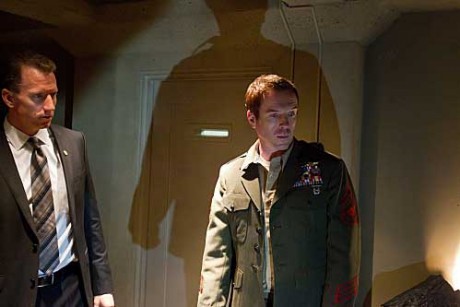

Yes, there is actually a sequence where Jeremy Renner, a new macho action hero for our times, is floating around with his arms outstretched in front of him like he’s Supergirl. And he’s sweating. Tom Cruise’s Ethan Hunt doesn’t sweat, not even when he’s fighting Michael Nyqvist’s Cobalt, a villain that is so hardcore that he’d rather kill himself than let Hunt get the upper hand. Cruise’s Hunt, by contrast, is all upper body strength and an unending supply of physical endurance and facial tics when he wants to show you just how hard he’s pushing his body (note: pretty freaking hard). Without him, Ghost Protocol would be nothing.

Simon Abrams is a New York-based freelance arts critic. His film reviews and features have been featured in the Village Voice,Time Out New York, Slant Magazine, The L Magazine, New York Press and Time Out Chicago. He currently writes TV criticism for The Onion AV Club and is a contributing writer at the Comics Journal. His writings on film are collected at the blog, The Extended Cut.

MATT ZOLLER SEITZ: Should HOMELAND have quit while it was ahead?

MATT ZOLLER SEITZ: Should HOMELAND have quit while it was ahead?

null

[Editor's Note: The following article contains spoilers for the season finale of Homeland, season one. Read at your own risk.]
 

Bugs Bunny and Daffy Duck might not seem to belong in a review of a searing cable drama about terrorism, but bear with me, OK? In the climax of Show Biz Bugs (1957), in which Bugs and Daffy compete for the right to claim top billing in a show, Daffy decides he’s had enough of being bested by the rabbit and hauls out his trump card, self-immolation. “I must warn those with weak constitutions to leave the theater for this performance,” the duck says, then swallows gasoline, nitro glycerine, gunpowder, uranium and a lit match, and explodes. “That’s terrific, Daffy!” Bugs exclaims from the wings, over thunderous applause. “They loved it! They want more!” “I know, I know,” says Daffy’s ghost, floating toward the rafters. “But I can only do it once!”

As knocked out as I was by the first season finale of Homeland, a part of me worries that the series might be the self-immolating Daffy Duck of cable dramas — incapable of topping itself in future seasons because the nature of its achievements this year are innately singular, and can only be diluted by a storyline that stretches out for two-plus years. (I have the same fears about American Horror Story, and I remember having them after Twin Peaks finally revealed who killed Laura Palmer, then sort of stumbled along until ABC canceled it.)

I even worry that the only major tactical mistake that Homeland made in its 90-minute season-ender was letting Marine Sgt. Nick Brody end his weird odyssey free and unharmed at the end. If producers Howard Gordon and Alex Gansa had let Brody swallow the match, so to speak — and complete his suicidal terrorist attack, or get shot or otherwise neutralized in the State Department bunker, or be talked down by his teenage daughter Dana, or his wife Jessica or Carrie, and sent to prison — the series would have still dazzled as a stand-alone while leaving us lots of plot and motivation questions to chew over. Brody’s statement on the phone to Abu Nazir — about how it might be more advantageous to have a fifth column influencing U.S. foreign policy rather than a sleeper agent plotting a bloodbath — makes dramatic sense, and it works as a setup for a second season, one set in the heart of executive branch power rather than on the military-intelligence fringes. But it’s damned hard to imagine how a scenario like the one that Brody laid out to Nazir could produce TV more exciting than the season that we just finished watching.

You can read the rest of Matt's recap here at Salon.

Matt Zoller Seitz is the publisher of Press Play and TV critic for Salon.

Occupy Wall Street movement: a survey of video footage from the front lines

Occupy Wall Street movement: a survey of video footage from the front lines

null

For just a moment, try to set aside your preconceptions. Try to set aside your ideological leanings, your ideas about power, money, and political speech. Even try to reach past your automatic emotional responses and most visceral feelings. And for a moment, just watch the video below this graf. It was shot in downtown Manhattan by Luke Rudkowski.
 

The picture plane is slightly tilted, a tell-tale sign the camera is sliding off its operator’s shoulder. He is stretching on his toes to peer over the shoulders of the crowd in front of him, where he sees two men in oddly formal dress – white shirts, navy blue hats, black, gold-clipped ties, and black gloves – wildly swinging batons at those nearest them. The swings cause the crowd to retreat behind the camera while the operator stays firmly in position. A man in a navy uniform attempts to guide him back, but from the right side comes a white shirt. We don’t see the impact of the baton, just the rotation of the white shirt’s shoulder, but the camera shakes as the operator is hit in his lower body, causing him to let out a pain-filled “Ugh!” The camera falls into a maze of legs as the operator’s body crumples to the ground. Now, take a look at the above footage shot in Oakland, California.

It’s daylight, and there is a scrum against a metal barricade. On one side, along with the camera is a roiling crowd, on the other navy-uniformed men wearing helmets with clear plastic faceplates. The uniformed men hold clubs – one even has a shotgun, the barrel of which creeps up to the chest level of the crowd – and it is clear by the way they are standing that they are trying to obscure the scene behind them. The camera fights against the crowd to get a view through the navy-clad legs, catching glimpses of a body being pinned to the ground. As the body writhes, you can see that it is a woman, and as she tries to escape her position, she is repeatedly struck with a club. Witnessing this only stirs the crowd more, with one man yelling, “Stop! That’s a female!” The uniformed men try to close ranks and hide the incident, but their faceplates can’t hide the fear and uncertainty their individual faces betray. Now, look at this footage shot at the University of California, Berkeley.


The camera in the above footage is perched high above the action. There is a large crowd made up of young people, at the foremost edge of which is a human chain formed by the locking of elbows together. The chain stands toe to toe with several anonymous individuals in identical body armor, who are initially statuesque. Near the center of the human chain is an Asian girl, who is noticeably smaller than any of those on either side of her. Without warning or provocation, one of the armored individuals shoves the butt of a nightstick in the girl’s stomach, lifting her off the ground, knocking her back into the crowd, and collapsing the chain. Other armored individuals follow suit, thrusting their sticks into the retreating crowd. When there is a cut to a ground-level shot, we can see a young man being repeatedly struck as he is pinned against a bush with nowhere to move. Another young man is stripped of his shirt, thrown to the ground, and a knee is placed on his neck as plastic zip ties are used to bind his wrists.

All of these scenes have a specific context. They were all captured by digital cameras at specific Occupy protests – New York City, Oakland, and Berkeley, respectively – over the past three months, and disseminated via YouTube. Each has its own specific crowds of protesters, with their own ideas about global capitalism and level of agitation, and each has its own specific law enforcement officers, with their own notions of duty and implements of crowd control. Each video shows a specific act of police brutality, but focusing on the specific context can be more limiting than illuminating. As more Occupy camps are violently evicted across the country, these scenes could be, and are, taking place anywhere. And at the moment when the baton, or fist, or pepper spray makes impact, the institutional divide between protestors and police officers becomes temporarily irrelevant. In these videos what we are really watching is bodies coming into conflict, and one using force to subordinate the other.

When one body uses force over another, it is always an attempt to assert control: to minimize the other body, to contain it, to take away its agency and purpose. In effect to silence it. Not just to silence the speech that may be emanating from the body, but to silence the statement the body itself might be making by virtue of where, when, and how it is positioned. When policemen hit protesters, the aim is to push them back and force them to disperse. When a policeman seizes a protester, the first movement is always to force them down to the ground. Take a look at this footage shot during a November march on the New York Stock exchange.

The video was shot at the intersection of New York City’s Pine and Williams Street and it shows brief jostling at the line between cops and activists, followed by one officer reaching forward to grab a young woman by her scarf and yank her down, out of the crowd. The assault is a disturbing image in and of itself, but equally as upsetting is the mechanics of the tactic on display. We see the police finding any excuse to intrude on the protest, and snatch away a participant, taking away her right to assemble, which in essence is the right to occupy a given space.

And the occupation of space is what is at the very heart of the Occupy movement, to use public areas – parks, plazas, university campuses – as the primary tool of redress, by asserting that they are commons. The concept of the commons is, according to Peter Linebaugh in The Magna Carta Manifesto, “The theory that vests property in the community and organizes labor for the common benefit” – an idea that dates back to 1215 at Runnymede and the limitations placed on the power of King John. The commons are more than just public spaces, but they are those liberties – trial by jury, Habeus corpus, etc. – that are essential to the individual use of those spaces with agency and purpose.

The antithesis of the commons is the commodity. Ever increasingly our public spaces are serviced and maintained by private entities, and open to general use in highly regulated increments requiring prior approval, and often for monetized purposes. Accordingly, officials now view public spaces as they do any asset that can be commodified, and deploy law enforcement to protect them accordingly. “The insanity of the commodity arises from its inherent contradiction or double bind: on the one hand it is useful, convenient, or commodious, on the other hand it is bought and sold for profit and gain,” Linebaugh writes. “Guile replaces plain dealing.”

The key word there is convenient. Commoditization has eased many of the daily tribulations of modern life through convenience, but it has also bred an unhealthy civic culture in which the value of individual actions is not determined by ethical judgments, but by judgments of the market. The disruption of conveniences by the Occupy protesters is the reason for much of the popular scorn heaped upon them, but it is also their very purpose.

And so what we are seeing in those videos is a contest for space, to define space. One side uses the power of their bodies and speech, the other uses force. After watching the clips, it is necessary to let the specific context of what we have seen sink back in – to consider the role that money and political considerations have in law enforcement; to consider the appropriateness of the actions of the crowd. But the most important specifics to let in are the very realness of the injuries that are sustained. The bruised tissue on the face of a woman punched by a NYCPD officer is real. Look at this video shot by journalist Michael Tracey as he covered a march by protesters through the streets of Manhattan. Around the 1:40 mark, an NYPD officer can clearly be seen assaulting a protester in a green shirt.

This following footage was shot on the campus of the University of California, Davis. The scorched eye sockets and nasal cavities of the sitting students casually pepper sprayed at UC Davis are real.

Now witness the concussion and broken skull of an Iraq War veteran in Oakland. His story is real, The camera finds him in Oakland, California.


Of course, cameras can lie. As Brian de Palma put it, “the camera lies 24 times a second.” And that is film; digital lies much more frequently, in every pixel. Every edit and choice of framing omits as much as it shows, and thus no image is ever complete. But to focus on the camera’s lie is not so much a deconstruction of the media, but an ancillary construction we build in order to interpret what we are seeing. And we should always question what we see. But the lie can become an excuse not to absorb what we are watching, and not to take responsibility for it. The lie can actually become an excuse not to watch.

Louis Godfrey currently lives in Chapel Hill, NC. He is originally from Salt Lake City, UT, where he spent five years reporting on politics and court cases, before turning to writing on film. He also likes cats.

VIDEO ESSAY: MAGIC AND LIGHT THE FILMS OF STEVEN SPIELBERG Chapter 2: Blood & Pulp

VIDEO ESSAY: MAGIC AND LIGHT: THE FILMS OF STEVEN SPIELBERG, Chapter 2: Blood & Pulp

[Editor's Note: Press Play is proud to present Chapter 2 of our first video essay series in direct partnership with IndieWire: Magic and Light: The Films of Steven Spielberg.  This series examines facets of Spielberg's movie career, including his stylistic evolution as a director, his depiction of violence, his interest in communication and language, his portrayal of authority and evil, and the importance of father figures — both present and absent — throughout his work.

Magic and Light is produced by Press Play founder and Salon TV critic Matt Zoller Seitz and coproduced and narrated by Ali Arikan, chief film critic of Dipknot TV, Press Play contributor, and one of Roger Ebert's Far Flung Correspondents. The Spielberg series brings many of Press Play's writers and editors together on a single long-form project. Individual episodes were written by Seitz, Arikan, Simon Abrams and Aaron Aradillas, and cut by Steven Santos, Serena Bramble, Matt Zoller Seitz, Richard Seitz and Kevin B. Lee. To watch Chapter 1: Introduction, go hereTo watch Chapter 3: Communication, click here. To watch Chapter 4: Evil & Authority, click here. To watch Chapter 5: Father Figures, click here. To watch Chapter 6: Indiana Jones and the Story of Life, click here.]

When you think of the films of Steven Spielberg, violence may not be the first thing that comes to mind. But Spielberg’s films wouldn’t be Spielberg’s films if he didn’t show and imply violent actions. Violence is just another color on Spielberg’s palette and he’s not shy about using it, either to excess or with moderation. And the presentation of the violence reveals a lot about Spielberg’s sense of what the audience can handle, and how far he can go as a director.  

In fact, you can tell what kind of Spielberg film you’re watching based solely on the way he shows violence.
As a child, Spielberg used to worship the violent Grand Guignol violence of EC Comics – specifically such lurid titles as Shock Suspense Stories and Weird Science.   But he also gorged himself on 1950s network television and old Hollywood movies, which for the most part had a much more circumspect attitude toward violence.

Look over his filmography, and you’ll see the tension between those two tendencies – excess and moderation. But you’ll also notice that he lets one tendency take over when it shouldn’t. Spielberg modulates the tenor of the violence he employs to suit the content of his films.

There’s no explicit gore in the director’s early made-for-TV films Something Evil and Duel. Instead, it’s mostly about implication.

Three years after Duel came Jaws, which defined the term “blockbuster hit.” The film famously opens with a swim at dawn, and the shredding of a helpless bather. The scene strikes the perfect balance between evident agony and visible damage to the body. We don’t see the shark’s teeth digging into the girl, but we do sense the shark’s power. The level of brutality is shocking yet perfectly judged, and for this type of film, it’s necessary. For the mass hysteria and panic in Jaws to be immediately shared by characters and viewers alike, there has to be blood in the water. And boy, is there.

Note that the film amps up the violence incrementally as the story goes on, each death a bit more front-and-center than the last, in much the same way that Spielberg keeps the shark mostly off camera at first, gradually unveiling it in bits and pieces.

Contrast this with the sheer excess of some of the violence in the Indiana Jones films, which Spielberg made with his old friend, producer George Lucas.

The original Indy movie, Raiders of the Lost Ark, is filled with acts of violence both implicit and explicit.  Its finale is as over-the-top violent as the psychokinetic insanity of such films as The Fury and Scanners.

The heritage of pulp becomes even more apparent in Indiana Jones and the Temple of Doom, which is almost certainly the pulpiest of the four Indy movies.

In scenes such as the opening – in which Indy uses a shish kebab skewer in a unique and uncomfortable way – Spielberg shows us he’s ready and willing to serve up cartoonish and wildly exaggerated mayhem.
The Temple of Doom is adorned with skulls and skeletons in various stages of decomposition, reminding the viewer of the dated but effectively excessive tone that Spielberg is adopting here.

The banquet scene in Pankot Palace is particularly grisly and over-the-top. At one point Kate Capshaw’s squeamish American is served a bowl of soup that suggests the palace’s kitchen is being run by the Crypt Keeper from EC Comics’ Tales from the Crypt.

And yet the Hitchcockian subtlety of Jaws and the gleefully boyish excess of the Indy films are but two of Spielberg’s violent modes. He finds other ones in his historical dramas – especially the ones that deal with war.

Empire of the Sun – an adaptation of J.G. Ballard’s uses violence in a very different way than Saving Private Ryan because, where Saving Private Ryan is about the chaos of being in war – the actual EXPERIENCE of combat – Empire of the Sun is about the disappearance of life as the film’s young protagonist once knew it.  It’s a subtle distinction, and this is – for all its scope – a subtle movie, as evidenced by the power that Spielberg wrings from a single, relatively minor act of violence that doesn’t even draw blood.

In Empire of the Sun, James Graham, the film’s young British protagonist, soon realizes that the sanctity and the familiarity of his home have disappeared. His maid, whom he used to boss around, slaps him when he catches her stealing furniture. He can’t process what this action means. He just stands there stunned and lets the maid walk away, averting her eyes so that they don’t meet with his as she steals his furniture.

A similarly direct and gritty approach can be seen in the combat and atrocity scenes of Spielberg’s violent historical dramas.The D-Day sequence in Saving Private Ryan is the apex of the de-humanizing nightmare that its characters endure. The entire point is to put you in the middle of it and show you everything, even things no person should see. Spielberg goes so far as to make the bullets whizzing through the air and water visible. That more than can be said for the individual faces of the American soldiers, who for the most part are depicted as cannon fodder – bodies hurled up on a German-held beach to die by the thousands.  The selective shakiness of Spielberg’s camera adds another layer of surrealism to the experience of watching this volatile scene.

This is a far cry from the gun battles in the Indiana Jones pictures, which take place in roughly the same era and have similar firearms, some of them wielded by Nazi Germans.

Even if you were to compare two of Spielberg’s strictly fantasy-based films, Jurassic Park and A.I.: Artificial Intelligence, you’d find that you’re seriously different territory just by looking at the way he depicts violence.

By the time Spielberg made Jurassic Park, the MPAA had created the PG-13 rating thanks to films like Joe Dante's Gremlins, which Spielberg executive produced, and Spielberg's own Temple of Doom. These films and others shepherded by Spielberg wrap fundamentally lurid material in family-friendly package. But the science fiction films – like the Indy films, for the most part – are very careful not to go too far, too soon.  They’re a bit like Jaws in that respect – a comparison made official by the opening kill in Jurassic Park, which is staged in a manner very similar to the bather’s death that opens Jaws.

Spielberg is so adept at balancing gore against human distress that in his films, as in Hitchcock’s, you often think you’re seeing more than you actually are. For example, it’s hard not to misremember that, during the scene in which Wayne Knight's opportunistic programmer gets spat on by a dinosaur, nothing that grisly is explicitly shown. He's screaming loudly though, and there's gunk on his face and his shirt, and John Williams's score is blaring. But in terms of what’s actually shown it’s a pretty restrained scene. The whole movie is more restrained than we may remember. In fact, the most horrendous violence in the film is not shown at all. The scene in which an unseen pack of raptors massacres a living cow happens off-screen, and is more unnerving because of it.

When Sam Neill describes to a snot-nosed kid how raptors used to gut their prey and ate them alive, the full brunt of the horror is conveyed verbally, without any images to assist it.

Artificial Intelligence is also set in a pulpy, theme-park-ride-friendly fantasy setting, but the film is decidedly darker than the Jurassic Park films, or almost any Spielberg films for that matter. And as a result, the violence here is pointedly less rambunctious. During the Flesh Fair scene, David the boy robot watches as outmoded robots get torn apart, shot through hoops of fire and dismantled in various different grisly ways. The Flesh Fair is supposed to be a carnival: a three-ring circus and so-called "celebration of life" that requires the death of inorganic robots to thrive.

On some level we may be aware that if the violence inflicted on these robots were inflicted on actual humans, we would probably turn away from it onscreen.  That subliminal awareness plays into the movie’s central preoccupation: at what point should a biologically non-human person be considered, for all intents and purposes, human? If it feels synthesized feelings, are they not still feelings?  Shouldn’t simulated pain still be considered pain?

The most upsetting scene in Artificial Intelligence might be the one in which David is abandoned by the side of the road by his distraught foster mother. The moment when he realizes what she's doing is heart-breaking. David's squeals of panic are so tortured that you're afraid that something bad is about to happen – something that will hurt both him and his mother. The juxtaposition of this scene with the Flesh Fair sequence is a good reminder of how good Spielberg is at juggling his role as both carnival barker and humanist. His movies are often dominated by trauma and violence: to appreciate his work, you just need to know when sit back and revel in an unreal, bloodthirsty spectacle, and when to avert your eyes.

Simon Abrams is a New York-based freelance arts critic. His film reviews and features have been featured in the Village Voice, Time Out New York, Slant Magazine, The L Magazine, New York Press and Time Out Chicago. He currently writes TV criticism for The Onion AV Club and is a contributing writer at the Comics Journal. His writings on film are collected at the blog, The Extended Cut. Video editor Richard Seitz has worked for 20 years as a sound designer, audio engineer, composer, and dialogue editor for video games, television, short films and theatrical trailers. Game titles include The Hulk 2, Battlestar Galactica, Van Helsing, The Hobbit, Predator and Diablo 2.