MATT ZOLLER SEITZ: PARADISE LOST 3: PURGATORY Offers Only a Fleeting Sense of Relief for the West Memphis Three

MATT ZOLLER SEITZ: PARADISE LOST 3: PURGATORY Offers Only a Fleeting Sense of Relief for the West Memphis Three

nullBy Matt Zoller Seitz

Press Play contributor

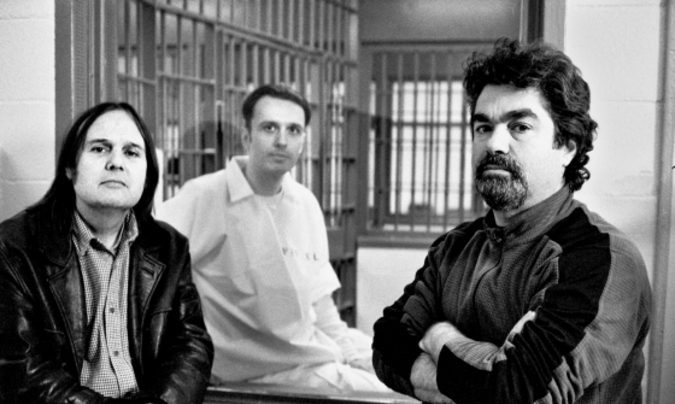
By all rights, Joe Berlinger and Bruce Sinofsky's Paradise Lost 3: Purgatory (HBO, 9 p.m. Eastern) should feel more triumphant than it does. It is, after all, about the release of the West Memphis Three, men who were imprisoned — wrongly, it now seems — for murdering and mutilating three young boys in West Memphis, Arkansas, nearly two decades ago. When convicted killers Damien Echols, Jason Baldwin, and Jessie Misskelly, Jr. were sentenced back in 1993, they were mere boys themselves, high school kids with pimply skin and uncertain voices.

Thanks in large part to the efforts of Free the West Memphis Three, a legal defense fund, the once seemingly impregnable case against them fell apart, exposed as circumstantial and shoddy and tainted by ineptitude and bureaucratic self-protection. When Berlinger and Sinofsky visited West Memphis in 1996's Paradise Lost, it was the story of a court case, pure and simple, and the filmmakers viewed it with an ominous and slightly clinical detachment. By the time they made their follow-up, 2000's Paradise Lost 2: Revelations, the trio were already starting to seem like victims of a witch hunt. When they're finally let go at the end of Paradise Lost 3 — the result of a bizarre plea-bargain arrangement that I'll get into shortly — there is a sense of relief and a surge of sentiment, but it's fleeting, and in the end it's eclipsed by a sense of emotional, physical, and spiritual exhaustion. Berlinger and Sinofsky titled this movie before the trio found out they were finally going free, but the word "Purgatory" still fits, because it encapsulates their predicament over the last eighteen years. The trio was condemned not just to rot in prison, but to wait for a resolution, an exoneration, that most people figured would never come.

To read the rest of the review at New York Magazine's Vulture web site, click here.

A critic, journalist and filmmaker, Matt Zoller Seitz is the staff TV columnist for New York Magazine and the founder of Press Play. 

SIMON SAYS: See ‘Devil’ if you must, but buy tickets for ‘Darkest’

SIMON SAYS: See ‘Devil’ if you must, but buy tickets for ‘Darkest’

nullAccording to Box Office Mojo, The Devil Inside wasn't just this weekend's surprise box office leader. Having raked in approximately $33.7 million dollars in just three days' time, the maddeningly generic Exorcist rip-off-by-way-of-Paranormal Activity also holds the record for the third-highest grossing domestic release to debut in January. Funny thing about that success: as Box Office Mojo also points out, Devil was most successful on Friday night, raking in about half of its take in just one night. Word of mouth about this pile of doo, directed by the guy that brought us Stay Alive, spread faster than a stink bomb in a middle school bathroom. (Stories about spontaneous booing at the film's hilariously anti-climactic conclusion are personal favorites.) And yet, common sense did not ultimately prevail and a goodly portion of the American movie-going public collectively said, "Fuck it, I'm going to just give my money away."

I mean, look, I get it: the siren call of crappy horror films is intense. I splurged when I watched The Devil Inside and bought a ticket for an RPX ("Regal Premium Experience," Regal Cinemas' answer to AMC's "Imax" auditoriums) screening of the film. I got a weirdly masochistic kick out of paying too much money to get the best possible picture and audio quality for a movie that was shot on handheld digital cameras with a palsied, fast-and-dirty, one-take-and-out aesthetic. But for criminey's sake, people: it's not worth it. The Devil Inside is not shitty in an interesting way, it's shitty in a "I just french-kissed a car battery" kind of way. There's no reason to support it.
 
If you paid to see The Devil Inside this weekend, the joke is on you. You just paid to see a movie you've probably seen several times before, a film whose trailer looked unequivocally bland and juice-free. You punished yourself by watching a film whose camerawork honestly could have been done by a three-toed sloth with a tripod, a drinking problem and a death wish. And you rewarded a major studio and an imaginatively stunted filmmaker with your cashola, telling them that you want more creative bet-hedging (i.e.: more of the same tacky first-person POV horror films that cost nothing to make and takes little to no skill to pull off). You fucked up, America. Hell, I fucked up with you, albeit for entirely different reasons (I just wanted to see what all the hubbub was about, though that reasoning is pretty much a cop-out when we come down to it, huh?). Still: you stink, voces populi, wherever you are. And if I pegged you wrong, and you did pay, see and enjoy The Devil Inside, then, uh, well, it's been rough knowing you.
 

If, however, you must have no-brow horror cinema and refuse to go beyond your local multiplex, might I suggest The Darkest Hour? Director Chris Gorak's ill-advised follow-up to his surprisingly stirring horror thriller Right at Your Door is at least uniquely awful. The Darkest Hour looks like it was cobbled together from parts of two equally superficial but otherwise dissimilar films. One of those films is a dopey but sometimes engaging alien invasion B-movie starring Emile Hirsch (who is currently stealing his schtick from DiCaprio, circa Catch Me if You Can) and a bunch of other young actors that are somehow even less famous than Hirsch. The other film is a clumsy disaster film-cum-metaphor for post-Soviet Russia as a consumerist mausoleum. So when you watch The Darkest Hour, you're paying to watch pretty young things run around a deserted Moscow as humans get disintegrated by invisible energy-absorbing aliens that inadvertently expose how hollow the lives of contemporary Muscovites are under capitalism. It's like they read our minds and created a film just for no one….

null

But seriously, The Darkest Hour is at least a uniquely disastrous fantasy. Apartment-shaped Faraday cages become metaphors for the protective shell Cold War survivors created for themselves after Mama Russia was introduced to designer clothes and McDonald’s stores. And, oh yeah, young pretty things get menaced by energy monsters that reduce every form of organic life they touch (man and dog alike) to ash. By contrast, The Devil Inside is just a one-trick turd. Its cookie-cutter protags get harassed by non-threatening demons that mouth the same curse words and make the same obscene gestures that Linda Blair and William Friedkin did in The Exorcist…except without any of that classic film's conviction or charisma whatsoever. 

So if you want to watch a fun, trashy movie this weekend but you're dead set on seeing The Devil Inside, go to a theater showing both The Darkest Hour and The Devil Inside. Buy a ticket for The Darkest Hour and support a film that has a truly bizarre vision, one that's so strange that even a promising tyro like Gorak wasn't able to pull it off. Start watching The Darkest Hour. And if you don't like it, sneak into The Devil Inside and see what you're not missing. This way you can get what you only think you want and support an ambitious misfire while doing it. You probably won't leave the theater happy. But at least you'll have voted with your wallet for a film that has several original thoughts competing in its head instead of a thrice told tale that was only ever as exciting as its ideas.

Simon Abrams is a New York-based freelance arts critic. His film reviews and features have been featured in the Village VoiceTime Out New YorkSlant MagazineThe L MagazineNew York Press and Time Out Chicago. He currently writes TV criticism for The Onion AV Club and is a contributing writer at the Comics Journal. His writings on film are collected at the blog, The Extended Cut.

I mean, look, I get it: the siren call of crappy horror films is intense. I splurged when I watched The Devil Inside and bought a ticket for an R.P.X. ("Regal Premium Experience," Regal Cinemas' answer to AMC's "IMAX" auditoriums) screening of the film. I got a weirdly masochistic kick out of paying too much money to get the best possible picture and audio quality for a movie that was shot on handheld digital cameras with a palsied, fast-and-dirty, one-take-and-out aesthetic. But for criminy's sake, people, it's not worth it. The Devil Inside is not shitty in an interesting way, it's shitty in a "I just french-kissed a car battery" kind of way. There's no reason to support it.
If you paid to see The Devil Inside this weekend, the joke is on you. You just paid to see a movie you've probably seen several times before, a film whose trailer looked unequivocally bland and juice-free. You punished yourself by watching a film whose camerawork honestly could have been done by a three-toed sloth with a tripod, a drinking problem and a death wish. And you rewarded a major studio and an imaginatively stunted filmmaker with your cashola, telling them that you want more creative bet-hedging (i.e., more of the same tacky first-person P.O.V. horror films that cost nothing to make and take little to no skill to pull off). You fucked up, America. Hell, I fucked up with you, albeit for entirely different reasons. (I just wanted to see what all the hubbub was about, though that reasoning is pretty much a cop-out when we come down to it, huh?) Still, you stink, voces populi, wherever you are. And if I pegged you wrong, and you did pay, see and enjoy The Devil Inside, then, uh, well, it's been rough knowing you.

VIDEO ESSAY: DEEP FOCUS: SUPERMAN RETURNS, Angel of America

VIDEO ESSAY: DEEP FOCUS: SUPERMAN RETURNS, Angel of America

[EDITOR’S NOTE: The inspiration for this piece, Deep Focus: Superman Returns – Angel of America, comes from a review Matt Zoller Seitz wrote for the New York Press in 2006 at the time of the film’s release. We have reprinted that piece below with this video essay as point of comparison.]

Review:

Bryan Singer’s Superman Returns is no masterpiece. The movie’s first act is hobbled by weird misjudgments (including a criminally underused Eva Marie Saint as Ma Kent), and it’s so choppy that it seems to have been edited with a meat axe. Kevin Spacey’s snidely campy performance as Lex Luthor unbalances the film’s otherwise sincere tone. It’s also so dependent upon our knowing what happened in 1978’s Superman: The Movie and its follow-up, Superman II, that at times it feels like a long-delayed sequel in which the principal cast has been replaced.
Yet these flaws don’t diminish the film’s impact. From the moment that its hero (Brandon Routh) returns to the sky to rescue Lois Lane (Kate Bosworth) from a plummeting jet, Superman Returns flirts with greatness. Its greatness originates in its respect for Superman’s decency: Routh’s graceful incarnation of the character, and Singer’s decision to express the hero’s goodness in a cascade of iconic images as beautiful as Superman himself.

Superman (aka Jor El, aka Clark Kent) left earth years ago to revisit Krypton to see if there was anything left (there wasn’t). He returns to earth in a meteor that lands near his Smallville homestead—a mirror image of his arrival in Superman: The Movie, and a tipoff that we’re about to see a bubblegum epic about loss, renewal and the continuity of values. Singer expresses this continuity by reviving elements from the Reeve movies, including John Williams’ score, the designs of Krypton, the Daily Planet, the Fortress of Solitude, the Kent Farm and—most strikingly—the late Marlon Brando’s hambone performance, revived through archive footage.

nullLuthor’s out of prison (thanks to the absent hero’s failure to testify at his trial) and up to his old tricks, scheming around Metropolis with his thug henchmen, his wiseass gal pal (Parker Posey) and two yippy but vicious little dogs. In Superman’s absence, Lois Lane (Bosworth, swapping stoic warmth for Margot Kidder’s abrasive ’70s kookiness) won a Pulitzer for an editorial about why the world doesn’t need him, and then settled down with Daily Planet colleague Richard White (James Marsden), nephew of publisher, Perry White (a brusque yet warm performance by Frank Langella).

She also has a moody, asthmatic son (Tristan Lake Leabu) whose existence puts a period at the end of a relationship, which Superman and Lois would rather treat as an ellipse. The tension between Lois, Richard and Clark/Superman forms the film’s bittersweet core; she loves him but just can’t be with him. Superman and Lois’ nighttime slow dance in the skies of Metropolis is richer than the similar scene in 1978’s Superman because of its acknowledgment of unrealized dreams. In scene after scene,  implicitly asks what it might feel like to be Superman and to live in a world that has the Man of Steel in it. Routh articulates the first part of that equation with sweet precision. Though he lacks Reeve’s sunbeam warmth, he compensates with a soft-spoken, Boy Scout melancholy that’s unique among superhero performances.

Singer backs Routh by deftly illustrating Superman’s casual mastery of his own powers. When a frazzled Lois leaves the Daily Planet newsroom and takes an elevator to the roof to smoke a cigarette, Clark’s X-ray vision allows him to peer through walls and elevator doors and observe every step in her short journey. Then he joins her on the roof as Superman, slyly announcing his presence by blowing out her flame from afar.

nullWhere most comic book movies are paradoxically inclined to make their points verbally—bulldozing heaps of raw data in our faces, a la The Matrix movies, Batman Begins and Singer’s own X-Men films — Superman Returns is conceived as a visionary spectacle, a series of mythic tableaus that brazenly liken Superman to Mercury, Jesus, Atlas and Prometheus. It’s a sensory—at times sensuous—experience, modeled not just on great comic book art, but on the crème-de-la-crème of machine-age spectacles: 2001: A Space Odyssey and Close Encounters of the Third Kind. (Warning, that segue means possible spoilers ahead.)

A slow Kubrickian pull-out from Krypton diminishes Superman’s homeworld against a boiling sun, and then obliterates it like a shotgunned chandelier. When Luthor experiments with pilfered kryptonite to produce a new crystal continent, the miniature prototype punches up through a model train diorama like the scale model of Devil’s Tower in Richard Dreyfuss’ rec room. The film’s powerful, often intensely violent final act—in which Superman tries to thwart Luthor’s plan, falls into a devastating trap, only to endure a Passion of the Christ-style beatdown and a plunge into the sea—climaxes with a biblically awesome panorama of a Texas-sized landmass ascending heavenward like the mother ship going home.

Singer never stops being amazed at the very idea that a man could fly. Yet, he treats his protagonist as an adult man who pays a price for his goodness. He is physically almost invulnerable, but he is not omnipotent: He can’t be everywhere at once, and he doesn’t always want to be.

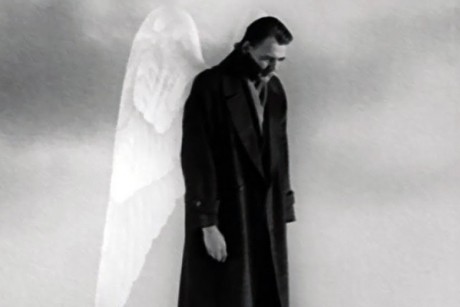
The film’s most haunting scene finds Superman floating above the earth, eavesdropping on layers of conversation, then becoming overwhelmed and shutting them all out. He could be a two-fisted cousin of the angels from Wings of Desire. He feels guilt over needing not to be needed, if only for an instant. He’s an extraordinary ordinary man—the better angel of our nature.

A critic, journalist and filmmaker, Matt Zoller Seitz is the staff TV columnist for New York Magazine and the founder of Press Play. Ken Cancelosi is a writer and photographer living in Dallas, Texas.

MATTHIAS STORK interviews JOHN BAILEY, cinematographer for GROUNDHOG DAY, THE BIG CHILL & THE PRODUCERS (2005)

MATTHIAS STORK INTERVIEW: JOHN BAILEY, cinematographer for GROUNDHOG DAY, THE BIG CHILL & THE PRODUCERS (2005)

null

A few weeks after my video essay Chaos Cinema had been published on Press Play, I received an email from cinematographer John Bailey. Even though I am primarily invested in directors, his name was familiar to me. When I was about ten years old, my dad had shown me the Wolfgang Peterson directed Clint Eastwood vehicle In the Line of Fire (1993). I distinctly remember liking the film and watching it several times on video. When I read Mr. Bailey’s name in the email, that memory immediately popped into my head.

He told me that he would like to meet and conduct an interview with me for his work at the American Cinematographers website, where he maintains an extraordinary personal blog that I wholeheartedly recommend. I was of course quite nervous about the meeting; after all, the video essay proved to be rather controversial. But it turned out to be a wonderful experience. Mr. Bailey was very considerate and friendly and I am deeply grateful for his generous assessment of my work.

He agreed to an interview with Press Play as well. I find Mr. Bailey's thoughts on Chaos Cinema and filmmaking in general very intriguing. It is always enlightening to learn the perspective of an industry professional.

Matthias Stork: I am familiar with your work as a cinematographer, but I was unaware of your blog at the American Society of Cinematographers (ASC) website which covers a wide variety of cinephiliac topics. How did your blog come about and how do you choose topics to write about?

John Bailey: Two years ago Martha Winterhalter, publisher of American Cinematographer Magazine, asked me if I would like to contribute to the ASC website by writing a blog. I had previously written for the Filmmaker’s Forum page of the magazine. I told her that I would do it if I could write about anything I wanted to, not just film. She agreed. I saw the blog, and continue to see it, as a place where I can explore my own eclectic interests in the arts; I have no set agenda and pick subjects from books, reviews, exhibitions, and ideas from friends. Writing about a subject forces me to focus my thoughts in some kind of coherent way. I was educated by the Jesuits; I have a proclivity to want to organize seeming randomness.

In my opinion, you inhabit a rather intriguing position within the film discourse. You are both an industry professional and an observer. Does this double status inform either of your occupations?   

nullBeing a working professional may give me a more credible bully pulpit to discuss current issues. Whether or not that extends to any perspective I have on any of the other arts depends on whether the reader thinks there are any reliable aesthetic underpinnings to what I write. I try to be less categorical in my opinions on subjects other than film, as I want to intrigue the reader to explore the art and artists I write about with the same enthusiasm that prompted me to write. My perspective on cinema, however, is much more personal, and comes out of over 40 years of work. It’s really impossible to objectify any discussion about what is so close to your skin. As they say, “movies are my life.”

In a fantastic essay titled In Search of a Cinema Canon you describe yourself as neither a critic nor a film historian, just an avid lover of movies. Could you elaborate what exactly it is that draws you to the medium? I understand that this is an abstract question. To put it differently, what do you like to see in films? Maybe we can also extend our purview and include more tangible aspects, drawn from your own work, i.e. cinematography.

If the question is abstract, my love of cinema is concrete—as is the art form itself. Wonderful as the history of experimental or abstract filmmaking is, we mostly think of movies as plot, character and narrative that relate to real world experience. It is the very real life aspect of movies that attracted me from the beginning. It may be why I have less interest in fantasy and action movies, and why I have such antipathy for gratuitously violent action films that bear no resemblance to any life experience. At the same time, I am powerfully affected by films that combine the drama of life with formalist technique and style, whether it is Bela Tarr, Robert Bresson, or Ernst Lubitsch.

I am drawn to filmmaking because though parts of me enjoy solitude, I love the give and take collaboration, even the tensions of a film set. It is a complex weave of art and technology with the equipment always threatening to overwhelm the art. You have to wrestle the equipment to the ground and make it crack to your whip.

nullIn the essay you also mention that you and your wife, film editor Carol Littleton, were involved in an international outreach program in Kenya and Rwanda. You gave workshops on cinematography and film editing. Could you speak about your experience and how you organized the workshops?

The workshops in Nairobi were created by the German organization One Fine Day, the brainchild of Tom Twyker and others. As you might expect, it was highly structured and ran like clockwork, a classically oriented pedagogic program, including one day that featured recreating five famous paintings. There were plenty of cameras and lights to work with.

In Kigali, there was no advance program and we all tried to develop an agenda based on the experience and questions of the students, many of which were of a start-up nature. The film school is embryonic and there is virtually no support equipment such as lights and grip and dollies. The greater potential of the Rwandan program, though, lies in the tragedy of its recent genocidal history, not that that is the only theme, but the power of that cultural and societal disruption can be the spark of a greater creative force in film.

During our encounter, you told me that you went abroad as a college student, an experience to which I can fully relate. I am wondering whether the time in Europe had an impact on you which is still present, and whether it extended to your work in the film industry as well.

I think I can speak for Carol as well as for myself [when I say that] it is impossible for me to imagine a life in film had I not studied as an undergraduate in Europe. It was there that I was exposed to cinema, not just movies. It took me a long time to embrace mainstream American movies. I am still coming as a late student, courtesy of Turner Classic Movies, to the glories of many American movies of the golden studio era.

I had the great good fortune in my time as camera assistant and camera operator to work with auteurist American directors such as Monte Hellman, Robert Altman, Robert Benton, Alan Rudolph, Terrence Malick, and of course with cinematographer Nestor Almendros. It gave me an aesthetic foundation, so that when I met with Paul Schrader for American Gigolo I was able to have real discourse with him about Bresson and Antonioni.

nullYou contacted me vis-à-vis my video essay on chaos cinema and I was very pleased to hear the opinion of a professional on the matter. You articulated your own thoughts in your blog essay but I would like to revisit some aspects of the phenomenon. How would you personally characterize what I termed chaos cinema?

I think that you have focused closely and clearly on action movies in discussing chaos cinema; I would characterize the notion of chaos cinema as a style that uses the camera to disrupt, disorient, even fracture the viewer’s sense of space and time—deliberately exploiting the most advanced techniques to replace traditional narrative engagement and substitute it with visceral excitement—exactly what many video games do.

Not being a huge fan of action movies, I ask myself whether the stylistic underpinnings you discuss can also be applied to more narrative oriented films and what effect chaos style has to either disrupt any sense of engagement beyond spectacle—or whether it can serve also as the foundation for a new kind of narrative. I try to address this, tentatively, in the last part of my blog essay on chaos cinema/classical cinema.

In your essay, you stress the significance of character and emotion in narrative storytelling. How do you approach these concepts as a film viewer and a cinematographer?

We can’t escape our personal histories. From grammar school forward, I was presented with many aspects of a classical education, meaning one that was based on Aristotelian ideas, even as they evolved through the pageantry of Western art history. As a viewer, I, like most people, am looking for emotional involvement that is grounded in some sense of credible experience. Those movies don’t have to be dour dramas. Sometimes, animated films like Up or The Triplets of Belleville capture these qualities in an essence that is more elusive in live action films.

As a cinematographer, I read the screenplay not for visual style or technical potential, but for emotional engagement. Any consideration of film style develops from that starting point, in discussions with the director and production designer.

nullYou worked as a cinematographer for the film In the Line of Fire, directed by German émigré filmmaker Wolfgang Petersen. It is my favorite of his Hollywood endeavors. Could you explain how you approached your work in the film? What was important to you, and how did you translate it into the film?

I told Wolfgang that Das Boot demonstrated beyond any doubt that he is a master of action; I had confidence that the visceral momentum of the film was easy for him. What interested me more is the cat-and-mouse drama between John Malkovich and Clint Eastwood, one an angry nihilist, and the other a humanist looking for redemption. I told him that the therapy scenes in Ordinary People between Tim Hutton and Judd Hirsch constituted a film within the film. I thought the phone calls between Malkovich and Eastwood had a similar basis, and that if we could make each of the phone calls dramatic and visually compelling—the rest of the film was window dressing. You may agree or not, but that is the idea I worked from and I think that is what makes that film different from most action films.

Cinematography has undergone significant changes during the last decades. What are, for you, some of the prominent shifts that have occurred and how do they register on-screen for average audiences? What would you define as chaotic attributes of modern cinematography?

To answer that question would require several lengthy essays. The most prominent shift, I think, is out of the hands of the cinematographer and is in the hands of the VFX creators. And that is the rise of computer-generated imagery to such a level of convincing space that, at least for quick cut, short bursts, it is visually credible as reality. What usually gives it away is the hubris of the generators in defying the laws of gravity. Movie action sequences have become so usurped by the ir-reality of first person video gaming that viewers don’t believe action sequences in movies any more; they look phony. Of course, that’s no problem if you aim for nothing more than spectacle. What is phenomenal about the CGI technique is the ability to tell character driven movies such as The Curious Case of Benjamin Button in a way that was not possible before.

nullChaotic attributes are simply major disruptions of time and space as a device to deconstruct or destroy traditional narrative. The use of multiple cameras for simultaneous action, especially at different frame rates, is one tool. Extensive use of multiple cameras, especially with longer lenses, disengages you from a sense of intimacy with the characters. Multiple cameras also make it more difficult to do what the French call a plan sequence, the complex interplay of one structured shot into the next one; that style is the antithesis of chaos cinema. Also, I find that shaky-cam is often a distancing rather than an engaging device. It is supposed to make you feel more involved, more present in the action. In practice, especially with arbitrary zooming and deliberately bad pans, it just throws you outside the moment making you conscious of the camerawork. It is self-indulgent and hubristic. Conversely, if you are aiming for a cinema verite feel, these very techniques can be effective. There are, after all, no set prohibitions. Also, rapid fire cutting as a relentless technique does not keep you engaged; if there is no slower paced rhythm in the quieter scenes as counter rhythmic, this pace becomes alienating, even boring. Finally, layering shot after shot after shot with no sense of hierarchy reduces the concept of cinematography to nothing but coverage. The shot becomes just data. The cinematographer is reduced to capturing data.

I have always wanted to pick the brain of a film professional about technology and the pragmatic approach to filmmaking. Could you briefly break down the profession of a cinematographer? What does a cinematographer do, and how?

This is actually easy to address. The cinematographer uses the camera to dramatize visually the narrative potential of the screenplay. His main tools to do this are lens selection, camera placement, composition, camera movement, shot-to-shot coverage, and light. In some film cultures it is the light that is his principal focus; in other cultures, such as the USA, all of these elements are the purview of the cinematographer. This work is done in collaboration with the director and in varying degrees with the production designer and costumer. Some directors are story and performance oriented; others are image oriented. The great ones should be both.

The cinematographer’s ability to do all of this work is modified or even constrained by many things, such as schedule and money. The greatest challenge for the cinematographer, like for any artist, is the ability to create good work within the parameters you have—to be flexible, to have a can-do attitude. Often it is the cinematographer and assistant director who have to set the positive tone on the set. The director is swamped by needs of the actors and dictates of the producers and studio.

You cite Point Blank as a paradigm of effective action. Are there any other action films that you like? And how would you define good action?

Good action is not an end in itself, but is a visceral tool to generate emotion by ratcheting up tension or creating release (catharsis). It serves as counterpoint to static dialogue scenes. Just like in a symphony, you have allegro and adagio movements.

I like much of Kurosawa; much of his action happens only after incredible tension precedes it. The same for the climactic action scenes in Sergio Leone films, and not just the spaghetti westerns. The Battle of Algiers and Wages of Fear are great action films, and recently, The Hurt Locker.

To hearken back to your blog, I was astonished by the breadth of topics you cover, and I urge cinephiles to seek it out. All of your work is steeped in the history of cinema. I wonder if you could enumerate a few books on film that you regard as essential to the study and enjoyment of the medium.

The books I love are not about the making of films but about life by filmmakers: Cocteau’s Diary of a Film; Bunuel’s My Last Sigh; Herzog’s Walking in Ice; Kurosawa’s Something Like an Autobiography; Jack Cardiff’s Magic Hour; Nestor Almendros’ A Man with a Camera; Karl Brown’s Adventures with D.W. Griffith; and of course, Bresson’s Notes on the Cinematographer.

If you could pick any director to collaborate with, who would it be? 

The late Francois Truffaut. I only met him once, when he came to visit Robert Benton on the set of The Late Show. Of living directors, I have done five films with Paul Schrader, who has been a great presence in my life beyond the set. I have also made five films with my friend Ken Kwapis. I hope to do five more with him.

Matthias Stork is a Press Play contributor and film scholar-critic from Germany who continues to pursue an academic career at UCLA where he studies film and television. He has an MA in Education with emphasis on American and French literature and film from Goethe University, Frankfurt. He has attended The Cannes film festival twice (2010/2011) as a representitive of Goethe University's film school and you can read his blog here.

GREY MATTERS: Exile from Guyville: The outsider heroines of HUNGER GAMES, UNDERWORLD and THE GIRL WITH THE DRAGON TATTOO

GREY MATTERS: Exile from Guyville: The outsider heroines of HUNGER GAMES, UNDERWORLD and THE GIRL WITH THE DRAGON TATTOO

null

When three of our top action heroes have names like Katniss Everdeen, Lisbeth Salander and Sookie Stackhouse, well, that at least counts for interesting. But when all three wildly different creations – The Hunger Games’ anti-war survivor, The Girl with the Dragon Tattoo’s enraged goth hacker, True Blood’s deep-fried super-powered fairy – are engaged in essentially the same radical gender role rewrite project, that’s another thing entirely. Throw in Mary Elizabeth Winstead’s flinty-fine turn as the nearly genderless Kate Lloyd in the fantastic The Thing prequel and there’s no doubt: a new wave is cresting, something wild and long in coming.

How things look when it hits the shore (in particular, when the Hunger Games film version attacks multiplexes this March) will tell us whether Twilight’s Santorum values are finally in retrograde; whether the age of the girl as just The Girl, the Mom, the Object or the Sidekick is fading a bit; and whether the culture in general is ready to one-up Liz Phair by finally allowing heroines their invigorating, self-defining exile from guyville.

But first, maybe you want to know what the hell I’m talking about.

nullSuzanne Collins’  Hunger Games trilogy is about a dystopian post-North America where tweens and teens are forced to kill each other on a nationally broadcast reality TV show. Our heroine is Katniss Everdeen – 16, and a loner who first experiences a boy’s romantic overtures as treachery, then as spiritual debt. With his every kindness, her indebtedness grows like a bad mortgage of the heart. Collins’ narratives are as non-erotic as Stephenie Meyer’s literary chastity belts, but you too might not be in the mood if, like Katniss, you were either starving, in pain or murdering children to survive. And while fans speculate endlessly over which boy Katniss would have chosen, I believe that, had she a choice, she would gladly have turned down both boys for one night of peace with her sister Prim and her mom. Readers of the trilogy know the truth of this.

But the key thing is this: when Katniss is hunting (alone or with Gale), at the market, at one with nature or with Prim, she’s full, complete, more. But after being torn between two romances she did not instigate, and after her body is waxed, shaved and peeled down to “Beauty Base Zero” so she’s ready for pre-Games fashion shows, it’s nearly impossible to imagine a more visceral, point-by-point depiction of female diminishment.

Anyway, if all this was just about one S.F. trilogy, it might be shrugged off as a weird pop culture blip.

But it’s not. As I type this, similar energies run through David Fincher’s deeply empathetic and subversive version of The Girl with the Dragon Tattoo, starring Rooney Mara’s savagely calculated reanimation of the book’s icon, Lisbeth Salander. An angry, acidly hermetic 24-year-old hacker savant, Salander was raised by a hell-father of unknowable monstrosity and is raped by her social worker. For her own reasons, she agrees to lend her incredible computer skills to a disgraced middle-aged journalist (Daniel Craig) trying to solve a corrupt family’s mystery.

Salander’s work invigorates her. But as someone raised in sexual horror, she can only express herself in the language of fucking. When she offers her body to the journalist, he takes it, despite having nothing real to offer in return.

nullSalander’s bad decision visibly diminishes her. Away goes the off-putting mohawk, bulky jacket, fetish gear and the essential protective hardness. She wears foundation, combs her hair and becomes “pretty.” She even buys Craig’s character an expensive leather jacket.

But Fincher’s got her back: when she catches the older man out on a date, Lisbeth hurls the gift in the trash, jumps on her tricked-out Honda CB350 and leaves the usurious journo in the midnight dust. As fucked up as she is, she’s at least herself again. Salander does what the guilt-wracked, self-loathing Katniss of the first two Hunger Games books can only dream of doing: she escapes “romance.”

Meanwhile, after three seasons of making a fool of herself on the horns of love, True Blood’s Sookie Stackhouse is finally learning the Salander lesson and saying no.

Increasingly super-powered and weary of being “vampire crack” (talk about triple entendres), Sookie is faced with choosing between two hot vamps – serial liar Bill and sizzling bad-boy Eric. Instead, she says no to both of them, and so a door opens to a new Sookie, one in control of those light-blast super-powers and…are you seeing a pattern here?

nullIf so, check out The Thing, which took Salander-style self-determination as far as Hollywood could stand. Our heroine is a paleontologist named Kate Lloyd (Winstead); the blunt name matches her no-nonsense character. She ends up with a group of Norwegian scientists in the Antarctic fighting a shape-shifting alien menace. Dressed in the same gender blurring winter wear as her coworkers and with not a stitch of makeup, Kate is not attracting or attracted. Undistracted, she is relentless.

Of course, the Big Kahuna of heroic self-definition is Buffy the Vampire Slayer, especially Buffy in her last moment on screen when, minus the distraction of her vampire lovers Spike and Angel or a man-created legacy to tie her down, she can finally, after 144 episodes of striving, get to live.

Still, why this deluge of Exile from Guyville properties now? You could just as easily ask why it’s raining fairy-tale-based films and TV shows, but I’ll give it a go.

I see three factors at work.

1. THE NAMES

The easiest to crack is the weird name thing. Not to ball-peen hammer my point too hard, but in properties that are all about questioning or opening spaces where it’s okay for heroines to be more, epic and amazing, it just makes sense to have people with fantastic names to match the mission. You just better buy into an enraged aggro-goth tattooing “I AM A RAPIST PIG” on a screaming rapist pig when her name is Salander instead of, say, Jody. (I love the way “Salander” sounds like an especially pissed off verb. “She salandered her money manager until he begged for mercy!”)

2. ROM-COM BRAINWASHING

Another is the  auto-critique of romance that these narratives so often represent. A single, smart, beautiful, for-now middle class New Yorker friend gave me an idea via her growing contempt of the one genre dedicated to female viewership: rom-coms. Her antipathy for the genre was simple: “Because they’re about making me go fucking insane, is why.”

She said rom-coms drive her around the bend by (1) making marriage look like the most nightmarish state of human bondage imaginable and (2) insisting that all single women must drop everything so as to enjoin that bondage at the exclusion of all other things, pronto. It’s basic cognitive dissonance — and when you look at the diminishing returns of recent genre efforts, it seems as though my friend has company.

3. SELF-DETERMINATION

nullJump-cut from rom-coms to another form of action entirely, the Underworld films – those interchangeable video game-style werewolves-and-vampires shoot-outs featuring Kate Beckinsale in a catsuit. (Another is coming out next month.) I’d always assumed the films were about dudes ogling Beckinsale’s aerodynamic, leather-clad bod wreaking gory havoc. Wrong.
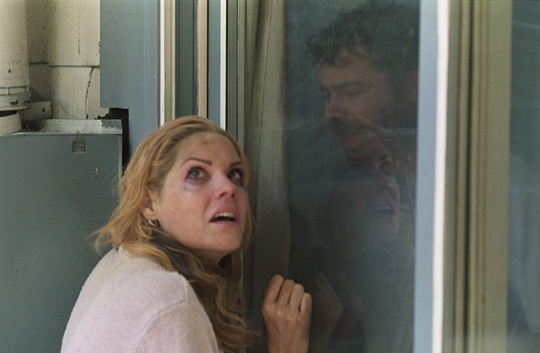
When Beckinsale stripped down to make soft-focus love with some hunk, the theater erupted in howling disapproval – from women. Women who did not brave a winter Manhattan night to see their action heroine surrogate become some dude’s bottom, but rather to enjoy her kicking ass, and often.

Claiming rom-com apostates and action film lovers as core constituency for anything may seem a stretch too far. But I think they both mine the same dissatisfaction.

The female half of the entertainment market is tiring of being pandered to in degrading, conservative fantasies while reacting really well to tales of possibility, no matter how dark.

That half of Comic-Con audiences already dressing as Katniss? Or Doctor Who devotees snatching up pricey Amy Pond and River Song action figures? They’re the base — the P.R. shock troops for properties that represent this new wave. And based entirely on apocryphal evidence and years in the S.F. nerd trenches, I’m here to report that those people are more often female than not.

That base is waiting for the Hunger Games film with a passion eclipsing Potter or Twilight because it’s based on real need here in Depression 2.0, a need for a self-defined someone who beats the odds, the economy, and the expectations placed upon her gender. (And yes, I know how it all ends – with acceptance, qualified hope and a sad awareness of limitations. Not exactly Love Story.)

Meanwhile, yet another Twilight-corrective book has been greenlit for a film version: Scott Westerfeld’s Uglies, which tells of another nightmare future in which youth are force-fed crap pop culture and made to endure prettifying body modification – or else. And the heroine’s name? Tally Youngblood. Katniss would be so proud.

Anyway, as Thunderclap Newman sang decades ago, there’s something in the air, and it’s all so incredibly exciting. This is gender egalitarianism creating itself without knowing it, which is why it might be real. Films in which men live without required romantic subplots or obsessive girl problems are unremarkable, the usual, expected. But films in the Katniss, Salander, Stackhouse and Lloyd wave, films in which the equation is gender-flipped with such passion – that’s punk rock. That’s the beginning of a leveled playing field and the end of dissonance, one story at a time.

Ian Grey has written, co-written or been a contributor to books on cinema, fine art, fashion, identity politics, music and tragedy. His column "Grey Matters" runs every week at Press Play.

SLIDE SHOW: Movies for a desert island

SLIDE SHOW: Movies for a desert island

null

You don’t need much of a setup for this one: It’s a Desert Island List of visual media that I’d like to have with me if I were shipwrecked.

Here are the rules:

1. This list is composed solely of motion pictures and TV shows. Music, books, paintings and other media are not included. It is assumed that you’ll have an indestructible DVD player with a solar-recharging power source, so let’s not get bogged down in refrigerator logic, mm’kay?

2. You can list 10 feature films, one short and a single, self-contained season of a TV series.

3. NO CHEATING. Every slot on the list must be claimed by a self-contained unit of media. You can put all 15 hours of Berlin Alexanderplatz on the list because it’s considered one long film (or if you saw it in Germany, a TV miniseries), but you can’t put The Godfather and The Godfather, Part II in the same slot because “it counts as one long film” (it doesn’t!). You can’t put 10 seasons of I Love Lucy on their, either, or "Twin Peaks up through the part in Season 2 where we finally find out who killed Laura Palmer.” Part of the fun of this exercise is figuring out what you think you can watch over and over, and what you can live without. Stick to the parameters, otherwise we’ll have human sacrifice, dogs and cats living together, and mass hysteria.

I’ve listed my short film pick and my TV season first, followed by a list of 10 theatrical features in alphabetical order. Please add your own picks to the Letters section; I want to see what you’d put in your suitcase.

You can view Matt's final slide show here at Salon.

A critic, journalist and filmmaker, Matt Zoller Seitz is the staff TV columnist for New York Magazine and the founder of Press Play.

VIDEO ESSAY: MAGIC AND LIGHT: THE FILMS OF STEVEN SPIELBERG – Chapter 6: Indiana Jones and the Story of Life

VIDEO ESSAY: MAGIC AND LIGHT: THE FILMS OF STEVEN SPIELBERG – Chapter 6: Indiana Jones and the Story of Life

[Editor's Note: Press Play is proud to present Chapter 6 of our first video essay series in direct partnership with IndieWire: Magic and Light: The Films of Steven Spielberg.  This series examines facets of Spielberg's movie career, including his stylistic evolution as a director, his depiction of violence, his interest in communication and language, his portrayal of authority and evil, and the importance of father figures — both present and absent — throughout his work.

Magic and Light is produced by Press Play founder and Salon TV critic Matt Zoller Seitz and coproduced and narrated by Ali Arikan, chief film critic of Dipknot TV, Press Play contributor, and one of Roger Ebert's Far Flung Correspondents. The Spielberg series brings many of Press Play's writers and editors together on a single long-form project. Individual episodes were written by Seitz, Arikan, Simon Abrams and Aaron Aradillas, and cut by Steven Santos, Serena Bramble, Matt Zoller Seitz, Richard Seitz and Kevin B. Lee. To watch Chapter 1: Introduction, go here. To watch Chapter 2: Blood & Pulp, go here.  To watch Chapter 3: Communication, click here. To watch Chapter 4: Evil & Authority, click here. To watch Chapter 5: Father Figures, click here. ]

Narration:

What does it mean to be a father? What does it mean to come of age without a father? These questions have been at the center of many Steven Spielberg films. Both light entertainments and dark historical dramas have considered them.

The director’s evolving views on fathers and fatherhood are on surprisingly vivid display in the Indiana Jones series, which were produced by his longtime friend and Star Wars mogul George Lucas. Taken as a whole, the films feel like markers in Spielberg’s maturation.

Raiders of the Lost Ark introduces us to Indiana Jones, an archeologist who is more excited by grave-robbing and cheating death than by lecturing to Ivy League students. Indy holds a position of authority at the university, but were it not for the fact that he’s somewhat older than most of his charges and stands at the front of a classroom, he could be mistaken for a student.

There is no clear parental figure or even parental influence in the film. If anything, Indy is in his late thirties but has no visible entanglements. He even seems to treat his home merely as a crash pad, a base of operations.

When Indy decides to go looking for the Ark of the Covenant, he is cautioned by his older colleague of its power – the power of God, the ultimate father – and warned that maybe it shouldn’t be disturbed. Indy’s response is a blithe dismissal.

nullIn later films we will learn that Indy has taken on the vocation of his father as a way to impress, and then one-up, the old man, a stern and distant academic. In Raiders, Indy is presented as almost a runaway kid, a grown-up Bowery Boy who doesn’t give much thought to others. He possesses the shallowness of youth, complete with the clichéd woman in every port. He’s a heartbreaker, this one.

The most uncomfortably adult moment in the film might be the scene where he re-encounters his great love, Marion. We learn that he loved and left her cruelly, and that she was much younger than he was. Their affair ended badly enough to drive Marion to go tend bar in the Himalayas. There’s an unsavory hint of cradle-robbing.

Although chronologically it’s a prequel, the hard-edged Indiana Jones and the Temple of Doom is actually a direct continuation of Spielberg’s coming to terms with adulthood.

Made on the eve of his marriage to Amy Irving — a marriage that would eventually end in divorce, and a second marriage to Temple of Doom costar Kate Capshaw — Spielberg channels the hesitation that can paralyze some men when deciding to make the ultimate commitment. The entire movie positions Indy in relation to various configurations of family – good and evil, functional and dysfunctional. The film is dotted with images of fathers, from the Chinese gangster Indy barters with to the dignified general who protects the palace to the numerous guards in the Thugee cult. And the entire story is infused with a son’s primal fear that his father will fail him — and a father’s primal fear that he’ll let his wife and children down.

The movie finds the hero slowly forming his own bickering makeshift family, with Indiana Jones as reluctant, grouchy father, nightclub singer Willie Scott as mother, and orphaned pickpocket Short Round as their son. Early in the film we’re casually informed that Short Round’s parents were killed in a bombing. Willie could be a gold-digging female equivalent of Indy, an eternal teenager who’s mainly interested in having fun and acquiring nice things. Three people who are used to living alone and relying only on themselves are thrown together, and forced to depend on each other to survive. Their trivial concerns will be beaten and burned out of them, in the Indiana Jones film which for long stretches is essentially a horror movie.

nullWhen Indy, Willie, and Short Round come across a village, they discover all of the children have been kidnapped and forced into slave labor in the mines of the Thugee cult. In effect, the bad guys in this film have made the entire village childless, and turned all the kids into orphans by kidnapping them.

The image of the cult is like a child’s nightmare made real as it consists of nothing but horrible, evil fathers. When Indy is forced to drink a potion he comes under the spell of the cult and his behavior is that of an abusive alcoholic dad.

Temple of Doom, along with Gremlins – which Spielberg produced, and which was also released that same summer – represent Spielberg’s final hurrah as a pure pop storyteller. These are tonally very strange movies, by turns charming and vicious, buoyant and horrific. When he directed the movie in the summer of 1983, Spielberg was edging up on 40, star Harrison Ford was actually turning 40, and George Lucas was dealing with the fallout from a painful and costly divorce. There’s a sense of looking backward on innocence, and forward, toward something darker.

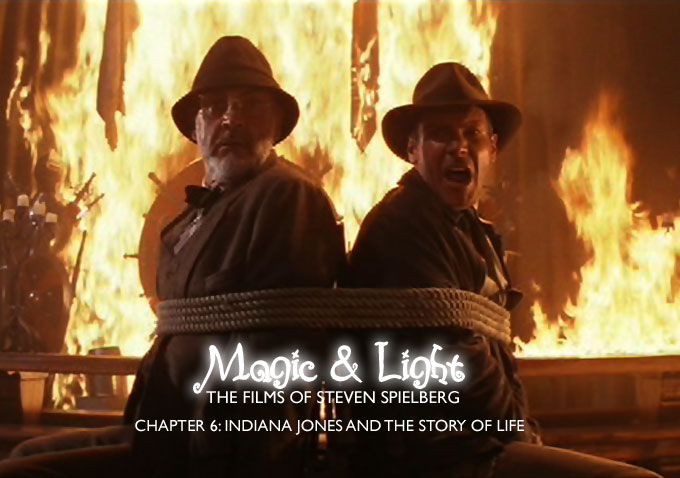
In the 5 years between Temple of Doom and Indiana Jones and The Last Crusade Spielberg had become a father himself. The film’s opening origin sequence shows Indy risking life and limb to get his father’s approval, only to be dismissed when he tries to show his dad his big discovery. His newfound understanding of what that means can be seen in the way that the film presents Indy’s relationship with his own father, a brilliant but rather distant man whom Indy instinctively calls “Sir.”

Like Roy Neary in Close Encounters, Indy’s father is obsessed with a vision, in this case the location of the Holy Grail – the cup from which Jesus Christ, perhaps theology’s most piteously suffering son, drank during the last supper.

nullWhile the elder Jones didn’t literally abandon his family to pursue his obsession, we have no doubt that a lot of the time when Indy was growing up, the old man was mentally or emotionally checked-out. You can see it in the way they communicate – or more accurately, don’t communicate.

Estranged from his father for years, the two are forced to work together when the Nazis attempt to also find the Grail.

Their rivalry is a constant source of father-son friction. It even plays out in Freudian ways as they sleep with the same woman.

In earlier films Spielberg might’ve been more inclined to empathize with Indy’s resentment towards his absentee dad. But in the scene in which Indy tries to lay a guilt trip on his dad, and his dad grows impatient with such childish complaints, Spielberg’s identification is with pretty clearly with the father.

For Spielberg, hanging onto resentment and anger over a parent’s failings is ultimately pointless, a sign that one has failed to evolve. At the same time, though, The Last Crusade acknowledges that a father is still capable of learning late in life, and that for good of both father and child, such evolution is desirable, and necessary.

When Indy is hanging on for dear life as he attempts to grab hold of the Grail, his father gives him one last order. The son puts his pride aside and listens. And it saves his life. It is the same lesson that the elder Jones had to learn – that the emotional reality of one’s family is more important than the abstract goal of pursuing one’s dream. Both father and son learn the value of letting go.

nullReleased almost twenty years after the last Indiana Jones film, Indiana Jones and the Kingdom of the Crystal Skull feels like a coda. Indy seems to be re-thinking his decisions, and having pangs of regret. Although the sixty-something Indy is still a snarling, leathery ass-kicker, and in what might be his surliest mood since the middle section of Temple of Doom, the movie’s overall tone is rueful and melancholy.
The whole story is suffused with feelings of displacement and regret. Indy is a man out of his element, and out of his time – perhaps out of time, period. Nobody who’s endured so much punishment should have lived this long. And emotionally, what has he got to show for it? Nothing. Or so he thinks….

Set in the 1950s – the decade of Spielberg’s childhood – Kingdom of the Crystal Skull shows Spielberg bringing everything full circle on both a story level and as his final musings on what he’s learned as a husband and father.

Kingdom of the Crystal Skull is about rejuvenation and the passing of knowledge. As a young man Indy thrilled to the globe-trotting search of artifacts of history without giving much thought to their historical significance. He sees them as prizes, showing little interest in context or for all that has come before him.

Indy’s discovery that he has a son forces him to realize that – in his own more physically fearless, two-fisted way – he’s as emotionally isolated as his father ever was. As he embarks on an adventure with Mutt, he doesn’t just become a father figure, he realizes he actually IS a father to the young man. He sees himself in Mutt, and tries to impart wisdom to the boy. Of course, coming out of Indiana Jones’ mouth, a lot of this sounds hilariously feeble. But he means well.

As father and son tentatively come together in order to rescue the boy’s mother – Marion, the relative baby that Indy robbed from her cradle in Raiders – their adventure becomes a meditation on a father’s legacy. It becomes

Indy’s last – and most important – adventure while simultaneously representing a son’s first step into true manhood. For Spielberg the gaining and passing of knowledge is the greatest legacy a father can give his son.

The changing of the guard – and the handing down of knowledge and wisdom – is symbolized in the film’s closing shot, which pairs Indy’s long-delayed marriage to Marion and Mutt’s final ascent into functional adulthood. There’s a gravitas to the young man’s swagger. His adventures with his mom and dad have seasoned him. For a moment we believe he might be ready to take possession of Indy’s iconic hat.

But the old man’s not done with it yet.

San Antonio-based film critic Aaron Aradillas is a contributor to The House Next Door, a contributor to Moving Image Source, and the host of “Back at Midnight,” an Internet radio program about film and television. Matt Zoller Seitz is publisher of Press Play. 

SIMON SAYS: As another year passes, Chris Gorak’s RIGHT AT YOUR DOOR reminds us where we have been

SIMON SAYS: As another year passes, Chris Gorak’s RIGHT AT YOUR DOOR reminds us where we have been

null

Writer/director Chris Gorak's The Darkest Hour hit theaters on Christmas Day; to give you an idea of why you should be excited, here's an appreciation of Gorak's topical 2006 chiller, Right at Your Door.

“They don’t really know anything,” Rory Cochrane murmurs wonderingly at one point early on in Right at Your Door, writer/director Chris Gorak’s nightmarish horror parable about the War on Terror as it's imagined at home. That line of dialogue guilelessly gets to the heart of Gorak’s drama, which features the best and not-so-best aspects of George Romero’s trenchantly moralistic horror movies.

Cochrane's exclamation is a small but significant breakthrough for his character. At this point in the film, a dirty bomb has gone off in downtown Los Angeles, sending toxic ashes across the city and its suburbs. Brad, Cochrane’s harried antihero, has sealed himself into his house at the recommendation of local authorities. He’s shuttered his house with duct tape and cellophane. But his wife Lexi (Mary McCormack) is on the outside of his house. She's now, as the title says, right at the door, and Brad can't – or maybe just won't – let her in.

So when Brad says, “They don’t really know anything,” to Lexi, who’s now tearfully begging Brad to let her into the house, Brad’s not really talking to her. He’s admitting to himself that yes, all the preparation and due diligence he’s hitherto performed don’t amount to a hill of beans considering that the people he’s taking orders from aren’t even sure what’s happened. From that moment, Brad’s one short step away from half-wailing and half-spitting out to Lexi that the L.A. authorities “don't fuckin' know enough to sugarcoat anything."

nullAs in Romero’s The Crazies, Right at Your Door evokes a world where authority figures are visibly shown to be unreliable. This is extraordinary in Right at Your Door because authority figures are only physically represented by armed grunts clad in gas masks and biohazard jumpsuits. These monsters are just following orders when they don’t answer Brad’s questions. For example, one can't help but notice the way one soldier hesitates and even trembles while puffing out his chest and defensively telling Brad, “We’re not trying to cause more panic than there already is.” Compare that with the way the similarly dressed soldiers in The Crazies are defined by their actions. They don’t use verbal prompts that might even tentatively reveal their humanity. By contrast, Gorak's army men reveal their humanity while they’re doing the most cruelly impersonal things.

And yet, Brad still clings to the notion that what he’s been told by authorities makes some kind of sense. He improvises an elaborate series of cellophane tarps and hangs them up on open doorways in order to quarantine Lexi in certain parts of their house until someone can come by and check her out. He does all of this because he’s in full-on panic mode. While Brad is thinking clearly enough to try to help his wife as best as he can, his self-preservation instincts have kicked into overdrive. So while he knows that the voices on his radio that warn him to stay indoors and seal himself into his house are not entirely reliable, he listens to them anyway. Because in this apocalyptic scenario, heeding any advice is understandably preferable to sitting on your hands and waiting to die.

Right at Your Door is striking both for its spare scenario and its sympathetic characters’ plights, and also for Gorak’s tendency of not shying away from pointed, Romero-esque sermonizing. At one point Alvaro (Tony Perez), the gardener of Brad’s next-door neighbor, despondently explains why he was admitted to Brad’s home and Lexi wasn’t: pure chance. “We didn't decide anything,” Alvaro insists. “It was instinct. It was just instinct." Gorak, like Romero, is shooting from his gut, not the hip, which is what makes the film’s twist ending and its shrill, blind howl of rage against the shadowy tactics and potential repercussions of the War on Terror. Gorak points a big honking finger of blame squarely at the evil-looking g-men, but they’re not really guilty and neither is Brad, even though he’s ultimately responsible for his fate. Hearing Cochrane cry out, “I’m still alive,” at the end is terrifying because it’s the last impotent complaint of a man that knows he’s unwittingly killed himself.

Simon Abrams is a New York-based freelance arts critic. His film reviews and features have been featured in the Village Voice, Time Out New York, Slant Magazine, The L Magazine, New York Press and Time Out Chicago. He currently writes TV criticism for The Onion AV Club and is a contributing writer at the Comics Journal. His writings on film are collected at the blog, Extended Cut.
 

GREY MATTERS: HOMELAND and the art of playing crazy

GREY MATTERS: HOMELAND and the art of playing crazy

null

As a certified crazy person, I’m here to tell you that either vampires burn in daylight or they don’t. I’ll accept no wiggle room on this. Anything less and you’ll quickly lose my suspension of disbelief. To get what I’m babbling about, this way, please. I’m talking about Homeland, which is, by the way, about almost nothing but crazy people.

Homeland, in case you’ve been busy catching up on something more realistic – I suggest Syfy’s zero-dollar wonder, Alphas – is about Carrie Mathison (Claire Danes), a C.I.A. operations officer haunted by the notion that she failed to do something that may have stopped 9/11 from happening. She was also compromised in an Iraq operation because of an American soldier who’d turned against his country.

Then a Delta Force raid uncovers Marine Sergeant Nicholas Brody (Damian Lewis) in a compound belonging to super-terrorist Abu Nazir. Brody becomes a hero but Carrie pegs him as connected to her failed op and worse, a turned sleeper agent.

When the C.I.A. turns down Carrie’s requests for invasive surveillance because dammit, we don’t do that sort of thing in America, she does it herself with some spy pals. (Alphas, with its metaphor-fraught tales of working class, genetically “super-powered” people fighting Cheney’s still-booming and lawless torture system that Homeland needs to pretend doesn’t exist, is the more clear-eyed, adult view of post-civil liberties America.) In episodes Alfred Hitchcock would love, Carrie watches Brody eat, talk and have sex with his stunningly gorgeous wife (Morena Baccarin of Firefly fame).

The season-long hook, teased sometimes to exquisitely hair-pulling extremes, is a has-he-or-hasn’t-he game of whether or not Brody has been turned and is out for big-time trouble.

And then, for me, it all went to hell.

nullCarrie’s a character whose entire life, as the brilliant credits sequence reminds us every week, is literally defined by terrorism, fear and trying to control that fear by building a life, a personage as a person in strict control, serving her country, her profession and the one real man in her life, her mentor and father figure Saul Berenson (the mighty Mandy Patinkin).

So of course she decides to throw it all away, including, quite possibly, the security of the United States, so she can get drunk and fuck Brody.

The show recovered in fits, some so good and others so bad it was like tuning in to get whiplash, but this was the first trumpet sounding Homeland’s true nature, and televisual literature was not included in that symphony. Homeland never dived so far as The Killing. It stayed professional, keeping us interested (and glad there were no commercial breaks where we could pause to think about its manifold absurdities). Then there was last week’s finale that led to an explosive terrorist conflagration that wasn’t – because if it was, one of the players would be taken off the board, and so much for Homeland Season Two.

But what about the vampires? What about you being crazy?

Okay. What I mean is, if a show has vampires who can never walk in sunlight because they’ll burn up in flames except when the writers need them to, well, I’m not going to be watching that show, because the writers have contempt for me, or their material, or both.

On the most basic level, that’s the deal with Carrie and Brody. In order to accept Carrie and Brody, we must accept some whoppers about what we know about bipolar disorder – if only from Oprah, what millions of people know about returning Iraq vets and P.T.S.D. and what we all know about what it is to be human.

nullRight, bipolar disorder. I didn’t mention that, to add some tension spice to Carrie’s character, Homeland makes Carrie suffer really badly from bipolar disorder. Like, it’s so bad that she has to take her meds every day or else she’ll go into a manic tailspin and lose her mind. The poor thing, she can’t even go to a regular doctor for those meds because the C.I.A. would kick her out as a security risk. So, she visits her psychiatrist sister on the down-low for her weekly supply, which translates into even more suspense, and some shame and anxiety to boot; this bipolar thing is paying off big-time and all they had to do was say she has it. Poor Carrie. This is going to be one rough season.

Except, not so much, because on Homeland, vampires can walk in daylight, so to speak. After a few episodes, her bipolar kind of…goes away. Why? I would imagine because its rigors would get in the way of other plots leading to such flights of fancy as Carrie blowing off seeing her sister for meds so she can get blotto drunk for some hot Brody ooh la la. Unlike all of us, intemperance does nothing to aggravate her bipolar; hell, she doesn’t even get hangovers.

Yes, “us.” I outed myself a while ago on being bipolar. It’s no big thing – as long as you remotely behave like a grown-up about this controllable thing, i.e., not like Carrie.

nullDon't get me wrong: I don’t suggest Homeland hang itself on the horns of scientific accuracy (or a WebMD search). I just ask that it create a ‘verse where there are laws for Carrie’s condition, and then stick to those laws, like the way Vulcans can or can’t intermarry and the like. (On the other hand, absurdity met ugliness when the showrunners had Carrie, in deep depression, diagnosing herself – with her sister mutely complicit – for electroconvulsive therapy, a.k.a. shock treatment, a controversial, risky, cognition- and memory-impairing but highly photogenic treatment calling for Danes to be strapped and gagged, electrodes glued to her scalp. Then they cranked the juice as her body spasmed grotesquely. If you’re suffering from depression, there are a million other ways to get help – this is just an ignorant TV show by the guys who made the torture-happy 24.)

Danes has created a viable person built off the showrunners’ thumbnail description and her own vision of Carrie, which manifests in endlessly fascinating halting speech patterns, “talking” body language, odd glares and more. The creators of Homeland were insanely fortunate to get such an artist.

As for Brody – good grief. Here’s a man who for eight years was brutalized, beaten, locked in solitary, became a surrogate father to an adorable child who died horribly, was forced to brutalize other Americans and, for a freshet of memorable detail, was pissed on while he bled. And yet within a day or so he’s home, and aside from limited, soon-to-improve sexual dysfunctions and some behavioral dissonances, he’s on his way to a full recovery with timeouts for plot-advancing nightmares.

nullMeanwhile, in Brody’s frequent shirtless scenes we see his scars and their implied memories of unimaginable months of pain and horror, which now have no apparent effect. (Even his attempted terrorist act is based not on torture, but on love of a child.) This is Spielbergism; take a sad song and make it ludicrously better, one-upping it by saying the sad song doesn’t exist even as you’re looking at it.

As Brody breezed through photo ops, interrogations, his love affair, superior fathering, a remarkable act of remembrance in a church, the first steps towards a congressional run and the build-up to his terror attack, watching Homeland, for me, became the job of creating in my mind a less ridiculous backstory for Brody. Something Uwe Boll would not reject as failing to meet his stringent standards of realism. (I also had to ixnay the absurdity that any country would allow such damaged goods into the ‘burbs with no decompression process, where anyone could get to him, or the poor bastard could just blow his brains out in 24 minutes.)

Again, it’s entirely the actor’s art that pulls this nonsense off. It’s Lewis’ eye and neck muscle work, his oddly timed blinks, his general tightness of bearing suggesting things blowing up inside. Everything that nobody bothered to write.

But there were such great moments! Like when Brody and Carrie went to her family cabin in the woods, with its implications of a peaceful childhood she somehow missed, and his connection to a person who gets his deal. It was beautiful. And then she flat-out accuses him of being with Al Qaeda, and he’s back at her, yelling that he isn’t (which technically is true). It’s the spy scene we’ve always wanted to see: the breaking of both players’ pose.

Pure gold. But moments like this get lost in a spy show’s mechanics and, as Carrie’s mental illness makes that special guest appearance, devastating her just in time for dramatic effect, I’m just over these daywalking vampires. Next season, I’ll recalibrate my expectations of Homeland. I’ll enjoy the acting, the twists and turns. What do you want? It’s just TV.

Ian Grey has written, co-written or been a contributor to books on cinema, fine art, fashion, identity politics, music and tragedy. His column "Grey Matters" runs every week at Press Play. To read another piece about Drive, with analysis of common themes and images in all of Refn's films, click here.

TRAILER: Terrence Malick’s TREE OF LULZ (Hey, it could have happened. . .)

TRAILER: Terrence Malick’s TREE OF LULZ (Hey, it could have happened. . .)

“For of all sad words of tongue or pen,

The saddest are these: ‘It might have been!

Maud Muller, by John Greenleaf Whittier

 Annals of film history are filled with masterpieces that never were.  Cineastes spend many a sleepless night thinking of Stanley Kubrick’s unproduced epic on Napoleon’s life.  Film historians still search every nook and cranny to possibly locate Orson Welles’ first cut of The Magnificent Ambersons. Then there is the original script for John Huston’s Freud: The Secret passion that a little known philosopher by the name of Jean-Paul Sartre wrote; and Aldous Huxley’s Alice and the Mysterious Mr. Carroll, which was an amalgam of Alice’s Adventures in Wonderland, Through the Looking Glass, and the biography of Lewis Carroll, of which Walt Disney said: “[The script] was so literary I could understand only every third word.” There are many, many more, and probably none of these intriguing projects will ever get to see the light of day.

But don’t despair, gentle reader.  As a late Christmas present, PressPlay is proud to offer you a glimpse of another masterpiece that could have been.  Drown your cinephile sorrows in this.

— Ali Arikan

Kevin B. Lee is Editor in Chief of Fandor, a new video on demand website featuring the best of independent and international films. He is also a film critic and award-winning filmmaker. In addition to editing Keyframe, Kevin contributes to film publications and produces online video essays. Ali Arikan is the chief film critic of Dipnot TV, a Turkish news portal and iPad magazine, and one of Roger Ebert’s Far-Flung Correspondents. Ali is also a regular contributor to The House Next Door, Slant Magazine’s official blog.