


After last week’s announcement of this year’s Oscar nominees, a handful of Press Play contributors gathered together via email to discuss the highs and lows in some of the major award categories. Below are some of the highlights of the conversation, and as always, we encourage you to keep the discussion going. The site's consensus picks for the films and individuals that should win be announced next week, starting Monday.
Matt Zoller Seitz: Has anybody seen A Better Life, for which Demián Bichir was nominated as Best Actor? That seemed out of left field. I feel like Gary Oldman might be a lock for that one, what do you think?
Glenn Close and Rooney Mara nominated for Best Actress is interesting, too. Some thought Close's work was too stunt-y. Mara seems a total surprise for me, as her character is so not Academy-friendly (in terms of looks and demeanor), and Mara is not anywhere close to a known quantity.
 Ali Arikan: Rooney Mara has been lauded by the critics and the industry, and the studio had been hyping her since the summer, so I'm not at all surprised that she got a nomination. Despite the fact that the Millennium books are terrible, people seem to love them, and Lisbeth Salander has become an iconic character. Plus, she also did sterling work in a solid film. What is interesting, however, is that either she or Glenn Close edged out Tilda Swinton for We Need to Talk About Rosemary's Omen. I thought she would be a lock.
I am happy about Moneyball, a film I thought I would hate, but ended up loving. I am one of the few in "our circles" who felt The Tree of Life was lacking, and I don't think it deserved a Best Picture nomination over Tinker Tailor Soldier Spy.
Extremely Loud and The Help are just risible. The latter was always going to be in there, but I thought Bridesmaids might have snuck in instead of Extremely Loud. Either way, having nine nominees obviously shows that the field is still pretty wide open.
 Matt: I like The Tree of Life best of the Best Picture nominees, though I know opinion in this thread is mixed. It's the most unconventional of any nominated film, so much so that I am pleasantly surprised that it became a sort of event when it hit theaters. I think more films that experimental should be made at the Hollywood level. There are not too many directors holding down the fort for that kind of experience, not even Malick's fellow '70s movie brats Spielberg and Scorsese.
Aaron Aradillas: I would argue that in their own ways, both Hugo and Tintin are experimental films. I mean, if it wasn't for their directors, I seriously doubt a studio would've rolled the dice on 'em.
Sarah D. Bunting: Margin Call got a Best Original Screenplay nod. Shut up, Oscars. Barf.
Ali: I also second Sarah's barf. Ewww.
My feelings about Melissa McCarthy mirror Scott Tobias' thoughts on Extremely Loud and Incredibly Close. I disliked Bridesmaids, but I despised her performance.
Aaron: I've yet to fully grasp the dislike for her performance. I know it exists, but I don't get it. I don't remember anyone being offended when Kevin Kline won for making a mockery of being a dumb, sexist man.
Nick Nolte is terrific in Warrior, but it is clearly a great performance of something he does well. He makes look effortless what Tom Hardy and Joel Edgerton huff and puff and make look so tiring. Besides, Nolte did a better version of this in Affliction.
 Christopher Plummer gives his career performance. There's no fat on it. Unlike The Insider, where he's a hoot, Plummer doesn't push it in Beginners, and that's why he leaves such an impression on those of us who love the movie. The way he embraces life at such a late date is funny, touching and ultimately quite sad. Ewan McGregor's character never acknowledges it, but he learns his father's final lessons and that's what leads to the movie's astonishingly hopeful and romantic ending. He is finally his father's son. Plummer's presence is felt in every scene. It be McGregor's story, but it's Plummer's film.
I'm a fan of Midnight in Paris, but Woody Allen's screenplay is not entirely original. It's kind of a variation on The Purple Rose of Cairo. Margin Call is a script written about how we're living right now. It trumps Mamet by not getting all tangled up in being clever with its verbal scenes.
Mara's my second choice in the Best Actress category, but Viola Davis is the only lead actress who literally has to create a character from scratch. The other performances all have something already existing that they're working off of.
Ali: I am not basing my dislike of McCarthy's performance on a curve. It was too easy, without any nuance and did not add anything to a film that definitely needed some sort of a breakout-star factor to make it less boring (and, you know, funny). So, I'd love to hear the case for her.
 Aaron: The beauty of McCarthy's performance is there isn't a trace of self-loathing or self-doubt that would probably get in a dozen other comedies with a character like hers. She is the most confident and aware person in the circle of Bridesmaids.
I'm willing to make a gentleman's bet that Meryl Streep will not win Best Actress. I think Viola Davis is going to "surprise" everyone and take it home.
Kevin B. Lee: If anything, Davis is the odd sober person surrounded by a carnival of sass, crass and crazy in The Help. Octavia Spencer and Jessica Chastain are like intrepid migrants from John Waters-land, while Davis anchors it in gravity and respectability ‒ she's the whipped cream atop the shit pie. I'm not sure whether she saves the movie or adds a layer of Oscar-mongering disingenuousness to what really should be an all-out camp farce. But her final scene standing up to Bryce Dallas Howard is a feat of acting gymnastics, going through a series of emotional states in lightning succession.
In contrast, The Iron Lady is pretty much all Meryl Streep (and everything that implies, good and bad). But it's an MVP performance; she actually made me like Margaret Thatcher for two hours.
Lisa Rosman: The Help is a tepid movie at best, offensive at worst, but as is so often the case, the performances far outstrip the film. Viola Davis never gives up an inch ‒ she may cater less as an actress than anyone else in Hollywood ‒ but so much goes on behind the eyes that she ignobles what could be a wretched role. And on that note, I love Rooney, but this is not the film for which she should win an Oscar. It's a one-trick-pony role and though she does it well, it doesn't have enough shades to win a golden naked man.
 I hate hate hate hate the idea of McCarthy winning this. The role is not just unfunny; it's mean-spirited and she executes it more poorly than she's done anything else in her career. (Wherefore art thou, Sookie?) Nay, for me it's Janet McTeer, who does everything that Close herself fails to do in the otherwise craptacular and super outdated Albert Nobbs. It's a finely tuned performance that brings real pathos and humor and at least three dimensions to the kind of person that Hollywood always, always gets wrong.
The rest I am less adamant on. I love Malick but The Tree of Life is not legible in ways that actually matter to me. Scorsese should take Best Director for Hugo, but I can understand why others do not agree. Gary Oldman should, of course, take it; it's a terrific performance, and Tinker Tailor the Thief Cook should get Best Adapted Screenplay. I don't love any of the Best Picture nominees but think Moneyball comes closest to being what I want a big movie to be. And sorry for the barfers, but I love Margin Call for Best Original Screenplay.
Aaron: I'm for Brad Pitt. I think he gives a star turn and acting powerhouse at once. George Clooney is great (and I have no problem if he wins), but he was going deeper into a character he does best: the good-looking asshole who is brought up short by life.
 There is real mystery to Pitt's take on Billy Beane. He loves the game, but knows the game is changing. He knows he has to get wins in order to keep his job and is more than willing to modernize for that reason. But he also knows there is something you can't calculate about the game of baseball. The scenes of Pitt driving to work or sitting in the locker room show a man who is constantly trying to figure out the odds and knowing deep down that there are some things you can't figure out. Also, Pitt is a great subtle comic performer in the scenes where he's making deals or bossing around others in the room. Like Jesse Eisenberg, he is a natural when it comes to Aaron Sorkin's writing.
Kevin: I think Pitt's performance falls under the same school of acting I endorse. (Clooney, on the other hand, is on autopilot).
Aaron: Clooney's not on auto, but I'll leave it at that. I do know Pitt is happy as can be to be nominated in the same category as Gary Oldman. His death scene in Fight Club is inspired by Oldman. Pitt says on that film’s commentary, "No one dies like Gary!" It should also be noted that Pitt gets a slight advantage in that his work in both Moneyball and The Tree of Life show how wide a range he truly has.
Lisa: I actually agree Clooney's not on auto, but I disliked the conceit of the casting of that film immensely. (Alexander Payne loves to get notoriously charismatic actors to play schlubs; it underscores his misanthropic view of "average people.")
 Ali: I, too, am for Pitt, even though I liked Tinker Tailor Soldier Spy Doo-Dah Doo-Dah more than any other American film this year. Goldman is magnificent as George Smiley, closer to John le Carré's vision than Alec Guinness' portrayal, and he explodes with understated pathos (paradoxically) the one time he shows his emotions (the incredible Soviet national anthem scene where he sees his wife having it on with Colin Firth).
That said, I have a problem with his voice and accent. He sounds like a constipated baboon trying to do an impression of Ian McKellen. It was but a minor quibble when I first saw the film, but after three times, it's just grating. (For what it's worth, Tom Hardy gives the best performance in that movie.)
As for Brad Pitt, first of all, his is an almost old-fashioned movie star performance. He's charming and cheeky and funny, and hella good looking. (Yes, I've just used "hella" ‒ I am a 14-year-old kid from 1998.) I have no idea who Beane is, so this is my estimation of the character as he is seen on the screen: as Aaron said, here is a person who decides to ride the waves of change. Pitt plays him as a nexus of frustration; he never made the big time, so he is trying to make up for that lost opportunity. He is clever, though. He knows that he is unable to see the forest for the trees (the final scene with Jonah Hill, the earlier conversation with his daughter, etc.), but that's what obsessive-compulsive people are like. They know what they're doing is irrational, but they have to keep doing it.
Also, the final shot shows him in full command of his face ‒ an incredibly important skill for a screen actor.
Matt: What about this Demián Bichir fellow? Nobody's really mentioned him as a contender….
Aaron: A Better Life is good, and he's really good, but not award-worthy, especially when you consider someone like, say, the criminally underrated Steve Carell or Kevin Spacey's triumphant return to good acting in Margin Call. If one is going to label his nomination the Indie Nod, I much prefer Michael Shannon. Take Shelter is far from perfect, but Shannon is amazing.
The biggest problem with A Better Life is the character of the 14-year-old son. The actor is pretty bad and the character, as written, is pretty thin. An old-school Mexican dad would not put up with half the shit this kid gives him. Compared to the father-son dynamic in A Bronx Tale, A Better Life comes up short.
 Can I make my case for The Help one more time? If the best 9/11 movies are not explicitly about 9/11 (Zodiac, Munich), then why can't one of the best films about race today be a movie about recent history? The outcry from so-called open-minded liberals was telling in that just because the movie was supposedly playing it safe by telling a story we all can agree on that it wasn't also making people think about the here and now.
Race is the one truly unspoken-about issue in this country. When it is spoken about, it is in an obvious safe way. The Help is about the moment when an open discussion was needed in order for change to occur. What the movie also makes clear is that discussion needs to be ongoing. And that is simply not the case right now.
Just because the movie delivers its "message" in bawdy, emotional, mass-appeal entertainment doesn't make it unworthy of praise (or awards). The Help not only attempts to keep recent history fresh in our minds, but also old-fashioned awards-worthy entertainment alive as well.

 [EDITOR'S NOTE: Fearless Sarah D. Bunting of
  The film has echoes of everything from Hoosiers to Hoop Dreams (the rising and falling fortunes of Money and Chavis) to The Blind Side to the late great Friday Night Lights, but that's a pretty impressive list of memorable narratives to have echoing down your movie. (Well, I loathed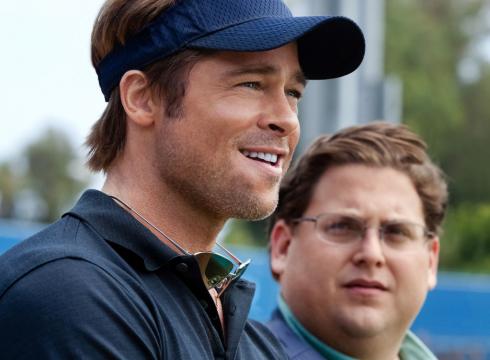

 I can't speak to what baseball atheists got out of it. I can name maybe two other people who got the same frisson of hilarity out of the casting of Chad Kreuter as Rick Peterson as I did. I know for a fact that nobody else snickered at "No bunting whatsoever," but I of course collect comments like that. But I'm pretty sure "Who's Fabio?" "He's that shortstop from Seattle"; the "I'm just saying, his girlfriend is a six, at best" sequence; and Billy Beane's ex-wife's new husband and his man-dals got laughs from other people, because I'm pretty sure Moneyball is a good movie qua movie, sharply observed and well acted across the board.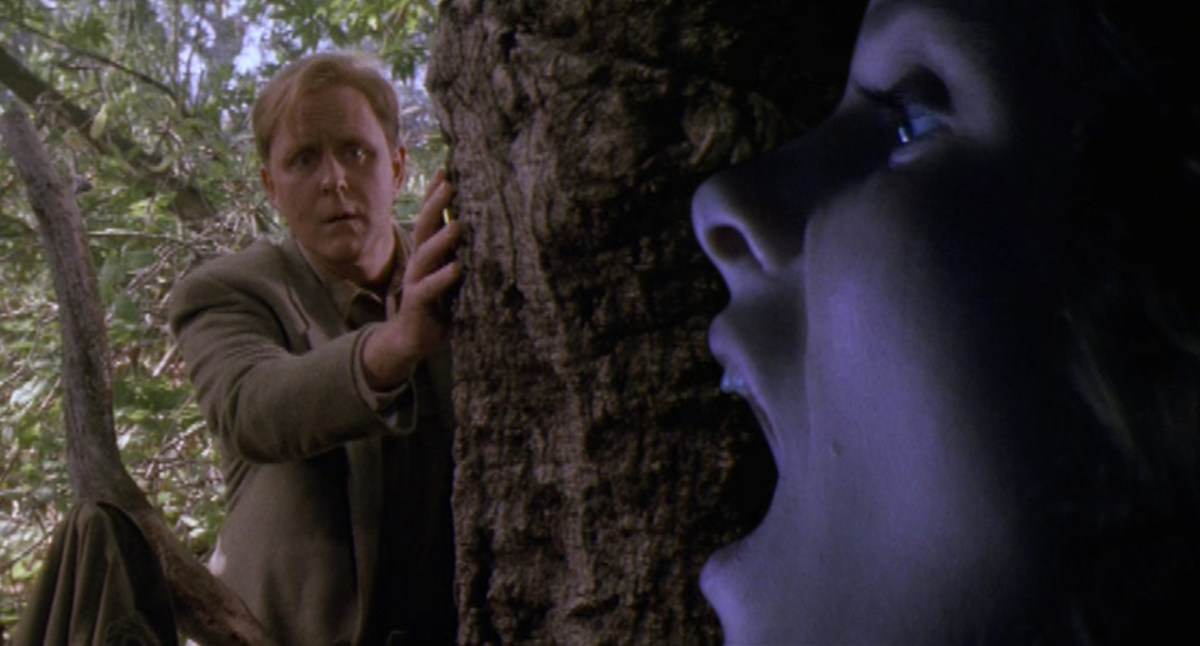
 Raising Cain combines all of the elements of a vintage De Palma thriller and raises the stakes for both maker and spectator. It’s easy to get lost in the film’s labyrinthine framework centered on Dr. Carter Nix (John Lithgow), a murdering child psychologist with multiple-personality disorder, and his unfaithful wife Jenny (Lolita Davidovich). But for those who are able to keep up with the various role reversals, dream-like transitions and densely interwoven plot threads, the journey is all the more rewarding.
 In the book Brian De Palma by Samuel Blumenfeld and Laurent Vachaud (in French and currently out of print), the director explains how this first act hurts the film:
 Crisis in masculinity isn’t even part of the equation anymore. This is going to be a movie about self-projection, about imagined lives, shifting perspectives and the collapsing present. The deliberate soap-opera framing of Jenny’s section, featuring lots of talking heads and over-the-shoulder shots that are atypical for bravura filmmaker De Palma, feels all the more fitting when isolated from parallel storylines.
 One transition in the re-cut proved particularly tricky. To make up for a lack of coverage, I deployed a technique De Palma repeatedly relies on in the second draft of his screenplay: repetition. By quickly playing back a key moment earlier in the film, the viewer is reminded of where the upcoming scene fits in the overall chronology. To soften the transition, I lifted an establishing shot from the epilogue.

 Nineteen eighty-one was the last gasp of the independent spirit of the '70s American cinema movement. The previous year's Raging Bull and Heaven's Gate may have represented both the climax and glorious ruin of the previous epoch; the all-consuming onslaught of Spielbergism and Reaganism commenced the following summer with the paradigm-changing success of E.T. But in 1981 there still was a kind of film being made which was soon to disappear: a film designed for intelligent, upscale adult audiences willing to be entertained on a more sophisticated level. Warren Beatty could only have made Reds at this point in his career, and of all the films nominated for the 1981 Best Picture Oscar, it works best as '70s swan song, especially in its interpolated documentary portions of aging witnesses to the life of John Reed. Otherwise, Reds was an ambitious and impressively literate mounting of a Lean-like spectacle that, since it celebrated the aspirations and ultimately lost dreams of fervid young 1917 communists (and by allusion, the contemporary counterculture), was unrevivable and largely forgotten during the rest of a conservative decade. The other four contenders were a varied lot: Steven Spielberg's Raiders of the Lost Ark, the year's pre-eminent popcorn smash; Chariots of Fire, a solidly produced British tradition-of-quality prestige yawner that was given some emotional texture by a stirring Vangelis score (as played on the opening credits over a pan of euphoric runners); On Golden Pond, a turgid sentimental spectacle of aging veterans Katherine Hepburn and Henry Fonda working together for the first time and co-starring with Fonda's daughter Jane; and Louis Malle's Atlantic City. Malle's film was the least pretentious and assuming of the bunch, yet also the most movie-movie-ish (even moreso than the mechanical Raiders). It is also the nominee whose reputation has grown the most over time.
 The film's iconic image is the European-scented scene of Sally (Susan Sarandon) cleaning herself with Lemon wedges by an open window, serenaded by classical music and gazed at across the way by a furtive Lou (Burt Lancaster). Sarandon was never more beautiful and sensual than in 1980, with her distinctively large eyes and ample bosom (well-exploited by Malle, both here and in his previous film Pretty Baby). She plays a worker at an oyster bar (hence, the ritualized lemon cleansings) who is also training to be a dealer in the casinos. Michel Piccoli is likely Malle's stand-in as a wizened Frenchman tutoring her in the rules of the game as well as the Gallic language itself. She's visited by her ex-husband, a ratty drug dealer who's happened upon an illicit wad of cocaine, and his pregnant hippie girlfriend, Chrissie (also Sally's sister). Lou lives next door. He's an aging numbers runner who "worked for the people who worked for the people". He spends his time nursing Grace (Kate Reid), his lover from way back who came to town, took third place in a Betty Grable lookalike contest, married a mobster and stayed. Grace's bedroom is as gratuitously overdecorated as one of the boudoirs in Pretty Baby's New Orleans brothel.
 Atlantic City's narrative texture and freewheeling romanticism have earned it a place as one of the most beloved American films of its period, but what struck me on my most recent viewing was how much it resembled a colorful, Jonathan Demme-esque survey of tacky Americana. A late '70s sign extolling the era's ecominic boosterism ("Atlantic City-Back on the Map Again") fronts the dillapidated exterior of Sally and Lou's crumbling apartment complex; Lou takes Grace's yapping toy dog to the "Pet-tique"; Robert Goulet and a tiny couplet of showgirls incongrously entertain at the hospital where Sally identifies her ex's body; the funeral parlor has 'We Understand' affixed under its name; the local news reports have a tacky authenticity. Sally leaves A.C. listening to "Sunrise Semester" on her car radio. The end credits music mimics a car radio shuttling down the dial, with different recordings from different eras evoking what Atlantic City once was and the city in transition that it had become.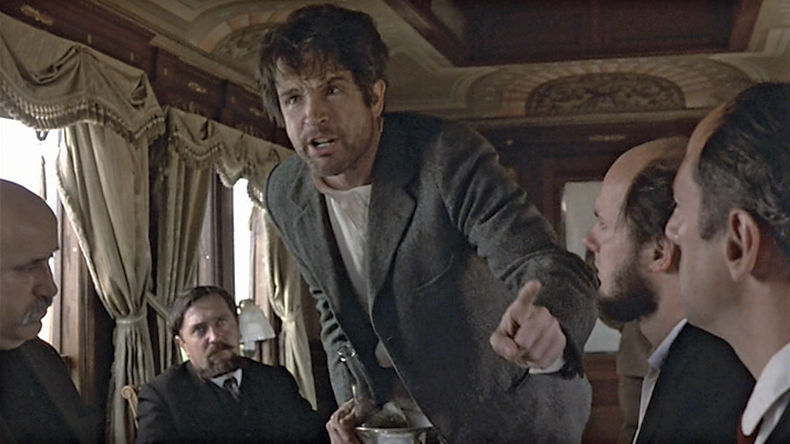
 Chalk it up to the power of Warren Beatty. Coasting on the success of such mega-hits as Shampoo – which he’d produced and starred in – and Heaven Can Wait – which he’d starred in, produced and co-directed – he was ready to make the ultimate “one for me.” And what a one it was. He’d been fascinated with the journalist since the mid-60s, and, with his typical slow burn, had started filming interviews with old-time lefty heavy hitters like feminist author Rebecca West, playwright Arthur Miller and ACLU founder Roger Nash Baldwin as far back as 1970 on the off chance that he'd gain funding to make a film about Reed and his comrades. Somehow he convinced Paramount of the feasibility of the project – though soon after signing on the dotted line they reportedly offered him $1 million to not make it – and it not only scored the brother four Oscar nods and one actual statue, but made $41 million, which was a highly respectable box office return for the time.
 At the film’s center lives the fraught romance between Reed (Beatty) and socialite writer Louise Bryant (Diane Keaton); Beatty had to maintain that aspect of the sweeping historical epic tradition, after all. I’d never really grokked Keaton’s much-touted beauty before. Above the high lace collars of that era, though, her grey eyes widen and narrow with a sensuality that’s hard to deny, and she speaks with none of the stammering affectations that muck up so many of her performances. But because the star-crossed lovers proclaimed a “free love” relationship – an eternally naïve concept if there ever were one, and one destined to appeal to well-known lothario Beatty – scene after scene sounds the soap operatic notes of their off-and-on relationship, including some gratingly if convincingly moony love scenes (Keaton and Beatty were reportedly involved off screen) and some awfully wooden dialogue (“I'm just living in your margins! No one takes me seriously!” “Well, what are you serious about?”). In general, dialogue has never been Beatty’s strong suit; everyone tends to rat-a-tat-tat in bumperstickese here (except for him; the man is a hopeless mumbler). There’s something charming about all that ideological jargon, though. So earnest. So unfashionable, at least until recently.

 The other film that holds its own from start to finish is Voice of My Father, a relaxed, beautifully composed Turkish film about an ethnic Kurd who visits his mother and discovers tape recordings made by the father he barely knew, who worked and died in Saudi Arabia. Deeply personal (based on the family of co-director Zeynel Doğan and scripted by co-director Orhan Eskiköy), it uses the voice recordings to haunting effect, triggering hypnotic scenes that flood the present moment with nostalgic pain. Less successful at lyrical docu-realism is In April the Following Year, There Was a Fire. After a playfully Apichatpong-esque opening sequence, the film lapses into a rather straight homecoming narrative of slow ethnographic long takes, the lingua franca of international art cinema. Similarly, Vasily Sigarev’s Living much abandons its most intriguing element, a bloody nosed man with a bicycle, electing to ping pong between separate half-baked domestic dramas of diminishing interest. Huang Ji’s Egg and Stone is perhaps too intent on swaddling its alienated rural teenage girl protagonist in feminist symbology, even indulging in doting close ups of her menstrual fluids. But what close-ups! Cinematographer Ryuji Otsuka (who also produced and edited) boasts some of the most extraordinary HD lensing in recent memory, doing exciting things with shallow focus and texturing of surfaces (including aforementioned menstrual fluids).
 Perhaps most disappointing – not for what it is, but for what it could have been – is Southwest, which as reported earlier, has the most jaw-dropping opening sequence among the competition films. This Brazilian magical realist fable charting the stages of a girl's life in and around an impoverished salt farm loses its momentum as it bulldozes its way towards a foregone “circle of life” conclusion; the sentimental soundtrack makes it feel like a Disney movie directed by Bela Tarr on Prozac. But Eduardo Nunes, clearly a very talented director, establishes himself as a strong visual storyteller, even if his dramatic instincts betray an inclination to go Hollywood over Cannes.
 Another film that plays more like an impressive demo reel than a fully realized work is Park Hong-Min’s debut A Fish, which has the distinction of being the first 3D movie to compete for the Rotterdam Tiger Award. A man suspects that his missing wife may have become a shaman, but his search leads into a narrative hall of mirrors and his mental disintegration. Its Mullholland Dr.-inspired narrative rabbit hole feels more like film student precociousness lacking emotional investment, but the film is remarkable in exploiting the inherently disorienting qualities of 3D to evoke a state of perceptual distortion, further underscored by a distressed stereophonic soundscape. Like several Rotterdam films, it’s exciting less for what it is than for what it promises for the future.
 [EDITOR'S NOTE: Fearless Sarah D. Bunting of
  Hell and Back Again cuts back and forth between the present day and the ground operation that brought Harris to harm, between Harris's attempts to manage his pain and his civilian life and the platoon's attempts to manage the mission, and civilians, in Afghanistan. In the quieter moments, the film is too pointed in showing us that this isn't a war to be "won," and the overlapping style of the sound design — by J. Ralph, and I'm probably the only one who remembers that he did the song for


 Press Play Video Blog