OSCARS DEATH RACE: FOOTNOTE

OSCARS DEATH RACE: FOOTNOTE

null

[EDITOR'S NOTE: Fearless Sarah D. Bunting of Tomatonation.com is making it her mission to watch every single film nominated for an Oscar before the Academy Awards Ceremony on February 26, 2012. She is calling this journey her Oscars Death Race. For more on how the Oscars Death Race began, click here. And you can follow Sarah through this quixotic journey here.]

In the press notes I received at the screening of Footnote, writer/director Joseph Cedar comments that his film "qualifies as a tragedy, as most father-son stories do." It's a big statement; what's interesting about Footnote — if not entirely successful — is how Cedar presents that tragedy.

nullDescribing the plot without spoiling its central elements is difficult, but basically, Eliezer Shkolnik (Shlomo Bar Aba) is a professor at the Hebrew University, a Talmudic scholar whose micro-focused research has gone largely unappreciated thanks to bad timing, academic backbiting, and Eliezer's immutably sour personality. His son, Uriel (Lior Ashkenazi), is a professor in the same department; his focus is broader, more civilian-friendly. Naturally, there is competition between father and son, although it isn't spoken of between them…until the precipitating event, it isn't spoken of at all, and even that event and its ensuing complications across the family doesn't force that conversation out in the open. It takes place through articles, footnotes, and the ways father and son read and write them.

Cedar often plays this silent tension for laughs, using list chyrons and cueing melodramatic chords on the score. The sound design amps up some effects and drops out others to parallel the selective understandings of the characters; when Uriel gives a speech accepting an award, the camera stays steady on Eliezer's unkempt eyebrows and bilious stare into the middle distance while the sound of his irritated breathing slowly crescendos. Later, as Eliezer and his strangely impassive wife, Uriel's mother Yehudit (Alisa Rosen), proceed into an auditorium, footsteps and airplane-y white noise dominate.

Cedar's decision not to include a confrontation between Eliezer and Uriel — or a discussion between Eliezer and Yehudit, or much reaction from Yehudit at all — is both maddening and refreshing. The "closure" we may have unconsciously come to expect in chapters of filial pain and disappointment is something most of us have to live without in real life; more to the point, it's true to these characters, emotionally bleak but truthful.

The execution doesn't always work. One scene featuring the university's most decorated minds crammed into a meeting "room" the size of a toaster oven is a deft visual gag, but the dialogue should move faster and include more over-talking (tip of the hat to Ashkenazi for the elegance of his straight-to-camera exposition-dumping here, though). And Yehudit's blankness might be too tough to read. Not knowing how she feels is one thing, but I'm not sure I know that she feels. Not that that couldn't work too, in context, but I needed a little more from that character.

But it does a handful of nifty things — the set design of an academic's teetering-book-pile-hole of an office is dead on, for one — and I feel confident in declaring "cookie recipes in the Babylonian Diaspora" the Oscars Death Race Subtitle of the Week.

Sarah D. Bunting co-founded Television Without Pity.com, and has written for Seventeen, New York Magazine, MSNBC.com, Salon, Yahoo!, and others. She's the chief cook and bottle-washer at TomatoNation.comFor more on how the Oscars Death Race began, click here.

OSCARS DEATH RACE: DRIVE

OSCARS DEATH RACE: DRIVE

null

[EDITOR'S NOTE: Fearless Sarah D. Bunting of Tomatonation.com is making it her mission to watch every single film nominated for an Oscar before the Academy Awards Ceremony on February 26, 2012. She is calling this journey her Oscars Death Race. For more on how the Oscars Death Race began, click here. And you can follow Sarah through this quixotic journey here.]

The IMDb's plot summary of Drive is hilariously understated: "A mysterious Hollywood stuntman, mechanic and getaway driver lands himself in trouble when he helps out his neighbour." Well…yeah. If by "mysterious," you mean "communicates primarily in stares and vicious, bloody attacks and is never given a name," and if by "trouble," you mean "a zero-degrees-Kelvin-cold set-up that will beat a path of shattered skulls to his door." But: yeah.

nullFor all that, and all the horrible crunching and squelching that accompanies the ultra-violence (which the film is basically nominated for in Sound Editing), and the Red Shoe Diaries credits font and the Sonny-Crockett-esque brooding by the dashboard light and various other hat-tips to '80s culture, it's a compelling 100 minutes. If you don't find gazing at Ryan Gosling a worthwhile pursuit for its own sake, your mileage may vary (sorry about that pun), but whenever I started to make a snarky note about B-side Tangerine Dream videos mated with a Chevy commercials, something twisted or capital-M Mythic would happen and yank the movie back onto the right side of lazy collage: Bernie (Albert Brooks) killing a dude in an unnecessarily messy way, then soothing him in a bedside tone as he dies; the lights going out in the elevator and turning a kiss between the driver and Irene (Carey Mulligan) into a dream sequence.

Several sequences stretch out too far without much apparent rationale, and the matching of soundtrack lyrics to onscreen emotional narrative is probably intended as another homage to the '80s, but that's not a film formula in need of honoring. Drive can get a little referential and self-indulgent for what is, in the end, a splattery heist-gone-wrong flick, and it oversold the scorpion/frog thing. But it's a world you don't usually see, in a story that doesn't use the usual toolkit or timing cues, and I liked it for that. It respects an ellipsis.

After the driver, Irene, and her son Benicio (Kaden Leos, exactly cute enough) spend an afternoon driving around, Irene breaks a gaze-tastic silence to say, "That was good." I really liked that line, how it was broad and specific at the same time.

Sarah D. Bunting co-founded Television Without Pity.com, and has written for Seventeen, New York Magazine, MSNBC.com, Salon, Yahoo!, and others. She's the chief cook and bottle-washer at TomatoNation.comFor more on how the Oscars Death Race began, click here.


MATT ZOLLER SEITZ: Why, After 500 Episodes, Slagging The Simpsons Is Unfair

MATT ZOLLER SEITZ: Why, After 500 Episodes, Slagging The Simpsons Is Unfair

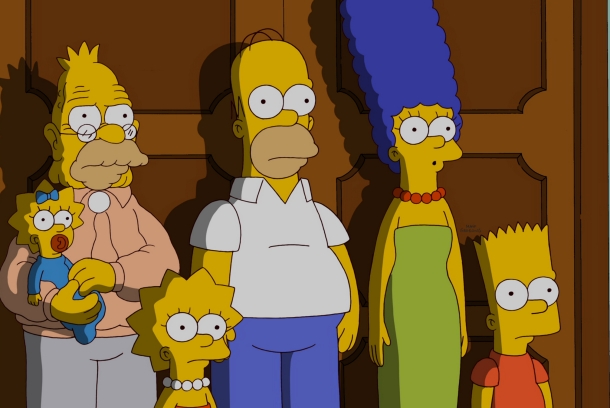
nullAt some point, a show stops being a show and becomes a utility: gas, electricity, water, The Simpsons. That’s not my line; it’s cribbed from a quote about 60 Minutes by its creator, the late Don Hewitt. But it seems appropriate to recycle a point about one long-running program in an article about another when it’s as self-consciously self-cannibalizing as The Simpsons. Matt Groening’s indestructible cartoon sitcom has run 23 seasons and will air its 500th episode on February 19. It hasn’t been a major cultural force in a decade or more, unless you count 2007’s splendid The Simpsons Movie, but it’s still the lingua franca of pop-culture junkies, quoted in as many contexts as the Holy Bible and Star Wars, neither of which includes lines as funny as “Me fail English? That’s unpossible!” I haven’t seen the 500th installment yet because it wasn’t done when I wrote this piece, and that’s probably for the best; pin a thesis to any single chapter and the kaleidoscopic parade of The Simpsons will stomp it flat. Early in the show’s run we rated episodes. Now we rate seasons. In seven years, we’ll be rating decades.

Homer, Marge, Bart, Lisa, and Maggie Simpson appeared in short segments of Fox’s The Tracey Ullman Show in 1987 and got their own series roughly two years later. By now, the series has sunk its roots so deep into the popular imagination that we tend to forget it was once considered déclassé, maybe even dangerous. Twenty years ago, Evangelists and politicians denounced The Simpsons as a televised toxin that weakened parental authority and coarsened the culture. Oblivious to the love that Homer, Marge, and the kids showed for one another, they blasted the clan as a disgusting, dysfunctional unit that was unfit to anchor a prime-time cartoon. During his 1992 reelection campaign, President George H. W. Bush even pledged to help U.S. families be “a lot more like the Waltons and a lot less like the Simpsons.”

You can read the rest of Matt's article here at New York Magazine.

Matt Zoller Seitz is publisher of Press Play and TV critic for New York Magazine.

VIDEO ESSAY: An Open Source Epic – Nina Paley’s SITA SINGS THE BLUES

VIDEO ESSAY: An Open Source Epic – Nina Paley’s SITA SINGS THE BLUES

null

Adaptation and appropriation are important subtexts to Nina Paley’s award-winning animated epic, Sita Sings the Blues. Paley herself became a cause celebre among Fair Use activists seeking reforms to copyright law during her struggle to secure rights to jazz vocalist Annette Harshaw’s recordings. With this video essay, I look at how Paley took inspiration from both the tragic story of Sita in the Ramayana and Annette Harshaw’s bittersweet torch songs to deal with her own breakup, combining them to transform her personal suffering into art. In visualizing the legend of Sita, Paley incorporates traditional Indian and South Asian art forms that were themselves creative innovations on the source material at one point in history. In doing so, Paley plugs her work squarely into a cultural history too rich to be contained by digital rights restrictions, illustrating that true art is open to all.

Originally published on Fandor. Visit Fandor for a video transcript and to watch SITA SINGS THE BLUES.

Kevin B. Lee is Editor in Chief of Press Play, and contributor to RogerEbert.com and Fandor. Follow him on Twitter..

‘SHOULD WIN’ VIDEO ESSAY SERIES: Best Actor Brad Pitt, MONEYBALL

‘SHOULD WIN’ VIDEO ESSAY SERIES: Best Actor Brad Pitt, MONEYBALL

[EDITOR'S NOTE: Press Play presents "Should Win," a series of video essays advocating winners in seven Academy Awards categories: supporting actor and actress, best actor and actress, best director and best picture. These are consensus choices hashed out by a pool of Press Play contributors. We'll roll out the rest of the series between now and Friday. Follow along HERE as Press Play picks the rest of the categories including Best Picture, Best Director, Best Actress, Best Supporting ActressBest Supporting Actor and Best DocumentaryImportant notice: Press Play is aware that our videos can not be played on Apple mobile devices. We are, therefore, making this and every video in this series available on Vimeo for these Press Play readers. If you own an Apple mobile device, click here.]

Narration:

Brad Pitt is one of the biggest movie stars in the world. But he is also a fantastic actor. His phenomenal range has allowed him to play delirious and zany, as in Twelve Monkeys, but also understated and restrained, as in The Curious Case of Benjamin Button. Those films brought Pitt a Best supporting actor and a best leading actor Oscar nomination respectively, but both times, he went back home empty-handed. This year, Pitt is once again nominated as best actor in a leading role Academy Award for his performance in Bennett Miller’s Moneyball. Press Play believes that he deserves the Oscar, and, in this video essay, we will tell you why.

In Moneyball, Brad Pitt plays Billy Beane, the legendary general manager of the Oakland A’s, who reinvented the way baseball players were hired during the 2002 season. There is real mystery to Pitt's take on Billy Beane. He loves the game, but knows the game is changing. He knows he has to get wins in order to keep his job, and is more than willing to modernize for that reason. But he also knows there is something you can't calculate about the game of baseball. The scenes of Pitt driving to work or sitting in the locker room show a man who is constantly trying to figure out the odds and knowing deep down that there are some things you can't figure out.

nullBrad Pitt’s performance is an almost old-fashioned, movie star one. In another universe, one could imagine Jimmy Stewart or Cary Grant taking the part. He brings to the role an assured quality on overzealous, yet understated, lust for ultimate success that was forged in the fires of years and years of failure. He's charming and cheeky and funny, and very good looking (despite the hideous early naughties’ haircut and lumbering fashion sense). Pitt brings a subtle comedic take to what could have been a rather boring central role; his various dealings with other managers, his scouts and players, betray genius-level timing and mimicry.

Pitt plays him as a nexus of frustration: he never made the big time, so he tries to make up for that lost opportunity. He is clever, though: he knows that he is unable to see the forest for the trees as evidenced in the final conversation with Peter Brand, a composite character played by Jonah Hill; as well as the earlier exchange with his precocious daughter, but that's what obsessive-compulsive people are like. They know what they're doing is irrational, but they have to keep doing it.

Ali Arikan is the chief film critic of Dipnot TV, a Turkish news portal and iPad magazine, and one of Roger Ebert’s Far-Flung Correspondents. Ali is also a regular contributor to The House Next Door, Slant Magazine’s official blog. Ken Cancelosi is writer/photographer living in Dallas, Texas. 

PETER TONGUETTE: An extremely misunderstood, incredibly moving 9/11 drama

PETER TONGUETTE: An extremely misunderstood, incredibly moving 9/11 drama

null

At what point do you start to wonder if a particular day might be the worst of your life? Maybe you realize it gradually over the course of an especially sour afternoon as things just keep going wrong. That is what happens in Roman Polanski’s Carnage, and when the Kate Winslet character says at the end that it has been the worst day of her life, what she means is that the day and its accumulation of indignities has finally worn her down.

On the other hand, sometimes it only takes a split-second for a fine, normal, nothing day to become “the worst day.” That is what Oskar Schell in Extremely Loud & Incredibly Close calls it: “the worst day.” September 11. The day that his father, Thomas, is killed in the attack on the World Trade Center. We should never, ever forget what Joan Didion says: “Life changes fast. Life changes in the instant.”

nullOskar is a wise child. Why do I think to describe him that way? Well, to start with, the Glass children in the stories of J.D. Salinger appeared on a game show called It’s a Wise Child, and Oskar is very much like them. The critic Walter Kirn described Jonathan Safran Foer’s novel (which I have not read) as “a conscious homage to the Gotham wise-child genre.” So is the movie. In fact, the actor who plays Oskar, Thomas Horn, was cast after the moviemakers saw him on Jeopardy! This irony aside, Horn gives his character the right bossy demeanor— Oskar is used to getting his way. His curiosity is indulged by his father (played by Tom Hanks in a series of short memories), who devises quests for him, such as finding New York’s “sixth borough.”

After his father dies, Oskar comes up with an excuse for one more “reconnaissance mission.” It starts with a key of unknown origin
(discovered by Oskar by accident when he tips over and shatters a blue vase) and it ends… well, we do not know when or where or if it will end. Oskar has a gift for sleuthing, but he does not kid himself into thinking that solving the puzzle behind the key is important in itself. What is important is that as long as he is searching, he is thinking of his father.

nullDuring Oskar’s journey, a great many people (most of them with the surname “Black”) come into his orbit, including a hulking, silent Swede (Max von Sydow) who might be his grandfather and is certainly a kindred spirit. Oskar also sees his glorious city from every angle. As filmed by director Stephen Daldry and cameraman Chris Menges, Extremely Loud & Incredibly Close is one of the great New York movies. It resembles The World of Henry Orient, with precocious young New Yorkers darting around the city unencumbered by adult supervision.

Daldry directs like a master—he is unafraid to go for bold effects, such as the montage sequence illustrating the many things Oskar is “panicky” about since the tragedy. The director is conscious of his predecessors. The freeze frame of Oskar at the end of the picture is meant, I think, to evoke the last shot of The 400 Blows. And when Oskar retreats to underneath his parents’ bed on “the worst day,” we are reminded of the beginning of Fanny and Alexander—another movie about a son losing a father too, too soon.

The movie gets the more pedestrian aspects of childhood right, too. Daldry captures what it is like to crack open your door late at night, let in a ray of light from the hall, and overhear the murmurings of grownups who think you are fast asleep. An only child, Oskar does a lot of eavesdropping on his parents (his mother, Linda, is played by Sandra Bullock), but he has an uncommon comprehension of what he overhears and a gift for remembering it. At one point, more than a year after September 11, he tells his mother something his father
said to him about her: “I really love your mother. She’s such a good girl.” It is unbearably moving that Oskar recalls the precise words his father used. A more average kid—a less wise child—would have misremembered the remark. It would have become something treacly like, “I love mom.”

I wonder if there is anything more meaningful than to tell someone you love that someone they lost loved them.

Throughout the movie, I worried that Sandra Bullock was being forgotten. There was so much about Oskar and Thomas and the cagey Swede, but relatively little about Linda. I found myself asking why Oskar was spending more time with strangers than with her or why he didn’t tell her about the key he found. She might, after all, know something about it.

Linda is, plainly, less of a pal to Oskar than Thomas was, but the simple truth is that Sandra Bullock gives the movie its pulse. After Oskar’s journey ends, amounting to a lot of sound and fury and signifying nothing (as far as he is concerned), his mother is there waiting for him, and the feeling is much as it is at the end of, say, Meet Me in St. Louis, when the family decides to stay there. It is home, sweet home. But it turns out that she has been with Oskar all along. She is no Tiger Mother, but she checked out every place he planned to visit and every person he planned to see. “Did you think I would ever let you out of my sights?” she asks, and we feel ashamed for wondering if she had.

nullIt is a great portrait of motherhood. The movie may seem all gilded surfaces, but the truths it contains are straightforward, and so many of them spring from Bullock’s quiet, easy performance. You want to cry softly when she whispers that what she misses most about her husband is his voice. It is a simple thing to miss, but any bereaved person can relate. I do not think Sandra Bullock has given a more natural or unaffected performance since Peter Bogdanovich’s The Thing Called Love.

I mentioned that I have not read the novel by Jonathan Safran Foer. So, of course, I do not know how close Eric Roth’s adaptation is. Maybe the things I like best about the movie are from the book—or maybe they aren’t. What I know is this: the movies have the power to make stories seem extremely loud and incredibly close in ways that often elude the written word, and that is especially true of so much contemporary fiction. Give me instead the look on Max von Sydow’s face and the sadness in Sandra Bullock’s voice.

Peter Tonguette is the author of Orson Welles Remembered and The Films of James Bridges. He is currently writing a critical study of the films of Peter Bogdanovich for the University Press of Kentucky and editing a collection of interviews with Bogdanovich for the University Press of Mississippi. You can visit Peter's website here.

FESTIVAL: Rotterdam final report: Sex, politics and family secrets

FESTIVAL: Rotterdam final report: Sex, politics and family secrets

null

Forty-one years and perpetually young at heart, the Rotterdam International Film Festival is a distinguished venue for cinematic discovery. It debuts more first and second films by emerging filmmakers than just about any festival in the world, with its prestigious Tiger Award bestowed upon three up-and-coming talents. With a special emphasis on films from Latin America, Africa and Asia, there's a clear mission to foster a truly global film culture. This year, new ground was broken along gender lines: for the first time all three Tiger Awards went to women directors. More noteworthy is how different the winning films are, each with their own way of telling their respective young heroine's story on screen.

The most controversial winner by far is "Clip," by Serbian filmmaker Maja Miloš, in which a 14-year old girl spirals down a teen vortex of drinking, drugs and sex. The last activity is almost always captured on camera phones, suggesting that today's teens can't enjoy sex without a video mediator. What's more, hardly any shots are filmed from the girl's point of view, especially the sex scenes, which are seen from the male partner's perspective through the camera phones. Is Milos suggesting that girls today can't help but see themselves as sex objects, influenced by their exposure to online porn clips and slutty pop songs? Provocative stuff, but Milos' treatment of the subject feels more exploitive than exploratory, rubbing the audience's noses in teen debauchery to cheap effect. While many critics deemed it a realistic portrayal of juvenile delinquency in the digital age, to me it seemed like an update of the hypocritical sordidness found in movies like Larry Clark's "Kids."

Read the full report on RogerEbert.com.

Kevin B. Lee is Editor in Chief of Press Play, and contributor to RogerEbert.com and Fandor. Follow him on Twitter.

‘SHOULD WIN’ VIDEO ESSAY SERIES: Best Actress Viola Davis, THE HELP

‘SHOULD WIN’ VIDEO ESSAY SERIES: Best Actress Viola Davis, THE HELP

[EDITOR'S NOTE: Press Play presents "Should Win," a series of video essays advocating winners in seven Academy Awards categories: supporting actor and actress, best actor and actress, best director and best picture. These are consensus choices hashed out by a pool of Press Play contributors. We'll roll out the rest of the series between now and Friday. Follow along HERE as Press Play picks the rest of the categories including Best PictureBest Director, Best ActorBest Supporting ActressBest Supporting Actor and Best Documentary. Important notice: Press Play is aware that our videos can not be played on Apple mobile devices. We are, therefore, making this and every video in this series available on Vimeo for these Press Play readers. If you own an Apple mobile device, click here.]

Narration:

Four out the five performances nominated for Best Actress are in part based on fulfilling audiences’ preconceived notions of what they should be. Both Meryl Streep and Michelle Williams do impersonations on the level of genius. Streep dares to make Margaret Thatcher seem all too human; Williams lets us look beyond Marilyn Monroe’s wiggle and teasing smile and see the insecurity, sadness and natural born talent that is required to be a star. Rooney Mara becomes a star by bringing to life one of popular literature’s most revered heroines in recent history. She allows us to feel the heat of Lisbeth Salander’s rage and burgeoning soul. Glenn Close pulls off a stunt that some actors believe is the ultimate test of their talent, be it Dustin Hoffman, Linda Hunt or Hilary Swank.

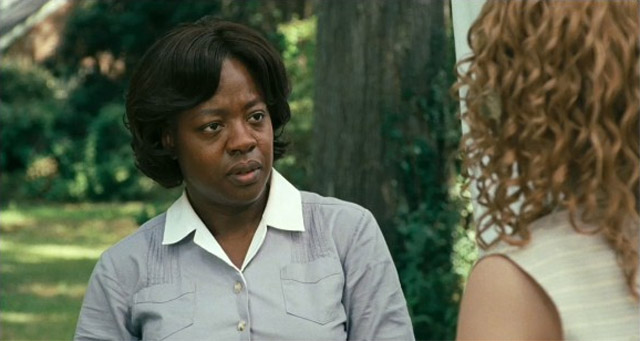
But it’s Viola Davis as Aibileen Clark in The Help who creates a character from scratch. She makes us feel the anger and unbearable sadness that comes from raising and caring for 17 white kids over the years only to have some of them grow up and see their affection turn to indifference and casual cruelty, all the while enduring the pain of burying her only son.

nullThe power of the performance is in Davis’ eyes. They take in everything – tossed-off racist remarks, a child’s need to be comforted. And her voice, which never rises above a formal submissiveness, quivers with a boiling anger that stands for generations of women whose hard work goes unnoticed. It’s a voice that needs to be heard.

The character could be seen as an example of Hollywood condescension: the quietly suffering noble black domestic. But Davis makes Aibileen unforgettable by cueing us into her quiet defiance. She knows a change is coming but worries if it’s too late. Aibileen may not possess the recklessness of youth, but in her own way she takes a stand. Davis may not raise her voice but we hear her loud and clear.

Kevin B. Lee is Editor in Chief of Press Play. He is also a film critic and award-winning filmmaker. San Antonio-based film critic Aaron Aradillas is a contributor to The House Next Door, a contributor to Moving Image Source, and the host of “Back at Midnight,” an Internet radio program about film and television.

OSCARS DEATH RACE: KUNG FU PANDA 2

OSCARS DEATH RACE: KUNG FU PANDA 2

null

[EDITOR'S NOTE: Fearless Sarah D. Bunting of Tomatonation.com is making it her mission to watch every single film nominated for an Oscar before the Academy Awards Ceremony on February 26, 2012. She is calling this journey her Oscars Death Race. For more on how the Oscars Death Race began, click here. And you can follow Sarah through this quixotic journey here.]

nullIt feels a little too long, and leans a little too hard on the "what happened to you is not who you are" messaging, but Kung Fu Panda 2 is pretty fun, even for people like me for whom a little Jack Black goes a very long way. The opening origami-style animation sequence is lovely; the fight scenes pop along; and I watched the kung-fu radish in the dream sequence three times. So cute!

KFP2 is a pro effort, and I can't draw a stick figure so it's hard for me to assess the logistical complexities of the category — but if this is some kind of achievement in animation, it's not terribly memorable. I liked it, I laughed a few times, but I don't know that I'd have remembered even the images I mentioned above if I hadn't written them down. "A pleasant enough hour and a half" doesn't seem like Oscar territory. Then again, as I keep reminding myself, Wolfman has one, so what the hell do I know. NEXT!

Sarah D. Bunting co-founded Television Without Pity.com, and has written for Seventeen, New York Magazine, MSNBC.com, Salon, Yahoo!, and others. She's the chief cook and bottle-washer at TomatoNation.comFor more on how the Oscars Death Race began, click here.

OSCARS DEATH RACE: Surveying the race for Best Actor

OSCARS DEATH RACE: Surveying the race for Best Actor

null

[EDITOR'S NOTE: Sarah D. Bunting of Tomatonation.com is watching every single film nominated for an Oscar before the Academy Awards Ceremony on February 26, 2012. She is calling this journey her Oscars Death Race. She has completed the category for Best Actor and now surveys the competition. For more on how the Oscars Death Race began, click here. And you can follow Sarah through this quixotic journey here.]

The Best Actor category is more interesting, to my mind, for who didn't get a nomination than for who did, although I guess the actual nominations are interesting. "Baffling" counts as interesting, right?

Let's get to it.

nullThe nominees

Demián Bichir (A Better Life): The performance looked better than it was thanks to subpar acting by his castmates. A solid outing, no more.

George Clooney (The Descendants): The Cloon did his best under the circumstances, and I acknowledge that the performance proceeds from the script, but I hated the script and the performance is not very good in the second place. It's not Keanu, but it's not very good. The blocking is lazy; a lot of the scenes land like first rehearsals, or he's letting the ugly shirts craft the character beats. From a craft standpoint, I don't get this nom at all. From a "sometimes, the universe wants — nay, needs — to remind the Cloon that he is loved" standpoint, it makes more sense and I can mostly live with it. A win would kind of gross me out, though — and Vegas has him sitting at short odds…

Jean Dujardin (The Artist): …but SAG went for Gallic charisma, and that award is a pretty reliable indicator. Dujardin is very good, and while this isn't my favorite performance nominated, I won't mind if it wins, and it probably will.

Gary Oldman (Tinker Tailor Soldier Spy): Initially, I had a "wait, seriously?" reaction to this nod, but much like the movie itself, the idea grew on me. But he's good here because he's so quiet in the role…and he might be too quiet. Should win for something one of these days; probably not for this.

Brad Pitt (Moneyball): Great, welcoming, confident performance by an actor who has finally grown all the way into his face. Born to play the role; hit all the notes in it. He'll likely have to content himself with a job well done, though.

Who shouldn't be here: Bichir and Clooney don't rate, given the talent that got passed over entirely.

Who should be here, but isn't: Hope you packed a lunch: Woody Harrelson in Rampart, Tom Hardy and/or Joel Edgerton in Warrior, Michael Fassbender in Shame, and Ralph Fiennes in Coriolanus. You could make an argument for Paul Giamatti in Win Win; you could also argue that you've seen that work from him before.

Who should win: Pitt.

Who will win: Dujardin, I'd say, but Clooney isn't a waste of your money.

Sarah D. Bunting co-founded Television Without Pity.com, and has written for Seventeen, New York Magazine, MSNBC.com, Salon, Yahoo!, and others. She's the chief cook and bottle-washer at TomatoNation.comFor more on how the Oscars Death Race began, click here.