AARON ARADILLAS: Loving LOVE STORY means never having to say you’re sorry

AARON ARADILLAS: Loving LOVE STORY means never having to say you’re sorry

“What can you say about a 25-year-old girl who died? That she was beautiful and brilliant? That she loved Mozart and Bach and the Beatles? And me.” – Opening narration from Love Story

Ali MacGraw Disease: A movie illness in which the only symptom is the sufferer grows more beautiful as death approaches – Roger Ebert’s Little Movie Glossary


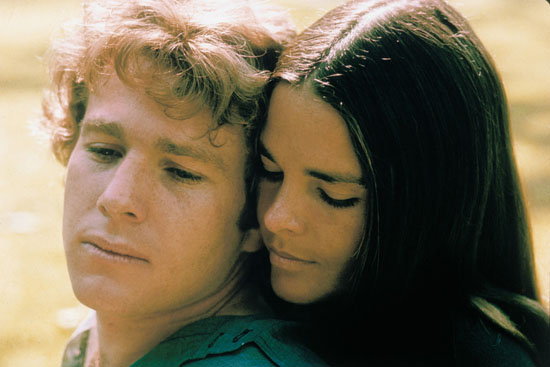
Watching Love Story today is like opening a time capsule you didn’t know had been buried. The movie is at times shocking, not because it’s bad (it’s actually surprisingly good), but because it is a movie unaware of the time and place where it is set. Erich Segal’s screenplay and novel (he wrote the script before the book) are shrewd mixes of innocence and shameless manipulation. The movie is devoid of all the hot-button topics of 1970: political orientation, the Vietnam War, drugs, the burgeoning awareness of the environment, civil rights, equal rights for women, rock & roll. (When poor working-class Catholic girl Jenny tells wealthy WASP Oliver that she loves the Beatles, you get the feeling she’s more of a Rubber Soul fan than The White Album.) By removing anything that could be remotely perceived as “controversial,” the filmmakers ensure a direct connection between the audience and the film. The universal blandness of the story allows us to project our own memories and feelings onto the characters. Love Story is calculated with a vengeance to get an emotional reaction out of the viewer. And I’ll be damned if it doesn’t still work.

(The one concession to contemporary audiences at the time is the rather touching use of profanity. Words like “bullshit” and “bitch” are tossed into the middle of sentences almost at random. Similar to when sound was first introduced, filmmakers were finding their way when it came to the new freedom of modern language. It is said that President Nixon liked the movie except for all the cursing. You can’t please everyone.) As you watch the following scene, notice the language as well as the syntax in this scene:

The story of Love Story is so simple it’s almost primal. It chronicles the romance between fourth generation rich Harvard kid Oliver Barrett IV (Ryan O’Neal) and poor Radcliffe girl Jennifer Cavalleri (Ali MacGraw). There are no major obstacles preventing them from being together. Oliver isn’t tempted by some sexy hippie chick. Jenny doesn’t have an affair with some long-haired campus radical. When Oliver’s humorless father cuts him off from any financial assistance for marrying “that girl,” they take their destitution in stride. Then, after Oliver graduates Harvard Law School and becomes a successful New York lawyer, they attempt to start a family. When they can’t conceive it is discovered that Jenny is ill. Jenny’s death turns a storybook romance into a tragedy.

1970 saw American movies responding to the radically changing times. Just look at the list of movies released that year: Woodstock, Five Easy Pieces, M*A*S*H, Catch-22, Gimme Shelter, Tropic of Cancer, Zabriskie Point, The Revolutionary, Alex in Wonderland, R.P.M., Hi, Mom!, Brewster McCloud. Hell, even Patton, the winner for Best Picture, was embraced by the counterculture as it turned the ultimate hawk into a rebel. Like Airport, (the other runaway hit of that year), Love Story was like a shelter from the storm. It provided a release for audiences growing more and more uncertain of the world around them. And like Airport (which kicked off the trend of disaster movies), Love Story more or less became ground zero for what is derisively referred to in some circles as the “chick flick.” Everything from An Officer and a Gentleman to Ghost to Titanic to The Notebook can be traced back to Love Story.

(I am in no way suggesting that Love Story is on par with any of those movies. It’s more on the level of The Notebook than Ghost or Titanic.)

nullSo why was Love Story such a hit? That’s the mystery, isn’t it? The strength in Arthur Hiller’s direction is his knowing not to get in the way of the actors. He knows he’s working with very delicate material, and that if you push it you are likely to get bad laughs. (For some viewers the bad laughs were always there.) Hiller is one of those reliable journeyman directors who knows how to get you what you want. He knows how to bring movies on time and on budget. In other words, he has no real distinctive style. That’s crucial for a movie like Love Story. Both Ryan O’Neal and Ali MacGraw are onscreen almost constantly. We must believe they are drawn to each other from frame one. We do. The dialogue and plot developments are secondary to how they look and relate to one another as both actors and their characters. Hiller does do a smart thing that is key to the movie’s success; whenever possible, he places O’Neal and MacGraw in real locations. Scenes of Oliver and Jenny walking and courting are given real immediacy when we can see activity swirling around them. Hiller indulges in what Roger Ebert at the time termed the Semi-Obligatory Lyrical Interlude. That’s when the movie stops and shows two characters walking together as a song plays on the soundtrack. By 1970 this had gone from novelty to standard to cliché. There are at least three such sequences in Love Story (the best being the one where Oliver and Jenny are goofing around in the snow). The musical score by Francis Lai is purposely ladled over the movie. Its swooning piano theme is appropriately romantic and mournful. (Since Jenny is studying classical music the score has a reason for being so formal. You do wonder though, if she’s a Beatles fan, does that mean Oliver is a Stones fan?) Watch Oliver and Jenny goof around in the snow:

(Note: By the time its sequel, Oliver's Story, was released in 1978, Watergate, the fall of Saigon, Star Wars, disco, and punk had occured. Audiences no longer cared if Oliver was still in mourning. They had their own problems.]

The performances by MacGraw and O’Neal are a case study of different energy levels matching up beautifully. At the time MacGraw had major heat coming off of Goodbye, Columbus. Her dark-haired attractiveness was in at the time. I admit she doesn’t do much for me. Compared to other actresses at the time like Faye Dunaway, Ann-Margret or Jane Fonda, there isn’t much mystery when it comes to MacGraw. What you see is what you get. She lacks the vulnerability, strength, and potential madness that marks all great actresses. And the staccato chirpiness of her line readings can be at times quite grating. Then, she’ll make subtle adjustments in her performance that makes it difficult to dismiss her. Her scenes with John Marley as her very understanding father show that Jenny doesn’t act the same way with everyone. (Marley, who is probably best known for playing the ruthless Hollywood producer Jack Waltz in The Godfather, is quite winning, especially in his final scene with O’Neal. I admit I kept expecting Marley to turn to O’Neal at any moment and say, “Well, let me tell you something, my Kraut-Mick friend.”) The way MacGraw says the word “preppy” has just the slightest hint of playfulness that you wonder if Oliver ever realizes that she’s mocking him. For me, MacGraw’s best moment is toward the end when she and Oliver are sitting together after he’s ice-skated for her. She asks if they have money to get a cab. He says, “Sure, where do you want to go?” Jenny’s two-word response is the most heartbreaking moment in the movie.

nullThe success of MacGraw’s performance is due in no small part to O’Neal’s forceful acting style. Like Redford, O’Neal was also burdened with being extraordinarily good-looking. Both men spent a good part of their careers having to overcome their beautiful exteriors in order to be taken seriously as actors. Redford used his looks to deconstruct the myth of the entitled WASP male. O’Neal used his looks as a way to disarm those around him. It allowed him to play con men, cads, jerks. He both embraced and resented the fact that being good-looking enabled him to get almost anything he wanted. (It was genius on Kubrick’s part to cast him in Barry Lyndon.) There is a constant seething anger in O’Neal’s acting that charges even the most routine scenes with the possibility of violence. There’s a startling moment when he gets mad at Jenny and tells her to stay out of his life. For a moment you’re genuinely scared for her safety. (It is this scene that leads to the moment where Jenny utters the immortal line, “Love means never having to say you’re sorry.”) O’Neal’s scenes with Ray Milland as his stern father are filled with tension as both father and son are constantly unable to make any kind of connection. (I’m sure at the time the Milland character was hissed at by young viewers rebelling against their out-of-touch parents. Seen today, Milland is very good at suggesting a man who comes from a generation not accustomed to expressing emotions. His final scene with O’Neal is a little jewel of understated acting.) The final scene between O’Neal and MacGraw is deservedly famous. Both actors display such genuine love and affection toward one another that we not only feel Oliver’s loss, but Jenny’s too.

What can you say about 42 year old movie that became apart of the zeitgeist? That it is synthetic, shameless and corny even by the standards of the time it was made. That if actors believe in their
characters you’re capable of believing anything. And that it still works.

San Antonio-based film critic Aaron Aradillas is a contributor to The House Next Door, a contributor to Moving Image Source, and the host of “Back at Midnight,” an Internet radio program about film and television.

‘SHOULD WIN’ VIDEO ESSAY SERIES: Best Documentary, UNDEFEATED

‘SHOULD WIN’ VIDEO ESSAY SERIES: Best Documentary, UNDEFEATED

[EDITOR'S NOTE: Press Play presents "Should Win," a series of video essays advocating winners in seven Academy Awards categories: supporting actor and actress, best actor and actress, best director and best picture. These are consensus choices hashed out by a pool of Press Play contributors. Follow along HERE as Press Play decides the rest of the major categories including Best Picture, Best Director, Best Actor, Best Actress, Best Supporting ActressBest Supporting ActorImportant notice: Press Play is aware that our videos can not be played on Apple mobile devices. We are, therefore, making this and every video in this series available on Vimeo for these Press Play readers. If you own an Apple mobile device, click here.]

Narration:

The Academy Awards are kind of funny when you think about it; the Academy sure does have a tendency to honor films that gloss over bigger societal problems or films that seem to fit the bill of accessible historical relevancy. Which is probably why the Best Documentary category is always of particular interest to true cinephiles.

Documentaries are as close to pure cinema as we have yet to get to. They tell our stories. The stories of those we don't know. They have the capability of breaking the fourth wall without winking at the audience. And sometimes they can make our chests swell with that uncommon feeling of humility. From the trials and tribulations of a radical environmental group in If A Tree Falls: A Story of the Earth Liberation Front to the long gestating murder trial of the West Memphis Three in Paradise Lost 3: Purgatory, audiences in 2011 had plenty of riveting non-fiction content to choose from. And although the Academy "has" to go with big topic documentaries as the night's big winner, I can't help but feel shorted on what the Academy could've inspired by honoring more innovative and, for lack of a better word, "timeless" content.

For example, Hell and Back Again stretches the cinematic canvas of a documentary and adds greater heft to an almost decade long war in the Middle East. On the other hand, Pina merged Wim Wenders' flair for transcendent storytelling with groundbreaking 3D technology.

nullYet, the most striking of this year's nominees is the underdog sports film Undefeated. Following what at first seems to be a hopeless season with the Manassas High School varsity football team in Memphis, Tennessee; Undefeated emerges as one of the more impressive examples of cinema verite, otherwise known as "direct cinema." Nearly every shot is handheld; in fact much of the film seems to be unfurling in real time, in front of our very eyes. The camera is free flowing and reacts to the reality of every situation. Like other great examples of direct cinema, from Don't Look Back to the thematically similar Hoop Dreams, Undefeated breathes with an immediacy that is void of headline political agenda, broad-stroke narrative fallacies and any sort of forced sentiment. This is observant, go-for-the-throat filmmaking.

The late, great direct cinema pioneer Richard Leacock once explained this style of filmmaking. Leacock said: "We had a whole bunch of rules. We were shooting handheld, no tripods, no lights, no questions…never ask anybody to do anything." And Undefeated does a tremendous job of not asking its subjects what they're feeling. It simply observes and watches the game of life unravel both on and off the field. It is the documentary-feature that SHOULD WIN the Oscar.

Nelson Carvajal is an independent digital filmmaker, writer and content creator based out of Chicago, Illinois. His digital short films usually contain appropriated content and have screened at such venues as the London Underground Film Festival. Carvajal runs a blog called FREE CINEMA NOW which boasts the tagline: "Liberating Independent Film And Video From A Prehistoric Value System."

OSCARS DEATH RACE: Surveying the race for Best Documentary

OSCARS DEATH RACE: Surveying the race for Best Documentary

null

[EDITOR'S NOTE: Sarah D. Bunting of Tomatonation.com is watching every single film nominated for an Oscar before the Academy Awards Ceremony on February 26, 2012. She is calling this journey her Oscars Death Race. She has completed the category for Best Documentary and now surveys the competition. For more on how the Oscars Death Race began, click here. And you can follow Sarah through this quixotic journey here.]

nullAh, Best Doc — where the short list gets the finger-pointing and pearl-clutching underway early. I like to imagine Steve James watching the Oscars at home with a bottle of Goldschlager and a Krazy Straw, wearing PJs with basketballs on them, because as you probably heard, he didn't get nominated. (Again.) Let's look at what did.
The nominees

Hell and Back Again: Compelling traditional-structure doc with a likeable subject whose sound-editing tricksiness could work either for or against it. Topicality of subject matter may give it a slight edge.

If a Tree Falls: A Story of the Earth Liberation Front: Also compelling and topical, also straight-ahead in structure; very well done and informative

Paradise Lost 3: Purgatory: I think very highly of the filmmakers' previous two works on the subject of the West Memphis 3, whose release I supported. Attending a New York premiere of the film with the WM3 present was a thrill. With that said, the film qua film is rushed and collage-y, and I'm not sure viewers not familiar with the case and/or the other films would get much from it. The ending changed on the filmmakers, and they did well with that circumstance, but in theory, the Oscar rewards the best in the category, not the happiest ending. In practice…this probably wins.

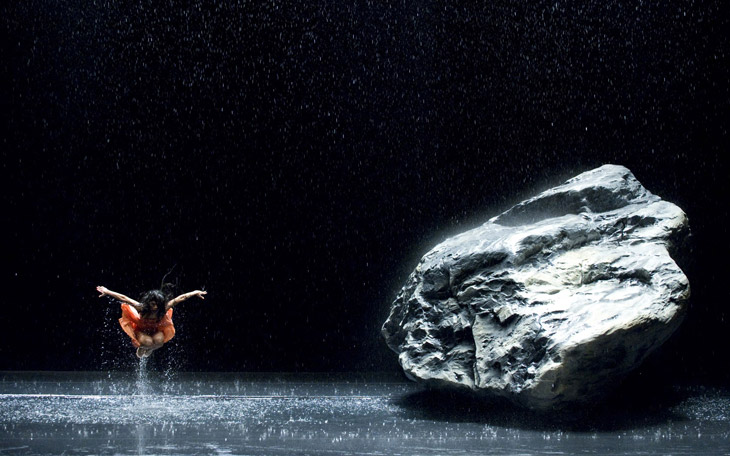
Pina: …Unless this wins. I think it's between PL3 and Pina; the latter has the edge in its use of technology, and it pushes the form harder. It may also push the audience…into a nap? It won me over, but this may not be a film Academy voters will force themselves to see.

Undefeated: Entertaining enough for an hour and a half, and another charismatic subject, but may seem somewhat familiar or not "issues-y" enough to voters.

Who shouldn't be here: May not be the right question. It's more of an apples-and-oranges issue, and we have three apples (the more traditional docs) and an orange (a doc that's more of a recap, tied to a news event) and…a kiwi, in a way (dance experiment/elegy), so it's not that the apples in question don't rate; it's which fruit the Academy is in the mood for. See below.

Who should be here, but isn't: Like the apples metaphor? …Too bad, we're stuck with it. So: as apples go, I think The Interrupters (airing this week on Frontline, I believe) and Project Nim are a little tastier than Undefeated. Conan O'Brien Can't Stop did some interesting things, in spite of pacing issues and O'Brien presenting as rather off-putting.

Who should win: Pina.

Who will win: The WM3 is a tough arc to resist, but I'm calling it for Wenders and Ringel.

Sarah D. Bunting co-founded Television Without Pity.com, and has written for Seventeen, New York Magazine, MSNBC.com, Salon, Yahoo!, and others. She's the chief cook and bottle-washer at TomatoNation.comFor more on how the Oscars Death Race began, click here.

OSCARS DEATH RACE: Pina

OSCARS DEATH RACE: Pina

null

[EDITOR'S NOTE: Fearless Sarah D. Bunting of Tomatonation.com is making it her mission to watch every single film nominated for an Oscar before the Academy Awards Ceremony on February 26, 2012. She is calling this journey her Oscars Death Race. For more on how the Oscars Death Race began, click here. And you can follow Sarah through this quixotic journey here.]

Pina made me impatient for at least an hour. A small part of it is seeing the film at BAM, where arriving at the specified showtime is considered entirely optional and in fact rather bourgeois, but whispering knowingly throughout the film is considered mandatory. A much larger part of it is the medium of dance; I respect it, and especially its physical demands, but it's…not my way, I guess. My response to "some situations have no words" is not "express the situation via the body." It's "get a thesaurus and try again."

nullAnd another large part of it is co-director Wim Wenders, who, in my experience, is more than happy to wait out the whiny-squirmy "get to the point, just tell me what's important, this is boring" viewer — which is my way — and let the images and moments accumulate. You don't so much get to the point as realize that it's surrounded you since the beginning. I don't know Wenders's work all that well, actually; this is just my impression, and it's certainly the case with Pina, a 3D documentary that's a dance concert movie, and an experiment with re-setting dance out into the world, and a working-through of loss by a dance company whose forceful and incisive leader has died. (Pina is Pina Bausch, artistic director of Tanztheater Wuppertal Pina Bausch; she passed away just days before principal shooting was to begin.)

The decision to shoot in 3D is understandable, but I don't know that it's necessary to the film's power. Some of the choreography is, in my opinion, overly obvious and earnest, and the grand plié denoting childbirth or the "I am floppy with grief" sequences aren't any fresher for seeming to happen in your lap. But the depth of field in the staging brings out a lot of cool visuals: dancers flashing through the foreground, water spinning outwards, men appearing as if from nowhere or out of a giant rock.

Still, the recurring themes of compulsion, inspection, the rearranging of the self don't require the eyes in order to have their effect. The pain and joy of the reverent interstitials, then reflected in dances on trams and in intersections and along hilltops, don't require glasses. The moment where a man curls up, sad, relieved, drained, at rest, on a woman's flat back as she walks is the moment where I realized I'd been there all along.

Absolutely not for everyone, Pina, but it's one of those movies I thank the Death Race for each year because it's knocked me a couple degrees to one side.

Sarah D. Bunting co-founded Television Without Pity.com, and has written for Seventeen, New York Magazine, MSNBC.com, Salon, Yahoo!, and others. She's the chief cook and bottle-washer at TomatoNation.comFor more on how the Oscars Death Race began, click here.

OSCARS DEATH RACE: THE MUPPETS

OSCARS DEATH RACE: THE MUPPETS

null

[EDITOR'S NOTE: Fearless Sarah D. Bunting of Tomatonation.com is making it her mission to watch every single film nominated for an Oscar before the Academy Awards Ceremony on February 26, 2012. She is calling this journey her Oscars Death Race. For more on how the Oscars Death Race began, click here. And you can follow Sarah through this quixotic journey here.]

I loved the Muppets as a kid — The Muppet Show is one of the few programs my parents' ambitious first-child rules about TV would allow — and I remember them fondly. But I had misgivings about The Muppets going in, for two reasons. The first is that, while I like Jason Segel, he works better for me as a seasoning and not the main course.

nullThe second reason, which I admit knowing full well that this is the internet equivalent of climbing Wolf Mountain wearing a steak suit, is that I don't like Miss Piggy, at all. I never did. The "hiiiii-YA!", the "moi," the Scarlett-O'Hara-class come-here-go-away nonsense with Kermit: no thanks. If it was always intended as a meta commentary on high-strung actresses or something, well, my bad, but I don't care for it.

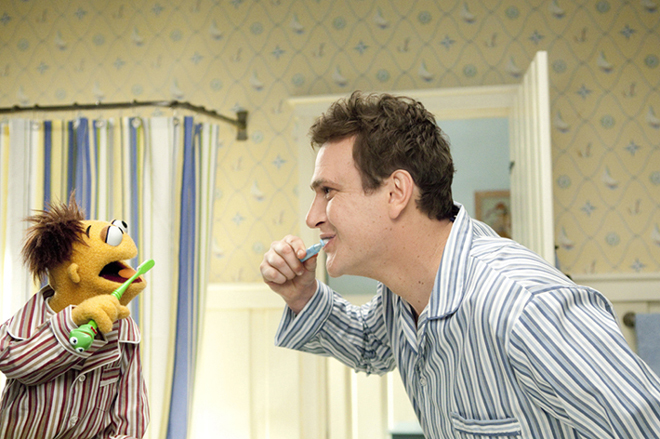
I didn't care for The Muppets either, and Miss Piggy is kind of a bitch in it but it isn't her fault (or Segel's; he fully commits to Gary and his various soppy subplots). It's the storyline about Walter, Gary's Muppet brother and world's biggest Muppets fan, finding his place in the world and believing in himself and whatnot — a perfectly functional concept whose execution here is problematic. Again, Gary (a human) and Walter (a Muppet) grew up together. Gary is apparently around 30, which would put Walter in his late 20s, probably, and yes, it's a kids' movie, but what's up with their still sharing a twin-beds Bert-and-Ernie domicile? If that's the house they grew up in, what became of their parents? This isn't even getting into the arrested-development issues Gary's having: son, you don't keep a girlfriend played by Amy Adams waiting ten years for a ring. She teaches a car-repair class, in a circle skirt and pumps! Also, she's Amy Adams. I know that's the point, but the problem here…is that it's Amy Adams. (She's charming in the film, in spite of the "it's me or the dog" bit she has to play.)

And then you find yourself troubled with all these larger existential questions about Muppet aging — they split up how long ago? Which makes them how old now? Are they…old old? The Eighties-Robot gag is okay (I enjoyed visiting with vintage soda-can fonts), but then you can't stop wondering how we're meant to understand "Muppet years" and whether they can die or they just get unstuffed or what.

And then you down a half-inch of bourbon and wander back to your point, and here it is: the movie treats Walter like he's still a child. That doesn't really line up timing-wise, and Walter is just kind of a wet end in the second place. It's great that he finds his people (well, "people"), and he's a hell of a whistler, but that subplot draaaaags. The main plot, in which the Muppets must reunite to save their theater from an evil land developer (Chris Cooper, who tries heroically, but I hope he fired his agent after he had to rap), is also a foregone conclusion, but between the meta jokes from Waldorf and Statler about how they're announcing plot points; the Scandinavian diacritical marks on the Chef's subtitles; the Chiba-esque credits sequence for kidnapping Jack Black; and sundry cameos, that story is more spritely. The Walter stuff that felt shoehorned in for children/people unfamiliar with the franchise felt damp and simplistic.

The nominated song, "Man or Muppet," is why we're all here. It's not good, and not just because forces Walter to sing that he's "a very manly Muppet." Blech. Still, expect to see Mr. The Frog up at the podium on Oscar night.

Sarah D. Bunting co-founded Television Without Pity.com, and has written for Seventeen, New York Magazine, MSNBC.com, Salon, Yahoo!, and others. She's the chief cook and bottle-washer at TomatoNation.comFor more on how the Oscars Death Race began, click here.

OSCARS DEATH RACE: Anonymous

OSCARS DEATH RACE: Anonymous

null

[EDITOR'S NOTE: Fearless Sarah D. Bunting of Tomatonation.com is making it her mission to watch every single film nominated for an Oscar before the Academy Awards Ceremony on February 26, 2012. She is calling this journey her Oscars Death Race. For more on how the Oscars Death Race began, click here. And you can follow Sarah through this quixotic journey here.]

I'd rather have seen a Noises Off-style story about what's going on backstage at the modern-day framing-device production that opens Anonymous — actors rushing to their places; the stage manager lighting torches with one of those little lighters chefs use to fire a crème brulee — than the film I got. Of course, I'd rather have seen a root canal than what I got; I recoiled physically from the trailer all "ohhhh no no no no no," because if a buddy/heist movie is Buntnip, a costume drama concerning Shakespeare and the dirty-haired era in which he worked is…whatever the opposite of that is. Red Byptonite?

nullDoesn't matter. A costume drama/conspiracy pic that attempts to argue for historical William Shakespeare (the enthusiastic Rafe Spalls) as an illiterate creeper, whom the Earl of Oxford (Rhys Ifans, one of the only compelling things in the film) uses as a writing beard via some pimping help from Ben Jonson (Sebastian Armesto, one of the…things in the film), is just not for me — at least, not one that takes itself and its theory this seriously. One scene in particular came to illustrate this problem: the young Earl of Oxford (Jamie Campbell Bower) has just boned Queen Elizabeth (Joely Richardson in the flashbacks). He offends her somehow, so she squalls at him to get out, but undaunted and barely clothed in a dingy damask something-or-other, he starts sonneting at her, and she's so ensorcelled that he's getting a beej by the closing quatrain. And…look, real talk? This is why a lot of dudes start writing poetry to begin with — God knows it ain't the big bucks — and often enough, it works. Fine. Just play it that way and make the joke, instead of positioning the moment, and all the others, as a portentous slo-mo high-five between political stagecraft and the literal version. That's the issue with Anonymous. It's not that the subject isn't my thing, or that the Shakespearean quotations selected aren't imaginative, or that some of the players aren't quite up to their tasks, although those things don't help. It's that Roland Emmerich is known for, and fairly good at, ripping yarns, and he unwisely treats Anonymous like a middle-school educational-theater field trip. And that's exactly how it feels.

…Most of the time. Whenever Xavier Samuel is onscreen, it feels like a time machine back to Jersey in the '80s. "The Earl of Southampton"? Try "the Earl of South Amboy" — I haven't seen a perm that crunchy since Hunka Bunka.

The film isn't awful. Ifans is great, and the movie seems to grab its gears better whenever he's onscreen; the stunt-casting of Richardson as the younger QE and Vanessa Redgrave as the older version actually works, although Richardson is often backed by the script into corners she has to screech her way out of. (The "shocking" plot twist in the third act is probably given to Ifans to play for a reason, and he's fantastic in the scene even though the twist itself is risible.) But it's often dull, and too dour for its own good.

The nomination is for Best Costumes, and while I will give extra credit for Robert Cecil's specialty breastplate that is fitted for his spinal disability, I will take the points back again just as quickly for the Bon Jovi extensions on Samuel.

Sarah D. Bunting co-founded Television Without Pity.com, and has written for Seventeen, New York Magazine, MSNBC.com, Salon, Yahoo!, and others. She's the chief cook and bottle-washer at TomatoNation.comFor more on how the Oscars Death Race began, click here.

FESTIVALS: Berlinale Decision Points Pt. 2 – Paul Dano, Zellner Brothers and the first great film of the festival

FESTIVALS: Berlinale Decision Points Pt. 2 – Paul Dano, Zellner Brothers and the first great film of the festival

null

Part two of my Berlinale coverage, focusing on decision points: the moment when I pretty much made up my mind about a film, and how that moment reflects on the film as a whole, capped by my Indiewire grade. Read Part One

Our Homeland (Yang Yonghi) For the most part this drama about a repatriated North Korean returning to his family in Japan is given a solemn, safe treatment. Things liven up when the man visits his childhood friend who’s come way out of the closet. Made by an accomplished documentarian making her fiction debut, the script feels saddled by a need to dispense documentary facts about Japan-North Korean relations, but the gay friend takes his expository function(“I’m gay and ethnic Korean, a double minority!”) and sells it like he’s making his Broadway debut. His exuberant presence catalyzes the entire ensemble, transforming them from societal representatives to flesh-and-blood characters. B-

Kid-Thing (David Zellner) Basically a candy-colored Texas version of Bresson’s Mouchette that kind of goes nowhere, but there’s no denying the ferocity of vision in some moments, especially the most disgusting ones: a reprobate girl crushes an inchworm with her bare hands; close ups of cow dung and a cattle carcass being pulverized with paint gun pellets, the screen exploding with brown and orange. There’s a lot of untamed energy in this film. B-

The Woman in the Septic Tank (Marlon N. Rivera) So many good moments in this South Park-esque satire of two young Filipino filmmakers trying to break into the film festival circuit with the ultimate third world festival movie, about a suffering slum mother forced to sell her son to a pedophile. There’s the raucous casting debate between three actresses as the lead, creating three simulated scenarios for the outcome; and Eugene Domingo running away with the show as a seasoned diva breathlessly breaking down all the DIY filmmaker bullshit into Sundance-ready formulas. But my favorite has to be when the production assistant imagines the project as a Hollywood musical, with Manila slumdogs breakdancing to lyrics like “we are burping our souls,” and a tender serenade by the pedophile to his victim. As the filmmakers say while high-fiving themselves, “Forget Cannes, we are going to the Kodak Theater!!!” B+

Caesar Must Die (Paolo and Vittorio Taviani) Julius Caesar performed by Italian inmates in a prison, moving freely (if sketchily) between straight performance of the play to actors breaking character talking about how the story relates to their lives. The movie never fully explores that interplay, leaving us with teasing moments like when an actor insinuates that another’s impeccable performance as a traitor reveals his true nature. They threaten to come to blows, and then abruptly the scene ends. But despite the shuttling, half-finished quality of it all, there is tremendous care taken to the textured black and white images and a consummate sense of staging. B-

Barbara (Christian Petzold) Barbara, a East German doctor stuck in a countryside hospital and secretly planning to escape to the West, while fending off her supervisor who has an obvious yen for her. With compelling matter-of-factness, he tells her the story of how he wound up in the boondocks: a tragedy involving a state-of-the-art baby incubator, a nurse with a crush, and a two infants blinded for life. Barbara’s response: “Is your story true?” She can’t be bothered to care about or trust the people she’s trying to escape from. But too late: her doctorly concern and shared sense of personal setback expose her weak points, camaraderie has wormed its way in. All of this is conveyed through the subtlest nuances in looks and timing. Masterful stuff. A-

Parabeton – Pier Luigi Nervi and Roman Concrete (Heinz Emigholz) In theory I get the connection between Emigholz’ amazingly dynamic 70s work and what he’s doing now with his static shot documentaries of architecture, where motion and energy are conveyed simply by the geometries of buildings. And I do like the haunted house approach to his filming buildings devoid of people, so that the focus is more on a sense of natural decay affecting the utopian lines and surfaces of modern concrete. Still, it’s hard to shake the feeling that you’re just watching shots of buildings, especially when it’s hard to discern a logical flow from one building shot to another. C

For Ellen (So Yong Kim) As a fan of Kim’s In Between Days and Treeless Mountain as well as Paul Dano’s mutant-like weirdness, I really wanted to like this one. But something is terribly missing at the center of this minimalist study of a rock star trying to retain his wife and daughter. For me the dealbreaker came when father and daughter finally sit down to their first conversation, a painfully drawn out series of banalities. Dano is usually great at being game for anything, but here it seems he’s called upon to synthesize moments for So’s characteristically docu-realist camera to capture, and his zombie-like character is so submerged inside his own inarticulacy that there’s hardly a ripple on the surface. The dreamy, shoegaze camerawork, so expressively precise in past So films, here merely compounds the obfuscation. C-

Kevin B. Lee is Editor in Chief of Press Play, and contributor to RogerEbert.com and Fandor. Follow him on Twitter.

VIDEO ESSAY: Paradise Lost in Ursula Meier’s HOME

VIDEO ESSAY: Paradise Lost in Ursula Meier’s HOME

null

This year's 2012 Berlin Film Festival Golden Bear competition includes Sister starring Lea Seydoux and Gillian Anderson, which is the second feature by Ursula Meier, one of the most exciting women directors working today. This video essay focuses on her first feature, Home, and is based on an insightful review written by Fernando F. Croce for Slant Magazine. Watching this video of Home and reading the Berlinale program description of Sister, several similarities emerge: Both are set in remote but idyllic locations and feature strong female leads contending with strange family dynamics. It seems that with only two features, Meier has established a distinctive voice.

VIDEO ESSAY: PARADISE LOST: Ursula Meier's HOME from Fandor Keyframe on Vimeo.

Originally published at Fandor.

Fernando F. Croce is a film critic who writes for Slant, MUBI, Reverse Shot and other sites. His own website is Cinepassion.

Kevin B. Lee is Editor in Chief of Press Play, and contributor to RogerEbert.com and Fandor. Follow him on Twitter.

FESTIVALS: Berlinale Decision Points Pt. 1: Herzog on DEATH ROW and Lesbian Marie Antoinette

FESTIVALS: Berlinale Decision Points Pt. 1: Herzog on DEATH ROW and Lesbian Marie Antoinette

nullAt what point do you make your mind up about a movie? It's an especially pressing question at a festival like Berlinale, where you can watch as many as seven or eight films a day. There’s a risk of just letting these films wash over you and, to borrow a French phrase, “fall from your eyes,” so that you leave the theater with just a vague impression of what you’ve seen and few specifics to say. To fight this I’ve decided to shape my Berlinale coverage around decision points: the moment where I pretty much made up my mind about a film, and how that moment reflects on the film as a whole, capped by my Indiewire grade:
Death Row (Werner Herzog) Towards the end of this three hour made-for-TV series on American murder convicts awaiting execution, Herzog has a contentious exchange with a Texas DA over a female inmate fighting for a retrial whom he's been interviewing. The DA, after making a heart-stirring plea on behalf of the victims of the case, warns Herzog about the risk of humanizing the killer in his mind by talking with her. Herzog replies, "I do not attempt to humanize her. She is already simply a human being." It's a startlingly direct statement of authorial intent that vindicates the presence of Herzog's voiceover that dominates the show. Unapologetically he asserts a clear-eyed personal sense of decency amidst an absurdly callous and punitive justice system. Someone should get him to replace Judge Judy. B+

Farewell My Queen (Benoit Jacquot) You would think a lesbian scene with Diane Kruger and Virginie Ledoyen would be something to celebrate; instead it's emblematic of what's off in this new wave costume drama. Kruger's Marie Antoinette bids adieu to her courtesan as the storm clouds of revolution approach the royal court. Kruger spouts teary platitudes of love while (Ledoyen hardly says anything, both are practically mummified in heaps of fancy dress, reducing them to decorative ornaments in their own key scene. Jacquot is a great director of in the moment cinema but his handheld camera feels wrong for a period piece, buzzing like a mosquito trapped in the grand halls of Versailles. The Paul Greengrass editing further diffuses the focus turning it into Marie Antoinette meets 24. C-

Formentera (Ann-Kristin Reyels) A remarkable middle sequence turns a late night swimming frolic involving a married couple into an eloquent dramatization of their discord, unfolding into extended sheer terror and humiliation for the wife when she's left stranded in the water. Nothing that follows matches the wordless power of that sequence, certainly not the climactic argument between the couple, featuring such accomplished dialogue as "Our life in Berlin really fucks me up." "I like our life in Berlin."   B- 

Nuclear Nation (Atsushi Funahashi) About midway in this documentary about the impact of the Fukashima nuclear disaster on the nearby city of Futaba, we encounter a cattle farmer tending to his herd, all of them contaminated and unable to be sold. The farmer, himself exposed to radiation, insists on feeding them – they wander freely through the nuclear ghost town, themselves ghosts, with no function to serve the society that abandoned them. It's the first truly immersive moment in the film, one that allows us to serve as committed witnesses to this devasting tragedy. B

The Delay (Rodrigo Pla) A weary single mother of three decides to abandon her senile father in an apartment complex, then later changes heart and seeks to retrieve for him. She spends a long cold night searching through every homeless shelter in town while her dad freezes in the apartment courtyard, remembering her command not to go anywhere so that she doesn't lose him. Several scenes later lady gets the bright idea to back to the place where she left him in order to find him, and we get the idea that the screenwriter has been stalling to milk the melodrama. Even the accomplished narrow focus camerawork can only do so much to elevate the shallow narrative. C+

Kevin B. Lee is Editor in Chief of Press Play, and contributor to RogerEbert.com and Fandor. Follow him on Twitter.

‘SHOULD WIN’ VIDEO ESSAY SERIES: Best Director Martin Scorsese, HUGO

‘SHOULD WIN’ VIDEO ESSAY SERIES: Best Director Martin Scorsese, HUGO

[EDITOR'S NOTE: Press Play presents "Should Win," a series of video essays advocating winners in seven Academy Awards categories: supporting actor and actress, best actor and actress, best director and best picture. These are consensus choices hashed out by a pool of Press Play contributors. Follow along HERE as Press Play decides the major categories including Best Picture, Best Actor, Best Actress, Best Supporting ActressBest Supporting Actor and Best Documentary.  Important notice: Press Play is aware that our videos can not be played on Apple mobile devices. We are, therefore, making this and every video in this series available on Vimeo for these Press Play readers. If you own an Apple mobile device, click here.]

Narration:

This year's Oscar race for Best Director features an especially strong roster. The five nominees are Woody Allen for Midnight in Paris, Michel Hazanavicius for The Artist, Terrence Malick for The Tree of Life, Alexander Payne for The Descendants and Martin Scorsese for Hugo. Four of them did magnificent work this year, one of them less so, but in the end there will only be one winner.

nullWoody Allen's Midnight in Paris is not a love letter to nostalgia or a trite piece of idol worship. Instead, it's a mature artist realizing his own folly. It's a melancholy film, yet Allen's direction is full of hope, with the final choice of the hero underlining the pointlessness of living in the past and the necessity of having to trudge on. Michel Hazanavicius' supreme achievement in The Artist is making people talk about the silent era again and argue about whether the film accurately represents it. Terrence Malick's canvas is as wide as they come in The Tree of Life, where he explores life, death, the universe and everything in a spasmodic stream-of-consciousness narrative. He finds the personal in the expansive. The theme of loss permeates the film. Malick arranges the beautiful movements with grandeur. The Descendants is perhaps Alexander Payne's most conventional movie to date. Loss, once again, is prominent in this family drama deftly directed by Payne with a loving eye for the minute details in the grand scheme of life.

But this year's Academy Award for Best Director should go to the master, Martin Scorsese. In Hugo, Scorsese shares with the audience his eternal love of movies through a magnificent palate of colors and exuberant motion made all the more fantastic by an exemplary use of 3D. But despite the added dimension, Hugo is the rare 3D film that works without it; the opening title sequence alone is a marvel of direction. Scorsese also displays a knack for physical comedy that one wouldn't have expected. Generally, though, Scorsese's direction manages to put a sense of wonder front and center. His love of films and filmmaking may be the hidden true subject of every film he has ever made. In a strange way, Hugo might be Scorsese's most personal film to date.

Kevin B. Lee is editor in chief of Press Play. Ali Arikan is the chief film critic of Dipnot TV, a Turkish news portal and iPad magazine, and one of Roger Ebert’s Far-Flung Correspondents. Ali is also a regular contributor to The House Next Door, Slant Magazine’s official blog.