VIDEO ESSAY: Love Against Irony in Maren Ade’s EVERYONE ELSE

VIDEO ESSAY: Love Against Irony in Maren Ade’s EVERYONE ELSE

null

One of the most sublime and insightful romantic films in recent memory, Maren Ade’s Everyone Else won both Best Director and Actress awards at the 2009 Berlin Film Festival. This video looks at one of the film’s key love scenes, and explores how two people struggle to express their true feelings clouded by personal insecurities, which they cloak behind a wall of smart-ass ironic statements. In other words, it’s truly a film for our time.

Read full transcript and watch the film on Fandor.

Kevin B. Lee is Editor in Chief of Press Play, and contributor to RogerEbert.com and Fandor. Follow him on Twitter.

GREY MATTERS: LOST GIRL is goofy, sexy entertainment, in a BUFFY vein

GREY MATTERS: LOST GIRL is goofy, sexy entertainment, in a BUFFY vein

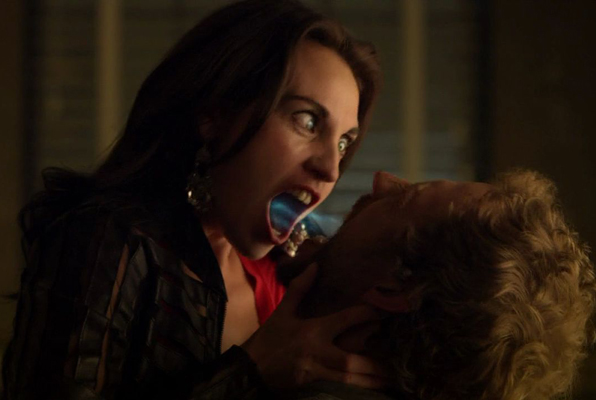
nullLost Girl is no big deal, and yet, for me, on sheer level of affection, it’s up there with the ludicrously better Luck, and I can barely wait for each episode to air. So WTF, right?

Looked at on paper (or screen) my affection becomes even more baffling. It’s yet another televisual offering where creatures of legend turn out to be true – see Grimm, Mirror, Mirror, Once Upon a Time, Red Riding Hood, Snow White and the Huntsman, etc. The production values and directorial style vary between modest and meh, and on first approach it at best achieves the amusement level of a third-tier Buffy episode.

And yet after a mere clutch of episode I can firmly say I simply adore it. I even think I’ve a notion why. I think creator Michelle Lovretta has made a list of every post-Buffy and fairy tale trope – and I mean every freaking one of them – and has methodically tweaked them just enough, not to radically change the entire urban fantasy, but to perhaps stretch the parameters of usual pleasures just enough to make aficionados feel real gratitude at the effort expended.

nullRight off, Lost Girl offers something that differentiates itself in a way that non-genre shows would be swell to emulate: a femme hero un-crushed by her backstory. While supernaturals from Buffy to Sookie to the entire cast of Once Upon a Time suffer their supernatural-ness, Lost Girl’s hero, the casually bi, trimly pumped, no-bullshit Bo (Anna Silk) accepts that she’s a deadly Fae.

A what? A Fae, a succubus who, through an accident of birth, occasionally sexy-sucks the life out of jerks. That is, until she hooks up with a hot Fae dude who lets her in on an epic backstory.

Warning: info dump! Seems that a war between the Light and Dark clans of Fae has been been going on for ages. And it turns out that Bo was raised by human parents while kept in the dark about this Fae business. So, she must choose between Light and Dark Fae, but being stout of heart and cranky of spirit, she tells them all to piss off and, like Fleetwood Mac suggested so long ago, goes her own way.

She does, however, avail herself of the Fae medicinals of the shy and lovely Dr. Lauren (Zoie Palmer), who you totally know will have supernatural sex with Bo, and who gives our hero a medication that allows her to just sort of nibble at people’s energy instead of draining them outright. (Hey, it’s that kind of show.) As it’s really early in the story’s arc, I will say no more, except to note that once-a-loner-Bo meets, pals up with and starts a PI agency with kohl-eyed Kenzi (Ksenia Solo), a goofy, post-goth petty thief human. Supernatural chemistry, kicky dialogue and Solo’s ceaselessly silly/energetic performance manage to make us buy into this beyond-absurd conceit, which comes complete with headless assassins, werewolves, underwater monsters, unearthly dwarves with agendas and so on.

Still, what’s the big? Again, the lack of hand-wringing mixed with the show’s overall light touch is constantly refreshing, as is both women’s advanced coping abilities.

nullSo, want to talk about sex? Yeah? Cool. There’s tons of it here, and in the show’s world, it’s no big, which makes sense when your hero is a being whose entire deal is sexual.

This is a show where the hero gets information from people by using her psychic abilities to get them so horny, they beg to spill (so to speak). Where, in that aforementioned Bo/scientist scene, lesbian sex-spark is a natural. Where Bo milks info from a cougar college administrator via a calf leg touch that causes the woman to practically orgasm the answers. Where another Fae literally tongue-kisses Bo back to health and to a few implied orgasms. It’s really something.

What Lost Girl isn’t is an HBO/Showtime/name-yer-basic-cable-channel-pandering-to-dudes boob parade. It is what comes after we accept as a given that gender orientation is, of course, an in-flux designation. So does that make the show feminist? Can’t say, it’s too early in its run. Certainly, Lost Girl is what comes after whatever it is we think of as “feminist” in TV action hero terms. While the show is usually having too much fun to attach itself to one congruous ideology, what it does have to say about self-determination manifests itself most often in the syntax of style.

Whereas Buffy once quipped that she was “not exactly quaking in my stylish yet affordable boots,” the girls and boys of Lost Girl look like they deal with the terrible economy with refreshing trips to retailers selling couture designers’ “diffusion lines.” Think of the iconic Missoni house creating a budget-conscious line for Target, Versace’s high style pretties for H&M at Nu Depression prices or Vera Wang dong the same at Kohl’s. Lost Girl’s constant engagement with fashion could be off-puttingly elitist but the whiff of the bargain makes it endearingly egalitarian. Instead of class resentment, we can enjoy the looks.

nullThere’s the sloe-eyed Fae werewolf (Kristen Holden-Ried) who’s partial to complexly rockin’ leather combos that suggest off-label John Varvatos; the mystery bartender named Trick (Rick Howland), whose way-butch, deep-dyed denim and rolled-sleeve style is off-season Diesel all the way; and the adorable, what-the-fuck-is-she-wearing Kenzi, whose loopy gothiness suggests Betsey Johnson after listening to My Chemical Romance a lot.

Again, just looking at these people is a tiny pleasure. I like to imagine them shopping (or in Kenzi’s case, liberating items from previous owners), which is just such an interesting way to craft a character, you know? And this isn’t about the evil tang of capitalism and over-consumption. Lost Girl loves style because fashion allows people with a unique way to beautifully present themselves to the world – and these are some pretty unique people.

As for where these stylish supernaturals hang, we see Lost Girl’s creators charming yet again with a rejection of the usual. Instead of True Blood’s “Fangtasia,” a sleaze dive straight out of a Rob Zombie lyric or an industrial metal light show hangout left over from an Underworld movie, the show’s creators offer us what looks like an airy German beer garden, heavy on the oak and steins.

But problems do exist with Lost Girl. The FX are pretty crappy, but I choose to think this as emblematic of the show having its priorities in the right place. The fact that Bo killed people before that blonde fixed up her sexual appetite is rather glossed over, but I’m trusting that we’ll be finessing that as episodes progress. And the one thing that does cause a certain amount of teeth gnashing for Bo is the least interesting part of the show for me: the whole “Who are my real parents?” thing. As played by Silk with a delicate mix of fuck-off, bite-me and muted need, Bo just doesn’t really seem the sort to need the crutch of a never-known bloodline.

But this too could be teased out and finessed; the show is called Lost Girl, after all. I’ll accentuate a positive view and say it will be a neat hat trick when the show lives up to the melancholy that lives right now in Bo’s startled responses; in Trick’s already exhausted helplessness regarding Dark/Light Fae hatreds; in the way the show plays with us with the simple fact that, unlike everyone else who is Fae and super-powered, Kenzi, the most instantly lovable character, is constantly in danger of a horrible instant death.

As of now, Lost Girl gracefully aims low-to-medium-high and always hits its mark. But I’ll be there watching as it inevitably aims higher. It’s the rare show you just have faith in.

Ian Grey has written, co-written or been a contributor to books on cinema, fine art, fashion, identity politics, music and tragedy. His column "Grey Matters" runs every week at Press Play. 

OSCARS DEATH RACE: WAR HORSE

OSCARS DEATH RACE: WAR HORSE

null[EDITOR'S NOTE: Fearless Sarah D. Bunting of Tomatonation.com is making it her mission to watch every single film nominated for an Oscar before the Academy Awards Ceremony on February 26, 2012. She is calling this journey her Oscars Death Race. For more on how the Oscars Death Race began, click here. And you can follow Sarah through this quixotic journey here.]

nullIn his review of War Horse for IFC.com, Matt Singer noted that "I did like one scene which is complete enough as its own unit of story and character that it could be pulled out of the film and played as its own short subject." The scene, of course, is the one in which said horse, Joey, makes a gallop for freedom but becomes hopelessly entangled in the barbed wire that separates the British and German lines. A soldier from each side comes out to aid Joey; for a moment, the Great War pauses to admit compassion — and Steven Spielberg pauses to work small.

I wish Spielberg had made a short subject, or even a trim feature, of that central moment, as it's free of everything that frustrated me about War Horse in its entirety: the insistent soundtrack that shoves us to and fro with plaintive piccolos and blatting-brass "hilarity"; the cartoonish attempts to show Joey (who is, after all, played…by a horse, and only expressive in certain ways) bonding with other horses and showing great heart and willing himself to escape and blah blah courage blah; the redundant exposition about Joey's many fine and remarkable qualities; the Saving Private Neighin' set pieces that strain to point up the horrors of war. The bit does contain continental characters speaking accented English instead of their native tongues, but that has a purpose here, at least, and isn't as Alcottsy and deadly dull as the Emilie sequence. (Or as poorly done. Top Secret! had better French accents.)

nullThe plot, in brief: Joey is bought at auction by drunk seldom-do-well Ted Narracott (Peter Mullan, too broad) to show up his rich landlord. Joey's not a plowhorse, he's a Thoroughbred, but Ted's son Albert (the promising Jeremy Irvine) bonds with Joey immediately, and swears he can break the colt to plow and get the rocky field tilled by the deadline. After this Rocky-of-the-shire moment, Joey is basically drafted into the British army — but by an officer who appreciates the special hoof-flake and promises Albert he'll get Joey home safe. Joey befriends another horse, Topthorne; escapes from various warlike tasks; gets caught in wire; and…cures the blind? Just go with it.
I rode horses as a girl, and worked as a stablehand in high school (the horse I had charge of was a goofy little blood bay named Indiana Jones, in fact) — I wanted to like War Horse, and I went into it prepared to write off the schmaltz and soaring strings that so often go with horse movies. But it's just too long, with too many breaks for Bazooka-Joe "humor" and sick-child moralizing. I gasped at the beauty of several of the shots or sequences, like the cavalry mounting up in the tall grass, and the expert editing of the cuts between the oncoming charge and the merciless gunners getting hurdled by riderless horses; that bit in particular would have gutted me in the fourth grade.

But this isn't the fourth grade; we know Spielberg can "do this." He does it here and he does it well, but the real accomplishment from the man at this point would be resisting the urge to hold our hands every minute, or setting himself the challenge of getting it in under 110 minutes on the first cut. Hell, re-cut this one — and boot that flatulent over-closed ending. I know many other reviews have mentioned the Gone with the Wind Technicolor skies, but: seriously! It's so over the top, you almost think he's joking! But it's Spielberg; he doesn't joke.

…Except in that barbed-wire sequence, which has a lightness to the banter, and gets at the message Spielberg is trying to send almost accidentally. The horror of war isn't always the barrage; sometimes it's the silences between, as in that scene with "enemies" working together and knowing the moment must end. The scene asks little of the horse except that he remain still, a symbol (which is how they work in our culture anyway, often), and subtracts the relationship with Albert, which starts out with a naïve sweetness but soon begins to seem rather weird. It doesn't show off. There isn't a cello. It's just a little story.

War Horse is handsome to look at; like Star Wars III, I'd have liked it more with my iPod in and some Handel playing. You want a real horse tearjerker, watch yourself some Phar Lap. You'll need IV fluids by the end.

This film's Oscar chances read to me as slim; the nominations may have been a gesture of respect, but it's not tapped for Best Director, so who knows. The score is diabetic and should not win; the cinematography could, and I would not hate that victory, but I wouldn't pick it.

Sarah D. Bunting co-founded Television Without Pity.com, and has written for Seventeen, New York Magazine, MSNBC.com, Salon, Yahoo!, and others. She's the chief cook and bottle-washer at TomatoNation.comFor more on how the Oscars Death Race began, click here.

OSCARS DEATH RACE: EXTREMELY LOUD AND INCREDIBLY CLOSE

OSCARS DEATH RACE: EXTREMELY LOUD AND INCREDIBLY CLOSE

null

Oskar Schell (Thomas Horn) lost his father, Thomas (Tom Hanks), on 9/11. About a year later, Oskar finds what he thinks is a message meant for himself in his father's closet: an envelope with the word "Black" written on it, and a key inside. Inspired by the memory of the myth-burnished scavenger hunts his father used to devise for him — both as a bonding agent between them and a way for Oskar to confront his phobias — Oskar decides that "Black" is the name of someone who knew Thomas, and sets out to find that someone. No matter that there are 472 of them in the New York City phone book, or that this won't change anything; he thinks it's what his father meant him to do.

nullIt's the type of Rube Goldberg plot I usually dig, and would have really dug at Oskar's age; at Oskar's age, I also cherished a number of compulsions and superstitions about deaths in the family and how they might be warded off or, after the fact, solved for X. Extremely Loud and Incredibly Close has the tools to become a movie I would love.

I did not love it. I did not love that the so-called revelation about Schell Sr.'s farewell answering-machine messages "revealed" nothing and hinged on an idiot plot — that Oskar's mother Linda (Sandra Bullock) wouldn't run straight to the machine, or check it after asking whether Thomas called, or notice that the answering machine had disappeared, is ridiculous. I did not love Horn's performance; it is a difficult role, I realize, but what is meant as realistic "spectrum behavior" seems mostly like an inexperienced actor tasked with a gamut of emotions and nuances he's not ready for. (His scenes with Viola Davis emphasize this.) I did not love the tics substituted for traits, or how the film idealizes Thomas to an unrelatable degree while really telling us nothing about him.

The film is a smug, twee gallery audio tour of a family's and a city's grief. Put on the headphones provided; proceed to the first image; listen to the facts we have selected for you. When you hear the ping, move to the next dot on the floor. At the conclusion of the tour, which will linger fetishistically on some things and rush past others that fail to resolve neatly, you will receive a complimentary tote bag. We ask that guests avert their eyes from the loose ends. Thank you for visiting the Closure Museum.

nullIt's not the pimping of 9/11 that makes EL&IC so off-putting. It's the tying of the handmade-art-project bow around Oskar's mourning — there's another bereft son out there! Mommy understands me! All better now! As overused and itchy a term as closure has become, it is the entire purpose of fictional narrative to impose order on chaos, and to bestow closure or peace on a child when perhaps we can't in life is of course enormously appealing. But the film doesn't trust its own hero. It has to tell us constantly how special and determined and pitiable Oskar is, cut in footage of him ranting uncontrollably (or another variation on Linda, hand clasped over her mouth, weeping silently through the twinkle of her engagement setting), team him up with a "mysterious" boarder at his grandma's house who speaks in notes and YES/NO tattoos on its hands, or, failing all of that, another shot of the Towers going down, like, for the love of beer and skittles! If you want me to cry, pluck one of my eyelashes and save yourself some time, but if you want an Oscar for the privilege, how about you not act like we're all too goddamn stupid to comprehend, or scale, a tragedy without the aid of a jingling tambourine? It's manipulative and condescending, and whether it's the book or the script, I resent it. Not every boy on a journey is Odysseus, or even Luke Skywalker, but Oskar only has to be the boy the story cares about, and he isn't. He's a tool for drawing parallels and jerking tears. Contempt for my perception duly noted, and returned in kind.

Max von Sydow does a wonderful job pretending that his character isn't a gimmick — if it's not the face he pulls in response to "Are you a stranger, technically?" that got him the nomination, it's the one he makes when he's awakened by a juice-box straw — but the man played chess with Death, for God's sake. Write the part with half an inch of depth.

Sarah D. Bunting co-founded Television Without Pity.com, and has written for Seventeen, New York Magazine, MSNBC.com, Salon, Yahoo!, and others. She's the chief cook and bottle-washer at TomatoNation.comFor more on how the Oscars Death Race began, click here.

TONY DAYOUB: The many faces of George Smiley

TONY DAYOUB: The many faces of George Smiley

nullThough Gary Oldman came up empty at the BAFTAs this past weekend, he still stands a chance of being recognized at this year's Academy Awards for his career-best turn as graying spymaster George Smiley in Tomas Alfredson’s Tinker Tailor Soldier Spy. This is Oldman's first nomination, and to my mind the most deserving of any of the performances cited in the Best Actor category this year. For Oldman – usually a kinetic and, at times, even bombastic performer – the role offered the challenge of playing a man accustomed to fading into the background. Projecting a face so passive it could almost be labeled a mask, Oldman allows a glimpse into Smiley’s inner life through his aqueous eyes, which betray volatility more in line with the rest of the actor’s notable roles.

Tinker Tailor Soldier Spy is about a Secret Service in which aging lonely spies fight for dominance in the landscape of the Cold War, a field of battle over which they long ago chose to sacrifice any kind of private lives. Oldman’s Smiley is, then, a perfect distillation of director Tomas Alfredson’s rethink of John le Carré’s 1974 novel. But Oldman is following in the footsteps of many famed British actors who’ve assayed the role. Sir Alec Guinness’ depiction of Smiley is the most well-known, but there were others.

  • Rupert Davies – The Spy Who Came In from the Cold (1965, Directed by Martin Ritt) –

Book excerpt:

nullShe thought they were a little too smart for policemen: they came in a small black car with an aerial on it. One was short and rather plump. He had glasses and wore odd, expensive clothes; he was a kindly, worried little man and Liz trusted him somehow without knowing why… As he got to the door, the elder man hesitated, then took a card from his wallet and put it on the table, gingerly, as if it might make a noise. Liz thought he was a very shy little man.
– John le Carré, The Spy Who Came In from the Cold, 1963


In this acclaimed thriller, based on Le Carré’s third novel, movie audiences first met Smiley, and only briefly. As played by Rupert Davies (The Witchfinder General), he comes closest to the way he was originally envisioned by the author and former spy. Though Smiley was the writer’s protagonist and alter ego in his first two, less successful novels, he took a different tack with this one. Focusing on Alec Leamas — a “scalphunter,” or field agent — Le Carré was able to benefit from some of the ’60s era ardor for the superspy generated by the 007 films, making the grittier, more realistic The Spy Who Came In from the Cold his first bestseller. Commensurate with Le Carré’s intentions at that point of his bibliography, the film relegates Smiley to a small supporting role as the undercover Leamas’s secret contact with the “Circus,” the British Secret Service. Disheveled, unremarkable, with a mustache and thick spectacles, Davies’ Smiley appears onscreen for maybe five minutes, but his role is pivotal. He welcomes Leamas (Richard Burton) to his Chelsea apartment (already familiar to readers of the earlier books), facilitating a secret rendezvous with their chief, the mysterious Control (Cyril Cusack). And in a scene depicting the character’s warm-hearted benevolence, Smiley visits Leamas’s lover, Nan (Claire Bloom), in order to investigate his whereabouts after losing contact with him. Or, as the ill-fated ending for Leamas and Nan suggests, maybe the cagey Smiley was actually putting Control’s larger plan into motion.
 

  • James Mason – The Deadly Affair (1966, directed by Sidney Lumet) –

null

Book excerpt:

When Lady Ann Sercomb married George Smiley towards the end of the war she described him to her astonished Mayfair friends as breathtakingly ordinary. When she left him two years later in favour of a Cuban motor racing driver, she announced enigmatically that if she hadn’t left him then, she never could have done; and Viscount Sawley made a special journey to his club to observe that the cat was out of the bag.


This remark which enjoyed a brief season as a mot, can only be understood by those who knew Smiley. Short, fat, and of a quiet disposition, he appeared to spend a lot of money on really bad clothes, which hung about his squat frame like skin on a shrunken toad. Sawley, in fact, declared at the wedding that “Sercomb was mated to a bullfrog in a sou’wester.” And Smiley, unaware of this description, had waddled down the aisle in search of the kiss that would turn him into a Prince.
– John le Carré, Call for the Dead, 1961


With those words, Le Carré introduced readers to his alter ego in his very first novel, in a chapter entitled ‘A Brief History of George Smiley.’ Lumet cast James Mason (Bigger Than Life) as Charles Dobbs, née George Smiley, a name tied whose rights were tied up with Paramount Pictures, the studio behind The Spy Who Came In from the Cold. As one would expect, the dashing Mason’s portrayal is quite a departure from the fat, cuckolded functionary of the novel. Perhaps that is one of the reasons screenwriter Paul Dehn – who had so faithfully adhered to Le Carré’s book when scripting the Ritt film – felt free to turn in one of the least faithful adaptations of Le Carré’s novels. Dobbs’ inner torment concerning his wife’s infidelities, never explicitly depicted in Call for the Dead, is externalized by Dehn. Ann – in the novel an absent memory that haunts Smiley throughout his investigation into the murder of a Foreign Office bureaucrat – is given form in the film by a very sexy Harriet Andersson (Smiles of a Summer Night). And for good reason.

Lumet’s film raises the stakes for Dobbs a lot higher than Le Carré did for Smiley in his maiden writing effort. In The Deadly Affair, Ann conducts an affair with Dieter Frey (Maximilian Schell), introduced early in the film as a former protégé of Dobbs. By contrast, Frey is free of such entanglements in Le Carré’s novel; readers don’t even know of Frey or his history with Smiley until the novel’s final chapters, in which the author reveals him as the spymaster’s nemesis. Dehn’s inspired reworking of the story doubtless influenced Le Carré when writing Tinker, Tailor, Soldier, Spy a few years after. This particular plot element of a double-agent betraying Dobbs/Smiley by attacking him his weak point, his wife, is a crucial story point in that book.

  • Alec Guinness Tinker Tailor Soldier Spy (1979, directed by John Irvin) and Smiley’s People (1982, directed by Simon Langton) –

null

Book excerpt:

…for each house three cars jammed the curb. From long habit, Smiley passed these in review, checking which were familiar, which were not; of the unfamiliar, which had aerials and extra mirrors, which were the closed vans that watchers like. Partly he did this as a test of memory to preserve his mind from the atrophy of retirement, just as on other days he learnt the names of the shops along his bus route to the British museum; just as he knew how many stairs there were to each flight of his own house and which way each of the twelve doors opened.


But Smiley had a second reason, which was fear, the secret fear that follows every professional to his grave. Namely, that one day, out of a past so complex that he himself could not remember all the enemies he might have made, one of them would find him and demand the reckoning.
– John le Carré, Tinker Tailor Soldier Spy, 1974


The iconic George Smiley performance – the one Oldman claims he didn’t see to prepare for his own portrayal – is that of Alec Guinness in these two BBC television productions. Guinness is so spot-on that Le Carré stated (in a 2002 interview included on the disc) that he could no longer imagine anyone but Guinness when thinking of Smiley, and that this limited his ability to write the character. (Indeed, Smiley would not appear in any of the author’s subsequent novels until making his final appearance in 1990’s The Secret Pilgrim.) In the first six-episode series, Guinness eschews any residual actor’s vanity to play a world-weary spy. Smiley is shelved for his unwillingness to play office politics in order to stay in the good graces of four incompetents who maneuver themselves into positions of power over the Circus. Though not at all physically imposing, Guinness brings a still quality to his performance that accentuates Smiley’s bespectacled, owl-eyed wisdom. Sticking closely to Le Carré’s novel – one of his most sprawling, and the fifth to feature Smiley – the miniseries adds another layer of complexity by addressing the decline of Smiley’s marriage and the degeneration of the British Secret Service’s influence on the world, and tying it both in with the decay of the British empire.

The second six-episode series Smiley’s People suffers from a confusing script rewritten by Le Carré himself, but that doesn’t stop Guinness from continuing to fine-tune his rendition of Smiley. By the time this sequel was shot, Guinness had melded with the character, absorbing the prop of Smiley’s wide glasses into the iconography of the role. Smiley, a virtual nobody to the new generation of agents in charge at the Circus, throws himself headlong (and alone) into a gambit to capture his arch-enemy, Soviet agent Karla (Patrick Stewart). Smiley – at once out of place and yet ordinary enough to be overlooked in any setting – is placed in such incongruous locales as the English countryside, Paris, and even a Hamburg sex club. Making sense of the labyrinthine plot (which confounded some viewers of the new version of Tinker Tailor) is ultimately of less importance than is the pleasure of seeing a master actor achieve symbiosis with one of the most significant characters in his filmography.
 

  • Denholm Elliot – A Murder of Quality (1991, directed by Gavin Millar) –

null

Book excerpt:

Obscurity was his nature, as well as his profession. The byways of espionage are not populated by the brash and colourful adventurers of fiction. A man who, like Smiley, has lived and worked for years among his country’s enemies learns only one prayer: that he may never, never be noticed. Assimilation is his highest aim, he learns to love the crowds who pass him in the street without a glance; he clings to them for his anonymity and his safety. His fear makes him servile…
– John le Carré, A Murder of Quality, 1962

More of a curiosity than required viewing, Millar’s film casts Smiley as a Jessica Fletcher-like amateur sleuth solving a murder mystery in a town built around a tony boy’s prep school. Le Carré wrote the screenplay himself, based on his second novel. Though, having painted himself into a corner with Smiley’s decision to leave the Secret Service in Call for the Dead, the author turned to his former occupation as a schoolmaster for inspiration. Denholm Elliot (Raiders of the Lost Ark) makes for a pretty bland Smiley, showing little of the wit that he possesses in other roles. But this is likely a result of a combination of circumstances; one being Smiley’s literary infancy in its thin source novel, and the other being the book’s atypical setting in a world that offers little opportunity for that character to display his obvious virtues. A Murder of Quality plays exactly like what it looks like, a middlebrow Masterpiece Mystery, albeit one featuring notable actors such as Joss Ackland, Christian Bale and Glenda Jackson.

Atlanta-based freelance writer Tony Dayoub writes about film and television for his blog, Cinema Viewfinder, and reviews DVDs and Blu-rays for Nomad Editions: Wide Screen, a digital weekly. His criticism has also been featured in Slant’s The House Next Door blog, Opposing Views and Blogcritics.org. Follow him on Twitter.

FESTIVALS: Berlinale Decision Points Part 4: Golden Slumbers and Golden Showers

FESTIVALS: Berlinale Decision Points Part 4: Golden Slumbers and Golden Showers

nullPart four (and the last) of my Berlinale coverage, focusing on decision points: the moment when I pretty much made up my mind about a film, and how that moment reflects on the film as a whole, capped by my Indiewire grade. Look for a summary report to follow on RogerEbert.com.

Read Part One  Read Part Two Read Part Three

Sister (Ursula Meier) 12 year-old Simon (Kacey Mottet Klein, terrific) enters the bedroom of family member Louise (Lea Seydoux) and offers to pay to sleep next to her. For 150 euros she agrees. He tosses the money and climbs on to cuddle, and the scene hangs on that tender moment of them being together without doing much of anything; as in Meier’s debut Home, a story concept that threatens to spoil as overt social allegory (environmentalism in that one, capitalism in this one) is saved by her ability to generate a genuine family vibe, even when it shades into the perverse, as Simon inches his head down Louise’s torso and we see his nostrils flare ever so slightly as they take in the scent of her crotch. B

No Man’s Zone (Toshi Fujiwara) For much of the first hour this documentary essay on Fukushima is carried by a smart voiceover narration that interrogates the public´s consumption of disaster through the media. It then shifts to a series of long, unedited first person interviews with survivors, as if to put its critique of the media´spolished packaging of disaster to the test. It works better in theory, but it´s still a noble, provocative effort. B

Postcards from the Zoo (Edwin) The scene where the massage parlor veteran trains the newbie about making sure to get paid extra when a john asks her to pee in front of him goes to show, even the Asian sex trade can be played for arthouse cutesiness. Especially when there are giraffes, hippo shaped golf carts and Indonesian cowboys strolling in this parade of inconsequence. Whee. D

Tabu (Miguel Gomes) For me the penultimate image of a baby crocodile on a carpet helped crystallize my feelings for this much-lauded, highly original competition film. The film is rife with such poetic images and dream-like moments, and charged with a wholly unique sense of narrative layering. On a formal level this is about as laudable an effort as I could expect for a film whose neo-colonialist romantic perspective I normally reject as a matter of principle. On one level, it’s more of the same swooning white material that illustrates how non-Africans can make great films in Africa, but not about Africa. But yeah, it’s pretty beautiful. B

White Deer Plain (Wang Quan’an) It takes a certain kind of talent to spoil such an opportunity as having the first censor-approved mainland Chinese film to feature a woman peeing on a man’s face. But said scene is just one of a series of plodding moments undermined by mediocre editing and direction. Scenes are assembled as individual set pieces that stunt off whatever momentum they have to carry into the next, turning one of the most controversial Chinese novels of the last 20 years into a Classics Illustrated set of enervated panels. C

Golden Slumbers (Davy Chou) My favorite moment in this documentary of the lost cinema of Cambodia (where nearly all films were destroyed during the Khmer Rouge reign of terror) is when a young film crew attempts to recreate a scene from a lost film following the original director´s vivid description. During the re-enactment, the documentary camera focuses not on the scene but on the crew filming and watching the scene, with the scene just barely out of frame. A clever moment that embodies the structuring absence that haunts this moving act of reclamation. B+

Kevin B. Lee is Editor in Chief of Press Play, and contributor to RogerEbert.com and Fandor. Follow him on Twitter.

OSCARS DEATH RACE: PUSS IN BOOTS

OSCARS DEATH RACE: PUSS IN BOOTS

null

[EDITOR'S NOTE: Fearless Sarah D. Bunting of Tomatonation.com is making it her mission to watch every single film nominated for an Oscar before the Academy Awards Ceremony on February 26, 2012. She is calling this journey her Oscars Death Race. For more on how the Oscars Death Race began, click here. And you can follow Sarah through this quixotic journey here.]

I bailed on the Shrek franchise after the first movie; I didn't really like it and I didn't need any more of it. So, either I forgot or never knew that the titular puss in Puss In Boots is a character from the second Shrek installment, which probably let me enjoy the story and the jokes without any expectations to live up (or down) to.

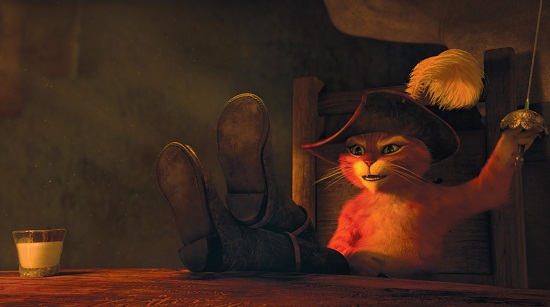
nullAnd for the first hour, I did enjoy said story. It's a similar fairytale/Zelig kind of a thing, with Puss (Antonio Banderas) teamed with Kitty Softpaws (Salma Hayek) and Humpty Dumpty (Zach Galifianakis), his former bestie and current nemesis, for one-last-heist/clearing-of-good-name fun times. The animation has an uncanny-valley issue or two vis-à-vis the felines having human teeth etc., but for the first half-hour, things move too fast for that to register, and the humor is rimshotty (Puss's thunderous "the egg betrayed me!" punctuated by Kitty snoring; the talking-to-plants crack that sets off the giant beanstalk) but enjoyable. Humpty is very funny, not least in his heel turn towards the end, and that "I was always there" montage cracked me up (as did his outfits, and I would like to thank the animation team, or whomever, for understand that, if you anthromorphize an object, you must then put some pants on it/him).

But the clever asides about catnip (Puss is using it "for his glaucoma") and the exciting free fall with the leaf parachutes go off the boil about halfway through. It's like the writers — and there are six credited, so go figure — didn't know how to end it. The result feels like each of the six wrote a climactic scene; all of those scenes stayed in; and then, after the last one, the story just kind of bah-dum-bummed offstage all, "Okay, my ride's here, so…see you guys at the sequel, 'kay?" Well, you killed off the best character in it, so: pass.

I giggled several times. It's fine. It won't win its category.

Sarah D. Bunting co-founded Television Without Pity.com, and has written for Seventeen, New York Magazine, MSNBC.com, Salon, Yahoo!, and others. She's the chief cook and bottle-washer at TomatoNation.comFor more on how the Oscars Death Race began, click here.

SIMON SAYS: Even in 3D, it’s still a PHANTOM MENACE II society

SIMON SAYS: Even in 3D, it’s still a PHANTOM MENACE II society

nullPrologue

In 1999, Star Wars Episode I: The Phantom Menace was released theatrically. The rest is a blur – for me, at least. I was 12 years old at the time, the ideal age for an uncritical Star Wars fan to see the first entry in George Lucas’ then-new prequel trilogy.

And I liked it!

Or, more accurately, in that hazy period I now refer to as my “pre-taste” period, I devoured it. Though I’m still convinced I’ve only seen Episode I once or twice before last night, I knew the film by heart, having played two of the PlayStation video games inspired by the film. (There was the podracer game and the action-adventure one that always gave me motion sickness…. I only owned the latter once my peers had moved on to the PlayStation 2. I led a deprived childhood, I think.)

nullMy taste in films evolved as the prequel trilogy was released. When Star Wars: Episode II – Attack of the Clones came out, I was 15. At the time, I was (and still am) an unabashed nerd but I was only slightly more opinionated. There were things in Episode II that I wholeheartedly enjoyed, like watching Yoda fight Count Dooku. (My sister and I gushed about that scene as we exited our Douglaston multiplex: Dracula versus a Muppet! Okay, a CG Muppet, but still!) Still, there were things about the film I distinctly recall disliking, like Hayden Christensen’s performance. I remained fairly uncritical at this point, though.


Finally, when Star Wars: Episode III – Revenge of the Sith came out in 2005, I was 18. I was (and probably still am) a raging asshole and as opinionated as I’ve ever gotten. And I hated Episode III. I didn’t think it was the worst thing I’d ever seen but I did think it was pretty awful. Christensen was still bad, his character’s moral conflict was stilted (I still can’t get over the minute pause between, “No, I won’t cut his head off,” and “Okay, I’ll cut his head off!”), the romance sucked, the dialogue sucked and the fight scenes were labored but unmoving. I saw that film under ideal circumstances of a kind, too: with the high school Science Fiction Club that I founded and quickly disbanded thereafter. (This was our last group activity; almost all of us hated what we saw.)

End Prologue

nullThe prospect of revisiting Episode I was daunting. By now, watching awful movies has become something of a passion of mine. But I didn’t watch this film, one that I still have fond preadolescent memories of, for the sake of rubbernecking. When I heard that George Lucas had post-converted The Phantom Menace into 3D, I knew my morbid curiosity would get the better of me and that attention must be paid. I earnestly wanted to know if the film could hold up for me. So I held a seance for my inner child at the Ziegfeld last night.

First, I had a beer and some bangers and mash at the Oldcastle Pub just down the street. This made Semi-Adult Simon happy (I’m 25, lemme alone). Then, I bought a big honking Pepsi and sat down with a friend at my favorite Manhattan movie theater (the opening night 7pm screening was not well-attended, though it wasn’t empty either). I was determined to give Kid Simon a fighting chance against George and what I rightfully feared was a three-dimensional cavalcade of crap.

And for a while there, I thought I could happily regress. The trailer for The Lorax looked like fun and I wanted to see the new Spider-Man movie and, hey, even the Ice Age cartoon in front of the movie made me laugh more than once. I was ready. I even wanted to shush my friend when he audibly rolled his eyes at the instantly recognizable “A long time ago in a galaxy far, far away,” intertitle. But I was ready to like Episode I again. And I wanted to pretty desperately. But while I was open to suggestion, I anticipated the worst.

Everything seemed to be going well for the first few minutes: Liam Neeson and Ewan McGregor fighting robots…but then there’s some aliens that talk like caricatures of Asian people, complete with slit eyes, Oriental robes and “w”- for-“r”-and-“l” wisps. Well, that part made sense, I rationalized frantically. In Indiana Jones and the Temple of Doom, a film whose story was co-written by George Lucas, there’s also an attempt to ground the kind of pulpy story we’re watching in the chauvinistic terms of “white man with whip knows best.” But that superior action film suggests that while Temple of Doom is inhabited by racial and sexist stereotypes, those characters (ex: Short Round and Willie Scott), the good stereotypes, prove themselves to be made of sterner stuff than the bad ones. So before Jar Jar Binks showed up, I was willing to give Lucas’ use of flagrantly offensive racial stereotypes a chance, too.

Then Jar Jar Binks showed up. And my inner child vanished.

It’s not enough to say that Jar Jar Binks is the nadir of The Phantom Menace: he’s pretty much every hyperbolic mean thing that’s ever been said about him by internet trolls and dejected fans alike (there might be a difference…). Jar Jar Binks (voiced by Ahmed Best) is a comic relief character so thoroughly miscalculated that he makes it nigh impossible to totally suspend your disbelief – in every scene he’s in. He’s too clownish, too offensive, too naïve, too pseudo-cute. He’s just awful!
nullAnd unfortunately, so is Episode I. Lucas took a film that I now recognize as being full of problems – especially bad dialogue, stiff acting with bad accents and illogical plot points (why is the Bedouin home of Anakin Skywalker full of so much STUFF? Isn’t this kid supposed to be a slave or something?) – and he made it worse by adding more stuff to it than it ever really needed. Darth Maul is unnecessarily introduced earlier than he previously was, Anakin’s acceptance into the Jedi Order is now over-explained, the podrace is overburdened with more instantly forgettable racers than were previously highlighted and the final fight scene with Darth Maul is now padded with extra footage. Anything that was once almost-spectacular in Episode I is now marred by new, distractingly cheap-looking sequences where characters stiffly intone lines as their CG-bodies bob from side-to-side to simulate human movement. It’s just awful!


Now I’m not sure how to feel about the prequels. Part of me wants to make a pilgrimage to the Ziegfeld for the remaining two 3D re-issues. But I honestly don’t know why. These films were important to me, so the sight of Jabba the Hutt’s son being randomly inserted into the podrace scene does bother me, just as it bothers me to see that a movie I remember semi-fondly was always awful. But George Lucas didn’t rape my childhood and he certainly didn’t ruin anything that wasn’t already ruined. I guess I just want to see this prequel 3D-fication thing through, because I feel nostalgic and, yes, I want to see a Star Wars film on a big screen again. I want to regress that badly, even though I’m now sure that I can’t while watching a Star Wars prequel. Sometimes, being an arrest adolescent really sucks.

Simon Abrams is a New York-based freelance arts critic. His film reviews and features have been featured in the Village Voice, Time Out New York, Slant Magazine, The L Magazine, New York Press and Time Out Chicago. He currently writes TV criticism for The Onion AV Club and is a contributing writer at the Comics Journal. His writings on film are collected at the blog, The Extended Cut.

FESTIVALS: Berlinale Decision Points Pt. 3: Billy Bob Thornton and Melissa Leo play to their own tune

FESTIVALS: Berlinale Decision Points Pt. 3: Billy Bob Thornton and Melissa Leo play to their own tune

null

Part three of my Berlinale coverage, focusing on decision points: the moment when I pretty much made up my mind about a film, and how that moment reflects on the film as a whole, capped by my Indiewire grade.

Read Part One  Read Part Two

Meteor (Spiros Stathoulopoulos) It’s hard to pick a defining moment for a film that juggles multiple modes, between hi-def animated sequences, digital landscapes, documentary/interview footage and romantic scenes between a nun and a priest secluded in a remote Thessalonian monastery. The film can be quietly audacious in isolated moments, like a matter of fact close-up shot of the nun’s genitals while she’s masturbating. But there’s a lack of cohesion between the diverse elements that keeps it from amassing dramatic power worthy of its blashemous climax. C+

Captive (Brilliante Mendoza) Basically this is the film Woman in the Septic Tank was made to ridicule, Pinoy no-budget exploitation trying to alight the festival prestige film elevator and missing the first step bigtime. A movie so mired in social issues-fellating, gratuitous audience-pandering and plain ineptitude I couldn’t stop watching just to see how bad it could get. There’s the awful CGI bird, the terrorists throwing Bibles off the boat and loads more Muslim-baiting, the shot of a baby being pulled out of a woman’s vagina in the middle of a firefight. But for me it was a shot of hostage Isabelle Huppert slurping pathetically on a flimsy bowl of instant noodles, wearing a look that deserves our outright contempt. F

friends after 3.11 (Shunji Iwai) I think it was the third consecutive extended talking head interview that made me realize that I was in for a two hour movie version of reading a long series of blog posts on the nuclear aftermath of Fukushima. Potentially great (or at least important) content thoroughly undermined by uninspired form. D+

Shadow Dancer (James Marsh) Towards the endgame of this thriller set in early 90s Northern Ireland, MI5 agent Clive Owen meets with the IRA double agent (Andrea Riseborough) he’s trying to protect. She’s wearing a red trenchcoat, a ridiculous choice for a secret outdoor meeting. They talk spy stuff and from out of the blue she kisses him. I took this to be a desperate attempt for the script to squeeze some half-baked romance into the proceedings, but upon further reflection there may be more cunning underneath the gesture. The direction throughout feels a bit flat for the narrative nuances to register, but still there may be more intelligence to this than I would initially credit. B-

Francine (Brian M. Cassidy, Melanie Shatzky) There’s a scene where Melissa Leo’s off-kilter animal lover is feeding her extended household of cats and dogs, scattering a nauseating mess of dry food all over her floor and even sprinkling it on the backs of the animals. Here the film seems to take the eccentriticies of its character too far: she’s worked at a pet store and a vet for crying out loud, and we’re to believe she resorts to this behavior? The only reason this comes off as remotely plausible is Leo’s commitment to the role portraying someone terminally lost in her own world, Leo’s guileless playfulness in the part invites us in. B-

Jayne Mansfield’s Car (Billy Bob Thornton) For all the Southern Gothic rococo and cul-de-sac subplots this film takes on, there are a lot of great little things going on, like around the start of the second act when Billy Bob is showing Frances O’Connor his car collection. He sets up the scene with a brazen obviousness of purpose (Billy Bob’s “Hey you wanna see my cars?” basically uttered like “Hey you wanna find out why you should fuck me?”) but as he geeks out over his hot rod the tone of the scene shifts in register into something dark and menacing, an all consuming obsession for things pure and fast wells up so quickly that it threatens to explode in his face. The film is chock full of such surprise tonal shifts, parting a cloud cover of narrative and thematic intentions to reveal many sublime moments underneath. This has been poorly received as a belaboured, ungainly work, but it plays like music to my ears. A-

Bestiaire (Denis Cote) For a good half hour there’s a masterful play of sound and image generated by various animals, whose organic physiognomies and noises clash wildly against the concrete and steel of their holding pens. The tipping point comes about midway with the introduction of a taxonomist plying his craft on a bird, eviscerating its carcass and reupholstering its feathered surface upon a styrofoam body. Sort of a stand-in for what the director is doing cinematically. What follows after doesn’t feel as attentive or compelling to what it’s filming, but this moment in all its tactile glory vindicates the film’s underlying thesis of us humans exerting control on all creatures with eyes and hands alike. B+

Kevin B. Lee is Editor in Chief of Press Play, and contributor to RogerEbert.com and Fandor. Follow him on Twitter.