


What does it take to get your film into a world class festival? That's the question asked with gleeful irreverence by "The Woman in the Septic Tank," which screened at the recently concluded 2012 Berlinale, one of the world's foremost festivals. This hilarious satire of international art filmmaking finds two aspiring auteurs sitting in a Manila café, jealously regarding a rival's Facebook photos taken at the Venice film fest. They vow to devise the ultimate movie to win festival audiences and prizes: a single mother of five suffering in the slums is forced to sell her son to a rich pedophile. But like Mel Brooks' "The Producers," the project gets out of hand, and before we know it we're watching a musical version with the pedophile singing "Is this the boy / who'll bring me endless hours of joy?" It's one of many delightful detours taken by these filmmakers seeking the road to art house glory.
Some critics find "Septic Tank's" satire too glib and cynical of the festival scene, but much of what it mocks can be found in another Filipino film that competed for the Berlinale's prestigious Golden Bear. Brilliante Mendoza is one of the standard-bearers of the blistering DIY filmmaking that thrives in the Philippines (and with an ego to match: his website describes him as a "living national treasure.") His success led to a golden ticket in the form of European funding, but his new film "Captive" finds him caught in the crossroads of no-budget trash filmmaking and festival prestige picture, doing service to neither. This hyperactive re-enactment of a 2001 terrorist incident even has Isabelle Huppert along for the ride as a kidnapped missionary, but it feels more like Michael Bay than Michael Haneke. From close-ups of menacing jungle creatures to a real baby being pulled out of a woman during a firefight, no attempt at sensationalism is spared to get a rise out of the audience.
Read the rest of this festival report, including thoughts on the best film at Berlinale 2012, at RogerEbert.com.
Kevin B. Lee is Editor in Chief of Press Play, and contributor to RogerEbert.com and Fandor. Follow him on Twitter.


 The trailer for Rango made the movie look unappealing, and I didn't have high hopes when I threw it in the DVD player. Oops: it's awesome.
 The voice acting is great across the board — Depp's plaintive "T.O., T.O., just a sec" prior to a duel is a highlight — and the hat-tips to other works cracked me up too. The Greek-chorus mariachi birds reminded me of the orchestra bus in Mel Brooks's High Anxiety, and the soundtrack repeatedly refers to Carter Burwell's yodeling runs on Raising Arizona's.


 Christopher Plummer (Beginners): The presumptive heir, and I'm fine with it. I wish it had come in a better story, but the performance did a lot to redeem a movie that was mostly tiresome.
 [EDITOR'S NOTE: Sarah D. Bunting of
  Meryl Streep (The Iron Lady): Streep is extremely good, and she's playing some wet toilet paper in that role. Until the BAFTA, I considered the nomination her award, a thanks for yeoman service, but she's probably going to win. Hated the movie, liked the work, fine with me.


 [EDITOR'S NOTE: Fearless Sarah D. Bunting of
  The movie is pretty to look at (the nomination is for Costume Design), but it has a Julie and Julia problem. Wally Winthrop (Abbie Cornish), unhappily married and underemployed in the present day, becomes obsessed with what she thinks of as the great love of King Edward and Wallis Simpson, and visits the Sotheby's auction of their effects every day. (She touches every goddamn item for sale, and later their love letters, without archival gloves or reproach from anyone. Just one of many minor errors that added up to a clueless script.) Her husband (Richard Coyle) is a twattily dismissive workaholic who later becomes abusive, and it's one of those straw-man bad film marriages in which you don't understand why these people even know each other. Coyle can't commit to the character — with good reason; the script gives him nothing but retrograde attitudes and Scotch-drinking to work with — while Cornish plays what she's given, a wan simp, rather too well.
 The script dodges a few key issues (Edward and Wallis's Nazi sympathies are waved off with a too-flip "just rumors, guvnor"-type scene) while lingering over others that don't merit it, like the ludicrous IVF subplot. Other moments land like a sackful of cowbells — Wallis bugging out to the Sex Pistols' "Pretty Vacant," for one. And of course the thoughtful, sweet, poetry-reading, piano-playing security guard has a $2 million loft in Williamsburg.
 [EDITOR'S NOTE: Fearless Sarah D. Bunting of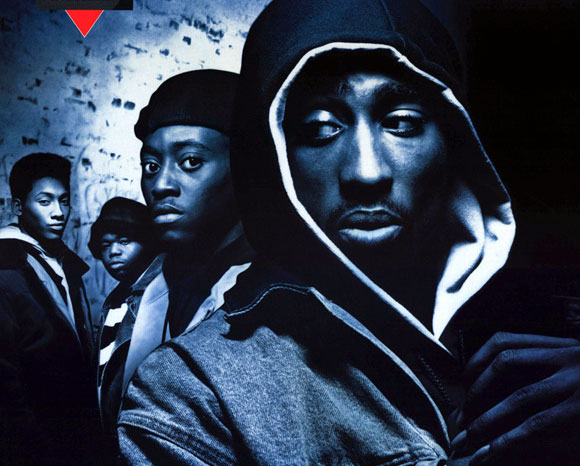
 At the same time, the New Black Wave in American movies was for the first time giving young black filmmakers the opportunity to tell stories of the contemporary black experience. Naturally, the soundtracks to most of these movies contained some of the most cutting-edge tracks around. Unlike the soundtracks to movies like Breakin’ or Krush Groove, which were dominated by the most adventurous rap acts around, the soundtracks to movies like
  Press Play Video Blog