
When Ghost Rider: Spirit of Vengeance was released this past Friday, I couldn’t help but think this of Nicolas Cage: “Wasn’t this guy supposed to play Superman?”
Follow my train of logic, please: as a fan of the Ghost Rider comic book character, the poor reviews for Spirit of Vengeance, a title that seemed like a shoe-in for Crank boys Mark Neveldine and Brian Taylor, were truly, er, dispiriting. I mean, if the guys that made Jason Statham a living cartoon character can’t do much with a film where Nicolas Cage plays an antihero with a flaming skull head, who can? I haven’t seen Spirit of Vengeance but I still want to enjoy it, and I hope that I’ll take away something from it other than abject despondence, which was what I got from the 2007 Ghost Rider.
 And yet, the kind of died-on-the-vine disappointment that both professionally critical friends and lay-nerds alike have experienced after watching Ghost Rider: Spirit of Vengeance led me to wonder about the comic book films that never were – dream projects like Tim Burton’s aborted version of Superman, whose prospective costumes look psychedelically campy in the best way imaginable.
Hold on, before you call me a troll or a contrarian, let me back up a moment: the reason I fantasize about a Tim Burton-directed, Nicolas Cage-starring Superman movie isn’t because I think it’d be a huge success. In fact, I think it’d be crazy and dysfunctional but possibly exciting and frequently dazzling. It’d be different, is what I’m trying to say, and different is what I want from comic book movies. I am, after all, writing in an age of drab Marvel comic book adaptations like Thor and Captain America: The First Avenger and Christopher Nolan’s frequently exciting but pointedly anti-flamboyant Batman movies.
Ahem. I dream of superhero movies where guys that wear four-colored outfits are allowed to be simultaneously human and ridiculous. This is admittedly a reactive stance after having only really been impressed by Iron Man 2, a character-driven mess that is mostly pretty entertaining but is also very much a film made by fans that felt like they could cut loose and just tell a story that they really wanted to tell after doing their due diligence in the first Iron Man. I want a comic book film that doesn’t pander to first-time audiences and also doesn’t deny the fact that these characters live in worlds where death rays and super-powers are commonplace. Is that so much to ask?
I guess so. In my recent search for comic book movies that are out there and exciting and yes, maybe consistently engaging enough to be worth seeking out, I focused primarily on the Marvel Comics movies that time forgot, by which I mean that I sought out made-for-TV projects that have been buried by Marvel and have yet to surface on DVD or Blu-ray. This didn’t require much skullduggery: many of these titles are available via YouTube and will likely continue to circulate on another medium after a Marvel rep reads this article and tries to pull down the titles listed below. I wish I had more time to watch more of these weird objects of cult worship, because you can say what you want about how “good” these made-for-TV films and episodes are, but hot damn, they look downright outré when compared to fairly recent Marvel movies. These older adaptations suck, but they’re a different kind of suck.
With that in mind, if you’re willing and interested, take a little trip with me down memory lane and remember comic book films that never were – released, that is. These are all Marvel properties, folks, so you won’t see me tackling equally tempting stuff like the 1997 Justice League pilot (though it is, uh, available). And you won’t see me talking about The Man-Thing or Dolph Lundgren’s Punisher. You can either Netflix those last two titles or buy them off of Amazon. Think more along the lines of the Roger Corman-produced Fantastic Four and bam, we’re on the same page.
Bear in mind: these are movies that aren’t necessarily superior to contemporary Marvel movies. In fact, if you’re still with me, you’ll soon find that these films are actually often worse. But they’re different and they at least attempt things that today’s Marvel titles don’t, and I find that’s almost always worth getting excited about. So face front, True Believers, we’re heading into the wonderful world of made-for-TV live-action comic book adaptations! Excelsior!
 The Amazing Spider-Man (1977): This 90-minute pilot for the short-lived live-action TV show by the same name is pretty strange. It’s almost as if its creators thought that because Peter Parker (Nicholas Hammond) is a hard-luck hero with a cloud permanently affixed over his head, he must also be a sub-intelligent creep and a pest, too. As his human alter ego, Parker spends a lot of time bothering poor Daily Bugle editor J. Jonah Jameson (David White) for work (Jameson just can’t use any of the photos Parker gives him, suggesting that this universe’s Parker is actually just a talentless hack that got lucky). Hammond’s Parker is Christopher-Reeve-as-Clark-Kent-levels of nebbish and annoying, but minus all the well-meaning aw-shucks stuff. He’s bashful but has a million questions to ask everyone and a weird inability to take a hint and leave well enough alone.
Worse still, once he’s suited up, Spider-Man spends a lot of time climbing up green-screened walls, skulking atop rooftops and backing away slowly from boring-looking villains. (Spidey fights a bunch of brainwashed thugs with wooden swords in this movie; meh.) He doesn’t talk much, mostly because he looks like he’s going to poop in his tights after backing up onto a banana peel.
But hey, at least this isn’t a boilerplate “Who is Spider-Man?” story like Sam Raimi’s first Spider-Man. The impulse to reintroduce new audiences to one of the most famous superheroes has always struck me as an odd impulse. So it’s nice to see a film where Spidey gets bit by a spider, then fights some brainwashed dudes, and saves the day without said day-saving meaning much in the grand scheme of things. This is not an event film, in other words; it’s a big installment in a serial and it doesn’t even look like a definitive first installment! Which isn’t great for a TV pilot, but hey, it’s certainly different.
 Captain America II: Death Too Soon (1979): The second of two starring vehicles for the charisma-less Reb Brown is much more interesting than its previous installment. In it, Brown fights Christopher Lee, who blackmails world leaders with a chemical agent that makes people age faster. See, already cool, right?
Eh, not so much. Brown’s a walking black hole and this made-for-TV film’s plot meanders like a mother. The scenes where Brown is painting in a park and is interrupted by local toughs is especially laughable. Then again, so is much of everything else in this film, right down to the cheap production values on the motorcycle that Brown drives as Captain America. Cap’s signature stars-and-stripes shield, which looks like it was bought from a nearby 99-cent store, serves as his bike’s windscreen, too (!?!?!), and is so small that when the motorbike launches out of Cap’s battle van (?!?!?!?!) accompanied by several fire extinguishers’ worth of smoke, it looks like Cap’s riding a colorful, rocking horse-sized missile of doom. Unless you really want to see a rapidly aging Lee fight Brown, you can probably skip this one.
 Dr. Strange (1978): For a movie about a surgeon that becomes the world’s greatest sorcerer, this made-for-TV film’s pretty damn sleepy. Peter Hooten (where do they find these guys?) plays Stephen Strange, a kind-hearted medico that gets wrapped up in the schemes of evil Morgan Le Fay (Jessica Walter), a sorceress trying to take over the world so that she can stay young forever. Strange is called up to help Thomas Lindmer (John Mills), who is secretly Merlin the ancient magician, to fight Morgan. Presumably because Dr. Strange is a relatively obscure superhero, this one’s a fairly straightforward and vanilla origin story. You spend most of the film’s 93-minute runtime watching a cookie cutter hero get the courage to dress up in a garish costume (complete with an ill-fitting cape) and duke it out on the Astral Plane with an evil woman in an equally garish costume. It has its moments, I suppose, and some cute psychedelic imagery. My favorite moment has to be when Le Fay tries to seduce Strange and trick him into removing the talisman-like ring that protects him from her. That moment was almost good! The rest is mostly indistinct and uninteresting.
 Nicky Fury: Agent of S.H.I.E.L.D. (1998): This is the one made-for-TV film I chose that wasn’t made in the ‘70s, that wild period where Marvel was most committed to bad ideas. In it, David Hasselhoff plays Col. Nick Fury, a grizzled old war vet that never met a rule he couldn’t break. I’m paraphrasing from David S. Goyer’s cheese-stuffed screenplay. (Goyer, incidentally, wrote the story and co-wrote the screenplay for Ghost Rider: Spirit of Vengeance, along with many other comic book properties.) Basically, this is a fairly rote alternative to the origin story: Fury comes back from retirement and helps S.H.I.E.L.D. fight Baroness von Strucker (Sandra Hess), the daughter of his arch-nemesis…Baron von Strucker. While it’s always a delight to see the Hoff chomp on a cigar and wildly overact, there probably should have been more to this film than just a lot of juiceless Oorah-ing and weird creative decisions (why do HYDRA’s minions look like the Spy vs. Spy guys except without the pointy noses?).
 First two episodes of Supaidaman (1978): This is easily my favorite of the collection of, well, stuff that I watched for this article. This live-action tokusatsu show is a weird mash-up of Spider-Man and Power Rangers. I didn’t know until now that select episodes were officially available for streaming via Marvel’s website. So you can actually watch this with real subtitles and everything, and see for yourself such sights as Spider-Man with a giant robot or Spider-Man fighting henchmen in bird costumes or Spider-Man fighting evil men in rubber monster outfits. That last item is what I’m into, apparently, because the intentionally poorly-subtitled versions I watched here and here are just as entertaining. In fact, I’d say that if you like what you see in those latter two links then you should definitely check out the official Marvel page. This stuff is nutty as all get-out and it’s certainly visually disturbing enough to make up for its plot’s many lapses in logic. A must-watch!
Simon Abrams is a New York-based freelance arts critic. His film reviews and features have been featured in the Village Voice, Time Out New York, Slant Magazine, The L Magazine, New York Press and Time Out Chicago. He currently writes TV criticism for The Onion AV Club and is a contributing writer at the Comics Journal. His writings on film are collected at the blog, The Extended Cut.


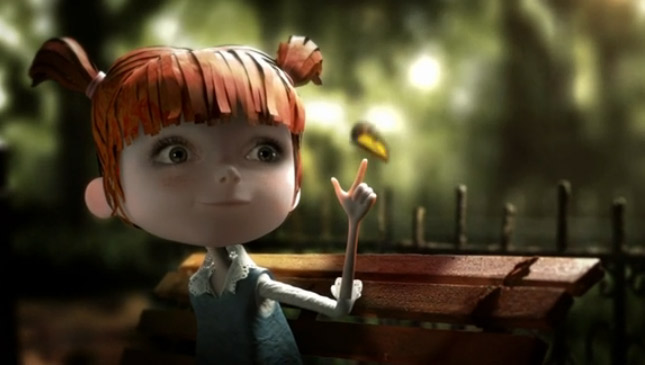

 The Fantastic Flying Books of Mr. Morris Lessmore. The ending is mournful and beautiful, but the emotion is unearned, and the more I thought about this one, the less it held up. The books themselves, bird/butterfly hybrids, are endearing, but between the scattershot hat-tips to The Wizard of Oz, the internal logic that isn't, and the over-long and show-offy tornado intro, the story doesn't jell.

 In Darkness is also expert at letting all the characters be who they are — sometimes they're horndogs. Sometimes they're brats. Sometimes they're unexpectedly, or tragically, generous. Some of them are all these things; the script isn't afraid to make some of the refugees straight-up jerks, to let Socha ruin good moments, to let his wife (the excellent Kinga Preis) leave him and then come back to him and yell and laugh and be complicated in her love for him. A child almost blows the set-up, then catches her snap immediately and turns things around. It's not easy to avoid reverting to two dimensions of good and evil in a life-during-wartime drama, especially not one about that particular war; In Darkness is as much about the life as the wartime, putting the people ahead of the situation, and that lets the situation come through more clearly and with more texture (harder to watch, too, but that's baseball).
 [EDITOR'S NOTE: Fearless Sarah D. Bunting of
 [EDITOR'S NOTE: Fearless Sarah D. Bunting of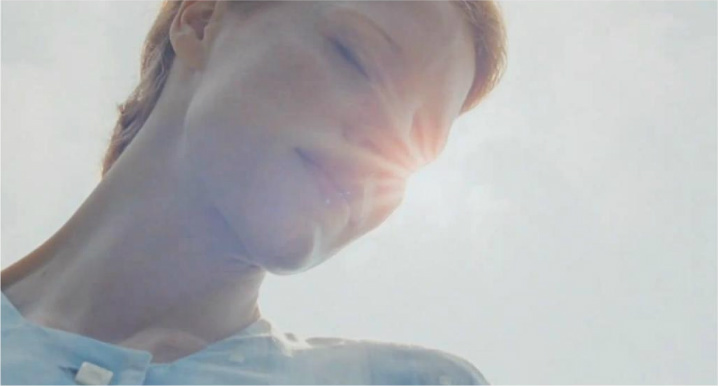
 It's impossible to discuss the movie without posing a number of questions. Whose story are we seeing here? Is it the story of the middle-aged Jack, played by Sean Penn, and his younger self? That point of view would not account for the voiceovers and subjective sequences told from the point of view of the father, played by Brad Pitt, and the mother, played by Jessica Chastain. Is the creation sequence an integral part of the movie's vision or an unnecessary and indulgent side-trip? In the scene between the wounded dinosaur and the predator down by that prehistoric river, why does the predator seem as though he's going to crush his skull, and then suddenly back off? Are we seeing the first stirrings of the schism that is discussed and visualized in different sections of the film – the way of nature versus the way of grace? Or is there some other explanation? Is there a God in Terrence Malick's universe? The repeated shots of trees, water, clouds, sky and figures haloed or backlit by intense, almost heavenly light would seem to indicate that, yes, there is a God, but uncertainty permeates the entire story, if indeed there is a story – and this, too, was the subject of debate.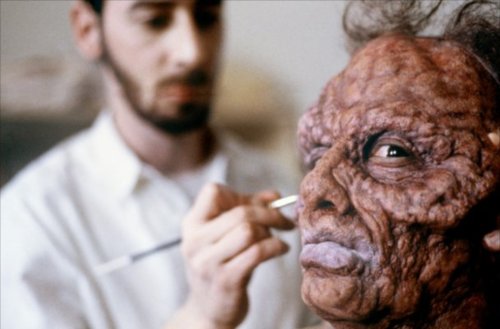
 David Cronenberg’s 1986 remake of The Fly would have been a shoo-in for a theoretical best collaborative performance Oscar. What makes it truly special is its empathy for its arrogant scientist hero, Seth Brundle, who tests his revolutionary new matter transporter on himself and becomes genetically fused with a fly that was not supposed to be in the telepod with him. Jeff Goldblum’s performance as Seth Brundle is a nexus point for all the film’s creative elements: direction, writing, acting, makeup, optical effects, miniatures and puppetry. Goldblum’s work here brings everything together. It’s kind of a thespian telepod.
 The effects are layered on incrementally, scene by scene, and they are showcased almost entirely through a single character, Seth Brundle, and a single performance, Jeff Goldblum’s.

 But the point of Transformers: Dark of the Moon isn't an acting master class, obvs, although it's courteous of Bay to include one. It's the crunchy beatings, and these work significantly better than those in Revenge of the Fallen — apparently, the production worked out a clearer color scheme for the 'bots in both car and 'bot form so it's easier to keep track of who's who in a punch-fest. It can still get a bit muddled, but it's better. And while the movie is much too long, it alternates kablam sequences with humor that usually succeeds: characters spluttering lines like "I don't care about your exotic milk, I care about respect!" while "You Light Up My Life" plays in an elevator; making Patrick Dempsey's skeezy character even more hateful by having him use the word "liaise." And I didn't mind the old Megan Fox, but Rosie Huntington-Whiteley, whose previous experience is as a model, is likable and a real pro at dashing through rubble in high heels. (Also, speaking of 'bots, does "Rosie Huntington-Whiteley" sound like it came out of the British Name Gener-A-Tron 5000 or what?)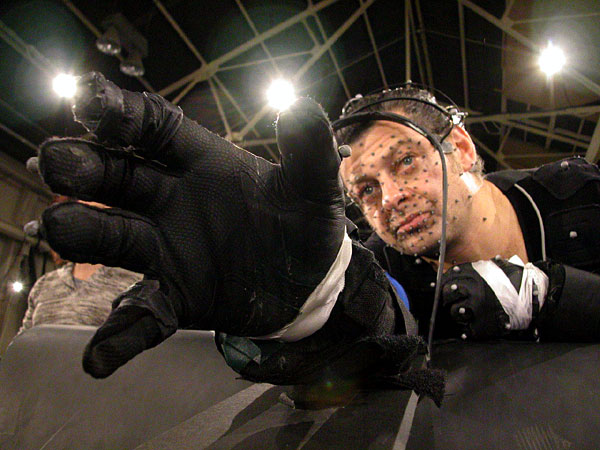
 This series argues for a new Oscar category that would honor characters brought to life through a combination of acting and behind-scenes-craft. This new category would not just acknowledge the important role that motion capture plays in modern cinema; it would open the door for honoring other forms of performance that have traditionally gotten snubbed by awards groups, including puppetry and acting under very heavy makeup.
 It also didn't happen for Tom Hanks or Jim Carrey, who played multiple roles in Robert Zemeckis' The Polar Express and A Christmas Carol respectively, or Crispin Glover, who was brilliant as Grendel in Zemeckis' Beowulf; all three films used motion capture technology.
 However, Serkis' motion capture acting can be compared, sort of, to Brad Pitt's work in 2008's The Curious Case of Benjamin Button, in which the star played a man who ages backward. Pitt's performance generated the expressions and body language that CGI artists needed to create Button's gnarled-old-man physique in early scenes, as well as the "youthful" face and body that he acquired later. Pitt earned an Oscar nod as Best Actor for Button but did not win; I would not be surprised to learn that the special effects disqualified him in voters' minds. Some people consider this kind of performance to be "cheating," and think the same of performances given under immersive makeup. John Hurt's makeup-submerged performance as the disfigured John Merrick in The Elephant Man (1980) was nominated as Best Actor that year, but didn't win, maybe for similar reasons. That year's eventual Best Actor winner Robert DeNiro sported heavy makeup in the fat-middle-aged scenes of Raging Bull, but you could always tell it was DeNiro; he wasn't swallowed up like Hurt
  For example: "The Oscar for Outstanding Collaborative Performance of 1980 goes to: Yoda in The Empire Strikes Back. Frank Oz, performance and voice; Jim Henson's Creature Shop, fabrication; Industrial Light and Magic, motion control."
 Press Play Video Blog