OSCARS DEATH RACE: Surveying the race for Best Picture

OSCARS DEATH RACE: Surveying the race for Best Picture

null[EDITOR'S NOTE: The end is rapidly approaching and Sarah D. Bunting of Tomatonation.com is down to the category for Documentary Shorts.  Here, she picks the Oscar in the Best Picture category. She has very nearly watched every single film nominated for an Oscar this year. She is calling this journey her Oscars Death Race. For more on how the Oscars Death Race began, click here. And you can follow Sarah through this quixotic journey here. It's a tough job. But, someone has to do it.]

NYMag's David Edelstein posits that The Artist is a lock for the gold on Sunday, and I don't disagree, with the conclusion or the reasoning. It's a weird year for the Best Pic slate, with a lot of seriously-flawed-at-best material; it might come down to the least of nine evils.

The evil-lope, please…

nullThe nominees

The Artist. As Edelstein notes, it's charming — charming enough. Some found it too self-consciously charming, but a lot of people saw it…and a lot of people felt good and smart about themselves for seeing it. The presumptive winner.

The Descendants. Went off the boil a few weeks ago, which is fine by me, as I despised it across the board. Not a terrible pick for your pool, but unlikely.

Extremely Loud and Incredibly Close. Man, people are REALLY afraid of Scott Rudin, eh? …I would drop a "just kidding" in here if I could find another reason for the nomination, but I can't. Widely, and correctly, reviled by critics; no chance.

The Help. Wonderful performances almost get the white-guilty writing out of its own way, but not quite. A long shot.

Hugo. I admired it a great deal, and while it's not something I will rush to buy on DVD, of the group this year, I think it's the most…complete, I guess. It's a story for all ages, the acting is good, the writing is a little strange but mostly good, the director pushed himself and the format, and it's pretty. It could win, but I would bet it for Best Directing, not here.

Midnight in Paris. A past-masters nomination, I suspect, for a likeable but redundant Woody Allen movie. No chance.

Moneyball. A very good movie that exceeded my expectations by a wide margin; it's built well. For whatever reason — too niche? — it's not in the discussion, which is unfortunate, but the nomination is the award.

The Tree of Life. A part of me wants it to win, because it didn't work for me, but I still think it's important, from an event standpoint and from a "half the fun of watching movies is talking about them afterwards" standpoint. Plus, watching people lose their fookin' minds on Twitter about it at 11:55 PM? Awesome. "Divisive" won't get it done, though, and I don't think it has enough friends in the room.

nullWar Horse. Gorgeous but undisciplined outing from Spielberg that might feel too "children's" to pull many votes. Doubtful.

Who shouldn't be here: I'll just say it: most of them. EL&IC is the most egregious, but this is another category where it's not who's here. It's who's not.

Who should be here, but isn't: I was disappointed in Tinker Tailor, but it's ambitious, at least, and it's better than several of the nominees. So is Win Win. So is Meek's Cutoff. So is the entire Best Foreign Language category. Seriously, where is A Separation — it pulled a screenplay nom, it got decent distribution compared to its category-mates, and it has a basic understanding of how human beings speak to one another, which is not something you can say for about half the BP slate. Where's Rango? Where's Bridesmaids, for that matter?

I get a whiff of "let's not bother nominating things the Academy voters won't make an effort to see" from the nominees this year. …Well, every year, but it's not usually the bulk of the list. I have absolutely no problem with nominating popular entertainments that did big box office, but if films got passed over as too challenging to the voters, that's horseshit. The rest of us have to pretend to take these awards seriously for 17 months out of the year, so the voters can take them seriously too, or they can step aside. Fall asleep reading subtitles? You're excused. Can't follow complicated plots? You're excused. "But how do I get the 3D glasses to go over my bifoca–" You're excused. You don't have to drive to Montreal and back in one day to see Monsieur Lazhar like one crazy lady I might mention, but if "best" means "least likely to inconvenience members of the industry whose kings we are crowning in front of the entire world on TV"? Not good enough.

ATTICA! ATTICA! ATTICA! …Hee. Sorry about that. I'm a little tired over here. To the prediction-mobile, let's go!

Who should win: Hugo or Moneyball

Who will win: The Artist

Who needs a binky and a nap: This brother

Sarah D. Bunting co-founded Television Without Pity.com, and has written for Seventeen, New York Magazine, MSNBC.com, Salon, Yahoo!, and others. She's the chief cook and bottle-washer at TomatoNation.comFor more on how the Oscars Death Race began, click here.

OSCARS DEATH RACE: Surveying the race for Best Director and Cinematography

OSCARS DEATH RACE: Surveying the race for Best Director and Cinematography

null[EDITOR'S NOTE: The end is rapidly approaching and Sarah D. Bunting of Tomatonation.com is ready to call the races for Best Director and Best Cinematography. She has very nearly watched every single film nominated for an Oscar this year. She is calling this journey her Oscars Death Race. For more on how the Oscars Death Race began, click here. And you can follow Sarah through this quixotic journey here. ]

Perhaps I should have given each of these categories its own piece, but I don't think you can separate them, and also, we're running out of time here. Let's take cinematography first.

nullI think any of the nominees has a solid argument, in theory: The Artist for its unusual film format (okay, that's kind of a reach), Dragon Tattoo for the palpable cold and consistent blue palette, Hugo for the dreamlike design and extra credit for 3D, War Horse for that saturated look and a handful of gorgeously orchestrated shots. But this one belongs to The Tree of Life (and this alone). And rightly so.

I don't see anyone on the list who doesn't belong, although The Artist's nom is kind of cheap, but I'd have liked to see Tinker Tailor get some photography/art recognition. You could practically smell the Soviet tobacco, even watching it on a screener.

Should win: The Tree of Life

Will win: The Tree of Life

nullBest Directing is a more difficult call, at least for me, because the tendency is to both praise and blame the director for anything and everything, even if we have no real information on what s/he could control inside the production. On the plus side, we really only have to consider three of the five directors on the list. Payne will win elsewhere for The Descendants, but I didn't see him doing anything above and beyond with the structure or the look of the story. Woody Allen could direct this picture in his sleep — and may have, with The Purple Rose of Manhattan tucked under his pillow. It's The Artist, Hugo, and The Tree of Life.

I can't say whether it's more challenging to direct actors with no audible dialogue. Hazanavicius may get extra credit for that, and various other quirks of the production. Again, that's rewarding the concept, not the execution, and I liked the execution well enough — but Hugo's is, well, harder, and as I've said elsewhere, the results are more universally appealing. The Tree of Life…I can see the argument. It's very ambitious, it gets good performances (out of children as well), it's gorgeous, and the issues I had with it are probably at the script/editing levels. But you can say the same things about Hugo, without as many problems. But I would watch TToL again, and I don't think I would "need" to revisit Hugo. So, as always, it depends on what we think should be rewarded here. I'd be very surprised if Malick won, but encouraged at the same time.

Woody Allen shouldn't have made this list, nor Payne — not if they're taking a spot from David Fincher, Asghar Farhadi, or another director who wasn't so by-numbers.

Should win: Hugo

Will win: The Artist

Sarah D. Bunting co-founded Television Without Pity.com, and has written for Seventeen, New York Magazine, MSNBC.com, Salon, Yahoo!, and others. She's the chief cook and bottle-washer at TomatoNation.comFor more on how the Oscars Death Race began, click here.

OSCARS DEATH RACE: Surveying the races for Best Original and Adapted Screenplay

OSCARS DEATH RACE: Surveying the races for Best Original and Adapted Screenplay

null[EDITOR'S NOTE: The Oscars Death Race is almost over and Sarah D. Bunting of Tomatonation.com is busting out her predictions for the Academy Awards 2012. She has very nearly watched every single film nominated for an Oscar this year. She is calling this journey her Oscars Death Race. For more on how the Oscars Death Race began, click here. And you can follow Sarah through this quixotic journey here.]

nullAdapted Screenplay is an interesting case, at least to me: what's getting voted on, exactly? Is it the screenplay qua screenplay? Or is it the skill of the adaptation? I realize I shouldn't think too deeply on these criteria, but the category this year points up the distinction I've just mentioned, for two reasons: 1) the source material is quite varied (two novels, a play, a non-fiction book, etc.); and 2) two adaptations of wildly popular book series didn't get nominated. More on that in a sec; first, the nominees.

The Descendants has this locked up, I believe, though it's probably the only statue the film will receive. I wish it could get some other statue, like for Best Hawaiian Shirts or Best Bridges Imitation By Another Bridges…something that's not for writing.

Hugo is one I'm surprised to see nominated, but that's probably because the movie registers more visually; people who have read the book almost uniformly praise the film version. I really liked the way the writing's phrasings and tone reflected the fabulism of the plot, and I wouldn't mind a win for it, but it's not happening.

The Ides of March. The movie had pacing problems, but I don't know that that's the screenplay's fault. The first half is gripping and it does do some things extremely well (the scene with Philip Seymour Hoffman in the SUV is an example of how it elided things and expected us to keep up). But this isn't the nom I thought we'd get from TIoM — George Clooney's acting and the way he's shot combined to make him, for the first time in a while, genuinely menacing and villainous onscreen; I also thought Ryan Gosling might get some attention. But it's this, and this came out too early. No shot.

nullMoneyball is, for my money, the best writing on offer here. It's Sorkin-y, but in the good ways; it lets the actors work, but isn't too indulgent of them; and it brought what I assumed was an unfilmable book to the screen. If I had a vote, I'd spend it on this.

Tinker Tailor Soldier Spy does have an argument. My understanding is that it had its work cut out as far as trying to tame the sprawling John le Carré plots (the last time the material was attempted, it was a miniseries), and while I've heard it called murky and confusing, I didn't agree, or think that opacity was a bad thing in the second place. If the criterion is "how well did the screenplay address the challenges presented by the source," TTSS may have had the biggest distance to cover. But…again, I wonder why it's the script that gets the nod and not Tom Hardy, or the set design or cinematography. And it did win the BAFTA. Solid pick.

Anyone not belong here? I like Payne's other stuff, so I'm not that bent about it, but The Descendants is not good writing.

Anyone not here who should be? Dragon Tattoo, perhaps. I do think Jane Eyre should have gotten a nomination; that material is not for everyone, but Moira Buffini's version chops out the bulk of what alienates people about it, and gets to the good stuff.

Should win: Moneyball

Will win: The Descendants

Original Screenplay is a bit easier to assess in theory; in practice, the diversity of the nominations in 2012 make it tougher.

The Artist will win a lot of its categories, and it may win this one too — but the narrative and its structure are rather conventional (or, if you're one of the film's detractors, "derivative"). The concept isn't the same thing as the scripting, but I don't know whether that's considered a relevant distinction. A solid bet.

nullBridesmaids. I liked the movie, but I had some issues with the length, and with the frat pandering. The writing did shine in the less showy scenes, like the scene at the beginning with the two friends at brunch, but I don't think it should win, and it won't.

Margin Call. JC Chandor attempted to split the difference between McGuffin-y vagueness and arcane specifics; I get the reasoning, but it failed. I'm betting he has good writing in him; this wasn't it. It's not impossible that he wins, but it doesn't seem to have legs.

Midnight in Paris. The customary nom for Woody Allen, but it's minor work. No shot.

A Separation is the best work here by a good distance, and at the highest difficulty level. The overlapping dialogue, the order and timing of the reveals, get more impressive the more you think about them.

Anything here that shouldn't be? Margin Call.

Anything that should be here but isn't? Win Win, maybe? Or Melancholia.

Should win: A Separation

Will win: The Artist

Sarah D. Bunting co-founded Television Without Pity.com, and has written for Seventeen, New York Magazine, MSNBC.com, Salon, Yahoo!, and others. She's the chief cook and bottle-washer at TomatoNation.comFor more on how the Oscars Death Race began, click here.

OSCARS DEATH RACE: A SEPARATION

OSCARS DEATH RACE: A SEPARATION

null[EDITOR'S NOTE: The end is rapidly approaching and Sarah D. Bunting of Tomatonation.com is down to the category for Documentary Shorts.  She has very nearly watched every single film nominated for an Oscar this year. She is calling this journey her Oscars Death Race. For more on how the Oscars Death Race began, click here. And you can follow Sarah through this quixotic journey here.]

nullA Separation opens with an argument in front of a judge. Simin (Leila Hatami) wants a divorce from Nader (Peyman Maadi), which he will grant, albeit reluctantly, and custody of their sixth-grade daughter Termeh (Sarina Farhadi, writer/director Asghar Farhadi's daughter), which he won't. Simin wants to take Termeh out of Iran (she doesn't say why, but we're to assume the reason is…Iran), but Nader won't leave his elderly father (Ali-Asghar Shahbazi), who has Alzheimer's and needs constant care. Simin doesn't really want to divorce Nader, we sense, but when the bluff is called, she doesn't blink, and moves to her mother's house; Termeh, invited to go with her, elects to stay with her father.

But the two of them can't care for Nader's father during the day, and with Simin gone, Nader hires a day nurse — the devout, pregnant Razieh (Sareh Bayat), who commutes two hours each way with her four-year-old daughter. On her first day, the patient soils himself, and Razieh must consult with religious authorities to see if it's a sin for her to clean him. The father has a tendency to wander away barefoot to the newsstand; at one point, Razieh has to venture across a busy city street to retrieve him. She tries to quit and substitute her husband, Hodjat (Shahab Hosseini, particularly outstanding), in her place, but that doesn't work out, so she comes back. That afternoon, Nader comes home to find his father on the floor beside his bed, barely breathing and lashed to the bedpost with a scarf restraint.

So Razieh is either a criminal or a moron, right? Unless she isn't, and that explanation takes its time to come out. First, accusations of stealing have to fly, Razieh has to refuse to leave Nader's apartment under a cloud, Nader has to make her go, and another incident has to compound the first, and so on, and so on. Someone is shoved, or thrown, or merely ordered to leave, and the consequence is Nader's fault, or his father's "fault," or Hodjat's, or no one's. A complaint is filed, and then a cross-complaint. The audience picks a side, then switches, then switches back as witnesses are called and admissions are made. These stubborn, brave, annoying, complicated, recognizable characters and the thoughtful, unaffected performances behind them (even little Kimia Hosseini as Somayeh, Razieh's daughter, is fantastic) combine with a naturalistic dialogue style to make A Separation feel like a documentary. The arguments overlap, repeat, in such an authentic way, sometimes Catskills-y, sometimes tiresome, and in doing so, they give you time to come around to points of view.

I'd expected to respect this movie; instead, I loved it. I loved the ending — Simin and Nader on either side of a busy doorway, not speaking. I loved the family's little jokes about Nader's father at the foosball table ("he's the manager"). I loved how Razieh reminded me, in some shots, of the worried-moon faces of the women in Marjane Satrapi's Persepolis, and in others of Madeline's Miss Clavel. It has texture.

Best Foreign Language is a strong category this year. I at least liked all the nominees, and three of them are wonderful. A Separation will win, and should.

Sarah D. Bunting co-founded Television Without Pity.com, and has written for Seventeen, New York Magazine, MSNBC.com, Salon, Yahoo!, and others. She's the chief cook and bottle-washer at TomatoNation.comFor more on how the Oscars Death Race began, click here.

OSCARS DEATH RACE: Surveying the Race for Best Live-Action Short

OSCARS DEATH RACE: Surveying the Race for Best Live-Action Short

null[EDITOR'S NOTE: The end is rapidly approaching and Sarah D. Bunting of Tomatonation.com is down to the category for Documentary Shorts.  She has very nearly watched every single film nominated for an Oscar this year. She is calling this journey her Oscars Death Race. For more on how the Oscars Death Race began, click here. And you can follow Sarah through this quixotic journey here.]

Pentecost. I feel like we get one of these every year, a mini roman a clef about a grade-school kid in which the central gag doesn't quite merit the attention, and Pentecost is this year's. The pep talk by the priest is cute, in theory, but the whole thing needs to move much faster, not least the climactic scene (it would still fall flat, but less so).

nullRaju. A nicely executed piece about a German couple in Kolkata to adopt an orphan. It does everything it needs to, and doesn't do anything it doesn't need to. Could have taken a little more time with the denouement, but I liked it.

The Shore. It's a sort of O. Henry story about two old friends who haven't spoken in a while, and it's acted extremely well, particularly by Ciaran Hinds; his elegance with the exposition is a pleasure to watch. But the big "humorous" set piece is set up in a way that doesn't make sense and isn't funny, and the payoff in no way justifies the build-up. It's not boring, exactly, or too long, since chopping it down wouldn't solve the problem; there's just not much of a story.

Time Freak. Cute, shaggy-doggish plot about two friends and a time machine that doesn't trust its jokes. The throwaway visuals and sped-up bits were the parts that worked, but the bulk of the short is the actors floundering in exposition quicksand (and the guy who plays Evan is not great). It holds the last beat way too long, like "you will say 'cut' out loud, several times" too long. Fun idea, weak execution.

Tuba Atlantic. A man is given a terminal diagnosis; shortly afterwards, an Angel of Death shows up at his door to "help" him. I was almost sure the aggressive quirk of the concept couldn't be overcome, but it's a beautiful piece to look at, and the script grounds itself in details: Oskar unfolding a photo after three decades; the Angel's complaint about her sister and her braces. The end is a tad corny, but the movie did suck me in in the end.

Should win: None of them is fantastic, but Raju is the best of the lot.

Will win: Based on what won the category last year, we can't rule out Time Freak; it's that or Tuba Atlantic.

Sarah D. Bunting co-founded Television Without Pity.com, and has written for Seventeen, New York Magazine, MSNBC.com, Salon, Yahoo!, and others. She's the chief cook and bottle-washer at TomatoNation.comFor more on how the Oscars Death Race began, click here.

VIDEO ESSAY: AN AMERICAN WEREWOLF IN HOLLYWOOD: HORROR, MAKEUP AND THE OSCARS

VIDEO ESSAY: AN AMERICAN WEREWOLF IN HOLLYWOOD: HORROR, MAKEUP AND THE OSCARS

Editor's Note: Press Play is aware that our videos can not be played on Apple mobile devices. We are, therefore, making this and every video in this series available on Vimeo for these Press Play readers. If you own an Apple mobile device, click here.]

Narration:

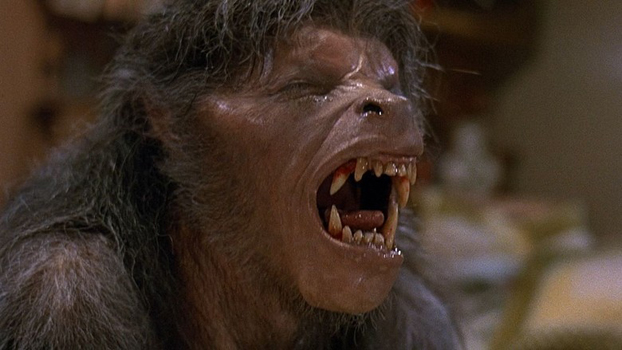
The practitioners of visual effects have a favorite phrase for what they do: the Invisible Art – effects that are imaginative, even astonishing, but that are ultimately there to sell a world, a character or a moment. Special makeup might be the best illustration of this principle. One of makeup's greatest triumphs is An American Werewolf in London, which in 1982 became the first film to win an Oscar for makeup in regular competition. Overseen by Rick Baker, who supervised all of the film's makeup effects, it shows a man changing into a werewolf in real time…right in front of your eyes. This sequence was the culmination of eight decades of movie makeup. And the film's Oscar represented a coming-out for a once-neglected aspect of filmmaking.

nullMakeup effects were always a key component of the movies. Greasepaint, wigs, putty, latex appliances and other items in the makeup master's toolkit helped make the improbable, and the impossible, seem vividly real. Boris Karloff could make us believe that he was a tormented, tragic creature built from pieces of dead men in Universal's Frankenstein films – with makeup by the great Jack Pierce. Pierce's work on The Wolfman made an ordinary man become a werewolf when the wolfbane bloomed and the moon was full and bright. A 25-year-old Orson Welles played the title character of Citizen Kane at a dazzling array of ages, thanks to inventive, at times highly theatrical effects by Maurice Seiderman.

Yet despite these and other examples of the makeup master's art, the Academy refused to acknowledge the contribution of makeup artists. Prior to the 1980s, just two Special Achievement awards were given for makeup effects. Both were handed out in the 1960s. One was for 1964’s 7 Faces of Dr. Lao, which sported effects by William Tuttle. The other was for 1968’s Planet of the Apes –makeup by John Chambers. The latter citation is fascinating because, while the Academy was right to recognize the extraordinary achievement of Apes, it ignored a film from that same year whose ape makeup was even more impressive. The ape makeup in the Dawn of Man sequence of 2001: A Space Odyssey was so good that many people assumed that director Stanley Kubrick used actual, trained apes. This uptake in visual sophistication was par for the course in that period of American film.

nullThe 1960s through the 1980s were the high point of traditional, analog filmmaking techniques. Some of the most memorable films from this era showed transformation, decay and violence with unprecedented realism. Some of the most striking makeup effects of this period were the work of one man, Dick Smith, who finally received a special Oscar from the Academy in 2012 after decades of groundbreaking work. Nobody spilled blood with more panache.

And nobody has ever done more convincing old-age makeup. For The Exorcist, Dick Smith helped turn preteen actress Linda Blair into a rotting, puking, devil-possessed monstrosity so profoundly revolting that it haunted the dreams of millions. But the film also contains a much subtler triumph: Max von Sydow's transformation into the title character. Von Sydow was just 43 when he played the role. But Dick Smith's wrinkles and liver spots were so believable that for years afterward, casting agents kept offering him old man parts. Just as viewers thought that the costumed actors in 2001 were real apes, casting agents unfamiliar with von Sydow's work for director Ingmar Bergman thought he was some doddering European character actor. For makeup artists, such misperceptions are the highest possible praise.

nullThe late 1970s saw makeup effects moving away from realistic applications and moving toward the extremes of fantasy. Christopher Tucker's remarkable makeup for David Lynch's 1980 drama The Elephant Man may have pushed the Academy to start handing out a Best Makeup award the following year. After eight decades' worth of movie makeup effects, and 20 years of rapid technical innovations, to continue ignoring the makeup artist's craft would have seemed perverse. And speaking of perverse….

When Rick Baker received the first Best Makeup Oscar ever given in regular competition for 1981's An American Werewolf in London, it was sweet vindication, not just for makeup artists, but for fans of genre movies. The creation of a makeup category was not just a means of acknowledging a branch of the industry that had been glossed over in the past. It was also a sneaky way to let Academy voters bestow awards on horror, science fiction, fantasy, action and other genres that were, and maybe still are, considered un-serious, or low-class. With its still-unique mix of slapstick, romance and gore, American Werewolf never could have gotten Oscar nominations in the major categories. In retrospect, the makeup award seems not just a prize for the movie's sophisticated use of latex, air bladders and audio-animatronic puppets, but for the originality of writer-director John Landis' vision. The technical categories let Academy voters honor offbeat fare – including genre films that tend not to get nominated in the picture, director, screenplay or acting categories.

The 1970s and '80s were the age of the makeup artist as cult figure. Magazines aimed at genre buffs and wannabe-gore wizards turned the giants of the field into heroes: Jack Pierce; Dick Smith; John Chambers; Tom Savini, George Romero's go-to guy for zombie makeup; Rob Bottin, who created similarly dazzling lycanthropes a year before American Werewolf in Joe Dante's The Howling and still-unmatched alien transformation effects in John Carpenter's The Thing.

nullThe Oscar for American Werewolf signaled that the 1980s – the decade of high-concept blockbusters – would be the golden age of analog makeup effects. When you look back over genre movies from the period – small and big, sensitive and crass, clichéd and innovative – the special effects often hold up surprisingly well. In some cases they're the main reason that people still talk about the movies. Modern makeup effects are slicker and more consistent from scene to scene and shot to shot for reasons that we'll get to in a minute. But, given the mechanical limitations of the pre-digital era, their achievements are still impressive. Even when the storytelling falters, or when the film itself seems less an artistic statement than the end result of a studio deal memo, you can still see the behind-the-scenes craftspeople working at the peak of their powers, always striving to innovate and impress.

But as it turned out, this golden age also represented a final flowering. The industry was about to change in ways that transformed every aspect of production, including makeup. With few exceptions, the '80s heyday of makeup focused on the fantastic – the spectacular. For every film like The Elephant Man or Mask, which integrated extraordinary makeup into a realistic drama, there were a dozen more films in which the makeup was the real show. But the thing is, on some fundamental level, even in the very best makeup-driven movies of that period, you were still aware of the makeup. The effects looked, at times, a little too wet – too painted-on. This was always true, even in earlier periods, when the abstracting effect of black-and-white film gave makeup people another layer of artifice to work with. In the early '90s, right around the time that Bram Stoker's Dracula was winning an Oscar for its state-of-the-art yet old-school makeup effects, new technological advances were making it harder to tell the difference between the real and the virtual. Starting in the late 1980s, advancements in computer generated imagery had begun to offer a level of detail that wasn't possible when done practically. It reached a point where you couldn’t tell where the makeup ended and the computer imagery began.

By the time of The Dark Knight and The Curious Case of Benjamin Button, viewers started to assume that makeup effects were achieved not with putty, powder, latex or other physical materials, but with computer generated effects. And increasingly, they were right. Movies were always driven by the mandate to make the implausible plausible. But this became an even more urgent mission in the '90s and aughts. Entertainment became centered on TVs, then computers, then ultimately phones. Hollywood strove to give viewers reasons to go to theaters and experience movies on a big screen. That increasingly meant spotlighting the unreal. The ostentatious. The overwhelming. All these qualities were more achievable with CGI. Special makeup effects have gradually become less apparent, and ultimately almost invisible, thanks to CGI. The work of makeup artists and visual effects wizards became intertwined – blended together after-the-fact by digital manipulation. The new tools blend acting, photography and visual effects with makeup. CGI is like a finishing coat of paint, applied to everything. For makeup artists, and indeed for all special effects people, this is the ultimate irony. The invisible art has finally earned its nickname.

San Antonio-based film critic Aaron Aradillas is a contributor to The House Next Door, a contributor to Moving Image Source, and the host of “Back at Midnight,” an Internet radio program about film and television. A critic, journalist and filmmaker, Matt Zoller Seitz is the staff TV columnist for New York Magazine and the founder of Press Play. Ken Cancelosi is the co-founder of Press Play and photographer living in Dallas, Texas

OSCARS DEATH RACE: TREE OF LIFE

OSCARS DEATH RACE: TREE OF LIFE

null[EDITOR'S NOTE: The end is rapidly approaching and Sarah D. Bunting of Tomatonation.com is down to the categories for Live Action Shorts and Documentary Shorts.  She has very nearly watched every single film nominated for an Oscar this year. She is calling this journey her Oscars Death Race. For more on how the Oscars Death Race began, click here. And you can follow Sarah through this quixotic journey here.]

Is it fair to review a work that functions, as Roger Ebert said in his piece on The Tree of Life, as more of a prayer than a story? Can we measure this intensely personal, individual film with traditional yardsticks?

nullI believe it is; I believe we can. Some of the positive reviews of The Tree of Life seem defensive to the point of stridency, meeting charges of "but there's no narrative!" with a carpet-bombing of superlatives, and implying between salvos that such an unconventional and daring form of filmic storytelling has no use for bourgeois adjectives like "linear" and "coherent." Well…actually, on the one hand, I agree, in the sense that Malick has his ways of doing things and thinking about stories and connecting (or shuffling) dots, and that peculiar Malickian blend of compulsive control and sticky viscera either hits you or it doesn't, so no review per se is going to change your mind.

But on the other hand, it's possible to understand how Malick operates, to be tolerant of the occasional sweaty lapses into sophomore workshop, to respect — revere — his unique sequencing and wait with hands folded for him to arrive inside your head, to say "oy, always with the leaves," but fondly, as you would about a nutty relative…and to think, still, that The Tree of Life doesn't work.

And that's where I'm at with it. I love Malick, he has the heart of a lion to try the shit he does and never hide, but: The Tree of Life fell flat for me. I didn't hate it; I adored parts of it, and got teary, and it is stunning visually. Nobody else can transport you back to the dusks of your youth like Malick.

nullThis felt forced, though — out of sync, like a hitter in a slump who swings too hard or too late. The whispered voice-overs do reflect the things some of us say to God, but "realistic" doesn't necessarily mean "interesting," and the murmurs become redundant after a while, then almost parodic. Ditto the gazillion scenes of the kids playing, and/or their mother (Jessica Chastain) providing a safe Rockwellian haven from the cardboard abusiveness of O'Brien Sr. (Brad Pitt); it's not the repetition itself, really, but the pacing, which occasionally felt like a screensaver designed by a joint coalition of Scientific American and Betty Friedan.

The acting is very good, given that the company doesn't get much to play aside from poignant gazing. I don't know how you'd begin to direct a kid in the young-Jack role, but Hunter McCracken is a keeper. Pitt is fantastic again, illustrating the divide between the man he thinks he is and the man his sons see — and that he knows that divide is there.

It isn't a disaster, but it never quite gets going, never quite attains that chant feeling I think Ebert is talking about that you get in other Malick works. Yes, it's self-indulgent, but that can work for this artist; here, it works against him (the regrettable megachurch-y foolishness of the ending is one example). I don't think anyone's wrong to love TToL, I agree that it's audacious and so on, but a noble failure is still a failure.

Sarah D. Bunting co-founded Television Without Pity.com, and has written for Seventeen, New York Magazine, MSNBC.com, Salon, Yahoo!, and others. She's the chief cook and bottle-washer at TomatoNation.comFor more on how the Oscars Death Race began, click here.

VIDEO ESSAY: Outstanding Collaborative Performance – Yoda, THE EMPIRE STRIKES BACK

VIDEO ESSAY: Outstanding Collaborative Performance – Yoda, THE EMPIRE STRIKES BACK


[EDITOR'S NOTE: This is one of four video essays arguing for the creation of a new Academy Awards category Outstanding Collaborative Performance. This category would honor teams of artists who create a vivid and memorable movie character whose existence is built upon performance but heavily assisted by CGI, immersive makeup, puppetry or other behind-the-scenes filmmaking craft. To read Matt Zoller Seitz's piece explaining why the film industry needs this category, and to view a video essay about the career of motion capture performance wizard Andy Serkis, click here. Important notice: Press Play is aware that our videos can not be played on Apple mobile devices. We are, therefore, making this and every video in this series available on Vimeo for these Press Play readers. If you own an Apple mobile device, click here.]

Muppets creator Jim Henson once said, “When Frank Oz does Grover, I think he is a better actor than Lawrence Olivier.” That’s not really an exaggeration. Puppeteering is not just a clever way to entertain children. It’s an ancient art, common to cultures all over the world.

And it’s another kind of performance — sort of a merger of acting, gesture and dance. It combines vocal performance with hand movements that approximate the movements of a human, an animal, or a non-human character.

nullIf you doubt it, go back and watch Star Wars: Episode V – The Empire Strikes Back, the Star Wars film that introduced Frank Oz’s first great non-Muppet character, the 800-year old, swamp-dwelling Jedi master Yoda.

At the time, there was some buzz about Frank Oz receiving a special award from the Academy for performing Yoda, but it didn’t happen. Who knows why, but I suspect it was because when judging this sort of achievement, nobody, even sci-fi and fantasy buffs, is entirely sure where performance ends and optical effects or makeup or puppet fabrication begin.

Oz and the Empire crew that backed him up would have been ideal candidates for a best collaborative performance Oscar if one had existed back in 1981, the year that the movie won a special Oscar for its visual effects. The performance is primarily the work of one person, Frank Oz.

But he is assisted by a small army of artists and technicians, including the craftspeople in Jim Henson’s creature shop who built the different versions of Yoda, and the special visual effects and production design elements around Yoda, created by Lucas’ company Industrial Light and Magic. These all help to create the illusion that Yoda is living, breathing, organic creation, part of a natural world.

nullYou never see Frank Oz when you’re watching Yoda. When he performs the character, he’s hidden behind props or underneath a platform. But this is nevertheless a performance, one that’s as imaginative, serious and engaging as any that are given by the movie’s human characters. Maybe more so. In the training scene with Luke, Yoda is mainly played by a dummy, affixed to the shoulders of actor Mark Hamill and the stuntman who plays Luke during his more acrobatic moments. The sequence relies entirely on our suspension of disbelief, carried over from earlier scenes that were more obviously dominated by Frank Oz the puppeteer.

This purely analog approach to the character continued in the next Star Wars film, Return of the Jedi.  In the first of the Star Wars prequels, 1997’s The Phantom Menace, Yoda was again played by a puppet, albeit a different looking one with a lot less texture and personality.

The Phantom Menace Yoda was revised by George Lucas many years after the film’s release, to make him visually consistent with the Yoda we saw in Attack of the Clones and Revenge of the Sith — a totally computer-animated character. The Clones and Sith versions of Yoda were voiced by Frank Oz, but involved no traditional puppeteering. They were still a collaborative effort, though.

Any of these incarnations of Yoda would have qualified for a nomination in a collaborative performance Oscar category. They all illustrate the idea behind such an award: that when group of people work together to bring a single, memorable character to life onscreen, the sum total of their efforts results in something greater than they might have achieved on their own.

Matt Zoller Seitz is founder of Press Play and TV critic for New York Magazine. Matthias Stork is a Press Play contributor and   film scholar-critic from Germany who continues to pursue an academic career at UCLA where he studies film and television. He has an MA in Education with emphasis on American and French literature and film from Goethe University, Frankfurt. He has attended The Cannes film festival twice (2010/2011) as a representitive of Goethe University's film school and you can read his blog here.

OSCARS DEATH RACE: BULLHEAD

OSCARS DEATH RACE: BULLHEAD

null[EDITOR'S NOTE: Fearless Sarah D. Bunting of Tomatonation.com is making it her mission to watch every single film nominated for an Oscar before the Academy Awards Ceremony on February 26, 2012. She is calling this journey her Oscars Death Race. For more on how the Oscars Death Race began, click here. And you can follow Sarah through this quixotic journey here.]
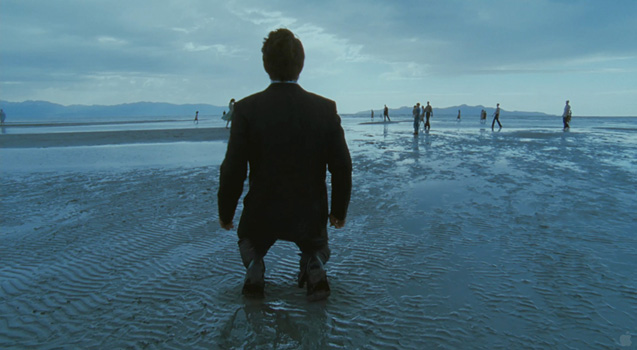
nullBullhead isn't about what you think it's about at first. You start out with a voice-over about things from the past coming back; then you move into a plot about the Flemish "hormone mafia," and whether cattle farmer Jacky Vanmarsenille (Matthias Schoenaerts) is going to involve himself in a deal to improve the weight of his cows. Or so you think. You also see a series of moody shots of Jacky in his bathroom, staring, sitting immobile in the shower, then injecting himself with testosterone, so then you think the movie is about that — that perhaps he's preparing for a fight of some kind? Then Jacky attends a meeting set up by a smarmy vet (Frank Lamers), and recognizes the boss's flunky Diederik (Jeroen Perceval), although both men play it like they've never met. There is A Vibe between them, and you think, "Ohhh, okay. It's about that." And it is. And…it isn't.

It's about all these things (the "preparing for a fight" part, too, although not in a Rocky sense). Jacky and Diederik were besties as kids; their fathers worked together, tied up with the same sketchy cattle characters Jacky is now dealing with. Then they crossed paths with a disturbed boy, and that long-ago horror is now leading inexorably to ruin.

The film is shot effectively, which is to say unpleasantly. I felt stifled by the greyness and the tight close-ups, but it worked to create tension. Good acting throughout as well. Perceval's jumpy jackass is convincing but not unsympathetic, and Schoenaerts has one of those beautifully busted European-actor faces that American film doesn't really allow for; it looks carved, not born, but it's expressive in spite of that, and he does fine work with an Ennis Del Mar-type character who isn't very articulate. And there isn't much even an articulate character can say to Jacky's situation. The film is about a man who couldn't quite become a man, who lived without living, and it's beyond discussing.

It puts a foot wrong now and then — I didn't love the last shot, and the crucifix hallucination is sophomoric — and it's hard to take in some ways, but it's a strong movie, in the way a drink is strong.

Sarah D. Bunting co-founded Television Without Pity.com, and has written for Seventeen, New York Magazine, MSNBC.com, Salon, Yahoo!, and others. She's the chief cook and bottle-washer at TomatoNation.comFor more on how the Oscars Death Race began, click here.

VIDEO ESSAY: Outstanding Collaborative Performance – E.T.: The Extra Terrestrial

VIDEO ESSAY: Outstanding Collaborative Performance – E.T.: The Extra Terrestrial

[EDITOR'S NOTE: This is one of four video essays arguing for the creation of a new Academy Awards category Outstanding Collaborative Performance. This category would honor teams of artists who create a vivid and memorable movie character whose existence is built upon performance but heavily assisted by CGI, immersive makeup, puppetry or other behind-the-scenes filmmaking craft. To read Matt Zoller Seitz's piece explaining why the film industry needs this category, and to view a video essay about the career of motion capture performance wizard Andy Serkis, click here. A case can also be made for Yoda. Important notice: Press Play is aware that our videos can not be played on Apple mobile devices. We are, therefore, making this and every video in this series available on Vimeo for these Press Play readers. If you own an Apple mobile device, click here.]

Narration:

For a pretty long time, Steven Spielberg’s E.T. The Extraterrestrial was the top grossing film ever made, and it’s still one of the most beloved. The title character is a space alien. Who plays him? It’s hard to even begin to answer that question. There were so many people involved, and they all contributed something. But it you rule out the obvious suspects – Spielberg, who directed the movie, and Melissa Mathison, who wrote it – it’s still a pretty long list. And when you actually try to sit down and cite specific people, what you end up with is a case study in why
there should be an Academy Award for outstanding collaborative performance.

The voice of E.T. was provided by Pat Welsh, an old woman who lived in Marin County, California. She was a two pack a day smoker. And when you listen to the dialogue, you can tell.

But 16 other people contributed just to E.T.’s voice. Supposedly one of them was Debra Winger, the star of Midnight Cowboy and An Officer and a Gentleman. It’s impossible to tell which voice actors did what , because their contributions are filtered through the sound effects wizardry of a legendary sound wizard named Ben Burtt. Burtt worked on a lot of classic science
fiction, fantasy and horror movies, including the Star Wars and Indiana Jones films, the 1978 remake of Invasion of the Body Snatchers, and Wall-E.

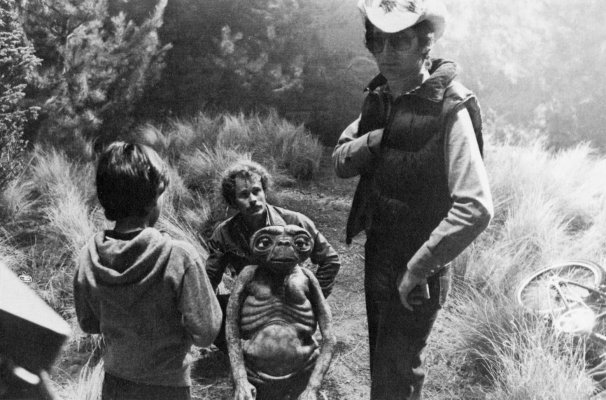
Who performed E.T.? And how many were there? It depends on the scene. The physical creation of E.T. was mainly the work of creature designer Carlo Rambaldi. Among other things, he created a lot of audio animatronic versions of the title creature for the 1976 version of King Kong. He also did the aliens for Spielberg’s previous science fiction movie, Close Encounters of the Third Kind. And he did the mechanical head effects for the original Alien.

When you see E.T. acting in closeup, and he’s reacting with great precision to the human actors around him, you’re seeing a very sophisticated, partly mechanical puppet, being manipulated by several people.

When you see E.T. in long shot, it’s a little person wearing a suit.

For some of the close-ups of E.T.’s hands, they went old-school and got a mime named Caprice Roth to wear prosthetic gloves.

I mean, you can’t really can’t argue that E.T. is an underappreciated film. Not only was it a huge hit, it got nine Oscar nominations, including Best Picture, Director and original Screenplay. And it won four technical awards, including best visual effects. But it still seems like kind of a shame that E.T. himself could not be recognized as an astonishing, singular creation. The system just isn’t set up for it.

The title character is a really just a collection of inanimate, inorganic things created in a workshop. But the parts are made so lovingly, and lit and shot and voiced with such imagination, that they that sell the illusion that E.T. is Elliott’s best friend, that he’s a creature with a personality and even a moral code. And I think if there had been an outstanding collaborative performance category that year, E.T. would have taken it for sure.

He’s one of the greatest fantasy characters in the history of cinema, and a walking, talking, living, breathing argument for a collaborative performance Oscar.

A critic, journalist and filmmaker, Matt Zoller Seitz is the staff TV columnist for New York Magazine and the founder of Press Play. Steven Boone is a film critic and video essayist for Fandor and Roger Ebert's Far Flung Correspondents. He writes a column on street life for Capital New York and blogs at Big Media Vandalism.