FESTIVALS – True/False 2012, Day Two: The Influence Machine

FESTIVALS – True/False 2012, Day Two: The Influence Machine

null

"The thing is, directors and studios don't really like each other." Graphic designer Erik Buckham ought to know. He has a ringside seat. He designs movie posters. The nature of the business means that he deals with both studio marketing departments and control freak directors, but not always in equal measure. This comment explains a lot about why American movies look the way they do and a lot about why Buckham prefers to work on small films rather than big.

If you don't know Buckham's name, you probably know his work. His most famous poster is probably the "You don't get to 500 million friends…" poster for The Social Network. True/False asked him to design their poster and graphics this year and brought him to the festival to speak about what he does. He brought a slideshow of his past work, including multiple variations that never made the cut, as well as pieces that show the evolution of the concepts that make up his final work.

The process of making the True/False graphics was the centerpiece of the talk, and it showcased the evolution of image from concept to final product. The theme of this year's True/False festival, both in its visual presentation and in the various artworks scattered around the venues, is film as an "Influence Machine," and the final result progressed from fairly abstract, illustration-y images to a steampunk Van de Graaf generator, cobbled together in the poster art as a photo collage, and in real life as a huge sculpture in the lobby of the Missouri Theater. It also features in the arresting bumper reels that play at the beginning of each film.

Friday is when True/False transforms into a kind of arts carnival. Most of the shows have opening acts of busking musicians who pass a hat around the audience. I wish there were a greater diversity of musicians and musical styles beyond the kind of 1990s-ish indie folk rock that dominates the fest, but not enough to grouse overly much. The Friday parade up at the Boone County courthouse seems like a combination of open-air rave and homecoming celebration, complete with marching band. And, as I mentioned, there's art scattered across the various venues. All of this gives True/False its flavor.


The opening scenes of Building Babel (directed by David Osit) are a study in contrasts. First, we see the huge twin spotlights that mark the site of the World Trade Center. On the soundtrack are the phone messages directed at Sharif el-Gamal, the man behind the Park 51 Islamic Community Center–popularly misidentified as the "Ground Zero Mosque". The messages are a mixture of invective and nativist bigotry. To the callers, el-Gamal is an Islamic invader. The scene then switches to el-Gamal's home life as he gets his daughters ready for school. The man we meet in this scene is an American, born and bred in Brooklyn to a Catholic mother and a Muslim father. In his demeanor and his speech, he's a New Yorker, not different in any significant way from a devout New York Jew or New York Catholic. Therein lies the thesis of the movie. It wants to paint a broader picture of what it means to be an American, a picture that includes people like el-Gamal and his family. It wants to be a rebuke to nativism.

null

The movie's ostensible narrative finds el-Gamal and his team fending off an attempt to get the old Burlington Coat Factory where he's set up shop as a landmark building. There's nothing particularly notable about the building except its proximity to the World Trade Center. A piece of airplane wreckage fell on it on 9/11. Making it a landmark would prevent el-Gamal from remodeling the property. At the time, the building was in a state of dereliction, so it would unintentionally freeze it as a derelict, which seems antithetical to the idea of a landmark. Al-Gamal's team (rightly) argue that being in the path of a disaster isn't enough to make it a landmark. Does the guard rail that James Dean drove through on his way to his death qualify as a landmark? Most sensible people would say no, and the landmark commission turns out to be unanimously sensible.

In some respects, the community center and the uproar around it is beside the point. The film gives it lip service–it can't avoid it–but it expends more energy painting Sharif and his family as an all-American family, just like any other American family, and it's largely successful at this. It doesn't deal with a fundamental problem in its thesis, though: why does it matter? If he is otherwise law-abiding, if he is otherwise a good citizen, what does it matter if he is totally assimilated or not? This is always the problems of a minority living within a majority, and the absence of a discussion of this is an elephant standing in the room. The movie works better as a character study of el-Gamal himself. It shows him warts and all. He's obviously an affable guy. He loves his kids and his wife, Rebecca (who is almost an equal partner in the film's attentions). He's a businessman who has bitten off a project for which he's totally unprepared. Still, he's perpetually optimistic, and that makes him archetypically American.

Building Babel was preceded by "Paraiso" (directed by Nadav Kurtz), a short film about skyscraper window washers in Chicago. I liked it better than the feature. Apart from the vertiginous locations over the sides of some very tall buildings–Mission: Impossible has nothing on this–it also touches on a bittersweet sense of mortality as its workers all contemplate their own deaths should they fall from their workplace. A beautiful film.


True/False isn't strictly a documentary festival. Its mission from the outset has been to showcase films in the fuzzy shadowland between truth and fiction, so it's not out of character at all for them to screen fiction. Last year, they showed Troll Hunter, based on its mockumentary styling. This year, they have V/H/S, a new wrinkle on the "found footage" subgenre. New wrinkles are sometimes wrapped around old forms, and in spite of its lo-res, found footage conceit, this is a familiar kind of film. This is our old friend, the anthology horror movie returned to life. V/H/S is a film that Milton Subotsky would have greenlit at Amicus in a heartbeat back in 1971. It's a close cousin to films like Tales from the Crypt, The House that Dripped Blood, and Torture Garden. There are five stories and a framing sequence. Like all anthologies, it's highly variable.

null

The premise finds a group of sociopathic friends hired to retrieve a mysterious VHS tape from a sinister house. Our "heroes" like to film their stunts, so they take their cameras with them. In the house, they find a dead body and a plethora of videotapes containing disturbing footage. The tapes they find provide the individual stories. In one, a couple of partying dudebros pick up the wrong woman in a bar, in another, a woman brings some of her friends into the woods to act as bait for a mad slasher. My favorite finds a couple on a second honeymoon terrorized by a mysterious woman who films them while they sleep. My least favorite finds another pack of partying dude bros lured to a haunted house. Mostly, they're all of a piece.

As far as horror movie tropes go, this doesn't reinvent the wheel. We get vampires and long-haired ghost girls and a haunted house. The slasher film segment provides a droll take on the penchant of mad slashers to move around the movie via off-screen teleportation. None of this is exactly new. What IS new is the form. Mostly filmed handheld and occasionally nausea inducing, this has a veneer of raw, undoctored footage (which, of course, it isn't–there are plenty of special effects). It's not unwatchable, but it takes some getting used to. I'm less sanguine about the depiction of gender in this film. Men in this movie are all douchebags. Women are generally there to be abused. The opening of the film has some disturbing rape imagery, while date rape figures into the first story and killer lesbians figure into another. I know that character development isn't necessarily the genre's strong point, especially in short form, but this film suffers from the lack more than most.

Watching V/H/S provided a nice callback to the Erik Buckham seminar earlier in the day because Buckham claimed the covers of old horror VHS tapes as one of his prime inspirations. He designed the art for The House of the Devil, too, and one of V/H/S's directors is Ti West. The experience of watching it is like sampling a bunch of old VHS horror movies after they've degraded a bit. Visually, the lo-fi grottiness of V/H/S is in the tradition of crappy 16mm blown up to 35 or the filmed through a glaze of dirt aesthetic of, say, Basket Case or I Spit on Your Grave. It's generally better than those movies, though it should be taken with a grain of salt.

Christiane Benedict is a writer and graphic artist who lives in Columbia, Missouri. She blogs at Krell Laboratories.

FESTIVALS: True/False Day One: The Waiting is the Hardest Part

FESTIVALS: True/False Day One: The Waiting is the Hardest Part

nullEDITOR'S NOTE: The True/False Film Festival, one of the leading showcases for nonfiction filmmaking in the US, unspools its ninth edition this weekend in Columbia, Missouri. We'll be featuring daily reports on the festival from film writer Christianne Benedict, a Columbia native who has attended and reported on the film festival since its beginning.

The first movie I ever saw at Columbia, Missouri's True/False Film Festival was Kevin MacDonald's Touching the Void nine years ago. The thing I remember best about that showing was the look of utter shell shock on MacDonald's face when he took the stage after the movie. True/False's audiences are large. That first audience had over a thousand people in it and the festival never looked back.

Over the years, I've seen that look of shell shock on the faces of other directors as True/False has grown larger and larger. I kind of missed seeing it again this year, but I didn't go to the opening night jubilee for a change. The opening night film this year was Undefeated, fresh off winning the Best Documentary Academy Award, and I doubt we were going to out-dazzle Oscar when it comes to impressing the filmmakers. I reckon I'll have the chance to see Undefeated when Columbia's local Ragtag Cinema gets it, as it almost surely will. Or I'll see it on video. I'll have my chances, which is more than I can say about some of the other films playing this weekend. 

The films I DID see provided the same experience in miniature without the premium price of the gala soirée that the opening night film has become. Besides, if I really want to see it with a big audience, it's the closing night film, too, and that showing is more geared to the hoi polloi who don't fancy getting dolled up. True/False schedules their opening night film in the stately Missouri Theater. The Missouri was a shipwrecked cathedral of a movie palace when the festival first began. It's been renovated over the years, and it's a swell place to watch a movie these days.

The first film to unspool at this year's festival was The Waiting Room, directed by Peter Nicks. The showing was packed into a converted ballroom at the old Tiger Hotel (which is not currently a hotel in spite of the big red sign on the roof). I didn't reserve a ticket for The Waiting Room, so I had the dubious pleasure of waiting in line. No trip to True/False is complete without the anxiety of queuing up for a movie with no guarantee of getting in. The organizers try to minimize the pain with their "Q" system, but that only means that you can go get a sandwich or an ice cream cone while you wait. Downtown Columbia is compact enough that most things are in easy walking distance during the 45 minutes you're likely to be waiting. For myself, I thought the title of the film was mocking me during the uneasy countdown of people waiting to get in. Fortunately, the movie itself was pretty good.

null

The Waiting Room is a chronicle of the day in the life of the emergency room at Highland Hospital in Oakland, California. It's set almost entirely in the eponymous waiting room, and in the small medical rooms where urgent care treats patients. During the Q&A after the movie, director Nicks claimed that his intention wasn't political and that he tried to keep the film as apolitical as possible. I'll give the film this much: it's not exactly a polemic. I don't know how successful he thought he would be at non-partisanship, because this film is a portrait of the wreckage of late capitalism.

It can't help but have a point of view, given that the people who populate this film are disadvantaged and uninsured. Public hospitals are a provider of last resort, and there's an air of desperation in both the patients and the hospital staff. One patient, sent to Highland for dialysis, is tired of the runaround he receives whenever he shows up for his treatment. He demands that they pull his catheter. Another, a drug casualty, poses the ethical question of how to treat self-destructive patients who have no place to go after they're stabilized and how to prioritize the space to treat such patients in the face of a perpetually full waiting room (one member of the audience asked how the hospital could possibly give this person a bed when there were other, apparently more worthwhile patients, which just goes to show that the urge to moralize when it comes to public policy is strong). Taken as a whole, The Waiting Room takes the measure of a systemic failure, where science, faith, and simple logistics–it goes into some detail about the logistics of ER triage–are all completely insufficient.

This is a pretty slick production. It indulges in stylistic flourishes, though not without purpose. The film's tendency to isolate its characters in shallow depth of field shots has the practical virtue of obscuring people who may not want to be in the shot, even as that very isolation focuses the audience on the faces and problems these people wear. There are a couple of time-lapse shots of the waiting room as a whole in which it rapidly fills, then empties, then fills again that are visual flourishes, sure, but they also suggest that the staff of Highland Hospital are basically shoveling sand against the tide. Two shots in particular followed me away from the movie: in one, a fifteen year old gunshot victim is wheeled to the freezer in the morgue. When the door to the freezer is closed, the filmmakers hold the shot a moment longer than pure reporting would dictate. In the other, a woman who is clearly unable to take care of herself is wheeled out to the bus stop after she is released. I wonder what happened to that woman. This is a character piece that follows several individuals, but it resists the urge to include various "where are they now" vignettes at the end. It doesn't have any tidy endings.


I probably made a mistake with my second movie of the night. True/False schedules several "Secret Screenings" every year. These are usually movies that are slated to premiere elsewhere. The secret film I saw was a good deal less polished than The Waiting Room, which occasionally resembles a television medical drama if I'm being honest about it. The secret film doesn't have the same kind of savoir faire of The Waiting Room, but it has a more focused rage underlying the story it tells and it has a chilling depiction of the appalling banality of evil. But I can't tell anyone about it and I want to scream. Maybe it's a good thing that True/False fancies itself a carnival of sorts, because I CAN tell you that the busking musicians who played before the show, a duo called Busman's Holiday, were pretty good. Of the movie itself, I can say no more.

Christiane Benedict is a writer and graphic artist who lives in Columbia, Missouri. She blogs at Krell Laboratories

SIMON SAYS: SNOWTOWN MURDERS and a Guided Tour Through Serial Killer Movies

SIMON SAYS: SNOWTOWN MURDERS and a Guided Tour Through Serial Killer Movies

null

“Now, do I look like a sex murderer to you? Can you imagine me, creeping around London, strangling all those women with ties? That’s ridiculous. For a start, I only own two.” –Jon Finch, Frenzy

In Florence, there’s a wax museum filled with dioramas of various serial killers. Almost none of these killers are from Italy. This is odd since the infamous Monster of Florence slayings are, ostensibly, the reason why such a museum is situated in Florence, the city most people associate with the Uffizi Museum and the Medicis.

If you take the museum’s guided tour (and you really must), you’ll notice that The Monster is however only a footnote, part of a single tapestry-like map of Italy’s many murderers. Ironically, most of these killers whom don’t really qualify as serial killers. Two or three murders, a death here or there, nothing like the wave of murders that inspired Thomas Harris to set his Hannibal in Florence. These killers are mostly Americans like Ed Gein, Aileen Wuornos and Jeffrey Dahmer. The Dahmer diorama is particularly impressive, complete with a realistic-looking trap door that hides half-exposed, half-decayed kiddy corpses.

Watch this video tour of the Serial Killer Museum – how many famous killers can you name?


I’m reminded of Florence’s wonderfully icky wax museum because The Snowtown Murders comes out in theaters this week. Based loosely on a series of real-life murders that took place in Snowtown, Australia, the film serves as a great reminder of why serial killers in particular are interesting: they’re pathologically disturbed. After a certain point, you can’t logically discern why a serial murderer does what he or she does. But that’s why they’re so fascinating: their gruesome crimes don’t make sense.

Think of it: guys like Albert Fish, the so-called “Vampire of Brooklyn,” or Jack the Ripper murdered people but only certain ones. So we want to know: why remove this body part or why take out your anger on women and why in this way? To make sense of these crimes, we have to confine these aberrant and largely inexplicable characters to reductive motives: they’re impotent, they have mommy issues, they hate women, etc.

Still, if everyone that had the above issues acted in the way that Ed Gein, the inspiration for films as diverse as Psycho, The Silence of the Lambs and The Texas Chain Saw Massacre, we’d not only be in deep shit but we’d also probably not care as much about serial murderers. Maybe, in an alternate universe where pathological behavior, as we understand it, is normal, dressing up like your mother and hacking people to bits with a chainsaw is something paid spokespeople encourage you to talk to your doctor about while Arnold Palmer throws footballs through tire swings.

But in our universe, many movies depict serial killers as a certain type of nebbish loner. In Psycho, Norman Bates is an exception that inadvertently proves the rule: Anthony Perkins is shy, keeps to himself but seems mostly harmless (He wouldn’t even hurt a fly, you know). So as cheesy as Psycho’s coda scene, where a police profiler breaks down why Norman killed people dressed like his mother and murdered people, is, it’s also kind of necessary. After all, Bates is evasive throughout the film. His personality and his motives are deliberately kept a mystery throughout the film’s proceedings. In the end, we want to know why he did it, and what drove him so far over the edge.

nullStill, it’s important to note that Gein isn’t really a serial killer. He murdered two people, which hardly establishes his slayings as a pattern. But he is important because he became a symbol of all the Freudian motivations that we project onto killers. We make these assumptions partly because of the phallic imagery implicit in Psycho’s shower scene or Leatherface’s chainsaw in The Texas Chain Saw Massacre (Massacre director Tobe Hooper would make a lot of hoopla over Leatherface’s fetish in The Texas Chainsaw Massacre 2, which plays out like a fittingly schizophrenic and limp slasher made by a big Laura Mulvey fan).

Take for example the depiction of murderers in a film like Maniac!, Bronx-born director William Lustig’s immaculately skuzzy 1980 film. Co-scripted by anti-star Joe Spinell, the film follows a loner that has garden variety psychological problems as they were defined in a post-Psycho filmic world: Spinell’s character kills women because he’s terrified of them. The ghost of his mother tells him what to do and he talks to himself throughout the film as her.

At the same time, even Spinell’s killer is constantly asking himself (as his mother, mind you) why he does what he does. But while he’s totally baffled by his behavior, we as viewers are made to feel like we know exactly what’s wrong with him: basically, he’s crazy. By which I mean he’s a very frustrated man that’s paralyzed and tantalized by sex. When Spinell’s character picks a prostitute up, he doesn’t decide to go with her to a motel until she tells him how far she’s willing to go for a hundred bucks. When the prostitute in question tries to put her arm on Spinell, he reactively brushes her off him. He can’t be seen in public being touched by her, though who he thinks is watching him is unclear.

Spinell’s character conforms to the basic stereotypes that define serial murderers in the 1972 thriller Frenzy, director Alfred Hitchcock’s last movie. Screenwriter Anthony Schaefer (Sleuth, The Wicker Man) suggests in no uncertain terms that, like Alec McCowen’s police chief, we, the viewers, presume to know the motives of a serial strangler pegged. McCowen haughtily explains to a peer how such killers behave:

“The important thing to remember is that they hate women and they’re mostly impotent. Don’t mistake rape for potency, Sergeant. In the latter stages of disease it’s the strangling, not the sex, that brings them off. You know what they are, Sergeant, I’m sure.”

nullThe funniest part about this scene is that it’s a 100% accurate description of the killer in Frenzy: he tries to rape one of his victims. But she resists and refuses to give him the satisfaction of whimpering while he breathes heavily and repeatedly growls, “Lovely!” The joke is that even McCowen’s chief, an equally impotent British man that politely hems and haws while his wife experiments with French cuisine, could guess why the real killer behaves the way he does. So while most characters in Frenzy spend the film insisting that they know exactly what the cops are looking for, McCowen inexplicably does.
One of the most satisfying depictions of a serial killer on film has to be Michael Rooker’s Henry in the 1986 character study Henry: Portrait of a Serial Killer. Rooker’s antihero is a more polished version of the loaded popular assumptions reproduced in most movies about serial killers. Henry lives with two other people, though he always seems uncomfortable around them and is tellingly emotionally withdrawn all the time. There’s even a line that deflates the assumption that Henry came from a broken home and has mommy issues: he tells Becky (Tracy Arnold) a story about how his mother died, one which Becky inadvertently reveals to be a pack of lies.

And there’s basically the rub: Rooker’s character has no hard-and-fast reason to kill. Which is really what’s so puzzling about serial killers, that sense of not knowing. The fact that Henry: Portrait of a Serial Killer is the most ambiguous film of the bunch I’ve listed is possibly because, of all the movie murders I’ve mentioned, Henry is the only one that’s really based on a real-life Henry Lee Lucas, a real-life serial killer (Bates was only inspired by Gein). As exploitable as their subject may be, Henry co-writers John McNaughton and Richard Fire at least respected the fact that there were things about their subject that they simply could not know for sure. I wonder if Florence’s Serial Killer Museum is looking for film-related add-ons. I’m sure they could fit in an extra TV monitor in somewhere, possibly between Ted Bundy and Charles Manson…

You can take a virtual tour of the Serial Killer Museum by visiting their website.

Simon Abrams is a New York-based freelance arts critic. His film reviews and features have been featured in theVillage VoiceTime Out New YorkSlant MagazineThe L MagazineNew York Press and Time Out Chicago. He currently writes TV criticism for The Onion AV Club and is a contributing writer at the Comics Journal. His writings on film are collected at the blog, The Extended Cut.

VIDEO: PHYSICAL INSTINCTS Traces Phantom Limbs Inside David Cronenberg

VIDEO: PHYSICAL INSTINCTS Traces Phantom Limbs Inside David Cronenberg

http://www.movingimagesource.us/flash/mediaplayer.swf?id=175/1019

This mesmerising video by filmmaker Gina Telaroli takes David Cronenberg's Dead Ringers as a cinematic slab upon which she splays a corpus oozing with audiovisual reference points. In the video's accompanying essay Telaroli's explains, "Genre could be a body transplant of sorts, a series of reconstructed appendages to approximate an ultimate, mass-manufactured body, story, romance." With appearances by Hitchcock, Caligari, Caravaggio, and dozens other sources for you to tease out. Originally published at the Moving Image Source.

AARON ARADILLAS: Jagger and Byrne Define and Redefine the Rock and Roll Frontman

AARON ARADILLAS: Jagger and Byrne Define and Redefine the Rock and Roll Frontman

VIDEO: Watch the two embedded clips to compare the performance styles of two iconic front men: The Rolling Stones' Mick Jagger and The Talking Heads' David Byrne.

The front man of any worthy rock band must act as conductor, medium, communicator. He must use his voice and body—his presence—to create a memorable performance. He must also channel the band’s energy while feeding off the immediate response of the audience, creating a kind of communal call-and-response. In this regard probably the greatest front man remains the late James Brown. He used his body to lead the band, with his feet laying down the beat, one arm conducting the horn section and the other leading the audience in his trademark audience participation sessions.

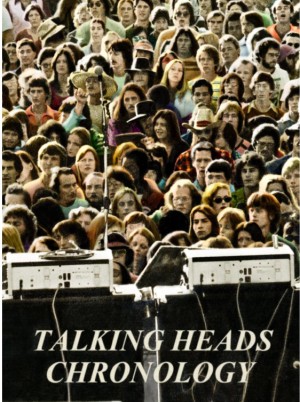
Two recent music DVD releases, Talking Heads Chronology and The Rolling Stones: Some Girls – Live In Texas ’78, offer a fascinating look at two of the most indelible band leaders in rock history. One is a performance-artist deconstructionist, while the other set the standard for all future rock gods. Both know how to move.

nullWhen Talking Heads came on the scene in 1975 they were labeled as preppy art punks. This wasn’t entirely by accident. Television, what with their prog-rock leanings, extended guitar solos, and apocalyptic lyrics, were too committed to their music to be mistaken for anything other than a band. But Talking Heads, at least in the beginning, were toying with the idea of what it meant to be a band. When you listen to More Songs About Buildings and Food or Remain in Light you feel challenged, not because you need footnotes in order to understand the songs, but because you know you are listening to a band stretching the possibilities of a pop song while adhering to the rules of pop. Unlike current art-rock outfits like The Fiery Furnaces or Arcade Fire, Talking Heads, for all their conceptual-art trappings, rarely forgot the skill and talent it takes to create a perfect pop song.

Talking Heads front man David Byrne, who at times resembles a cross between Anthony Perkins younger, more demented brother and Jesse Eisenberg’s Mark Zuckerberg, remains the unlikeliest of rock stars. Long before Bono created his alter ego The Fly, Byrne was deconstructing what it meant to be a rock star. His emotionless stage presence gave him a spooky-cool quality that forced you to lean in a little closer. He wasn’t entirely detached from life, but he was engaging it on his own almost autistic-savant terms. He shunned normal modes of expressions like smiling—or frowning. And Talking Heads made it a point not to write songs about typical rock & roll topics like sex or cars or lust or decadence. Instead they wrote about imagining a world without love (“I'm Not in Love”) or a guy losing control because someone was rude (“Psycho Killer”). They were a quintessential New York band.

Talking Heads Chronology consists mostly of videotaped performances of the band. The early clips are kind of riveting as we see the band as a trio, struggling to create a full sound. (Rhythm guitarist and keyboardist Jerry Harrison hadn’t yet joined the band.) Seeing them perform a song like, say, “I'm Not in Love” at CBGB’s in 1975, you can see how even a sketch of a song could be excitingly unpredictable. Byrne’s punk guitar riffing is thrilling. In the early performances at places like CBGB’s or The Kitchen you can see Byrne trying to overcome an almost crippling shyness. He rarely leaves the mic to prowl the stage. But you sense something is burning inside. You can see it start to come out as they rush through “Thank You For Sending Me An Angel,” a punk version of a galloping country ditty. (Would that make it rockabilly punk?)

As the band grew in popularity they made it a point to play it cool, especially when performing on nationally televised shows. Byrne proves himself a brilliant minimalist when they appear on American Bandstand. Considering all acts that appeared on Bandstand were required to lip-sync and basically mime their performance, the Heads retain their dignity as they showcase their slowed-down cover of “Take Me to the River.”

As Talking Heads expanded their sound and the band, Byrne would give himself over to the rhythm. The highlight on the DVD is a performance of the Fear of Music cut “Animals” for German television. Byrne’s spastic head movements are charming and a little unnerving. (He reminded me a little of DeNiro’s jerky dance in a key moment of Mean Streets.) The song’s climax is given a visual punch when Byrne starts to bob and weave around the stage.

The DVD unfortunately omits the key period of Talking Heads evolution. I assume because of rights issues, there are no clips from Jonathan Demme’s transcendent concert film Stop Making Sense. That’s too bad, because that film shows Byrne (and the band) at their peak. To see Byrne’s gymnastics workout during “Life During Wartime” is simply exhilarating. By the time we see the band reunite to perform “Life During Wartime” at the Rock & Roll Hall of Fame they’re still in sync (even thought they hadn’t performed together in nearly 20 years), and Byrne seems able to show a trace of emotion. He displays the slightest hint of bemusement at being a rock star.

Legend has it that Mick Jagger didn’t start to cut loose until after seeing Tina Turner perform. This isn’t entirely true. Jagger always had a roiling energy itching to get out. You can see it when the Stones perform “It’s All Over Now” on The T.A.M.I. Show. By the time you get to the death-of-a-dream documentary Gimme Shelter, Jagger dances like he’s the prince of darkness. When he shimmies and shakes at the climax of “Sympathy for the Devil,” as if possessed by a demonic spirit, it’s both mesmerizing and frightening. (You wonder how come there wasn’t more violence at Altamont.) Even better is his joyous shoulder moves throughout Ladies and Gentlemen: The Rolling Stones.

The genius of the song “Moves Like Jagger” is that it’s such a perfect summation of what it means to feel the beat. Jagger’s moves are working-man gyrations with a heavy dose of sexual aggression—both masculine and feminine. He doesn’t use any kind of thought-out choreography. Charlie Watts’ drumming dictates his movements. When Adam Levine says he’s “got the moves like Jagger,” we know what he’s really saying is that a moment of happiness can only be expressed through dancing. The phrase “moves like Jagger” is nothing short than a declaration of living in the moment.

nullFilmed in Fort Worth, TX. in support of the Some Girls album, Live in Texas 78 shows the Stones at first looking a little defensive, as if having something to prove. Their previous two albums (It’s Only Rock ‘n Roll and Black and Blue) and tour were met with indifference by everyone except the most hardcore fans. The song “It’s Only Rock ‘n Roll (But I Like It)” was seen as an affront to everything the Stones once stood for. They were now the Establishment. And Punk and Disco were re-invigorating pop music in much the same way the British Invasion did a generation earlier. It almost looked as if The Rolling Stones were no longer relevant.

But Some Girls was a major achievement, a disco-spirited gallop through the seamy side of NYC with punk attitude lyrics. It was a rude, nasty, and cautiously romantic record.

They start the concert a little wobbly. They open with a rather rote cover of Chuck Berry’s “Let It Rock,” treating the song as a palette cleanser. They seem to be going through the motions on the classic Exile cut “All Down the Line.” Jagger’s moves seem a bit mechanical, while Keith looks close to happy. (The fact he had just dodged jail probably explains this.) And nothing seems to surprise the astonishing Charlie Watts.

But then they go into the underrated Goats Head Soup cut ”Star Star” and you see things start to come alive. Then, in an unprecedented move, they go into a seven-song tear through Some Girls. (Apparently, on some nights they would do eight out of the ten songs from the record.) Considering the album was only a little over a month old, this shows the confidence the band had in the new material. (Most major acts will play three or four cuts at he most from their new album on the supporting tour. They implicitly know audiences want to hear the hits.)

They kick things off with the un-PC “When the Whip Comes Down,” a song about leaving home and trying to make it in he city. Lyrically, the song is pretty abrasive (“I was a fag in New York/I was gay in L.A.”), and the hustling beat borders on confrontational. Jagger plays guitar throughout most of the concert and he seems truly energized by both his playing and the songs.

Both “Beast of Burden” and “Miss You” get the extended treatment, with Jagger using his arms to express the emotional yearning in “Burden.” There are extraordinary close-ups of him singing both “Burden” and “Miss You” and he looks lost in the moment. In fact, the whole band rarely comes together in any traditional kind of way. They give workman-like fat-free performances that somehow manage to still connect. On “Miss You,” a stripped-down blues number given a disco-inflected beat, Jagger prowls the stage with purpose. He even points the neck of his guitar down in that exaggerated way that Hendrix made famous. He looks like he’s about to explode as he jumps up and down right before going into the song’s insinuating come-on.

Other highlights include a ridiculously fast “Respectable” and “Love in Vain,” a song the Stones never fail to turn into a showstopper. There are no indulgent numbers like “Can You Hear Me Knocking” or “Midnight Rambler” or “Sympathy for the Devil,” which I’m guessing they still had a moratorium on after Altamont. Instead they manage to liven up the one weak Some Girls cut, their cover of “Just My Imagination.” Jagger almost matches the heartache of the Motown original. (The best version of the song can be found in Martin Scorsese’s terrific Shine A Light.) Tellingly, the Stones don’t perform the controversial title track. With its racially insensitive lyrics (“Black girls just wanna get fucked all night/But I just don't have that much jam”), the Stones decided to play a little nice. (Although, at one point, Jagger says, “If the band is slightly slacking in energy it’s because we spent all last night fucking!”

By the time they perform Chuck Berry’s “Sweet Little Sixteen” Jagger has put down the guitar in favor of some of his trademark moves. (He playfully changes one lyric to “tight dresses and Tampax.”) He even does some classic rock star gimmicks like taking off his shirt and dousing the audience with buckets of water. Live in Texas 78 shows the Stones in transition. Later concert films would show them forsaking the music in favor of spectacle. (Hal Ashby’s 70mm stadium images in Let’s Spend the Night Together upstages the band. The same goes for their IMAX movie At the Max. It wouldn’t be until Shine A Light that they would let the music speak for itself.) The Rolling Stones have long since stopped being dangerous (whatever that means). And when we now see Jagger dance it rarely looks spontaneous. It looks more comforting than anything else. At least we have Live in Texas 78 as evidence that that wasn’t always the case. 

San Antonio-based film critic Aaron Aradillas is a contributor to The House Next Door, a contributor to Moving Image Source, and the host of “Back at Midnight,” an Internet radio program about film and television.

REVIEW: The Trials of (Not) Making a Movie in THIS IS NOT A FILM

REVIEW: The Trials of (Not) Making a Movie in THIS IS NOT A FILM

In the past two years, the Iranian government has moved from merely banning films (most of which were allowed to be released internationally) to arresting actors and filmmakers. Jafar Panahi is the highest-profile director to suffer such treatment. In 2010, his request to travel to the Berlin Film Festival was denied. He was arrested in March of that year, purportedly because he was making a film inspired by the protests following Iran’s 2009 election. In May, he was released on bail. In December, he was sentenced to six years in jail. Furthermore, he was banned from directing films, writing screenplays, giving interviews (even to Iranian media) and leaving the country for 20 years. While he appealed the sentence, he lost it in October 2011. Although he’s currently out of jail, he could be sent back at any moment.

Panahi’s latest film, This Is Not A Film, requires such background information. It was made while he was under house arrest. While this is obvious, it’s never explicitly mentioned. Co-director Mojtaba Mirtahmasb was arrested himself when he tried to attend last fall’s Toronto Film Festival. Panahi’s first feature-length documentary, it’s a work of reduced means, to say the least. Several scenes were shot by Panahi with an iPhone. It wears its poverty as a badge of honor.

Despite the American and Israeli government’s sabre-rattling towards Iran’s nuclear program, Western interest in Iranian cinema has never been higher. Asghar Farhadi’s A Separation has grossed more than two million dollars in the U.S., more than any other Iranian film has ever achieved, and just won an Oscar. The Film Society of Lincoln Center has recently announced a Farhadi retrospective for April. I hope some of this interest rubs off on Panahi and Mirtahmasb’s film, but it’s closer to Jonas Mekas’ diary films than the more familiar Chekhovian sensibility of A Separation.

Who would have thought that a little girl running away from a camera crew would lead Iranian director Jafar Panahi on a path culminating in his arrest and 20-year ban from filmmaking? That moment happened in his second film, The Mirror, which received a cursory American release in 1997. At the time, no one perceived it as a political statement, perhaps because it fit so snugly in the then-current Iranian vogue for neo-realist films about cute children. In retrospect, one can see that it was the start of Panahi’s string of films about rebellious girls and young women. His next film, The Circle, would make his overtly feminist politics a lot clearer.

Until now, Offside, made in 2006, has struck me as Panahi’s most interesting and successful film. It points out the contradictions in Iran’s repressive regime: the ways in which its policies can produce the opposite results for which they’re aiming. As critic Michael Sicinski has suggested, banning women from many areas of Iranian life, including male-only soccer matches, has led to a generation of masculine girls, even if they’re not transgender or lesbian. The climax of Offside suggests that one can reconcile Iranian nationalism and feminism, leading Cahiers du Cinéma editor Jean-Michel Frodon to conclude that Panahi was pandering to the Iranian government. Alas, even if Frodon’s cynical thesis were true, it didn’t work, as Offside, like The Circle and Crimson Gold, was banned in Iran.

nullThe central conceit of This Is Not A Film is that it presents a day in Panahi’s life, although I doubt the entire film was actually shot in one day. On a moment-to-moment basis, it feels casually made, but its structure is carefully planned. It depicts him eating breakfast and talking on the phone with his lawyer and fellow filmmaker Rakhshan Bani-Etemad. (She seems to be suffering a period of idleness herself, although it’s unclear if the law has anything to do with it.) When Mirtahmasb shows up, Panahi talks about his unproduced screenplays and reads from one, treating his living room floor as a set. It deals with a teenage girl prevented from attending college and eventually locked in her room by a religious family. Any similarities to Panahi’s current situation are entirely coincidental, of course. Outside, the city of Tehran prepares for Iranian New Year. Fireworks begin going off, and a neighbor asks Panahi to take care of her dog. Eventually, Panahi ventures into the elevator, in the company of the building’s janitor, and the film ends with him apparently on the verge of heading outside.
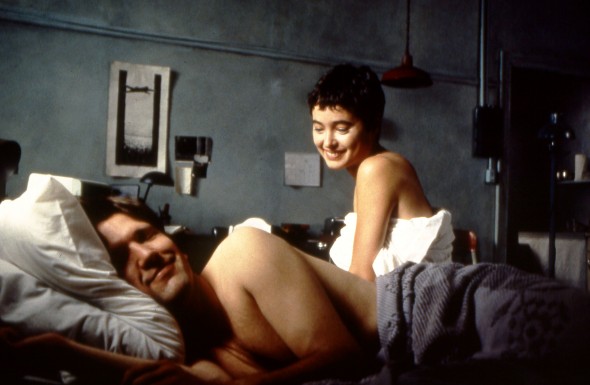
Melancholy as it is, This Is Not A Film is no pity party. It evokes ennui and anxiety without ever being boring itself. Within a compact 75-minute running time, it suggests what it’s like to suffer house arrest. Panahi browses the Internet, but complains that most websites are blocked by the government’s filters and the few that aren’t are painfully bland or propagandistic. He initially seems enthusiastic about reading out his unproduced screenplays for Mirtahmasb’s camera, but he eventually grows disillusioned, finding it an unsatisfying substitute for making them. (Ironically, of course, he is indeed making a film while reading them out loud for the camera.) This film’s very title mocks his 20-year ban from filmmaking, even as it points to the technical limitations with which Panahi and Mirtahmasb had to work.

Understandably, This Is Not A Film has a very raw look. When Mirtahmasb leaves Panahi’s apartment, no tripod is available; at one point, Panahi tries balancing the camera on a pack of cigarettes. In technical terms, the title is correct. This Is Not A Film brandishes video’s differences from 35mm as a political gesture, even a badge of resistance. (Panahi shoots clips from The MIrror and Crimson Gold off a TV monitor, and the former looks particularly crude.) One suspects that Panahi would have shot the whole film on an iPhone if he had to.

In the unlikely event that Panahi’s travel ban is lifted, The Playlist has reported that he had been offered a deal with Sony and producer Scott Rudin to adapt Khaled Hosseini’s novel A Thousand Splendid Suns. So far, Panahi’s work seems so intimately tied to Iran, even if it’s highly critical of the country’s government, that it’s hard to imagine him working outside it. The government’s treatment of him suggests that even if he stays out of jail, he’s unlikely to be able to make a large-scale film there again. This Is Not A Film resembles a film made by the hero of Kafka’s The Trial.

Steve Erickson is a freelance writer who lives in New York. He writes for Gay City NewsFandor's blog, the Nashville SceneFilm CommentThe Atlantic website and other publications. He has made four short films, the most recent being 2009's "Squawk".

VIDEO: Hal Hartley’s Must-See Moments

VIDEO: Hal Hartley’s Must-See Moments

Hal Hartley’s newest film Meanwhile is said to be about a man who can do everything from plumbing to international finance to novel-writing, but who can’t seem to find “success.” But how do we measure success? In a quarter century of iconoclastic filmmaking, Hal Hartley has redefined the “achievement” as it pertains to film. As Meanwhile makes its debut at IFC center Wednesday, February 29, we celebrate several of Hartley’s films with a tribute to classic Hartley moments, especially from his excellent 1991 film, Surviving Desire.

Originally published on Fandor.

Kevin B. Lee is Editor in Chief of IndieWire’s PressPlay Video Blog and contributor to Roger Ebert.com. Follow him on Twitter.

VIDEO – THREE REASONS: King Vidor’s THE CROWD

VIDEO – THREE REASONS: King Vidor’s THE CROWD

[EDITOR'S NOTE: Contributor Robert Nishimura's video series Three Reasons continues with King Vidor's The Crowd. He feels this film deserves attention in light of the Best Picture Oscar for The Artist and is a perfect candidate for restoration and release on the Criterion label.]

The last time the Academy nominated a silent film for Best Picture was in 1929, at the 1st Academy Awards ceremony.  Hosted by Douglas Fairbanks and held at the Hollywood Roosevelt Hotel, the ceremony honored the best films produced in 1927 to 1928.  At that time the Best Picture category was broken into two separate awards, one for Outstanding Picture Production and one for Unique and Artistic Production.  Those distinctions were quickly eliminated in the subsequent Academy Awards in favor of a single statuette for Best Picture.  Although sound film had already made an appearance by this time, all the films nominated for Best Picture (in both categories) were silent.  F.W. Murnau's Sunrise: A Song of Two Humans won for its artistic merit and William Wellman's Wings won for making Paramount an ass-load of money.

It should be no surprise that all of the nominees at the first Academy Awards were for silent pictures, since the event was created to defend itself from the threat of sound film.  Louis B. Mayer (one of the Ms in MGM) came up with the whole idea for The Academy as a response to the shift in technology and as a way to keep "the talent" in their right place.  Essentially a means to praise itself, the Academy Awards reinforce the Hollywood mythology and provide the perfect venue to pat itself on the back.  By the time the 2nd Academy Awards were held the following year, Hollywood had fully embraced sound technology and a silent film was never allowed to grace the red carpet again.

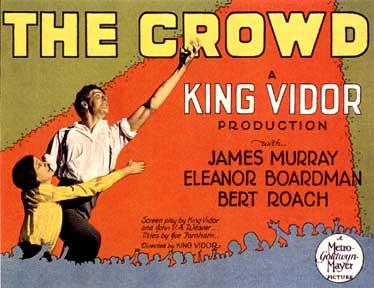
nullAmong the films nominated for Best (Artistic) Picture at that first fabled ceremony was King Vidor's The Crowd.  Considered by many to be his masterpiece and a timeless American classic, The Crowd shares many thematic elements to this years Best Picture winner, Michel Hazanavicus' The Artist.  Although both film's protagonists have similar trajectories, The Crowd is the opposite of how The Artist presents itself. King Vidor's film was remarkably different for its time in portraying a very non-Hollywood representation of everyday life.  While revealing the stylistic influence of his European predecessors, Vidor evoked a natural realism that had not been seen before on American screens.  Casting a relatively unknown actor (James Murray) in the lead role of John Sims, he embodied the everyday struggle of a typically average American trying his best to make his mark in a massively foreboding big city.  An ambitious, experimental, and socially relevant film, its no wonder why it had been nominated for Best Picture, or why it still resonates today.

The film begins with the birth of John Sims on the fourth of July, 1900.  On such an auspicious date, John is destined to become someone great and as his father proclaims, John "is a little man that the world is going to hear from."  We see the progression of John's life from an ambitious childhood to mundane adulthood.  But with every turn of fortune there is equal tragedy (usually double).  In fact almost every moment of brief triumph is accentuated by a harsh bittersweet tragedy that forces John to struggle even harder.  As a child we see John's aspirations to be "someone big."  As soon as these words are uttered John's father immediately dies, leaving John to be the man of the house at an early age.

When John turns 21 he naturally goes to New York City with the high hopes of making it big. We see John at work, one of the many faceless drones in a sea of desks, but John doesn't fit in with the monotonous routine.  John aspires to write ad slogans and is constantly doodling ideas while at work.  He soon meets his bride-to-be, Mary through a co-worker who entices John to a night on the town.  Played superbly by Vidor's wife Eleanor Boardman, Mary provides the next logical step in John's life; get married and have kids.  The expectations that John has towards married life do allow some respite from his boring job, but soon tragedy strikes again by taking their youngest child.  Desperate and unable to work, John's domestic life is threatened to fall apart as well, causing him to contemplate suicide right in front of his son.

John is able to find solace by becoming a member of the crowd, instead of struggling to rise above it.  Like Jean Dujarin's character Valentin in The Artist, John hits rock-bottom by trying to maintain a sense of pride and ambition, and ultimately must learn to embrace conformity in order to survive.  John's self-realization comes full circle when he becomes the very thing that he despised at the start of the film; just another poor sap in the crowd of people.  The last shot of The Crowd finds John seemingly content with his family enjoying a vaudeville show, but as the camera cranes away from the Sims it feels much more desperate than the faceless laughing masses would indicate.  Just as Valentin must perform his little song and dance to regain approval from the studio heads, John must grin and bear the weight of being just another cog in the machine, and one that will inevitably be replaced when the time comes. Vidor is able to perfectly sum up our lot in life with one intertitle, "The crowd laughs with you always…but it will cry with you for only a day."

The same year that King Vidor made The Crowd he made another film that was eerily similar to The Artist. Show People was Vidor's swan-song to the silent era and included cameos from every prominent star of the day.  Chaplin, Fairbanks, and a host of others all showed up to show their support for King Vidor (although it had probably more to do with William Randolph Hearst who was pushing for the project).  It spoke volumes on the transition from silent film to talkies, in addition to being a vehicle for Marion Davis in her portrayal of struggling actress Peggy Pepper.  Both of these Vidor films were re-released in the 80s and Carl Davis composed amazing scores to accompany them, so if Criterion were to release The Crowd it would be an ideal supplement to include Davis' score as well as any others that compliment the film.

It goes without saying that Hazanavicus' borrowed heavily from film history to make The Artist, and possibly from Vidor specifically, but it is not my intention to single out every cinematic reference point of the film.   Hazanavicus clearly has an understanding of silent film choreography and editing that is easily missed by an average moviegoer, but again, this is not about The Artist.  This was just a friendly reminder that we should not forget which came first.  Unfortunately it seems that MGM has already forgotten as The Crowd still remains unavailable on DVD/Blu-ray.  Should Criterion decide to release The Crowd it would allow a home viewing audience to see what Hazanavicus had in mind. The Artist's Best Picture win is the first time a silent film has taken home a statuette in 83 years, but it's not the first time the Academy gave praise to a film that glorifies the Hollywood mythology. As Hollywood runs screaming from yet another technological advancement, history repeats itself.

Robert Nishimura is a Japan-based filmmaker, artist, and freelance designer. His designs can be found at Primolandia Productions. His non-commercial video work is at For Criterion Consideration. You can follow him on Twitter here. To watch other videos in his "Three Reasons" series, click here.

OSCARS DEATH RACE: Sarah D. Bunting wins the Oscars Death race as she surveys the race for Best Documentary Shorts

OSCARS DEATH RACE: Sarah D. Bunting wins the Oscars Death race as she surveys the race for Best Documentary Shorts

null[EDITOR'S NOTE: It's over! With her inclusion of Best Documentary Shorts in this series, Sarah D. Bunting of Tomatonation.com has succeeded in watching every single film nominated for an Oscar this year. Congratulations, Sarah, for winning the Oscars Death Race. You can catch her down at the local bar treating herself to a pleasant alcoholic beverage, celebrating her hard-won victory. For more on how the Oscars Death Race began, click here. And you can follow Sarah through this quixotic journey here. ]

Documentary Shorts Sarah 61, Oscars 0; 24 categories completed, race won

nullThe Barber of Birmingham: Foot Soldier of the Civil Rights Movement. A salute to the many men and women who took enormous risks for the movement without needing name recognition, TBoB introduces us to James Armstrong, a barber in his eighties, on the eve of Barack Obama's election. You can't necessarily separate the man from his relationship to the fight for integration (his sons integrated Graymont Elementary in Birmingham), but I'd rather have seen a tighter focus on the man himself, letting those stories come through him. The talking heads and footage of the inauguration made the film a little flat overall.

God Is The Bigger Elvis. The film that completed the Death Race, it will always have a special place in my heart — but it's a visit with Dolores Hart, once an up-and-coming starlet who foreswore Hollywood to join a Benedictine order almost 50 years ago. Now a mother prioress, she and other nuns talk about that decision, the process of communing with God, and the evolution of their understanding of intimacy. The bittersweet reveal towards the end is lovely and sad.

Incident in New Baghdad. The film is told from the POV of Ethan McCord, an infantryman present at said incident, and runs footage that is truly stern stuff as McCord gives his perspective on what really went down. Its strength is the way it acts as a confessional for McCord, but I think it needed a few more minutes of him and a few less of pointed Fox News coverage.

nullSaving Face. This one knocked me back a step. I hadn't known about the epidemic of women getting acid thrown on them in Pakistan, but this horrible problem (if that's a big enough word for it; I feel it isn't) was on the rise. In 2011, a member of the parliament got a bill through that made it punishable with a life sentence, but prior to that, many victims had to continue living with the husbands and in-laws who had maimed them. Others tried to rebuild their lives and self- esteem through plastic surgery and support groups. Some very upsetting footage; a fairly conventional triumph-over-adversity doc, but well done of the genre.

The Tsunami and the Cherry Blossom. Starts out rivetingly, with home movies of the March 2011 tsunami carrying a moving carpet of destruction towards a hillside — houses, cars, fleeing people. The tension dissipates once the film moves into its central topic: that the cherry blossoms which return to Japan each spring are a symbol of national spirit and resilience. Unpoetic shots of aftermath debris, contrasted with Malick-y portraits of the blooms themselves, get repetitive, but there's interesting stuff here; look out for the tree wrangler (who refers to himself as "the cherry master") who talks about the beauty and terror of nature, and how "we forget the terror."

Should win: No clear leader in my opinion, but the one that really stuck with me is Saving Face.

Will win: My sense is that The Tsunami and the Cherry Blossomhas the lead here.

Sarah D. Bunting co-founded Television Without Pity.com, and has written for Seventeen, New York Magazine, MSNBC.com, Salon, Yahoo!, and others. She's the chief cook and bottle-washer at TomatoNation.comFor more on how the Oscars Death Race began, click here.

SCORE CARD UPDATE: Sarah D. Bunting wins the Oscars Death Race

SCORE CARD UPDATE: Sarah D. Bunting wins the Oscars Death Race

nullCurrent score: Oscars 0, Sarah 61; 24 categories completed

[EDITOR'S NOTE: It's over! With her inclusion of Best Documentary Shorts in this series, Sarah D. Bunting of Tomatonation.com has succeeded in watching every single film nominated for an Oscar this year. Congratulations, Sarah, for winning the Oscars Death Race. You can catch her down at the local bar treating herself to a pleasant alcoholic beverage, celebrating her hard-won victory. For more on how the Oscars Death Race began, click here. And you can follow Sarah through this quixotic journey here. ]For more on how the Oscars Death Race began, click here. The adventure begins.

nullBest Picture:

Best Actor:


Best Actress:


Best Supporting Actor:

nullBest Supporting Actress:

Best Director

Best Foreign Language Film:

Best Adapted Screenplay:

nullBest Original Screenplay:

Best Animated Feature Film:

Best Art Direction:

Best Cinematography:

Best Sound Mixing:

Best Sound Editing:

Best Original Score:

Best Original Song:

Best Documentary Feature:

Best Documentary (short subject):

Best Film Editing:

Best Makeup:

Best Costume Design:

Best Animated Short Film:

Best Live Action Short Film:

Best Visual Effects:

Sarah D. Bunting co-founded Television Without Pity.com, and has written for Seventeen, New York Magazine, MSNBC.com, Salon, Yahoo!, and others. She's the chief cook and bottle-washer at TomatoNation.com.