Watch: The ‘Star Wars’ Climax and the Movies Behind It

Watch: The ‘Star Wars’ Climax and the Movies Behind It

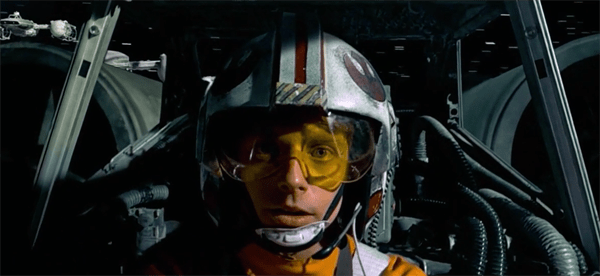
It’s hard to watch the climactic scene in ‘Star Wars: Episode IV’ without breaking a sweat. Why is that? Is it the stakes involved in the story at this point, in which Luke’s quest to destroy the Death Star would read to anyone who had been paying attention as the one thing that could save all human and non-human life? Is it the pacing of the scene? The jump cuts? The constantly changing perspective? Or George Lucas’s shrewd assimilation of myriad influences into one burst of cinematic energy? Julian Palmer has chosen this scene as the final episode in his ‘Discarded Image’ series with 1848 Media, and fittingly: by the end of the scene, one really does feel stunned, wiped out, and, optimistically, gratified, to a degree with which few films of its era could compare. Palmer does an excellent job of exploring the scene, getting under its hood and finding out how it works, and, by extension, telling us quite a bit about Lucas himself, as well as the film’s historical context, in this piece: I look forward to seeing what Palmer will do next.  

Watch: In ‘Hannibal,’ The Script Is Only the Beginning

Watch: In ‘Hannibal,’ The Script Is Only the Beginning

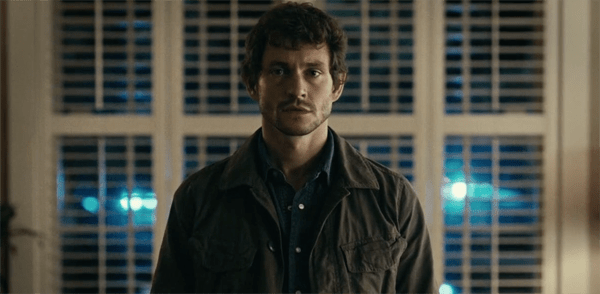
The script is everything and nothing at the the same time. In this video essay, Vashi Nedomansky runs the script for the ‘Hannibal‘ pilot below 5 minutes of the actual episode. And what do we learn? We learn that, to work with Bryan Fuller’s script, DP James Hawkinson had to listen to it. David Slade, the director, could only help him so much–and the vision Fuller might have had in mind was only as executable as he made it on the page. We can see, from the samples we have here, that the script was explicit–but we can also see that scripts don’t move or make noise. For the show to come to terrifying, pristine life, as it has, the visions of the DP and director had to catch fire, somehow. And, judging from the show we have in front of us, that fire was one that would burn for a long time.     

Watch: What Makes a David Lynch Film So… Lynchian?

Watch: What Makes a David Lynch Film So… Lynchian?

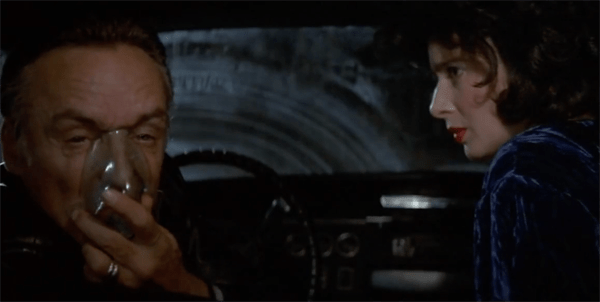
If you ask me the question What makes a David Lynch film "Lynchian"? And I answer, If I have to explain, you probably won’t understand it, I’m not being as obnoxious as you might think. There is a quality to Lynch’s films that resists understanding, description, summary, analysis, or any of the other activities we engage in to make artworks more palatable. This excellent new video essay by Kevin B. Lee for Fandor, using text from Dennis Lim’s book David Lynch: The Man from Another Place comes as close, really, as one might ever get to characterizing Lynch’s work, with some surprising cameos. Susan Boyle? Lynchian? Perhaps. You be the judge…

Watch: Brian De Palma’s Split Diopter Shot Creates Worlds Upon Worlds

Watch: Brian De Palma’s Split Diopter Shot Creates Worlds Upon Worlds

Because Brian De Palma is fascinated by the inherently Byzantine nature of human activity, be it war, detective work, murder, or espionage, it makes perfect sense that he would be drawn to the split diopter shot, which uses an attachment that gives equal focus to both close and distant objects. De Palma doesn’t want us to miss anything. Even as Caruso sings on stage, the murderous Al Capone sits a matter of feet away from him, in ‘The Untouchables‘; even as a drone scratches his head in ‘Mission: Impossible,’ a stealthy thief hangs above him; even as a blond, all-American teen boy sits bored at a classroom desk, a tortured girl writhes inwardly not far away from him in ‘Carrie.’ What’s the effect? It’s a tightening in the chest, it’s a sense that there’s something we missed previously, it’s the feeling that something bad is about to happen, or could. This video by Jaume Lloret is a tight visual hymn to De Palma’s famed use of the shot–watch it, and see if you don’t feel uncomfortable afterwards.   

Watch: For Christopher Nolan, Hands Are a Locus of Power

Watch: For Christopher Nolan, Hands Are a Locus of Power

In the work of Christopher Nolan, hands shape the world, reclaim it, destroy it, ameliorate it, keep in order, drive it to a state of chaos, hold it back, steer us through. And in so being, how is Nolan’s work any different from any other filmmaker, you ask? It’s that Nolan gently nudges us with the idea of the hands’ supremacy. For a director who at times seems to be bursting with florid bombast, he also relishes in quiet moments, so much so that a detail like recurring use of hand close-ups might be the last thing you would notice and yet, simultaneously, the most important thing of all. This video essay by Jorge Luengo moves us through Nolan’s filmography, drawing our attention to the quiet primacy these appendages can obtain.

Watch: Robert Bresson, Master of the Self-Sustaining Shot

Watch: Robert Bresson, Master of the Self-Sustaining Shot

Robert Bresson was a French filmmaker whose minimalist approach to filmmaking and dedicated precision in his style made him a favorite among his contemporaries and the following generation of filmmakers—most notably Jean-Luc Godard and Andrei Tarkovsky, both of whom cited him as a strong influence. His filmic philosophies of using real locations, non-actors, and retaining authorial control helped to inspire the start of the French New Wave.
 
Bresson was born in 1901 in central France and later moved to Paris where, as a young man, he wanted to be a painter. In fact, he didn’t make his first feature film until he was already in his early forties. By that time, he had been a prisoner of war for a year and his debut film, released in 1943, would be his only feature film made during the Nazi occupation of France. The film is titled ‘Angels of Sin’ and follows a young woman who decides to become a nun. ‘Angels of Sin,’ as well as his second film, would be the only of Bresson’s films to feature a cast of professional actors.
 
His time spent as a prisoner of war would influence one of his most famous films, titled ‘A Man Escaped,’ which follows a French Resistance fighter in Nazi-occupied France named Fontaine, who is taken prisoner. The film traces Fontaine’s attempts to escape the prison, and the story is based on a real person named Andre Devigny who managed to escape a Nazi-run prison in France during World War II. Bresson tells this story as factually as possible—the events are not sensationalized, and this allows us to better connect with the experience of Fontaine’s predicament and put ourselves in his shoes.
 
Catholicism would also be a major influence on his work, showing up in nearly all of his films, and several center entirely around the religion. Bresson himself was said to have identified as a “Christian Atheist,” although it is unclear to what extent. The themes of his films range from finding salvation and redemption to commentary on French society.
 
Perhaps his most famous film, titled ‘Pickpocket,’ follows a thief learning and practicing techniques to master his craft. Bresson’s discipline as a painter most likely contributed to the precision of his shots. He would storyboard his shots alone and then set his drawings aside never to look at them again during production. He is well-known for fragmenting the body through composing shots of hands or feet, which was part of his aim to find and define the language of film as opposed to many other films, which could just as easily be done on the stage.
 
In his forty years of filmmaking, Bresson would make only thirteen films, yet his impact on cinema as an art form leaves us with a masterful and unique demonstration of what the medium can do.


Clips:

‘Angels of Sin’ (1943 dir. Robert Bresson)
‘Diary of a Country Priest’ (1951 dir. Robert Bresson)
‘A Man Escaped’ (1956 dir. Robert Bresson)
‘Pickpocket’ (1959 dir. Robert Bresson)
‘The Trial of Joan of Arc’ (1962 dir. Robert Bresson)
‘Au hasard Balthazar’ (1966 dir. Robert Bresson)
‘Mouchette’ (1967 dir. Robert Bresson)
‘A Gentle Woman’ (1969 dir. Robert Bresson)
‘L’argent’ (1983 dir. Robert Bresson)
‘Breathless’ (1960 dir. Jean-Luc Godard)

Tyler Knudsen, a San Francisco Bay Area native, has been a student of film for most of his life. Appearing in several television commercials as a child, Tyler was inspired to shift his focus from acting to directing after performing as a featured extra in Vincent Ward’s What Dreams May Come. He studied Film & Digital Media with an emphasis on production at the University of California, Santa Cruz and recently moved to New York City where he currently resides with his girlfriend.

Watch: Michael Powell’s ‘Peeping Tom’ Painted the Perversity Born of Loneliness

Watch: Michael Powell’s ‘Peeping Tom’ Painted the Perversity Born of Loneliness

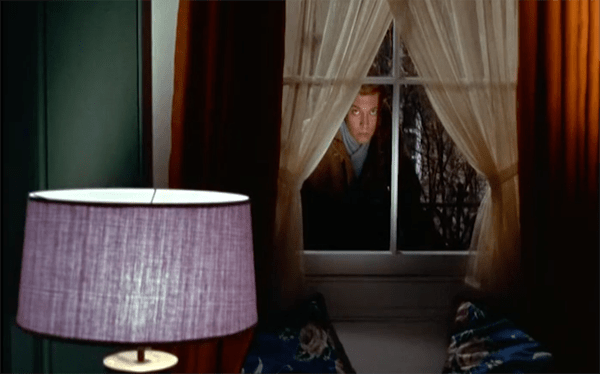
Of course Martin Scorsese championed Michael Powell’s ‘Peeping Tom.’ Scorsese knew a fellow connoisseur of isolation when he saw one. This video essay by the Weld Art Collective deftly explores this classic, teaching a little bit about its remarkable director, as well as his frequent collaborator Emeric Pressberger. Without films such as this story of a murderous, perverted photographer, the films of Brian DePalma, David Lynch, Ken Russell, and other similar directors would either be different or would not exist. Powell’s films have an enduring mystery about them, possibly because he takes on subjects which are themselves, in a sense, depthless. 

Watch: Paul Thomas Anderson’s Very, Very Independent Roots

Watch: Paul Thomas Anderson’s Very, Very Independent Roots

Watching a director in their earliest attempts can be highly enlightening about their future methods and work, as shown in this new video essay in the Raccord collective’s excellent Directors Series, made by Cameron Beyl, about the starting years of Paul Thomas Anderson. Not only do we glance at ‘The Dirk Diggler Story,’ the very cheaply made short that blossomed into ‘Boogie Nights,’ but we also take a look at ‘The Hard Eight,’ the gorgeous gambler drama that would give Gwyneth Paltrow one of her great early roles. Enjoy.

Watch: Michael Mann As a Master of Digital Filmmaking in ‘Public Enemies’

Watch: Michael Mann As a Master of Digital Filmmaking in ‘Public Enemies’

In this installment of "The Unloved," a series of video essays for RogerEbert.com on films which didn’t necessarily find widespread critical acceptance on their delivery, Scout Tafoya takes up ‘Public Enemies,’ Michael Mann’s voyage to the 1930s gangster universe of John Dillinger and his ilk. Tafoya emphasizes the degree to which Mann made digital cinematography his own in the film, an interesting point and one which, if applied properly, could be a mind-changer in looking at this less popular of Mann’s films. At the time the film was released, Press Play published Nelson Carvajal’s gangster movie homage, whose text accompaniment a skeptical eye on the film’s chances—this video piece by Tafoya might encourage those who shared that skepticism to give the film a second look. 

Watch: The Doorway Shot in Film Points Outwards and Inwards at the Same Time

Watch: The Doorway Shot in Film Points Outwards and Inwards at the Same Time

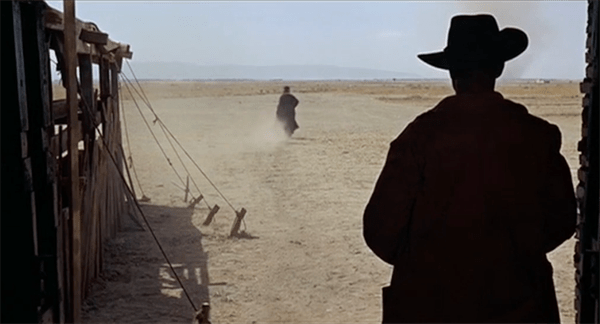
If a director places a figure standing in a doorway, looking off into the distance, where does the viewer’s gaze go? Invariably, it will both go through the doorway, towards all that lies beyond it, but it will also, in a strange way, go back inwards, towards all a character may be turning away from or leaving. This new video compilation by ever-prolific Jake Swinney for Fandor takes us through doorway shots from cinema history, starting with John Ford’s ‘The Searchers,’ which contains the grand-daddy of all doorway shots, and then moving on to directors such as Paul Thomas Anderson, Quentin Tarantino and others.