VIDEO ESSAY: Ninja Turtles: Generation Y in a Half Shell

VIDEO ESSAY: Ninja Turtles: Generation Y in a Half Shell

“Ugh. Where do they come up with this stuff?” groans a frustrated Raphael, the brooding, red-bandana-wearing member of the Ninja Turtles, whilst walking out of a New York movie theater that’s playing the 1980s creature feature Critters. Here’s why this is an important scene in director Steve Barron’s live-action film Teenage Mutant Ninja Turtles: The 1980s saw an explosion of brawny, Reagan-infused cartoon TV series (e.g. Transformers and G.I. Joe) and live-action romps (e.g. the American family battling the furry aliens in Critters is yet another microcosmic representation of Reagan’s war against international terrorism), but when TMNT hit cinemas in the spring of 1990, its band of sewer-dwelling, skateboard-riding (mutant) outcasts aligned themselves with what we call Generation Y (people born between the late 70s and early 90s), leaving behind the pandemic seriousness of the 80s (industrializing economies, wars in the Middle East, etc.) and embracing a childlike irreverence, a burgeoning urban terrain and yes, lots of pizza with no anchovies. The Turtles were in a pop culture class all by themselves. After emerging as an overnight sensation with comic book fans (Ninja Turtles’ creators Peter Laird and Kevin Eastman only printed 3,000 copies of the original black and white magazine-style comic book in 1984), the Ninja Turtles quickly became a phenomenon both onscreen (its popular animated TV series debuted in 1987) and off (Playmates Toys began producing Turtles action figures in 1987, becoming regular “must-haves” for the youth). Considering all of this Turtlemania, it’s remarkable that Barron’s live-action Turtles film was able to thwart the “Saturday morning” innocence of its source material and create a dark, atmospheric film which dug a little deeper into the themes that would interest its target audience—Generation Y.

In many ways, the Ninja Turtles were the perfect mirrors for the angst-driven Generation Y’ers. Take the case of the family unit, for example. Unlike the generation that came before theirs (Generation X), a substantial number of Generation Y’ers were born into single-parent families. The four Ninja Turtles—Leonardo, Michelangelo, Donatello and Raphael—were no different, living only with their father Splinter (a giant rat), in the most poverty-stricken of homes: a sewer lair. And like most young Generation Y’ers, the Turtles dealt with their anxieties by turning familiar behavioral schemes into occasionally distracting daily routines: The Turtles blended the speech patterns of 1989’s Bill & Ted’s Excellent Adventure into their own vernacular (“Cowabunga!”), while also applying the Ninjutsu practices of 1988’s Bloodsport during their ventures onto the battle worn streets of New York.

Throughout TMNT, isolation is opposed to acceptance. Although the Turtles have a haven in their reclusive sewage den, the rest of New York’s teenage population (i.e. the movie’s “real” Generation Y) seeks acceptance (and shelter) from the Foot Clan, an underground gang overseen by the villainous Shredder. In a disarming scene, Shredder addresses his hordes of loyal teen followers: “You are here because the outside world rejects you. THIS is your family. I am your father.” The dark, striking images in these sections of TMNT (pre-teens smoking cigarettes, young kids fighting each other as part of the training to become a “foot soldier”) are a precursor to future Generation Y films of the 90s that follow teens desperately seeking acceptance, even in the midst of violence (e.g. Menace II Society, Juice and The Basket Ball Diaries). And for a PG-Rated “children’s movie,” the Ninja Turtles talk in a shockingly racy way, too (on more than one occasion, Raphael angrily yells out “Damn!”).

Perhaps the one aspect of TMNT that is not directly linked to Generation Y is its technical accomplishment. The Jim Henson Creature Shop (famous for introducing The Muppets to the world) made an indelible impression on young hearts and minds in multiplexes during the spring in 1990. The lifelike turtle bodysuits that the performance actors wore had movable mouths and blinking eyes. Even the skin of these turtle bodysuits seemed to sweat and pulsate. Detractors of the film always point to the obvious absurdity of watching four grown men high-kicking in giant turtle costumes. But to get hung up on that would ignore how special a film like this can be when it’s done right (as in Spike Jonze’s 2009 live-action film Where The Wild Things Are). And TMNT gets it right. Like the best children’s stories, fables and films, the Teenage Mutant Ninja Turtles movie earns its place as a seminal work of popular fiction by acting as a cultural prism through which viewers (in this case Generation Y) can develop a more profound sense of their identity—depending on their cultural and historical vantage point. As the Turtles would say: “Totally tubular, dude!”

Nelson Carvajal is an independent digital filmmaker, writer and content creator based out of Chicago, Illinois. His digital short films usually contain appropriated content and have screened at such venues as the London Underground Film Festival. Carvajal runs a blog called FREE CINEMA NOW which boasts the tagline: "Liberating Independent Film And Video From A Prehistoric Value System."

BEAVER’S LODGE: THE PROFESSIONALS (1966)

BEAVER’S LODGE: THE PROFESSIONALS (1966)

This is the third installment of BEAVER'S LODGE, a series of video essays narrated by actor Jim Beaver which will offer critical takes on some of Beaver's favorite films. Jim Beaver is an actor, playwright, and film historian. Best known as Ellsworth on HBO’s Emmy-award winning series DEADWOOD and as Bobby Singer on SUPERNATURAL, he has also starred in such series as HARPER'S ISLAND, JOHN FROM CINCINNATI, and THUNDER ALLEY and appeared in nearly forty motion pictures. You can follow Jim on Twitter.

There was a time when a certain kind of adventure film was popular. The 1960s were its heyday. Sometimes they were realistic, or even drawn from real life. Sometimes they were fanciful. But almost always they were intelligent and enormously entertaining. I haven't seen a new example of that kind of film in 30 or 40 years. Maybe they exist, maybe I've simply forgotten them or never knew of them. But I don't think they make that kind of movie anymore (though I suspect Hollywood thinks it still makes them). I'm thinking of movies like The Dirty Dozen, Von Ryan's Express, The Magnificent Seven, The Great Escape, The Guns of Navarone, and this one, The Professionals.

The Professionals is about four rugged experts in various fields, hired by a rich man to rescue his wife, abducted by a Mexican revolutionary near the Texas border around 1917. Lee Marvin, Woody Strode, Robert Ryan, and Burt Lancaster are the charismatic title figures, each particularly well-equipped for one aspect of the mission. Ralph Bellamy is their wealthy employer, Claudia Cardinale his buxom Latina wife, and Jack Palance is the revolutionary, Raza, with whom Marvin and Lancaster once rode. And Marie Gomez is Chiquita, a delectable tough girl, *really* tough, in a way that suggests it's her way of life, not something the script called for her to do.

Accompanied by a jaunty, rousing score by Maurice Jarre, the film by Richard Brooks is delirious masculine fun, an adventure filled with derring-do, witty quips, and just enough pseudo-depth to make it seem like it means something beyond the fun. I can't speak for women, but it's the kind of movie no guy can pass up, no matter how many times he's seen it. They don't make 'em like this anymore. And it's a shame.
 

VIDEO ESSAY: BEAVER’S LODGE: OUR HOSPITALITY (1923)

VIDEO ESSAY: BEAVER’S LODGE: OUR HOSPITALITY (1923)

This is the second installment of BEAVER'S LODGE, a weekly series of video essays narrated by actor Jim Beaver which will offer critical takes on some of Beaver's favorite films. Jim Beaver is an actor, playwright, and film historian. Best known as Ellsworth on HBO’s Emmy-award winning series DEADWOOD and as Bobby Singer on SUPERNATURAL, he has also starred in such series as HARPER'S ISLAND, JOHN FROM CINCINNATI, and THUNDER ALLEY and appeared in nearly forty motion pictures. You can follow Jim on Twitter.

A guest at a screening of this masterpiece at my home recently literally leaped out of her seat upon seeing the final, transcendentally beautiful stunt executed by Buster Keaton. I've never seen anyone do that except at a horror movie. Our Hospitality is a comedy, without an ounce of horror element. Yet it has heart-stopping thrills, made all the more heart-stopping by the knowledge that it was Keaton himself risking his neck in stunts that no star until the Keaton-inspired Jackie Chan would approach, seventy years later.

The title Our Hospitality refers to a peculiar brand of rural courtesy that says one can't murder a guest INSIDE one's home. The Hatfield-McCoy feud of legend is the inspiration for this story of a young man (Keaton) coming home to claim his inheritance, unaware of the feud between his family and another that will lead anyone in the other family to try to kill him on sight. Invited by fluke into the Canfield family residence, young Joseph McKay (Keaton) learns of the feud and realizes his only safety lies in never leaving. This is the setting for the central comedic sequence of the film, in which the Canfield family is constantly on the ready to shoot him whenever he gets anywhere near an exit door. It's pretty amazing how many brilliant comic variations Keaton is able to play out with the situation.

The earlier portion of the film is wonderful in its own right, both for the masterful comedy of which Keaton was unmatched at creating and for the wonderfully amusing look at 1830, the period in which the film is set. Manhattan's Broadway and 42nd Street intersection is not much more than a pasture, yet people are already complaining about the traffic. Keaton, who in real life was a railroad buff, recreated the first locomotive for this film, and it is both historically fascinating and wildly funny to watch his trip across country on rails that can be moved out of the way to avoid obstacles and which aren't always even necessary for the train's progress.

The final third of the film is a thrill-seeker's paradise. On the run from his enemies, Keaton finds himself adrift in a cascading river along with the girl he loves (the daughter of the enemy Canfield clan). Keaton's attempts to save himself and then his girl from the spectacular waterfall toward which they race is one of the great comedic stunt sequences of all cinema.

It's difficult for me to pick my favorite Buster Keaton film, but this is usually the one I show to people I want to convert to Keaton idolatry. I've never known it to fail. The word classic gets thrown around a lot—maybe not as much as the dreaded awesome, but far too frequently, nonetheless. But this is a genuine comedy classic. It's awesome.


VIDEO ESSAY: CRUEL SUMMER: BATMAN (1989)

VIDEO ESSAY: CRUEL SUMMER: BATMAN (1989)

The "Cruel Summer" series of articles examines influential movies from the summers of the 1980s. The previous entries in the series have covered THE BLUES BROTHERS (1980), STRIPES (1981), ROCKY III (1982), WARGAMES (1983), PURPLE RAIN (1984), PEE-WEE'S BIG ADVENTURE (1985), TOP GUN (1986), ROBOCOP (1987), and DIE HARD (1988).

Tim Burton’s Batman was a game-changer for summer blockbusters. It closed out a decade marked by light and sunny escapist entertainment by applying a more serious, atmospheric attitude, both dark and thrilling. It also ushered in a new level of hype that became an integral part of the movie-going experience. And it pointed the way for comic-book movies to become the dominant vehicle for summer entertainment.

Before Batman, Hollywood had created comic-book movies as silly, second-tier product. With the exception of the first Superman movie, comic-book movies lacked high production values and fidelity to their source material.

Things began to change when comic-book artists like Frank Miller and Alan Moore offered their takes on the superhero genre. Miller’s The Dark Knight Returns brought a new level of psychological depth and graphic sophistication to comics.

Meanwhile, Hollywood was searching for the new Steven Spielberg or George Lucas, another prodigy with a childlike sense of wonder to dazzle audiences. Enter Tim Burton, who scored two hits, Pee-Wee’s Big Adventure and Beetlejuice, before turning 30. The surprise success of these dark, anarchic films marked Burton as having the ability to be edgy and still appeal to mass audiences. The execs at Warner Brothers could sense that audiences’ tastes were changing and a risk-taker like Burton might be necessary for Batman.

Batman arrived at the end of a decade where greed ran rampant, recession was imminent and people sensed things were getting worse, not better. Burton’s vision of Batman matched his audience’s feelings of restlessness and unease.

Every aspect of the movie was infused with Burton’s desire to present the world of Batman as a reflection of modern dystopia. Anton Furst’s groundbreaking production design took elements of Metropolis, Blade Runner and Depression-era Art Deco Manhattan, heaping layers of urban squalor upon itself.

But if there’s one image that defines the bold new vision of Burton’s Batman, it’s the Batsuit. Designer Bob Ringwood totally rejected the gray and blue image from the camp TV series. Ringwood’s design is a suit that contains drama in itself, something powerful but unwieldy, something closer to Robocop than Adam West. The Batsuit is a vision of man made superior by advanced technology, but also encased and imprisoned by it. It’s a 21st-century suit of armor for a Dark Knight, and it is still the template for how we see Batman today.

At the same time, the new Batman’s rigidness made him a foil for the film’s true protagonist. The Joker, with his anarchic wit and irreverent gags, is the heir to Beetlejuice. the charismatic anti-hero and master of ceremonies of Burton’s funhouse. At the same time, he was the comic alibi that could make Burton’s seriousness acceptable, breathing life and energy into his arty aspirations.

The Joker may have overwhelmed Batman in this film, but looking at the superhero movies that followed, we see the real winner, in a legacy of dark, disturbed protagonists whose vulnerabilities reflect the anxieties of our era. At the same time, Batman’s demons yielded a new dimension of interior drama and fragility that feels real—something that modern-day superheroes with their unlimited CGI powers can’t compensate for.

With its groundbreaking character types and radical visuals, Batman provided a new template for blockbuster storytelling, one that could even overcome its greatest weakness: its script. The plot of Batman may dip into incoherence, revolving around the Joker’s wanting to become some kind of homicidal artist by poisoning the citizens of Gotham until they die with a smile on their face.

Then again, the plot holes didn’t seem to matter to audiences. What mattered was the vision, the mood, the experience of a live-action comic-book movie that treated its source material seriously. Burton’s Batman provided the signal for a new comic-book movie whose ambitions often surpassed its abilities to deliver. These films are often incoherent or overloaded, but at their best, they come through with unforgettable images and moments. The Joker’s master plan has come to fruition. For better or worse, we exit the theater with a smile on our face.

San Antonio-based film critic Aaron Aradillas is a contributor to The House Next Door, a contributor to Moving Image Source, and the host ofBack at Midnight,” an Internet radio program about film and television.

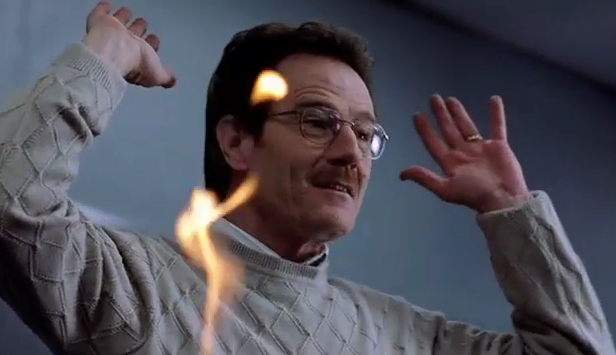
VIDEO ESSAY: From Mr. Chips to Scarface: The Evolution of Walter White

VIDEO ESSAY: From Mr. Chips to Scarface: The Evolution of Walter White

"Walter's a shithead!"

I had just walked in the door to the family home in Forestville, California. My dad had just finished the second season of Breaking Bad, specifically the episode "Phoenix," in which Walter (Bryan Cranston) passively allows Jesse's heroin-addicted blackmailing girlfriend Jane (Krysten Ritter) to choke to death on her own vomit. "I mean, he just stood there and let her die. He cried at the end, but still," my dad recounted, disgusted and amazed at the same time. Now, understand that my father is a pacifist hippie who would rather laugh than cry and much prefers Californication over Mad Men (which I give him slack for every minute I can—including while I’m writing this), but I'm sure other viewers have had a similar reaction to Walt's progression from a bumbling schoolteacher who doesn’t know where the safety tab on a gun is located to a meth kingpin, and the collateral damage in between.

Personally, I had an opposite reaction to my father’s: I feel that the show is at its strongest when it exposes the moral gray matter of Walt's decisions. Like AMC's other headliner show Mad Men, Breaking Bad doesn't excuse its protagonist's behavior like so many other shows do ad nauseum, as it reinforces and even underlines his vulnerabilities, and it boldly forgoes the safety net of having a sex symbol as a leading man. Gone are the excuses that he needs money for chemotherapy and his family. Walt has worked his way up, from Mr. Chips to Scarface, as Vince Gilligan likes to say, but now more than ever, there's nowhere to go but down. All we can do is look at him with some amount of disgust at his actions—and with amazement at how far the show has come.

Serena Bramble is a rookie film editor whose montage skills are an end result of accumulated years of movie-watching and loving. Serena is currently pursuing a Bachelor's degree in Teledramatic Arts and Technology from Cal State Monterey Bay. In addition to editing, she also writes on her blog Brief Encounters of the Cinematic Kind.

VIDEO ESSAY: BEAVER’S LODGE: EMPEROR OF THE NORTH POLE

VIDEO ESSAY: BEAVER’S LODGE: EMPEROR OF THE NORTH POLE

This will be the first installment of BEAVER'S LODGE, a weekly series of video essays narrated by actor Jim Beaver which will offer critical takes on some of Beaver's favorite films. Jim Beaver is an actor, playwright, and film historian. Best known as Ellsworth on HBO’s Emmy-award winning series DEADWOOD and as Bobby Singer on SUPERNATURAL, he has also starred in such series as HARPER'S ISLAND, JOHN FROM CINCINATTI, and THUNDER ALLEY and appeared in nearly forty motion pictures. You can follow Jim on Twitter.

I love this movie. Let's get that out of the way before I start in on a rant about studio stupidity.

This film is about hobos riding the rails of Depression-era America. It was made and originally released as Emperor of the North Pole. After initial screenings, Twentieth Century Fox executives feared that audiences might think the title indicated a Christmas movie (!) or an Arctic exploration story and so shortened the title to Emperor of the North, a change that made little sense in terms of audience expectations and none at all in light of the fact that "Emperor of the North Pole" is a hobo term used extensively throughout the film. To be emperor of the North Pole, in hobo jargon, is to be king of the road. To be emperor of the north means some idiot is in charge of the title.

This is a tough little picture, directed by Robert Aldrich, no stranger to tough little pictures (Kiss Me Deadly, The Dirty Dozen). It is written by Christopher Knopf (a true gentleman, by the way), reportedly from stories by Jack London. It stars Lee Marvin as the toughest 'bo on the rails and Ernest Borgnine as the meanest man ever to run a train. Keith Carradine is a windy, self-important, and callow kid who thinks he can play with the big boys. Borgnine's Shack is the conductor on #19, a freight train plying the rails of the Pacific Northwest. His driving passion is to prevent hobos from stealing free rides on his train, and he's willing to kill and maim to stop them. Marvin, as "A-No. 1," decides to ride the 19 and show Shack just who is Emperor of the North Pole.

nullMarvin is just about perfect in this gritty film. His makeup, his wardrobe, his demeanor, everything about him screams 1930s tough guy on the bum. There's no glamor to this star turn. The same can be said for Ernest Borgnine, though glamor admittedly was never his strong suit. Borgnine was one of the most decent men in Hollywood, but when he played a heavy, there were few nastier fellows in the business. His intensity and cruelty as the obsessed Shack are brilliantly delineated. Keith Carradine is irritating as Cigaret, the peacock kid who thinks he's as tough as they come. But he's supposed to be irritating, and it's a fine performance.

This is also one of those films that pulls together a passel of great character actors (Elisha Cook Jr., Malcolm Atterbury, Charles Tyner) and leaves one wondering where all the wonderful, familiar faces that used to populate Hollywood films have gone, and why we don't see such collections of comfortably resonant characters so much anymore. (I think I know why, but that's corporate talk, for another discussion.)

Most of the action takes place on board the train, and some of it is harrowing. Of particular note is the fact that most of the leading actors put themselves at some extended risk in the making of the film. Long before CGI special effects made such things meaningless, it's clear in this movie that it really is Ernest Borgnine, Lee Marvin, Keith Carradine, and Charles Tyner walking, running, and clambering on, around, and UNDER a speeding train. Surely safety measures were taken, yet it's wonderful to see shots where one misstep could have cost a star, not a stuntman, his life–even as it's good to know nothing like that happened.

Aside from my disgust with the stupidity of the title change, and a couple of too-cutesy moments in the music and a river baptism scene, Emperor of the North Pole is a favorite of mine, an exciting film as tough as old leather and as harsh as the era it depicts. And it's got Lee Marvin and Ernest Borgnine, two of the hardest hard cases in movies, going head to head. It's a great ride.
 

VIDEO ESSAY: THE DARK KNIGHT: NOLAN’S MODERNIZED MYTH

VIDEO ESSAY: THE DARK KNIGHT MYTH

When director Christopher Nolan first conceived of his Batman film trilogy, the challenge was revitalizing a hero who had previously been buried in cinematic fantasy shtick—a de-evolution that started with Tim Burton’s promising Batman and ended with Joel Schumacher’s laughably bad Batman & Robin. And Nolan wasn’t a franchise superhero movie director either. From the get-go, Nolan was an unlikely choice to take over such a mammoth cash cow for Warner Bros. Nolan’s previous films—Following, Memento and Insomnia—were small by comparison with the Batman films but shared the common narrative thread of a protagonist struggling to find moral redemption amidst the chaotic (psychological) forces of each film’s unique environment.  Therefore, the Batman mythos and its dark, enigmatic origin story of a billionaire turned self-made vigilante proved an apt fit for the intellectual Nolan—ultimately helping the director edge out the likes of Boaz Yakin (Remember The Titans), Darren Aronofsky (Black Swan) and Wolfgang Petersen (Air Force One) for the job of rebooting the series.

In his first entry, Batman Begins, Nolan’s masterstroke lay in envisioning Gotham City as a modern, real city. Gone were the colorful, circus-like set pieces from earlier Batman films. There weren’t any fantastical lairs or alternate dimensions. Nolan’s Gotham had public transportation, seedy corporate suits, corrupt court systems and even a lower-income housing area only accessible by street bridges. By positioning a beloved comic book superhero in a very accessible and believable environment, Nolan transcended the dated source material and forced audiences to re-evaluate Batman’s role. In other words, it wasn’t so much about what outrageous predicament Batman would have to punch (Pow!) his way out of. It was more of seeing how this new Batman could plausibly function within the day-to-day operations of the modern urban world.

After establishing a parallel “real” society in Batman Begins, Nolan raised the stakes with The Dark Knight. By zeroing in on the very relevant, modern topic of terrorism, Nolan recreated the post-9/11 atmosphere of dread and fear for the citizens of Gotham. In The Dark Knight, Nolan separated the villainous Joker character from his silly, cartoonish origins and recreated the Joker as “an agent of chaos”—a volatile criminal hell-bent on demoralizing the citizens of Gotham. The Joker’s plan was simple: If he could invoke the fear of death at every corner for every Gotham citizen, a radical unbiased social structure based on elemental fear would emerge. Thus, this society would be in constant stasis; the people of Gotham would be united by fear but torn apart by their animalistic instincts to outlive one another.

Putting Batman in the backseat in a Batman film was an important gesture for this movie and for Nolan’s work—as well as a first in the Batman filmography. In The Dark Knight, Batman himself was unusually absent from the screen, allowing for an array of equally compelling characters to come through. By building the film this way, Nolan deconstructed the mythology behind the Batman figure. Specifically, this once indomitable hero from comic book legend now became as vulnerable as anybody else in Gotham (or the real world for that matter).

Still, the fundamentals that Batman stood for as a comic book hero—justice, social order and establishing a sense of collective moral hope for Gotham—were evident in Nolan’s interpretation of the caped crusader (e.g. Batman reconciled both his and Gotham’s disillusionment with faux heroism by taking the blame for Harvey Dent’s murderous rampage in The Dark Knight). More interestingly, Nolan’s modernized Batman redefined the function of the traditional myth. Consider: The comic book Batman’s original Sociological Function was to establish a proper social order by existing outside the parameters of society, as an elite hero. In the comic book and earlier film adaptations, Batman was only accessible to Gotham’s police (via a red telephone or a bat signal in the sky); this exclusivity positioned Batman to exist as an intangible, incorruptible and unbelievably fantastic heroic figure. Yet, in Nolan’s screen narrative, Batman has been dethroned from his once-elusive crime fighter status. In an obscenely modern twist, Nolan looks to argue that order in any society cannot rest solely on an elected or officially prominent figure.

The promotional clips for Nolan’s third and final entry, The Dark Knight Rises, show Batman in the war zone streets, fighting alongside the citizens of Gotham. This is fitting imagery for Nolan’s modernization of this once-romantic comic book myth. The new Batman mythology isn’t meant to serve as adventurous escapism. The new Batman mythology reflects our very modern world, a society desperately trying to restore order amidst all the chaos—without having to always flash a bat signal in the sky.

Nelson Carvajal is an independent digital filmmaker, writer and content creator based out of Chicago, Illinois. His digital short films usually contain appropriated content and have screened at such venues as the London Underground Film Festival. Carvajal runs a blog called FREE CINEMA NOW which boasts the tagline: "Liberating Independent Film And Video From A Prehistoric Value System."

VIDEO ESSAY: HAJI!

VIDEO ESSAY: HAJI!


I personally prefer the aggressive female . . . the superwoman. — Russ Meyer

In the 1960s there was a huge revival in striptease by way of topless go-go dancing. In Los Angeles there were a bevy of strip clubs that catered to all tastes. One particular swanky strip joint on La Cienega Boulevard, called The Losers, highlighted unpopular figures from current events. Richard Nixon, Fidel Castro, and other celebrity screw-ups would be lit up on the billboard as the loser of each week. Aside from that tasteless gimmick, The Losers was a little more classy than your usual strip club. Its dancers promoted classic burlesque and Las Vegas-style showmanship that attracted more sophisticated customers. One infamous patron of the establishment was Russ Meyer, who would often go there to select the sumptous starlets for his features. Nearly all of Meyer's stars began their career at The Losers: Tura Satana, Erica Gavin, Kitten Navidad, Bebe Louie, Shawn "Baby Doll" Devereaux, and my personal favorite, Haji. If there were any kind of pecking order at The Losers (which there was), Tura Satana would certainly be at the head of the table, but Haji would be second in command. When Mr. Meyer finally persuaded Haji to audition for a minor role in his next picture, Haji admitted that she didn't know the first thing about acting.  "Stick with me, kid," said Meyer, "I'll teach you everything you need to know." It would only be the beginning of her legendary, ass-kicking career.
 
Robert Nishimura is a Japan-based filmmaker, artist, and freelance designer. His designs can be found at Primolandia Productions. You can follow him on Twitter here.

VIDEO – Sight & Sound Film Poll: Ignatiy Vishnevetsky on How to Make a Random Top Ten List (and Why)

VIDEO – Sight & Sound Film Poll: Ignatiy Vishnevetsky on How to Make a Random Top Ten List (and Why)

Press Play presents Sight & Sound Film Poll: Critics' Picks, a series of video essays featuring prominent film critics on films they selected for Sight and Sound magazine's poll of the greatest films of all time. New videos will premiere regularly until the poll results are announced later this summer.

In speaking with critics voting in this year's Sight & Sound Film Poll, one detects an emerging theme of canonical distension, as participants attempt to distill their experience with 117-odd years of great cinema down to ten titles. More than a few have expressed the need to increase the ballot to twenty slots or more. Others complain that the proceedings seem certain to cement the placement of standard titles like Citizen Kane, The Rules of the Game and Vertigo, with little chance for other titles, especially from more recent years, to enter the top ten. Are we at a point in film history where a top ten poll does more harm than good in reflecting the best that cinema has to offer? Whatever the case, as argued here earlier, the poll's significance – both in how it forms tastes in cinema, and how it is formed itself – can't be taken for granted. 

Here on Press Play we've been conducting an ongoing conversation on how to shake up the Sight and Sound Poll and its resulting canon. Along these lines, it was fascinating to learn how film critic Ignatiy Vishnevetsky produced his top ten list for the poll when faced with more titles than he could possibly narrow down – over 90 in fact. The video explains his method, which, as he says, "is as good as anyone's," and then explores one of its intriguing results, the inclusion of three films from 1981. This year is not commonly known as being one of the best in movie history, but it is reflected as such in Vishnevetsky's list with Brian De Palma's Blow Out, Albert Brooks' Modern Romance, and Andre Techine's Hotel des Ameriques. This sets up an excellent opportunity to make an argument for why cinema from this particular year should be considered among the best ever made. Vishnevetsky does so with an astute exploration of filmmaking following the creative surge of '60s and '70s European New Wave and post-New Hollywood filmmaking, and before the advent of '80s commercialism.

What I like about what I will henceforth dub the Vishnevetsky Method to listmaking (again, watch the video for his explanation) is how its initial sense of randomness actually opens bracing new perspectives on canons and cinemas with a charge of rediscovery. For example, I decided to try the Vishnevetsky Method (though using a paperless, salad bowl-less version which I'll describe below) with my own list of 122 films that I considered for my own top ten. My results were as follows:

1. Outer Space (1999, Peter Tscherkassky)*
2. Histoire(s) du Cinema (1998, Jean-Luc Godard)
3. Yesterday Girl (1966, Alexander Kluge)
4. Sansho the Baliff (1954, Kenji Mizoguchi)
5. Intimate Confessions of a Chinese Courtesan (1972, Chor Yuen)
6. Days of Being Wild (1991, Wong Kar-Wai)
7. Love and Duty (1931, Bu Wancang)*
8. Pandora's Box (1929, G.W. Pabst)
9. Aparajito (1957, Satyajit Ray)
10. Bienvenido Mister Marshall! (1952, Luis Garcia Berlanga)

* indicates a title that I actually listed in my official Sight & Sound poll ballot.

Although I am passionate about Asian cinema and Chinese cinema in particular, I didn't expect this exercise to yield three Chinese titles; out of 122 possible titles that I listed for this exercise, 16 are Chinese language, a 1.5 of ten average (my actual top ten has two). But the presence of the three titles – Intimate Confessions of a Chinese Courtesan, Days of Being Wild and Love and Duty stimulate intriguing connections and arguments on behalf of their greatness, not just as exceptional Chinese language films, but films that in their own way pushed the edges of what was possible, not just in Chinese cinema but all cinema. It's a topic certainly worth devoting a video essay in the future. 

For those who don't have access to a salad bowl or paper, here's the paperless, salad bowl-less version of the Vishnevetsky method that I devised through digital resources. Follow these steps to get your own randomized top ten list:

1) Make a numbered list of every film you would consider putting on your top ten list. Make sure each film has a number associated with it. 
2) Visit this link: http://www.random.org/integers/
3) In the first field "Generate 100 random integers" replace 100 with 10.
4) In the next field "Each integer should have a value between 1 and 100," replace the number 100 with the number of films you've listed. 
5) In the next field, select one column for format.
6) Move to Part 2 and select "Get Numbers" 
7) Ten numbers will automatically generate at random. Match those numbers with their corresponding title. List those films in the order of those numbers.
8) Congratulations, you have a randomized top ten list! See what canon-changing insights you can derive from it, and feel free to share in the comments.

Ignatiy Vishnevetsky is a film critic for Mubi Notebook and co-host of Roger Ebert Presents At the Movies.

Kevin B. Lee is Editor in Chief of IndieWire’s PressPlay Video Blog, Video Essayist for Fandor Keyframe, and contributor to Roger Ebert.com. Follow him on Twitter.

VIDEO ESSAY: Sorkinisms, by Kevin T. Porter: A Writer Under a Microscope

VIDEO ESSAY: Sorkinisms, by Kevin T. Porter: A Writer Under a Microscope

EDITOR'S NOTE:

I don't know what to think of this video.

I know what its creator, Kevin T. Porter, wants me to think of it. He makes it clear that he considers this exhaustively researched and edited work to be "a tribute to the work of Aaron Sorkin"—a "playful excursion through Sorkin's wonderful world of words."

But that's not exactly how the piece comes across.

"This piece is not intended as a critique," he writes.

Mr. Porter's careful admonishment to his viewers does little to change the simple fact that this video—edited in a way that exposes the repetition in Sorkin's syntax—puts the whole enterprise on trial, arming Sorkin-haters with all the evidence they need to scream "hack!"

And they have a strong point.

On the one hand, the sameness laid bare in this piece can be easily be derided for its lack of imagination, and yet it can be celebrated on the other because—let's face it—Sorkin-speak has that unique tendency to transcend everything else in the frame, including story, plot, lighting, and direction. It's that much fun to hear.

But, the same point can be made about writer/director Joss Whedon, a writer with a voice so unique that he has built his own cult following of half-crazed fanatics—now that The Avengers has raked in a billion or so, the Whedonites will rule the world. Yet every character Mr. Whedon has ever created talks like some version of himself.

If anything, this remarkable video reminds us that writing is not golf.

Anyone who has ever rented a pair of clubs for the first time, stepped on to a fairway, and taken a swing at a ball off the ground knows that golf is damn hard. The very act of playing it bathes you in such abject humiliation that I personally think the New York Department of Corrections should force convicted felons to do it as punishment.

Writing, on the other hand, seems deceptively easy—especially for a first-timer. In fact, I'd say it takes a good while to discover how bad you are at it; one's identity as a writer, similarly, comes together only after one suffers a slower but just as humiliating journey through the complicated world of syntax, dialogue, and grammar.

Perhaps it's fair to say that the Sorkins and Whedons of the world have earned the right to their unique voices, and therefore they deserve a respectful place in popular entertainment.

While it is true none of these guys are ever going to win the Paddy Chayefsky award for realism, somehow, we still fall for them all the same. — Ken Cancelosi