VIDEO ESSAY: First Fassbinder

VIDEO ESSAY: First Fassbinder

EARLY FASSBINDER: A ROMANTIC ANARCHIST FROM THE FIRST

The German actor and filmmaker Frank Ripploh interviewed Rainer Werner Fassbinder in March 1982, only a few months before Fassbinder’s death at age 37.

Ripploh’s last question was: “How do you describe yourself?”

“I’m a romantic anarchist,” Fassbinder said.

And so he had been from the beginning. It can be difficult to know what to make of Fassbinder, how to enter his extraordinary body of work, how to assess and appreciate his achievement. Romantic anarchists don’t sum up well.

First, there is the simple problem of scale. Though his career was relatively short, he sometimes directed in one year more movies than other people made in entire lifetimes. Even quantifying the exact number of items is a challenge, because they span so many formats — over 40 feature-length films (both for television and theatrical release), a handful of shorts, some radio plays, numerous stage plays, and a few television mini-series (including the 15-hour Berlin Alexanderplatz, his magnum opus). That Fassbinder is generally known for a small set of major works (The Bitter Tears of Petra von Kant, Fear Eats the Soul, The Marriage of Maria Braun) is partly due to how well those films were originally received at international film festivals, but also because limiting the idea of “Fassbinder” to a small number of titles allows the casual viewer a few touchstones.

It is impossible, though, to get a sense of what makes Fassbinder’s work uniquely powerful and uniquely necessary without knowing at least some of his lesser-known movies. The Rainer Werner Fassbinder Foundation has done excellent work preserving and restoring many of Fassbinder’s films, and the majority have found their way onto home video in one form or another over the years — most recently, the revelatory restoration of Fassbinder’s 4-hour TV mini-series World on a Wire, a captivating, reality-bending science fiction story that had only rarely been seen anywhere since its original airing in 1973. Even some of Fassbinder’s most obscure films are currently available on DVD in Europe, and while that is not the case in the United States, the Criterion Collection has done a fine job of bringing a few of the major works into print in typically excellent packages, and providing others via their Hulu Plus channel. Their most recent release is a selection of five of Fassbinder’s earliest films as part of their Eclipse series of DVDs.

The selection of works for Early Fassbinder is excellent, giving viewers access to the most satisfying films Fassbinder made before his stylistic breakthrough into melodrama with The Merchant of Four Seasons, shot in August 1971. The pleasure of the early films is the pleasure of watching a breathtakingly talented artist discover his art. While completists must certainly lament the exclusion from the Eclipse set of Fassbinder’s first two shorts (as well as, perhaps, Whitey, the production of which at least partly inspired Beware of a Holy Whore), the core of Fassbinder before his deliberate turn to melodrama is represented here.

Various scholars have attempted to categorize and periodize Fassbinder’s output and make the vast sprawl of it more manageable. Fassbinder himself hinted at one way to do this with his early films, saying that they break into two types: cinema films and bourgeois films. The cinema films were primarily in conversation with other films and the world of filmmaking, while the bourgeois films were critiques of middle class values and lifestyles.

Categories hide as much as they show, however, and we should only use the cinema films/bourgeois films taxonomy as a quick way to get oriented with the works up through Beware of a Holy Whore. Other categorizations also work as well or better, for instance Thomas Elsaesser’s two categories for the first quarter of Fassbinder’s career: gangster films and more general tales of violence, self-aggression, and in-groups. No taxonomy is entirely satisfactory, though, because what’s most apparent in the early work is how much Fassbinder is trying out different genres and styles. These are exploratory works, and sometimes almost hermetic works—occasionally, Fassbinder scoffed at his first ten movies, insisting they were made just to amuse his friends and nothing more. At other times, he felt differently; for instance, in 1981 he made a list of “The Top Ten of My Own Films” and placed Gods of the Plague fourth and Beware of a Holy Whore first.

Love Is Colder than Death, Gods of the Plague, and The American Soldier form a loose trilogy, overlapping in both content and style, but each is also unique in ways that may not be apparent immediately. While none is as fast-paced as a film from Hollywood, Gods of the Plague is notably less narrative than the others and distinctly more laconic. The American Soldier brings Fassbinder’s interest in manipulating (or hollowing out) the icons of genre films to the fore. Love Is Colder than Death, for all its long takes and shallow conversations, offers a journeyman’s go-for-broke energy that Fassbinder would rarely replicate (such blind brio would reach its apex with The Third Generation in 1979).

Katzelmacher challenges audiences with its determinedly static camera, empty conversations, and miserable characters. Fassbinder was fascinated, especially early in his career, with stretching the audience’s experience of cinematic time by removing any elements that would contribute to a sense of suspense or even rising/falling dramatic action: the characters speak with as little affect as possible, and the editing allows shots and scenes to last longer than seems at all justified. (Even later, when he wanted to make movies that would attract a larger audience, Fassbinder couldn’t resist letting scenes go on for just a little bit longer than most other directors and editors would.) Our discomfort and impatience become a valuable response—boredom and frustration are important to the experience of what films like Katzelmacher are attempting to communicate. We feel, viscerally and almost unbearably, the ennui of the lives of Elisabeth, Paul, Erich, Franz, etc., and so gain an emotional connection to their relationships with and behavior toward Jorgos that we would not have were the film more conventionally entertaining. With Katzelmacher, the young Fassbinder took this approach as far as he could, and farther than he ever would again. The experiment is fascinating and sometimes powerful and evocative, but the characters are all either so detestable or dull that it may be difficult for viewers to locate a space for themselves within its suffocating world. Whatever we end up thinking of Katzelmacher, though, it was vital to Fassbinder’s development, for without it, it’s unlikely he could have achieved, for instance, the extraordinary (and painful!) perfection of pacing in The Bitter Tears of Petra von Kant, a similarly challenging film, but one where compassion for the characters has more opportunity to grow.

The final film in the Early Fassbinder set, Beware of a Holy Whore, marks a clear end to the first phase of Fassbinder’s career, no matter what taxonomy we choose. From his earliest days in the theatre, he and many of his colleagues had tried to live by communal, even utopian, principles, effectively creating a repertory company that lived and worked together constantly. The arrangement is part of the reason that Fassbinder was able to be so consistently productive, but it led to many tensions and tempests. Beware of a Holy Whore is, among other things, an epitaph for the most communal time of Fassbinder’s life. He was too talented, ambitious, and relentless to live and, especially, work in even a superficially nonhierarchical structure. For all his love of anarchy and romance, he needed to be able to channel order. He needed to be The Director.

Order can arrive in seemingly anarchic forms. The best of Fassbinder’s films are full of juxtapositions and contradictions. For all the sharp shocks and even despair in Beware of a Holy Whore, one thing we mustn’t forget about the film is that it is often deliberately absurd, exaggerated, and sometimes very funny. Many of the participants later noted that they had a great time making it (though Fassbinder’s more sardonic and acid caricatures wounded some of his friends). Fassbinder was often drawn to the exploration of characters as types rather than fully rounded human beings, and that interest is especially apparent here. The effect is, for the first time in his oeuvre, haunting: perceptive, sympathic viewers learn to see the roundedness within the types, the unique humanity within the common words, gestures, behaviors. It’s an effect he would soon master and repeat, an effect that would give his later, emotionally complex films extraordinary resonance.

Beware of a Holy Whore is an epitaph to a certain way of living, but it is an also an exorcism. Fassbinder seemed to recognize that he had come to the end of all of his paths — of living, working, being. He now knew the proclivities of the demons that drove him through his first ten movies. His favorite topics and obsessions would recur throughout his career, from his first shorts in the late 1960s until the final shot of his final film, Querelle, in 1982, but his tactics and templates would change. His discovery in 1971 of the American movies directed by Douglas Sirk offered him a new model, one that fit his sensibilities and showed him ways to bring feeling into form without sacrificing his interest in politics, representation, and identity. No longer was he stuck with the nihilism of noir or the angry disaffection and incipient fascism of the young bourgeoisie. Instead of having a character tell the story of an elderly woman who falls in love with a guestworker, as he did in The American Soldier, now he could bring that story itself to life in Fear Eats the Soul (his most explicitly Sirkean melodrama), meanwhile incorporating many of the insights about German society that he explored in Katzelmacher—and doing so in a way that not only infuriated and discomfited the audience but also engaged them in a more richly complex emotional journey.

We might become so enamored of the complexities and richness of the later films that we misinterpret the early films as shallow. They are not. They are experimental and deliberately artificial, certainly. They hold the viewer at a distance. But at their best their effects are purposeful and controlled. The films are, each of them, enjoyable on their own terms, and meaningful in their own ways. More importantly, they fit into the great tapestry that is the Fassbinder canon. The great joy of exploring beyond the most familiar and famous of Fassbinder’s works is the joy of seeing variations and iterations, the joy of possibilities and potentials. Character names and types appear and re-appear, sometimes in the body of the same actor as before, sometimes not. Situations arise in one way and then another, ideas flow toward a particular conclusion and then away from it, images expand and echo, and all the while our feelings shift, stretch, drift. Fassbinder’s work was often highly, even ostentatiously, artificial, but it was also rooted in a desire to address the world: both the specific world of his (and Germany’s) immediate circumstances and the world more generally, the world of history and literature and philosophy and humanity.

One of Fassbinder’s favorite books was Antonin Artaud’s Van Gogh, the Man Suicided by Society. It’s partly a prose poem, partly a statement of desires dreams, partly a denunciation of humanity, partly an artistic manifesto, and mostly a celebration of outsiders and unholy fools against the forces and institutions of conformist society. Fassbinder surely read some of himself into it. We could, too. Consider, for instance: “Under the guise of representation he welded an air and enclosed within it a nerve, things which do not exist in nature, which are of a nature and an air more real than the air and nerve of real nature” (trans. by Helen Weaver).

From the right distance, chaos reveals its order. Anarchy needs governing forces to resist. The romantic anarchist is always resisting, always seeking another order and thus imbuing every present order with chaos. Fassbinder was sometimes a lord of chaos, but now, thirty years after his death, we have the distance to perceive the order, to feel our way through artificiality to reality, to learn to see again.

Matthew Cheney’s work has been published by English Journal, One Story, Web Conjunctions, Strange Horizons, Failbetter.com, Ideomancer, Pindeldyboz, Rain Taxi, Locus, The Internet Review of Science Fiction and SF Site, among other places, and he is the former series editor for Best American Fantasy. He teaches English, Women’s Studies, and Communications & Media Studies at Plymouth State University.

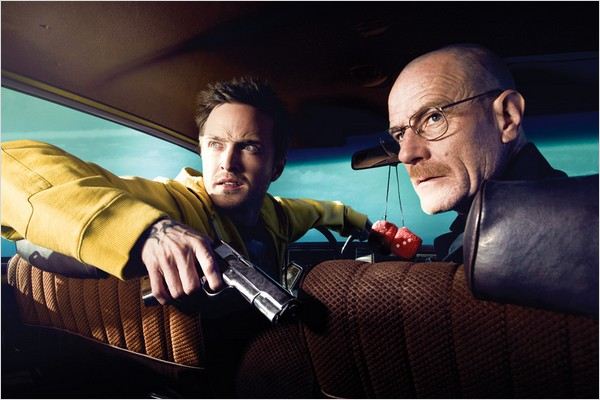
VIDEO ESSAY: Gliding Over All: The Cinematography of BREAKING BAD, Season 1

VIDEO ESSAY: Gliding Over All: The Cinematography of BREAKING BAD, Season 1

This video essay is a co-production of Press Play and RogerEbert.com.

What is it about the desert?

Put more simply, what is it about the desert that simplifies
human conflicts, desires, and fears as represented in film and literature?

Think of Kobo Abe’s Woman
in the Dunes
, Paul Bowles’ The
Sheltering Sky
, Sam Shepard’s True
West
. Terrence Malick’s Badlands. Sergio Leone‘s Once Upon a TIme in the West.

Or, more relevantly to this discussion, Breaking Bad.

Put more specifically, what is it about the desert that, in
early episodes of this show, threatens to topple the narrative with the
sparseness of its scenery, with shots so dry you can practically taste the
sand?

It’s the emptiness.

The sense that there is nothing but the air between a
character and his problems, and that air is so thin it might as well not be
there.

The sense that a man, when faced with a problem, be it the
legality of his enterprise, death, the ineptitude of other humans, or all
three, might flail in the desert air, and find nothing giving resistance,
moving him forward.

The tedium of all of it. The difficulty.

But, at the same time, the profound importance of it.

There is also the way conversation sounds in the desert: the
way each sentence falls into silence, like a coin falling into a dry well.

We don’t hear the clink of the coin at the bottom of the
well, because it doesn’t have a bottom. Not on this show.

Another thing about the desert, particularly the New Mexico
desert, is that it dehydrates you. It sucks everything out of you. You come to
it with a set of complications, a set of morals, a set of daily worries, and
you find, in almost no time, that they’re all gone, lost in the cold night wind.

All that’s left is you, and the matter that brought you
here.

Another thing about the desert is that it’s where we all
started. (Depending on who you ask.)

Not in the desert, literally—but in the semblance of desert.
With nothing.

Nothing except, of course, that 800-pound elephant,
shimmering in the heat in front of you.

You can either stay where you are, and hope, until the sun
goes down, that the elephant goes away.

Or you can do something. And walk towards it.

And that moment, right there, that first step, is where your
troubles begin.

You think, If I can
just kill that elephant, all my problems will go away. I can leave. I can step
over its corpse, and head back to what I was doing before this.
 

But sadly,

and truthfully,

and unavoidably,

you think you’re walking out, but in reality, you’re just
walking farther in.–Max Winter

For a terrific essay by Nick Schager on the cinematography of Breaking Bad’s inaugural season, go here:

http://www.rogerebert.com/balder-and-dash/cinematography-of-breaking-bad-season-1

To watch the video essay on Season 2, along with an interview with director of photography Michael Slovis, go here:

http://www.rogerebert.com/balder-and-dash/gliding-over-all-the-cinematography-of-breaking-bad-season…

To watch the entire series on Press Play, go here:

http://blogs.indiewire.com/pressplay/tag/dave-bunting-jr

Dave Bunting, Jr. is the co-owner (with his sister and fellow Press Play contributor, Sarah D. Bunting) of King Killer Studios, a popular music rehearsal and performance space in Gowanus, Brooklyn.  He plays guitar and sings in his band, The Stink,
and dabbles in photography, video editing, french press coffee, and
real estate.  Dave lives in Brooklyn with his wife, son, and sister.

Max Winter is the Editor-in-Chief of Press Play.

VIDEO ESSAY: Gliding Over All: The Cinematography of BREAKING BAD, Season 2

VIDEO ESSAY: Gliding Over All: The Cinematography of BREAKING BAD, Season 2

This video essay is a co-production of Press Play and RogerEbert.com.

Season 2 of Breaking Bad is about the speed and exhilaration
of being reborn, as well as the mounting pressures and heightening dangers that
come with transformation.  Dave Bunting’s
video essay is a free-fall montage, each scene seamlessly drifting into the
next: an aimless array of violence, fear and the desire for escape.

Breaking Bad asks if we are simply the product of
circumstances beyond our control, or if we are in fact agents propelling our
own destiny. In Season 2, Walt’s transformation into Heisenberg is triggered,
but is also incomplete. Is Walt a man driven by selfless devotion to providing
for his family, or is he actually motivated by his own hunger for power? Season
2 is built around a charred stuffed animal’s descent from the heavens. At
the start of each episode we see bigger parts of the same strange and startling
image. In Bunting’s essay, the heart of Season 2 is not the mystery of what this
object is or where it will land, but the center of a father’s grief and how one
mistake born of that grief ends up being a catalyst for even greater disaster.

Choices may often be perceived as the catalyst for change
throughout Breaking Bad, but the show often demonstrates that our agency is
not merely limited; it is profoundly influenced by circumstances well beyond our control. But while Walt’s transformation is not necessarily
the product of his decisions, Walt does bear responsibility for his choices. In
Season 2, Walt’s decision to let Jane die indicates a major shift in Walt’s
moral compass and challenges the viewer to continue to identify with him and
root for him as a hero in this story.

The cinematography of Breaking Bad shows tremendous
scope, as well as intimacy—we see both the gorgeous desert landscape and a close-ups of Walt’s deeply lined face as he struggles through chemo. Scenes
of Walt and Jesse cooking and spending time in the desert together highlight the tremendous differences between
these two men—in size, gait, age, sense of style, and use of language. But as the
season progresses, their hazmat silhouettes on the horizon become less and less
distinguishable. Here, intimacy, like moral decision-making, is two parts
circumstance, one part actual individual choice.  Still, in Bunting’s video essay we see the
ways in which Walt and Jesse differ when confronted with moral choices. When
separate, Jesse is often depicted as crouching over, wide eyed and overwhelmed—his preference is always to slip back into the candy-colored dream world of
comic books, puppy love, and drug experiences, where he doesn’t have to deal with
the weight of his own decisions. In contrast, in Season 2, we see the
beginning of Walt‘s transformation into “the one who knocks.” Alone, apart
from Jesse, he is hard-eyed, diligent, the master of his own destiny, whether he is
holding a gun, pushing a cart, or standing naked in a fluorescent-lit
supermarket.

In Season 2, deserts are torn apart by man-made explosives,
and lovers float away from each other in drug-induced dreams. Many characters
like Skyler and Hank often seem to be in the periphery, outside the kinetic,
often volatile relationship between Jesse and Walt. This sense of a rapidly
disintegrating sense of reality and moral sensibility is exacerbated in time-lapse scenes, often used when Walt and Jesse are cooking, but also capturing
the otherworldly backdrop of the Southwestern American sky.  These sped-up scenes feel flushed and
out-of-breath, like time is racing and the entire world is out of control.

In Bunting’s masterful distillation of Season 2’s central
themes, the audio is just as important as the visual. The repetition of Donald’s
air traffic directions—resolute, measured, unemotional—becomes the backbone for
the unfolding human drama, connecting these seemingly disparate stories and
showing how human choices create disaster in a way that no butterfly wing ever
could.–Arielle Bernstein

To read an interview with Breaking Bad‘s director of photography, click here:

http://www.rogerebert.com/balder-and-dash/gliding-over-all-the-cinematography-of-breaking-bad-season-2


Arielle Bernstein
is
a writer living in Washington, DC. She teaches writing at American
University and also freelances. Her work has been published in
The
Millions, The Rumpus, St. Petersburg Review and The Ilanot Review. She
has been listed three times as a finalist in
Glimmer Train short story
contests
. She is currently writing her first book. She is Associate
Book Reviews Editor at
The Nervous Breakdown.

Dave Bunting, Jr. is the co-owner (with his sister and fellow Press Play contributor, Sarah D. Bunting) of King Killer Studios, a popular music rehearsal and performance space in Gowanus, Brooklyn.  He plays guitar and sings in his band, The Stink,
and dabbles in photography, video editing, french press coffee, and
real estate.  Dave lives in Brooklyn with his wife, son, and sister.

VIDEO ESSAY: Siding with the Victim, Part 3: We Are All Meat

VIDEO ESSAY: Siding with the Victim, Part 3: We Are All Meat

Warning: This video contains shocking imagery, and so the faint of heart might want to gird themselves before Pressing Play.

[Complete script follows:]

We like to think we are in control, of our lives, of our
bodies, of our futures. If we work hard
and manage our lives, everything will turn out fine. 

We hold these truths to be self-evident . . . until we lose
that fragile sense of control.

Illness, injury, the loss of a loved one: all of us have
experienced moments when we realize we have no control over things, when we are
powerless.

That’s an uncomfortable place to be. But these experiences teach us that just
because we’re human, that doesn’t mean we’re special.

Art critic John Berger has said: “Animals are born, are
sentient, and are mortal. In these
things they resemble man.” In other
words, our most basic selves are animal. The horror movie reveals this, by showing us our mortality, stripping
away our arrogance.

Trapped. Tortured. Hunted. Slaughtered. This is the way of life, and death, for most animals. We’d like to forget this, but the horror film
never forgets. It reminds us that, like the over 50 billion animals killed
every year for human consumption, in the end, we are all meat.

The images of violence so abundant in modern horror movies
may seem prurient, mindless, sadistic. But
they also show us what we would otherwise turn away from: namely, the raw
material fact of our physical bodies, which, at the end of the day, are only so
much meat.

Most of us believe that human beings are more than this, but
horror movies are not so sure.

Plot and dialogue are crucial to a great horror film, but
when it comes time to immerse the audience in fear, the only sound we hear is
screaming. 

And sometimes a string section. 

To be without a voice is to be put in the place of animals:
speechless.

No film better captures this feeling of brute powerlessness
than The Texas Chainsaw Massacre. When a band of twenty-somethings pick up a
hitcher in rural Texas, he tells them about an old slaughterhouse that has been
closed down. He tells them his family’s
always been in meat, a grotesque line that cuts several ways: First, for
generations this community was sustained by the local meat industry; Second,
like the rest of the community, the hitcher and his family are no more
important to big agriculture than the animals they slaughtered; and Third,
driven to madness, they now make meat out of anything that crosses their path,
animal or human, male or female.

This scene is arguably the most terrifying ever filmed. It exemplifies
the moral force of siding with the victim. Here we see a woman stripped of every last vestige of her humanity, her
very fear made an object of derision by her monstrous hosts.

Most striking is the camera’s concentration on her eyes. A
baby’s eyes tell a mother what it needs, what it feels; in a dog’s or cat’s
eyes we can tell if it is happy or sad, scared or confident. Eyes transcend the species barrier, but,
unfortunately, that isn’t going to help this victim.

And this is why horror movies bring us to these horrifying
places: so that we can’t ignore the appeal in a victim’s eyes. In horror we
bear witness to suffering. We recognize ourselves in the victims, and the
victims in ourselves.

This family has always been in meat. For the film’s most frightening antagonist,
known as Leatherface, this is literally true. He wears a mask made from the skin from a human victim.  He is one of the most terrifying creations in
the history of cinema. Yet in this scene, unexpectedly, we feel a grudging
sense of sympathy with a monster we have already witnessed ruthlessly murdering
several hapless twenty-somethings. He is
like a guilty child, uncomfortable in his own skin. Underneath that mask we can imagine a being
stalled at a rudimentary stage of development, and made evil. But we can also recognize,
perhaps even relate to, his anguish.

Our protagonist has clearly been wounded by her experiences,
inside and out, and she can only laugh maniacally as the truck moves away at
the growing distance between herself and her erstwhile attacker. This distance, though, is only an illusion. Her
attacker’s dance of demented victory suggests a kinship between their warped
psychological states, and a reminder that monsters and victims, predator and
prey, are often two sides of the same being.


Ken Cancelosi is the Publisher and Co-Founder of Press Play.

Jed Mayer is an Associate Professor of English at the State University of New York, New Paltz.

VIDEO ESSAY: Horror Films and the War on Women (Siding with the Victim, Part 2)

VIDEO ESSAY: Horror Films and the War on Women (Siding with the Victim, Part 2)

[Original script follows:]

Everyone loves a winner. 
This is why most films have happy endings.

Such films seem empowering, especially when the characters
have to struggle through difficulties before rising triumphant.

Although we all know these are fantasies, they also mirror
our real life aspirations.

In the 1970s women demonstrated in the hopes of realizing
their aspirations to be treated equally.

But the most striking films from that decade tell a
different story.

There are two sides to any social movement, tales of victory
and tales of defeat. 

Horror movies tell us tales of defeat, usually involving
women.  Most people would say that horror
films are generally anti-feminist, even misogynistic.

But the stories of victims are just as important as those of
victors. The war on women has been going
on for many years, and the stories of its victims still need to be told.

Before the modern horror film, the melodrama told such
stories to women. Most melodramas follow the lives of people who encounter
great misfortunes. In the golden age of Hollywood, melodramas flourished. Such
films came to be called “women’s pictures.” Back then, women were expected to
be seen and not heard. There was no open forum where women’s issues could be
discussed. But women could connect with others through the medium of film. They
saw their own stories reflected in those of characters played by their favorite
stars. These lives were generally filled with suffering, and this suffering was
largely caused by men.

The modern horror movie takes this scenario to an
extreme.  This is the melodrama’s dark
unconscious.  Victimization is taken to
an extreme, and this makes us uncomfortable. 
In the best horror films, the viewer learns what it’s like to have every
last vestige of power and control stripped away.

For all of Roman Polanski’s own questionable behavior with
women, his films are uniquely attuned to their plight.  Rosemary’s
Baby
, from 1968, anticipares the 70s and horror by focusing on the vulnerability of women in a male-dominated world. This scene cuts in and out of Rosemary’s dreams. This emphasizes the
fact that we are seeing the world from a female character’s perspective. That
world is a very scary place, filled with very scary men. Such scenes linger in
the mind. They create a sense that anything can happen, and all is not as it
seems.

Or is it? Polanski leaves this in doubt until the ending of
the film.

After keeping her feelings bottled up inside for several
months, Rosemary spills out her troubles. 

Her husband then tries to regain control, but this only
makes Rosemary more suspicious.

But at last Rosemary makes a decisive break from the
sinister circle that seems to be tightening around her.  Farrow’s marvelously fragile and nervous
delivery draws us in to her vulnerable state. We share her nervousness:
certainly no one will believe her.  When
he does, a door of possibility opens and we share her relief. 

But as the door to her examination room is about to open,
the camera shifts to her perspective. When the door opens to reveal her
husband, and the sinister Dr. Sapirstein, we share her entrapment. 

The moral of the story? 
Don’t hire Charles Grodin as your obstetrician.

One of the worst injustices against women is when a
complaint of sexual harassment or charges of spousal abuse are disregarded as oversensitivity or the
delusions of female biology. Rosemary’s Baby captures that experience of being a
victim who isn’t taken seriously.

Unlike melodramas, horror films don’t simply negate the
experience of suffering by tacking on a happy ending in which everything comes
out right. This can make for grim
viewing, but it also challenges us to endure even when hope seems dim or even
non-existent.

Whether it’s physical abuse, rape, or simply a quiet life of
desperation under the glass ceiling, you don’t just get over it. There’s no “closure” for women living in a
sexist society, but most Hollywood films would like to make us forget that. 

Thankfully the horror film has a way of shutting
that whole thing down.

Ken Cancelosi is the Publisher and Co-Founder of Press Play.

Jed Mayer is an Associate Professor of English at the State University of New York, New Paltz.

VIDEO AND TEXT: Nelson Carvajal and Amber Sparks on Guillermo del Toro

VIDEO AND TEXT: Nelson Carvajal and Amber Sparks on Guillermo del Toro

Guillermo del Toro: The
Unlikely Auteur

As Guillermo del Toro’s Pacific Rim release date fast
approaches, I can’t help but feel a little depressed.

Don’t get me wrong. I’m a huge fan (pun intended) of the kaiju—or giant monster—film, so I really
am looking forward to the release of this film, director and ultimate fanboy
Guillermo del Toro’s attempt to reboot giant monsters and mecha warriors for a
new generation. I seriously can’t wait to see Idris Elba and Ron Perlman battle
giant monsters from the deeps.

That said, I’m still in mourning for The
Hobbit
-that-could-have-been, a film that—instead of a lesser Lord of the Rings for small children and
people who love dwarf slapstick—might have featured an entirely new Middle
Earth. Imagine a brilliant, sadistic dragon-against-type; imagine troll-like dwarves
and sylph-like hobbits inhabiting an alien, immersive new world (instead of
wandering around in the digital landscape of LOTR like wide-eyed tourists:
“Look! There’s Galadriel!”); imagine Tolkien’s book, transformed utterly, in
the hands of a true auteur.

That’s right. An auteur. But,
you might say, shocked and appalled—he does genre
pictures
!

Yes. And?

His body of work reveals a filmmaker
who, along with a handful of contemporaries (both Andersons, Malick, Haneke,
Von Trier, etc.) has transformed his source
material so that it reflects absolutely his personal vision. And after
all, Hitchcock did genre, as Kurosawa often did. In del Toro’s case, the
personal vision was shaped by perhaps less
traditional sources
: by Forrest Ackerman’s Famous Monsters of Filmland, by Universal Horror classics and
Godzilla and Gamera films, by a childhood in Mexico steeped in Catholicism, and
by a self-confessed nerd’s affinity for children, outcasts, and monsters.

His interest in film began as an interest in makeup
and effects
, and his films are his
films precisely because of the love and care he takes in designing his
creatures and his unreal worlds: the pagan, organic nature of his creatures is
uncanny and frightening—even the mechanized creatures resemble insects or
animals or very old gods. In a Hollywood in which horror movies routinely make
monsters and demons from a few ready-made molds, when comic book films
(with a few exceptions) follow a format that doesn’t deviate too much from the
standard—del Toro makes films like Pan’s
Labyrinth
, with possibly the most terrifying creature in all of recent
cinema—The Pale Man, Norn-like and flesh-draped and utterly original. He makes
films like The Devil’s Backbone,
which turned the ghost story genre on its head. He makes films like Hellboy and Hellboy II: The Golden Army,
which took a wildly popular comic book and transformed it completely. The Troll
Market in Hellboy II is worth the
price of admission alone, as are the bizarre and frightening tooth fairies.
These creatures are unlike any you will find in any other film, because they
don’t come from formula and they aren’t lifted from other films. As Daniel
Zalewski wrote in his fascinating New Yorker profile of del Toro, “When movie monsters look largely the same, Del
Toro’s reach deep into the past and into mystic and pagan iconography to
present something else entirely—something far more terrifying and familiar . . . A
del Toro monster is as connected to a succubus in a Fuseli painting as it is to
the beast in ‘Predator.’ His films remind you that looking at monsters is a
centuries-old ritual—a way of understanding our own bodies through gorgeous
images of deformation.”

Del Toro himself seems motivated to keep moving, to keep
making it new. On
his sources of inspiration:
“The worst thing that you can do is be inspired
solely by movie monsters. You need to be inspired by National
Geographic,
by biological treatises, by literature, by fine painters, by bad
painters.” Indeed, in Pacific Rim,
del Toro has said he wants to create something entirely new, despite the
Godzilla and Gamera-like kaijus of
the genre’s heyday. He was instead inspired by perhaps not such an unlikely
source: Goya’s
The Colossus.

But a visual feast alone would make del Toro a great artist,
not a great filmmaker. The compelling and very dark stories he chooses to tell
are what animate the films and give them their haunting quality. Beauty holds
hands with horror, two sides of a coin in all of his films. Del Toro seems much
more in debt to Grimm’s Fairy Tales
than to The Texas Chainsaw Massacre.

One gets the impression that perhaps del Toro deals in
horror because of his dark view of human nature. People are the real monsters
in most of his films, not the fantastic, often ambivalent, only cruel-as-nature
creatures that inhabit his worlds. Humans are the ones who do the real, lasting
damage. He says, “I ended up thinking that monsters are sort of the patron saints
of imperfection. I try to celebrate imperfection in my movies; the really scary
characters are always the ones who insist everything has to be perfect.”

All this is the reason I’m still in mourning. I loved Peter
Jackson’s Lord of the Rings trilogy
just like everyone else, and after that it would have been great to see what a
true auteur could do to put a different spin on the prequel. (I also would have
loved to see Del
Toro’s canceled adaptation of Lovecraft’s At the Mountains of Madness
.) But
I suppose it’s not such a bad consolation prize to get a new and exciting kaiju movie, one that will feature new
creatures but follow the old wild joy of the kaiju orgy of destruction in the (important for a pacifist
director) empty city (thus the scenes
of frantic evacuation in every giant monster movie ever). And maybe I’ll even
(fingers crossed) get to see him team with Charlie Kaufman to make what could
be the first
good screen adaptation of Slaughterhouse Five.

The man with endless creative ideas, who lives
in a mansion he calls Bleak House—filled with monsters, aliens, and comics—seems
perhaps more in touch with a pop-culture obsessed public hungry for good horror than any other director
since Hitchcock. And as del
Toro has said himself
, “Hitchcock would have gone
to Comic-Con. He would have signed collectible shower curtains. He
was a showman and an auteur.”
–Amber Sparks


Nelson Carvajal is an independent digital filmmaker, writer and content
creator based out of Chicago, Illinois. His digital short films usually
contain appropriated content and have screened at such venues as the
London Underground Film Festival. Carvajal runs a blog called FREE CINEMA NOW
which boasts the tagline: “Liberating Independent Film And Video From A
Prehistoric Value System.” You can follow Nelson on Twitter
here.

Amber Sparks’ short stories have been widely published in journals and anthologies, including New York Tyrant, Unsaid, Gargoyle, Barrelhouse, and The Collagist. Her chapbook, A Long Dark Sleep: Stories for the Next World was included in the chapbook collection Shut Up/Look Pretty from Tiny Hardcore Press, and her first full-length story collection, May We Shed These Human Bodies, was published in 2012 by Curbside Splendor. You can find her at ambernoellesparks.com or follow her on Twitter @ambernoelle.

VIDEO ESSAY: Siding with the Victim, Part I: THE SHINING

VIDEO ESSAY: Siding with the Victim, Part I: THE SHINING: Death in the Family

[The script follows:]

From the time we are little children we like hearing scary stories.  Some
psychologists claim it’s because we use these stories to work through our anxieties.
 Fairy tales and nursery rhymes expose us to fearful situations, and along
with Hansel and Gretel, Goldilocks, and Little Red Riding Hood, we see our way
through to daylight.

But for every little piggy who lives, another little piggy has to die…

Maybe there’s another explanation to why we like scary stories, a darker, and
perhaps a richer one than that given by psychologists. Perhaps we don’t
identify with the victors so much as the victims.


Horror films show us the dark underside of the
American dream. As one group rises to power, another is disenfranchised. Often,
violence is visited upon those who are in the minority. 

Thrillers and action films celebrate triumph and
success. Horror films clean up the mess, mop up the blood, and show us what’s
under the rubble after the action hero lays waste.

Many horror movies’ victims, are women and
children, as in real life.

The Shining is
arguably the greatest horror film because it so movingly bears witness to the
suffering of the frightened wife and child of a violent alcoholic.
 

Wendy Torrance’s glassy-eyed smile holds a dark
history and a sense of nervous fear. This is revealed by the enormous ash
perilously dangling from her cigarette. The film will draw her repressed fears
out, writ large in bloody letters across the screen.

If this were a made for TV movie about spousal
abuse, a councilor or friend would come to the abused wife’s aid. That person
would help her to gain control of her life. 

But the narrative and moral logic of horror films
tells us a different story, one that is, perhaps, truer to life: evil never
sleeps, and the dead don’t always stay dead.

It is a common story, sadly enough, but like all
great horror films, The Shining gives this
story the magnitude of a tragic American myth. 

As family tensions mount in the Overlook, each
member of the family goes over the edge in their own special way.


“They fuck you up, your mum and dad. / They may
not mean to, but they do. / They fill you with the faults they had / And add
some extra, just for you.”  Poet Philip
Larkin’s words are particularly relevant to the American horror film.  Many of the best horror films capture the
unique vulnerability of childhood. In the end, the horror movie makes us all as
vulnerable as little children.

The tradition of gothic horror has been replete with beings
whose monstrousness is as much a burden to themselves as a threat to others.  There is no such thing as a victimless crime
in horror movies. Even the victimizers may be said to suffer.

We see Jack Torrance having a nightmare that,
the film suggests, is a kind of a vision brought on by the haunted hotel where he
and his family live. Such visitations vex him, and we can identify with his
anguish. 

Jack can still feel compassion, though, and we sense
his torment and anguish as he confronts and eventually turns toward
derangement. 

As such visitations increase in frequency and
intensity, Jack is transformed into a savage, and yet we continue to see him as
a victim driven to madness. And thus, his final transformation and his
merciless rampage seem all the more tragic. 

Even in the end, he is no monster. 

This is simply the dark side of human power. 

The waxing and waning of power itself—in
cinema as in real life—is merely an illusion.

The horror film: It shows us the dark side of
power, and reminds us that we are all, at some levels, powerless victims.

Power,
in and of itself, is not a moral virtue, but compassion is.


Jed Mayer is an Associate Professor of English at the State University of New York, New Paltz.

Ken Cancelosi is the Co-Founder and Publisher of Press Play.

TRAILER: SIDING WITH THE VICTIM: A Video Essay Series

TRAILER: SIDING WITH THE VICTIM: A Video Essay Series

July is going to be a scary month in the cineplex: horror (or at least scary) movies set to be released in the coming weeks range from V/H/S/2 to The Conjuring to Apartment 1303 to Frankenstein’s Army: as a sort of hat-tip to all of these movies coming out during the rainy, hazy, steamy days of summer, Press Play is presenting a three-part video essay series called Siding with the Victim, about the ways in which identifying with the hapless ones in horror films, the ones who do go into the basement/behind the creaky door/into the woods without a flashlight/into the attic and who don’t ever look behind them, is a crucial part of what makes these films so compelling. We’ll look at The Shining, Halloween, Rosemary’s Baby, The Texas Chainsaw Massacre, and countless other chilling films…

And here, for your consideration, is a tantalizing trailer. Watch it–if you dare!

VIDEO ESSAY: LIE BACK AND ENJOY IT by Jessica Bardsley

VIDEO ESSAY: LIE BACK AND ENJOY IT by Jessica Bardsley

What does it mean to watch, and to record, daily life? Can
plain, simple documentation, which would seem at times to be anti-lyrical, have
its own music? These are two questions raised by Lie Back and Enjoy It, Jessica Bardsley’s driven and dynamic video
essay about JoAnn Elam, an experimental documentary filmmaker who passed away
in Chicago in 2009. Much of what’s here will strike you at first because of its
intimacy: we are forced to look at a dress, or the shoes someone is wearing,
and then you begin to observe these things in a slightly more clinical way, and
then you begin to learn something, if slowly. This is what Chicago’s Logan Square looked like during the 1960s. This
is the way people dressed during the 1970s. This is the way JoAnn Elam smiled
when she was being filmed.
We learn, via printed lines that roll across the screen at irregular intervals, that Elam was a postal carrier for many
years, and that she worked on a documentary about the USPS for a decade. This
only adds to the luminous daily-ness of the film, as we begin to pay attention
to smaller and smaller things, such as the way someone smiles, the way they
tilt their head, or the way Elam delivers mail. Throughout the film, drummer
Tim Kinsella’s percussion runs at differing speeds, depending on which of the
entirely spontaneous and yet also personal images we are watching on screen.
This is an entirely perfect choice for the film at hand, reflective as it is of
motion, of a kind, and evocative as it is of the endless pushing forward of
minutes and hours. The grayness of the sound, too, each drumbeat maintaining a
tone and timbre identical with the next, reminds us that what we are watching
is a document—but also that documents have their own rhythms, and why shouldn’t
they? When, in its second half, the film goes into more abstract territory, as
we learn that Elam discovered she had cancer relatively early in life and then died
at age 60, leaving behind reel upon reel of film, much of which had never been
seen publicly, the drumming slows and we recall, perhaps by design, perhaps by
accident, nothing more loudly than our own heartbeats, nudging us forward. To
watch this piece is to be reminded of just how fascinating the things we don’t
see can be.–Max Winter

Jessica Bardsley is a film
artist and critical writer exploring experimental non-fiction forms. Her
work has screened across the U.S. and internationally at esteemed
venues such CPH:DOX, Visions du Réel, Antimatter Film Festival, European
Media Arts Festival, Kassel Dokfest, Rencontres Internationales
Paris/Berlin/Madrid, Images Festival, Big Sky Documentary Film Festival,
Rooftop Films and more. She is the recipient of a Princess Grace Award
in Film (2010), a Flaherty Fellowship (2011), Director’s Choice at the
Black Maria Film and Video Festival (2012), Grand Prix at 25fps (2012),
and the Eileen Maitland Award at the Ann Arbor Film Festival (2013). She
received an MFA in Film, Video, New Media and Animation as well as an
MA in Visual and Critical Studies at the School of the Art Institute of
Chicago, and is a first year PhD student in Film and Visual Studies at
Harvard University.
www.jessicabardsley.com

Max Winter is the Editor-in-Chief of Press Play.

VIDEO ESSAY: Wong Kar-Wai’s Lust for Life

VIDEO ESSAY: Wong Kar-Wai: Superimposed Symphony

Wong Kar-Wai, whose long-awaited The Grandmaster opens in August, is not about plot. Wong Kar-wai is about motion and emotion. As my friend Nelson Carvajal’s new video suggests, he’s about the moment within the moment, the eternal in the now. Beautiful neighbors pass in a stairwell and exchange lingering looks, or talk more softly than they need to so that they can be face-to-face. The camera (usually Chris Doyle’s) doesn’t merely record or represent: it scopes out, insinuates, measures and caresses. All is texture. Physical texture. Emotional texture. What it feels like. What it really is. What you dream it is. What you dream it was.

A woman’s swaying hips are sexy, but they’d be sexy anyway, in Wong Kar-Wai’s films or anyone’s. Ditto food:  My Blueberry Nights boasts a closeup of melted ice cream on pie so lovingly composed and lit that it amounts to dessert-as-orgasm — and you know that when you’re hungry that’s just what a luscious dessert can feel like, in spirit anyway. But the sexiness, the sheer visceral tingliness, of this artist’s work transcends particular situations. Somehow he makes everything sexy: sweaty huts, cobblestone streets, peeling paint; fear, regret, misery, death. How? 

By communicating exuberance at existence. His films may chart specific lusts — for sex, for love, for freedom, for murder — but all those lusts are gathered beneath a poetic umbrella: lust for life.

He’s what I called, in a 2009 Salon series about “The Directors of the Decade,” a “sensualist” filmmaker:  “Sensualist directors have a respect for privacy and mystery. They are attuned to tiny fluctuations in mood (the character’s and the scene’s). But they’d rather drink lye than tell you what a character is thinking or feeling – or, God forbid, have a character tell you what he’s thinking or feeling. The point is to inspire associations, realizations, epiphanies — not in the character, although that sometimes happens, but in the moviegoer. You can tell by watching the sensualists’ films, with their startling cuts, lyrical transitions, off-kilter compositions and judicious use of slow motion as emotional italics, that they believe we experience life not as dramatic arcs or plot points or in-the-moment revelations, but as moments that cohere and define themselves in hindsight — as markers that don’t seem like markers when they happen.”–Matt Zoller Seitz