Watch: A Video Essay About the Power of the Lens Flare

Watch: A Video Essay About the Power of the Lens Flare

The lens flare is typically used, or perhaps over-used, to show a brush with the unnameable, in whatever form that might take. Jacob Swinney takes us through over 50 of these instances in this video essay, but they are all unified by a sense of sublimity, either benign or horrific. We see lens flares at the opening of Saving Private Ryan to signal the enormity of the war carnage approaching. When Leatherface spins his chainsaw around, and around, and around, the lens flares recall the grandiosity of the bloodshed that has preceded this moment. The technique doesn’t always have to signal dread, though, of course. In Punch Drunk Love, its presence signals the growth of love between Barry and Lena; in There Will Be Blood, we catch lens flare as Daniel Plainview ponders the possibilities of oil. It’s been argued that the technique is a cinematic trick, somewhat facile; it’s also been suggested that lens flares are annoying, little bursts of light that interrupt visual narrative for not certain purpose. This viewer tends to find their effect somewhat different–the lens flare almost always expands what I’m looking at, increases its potential, and brings speculativeness into the picture. Swinney’s beautiful video piece concludes, quite sensibly, with lens flare from one of the more expansive and widely appreciated stories of the last century: E.T., in which the earthly touched the unearthly, both in a literal and figurative sense.

WATCH: This OK Go Music Video for “I Won’t Let You Down” Channels Busby Berkeley, Bollywood, and SINGIN’ IN THE RAIN

WATCH: This OK Go Music Video for “I Won’t Let You Down” Channels Bollywood and SINGIN’ IN THE RAIN

OK Go’s new music video for "I Won’t Let You Down" is a refreshing, vigorous burst of cinematic energy, referencing everything from Busby Berkeley’s spinning geometrical fever-dreams to the wild happiness of Bollywood dance numbers to the lyrical outpourings (and downpourings) of Singin’ in the Rain. The song itself is a throwback, of sorts; its sincere croons about truth in love could have sprouted straight from the depths of Saturday Night Fever. In the video, the band zips around an immaculate urban landscape on scooters; we see them head-on at first, and then the camera moves upwards, until we witness the design behind their zipping. How dos it do this? With a drone camera! In any other band’s video, this might have seemed like a cheap move; here, though, the shift achieves some cosmic significance, as if the comfort of love might offer some balm for life’s battering. And then: they whip out the primary-colored umbrellas. Gene Kelly, anyone? The symbolism is obvious, sure: partners provide shelter for each other. But in this little film, what OK Go has done is transporting.

And it’s not the first time they’ve pulled it off–they have a long-standing reputation for well-crafted videos. Look, for instance, at this Neo-Geo masterpiece for "The Writing’s on the Wall":

The first time I listened to OK Go was on a CD The Believer offered as part of their annual music issue, a few years ago–I remember being struck by their upbeat charm, their clear enunciation, their rambling chord structure, and above all, the way in which, despite the fact that they seemed unlike the selections surrounding them, all of which had a slightly more handmade, "indie" feel, the combination worked, somehow–which is part of the band’s virtue. OK Go fits anywhere.

WATCH: This Video Essay Explores the Way We See Ourselves in Movies, from Charlie Chaplin to THE MATRIX

WATCH: This Video Essay Explores the Way We See Ourselves in Movies, from Chaplin to THE MATRIX

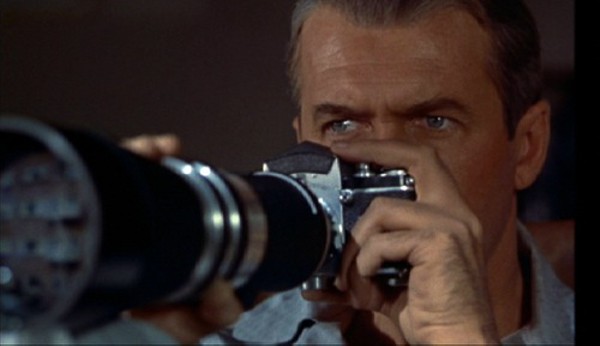
This gorgeously executed video essay takes us from The Great Train Robbery to Lost Highway to The Matrix to the original Dracula to Rear Window to explore what’s happening when we watch movies. The elegant point made here is two fold. One part is that when we watch a film, we are immediately brought back to what Jacques Lacan called the mirror stage, or the point at which an infant recognizs himself or herself in a mirror. The other part, and the more more ominous part, is that we look to movies to find idealized versions of ourselves–which is perhaps a childish impulse. That impulse, when reflected in a film, is chilling. Who could forget Bill Pullman’s phone conversation with Robert Blake in Lost Highway, as Blake was standing a couple of feet away from Pullman? Or Jimmy Stewart’s building revelations through his binoculars in Rear Window? This piece from Little Studio navigates, with delicacy and swiftness, some thorny concepts, threaded together with extensive film scholarship and great perceptiveness.

All Truffaut Fans Should Watch This French Animated Short About DAY FOR NIGHT

All Truffaut Fans Should Watch This French Animated Short About DAY FOR NIGHT

La nuit américaine d’Angélique, or Angelique’s Day for Night, is, on one level, a story about a young girl’s experience of watching Francois Truffaut’s Day For Night at a young age and fantasizing about being, like Nathalie Baye in the film, a script supervisor. As a child, she romanticized the job, imagining, for instance, how wonderful it would be to place "messages," or revised script pages, under hotel guests’ doors. As she grows up, of course, she realizes that the job is too secondary and would not be nearly as exciting as it might have seemed to her as a child. Adult reflection reveals other things to Angelique that she was not conscious of as a child–most significantly that the act of seeing, when watching a film, is often more important than what you’re seeing. You might watch, as in Day for Night, implied sex on a screen, but the way the sex is represented is more important. Angelique also has significant revelations about the changing nature of her relationship with her father, with whom she saw the movie for the first time, during a period when he was divorcing her mother. As if to highlight the elegance of this small, bittersweet tale, directors Pierre-Emmanuel Lyet and Joris Clerté present it in a simple, cut-out style–in some of the passages that instruct about the nature of film-watching, the short even resembles a puppet show, with heads and other symbols held at the ends of long sticks. Based on a graphic novel by Olivia Rosenthal, this feature, in just over six minutes, manages to impart some hard messages about growing up, albeit ameliorated by snowfall, present from the beginning of the story to the end.

FAST CLIPS: The Video for Roy Kafri’s “Mayokero” by Vania Heymann Is a Simple Nostalgic Pleasure

FAST CLIPS: The Video for Roy Kafri’s “Mayokero” by Vania Heymann Is a Simple Nostalgic Pleasure

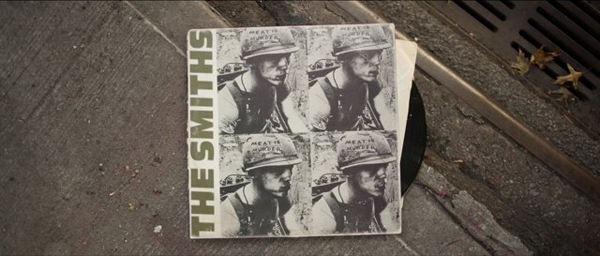
Vania Heymann’s video for Roy Kafri’s "Mayokero" is both spare and complex. It’s a pop cascade, in a sense, but what pop! Serge Gainsbourg, The Smiths, Prince, Madonna, Simon and Garfunkel, and many, many others show up on album covers tossed on an urban side street; their mouths move, singing the simple, catchy track for the video. The camera spins over these images, and then we see a homeless man going through the albums, and then we get the rest of the story: a reverse sequence showing the albums’ original purchase, a wistful look back at the days when you had to get up and drop a needle in a groove to listen to your favorite song–a needle which might skip sometimes, or might give away a scratch on the vinyl. There aren’t too many bells and whistles to Vania Heymann’s work here–in fact the camera work has a pointedly do-it-yourself feel, with one exception: the moving mouths. Even that gesture, though, is a recall of early TV comedy days, when a famous person’s picture, wth lips moving, might just make you laugh. We’re more sophisticated now–or are we? The video for "Mayokero" is proving remarkably popular, with 41,000 Vimeo plays in less than a week–it raises the question as to whether this sort of simplicity is just what video-watchers need right now.

VIDEO ESSAY: Godard VS Benny Hill

VIDEO ESSAY: Godard VS Benny Hill

For many people, watching Jean-Luc Godard’s Breathless is a rite of cultural passage; so, too, is watching The Benny Hill Show, though of a slightly different sort. One is a touchstone for knowledge of film history; the other is what many might call a "guilty pleasure." One is ideally watched on a large screen, in a dark theater; the other can only be watched on a small screen and most likely late at night, before one collapses to sleep exhausted. One is a mixture of love story, farce, and cultural commentary; the other is mostly farce, with some sexual humor thrown in, and negligible cultural commentary. One is a ground-breaking cinematic experiment; the other features a lot of things breaking (wind, glasses, windows, plates, chairs), but not much in the way of ground. Whatever the similarities or differences, Miklos Kiss has sped up the entirety of Breathless and compressed it into an 11-minute video essay, just long enough for the theme of The Benny Hill Show to play. And….. it works, kind of. The zippiness of the French film is there, at any speed, and the liveliness of the Hill theme is a nice match for it. What do you think?  

FAST CLIPS: How Arcade Fire’s Music Videos Show the Essence of Greta Gerwig and Andrew Garfield

FAST CLIPS: How Arcade Fire’s Music Videos Show the Essence of Greta Gerwig and Andrew Garfield

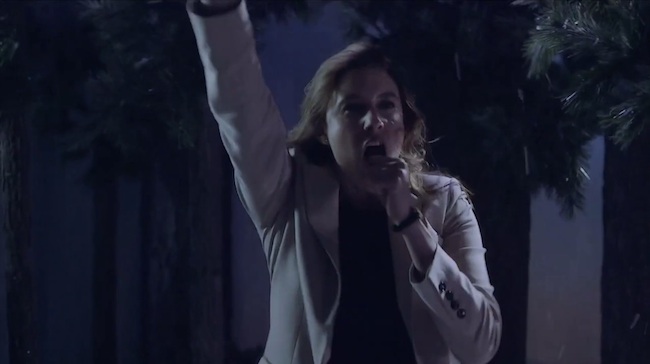
If you’re immune to Greta Gerwig’s charms, or skeptical of Andrew Garfield’s talent, or not sold on Arcade Fire, the band’s recent music videos might help you out a little. There’s only so much a music video can do, of course. It has a limited life span–limited by the length of the track it’s built around. If it strays too far from the song, it risks being derided as "weird" or "gratuitous." Indeed, either of these adjectives could be directed at the two videos the band put out in the last year or so, the former (for "Afterlife") featuring Greta Gerwig capering, post-breakup, through a forest, under the dreamlike direction of Spike Jonze, and the latter (For "We Exist") featuring Andrew Garfield, in drag, directed with a strong sense of narrative by David Wilson. But why do that? Neither piece calls out for censure—and in fact, both seem the result of careful thought. 

What’s this evaluation based on? Well, these two videos, at least, have a similar structure, one which works well for the story being told in each case. They begin in stark, dramatic situations–in the case of "Afterlife," a tearful conversation, a goodbye in a tastefully lit room; in the case of "We Exist," a man dressing up in drag and going out to a rough-ish bar–and build the drama outwards, both ending up on an actual stage, during an actual musical performance. (Which, to their credit, both videos present to us without Bruce-Springsteen-ing it too much, or going too hammy.) The former video was filmed live, at the 2013 YouTube Music Awards, as if to underscore a point. And what is that point? There’s one point, and then there’s another–which both pieces share. The most obvious message is one which this particular kind of film has been sending since the mid-1980s, which is that, simply put, freedom and triumph are both possible within the purview of fictional narratives, and possibly within life itself. This notion of cheaply-bought happiness, conveyed within the confines of a 5-minute song, provide a buoyance that is easily digested, like a package of energy-boosting supplements you might buy at a bodega. These two videos, though, torque this narrative, or rather, this idea just slightly.

In the first, Gerwig’s heroine swoops from deep sadness (convincingly brought off, for such an all-too-often comic actress) into profound relief. She does, in the course of the action, a lot of cheesy dance moves–but only cheesy if you were born after 1990. For anyone born slightly earlier than that, the fist pumping has a nostalgic twang to it–recalling everything from Saturday Night Fever to Dr. Pepper commercials. The sudden burst of happiness, too, is just abruptly timed enough to smack of looniness–indeed, the type of looniness we all carry within us, and which can be unleashed at vulnerable moments, the kind of energy we don’t see coming. The earmark sprinting cascades of sound that Arcade Fire issues add to the mix with aplomb, making the whole thing less of a breakup story than a hero saga, complete with a treacherous journey through sharply photographed dark woods. And Gerwig herself communicates less a sense of youngster awkwardness than unbridled aggression here–which may lie more at the heart of her comedy than a desire to be funny: the difference between expressing your anger or happiness and turning it into a verbal or physical pratfall.

There’s more than one would think at the heart of the "We Exist" video, as well, at least in terms of the shapes it takes. There’s something internecine about Andrew Garfield, always, despite the roles he plays–his aggression is always tempered by a slightly more sensitive, vulnerable undercurrent, which runs at full force through this short clip. We begin with a scene that’s one part Midnight Cowboy, one part Girls Don’t Cry, one part American Gigolo, as Garfield puts on dress, wig, fake bra, and make-up to head out to what looks to be a dive bar in a tiny town, in the middle of the heartland, where nonconformity is wholly absent. As one might suspect, Garfield’s naif gets into a fight after a false dance or two with a couple of rowdies, and then the scene becomes surreal, as we watch a group of rowdies, by turns, dancing in skirts and fighting with Garfield. There’s a happy ending here–Garfield escapes and joins the band on the stage, as in the earlier piece. Once again, Hollywood writ small: truth to one’s self wins out, despite adversity, being outnumbered, and being wildly out of place–all showcasing Garfield’s ability. One can only hope that at some point this actor decides to try Greek tragedy: his vision of performance is that huge, and that personal. At a longer length, the scenario played out here would be unbelievable: here, it comes across as a burst of soft-hued optimism, dramatized against lush farmland and shadowy, believably grungy interiors, a small film, if you’re willing to give it the label.  

Oh, what to do with the music video? For people who came of age in the 1980s, when cable television was a mark of privilege (or something you could only watch by swiveling your TV antenna in a hyper-sensitive manner), music videos had a near-mystical charm to them, somewhat like the earliest films, which presented mini-narratives, or half-narratives, in easily watchable form. They were dynamic, too–a way to assess a cultural zeitgeist rapidly and without too much intellectual effort. Chances could be taken, as well–I remember watching a gorgeous video for Tom Waits’s "In the Neighborhood" (from Swordfishtrombones), showing him leading a parade of side-show freaks down a suburban street, and marveling at its subtlety. This was the crucial ah-ha moment that most music videos want you to take away: you thought the song was about this, but it could just as easily be about this. These two videos are fairly straightforward in their approach, as befits Arcade Fire, who have achieved a supremely marketable mix of sincerity and hipness; in so being, they add substantially to a medium that, like ivy, continues to grow up the walls of the edifice of music, beautifying it as it creates its own undeniable kind of beauty.        

Max Winter is the Editor of Press Play.

FAST CLIP: Watch MONSTER, Jennifer Kent’s Short Horror Film Made Before THE BABADOOK

FAST CLIP: Watch MONSTER, Jennifer Kent’s Short Horror Film Made Before THE BABADOOK

If you have 10 minutes—less, in fact—you should watch Monster, the short horror film Jennifer Kent made before directing The Babadook. The latter Australian film has received widespread kudos–and from the looks of its trailer, they are richly deserved. Nevertheless, if, in this month of All Hallow’s Eve, if you’d like a truly frightening experience with remarkable (and blessed) brevity, Monster is just that. The film creates a mood of fear by, in fact, not trying. It presents its story, with its mundanities and its horrors, nakedly and simply, with a minimum of fanfare–small details may either tell you a great deal about a character or scare the crap out of you. The story is a simple one: A woman lives alone with her son. The son is restless, because he thinks there is a monster in the house. Is there a monster? Oh yes. But, unlike other monsters, it is frightening simply by being frightening, and not because of the way it is presented to us. There are no jumps, no shadowy figures moving in the background, no gruesome faces popping up in the center of the screen; indeed, when the mother first sees the monster, thy make calm eye contact for few seconds, as if maybe the creature were a household pest. And then? Well, things get a little rough from that point forward. Kent films the story in a crisp, pristine black and white–the shadows that occur seem entirely in place, natural, not added for effect. The actors fit right into this schema; Susan Prior’s mother has a careworn appearance, and a relaxed way of speaking that will, ultimately, allow her to make peace in her home, a peace which would not be believable in other films but works quite nicely here. Luke Ikimis-Healey’s child of the house, similarly, manifests his fear believably and without too much over-acting. While none of thse characteristics would seem to be elements which make a horror film frightening, they do: in allowing us to feel comfortable inhabiting this world for a few minutes, we, as viewers, become more prey to its terrors.

Max Winter is the Editor of Press Play.
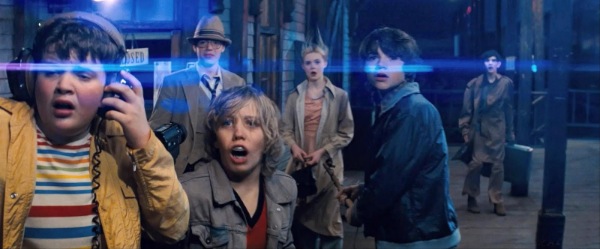
FAST CLIP: Video for Goat’s “Hide From The Sun” by Sam Macon

FAST CLIP: Video for Goat’s “Hide From The Sun” by Sam Macon

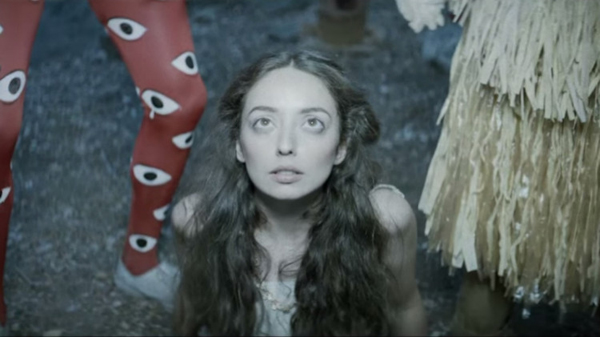
If there is something anarchic, primal, and unknowable about Sam Macon’s new video for Swedish band Goat’s song "Hide From The Sun," from their new Subpop album Commune, that may be in part because there is something primal, pagan, and mysterious about the band itself. Its members wear masks when they perform, and it is rumored that the band has been existence for 30-odd years, in different forms. Leaping to the African-inspired pounding beat of the song, in this video human figures wearing animal masks chase a pre-Raphaelite young woman, wearing a diaphanous white gown, through a misty forest, are subdued by her in a flash of light, and then become her subjects after a hallucinatory journey through a long tunnel into an ill-defined afterworld. The lyrics are not overly intelligible, which is fine; in a song like this words function more as mood-setters through tone than as bearers of meaning. Sam Macon has designed beautiful, semi-Mayan, semi-indigenous, semi-childlike costumes for this piece, and provides animation for its more surreal parts that looks both hand-crafted and carefully considered. Watching Macon’s colors cavort and spin through the universe he creates would leave blessed trails on the retinae of any viewer. The song has a panicky nerve to it; raher than letting his camera be guided by the jumps and jolts of the song, though, Macon lets this energy flow through the film and empower it, pushing it along. Wordless epiphanies occur, one after the other, about power, about the nature of vision, about the passage into maturity, as we move through the video; we drink these in because, old as the story Macon tells might be, we never tire of hearing it.

Max Winter is the Editor of Press Play.
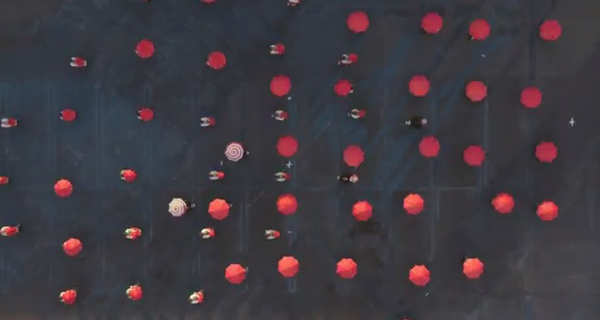
FAST CLIP: Video for Beck’s “Heart Is a Drum” by Sophie Muller

FAST CLIP: Video for Beck’s “Heart Is a Drum” by Sophie Muller

Beck has always had the capacity for expansiveness inside
his songs, even during the goofy days of One
Foot in the Grave
and Loser; the
song “Jack-ass” from Odelay always
read to me as an audio version of a Super-8 tour of a flat, marsh-infested
landscape of unchecked emotions rained upon by pure cool from the artist
himself. He has found a likely chronicler in longtime video maker Sophie
Muller, whose video for “Heart Is a Drum,” from the recent Morning Phase, takes us through and around cycles of life, death,
and aging. It’s been said that the piece owes a lot to Maya Deren’s Meshes in the Afternoon, which may
indeed be true, on the surface, but there are other influences lurking here, as
well, in the dust-bowl era pastoral Muller carries us through: the starkness of
the earliest and most aesthetically pure Bergman films; the Terrence Malick of Days of Heaven in its broad, sparsely
punctuated landscapes; a little bit of early Peter Bogdanovich, of the The Last Picture Show period; possibly
Jim Jarmusch’s brooding but also ambulatory realism that lends itself so
beautifully to down-at-heels domestic scenes. The video tells us a circular story,
as Beck sings his song of universality, of a beating heart “keeping time with
everyone.” We see the mature Beck, suited, standing in a deserted farmhouse,
staring outwards, looking within. Then we see different figures standing at the
end of a dusty road; Muller has played with the actual focus in such a way that
we are never sure where we stand with this story, even at its end. A caped,
masked figure of Death, tall, dark, scythe in hand, stands in a field, far
away, now closer, now walking swiftly towards Beck and a small child. A woman
is stricken down, as is her husband, whose face has an intensity and severity that
recalls the great silent film actors. There is a tremendous sense of poignance here.
The song itself goes in praise of embracing life in its completeness, and the
difficulty of doing so is brought home clearly by Muller’s film. Beyond this,
though, Beck has weathered change within his own work, from punk to funk to
bossanova, and so he has earned the right to slow down, in a sense. There is a
confidence to the way that he sings, “Need to find someone to show me how to
play it slow,” that suggests, in fact, he already knows how, as is borne out by the sound
of his recent albums, which has been, if anything, larger, more declarative,
more resonant than those of the past. As the video drifts towards its
conclusion, we see a hipper, younger version of Beck, bedecked with pony-tailed
ski cap and flappy clothes, walking with Death, in a small party that also
includes a small boy and the doomed couple who appeared earlier—a nod to The Seventh Seal, but also a haunting
image, suggesting that all that has occurred was only for the purpose of moving
onwards, or maybe inwards. Sometimes, there’s nowhere else one might rather go.

Max Winter is the Editor of Press Play.