MATT ZOLLER SEITZ: GLEE has a Judy Garland Christmas

MATT ZOLLER SEITZ: GLEE has a Judy Garland Christmas

nullAll together now, readers: If you hate Glee so much, Matt, why do you keep watching it? I don’t know, folks. At the risk of sounding like a masochistic romantic who’s stuck in a tortuous relationship — Dear diary, I can’t TAKE this anymore, it’s horrible and it’s KILLING me … but OH MY GOD IF YOU COULD HAVE SEEN THE GIFT SHE BOUGHT ME! — I have to go on the record about last night’s Glee Christmas special. It was brilliant.

OK, actually, I should qualify that — the middle section was brilliant. The wraparound stuff was the Glee usual: silly, pandering and dull. During the final number — “Do They Know It’s Christmas,” set in a soup kitchen that no doubt was populated by the children of “Glee” cast and crew — even the actors seemed bored, except for Jane Lynch, whose Coach Sylvester was acknowledging the first anniversary of her sister’s death. (Tear cup.) But OH MY GOD IF YOU COULD HAVE SEEN THAT MIDDLE SECTION, DIARY! Presented in black-and-white, it perfectly re-created the set, the tone and even the camera moves of The Judy Garland Show Christmas special from 1963, but with a cultural flash forward/flashback quality, presenting a patchwork quilt vision of America that wouldn’t have gotten past the network censors four decades ago.

You can read the rest of Matt's recap here at Salon.

Matt Zoller Seitz is the publisher of Press Play and TV critic at Salon.

Dear HBO: Renew ENLIGHTENED

Dear HBO: Renew ENLIGHTENED

null

“Everything can be transformed,” said Laura Dern’s character, Amy Jellicoe, on last night’s first-season finale of Enlightened, walking to work and then through the corridors of her office. “Every single thing. Goodness exists. It’s all around. It’s just sleeping. It can be wakened.”

HBO, which is reputedly on the fence about renewing this critically acclaimed but low-rated series, should recognize the goodness on its schedule Monday night and give Enlightened another season. It’s charming, intelligent, uncomfortable, often moving. Executive produced by Dern and writer-producer Mike White, and written by White, Enlightened is doing things that no series has ever done, in a tone that no show has ever attempted. And on top of that, it feels like a definitive statement on a troubled era.

If you saw the finale of Enlightened last night — only half-jokingly titled “Burn it Down” — you know that Amy made good on her promises to confront her employer, the giant drug company Abaddon, about the callousness and illegality that she uncovered through research. You also know that Amy, who survived a breakdown so severe that it sent her into rehab, is especially outraged about her own department, which is developing software that figures out how to work employees as hard as possible while paying them as a little as possible. Enlightened is not an explicitly political series — not in the way that South Park is, or that The West Wing was — and yet the corporate intrigue aspects strike to the heart of the moral crisis that’s convulsing this nation. The image of Amy fantasizing about pouring gasoline on the floors of Abaddon’s headquarters and setting it ablaze was chilling — and as metaphor, perfect. Do we continue to accept business as usual out of a weary belief that change is just too hard? Or do we say something, and do something, even if means enduring humiliation and abuse? Do we continue to live in this rotting house, or do we burn it down?

You can read the rest of Matt's article here at Salon.

Matt Zoller Seitz is publisher of Press Play and TV critic for Salon.

RECAP: What’s this on DEXTER? An incest tease?

RECAP: What’s this on DEXTER? An incest tease?

nullSeriously, Showtime: Dexter-Debra incest? That’s what you’re banking on as you approach the season-six finale? Isn’t that why God created slashfic? What’s next? Ghost-y tussles between Dexter and Harry? Deb and Laguerta? The mind reels.

This week’s Dexter is all bent out of shape, peaking at the 20-minute mark, then limping along as it betrays sundry atrocities, anti-revelations and proof that Captain Laguerta (Lauren Vélez) is the Latina Cruella de Vil of the Miami police department.

After a recap in which Debra (Jennifer Carpenter) says that Dex (Michael C. Hall) is her one safe place — oh, great — the Miami police find the body of Travis’ latest murdered girl, along with the corpse of Doomsday_Adam (Kyle Davis), the one-time Travis fanboy, who was actually stabbed by Dexter.

Travis, meanwhile, has hogtied Angel (David Zayas), stolen his ID and given it to Doomsday_Adam’s batty wife Beth (Jordana Spiro). He’s also gifted Beth with a backpack bomb of wormwood poison, with instructions to deliver the package to Deb. She’d once interviewed the object of Travis’ passions, his sister (who he then killed, as these brother-sister love affairs never pan out). And so Deb and the Miami P.D. must die in the name of God. It’s simple, really.

You can read the rest of Ian's piece here at Salon.

Ian Grey has written, co-written or been a contributor to books on cinema, fine art, fashion, identity politics, music and tragedy. His column "Grey Matters" runs every week at Press Play.

MATT ZOLLER SEITZ: BOARDWALK EMPIRE season two finale

MATT ZOLLER SEITZ: BOARDWALK EMPIRE season two finale

null“To the Lost,” the second season finale of Boardwalk Empire, may be remembered as the moment when Boardwalk finally, finally hit its stride. This isn’t the first time the HBO drama has impressed me — even the worst episodes have had great scenes or moments — but there was something special about this one. It was dead solid perfect in almost every department. I think a lot of it comes back to the episode’s consistency of tone, and the show’s comfort with having settled on it.

I thought about tone during that haunting close-up of the soon-to-be-late James Darmody smoking a cigarette by an open window. There was really no reason why such a simple moment should have summoned such force. Michael Pitt wasn’t selling the moment at all. He was just sitting there smoking. Yet the accumulated weight of Jimmy’s trauma — his wife’s death and his tragic inability to feel his way through it thanks to his war experience, his Oedipally perverse childhood, and a life spent among super-macho gangsters — came through loud and clear. Pitt’s posture, gestures and slightly mask-like expressions were exactly right, just as his gentleness during the beachside pony-ride scene with Jimmy’s son was exactly right, and as his ego-free coolness during that rain-soaked final sequence was exactly right. I love how Pitt delivered Jimmy’s statement to Nucky about what to expect after your first killing: 48 hours of nausea. It reclaimed a bit of dignity for Jimmy in his final moments — the implication being that this was first time that Nucky, the butcher of Atlantic City, ever personally killed anyone — but it was not particularly boastful or petty. Jimmy was just a guy who had nothing to lose, delivering information.

Pitt’s acting was always good, if a bit vague and guarded early on — an understandable response to being ask to play a character who was whatever the show needed him to be at any given instant — but he was especially strong during the last five episodes, probably because the writing sharpened up, and he hit his peak last night. The performance was free of 21st-century neuroses, which is by no means the same thing as being untroubled. When Jimmy said he died in the trenches during the war, there was nothing self-dramatizing about it. The character was just reporting the facts as he saw them. Pitt’s acting, here and earlier on the show, was retro, but not ostentatiously so. It seemed to be pitched somewhere between 1940s-era Joel McCrea or Dana Andrews and the kinds of performances that Montgomery Clift gave in the 1950s, which were soulful and tormented, but never never over-indicated or begged for sympathy.

You can read the rest of Matt's piece here at Salon.

Matt Zoller Seitz is publisher of Press Play and TV critic for Salon.

MATT ZOLLER SEITZ: The controlled madness of AMERICAN HORROR STORY

MATT ZOLLER SEITZ: The controlled madness of AMERICAN HORROR STORY

null

EDITOR'S NOTE: The following article contains spoilers for American Horror Story season one, episode 10, "Smoldering Children." Read at your own risk.

“Ladies and gentlemen … the ham.”

This may be the line that Jessica Lange was born to say, in the role she was born to play, on a TV show perfectly suited to her fluttery intensity. That she delivered it over a tight shot of a ham festooned with moist pineapple slices being thrust into the camera’s lens — as if the show were being broadcast in 3-D! — made it a perfect kick-off to “Smoldering Children,” the 10th episode of the first season of American Horror Story.

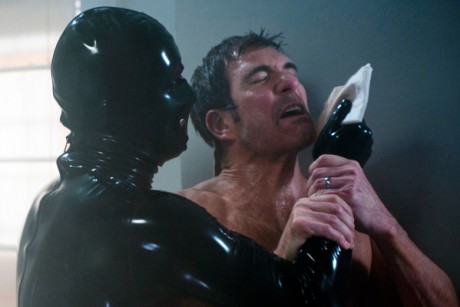
Written by X-Files veteran James Wong and directed by Michael Lehmann (Heathers), the hour greatly escalated the madness on this already demented show. Created by Glee executive producers Ryan Murphy and Brad Falchuk, the series seems to be inventing a new kind of horror — a 21st-century, short-attention-span-theater version, with no lulls. The traditional buildup to the big scare? Booooo-ring. Perhaps operating under the assumption — not unwarranted — that most viewers are watching the program on DVR or illegal download and will just fast-forward to the “good parts” anyhow, they’ve decided to save us all the bother. Every few seconds there’s a fabulously bitchy one-liner, a grim bit of exposition or a surprisingly deft transition between the two, or a beating or stabbing or disembowelment or horrendous searing of flesh, or a faintly S&M-dungeon-flavored sex scene, or a revelation that a character you thought was alive was actually dead all along, or that the heroine has been impregnated by both her husband and by a black-rubber-suited spectral hunk and is carrying both of their children.

What happened tonight? Let’s review — with the caveat that when you describe the actual events on this show, they sound like the plot of a hypothetical horror novel being plotted out by a couple of precocious 13-year-olds.

You can read the rest of Matt's article here at Salon.

Matt Zoller Seitz is publisher of Press Play and TV critic for Salon.

MATT ZOLLER SEITZ: TV’s unconscionable spectacle

MATT ZOLLER SEITZ: TV’s unconscionable spectacle

null

The scariest, most disgusting show on television isn’t American Horror Story. It’s Real Housewives of Beverly Hills.

Bravo’s unscripted series offers that horror movie gimmick of showing you unlikable people doing ill-advised things that you can’t prevent no matter how loudly you yell or curse at the screen. But because the characters are — in the physical sense, at least — “real,” and the world-shattering plot twist at the core of this season was telegraphed to the audience long in advance, what might otherwise seem a guilty pleasure seems instead a travesty, as depraved a spectacle as anything that has ever appeared on American screens.

We all knew before this new batch of episodes started that Real Housewives husband Russell Armstrong killed himself in August 2011. We knew that some of his family members blamed the unrelenting public scrutiny built into the show’s production for hastening his death, and that the tension with his wife, Taylor, was more than a tabloid spat between shallow rich folk — that it was, in fact, symptomatic of something far darker than the typical unscripted cable show could handle. But Real Housewives either ineptly failed to integrate our awareness of the tragedy into the plot in any meaningful way, or else decided to plug its ears and tiptoe through the hand-woven silk origami tulips. Is this approach evidence of a conscious creative choice — the calm before the storm? If this franchise weren’t so committed to manufactured melodrama and toxic materialism, I’d offer a very tentative “yes,” but I suspect it’s more likely the case of the show not having the slightest clue of what to do with such explosive material — material that it frankly never should have tried to deal with on-screen, because it is morally, intellectually and creatively unequipped to get anywhere near it without making it dishonest and trite. We’re not talking about Deadliest Catch here, or even Survivor or freaking Celebrity Rehab. It’s Real Housewives of Beverly Hills.

You can read the rest of Matt's piece here at Salon.

Matt Zoller Seitz is the publisher of Press Play and TV critic for Salon.

MATT ZOLLER SEITZ: When great TV shows disappoint

MATT ZOLLER SEITZ: When great TV shows disappoint

null

As regular readers know, I sometimes fall head-over-heels in love with promising new shows, and when they deliver a problematic or outright bad episode, it’s disillusioning. I tell myself it’s the nature of the beast — that it’s hard to make just one great half-hour or hour-long episode, let alone 10 or 12 or 26 in a row. The law of averages has to catch up eventually. But that doesn’t change the fact that a show that once seemed to have excellent judgment suddenly made what felt like out-of-character or flat-out stupid choices. A botch-job episode can make you wonder if you were right to like the show in the first place. At its most misjudged and tone-deaf, a bad episode of an otherwise terrific series can emphasize flaws you were previously inclined to overlook. It can even make you second-guess the things you praised in the past.

I’ll give you two recent examples, then pose a few questions and open the floor for readers to share their own experiences. I’ll place the examples within self-contained sections, so that you can easily skip them if you’re afraid of spoilers.

You can read the rest of Matt's recap here at Salon.

Matt Zoller Seitz is publisher of Press Play and TV critic at Salon.com.

RECAP: The man’s world of BOARDWALK EMPIRE

RECAP: The man’s world of BOARDWALK EMPIRE

null

EDITOR'S NOTEThe following article contains spoilers for "Boardwalk Empire" season two, episode 10 ("Georgia Peaches"). Read at your own risk.

On one hand, yes, oh my God, oh the humanity, poor Angela Darmody (Aleksa Palladino), rest her soul; what a ghastly exit. Philadelphia gangster/butcher Manny Horvitz (William Forsythe) avenged a botched assassination attempt by Angela’s husband, Jimmy (Michael Pitt), by invading the Darmodys’ seaside house and putting Angela and her girlfriend down like livestock. It was obscenely dark, and I mean that as a compliment. Violence that’s supposed to mean something — to feel “real” and hurt the spectator — can’t be clean, abstract or comic bookish. It needs to have that ’70s movie nastiness, and this killing definitely had it. It reminded me of the murder spree that ended Boys Don’t Cry, with the bodies on the floor and the bloodstains on the wall. Horrifying.

But on the other hand: sooner or later “Boardwalk Empire” had to kill off somebody who was listed in the show’s opening credits, otherwise it would have seemed like Guest Star Murder Theater, and Angela was definitely the most disposable major character. She never drove important plotlines; mostly she reacted to her husband’s macho shenanigans, sometimes suffering in silence, sometimes acting out. Her appearances tended to tease the same question over and over: “Is Angela being true to herself and flirting with women this week, or trying to pass for straight again?” That’s a fascinating predicament for a female character in male-dominated 1920s Atlantic City, with its boho influence bubbling just under the surface, but “Boardwalk” has yet to address it in a meaningful way. We got a parting taste of Angela’s internal conflict during her final episode, but it ultimately felt like a glorified setup for the surprise of seeing a woman coming out of that bathroom instead of Jimmy. (On TV, when unhappy characters try to set things right with the people who mean the most to them, it often means that death is right around the corner.)

If you would like to read the rest of Matt's recap, click here at Salon.

Matt Zoller Seitz is the publisher of Press Play and TV critic for Salon. 

MATT ZOLLER SEITZ: SONS OF ANARCHY: What happens next, daddy?

MATT ZOLLER SEITZ: SONS OF ANARCHY: What happens next, daddy?

null

EDITOR'S NOTE: The following recap of "Sons of Anarchy" season four, episode 12 contains spoilers. Read at your own risk.

When Charles Dickens was at the peak of his popularity, Americans used to wait on East Coast docks for the latest chapters of his serialized novels to arrive. TV dramas are our version of that. The best have that mix of shamelessness and sophistication that Dickens refined into art — or at the very least, artful melodrama — and the FX biker drama Sons of Anarchy is right up there in the pantheon. Its cliffhanger episode endings are among the most addictive I’ve seen, and last night offered a great example: a three-way standoff between the increasingly evil gang boss Clay Morrow (Ron Perlman), his disaffected lieutenant Jax (Charlie Hunnam) and the vengeful Opie (Ryan Hurst), who discovered his dad’s reeking body and was informed that Clay secretly killed him. Everything about the standoff was utterly shameless: the race-to-the-finish-line lead-up; Opie’s tearful speech; Opie leveling his gun at Clay at the precise moment when Jax burst in and screamed at him to drop it; the shot of Clay’s body slamming against a wall; Jax’s horrified close-up. Cut to black, roll credits. Is he dead? Was he wearing a bulletproof vest?

I laughed out loud at this ending. It was primordially manipulative. It reminded me of watching old Captain America serials on local TV as a kid. (Me: “Mom, is Captain America going to get cut in half by the buzz saw?” Mom: “I guess you’ll have to watch next week to find out, but for now I’ll just remind you that the thing is called Captain America.) It also parallels nicely with the adventure tales I’ve been reading to my young son at bedtime — the kinds of books that’ll end chapters with sentences like, “He held his sword in front of him, moving slowly down the long, dark hallway until he pushed open the door and revealed the most horrifying image imaginable.” My boy’s reaction to these Big Reveal is always the same: “Daddy, what happens next? Can we read just one more chapter?”

If you would like to read the rest of Matt's recap, click here at Salon.

A critic, journalist and filmmaker, Matt Zoller Seitz is the staff TV columnist for Salon.com and the founder of Press Play.

MATT ZOLLER SEITZ: The frustrating sci-fi drama “Terra Nova” finally shows signs of life

MATT ZOLLER SEITZ: The frustrating sci-fi drama “Terra Nova” finally shows signs of life

null

Stephen Lang and the dinosaurs: Those are the only two reasons to watch Terra Nova. And that’s depressing when you consider that the Steven Spielberg-produced science fiction series is the most expensive show on TV right now, and that it’s still considered a long shot for renewal even though more worthy network shows — including NBC’s Community and ABC’s Pan Am — have effectively been canceled.

Last night’s episode was solid and surprising, but arriving eight episodes into the series’ run, it’s meager compensation for viewer loyalty. Lang’s character, Commander Taylor — the first explorer to step through the time rift that let inhabitants of a polluted Earth to colonize an unspoiled, alternate, prehistoric version of their planet — finally confirmed what viewers suspected and hoped: that he’s not such a great guy after all. (Of course he isn’t! Why cast the frequently chilling Lang in an unambiguous nice-guy role?) We learned that, like so many colonies throughout real Earth history, Terra Nova is founded on a lie and a crime. That it’s a well-meaning lie and a desperate crime doesn’t mitigate the feeling that Taylor is one dark hombre, and that the Terra Novans’ enemies, a splinter group known as The Sixers, are less an evil force than principled opposition. (I love how they communicate with a spy within the Terra Nova camp via a big dragonfly outfitted with a data chip; here and elsewhere, the series displays a knack for showing you things you’ve never seen before, anywhere.)

You can read the rest of Matt's review here at Salon.

A critic, journalist and filmmaker, Matt Zoller Seitz is the staff TV columnist for Salon.com and a finalist for the Pulitzer prize in criticism. He has worked as a movie critic for The New York Times, New York Press and New Times Newspapers and as a TV critic for The Star-Ledger of Newark.