
GREY MATTERS: HOMELAND and the art of playing crazy

GREY MATTERS: HOMELAND and the art of playing crazy

null

As a certified crazy person, I’m here to tell you that either vampires burn in daylight or they don’t. I’ll accept no wiggle room on this. Anything less and you’ll quickly lose my suspension of disbelief. To get what I’m babbling about, this way, please. I’m talking about Homeland, which is, by the way, about almost nothing but crazy people.

Homeland, in case you’ve been busy catching up on something more realistic – I suggest Syfy’s zero-dollar wonder, Alphas – is about Carrie Mathison (Claire Danes), a C.I.A. operations officer haunted by the notion that she failed to do something that may have stopped 9/11 from happening. She was also compromised in an Iraq operation because of an American soldier who’d turned against his country.

Then a Delta Force raid uncovers Marine Sergeant Nicholas Brody (Damian Lewis) in a compound belonging to super-terrorist Abu Nazir. Brody becomes a hero but Carrie pegs him as connected to her failed op and worse, a turned sleeper agent.

When the C.I.A. turns down Carrie’s requests for invasive surveillance because dammit, we don’t do that sort of thing in America, she does it herself with some spy pals. (Alphas, with its metaphor-fraught tales of working class, genetically “super-powered” people fighting Cheney’s still-booming and lawless torture system that Homeland needs to pretend doesn’t exist, is the more clear-eyed, adult view of post-civil liberties America.) In episodes Alfred Hitchcock would love, Carrie watches Brody eat, talk and have sex with his stunningly gorgeous wife (Morena Baccarin of Firefly fame).

The season-long hook, teased sometimes to exquisitely hair-pulling extremes, is a has-he-or-hasn’t-he game of whether or not Brody has been turned and is out for big-time trouble.

And then, for me, it all went to hell.

nullCarrie’s a character whose entire life, as the brilliant credits sequence reminds us every week, is literally defined by terrorism, fear and trying to control that fear by building a life, a personage as a person in strict control, serving her country, her profession and the one real man in her life, her mentor and father figure Saul Berenson (the mighty Mandy Patinkin).

So of course she decides to throw it all away, including, quite possibly, the security of the United States, so she can get drunk and fuck Brody.

The show recovered in fits, some so good and others so bad it was like tuning in to get whiplash, but this was the first trumpet sounding Homeland’s true nature, and televisual literature was not included in that symphony. Homeland never dived so far as The Killing. It stayed professional, keeping us interested (and glad there were no commercial breaks where we could pause to think about its manifold absurdities). Then there was last week’s finale that led to an explosive terrorist conflagration that wasn’t – because if it was, one of the players would be taken off the board, and so much for Homeland Season Two.

But what about the vampires? What about you being crazy?

Okay. What I mean is, if a show has vampires who can never walk in sunlight because they’ll burn up in flames except when the writers need them to, well, I’m not going to be watching that show, because the writers have contempt for me, or their material, or both.

On the most basic level, that’s the deal with Carrie and Brody. In order to accept Carrie and Brody, we must accept some whoppers about what we know about bipolar disorder – if only from Oprah, what millions of people know about returning Iraq vets and P.T.S.D. and what we all know about what it is to be human.

nullRight, bipolar disorder. I didn’t mention that, to add some tension spice to Carrie’s character, Homeland makes Carrie suffer really badly from bipolar disorder. Like, it’s so bad that she has to take her meds every day or else she’ll go into a manic tailspin and lose her mind. The poor thing, she can’t even go to a regular doctor for those meds because the C.I.A. would kick her out as a security risk. So, she visits her psychiatrist sister on the down-low for her weekly supply, which translates into even more suspense, and some shame and anxiety to boot; this bipolar thing is paying off big-time and all they had to do was say she has it. Poor Carrie. This is going to be one rough season.

Except, not so much, because on Homeland, vampires can walk in daylight, so to speak. After a few episodes, her bipolar kind of…goes away. Why? I would imagine because its rigors would get in the way of other plots leading to such flights of fancy as Carrie blowing off seeing her sister for meds so she can get blotto drunk for some hot Brody ooh la la. Unlike all of us, intemperance does nothing to aggravate her bipolar; hell, she doesn’t even get hangovers.

Yes, “us.” I outed myself a while ago on being bipolar. It’s no big thing – as long as you remotely behave like a grown-up about this controllable thing, i.e., not like Carrie.

nullDon't get me wrong: I don’t suggest Homeland hang itself on the horns of scientific accuracy (or a WebMD search). I just ask that it create a ‘verse where there are laws for Carrie’s condition, and then stick to those laws, like the way Vulcans can or can’t intermarry and the like. (On the other hand, absurdity met ugliness when the showrunners had Carrie, in deep depression, diagnosing herself – with her sister mutely complicit – for electroconvulsive therapy, a.k.a. shock treatment, a controversial, risky, cognition- and memory-impairing but highly photogenic treatment calling for Danes to be strapped and gagged, electrodes glued to her scalp. Then they cranked the juice as her body spasmed grotesquely. If you’re suffering from depression, there are a million other ways to get help – this is just an ignorant TV show by the guys who made the torture-happy 24.)

Danes has created a viable person built off the showrunners’ thumbnail description and her own vision of Carrie, which manifests in endlessly fascinating halting speech patterns, “talking” body language, odd glares and more. The creators of Homeland were insanely fortunate to get such an artist.

As for Brody – good grief. Here’s a man who for eight years was brutalized, beaten, locked in solitary, became a surrogate father to an adorable child who died horribly, was forced to brutalize other Americans and, for a freshet of memorable detail, was pissed on while he bled. And yet within a day or so he’s home, and aside from limited, soon-to-improve sexual dysfunctions and some behavioral dissonances, he’s on his way to a full recovery with timeouts for plot-advancing nightmares.

nullMeanwhile, in Brody’s frequent shirtless scenes we see his scars and their implied memories of unimaginable months of pain and horror, which now have no apparent effect. (Even his attempted terrorist act is based not on torture, but on love of a child.) This is Spielbergism; take a sad song and make it ludicrously better, one-upping it by saying the sad song doesn’t exist even as you’re looking at it.

As Brody breezed through photo ops, interrogations, his love affair, superior fathering, a remarkable act of remembrance in a church, the first steps towards a congressional run and the build-up to his terror attack, watching Homeland, for me, became the job of creating in my mind a less ridiculous backstory for Brody. Something Uwe Boll would not reject as failing to meet his stringent standards of realism. (I also had to ixnay the absurdity that any country would allow such damaged goods into the ‘burbs with no decompression process, where anyone could get to him, or the poor bastard could just blow his brains out in 24 minutes.)

Again, it’s entirely the actor’s art that pulls this nonsense off. It’s Lewis’ eye and neck muscle work, his oddly timed blinks, his general tightness of bearing suggesting things blowing up inside. Everything that nobody bothered to write.

But there were such great moments! Like when Brody and Carrie went to her family cabin in the woods, with its implications of a peaceful childhood she somehow missed, and his connection to a person who gets his deal. It was beautiful. And then she flat-out accuses him of being with Al Qaeda, and he’s back at her, yelling that he isn’t (which technically is true). It’s the spy scene we’ve always wanted to see: the breaking of both players’ pose.

Pure gold. But moments like this get lost in a spy show’s mechanics and, as Carrie’s mental illness makes that special guest appearance, devastating her just in time for dramatic effect, I’m just over these daywalking vampires. Next season, I’ll recalibrate my expectations of Homeland. I’ll enjoy the acting, the twists and turns. What do you want? It’s just TV.

Ian Grey has written, co-written or been a contributor to books on cinema, fine art, fashion, identity politics, music and tragedy. His column "Grey Matters" runs every week at Press Play. To read another piece about Drive, with analysis of common themes and images in all of Refn's films, click here.
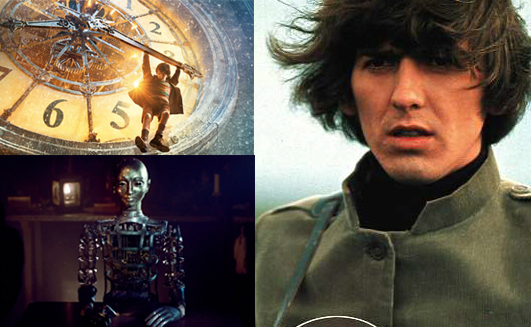
GREY MATTERS: Martin Scorsese’s interesting year

GREY MATTERS: Martin Scorsese’s interesting year

null

Aside from being a lousy whitewash out to prove God-knows-what, Martin Scorsese’s George Harrison: Living in the Material World doesn’t even live up to some simple realities, things like the fact that when you’re Martin Scorsese, you most certainly do have a huge responsibility when taking on such an undertaking. Nobody will ever again have your resources, access or your name, and the sobriety of purpose and sheer cred that goes with it.

And now, to super-complicate matters really interestingly, we have Hugo, easily one of Scorsese’s top five films, a masterpiece, coming mere months on the heels of the Harrison debacle. The two films, in eternal orbit and connected by “George” as a name and notion – of the guitar player and his revolution in sound, and of the disgraced special effects trailblazer, Georges Méliès, who, in our world, delighted a small, asthmatic Italian-American boy in Little Italy almost 60 years ago with his lowest-fi wonders.

My sense is that Scorsese – a Catholic boomer from the age of Aquarius, director of Kundun and The Last Temptation of Christ – simply could not have made Hugo without the mysteries of Harrison’s persona and life-long mysticism nagging him on. It’s just a damned pity that a huge chunk of facts, music history and Harrison’s vast, real legacy had to be the sacrificial lamb for Scorsese’s beautiful triumph.

So am I arguing that artists have responsibilities? Nope, no way. Do journalists? Yes. Absolutely.

nullBut in Material World Scorsese straddles art and reportage and screws the pooch on both. And yet Hugo, a film that makes no bones about being a total spin on some history using the toolbox of fiction, absolutely gets the heart of so many truths: truths about cinema, anger and healing, growing up and magic. And yeah, ironically, of the creation of history.

The irony is that the methods and mindset that serve Hugo so well are poison to Material World. Before we move on, though, a quick view of both films.

Material World offers a superfan’s mind-blow of previously unearthed Beatles and Harrison footage to drag us through a brilliantly edited but still relentlessly middlebrow, Ken Burns-like take on The Beatles and Harrison.

You know the drill. Grew up in grim, post-war Liverpool. Played crap clubs with John, Paul and Ringo until gaining world domination. Became entranced with Indian culture, the sitar and transcendental meditation under the guidance of Maharishi Mahesh Yogi. Made the magisterial All Things Must Pass solo record with the insane Phil Spector, now imprisoned for murder. Formed The Travelling Wilburys with Dylan, Tom Petty, Jeff Lynne and Roy Orbison. Did too much coke at some point. Got cancer, beat it. Suffered a knife attack by an insane person. Got cancer again, died peacefully. Every so often something new and interesting pops up – Harrison was a race car driver? – only to be summarily deleted.

nullAs you’ve probably heard, the film’s talking heads – among them Ringo and McCartney – are sometimes identified and sometimes not. About fifteen years of Harrison’s life are simply omitted, one assumes, because, like that racing bit, they just don’t fit Marty’s thesis: quiet guy becomes mystic. (You could say this lacks dimension.) The tales we’ve heard of George as a compulsive, somewhat cruel womanizer are whimsically hinted at by his wife Olivia, and then dropped. The epic coke binges occupy a fascinating single string of video that suggests the great film this could have been – I’ll return to that topic.

In general, Scorsese behaves as if his love of music will cover for the fact he truly doesn’t understand the thing, how it works or why the damned it so bewitches and obsesses him.

On the other hand, Hugo finds Scorsese not only at home in multiple cinematic languages and dialects, but talking about talking those languages. And so 3D not only works as immersion technique, but as an element with its own sacred history in a film that assumes longing for the cinematic experience and love of illusions as basic currencies.

The incredible richness of Scorsese’s visual languages allows him to express Harrisonian spiritual values delivered with an Amélie-like breathlessness and a neo-Gaultier splendor. (If costume designer Sandy Powell doesn’t win an Oscar for her designs, heads will roll – to speak only of heads.) As much as The Tree of Life is intrinsically Christian, Hugo is deeply Eastern in tradition, a film of real and metaphorical deaths and rebirths, of spirit animating the material world.

The film’s about Hugo (Asa Butterfield), a smudge-face Dickensian literally marking time by minding a Paris train station’s clocks and trying to repair the broken, beautiful automaton gifted to him by his deceased dad (Jude Law).

Hugo’s enemy is Inspector Gustav (Sacha Baron Cohen), once a foster child, now a spiritually broken policeman crippled by war. (Scorsese/Cohen/writer John Logan only play Gustav for laughs until they understand the true depths of his brokenness).

nullHugo’s redemption comes in the form of Isabelle (Chloë Moretz), a young girl who’s never seen a film, and who’s the foster granddaughter of Papa Georges (Ben Kingsley), a cranky man with a toy shop in the station, and who is on the run from the slow reveal of being the Georges Méliès – more than just special effects’ godfather, a man who rejects bleak reality for the hygienics of extreme fantasy.

By the way, we already we know far more about Hugo’s fictional characters than we ever learn about anyone in Material World. Just saying.

Scorsese’s film, the stuff of John Logan’s script (itself based on Brian Selznick’s book), unfolds a series of beautiful, almost Hindu cycles of death – Hugo’s dad and uncle’s passing – of birth – Isabelle’s discovery of cinema, the “awakening” of the automaton – and rebirth – the automaton coming to “life,” Georges’ films rediscovered, his reputation, his essence, Inspector Gustav healed of the burns of a bad childhood.

Along with its spiritual transcendences and heroic humanism, Hugo addresses, delights in and celebrates film history through mostly-fictional characters, fantastic devices and interlocking, exquisitely alive tableaus.

The reason this works with Méliès and not Harrison would seem obvious: most of Méliès’ films were destroyed after World War I, most Americans have no idea who he was, most historians have no idea what the “real” man was like. And so there’s no such thing as “doing” Méliès inaccurately. Harrison’s life, on the other hand, as we see in Scorsese’s own film, is ridiculously open to scrutiny, which means the director has to work that much harder to float his revision.

In Hugo, fiction about fact frees Scorsese. In Material World, what we get is an attempt to mold fact to fit intent. After a while, it’s like a root canal; the only painless part is when it’s over.

nullI get the temptation to rewrite George as spiritually ahead-of-the-curve, as an enigma tucked inside a mystery. Problem is, in order to do this properly, you have to commit all kinds of misdemeanors against the artist, the arts and history. Scorsese ends up so busy whitewashing alone, he has to, for example, mostly play down the matter of George’s, well, guitar playing.

Off and on, people – mostly unidentified – declare George’s playing to be “soulful.” This means nothing. Paul and Ringo – both acquitting themselves with warmth and grace – speak of their fallen mate with respect, with Paul saying he was the best musician by far when they started, which is something as George was, like, 17 years old at The Beatles’ beginning. Whatever – I eat this stuff up with a spoon, Paul and Ringo’s humbled late-life understanding of their band’s magnificence.

But aside from the static, overlong middle section of the film involving George’s interest in the sitar and Ravi Shankar, there’s not much in the way of musical insight. Scorsese seems so bent on fuck-knows-what, he misses the ready-made metaphor for Harrison’s spiritual quest sitting right there on his AVID screens.

It’s Harrison’s mysterious morph from the edgy, all-elbows player on early hits like “Don’t Bother Me” to the soaring transcendent slide guitarist you hear on Badfinger’s “Day After Day” (not in the film) and pretty much everywhere after the White Album.

What happened? How did he change? This is exciting stuff – the sound of a man’s soul in transition!

nullScorsese, literally, could not care less. Instead of this tale of self and spiritual discovery through music, Scorsese fritters away precious time with Eric Clapton, who shares tales of his cockmanship, of his creation of Scorsese’s favorite GoodFellas track, “Layla.” Scorsese is so enraptured with Clapton, who comes off as the epitome of noxious, boomer rock royalty, chortling about stealing George’s wife and choosing to not join the Beatles due to his extreme awesomeness, that Scorsese doesn’t seem aware Clapton is most recalled as a soft rock favorite and that, more importantly, aside from the solo on “While My Guitar Gently Weeps” and some shared women (nice), Clapton has fuck-all to do with our story here.

The Clapton infatuation is, however, a side effect of what’s really wrong: Scorsese refusing to leave his boomer bubble for context or insights, and in so doing, missing Harrison’s vast contributions beyond his own first edition vinyl collection.

Based on what’s here, Harrison is a minor figure – no big deal, used to be in The Beatles, saw God, Ommmmmmm…. You’d never know that Harrison’s early Beatles compositions (think “If I Needed Someone”), with their signature bell-toned arpeggios, tightly harmonized, octave-sweeping melodies and oddly chorded middle-eights, provided the vocabulary for New Wave, power pop and indie pop, inspiring/defining everyone/everything from Aimee Mann, Elvis Costello and Glenn Tilbrook to David Bowie’s wholesale theft of the song in “Blue Jean” to Elliot Smith’s post-Brit Invasion confessional aesthetic.

You’d never know that, as much as John Lennon, Harrison brought the ways and modes of the avant-garde into pop, whether it was the teeth-rattling extreme dissonances in “I Want to Tell You,” the tape-loop floaty-ness of “Blue Jay Way” or the triumphant wall of feedback in “It’s All Too Much.”

nullIt’s an amazing legacy that Scorsese omits, and it doesn’t end there. There’s George creating “world music” decades before the likes of Peter Gabriel, Sting or Björk via the 1968 Beatles track “The Inner Light” and its pulsing dress of sitar, harmonium, flute, table and santoor. (That Scorsese used world-music-style music by Gabriel for the soundtrack for The Last Temptation of Christ makes this omission a real head-scratcher – or is Scorsese simply unable to connect the dots?)

Meanwhile, wouldn’t it be clean fun to chart Harrison’s perversely “WTF?” appearances on records by Belinda Carlisle (The Go-Go’s), Fleetwood Mac and Electric Light Orchestra?

Who was that George? In particular, the George who, again like the Georges Méliès of Hugo, lived to enjoy a late-life resurgence with 1987 Top Ten hits like “Got My Mind Set on You,” “When We Was Fab” and the album Cloud Nine? You’re not going to hear much about that George. In order to buy the mystic-dude-in-the-material-world shtick, you have to – simply have to – accept that an entire fifteen or so years of Harrison’s life didn’t much matter.

Actually, Harrison seems to leave Scorsese’s radar as soon as the counter-culture dissipated. Which means that Harrison only has meaning for the director if he’s attached to a larger context, like the perky midlife crisis that was The Traveling Wilburys.

What does compel more than anything in the film comes from the artist’s cocaine days (told you I’d get back to this.). Not because it limns him bottoming out way, but because Harrison with his throat trashed by blow doing godawful Philly-soul-inflected versions of his hits so utterly deconstructs the narrative Scorsese has so painstakingly constructed. Because it turns Scorsese into Jake LaMotta beating his own film, which, for a few moments, is incredibly liberating. Here and only here is the Scorsese we all love and admire, the actual artist willing to go way out on a ledge.

Who is this George Harrison sarcastically mixing a throat concoction recommended by Barbara Streisand? We’ve been hearing, in draughts here and there, about an anger living beneath George’s placidity, a cooled, arched-eyebrow lividity amping up even early solos.

And here, in his cocaine days, finally, that anger twitches near the surface and Harrison cackles. You get the sense that if a mantra showed up, this George Harrison would spit at it and laugh.

I wish Scorsese had started here, or referenced this more. Not because it’s “dark,” or what I want to see, but because it’s true, because it goes beyond the firewall of the Harrison legend and because, if you want the mystery of George Harrison, it’s hidden in plain sight.

I want to believe that Material World will be forgotten – an aberration in a great career. I know Hugo will be remembered as long as cinema exists in any form.

Ian Grey has written, co-written or been a contributor to books on cinema, fine art, fashion, identity politics, music and tragedy. His column "Grey Matters" runs every week at Press Play. To read another piece about Drive, with analysis of common themes and images in all of Refn's films, click here.

SIMON SAYS: Tom Cruise in MISSION IMPOSSIBLE 4: “it is my destiny to be the king of vain.”

SIMON SAYS: Tom Cruise in MISSION IMPOSSIBLE 4: “it is my destiny to be the king of vain.”

null

In the recent Mission: Impossible movies, Tom Cruise has basically played a charismatic body under stress. While Mission: Impossible III is still the most satisfying film of the series because it takes the Ethan Hunt character and gives him personal stakes to fight for, Hunt’s main appeal has always been his charm as a humorless beast of burden. No film in the series makes this more apparent than the fourth and most recent entry in the film franchise, Mission: Impossible – Ghost Protocol. Here, Cruise, who gets a prominent producer credit in the film’s opening credits, shows his age; in fact, he flaunts it. Not in an “I’m getting too old for this shit” kind of way. More like a “My body has seen better days but I’m still pretty amazing, so shut the hell up and watch me scale the tallest building in the world…one-handed” kind of way.

Okay man, sure, I just came for the movie, I swear, don’t hurt me!

Tom Cruise in Ghost Protocol is intimidating-looking. In fact, watching the grooves on Cruise’s scored face is so distracting that it’s sometimes just as thrilling as watching the film’s immaculate set pieces. The bags under his eyes are always more pronounced, the contours of his face more angular and the wrinkle lines etched into his cheeks like stone always suggest more texture than his co-stars’ features. Take note: Tom Cruise’s body hasn’t gone to seed. But Hunt’s hair is longer than usual and his face is certainly showing signs of age.

nullYou’d have to work pretty hard to cover up that kind of wear, but that’s kind of the point of Ghost Protocol: Cruise’s Hunt is not in denial. He’s in great shape – did you not see him clean up the world’s tallest building in Dubai? Or, on foot in a sand storm, running around like a madman? Or crashing several BMW luxury sedans? Just think of Tom Cruise’s face as the portrait of Dorian Gray, which I guess makes his body Dorian Gray…except in Ghost Protocol, Dorian Gray is galloping around the world with his portrait on display. Which is…odd, to say the least.

So Ethan Hunt in Ghost Protocol is going around doing incredibly impossible missions. He’s not developed well enough to be treated like most characters, with ulterior motives and “feelings” that extend beyond the circumstantial peril Hunt is constantly forcing upon himself. So in this film, he’s just a really versatile guy that takes it upon himself to do much of the heavy lifting of tracking and disarming an evil Russian madman, codenamed “Cobalt” (Abduction’s Michael Nyqvist).

Until Hunt and his team catch Cobalt, they’re in the shit. But even though he’s working with them throughout the film, Hunt has to basically lead the group because none of them are capable of doing things with restraint, improvisatory skill or much brawn without him. He’s the Mr. T to their A-Team; if they were replaced by other actors mid-film, no one would notice or care. That lopsided team dynamic is sort of a given until the film’s last big set piece, which reminds us that the film is about a team of spies, some of whom, unlike Hunt, are actually both charismatic and capable of laughing at themselves, too.

Cruise’s Hunt has no such default setting. His onscreen persona throughout the series has been, and continues to be, pretty brittle. So it’s a very good thing that Cruise is naturally charming. The curious thing about these Mission: Impossible movies is that in them, he’s constantly trying to remind us of this by performing spy hijinks and superhuman acrobatics, like his big Dubai Spider-man act in Ghost Protocol, where he climbs up 11 stories using magnetic gloves, one of which short-circuits mid-climb. This only momentarily fazes Hunt. He keeps climbing.

Director Brad Bird (The Iron Giant, The Incredibles) and Ghost Protocol’s capable stunt choreographers play up Cruise’s glassy charms by making a sight gag of Hunt’s malfunctioning magnetic gloves. After he callously shucks the glove off, Hunt soon finds the errant glove stuck to a pane of glass just a few stories below where he originally ditched it. This is a rare thing in Ghost Protocol, a joke involving Hunt’s man of action. But it should be noted that the joke is not on Hunt but rather the malfunctioning equipment that Benji (Simon Pegg), a geeky and relatively effete fellow spy, gave him. Modern technology can’t even keep up with Tom Cruise!

nullBut in all seriousness, Ghost Protocol needs Cruise’s over-seriousness and his tendency of making himself look that much more focused, that much more determined and that much more capable than everyone around him. Even newcomer Jeremy Renner looks like a girly man compared to Cruise, like in the scene where Renner is floating around (literally, floating around) in an overheated subterranean tunnel while wearing a chain mail suit that levitates his whole body.

Yes, there is actually a sequence where Jeremy Renner, a new macho action hero for our times, is floating around with his arms outstretched in front of him like he’s Supergirl. And he’s sweating. Tom Cruise’s Ethan Hunt doesn’t sweat, not even when he’s fighting Michael Nyqvist’s Cobalt, a villain that is so hardcore that he’d rather kill himself than let Hunt get the upper hand. Cruise’s Hunt, by contrast, is all upper body strength and an unending supply of physical endurance and facial tics when he wants to show you just how hard he’s pushing his body (note: pretty freaking hard). Without him, Ghost Protocol would be nothing.

Simon Abrams is a New York-based freelance arts critic. His film reviews and features have been featured in the Village Voice,Time Out New York, Slant Magazine, The L Magazine, New York Press and Time Out Chicago. He currently writes TV criticism for The Onion AV Club and is a contributing writer at the Comics Journal. His writings on film are collected at the blog, The Extended Cut.

SIMON SAYS: THE SITTER, blah blah, balls on fire, Method Man cameo, blah blah, double-fisted punch to the balls, blah

SIMON SAYS: THE SITTER, blah blah, balls on fire

nullThis is it, folks: David Gordon Green isn’t the guy that made George Washington and All the Real Girls anymore. Now, he’s the guy that made Pineapple Express and Your Highness. Which is a transition that doesn’t really deserve an award or a hearty handshake or even much praise really. But for the sake of needlessly giving credit where credit is due, I have to say: this new David Gordon Green is ok.

No, seriously. I may have joked in the past that, after hearing that Green wanted to remake Dario Argento’s Suspiria, perhaps doing a shot-for-shot remake of Super Mario Bros.: The Movie would be more his speed. And I definitely don’t think his comedies are worth starting a #teamstonergreen movement for or anything. But Green’s slacker comedies have been incrementally getting better. And they’re mostly funny.

So…yeah, I am working myself up to recommending The Sitter. Because it’s often very funny, thanks in no small part to star Jonah Hill. And until Green and his screenwriters start to take seriously the clichés they had been theretofore only conforming to with their tongues lazily lolling in their collective cheek, it’s pretty amiably ditzy. The film’s charms don’t really wear off until it has to become a narrative about something. Still, The Sitter’s about 2/3rds on-target, which is unfortunately more than can be said about most studio-produced contemporary comedies.

In The Sitter, an exceptionally disheveled Hill plays Noah Griffith, a push-over and a slacker that has to baby-sit three troublesome tykes so that his single mother can go out on a date. One kid, Rodrigo (Kevin Hernandez), is Hispanic, has to go the bathroom constantly and enjoys blowing toilets up. Another kid, Blithe (Landry Bender), wants to grow up to be a “celebutante” and hence wears too much make-up and acts like she knows what’s hot and what’s not. The third kid, Slater (Max Records), is the least annoying kid as he’s just got anxiety issues…oh, and apparently he’s a repressed homosexual, which is news even to him. None of these kids are interesting. You did not come to see The Sitter to watch these kids. Because these kids are only worthwhile as straight men to Jonah Hill’s fat man in a little plaid coat.

nullBecause, let’s face it, the plot of The Sitter is exhausting and not always comically so. Even screenwriter Brian Gatewood and Alessandro Tanaka eventually throw up their hands and accept that they have to get semi-serious about their lazy, potty-mouthed pastiche after a point, which puts a serious damper on Green’s genital-fixated style of humor (I’d say the point where the film stops being generously funny is probably the point where Noah tells Slater that he’s gay…).

So Noah takes these kids out on a wild journey to buy cocaine from Sam Rockwell, who plays a cocaine dealer named Karl that’s basically like Alfred Molina’s character in Boogie Nights but with a muscleman fetish and not as funny. But that goes to hell because Rodrigo winds up stealing one of Karl’s smack-filled dinosaur eggs (Karl also has a dinosaur and Faberge egg fetish). Then Noah meets Roxanne (Kylie Bunbury), an attractive but nerdy black girl that he can relate to and hence eventually winds up dating. Oh and Noah’s got daddy issues. Blah blah blah, balls on fire, blah blah blah, Method Man cameo, blah blah, double-fisted punch to the balls, blah.

But hey, how ‘bout that Jonah Hill? While his serious dramatic performance in Moneyball is impressive, I think he delivers an equally superlative turn in The Sitter. Hill exudes schlubbiness, which is almost enough to make his character seem fully-developed (note: his character is not even halfway well-developed). Noah is a sassy, slovenly loser, which is perfect for Hill, since he looked like Gene Wilder ate Zero Mostel when he shot The Sitter.

Noah is such a waste of space that we’re introduced to while he’s going down on his aloof girlfriend Marisa (Ari Graynor). Marisa doesn’t reciprocate, leaving Noah to peddle dejectedly back home to his mom’s place on his two-speed bike. This isn’t for want of trying: he guilelessly tries to steer her towards his crotch, winking and nudging her all the while. But she feigns stomach problems and that’s the end of that. This is material tailor-
made for Hill, though if Moneyball is any indication, he’s now trying to put that period in his career behind him. It’s similarly too bad that, true to generic form, Noah has to grow up a little by film’s end—he was just hitting his stride.

But let’s not talk about that. Like Hill, Green is in a period of creative stasis. He’s doing what he’s most comfortable right now and that’s only commendable because he’s doing it with a comic performer as talented as Hill, someone that can really turn it on if given half the chance. And The Sitter is roughly half of a chance, give or take a tenth of a chance. It’s sporadically very funny, then it’s mostly just a stupid kiddy pic. But hey, I laughed.

Simon Abrams is a New York-based freelance arts critic. His film reviews and features have been featured in the Village Voice, Time Out New York, Slant Magazine, The L Magazine, New York Press and Time Out Chicago. He currently writes TV criticism for The Onion AV Club and is a contributing writer at the Comics Journal. His writings on film are collected at the blog, The Extended Cut.

TONY DAYOUB: TINKER TAILOR SOLDIER SPY is a worthy remake filled with lonely characters

TONY DAYOUB: TINKER TAILOR SOLDIER SPY is a worthy remake filled with lonely characters


null

The tall, athletic man introduced earlier in Tinker Tailor Soldier Spy as British Intelligence officer Jim Prideaux (Mark Strong) walks into a classroom and begins to write his name on the chalkboard. Only he does not write the name we’ve come to know him by. The typically garrulous young males attending the tony prep school remain blissfully unaware of their new teacher’s identity as he starts handing out the class assignment. But the viewer is all too keenly aware of who Prideaux is if only for the fact that we saw him shot in the back at the start of Tomas Alfredson’s film adaptation of the John le Carré novel. Is this a flashback? Or did Prideaux somehow survive the shooting? Prideaux’s mild demeanor belies his efficiency, a fact his students become aware of when a bird trapped in the chimney suddenly flies into the classroom in confusion. Prideaux rapidly pulls out a club from his desk drawer and swats the bird down to the ground where it continues to squeal in pain. As Alfredson directs the camera to capture the students’ horrified reactions, the sound of Prideaux beating the bird to death comes from off-screen.

nullThis memorable scene crystallizes much of the convoluted – yet ultimately satisfying – story of Tinker Tailor Soldier Spy. For one, the momentary confusion caused by the squawking bird is a metaphor representing the chaos a Soviet double agent is causing within the upper ranks of the Circus, the British Intelligence branch MI6 that Prideaux was working for at the time he was shot in Budapest. Secondly, the viewer must determine whether what is being shown is taking place in the film’s past or its present. Lastly, the sequence illustrates how a character who’s been left to languish in a sort of purgatory for a failed espionage mission may actually be underestimated in his level of competency. The treatment of Prideaux after the shooting – torture, reassignment and disavowal – has been a far more protracted death than the mercy killing he granted the poor animal.

One could say the same thing about George Smiley (Gary Oldman), ex-Deputy Director of the Circus, who was dismissed along with his boss, the mysteriously designated Control (John Hurt), when Prideaux was believed to have been killed in Hungary. Control had secretly sent Prideaux there in order to uncover a mole amongst his top lieutenants: “Tinker” (Toby Jones), “Tailor” (Colin Firth), “Soldier” (Ciarán Hinds) and “Beggarman,” Smiley himself. Smiley’s firing along with that of Control’s made the question of his treachery academic. But both operatives were now on the outside, unable to ferret out which of the other three officers was providing the Soviet double agent some of the Circus’s most valuable secrets. The aimless Smiley goes about his daily routine – swimming in the Thames, contemplating the ruin of his marriage and unable to shake the paranoia inherent in his lifelong career – all but forgotten by his country. However, the death of Control, and intelligence gathered by an underling, Ricki Tarr (Tom Hardy), initiates an invitation from the Prime Minister’s office for Smiley to return and continue his former boss’s investigation into the identity of the traitor.

nullThe usually volatile Oldman is superb as the constricted Smiley. Oldman’s portrayal is even more amazing considering it follows in the footsteps of Alec Guinness, whose performance as Smiley in the original 1979 BBC miniseries and its sequel, Smiley’s People – both available on DVD from Acorn Media if you’d like to compare – is among his most iconic. Over the hill, his hair streaked with gray, and wearing oversized spectacles – red frames for the flashback sequences, horn-rimmed for the ones set in the film’s present day, 1974 – Oldman’s Smiley is a study not so much of repression but economy. Smiley never raises his voice in the film, not even at the close friend who is cuckolding him, except for when an associate tries to justify his betrayal of queen and country. Smiley’s reflective glasses even serve as an occasional blind, shielding his tempestuous, observant eyes from any examination. When a fly is buzzing around the interior of a car driven by protégé Peter Guillam (Benedict Cumberbatch), Smiley, rather than fruitlessly wave his hand in the air chasing it down, waits until the fly is close enough to the window to roll it down and let suction take care of the rest.

What one finds most striking about Tinker Tailor Soldier Spy is the anguish and loneliness that lies at the heart of its brittle, cold exterior. As the movie starts to wind down, the depth of alienation experienced by those in this nasty profession becomes ever more apparent. The desire for emotional connections – the utter loneliness of the job – drives many of the film’s players, including Prideaux, the closeted Guillam, the traitorous mole and yes, even the stoic Smiley. Tarr, the lethal operative whose intelligence relaunched the inquiry, is eager to finish his part of the mission to chuck it all for a quiet life raising a family. Prideaux and Guillam, each separately involved in his own secret homosexual relationship, are the epitome of the type of individuals bred for the espionage service, men of character who have developed an unerring ease in cultivating a double life. And then there’s Smiley, whose frustrating love for his philandering wife is the only chink in his carefully built armor. Smiley’s weakness might just be the proper fuel for his instinctive ability to unearth his fellows’ motivations and find out who the mole really is.

Atlanta-based freelance writer Tony Dayoub writes about film and television for his blog, Cinema Viewfinder, and reviews DVDs and Blu-rays for Nomad Editions: Wide Screen, a digital weekly. His criticism has also been featured in Slant’s The House Next Door blog, Opposing Views and Blogcritics.org. Follow him on Twitter.

Joe Swanberg’s CAITLIN PLAYS HERSELF defies expectations and categorization

Joe Swanberg’s CAITLIN PLAYS HERSELF defies expectations and categorization

null

There’s not much nuance to the discussion around Joe Swanberg’s films. You either think the amazingly prolific director’s the second coming of Ingmar Bergman and the French New Wave or a sexist softcore sleazebag. No other member of the mumblecorps generates so much heat, even if Andrew Bujalski or Aaron Katz’s films aren’t universally liked. At a Q&A in Brooklyn two months ago, I asked Swanberg why he thinks his work is so divisive. He pointed out several possible reasons – shooting entirely on video (although he’s far from alone there), acting in his own films – before settling on the fact that he puts his libido explicitly into his work. That sex drive is usually but not always directed towards beautiful young women. However, Swanberg has also filmed himself masturbating for real, and his forthcoming film, The Zone, an update of Pier Paolo Pasolini’s Teorema, depicts a mysterious bisexual stranger.

As if to bait Swanberg’s critics, Caitlin Plays Herself opens with a shot of Caitlin (Caitlin Stainken, who does indeed play herself) baring her breasts. However, voyeurs will soon be frustrated, as she’s covered in dark liquid in the very next shot (echoing Brian De Palma’s Carrie) during a performance piece about the BP oil spill. Caitlin’s in an on-again, off-again relationship with a filmmaker (Swanberg) who frequently travels out of town. She dates other men, but she can’t pull herself together to make a definitive break with Swanberg, who takes offense at her onstage nudity. The film exposes both female bodies and, more daringly and threateningly, male egos.

Swanberg has improved greatly as a visual stylist since early films like Hannah Takes the Stairs and Nights and Weekends. At this point, he rarely moves the camera or uses close-ups. His feel for the expressive potential of digital video has increased, as he gets a particularly uncanny glow from onscreen lights. He’s left shakycam clichés associated with the mumblecore movement far behind.

Swanberg claims that he makes films with no written script. Be that as it may, Caitlin Plays Herself does include a writing credit for himself and Stainken. As Swanberg’s work has progressed, it’s become clearer that its central point is his ability to simulate reality in all its messy aimlessness. At first, it seemed as though he were simply shooting amateurish improv sessions. In more mature films like Silver Bullets, the quality of his direction of improv has improved so much that the purpose behind the aimlessness is usually evident.
null
If only that were always the case in Caitlin Plays Herself! Especially in its first half, it is full of scenes that seem hopelessly digressive, introducing minor characters who never reappear, or subject matter that sheds light on nothing. The film promises to address the contradictions and difficulties of making political theater in the Obama era, but it turns out to have almost nothing to say about this. It’s far from devoid of subtext, such as Caitlin’s desire to get back to nature (which seems linked to her politics), but Swanberg’s storytelling methods are so haphazard that little of it really resonates.

Swanberg’s cinema picks up on one of the promises of the French New Wave: a kind of filmmaking akin to writing a diary. With The 400 Blows, François Truffaut filmed his difficult adolescence. With his trilogy of reflexive films, including Art History, Silver Bullets and Caitlin Plays Herself, Swanberg has created a public persona that seems to acknowledge the gossip some people have spread about him online. However, his self-portraits are rarely flattering. In Caitlin Plays Herself, his flightiness makes him emotionally – and often physically – unavailable for Caitlin.

How much of the real Swanberg exists in his cinematic alter egos? His use of fellow filmmakers as supporting actors and his tendency to work with the same collaborators repeatedly – here, co-cinematographer Adam Wingard, with whom he directed Autoerotic earlier in the year – suggests a network of friendship belied by the film’s often icy view of interpersonal relationships. All the same, they seem designed to provoke questions about Swanberg’s real life.
null
Much of Caitlin Plays Herself plays like the café-set first 90 minutes of Jean Eustache’s The Mother and the Whore, except that neither Swanberg nor Stainken is as charismatic an actor as Jean-Pierre Léaud, and the drama that ultimately emerges offers nothing as compelling as Eustache’s devastating finale. Perhaps judging this film by the standards of conventional screenwriting or French films from the ‘60s and ‘70s is misguided; after all, Swanberg has said that he’s more influenced by YouTube clips than cinema from the past. At its best, his cinema suggests a hybrid between previous models and something genuinely new,  specific to video and our fragmented technological communication. (Caitlin talks about reducing her anxiety by going off the grid.) While not nearly as accomplished as the films it evokes, Caitlin Plays Herself resists easy dismissal.<

Steve Erickson is a freelance writer who lives in New York. He has also made 4 shorts, the most recent one being 2009's SQUAWK. He writes for Gay city News, Fandor's blog, the Nashville Scene, Film Comment, the Tribeca Film Festival's website, The Atlantic website and has written for many other publications.

MATT ZOLLER SEITZ: On “Weed Wars,” drug clichés go up in smoke

MATT ZOLLER SEITZ: On “Weed Wars,” drug clichés go up in smoke

null

“I run a family business, and the business is cannabis,” says Steve D’Angelo, a central character in Discovery’s new series Weed Wars and the co-founder and executive director of Oakland’s Harborside Health Center, which distributes medical marijuana to almost 100,000 customers. D’Angelo’s matter-of-fact statement sums up the tone of this series, which treats the Harborside Heath Center as just another family-owned (albeit nonprofit) business, ultimately not too different from a veterinary clinic, a hair salon or a tattoo parlor.

Well, OK, there is one major difference: Although the clinic’s main product can be sold legally to any California resident with a medical permit to buy it, the federal government still considers marijuana a Schedule 1 narcotic, as dangerous to the republic as crack cocaine. That means that in addition to the usual entrepreneurial headaches, D’Angelo and his brother Andrew, the clinic’s general manager, live in fear of a massive bust by the DEA on whatever pretext — a catastrophe that would wipe out everything they’ve built.

You can read the rest of of Matt's piece here at Salon.

Matt Zoller Seitz is publisher of Press Play and TV critic for Salon.com.

Jason Segel’s THE MUPPETS proves it’s time for Kermit & Co. to pack it in

Jason Segel’s THE MUPPETS proves it’s time for Kermit & Co. to pack it in

null

In his effort to revitalize the brand, Jason Segel exposes his fondness for the Muppets as boldly as he exposed his naked body in Forgetting Sarah Marshall. No hidden agendas here, The Muppets is packed with full-frontal nostalgia that suggests not just Segel’s desire to relive the magic of yesteryear but also his fervent belief that the Muppets’ charms can cast an equally powerful spell today. The Muppets, which Segel co-wrote with Nicholas Stoller, opens with an outright appreciation of The Muppet Show and the not so subtle implication that Segel spent his childhood feeling as if the Muppets were part of his family. If you’re a hardcore fan and realize how much the brand’s spirit has strayed from its roots since Jim Henson’s death in 1990, this is exactly the kind of opening you want to see, and it’s equally encouraging when, not much later, Segel’s Gary and his brother Walter (a Muppet performed by Peter Linz) break into song. The film’s rousing opening number, “Life’s a Happy Song,” captures some of the cherished Henson-era optimism and sweetness in its title alone, and the lyrics have a casually playful absurdity to them that feels just right. But the capper is a massive dance routine at the end of the song, when the citizens of Smalltown, USA, come flooding into the frame to form a leg-kicking, jazz-handsing chorus, creating a spectacle that would rank among the all-time greatest Muppet moments if not for one small problem. None of them are Muppets.

nullFor a guy who so clearly gets the Muppets, Segel should be the first person to realize how utterly un-Hensonian this is. Henson’s Muppet movies are full of big musical performances, but always with the Muppets at the center of the action. In The Great Muppet Caper alone, there’s the black-tie dance sequence that includes Miss Piggy tap-dancing, the synchronized swimming number, also starring Piggy, and “Couldn’t We Ride,” with the whole crew on bicycles. The thrill of these Henson numbers is their audaciousness, the way Henson dared to make the Muppets part of the action in scenarios in which it seemed logistically impossible. Segel’s opening dance number takes the opposite approach. One moment Walter and Gary are singing their way through the streets, and the next moment Walter is gone, literally kicked from the frame, never to return until he’s wheeled in on luggage at the very end of the sequence as dozens of humans dance behind him. Audacious? Hardly. And it’s a sign of what’s to come. Segel’s core mistake is to repeatedly push the Muppets to the margins in a movie designed to give them the spotlight. Case in point: Of the more than 20 songs in Henson’s three Muppet movies, only one of them has a non-Muppet performer (“Piggy’s Fantasy” in Caper, in which Kermit vies with a voice-dubbed Charles Grodin, which is part of the joke). Yet of the six original songs in Segel’s film, only one of them is Muppets-only. One.


None of this is to suggest that Segel’s approach to the Muppets isn’t endearing in its own way. But The Muppets speaks to the ability of Segel and Amy Adams (as Gary’s girlfriend Mary) to be Muppet-like as often as it speaks to the appeal of the Muppets themselves. What’s particularly odd about Segel’s reboot, directed by James Bobin, is that it tends to miss most glaringly when trying hardest for the bull’s eye. Midway through the film, for example, the Muppets, who have been gathered together from far and wide to put on the traditional one-last-show, are faced with
cleaning and repairing their decrepit studio. After watching Scooter quietly push a broom for a few unproductive seconds it’s Walter who reminds the Muppets that this is the kind of stuff that they’re supposed to do to music, and he’s right. But Starship’s “We Built This City”? Uh, no. That scene might be intended as Segel’s nod to the Muppets’ recent successes on YouTube, where they covered Queen’s “Bohemian Rhapsody” to hilarious results, but it lacks the Muppets’ own signature. It’s more like an Alvin & The Chipmunks cover: same song, different performers, no reinvention. Thus it smells like surrender, an odor that returns late in the film when the Muppets sing “Rainbow Connection” as the main act of their studio-saving telethon. Make no mistake, watching the gang
perform “Rainbow Connection” is lump-in-the-throat touching and realistic, too (not that the Muppets have ever been about realism), but it comes off like a concession – that the Muppets’ best days are behind them and the most magic we can hope for is an occasional performance of their greatest hits.

Maybe that’s true. Maybe what Segel’s film shows us is that Henson and Frank Oz, the puppeteers extraordinaire who through their voices and hands gave so many of these characters their spirit, are irreplaceable. As disappointing as it can be to watch the Muppets lose their identities in adaptations like The Muppet Christmas Carol and Muppet Treasure Island, the catch-22 of letting the Muppets be themselves is to be made increasingly aware that, with Henson and Oz gone, most of the performances can be nothing more than imitative. Credit where it’s due, Steve Whitmire’s Kermit is as strong as it's ever been – he’s mastered the subtle finger movements that make Kermit so thoughtful – but Fozzie and Piggy, to name two, are frequently off key, and Rowlf seems to have lost his personality entirely. When the new troupe nails it, as Whitmire and Eric Jacobson do when Kermit and Fozzie have a quiet conversation in hammocks underneath the stars, it warms the soul. But so much of what works in this picture is an allusion to the Henson era (the lens flares that recall The Muppet Movie) or a direct quotation of it (the cover of the “Rainbow Connection”), and as welcome as it is to see banjos hanging on the wall of Kermit’s office or to spot a photograph of the African-mask puppets from Harry Belafonte’s famous performance on The Muppet Show, these little details can make the film feel less like a reinvention for a new generation than like a fantasy camp for the old one.

Segel’s stroke of brilliance with The Muppets, beyond reviving the running gags and meta references that are key to the brand, is to backload the picture with the sort of colorful, chaotic and heartfelt performances that typified The Muppet Show, ensuring that the movie ends on a high note. I’m not sure what the shelf life is for the cover of Cee Lo Green’s “Fuck You” by about a dozen chickens, but I do know it’s precisely the kind of mischief Henson would be up to if helming The Muppet Show today and that it inspired much of the packed crowd at my screening to break into gleeful rhythmic clapping. Trouble is, so many of these thrills send us backward, not forward, like the goose bump-inducing recreation of The Muppet Show’s opening number, confining the Muppets to retro appeal. In the movie’s greatest shot, one that perfectly blends the familiar and the new, Kermit sits alone backstage, his hand on a small handle that he’ll use to throw open the oval hatch through which he’ll announce the start of the show, looking angst-ridden and full of questions. Will their material hold up? Will anyone come to watch? Will the crowd still love them? Segel’s film makes it clear that the answer to those questions is yes, but we’ve yet to see if someone can return the Muppets to their roots while moving beyond nostalgia. Segel’s film offers hope and also confirms fears.

Maybe the time has come for Kermit and the gang to cede the spotlight, not to eliminate the brand but to preserve it. Maybe the Henson-era characters need to be retired, replaced by Walters, Bobos and Pepes. It’s a tough task, immortality. Then again, part of loving the Muppets is believing in the dream.

Jason Bellamy ruminates on cinema at The Cooler and is a regular contributor to Slant Magazine's The House Next Door, coauthoring The Conversations series with Ed Howard. Follow him on Twitter.

LISA ROSMAN: MY WEEK WITH MARILYN pleases while it lasts

LISA ROSMAN: MY WEEK WITH MARILYN pleases while it lasts

null

These days, you can scarcely hit a Cineplex without tripping over at least one biopic, a phenomenon I chalk up to the same one that makes reality TV so proliferate: people tend to thrill over the idea that
anything really happened, like, ever. But as thrilling as some human lives may be conceptually, rarely do any produce a satisfying narrative arc.

As a species, we tend to make the same mistakes over and over until we fade out– more the stuff of early Warhol installations or daytime soaps than a two-hour feature. Most biopics are either factually sound and dramatically dull (Sylvia, Ray), or historically inaccurate (Walk the Line). The best ones limit themselves to a very specific theme or period in a person’s life (Capote, Frost/Nixon). So structurally at least, My Week With Marilyn, based on memoirist Colin Clark’s short-lived dalliance with Marilyn Monroe during the 1956 filming of The Prince and the Showgirl, seems ahead of the game.

First, the million-dollar question: how well does Michelle Williams do Monroe? For there may be nothing ballsier than playing the legendary actress—and “ballsy” is the operative term, as everyone who attempts to conjure her quintessential femininity always seems a drag queen in comparison, be they biologically female or male. Given that, Williams ain’t half bad. There may be a stridence that defines her, a wounded gravity, that exists in contrapunto to the gentle fun Marilyn always radiated on screen; her features may seem hard, her eyes hooded, in contrast to Marilyn’s delicious, eternal softness (even her nose was a sweet little blob);  but the voice, breathy and yet precise, is
pitch-perfect. And that palpable need for an intimacy she also fears, for a relief from a loneliness that at core seems inescapable, is exactly right.

But a character sketch, no matter how well done, does not a movie make, and ultimately this film doesn’t explore its terrain enough. Rumors of strife on the British The Prince and Showgirl set have outlived general interest in the film itself, which is at best a trifle. (Only Marilyn’s performance is remotely palatable in retrospect.) By all accounts, Prince’s director and costar Sir Lawrence Olivier (played here by Kenneth Branagh) found Monroe’s pill-popping, entourage, erratic work ethic, and method acting preparation intolerable, while she found him a cold fish bordering on cruel. The results were delays, tears, arguments, and booze, lots of booze—all of which exist in copious amounts here. Alas, little else does.
null
During this shoot, Marilyn is newly married to playwright Arthur Miller (Dougray Scott), and the combination of his and Olivier’s disdain for her proves too much to bear—which only increases her reliance on such crutches as valium, acting coach Paula Strasburg (a wonderfully, appallingly vampiric Zoë Wanamaker) and, apparently, Clark (Eddie Redmayne) himself, who’s not much of a narrator as narrators go. In a very early scene we watch him watch her up on a movie theater screen (Williams shimmies a fantastic “Fever”), and that sets the prevailing, surprisingly unexamined tone. A 23-year-old third assistant director (read: lackey), he may be looking to defy his hyper-aristocratic family by, god forbid, launching a career but he hasn’t shed their inability to recognize the full humanity of Everyone Else despite his superficial congeniality. Though the film is ostensibly about the love he broached with the actress, it never transcends his lack of motivation to look behind the Marilyn curtain no matter how up and close and personal he ever got. (For the record, we never know just how close the two ever got, though we’re subjected to a monotonous number of their tender, unhungry kisses.) Instead, it bumps along in a series of oddly unrelated, too-expertly staged scenes, mostly featuring her thrashing about unhappily while British people stare bleakly into the bottom of their drinks.

That Marilyn was fragile and lonely is nothing new. That she was a massive star whose seemingly natural appeal rested squarely on a self-construction is nothing new. (When suddenly flocked by a throng of admirers, she breathes to Clark, “Shall I be her?”). That the making of the Prince and the Showgirl marks a crossroads in film, in which an old-guard Olivier was struggling to resurrect his cinematic relevance (to no avail) while movie-star Marilyn was struggling to prove her bona-fide acting chops (also to no avail) is not only nothing new but inadequately explored.

So this is a trifle of a film about a trifle of a film. But trifles can be appealing, especially English trifles, and this one is no exception. Taking its visual cues from Marilyn herself, it boasts a lovely, bleached-out aesthetic punched up by the same jewel tones she often wore. During one especially striking scene, she and Clark romp through a countryside awash in sunlight and green and a body of
sparkling water that provides the exact sort of mirror that she always offered others.  In her gorgeous receptivity, you always could feel fully alive, connected somehow, no matter how isolated she herself
seemed to be. It’s a reverie, that kind of effect, and it’s pleasing while it lasts. Just like this film.

Lisa Rosman writes the indieWire film blog New Deal Sally and has reviewed film for Marie Claire, Time Out New York, Salon.com, LA Weekly, Us Weekly, Premiere and Flavorpill.com, where she was film editor for five years. She has also commentated for the Oxygen Channel, TNT, the IFC and NY1. You can follow Lisa on twitter here.
 

SIMON SAYS: Géla Babluani’s 13 is pure, bone-headed bliss

SIMON SAYS: Géla Babluani’s 13 is pure bone-headed bliss

null

Géla Babluani’s 13, a remake of his own 13 Tzameti, is arty, self-serious macho bullshit, and it’s also a lot of fun. The director still takes his original premise too seriously, but it’s a problem that only really becomes apparent during 13’s last 20 minutes, so until then, you easily get lost watching Babluani cover the same ground again, only this time with a mesmeric ensemble cast.

In a remote part of upstate New York, a baker’s dozen of tough guys – the likes of Ray Winstone, Sam Riley, a sweaty and morbidly obese black man, Mickey Rourke and a guy named Hans that yells, “ARRRGH!” a lot – gather in a poorly lit room. Other macho men, including 50 Cent, Ben Gazzara and Jason Statham, bet on those 13 men, who are given 13 revolvers with one bullet each as Michael Shannon, seated precariously atop a tiny ladder, yells the rules to the version of Russian Roulette they’re about to play. It’s like The Deer Hunter without anything but the barest topical context (more on this shortly). The 13 men all stare at a light bulb and wait for it to turn on. Then they shoot each other.
null
This movie exists. This is a real thing. There’s enough musk in that poorly lit room to put down a herd of rabid bison, and the only thing that could take 13’s testosterone level any higher would be if Mel Gibson showed up, jammed a bit and reins in Hulk Hogan’s mouth and rode him around like a pony. 13 is pure boneheaded bliss, a film so high on sweat and mortality and the sounds of Michael Shannon barking things like, “Eyes on the bulb,” that it can’t help but be better than its predecessor. It is cheesy and pulpy and dopey and fun fun fun!

But why, you might ask, do we need an action movie that takes the memorably traumatic death sport from The Deer Hunter and strips it of its historically specific context? I dunno, Bunky, but did you know that there’s a recession going on? That’s basically the answer Babluani offers in 13, a film that starts and stops with Riley’s young, downtrodden, passive-aggressive, blue-collar man.

Riley plays Vince, a stringy twenty-something looking for a quick way to pay off his recently deceased father’s considerable debts. He finds an out in the form of an invitation extended to him by a mysterious illegal gambling ring that encourages him to travel to a dimly lit room and hold a loaded gun to the back of a stranger’s head. If he lives, he makes lots of dough; if he loses, well, you get the idea. This is such a ridiculous manifestation of the action film’s young-man-with-Atlas-complex-must-make-money-to-support-family-because-he-like-Obi-Wan-is-their-only-hope stock plot that I’m surprised it hasn’t been pushed this far before.

Then again, 13 isn’t entertaining because it’s original, but because Babluani takes himself somewhat seriously, and because he’s assembled a game cast of character actors. There are large swathes of the film where these intimidating or just effectively posturing men look threatening simply by talking to each other. And somehow, almost every actor in the film hits his marks, or as my good friend Steve Carlson might put it, all of them meet the material they’ve been given at its intended level. 50 Cent twitches his eyebrows like a confused but hyper schoolboy while talking to an appropriately wasted Mickey Rourke. Jason Statham just stands there and lets Ray Winstone breathe heavily, as is his wont. Even Brad Gallagher, who plays Hans, is a real treat.

If I may, I’d like to praise Gallagher for a moment. Hans is represented at the match by Schlondorff (yes, Babluani is pretentious enough to name a character after Volker Schlöndorff!), played by Ben Gazzara. At one point, Schlondorff calls Hans over, but Hans won’t go. Now remember, Hans’s default answer to everything is, “ARRRGH.” When Schlondorff gently admonishes his champion that, “When you start something, you know you must see it through,” Hans replies with a lusty, “ARRRRRGH.”

So when Schlondorff says he needs to talk to Hans and asks one of the game’s volunteers (they seem more like film festival volunteers than employees, too sheepish and unsure of themselves to be getting paid) to bring him over, Hans reacts with an “ARRRGH” as the volunteer takes him by the arm. And that’s not even Hans’ best “ARRGH.” At the end of the first round of Russian Roulette, Vince looks behind him, making the mistake of looking back at Hans. Hans, being Hans, says, “ARRRGGH.”
null
Babluani does a commendable job of keeping events tense enough to move ahead at a brisk and reliably taut pace. There are stakes to this game, as you see when shooter #3 (Omar Hernandez), the aforementioned morbidly obese gentleman, has to sit down before the third round can proceed. His face is covered in enough sweat to make the sweat coating Dwayne Johnson in Fast Five look like a light misting. He’s got an advanced form of the shakes and it’s a pretty sad sight to see, especially considering that Michael Shannon’s referee is glowering down at him.

When Shannon starts yelling in 13, you forget that he’s yelling at a group of grown men – grown men with loaded guns, no less. He’s giving them orders and they’re just averting their eyes and loading their guns like it’s not a big deal, like it’s just S.O.P. and they’re really hoping Shannon doesn’t see them: “Oh gosh, don’t see me, don’t see me.”* But he sees #3 in that moment of weakness, and for a split-second, you’re afraid that shit’s about to go off. But it doesn’t. And you’re relieved for #3, you really are, and you’ve just barely met the guy.

Because it’s populated with such fascinating monsters, the world of 13 never feels stale, at least not until its stale denouement. Babluani takes so much time introducing various different subplots which he makes a point of not satisfactorily resolving that by the time the film returns to Vince’s story, you’ve forgotten that the film has to be about this hard-luck kid. That’s a real saving grace for a film as fundamentally unambitious as 13, though admittedly, it would have been nice if Babluani dared to make Vince just another face in the dimly lit room’s crowd.

But even Vince is a captivating character thanks to Riley’s twitchy performance. You can tell that this kid is dangerous (in a sociopathic sense) just from an opening scene where he asks his sister, on her birthday, why the pet lamb she dreams of owning must have black ears. She tells him it’s so that she can identify the mutton in question and take it back to bed with her at night (visions of Woody Allen’s Everything You Always Wanted to Know About Sex…But Were Afraid to Ask might dance through your head here). Riley interrupts her to say, “Yeah, but you forgot something.” And for a moment, it seems like Vince is going to shove a butter knife up his kid sister’s nose and twist it until she starts singing “When the Saints Go Marching In.” But he doesn’t. 13 works as well as it does because it’s filled with almost-confrontations just like that, little moments of absurdly overloaded tension. It’s real fun, oh yes.

* There needs to be another Charlie and the Chocolate Factory movie, just so Shannon can play Willy Wonka and make children cry while growling in their ear as ropey gobs of spit shoot out of his mouth like laser beams.

Simon Abrams is a New York-based freelance arts critic. His film reviews and features have been featured in the Village Voice, Time Out New York, Slant Magazine, the L Magazine, the New York Press and Time Out Chicago. He currently writes TV criticism for The Onion AV Club and is a contributing writer at the Comics Journal. His writings on film are collected at the blog, Extended Cut.