
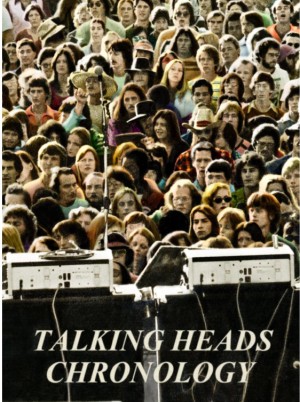
VIDEO: Watch the two embedded clips to compare the performance styles of two iconic front men: The Rolling Stones' Mick Jagger and The Talking Heads' David Byrne.
The front man of any worthy rock band must act as conductor, medium, communicator. He must use his voice and body—his presence—to create a memorable performance. He must also channel the band’s energy while feeding off the immediate response of the audience, creating a kind of communal call-and-response. In this regard probably the greatest front man remains the late James Brown. He used his body to lead the band, with his feet laying down the beat, one arm conducting the horn section and the other leading the audience in his trademark audience participation sessions.
Two recent music DVD releases, Talking Heads Chronology and The Rolling Stones: Some Girls – Live In Texas ’78, offer a fascinating look at two of the most indelible band leaders in rock history. One is a performance-artist deconstructionist, while the other set the standard for all future rock gods. Both know how to move.
 When Talking Heads came on the scene in 1975 they were labeled as preppy art punks. This wasn’t entirely by accident. Television, what with their prog-rock leanings, extended guitar solos, and apocalyptic lyrics, were too committed to their music to be mistaken for anything other than a band. But Talking Heads, at least in the beginning, were toying with the idea of what it meant to be a band. When you listen to More Songs About Buildings and Food or Remain in Light you feel challenged, not because you need footnotes in order to understand the songs, but because you know you are listening to a band stretching the possibilities of a pop song while adhering to the rules of pop. Unlike current art-rock outfits like The Fiery Furnaces or Arcade Fire, Talking Heads, for all their conceptual-art trappings, rarely forgot the skill and talent it takes to create a perfect pop song.
Talking Heads front man David Byrne, who at times resembles a cross between Anthony Perkins younger, more demented brother and Jesse Eisenberg’s Mark Zuckerberg, remains the unlikeliest of rock stars. Long before Bono created his alter ego The Fly, Byrne was deconstructing what it meant to be a rock star. His emotionless stage presence gave him a spooky-cool quality that forced you to lean in a little closer. He wasn’t entirely detached from life, but he was engaging it on his own almost autistic-savant terms. He shunned normal modes of expressions like smiling—or frowning. And Talking Heads made it a point not to write songs about typical rock & roll topics like sex or cars or lust or decadence. Instead they wrote about imagining a world without love (“I'm Not in Love”) or a guy losing control because someone was rude (“Psycho Killer”). They were a quintessential New York band.
Talking Heads Chronology consists mostly of videotaped performances of the band. The early clips are kind of riveting as we see the band as a trio, struggling to create a full sound. (Rhythm guitarist and keyboardist Jerry Harrison hadn’t yet joined the band.) Seeing them perform a song like, say, “I'm Not in Love” at CBGB’s in 1975, you can see how even a sketch of a song could be excitingly unpredictable. Byrne’s punk guitar riffing is thrilling. In the early performances at places like CBGB’s or The Kitchen you can see Byrne trying to overcome an almost crippling shyness. He rarely leaves the mic to prowl the stage. But you sense something is burning inside. You can see it start to come out as they rush through “Thank You For Sending Me An Angel,” a punk version of a galloping country ditty. (Would that make it rockabilly punk?)
As the band grew in popularity they made it a point to play it cool, especially when performing on nationally televised shows. Byrne proves himself a brilliant minimalist when they appear on American Bandstand. Considering all acts that appeared on Bandstand were required to lip-sync and basically mime their performance, the Heads retain their dignity as they showcase their slowed-down cover of “Take Me to the River.”
As Talking Heads expanded their sound and the band, Byrne would give himself over to the rhythm. The highlight on the DVD is a performance of the Fear of Music cut “Animals” for German television. Byrne’s spastic head movements are charming and a little unnerving. (He reminded me a little of DeNiro’s jerky dance in a key moment of Mean Streets.) The song’s climax is given a visual punch when Byrne starts to bob and weave around the stage.
The DVD unfortunately omits the key period of Talking Heads evolution. I assume because of rights issues, there are no clips from Jonathan Demme’s transcendent concert film Stop Making Sense. That’s too bad, because that film shows Byrne (and the band) at their peak. To see Byrne’s gymnastics workout during “Life During Wartime” is simply exhilarating. By the time we see the band reunite to perform “Life During Wartime” at the Rock & Roll Hall of Fame they’re still in sync (even thought they hadn’t performed together in nearly 20 years), and Byrne seems able to show a trace of emotion. He displays the slightest hint of bemusement at being a rock star.
Legend has it that Mick Jagger didn’t start to cut loose until after seeing Tina Turner perform. This isn’t entirely true. Jagger always had a roiling energy itching to get out. You can see it when the Stones perform “It’s All Over Now” on The T.A.M.I. Show. By the time you get to the death-of-a-dream documentary Gimme Shelter, Jagger dances like he’s the prince of darkness. When he shimmies and shakes at the climax of “Sympathy for the Devil,” as if possessed by a demonic spirit, it’s both mesmerizing and frightening. (You wonder how come there wasn’t more violence at Altamont.) Even better is his joyous shoulder moves throughout Ladies and Gentlemen: The Rolling Stones.
The genius of the song “Moves Like Jagger” is that it’s such a perfect summation of what it means to feel the beat. Jagger’s moves are working-man gyrations with a heavy dose of sexual aggression—both masculine and feminine. He doesn’t use any kind of thought-out choreography. Charlie Watts’ drumming dictates his movements. When Adam Levine says he’s “got the moves like Jagger,” we know what he’s really saying is that a moment of happiness can only be expressed through dancing. The phrase “moves like Jagger” is nothing short than a declaration of living in the moment.
 Filmed in Fort Worth, TX. in support of the Some Girls album, Live in Texas 78 shows the Stones at first looking a little defensive, as if having something to prove. Their previous two albums (It’s Only Rock ‘n Roll and Black and Blue) and tour were met with indifference by everyone except the most hardcore fans. The song “It’s Only Rock ‘n Roll (But I Like It)” was seen as an affront to everything the Stones once stood for. They were now the Establishment. And Punk and Disco were re-invigorating pop music in much the same way the British Invasion did a generation earlier. It almost looked as if The Rolling Stones were no longer relevant.
But Some Girls was a major achievement, a disco-spirited gallop through the seamy side of NYC with punk attitude lyrics. It was a rude, nasty, and cautiously romantic record.
They start the concert a little wobbly. They open with a rather rote cover of Chuck Berry’s “Let It Rock,” treating the song as a palette cleanser. They seem to be going through the motions on the classic Exile cut “All Down the Line.” Jagger’s moves seem a bit mechanical, while Keith looks close to happy. (The fact he had just dodged jail probably explains this.) And nothing seems to surprise the astonishing Charlie Watts.
But then they go into the underrated Goats Head Soup cut ”Star Star” and you see things start to come alive. Then, in an unprecedented move, they go into a seven-song tear through Some Girls. (Apparently, on some nights they would do eight out of the ten songs from the record.) Considering the album was only a little over a month old, this shows the confidence the band had in the new material. (Most major acts will play three or four cuts at he most from their new album on the supporting tour. They implicitly know audiences want to hear the hits.)
They kick things off with the un-PC “When the Whip Comes Down,” a song about leaving home and trying to make it in he city. Lyrically, the song is pretty abrasive (“I was a fag in New York/I was gay in L.A.”), and the hustling beat borders on confrontational. Jagger plays guitar throughout most of the concert and he seems truly energized by both his playing and the songs.
Both “Beast of Burden” and “Miss You” get the extended treatment, with Jagger using his arms to express the emotional yearning in “Burden.” There are extraordinary close-ups of him singing both “Burden” and “Miss You” and he looks lost in the moment. In fact, the whole band rarely comes together in any traditional kind of way. They give workman-like fat-free performances that somehow manage to still connect. On “Miss You,” a stripped-down blues number given a disco-inflected beat, Jagger prowls the stage with purpose. He even points the neck of his guitar down in that exaggerated way that Hendrix made famous. He looks like he’s about to explode as he jumps up and down right before going into the song’s insinuating come-on.
Other highlights include a ridiculously fast “Respectable” and “Love in Vain,” a song the Stones never fail to turn into a showstopper. There are no indulgent numbers like “Can You Hear Me Knocking” or “Midnight Rambler” or “Sympathy for the Devil,” which I’m guessing they still had a moratorium on after Altamont. Instead they manage to liven up the one weak Some Girls cut, their cover of “Just My Imagination.” Jagger almost matches the heartache of the Motown original. (The best version of the song can be found in Martin Scorsese’s terrific Shine A Light.) Tellingly, the Stones don’t perform the controversial title track. With its racially insensitive lyrics (“Black girls just wanna get fucked all night/But I just don't have that much jam”), the Stones decided to play a little nice. (Although, at one point, Jagger says, “If the band is slightly slacking in energy it’s because we spent all last night fucking!”
By the time they perform Chuck Berry’s “Sweet Little Sixteen” Jagger has put down the guitar in favor of some of his trademark moves. (He playfully changes one lyric to “tight dresses and Tampax.”) He even does some classic rock star gimmicks like taking off his shirt and dousing the audience with buckets of water. Live in Texas 78 shows the Stones in transition. Later concert films would show them forsaking the music in favor of spectacle. (Hal Ashby’s 70mm stadium images in Let’s Spend the Night Together upstages the band. The same goes for their IMAX movie At the Max. It wouldn’t be until Shine A Light that they would let the music speak for itself.) The Rolling Stones have long since stopped being dangerous (whatever that means). And when we now see Jagger dance it rarely looks spontaneous. It looks more comforting than anything else. At least we have Live in Texas 78 as evidence that that wasn’t always the case.
San Antonio-based film critic Aaron Aradillas is a contributor to The House Next Door, a contributor to Moving Image Source, and the host of “Back at Midnight,” an Internet radio program about film and television.

 The central conceit of This Is Not A Film is that it presents a day in Panahi’s life, although I doubt the entire film was actually shot in one day. On a moment-to-moment basis, it feels casually made, but its structure is carefully planned. It depicts him eating breakfast and talking on the phone with his lawyer and fellow filmmaker Rakhshan Bani-Etemad. (She seems to be suffering a period of idleness herself, although it’s unclear if the law has anything to do with it.) When Mirtahmasb shows up, Panahi talks about his unproduced screenplays and reads from one, treating his living room floor as a set. It deals with a teenage girl prevented from attending college and eventually locked in her room by a religious family. Any similarities to Panahi’s current situation are entirely coincidental, of course. Outside, the city of Tehran prepares for Iranian New Year. Fireworks begin going off, and a neighbor asks Panahi to take care of her dog. Eventually, Panahi ventures into the elevator, in the company of the building’s janitor, and the film ends with him apparently on the verge of heading outside.
 Prologue
 My taste in films evolved as the prequel trilogy was released. When Star Wars: Episode II – Attack of the Clones came out, I was 15. At the time, I was (and still am) an unabashed nerd but I was only slightly more opinionated. There were things in Episode II that I wholeheartedly enjoyed, like watching Yoda fight Count Dooku. (My sister and I gushed about that scene as we exited our Douglaston multiplex: Dracula versus a Muppet! Okay, a CG Muppet, but still!) Still, there were things about the film I distinctly recall disliking, like Hayden Christensen’s performance. I remained fairly uncritical at this point, though.
 The prospect of revisiting Episode I was daunting. By now, watching awful movies has become something of a passion of mine. But I didn’t watch this film, one that I still have fond preadolescent memories of, for the sake of rubbernecking. When I heard that George Lucas had post-converted The Phantom Menace into 3D, I knew my morbid curiosity would get the better of me and that attention must be paid. I earnestly wanted to know if the film could hold up for me. So I held a seance for my inner child at the Ziegfeld last night.
 And unfortunately, so is Episode I. Lucas took a film that I now recognize as being full of problems – especially bad dialogue, stiff acting with bad accents and illogical plot points (why is the Bedouin home of Anakin Skywalker full of so much STUFF? Isn’t this kid supposed to be a slave or something?) – and he made it worse by adding more stuff to it than it ever really needed. Darth Maul is unnecessarily introduced earlier than he previously was, Anakin’s acceptance into the Jedi Order is now over-explained, the podrace is overburdened with more instantly forgettable racers than were previously highlighted and the final fight scene with Darth Maul is now padded with extra footage. Anything that was once almost-spectacular in Episode I is now marred by new, distractingly cheap-looking sequences where characters stiffly intone lines as their CG-bodies bob from side-to-side to simulate human movement. It’s just awful!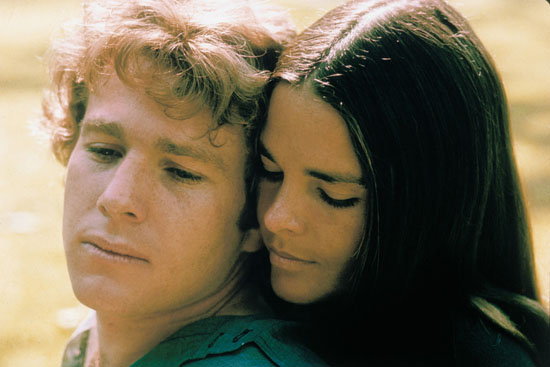
 So why was Love Story such a hit? That’s the mystery, isn’t it? The strength in Arthur Hiller’s direction is his knowing not to get in the way of the actors. He knows he’s working with very delicate material, and that if you push it you are likely to get bad laughs. (For some viewers the bad laughs were always there.) Hiller is one of those reliable journeyman directors who knows how to get you what you want. He knows how to bring movies on time and on budget. In other words, he has no real distinctive style. That’s crucial for a movie like Love Story. Both Ryan O’Neal and Ali MacGraw are onscreen almost constantly. We must believe they are drawn to each other from frame one. We do. The dialogue and plot developments are secondary to how they look and relate to one another as both actors and their characters. Hiller does do a smart thing that is key to the movie’s success; whenever possible, he places O’Neal and MacGraw in real locations. Scenes of Oliver and Jenny walking and courting are given real immediacy when we can see activity swirling around them. Hiller indulges in what Roger Ebert at the time termed the
  The success of MacGraw’s performance is due in no small part to O’Neal’s forceful acting style. Like Redford, O’Neal was also burdened with being extraordinarily good-looking. Both men spent a good part of their careers having to overcome their beautiful exteriors in order to be taken seriously as actors. Redford used his looks to deconstruct the myth of the entitled WASP male. O’Neal used his looks as a way to disarm those around him. It allowed him to play con men, cads, jerks. He both embraced and resented the fact that being good-looking enabled him to get almost anything he wanted. (It was genius on Kubrick’s part to cast him in Barry Lyndon.) There is a constant seething anger in O’Neal’s acting that charges even the most routine scenes with the possibility of violence. There’s a startling moment when he gets mad at Jenny and tells her to stay out of his life. For a moment you’re genuinely scared for her safety. (It is this scene that leads to the moment where Jenny utters the immortal line, “Love means never having to say you’re sorry.”) O’Neal’s scenes with Ray Milland as his stern father are filled with tension as both father and son are constantly unable to make any kind of connection. (I’m sure at the time the Milland character was hissed at by young viewers rebelling against their out-of-touch parents. Seen today, Milland is very good at suggesting a man who comes from a generation not accustomed to expressing emotions. His final scene with O’Neal is a little jewel of understated acting.) The final scene between O’Neal and MacGraw is deservedly famous. Both actors display such genuine love and affection toward one another that we not only feel Oliver’s loss, but Jenny’s too.

 Anyone but Hardy, really. To be fair, The Wicker Tree’s script, which Hardy also adapted, is pretty sharp. He capably evokes the main ideas and wryly cynical sense of humor that makes Cowboys for Christ so entertaining. (Christopher Lee, who starred in the original Wicker Man and has a cameo in The Wicker Tree, heartily endorsed the book by saying, “It's comic, romantic, sexy but also horrific enough to melt the bowels of a bronze statue.”) But as a director, Hardy hasn’t improved drastically in the intervening four decades between The Wicker Man and The Wicker Tree. If there’s anything holding The Wicker Tree back from being the adaptation Hardy’s charmingly mean-spirited source material deserves, it’s unfortunately Hardy.
 Beth Boothby (Brittania Nicol) is a Texan pop star that used to sing empty-headed, salacious pop songs and now performs Christian-themed country music. Together with Steve (Henry Garrett), her cowboy boyfriend, Beth sets out to convert the residents of Tressock, Scotland to Christianity. This makes Beth and Steve prime targets for the sardonic Sir Lachlan Morrison (Graham McTavish) and his wife Delia (Jacqueline Leonardas), community leaders that are more bemused than off-put by the Americans’ arrival. To Lachlan and Delia, the two missionaries are unexpected but not entirely unpleasant additions to their May Day festivities: Beth will be their Queen of the May and Steve will be their Laddie.
 Likewise, Beth wants to turn her back on her past as a randy sex object and focus on her current position as a symbol of Christian piety. But the fact that she acknowledges that she willingly objectified herself in the past suggests that Beth’s also adept at role-playing. It’s fitting then that the character that bridges the ideological gap between Lachlan and Beth is Lolly (Honeysuckle Weeks), a nymphomaniac that has sex with whomever Lachlan tells her to—for the good of their community.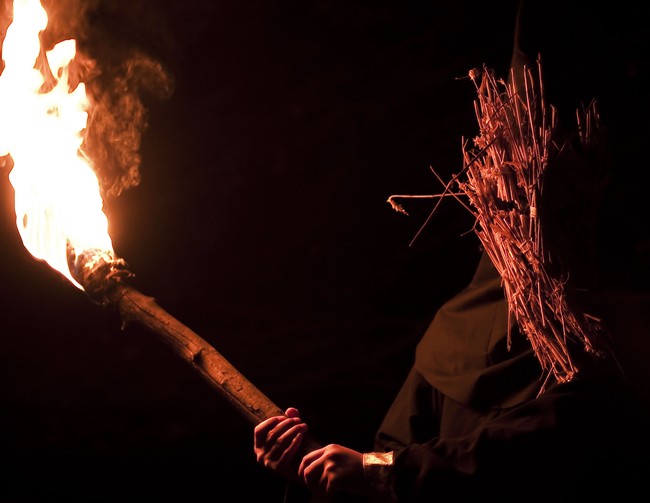




 It is not in this spirit that Mavis returns to Mercury—on a whim, she decides she wants to renew a romance with an old, now-married boyfriend (Patrick Wilson)—but the trip actually provides her with more material. Mavis uses what she is feeling and thinking for her work. She may not realize it at first, but her meanness is a way for her to create a distance between herself and her subject. If Mavis errs, it is only in thinking at first that she can inhabit Mercury innocently, as though she could ever woo her former beau away from his wife and baby, as though he would ever find her values and preferences as worthwhile as his own. Mavis is delusional in that she fails for a long time to grasp that she is, by virtue of her chosen profession, an outsider. She will always be the only one in Mercury who shows up at a “baby naming” ceremony in a silk blouse among a sea of sweatshirts, looking put-together as only Charlize Theron can. As Clark Kent said at his high school reunion in Superman III: “The prettiest girl in school… is still the prettiest girl in school.”
 The direction of Jason Reitman is relaxed, unobtrusive, recalling Woody Allen at his most unassuming. The casual handheld camera of Manhattan Murder Mystery has resurfaced here, catching quirks of behavior without seeming to try very hard—in a way, not unlike Mavis, who view things so critically but also so softly.
 At first glance, the title of
  On one level, it’s ridiculous to interpret this film as being as autobiographical as Routine Pleasures. In its world, white people are few and far between: barely glimpsed cops or crime victims. Rather than making his presence directly felt through his voice, as in his previous two films, Gorin has his subjects interview each other. However, on a deeper level, the film examines the pain of statelessness and the costs of emigration. It uses shots of beautiful Samoan landscapes as punctuation, even as one gang member shouts “Fuck Margaret Mead!” Brought to Hawaii or Samoa, his subjects are torn between wanting to hang out with their friends in L.A. and craving a deeper connection to their island roots, like learning to speak Samoan fluently.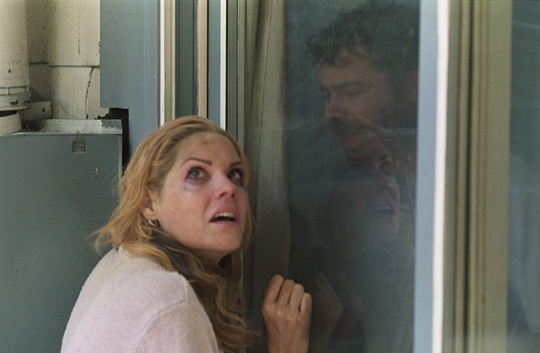

 As in Romero’s The Crazies, Right at Your Door evokes a world where authority figures are visibly shown to be unreliable. This is extraordinary in Right at Your Door because authority figures are only physically represented by armed grunts clad in gas masks and biohazard jumpsuits. These monsters are just following orders when they don’t answer Brad’s questions. For example, one can't help but notice the way one soldier hesitates and even trembles while puffing out his chest and defensively telling Brad, “We’re not trying to cause more panic than there already is.” Compare that with the way the similarly dressed soldiers in The Crazies are defined by their actions. They don’t use verbal prompts that might even tentatively reveal their humanity. By contrast, Gorak's army men reveal their humanity while they’re doing the most cruelly impersonal things.
 Press Play Video Blog