CANNES 2012: Wes Anderson’s MOONRISE KINGDOM

CANNES 2012: Wes Anderson’s MOONRISE KINGDOM

nullMoonrise Kingdom is a great success, both within the context of Wes Anderson's body of work and as a work unto itself. Initially, however, its Wes- Anderson-y-ness is almost off-putting. At the start of this very mature children’s romance about two pre-teens, the camera tracks through almost every room of a house; the separate but equal nature of each of the house’s various inhabitants is matched with a song from a child’s record, explaining how an orchestra's sections come together to perform a piece by British composer Benjamin Britten.

The aforementioned sequence is a table setting scene, establishing the film’s main conceit. Similarly, in successive scenes, Anderson’s mise en scene characteristically consists of various objects which stick out like sore thumbs, such as different types of fishing tackle hanging on a wall, or old mailboxes arranged on a shelf behind a telephone switchboard). These objects draw attention to themselves, but, in Anderson’s eyes, they function as parts of a whole. Thankfully, Anderson and co-writer Roman Coppola (CQ) demonstrate how difference creates mass unity as the film goes along. No matter how discontent Anderson's latest film’s protagonists might feel, they are always in concert with the people who care for them.

Moonrise Kingdom is about the cascading repercussions of young love in the small community of New Penzance Island. Sam (Jared Gilman), a talented but “emotionally disturbed” member of the island's Khaki Scout troop, loves Suzy (Kara Hayward), a self-possessed but “troubled” singer, the only girl in her family’s brood of five children. Suzy’s emotionally estranged parents, Laura and Walt (Frances McDormand and Bill Murray) and Scoutmaster Ward (Ed Norton) are beside themselves when they learn that their respective charges have fled. But the search for Sam and Suzy eventually involves almost everyone on New Penzance, including a local Island policeman (Bruce Willis) and a mysterious narrator (Bob Balaban). Every character is an equally important member of Anderson’s wild bunch, even if not all of them are created equally (as in the case of one poor eye-patch-wearing Khaki scout).

That being said, Anderson and Coppola do fully explore the group dynamic aspect of Suzy and Sam’s relationship. Scenes like the one where Laura and Walt talk obliquely about their marriage woes nicely illustrate how it’s possible for Sam and Suzy to be alone together and also with their various friends and surrogate family members.

Anderson typically champions his protagonists’ eccentricities as the means by which they define themselves. But his characters are also often unified by the understanding that excluding each other is pointless, as everybody brings something to the group’s collective table. Even the crueler Khaki scouts learn this lesson in a hilarious scene built around a polemic from a pint-sized (former) bully.

The use of song cues, especially those from Britten’s Noye’s Fludde and Camille Saint-Saens’s Carnival of the Animals, subtlely establishes that characters defined by their difference and unhappiness are always an integral part of the film’s whole. In fact, the characters' quirks and unhappiness only further embellish Anderson’s comedy of power dynamics. 

Simon Abrams is a New York-based freelance arts critic. His film reviews and features have been featured in The Village Voice, Time Out New York, Slant Magazine, The L Magazine, The New York Press and Time Out Chicago. He currently writes TV criticism for The Onion AV Club and is a contributing writer at the Comics Journal. His writings on film are collected at the blog, Extended Cut.

FESTIVALS: True/False 2012, Day Four: Destroy Your Safe and Happy Lives

FESTIVALS: True/False 2012, Day Four: Destroy Your Safe and Happy Lives

null

The movies I saw on the last day of True/False continued to intersect with the other movies I've seen this weekend. The festival taken as a whole functions as a kind of mosaic, in which the individual pieces add up to a larger whole. This is the first year I've really noticed this, even though I'm sure that past festivals have been similarly constructed. I just never saw enough movies in past years to get the full effect. I saw thirteen movies this year, counting Secret Screenings. My second favorite film of the festival was secret. So was the lone film I didn't really like. It's probably just as well that I don't get to write about that one.

The three films I saw on Sunday were Ai Weiwei: Never Sorry, 1/2 Revolution, and The Imposter. Ai Weiwei: Never Sorry circles around the same issues of art one finds in Maria Abramovic: The Artist Is Present, the same activism as 1/2 Revolution and How to Survive a Plague, and the same daredevil tweaking of corrupt power structures as The Ambassador. 1/2 Revolution has the same humanizing impulse toward Islam as Building Babel, the same sense of the subject as the creators of the film as How to Survive a Plague, and the same opposition to corrupt power as Ai Weiwei and The Ambassador. The Imposter has the same fuzzy relationship with "truth" as any number of films in the festival. It's appropriate, then, that The Imposter was the last film I saw before they started gathering up the chairs and rolling up the carpets.


Ai Weiwei is arguably the most influential living artist anywhere in the world. Ai Weiwei: Never Sorry (directed by Alison Klayman) is a catalog of why this is so. Ai is the artist who designed the "birds nest" stadium for the 2008 Olympics then disavowed it when he saw the average people of Beijing driven from their homes to make room for the games. Following the Sichuan Earthquake, Ai made a project of finding the names of all of the schoolchildren who had died in the disaster. The authorities, he suspected, were under-reporting the numbers. At a show in Munich, he arranged hundreds of backpacks on the facade of the Haus der Kunst to spell out "She lived happily for seven years in this world." These kinds of challenges to the state have not gone unnoticed by the Chinese government. Since 2008, Ai has been under constant threat as a dissident. It's a miracle, really, that he's gotten away with as much as he has, but there's a reason for that. Through the viral spread of social media–and Ai is a master at using social media–he's become the highest profile artist in China. To simply get rid of him would be sticky for the government, not that they wouldn't do it.

The first narrative of the film is art. This narrative culminates in the sunflowers installation at the Tate Modern consisting of a hundred million mass produced porcelain sunflowers each individually painted by Chinese workers. It says something about China's role in the global economy at the same time that it celebrates the individuals who work in the system. There's a shot late in the film that would be an ideal end to any other film, in which Ai and his son stand facing each other on the bed of sunflower seeds at opposite sides of the screen. Unfortunately, the film's second narrative supercedes this. It would be a deceitful film if it had ended there.

The second narrative chronicles Ai's relationship with The State, and this is unhappy. He's under constant surveillance, he's cut off from most means of communication outside of China (except, significantly, for Twitter), and he was subjected to a beating by the Chengdu police. This last resulted in a cerebral hemorrhage while he was in Munich. Ai's attempts to redress this form a core part of his activism. It seems incredible to an American eye that Ai would have no redress for wrongs done by the state, but that very invulnerability is something that his work seeks to undo. When the film's screen goes black and a title card appears describing the artist's disappearance, there's a real sense of dread. Ai's arrest lasted 81 days, perhaps prompted by the Arab Spring.

There's a third narrative here, too, one beginning at least as far back as Ai's Black, Gray, and White Cover books. These were the precursors to viral information. You couldn't shop for them. You had to know someone to get them. Ai's online activities are at least as significant as his art and his activism, because it's what has spread his fame. There's a kernel of what political action against entrenched power is going to increasingly look like here, assuming that those forces don't succeed in cutting it all off at the ankles with things like SOPA. If the future isn't going to be a boot to the throat forever, as Orwell once speculated, then social media will be why.


nullSpeaking of the Arab Spring, 1/2 Revolution (directed by Karim El Hakim and Omar Shargawi) throws the viewer into the middle of it. This is a film made by the participants, which means that their film is a ground level view of the events in Cairo in early February, 2011. This film watches the stages unfold, from zeal to optimism to fear to despair. The Egyptians managed to shrug force Hosni Mubarak from office, but they didn't shrug off the structures that kept him in place. Once the military seized absolute power, it became clear that they may have gotten rid of the dictator, but the dictatorship remained. It's a pessimistic film.

The film's directors, Karim and Omar are part of a circle of friends who live in downtown Cairo, and in addition to participating in the marches and demonstrations, they also provide a glimpse of their family lives. This is something that puts a human face on the broader social movement, and they're canny in the way they translate their own personal concerns into a broader context. Their circle isn't a lot different than a boho circle of friends in New York or San Francisco. They're smart, likeable people, and the movie ratchets up the dread because we like them. they're engaging in something profoundly dangerous. The film communicates this with the street level footage of marches that turn into riots. These scenes have a visceral impact. For pure, white-knuckle suspense, this is better than most action films.

Of course, the film is incomplete. The "1/2" in the title should tell you that. The filmmakers ultimately fled for their own safety, and I can't blame them for that. The events in Egypt are still roiling. For that matter, there's precious little context provided for the events on screen, but that's okay. That's the job of another kind of documentary, one with talking heads. But that's not this movie. Extrapolating where this film leads is murky at best, and the future is unwritten anyway, so what the hell, eh?

This was my favorite film of this year's True/False.


nullThe Impostor (directed by Bart Layton) is so utterly absurd that if someone ever decides to adapt it into a fictional feature, no one will believe it. The Impostor tells the unlikely story of a 23 year old Frenchman named Frédéric Bourdin who successfully impersonated a missing teen from San Antonio, Texas. The teen, Nicolas Barclay, disappeared three years prior. Bourdin, it turns out, is a pathological liar whose personal quirks lead him to impersonate minors as a way of putting himself in touch with a childhood he never had. That he got away with it for any length of time, though, well, that's where this story lies. This is a film that has indulges in the Rashomon effect.

The film is up front with Bourdin's deception. Narrating the film's flashback reconstructions of the events, Bourdin himself tells the audience exactly what happened. There's no rug-pulling involved along those lines. What isn't so clear is why Nicolas Barclay's family accepted the deception. Bourdin obviously wasn't Nicolas. The boy had blue eyes, while Bourdin's eyes were brown. Bourdin was dark-haired. Nicolas had blonde. Bourdin spoke with a French accent. Did the Barclays so desperately need to be reunited with Nicolas that could deceive themselves to that extent? Maybe. Two other characters muddy things. Charlie Parker, a private investigator for Hard Copy, sees through Bourdin at once, and suspects him of being some kind of a spy, then begins to wonder at the Barclays motives for not realizing who he is. He decides that something untoward happened to the real Nicolas. FBI Agent Nancy Fisher gets caught up in this idea, too. Nothing concerning Nicolas's disappearance has been resolved. The homicide case opened on the word of Bourdin and Parker remains open a decade later. We're left with a multiplicity of viewpoints, and no firm grasp on what really happened. It's a disturbing movie.

This is a hybrid documentary, in which great whacks of the movie are filmed recreations with actors playing the parts of the principles involved. The real people give their own testimony in separate vignettes. The filmmakers have deliberately stylized the recreations, as if they want to sully the veracity of everything they put on screen. The film is remarkably forthcoming with its facts, too. It scrupulously avoids passing Bourdin off as anything other than a charlatan. It doesn't prejudice the audience toward one point of view or another. That's smart, because the audience might become attached to one or the other characters otherwise and it's important to the film's thesis that this not happen. It manages this well enough, though Charlie Parker is a character right out of the movies, the kind of character that Charles Durning would play in a Hollywood version.

The end of The Impostor is confrontational. Carey Gibson, Nicolas's sister, tells the audience directly what she thinks of Frédéric Bourdin, while Bourdin tells the audience what he thinks of everyone. This last, is a pure portrait of sociopathy. Parker, for his part, ends the film standing on the edge of an open hole where the body of Nicolas Barclay has conspicuously not been found.

And on that note, the True/False Festival came to a close.

Christiane Benedict is a writer and graphic artist who lives in Columbia, Missouri. She blogs at Krell Laboratories.

FESTIVALS: True/False 2012, Day Three: Strange Intersections

FESTIVALS: True/False 2012, Day Three: Strange Intersections

nullThere's a strange sense of connectedness between the films I'm seeing at this year's True/False festival. Whether that's accidental or because of the way True/False is curated, I can't say, but some of the movies I'm seeing seem to be rhymes of other movies. Sometimes it's visual. Sometimes it's thematic. Often, it's both. This year's films seem to be grouped around intersections of race, healthcare, art, queerness, and activism. Having said this, I can't actually support this observation as well as I'd like, because the keystone film that ties all of this together in my own mind is one of those secret screenings I can't talk about. Listening to the buzz around the fest, I get the feeling that more than one of those secret films would supply the glue for this feeling of intersectionality.


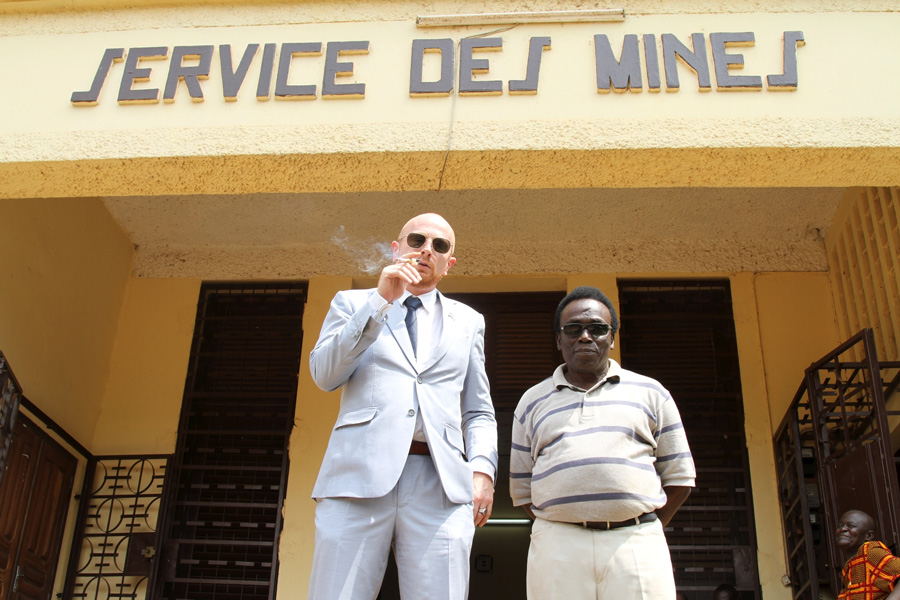
I couldn't help but hear Perry White in my head telling Lois Lane that "A good reporter doesn't just report the news, she makes the news while watching The Ambassador, in which director/provocateur Mads Brugger goes undercover as a Liberian diplomat to the Central African Republic. As the film demonstrates, it's relatively easy to get accredited as a diplomat if you have the right shady connections–you can even find these connections on the internet–and there's money to be made from the endeavor. The CAR is a lawless country the size of Texas where the land is rich in natural resources and where the government is so riddled with corruption that it might just as well not exist at all. Brugger himself reminds me of another pop culture figure, too. With his riding boots, sunglasses, and cigarette holder always clenched in his teeth, he does a passable Hunter S. Thompson. An alternate title for this movie might be Fear and Loathing in Bengui.

Brugger's cover has him looking to build a match factory in Bengui (the capital of the CAR), though that's only a ruse. Nobody involved has any illusions that a factory will actually be built, but pretenses must be kept up. The real aim is to get to the trade of conflict diamonds, and this proves deceptively easy. With his hinky documents, Brugger is able to move about in high circles of government in both Liberia and the CAF. The distribution of "envelopes of happiness" containing cash turns out to be a social lubricant of the first order in sub-Saharan Africa, a fact that isn't even a secret. Corruption is like air here. You can't help but breathe it. It's so absurd that when Brugger decides to hire Pygmies for his match factor so he can market their supposed powers as wizards, it's just one more thing.

Brugger's business partner is a man who owns a diamond mine in the disputed "Triangle of Death." He knows a sucker when he sees one, and his first contract with Brugger stipulates that Brugger will pay all of his expenses and upkeep forever. That's some cheek, right there. Brugger also encounters the minister of security, a former Legionnaire turned mercenary who lays out who is behind the CAR's miseries. France, he says, views the CAR as a savings account, and through its proxies it continues to put stones in the CAR's shoes. Resources allocated to put down unrest cannot be used to build infrastructure. This guy is assassinated during the course of the movie. There's an ever present feeling that things could head south for Brugger at any time, and during the second part of the movie, it appears that that's exactly what's happening. His diplomatic papers never show up, his business partner vanishes, and the only friends he appears to have are the Pygmy assistants.

This is as much a movie about Brugger as it is about Africa and corruption, and I'm of two minds about this. On the one hand, Brugger himself provides a veneer of absurdity that makes the whole thing watchable. Unvarnished, the corruption and misery on display in this movie might be unbearable. On the other, this is the Heart of Darkness dilemma. By building the movie around a white European and his persona, it runs the risk of using Africa as a backdrop for the problems of white men. I'm all for pointing the finger at Europe and America for the disaster of Africa, but I'd feel more comfortable with The Ambassador wasn't so dependent on its director's personality and ego.


nullPerformance art is as much about the viewer as it is about the artist. Really good performance art engages the viewer in a way that encourages or even forces them to think about their own relationship to art. The audience, as the saying goes, completes the picture. Marina Abramović: The Artist is Present (directed by Matthew Akers) gets around to this point of view eventually, but it dawdles a little in the process. Abramović is reckoned The Grandmother of Performance art. This movie is centered around the creation of a new piece called "The Artist is Present", to premiere at the Museum of Modern Art during a retrospective of her work in which a cadre of younger performance artists recreate the signature pieces from her career. This is a pretty standard arts documentary in which the first part is spent defending the art, the second chronicles the artist's troubled personal life (particularly her relationship with her ex-husband), and the third celebrates whatever new piece the artist is working on at the time. Frankly, the middle part of The Artist is Present sags under this weight.

The Artist is Present is most engaging when it is chronicling the creation and exhibition of Abramović's new piece and when it is showing her work with the younger artists who will recreate her old work. The preparation consists of workshops to train them in the stillness and self-discipline required to perform Abramović's pieces. This is a little New Age-y for my tastes, but the end result on display in the last third of the film is worth the effort. Best of all is watching what "The Artist is Present" does to both Abramović and the participant audience. The premise of "The Artist is Present" is simplicity itself: the artist herself is on display. She sits in a chair for the entire time the museum is open and anyone can sit down opposite her. Abramović then gazes into the eyes of the viewer for as long as the viewer is there. This is a variant of an older piece in which she stood naked before the audience and provided the viewer with a selection of implements (including a revolver) and invited them to do anything to her body they wanted. The newer variant is less hazardous to the artist, but is no less confrontational. There's a famous apocryphal quote by John Ford to the effect that the human face is the most interesting landscape in the world, and The Artist is Present, film and performance both, mines this to devastating effect. The scenes of Abramović gazing into the eyes of her audience are shocking in their intimacy, an effect heightened when the person in the other chair has a some kind of personal relationship to Abramović. One of the sitters is her ex-husband.

Director Matthew Akers comes to the director's chair from the cinematography department and that's all for the good. This is an attractive movie filled with modernist designer spaces. He knows how to film Abramović so that she appears to be a work of art herself, and this is the crux of it: does the artist matter more than the work? No one goes to the Chicago Art Institute just to see Water Lilies. They want to see a Monet. Part of the point of The Artist is Present is to literalize this idea, to put the artist into the space that would ordinarily be reserved for an object rather than an idea.


nullTrue/False's annual True Vision Award was presented to Russian filmmaker Victor Kossakovsky. In addition to Kossakovsky's first film, The Belovs, they were also showing his latest, ¡Vivan Las Antipodas!, while lamenting that all of the director's films are unavailable in the USA.

¡Vivan Las Antipodas! is a profoundly disorienting movie for one that is so quiet and so full of mundane life. This is an example of the documentary as tone poem rather than a message-laden agit prop. It's beautifully filmed at eight different spots on the globe. The only thing each location has in common is that it's an antipode to another spot. Antipodes are diametrically opposite spots on a sphere, hence each location is paired with another in the structure of the film. Patagonia is opposite Shanghai, Hawaii is opposite Botswana, Chile is opposite Lake Baikal, Spain is opposite New Zealand. The filmmakers do not give equal weight to these locations. Kossakovsky's camera turns again and again to Patagonia, where he's found an interesting human story rather than an epic landscape, as two bridge keepers offer a dry commentary as a flood wipes away their living. These two guys function as a kind of Greek chorus for the film. In contrast, the only heavily populated area in the film is Shanghai, and the scenes here are strangely impersonal in spite of the press of humanity. The other locations provide epic landscapes and minimal human stories, though the shepherd in Chile who greets all of his sheep by name and whose house is overrun by cats suggests such a story, as does the woman living with her daughter near Lake Baikal. These tend to be small concerns compared to the environments in which they live.

I mentioned that this is a disorienting movie, and so it is. Kossakovsky often turns his camera upside down for long periods, suggesting that the Earth has a bottom on its other side. This makes for strange imagery. It turns a highway in Shanghai at rush hour into an alien landscape that looks as if it were made in a computer. There are also long shots when the camera is on its side. It treats the planet as a shape where the concept of "up" in relation to gravity is only a matter of perception. Many of these shots are composited with reflections on water that turn out to be from their antipodes. It's artfully composed. It takes some patience to sit through it, though, because it requires a perceptual adjustment, not unlike adjusting to 3-D. It's a film that will lose a great deal of its impact on a small screen, unfortunately.


nullHow to Survive a Plague (directed by David France) chronicles the AIDS epidemic from the point of view of ACT UP, whose activism forced dramatic changes in the way drugs are researched and in how medicine interacts with patients. It's also an abject lesson in how putting a gun to someone's head is an amazing motivation. ACT UP existed underneath a Sword of Damocles, and the movie shows the attrition of its members over time. It's a tragic progression, but the film itself has a happy ending of sorts. ACT UP and it's successor, TAG, did succeed in forcing a breakthrough in the end, but even in the midst of celebrating, there's a cautionary note struck. The survivors place a lot of blame on Ronald Reagan and George Bush for foot-dragging. How many millions of people might have been saved had AIDS not been stigmatized as a "gay disease" and as a moral judgement? What can you do in the face of a government that regards your community as essentially disposable. It's a bitter memory.

There's another cautionary note, too, in so far as AIDS is still killing 2 million people a year, which is as many as it was killing at the height of the epidemic. Given that there are effective treatments, this is an appalling number. AIDS activism is no longer a matter of finding a "cure", though that research is still ongoing, so much as it's a matter of forcing access to those treatments.

As an emotional experience, How to Survive a Plague is heartbreaking. It's all such a waste. It's a particularly hard film to watch if one knows anyone who has died AIDS (I do), though this may amplify the catharsis at the end, but anyone can see the tragedy of the bright people on the screen getting sicker and sicker and then dying young.

The media largely ignored AIDS activism at the time this film is set, so the footage in How to Survive a Plague was largely shot by the people in the film. In any gathering shown in the film, you see cameras in the background. The AIDS epidemic was born at the same time as the camcorder, after all, so there's a document where otherwise there wouldn't be, and the task of making the film was a matter of finding this footage. There are more than 30 credited cinematographers. This is a minor theme with some of the films at this year's True/False. Several films were shot by their subjects rather than by a traditional documentary crew, and these films have an immediacy that is absent from other entries at the fest.

Christiane Benedict is a writer and graphic artist who lives in Columbia, Missouri. She blogs at Krell Laboratories.

FESTIVALS – True/False 2012, Day Two: The Influence Machine

FESTIVALS – True/False 2012, Day Two: The Influence Machine

null

"The thing is, directors and studios don't really like each other." Graphic designer Erik Buckham ought to know. He has a ringside seat. He designs movie posters. The nature of the business means that he deals with both studio marketing departments and control freak directors, but not always in equal measure. This comment explains a lot about why American movies look the way they do and a lot about why Buckham prefers to work on small films rather than big.

If you don't know Buckham's name, you probably know his work. His most famous poster is probably the "You don't get to 500 million friends…" poster for The Social Network. True/False asked him to design their poster and graphics this year and brought him to the festival to speak about what he does. He brought a slideshow of his past work, including multiple variations that never made the cut, as well as pieces that show the evolution of the concepts that make up his final work.

The process of making the True/False graphics was the centerpiece of the talk, and it showcased the evolution of image from concept to final product. The theme of this year's True/False festival, both in its visual presentation and in the various artworks scattered around the venues, is film as an "Influence Machine," and the final result progressed from fairly abstract, illustration-y images to a steampunk Van de Graaf generator, cobbled together in the poster art as a photo collage, and in real life as a huge sculpture in the lobby of the Missouri Theater. It also features in the arresting bumper reels that play at the beginning of each film.

Friday is when True/False transforms into a kind of arts carnival. Most of the shows have opening acts of busking musicians who pass a hat around the audience. I wish there were a greater diversity of musicians and musical styles beyond the kind of 1990s-ish indie folk rock that dominates the fest, but not enough to grouse overly much. The Friday parade up at the Boone County courthouse seems like a combination of open-air rave and homecoming celebration, complete with marching band. And, as I mentioned, there's art scattered across the various venues. All of this gives True/False its flavor.


The opening scenes of Building Babel (directed by David Osit) are a study in contrasts. First, we see the huge twin spotlights that mark the site of the World Trade Center. On the soundtrack are the phone messages directed at Sharif el-Gamal, the man behind the Park 51 Islamic Community Center–popularly misidentified as the "Ground Zero Mosque". The messages are a mixture of invective and nativist bigotry. To the callers, el-Gamal is an Islamic invader. The scene then switches to el-Gamal's home life as he gets his daughters ready for school. The man we meet in this scene is an American, born and bred in Brooklyn to a Catholic mother and a Muslim father. In his demeanor and his speech, he's a New Yorker, not different in any significant way from a devout New York Jew or New York Catholic. Therein lies the thesis of the movie. It wants to paint a broader picture of what it means to be an American, a picture that includes people like el-Gamal and his family. It wants to be a rebuke to nativism.

null

The movie's ostensible narrative finds el-Gamal and his team fending off an attempt to get the old Burlington Coat Factory where he's set up shop as a landmark building. There's nothing particularly notable about the building except its proximity to the World Trade Center. A piece of airplane wreckage fell on it on 9/11. Making it a landmark would prevent el-Gamal from remodeling the property. At the time, the building was in a state of dereliction, so it would unintentionally freeze it as a derelict, which seems antithetical to the idea of a landmark. Al-Gamal's team (rightly) argue that being in the path of a disaster isn't enough to make it a landmark. Does the guard rail that James Dean drove through on his way to his death qualify as a landmark? Most sensible people would say no, and the landmark commission turns out to be unanimously sensible.

In some respects, the community center and the uproar around it is beside the point. The film gives it lip service–it can't avoid it–but it expends more energy painting Sharif and his family as an all-American family, just like any other American family, and it's largely successful at this. It doesn't deal with a fundamental problem in its thesis, though: why does it matter? If he is otherwise law-abiding, if he is otherwise a good citizen, what does it matter if he is totally assimilated or not? This is always the problems of a minority living within a majority, and the absence of a discussion of this is an elephant standing in the room. The movie works better as a character study of el-Gamal himself. It shows him warts and all. He's obviously an affable guy. He loves his kids and his wife, Rebecca (who is almost an equal partner in the film's attentions). He's a businessman who has bitten off a project for which he's totally unprepared. Still, he's perpetually optimistic, and that makes him archetypically American.

Building Babel was preceded by "Paraiso" (directed by Nadav Kurtz), a short film about skyscraper window washers in Chicago. I liked it better than the feature. Apart from the vertiginous locations over the sides of some very tall buildings–Mission: Impossible has nothing on this–it also touches on a bittersweet sense of mortality as its workers all contemplate their own deaths should they fall from their workplace. A beautiful film.


True/False isn't strictly a documentary festival. Its mission from the outset has been to showcase films in the fuzzy shadowland between truth and fiction, so it's not out of character at all for them to screen fiction. Last year, they showed Troll Hunter, based on its mockumentary styling. This year, they have V/H/S, a new wrinkle on the "found footage" subgenre. New wrinkles are sometimes wrapped around old forms, and in spite of its lo-res, found footage conceit, this is a familiar kind of film. This is our old friend, the anthology horror movie returned to life. V/H/S is a film that Milton Subotsky would have greenlit at Amicus in a heartbeat back in 1971. It's a close cousin to films like Tales from the Crypt, The House that Dripped Blood, and Torture Garden. There are five stories and a framing sequence. Like all anthologies, it's highly variable.

null

The premise finds a group of sociopathic friends hired to retrieve a mysterious VHS tape from a sinister house. Our "heroes" like to film their stunts, so they take their cameras with them. In the house, they find a dead body and a plethora of videotapes containing disturbing footage. The tapes they find provide the individual stories. In one, a couple of partying dudebros pick up the wrong woman in a bar, in another, a woman brings some of her friends into the woods to act as bait for a mad slasher. My favorite finds a couple on a second honeymoon terrorized by a mysterious woman who films them while they sleep. My least favorite finds another pack of partying dude bros lured to a haunted house. Mostly, they're all of a piece.

As far as horror movie tropes go, this doesn't reinvent the wheel. We get vampires and long-haired ghost girls and a haunted house. The slasher film segment provides a droll take on the penchant of mad slashers to move around the movie via off-screen teleportation. None of this is exactly new. What IS new is the form. Mostly filmed handheld and occasionally nausea inducing, this has a veneer of raw, undoctored footage (which, of course, it isn't–there are plenty of special effects). It's not unwatchable, but it takes some getting used to. I'm less sanguine about the depiction of gender in this film. Men in this movie are all douchebags. Women are generally there to be abused. The opening of the film has some disturbing rape imagery, while date rape figures into the first story and killer lesbians figure into another. I know that character development isn't necessarily the genre's strong point, especially in short form, but this film suffers from the lack more than most.

Watching V/H/S provided a nice callback to the Erik Buckham seminar earlier in the day because Buckham claimed the covers of old horror VHS tapes as one of his prime inspirations. He designed the art for The House of the Devil, too, and one of V/H/S's directors is Ti West. The experience of watching it is like sampling a bunch of old VHS horror movies after they've degraded a bit. Visually, the lo-fi grottiness of V/H/S is in the tradition of crappy 16mm blown up to 35 or the filmed through a glaze of dirt aesthetic of, say, Basket Case or I Spit on Your Grave. It's generally better than those movies, though it should be taken with a grain of salt.

Christiane Benedict is a writer and graphic artist who lives in Columbia, Missouri. She blogs at Krell Laboratories.

FESTIVALS: True/False Day One: The Waiting is the Hardest Part

FESTIVALS: True/False Day One: The Waiting is the Hardest Part

nullEDITOR'S NOTE: The True/False Film Festival, one of the leading showcases for nonfiction filmmaking in the US, unspools its ninth edition this weekend in Columbia, Missouri. We'll be featuring daily reports on the festival from film writer Christianne Benedict, a Columbia native who has attended and reported on the film festival since its beginning.

The first movie I ever saw at Columbia, Missouri's True/False Film Festival was Kevin MacDonald's Touching the Void nine years ago. The thing I remember best about that showing was the look of utter shell shock on MacDonald's face when he took the stage after the movie. True/False's audiences are large. That first audience had over a thousand people in it and the festival never looked back.

Over the years, I've seen that look of shell shock on the faces of other directors as True/False has grown larger and larger. I kind of missed seeing it again this year, but I didn't go to the opening night jubilee for a change. The opening night film this year was Undefeated, fresh off winning the Best Documentary Academy Award, and I doubt we were going to out-dazzle Oscar when it comes to impressing the filmmakers. I reckon I'll have the chance to see Undefeated when Columbia's local Ragtag Cinema gets it, as it almost surely will. Or I'll see it on video. I'll have my chances, which is more than I can say about some of the other films playing this weekend. 

The films I DID see provided the same experience in miniature without the premium price of the gala soirée that the opening night film has become. Besides, if I really want to see it with a big audience, it's the closing night film, too, and that showing is more geared to the hoi polloi who don't fancy getting dolled up. True/False schedules their opening night film in the stately Missouri Theater. The Missouri was a shipwrecked cathedral of a movie palace when the festival first began. It's been renovated over the years, and it's a swell place to watch a movie these days.

The first film to unspool at this year's festival was The Waiting Room, directed by Peter Nicks. The showing was packed into a converted ballroom at the old Tiger Hotel (which is not currently a hotel in spite of the big red sign on the roof). I didn't reserve a ticket for The Waiting Room, so I had the dubious pleasure of waiting in line. No trip to True/False is complete without the anxiety of queuing up for a movie with no guarantee of getting in. The organizers try to minimize the pain with their "Q" system, but that only means that you can go get a sandwich or an ice cream cone while you wait. Downtown Columbia is compact enough that most things are in easy walking distance during the 45 minutes you're likely to be waiting. For myself, I thought the title of the film was mocking me during the uneasy countdown of people waiting to get in. Fortunately, the movie itself was pretty good.

null

The Waiting Room is a chronicle of the day in the life of the emergency room at Highland Hospital in Oakland, California. It's set almost entirely in the eponymous waiting room, and in the small medical rooms where urgent care treats patients. During the Q&A after the movie, director Nicks claimed that his intention wasn't political and that he tried to keep the film as apolitical as possible. I'll give the film this much: it's not exactly a polemic. I don't know how successful he thought he would be at non-partisanship, because this film is a portrait of the wreckage of late capitalism.

It can't help but have a point of view, given that the people who populate this film are disadvantaged and uninsured. Public hospitals are a provider of last resort, and there's an air of desperation in both the patients and the hospital staff. One patient, sent to Highland for dialysis, is tired of the runaround he receives whenever he shows up for his treatment. He demands that they pull his catheter. Another, a drug casualty, poses the ethical question of how to treat self-destructive patients who have no place to go after they're stabilized and how to prioritize the space to treat such patients in the face of a perpetually full waiting room (one member of the audience asked how the hospital could possibly give this person a bed when there were other, apparently more worthwhile patients, which just goes to show that the urge to moralize when it comes to public policy is strong). Taken as a whole, The Waiting Room takes the measure of a systemic failure, where science, faith, and simple logistics–it goes into some detail about the logistics of ER triage–are all completely insufficient.

This is a pretty slick production. It indulges in stylistic flourishes, though not without purpose. The film's tendency to isolate its characters in shallow depth of field shots has the practical virtue of obscuring people who may not want to be in the shot, even as that very isolation focuses the audience on the faces and problems these people wear. There are a couple of time-lapse shots of the waiting room as a whole in which it rapidly fills, then empties, then fills again that are visual flourishes, sure, but they also suggest that the staff of Highland Hospital are basically shoveling sand against the tide. Two shots in particular followed me away from the movie: in one, a fifteen year old gunshot victim is wheeled to the freezer in the morgue. When the door to the freezer is closed, the filmmakers hold the shot a moment longer than pure reporting would dictate. In the other, a woman who is clearly unable to take care of herself is wheeled out to the bus stop after she is released. I wonder what happened to that woman. This is a character piece that follows several individuals, but it resists the urge to include various "where are they now" vignettes at the end. It doesn't have any tidy endings.


I probably made a mistake with my second movie of the night. True/False schedules several "Secret Screenings" every year. These are usually movies that are slated to premiere elsewhere. The secret film I saw was a good deal less polished than The Waiting Room, which occasionally resembles a television medical drama if I'm being honest about it. The secret film doesn't have the same kind of savoir faire of The Waiting Room, but it has a more focused rage underlying the story it tells and it has a chilling depiction of the appalling banality of evil. But I can't tell anyone about it and I want to scream. Maybe it's a good thing that True/False fancies itself a carnival of sorts, because I CAN tell you that the busking musicians who played before the show, a duo called Busman's Holiday, were pretty good. Of the movie itself, I can say no more.

Christiane Benedict is a writer and graphic artist who lives in Columbia, Missouri. She blogs at Krell Laboratories

FESTIVALS – Berlinale 2012 Final Report: The Tantalizing and the Taboo

FESTIVALS – Berlinale 2012 Final Report: The Tantalizing and the Taboo

null

What does it take to get your film into a world class festival? That's the question asked with gleeful irreverence by "The Woman in the Septic Tank," which screened at the recently concluded 2012 Berlinale, one of the world's foremost festivals. This hilarious satire of international art filmmaking finds two aspiring auteurs sitting in a Manila café, jealously regarding a rival's Facebook photos taken at the Venice film fest. They vow to devise the ultimate movie to win festival audiences and prizes: a single mother of five suffering in the slums is forced to sell her son to a rich pedophile. But like Mel Brooks' "The Producers," the project gets out of hand, and before we know it we're watching a musical version with the pedophile singing "Is this the boy / who'll bring me endless hours of joy?" It's one of many delightful detours taken by these filmmakers seeking the road to art house glory.

Some critics find "Septic Tank's" satire too glib and cynical of the festival scene, but much of what it mocks can be found in another Filipino film that competed for the Berlinale's prestigious Golden Bear. Brilliante Mendoza is one of the standard-bearers of the blistering DIY filmmaking that thrives in the Philippines (and with an ego to match: his website describes him as a "living national treasure.") His success led to a golden ticket in the form of European funding, but his new film "Captive" finds him caught in the crossroads of no-budget trash filmmaking and festival prestige picture, doing service to neither. This hyperactive re-enactment of a 2001 terrorist incident even has Isabelle Huppert along for the ride as a kidnapped missionary, but it feels more like Michael Bay than Michael Haneke. From close-ups of menacing jungle creatures to a real baby being pulled out of a woman during a firefight, no attempt at sensationalism is spared to get a rise out of the audience.

Read the rest of this festival report, including thoughts on the best film at Berlinale 2012, at RogerEbert.com.

Kevin B. Lee is Editor in Chief of Press Play, and contributor to RogerEbert.com and Fandor. Follow him on Twitter.

FESTIVALS: Berlinale Decision Points Part 4: Golden Slumbers and Golden Showers

FESTIVALS: Berlinale Decision Points Part 4: Golden Slumbers and Golden Showers

nullPart four (and the last) of my Berlinale coverage, focusing on decision points: the moment when I pretty much made up my mind about a film, and how that moment reflects on the film as a whole, capped by my Indiewire grade. Look for a summary report to follow on RogerEbert.com.

Read Part One  Read Part Two Read Part Three

Sister (Ursula Meier) 12 year-old Simon (Kacey Mottet Klein, terrific) enters the bedroom of family member Louise (Lea Seydoux) and offers to pay to sleep next to her. For 150 euros she agrees. He tosses the money and climbs on to cuddle, and the scene hangs on that tender moment of them being together without doing much of anything; as in Meier’s debut Home, a story concept that threatens to spoil as overt social allegory (environmentalism in that one, capitalism in this one) is saved by her ability to generate a genuine family vibe, even when it shades into the perverse, as Simon inches his head down Louise’s torso and we see his nostrils flare ever so slightly as they take in the scent of her crotch. B

No Man’s Zone (Toshi Fujiwara) For much of the first hour this documentary essay on Fukushima is carried by a smart voiceover narration that interrogates the public´s consumption of disaster through the media. It then shifts to a series of long, unedited first person interviews with survivors, as if to put its critique of the media´spolished packaging of disaster to the test. It works better in theory, but it´s still a noble, provocative effort. B

Postcards from the Zoo (Edwin) The scene where the massage parlor veteran trains the newbie about making sure to get paid extra when a john asks her to pee in front of him goes to show, even the Asian sex trade can be played for arthouse cutesiness. Especially when there are giraffes, hippo shaped golf carts and Indonesian cowboys strolling in this parade of inconsequence. Whee. D

Tabu (Miguel Gomes) For me the penultimate image of a baby crocodile on a carpet helped crystallize my feelings for this much-lauded, highly original competition film. The film is rife with such poetic images and dream-like moments, and charged with a wholly unique sense of narrative layering. On a formal level this is about as laudable an effort as I could expect for a film whose neo-colonialist romantic perspective I normally reject as a matter of principle. On one level, it’s more of the same swooning white material that illustrates how non-Africans can make great films in Africa, but not about Africa. But yeah, it’s pretty beautiful. B

White Deer Plain (Wang Quan’an) It takes a certain kind of talent to spoil such an opportunity as having the first censor-approved mainland Chinese film to feature a woman peeing on a man’s face. But said scene is just one of a series of plodding moments undermined by mediocre editing and direction. Scenes are assembled as individual set pieces that stunt off whatever momentum they have to carry into the next, turning one of the most controversial Chinese novels of the last 20 years into a Classics Illustrated set of enervated panels. C

Golden Slumbers (Davy Chou) My favorite moment in this documentary of the lost cinema of Cambodia (where nearly all films were destroyed during the Khmer Rouge reign of terror) is when a young film crew attempts to recreate a scene from a lost film following the original director´s vivid description. During the re-enactment, the documentary camera focuses not on the scene but on the crew filming and watching the scene, with the scene just barely out of frame. A clever moment that embodies the structuring absence that haunts this moving act of reclamation. B+

Kevin B. Lee is Editor in Chief of Press Play, and contributor to RogerEbert.com and Fandor. Follow him on Twitter.

FESTIVALS: Berlinale Decision Points Pt. 3: Billy Bob Thornton and Melissa Leo play to their own tune

FESTIVALS: Berlinale Decision Points Pt. 3: Billy Bob Thornton and Melissa Leo play to their own tune

null

Part three of my Berlinale coverage, focusing on decision points: the moment when I pretty much made up my mind about a film, and how that moment reflects on the film as a whole, capped by my Indiewire grade.

Read Part One  Read Part Two

Meteor (Spiros Stathoulopoulos) It’s hard to pick a defining moment for a film that juggles multiple modes, between hi-def animated sequences, digital landscapes, documentary/interview footage and romantic scenes between a nun and a priest secluded in a remote Thessalonian monastery. The film can be quietly audacious in isolated moments, like a matter of fact close-up shot of the nun’s genitals while she’s masturbating. But there’s a lack of cohesion between the diverse elements that keeps it from amassing dramatic power worthy of its blashemous climax. C+

Captive (Brilliante Mendoza) Basically this is the film Woman in the Septic Tank was made to ridicule, Pinoy no-budget exploitation trying to alight the festival prestige film elevator and missing the first step bigtime. A movie so mired in social issues-fellating, gratuitous audience-pandering and plain ineptitude I couldn’t stop watching just to see how bad it could get. There’s the awful CGI bird, the terrorists throwing Bibles off the boat and loads more Muslim-baiting, the shot of a baby being pulled out of a woman’s vagina in the middle of a firefight. But for me it was a shot of hostage Isabelle Huppert slurping pathetically on a flimsy bowl of instant noodles, wearing a look that deserves our outright contempt. F

friends after 3.11 (Shunji Iwai) I think it was the third consecutive extended talking head interview that made me realize that I was in for a two hour movie version of reading a long series of blog posts on the nuclear aftermath of Fukushima. Potentially great (or at least important) content thoroughly undermined by uninspired form. D+

Shadow Dancer (James Marsh) Towards the endgame of this thriller set in early 90s Northern Ireland, MI5 agent Clive Owen meets with the IRA double agent (Andrea Riseborough) he’s trying to protect. She’s wearing a red trenchcoat, a ridiculous choice for a secret outdoor meeting. They talk spy stuff and from out of the blue she kisses him. I took this to be a desperate attempt for the script to squeeze some half-baked romance into the proceedings, but upon further reflection there may be more cunning underneath the gesture. The direction throughout feels a bit flat for the narrative nuances to register, but still there may be more intelligence to this than I would initially credit. B-

Francine (Brian M. Cassidy, Melanie Shatzky) There’s a scene where Melissa Leo’s off-kilter animal lover is feeding her extended household of cats and dogs, scattering a nauseating mess of dry food all over her floor and even sprinkling it on the backs of the animals. Here the film seems to take the eccentriticies of its character too far: she’s worked at a pet store and a vet for crying out loud, and we’re to believe she resorts to this behavior? The only reason this comes off as remotely plausible is Leo’s commitment to the role portraying someone terminally lost in her own world, Leo’s guileless playfulness in the part invites us in. B-

Jayne Mansfield’s Car (Billy Bob Thornton) For all the Southern Gothic rococo and cul-de-sac subplots this film takes on, there are a lot of great little things going on, like around the start of the second act when Billy Bob is showing Frances O’Connor his car collection. He sets up the scene with a brazen obviousness of purpose (Billy Bob’s “Hey you wanna see my cars?” basically uttered like “Hey you wanna find out why you should fuck me?”) but as he geeks out over his hot rod the tone of the scene shifts in register into something dark and menacing, an all consuming obsession for things pure and fast wells up so quickly that it threatens to explode in his face. The film is chock full of such surprise tonal shifts, parting a cloud cover of narrative and thematic intentions to reveal many sublime moments underneath. This has been poorly received as a belaboured, ungainly work, but it plays like music to my ears. A-

Bestiaire (Denis Cote) For a good half hour there’s a masterful play of sound and image generated by various animals, whose organic physiognomies and noises clash wildly against the concrete and steel of their holding pens. The tipping point comes about midway with the introduction of a taxonomist plying his craft on a bird, eviscerating its carcass and reupholstering its feathered surface upon a styrofoam body. Sort of a stand-in for what the director is doing cinematically. What follows after doesn’t feel as attentive or compelling to what it’s filming, but this moment in all its tactile glory vindicates the film’s underlying thesis of us humans exerting control on all creatures with eyes and hands alike. B+

Kevin B. Lee is Editor in Chief of Press Play, and contributor to RogerEbert.com and Fandor. Follow him on Twitter.

FESTIVALS: Berlinale Decision Points Pt. 2 – Paul Dano, Zellner Brothers and the first great film of the festival

FESTIVALS: Berlinale Decision Points Pt. 2 – Paul Dano, Zellner Brothers and the first great film of the festival

null

Part two of my Berlinale coverage, focusing on decision points: the moment when I pretty much made up my mind about a film, and how that moment reflects on the film as a whole, capped by my Indiewire grade. Read Part One

Our Homeland (Yang Yonghi) For the most part this drama about a repatriated North Korean returning to his family in Japan is given a solemn, safe treatment. Things liven up when the man visits his childhood friend who’s come way out of the closet. Made by an accomplished documentarian making her fiction debut, the script feels saddled by a need to dispense documentary facts about Japan-North Korean relations, but the gay friend takes his expository function(“I’m gay and ethnic Korean, a double minority!”) and sells it like he’s making his Broadway debut. His exuberant presence catalyzes the entire ensemble, transforming them from societal representatives to flesh-and-blood characters. B-

Kid-Thing (David Zellner) Basically a candy-colored Texas version of Bresson’s Mouchette that kind of goes nowhere, but there’s no denying the ferocity of vision in some moments, especially the most disgusting ones: a reprobate girl crushes an inchworm with her bare hands; close ups of cow dung and a cattle carcass being pulverized with paint gun pellets, the screen exploding with brown and orange. There’s a lot of untamed energy in this film. B-

The Woman in the Septic Tank (Marlon N. Rivera) So many good moments in this South Park-esque satire of two young Filipino filmmakers trying to break into the film festival circuit with the ultimate third world festival movie, about a suffering slum mother forced to sell her son to a pedophile. There’s the raucous casting debate between three actresses as the lead, creating three simulated scenarios for the outcome; and Eugene Domingo running away with the show as a seasoned diva breathlessly breaking down all the DIY filmmaker bullshit into Sundance-ready formulas. But my favorite has to be when the production assistant imagines the project as a Hollywood musical, with Manila slumdogs breakdancing to lyrics like “we are burping our souls,” and a tender serenade by the pedophile to his victim. As the filmmakers say while high-fiving themselves, “Forget Cannes, we are going to the Kodak Theater!!!” B+

Caesar Must Die (Paolo and Vittorio Taviani) Julius Caesar performed by Italian inmates in a prison, moving freely (if sketchily) between straight performance of the play to actors breaking character talking about how the story relates to their lives. The movie never fully explores that interplay, leaving us with teasing moments like when an actor insinuates that another’s impeccable performance as a traitor reveals his true nature. They threaten to come to blows, and then abruptly the scene ends. But despite the shuttling, half-finished quality of it all, there is tremendous care taken to the textured black and white images and a consummate sense of staging. B-

Barbara (Christian Petzold) Barbara, a East German doctor stuck in a countryside hospital and secretly planning to escape to the West, while fending off her supervisor who has an obvious yen for her. With compelling matter-of-factness, he tells her the story of how he wound up in the boondocks: a tragedy involving a state-of-the-art baby incubator, a nurse with a crush, and a two infants blinded for life. Barbara’s response: “Is your story true?” She can’t be bothered to care about or trust the people she’s trying to escape from. But too late: her doctorly concern and shared sense of personal setback expose her weak points, camaraderie has wormed its way in. All of this is conveyed through the subtlest nuances in looks and timing. Masterful stuff. A-

Parabeton – Pier Luigi Nervi and Roman Concrete (Heinz Emigholz) In theory I get the connection between Emigholz’ amazingly dynamic 70s work and what he’s doing now with his static shot documentaries of architecture, where motion and energy are conveyed simply by the geometries of buildings. And I do like the haunted house approach to his filming buildings devoid of people, so that the focus is more on a sense of natural decay affecting the utopian lines and surfaces of modern concrete. Still, it’s hard to shake the feeling that you’re just watching shots of buildings, especially when it’s hard to discern a logical flow from one building shot to another. C

For Ellen (So Yong Kim) As a fan of Kim’s In Between Days and Treeless Mountain as well as Paul Dano’s mutant-like weirdness, I really wanted to like this one. But something is terribly missing at the center of this minimalist study of a rock star trying to retain his wife and daughter. For me the dealbreaker came when father and daughter finally sit down to their first conversation, a painfully drawn out series of banalities. Dano is usually great at being game for anything, but here it seems he’s called upon to synthesize moments for So’s characteristically docu-realist camera to capture, and his zombie-like character is so submerged inside his own inarticulacy that there’s hardly a ripple on the surface. The dreamy, shoegaze camerawork, so expressively precise in past So films, here merely compounds the obfuscation. C-

Kevin B. Lee is Editor in Chief of Press Play, and contributor to RogerEbert.com and Fandor. Follow him on Twitter.

FESTIVALS: Berlinale Decision Points Pt. 1: Herzog on DEATH ROW and Lesbian Marie Antoinette

FESTIVALS: Berlinale Decision Points Pt. 1: Herzog on DEATH ROW and Lesbian Marie Antoinette

nullAt what point do you make your mind up about a movie? It's an especially pressing question at a festival like Berlinale, where you can watch as many as seven or eight films a day. There’s a risk of just letting these films wash over you and, to borrow a French phrase, “fall from your eyes,” so that you leave the theater with just a vague impression of what you’ve seen and few specifics to say. To fight this I’ve decided to shape my Berlinale coverage around decision points: the moment where I pretty much made up my mind about a film, and how that moment reflects on the film as a whole, capped by my Indiewire grade:

Death Row (Werner Herzog) Towards the end of this three hour made-for-TV series on American murder convicts awaiting execution, Herzog has a contentious exchange with a Texas DA over a female inmate fighting for a retrial whom he's been interviewing. The DA, after making a heart-stirring plea on behalf of the victims of the case, warns Herzog about the risk of humanizing the killer in his mind by talking with her. Herzog replies, "I do not attempt to humanize her. She is already simply a human being." It's a startlingly direct statement of authorial intent that vindicates the presence of Herzog's voiceover that dominates the show. Unapologetically he asserts a clear-eyed personal sense of decency amidst an absurdly callous and punitive justice system. Someone should get him to replace Judge Judy. B+

Farewell My Queen (Benoit Jacquot) You would think a lesbian scene with Diane Kruger and Virginie Ledoyen would be something to celebrate; instead it's emblematic of what's off in this new wave costume drama. Kruger's Marie Antoinette bids adieu to her courtesan as the storm clouds of revolution approach the royal court. Kruger spouts teary platitudes of love while (Ledoyen hardly says anything, both are practically mummified in heaps of fancy dress, reducing them to decorative ornaments in their own key scene. Jacquot is a great director of in the moment cinema but his handheld camera feels wrong for a period piece, buzzing like a mosquito trapped in the grand halls of Versailles. The Paul Greengrass editing further diffuses the focus turning it into Marie Antoinette meets 24. C-

Formentera (Ann-Kristin Reyels) A remarkable middle sequence turns a late night swimming frolic involving a married couple into an eloquent dramatization of their discord, unfolding into extended sheer terror and humiliation for the wife when she's left stranded in the water. Nothing that follows matches the wordless power of that sequence, certainly not the climactic argument between the couple, featuring such accomplished dialogue as "Our life in Berlin really fucks me up." "I like our life in Berlin."   B- 

Nuclear Nation (Atsushi Funahashi) About midway in this documentary about the impact of the Fukashima nuclear disaster on the nearby city of Futaba, we encounter a cattle farmer tending to his herd, all of them contaminated and unable to be sold. The farmer, himself exposed to radiation, insists on feeding them – they wander freely through the nuclear ghost town, themselves ghosts, with no function to serve the society that abandoned them. It's the first truly immersive moment in the film, one that allows us to serve as committed witnesses to this devasting tragedy. B

The Delay (Rodrigo Pla) A weary single mother of three decides to abandon her senile father in an apartment complex, then later changes heart and seeks to retrieve for him. She spends a long cold night searching through every homeless shelter in town while her dad freezes in the apartment courtyard, remembering her command not to go anywhere so that she doesn't lose him. Several scenes later lady gets the bright idea to back to the place where she left him in order to find him, and we get the idea that the screenwriter has been stalling to milk the melodrama. Even the accomplished narrow focus camerawork can only do so much to elevate the shallow narrative. C+

Kevin B. Lee is Editor in Chief of Press Play, and contributor to RogerEbert.com and Fandor. Follow him on Twitter.