The Art of the March Madness Telecast

The Art of the March Madness Telecast

To celebrate the NCAA Men's Basketball Tournament, here is a phenomenal account of the storytelling skills and visual analysis that goes behind a March Madness telecast. Written by Andy Horbal, the piece examines the CBS sports telecast of his favorite college basketball game ever, the 2005 Elite Eight match-up between Kentucky and Michigan State that the Spartans eventually won 94-88 in double overtime. This version of the article was originally published on Andy's blog in 2010. An earlier, lengthier version of the post can be found here.

Every year narratives play out in NCAA tournament games that are as dramatic and sensational as those in the soap operas that they preempt, and the storytelling strategies used in the broadcasts themselves can be downright fascinating. This game is a perfect example of what I mean: the last few minutes of regulation unfold as if they’re part of a self-contained short film about heartache, redemption, and truth in photography made by a director inspired by movies like Blow-Up (1966)JFK (1991), and Ken Jacobs’s Tom, Tom, the Piper’s Son (1969). Call it The Passion of Patrick Sparks:

Back story: Patrick Sparks — a hometown hero who grew up dreaming of playing basketball for the University of Kentucky Wildcats — lit up Michigan State in the first half for four threes, but has since gone a bit cold. As our story begins with Kentucky down by four and just over one minute left in the game, he’s sitting on the bench:

We know that’s where he is because every time play stops either Jim Nantz or Billy Packer, the play-by-play announcers calling the game for CBS, mentions that he’s Kentucky’s best 3-point shooter, usually over a close-up like this one. For all their desire to see him enter the game, though, it isn’t until Sparks’s teammate Ramel Bradley takes a hard foul at center court with 27.1 seconds left that he checks in to shoot free throws with Kentucky down by one:

As the recipient of the foul, Bradley would normally go to the line in this situation, but because he’s injured any player on the bench can take his free throws. Sparks is, Jim Nantz tells us, “the Chosen One.” He’s a 71% free throw shooter and he’s clutch, so at least the front end of the one-and-one should be a gimme. But no: he misses. As we were told by a voiceover during the montage that began the broadcast, all of these players “have been working their entire lives to reach College Basketball’s ultimate destination.” Knowing that Sparks’s lifelong ambition has been to play for Kentucky, we wonder how many times he’s dreamed of this exact scenario: Down by one, with a chance to tie and then take the lead by making two free throws, Patrick Sparks steps up to the line. . . .

To miss that first shot must be devastating:

He will soon have a chance to redeem himself. Down by three with the clock winding down, Kentucky has the ball and one last chance to tie the game. Sparks gets the ball behind the arc with 8 seconds left:

He misses again! His teammate Kelenna Azubuike grabs the rebound, dribbles past the arc, and takes another shot with 4 seconds left:

The ball hits the front rim, but somehow it caroms right into Sparks’s hands. He dribbles back, takes one step forward, and with 1.1 seconds left gets a shot off:

The ball spends what seems like an eternity bouncing around the rim — once, twice, three times — before finally, at long last, dropping in for a made three. Tie game! Overtime! Patrick Sparks is a hero!

Or is he? This is where the game gets really interesting. Even as the Kentucky players and fans celebrate, the specter of a doubt rears its ugly head: was Sparks’s foot on the line, making the three a two and giving Michigan State a one-point win?

We see a replay:

Then a replay from another angle:

And then it’s back to the first angle, again and again. We see Sparks take off from the floor and shoot over, and over, and over: four, five, six times:

By now they’re no longer showing us the whole shot, just the few split seconds before and after the shot is released. The ball is stopping in mid-air and returning to Sparks’s hands: up, and to the line . . . up, and to the line. As the tension builds as we cut away to anxious Kentucky fans:

And to deliciously “meta” footage of the refs reviewing the replays:

We look at a blow-up (!) of the shot:

We move out again:

Then in, in, in:

More than five minutes have passed since Sparks’s shot, and as the fans grow tenser:

We’re treated to an “enhanced” blow-up:

Jim Nantz realizes the truth just as we do: “You still can’t tell!” he exclaims. And that’s exactly the moment that the refs announce that the three will stand. The crowd goes wild:

Huzzah for uncertainty!

Andy Horbal is a librarian and occasional film critic currently living in Westminster, Maryland. He roots for the Pitt Panthers, even when they're playing in something called the "College Basketball Invitational."

BREAKING THE FEEDBACK LOOP: Looking Beyond “Kony 2012″and Its Critics

BREAKING THE FEEDBACK LOOP: Looking Beyond “Kony 2012″and Its Critics

It’s easy to be cynical about the Kony 2012 video.  There is a painful lack of self-consciousness on the part of filmmaker and activist Jason Russell – a handsome white guy, culling together video he shot in Uganda in 2003 – as he uses his camera to preach the cause of ending African suffering, intercutting testimonials from escaped child soldiers with footage of his son Gavin.  The testimonials are blatantly manipulative, framed with swelling music and fancy editing tricks to underscore each child’s tears, particularly of a young boy named Jacob, he talks solemnly about his flight from being forced into combat by Joseph Kony and the Lord’s Resistence Army. 

nullThe video is a staggering viral sensation, at this point having been viewed over 70 million times on YouTube, but the conversation it has spurred has been, unsurprisingly, repetitive and stagnant.  Kony 2012 is the latest example of a public discourse caught in a cycle of perpetual feedback, from thesis to antithesis.  But rarely do we arrive at synthesis.  Rather arguments spur counter arguments, which only return to the same arguments, around and around, in what only looks like motion but is actually stasis.

Kony 2012 does little to explain the crimes of Joseph Kony.  The video, along with the NGO that produced it, Invisible Children, highlight the LRA’s use of child soldiers – between 30 and 60 thousand abducted and made to carry weapons since 1987 – a crime that still shocks despite our increased knowledge of it.  Beyond that though, the video does little but paint Kony as a Hitler-esque figure.  It notes his indictment by the International Criminal Court in 2005, but does little to explain the history and breadth of the LRA’s actions.  The group’s atrocities are well documented, and range from the ‘standard’ war crimes (mass murder, displacement, rape and sexual slavery) to more exotic charges, including cannibalism and hacking off the legs of those caught riding bicycles (which Kony, reportedly, believes to be the work of the devil).

nullThere is nothing particularly controversial about calling Joseph Kony a monster.  For 25 years, Kony and the LRA, a militant offshoot of other Acholi-nationalist movements in northern Uganda, have survived the tribal insurrections of the late 1980s due to the unwavering fanaticism of its leader and his willingness to commit the most brutal of atrocities. The LRA is sponsored by no government, and adheres to no pre-fab revolutionary ideology; its cult is strictly of Kony’s personality, which blends tribalism with a mystical Christianity (he believes in the literal protective power of crucifixes and holy water).  Joseph Kony is not a genocidal dictator, he is a fanatical strongman who has carved out his fiefdom the way fanatical strongmen always have, with unrelenting barbarism. 

The most the most glaring problem with Kony 2012 though, and Invisible Children as a whole, is that it equates awareness with action.  Invisible Children is dedicated to aiding in the arrest of Kony, a goal they hope to achieve this year by raising public awareness – turning him into a celebrity on par with IC backer George Clooney – to the point where we the people demand his capture.  Being aware of a problem does nothing directly to alleviate it.  It’s not as if the ignorance of Americans is the binding constraint on ending suffering in the world.

Invisible Children is sketchy when it comes to advocating further policy.  They clearly favor continuing the commitment of 100 American military advisors in Uganda to aid in hunting for Kony, but it is not clear if they favor further military intervention (which after the Iraq quagmire and our current military commitments is a non-starter).  IC wants Kony brought before the International Criminal Court, but the biggest constraint on that organization is the lack of US participation in it (does IC favor the US finally ratifying Rome Statute, or is that too partisan a demand?).  These would be concrete steps – incomplete, possibly problematic ones – but they would be action.  Making Kony famous is almost entirely passive beyond the clicking of the ‘share’ button.

null

Kony 2012 has, naturally, been met with a torrent of criticism.  Invisable Children has been accused of shady business practices, as they refuse to open their books to auditing.  At the Foreign Policy website, Michael Wilkerson points out that the LRA’s strength has been greatly diminished (it’s numbers are estimated in the hundreds), and that they are no longer operating in Uganda, but roaming between southern Sudan, the Democratic Republic of Congo, and the Central African Republic (where they do continue to commit atrocities).  Yale Law professor Chriss Blattman writes that “There’s something inherently misleading, naïve, maybe even dangerous, about the idea of rescuing children or saving of Africa.”  And Kate Cornin-Furman and Amanda Taub, writing for The Atlantic, decry the arrogance of Invisible Children thinking they “can solve war crimes with wristbands” (which come with Kony 2012 activist kit, available for the low, low price of $30).

But these criticisms also lack any solutions-based thinking.  (The closest they come is to point out the perils of US involvement with governments with spotty human rights records themselves, and that the best answer may be local.  But if the governments of Uganda, Sudan, DRC and CAR could apprehend Kony, they would; no government in that region has been able to claim full sway over their territory since the days of Idi Amin.)  Rather the criticisms are calls for acknowledging the complexity of the situation.  And surely the situation is complex, but acknowledging that is again not a form of action, but another attempt to raise awareness.  And while full consideration is never bad, complexity must also be understood as something of a construct placed on the situation.  For those forced to the ground, or faces slashed, or hands forced to carry weapons, the situation is fear and pain, and those feelings are quite basic.

****

On the same day that the Kony 2012 video was posted, March 5th, US Attorney General Eric Holder gave a speech at Northwestern Law School on the legal justification necessary for carrying out targeted killings.  “Some have argued that the President is required to get permission from a federal court before taking action against a US citizen who is a senior operational leader of al Qaeda or associated forces,” Holder said.  “This is simply not accurate. ‘Due process’ and ‘judicial process’ are not one and the same, particularly when it comes to national security.  The Constitution guarantees due process, not judicial process.”  That statement was meant to clarify the Obama Administration’s view on their legal power to use surgical drone strikes to eliminate non-military combatants.  Since drones were put into use in 2004, official numbers claim thousands of insurgent targets have been killed, along with between 400 and 800 civilians, at least 200 of which were children.  But the civilian toll could be much higher.  A 2009 Brookings Institute study estimated that for every 1 insurgent killed, 10 civilians were also killed.

If our idea of civilization can not tolerate the barbarism of Joseph Kony, can it tolerate other forms?   What exactly does it mean to not tolerate barbarism?    

nullAt its heart, the Kony 2012 is a naïve-yet-earnest plea for justice to be done, which accounts, at least in part, for its popularity, which is.  While that earnestness does not have to be shared, it should not be dismissed either. Justice is an abstract concept, and we should all want more concrete ways to measure it.  Kony seems like a clear-cut case where justice could be served by his capture and prosecution, but how can we be expected to have productive conversation about justice when our institutional instruments are being bent to justify acceptable body counts for extra-legal operations?  Our standards for justice in our discourse have been warped, stunting our ability to take meaningful actions based on what is right and wrong in the greater world.

If there is a single problem in our discourse, it lies in what J.M. Coetzee called the “economistic bent” of our political language.  When it comes to discussing human life, we invariably fallback on the word ‘value.’  Not just when we measure the worth of a life against other life’s and interests, but also when we utter platitudes about all lives being of equal worth (or even that they are ‘invaluable).  Such words equate all human experiences, and turn empathy from an act of feeling and communication into something resembling exchange and commerce.  In Kony 2012, Russell presents his son Gavin as being a child “just like” the Ugandan Jacob, a claim that is absurd beyond basic biology.  Gavin enjoys immense privileges that Jacob could not begin to fully imagine.

That cuts both ways.  As Susan Sontag wrote in Regarding The Pain Of Others, “We – this ‘we’ is everyone who has never experienced anything like what they went through – don’t understand.  We don’t get it.  We truly can’t imagine what it was like.  We can’t imagine how dreadful, how terrifying war is; and how normal it becomes.  Can’t imagine, can’t understand.”  Maybe meaningful action is rooted in greater awareness, but it has to be an awareness of just how unaware ‘we’ really are. 

Louis Godfrey currently lives in Chapel Hill, NC. He is originally from Salt Lake City, UT, where he spent five years reporting on politics and court cases, before turning to writing on film. He also likes cats.

GREY MATTERS: LOST GIRL is goofy, sexy entertainment, in a BUFFY vein

GREY MATTERS: LOST GIRL is goofy, sexy entertainment, in a BUFFY vein

nullLost Girl is no big deal, and yet, for me, on sheer level of affection, it’s up there with the ludicrously better Luck, and I can barely wait for each episode to air. So WTF, right?

Looked at on paper (or screen) my affection becomes even more baffling. It’s yet another televisual offering where creatures of legend turn out to be true – see Grimm, Mirror, Mirror, Once Upon a Time, Red Riding Hood, Snow White and the Huntsman, etc. The production values and directorial style vary between modest and meh, and on first approach it at best achieves the amusement level of a third-tier Buffy episode.

And yet after a mere clutch of episode I can firmly say I simply adore it. I even think I’ve a notion why. I think creator Michelle Lovretta has made a list of every post-Buffy and fairy tale trope – and I mean every freaking one of them – and has methodically tweaked them just enough, not to radically change the entire urban fantasy, but to perhaps stretch the parameters of usual pleasures just enough to make aficionados feel real gratitude at the effort expended.

nullRight off, Lost Girl offers something that differentiates itself in a way that non-genre shows would be swell to emulate: a femme hero un-crushed by her backstory. While supernaturals from Buffy to Sookie to the entire cast of Once Upon a Time suffer their supernatural-ness, Lost Girl’s hero, the casually bi, trimly pumped, no-bullshit Bo (Anna Silk) accepts that she’s a deadly Fae.

A what? A Fae, a succubus who, through an accident of birth, occasionally sexy-sucks the life out of jerks. That is, until she hooks up with a hot Fae dude who lets her in on an epic backstory.

Warning: info dump! Seems that a war between the Light and Dark clans of Fae has been been going on for ages. And it turns out that Bo was raised by human parents while kept in the dark about this Fae business. So, she must choose between Light and Dark Fae, but being stout of heart and cranky of spirit, she tells them all to piss off and, like Fleetwood Mac suggested so long ago, goes her own way.

She does, however, avail herself of the Fae medicinals of the shy and lovely Dr. Lauren (Zoie Palmer), who you totally know will have supernatural sex with Bo, and who gives our hero a medication that allows her to just sort of nibble at people’s energy instead of draining them outright. (Hey, it’s that kind of show.) As it’s really early in the story’s arc, I will say no more, except to note that once-a-loner-Bo meets, pals up with and starts a PI agency with kohl-eyed Kenzi (Ksenia Solo), a goofy, post-goth petty thief human. Supernatural chemistry, kicky dialogue and Solo’s ceaselessly silly/energetic performance manage to make us buy into this beyond-absurd conceit, which comes complete with headless assassins, werewolves, underwater monsters, unearthly dwarves with agendas and so on.

Still, what’s the big? Again, the lack of hand-wringing mixed with the show’s overall light touch is constantly refreshing, as is both women’s advanced coping abilities.

nullSo, want to talk about sex? Yeah? Cool. There’s tons of it here, and in the show’s world, it’s no big, which makes sense when your hero is a being whose entire deal is sexual.

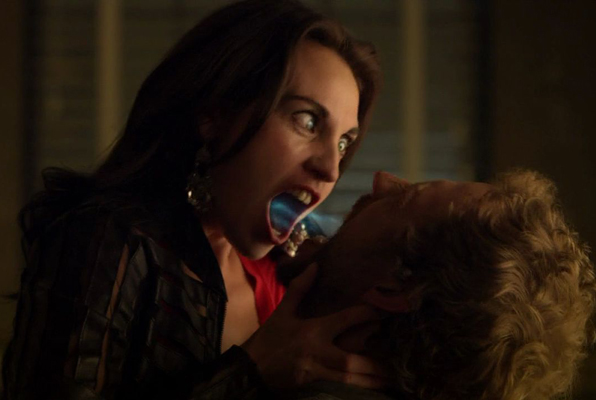
This is a show where the hero gets information from people by using her psychic abilities to get them so horny, they beg to spill (so to speak). Where, in that aforementioned Bo/scientist scene, lesbian sex-spark is a natural. Where Bo milks info from a cougar college administrator via a calf leg touch that causes the woman to practically orgasm the answers. Where another Fae literally tongue-kisses Bo back to health and to a few implied orgasms. It’s really something.

What Lost Girl isn’t is an HBO/Showtime/name-yer-basic-cable-channel-pandering-to-dudes boob parade. It is what comes after we accept as a given that gender orientation is, of course, an in-flux designation. So does that make the show feminist? Can’t say, it’s too early in its run. Certainly, Lost Girl is what comes after whatever it is we think of as “feminist” in TV action hero terms. While the show is usually having too much fun to attach itself to one congruous ideology, what it does have to say about self-determination manifests itself most often in the syntax of style.

Whereas Buffy once quipped that she was “not exactly quaking in my stylish yet affordable boots,” the girls and boys of Lost Girl look like they deal with the terrible economy with refreshing trips to retailers selling couture designers’ “diffusion lines.” Think of the iconic Missoni house creating a budget-conscious line for Target, Versace’s high style pretties for H&M at Nu Depression prices or Vera Wang dong the same at Kohl’s. Lost Girl’s constant engagement with fashion could be off-puttingly elitist but the whiff of the bargain makes it endearingly egalitarian. Instead of class resentment, we can enjoy the looks.

nullThere’s the sloe-eyed Fae werewolf (Kristen Holden-Ried) who’s partial to complexly rockin’ leather combos that suggest off-label John Varvatos; the mystery bartender named Trick (Rick Howland), whose way-butch, deep-dyed denim and rolled-sleeve style is off-season Diesel all the way; and the adorable, what-the-fuck-is-she-wearing Kenzi, whose loopy gothiness suggests Betsey Johnson after listening to My Chemical Romance a lot.

Again, just looking at these people is a tiny pleasure. I like to imagine them shopping (or in Kenzi’s case, liberating items from previous owners), which is just such an interesting way to craft a character, you know? And this isn’t about the evil tang of capitalism and over-consumption. Lost Girl loves style because fashion allows people with a unique way to beautifully present themselves to the world – and these are some pretty unique people.

As for where these stylish supernaturals hang, we see Lost Girl’s creators charming yet again with a rejection of the usual. Instead of True Blood’s “Fangtasia,” a sleaze dive straight out of a Rob Zombie lyric or an industrial metal light show hangout left over from an Underworld movie, the show’s creators offer us what looks like an airy German beer garden, heavy on the oak and steins.

But problems do exist with Lost Girl. The FX are pretty crappy, but I choose to think this as emblematic of the show having its priorities in the right place. The fact that Bo killed people before that blonde fixed up her sexual appetite is rather glossed over, but I’m trusting that we’ll be finessing that as episodes progress. And the one thing that does cause a certain amount of teeth gnashing for Bo is the least interesting part of the show for me: the whole “Who are my real parents?” thing. As played by Silk with a delicate mix of fuck-off, bite-me and muted need, Bo just doesn’t really seem the sort to need the crutch of a never-known bloodline.

But this too could be teased out and finessed; the show is called Lost Girl, after all. I’ll accentuate a positive view and say it will be a neat hat trick when the show lives up to the melancholy that lives right now in Bo’s startled responses; in Trick’s already exhausted helplessness regarding Dark/Light Fae hatreds; in the way the show plays with us with the simple fact that, unlike everyone else who is Fae and super-powered, Kenzi, the most instantly lovable character, is constantly in danger of a horrible instant death.

As of now, Lost Girl gracefully aims low-to-medium-high and always hits its mark. But I’ll be there watching as it inevitably aims higher. It’s the rare show you just have faith in.

Ian Grey has written, co-written or been a contributor to books on cinema, fine art, fashion, identity politics, music and tragedy. His column "Grey Matters" runs every week at Press Play. 

SIMON SAYS: Top Five From the New Wave of French Horror

SIMON SAYS: Top Five From the New Wave of French Horror

null

Xavier Gens used to be cutting edge. Which is to say, he used to be a sign of what horror fans optimistically thought was going to be changing times. This was in 2008, mind you, back when Gens’s Frontier(s) was released in the US. Apart from catching on with American gorehounds in a big way (it seemed like you couldn’t get away from the title for the rest of the year), the Film Society at Lincoln Center singled Frontier(s) out as part of their annual Film Comment Selects program. Festival programmers used both Gens’s film and Inside, Julien Maury and Alexandre Bustillo’s 2007 gutting chiller, as prime examples of a burgeoning new wave in French horror cinema. The cult success of Frontier(s) opened the doors for gritty dystopian French horror and science fiction films like Them, Martyrs, and even Inside, which didn’t come out in America until 2008.

If you believed the hype behind the film, Frontier(s) was the first sign that the French were re-inventing the generic wheel. This was an exciting prospect for horror fans bored of shit like teen-oriented remakes of ‘80s films like The Fog (2005) and The Stepfather (2009). If you believed the hype, then you thought the French were coming and that they were going to bring horror back to horror films and they were going to do it with ungodly amounts of blood and guts, too. These mythical films were talked about as if they were what “torture porn” films could have been like if they were filmed by vraie artistes and not brats like Eli Roth and Rob Zombie (Hey, this may not have been so long ago but it’s what many thought! The cult of The Devil’s Rejects had yet to form and people were still having a great time kicking Roth around for being a mouthy, exploitative huckster.).

Too bad Frontier(s) isn’t very good.

I’m reminded of this salient fact because Gens has a new film out this weekend, one that he hasn’t yet publicly disowned (he didn’t have such a good time making Hitman, saying that this bland video game was taken out of his hands by studio execs). The film’s called The Divide and it is also not a very good film, in spite of the fact that it stars The Terminator’s Michael Biehn smoking a stogey and doing his best Dennis Hopper impression.

nullLike Frontier(s) before it, The Divide is a grungy pastiche of a classic horror film; it is to Night of the Living Dead what Frontier(s) is to The Texas Chain Saw Massacre. In The Divide, the sudden impact of a nuclear explosion in Manhattan forces a group of survivors to pile into a subterranean shelter where they bicker shrilly, form cliques and devolve into monsters. In the film, Gens tries to prove that he can be even more cynical than his predecessors were, if that’s imaginable. So instead of the black guy getting shot and killed at the very end, the black guy gets shot and killed about midway through the film while his murderer’s silhouette is hidden behind an American flag; take that, Romero!

Still, there’s one thing about The Divide’s current limited NYC engagement that has me excited: it’s getting exactly the kind of roadshow release that such a film deserves, namely a limited midnight-only engagement at the Landmark Sunshine.

(A brief tangent: This is the kind of clever event programming that the Sunshine used to regularly take chances on as far back as, oh, 2007 and 2008, incidentally. At that time, the Sunshine tried midnight showings of contemporary horror movies like Midnight Meat Train (which is pretty fun in a dopey way, incidentally). That film was sandwiched between older midnight movie fare like A Boy and His Dog and Night of the Creeps (Before the latter film was even released on DVD!). Now, the Sunshine typically shows Jurassic Park, Breakfast at Tiffany’s and The Goonies, though there are an encouraging number of cult films in their upcoming slate of midnight movies (The Room and Cruising being the most exciting of the bunch). End tangent.)

Horror fans should be excited about new horror films. So seeing The Divide play a couple of midnight showings at the Sunshine is an encouraging sign that somebody out there knows what they’re doing with the film. Just wish The Divide was, you know, good.

Though maybe I expect too much from Gens. He may end up being an important filmmaker in the long run because of the way that Frontier(s) and maybe The Divide helped to keep the presence of new French horror movies in the public eye. After all, while The Divide now has a small theatrical release, Livid, Bustillo and Maury’s sloppy but effective follow-up to Inside, still hasn’t gotten a theatrical release beyond touring the international festival circuit (midnight audiences ate Livid up when it screened at the Toronto International Film Festival this past September).

So if you go see The Divide and you’re hungry for more (and hopefully better) Gallic fare, try these on for size:

nullFor people that just can’t stand gore: Them (2006). This spare, based-on-a-true-story house invasion film is so gripping that people still maintain that, even though its plot is pretty much pure formula storytelling, The Strangers is somehow a rip-off of Them. Them’s just that good.

For anyone that doesn’t mind gore so long as it means good chills: Inside (2007). Really one of the best films of the recent spate of French horror flicks and one whose vision of the post-urban apocalypse is uniquely expressed via a relentless, feature-length chase where a pregnant woman plays Roadrunner to a very violent murderess’s Wil E. Coyote. Creepy, claustrophobic and very grisly.

For fans of bone-headedly macho stories of the post-apocalypse: Eden Log (2007). If you like watching a mute amnesiac with a caveman mentality scramble around the ruins of a futuristic commune, then you’ll probably dig this.

For the fans of Humanoid comic books and stories about men with God complexes: Dante 01 (2008). Delicatessen co-creator Marc Caro directed and co-wrote this acid-soaked story about a schizophrenic mental patient that saves the universe by transforming into a human glow stick. It’s not very deep, mind you, but Dante 01 is kind of fascinating. Though only kind of.

For anyone looking for something a little stronger, shall we say: Martyrs (2008). If you still haven’t seen this one, don’t read anything else about it. Go in blind and expect to be totally drained in the end.

MATTHIAS STORK interviews JOHN BAILEY, cinematographer for GROUNDHOG DAY, THE BIG CHILL & THE PRODUCERS (2005)

MATTHIAS STORK INTERVIEW: JOHN BAILEY, cinematographer for GROUNDHOG DAY, THE BIG CHILL & THE PRODUCERS (2005)

null

A few weeks after my video essay Chaos Cinema had been published on Press Play, I received an email from cinematographer John Bailey. Even though I am primarily invested in directors, his name was familiar to me. When I was about ten years old, my dad had shown me the Wolfgang Peterson directed Clint Eastwood vehicle In the Line of Fire (1993). I distinctly remember liking the film and watching it several times on video. When I read Mr. Bailey’s name in the email, that memory immediately popped into my head.

He told me that he would like to meet and conduct an interview with me for his work at the American Cinematographers website, where he maintains an extraordinary personal blog that I wholeheartedly recommend. I was of course quite nervous about the meeting; after all, the video essay proved to be rather controversial. But it turned out to be a wonderful experience. Mr. Bailey was very considerate and friendly and I am deeply grateful for his generous assessment of my work.

He agreed to an interview with Press Play as well. I find Mr. Bailey's thoughts on Chaos Cinema and filmmaking in general very intriguing. It is always enlightening to learn the perspective of an industry professional.

Matthias Stork: I am familiar with your work as a cinematographer, but I was unaware of your blog at the American Society of Cinematographers (ASC) website which covers a wide variety of cinephiliac topics. How did your blog come about and how do you choose topics to write about?

John Bailey: Two years ago Martha Winterhalter, publisher of American Cinematographer Magazine, asked me if I would like to contribute to the ASC website by writing a blog. I had previously written for the Filmmaker’s Forum page of the magazine. I told her that I would do it if I could write about anything I wanted to, not just film. She agreed. I saw the blog, and continue to see it, as a place where I can explore my own eclectic interests in the arts; I have no set agenda and pick subjects from books, reviews, exhibitions, and ideas from friends. Writing about a subject forces me to focus my thoughts in some kind of coherent way. I was educated by the Jesuits; I have a proclivity to want to organize seeming randomness.

In my opinion, you inhabit a rather intriguing position within the film discourse. You are both an industry professional and an observer. Does this double status inform either of your occupations?   

nullBeing a working professional may give me a more credible bully pulpit to discuss current issues. Whether or not that extends to any perspective I have on any of the other arts depends on whether the reader thinks there are any reliable aesthetic underpinnings to what I write. I try to be less categorical in my opinions on subjects other than film, as I want to intrigue the reader to explore the art and artists I write about with the same enthusiasm that prompted me to write. My perspective on cinema, however, is much more personal, and comes out of over 40 years of work. It’s really impossible to objectify any discussion about what is so close to your skin. As they say, “movies are my life.”

In a fantastic essay titled In Search of a Cinema Canon you describe yourself as neither a critic nor a film historian, just an avid lover of movies. Could you elaborate what exactly it is that draws you to the medium? I understand that this is an abstract question. To put it differently, what do you like to see in films? Maybe we can also extend our purview and include more tangible aspects, drawn from your own work, i.e. cinematography.

If the question is abstract, my love of cinema is concrete—as is the art form itself. Wonderful as the history of experimental or abstract filmmaking is, we mostly think of movies as plot, character and narrative that relate to real world experience. It is the very real life aspect of movies that attracted me from the beginning. It may be why I have less interest in fantasy and action movies, and why I have such antipathy for gratuitously violent action films that bear no resemblance to any life experience. At the same time, I am powerfully affected by films that combine the drama of life with formalist technique and style, whether it is Bela Tarr, Robert Bresson, or Ernst Lubitsch.

I am drawn to filmmaking because though parts of me enjoy solitude, I love the give and take collaboration, even the tensions of a film set. It is a complex weave of art and technology with the equipment always threatening to overwhelm the art. You have to wrestle the equipment to the ground and make it crack to your whip.

nullIn the essay you also mention that you and your wife, film editor Carol Littleton, were involved in an international outreach program in Kenya and Rwanda. You gave workshops on cinematography and film editing. Could you speak about your experience and how you organized the workshops?

The workshops in Nairobi were created by the German organization One Fine Day, the brainchild of Tom Twyker and others. As you might expect, it was highly structured and ran like clockwork, a classically oriented pedagogic program, including one day that featured recreating five famous paintings. There were plenty of cameras and lights to work with.

In Kigali, there was no advance program and we all tried to develop an agenda based on the experience and questions of the students, many of which were of a start-up nature. The film school is embryonic and there is virtually no support equipment such as lights and grip and dollies. The greater potential of the Rwandan program, though, lies in the tragedy of its recent genocidal history, not that that is the only theme, but the power of that cultural and societal disruption can be the spark of a greater creative force in film.

During our encounter, you told me that you went abroad as a college student, an experience to which I can fully relate. I am wondering whether the time in Europe had an impact on you which is still present, and whether it extended to your work in the film industry as well.

I think I can speak for Carol as well as for myself [when I say that] it is impossible for me to imagine a life in film had I not studied as an undergraduate in Europe. It was there that I was exposed to cinema, not just movies. It took me a long time to embrace mainstream American movies. I am still coming as a late student, courtesy of Turner Classic Movies, to the glories of many American movies of the golden studio era.

I had the great good fortune in my time as camera assistant and camera operator to work with auteurist American directors such as Monte Hellman, Robert Altman, Robert Benton, Alan Rudolph, Terrence Malick, and of course with cinematographer Nestor Almendros. It gave me an aesthetic foundation, so that when I met with Paul Schrader for American Gigolo I was able to have real discourse with him about Bresson and Antonioni.

nullYou contacted me vis-à-vis my video essay on chaos cinema and I was very pleased to hear the opinion of a professional on the matter. You articulated your own thoughts in your blog essay but I would like to revisit some aspects of the phenomenon. How would you personally characterize what I termed chaos cinema?

I think that you have focused closely and clearly on action movies in discussing chaos cinema; I would characterize the notion of chaos cinema as a style that uses the camera to disrupt, disorient, even fracture the viewer’s sense of space and time—deliberately exploiting the most advanced techniques to replace traditional narrative engagement and substitute it with visceral excitement—exactly what many video games do.

Not being a huge fan of action movies, I ask myself whether the stylistic underpinnings you discuss can also be applied to more narrative oriented films and what effect chaos style has to either disrupt any sense of engagement beyond spectacle—or whether it can serve also as the foundation for a new kind of narrative. I try to address this, tentatively, in the last part of my blog essay on chaos cinema/classical cinema.

In your essay, you stress the significance of character and emotion in narrative storytelling. How do you approach these concepts as a film viewer and a cinematographer?

We can’t escape our personal histories. From grammar school forward, I was presented with many aspects of a classical education, meaning one that was based on Aristotelian ideas, even as they evolved through the pageantry of Western art history. As a viewer, I, like most people, am looking for emotional involvement that is grounded in some sense of credible experience. Those movies don’t have to be dour dramas. Sometimes, animated films like Up or The Triplets of Belleville capture these qualities in an essence that is more elusive in live action films.

As a cinematographer, I read the screenplay not for visual style or technical potential, but for emotional engagement. Any consideration of film style develops from that starting point, in discussions with the director and production designer.

nullYou worked as a cinematographer for the film In the Line of Fire, directed by German émigré filmmaker Wolfgang Petersen. It is my favorite of his Hollywood endeavors. Could you explain how you approached your work in the film? What was important to you, and how did you translate it into the film?

I told Wolfgang that Das Boot demonstrated beyond any doubt that he is a master of action; I had confidence that the visceral momentum of the film was easy for him. What interested me more is the cat-and-mouse drama between John Malkovich and Clint Eastwood, one an angry nihilist, and the other a humanist looking for redemption. I told him that the therapy scenes in Ordinary People between Tim Hutton and Judd Hirsch constituted a film within the film. I thought the phone calls between Malkovich and Eastwood had a similar basis, and that if we could make each of the phone calls dramatic and visually compelling—the rest of the film was window dressing. You may agree or not, but that is the idea I worked from and I think that is what makes that film different from most action films.

Cinematography has undergone significant changes during the last decades. What are, for you, some of the prominent shifts that have occurred and how do they register on-screen for average audiences? What would you define as chaotic attributes of modern cinematography?

To answer that question would require several lengthy essays. The most prominent shift, I think, is out of the hands of the cinematographer and is in the hands of the VFX creators. And that is the rise of computer-generated imagery to such a level of convincing space that, at least for quick cut, short bursts, it is visually credible as reality. What usually gives it away is the hubris of the generators in defying the laws of gravity. Movie action sequences have become so usurped by the ir-reality of first person video gaming that viewers don’t believe action sequences in movies any more; they look phony. Of course, that’s no problem if you aim for nothing more than spectacle. What is phenomenal about the CGI technique is the ability to tell character driven movies such as The Curious Case of Benjamin Button in a way that was not possible before.

nullChaotic attributes are simply major disruptions of time and space as a device to deconstruct or destroy traditional narrative. The use of multiple cameras for simultaneous action, especially at different frame rates, is one tool. Extensive use of multiple cameras, especially with longer lenses, disengages you from a sense of intimacy with the characters. Multiple cameras also make it more difficult to do what the French call a plan sequence, the complex interplay of one structured shot into the next one; that style is the antithesis of chaos cinema. Also, I find that shaky-cam is often a distancing rather than an engaging device. It is supposed to make you feel more involved, more present in the action. In practice, especially with arbitrary zooming and deliberately bad pans, it just throws you outside the moment making you conscious of the camerawork. It is self-indulgent and hubristic. Conversely, if you are aiming for a cinema verite feel, these very techniques can be effective. There are, after all, no set prohibitions. Also, rapid fire cutting as a relentless technique does not keep you engaged; if there is no slower paced rhythm in the quieter scenes as counter rhythmic, this pace becomes alienating, even boring. Finally, layering shot after shot after shot with no sense of hierarchy reduces the concept of cinematography to nothing but coverage. The shot becomes just data. The cinematographer is reduced to capturing data.

I have always wanted to pick the brain of a film professional about technology and the pragmatic approach to filmmaking. Could you briefly break down the profession of a cinematographer? What does a cinematographer do, and how?

This is actually easy to address. The cinematographer uses the camera to dramatize visually the narrative potential of the screenplay. His main tools to do this are lens selection, camera placement, composition, camera movement, shot-to-shot coverage, and light. In some film cultures it is the light that is his principal focus; in other cultures, such as the USA, all of these elements are the purview of the cinematographer. This work is done in collaboration with the director and in varying degrees with the production designer and costumer. Some directors are story and performance oriented; others are image oriented. The great ones should be both.

The cinematographer’s ability to do all of this work is modified or even constrained by many things, such as schedule and money. The greatest challenge for the cinematographer, like for any artist, is the ability to create good work within the parameters you have—to be flexible, to have a can-do attitude. Often it is the cinematographer and assistant director who have to set the positive tone on the set. The director is swamped by needs of the actors and dictates of the producers and studio.

You cite Point Blank as a paradigm of effective action. Are there any other action films that you like? And how would you define good action?

Good action is not an end in itself, but is a visceral tool to generate emotion by ratcheting up tension or creating release (catharsis). It serves as counterpoint to static dialogue scenes. Just like in a symphony, you have allegro and adagio movements.

I like much of Kurosawa; much of his action happens only after incredible tension precedes it. The same for the climactic action scenes in Sergio Leone films, and not just the spaghetti westerns. The Battle of Algiers and Wages of Fear are great action films, and recently, The Hurt Locker.

To hearken back to your blog, I was astonished by the breadth of topics you cover, and I urge cinephiles to seek it out. All of your work is steeped in the history of cinema. I wonder if you could enumerate a few books on film that you regard as essential to the study and enjoyment of the medium.

The books I love are not about the making of films but about life by filmmakers: Cocteau’s Diary of a Film; Bunuel’s My Last Sigh; Herzog’s Walking in Ice; Kurosawa’s Something Like an Autobiography; Jack Cardiff’s Magic Hour; Nestor Almendros’ A Man with a Camera; Karl Brown’s Adventures with D.W. Griffith; and of course, Bresson’s Notes on the Cinematographer.

If you could pick any director to collaborate with, who would it be? 

The late Francois Truffaut. I only met him once, when he came to visit Robert Benton on the set of The Late Show. Of living directors, I have done five films with Paul Schrader, who has been a great presence in my life beyond the set. I have also made five films with my friend Ken Kwapis. I hope to do five more with him.

Matthias Stork is a Press Play contributor and film scholar-critic from Germany who continues to pursue an academic career at UCLA where he studies film and television. He has an MA in Education with emphasis on American and French literature and film from Goethe University, Frankfurt. He has attended The Cannes film festival twice (2010/2011) as a representitive of Goethe University's film school and you can read his blog here.

GREY MATTERS: Exile from Guyville: The outsider heroines of HUNGER GAMES, UNDERWORLD and THE GIRL WITH THE DRAGON TATTOO

GREY MATTERS: Exile from Guyville: The outsider heroines of HUNGER GAMES, UNDERWORLD and THE GIRL WITH THE DRAGON TATTOO

null

When three of our top action heroes have names like Katniss Everdeen, Lisbeth Salander and Sookie Stackhouse, well, that at least counts for interesting. But when all three wildly different creations – The Hunger Games’ anti-war survivor, The Girl with the Dragon Tattoo’s enraged goth hacker, True Blood’s deep-fried super-powered fairy – are engaged in essentially the same radical gender role rewrite project, that’s another thing entirely. Throw in Mary Elizabeth Winstead’s flinty-fine turn as the nearly genderless Kate Lloyd in the fantastic The Thing prequel and there’s no doubt: a new wave is cresting, something wild and long in coming.

How things look when it hits the shore (in particular, when the Hunger Games film version attacks multiplexes this March) will tell us whether Twilight’s Santorum values are finally in retrograde; whether the age of the girl as just The Girl, the Mom, the Object or the Sidekick is fading a bit; and whether the culture in general is ready to one-up Liz Phair by finally allowing heroines their invigorating, self-defining exile from guyville.

But first, maybe you want to know what the hell I’m talking about.

nullSuzanne Collins’  Hunger Games trilogy is about a dystopian post-North America where tweens and teens are forced to kill each other on a nationally broadcast reality TV show. Our heroine is Katniss Everdeen – 16, and a loner who first experiences a boy’s romantic overtures as treachery, then as spiritual debt. With his every kindness, her indebtedness grows like a bad mortgage of the heart. Collins’ narratives are as non-erotic as Stephenie Meyer’s literary chastity belts, but you too might not be in the mood if, like Katniss, you were either starving, in pain or murdering children to survive. And while fans speculate endlessly over which boy Katniss would have chosen, I believe that, had she a choice, she would gladly have turned down both boys for one night of peace with her sister Prim and her mom. Readers of the trilogy know the truth of this.

But the key thing is this: when Katniss is hunting (alone or with Gale), at the market, at one with nature or with Prim, she’s full, complete, more. But after being torn between two romances she did not instigate, and after her body is waxed, shaved and peeled down to “Beauty Base Zero” so she’s ready for pre-Games fashion shows, it’s nearly impossible to imagine a more visceral, point-by-point depiction of female diminishment.

Anyway, if all this was just about one S.F. trilogy, it might be shrugged off as a weird pop culture blip.

But it’s not. As I type this, similar energies run through David Fincher’s deeply empathetic and subversive version of The Girl with the Dragon Tattoo, starring Rooney Mara’s savagely calculated reanimation of the book’s icon, Lisbeth Salander. An angry, acidly hermetic 24-year-old hacker savant, Salander was raised by a hell-father of unknowable monstrosity and is raped by her social worker. For her own reasons, she agrees to lend her incredible computer skills to a disgraced middle-aged journalist (Daniel Craig) trying to solve a corrupt family’s mystery.

Salander’s work invigorates her. But as someone raised in sexual horror, she can only express herself in the language of fucking. When she offers her body to the journalist, he takes it, despite having nothing real to offer in return.

nullSalander’s bad decision visibly diminishes her. Away goes the off-putting mohawk, bulky jacket, fetish gear and the essential protective hardness. She wears foundation, combs her hair and becomes “pretty.” She even buys Craig’s character an expensive leather jacket.

But Fincher’s got her back: when she catches the older man out on a date, Lisbeth hurls the gift in the trash, jumps on her tricked-out Honda CB350 and leaves the usurious journo in the midnight dust. As fucked up as she is, she’s at least herself again. Salander does what the guilt-wracked, self-loathing Katniss of the first two Hunger Games books can only dream of doing: she escapes “romance.”

Meanwhile, after three seasons of making a fool of herself on the horns of love, True Blood’s Sookie Stackhouse is finally learning the Salander lesson and saying no.

Increasingly super-powered and weary of being “vampire crack” (talk about triple entendres), Sookie is faced with choosing between two hot vamps – serial liar Bill and sizzling bad-boy Eric. Instead, she says no to both of them, and so a door opens to a new Sookie, one in control of those light-blast super-powers and…are you seeing a pattern here?

nullIf so, check out The Thing, which took Salander-style self-determination as far as Hollywood could stand. Our heroine is a paleontologist named Kate Lloyd (Winstead); the blunt name matches her no-nonsense character. She ends up with a group of Norwegian scientists in the Antarctic fighting a shape-shifting alien menace. Dressed in the same gender blurring winter wear as her coworkers and with not a stitch of makeup, Kate is not attracting or attracted. Undistracted, she is relentless.

Of course, the Big Kahuna of heroic self-definition is Buffy the Vampire Slayer, especially Buffy in her last moment on screen when, minus the distraction of her vampire lovers Spike and Angel or a man-created legacy to tie her down, she can finally, after 144 episodes of striving, get to live.

Still, why this deluge of Exile from Guyville properties now? You could just as easily ask why it’s raining fairy-tale-based films and TV shows, but I’ll give it a go.

I see three factors at work.

1. THE NAMES

The easiest to crack is the weird name thing. Not to ball-peen hammer my point too hard, but in properties that are all about questioning or opening spaces where it’s okay for heroines to be more, epic and amazing, it just makes sense to have people with fantastic names to match the mission. You just better buy into an enraged aggro-goth tattooing “I AM A RAPIST PIG” on a screaming rapist pig when her name is Salander instead of, say, Jody. (I love the way “Salander” sounds like an especially pissed off verb. “She salandered her money manager until he begged for mercy!”)

2. ROM-COM BRAINWASHING

Another is the  auto-critique of romance that these narratives so often represent. A single, smart, beautiful, for-now middle class New Yorker friend gave me an idea via her growing contempt of the one genre dedicated to female viewership: rom-coms. Her antipathy for the genre was simple: “Because they’re about making me go fucking insane, is why.”

She said rom-coms drive her around the bend by (1) making marriage look like the most nightmarish state of human bondage imaginable and (2) insisting that all single women must drop everything so as to enjoin that bondage at the exclusion of all other things, pronto. It’s basic cognitive dissonance — and when you look at the diminishing returns of recent genre efforts, it seems as though my friend has company.

3. SELF-DETERMINATION

nullJump-cut from rom-coms to another form of action entirely, the Underworld films – those interchangeable video game-style werewolves-and-vampires shoot-outs featuring Kate Beckinsale in a catsuit. (Another is coming out next month.) I’d always assumed the films were about dudes ogling Beckinsale’s aerodynamic, leather-clad bod wreaking gory havoc. Wrong.

When Beckinsale stripped down to make soft-focus love with some hunk, the theater erupted in howling disapproval – from women. Women who did not brave a winter Manhattan night to see their action heroine surrogate become some dude’s bottom, but rather to enjoy her kicking ass, and often.

Claiming rom-com apostates and action film lovers as core constituency for anything may seem a stretch too far. But I think they both mine the same dissatisfaction.

The female half of the entertainment market is tiring of being pandered to in degrading, conservative fantasies while reacting really well to tales of possibility, no matter how dark.

That half of Comic-Con audiences already dressing as Katniss? Or Doctor Who devotees snatching up pricey Amy Pond and River Song action figures? They’re the base — the P.R. shock troops for properties that represent this new wave. And based entirely on apocryphal evidence and years in the S.F. nerd trenches, I’m here to report that those people are more often female than not.

That base is waiting for the Hunger Games film with a passion eclipsing Potter or Twilight because it’s based on real need here in Depression 2.0, a need for a self-defined someone who beats the odds, the economy, and the expectations placed upon her gender. (And yes, I know how it all ends – with acceptance, qualified hope and a sad awareness of limitations. Not exactly Love Story.)

Meanwhile, yet another Twilight-corrective book has been greenlit for a film version: Scott Westerfeld’s Uglies, which tells of another nightmare future in which youth are force-fed crap pop culture and made to endure prettifying body modification – or else. And the heroine’s name? Tally Youngblood. Katniss would be so proud.

Anyway, as Thunderclap Newman sang decades ago, there’s something in the air, and it’s all so incredibly exciting. This is gender egalitarianism creating itself without knowing it, which is why it might be real. Films in which men live without required romantic subplots or obsessive girl problems are unremarkable, the usual, expected. But films in the Katniss, Salander, Stackhouse and Lloyd wave, films in which the equation is gender-flipped with such passion – that’s punk rock. That’s the beginning of a leveled playing field and the end of dissonance, one story at a time.

Ian Grey has written, co-written or been a contributor to books on cinema, fine art, fashion, identity politics, music and tragedy. His column "Grey Matters" runs every week at Press Play.

PETER TONGUETTE: EVERYONE SAYS I LOVE YOU is a stealthy Christmas classic

PETER TONGUETTE: EVERYONE SAYS I LOVE YOU is a stealthy Christmas classic

null


1.

In Stardust Memories, as we all know, Woody Allen plays a movie director. At one point, a studio executive (a brilliant little cameo role by Laraine Newman) says to him, “This is an Easter film. We don’t need a movie by an atheist.”

But what about a Christmas film by an atheist?

2.

By the time I saw Woody Allen’s Christmas movie Everyone Says I Love You, Christmas was over, and so was New Year’s Eve. It wasn’t until some dreary day in the middle of something like February that the film reached us, weeks after the tree had been taken out to the curb and the confetti swept away. That day, Christmas seemed very far away.

It wasn’t just that the season had passed. It was where I was calling from, as Raymond Carver might put it, that was the problem. Everyone Says I Love You was a musical comedy set in Manhattan, Venice, and Paris, and it was the last city that served as the backdrop for the film’s richly evoked Christmas scenes. Well, I had never been to any of those cities, and it was hard not to feel out of the loop when gawking at them from Slidell, Louisiana, the city north of New Orleans where for all intents and purposes I grew up.

In my thirteen-year-old mind, it wasn’t a difficult choice: La Tour Eiffel or the Superdome? Please.

I was besotted with the offhand glamour of the Christmas section of Everyone Says I Love. For example, the way the story’s narrator D.J. (Natasha Lyonne) says that her family (mother Goldie Hawn, father Woody Allen, stepfather AlannullAlda, and assorted siblings and step-siblings) doesn’t go for the usual Christmas things, like singing carols or hangings stockings. “What we do do is we head right for Paris,” she says, “and we spend our Christmas holiday at the Ritz.” Woody Allen must have directed Natasha Lyonne to deliver that line—among the wittiest he has ever written—in as deadpan a manner as possible. It’s charming how this lifestyle is, for D.J., routine.

Allen had her same nonchalant tone when he talked to interviewer Eric Lax about some of the challenges he faced in making Everyone Says I Love You. One problem was that he wanted to film the scene where Edward Norton picks out an engagement ring for D.J.’s older sister (played by Drew Barrymore) at Tiffany’s. “[B]ut they didn’t want us to dance on the glass countertops. We said we’d put in our own glass and protect everything but they just didn’t want dancing on them. They said we could dance in the aisles and take over the place but we went over to Harry Winston and they gave us complete cooperation and it was fresher.”

I would have gladly traded problems with Woody Allen.

3.

At the same time, if I really searched my memory, I could find things in my life that were comparable to the stylishness of the family who spends Christmas at the Ritz. My favorite scene in Everyone Says I Love You comes when Woody Allen and Goldie Hawn go to a Groucho Marx-themed Christmas Eve party. Everyone there has dressed up like the comedian. There was something about the party’s improbable combination of elegance and silliness that I could relate to.

nullYou see, around this time our family was friends with a family who lived in uptown New Orleans on a street called Audubon Place. The Christmas before I saw Everyone Says I Love You, we went to a party they threw at their grand house, which was probably not even the grandest on their street. I couldn’t tell you because the only time I ever saw it was in the cover of night at parties like this one. But really: I knew. Whenever I entered their house—three stories, with a spiral staircase and an elevator—I thought of April Wheeler’s line in the Richard Yates novel Revolutionary Road: “I still had this idea that there was a whole world of marvelous golden people somewhere…”

I always felt like telling April Wheeler that the people she is talking about live on Audubon Place.

The wife had an enormous collection of hats. I don’t mean that she had ten hats. There were at least fifty, but there could have easily been 100 or more. There was shelf after shelf of hats, protected by glass, illuminated by what was presumably special lighting. Their variety was almost cartoon-like. That’s what reminded me of the Groucho Marx party in Everyone Says I Love You; the hats looked as silly faux greasepaint moustaches do in the context of a luxe party.

And yet there was something terrific about them, too. Woody Allen would recognize this truth. He saw Everyone Says I Love You as a fond valentine to the Upper East Side—in all of its over-the-top splendor. “I look around and I see rich kids going to these private schools and their chauffeurs take them,” he told Time magazine, “and I see husbands and wives come down at night, and he’s got a tux on and she’s got a gown, and they go out—it’s a wonderful, romantic neighborhood. These people have money, and it’s nothing to be ashamed of.”

I came to share Woody Allen’s benevolent view of wretched excess. People collect butterflies. Why not hats?

4.


Maybe, then, I shouldn’t have felt so excluded from the world of Everyone Says I Love You. A few days after Christmas that year, my father and I went to the Brooks Brothers on Canal Street, hoping to find a good sale. I had been looking for an overcoat. I remember my father telling Stephanie, the clerk who usually helped us, that I was looking for the sort of overcoat “that Jules Feiffer might wear.”

You see, in my mind Christmas and the New York intelligentsia and having nice things were all rolled up into one tangly ball. These associations made perfect sense to me. My father got where I was coming from, but at the time I privately thought to myself, “I wonder if Stephanie has even heard of Jules Feiffer?” I might have also thought, “When in the hell will Everyone Says I Love You open down here?”

Then again, is shopping for a Jules Feiffer-style overcoat at Brooks Brothers a few days after Christmas so much more déclassé, or any less unconventional, than spending Christmas at the Ritz?

nullI say “Woody Allen’s Christmas movie,” but of course only a small portion of Everyone Says I Love You takes place during the holiday season. Yet when you watch the movie for the second or third time (I have seen it perhaps 10 times by now), it feels like the whole story is building to those scenes. There is a lot to enjoy in the scenes set in the spring, summer, and fall, but they don’t have the same magical pull. By the time we get to Halloween, we’re antsy, and so is our director. Woody Allen can’t wait for Christmas. He’s like a seven-year-old that way.

So many of the movies I think of as Christmas movies have very little to do with the holiday per se. I think of them as Christmas movies only because I saw them on or near Christmas. I’m talking about films like Marnie, Love Streams, Sleepy Hollow, Slacker, The Trial, The Talented Mr. Ripley. So it still really bothers me that I wasn’t able to see an actual Christmas movie like Everyone Says I Love You until February of the following year. I think I would have better grasped the connections between the fantasy on the screen and the reality of my own life if the hat collection on Audubon Place had been fresh in my mind as I watched the party where everyone looked like Groucho Marx.

The most famous scene in Everyone Says I Love You comes when Woody Allen and Goldie Hawn leave the Groucho Marx party and go for a stroll beside the River Seine. The stroll turns into a dance number and after it is over, Woody and Goldie talk about their former life together and their current life apart. It seems like they begin every sentence with “Do you remember when…?” Is there a better way to spend Christmas Eve than reconciling yourself to your past?

It was this scene that prompted Roger Ebert (the movie’s best and most persistent champion) to wonder if “perhaps Everyone Says I Love You is the best film Woody Allen has ever made.”

All I can say is this: there is nothing like leaving a fancy party early and facing the bite of the cold night air. Especially if you’re with a pretty companion. Especially if you’re going over old times with her. Especially if it’s Christmastime and you’re in Paris. I’ve had a few experiences not unlike these. I hope to have a few more.

Peter Tonguette is the author of Orson Welles Remembered and The Films of James Bridges. He is currently writing a critical study of the films of Peter Bogdanovich for the University Press of Kentucky and editing a collection of interviews with Bogdanovich for the University Press of Mississippi. You can visit Peter's website here.

PETER TONGUETTE: Director Steven Spielberg and editor Michael Kahn: a life long partnership

PETER TONGUETTE: Director Steven Spielberg and editor Michael Kahn: a life long partnership

[Editor's Note: It's Steven Spielberg weekend here at Press Play. We are publishing our first video essay series in direct partnership with IndieWire called Magic and Light: The Films of Steven Spielberg.  This series examines facets of Spielberg's movie career, including his stylistic evolution as a director, his depiction of violence, his interest in communication and language, his portrayal of authority and evil, and the importance of father figures — both present and absent — throughout his work. A different version of the following article originally appeared in CinemaEditor magazine, Volume 61, Issue 1, First Quarter 2011, under the title, "Michael Kahn, A.C.E.: A Beginner's Mind, A Professional's Craft." If you would like to watch Magic and Light: The Films of Steven Spielberg Chapter 1: Introduction, go here. If you would like to view Magic and Light Chapter 2: Blood & Pulp, go here. To watch Magic and Light: The Films of Steven Spielberg Chapter 3, go here. ]

nullI was the sort of kid who paid attention to movie credits, even if I didn’t comprehend them, so from an early age I was familiar with the name of Michael Kahn. There it was, appearing again and again at the start of some of my favorite movies as a child: Close Encounters of the Third Kind, Raiders of the Lost Ark, Empire of the Sun. It was always preceded by words like “Film Editor” or “Edited By.”

Years later, I had the opportunity to write for CinemaEditor magazine, the official periodical of the American Cinema Editors (ACE), an honorary society. I wrote for the magazine for five years, diligently filing story after story about editor after editor, but all the while I dreamed of speaking with one editor in particular. The editor whose name I remembered from my childhood.

The day came when it was announced that Michael Kahn would receive the ACE Career Achievement Award in February 2011, and I was asked to profile him for CinemaEditor. I don’t know that I’ve ever been as excited about an interview.

But even his closest collaborator, Steven Spielberg, manages to still get excited about working with the man. When Spielberg accepted the American Film Institute’s Life Achievement Award in 1995, he singled out two of his longtime collaborators. Audiences watching the special at home that night would probably have seen the first one—John Williams—coming a mile away. But the second name Spielberg mentioned would be unfamiliar to many. “And, wherever you are, my lifelong editor, Michael Kahn, I wouldn’t be standing up here without you,” Spielberg said. (That video appears below)


“Wherever you are”? Michael Kahn really was elusive, but—as I was to discover—not in a Greta Garbo sort of way. He was so modest that when I called him up last November to ask him about the award, it was difficult to get him to talk very much about it. “I’ve gone to a lot of these events and I’ve seen all of these fellas get these awards,” he told me. “I never thought that it fit me to get one. I was delighted that my peers think me good enough to get the award. It was very surprising to me. I’m happy and thrilled that I belong in that category.”

Maybe Kahn was surprised that his career had taken him to this point. After all, it was a career that unfolded as if by accident. Born and raised in New York City, he told me he never had any thought of going into film or television in any capacity. “My parents didn’t encourage me to do this,” he said. “To tell you the truth, I got out of high school and I didn’t know what I wanted to do.”


nullThat isn’t to say that Kahn didn’t go to the movies a lot. It was a weekend ritual for him as a teenager. “I’d go Saturday, I’d go Sunday. I’d see anything that was playing,” he recalled. For an editor who would later make films like Poltergeist and Jurassic Park, Kahn’s youthful response to horror films is surprising: “If there was a scary picture on, I’d throw the coat over my head! Even today, I can edit a horror movie, but I can’t watch one! When I was a kid, I was very impressionable and it was extremely scary to me.”

He remembered going to double features. “So you went to see one and then you got the other one. I wanted to see a Western, so there was a Western, and then I got the other one. And if the other was too scary, I’d chew on my Hershey’s chocolate bar! I’d buy a big chocolate bar that had the little blocks of H-E-R-S-H-E-Y-S. I’d chew off a block and by the time the movie was over I’d finished the whole bar! I was probably as high as a kite by that time!”

Another accident: Kahn got a job at a New York ad agency that made commercials in California. “They had clients like Pepsi-Cola and Phillip Morris,” he said. “So they sent my boss out there. I was just a flunky, you know? They said, ‘Do you want to come?’ I said, ‘Sure.’ I came out to the coast. I didn’t know a thing. I didn’t even know what editing was, honest to God. They did a series of commercials and I said, ‘Gee, can I stay?’ They said, ‘Sure, if you want to.’”

nullKahn stayed and got a job at Desilu. It was there that he came into contact with Dann Cahn, Desilu’s editorial supervisor. “Danny was very nice to me,” Kahn said. “I was his assistant in the office. He said, ‘Listen, if you want to get ahead in this business, you’d better get into a union.’ So he got me into the editors union.”


Do you get the theme here? “And it was an accident that Danny liked me,” Kahn laughed. “He didn’t have to like me, but he did and there I was. He said, ‘I’m going to have to put you in the editing room.’ He put me in the editing room as an assistant to John Woodcock. I assisted him and I started learning about what an editor did.”

It was through osmosis that Kahn learned the art of editing. Besides Cahn and Woodcock, he absorbed the knowledge and expertise of such editors as Harry Harris (later an acclaimed director) and Bud Molin. It was Jerry London, another Desilu alum, who took Kahn from assistant editor to editor. London was editing Hogan’s Heroes when he decided to give directing a try. “We were friends, our wives were friends, we went out together,” Kahn remembered. “He said, ‘I’m starting a new show called Hogan’s Heroes for Bing Crosby Productions. If you come on as my assistant, the fifth or sixth show, I’ll make you an editor, so that I can go ahead and direct.’ Lo and behold, that’s exactly what happened….

“I learned how to edit on Hogan’s Heroes. I did it for five or six years. You had a lot of different directors. They all had different styles. I learned how to make things work. By the time I was through with him Hogan’s Heroes, I was a regular cowboy, you know?”

He graduated to features with George C. Scott’s Rage in 1972. In the five years between it and Close Encounters of the Third Kind (his first film with Steven Spielberg), Kahn edited twelve films. He found something to take away from each experience. “It wouldn’t matter what film it was,” he said. “Whatever came up, I did. I did a lot of low-budget pictures and had nothing but fun.” He had just done a film for Irvin Kershner—The Return of a Man Called Horse—when he was up for Close Encounters. “Kershner knew Steven, and so did [cinematographer] Owen Roizman, and Steven respected them,” Kahn said. “They recommended me. They gave him my name and I went in for an interview with Steven. It was a fast interview, but he told me to meet him in Devils Tower, Wyoming, and I met him there and we did Close Encounters. We got along well. It all went beautifully.”

nullTwenty-three films later, it is still going beautifully. “It just worked out that way,” Kahn said. “What did the old guy say? ‘It was meant to be!’… I’ve worked with Steven for so many years and I’m amazed at how he’s advanced. He wasn’t what he used to be. He’s better. You become a sidekick. You become a partner. I’m very comfortable with him. We spend a lot of time together in the editing room.”

Since Kahn edits as Spielberg is filming, a rough cut is usually ready in a week or less after production ends. “I edit right behind him,” he said. “I mount the show and I put it together. And at least he’s not going to be shocked when he sees the scenes because he’s seen them all. That saves a lot of time.”

During the filming of Saving Private Ryan, Spielberg repeatedly visited the editing room to look at the opening D-Day landing sequence, which had already been cut. As Kahn recalled, “I said, ‘How come you’re looking at it so much?’ He said, ‘Well, I don’t want the ending to be similar to the beginning. I want to keep it all fresh. And the beginning inspires me.’ He kept looking at it.” The scene couldn’t have provided Spielberg with inspiration had the film not been assembled according to Kahn’s method of cutting as shooting progresses.

Spielberg’s versatility has meant that Kahn has worked in virtually every genre, from science-fiction (Close Encounters) to adventure (Raiders of the Lost Ark), from historical drama (Empire of the Sun) to comedy (The Terminal). “There are some directors that do one genre,” he observed. “They stay with what they know. Steven is more adventurous. He’ll go and try different things. We were in Poland doing Schindler’s List and from ILM, in a big saucer, we’d be getting shots in from Jurassic Park. We’d be looking at them in Poland. I had my work print with me, so I would cut those shots in as they came in. We’re doing two shows at the same time, but it was fun.”

Even if he has worked in a particular genre before (as he has in the three Indiana Jones sequels), Kahn does his best to approach each film with a fresh set of eyes. “I try to forget what I have done in the past and drop it, so I’m not taking any baggage with me,” he said. “I don’t differentiate between one thing or another. The next thing I’m going to is like the first time I’m doing it. I find it fresh and new. There’s a phrase that I always use. It’s called ‘beginner’s mind.’ I come in with beginner’s mind, like it’s the first time I’ve done something and it’s brand new…. Each time I do a show, I try to forget everything that happened on the previous project. I come in with an open, free mind, like I haven’t edited before. I’m open to the director’s ideas because that’s the one you’re working with. With directors, I don’t talk too much. I listen. By listening and watching, that’s how I learn how to put it together and [understand] what the director had in mind.”

nullKahn didn’t mince words in explaining why his collaboration with Spielberg has been so successful: “After all, let’s be frank, I’m working with the best. There’s no doubt about it. I don’t say that because I’m with him. If I wasn’t with him, I’d say it. His memory is unbelievable. I feel I have a great memory, but he doesn’t forget. He likes me to put in temp music from other scores. He remembers the temps I put in years ago! It blows my mind. He’ll remember something. ‘Oh, you used that before!’ ‘Yeah, but it was ten years ago!’”

I got a scoop as my interview with Michael Kahn was coming to a close. Going in, I knew that all of the films he made with Spielberg had been cut on film, but then Kahn told me something as we were talking a bit about War Horse: “I’m doing a film with him now and it’s the first time that we’re working on the Avid. He decided that he’d like to try it. I was already experienced on the Avid.”

Spielberg is famous for cutting on film—“Steven likes the smell of it, the feel of it, the history of it,” Kahn told me—so this was a startling revelation, but in a way it made sense. It’s a testament to what Kahn called Spielberg’s adventurousness. He doesn’t stay settled in one genre or in one manner of working, even if he’s been working that way for a very long time.

This doesn’t daunt Kahn, though, who was similarly unflappable when talking about the challenges of editing The Adventures of Tintin: The Secret of the Unicorn, Spielberg’s first animated film and also his first in 3-D. “It’s all the same, no matter what they do technologically,” Kahn said. “What I do is the same. Being on the right angle at the right time and trying to help the story editorially. It doesn’t change, no matter if it’s 3-D, 4-D or 10-D!”

I could hear the enthusiasm in Michael Kahn’s voice as he talked to me about his craft. “When I was coming up as an editor,” he said, “editing was a transitory stage. [Editors] wanted to be directors. I was one of the few who was happy as an editor. I just wanted to be the best that I could be at it.” His suggestion to young editors who are just beginning? “I would say to see as many motion pictures as you can. How are you going to grow unless you see styles and see what people are doing?” In a way, it’s not unlike his own unwitting preparation for the job, watching all of those double features as a teenager in New York.

“To tell you the truth,” he laughed, “I can’t even find a big Hershey’s bar anymore!”

Peter Tonguette is the author of Orson Welles Remembered and The Films of James Bridges. He is currently writing a critical study of the films of Peter Bogdanovich for the University Press of Kentucky and editing a collection of interviews with Bogdanovich for the University Press of Mississippi. You can visit Peter's website here.
 

Occupy Wall Street movement: a survey of video footage from the front lines

Occupy Wall Street movement: a survey of video footage from the front lines

null

For just a moment, try to set aside your preconceptions. Try to set aside your ideological leanings, your ideas about power, money, and political speech. Even try to reach past your automatic emotional responses and most visceral feelings. And for a moment, just watch the video below this graf. It was shot in downtown Manhattan by Luke Rudkowski.
 

The picture plane is slightly tilted, a tell-tale sign the camera is sliding off its operator’s shoulder. He is stretching on his toes to peer over the shoulders of the crowd in front of him, where he sees two men in oddly formal dress – white shirts, navy blue hats, black, gold-clipped ties, and black gloves – wildly swinging batons at those nearest them. The swings cause the crowd to retreat behind the camera while the operator stays firmly in position. A man in a navy uniform attempts to guide him back, but from the right side comes a white shirt. We don’t see the impact of the baton, just the rotation of the white shirt’s shoulder, but the camera shakes as the operator is hit in his lower body, causing him to let out a pain-filled “Ugh!” The camera falls into a maze of legs as the operator’s body crumples to the ground. Now, take a look at the above footage shot in Oakland, California.

It’s daylight, and there is a scrum against a metal barricade. On one side, along with the camera is a roiling crowd, on the other navy-uniformed men wearing helmets with clear plastic faceplates. The uniformed men hold clubs – one even has a shotgun, the barrel of which creeps up to the chest level of the crowd – and it is clear by the way they are standing that they are trying to obscure the scene behind them. The camera fights against the crowd to get a view through the navy-clad legs, catching glimpses of a body being pinned to the ground. As the body writhes, you can see that it is a woman, and as she tries to escape her position, she is repeatedly struck with a club. Witnessing this only stirs the crowd more, with one man yelling, “Stop! That’s a female!” The uniformed men try to close ranks and hide the incident, but their faceplates can’t hide the fear and uncertainty their individual faces betray. Now, look at this footage shot at the University of California, Berkeley.


The camera in the above footage is perched high above the action. There is a large crowd made up of young people, at the foremost edge of which is a human chain formed by the locking of elbows together. The chain stands toe to toe with several anonymous individuals in identical body armor, who are initially statuesque. Near the center of the human chain is an Asian girl, who is noticeably smaller than any of those on either side of her. Without warning or provocation, one of the armored individuals shoves the butt of a nightstick in the girl’s stomach, lifting her off the ground, knocking her back into the crowd, and collapsing the chain. Other armored individuals follow suit, thrusting their sticks into the retreating crowd. When there is a cut to a ground-level shot, we can see a young man being repeatedly struck as he is pinned against a bush with nowhere to move. Another young man is stripped of his shirt, thrown to the ground, and a knee is placed on his neck as plastic zip ties are used to bind his wrists.

All of these scenes have a specific context. They were all captured by digital cameras at specific Occupy protests – New York City, Oakland, and Berkeley, respectively – over the past three months, and disseminated via YouTube. Each has its own specific crowds of protesters, with their own ideas about global capitalism and level of agitation, and each has its own specific law enforcement officers, with their own notions of duty and implements of crowd control. Each video shows a specific act of police brutality, but focusing on the specific context can be more limiting than illuminating. As more Occupy camps are violently evicted across the country, these scenes could be, and are, taking place anywhere. And at the moment when the baton, or fist, or pepper spray makes impact, the institutional divide between protestors and police officers becomes temporarily irrelevant. In these videos what we are really watching is bodies coming into conflict, and one using force to subordinate the other.

When one body uses force over another, it is always an attempt to assert control: to minimize the other body, to contain it, to take away its agency and purpose. In effect to silence it. Not just to silence the speech that may be emanating from the body, but to silence the statement the body itself might be making by virtue of where, when, and how it is positioned. When policemen hit protesters, the aim is to push them back and force them to disperse. When a policeman seizes a protester, the first movement is always to force them down to the ground. Take a look at this footage shot during a November march on the New York Stock exchange.

The video was shot at the intersection of New York City’s Pine and Williams Street and it shows brief jostling at the line between cops and activists, followed by one officer reaching forward to grab a young woman by her scarf and yank her down, out of the crowd. The assault is a disturbing image in and of itself, but equally as upsetting is the mechanics of the tactic on display. We see the police finding any excuse to intrude on the protest, and snatch away a participant, taking away her right to assemble, which in essence is the right to occupy a given space.

And the occupation of space is what is at the very heart of the Occupy movement, to use public areas – parks, plazas, university campuses – as the primary tool of redress, by asserting that they are commons. The concept of the commons is, according to Peter Linebaugh in The Magna Carta Manifesto, “The theory that vests property in the community and organizes labor for the common benefit” – an idea that dates back to 1215 at Runnymede and the limitations placed on the power of King John. The commons are more than just public spaces, but they are those liberties – trial by jury, Habeus corpus, etc. – that are essential to the individual use of those spaces with agency and purpose.

The antithesis of the commons is the commodity. Ever increasingly our public spaces are serviced and maintained by private entities, and open to general use in highly regulated increments requiring prior approval, and often for monetized purposes. Accordingly, officials now view public spaces as they do any asset that can be commodified, and deploy law enforcement to protect them accordingly. “The insanity of the commodity arises from its inherent contradiction or double bind: on the one hand it is useful, convenient, or commodious, on the other hand it is bought and sold for profit and gain,” Linebaugh writes. “Guile replaces plain dealing.”

The key word there is convenient. Commoditization has eased many of the daily tribulations of modern life through convenience, but it has also bred an unhealthy civic culture in which the value of individual actions is not determined by ethical judgments, but by judgments of the market. The disruption of conveniences by the Occupy protesters is the reason for much of the popular scorn heaped upon them, but it is also their very purpose.

And so what we are seeing in those videos is a contest for space, to define space. One side uses the power of their bodies and speech, the other uses force. After watching the clips, it is necessary to let the specific context of what we have seen sink back in – to consider the role that money and political considerations have in law enforcement; to consider the appropriateness of the actions of the crowd. But the most important specifics to let in are the very realness of the injuries that are sustained. The bruised tissue on the face of a woman punched by a NYCPD officer is real. Look at this video shot by journalist Michael Tracey as he covered a march by protesters through the streets of Manhattan. Around the 1:40 mark, an NYPD officer can clearly be seen assaulting a protester in a green shirt.

This following footage was shot on the campus of the University of California, Davis. The scorched eye sockets and nasal cavities of the sitting students casually pepper sprayed at UC Davis are real.

Now witness the concussion and broken skull of an Iraq War veteran in Oakland. His story is real, The camera finds him in Oakland, California.


Of course, cameras can lie. As Brian de Palma put it, “the camera lies 24 times a second.” And that is film; digital lies much more frequently, in every pixel. Every edit and choice of framing omits as much as it shows, and thus no image is ever complete. But to focus on the camera’s lie is not so much a deconstruction of the media, but an ancillary construction we build in order to interpret what we are seeing. And we should always question what we see. But the lie can become an excuse not to absorb what we are watching, and not to take responsibility for it. The lie can actually become an excuse not to watch.

Louis Godfrey currently lives in Chapel Hill, NC. He is originally from Salt Lake City, UT, where he spent five years reporting on politics and court cases, before turning to writing on film. He also likes cats.

AARON ARADILLAS: JAWS: the film and the director that changed everything

AARON ARADILLAS: JAWS: the film and the director that changed everything

null


[Editor's Note: It's Steven Spielberg weekend here at Press Play. We are publishing our first video essay series in direct partnership with IndieWire: Magic and Light: The Films of Steven Spielberg.  This series examines facets of Spielberg's movie career, including his stylistic evolution as a director, his depiction of violence, his interest in communication and language, his portrayal of authority and evil, and the importance of father figures — both present and absent — throughout his work. If you would like to watch Magic and Light: The Films of Steven Spielberg Chapter 1: Introduction, go here ]

It is often said that Steven Spielberg’s Jaws, his excitingly directed adaptation of Peter Benchley’s disposable beach read about a summer community being terrorized by a great white shark, ushered in what we now know as the modern blockbuster. It, along with George Lucas’ Star Wars, brought about what we now accept as the Summer Movie Season. Up until Jaws, studios had considered the summer a vast wasteland where they could offload their grade-z programmers. Just like the town of Amity in the film (really Martha’s Vineyard), where a successful summer tourist season could carry the town through the rest of the year, Hollywood studios would forever rely on summer blockbusters to carry them throughout the rest of the year. This is all true, but Jaws is something else. Look closely and you’ll see it is actually the last old-fashioned adventure, a kind of farewell to a rickety yet sturdy style of Hollywood filmmaking – and values.

The first half of Jaws plays like one of those ‘50s monster movies where a town is under attack by a man-eating creature, but instead of it being mutated ants or Godzilla, it is a shark. The opening shark attack put the audience on notice that this wasn’t your run-of-the-mill horror film. The shooting of the movie was plagued by a constantly malfunctioning mechanical shark. This setback forced Spielberg to be creative by creating suspense by withholding the sight of the shark. This also lined up beautifully with future audiences’ anticipation of the summer movie season. You didn’t know what was coming your way.


There are really only two points of view in the film; the shark’s or Spielberg’s, and at times they’re one and the same. The opening of the film is a P.O.V. shot of the shark in motion, but it could easily be Spielberg, the hot young director who had wowed TV audiences with the compact road thriller Duel and impressed critics with the mature romantic chase picture The Sugarland Express, looking to announce himself to the world. Not yet 30, Spielberg was a product of the first generation to grow up with television. He had an encyclopedic understanding of film and film history. He loved Hollywood spectacles like Around the World in 80 Days and B movies by William Whitney equally. He clearly respected the movies and stars that came before him, but he also knew things had to change. He wanted to tell stories faster and on the appropriate scale. He wanted to make a monster movie where you actually believed the characters were in danger.

Like Hitchcock and Welles, Spielberg refused to be restricted by the rules of realistic perspectives. For Spielberg, the camera could be where it was needed to be in order to tell the story. The only point of view that mattered was his; all others were secondary. You can see this in the sequence where Chief Brody (Roy Scheider) is with his family on the beach, keeping watch on everyone to make sure they’re safe. He’s been told by the mayor to consider a shark attack an isolated incident. Brody isn’t comfortable with this. As he watches people swimming and playing, Spielberg uses a series of wipes to get our senses heightened to the possibility of another shark attack. Then, John Williams’ two-note score begins and we’re plunged into the water as the shark zeros in on the splashing legs of a boy. When the boy is attacked Spielberg cuts to Brody and uses the famous zoom in/pullback shot from Vertigo to make us aware of Brody’s worst fears coming true. The entire sequence isn’t shot to make us feel like one of the tourists on the beach. It is told from the perspective of a filmmaker wanting to play us like a piano. (That scene appears below.)


The second half of the film has Brody and college rich kid oceanographer Hooper (Richard Dreyfuss) accompanying veteran shark hunter Quint (Robert Shaw) as they set out to kill the shark. When their boat leaves the dock it’s as if the movie is leaving behind traditional filmmaking and entering uncharted territory. The camera is rarely, if ever, locked down. It bobs up and down, circles the characters, swoops around Quint’s leaky boat looking for the best angle. (One of my favorite unexplained shots is when Quint stands out on the ship’s pulpit, readying to shoot a barrel into the shark, and the camera moves up and down as he takes aim.) It is the second half of the film that we finally see the shark, but Spielberg purposely catches us off guard. It’s a throwaway gag designed to make you scream, then laugh. (Spielberg also cheats by not using the shark’s theme music to warn us it’s nearby.) Later, Spielberg displays a playful sense of motion as the men seem to be chasing the shark. Williams’ score along with the camera gliding alongside the boat and the sight of barrels moving in the water give us a real sense of momentum.

nullThe centerpiece of the movie is when the men sit around the table, drinking and talking. There’s an unspoken rivalry between the crusty old seaman Quint and the young smart-ass Hooper. They start to compare scars they’ve gotten while observing sharks. (Brody, a former big-city cop who has rarely fired his gun, has no scars.) Hooper is amused by Quint, humoring his macho posturings. Quint knows this. But Quint puts Hooper in his place when he begins to tell him how he survived the Indianapolis, the World War II vessel that delivered the Hiroshima bomb. The Indianapolis is most famous for being attacked and its crew being picked off by sharks. There are a couple of things going on in this sequence. Quint’s monologue stops the film cold and gives it a sense of drama that had been mostly absent up until that point. His story is real and is scarier than anything in the movie. That’s probably why some critics (particularly Pauline Kael) raised concerns about its inclusion in otherwise escapist entertainment. Some felt the movie was crossing a line by using a real-life tragedy in the service of an adventure story. It would seem to be exploiting the real pain of the families of those who perished or survived the Indianapolis. But for Spielberg and his contemporaries (Scorsese, Coppola, De Palma), nothing was off limits. Nothing was sacred if it made for a better story. Quint’s monologue transforms the movie from an old-fashioned monster movie into something haunting. It’s why the movie has endured all these years.


The sequence also represents the changing of the guard as an older generation relinquishes power to a younger, cockier one; it’s the passing of Hollywood’s old guard to a generation of new filmmakers itching to make their mark. Shaw’s Quint stands in for a generation of men of few words who rarely allowed themselves to show their emotions, men full of stories – and to a certain degree, full of shit. Quint’s tale of survival trumps anything that Hooper will ever experience. Hooper knows this. Earlier, he had mocked Quint’s crumbling of a beer can by crumbling his Styrofoam cup. Now he has a newfound respect for him and quietly accepts his wisdom. But Hooper is also clearly Spielberg’s stand-in, a smart-ass who employs the latest in technology to do his job. Brody’s our stand-in as he takes in all he can from the old and the new in an attempt to keep up with what is going on around him. And when the shark finally leaps onto the boat (and at the audience) and bites down on poor Quint, we are seeing the devouring of an outdated Hollywood value system. The shark is the unknown variable that continues to surprise audiences. From the shark in Jaws to the Millennium Falcon going into hyperspace to Superman taking flight to the runaway boulder in Raiders of the Lost Ark to the Stay Puft Marshmallow Man to seeing the Batmobile to the T-1000 to the dinosaurs in Jurassic Park to the long shadow of the flying saucers in Independence Day to Jar Jar Binks to the birth of Darth Vader, we’ve been conditioned to expect the unexpected during the summer. Jaws was the first movie roller coaster. At the time, who would’ve predicted that we wouldn’t want the ride to end?

San Antonio-based film critic Aaron Aradillas is a contributor to The House Next Door, a contributor to Moving Image Source, and the host of “Back at Midnight,” an Internet radio program about film and television.