
Whenever friends ask for my opinion on Steven Soderbergh, I reply, "Which Soderbergh?'" Are they referring to the man who directs super-stylish, cool, intelligent entertainments such as the Ocean's trilogy, Out of Sight and Erin Brockovich, or the man who directed such idiosyncratic experimental features as Schizopolis, Full Frontal and Bubble)? On the surface, his career choices seem among the most perverse and erratic of any modern filmmaker. There aren't any other contemporary directors who are able or willing to switch from one genre and style of filmmaking to another and exhibit such different sensibilities. It is entirely possible to love one side of the man's professional identity, the entertainer — a side currently represented by his bruising action picture Haywire (2012) – whilst remaining ambivalent about his other, equally important and equally characteristic side, the experimenter.
Soderbergh gained mainstream ecognition for such mainstream films as Traffic (2000) and Erin Brockovich, both released in 2000 and representing his popular peak: both were nominated for Best Picture; Julia Roberts won Best Actress for the latter, and Soderbergh Best Director for the former. And yet Soderbergh sees himself as a filmmaker to whom this work is all of a piece. Where other directors might have reeled after having their vision for a film (Moneyball, 2011) rejected mere days before the scheduled start of production, he took it in his stride, and it seems likely that his chameleon temperament helped him move on. Whether directing big-budget, star-driven, Hollywood movies or micro-budgeted, freeform, experimental works, to him it's the same process, just a different canvas. Soderbergh told The Rumpus, 'That's a delineation only somebody who doesn't make movies would make. They're all for me."
 This attitude frustrates some critics and fans and has been a source of some personal difficulty for the director. Soderbergh's commercial films have made money, earned critical respect and won awards. I always compare his Hollywood features, or at least the best of them, to the amazing work done by John Schlesinger on Midnight Cowboy (1969). Like Schlesinger, Soderbergh is no hack. The man is a brilliant director of Hollywood films, bringing experimental style and techniques to his movies that add richness, class, emotion and taste. His intrinsic understanding of what Ocean's Eleven could be is what turned it into the crowd-pleaser that it became; he talked of Jaws (1975) and Ghostbuster (1984) being the models for that 2001 hit, and he brought out the best in his large cast. His decision to film the separate storylines in Traffic using different filters and film stock led some critics to call the movie schematic, but it made a potentially confusing story easy to follow and compelling. (Compare Traffic to the similarly plotted but very confusing 2005 film Syriana, which was directed by Oscar-winning Traffic screenwriter Stephen Gaghan, but had an unvarying visual style.) A career built exclusively on the likes of Traffic, Erin Brockovich and the Ocean's films would satisfy most directors.
But over the decades Soderbergh has built a parallel career of small-scale, experimental films which, whilst always interesting, are always flawed and rarely, to be honest, accomplished. They all have the air of needing to be made to satisfy some personal quirk or to test new technology. In a word, they are 'experimental'. And Hollywood doesn't understand 'experimental'. It's a results-based town.
Such distinctions frustrate Soderbergh because he doesn't see himself as an art house director who compromises himself every time he makes a commercial feature, nor as a mainstream Hollywood director who makes a bit of art on the side. He's a total filmmaker who writes or cowrites, directs and produces his movies and often shoots and edits them as well (under pseudonyms). He wants a cinema that can be both experimental and commercial. And if he does continue to make movies (in 2010, he talked about plans to quit film for painting), his challenge will be to find ideas that interest both him and a large audience – a lesson that he learned during the first decade of his career.
When Soderbergh, at the age of 26, won the Palme d`Or at Cannes (the youngest to ever do so) for Sex, Lies, and Videotape (1989), he joked, "It's all downhill from here." And commercially at least, until Out of Sight almost a decade later, it was. Sex, Lies, and Videotape was a phenomenon – it revitalised the independent filmmaking community and briefly made it seem as though "indie" films could crossover to the mainstream with ease. While other independent filmmakers flourished in his wake, Soderbergh stood his ground and went his own way, making films that unfortunately didn't interest many critics and failed to cross over. As Soderbergh told The Telegraph about his commercial and critical disappointments, '…they failed because the ideas were too narrow. Not enough people were interested in the ideas."
In retrospect his choices were commendable and speak volumes about what kind of filmmaker he is: Soderbergh decided to follow his interests and instincts and damn the consequences, and all the films were at least interesting. Kafka (1991) is a mystery thriller that blended fact with fictional elements from Franz Kafka's novels. It was barely released and isn't readily available even now, being a much sought-after import DVD (Soderbergh has talked of puting together a director's cut of the movie). King of the Hill (1993) was similarly little-seen, but the likeable Depression-era drama was acclaimed by certain critics and won Soderbergh his second Best Directing nomination at Cannes. Perhaps hoping to increase his commercial chances, he next made The Underneath (1995), a modern updating of the Noir classic, Criss Cross (1949). The result was a film that even Soderbergh was disappointed with at the time. (He has described all three films as failures.) He followed that up with his least commercial venture up to that point, the 80-minute Spalding Gray monologue, Gray's Anatomy (1996).
Schizopolis (1996) was the film ended the first chapter of his career. It was also the first evidence of his rebellious, mischievous, quirky side, and his surreal sense of humour. Soderbergh told The Believer that when he finished directing himself in Schizopolis, "I honestly thought…that I was really onto something that was going to be very, very popular. I thought that movie was going to be a hit. I thought people would go, 'This is a new thing'. I thought it was going to be bigger than Sex, Lies, and Videotape. You have to believe that while you're making it. Once I started showing it, I didn't believe it anymore.'
Schizopolis (1996) has a non-linear narrative and tells the same story from three different perspectives. Wholly improvised and shot for $400,000, the film is a surreal satire, but it's (deliberately) unclear of what. Identity? Scientology? The lack of communication in modern life? Our attempts to extract meaning from art? Soderbergh plays the hero Lester Richards, a nod to his filmmaking hero Richard Lester, whose spirit pervades the movie; he also directed, wrote, co-produced, photographed, co-composed and co-edited. It is one of his most personal films, and at the time (or even now to casual fans), it forces one to reassess what one thought one knew about the filmmaker. It's tempting to see it as an act of artistic liberation, a cleansing of the soul, and a questioning of his identity as a filmmaker, husband, father and human being. His marriage to actress Betsy Brantley (his estranged wife in the movie) had ended in 1994,; the couple have a daughter together. Soderbergh had gone his own artistic path, but it had paid no dividends apart from his own personal satisfaction. He had tried to make a more commercial film but failed. Soderbergh would eventually describe Schizopolis as being "about the breakdown of a marriage. It's very simple, in a way. It's about two people who can't communicate. It's all in the service of expressing this emotional detachment and frustration. As crazy as it gets, it's not actually an obscure movie to me." Schizopolis wasn't hated, it just wasn't widely seen, and for the most part critics weren't interested in it. It's a film I didn't like on first viewing, but I now appreciate the artistic bravery, the apparent wish to break free of constraints and simply have fun and not worry about narrative, structure and the profit margin. Its sense of humour is slyly amusing rather than hilarious. A similar thumbing-of-the-nose sense of humour is apparent in Soderbergh's later, more tightly structured and linear The Informant! (2009), a funny and entertaining film.
 Schizopolis has since become a cult film and was included in The Criterion Collection, but it did nothing for Soderbergh's career, and its US gross was only $10,500. The offer to direct George Clooney and Jennifer Lopez in the Elmore Leonard adaptation Out of Sight must have seemed a strange prospect to him, but it set him on the road to commercial and critical recovery and gave him a new agenda: to make mainstream films, but to bend their structure, play with their style, and tinker with their tone; in short, to make films that both he wanted to make and that audiences would appreciate. Out of Sight's nonlinear narrative is probably what held it back from being more than a modest hit. But it may also be what made it seem so fresh at the time (attracting the attention of Hollywood producers previously disinterested in him), and is surely one of the reasons it holds up so well.
Soderbergh's next assignment was the intriguing revenge thriller The Limey (1999). Despite its status as a flop, the film is brilliant, and a key entry in the man's ouevre because it was an even more artistically successful melding of experimentalism and commercialism than Out of Sight. The plot – Cockney career criminal Terence Stamp comes to L.A. to avenge the death of his daughter at the hands of music promoter Peter Fonda – is secondary to the innovations beneath the text. Soderbergh skilfully uses flashbacks and flashforwards to reveal the hero's sadness, disappointment and regret of a life ill-spent and his neglect of his daughter, and the anger and will for revenge that such bittersweet memories elicit in him. The approach doesn't come across as arty or self-indulgent but unexpectedly poignant, and it subverts the genre. The plot is little more than a remake of Get Carter (1971), but Soderbergh also pays homage to films from the '60s and early '70s. Stamp's film Poor Cow (1967) supplies the flashbacks and his character's name and occupation: Wilson, thief. (He also played a supergrass apprehended by his ex-cohorts in 1984's The Hit.) Peter Fonda comes across as if his character from Easy Rider (1969) had decided to go mainstream but, despite his cyncism, still had his head in the pot-haze of 1966 to early '67. Andy Warhol repertory company member Joe Dallesandro has a small part as a hot-tempered thug. Barry Newman, who starred in the 1971 chase film Vanishing Point as a disaffected ex-cop angry at The Man, plays Fonda's henchman, and has trouble controlling his car.
 The Limey was followed by three critically acclaimed, commercially successful movies in a row: Erin Brockovich, Traffic and Ocean's Eleven. He followed this run of movies with Full Frontal (2002), his first fully-fledged experimental piece since Schizopolis and likewise a movie that confounded critics and barely made a dent at the box-office. I didn't enjoy it at the time, finding it tedious, self-indulgent and pretentious. But my second time was a different experience. It's not a serious film, but a lark in the spirit of some of Godard's work, all about the artificiality of the Hollywood or L.A. life, and its sense of humour is subtle but playful. Like Schizopolis, it's an opportunity to flex the muscles and act on the impulses that commercial filmmaking doesn't require, and to refocus and replenish energy. As great as his previous three films were, Soderbergh had had to work hard to make them his own – proving his worth as a filmmaker able to tackle any project – and Full Frontal was a film just for himself: a freewheeling, French New Wave-inspired comedy docudrama, shot in a month on digital video for only $2m. I feel embarassed that I sat on my first viewing attempting to compare it with his previous three films. it's not aimed at same audience. One shouldn't look for the qualities found in his commercial work in his experimental work because they are not there. His commercial films have star performances and feel professionally and stylishly made. His experimental films tend to be shot on digital formats, feature non-professional actors, and have a lo-fi, off-the-cuff feel.
Soderbergh would argue that his 'eclectic' upbringing, in which he saw many styles and genres of films, made it natural for him to go "from one genre to the next, with the same satisfaction", but the timing of Full Frontal is interesting. Was Soderbergh worried about becoming typecast as a craftsman, a Hollywood director-for-hire with famous friends who would appear in his films (at reduced fees) at the drop of a hat? Probably not. The film was likely a reaction to the wearying realities of Hollywood filmmaking – the politics, the deal-making, the endless rewriting, the star trailers, the long shoots, etc. Full Frontal was as Un-Hollywood as one could get, and gave him a chance to see who he was as a filmmaker after being embraced by Hollywood.
Full Frontal would be followed by the big-budget remake of Andrei Tarkovsky's Solaris (2002). It was a worthy remake, more emotional than the original but no less haunting. Its unfortunate failure at the box-office would push the possibility of Soderbergh's experimental instincts and commercial expectations co-existing in a popular film even further into the distance.
He tried something similar in Ocean's Twelve (2004). Whilst a huge hit, the film confounded audience members who didn't want such a complex plot and a twist ending that fooled them. They likely wanted a repeat of the original. Matt Damon remarked that the only reason he returned for Ocean's Thirteen (2007) was to make up for the second film.
 Twelve was followed by a third experimental venture: Bubble (2005). It was again low-budget ($1.6m), filmed without a script (just an outline by his Full Frontal collaborator Coleman Hough) and with Soderbergh working in various capacities (director, producer, cinematographer, editor). The film was shot on HD video, and was controversially simultaneously released in cinemas and on cable/ satellite network HDNet Movies. The DVD followed a few days later. Only 73 minutes in length, the thriller tells the story of an overweight, middle-aged factory worker whose infatuation with a much younger co-worker has deadly consequences. The actors in the film were not professional actors but simply people Soderbergh had chosen from areas of West Virginia and Ohio. If anything, with his experimental features he was getting further and further away from the films that had made his reputation, and many saw him as being deliberately obscure and self-indulgent.
Ocean's Thirteen (2007) and the big-budget, two-part (and commercially unsuccessful but well-reviewed) Che (2008) were followed by a kind of companion piece to Bubble titled The Girlfriend Experience (2009). Inspired by Godard and Bergman and shot for $1.3m with a RedOne digital camera, it details a few days (leading up to the 2008 Presidential election) in the life of a high-class Manhattan call girl (real-life porn star Sasha Grey). The movie drew the usual mixed reviews accorded Soderbergh's experimental films, and the New York Post went so far as to call it 'half-assed'. (Roger Ebert, however, loved it.)
Soderbergh told The Believer: "A lot of people who write about art don't understand the importance of failure, the importance of process. Woody Allen can't leap from Annie Hall to Manhattan. He has to make Interiors in between to get to Manhattan. You've got to let him do that."
Perhaps the truth is that we the audience need to be more open-minded and supportive of his artistic choices. His experimental films have to be treated as what they are, "experiments". They are attempts to test the ground and make small steps forward that can advance his art, and the art of film in general. He has learned from his "failures" and is on a quest to make his films clearer. He wants to connect, but his way, telling The Rumpus "…the hardest thing in the world is to be good and clear when creating anything. It's the hardest thing in the world. It's really easy to be obscure and elliptical and so fucking hard to be good and clear. It breaks people. Because you don't often get encouragement to do that, to be good and clear." Soderbergh believes there is a thread that unites all his work, telling the same website: "There's probably a commonality in protagonists who feel that through sheer will they can make things turn out the way they want them to turn out.'
 Soderbergh's latest releases, Contagion and Haywire, prove he's a remarkably versatile, resourceful filmmaker who is still trying to fuse the two strands of his cinematic personality into a coherent whole. Haywire is a low-budget action thriller that has found critical acclaim and proves that the aesthetics, practices and lessons learned from his experimental films can be applied to a popular genre with strong results. Soderbergh's medical thriller/ disaster movie Contagion (2011), released only four months earlier, was a mainstream blockbuster with a similarly restless sensibility, and is a culmination of lessons learned and skills honed. It's globetrotting, and has many inter-connected storylines and a lot of information and allusions to impart, but like Haywire star Gina Carano, it's lean, direct, and packs a hell of a punch. It's an experimental in its digital, raw, docu-style, but the approach fits the essence of its reality-based story, and helps the audience accept mega-stars (Matt Damon, Jude Law, Gwyneth Paltrow) as real people.
He is a uniquely interesting and challenging filmmaker who time and again subverts our expectations. I may not always like the films he makes, but I understand his need to make them. We have to look at the bigger picture and see that whilst Godard had two careers with a clear chronological split in the middle, Soderbergh has two careers running parallel, but they are coming from the same adventurous spirit, and both are essential to understanding his artistic sensibility. If he does indeed retire to take up painting, it will be our loss.
Paul Rowlands writes about film on his website, Money into Light. He lives in Japan, where he also teaches English. Originally from the UK, he has lived in Japan since 1999. His writing has also appeared in the James Bond journal Kiss Kiss Bang Bang. On his site he covers films he believes to be misunderstood, underrated or brilliant, and interviews actors and filmmakers associated with such films.


 [EDITOR'S NOTE: Fearless Sarah D. Bunting of Tomatonation.com is making it her mission to watch every single film nominated for an Oscar before the Academy Awards Ceremony on February 26, 2012. She is calling this journey her Oscars Death Race. For more on how the Oscars Death Race began, click here. And you can follow Sarah through this quixotic journey here.]
 The film has echoes of everything from Hoosiers to Hoop Dreams (the rising and falling fortunes of Money and Chavis) to The Blind Side to the late great Friday Night Lights, but that's a pretty impressive list of memorable narratives to have echoing down your movie. (Well, I loathed The Blind Side on film, but I'm told the book is good.) Directors T.J. Martin and Daniel Lindsay trust their story, and their subjects, and rightly so; Bill Courtney probably knows what the filmmakers are going for, and he's good at boiling those things down, but not in a sound-bitey way. In one longish interview, he ruminates on giving up on people, how you know if it's a test or a lost cause. Elsewhere, he grumps that football does not build character, "football reveals character."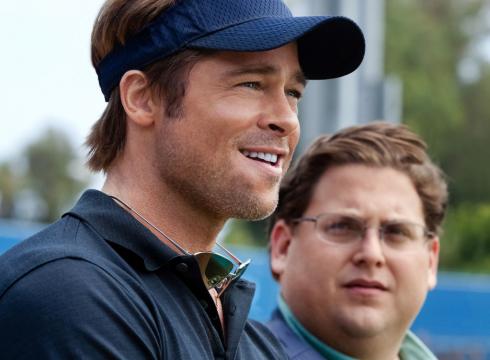

 I can't speak to what baseball atheists got out of it. I can name maybe two other people who got the same frisson of hilarity out of the casting of Chad Kreuter as Rick Peterson as I did. I know for a fact that nobody else snickered at "No bunting whatsoever," but I of course collect comments like that. But I'm pretty sure "Who's Fabio?" "He's that shortstop from Seattle"; the "I'm just saying, his girlfriend is a six, at best" sequence; and Billy Beane's ex-wife's new husband and his man-dals got laughs from other people, because I'm pretty sure Moneyball is a good movie qua movie, sharply observed and well acted across the board.
 Nineteen eighty-one was the last gasp of the independent spirit of the '70s American cinema movement. The previous year's Raging Bull and Heaven's Gate may have represented both the climax and glorious ruin of the previous epoch; the all-consuming onslaught of Spielbergism and Reaganism commenced the following summer with the paradigm-changing success of E.T. But in 1981 there still was a kind of film being made which was soon to disappear: a film designed for intelligent, upscale adult audiences willing to be entertained on a more sophisticated level. Warren Beatty could only have made Reds at this point in his career, and of all the films nominated for the 1981 Best Picture Oscar, it works best as '70s swan song, especially in its interpolated documentary portions of aging witnesses to the life of John Reed. Otherwise, Reds was an ambitious and impressively literate mounting of a Lean-like spectacle that, since it celebrated the aspirations and ultimately lost dreams of fervid young 1917 communists (and by allusion, the contemporary counterculture), was unrevivable and largely forgotten during the rest of a conservative decade. The other four contenders were a varied lot: Steven Spielberg's Raiders of the Lost Ark, the year's pre-eminent popcorn smash; Chariots of Fire, a solidly produced British tradition-of-quality prestige yawner that was given some emotional texture by a stirring Vangelis score (as played on the opening credits over a pan of euphoric runners); On Golden Pond, a turgid sentimental spectacle of aging veterans Katherine Hepburn and Henry Fonda working together for the first time and co-starring with Fonda's daughter Jane; and Louis Malle's Atlantic City. Malle's film was the least pretentious and assuming of the bunch, yet also the most movie-movie-ish (even moreso than the mechanical Raiders). It is also the nominee whose reputation has grown the most over time.
 The film's iconic image is the European-scented scene of Sally (Susan Sarandon) cleaning herself with Lemon wedges by an open window, serenaded by classical music and gazed at across the way by a furtive Lou (Burt Lancaster). Sarandon was never more beautiful and sensual than in 1980, with her distinctively large eyes and ample bosom (well-exploited by Malle, both here and in his previous film Pretty Baby). She plays a worker at an oyster bar (hence, the ritualized lemon cleansings) who is also training to be a dealer in the casinos. Michel Piccoli is likely Malle's stand-in as a wizened Frenchman tutoring her in the rules of the game as well as the Gallic language itself. She's visited by her ex-husband, a ratty drug dealer who's happened upon an illicit wad of cocaine, and his pregnant hippie girlfriend, Chrissie (also Sally's sister). Lou lives next door. He's an aging numbers runner who "worked for the people who worked for the people". He spends his time nursing Grace (Kate Reid), his lover from way back who came to town, took third place in a Betty Grable lookalike contest, married a mobster and stayed. Grace's bedroom is as gratuitously overdecorated as one of the boudoirs in Pretty Baby's New Orleans brothel.
 Atlantic City's narrative texture and freewheeling romanticism have earned it a place as one of the most beloved American films of its period, but what struck me on my most recent viewing was how much it resembled a colorful, Jonathan Demme-esque survey of tacky Americana. A late '70s sign extolling the era's ecominic boosterism ("Atlantic City-Back on the Map Again") fronts the dillapidated exterior of Sally and Lou's crumbling apartment complex; Lou takes Grace's yapping toy dog to the "Pet-tique"; Robert Goulet and a tiny couplet of showgirls incongrously entertain at the hospital where Sally identifies her ex's body; the funeral parlor has 'We Understand' affixed under its name; the local news reports have a tacky authenticity. Sally leaves A.C. listening to "Sunrise Semester" on her car radio. The end credits music mimics a car radio shuttling down the dial, with different recordings from different eras evoking what Atlantic City once was and the city in transition that it had become.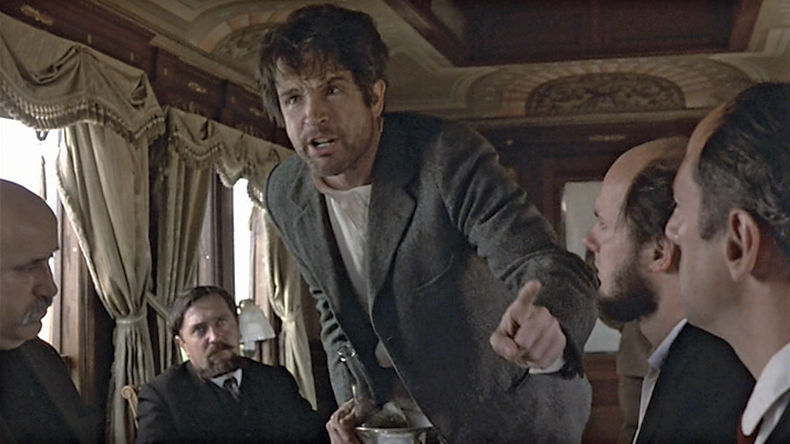
 Chalk it up to the power of Warren Beatty. Coasting on the success of such mega-hits as Shampoo – which he’d produced and starred in – and Heaven Can Wait – which he’d starred in, produced and co-directed – he was ready to make the ultimate “one for me.” And what a one it was. He’d been fascinated with the journalist since the mid-60s, and, with his typical slow burn, had started filming interviews with old-time lefty heavy hitters like feminist author Rebecca West, playwright Arthur Miller and ACLU founder Roger Nash Baldwin as far back as 1970 on the off chance that he'd gain funding to make a film about Reed and his comrades. Somehow he convinced Paramount of the feasibility of the project – though soon after signing on the dotted line they reportedly offered him $1 million to not make it – and it not only scored the brother four Oscar nods and one actual statue, but made $41 million, which was a highly respectable box office return for the time.
 At the film’s center lives the fraught romance between Reed (Beatty) and socialite writer Louise Bryant (Diane Keaton); Beatty had to maintain that aspect of the sweeping historical epic tradition, after all. I’d never really grokked Keaton’s much-touted beauty before. Above the high lace collars of that era, though, her grey eyes widen and narrow with a sensuality that’s hard to deny, and she speaks with none of the stammering affectations that muck up so many of her performances. But because the star-crossed lovers proclaimed a “free love” relationship – an eternally naïve concept if there ever were one, and one destined to appeal to well-known lothario Beatty – scene after scene sounds the soap operatic notes of their off-and-on relationship, including some gratingly if convincingly moony love scenes (Keaton and Beatty were reportedly involved off screen) and some awfully wooden dialogue (“I'm just living in your margins! No one takes me seriously!” “Well, what are you serious about?”). In general, dialogue has never been Beatty’s strong suit; everyone tends to rat-a-tat-tat in bumperstickese here (except for him; the man is a hopeless mumbler). There’s something charming about all that ideological jargon, though. So earnest. So unfashionable, at least until recently.
 [EDITOR'S NOTE: Fearless Sarah D. Bunting of
  Hell and Back Again cuts back and forth between the present day and the ground operation that brought Harris to harm, between Harris's attempts to manage his pain and his civilian life and the platoon's attempts to manage the mission, and civilians, in Afghanistan. In the quieter moments, the film is too pointed in showing us that this isn't a war to be "won," and the overlapping style of the sound design — by J. Ralph, and I'm probably the only one who remembers that he did the song for
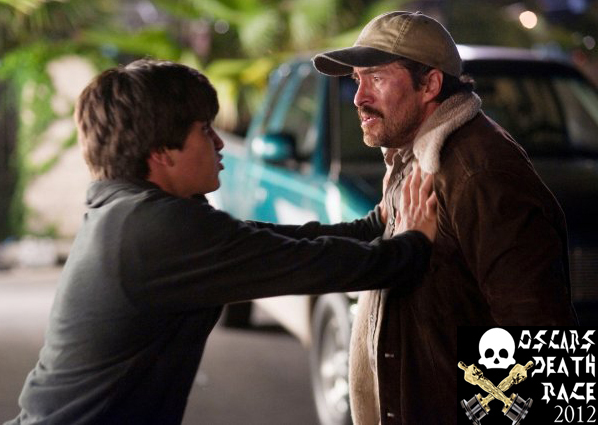

 But A Better Life doesn't do anything with Ruthie after that, really, and what it does do is disappointing and timid. The center of the story is Ruthie's boyfriend, Luis (José Julián) — or rather his father, Carlos (Damián Bichir), and his struggles to keep Luis in school and away from bad influences like Ruthie's Uncle Celo (the charismatically tattooed, and underused, Richard Cabral). Carlos can't do much, though, because he works all the time and Luis's mother is not around. But when Carlos borrows a whack of money from his sister to buy his friend's landscaping truck (and by extension the business), he lets himself begin to dream bigger for himself and Luis, about more money, a nicer apartment, a safer school. Maybe even his citizenship.

 Hello, and welcome to the Oscars Death Race. I'm Sarah D. Bunting, the head rodeo clown at Tomato Nation; the Oscars Death Race is pretty much what it sounds like, a quixotic attempt to watch every single nominee in the Academy-Awards categories that appear on the broadcast.
 Star Wars Uncut: Director's Cut
 Press Play Video Blog