OSCARS DEATH RACE: CHICO AND RITA

OSCARS DEATH RACE: CHICO AND RITA

null

[EDITOR'S NOTE: Fearless Sarah D. Bunting of Tomatonation.com is making it her mission to watch every single film nominated for an Oscar before the Academy Awards Ceremony on February 26, 2012. She is calling this journey her Oscars Death Race. For more on how the Oscars Death Race began, click here. And you can follow Sarah through this quixotic journey here.]

nullI wish I had seen what other reviewers did in Chico & Rita. The word "dazzling" keeps coming up, but I was not dazzled. …Well, not by the film, whose plot is the old "boy meets girl / girl gets in naked catfight with other girl / boy wins girl back / girl leaves for New York / boy gets deported" tale of star-crossed musicians in a bygone era.

The music is amazing, though, and Chico & Rita might have worked better without Chico and Rita, or at least without their overly adagio romantic ups and downs. Something more collagey, vignettes of '40s Cuba and the '50s jazz scene in New York, the various other bits and cross-sections the animation does well — the vintage fonts, and a sequence where Chico follows Rita's bus — that would work better for the true heart of the story, the music and the songs. Instead, it uses a traditional romantic arc it doesn't need, that isn't served very well by the characters as written; Chico is ineffectual, mostly, and the darker currents hinted at in Rita's offscreen existence never get explored, so she comes off as kind of a bitch. (The pair's voice acting, by Eman Xor Oña and Limara Meneses respectively, is fine.)

The soundtrack is great, the sound design is great; the animation is imperfect, but in an improvisational way that works for the subject matter. The love story and its attendant subplots merely pull focus and slow things down.

Sarah D. Bunting co-founded Television Without Pity.com, and has written for Seventeen, New York Magazine, MSNBC.com, Salon, Yahoo!, and others. She's the chief cook and bottle-washer at TomatoNation.comFor more on how the Oscars Death Race began, click here.

OSCARS DEATH RACE: W.E.

OSCARS DEATH RACE: W.E.

null[EDITOR'S NOTE: Fearless Sarah D. Bunting of Tomatonation.com is making it her mission to watch every single film nominated for an Oscar before the Academy Awards Ceremony on February 26, 2012. She is calling this journey her Oscars Death Race. For more on how the Oscars Death Race began, click here. And you can follow Sarah through this quixotic journey here.]

nullWhen a movie bombs, I like to go to Rotten Tomatoes, sort the reviews by "Rotten," and enjoy the show. Flops can bring out the best a critic (or her thesaurus) has to offer, the acidic synonyms and dismissive gut-punches she saves for when a movie is genuinely and thoroughly crap and not just misguided or inconsistent, and I like scorched-earth movie reviews for the wordsmithing — but also because I know that glorious tingle, that "I'm-a stomp this flat and make the deadline with two hours to spare" feeling.


W.E., drowning in the boot of a 13%-Fresh rating at present, isn't as hateful as I'd expected, but I still had fun scrolling down the reviews list, which is kind of like sighting down a line of golf pros at the driving range. "Relentlessly monotonous" — whock! "A pointless and pretentious oddity" — whock! "A sloppy, hubristic affair" — whock! "Vapid," "torpid," "abysmal" — whock whock whock!

nullThe movie is pretty to look at (the nomination is for Costume Design), but it has a Julie and Julia problem. Wally Winthrop (Abbie Cornish), unhappily married and underemployed in the present day, becomes obsessed with what she thinks of as the great love of King Edward and Wallis Simpson, and visits the Sotheby's auction of their effects every day. (She touches every goddamn item for sale, and later their love letters, without archival gloves or reproach from anyone. Just one of many minor errors that added up to a clueless script.) Her husband (Richard Coyle) is a twattily dismissive workaholic who later becomes abusive, and it's one of those straw-man bad film marriages in which you don't understand why these people even know each other. Coyle can't commit to the character — with good reason; the script gives him nothing but retrograde attitudes and Scotch-drinking to work with — while Cornish plays what she's given, a wan simp, rather too well.


The flashbacks work better, with fantastic set design, mouth-watering outfits, and a snappy performance by Andrea Riseborough as Wallis. The sequences in the past aren't good, quite; James D'Arcy as Edward is a bore, and it takes the film too long to get to the abdication. But it's better than the present-day material, in which the love of a blue-collar cutie (Oscar Isaac, very good in Drive and better than W.E. deserves) solves Wally's life.

nullThe script dodges a few key issues (Edward and Wallis's Nazi sympathies are waved off with a too-flip "just rumors, guvnor"-type scene) while lingering over others that don't merit it, like the ludicrous IVF subplot. Other moments land like a sackful of cowbells — Wallis bugging out to the Sex Pistols' "Pretty Vacant," for one. And of course the thoughtful, sweet, poetry-reading, piano-playing security guard has a $2 million loft in Williamsburg.


I sat there checking my watch and longing for other, better versions of W.E. — Guy Pearce playing his King's Speech version of Edward, a documentary about the famous couple, anything but yet another "poignant" close-up of Wally creepily sniffing another woman's table linens.

Madonna really knows how to shoot a $5,000 floor lamp, I'll give her that, but it's too long, it's tone-deaf…I basically paid $13.50 to watch a live-action catalog, and it's not even bad enough to merit an MST3K viewing.

Sarah D. Bunting co-founded Television Without Pity.com, and has written for Seventeen, New York Magazine, MSNBC.com, Salon, Yahoo!, and others. She's the chief cook and bottle-washer at TomatoNation.comFor more on how the Oscars Death Race began, click here.

OSCARS DEATH RACE: ADVENTURES OF TINTIN

OSCARS DEATH RACE: ADVENTURES OF TINTIN

null[EDITOR'S NOTE: Fearless Sarah D. Bunting of Tomatonation.com is making it her mission to watch every single film nominated for an Oscar before the Academy Awards Ceremony on February 26, 2012. She is calling this journey her Oscars Death Race. For more on how the Oscars Death Race began, click here. And you can follow Sarah through this quixotic journey here.]

nullNot to crap on two Steven Spielberg movies in a row here, because I do enjoy his work sometimes. Alas: enh. The Adventures of Tintin's failure to land with me isn't entirely on the director; the source material seems like something I'd have loved as a child, but isn't something I knew before coming to the film, so I didn't get any reunion-y feelings, and motion capture may appeal to some, but is still creepy to me.

But the pacing probably is Spielberg's responsibility, and the movie plods. Chase scene; interstitial bit with Thomson and Thompson that fails to delight; fight scene; Thomson and Thompson; chase/fight; nonsense with dog; "joke" about Captain Haddock's alcoholism that's awkward instead of funny; lather, rinse, repeat. The 3D does nothing to help the story, which involves a flea-market ship Tintin purchases and a treasure lost at sea and which contains no suspense — we've been told repeatedly from the very beginning of the film that Tintin is a genius investigator (though not shown much evidence of this; he repeats things a lot, and actually seems somewhat slow), and it's clear he'll solve the…or prevail over the…whatever. The score tries to add tension, but John Williams is recycling runs and trills from Indiana Jones and the Imperial March. No idea how that nabs Williams a second nom in the category, but at least it didn't make me yell "shut UP, timpani!" like the other one did.

I've never even read the comics and I have to think they're a better bet than this clatter-fest.

Sarah D. Bunting co-founded Television Without Pity.com, and has written for Seventeen, New York Magazine, MSNBC.com, Salon, Yahoo!, and others. She's the chief cook and bottle-washer at TomatoNation.comFor more on how the Oscars Death Race began, click here.

AARON ARADILLAS: 20 years later, a soundtrack that still has JUICE

AARON ARADILLAS: 20 years later, a soundtrack that still has JUICE

The first half of the 1990s may be considered by some as being ruled by grunge, but for more enlightened music fans that is simply not the case. Hip-hop and R&B, in particular the New Jack Swing sound of the early ‘90s, has had a profound impact in shaping pop music. Producers like Jimmy Jam & Terry Lewis and Teddy Riley modernized the rather quaint sound of R&B with funk rhythms, piano, jazz and break beats, while guys like Q-Tip of A Tribe Called Quest and The Bomb Squad gave hip-hop a fuller sound – a bass-thumping thickness. Rap and R&B, two genres that had been segregated by class prejudice and musical temperament, were now fused together to create an at once looser and tighter sound. Songs like Johnny Kemp’s "Just Got Paid" or Tony! Toni! Tone!’s "If I Had No Loot" or Michael Jackson’s "Remember the Time" or Schoolly D’s "Am I Black Enough For You?" or Naughty By Nature’s "O.P.P." made you feel as if you were inside the song – as if the greatest block party was boiled down to four minutes of grooves, beats and samples.

nullAt the same time, the New Black Wave in American movies was for the first time giving young black filmmakers the opportunity to tell stories of the contemporary black experience. Naturally, the soundtracks to most of these movies contained some of the most cutting-edge tracks around. Unlike the soundtracks to movies like Breakin’ or Krush Groove, which were dominated by the most adventurous rap acts around, the soundtracks to movies like House Party or New Jack City made room for R&B slow jams and new-funk dance tracks. With songs like Bobby Brown’s "We’re Back" from Ghostbusters II or Public Enemy’s anthemic "Fight the Power" from Do the Right Thing giving their respective soundtracks a jolt of energy, it was inevitable that a full-scale new-jack soundtrack would make its mark. 1990’s House Party was a good start, with Kid 'n Play kicking the party up a notch or two. Then, 1991 saw new jack soundtracks start to come into their own. The soundtrack for Mario Van Peebles' New Jack City featured memorable tracks by Ice-T ("New Jack Hustler"), Christopher Williams ("I’m Dreamin’"), Keith Sweat ("(There You Go) Tellin’ Me No Again") and Troop/LeVert’s interpretation of "For the Love of Money." (The soundtrack also featured the ridiculously sexual #1 hit "I Wanna Sex You Up" by Color Me Badd.) The soundtrack to John Singleton’s landmark directorial debut Boyz N the Hood added a West Coast seasoning with songs like Ice Cube’s "How To Survive In South Central" and Compton’s Most Wanted’s "Grownin’ Up in the Hood." Even Stevie Wonder got into the swing of things with his song score to Spike Lee’s interracial love story Jungle Fever. (If you think about it, albums like Stevie Wonder's Innervisions laid the foundation for the new-jack sound.)

Then, in 1992, a movie and soundtrack announced with authority the arrival of street-level hip-hop. Ernest Dickerson’s excitingly directed Juice was an up-to-the-minute morality play about the intoxicating power of guns. Shot on the street corners of Harlem, where the ritual of hanging on the corner with your friends is charged with the possibility of violence, Juice has an electrifying propulsive energy. So does the soundtrack.

Produced by Hank Shocklee of The Bomb Squad (the production crew behind Public Enemy’s collage of sound), the soundtrack highlights everything from hardcore hop-hop to mid-tempo new-jack grooves to playful girl crew anthems.

The opening track, Naughty By Nature’s "Uptown Anthem," is a piano-driven thumper highlighted by Treach’s scat-fast flow. They’re contrasted by Son of Bazerk’s "What Could Be Better Bitch," a hilarious boast about being the best rapper around.

Too $hort’s "So You Want to Be a Gangster" is a spare and stark warning against getting into "the life," while M.C. Pooh’s "Sex, Money & Murder" is a jaunty strut about not giving a fuck. The one weak track on the soundtrack is EPMD’s "It’s Going Down." Its cluttered soundscape obscures some terrific rhymes. Cypress Hill offers something better with "Shoot 'Em Up," a sinister creep of a song with B-Real’s trademark nasal flow. (Not included on the soundtrack, but featured in the movie, is Cypress Hill’s "How I Could Just Kill a Man," a song that is easily the equal of Johnny Cash’s "Folsom Prison Blues.")

On the R&B tip, Teddy Riley & Tammy Lucas’ "Is It Good to You" is an afternoon delight shoulder-shaker. Aaron Hall’s "Don’t Be Afraid" gets you in the right mood, while Rahiem’s "Does Your Man Know About Me" is a creamy background jam about a male lover’s paranoia over getting caught.

But the two most memorable tracks are Eric B & Rakim’s "Juice (Know the Ledge)" and Big Daddy Kane’s "Nuff Respect." Positioned as the theme song for the lead character Q (Omar Epps), a good kid who dreams of being a mixmaster DJ, "Juice" is a stunning New York anthem about hustling as a way of survival. From its tension-filled bass line to Eric B’s perfectly timed scratching to its multiple samples, "Juice" feels like the big-budget sequel to "Paid in Full." Even better, "Nuff Respect" showcases Big Daddy Kane’s breathtaking rapping as he easily keeps up with Shocklee’s and G-Wiz’s thumping production. The soundtrack to Juice is just about the most perfect sampler of early '90s hip-hop. It’s more than a blast from the past. It’s a look into the future.

San Antonio-based film critic Aaron Aradillas is a contributor to The House Next Door, a contributor to Moving Image Source, and the host of “Back at Midnight,” an Internet radio program about film and television.

OSCARS DEATH RACE: WAR HORSE

OSCARS DEATH RACE: WAR HORSE

null[EDITOR'S NOTE: Fearless Sarah D. Bunting of Tomatonation.com is making it her mission to watch every single film nominated for an Oscar before the Academy Awards Ceremony on February 26, 2012. She is calling this journey her Oscars Death Race. For more on how the Oscars Death Race began, click here. And you can follow Sarah through this quixotic journey here.]

nullIn his review of War Horse for IFC.com, Matt Singer noted that "I did like one scene which is complete enough as its own unit of story and character that it could be pulled out of the film and played as its own short subject." The scene, of course, is the one in which said horse, Joey, makes a gallop for freedom but becomes hopelessly entangled in the barbed wire that separates the British and German lines. A soldier from each side comes out to aid Joey; for a moment, the Great War pauses to admit compassion — and Steven Spielberg pauses to work small.

I wish Spielberg had made a short subject, or even a trim feature, of that central moment, as it's free of everything that frustrated me about War Horse in its entirety: the insistent soundtrack that shoves us to and fro with plaintive piccolos and blatting-brass "hilarity"; the cartoonish attempts to show Joey (who is, after all, played…by a horse, and only expressive in certain ways) bonding with other horses and showing great heart and willing himself to escape and blah blah courage blah; the redundant exposition about Joey's many fine and remarkable qualities; the Saving Private Neighin' set pieces that strain to point up the horrors of war. The bit does contain continental characters speaking accented English instead of their native tongues, but that has a purpose here, at least, and isn't as Alcottsy and deadly dull as the Emilie sequence. (Or as poorly done. Top Secret! had better French accents.)

nullThe plot, in brief: Joey is bought at auction by drunk seldom-do-well Ted Narracott (Peter Mullan, too broad) to show up his rich landlord. Joey's not a plowhorse, he's a Thoroughbred, but Ted's son Albert (the promising Jeremy Irvine) bonds with Joey immediately, and swears he can break the colt to plow and get the rocky field tilled by the deadline. After this Rocky-of-the-shire moment, Joey is basically drafted into the British army — but by an officer who appreciates the special hoof-flake and promises Albert he'll get Joey home safe. Joey befriends another horse, Topthorne; escapes from various warlike tasks; gets caught in wire; and…cures the blind? Just go with it.

I rode horses as a girl, and worked as a stablehand in high school (the horse I had charge of was a goofy little blood bay named Indiana Jones, in fact) — I wanted to like War Horse, and I went into it prepared to write off the schmaltz and soaring strings that so often go with horse movies. But it's just too long, with too many breaks for Bazooka-Joe "humor" and sick-child moralizing. I gasped at the beauty of several of the shots or sequences, like the cavalry mounting up in the tall grass, and the expert editing of the cuts between the oncoming charge and the merciless gunners getting hurdled by riderless horses; that bit in particular would have gutted me in the fourth grade.

But this isn't the fourth grade; we know Spielberg can "do this." He does it here and he does it well, but the real accomplishment from the man at this point would be resisting the urge to hold our hands every minute, or setting himself the challenge of getting it in under 110 minutes on the first cut. Hell, re-cut this one — and boot that flatulent over-closed ending. I know many other reviews have mentioned the Gone with the Wind Technicolor skies, but: seriously! It's so over the top, you almost think he's joking! But it's Spielberg; he doesn't joke.

…Except in that barbed-wire sequence, which has a lightness to the banter, and gets at the message Spielberg is trying to send almost accidentally. The horror of war isn't always the barrage; sometimes it's the silences between, as in that scene with "enemies" working together and knowing the moment must end. The scene asks little of the horse except that he remain still, a symbol (which is how they work in our culture anyway, often), and subtracts the relationship with Albert, which starts out with a naïve sweetness but soon begins to seem rather weird. It doesn't show off. There isn't a cello. It's just a little story.

War Horse is handsome to look at; like Star Wars III, I'd have liked it more with my iPod in and some Handel playing. You want a real horse tearjerker, watch yourself some Phar Lap. You'll need IV fluids by the end.

This film's Oscar chances read to me as slim; the nominations may have been a gesture of respect, but it's not tapped for Best Director, so who knows. The score is diabetic and should not win; the cinematography could, and I would not hate that victory, but I wouldn't pick it.

Sarah D. Bunting co-founded Television Without Pity.com, and has written for Seventeen, New York Magazine, MSNBC.com, Salon, Yahoo!, and others. She's the chief cook and bottle-washer at TomatoNation.comFor more on how the Oscars Death Race began, click here.

OSCARS DEATH RACE: EXTREMELY LOUD AND INCREDIBLY CLOSE

OSCARS DEATH RACE: EXTREMELY LOUD AND INCREDIBLY CLOSE

null

Oskar Schell (Thomas Horn) lost his father, Thomas (Tom Hanks), on 9/11. About a year later, Oskar finds what he thinks is a message meant for himself in his father's closet: an envelope with the word "Black" written on it, and a key inside. Inspired by the memory of the myth-burnished scavenger hunts his father used to devise for him — both as a bonding agent between them and a way for Oskar to confront his phobias — Oskar decides that "Black" is the name of someone who knew Thomas, and sets out to find that someone. No matter that there are 472 of them in the New York City phone book, or that this won't change anything; he thinks it's what his father meant him to do.

nullIt's the type of Rube Goldberg plot I usually dig, and would have really dug at Oskar's age; at Oskar's age, I also cherished a number of compulsions and superstitions about deaths in the family and how they might be warded off or, after the fact, solved for X. Extremely Loud and Incredibly Close has the tools to become a movie I would love.

I did not love it. I did not love that the so-called revelation about Schell Sr.'s farewell answering-machine messages "revealed" nothing and hinged on an idiot plot — that Oskar's mother Linda (Sandra Bullock) wouldn't run straight to the machine, or check it after asking whether Thomas called, or notice that the answering machine had disappeared, is ridiculous. I did not love Horn's performance; it is a difficult role, I realize, but what is meant as realistic "spectrum behavior" seems mostly like an inexperienced actor tasked with a gamut of emotions and nuances he's not ready for. (His scenes with Viola Davis emphasize this.) I did not love the tics substituted for traits, or how the film idealizes Thomas to an unrelatable degree while really telling us nothing about him.

The film is a smug, twee gallery audio tour of a family's and a city's grief. Put on the headphones provided; proceed to the first image; listen to the facts we have selected for you. When you hear the ping, move to the next dot on the floor. At the conclusion of the tour, which will linger fetishistically on some things and rush past others that fail to resolve neatly, you will receive a complimentary tote bag. We ask that guests avert their eyes from the loose ends. Thank you for visiting the Closure Museum.

nullIt's not the pimping of 9/11 that makes EL&IC so off-putting. It's the tying of the handmade-art-project bow around Oskar's mourning — there's another bereft son out there! Mommy understands me! All better now! As overused and itchy a term as closure has become, it is the entire purpose of fictional narrative to impose order on chaos, and to bestow closure or peace on a child when perhaps we can't in life is of course enormously appealing. But the film doesn't trust its own hero. It has to tell us constantly how special and determined and pitiable Oskar is, cut in footage of him ranting uncontrollably (or another variation on Linda, hand clasped over her mouth, weeping silently through the twinkle of her engagement setting), team him up with a "mysterious" boarder at his grandma's house who speaks in notes and YES/NO tattoos on its hands, or, failing all of that, another shot of the Towers going down, like, for the love of beer and skittles! If you want me to cry, pluck one of my eyelashes and save yourself some time, but if you want an Oscar for the privilege, how about you not act like we're all too goddamn stupid to comprehend, or scale, a tragedy without the aid of a jingling tambourine? It's manipulative and condescending, and whether it's the book or the script, I resent it. Not every boy on a journey is Odysseus, or even Luke Skywalker, but Oskar only has to be the boy the story cares about, and he isn't. He's a tool for drawing parallels and jerking tears. Contempt for my perception duly noted, and returned in kind.

Max von Sydow does a wonderful job pretending that his character isn't a gimmick — if it's not the face he pulls in response to "Are you a stranger, technically?" that got him the nomination, it's the one he makes when he's awakened by a juice-box straw — but the man played chess with Death, for God's sake. Write the part with half an inch of depth.

Sarah D. Bunting co-founded Television Without Pity.com, and has written for Seventeen, New York Magazine, MSNBC.com, Salon, Yahoo!, and others. She's the chief cook and bottle-washer at TomatoNation.comFor more on how the Oscars Death Race began, click here.

TONY DAYOUB: The many faces of George Smiley

TONY DAYOUB: The many faces of George Smiley

nullThough Gary Oldman came up empty at the BAFTAs this past weekend, he still stands a chance of being recognized at this year's Academy Awards for his career-best turn as graying spymaster George Smiley in Tomas Alfredson’s Tinker Tailor Soldier Spy. This is Oldman's first nomination, and to my mind the most deserving of any of the performances cited in the Best Actor category this year. For Oldman – usually a kinetic and, at times, even bombastic performer – the role offered the challenge of playing a man accustomed to fading into the background. Projecting a face so passive it could almost be labeled a mask, Oldman allows a glimpse into Smiley’s inner life through his aqueous eyes, which betray volatility more in line with the rest of the actor’s notable roles.

Tinker Tailor Soldier Spy is about a Secret Service in which aging lonely spies fight for dominance in the landscape of the Cold War, a field of battle over which they long ago chose to sacrifice any kind of private lives. Oldman’s Smiley is, then, a perfect distillation of director Tomas Alfredson’s rethink of John le Carré’s 1974 novel. But Oldman is following in the footsteps of many famed British actors who’ve assayed the role. Sir Alec Guinness’ depiction of Smiley is the most well-known, but there were others.

  • Rupert Davies – The Spy Who Came In from the Cold (1965, Directed by Martin Ritt) –

Book excerpt:

nullShe thought they were a little too smart for policemen: they came in a small black car with an aerial on it. One was short and rather plump. He had glasses and wore odd, expensive clothes; he was a kindly, worried little man and Liz trusted him somehow without knowing why… As he got to the door, the elder man hesitated, then took a card from his wallet and put it on the table, gingerly, as if it might make a noise. Liz thought he was a very shy little man.
– John le Carré, The Spy Who Came In from the Cold, 1963


In this acclaimed thriller, based on Le Carré’s third novel, movie audiences first met Smiley, and only briefly. As played by Rupert Davies (The Witchfinder General), he comes closest to the way he was originally envisioned by the author and former spy. Though Smiley was the writer’s protagonist and alter ego in his first two, less successful novels, he took a different tack with this one. Focusing on Alec Leamas — a “scalphunter,” or field agent — Le Carré was able to benefit from some of the ’60s era ardor for the superspy generated by the 007 films, making the grittier, more realistic The Spy Who Came In from the Cold his first bestseller. Commensurate with Le Carré’s intentions at that point of his bibliography, the film relegates Smiley to a small supporting role as the undercover Leamas’s secret contact with the “Circus,” the British Secret Service. Disheveled, unremarkable, with a mustache and thick spectacles, Davies’ Smiley appears onscreen for maybe five minutes, but his role is pivotal. He welcomes Leamas (Richard Burton) to his Chelsea apartment (already familiar to readers of the earlier books), facilitating a secret rendezvous with their chief, the mysterious Control (Cyril Cusack). And in a scene depicting the character’s warm-hearted benevolence, Smiley visits Leamas’s lover, Nan (Claire Bloom), in order to investigate his whereabouts after losing contact with him. Or, as the ill-fated ending for Leamas and Nan suggests, maybe the cagey Smiley was actually putting Control’s larger plan into motion.
 

  • James Mason – The Deadly Affair (1966, directed by Sidney Lumet) –

null

Book excerpt:

When Lady Ann Sercomb married George Smiley towards the end of the war she described him to her astonished Mayfair friends as breathtakingly ordinary. When she left him two years later in favour of a Cuban motor racing driver, she announced enigmatically that if she hadn’t left him then, she never could have done; and Viscount Sawley made a special journey to his club to observe that the cat was out of the bag.


This remark which enjoyed a brief season as a mot, can only be understood by those who knew Smiley. Short, fat, and of a quiet disposition, he appeared to spend a lot of money on really bad clothes, which hung about his squat frame like skin on a shrunken toad. Sawley, in fact, declared at the wedding that “Sercomb was mated to a bullfrog in a sou’wester.” And Smiley, unaware of this description, had waddled down the aisle in search of the kiss that would turn him into a Prince.
– John le Carré, Call for the Dead, 1961


With those words, Le Carré introduced readers to his alter ego in his very first novel, in a chapter entitled ‘A Brief History of George Smiley.’ Lumet cast James Mason (Bigger Than Life) as Charles Dobbs, née George Smiley, a name tied whose rights were tied up with Paramount Pictures, the studio behind The Spy Who Came In from the Cold. As one would expect, the dashing Mason’s portrayal is quite a departure from the fat, cuckolded functionary of the novel. Perhaps that is one of the reasons screenwriter Paul Dehn – who had so faithfully adhered to Le Carré’s book when scripting the Ritt film – felt free to turn in one of the least faithful adaptations of Le Carré’s novels. Dobbs’ inner torment concerning his wife’s infidelities, never explicitly depicted in Call for the Dead, is externalized by Dehn. Ann – in the novel an absent memory that haunts Smiley throughout his investigation into the murder of a Foreign Office bureaucrat – is given form in the film by a very sexy Harriet Andersson (Smiles of a Summer Night). And for good reason.

Lumet’s film raises the stakes for Dobbs a lot higher than Le Carré did for Smiley in his maiden writing effort. In The Deadly Affair, Ann conducts an affair with Dieter Frey (Maximilian Schell), introduced early in the film as a former protégé of Dobbs. By contrast, Frey is free of such entanglements in Le Carré’s novel; readers don’t even know of Frey or his history with Smiley until the novel’s final chapters, in which the author reveals him as the spymaster’s nemesis. Dehn’s inspired reworking of the story doubtless influenced Le Carré when writing Tinker, Tailor, Soldier, Spy a few years after. This particular plot element of a double-agent betraying Dobbs/Smiley by attacking him his weak point, his wife, is a crucial story point in that book.

  • Alec Guinness Tinker Tailor Soldier Spy (1979, directed by John Irvin) and Smiley’s People (1982, directed by Simon Langton) –

null

Book excerpt:

…for each house three cars jammed the curb. From long habit, Smiley passed these in review, checking which were familiar, which were not; of the unfamiliar, which had aerials and extra mirrors, which were the closed vans that watchers like. Partly he did this as a test of memory to preserve his mind from the atrophy of retirement, just as on other days he learnt the names of the shops along his bus route to the British museum; just as he knew how many stairs there were to each flight of his own house and which way each of the twelve doors opened.


But Smiley had a second reason, which was fear, the secret fear that follows every professional to his grave. Namely, that one day, out of a past so complex that he himself could not remember all the enemies he might have made, one of them would find him and demand the reckoning.
– John le Carré, Tinker Tailor Soldier Spy, 1974


The iconic George Smiley performance – the one Oldman claims he didn’t see to prepare for his own portrayal – is that of Alec Guinness in these two BBC television productions. Guinness is so spot-on that Le Carré stated (in a 2002 interview included on the disc) that he could no longer imagine anyone but Guinness when thinking of Smiley, and that this limited his ability to write the character. (Indeed, Smiley would not appear in any of the author’s subsequent novels until making his final appearance in 1990’s The Secret Pilgrim.) In the first six-episode series, Guinness eschews any residual actor’s vanity to play a world-weary spy. Smiley is shelved for his unwillingness to play office politics in order to stay in the good graces of four incompetents who maneuver themselves into positions of power over the Circus. Though not at all physically imposing, Guinness brings a still quality to his performance that accentuates Smiley’s bespectacled, owl-eyed wisdom. Sticking closely to Le Carré’s novel – one of his most sprawling, and the fifth to feature Smiley – the miniseries adds another layer of complexity by addressing the decline of Smiley’s marriage and the degeneration of the British Secret Service’s influence on the world, and tying it both in with the decay of the British empire.

The second six-episode series Smiley’s People suffers from a confusing script rewritten by Le Carré himself, but that doesn’t stop Guinness from continuing to fine-tune his rendition of Smiley. By the time this sequel was shot, Guinness had melded with the character, absorbing the prop of Smiley’s wide glasses into the iconography of the role. Smiley, a virtual nobody to the new generation of agents in charge at the Circus, throws himself headlong (and alone) into a gambit to capture his arch-enemy, Soviet agent Karla (Patrick Stewart). Smiley – at once out of place and yet ordinary enough to be overlooked in any setting – is placed in such incongruous locales as the English countryside, Paris, and even a Hamburg sex club. Making sense of the labyrinthine plot (which confounded some viewers of the new version of Tinker Tailor) is ultimately of less importance than is the pleasure of seeing a master actor achieve symbiosis with one of the most significant characters in his filmography.
 

  • Denholm Elliot – A Murder of Quality (1991, directed by Gavin Millar) –

null

Book excerpt:

Obscurity was his nature, as well as his profession. The byways of espionage are not populated by the brash and colourful adventurers of fiction. A man who, like Smiley, has lived and worked for years among his country’s enemies learns only one prayer: that he may never, never be noticed. Assimilation is his highest aim, he learns to love the crowds who pass him in the street without a glance; he clings to them for his anonymity and his safety. His fear makes him servile…
– John le Carré, A Murder of Quality, 1962

More of a curiosity than required viewing, Millar’s film casts Smiley as a Jessica Fletcher-like amateur sleuth solving a murder mystery in a town built around a tony boy’s prep school. Le Carré wrote the screenplay himself, based on his second novel. Though, having painted himself into a corner with Smiley’s decision to leave the Secret Service in Call for the Dead, the author turned to his former occupation as a schoolmaster for inspiration. Denholm Elliot (Raiders of the Lost Ark) makes for a pretty bland Smiley, showing little of the wit that he possesses in other roles. But this is likely a result of a combination of circumstances; one being Smiley’s literary infancy in its thin source novel, and the other being the book’s atypical setting in a world that offers little opportunity for that character to display his obvious virtues. A Murder of Quality plays exactly like what it looks like, a middlebrow Masterpiece Mystery, albeit one featuring notable actors such as Joss Ackland, Christian Bale and Glenda Jackson.

Atlanta-based freelance writer Tony Dayoub writes about film and television for his blog, Cinema Viewfinder, and reviews DVDs and Blu-rays for Nomad Editions: Wide Screen, a digital weekly. His criticism has also been featured in Slant’s The House Next Door blog, Opposing Views and Blogcritics.org. Follow him on Twitter.

OSCARS DEATH RACE: PUSS IN BOOTS

OSCARS DEATH RACE: PUSS IN BOOTS

null

[EDITOR'S NOTE: Fearless Sarah D. Bunting of Tomatonation.com is making it her mission to watch every single film nominated for an Oscar before the Academy Awards Ceremony on February 26, 2012. She is calling this journey her Oscars Death Race. For more on how the Oscars Death Race began, click here. And you can follow Sarah through this quixotic journey here.]

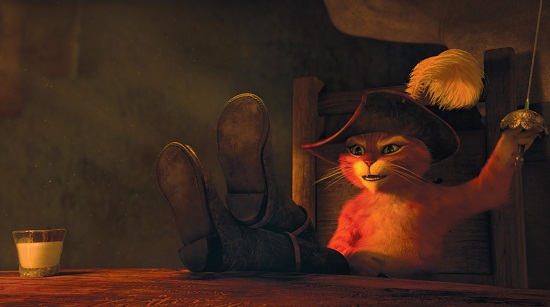
I bailed on the Shrek franchise after the first movie; I didn't really like it and I didn't need any more of it. So, either I forgot or never knew that the titular puss in Puss In Boots is a character from the second Shrek installment, which probably let me enjoy the story and the jokes without any expectations to live up (or down) to.

nullAnd for the first hour, I did enjoy said story. It's a similar fairytale/Zelig kind of a thing, with Puss (Antonio Banderas) teamed with Kitty Softpaws (Salma Hayek) and Humpty Dumpty (Zach Galifianakis), his former bestie and current nemesis, for one-last-heist/clearing-of-good-name fun times. The animation has an uncanny-valley issue or two vis-à-vis the felines having human teeth etc., but for the first half-hour, things move too fast for that to register, and the humor is rimshotty (Puss's thunderous "the egg betrayed me!" punctuated by Kitty snoring; the talking-to-plants crack that sets off the giant beanstalk) but enjoyable. Humpty is very funny, not least in his heel turn towards the end, and that "I was always there" montage cracked me up (as did his outfits, and I would like to thank the animation team, or whomever, for understand that, if you anthromorphize an object, you must then put some pants on it/him).

But the clever asides about catnip (Puss is using it "for his glaucoma") and the exciting free fall with the leaf parachutes go off the boil about halfway through. It's like the writers — and there are six credited, so go figure — didn't know how to end it. The result feels like each of the six wrote a climactic scene; all of those scenes stayed in; and then, after the last one, the story just kind of bah-dum-bummed offstage all, "Okay, my ride's here, so…see you guys at the sequel, 'kay?" Well, you killed off the best character in it, so: pass.

I giggled several times. It's fine. It won't win its category.

Sarah D. Bunting co-founded Television Without Pity.com, and has written for Seventeen, New York Magazine, MSNBC.com, Salon, Yahoo!, and others. She's the chief cook and bottle-washer at TomatoNation.comFor more on how the Oscars Death Race began, click here.

OSCARS DEATH RACE: Surveying the race for Best Documentary

OSCARS DEATH RACE: Surveying the race for Best Documentary

null

[EDITOR'S NOTE: Sarah D. Bunting of Tomatonation.com is watching every single film nominated for an Oscar before the Academy Awards Ceremony on February 26, 2012. She is calling this journey her Oscars Death Race. She has completed the category for Best Documentary and now surveys the competition. For more on how the Oscars Death Race began, click here. And you can follow Sarah through this quixotic journey here.]

nullAh, Best Doc — where the short list gets the finger-pointing and pearl-clutching underway early. I like to imagine Steve James watching the Oscars at home with a bottle of Goldschlager and a Krazy Straw, wearing PJs with basketballs on them, because as you probably heard, he didn't get nominated. (Again.) Let's look at what did.

The nominees

Hell and Back Again: Compelling traditional-structure doc with a likeable subject whose sound-editing tricksiness could work either for or against it. Topicality of subject matter may give it a slight edge.

If a Tree Falls: A Story of the Earth Liberation Front: Also compelling and topical, also straight-ahead in structure; very well done and informative

Paradise Lost 3: Purgatory: I think very highly of the filmmakers' previous two works on the subject of the West Memphis 3, whose release I supported. Attending a New York premiere of the film with the WM3 present was a thrill. With that said, the film qua film is rushed and collage-y, and I'm not sure viewers not familiar with the case and/or the other films would get much from it. The ending changed on the filmmakers, and they did well with that circumstance, but in theory, the Oscar rewards the best in the category, not the happiest ending. In practice…this probably wins.

Pina: …Unless this wins. I think it's between PL3 and Pina; the latter has the edge in its use of technology, and it pushes the form harder. It may also push the audience…into a nap? It won me over, but this may not be a film Academy voters will force themselves to see.

Undefeated: Entertaining enough for an hour and a half, and another charismatic subject, but may seem somewhat familiar or not "issues-y" enough to voters.

Who shouldn't be here: May not be the right question. It's more of an apples-and-oranges issue, and we have three apples (the more traditional docs) and an orange (a doc that's more of a recap, tied to a news event) and…a kiwi, in a way (dance experiment/elegy), so it's not that the apples in question don't rate; it's which fruit the Academy is in the mood for. See below.

Who should be here, but isn't: Like the apples metaphor? …Too bad, we're stuck with it. So: as apples go, I think The Interrupters (airing this week on Frontline, I believe) and Project Nim are a little tastier than Undefeated. Conan O'Brien Can't Stop did some interesting things, in spite of pacing issues and O'Brien presenting as rather off-putting.

Who should win: Pina.

Who will win: The WM3 is a tough arc to resist, but I'm calling it for Wenders and Ringel.

Sarah D. Bunting co-founded Television Without Pity.com, and has written for Seventeen, New York Magazine, MSNBC.com, Salon, Yahoo!, and others. She's the chief cook and bottle-washer at TomatoNation.comFor more on how the Oscars Death Race began, click here.

OSCARS DEATH RACE: Pina

OSCARS DEATH RACE: Pina

null

[EDITOR'S NOTE: Fearless Sarah D. Bunting of Tomatonation.com is making it her mission to watch every single film nominated for an Oscar before the Academy Awards Ceremony on February 26, 2012. She is calling this journey her Oscars Death Race. For more on how the Oscars Death Race began, click here. And you can follow Sarah through this quixotic journey here.]
Pina made me impatient for at least an hour. A small part of it is seeing the film at BAM, where arriving at the specified showtime is considered entirely optional and in fact rather bourgeois, but whispering knowingly throughout the film is considered mandatory. A much larger part of it is the medium of dance; I respect it, and especially its physical demands, but it's…not my way, I guess. My response to "some situations have no words" is not "express the situation via the body." It's "get a thesaurus and try again."

nullAnd another large part of it is co-director Wim Wenders, who, in my experience, is more than happy to wait out the whiny-squirmy "get to the point, just tell me what's important, this is boring" viewer — which is my way — and let the images and moments accumulate. You don't so much get to the point as realize that it's surrounded you since the beginning. I don't know Wenders's work all that well, actually; this is just my impression, and it's certainly the case with Pina, a 3D documentary that's a dance concert movie, and an experiment with re-setting dance out into the world, and a working-through of loss by a dance company whose forceful and incisive leader has died. (Pina is Pina Bausch, artistic director of Tanztheater Wuppertal Pina Bausch; she passed away just days before principal shooting was to begin.)

The decision to shoot in 3D is understandable, but I don't know that it's necessary to the film's power. Some of the choreography is, in my opinion, overly obvious and earnest, and the grand plié denoting childbirth or the "I am floppy with grief" sequences aren't any fresher for seeming to happen in your lap. But the depth of field in the staging brings out a lot of cool visuals: dancers flashing through the foreground, water spinning outwards, men appearing as if from nowhere or out of a giant rock.

Still, the recurring themes of compulsion, inspection, the rearranging of the self don't require the eyes in order to have their effect. The pain and joy of the reverent interstitials, then reflected in dances on trams and in intersections and along hilltops, don't require glasses. The moment where a man curls up, sad, relieved, drained, at rest, on a woman's flat back as she walks is the moment where I realized I'd been there all along.

Absolutely not for everyone, Pina, but it's one of those movies I thank the Death Race for each year because it's knocked me a couple degrees to one side.

Sarah D. Bunting co-founded Television Without Pity.com, and has written for Seventeen, New York Magazine, MSNBC.com, Salon, Yahoo!, and others. She's the chief cook and bottle-washer at TomatoNation.comFor more on how the Oscars Death Race began, click here.